Tag: Conversion Rate

  • How Dark Themes Outperformed in Our B2B Landing Page Test

    How Dark Themes Outperformed in Our B2B Landing Page Test

    I have to admit, I was surprised when our dark-themed landing page outperformed the light one.

    Everything I believed about conversion optimization suggested the light background would dominate.

    Light themes are generally the norm for B2B lead generation due to their readability and clean look, aligning perfectly with accessibility standards.

    Unbounce’s study of 41,000 landing pages backs up this trend for light backgrounds. Betting on the light theme seemed like a safe decision.

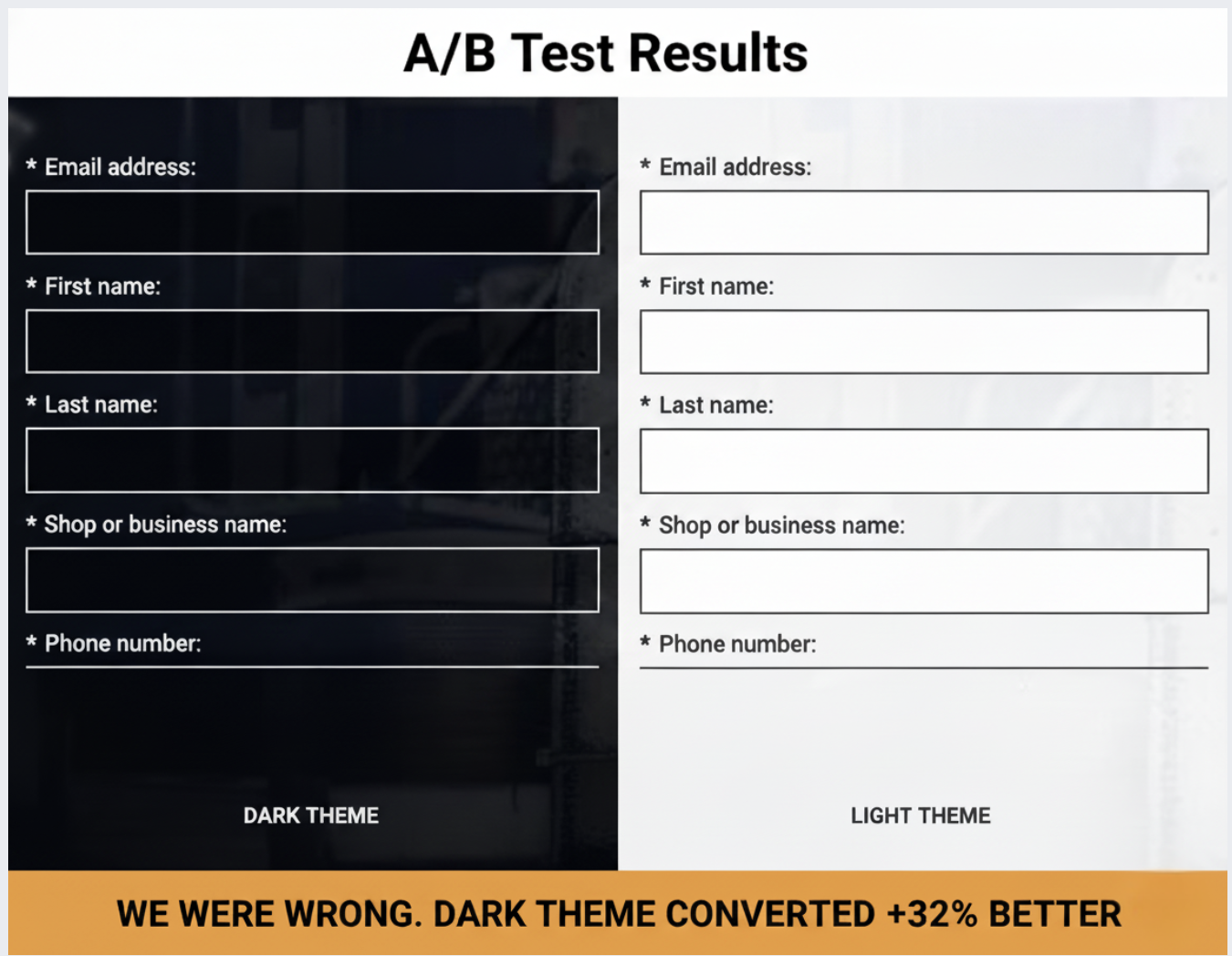
    However, after dividing our paid traffic equally between a dark and a light landing page for our industrial fleet repair SaaS, despite a 16.62% higher CTR for the light variant, it resulted in 42% fewer conversions.

    This isn’t a call for adopting dark themes universally.

    Rather, it’s a case study showing how audience context and industry-specific associations can outweigh best practices drawn from broader samples.

    We cater to a niche in the B2B SaaS market, particularly serving the transportation industry—businesses maintaining commercial vehicles and equipment.

    Our intended audience includes shop owners and operators engaged in industrial settings, managing technicians, equipment, and demanding commercial clients.

    Going into this test, my expectations were clear.

    I anticipated light backgrounds would be more effective for our text-heavy lead generation pages, given their emphasis on whitespace and visual hierarchy. Our 7-field form aimed at busy shop operators seemed poised for success with light mode.

    I also assumed blue CTAs would yield better results, with blue being associated with trust and security crucial for B2B software purchases. Thus, we used a blue CTA button.

    I was incorrect on both fronts.

    We conducted this test by isolating the visual design, directing traffic through Google Ads and Meta to two vastly different landing pages with identical copy.

    The control page sported a dark theme with a black background, white text, high-contrast form fields, and a subtly outlined black CTA button. The header lacked a brand logo, intensifying the focus on the content.

    Conversely, the treatment page featured a light theme, employing white and light gray elements, dark text, and a blue CTA button. Here, our brand logo was prominently placed in the header.

    All other variables remained the same, emphasizing the importance of isolating design as the sole differentiating factor.

    This test spanned three to four weeks, with Google Ads search campaigns topping $8,205.97, yielding 767 clicks and 30 conversions.

    The light theme’s seemingly advantageous CTR masked the truth—it attracted less qualified traffic, converting at a similar or worse rate than expected.

    A consistent preference for the dark theme also emerged in Meta tests, reinforcing the role of audience preference rather than algorithmic anomaly.

    Understanding why the dark theme won lies in recognizing how it aligns with the psychological and environmental cues of our target audience in the industrial sector.

    The dark theme resonated well with the familiarity of industrial aesthetics—functional, robust environments characterized by dark, metallic tones.

    The contrast provided by white form fields on a dark background was unmistakable, drawing eye attention naturally.

    Dark themes carry a tone of seriousness and value, fitting for the weighty decision-making expected in B2B software acquisitions.

    Moreover, embracing familiar industry conventions, the dark interface enhanced trustworthiness and familiarity.

    This test taught me that testing design psychology is just as crucial as testing visual elements themselves. Before embarking on similar experiments, consider what your design communicates to your audience rather than just aesthetic appeal.

    Finally, ensure your experiments include significant contrast between variations while keeping other elements constant to draw accurate conclusions.

    Audience context should guide optimization efforts more than generalized best practices. By focusing on specific audience needs and signals, I’ve learned that real, lasting optimization success can be achieved.


    Inspired by this post on Search Engine Land.


    crushpress.ai community screenshot
  • Master Ecommerce PPC: Boost Campaign Performance

    Master Ecommerce PPC: Boost Campaign Performance

    I’ve delved deep into four key areas that shape how ecommerce PPC campaigns perform: mastering the essentials of Performance Max, leveraging Amazon’s conversion power, building social audiences, and crafting insightful dashboards.

    PPC in ecommerce differs vastly from PPC for lead generation or SaaS. The mechanics of campaigns, the conversion data volume, and each platform’s unique role demand a specialized approach.

    Entering the ecommerce realm helped me identify which fundamentals truly matter. Let’s look at how the core differences between ecommerce and non-ecommerce models influence PPC strategy and how to play to each platform’s strengths.

    1. Performance Max is Built for Ecommerce

    Google Ads is essential for ecommerce, primarily because of Performance Max campaigns, or PMax. It’s tailored for ecommerce, where data flows from high sales volumes and lower ticket sizes, allowing rapid learning and improvement.

    To maximize PMax’s potential, optimizing your feed, segmenting your campaigns, and ensuring conversion tracking are crucial steps.

    ```json
{
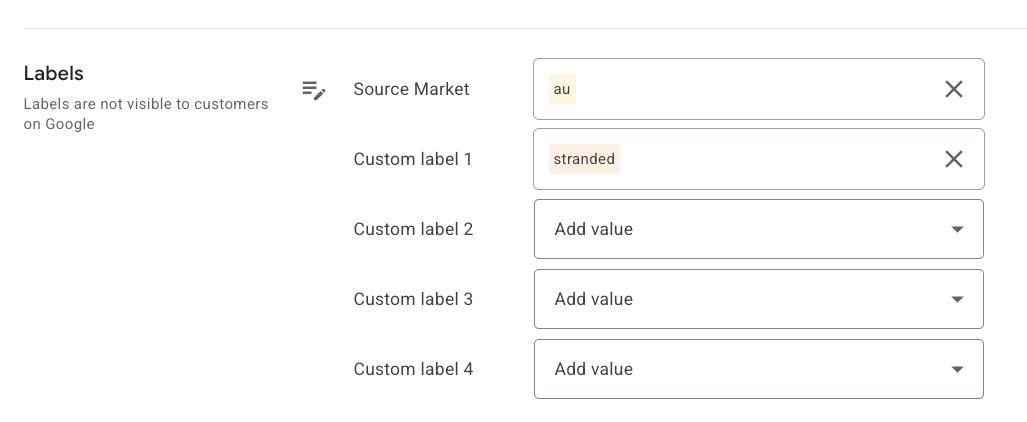
  "alt": "Interface showing Google Ads labels with 'Source Market' and 'Custom labels'.",
  "caption": "A glimpse into organizing data with Google Ads labels—where Source Market and Custom labels streamline categorization.",
  "description": "The image displays the 'Labels' section of Google's interface, featuring 'Source Market' with a label 'au' and 'Custom label 1' marked 'stranded'. Other custom labels are yet to be filled, providing a flexible setup for organizing and filtering data within Google Ads. These labels assist in categorizing and managing marketing campaigns more effectively."
}
```

    Feed Optimization

    Optimizing your feed can dramatically enhance PMax performance. Ensure your product titles and descriptions are well-structured, utilize character limits, and incorporate keywords effectively.

    Campaign Segmentation

    By categorizing your feeds effectively, you can segment campaigns for better results. Utilize default and custom labels in Google Merchant Center to achieve precise targeting and higher ROAS.

    Conversion Tracking

    Accurate conversion tracking is critical. Integrating with tools like Shopify to sync data with Google Ads enables automated bidding strategies and campaign experiments for enhanced ROI.

    2. Amazon Excels in Ecommerce Advertising

    Amazon is an advertising powerhouse for ecommerce, offering transparency and deeper insights through its platform, which results in higher conversion rates compared to competitors.

    ```json
{
  "alt": "A table displaying search query data with metrics like volume, impressions, and clicks.",
  "caption": "Dive into detailed search query metrics—explore volume, impressions, click through rates, and brand shares to fine-tune your strategy.",
  "description": "The image presents a detailed table of search query analytics divided into columns such as Search Query Score, Volume, and two funnels: Impressions and Clicks. Each funnel includes Total Count, Brand Count, and Brand Share with respective numerical values. This visualization offers insights into online search performances, crucial for data-driven marketing strategies, and highlights metrics like click-through rates. Ideal for SEO analysis and performance optimization."
}
```

    Transparency

    Amazon provides detailed reporting, enabling clear insights into conversion performance at both the keyword and market level, setting it apart from platforms like Google and Meta.

    Higher Conversion Rates

    Amazon’s unified platform leads to seamless transactions, resulting in higher average conversion rates and more reliable attribution data, minimizing guesswork.

    Rankings Philosophy

    Amazon’s approach to linking ads and organic rankings provides clarity and allows advertisers to precisely strategize on improving offers and performance based on conversion metrics.

    3. Social Media: Not the Conversion Leader

    While social platforms are crucial for brand awareness and audience building, they typically aren’t optimal for direct conversions, making them secondary to platforms like Amazon Ads and PMax.

    ```json
{
  "alt": "Table showing search funnel data for cart adds and purchases including total count, rates, brand counts, shares, and shipping speed.",
  "caption": "Unveiling e-commerce insights: A table showcasing the search funnel metrics from cart adds to purchases, revealing customer behavior patterns and brand impact.",
  "description": "This image displays a detailed table of e-commerce search funnel data, illustrating metrics from cart adds to purchases. Columns include Total Count, Cart Add Rate, Brand Count, Brand Share, and Same Day Shipping Speed for both stages. This data helps in understanding user interaction and conversion through the sales funnel, highlighting conversion rates and brand influence in online shopping. Keywords: e-commerce, customer behavior, sales funnel, conversion rates, brand impact."
}
```

    Building Customer Lists

    Using social channels to host giveaways can substantially grow your customer lists, which are invaluable for targeted marketing efforts such as promotions and cross-selling.

    Awareness

    Utilize social media to build brand visibility with cost-effective campaigns, focusing on awareness over immediate sales for new-to-market products.

    Remarketing

    Social media excels in creating remarketing funnels that engage customers more deeply, enhancing overall campaign effectiveness.

    4. Dashboarding for Clarity and Success

    Effective dashboarding is vital for maintaining clarity across multiple platforms. A good dashboard distills complex data into actionable insights, critical for profitability and strategy alignment.

    With tools like Sellerboard, you can connect revenue and costs down to the SKU, providing clarity and revealing which platforms and strategies are truly driving success.

    Guide to Next Steps in Ecommerce PPC

    Recognizing the nuances of ecommerce PPC is crucial for making informed decisions that result in campaign success. These insights continue to guide my strategy and I hope they do the same for you.


    Inspired by this post on Search Engine Land.


    crushpress.ai community screenshot
  • Unlocking the Truth Behind Conflicting AI Search Studies

    Unlocking the Truth Behind Conflicting AI Search Studies

    Every time I delve into AI search studies, I find myself in the midst of a whirlwind of conflicting narratives. Major SEO platforms like Ahrefs and Semrush produce studies that seem to answer all our questions, yet a closer inspection reveals a patchwork of stories.

    As I sifted through the data, I uncovered an uncomfortable truth: definitive answers are elusive, and with some creative interpretation, numbers can validate nearly any storyline.

    At first glance, there appears to be agreement on AI search fundamentals. For instance, Ahrefs indicates a significant drop in clickthrough rates when AI Overviews are present, suggesting a substantial impact on traffic.

    Conversely, Semrush’s findings paint a different picture, emphasizing opportunities rather than a crisis, even suggesting AI search can prove more valuable than traditional methods. How on earth can both be right?

    ```json
{
  "alt": "Bar chart showing decrease in CTR for informational keywords from March 2024 to March 2025.",
  "caption": "A stark decline: This chart reveals how the #1 position's click-through rate for informational keywords has dropped from 0.056 in March 2024 to 0.031 in March 2025.",
  "description": "This image depicts a bar chart analyzing the average CTR (click-through rate) for the position #1 of informational keywords. The analysis is based on 150,000 keywords and shows a decrease from 0.056 in March 2024 to 0.031 in March 2025. The chart highlights the impact of AI Overview on organic click rates, indicating a significant reduction in clicks by around 34%."
}
```

    The variance in conversion rates further complicates the matter. Studies swing between AI features converting better or worse than traditional searches, with voices on all sides claiming accuracy.

    Each narrative is backed by credible research, showing how industry segment and business model can wildly alter the impact of AI search.

    When it comes to AI search impacts, the truth is woven into the fabric of varying intents, demographic shifts over time, and subjective measurement criteria. This makes any single study’s findings inherently limited.

    ```json
{
  "alt": "Bar chart comparing zero-click searches with and without AI overview from Jan to Mar 2025.",
  "caption": "Exploring the impact of AI overview on zero-click search queries from January to March 2025. See how AI changes the search landscape!",
  "description": "This bar chart illustrates zero-click searches as a percentage of total queries with and without AI overview from January to March 2025. Each month displays two bars: pink for keywords with AI overview and blue for keywords without. The chart reveals higher zero-click rates for AI-enhanced queries, suggesting a significant influence of AI on search behaviors. Key insights are derived from SEMrush data."
}
```

    While Ahrefs warns of “The Great Decoupling” illustrating loss, Semrush sees “The Great Opportunity.” The same data becomes a different story when emphasized differently.

    Then there’s the shift from ranking to citation—whether this is revolutionary or merely incremental is up for debate, with multiple studies ushering each view.

    The hidden agendas of researchers, driven by their organization’s interests, echo through these studies, coloring results and interpretations. This linkage to business models inherently influences the framing of their findings.

    ```json
{
  "alt": "Bar graph shows LLM conversion rates outpacing organic search on insurance and eCommerce sites.",
  "caption": "LLMs outperform traditional search in conversion rates on insurance and eCommerce sites, illustrated in a vibrant bar graph.",
  "description": "This image features a bar graph comparing conversion rates from LLMs to traditional organic search. On the left, an insurance site shows a 1.19% conversion rate from organic search and a 3.76% rate from LLMs. On the right, an eCommerce site displays a 3.7% conversion rate from organic search and a 5.53% rate from LLMs. The colorful graph highlights the effectiveness of LLMs in driving higher conversion rates across different domains. Keywords: LLM conversion rates, organic search, bar graph, insurance, eCommerce."
}
```

    In reality, AI search impacts are markedly segment-specific. Factors such as your industry, business model, and audience define your experience. Thus, the true answer is, “it depends.”

    The vast datasets behind studies create an illusion of certainty which may not be justified. Even with impressive scales, they may not provide universally applicable answers.

    For marketers and SEOs, the key lies in conducting personal analyses, closely monitoring behavior specific to your demographic, and adjusting strategies accordingly.

    ```json
{
  "alt": "Boxplot comparing conversion rates of various channels, highlighting oLLM with low rate.",
  "caption": "Explore the conversion rates across different marketing channels with this insightful boxplot, highlighting the particularly low rate for oLLM.",
  "description": "This image features a boxplot comparing the conversion rates of multiple marketing channels, including oLLM, Paid Social, Referral, Organic Search, and more. The plot spans conversion rates from 0% to 15%. Notably, oLLM is highlighted in red, indicating a particularly low conversion rate. This visualization provides a clear comparison, making it useful for analyzing marketing strategies."
}
```

    Instead of chasing definitive answers from studies, embracing ambiguity and continuously adapting strategies based on personal data insights is more fruitful.

    Given the myriad narratives co-existing, accepting that complete certainty is unreachable empowers us to stay flexible and responsive in our approach, running our own tests to guide us through the shifting AI landscape.


    Inspired by this post on Search Engine Land.

    crushpress.ai community screenshot
