AI Overviews are reshaping the landscape of paid search by lowering click-through rates, increasing cost-per-click, and compressing the buyer journey. As I’ve seen in my own campaigns, adapting to these changes is crucial for maintaining performance and staying competitive.
I’ve noticed Google’s AI Overviews appear across search results with varying frequency. However, in some categories, they take over completely. According to Adthena:
Finance queries with five or more words see AI Overviews on 79% of searches.
Retail shows an 84% visibility for comparison and product discovery queries in the 9-10 word range.
Healthcare keywords, even short ones (1-3 words), trigger high AI Overview penetration.
I realize that organic traffic faces obvious challenges, yet the downstream impact on paid search is more severe than I thought. Here’s how that manifests in practice.
AI Overviews systematically alter paid search by affecting click volume, auction dynamics, and user behavior during conversion. They speed up structural trends that reshape search, such as SERP saturation, automated bidding, and Performance Max adoption.
The speed at which Google rolled out AI Overviews is staggering. Many verticals have seen transitions that typically spanned years compressed into months. To understand how this impacts my paid search, I must consider how AI Overviews have reshaped each component of campaign performance.
So now, how much have the response rates been affected by AI Overviews? Recent data from Seer Interactive shows the decline’s scale. Paid CTR on queries featuring AI Overviews plummeted by 68%, dropping from 19.7% to 6.34% between June 2024 and September 2025.
At the same time, organic CTR fell 61% on the same queries, but the steeper decline in paid traffic suggests AI Overviews reshape where paid ads appear and who clicks them, not simply their overall presence.
The drop accelerated sharply in July 2025, when paid CTR collapsed from approximately 11% to 3% within a month due to Google aggressively expanding AI Overviews.
Non-branded informational queries saw the most severe declines. But it’s not all bad news. Branded searches and high-intent queries exhibited greater resilience, and many advertisers noticed minimal impact on key conversion terms.
There’s a direct link between AI Overviews and rising campaign costs. As response rates decline, CPC inflation occurs due to supply and demand mechanics. Google Search spending grew 9% YoY in Q1 2025, but click growth was just 4%. The 5% gap reflects more money chasing fewer clicks.
AI Overviews boost CPC inflation via several mechanisms, including ad positioning. Research on ad positioning reveals that ads performing well above an AI Overview see a performance dip for those below, reducing impression share and CTR.
AI Overviews also accelerate the consideration phase of the buyer’s journey. Activities that once took days are now compressed into minutes, facilitating research and comparisons across sessions.
For instance, what used to be a multi-day process in 2023, like looking for the [best project management software for remote teams], can now convert users in a single session with the help of AI Overviews.
This shift affects campaigns in three ways: smaller retargeting pools, diminished brand awareness, and AI Overviews mentions being a must for visibility.
The compression of the buyer journey results in a surprising economic outcome. While click volume shrinks, conversion rates improve. An analysis of 16,446 campaigns showed enhanced conversion rates in 65% of industries despite reduced click volume.
Enhanced conversion rates signify that AI Overviews are filtering out casual inquiries, leaving high-intent prospects to convert. While this could offset CPC inflation, the need for strategic adaptation in campaigns remains vital.
Therefore, let’s discuss the four strategic pivots I find essential in today’s AI-driven search environment.
First, monitor and optimize informational intent performance. Given AI Overviews’ impact, systematic observation and adaptation are necessary to identify profitable versus draining keywords.
Second, prioritize feed quality. AI can summarize but not invent details like price and inventory. Robust product feeds offer a competitive advantage here.
Third, craft creative that stands out. Ads need to answer why customers should choose your service over others and why now.
Fourth, leverage audience data over keyword targeting. Audience lists built from first-party data allow targeting based on customer relationships.
In conclusion, AI Overviews are reshaping paid search, leaving advertisers at a crossroads. Personalized strategies that embrace new realities will help navigate these challenges effectively.
ChatGPT has significantly impacted e-commerce site conversions, with traffic from ChatGPT converting 31% better than non-branded organic search across 94 sites in 2025. Despite this impressive performance in conversion rates, it still contributes only a small fraction of the overall revenue. This insight comes from a detailed year-long analysis by Visibility Labs, covering from January to December 2025.
Why I’m Interested. This data is crucial because it highlights how AI referral traffic, while not yet dominant, is showcasing higher conversion potential compared to traditional non-branded search traffic. It indicates a growing value in AI-driven referrals, supplementing rather than replacing existing channels.
Higher Conversion Rate. The analysis found that ChatGPT traffic converted at 1.81% compared to 1.39% for non-branded organic traffic, translating to a 31% higher conversion rate. This trend was consistent for 10 out of the 12 months analyzed.
Visibility Labs points to intent compression as the key reason behind this high conversion rate. Users often use ChatGPT to refine their product preferences, arriving at product pages with a clearer purchase intent compared to visitors from typical search channels.
Key Observations. While ChatGPT shows a conversion advantage, the overall growth has decelerated, and the traffic volume remains modest.
Significant Traffic Growth: There was an astonishing growth of 1,079% in ChatGPT visits, escalating from 1,544 in January to 18,202 in December. In comparison, non-branded organic traffic increased by 17% during the same timeframe.
Lower AOV: The average order value (AOV) for ChatGPT was $204, compared to $238 for organic traffic, marking a 14.3% difference.
Increased Revenue Per Session: Despite the lower AOV, ChatGPT generated $3.65 in revenue per session versus $3.30 from organic, yielding a 10.3% higher earning per session.
Minor Revenue Share: ChatGPT accounted for $474,000 in revenue against $32.1 million from non-branded organic traffic, amounting to 1.48%, which rose to 2.2% in the latter half of 2025.
Growth Correlated with Updates: The increase in traffic during the first half is linked to the introduction of shopping carousel features in April 2025. However, growth rates began to stabilize around August.
Overshadowed by Organic Traffic: Overall, non-branded organic traffic was 70 times larger than ChatGPT, narrowing to 47 times in Q4. Early 2025 saw variability, with conversions ranging from 15 to 37 per month, which limited confidence levels until the middle of the year.
The Attribution Challenge. GA4’s referral data may not fully capture ChatGPT’s impact. According to Visibility Labs, many users receive recommendations through ChatGPT, then search for brands via Google before making a purchase, which are typically tracked as branded organic conversions.
To better capture AI-influenced sales, it’s advised to implement post-purchase surveys.
Data Insights. Visibility Labs’ analysis included GA4 data span over 12 months (January to December 2025), gathered from 94 e-commerce brands with seven- and eight-figure turnovers, comparing 9.46 million non-branded organic sessions to 135,000 ChatGPT referral sessions. The study focused exclusively on visits with commercial intent, excluding homepage and blog traffic.
The Complete Report. Find the detailed report here.
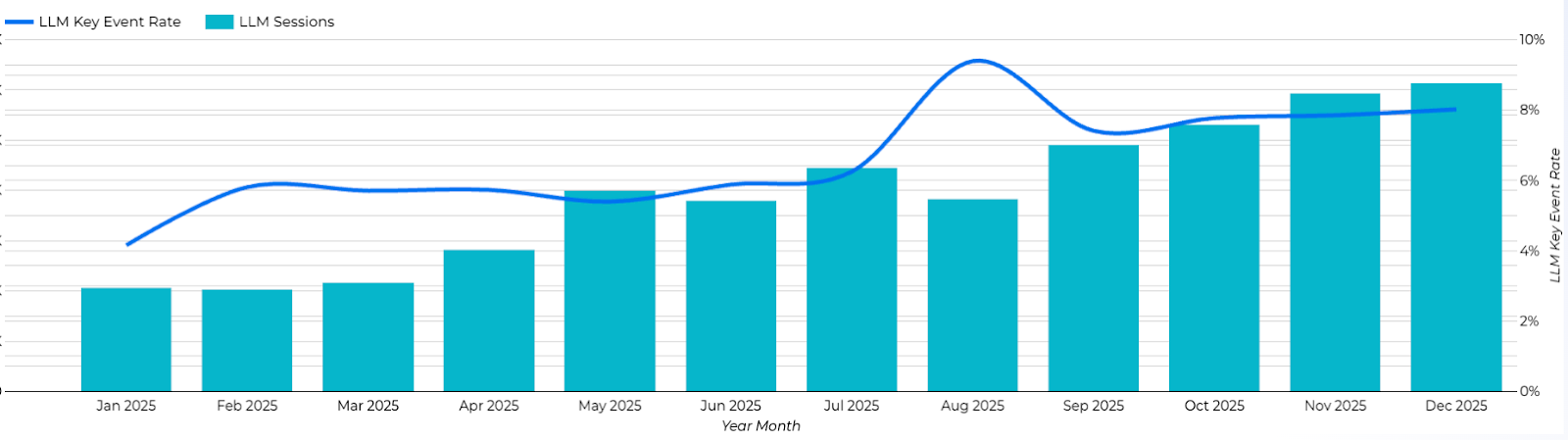
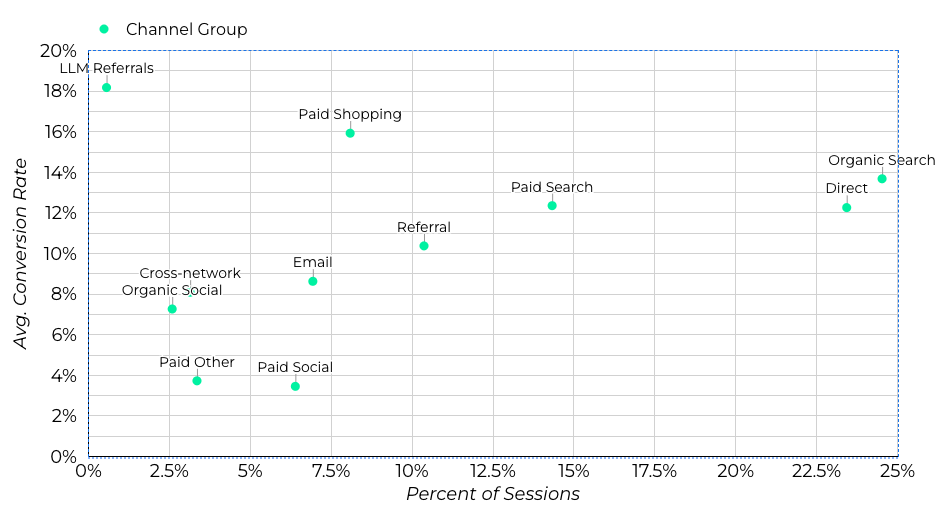
Analyzing LLM referral traffic has opened my eyes to intriguing trends regarding volume, growth, citation shifts, and an impressive 18% conversion rate.
Discussing LLMs and their impact on website traffic has become a staple in my client consultations. I’m often asked about current trends, potential improvements, and established best practices.
For brands eager to navigate these waters, my advice is straightforward: begin with the data you can rely on.
To understand how LLM traffic influences key metrics, I thoroughly analyzed 13 months of LLM prompt referral traffic within Google Analytics from our customer base (Jan. 1, 2025, to Feb. 7, 2026).
We concentrated on traffic from various LLM models to brand sites and the conversion events that align closely with substantial business outcomes, such as purchases or lead generation.
Our analysis unveiled four significant insights:
LLM referral traffic remains modest.
LLM traffic is growing rapidly.
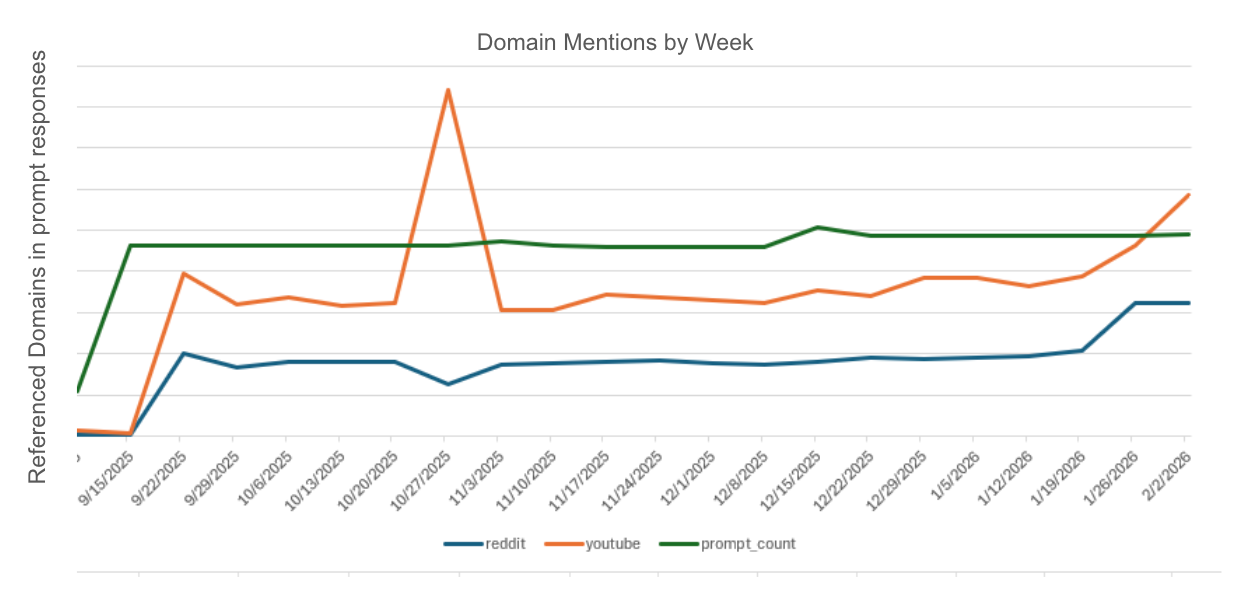
Sources mentioned in responses are evolving.
LLMs have a high conversion rate compared to other channels.
LLM Referral Traffic is Still Small
Our dataset reveals that LLM referral traffic constitutes less than 2% of total referral traffic. This means that fewer than 2 out of every 100 site visitors come from an LLM source.
The figures vary between 0.15% and 1.5%, with sources like ChatGPT, Perplexity, Gemini, and Claude.
Though a hot topic, it’s not yet the top concern for immediate financial impacts for many businesses.
… (The rest of the content should follow the same structure, formatted as Gutenberg paragraph blocks) …
In this rapidly evolving space, I believe staying focused, driving innovation, and leveraging data can give brands a strategic advantage over competitors.
When I first heard the term “contact page,” my mind immediately envisioned a simple space filled with contact info and a form. However, it turns out that this is a major oversight from a local SEO standpoint. Let me guide you on crafting a contact page that not only elevates your Google prominence but also converts more leads.
Google pays special attention to your contact page
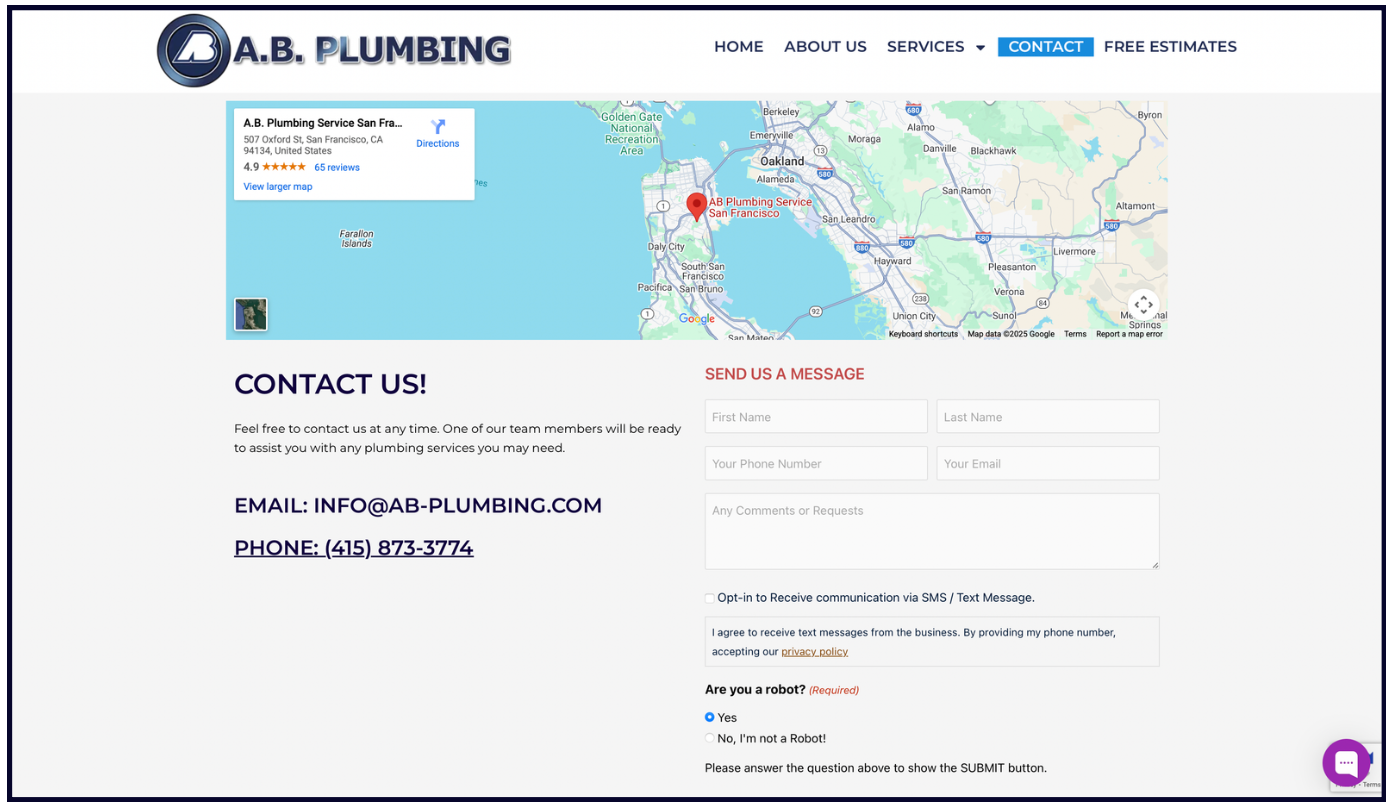
Joel Headley, the former head of Google Business Profile Support, once shared with me that Google actively crawls and interprets your contact page to extract details about your business. This revelation illuminated the common inadequacy of contact pages that simply display a business’s name, address, and phone number (NAP), coupled with a basic contact form.
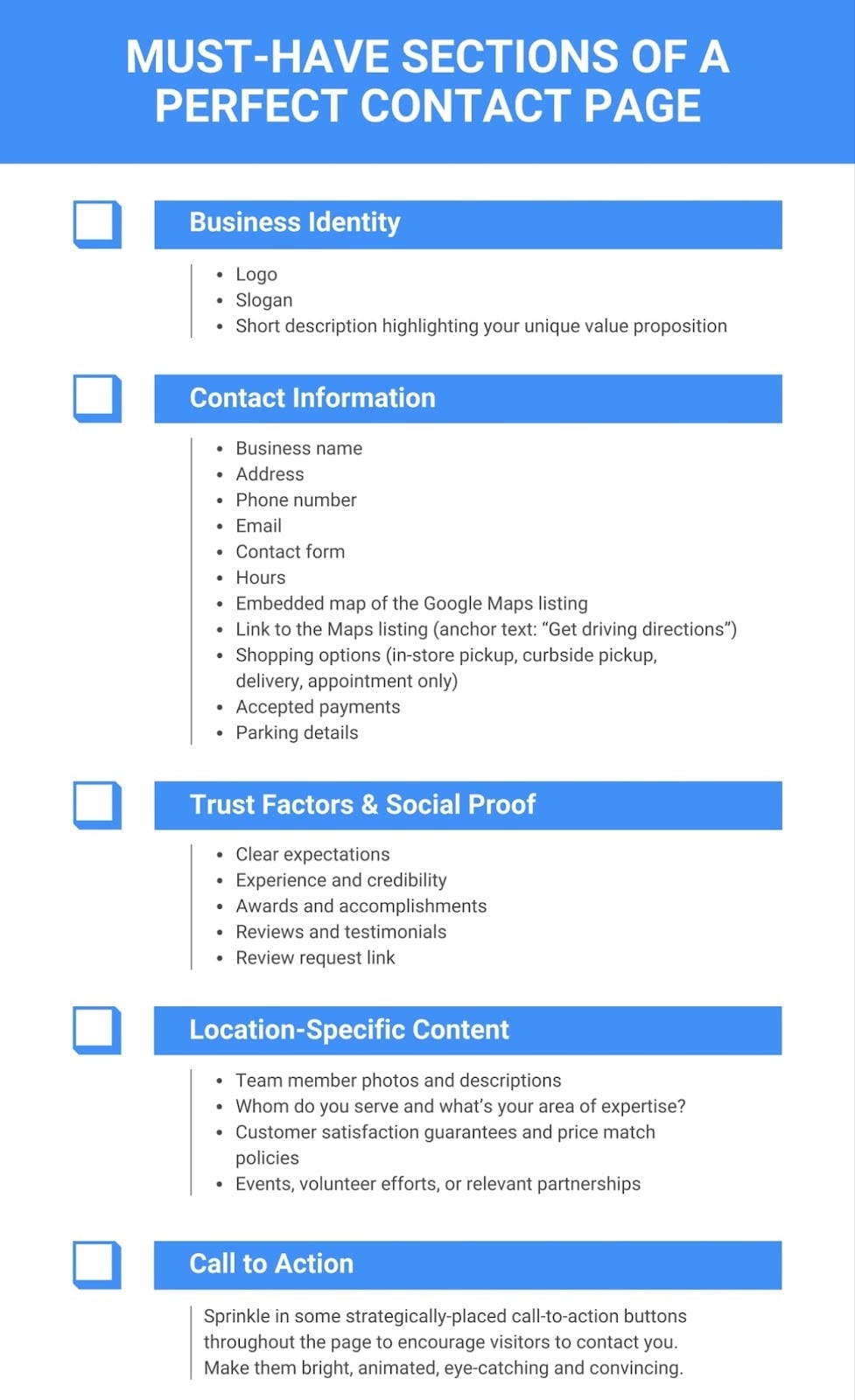
Google is essentially requesting, “Provide me with your business data,” while you might be responding, “No data for you.” Instead, I encourage you to treat your contact page with the same importance as a multi-location landing page. Here’s what your contact page needs to transform visitors into paying clients:
Business identity.
Contact information.
Trust factors and social proof.
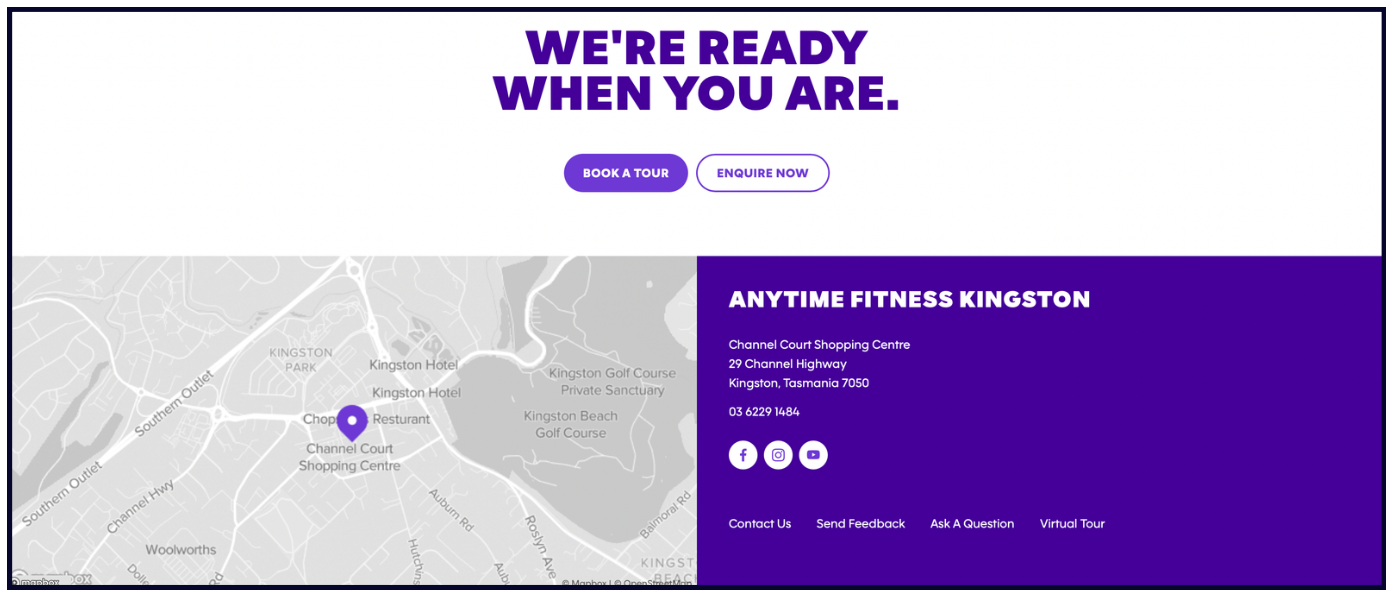
Location-specific content.
Amenities.
Call to action.
1. Business identity
Your contact page should be a reflection of your brand, just like every other page on your site. Here’s what to include:
Your business logo, matching all marketing materials and signage.
Your slogan, with potential keywords for SEO enhancement.
A concise introduction detailing your business’s function, location, and unique value proposition (UVP).
Your contact page isn’t just about providing contact avenues; it should convince visitors of their decision’s wisdom before they reach out.
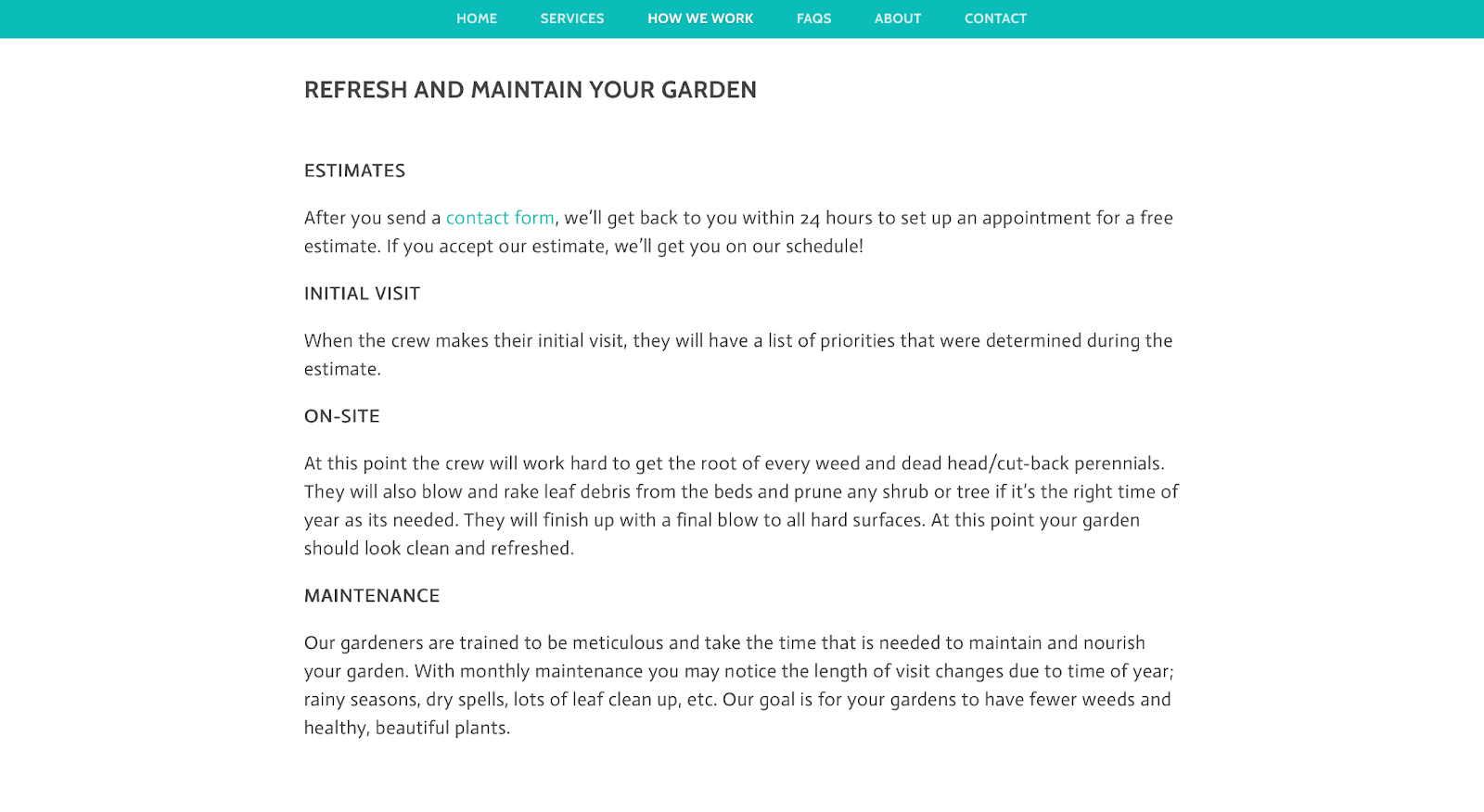
Clear expectations
Clearly communicate what a customer can expect post-contact to solidify their choice to connect with you:
Expected response times.
Upcoming steps and confirmations from your team.
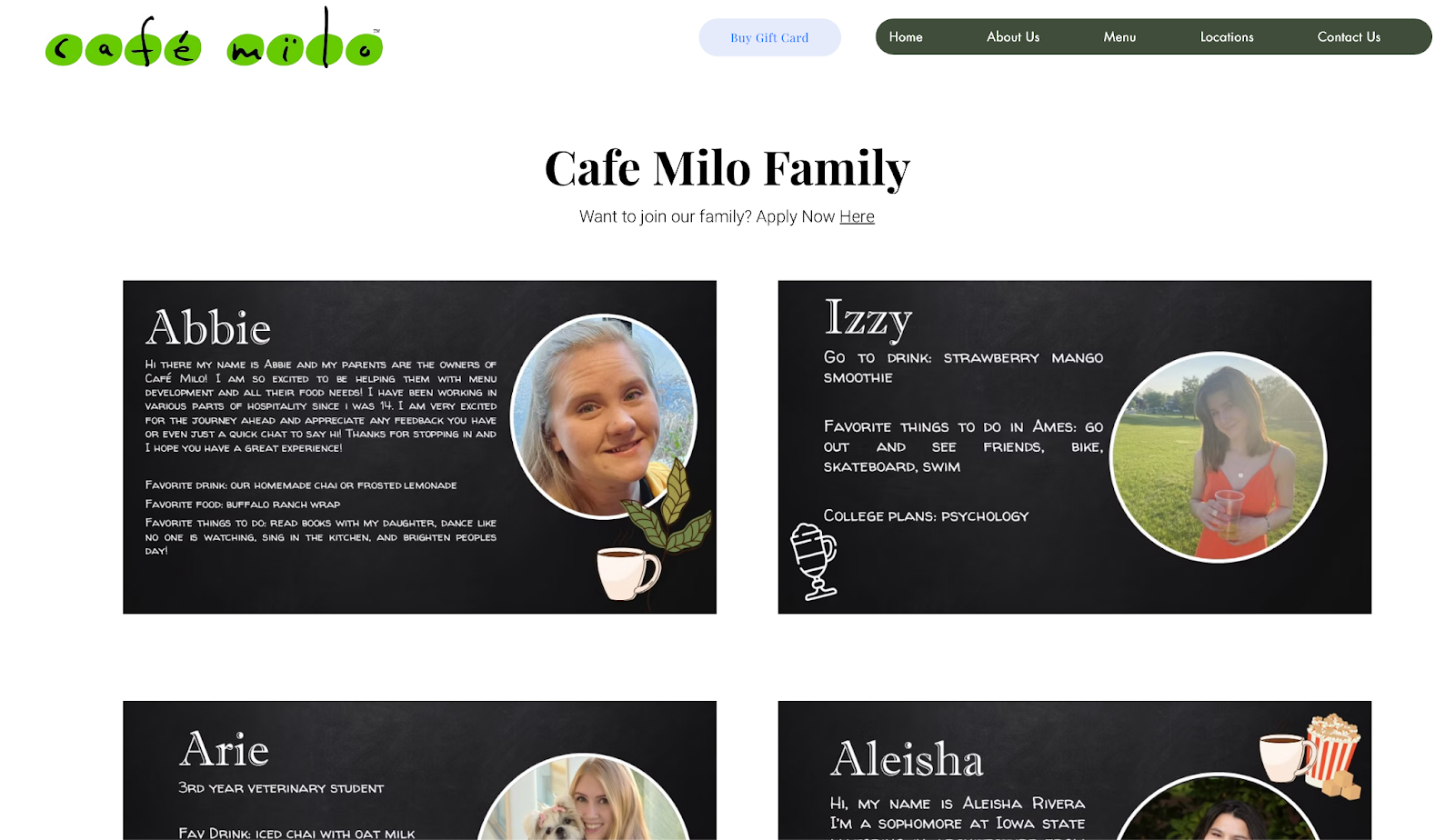
Additional useful information about your team, location, or differentiators.
Experience and credentials
Boost trust and conversion rates by displaying involvement in:
Industry associations, locally and nationally.
Chamber of commerce groups.
Professional organizations.
Meetup and neighborhood associations.
Better Business Bureau ratings.
Tip: Link association names to your business listing on their sites.
Awards and accomplishments
Include any awards and press mentions, with links to the relevant articles or sites. If there are many, consider a dedicated media section.
Reviews and testimonials
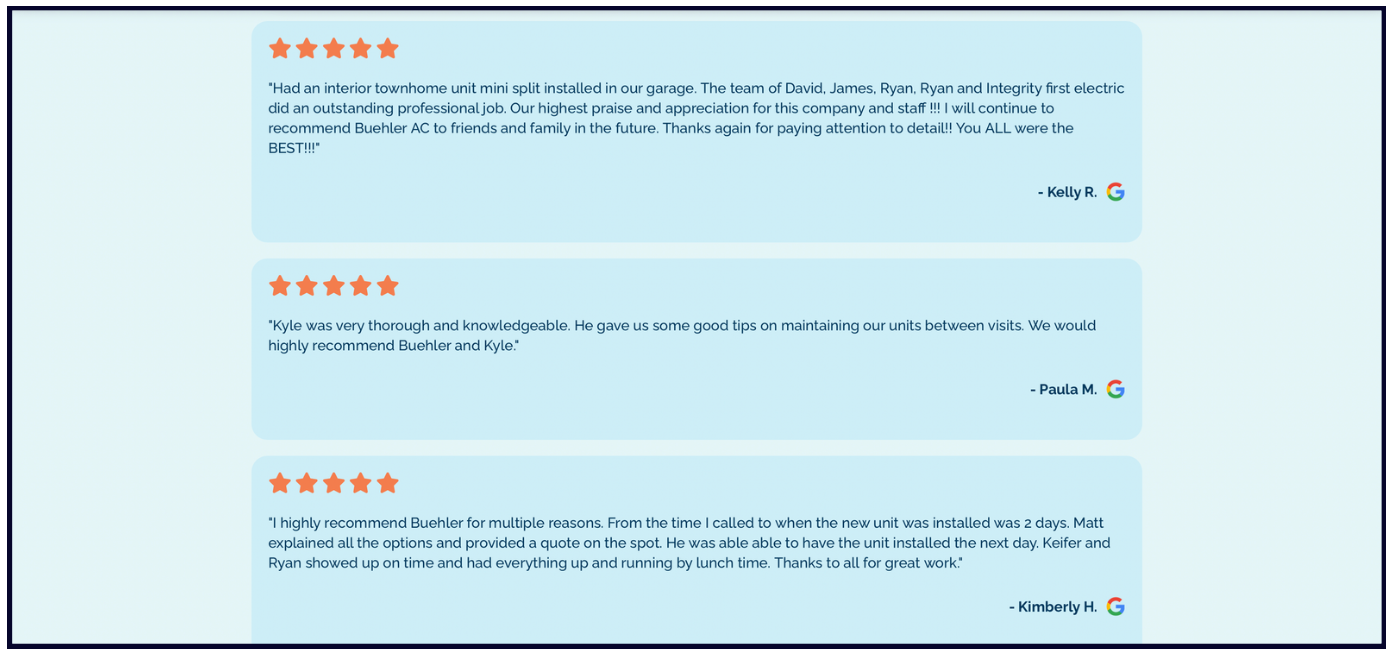
Embed external reviews and include testimonials to enhance trust. Enhance authenticity by showing reviewer photos, names, cities, and profiles.
Your review section is also an excellent place to request additional Google reviews, especially from repeat customers, using a link and call to action.
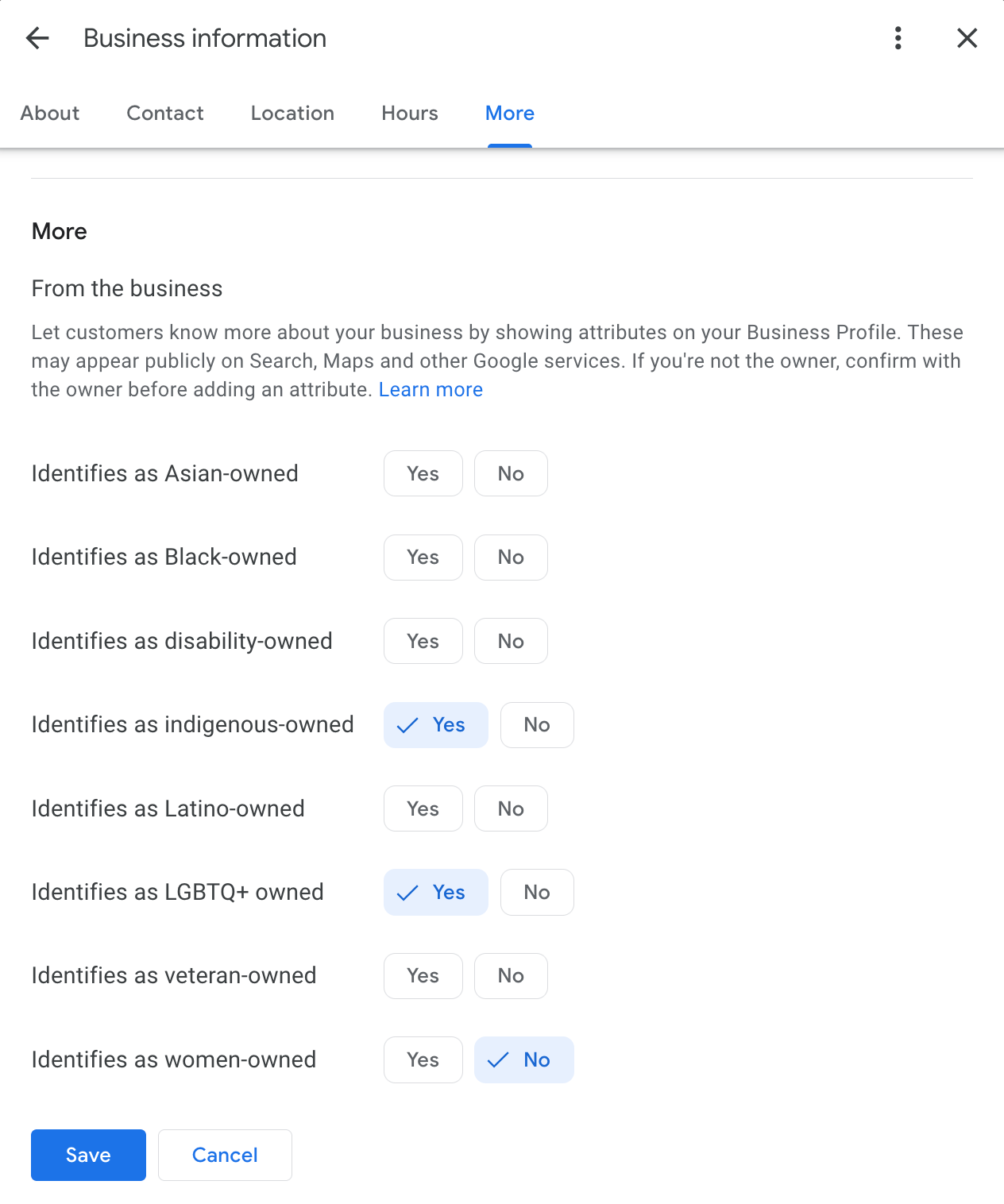
Review your Google Business Profile’s attributes and list those on your contact page, along with other unique attributes. This specificity aids traditional and AI searches in understanding if you meet distinct needs.
6. A clear CTA button
With a well-structured contact page, a compelling call to action (CTA) is essential. Use vibrant, eye-catching CTAs throughout the page to encourage engagements.
Treat your contact page like a local SEO asset
Your contact page should be seen as a local SEO asset. By investing effort similar to creating a multi-location landing page, you elevate your engagement and conversion rates, surpassing most competitors. Keep this list handy to ensure all necessary sections are covered.
I’ve realized that many of us, myself included, might be tracking the wrong SEO metrics lately. We need to shake things up, especially with 2026 approaching.
Picture this: I present an impressive chart depicting a 47% increase in site traffic. But instead of excitement, I’m met with puzzled looks from the CMO, wondering why revenue remains stagnant. Or, I celebrate a top-three ranking for a keyword nobody searches for.
The SEO metrics that boosted my confidence back in 2019 might just be steering me wrong in 2026. With AI Overviews taking over search results and zero-click searches becoming the new standard, clinging to outdated metrics might jeopardize my strategy and budget.
I’m ready to take you through the precise metrics that our SEO team should retire and which new, revenue-focused metrics to prioritize instead.
Traffic Metrics
1. Organic Traffic
Organic traffic has been my go-to KPI in SEO reports ever since I started. But relying solely on it doesn’t provide enough context.
Not all traffic is equally valuable. A thousand visitors who bounce instantly are not beneficial. However, a hundred visitors converting at an 8% rate? That’s a success story.
I witnessed a local HVAC company whose traffic dropped by 22%, year on year. Panic, right? Yet, organic revenue increased by 31%. We focused on enriching high-intent service pages, pruning low-intent content. Fewer visitors, but better ones.
Before panicking over traffic drops, I always reassess where traffic is declining. If losses involve informational articles and customer login pages, it’s not a revenue issue. That’s just noise exiting my dashboard.
2. Total Impressions Without Intent Segmentation
This metric can mislead. A million impressions from merely informational queries like “what is SEO” might build some awareness, but they contribute zero revenue. Meanwhile, ten thousand impressions from business-driven queries like “best enterprise SEO agency” could significantly boost my pipeline.
Google Search Console offers this data, but many teams, myself included, often fail to segment it intelligently.
3. Traffic Growth Without Revenue Correlation
This is a risky trap for SEO teams. Bringing a 35% increase in organic traffic to a quarterly review sounds impressive, right until the CFO asks, “And how does this translate to revenue?” If I can’t answer that, I’m just reporting noise.
Ranking Metrics
4. Average Keyword Position
This metric might look compelling in a dashboard, but it doesn’t hold up under scrutiny. If I rank first for a keyword with ten monthly searches and fiftieth for one with 50,000, my average position might seem okay, but I’m losing where it matters most.
The average position treats all keywords as identical when they aren’t. With personalized search results, an “average position” can vary greatly by user and location.
5. Isolated Keyword Tracking
Searchers these days don’t typically use isolated keywords. They pose questions, explore themes, and adjust their queries. Google’s focus has shifted toward semantic search and topic modeling.
Tracking a solitary keyword like “lawyer” is pointless without understanding intent — are searchers interested in criminal defense, divorce services, or merely looking up what lawyers do?
6. Share of Top 10 Rankings
This metric sounds clever until it’s clear that 80% of my top-10 rankings might involve low-intent, low-volume queries. Meanwhile, competitors claim the top-three spots for crucial commercial queries in my niche.
Achieving a No. 1 ranking for a high-converting transactional keyword is more valuable than holding 50 top-10 positions for low-value informational queries.
Authority and Engagement Metrics
7. Domain Authority and Domain Rating
DA and DR might not align with Google’s metrics. They’re proprietary scores from SEO tool companies. Yet, teams often set misguided goals like boosting DA from 42 to 50 by Q3.
I’ve seen how backlink volume is often overrated. Google’s algorithm prioritizes link quality, relevance, and context over sheer volume.
A single link from a high-quality, relevant site outweighs hundreds of low-grade directory links. I’ve seen sites with 100,000+ backlinks struggle to rank for meaningful terms because most links lacked quality.
9. Bounce Rate
I’ve found bounce rate misunderstood for years. If someone searches for my company’s business hours, finds them on the contact page, and leaves, that’s a success with a 100% bounce rate.
Google replaced bounce rate with “engagement rate” in GA4 for a reason. Similarly, session duration and pages per session need context. A high pages-per-session score on my pricing page may indicate confusion, not engagement.
Why These SEO Metrics Are Failing Now
I’ve noticed the search landscape shifting quite a bit. Up to 58.5% of U.S. and 59.7% of EU Google searches now conclude without a click, as per SparkToro’s zero-click study. This means, for every 1,000 searches, only 360 result in a visit to a site.
AI technologies are capturing and synthesizing information, bypassing the need for a click. My content can gain visibility and influence without contributing to sessions in Google Analytics.
Wynter’s latest B2B buyer research indicates nearly 24% of CMOs now utilize AI tools like ChatGPT for research, a significant rise from last year.
Buyers discover brands via AI tools and use Google to validate those discoveries. This alters my SEO focus from merely driving traffic to ensuring my brand is visible during pivotal decision-making stages.
Modern customer journeys can be erratic. Often, users who initially find us through organic search might return through paid ads or direct links. If we use last-click attribution, the true value of SEO is obscured, although this organic start was critical for conversion.
For ecommerce, I aim to track revenue from organic sessions by product category and landing pages. For lead-generation, I’ll track how many leads convert to customers. Integrating with a CRM helps in connecting those dots.
No one’s interested in your DA if you can demonstrate $1.2 million in revenue attributed to organic channels.
Conversion-weighted Visibility
I’ll focus on visibility for high-value terms that lead to conversions.
A franchise client noticed they dominated low-intent queries but were invisible for crucial local terms. We adjusted priorities, and their qualified leads doubled in four months.
Topic Cluster Performance
This metric supersedes individual keyword rankings. Monitoring how I rank across full topic clusters, and the aggregate visibility and conversions from these clusters, gives a comprehensive view of topic authority.
SERP Real Estate Ownership
By gauging control over the entirety of search pages, not just listings, including snippets and local packs, I can effectively keep competitors at bay for crucial queries.
AI Platform Visibility and Brand Mentions
My focus will also be on how frequently my brand is mentioned in AI responses. Mentions are becoming as crucial as click-through rates.
For instance, if I secure a favorable recommendation rate across multiple AI platforms for vital topics, it’s a win, even if website traffic appears unchanged.
While tools are emerging to monitor this, manual spot checks can reveal valuable insights, enhancing authority and awareness, eventually leading to brand searches and conversions.
Branded Search and Direct Traffic as AI Visibility Proxies
I notice when buyers find out about my brand through zero-click searches, they often search the brand name directly instead of clicking through. This reflects in my branded and direct traffic rather than organic metrics.
If I see no change in nonbranded organic traffic but an increase in branded search and direct visits, it usually indicates that my content gains attention in AI Overviews.
How to Transition My Reporting
Revamping reporting around new metrics might feel daunting. Stakeholders are comfortable with old metrics.
I start by evaluating my current dashboard, ensuring relevant metrics face business outcomes directly rather than just tallying activities.
Transition by gradually omitting vanity metrics. If organic traffic was my focal KPI, I now introduce it segmented by intent and accompany it with organic-attributed revenue. Gradually, I pivot focus and phase out the dated metrics.
When I introduce new metrics, I frame them in relatable terms. Avoid using “conversion-weighted visibility.” Opt for “visibility metrics for top-converting terms.”
The Metrics That Prove SEO’s Value
The metrics we’ve relied upon — organic traffic, average keyword position, domain authority, bounce rate — aren’t inherently harmful. They’re just incomplete, providing a potentially false sense of security while others prioritize revenue-generating metrics.
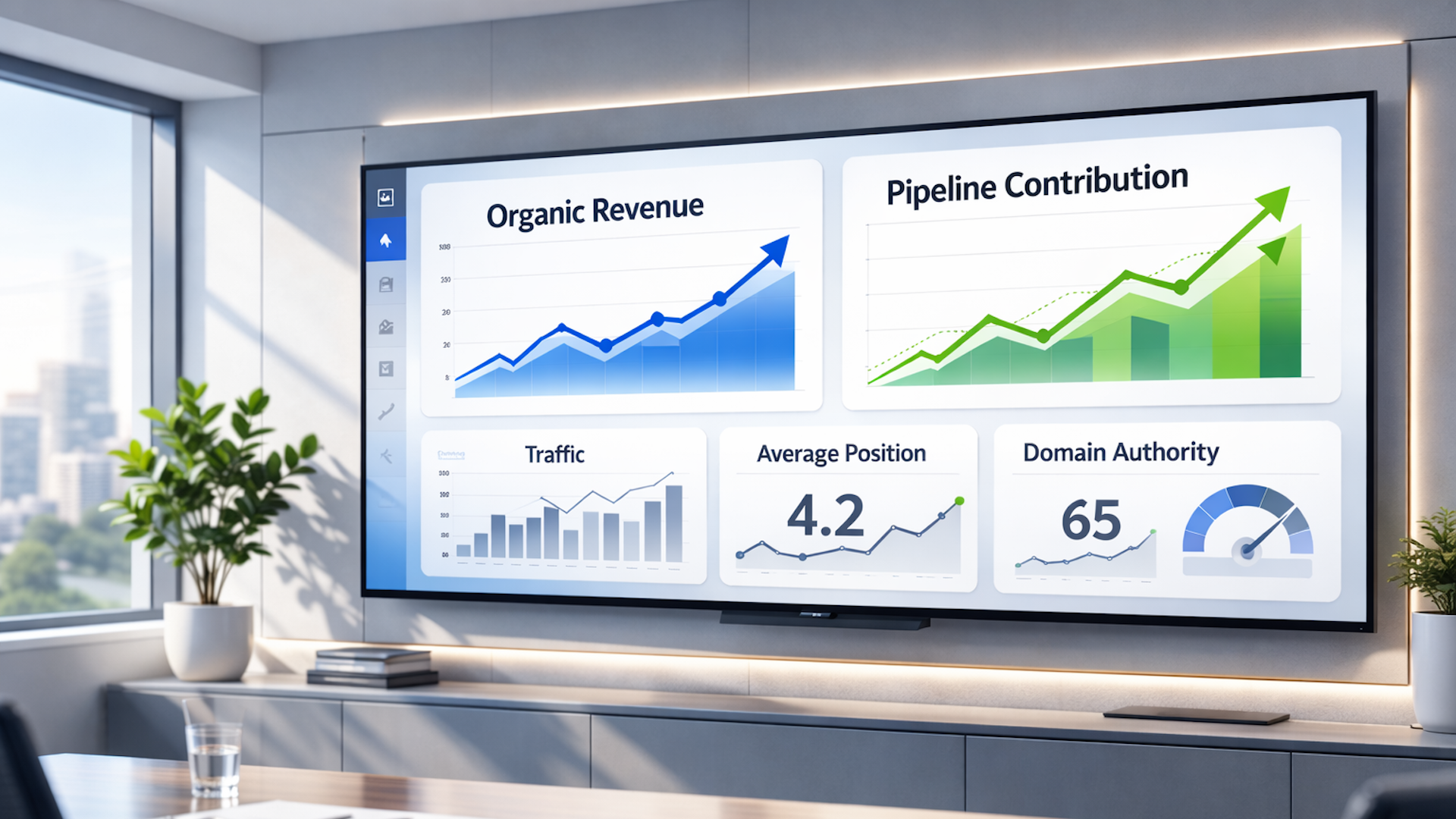
Newly adopted metrics — revenue contributions, conversion-oriented visibility, topic authority, SERP dominance, AI platform mentions — directly relate SEO to tangible business outcomes. They prove ROI, justify budgets, and align strategies with business growth.
Consider which metrics in your dashboard lend false impressions of activity over effectiveness. Retire them. Replace them.
Ultimately, no one’s concerned with traffic numbers or DA scores. They want to know if SEO drives growth. Make sure your metrics affirm it.
During the period from May 2025 to February 2026, I embarked on an exhaustive research journey with my team to explore ChatGPT conversion rates across various industries. We examined anonymous client data from over 150 companies, focusing on the proportion of referral traffic from ChatGPT that resulted in a conversion action defined by each client.
Most companies in our dataset had invested in generative engine optimization. This investment led to higher-than-average referral traffic from ChatGPT, paired with dedicated ChatGPT-focused conversion funnels. Our study’s insights are showcased below:
Higher Intent Traffic: I’ve noticed that ChatGPT-influenced traffic consistently boasts higher conversion rates than traditional SEO. This hints that conversational AI effectively pre-qualifies leads, as users express detailed needs through natural language queries.
Complexity Impact: It’s fascinating to see that complex industries like Commercial Insurance and Pharmaceuticals achieve higher conversion rates. Surprisingly, simple sectors like eCommerce or Food & Beverage see less dramatic improvements over traditional search. Yet, even high-trust sectors such as Financial Services benefit moderately, as ChatGPT conversion rates surpass those of standard methods.
B2B vs. B2C: Interestingly, B2C conversion rates show smaller improvements compared to B2B-focused sectors when stacked against traditional SEO. This suggests a substantial advantage for ChatGPT in navigating intricate B2B sales cycles.
Conclusion: Requesting a Copy of This Report
The insights from our report highlight how ChatGPT can significantly boost conversion rates across industries, outpacing traditional marketing channels. With ChatGPT’s continued adoption and the emergence of paid ads, more conversion advantages are on the horizon.
If you’re keen to get a PDF version of this report or want to learn more about our GEO services, feel free to reach out here.
First Page Sage Internal Research Study, February 2026, First Page Sage.
In our latest report, I’ve dug deep into the world of Shopify Plus agencies to bring you the cream of the crop for 2026. With an exhaustive analysis of 84 agencies globally, my research focused on crucial factors like mastery of the Shopify Plus platform, customer reviews, and unique enterprise capabilities.
After meticulously evaluating each agency, I honed in on six standout contenders by ranking their abilities in areas such as technical expertise, B2B implementation success, and customer satisfaction rates. Below, I’ve summarized who made the cut and why they shine.
The Top Shopify Plus Agencies of 2026
Here, I’m unveiling the top Shopify Plus specialists! This table showcases each expert agency based on a comprehensive assessment of their technical prowess and customer delight.
With over 15 years of experience, Atwix stands as a beacon for B2B eCommerce transformation. Founded by Slava Kravchuk, Atwix leverages its vast Shopify Plus expertise, bringing innovative custom development and integration services to manufacturers and distributors.
What sets Atwix apart is their ingenious Sirius integration platform, a vital tool that links various enterprise systems with ease, ensuring real-time data accuracy. Their 96% client retention rate is a testament to their ability to offer solutions that scale as businesses expand.
Clients laud Atwix as “true professionals” providing “quick responses” and “elegant solutions” to complex challenges. Their “deep technical expertise” and proactive management are consistently highlighted.
Eastside Co: Masters of Conversion Rate Optimization
At Eastside Co, the name of the game is conversion rate optimization through precise A/B testing strategies. My insights show this agency emphasizes performance metrics, helping brands maximize their growth potential in the Shopify Plus ecosystem.
Their targeted services benefit direct-to-consumer brands, reflecting their commitment to driving results using data-driven methodologies. Though they excel in conversion, their scope might be too narrow for businesses needing expansive ecommerce solutions.
Clients commend Eastside Co for their “focus on performance metrics” and systematic approach to achieve “ROI improvements.” Their dedication to analytics stands out, though some mention the need for additional partners for broader projects.
We Make Websites: Experts in UK Headless Development
In the UK, We Make Websites is synonymous with expertise in headless commerce and performance optimization. My research indicates their focus on Core Web Vitals and innovative technical practices makes them a powerhouse for UK markets.
While they are adept at creating high-speed, dynamic experiences, their strategies focus primarily on the UK, which might pose challenges for international companies with more complex needs.
Location: London, UK
Established: 2008
Price Range: $$$$
Average Review Score: 4.8/5
Services Offered: Headless Commerce, Performance Optimization, Custom Development, API Integration, Technical SEO
Summary of Online Reviews
Clients praise them for their “attention to performance” with “lightning-fast storefronts.” However, their strong UK-centric approach can be challenging for global firms.
Digital Silk: Crafted for Large-Scale Fashion Brands
For those in the fashion arena, Digital Silk offers exceptional design-centric Shopify Plus services. Their commitment to aesthetic excellence is ideal for high-end fashion brands focused on stunning visual identity over operational intricacies.
While their creativity in design sets them apart, their services might not suit businesses looking for robust, functional ecommerce solutions with sophisticated technical requirements.
Location: New York, NY
Established: 2013
Price Range: $$$$
Average Review Score: 4.7/5
Services Offered: Brand Design, Shopify Plus Development, Visual Identity, Digital Marketing, UX Design
Summary of Online Reviews
Clients appreciate their “design quality” and the ability to craft “experiences” that highlight brands, though some note their focus on aesthetics can sometimes overlook functional needs.
Studio Rotate: Embodying Australian Commerce Design
Studio Rotate blends local market knowledge with design prowess to serve the Australian market effectively. My insights reveal their visually compelling solutions cater magnificently to regional audiences.
While their boutique approach is a boon for Australian brands, it might not match the needs of international or large enterprises seeking extensive capabilities and scalability.
Location: Melbourne, Australia
Established: 2016
Price Range: $$$
Average Review Score: 4.5/5
Services Offered: Shopify Plus Development, Australian Market Focus, Design Direction, User Experience, Local Commerce
Summary of Online Reviews
Clients remark on their “deep Australian market knowledge” and ability to craft “local designs.” However, regional focus can limit scalability for international markets.
Charle: Masters of UK Creative Solutions
Since 2018, Charle has charmed ambitious UK brands with their creative and performance-driven Shopify Plus development. With a focus on people-first strategies, they’ve built a remote-first culture that encourages innovative collaboration.
However, while offering captivating creative designs, their capacity to address comprehensive B2B functionality is limited, particularly outside the UK market.
Location: London & Manchester, UK
Established: 2018
Price Range: $$$
Average Review Score: 4.4/5
Services Offered: Shopify Plus Development, Creative Design, UK Market Focus, Platform Migration, Brand Development
Summary of Online Reviews
Clients describe their experience with Charle as “an absolute dream” due to their “creative approach” and seamless process, though their focus on UK limits global expansion capabilities.
The Top Shopify Plus Agencies in the US by Specialty
To aid you further, I’ve classified these exceptional Shopify Plus agencies into specialized categories based on detailed research. This should help you align with partners who resonate with your project goals and growth aspirations.
I’ve been there myself. A client approaches me, eager to upscale their Google Ads spend from €10,000 to €100,000 monthly. Like any dedicated PPC manager, I dive into the usual strategies:
Refine bidding strategies.
Test new ad copy.
Expand keyword lists.
Optimize landing pages.
Boost Quality Scores.
Launch Performance Max campaigns.
Several months in, the ad spend only grows by 15%. The client is content, but I know we can do better.
Here’s a harsh truth I’ve learned: much of what we consider PPC optimization is really just sophisticated procrastination.
The theory of constraints, introduced by Eliyahu Goldratt, offers insights for PPC much like it does for manufacturing. It shows that every system has a single constraint that limits its potential.
It doesn’t matter if the marketing team is super-efficient if the production capacity is what’s limited. Likewise, a 20% improvement in ad copy CTR isn’t useful if the real constraint lies in budget or conversion tactics.
This theory calls for radical focus: pinpoint the weakest link, make it your priority, and tune out the rest.
Applying this to PPC means stopping the widespread optimization efforts. Detect the primary barrier, resolve it, and press on.
Over time, managing PPC accounts has shown me that scaling challenges usually fit within one of seven categories:
Budget: Profitability could be higher, but client approval caps spending.
For instance, a campaign might run successfully at €10,000 monthly, with scope to go to €50,000, yet the client hesitates due to risk aversion or cash flow concerns.
Developing a compelling business case that showcases past ROI and projected returns is vital here.
I ignore ad copy tests or keyword expansions because, if I can’t increase budget, they won’t help.
Impression Share: Already capturing over 90% share, limiting traffic growth.
Entering new markets or ad platforms can often be the solution for these scenarios.
The Creative aspect needs tightening when high impressions yield low CTRs, and so on for conversion rate, fulfillment, profitability, and tracking or attribution challenges.
With my diagnostic steps, I start by running an audit to benchmark the key metrics—impression share, CTRs, CPCs, and conversion rates— to pinpoint what’s genuinely holding the account back.
The moment I finish an audit and single out the top challenge, the focus becomes precise. For instance, if it turns out conversion rate optimization can unlock growth, that’s where all my efforts channel into until I see a breakthrough.
Every time the constraint is overcome, a new bottleneck emerges, signifying growth and the movement to new phases. It is both a marker of success and a roadmap to what needs attention next.
I’ve realized that not every Shopify integration delivers the value we expect. Let me share how I organize and prioritize checkout, re-engagement, and optimization tools to make a real revenue impact.
Developers have the freedom to create apps for almost any function imaginable.
Yet, with countless options available, ecommerce teams often waste time on shiny add-ons that promise gains but fail to deliver.
Having been involved in numerous Shopify setups, I’ve seen firsthand which integrations truly enhance checkout completion and cart recovery while boosting revenue.
From my experience, I’ve structured the most impactful integrations into three tiers. This helps prioritize essentials before advancing to sophisticated optimization.
Thus, every Shopify store should integrate two key components into its storefront:
Compatibility with digital wallets.
A ‘buy now, pay later’ (BNPL) option.
Without these integrations, customers may face unnecessary friction and turn to competitors for a smoother transaction experience.
The great news is that both of these features integrate easily with Shopify without requiring custom development.
Digital wallets, like Apple Pay, Google Pay, and PayPal, streamline the payment process by autofilling necessary details, reducing friction on small screens.
This efficiency reduces the purchase process to just a few clicks from a social ad to checkout.
Up to 64% of Americans now use digital wallets as much as traditional methods, with 54% preferring them more often.
Beyond convenience, customers seek payment flexibility. Providers like Klarna and Afterpay offer BNPL options that mitigate price objections at checkout.
Last year, these options contributed $18.2 billion to online revenues.
Combining digital wallets with BNPL functionality forms a robust foundation for a mobile-first checkout experience. With these in place, Shopify sellers can focus on re-engagement tools that drive customers back to complete their purchases.
The second tier centers on re-engagement strategies. These tools are designed to entice back customers who have already shown interest.
They enhance abandoned-cart recovery, boost repeat purchases, and build trust through social proof.
Email remains a powerful channel for re-engaging customers across their journey. For Shopify users, platforms like Klaviyo and Attentive offer deep integrations with minimal setup.
These platforms also extend to SMS, enabling automated texts to shoppers’ mobile devices.
SMS consistently outperforms email in terms of open, click-through, and conversion rates, making it particularly effective for re-engagement needs such as recovering abandoned carts.
However, navigating CAN-SPAM and TCPA regulations means explicit opt-ins are required for email and SMS marketing, respectively.
While Klaviyo and Attentive excel at targeting opted-in customers, CartConvert helps merchants engage with the 50% to 60% who haven’t subscribed.
CartConvert uses real agents to reach out via SMS, bypassing automated restrictions and engaging customers in real-time conversations.
By combining CartConvert with platforms like Klaviyo, sellers can ensure comprehensive re-engagement strategies for both opted-in and non-opted customers.
Human-centered marketing also enhances buyer confidence. Modern online shoppers depend on reviews heavily when deciding on purchases.
Incorporating reviews directly into the shopping experience bolsters trust and legitimacy, boosting conversion rates.
According to the Spiegel Research Center, a product with just five reviews is 270% more likely to be purchased than one without any reviews.
Tools like Okendo, Yotpo, and Shopper Approved easily integrate with Shopify and sync with Google Merchant Center, enhancing Google Shopping ads’ performance.
The third tier involves advanced integrations that help optimize your sales funnel and performance for scale.
With GA4’s updates, tracking and attributing performance has become more challenging. Since 2023, Triple Whale has positioned itself as a robust alternative with third-party attribution tools integrating easily with Shopify.
It supports various attribution models and provides real-time data—something Google Analytics lacks—offering valuable insights, especially during high-stakes periods like Black Friday.
For improving conversion rates, custom landing pages are key. Replo allows Shopify users to design and A/B test landing pages on a large scale without coding risks.
These personalized pages typically convert at higher rates than standard templates by using site data to adapt to users’ browsing patterns.
Lastly, as TikTok grows as a paid media platform, its Shopify integration allows sellers to link ads directly to their sites, opening new opportunities for creative outreach and engagement.
Remember, you don’t need to adopt every tool at once. Start by auditing your current set-up, fill in the gaps, and prioritize tools that promise to enhance conversions and re-engagement.
Shopify’s greatest strength is its flexibility, empowering us to convert more visitors into loyal buyers.
Have you ever felt uneasy managing large catalogs in Google Performance Max, almost like you’re handing over your wallet to an algorithm? I sure have.
La Maison Simons faced a similar struggle. With too many products and not enough control, they decided to rebuild their segmentation using Channable Insights. This change turned their perplexing campaign into a revenue powerhouse.
Step 1: Stop segmenting by category
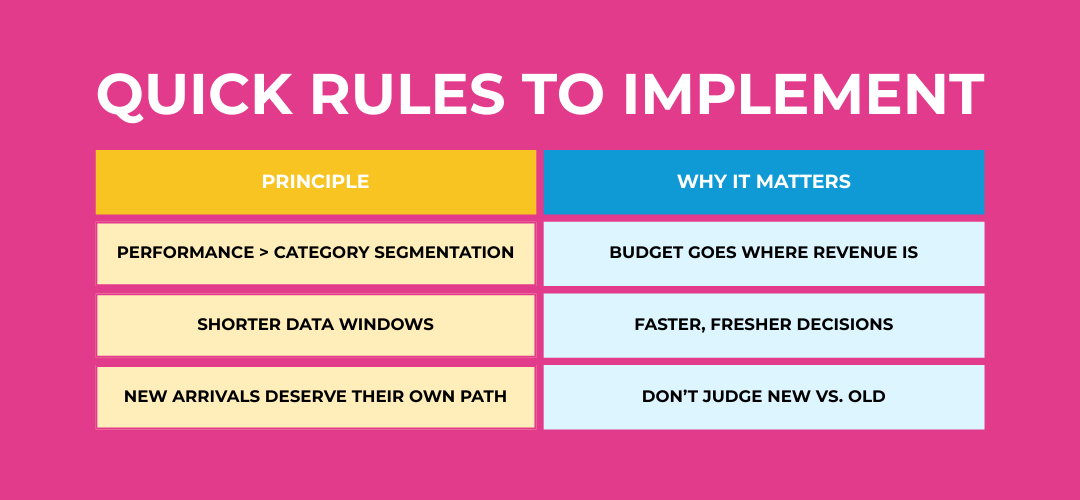
Initially, Simons divided campaigns by product category. It seemed like a good idea until their popular sweater consumed the entire budget, leaving less visible or new products unnoticed.
Static segmentation brought limited visibility and sluggish decision-making. Marketers were trapped with manual tweaks, while Google auto-focused on what’s already succeeding.
Step 2: Segment by performance
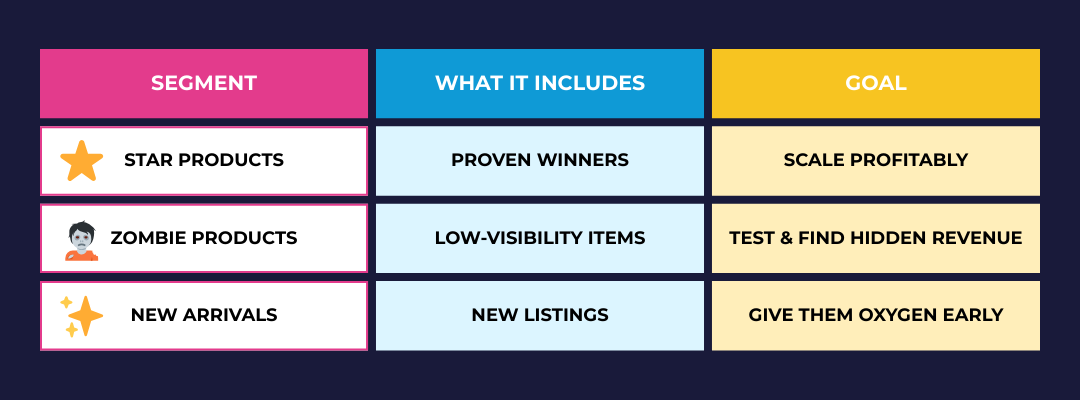
With Channable Insights, product-level data like ROAS and clicks now fuel dynamic grouping:
Products automatically transition between segments based on performance. As Etienne Jacques, Digital Campaign Manager at Simons, expressed:
“One super popular item no longer takes all the money.”
Step 3: Shorten your analysis window
Instead of the usual 30-day signals, Simons decided to use a rolling 14-day window. This means quicker reactions, more accurate decisions, and less wasted spend in a fast-paced catalog.
Step 4: Push the strategy across channels
Why limit the strategy to Google? Simons applied the same segmentation across:
Meta
Pinterest
TikTok
Criteo
This cross-channel consistency amplifies optimization.
Step 5: Watch the metrics climb
Simons unlocked impressive results without increasing ad spend:
ROAS growth: from ~800% to ~1500%
CPC decrease: $0.37 to $0.30
CTR lift: 1.45% to 1.86%
14% increase in average order value
1300% ROAS for New Arrivals campaigns
Faster workflows and fewer manual tweaks
Even previously invisible products turned into unexpected profit drivers with a spot in the limelight.
Step 6: Treat automation as control, not chaos
Automation has restored marketing control rather than taking it away. Now, teams can learn from data and actively influence product growth instead of leaving everything to PMax autopilot.
Your action plan
Classify products as Stars, Zombies, and New Arrivals.
Automate campaign reassignment based on real-time data.
Refresh product insights every 14 days.
Roll out segmentation logic to every paid channel.
Scale what wins – test what’s yet to succeed.
Aiming for Simons-style ROAS gains without raising ad spend? Start with a free feed and segmentation audit to enhance your product data quality.