Tag: Content Strategy

  • Mastering AI: Elevate Your Funnel with Bottom-Funnel Content

    Mastering AI: Elevate Your Funnel with Bottom-Funnel Content

    Traffic from Google searches is declining, and I know it firsthand because I’ve invested years in organic strategies. Seeing this shift in real-time is unsettling but also enlightening.

    I’ve observed this change particularly in my SaaS clients. The educational, top-of-funnel (TOFU) content that once consistently drew traffic is losing steam. This isn’t due to declining quality; users simply don’t need to click anymore. AI Overviews are handling their queries.

    This led me to a crucial choice: defend the old strategy or adapt to the new landscape. I decided to adapt.

    Surprisingly, while informational content is getting fewer clicks, bottom-of-funnel (BOFU) content is not only steady but often driving more qualified leads.

    This shift signifies a new understanding of value creation through search.

    The pivot: Making BOFU the priority

    My new approach focuses 60% to 80% of my efforts on bottom- and mid-funnel content. The rest fills in gaps with TOFU topics, supporting content clusters and timely industry discussions.

    When I proposed this change to clients, I put it plainly:

    • “You can choose between traffic and leads. If leads are your goal, here’s our path, though it may mean less traffic.”

    I was transparent that traffic might dip, but conversions would likely increase. Clients saw the appeal of a qualified pipeline over mere traffic.

    Comprehensive comparison guides and listicles aimed at high-intent queries are highly effective BOFU content.

    Take, for example, a guide on the best time-tracking software for construction. I created a reusable review methodology for the client, addressing pros and cons transparently, including their product. This honesty builds trust with evaluating readers.

    The guide was factual, precise, and targeted at decision-makers in the purchasing phase, not casual browsers.

    In weeks, it became our most referenced article in LLM responses. Now a cornerstone piece, it often appears in conversion pathways, driving qualified leads.

    That single piece outperformed a dozen previous informational posts in pipeline impact because it directly answers a buyer’s question.

    Dig deeper: How to align your SEO strategy with the stages of buyer intent

    TOFU isn’t dead; it just has a new role

    Many SEOs see this as a binary choice. But I haven’t abandoned TOFU content; I’ve simply repositioned it.

    TOFU now builds topical authority, supporting the ranking of BOFU pages. It’s the structure beneath the main act. Guides and educational content should:

    • Support content clusters.
    • Establish expertise in Google’s eyes.
    • Pass link equity to BOFU pages.

    We’ve revised top-performing TOFU pieces to connect directly to clients’ products, supported by screenshots and expert insights.

    Calls to action were redesigned for context and strategically placed throughout the content, not just at the end.

    ```json
{
  "alt": "The CapmatchOne logo with a gradient circle and bold text.",
  "caption": "Discover innovation with the CapmatchOne logo, featuring sleek typography and a modern gradient circle.",
  "description": "The CapmatchOne logo features bold, modern typography coupled with a gradient circle, symbolizing connection and innovation. The sleek design conveys a sense of progress and creativity. This image can be used for branding or promotional purposes, appealing to audiences interested in innovative solutions and forward-thinking designs."
}
```

    These changes significantly increased visitor engagement with demo request pages, without altering the informational purpose.

    The key is still producing valuable TOFU content but ensuring it has a unique perspective—something fresh and insightful.

    Specificity in a sea of AI-generated content sets us apart.

    Why this strategy excels in AI-driven search

    Visitors from AI platforms arrive informed and ready to weigh options. This aligns with how AI Overviews serve search results.

    AI Overviews are more frequent for informational than commercial queries. E-commerce searches trigger them less, safeguarding BOFU content for now, though commercial coverage is growing.

    This change in behavior modifies what content performs well. As informational value diminishes with upfront answers, decision-stage content gains importance, aiding users in comparison and validation.

    That’s why BOFU content thrives; it matches users’ decision-making phase, not just their search.

    The time tracking software comparison piece is a prime example. It often appears in discussions on construction time tracking tools. While it might not always convert instantly, its impact is evident in branded searches and lead generation.

    The attribution challenge to embrace

    Here’s the dilemma: BOFU content’s true value often isn’t reflected in traditional analytics.

    When someone discovers your solution via an AI response, then proceeds via direct or branded search to convert, it often appears as direct traffic in GA4, masking SEO’s role.

    Therefore, I’ve guided clients to emphasize broader performance metrics, including:

    • Trends in brand search volume.
    • Citation frequency in LLM platforms.
    • Increases in direct traffic post-publication.
    • Conversions even with stable traffic levels.

    The ROI of BOFU and LLM-focused content exceeds dashboard insights. Relying solely on immediate click metrics misses SEO’s true value creation.

    Your playbook for transitioning to BOFU

    Here’s a practical guide to capitalizing on this shift:

    • Audit for BOFU gaps: Identify purchase-stage queries lacking coverage. These high-intent gaps offer quick opportunities.
    • Create comparison content: Use a consistent review framework, openly address pros and cons for credibility and citations.
    • Enhance leading TOFU articles: Incorporate product links, contextual CTAs, and expert testimony for dual-purpose content.
    • Set up LLM tracking in GA4: Use regex segments to track AI referrer traffic and gain insights often overlooked.
    • Refocus client metrics dialogue: Shift focus from traffic to lead quality and conversion rates, reflecting modern SEO’s impact.

    AI Overviews have reshaped informational content economics.

    This disruption opens strategic doors. BOFU content traditionally converts better, and AI highlights the need to focus on content that drives revenue rather than mere site visits.

    The opportunity for strategic realignment is here, but it won’t last indefinitely.


    Inspired by this post on Search Engine Land.


    crushpress.ai community screenshot
  • Master SEO Without Using Restricted Keywords

    Master SEO Without Using Restricted Keywords

    When I’m faced with the challenge of optimizing for keywords that I can’t explicitly use, I gear up with a strategic mindset. Legal constraints, brand guidelines, or public perceptions might put certain terms off-limits, but there are effective ways to capture demand without using them directly.

    Here’s my approach to overcoming this hurdle, aligning with search behaviors, and enhancing visibility despite limitations.

    When Certain Keywords Are Off-Limits

    In the world of SEO, it’s not uncommon to hear, “We want to rank for (insert competitive term),” followed by, “Avoid using (that exact term) in content.”

    My journey began over 10 years ago, tasked with ranking for “custom koozies.” This sparked endless debates on the correct nomenclature for these drink holders. At home, we referred to them as “coolie cups,” but data revealed that most people simply called them “koozies.” However, “Koozie®” being a trademark meant we had to cleverly position ourselves at the top without relying on that term as our primary focus.

    Years later, at a marketing agency focusing on senior living, I encountered new terminology like assisted and independent living. Despite a bias against the term “nursing home” due to negative connotations, our research showed it was still widely used, presenting similar challenges to what I had faced before.

    Dig deeper: Branded search and SEO: What you need to know

    Strategies for Ranking Without Using Specific Keywords

    Even if I can’t use a keyword, by sending the correct signals through related terms and creative strategies, I can still rank effectively. Here’s how:

    1. Pull the Data and Confirm Direction

    Sometimes, showcasing data alone can shift perspectives. Sharing insights like “skilled nursing near me” having 4,400 monthly searches compared to “nursing home near me” with 27,100 searches can be eye-opening. Understanding the local search volume is crucial in determining the best strategy.

    2. Surround the Terms

    Creating contextual relevance is essential. For example, around the term “Koozies,” I include words like “beer,” “drink,” and occasions such as “bachelorette party.” These help build search engine context.

    ```json
{
  "alt": "The CapmatchOne logo with a gradient circle and bold text.",
  "caption": "Discover innovation with the CapmatchOne logo, featuring sleek typography and a modern gradient circle.",
  "description": "The CapmatchOne logo features bold, modern typography coupled with a gradient circle, symbolizing connection and innovation. The sleek design conveys a sense of progress and creativity. This image can be used for branding or promotional purposes, appealing to audiences interested in innovative solutions and forward-thinking designs."
}
```

    3. Use Synonyms and Break Down Phrases

    Utilizing synonyms or splitting phrases works well. Instead of “Koozies,” I might say “cozies” or “coolies,” and for “nursing homes,” highlighting “nursing” and “home” separately enriches content.

    4. Employ Indirect Usage

    Referring indirectly can be impactful, such as using headers like “More than a nursing home” or integrating the terms into questions or statements naturally within the content.

    5. Incorporate Unnameable Products

    Incorporating trademarked items alongside other products allowed me to use the term “Can Coolers & Koozies” even when the latter couldn’t be the focal point.

    6. Craft Creative Anchor Text

    Using the primary term in both off-site and internal links can guide search engines effectively. Controlling anchor text is key.

    7. Optimize Non-Visible Elements

    Leveraging alt text and strategically placing terms in title tags ensures that search engines get the right signals without visible usage, balancing between being search-friendly and on-brand.

    8. Add Definitions

    Adding definitions helps clarify common terms related to your offerings, boosting SEO and enhancing your site’s authority.

    Dig deeper: The shift to semantic SEO: What vectors mean for your strategy

    Your Strategy for Off-Limits Keywords

    Always consult with legal advisors regarding trademarked terms. By gathering data, crafting strategic approaches, and adjusting tactics as necessary, you can achieve SEO success even with restrictions.


    Inspired by this post on Search Engine Land.


    crushpress.ai community screenshot
  • How Reddit is Shaping PPC Campaigns in Unexpected Ways

    How Reddit is Shaping PPC Campaigns in Unexpected Ways

    I’ve noticed something interesting happening in the world of PPC advertising. More and more buyers are doing their homework on Reddit before they even think about clicking on ads. This detour is skewing PPC data and misleading our automation efforts.

    At over $50 per click, Reddit surprisingly outperforms every vendor organically around 67.3% of the time based on a study that covered 8,566 keywords. This insight is not restricted to just B2B SaaS; it’s a reality many industries are facing.

    If you’re in legal, finance, premium home services, or insurance sectors, these high CPCs are part of your landscape. It’s crucial to understand how these dynamics affect you.

    The SEO community has been discussing this for a while, highlighting the need to build glossaries and invest in content strategies. However, what intrigues me is how this affects the signal layer our PPC campaigns rely on.

    When someone searches a high-intent term and lands on Reddit instead of our page, they don’t just get peer opinions. Google’s algorithm takes note too, registering this as a resolved query.

    This kind of engagement feeds back into Google’s algorithm, gradually shaping the relevance of those terms, and it spells trouble for us if we’re not aware of it.

    The real complication arises when someone clicks on our ad after spending days researching on Reddit. Smart Bidding isn’t aware of this buyer journey; it sees only a $50 click and waits to see if it converts.

    ```json
{
  "alt": "The CapmatchOne logo with a gradient circle and bold text.",
  "caption": "Discover innovation with the CapmatchOne logo, featuring sleek typography and a modern gradient circle.",
  "description": "The CapmatchOne logo features bold, modern typography coupled with a gradient circle, symbolizing connection and innovation. The sleek design conveys a sense of progress and creativity. This image can be used for branding or promotional purposes, appealing to audiences interested in innovative solutions and forward-thinking designs."
}
```

    That delay might lead to misinterpreting performance and drawing back on keywords that are actually bringing in qualified buyers because the full picture wasn’t visible.

    UCaaS vendors show us how to counteract this. They didn’t outspend Reddit. They invested in content that educates and informs, giving search engines robust, relevant signals.

    On the bidding side, offline conversion tracking is essential. It shows the algorithm which leads closed and their worth, helping it comprehend that a longer, research-heavy path at a higher CPC might still be beneficial.

    By feeding the system first-party data via click IDs, Google’s findings indicate a 10% median lift in conversions. This helps align the algorithm’s understanding with what’s actually happening on the ground.

    For organic strategy, it’s about being present where these conversations take place. This could mean answering more questions directly on platforms like Reddit and evaluating your presence in these research hubs.


    Inspired by this post on Search Engine Land.


    crushpress.ai community screenshot
  • How AI is Redefining SEO with Persuasion and Positioning

    How AI is Redefining SEO with Persuasion and Positioning

    The journey into SEO’s future is personal for me. When I think of ‘Mad Men,’ it’s more than a show; it’s an era of advertising where persuasion reigned supreme. It’s fascinating to see how today’s AI influences SEO in a similar way, deciding visibility based on a brand’s positioning, proof, and online presence.

    I recall the early days of the internet, where simply getting a brand found was the goal. Google streamlined that process, making SEO a crucial part of marketing. But now, AI drives a new layer of SEO that many still misinterpret.

    Interestingly, AI is revealing gaps in traditional SEO practices. Brands won’t capture AI’s attention by just pumping out content; rather, they must appeal through strategic positioning and persuasive narratives, just like Madison Avenue did.

    Back when SEO was emerging, content felt like king, but it was a means to an end. For many businesses, it shifted from serving customers to gaming search algorithms—it’s a narrative that’s changing.

    I can see how AI is absorbing the informational retrieval once handled by search engines, pushing users straight to answers rather than through a maze of links. This shift highlights how SEO is becoming more about impactful marketing.

    Reflecting on the “4 Ps” of marketing, traditional SEO was all about place. Today, I feel the challenge lies more in earning preference through AI’s lens, transforming from being found to being favored.

    Those AI-driven recommendations boil down to good old advertising principles. It’s about guiding choices invisibly, which AI does through recommendations rather than ads.

    Understanding AI recommendations is crucial. These systems weigh evidence like reviews and brand prominence, similar to how we humans rely on social proof and authority to make decisions.

    ```json
{
  "alt": "The CapmatchOne logo with a gradient circle and bold text.",
  "caption": "Discover innovation with the CapmatchOne logo, featuring sleek typography and a modern gradient circle.",
  "description": "The CapmatchOne logo features bold, modern typography coupled with a gradient circle, symbolizing connection and innovation. The sleek design conveys a sense of progress and creativity. This image can be used for branding or promotional purposes, appealing to audiences interested in innovative solutions and forward-thinking designs."
}
```

    I realize that if a brand isn’t actively testing and optimizing for AI recommendations, it’s missing out, especially as these recommendations can quietly sway market outcomes.

    Now, I see my website—our digital face—as more than a stopping point. It’s an advocate for preference, needing clear differentiation and purpose to stand out in AI and human evaluations alike.

    True commercial copywriting must articulate value and sharpen the proposition for potential customers, standing out in a sea of content vying for attention.

    The future seems to demand that we move beyond keyword-centric strategies. To truly prepare, we need to craft compelling arguments for why our brand deserves to be recommended and seen.

    As I explore strategies to remain relevant, it’s clear—the focus shift is from visibility to building persuasive, evidence-based branding through various channels, including digital and traditional PR.

    Even amidst all the change, core SEO fundamentals still hold their ground. Understanding technical optimization, site architecture, and secured recommendation visibility remain indispensable.

    Winning in this landscape means embracing a hybrid approach, merging SEO with branding, PR, and strategic infrastructure. It’s about ensuring our brand is not just found, but chosen, guided by both traditional tactics and cutting-edge AI understanding.


    Inspired by this post on Search Engine Land.


    crushpress.ai community screenshot
  • Mastering AEO: Build Authority with Engaging Content

    Mastering AEO: Build Authority with Engaging Content

    How to produce content that naturally builds AEO clout

    Backlinks are still important, but today, authority also thrives on mentions and citations. I’m here to guide you on crafting content that garners both, significantly boosting your presence in AI search results.

    In the past, links were the main authority signal in search. Creating backlinks was my go-to strategy for visibility, and earning placements was key for credibility. This still holds relevance, but it’s no longer the sole method.

    In the realm of AI-driven search, my authority is now shaped by how frequently my brand is mentioned, cited, and associated with specific topics. Visibility is achieved through references in AI-generated answers.

    With this in mind, my aim is to craft content that consistently earns brand mentions and citations, which are the new driving forces for AEO visibility.

    The Philosophy Driving Content that Fuels AEO Growth

    In 2026, organic discovery is driven by authority incorporating entity recognition. On platforms like Google and AI models such as ChatGPT, authority is strengthened through:

    • High-quality backlinks.
    • Brand mentions (linked or unlinked).
    • Consistent citations across trusted publications.
    • Clear entity associations (defining who I am, what I’m known for, and my core topics).

    Since LLMs synthesize information rather than rank pages, I need repeatable, credible mentions across the web to enhance the probability of being cited or referenced in AI answers. Moreover, I’m focused on using my owned media to clearly define my brand entity.

    Building authority has become more crucial as my content competes with AI results within the SERP and AI-generated content from other creators.

    In short, I need to establish a clear brand identity and produce content so valuable that other experts, journalists, creators, and AI systems frequently reference my brand in discussions relevant to my business.

    Dig deeper: How to build an effective content strategy for 2026

    The Principles and Formatting of AEO-Friendly Content

    I rely on many traditional SEO principles as a foundation for AEO-friendly content. Content aligned with Google’s helpful content guidelines, emphasizing value and user experience, appeals to both people and LLMs sourcing expert input.

    However, to truly optimize AEO-friendly content, I incorporate formatting that facilitates LLM extraction.

    ```json
{
  "alt": "The CapmatchOne logo with a gradient circle and bold text.",
  "caption": "Discover innovation with the CapmatchOne logo, featuring sleek typography and a modern gradient circle.",
  "description": "The CapmatchOne logo features bold, modern typography coupled with a gradient circle, symbolizing connection and innovation. The sleek design conveys a sense of progress and creativity. This image can be used for branding or promotional purposes, appealing to audiences interested in innovative solutions and forward-thinking designs."
}
```

    Key formatting principles include:

    • Clear definitions: Provide concise, clear definitions high on the page:
      • “X is…”
      • “Y refers to…”
    • Structured formatting:
      • Use descriptive H2s and H3s.
      • Employ bullet points.
      • Keep paragraphs short.
      • Include direct answers under question-based headers.
    • Explicit context:
      • Avoid vague pronouns and implied references.
      • LLMs perform better with explicit, self-contained context.
    • Summary sections: 
      • TL;DR blocks.
      • Key takeaways.
      • FAQs.
    • Entity reinforcement:
      • Brand name.
      • Author expertise and authority.
      • Brand and author credentials.

    By keeping these principles in mind, I can effectively create content that resonates with both AEO requirements and user expectations.

    The Specific Objectives for Your AEO Content to Address

    To focus solely on AEO, I approach content with these objectives:

    • Be highly citable: Provide original data or perspectives that are valuable for media such as podcasts, expert roundups, or contributor columns.
    • Be highly quotable: Deliver at least one clear, insightful quote.
    • Be specific: Address specific questions that AI systems would seek to answer. Articulate and answer a question verbatim within the content.
    • Be clear: Clearly define topics for easy extraction.

    To meet these goals, I think beyond blog posts to create “reference-grade” assets like:

    • Original research.
    • Data studies.
    • Industry benchmarks.
    • Visual explainers.
    • Definitive guides.
    • Glossaries.

    Dig deeper: How to create answer-first content that AI models actually cite

    Practical Steps to Build AEO Authority with Content

    Here’s how I turn those principles into a repeatable process:

    • Research keywords where bloggers and journalists seek references (often including “statistics” or “reports”). I utilize resources like Reddit, Quora, X, Ahrefs, and Exploding Topics.
    • From those keywords, develop a list of topics my team can provide valuable insights on.
    • Compile a list of writers and journalists who cover those topics.
    • Conduct interviews with expert resources to gather content.
    • Refine content into contemporary insights using Google Trends and social listening.
      • Example: Collect tips from an expert to help hay fever sufferers (niche audience) sleep better (core topic) during high pollen periods (relevance).
    • Pitch to writers and journalists on the urgency and uniqueness of my content.
    • Engage with these writers on social media to build relationships for future opportunities.

    Dig deeper: Organizing content for AI search: A 3-level framework

    Create Content Worth Referencing

    Writing for AEO is aligned with writing for humans. It incorporates many of the SEO fundamentals meant to engage actual users.

    Despite differences in how LLMs extract and process content, keeping these nuances in mind helps me refine my content approach for both AEO and human users.

    With a well-defined brand on my owned media and a strong understanding of AEO principles, I’m ready to leverage my team’s expertise for superior visibility in the AI search landscape.


    Inspired by this post on Search Engine Land.


    crushpress.ai community screenshot
  • Boosting AI Visibility Through Social Content: Uncover the Impact

    Boosting AI Visibility Through Social Content: Uncover the Impact

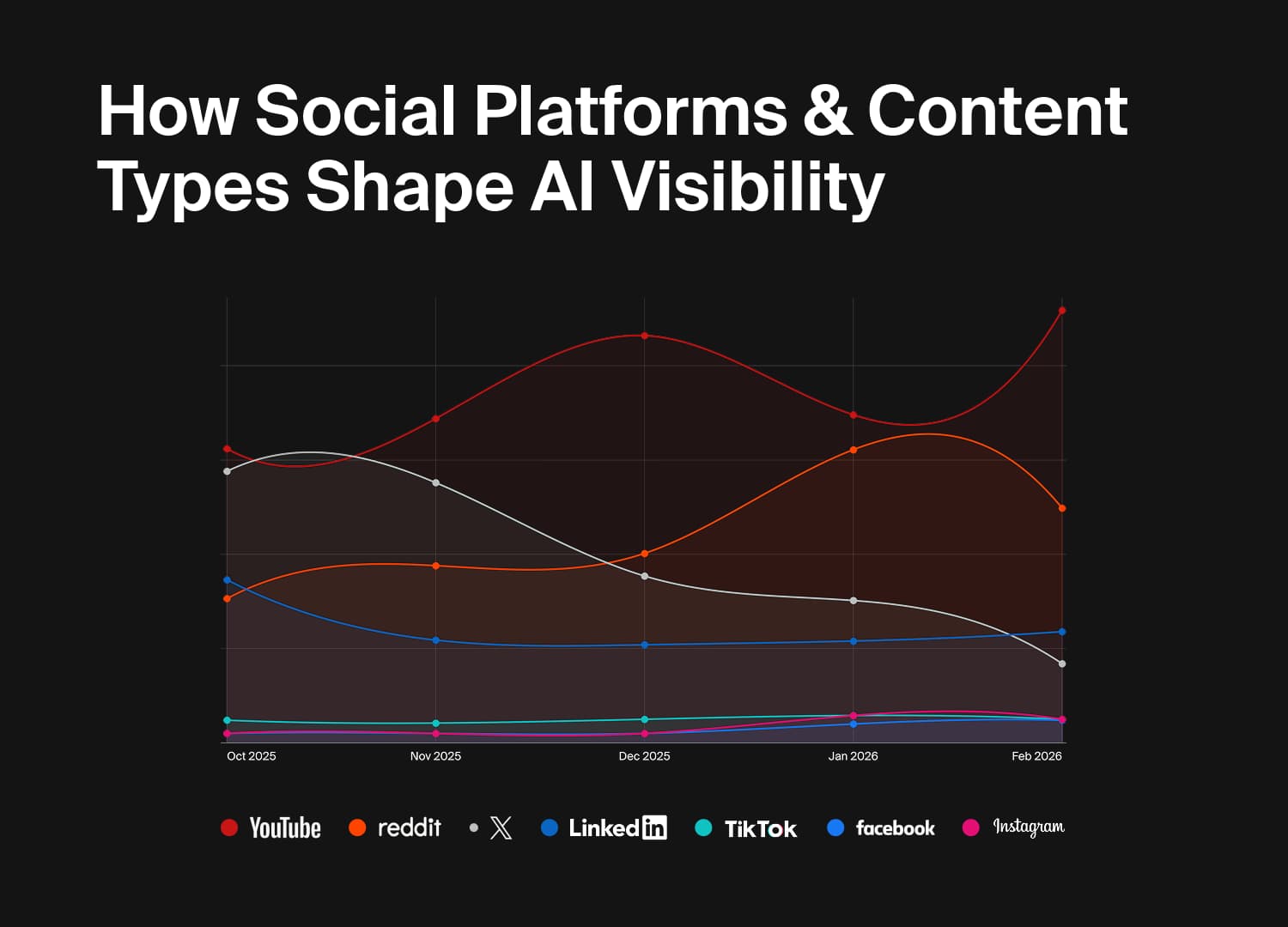
    Have you ever wondered how different types of social content can influence AI visibility? Well, I’ve delved into this fascinating topic to uncover the ways platforms like YouTube and Reddit, along with long-form content, enhance AI citation.

    Understanding the mechanics of how social platforms shape AI visibility is crucial in today’s digital landscape. In my exploration, I discovered that YouTube and Reddit are particularly powerful in driving AI citations, thanks to their unique content structures and engagement models.

    Long-form content, known for its depth and comprehensive nature, is another player in this arena. Its ability to provide detailed insights makes it a preferred format for AI learning and referencing.


    Inspired by this post on HiGoodie Blog.


    crushpress.ai community screenshot
  • Unlock AI Search: Strategies & Insights You Need To Know

    Unlock AI Search: Strategies & Insights You Need To Know

    I’ve always been fascinated by the evolving landscape of AI and its impact on search optimization. Recently, I’ve been diving deep into platform updates, proprietary research, and the latest optimization strategies emerging from the AEO category.

    One article that caught my eye is “9 Top ChatGPT Optimization Tools for Better Visibility” by Emily Axelsen, which was published on October 10, 2025. It offers incredible insights into boosting visibility using ChatGPT.

    Julia Olivas also provides a deep dive into crafting an LLM-friendly content strategy, which she explores in “AEO & AI Content Marketing,” released on December 19, 2025. Her insights are invaluable for anyone looking to align with AI advancements.

    Understanding the differences in optimization strategies with the article “AEO & GEO vs SEO” by Daria Erzakova, published on August 20, 2025, also expanded my perspective significantly.

    In addition to these, various other posts delve into AEO research frameworks, technical foundations, and social optimization. I personally found the analysis in Michael Saltz’s “Social Optimization Suite” from March 17, 2026, to be enriching, emphasizing the importance of owning conversations that truly matter.

    Even more, on March 16, 2026, Julia Olivas published about the necessity of having a social media agency adept in AEO, adding depth to my understanding of agency capabilities in today’s digital world.

    The timeline of “LLM Data Wars: Deals, Restrictions & Platform Power Plays (2023-2026)” by Julia Olivas, published on March 9, 2026, reveals intriguing narratives about the competitive landscape of AI platforms.

    Mostafa Elbermawy’s study on March 5, 2026, explores the power of social platforms and content types in shaping AI visibility, adding more context to these discussions.

    For those interested in AI PR, Michael Saltz’s “From Mentions to Citations” on March 4, 2026, provides a fresh perspective on how PR strategies are evolving in the AI era.

    The guide on schema markup by Ollie Martin, published March 2, 2026, is comprehensive for anyone looking to enhance AI search. It’s a must-read if you’re diving into AI search optimization.

    Lastly, Daria Erzakova’s work on aligning social, SEO, PR, and content for AI search dominance, from February 20, 2026, encapsulates a forward-thinking strategy for today’s digital landscape.


    Inspired by this post on HiGoodie Blog.


    crushpress.ai community screenshot
  • Mastering AI Visibility: Beyond ‘Publish and Wait’

    Mastering AI Visibility: Beyond ‘Publish and Wait’

    In 1998, I found myself meticulously submitting websites to search engines. I remember the drill well: AltaVista, Yahoo Directory, Excite, Infoseek, Lycos, and others. Each had its own form and wait time, leaving us to wonder if our URLs would make the cut.

    Back then, we submitted a whopping 18,000 pages, manually. While this was happening, Google was just emerging. Yet, they already had a vision that would render manual submissions almost obsolete.

    Google’s PageRank meant that if a site had incoming links, it didn’t necessarily need to submit. While other search engines waited, Google proactively discovered content, streamlining what was once a tedious process.

    ```json
{
  "alt": "The CapmatchOne logo with a gradient circle and bold text.",
  "caption": "Discover innovation with the CapmatchOne logo, featuring sleek typography and a modern gradient circle.",
  "description": "The CapmatchOne logo features bold, modern typography coupled with a gradient circle, symbolizing connection and innovation. The sleek design conveys a sense of progress and creativity. This image can be used for branding or promotional purposes, appealing to audiences interested in innovative solutions and forward-thinking designs."
}
```

    For two decades, the rule was simple: you published, you waited, and the bots would come. But now, the landscape is shifting. Not because Google has lost its edge, but due to an expanded game where merely waiting won’t capture all available revenue streams.

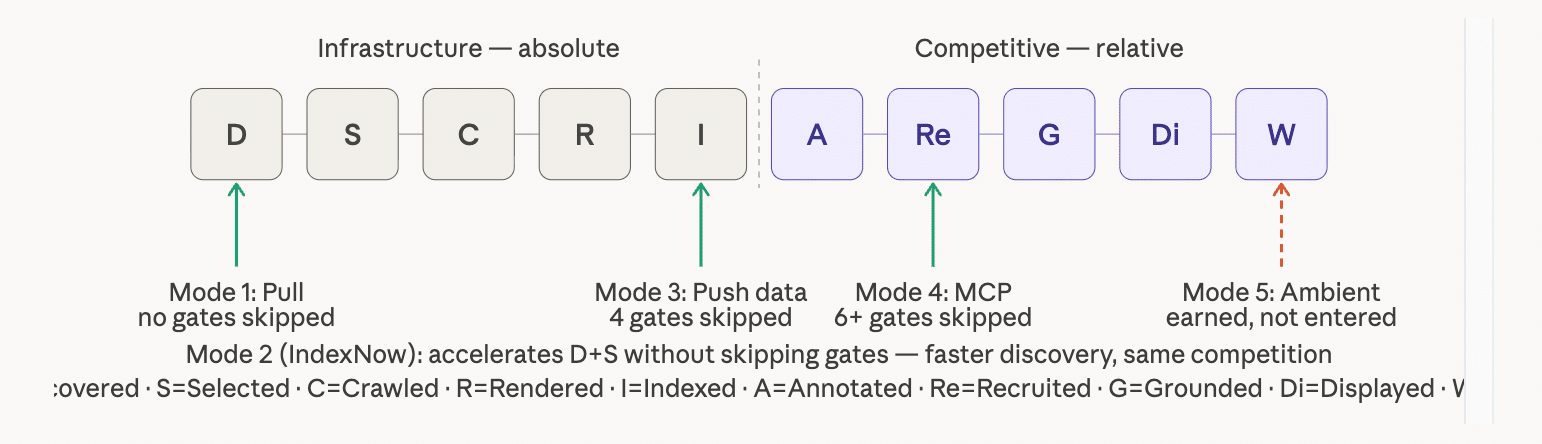
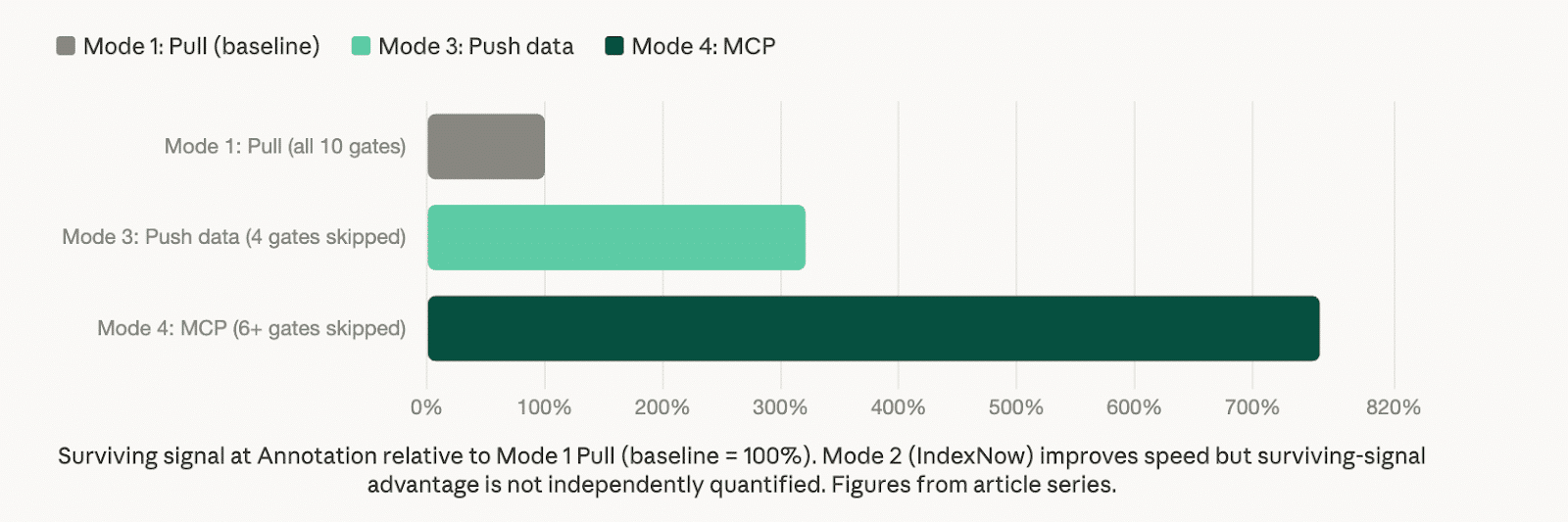
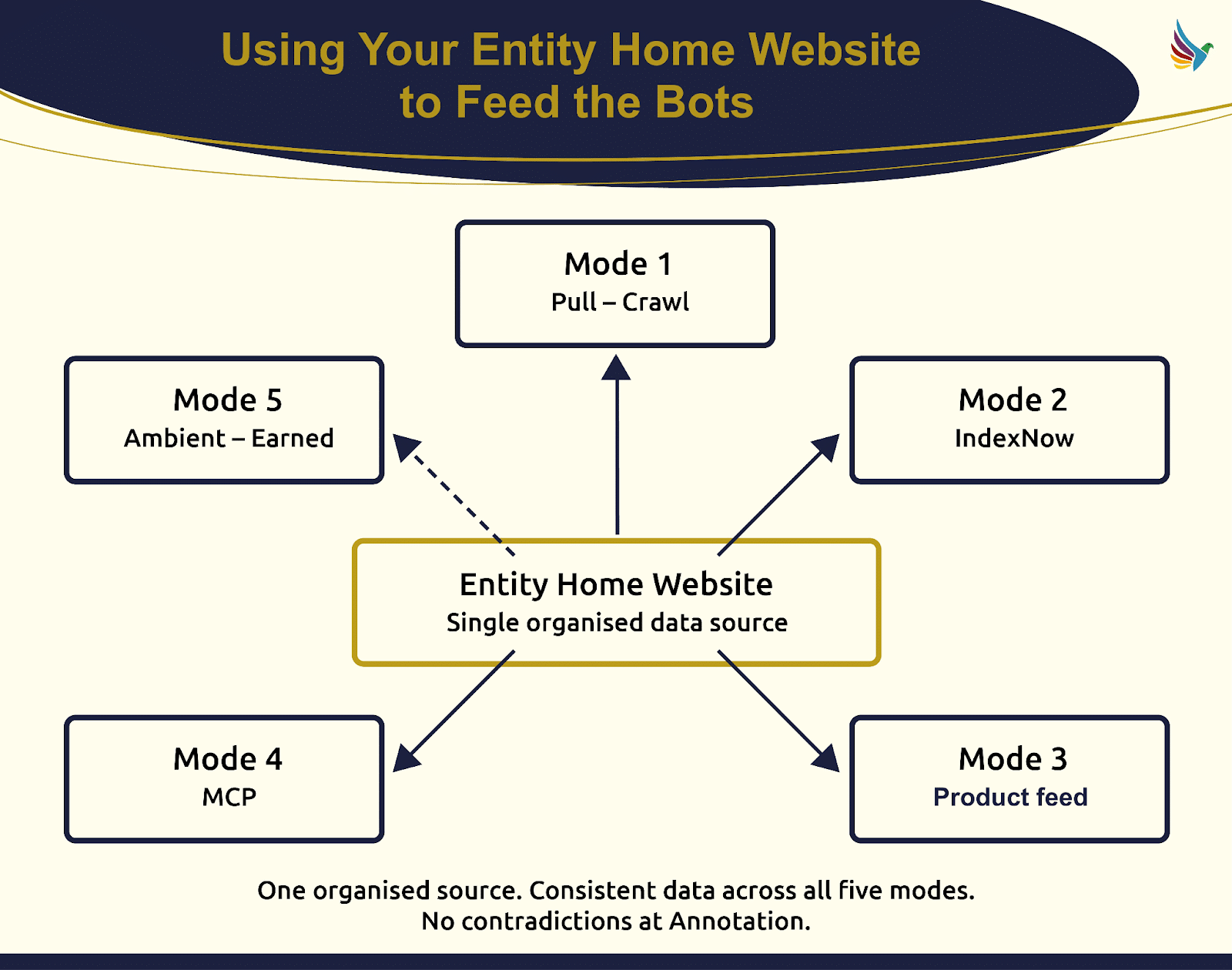
    The pull model, which depends on search bots, is no longer the only method of content discovery. We now have five modes of entry into the AI engine pipeline, and the single entry mode of the past has evolved dramatically.

    ```json
{
  "alt": "Bar chart comparing surviving signals for Mode 1 Pull, Mode 3 Push Data, and Mode 4 MCP.",
  "caption": "Explore the efficiency boost in data modes: See how Mode 3 and Mode 4 outperform the baseline Mode 1 in surviving signals.",
  "description": "This bar chart illustrates the surviving signal percentages for three data modes: Mode 1 Pull (baseline), Mode 3 Push Data, and Mode 4 MCP. Mode 1 acts as the baseline at 100%, Mode 3 surpasses it slightly, and Mode 4 achieves a significant increase, reaching over 700%. Annotations mention speeds and gate skipping specifics, with Mode 4 skipping six or more gates. This contextual data is part of a larger article series examining data mode advantages."
}
```

    I’ve identified these modes to show how they each confer unique advantages at the crucial stages of indexing and annotation, which determine a content’s competitive edge.

    First up, the traditional pull model remains, where bots fetch and decide everything. It offers no structural leverage, leaving content entirely dependent on the bot’s schedule.

    ```json
{
  "alt": "Infographic on how algorithmic confidence affects AI research modes: explicit, implicit, and ambient research with varying confidence levels.",
  "caption": "Discover how algorithmic confidence shapes the reach and effectiveness of explicit, implicit, and ambient AI research modes, impacting audience engagement.",
  "description": "This infographic details how algorithmic confidence affects three research modes in AI: explicit, implicit, and ambient research. Explicit research involves a narrow audience with low AI confidence requirements, implicit research reaches a wider audience with medium confidence needs, and ambient research targets the widest audience but demands high confidence. It highlights that most brands invest heavily at the explicit level, while the highly valuable audience is reached through ambient research."
}
```

    Next, push discovery is a proactive approach, notifying systems of new or updated content. Tools like IndexNow by Bing expedite this process significantly, allowing content to be recommended much sooner.

    Push data skips the bot entirely, using structured data to directly feed AI systems. Here, seamless indexing from a machine-readable format offers a major competitive edge.

    ```json
{
  "alt": "Diagram showing how an Entity Home Website feeds data to various modes for bots including pull-crawl, IndexNow, product feed, MCP, and ambient-earned.",
  "caption": "Discover how your Entity Home Website serves as a hub for feeding essential data to bots, ensuring consistent and organized information flow across five strategic modes.",
  "description": "This diagram illustrates the role of an Entity Home Website as a central repository for structured data, facilitating information flow across five different modes. These include Mode 1: Pull-Crawl, Mode 2: IndexNow, Mode 3: Product Feed, Mode 4: MCP, and Mode 5: Ambient-Earned. Arrows indicate the connection from the Entity Home Website to each mode, emphasizing the importance of having a consistent, organized data source that avoids contradictions in annotation. Keywords: Entity Home Website, bots, data source, SEO, IndexNow, product feed."
}
```

    Push via MCP allows AI agents to access real-time data directly, transforming how content enters the competitive arena. Brands without MCP-ready data risk losing out to those with real-time access capabilities.

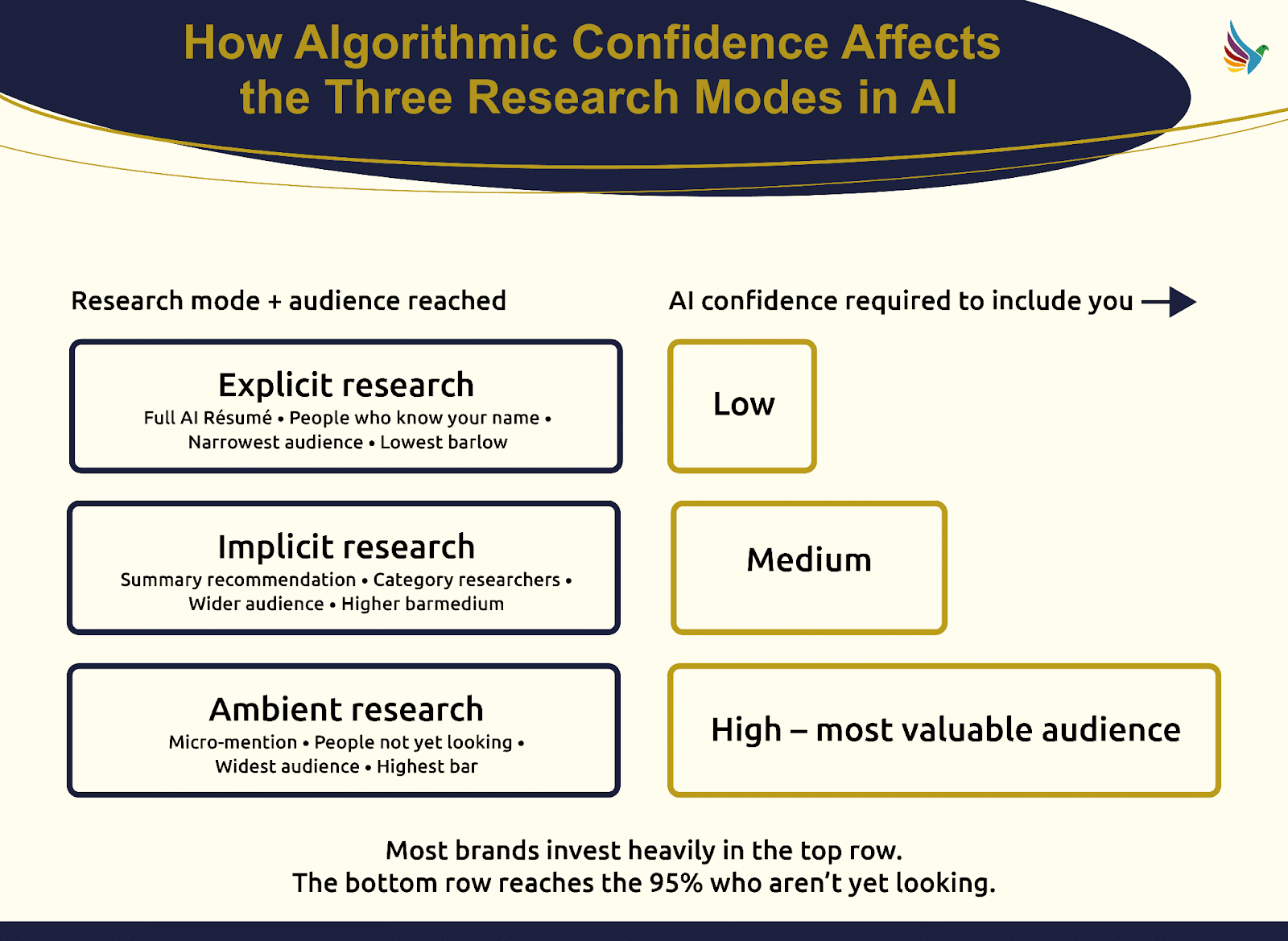
    Finally, ambient entry is about AI recommending content without explicit user queries, often seen in tools many of us use daily.

    All modes converge at the annotation phase, a critical step for successful content visibility in AI systems. As we shift focus on entity management and centralized data, brands can optimize for all entry modes, ensuring readiness for any future developments.


    Inspired by this post on Search Engine Land.


    crushpress.ai community screenshot
  • Unlock Unique Insights: Harness First-Party Data for Content Success

    Unlock Unique Insights: Harness First-Party Data for Content Success

    Have you ever wondered how to set your content apart in a competitive landscape? As a content marketer, I often face the challenge of using the same tools and data sources as everyone else, like Semrush, making it hard to create truly unique content.

    We are all casting our nets in the same pond, using identical resources to gather content ideas. The result? Overly similar content across the board. But there’s a smarter way.

    I realized that the wealth of data about my audience and customers is a goldmine, just waiting to be mined. These insights are invisible to my competitors, as they remain untouched and underutilized within my marketing team.

    I discovered how third-party tools often lead to an echo chamber of commoditized content. While essential, these tools don’t always align with what my specific audience is truly looking for, leading to a flood of generic content.

    Recognizing this challenge encouraged me to tap into my own data, creating content that appeals directly to people already interested in my services.

    First-party data is the information I need. It includes internal insights that only I have access to, such as site search queries, sales call transcripts, CRM data, support tickets, and email interactions.

    Let’s dive deeper into why this approach is effective. First-party data is proprietary. No matter how advanced a competitor’s tools might be, they can’t access my internal data, and this gives me a unique edge.

    This data reflects real buyer language, which helps me avoid assumptions based on my internal knowledge bias. I can tailor my content to match the language my audience uses.

    ```json
{
  "alt": "The CapmatchOne logo with a gradient circle and bold text.",
  "caption": "Discover innovation with the CapmatchOne logo, featuring sleek typography and a modern gradient circle.",
  "description": "The CapmatchOne logo features bold, modern typography coupled with a gradient circle, symbolizing connection and innovation. The sleek design conveys a sense of progress and creativity. This image can be used for branding or promotional purposes, appealing to audiences interested in innovative solutions and forward-thinking designs."
}
```

    By mapping this data to my entire marketing funnel, I fill gaps at every stage, driving not just traffic, but conversions and loyalty.

    How do I turn these insights into content ideas? I start with internal site searches. Examining how visitors use my site can reveal content gaps and opportunities for new offerings.

    Next, I analyze sales call transcripts and CRM data to uncover recurring themes and objections, crafting content that addresses potential buyers’ concerns directly.

    My support tickets provide another source of inspiration. By identifying common customer complaints, I create resources that help both my customers and support team.

    Lastly, I pay close attention to email replies and engagement metrics. Tracking which types of communication yield the greatest response helps me understand content preferences.

    Embracing first-party data helps my brand stand out. While competitors can mimic my content style, they can’t replicate these unique insights. Every week, I make it a point to explore a new data set and extract fresh content ideas.


    Inspired by this post on Search Engine Land.

    crushpress.ai community screenshot
  • Transform ‘What’s Wrong?’ Searches into Local Leads

    Transform ‘What’s Wrong?’ Searches into Local Leads

    I’ve discovered that local SEO struggles with visibility, not in the way most of us expect. It’s not about showing up for ‘near me’ queries or specific service keywords.

    The real issue emerges before those searches, when potential customers are diagnosing their problems and deciding on further action. This is where a significant amount of high-intent demand is overlooked.

    Despite our efforts, most local service websites rely on a standard hierarchy: a main page, then service pages, often accompanied by location-specific sections. While this setup benefits the business, reflecting its internal organization, it misses out on capturing actual search behaviors.

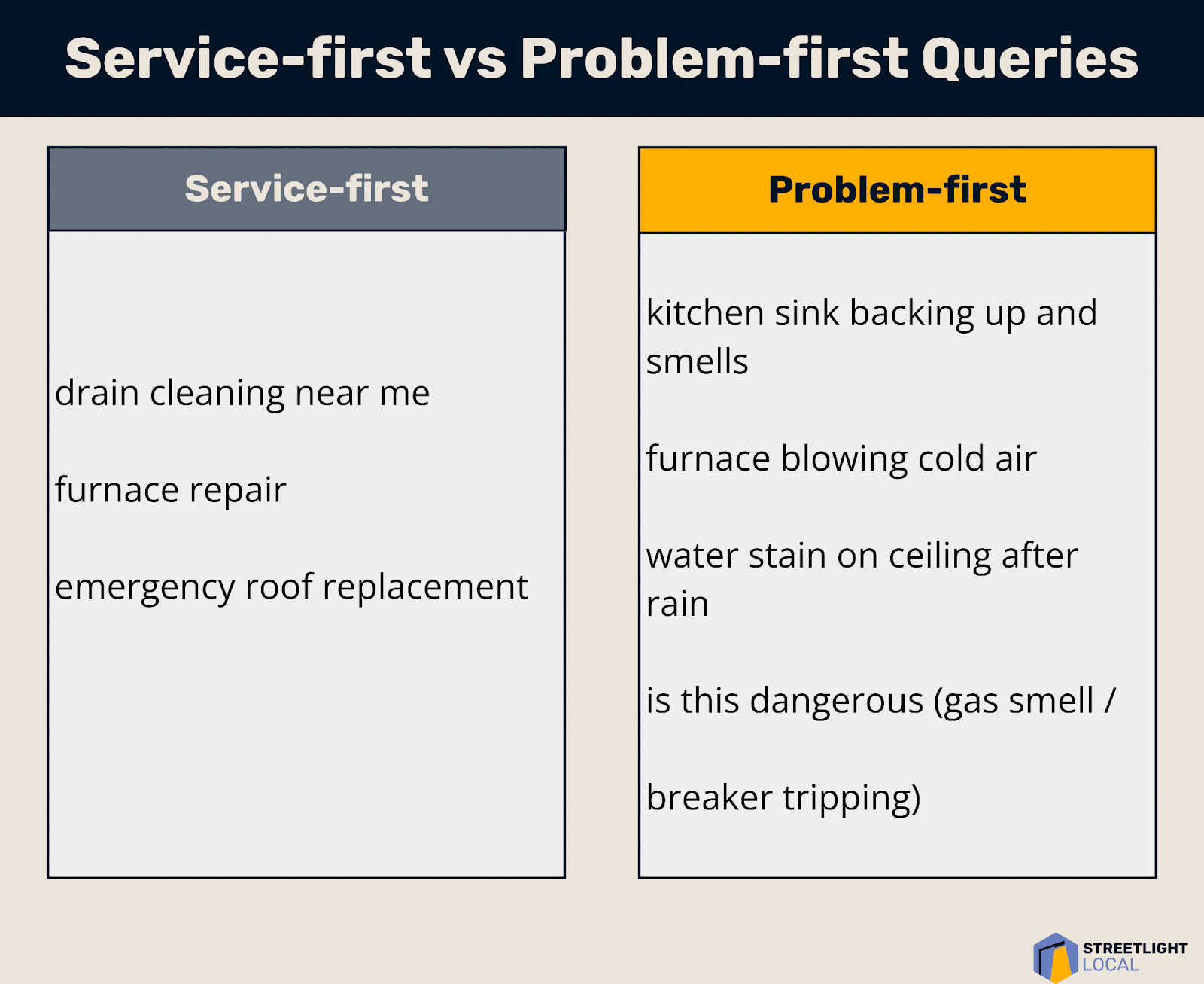
    Instead of searching for ‘drain cleaning in Brookline, MA,’ customers might be googling symptoms. They review what’s visibly wrong, perhaps thinking, ‘Why is my kitchen sink backing up?’ or ‘Why is the heater blowing cold air?’ That initial consideration often determines where they seek guidance.

    ```json
{
  "alt": "Comparison of service-first and problem-first search queries in a chart format.",
  "caption": "Explore the difference between service-first and problem-first queries with this insightful chart, highlighting how people search for solutions online.",
  "description": "This image presents a comparison between service-first and problem-first queries. The left column lists service-focused searches such as 'drain cleaning near me', while the right column features problem-specific searches like 'kitchen sink backing up and smells'. The chart aims to highlight different approaches people take when searching for home services. It includes a logo from Streetlight Local at the bottom right, emphasizing the brand's capability in understanding customer queries. Ideal for SEO and marketing strategy insights."
}
```

    By focusing only on service names, many websites fail to engage users earlier in their decision-making process. The ‘Jobs-to-be-done’ (JTBD) approach offers a practical solution to fill this gap.

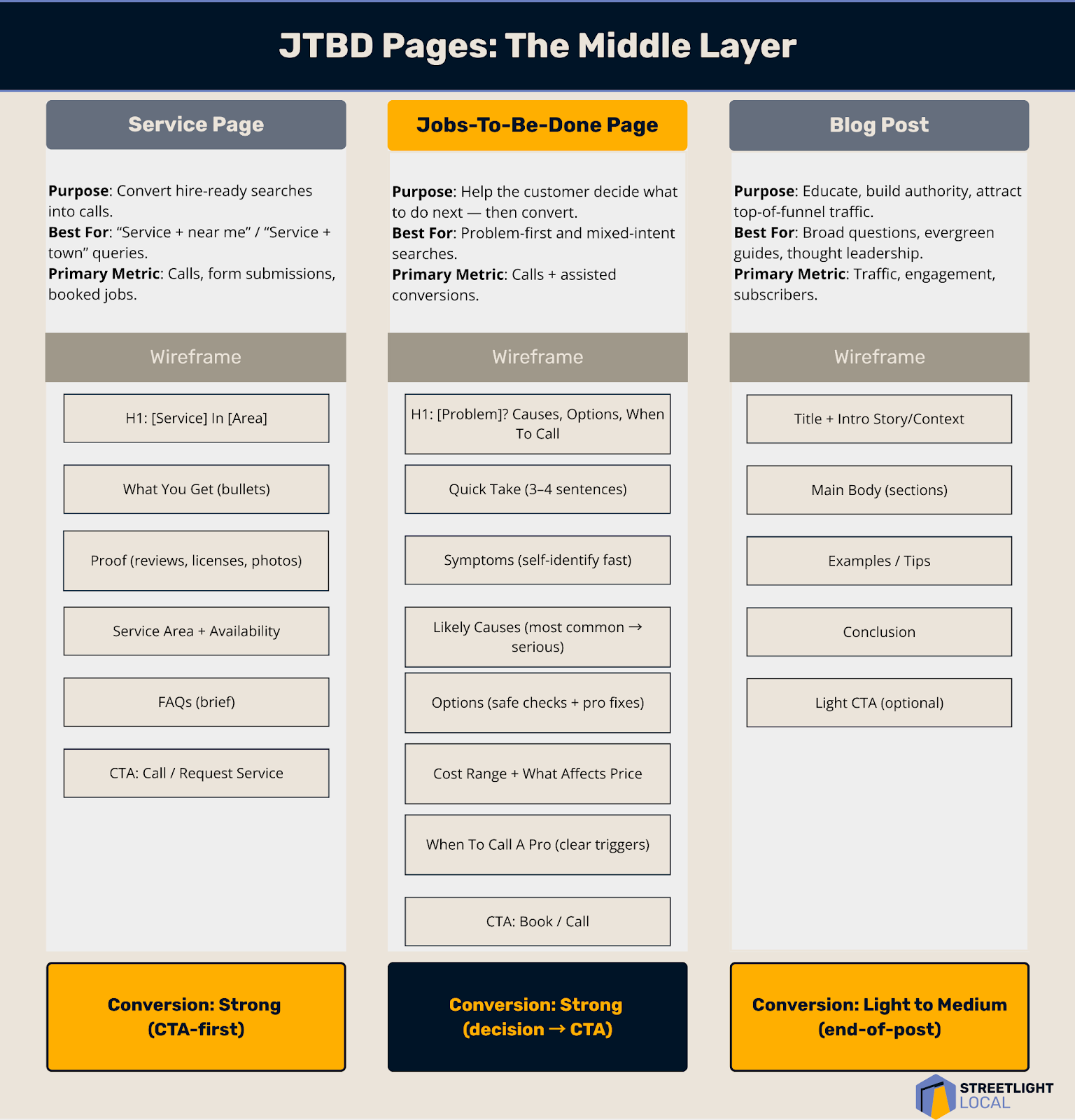
    JTBD pages focus on real-life objectives searchers are attempting to achieve — clarity on their issues and guidance on whether they need professional assistance. Unlike traditional service pages meant for direct hires, JTBD pages are structured to inform and convert visitors by supporting informed decision-making.

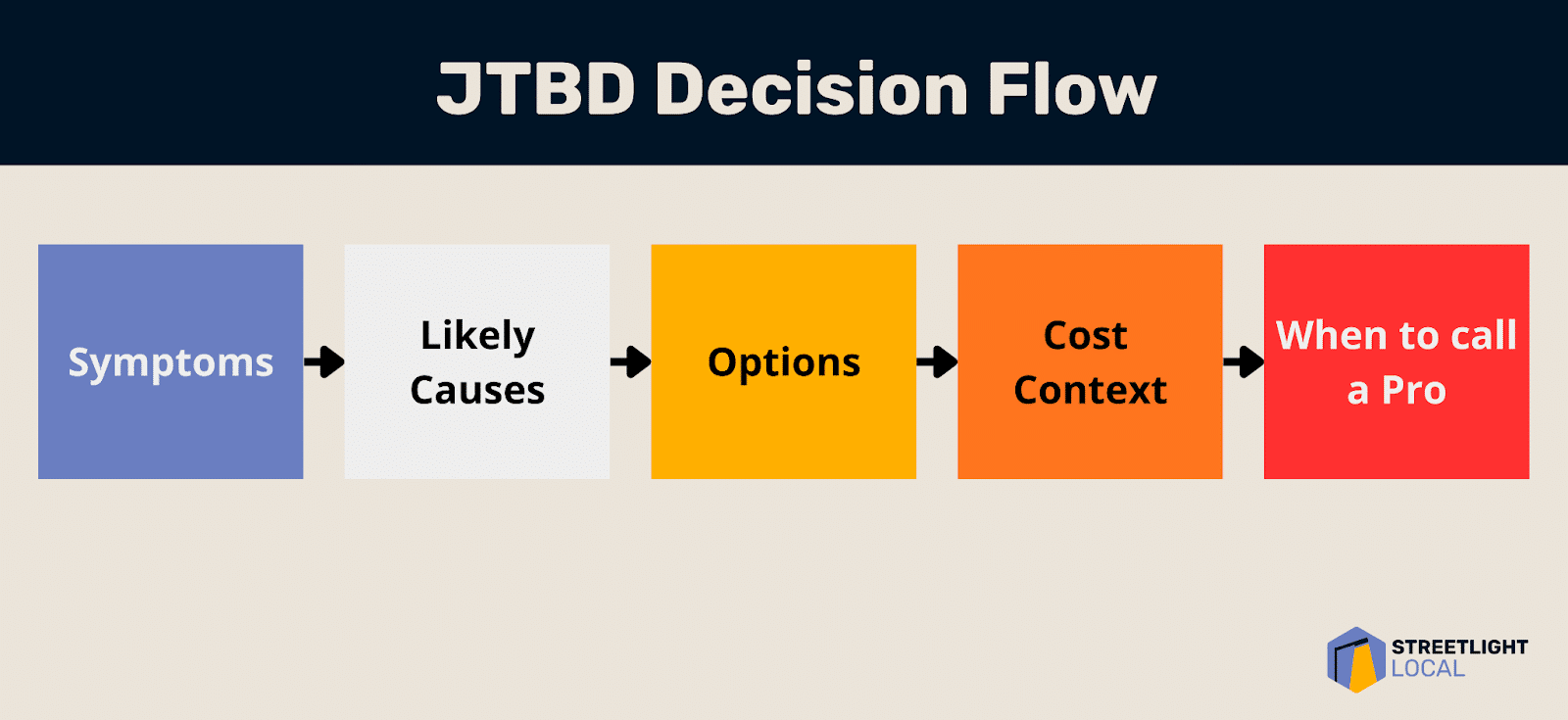
    From my experience, JTBD pages follow a logical progression akin to how a customer thinks: starting with symptoms, identifying likely causes, exploring options, and providing cost context before nudging them towards professional intervention.

    ```json
{
  "alt": "Diagram outlining JTBD pages: Service Page, Jobs-To-Be-Done Page, and Blog Post.",
  "caption": "Explore the JTBD Pages: A strategic view on how Service Pages, Jobs-To-Be-Done Pages, and Blog Posts contribute to conversions in digital marketing.",
  "description": "This diagram breaks down JTBD Pages into three types: Service Page, Jobs-To-Be-Done Page, and Blog Post, each with distinct purposes, best use cases, primary metrics, and wireframe structures. Service Pages focus on conversion through CTAs, JTBD Pages assist decision-making before converting, and Blog Posts build traffic and engagement. The image visually guides digital marketers in optimizing content strategies using defined page purposes and conversion goals."
}
```

    This front-loaded approach — beginning with symptoms — resonates more because it mirrors users’ own experiences and signals you’ve anticipated their needs.

    When explaining causes, avoid over-simplification or exhaustive technicality. I’ve found that listing potential causes in order of complexity, while subtly guiding next steps, builds trust.

    Providing options, including safe checks and pro tips, eases visitor anxiety — offering a reassuring glimpse of what hiring a professional would entail, often leading to conversions where the intent is to find relief and certainty from professionals.

    ```json
{
  "alt": "The CapmatchOne logo with a gradient circle and bold text.",
  "caption": "Discover innovation with the CapmatchOne logo, featuring sleek typography and a modern gradient circle.",
  "description": "The CapmatchOne logo features bold, modern typography coupled with a gradient circle, symbolizing connection and innovation. The sleek design conveys a sense of progress and creativity. This image can be used for branding or promotional purposes, appealing to audiences interested in innovative solutions and forward-thinking designs."
}
```

    Offering cost insights without promising exact prices is crucial. Articulating price ranges cultivates trust, informing users about possible costs without the dreaded sticker shock.

    Explicitly marking important signals for professional help enhances conversion potential. An effective JTBD page doesn’t just imply; it outlines clear triggers to engage experts.

    Placement of these pages can significantly influence their perception. Ensure they’re nested among valuable resources, highlighting their role in service solutions rather than lost in blog archives.

    ```json
{
  "alt": "JTBD Decision Flow chart with stages from symptoms to when to call a pro.",
  "caption": "Navigate the JTBD Decision Flow: from recognizing symptoms to deciding when it's time to call a professional.",
  "description": "The JTBD Decision Flow chart visually guides users through a process starting with 'Symptoms', followed by 'Likely Causes', then 'Options', considering 'Cost Context', and finally deciding 'When to call a Pro'. Each stage is represented by a distinct colored box with directional arrows indicating the flow. The design is clear and organized, facilitating decision-making at each step. Keywords: JTBD, decision flow, symptoms, professional, cause, options."
}
```

    From your most frequent customer inquiries, construct these pages around relatable search terms by engaging with real customer language and needs—this element is the linchpin of effective keyword strategy.

    JTBD pages have the added benefit of aligning with AI-driven summary requirements, improving indexing accuracy and aiding AI engagement in search results.

    Ultimately, JTBD pages close the loophole between customer inquiries and actionable business engagement. They don’t just enhance search visibility but convert curiosity into booked services, transforming local SEO landscapes.


    Inspired by this post on Search Engine Land.

    crushpress.ai community screenshot