I recently had an enlightening chat with Chloe Varnfield, a seasoned digital marketer from Atelier Studios with nearly eight years of PPC experience. She shared invaluable insights on avoiding hidden Google Ads settings, steering clear of Friday mishaps, and the dangers of following Google rep advice blindly. These hard-learned lessons resonated with me deeply.
One of Chloe’s early eye-openers involved Google’s elusive account-level automated assets setting. It’s tucked away so deeply that I didn’t even realize it existed until I got an unexpected client message questioning a bizarre headline in their ad. It turns out Google had generated it automatically. This experience taught me the importance of auditing account-level settings and being proactive about Google updates.
Another lesson Chloe swears by is to never implement significant changes on a Friday. Once, she adjusted a campaign’s geographic targeting mid-conversation, only to accidentally exclude the UK. Recovery took three bewildering days. The rule I learned? Avoid major changes on a Friday and promptly audit your campaigns when things go awry.
Chloe’s most costly mistake unfolded when she followed a Google rep’s suggestion to switch bid strategies. What seemed like solid advice plummeted her campaign’s performance. It was a stark reminder of the high stakes involved in altering bid strategies, especially for businesses not hitting conversion volume thresholds. Patience and trusting my judgment emerged as crucial takeaways.
While auditing inherited accounts, Chloe often finds recurring issues like broken conversion tracking and brand-broad match campaigns—challenges that skew performance data and waste precious budget. These insights made me acutely aware of consistently vigilant account management.
Transparency in client relationships plays a pivotal role in Chloe’s success. Honest communication—explaining issues, solutions, and next steps—has shielded her from losing client trust. Her advice? Stay calm, be kind to yourself, and remember every problem offers a chance for growth.
Lastly, Chloe emphatically warns against over-relying on AI for generating ad copy without thorough review. AI should be a tool to enhance speed, not replace meaningful human oversight. It reinforced my commitment to always infuse my unique voice and critical review into AI outputs.
I find it fascinating how AI is transforming the world of Google campaigns, particularly through tools like Performance Max (PMax) and AI Max. The reliance is shifting from long keyword lists to automation, audience insights, and machine learning, presenting new opportunities with a speed and scale beyond human capabilities.
At a recent SMX Next event, PPC experts Nikki Kuhlman from Jumpfly, Brad Geddes of Adalysis, and Christine Zirnheld from Cypress North shared insights on integrating PMax and AI Max within our broader campaign strategies. They explored how to balance automation with human input, showing where personal strategy still trumps AI.
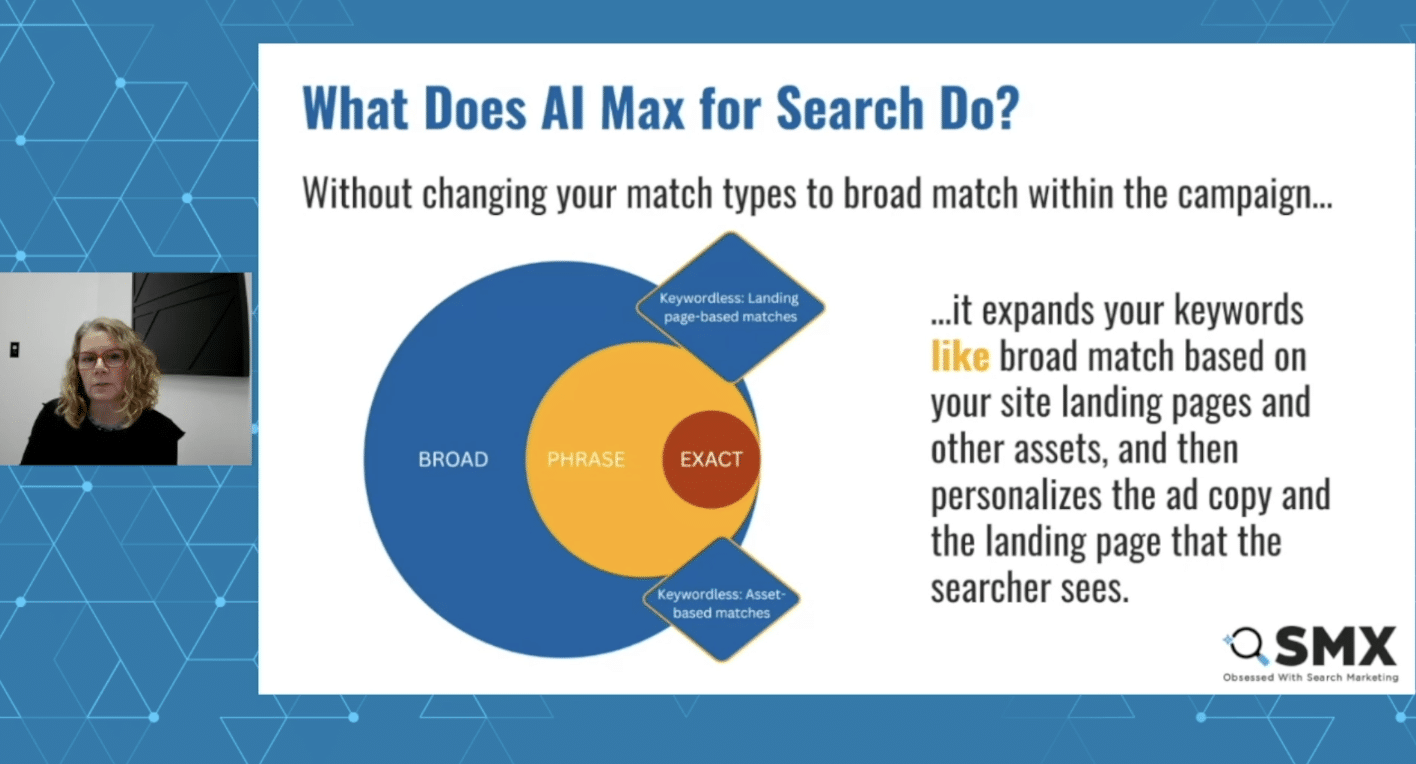
AI Max for Search is an opt-in setting that extends keywords without needing a broad match, utilizing site resources to craft personalized ad content. This approach ensures more relevant ads and landing pages that meet user expectations.
I’ve noticed remarkable results with AI Max when used in blog content, a departure from traditional Digital Search Ads (DSA) approaches. These campaigns now guide users toward specific products, not just general reading, resulting in higher conversions.
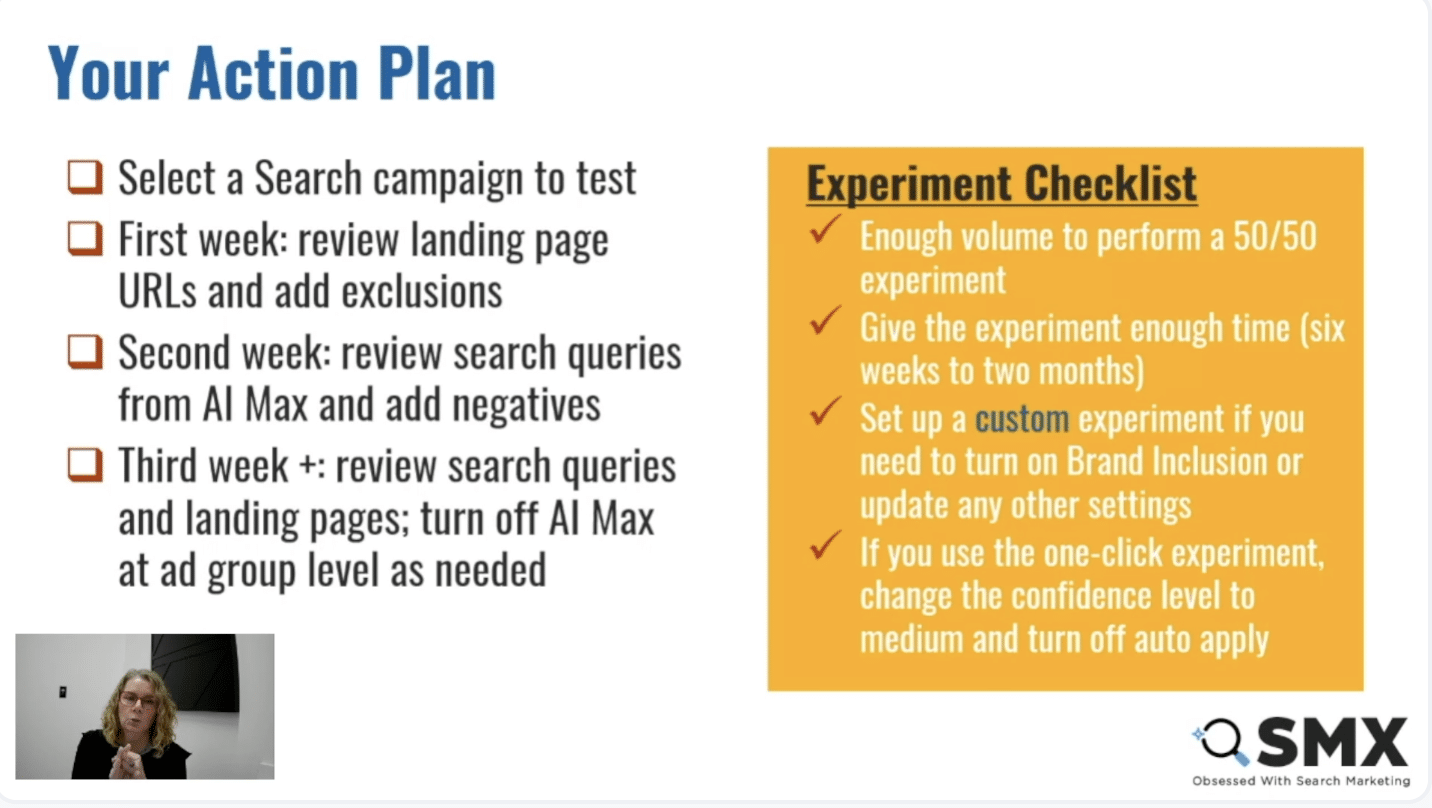
When testing AI Max for Search, experts recommend using it on established campaigns with data, starting with A/B tests rather than full-scale changes. It’s essential to monitor landing page quality and search queries, incorporating negative terms where necessary.
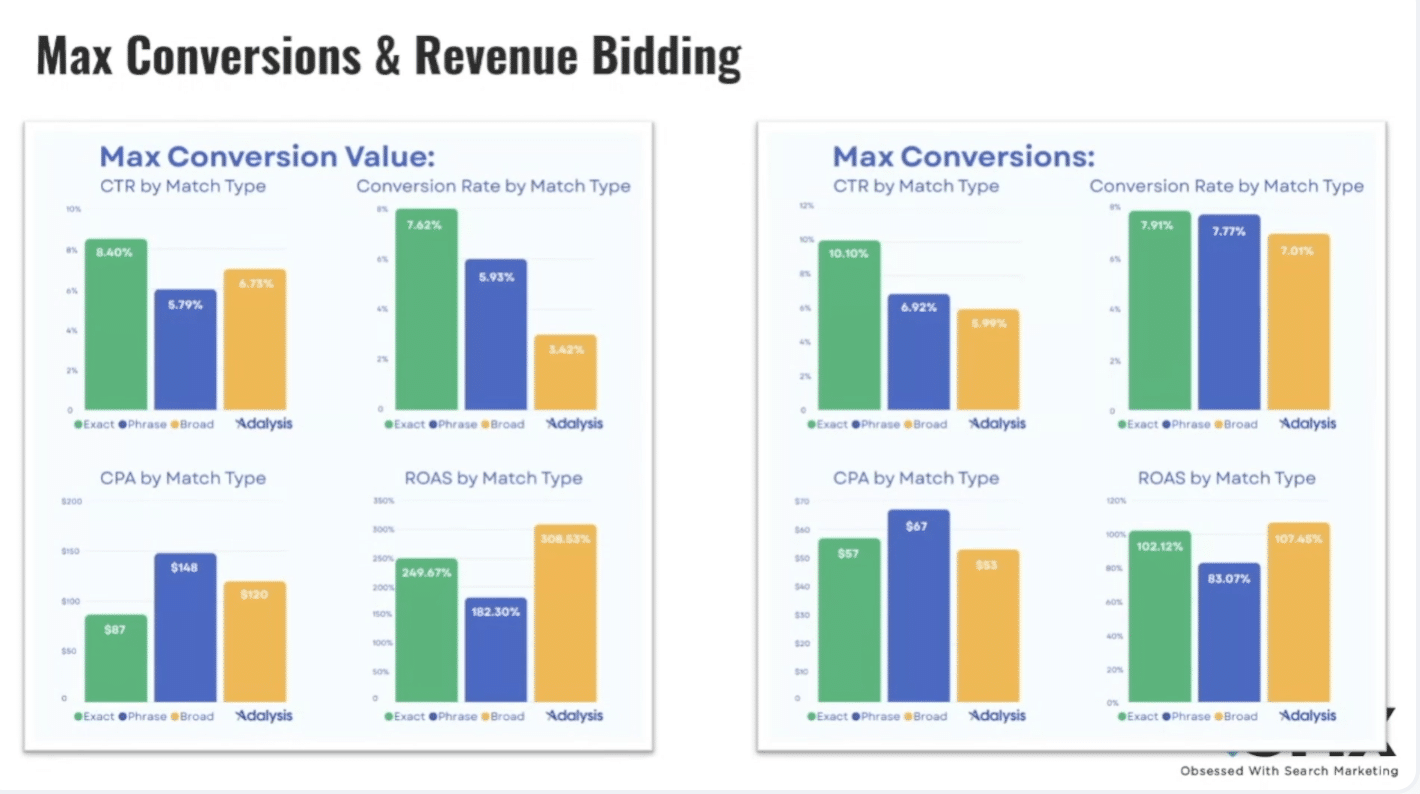
Initial experiments in match type performance suggest exact match tends to deliver the best conversion rates, especially in campaigns with robust data volumes. However, broad match can be surprisingly effective when data is scarce, thanks to its ability to leverage previous user search history.
For those working within ecommerce, broad match might yield higher average order values from shoppers still exploring their options, even if conversion rates dip.
PMax has shown its potential in lead generation, contrary to common belief that it suits only ecommerce. The key is aligning campaign goals with true bottom-of-funnel conversions rather than mere form submissions.
With increased control options, PMax is now viable even in regulated industries. Device control features, for instance, are a strategic advantage for B2B campaigns, allowing targeted CPA adjustments across different platforms.
AI Max for Search is showing early promise in financial services, where it outperforms standard search despite being in a highly competitive keyword environment. This showcases AI Max’s potential to deliver better quality leads throughout the conversion funnel.
Ultimately, the future of PPC lies in a strategic blend of AI-driven tools and human oversight, ensuring campaigns are optimized not just for immediate conversions but long-term success. By correctly applying automation, we can achieve unprecedented results in search campaigns.
After conducting a thorough comparison of over 35 SEO agencies focusing on AI startups, I’ve ranked them based on five crucial factors. Each agency was evaluated to identify their capacity in rapidly evolving markets.
The criteria used in this assessment include:
Notable Clients (35%): Agencies were assessed based on their clientele, specifically those in AI and software startups, highlighting their proficiency in adaptable markets.
Leadership Experience Score (25%): A score from 1-5 that evaluates the leadership, focusing on their history in marketing and tech startups.
Average Reviews (25%): Agency performance was rated from 1-5, weighted more by reviews from AI firms.
Company Size and Year Founded (15%): While not as critical, company size and longevity are indicative of sustainable growth and enduring success.
The top agencies are displayed below, noting their rankings, headquarters, and SEO specializations.
Tech-focused marketing services centered on modern marketing channels like SEO, short-form video, and social media
First Page Sage
At First Page Sage, we’re leading the field with innovative SEO and generative engine optimization strategies tailored for AI companies. Our robust content production helps AI firms solidify their authority, with proven success on Google and AI platforms like ChatGPT.
“First Page Sage provides top quality content marketing with competent teams possessing specialized industry knowledge. Clients report measurable organic results within year one that significantly increased online leads.”
Clay Agency
Specializing in the technical side of SEO, Clay Agency excels in branding and UX/UI design, making them perfect for AI companies aiming to unveil products or services interactively and refresh their image in the AI realm.
“The Clay Agency worked as an extension of our own team, delivering an interface that clients are extremely proud of. Their tech-savvy teams are familiar with market trends, creatively tackling technical challenges.”
Marketing Eye
At Marketing Eye, we focus on technical SEO for tech firms, including website auditing and keyword analysis. Besides technical services, we also manage content and social media campaigns, particularly in the retail sector, while also supporting various tech companies.
One of the more established names here, our lean team thrives on blending marketing expertise with computing acumen, ensuring continued prominence in the field.
“Marketing Eye provides superior service, delivering measurable growth. Their teams are competent and professional but might require additional training.”
RNO1
RNO1 specializes in digital branding and product design for tech, AI, and commerce brands, offering technical SEO, market research, and services like AR/VR and Web3, distinguishing them from others.
Notable Clients: Prive, TakeUp, Fluxa
Leadership Experience: 3.5
Company Size: 51-100
Year Founded: 2018
Headquarters: Seattle, WA
Average Reviews: 4.2
Main Focus: Market research and UX/UI design for SaaS Companies
“RNO1 offers a redesigned website praised by users, but their teams sometimes rely too much on online management over direct communication.”
REQ
With REQ‘s expertise in branding, PR, and reputation management, we’re ideal for companies launching new products. While primarily focusing on branding and PR, our SEO services complement traditional marketing strategies effectively.
Notable Clients: Katabat, Verint, ActiveNav
Leadership Experience: 3.8
Company Size: 51-100
Year Founded: 2008
Headquarters: Washington, DC
Average Reviews: 4.3
Main Focus: Branding and UX focused SEO for tech companies
“REQ provides an excellent SEO analytics department that improves client reporting visibility and dramatically raises CTR, though improvements are needed in web development and response speed.”
Optimizely
Optimizely focuses on optimizing web pages through A/B testing, multivariate testing, and personalization, perfect for companies with solid content needing enhanced technical support.
Notable Clients: Google Cloud, Salesforce, New Era
Leadership Experience: 3.8
Company Size: 500+
Year Founded: 2010
Headquarters: New York, NY
Average Reviews: 4.0
Main Focus: A/B Testing, Mobile optimization, Conversion Rate Optimization
“Optimizely offers an intuitive UI that integrates easily, though lacking in extensive server-side testing capabilities.”
Directive Consulting
Directive Consulting excels in PPC and tech-focused marketing, offering performance-based campaigns that blend paid services with SEO to enhance visibility.
Notable Clients: Amazon, Snap Inc
Leadership Experience: 4.0
Company Size: 50-249
Year Founded: 2014
Headquarters: Irvine, CA
Average Reviews: 4.8
Main Focus: Tech-focused marketing services centered on modern marketing channels like SEO, short-form video, and social media
Today, I’m excited to share that Yahoo has rolled out MyScout, a new and personalized homepage within its Scout AI platform. This feature transforms Yahoo’s AI search into a daily dashboard tailored just for me.
How MyScout Works. As a logged-in user, I have the power to customize my homepage with tiles that gather information from various Yahoo properties like Mail, News, Sports, Finance, and Games. Here are some of the features I find useful:
Inbox previews from Yahoo Mail.
Live stock updates from my Yahoo Finance watchlists.
The latest news topics and trending stories.
Scores and schedules for my favorite sports teams.
Weather updates, shopping comparisons, and fun games.
I can easily add, remove, reorder, or create tiles to follow topics or queries that interest me.
Certain tiles provide real-time updates, like stock prices.
Others refresh throughout the day with new emails, sports scores, and breaking news.
As the system learns from my activities, it promises a more “agentic and personalized” experience.
New Publisher Features. Yahoo emphasizes supporting the open web by directing users to the original sources of AI-generated answers. With this goal in mind, Yahoo News introduces new publisher features to help grow my recurring audience:
Publisher brand pages that consolidate my articles, videos, and social media feeds on Yahoo.
A follow feature allowing users to subscribe to my content and receive curated newsletters in their inbox.
Availability: MyScout, part of Yahoo Scout, is now in beta for U.S. users at Scout.com and through the Yahoo Search app on iOS and Android.
PPC is becoming an increasingly difficult landscape to navigate, and even though AI provides some help, it doesn’t save the day. Meanwhile, platform transparency continues to decline, leaving us in the dark about budget management.
The latest survey of PPC professionals reveals a challenging environment characterized by less transparent platforms, diminishing effectiveness of traditional measurement methods, and AI tools that have yet to revolutionize our daily routines.
Why I care. As someone deeply invested in PPC, it’s notable that over half of practitioners (53%) believe PPC has become tougher compared to two years ago. The issue isn’t just competition; it’s the increasing number of decisions being made by platforms out of advertisers’ view, which contributes to this growing complexity.
Considering that a whopping 89% of digital ad spend goes to just three companies, those of us who don’t have private measurement tools are essentially navigating without a compass.
By the numbers:
1,306 respondents participated in the survey conducted between November and December 2025, representing agency, freelance, and in-house roles.
62% identified platform opacity as the main reason for increased PPC complexity, with 53% pointing to the loss of effective measurement tools.
5.2 hours/week are saved on average with AI tools, though the majority of us (55%) save only 1–5 hours; almost nobody reports saving over 20 hours.
59% are now using LLMs for ad copy, up significantly from 42% the previous year, marking it as the fastest-growing AI use case.
73% of in-house teams now manage PPC entirely in-house, a significant increase from 44% two years ago.
20% of clients are considering replacing agency work with AI, compared to just 12% planning to switch agencies.
$1 trillion was spent globally on digital ads in 2025, with 89% directed towards Google, Meta, or Amazon.
What they’re saying. Among PPC features, exact match keywords remain the most reliable, with 75% of us using them frequently. However, AI Max for Search sees minimal adoption, with 34% never having used it, possibly due to it being one of Google’s newest updates. Across the board, auto-apply recommendations are viewed with skepticism.
Between the lines. The underlying theme in the report revolves around agency survival. Many of us (62%) highlight the challenges of finding talent and increasing revenue, with the real threat being clients opting to manage PPC internally using AI.
The big picture. We’ve developed a cautious yet practical approach to incorporating AI — leveraging it for tasks like copywriting and research while being wary of its ability to make autonomous decisions. The more pressing issue that remains unaddressed is that platforms are gaining control and giving us less control over visibility, with no easy solution on the horizon.
As a marketing professional, I’ve experienced various identity crises in my journey. Initially, I was just a channel expert, then an integrated marketer, and eventually evolved into roles like growth and performance marketing. And then, AI became a buzzword that sneakily entered everyone’s job description.
Now, I find myself stepping into the era of the full-stack marketer, especially as a media leader. It’s strikingly similar to adopting a product management mindset.
Don’t worry, this doesn’t mean writing Jira tickets for fun (though some of us might enjoy it). It actually signifies that the most successful media leaders will not just focus on campaign optimization. They’ll take ownership of outcomes, foster cross-team connections, and holistically enhance the entire user experience, from first contact to final conversion and beyond.
In the sectors I’ve engaged with, especially those with extensive consideration cycles and rising acquisition costs, the link between marketing performance and the user experience is evident.
Let’s explore what spurs the rise of the full-stack marketer, what it truly means to “think like a product manager,” and why this mindset is essential for media leaders today.
What is a full-stack marketer, anyway?
From my perspective, a full-stack marketer knows the importance of how various elements mesh together, rather than trying to juggle everything solo, which inevitably leads to burnout.
Reflecting on my career, truly impactful media decisions are never born from expertise in a single channel. Instead, they stem from a broad fluency, inclusive of:
Media and channels: Understanding paid search, paid social, SEO, email, SMS, and staying abreast of upcoming trends and platforms.
Creative and messaging: Grasping what resonates, where, and why.
Data and analytics: Diving beyond dashboards by asking insightful questions.
UX and CRO: Identifying friction, intent, and behavior patterns.
Technology and platforms: Utilizing CRMs, CMSs, automation tools.
The full-stack marketer’s goal isn’t to become an all-knowing expert in every facet. Instead, we aim to gather sufficient knowledge to connect insights and make informed decisions by consistently zooming out and then zooming in whenever necessary.
Why media leaders are evolving into product thinkers
As I reflect on my earlier career, media leadership often revolved around meeting CPA targets and efficiently allocating budgets. These metrics mattered, and they still do.
Yet now, the landscape demands tackling larger, more complex questions like declining conversion rates or mysterious pipeline drop-offs, which oftentimes are product questions by nature.
Product managers focus heavily on the comprehensive experience — the user journey, friction points, trade-offs, and ultimate outcomes. Adopting this mindset encourages media leaders to view campaigns as part of a larger ecosystem, influencing our decision-making significantly.
Media doesn’t live in a vacuum
Marketing performance isn’t isolated. In many sectors, particularly those with extended decision cycles, a click represents merely the beginning of an intricate journey.
Industries such as financial services, healthcare, and education involve buyers moving through nonlinear paths, impacted by numerous interactions. This scenario is where the full-stack mindset becomes crucial.
Example 1: When media isn’t the problem, the experience is
I’ve frequently heard the claim “The platform is getting more expensive” when performance metrics drop. But as a product-minded media leader, I delve deeper into possible reasons, asking:
Has the conversion path recently changed?
Were additional steps or fields introduced?
Is mobile traffic directed to a non-responsive desktop?
In numerous instances, I’ve observed promising intent followed by a sharp decline at the conversion breather, a sign of a flawed product experience rather than a media issue.
For example, in higher education, potential students exhibiting strong intent may encounter roadblocks due to lengthy or unclear application processes. This often has less to do with the marketing campaign and more with the experience provided.
Here, the role of a full-stack marketer is to highlight these challenges, bring data insights to the table, and work cross-functionally to tackle and resolve these issues.
Example 2: Different audiences, different ‘products’
One vital product lesson is that not every user is the same, and thus, shouldn’t be lumped together.
Different audiences possess distinct motivations, risk profiles, and decision timelines. Viewing them as a homogenous group often leads to mediocrity.
I’ve discovered industries like healthcare — where patients, caregivers, and referring providers require individualized approaches — are perfect examples. Similarly, in financial services, decisions vary greatly depending on the individual’s life stage and goals.
A full-stack marketer tailors their media strategy, from messaging to channel selection, understanding that product-market fit is key, not just audience targeting.
Example 3: What happens after the conversion
A common blind spot in media strategies is post-conversion tracking. Product thinkers probe into the depths of:
How prompt and personalized the follow-up is.
Whether the messaging aligns with campaign promises.
I’ve witnessed enhanced performance with simple changes like improving lead response times or ensuring follow-up messages match campaign intentions.
Healthcare stands out in illustrating these principles, showing how vital immediate follow-up and aligned customer experiences can be across workflows.
Thinking in roadmaps
Roadmap thinking — prioritizing initiatives by impact — is another core aspect of product management. Similarly, full-stack media leaders prioritize marketing efforts accordingly.
Instead of pursuing every new shiny channel, we focus on sustainable progress, often by mapping out phases, such as:
Product managers don’t merely view metrics at face value; they challenge them. Being similar in nature, media leaders should mirror this approach, asking:
“Which segments convert faster?”
“How does performance vary across regions or stages?”
“Are engagement signals reflecting readiness or curiosity?”
In higher education, for example, dissecting performance by program or brand intent helps sharpen our strategies, turning data into actionable insights.
Collaboration is the new superpower
Full-stack marketers are naturally collaborative. In education, achieving success requires coordination across various departments including admissions and IT. In this role, we don’t just fulfill requests; we help partners navigate choices and establish shared objectives.
Translating data into actionable narratives becomes part of our collaborative toolbox and is essential in breaking down silos.
So, what does this mean for tomorrow’s media leaders?
The rise of the full-stack marketer doesn’t mark the end of specialization. It’s about seeing the broader structure rather than just optimizing single elements.
In my view, tomorrow’s media leaders should:
Understand the business driving their campaigns.
Think beyond their specific channels.
Advocate sincerely for user experiences.
Use data thoughtfully for influence.
Embrace change and unpredictability.
In industries where trust, timing, and transformation are integral, this mindset is vital. Marketing is about more than just campaigns — it’s about guiding pivotal life choices. If you feel like your media leadership role is expanding, that’s because it is — and rightfully so!
Recently, I’ve been diving into McKinsey’s ‘Organize to Value’ strategy, a fascinating blueprint for transforming marketing into a positionless model. According to a comprehensive analysis, it’s not technology that’s holding back operational transformations; it’s unclear objectives, uncommitted leadership, and a stagnant culture that are to blame.
Implementing new AI technologies to drive marketing efforts seems simple. However, the real challenge lies in empowering marketing teams to utilize these tools independently, decisively, and at scale. The primary obstacle? It’s us, the humans.
For as long as I can remember, marketing teams have aimed to keep up with consumers, delivering timely, relevant messages and optimizing customer lifetime value to boost loyalty and ROI. While this goal isn’t new, the AI technologies that help us analyze data and create personalized messages at scale are continuously evolving. Unfortunately, our ability to fully harness this technology has fallen behind.
Despite these challenges, progress is being made. Some marketing teams have overcome these hurdles, yielding remarkable results. Take Caesars Entertainment for example. They reduced campaign execution time from five days to just five minutes. As Asadul Shah, the vice president of player revenue strategy notes, this transformation was ‘a massive game changer.’
Before their transformation, marketers at Caesars manually built targeting lists and coordinated efforts across disconnected systems, often waiting on multiple teams before launching campaigns. This made it difficult to target players with precision and timing. By partnering with Optimove, Caesars combined data, orchestration, and execution into a single platform. This change didn’t just improve efficiency; it allowed the marketing team to react more dynamically to players’ needs.
What truly made this transformation effective wasn’t just the technology—it was the implementation of Positionless Marketing. This framework liberated marketers from fixed roles, empowering every team member to act independently. Optimove provided the platform, while Caesars developed the necessary team structure. This synergy of technology and human ingenuity brought Positionless Marketing to life.
Organizations that achieve such transformation are embodying what McKinsey describes as ‘organizing to value.’ This involves a deep rethinking of structure, decision-making, and accountability, transforming marketing teams into operations that continuously drive value—ultimately optimizing customer lifetime value, fostering loyalty, and delivering measurable ROI.
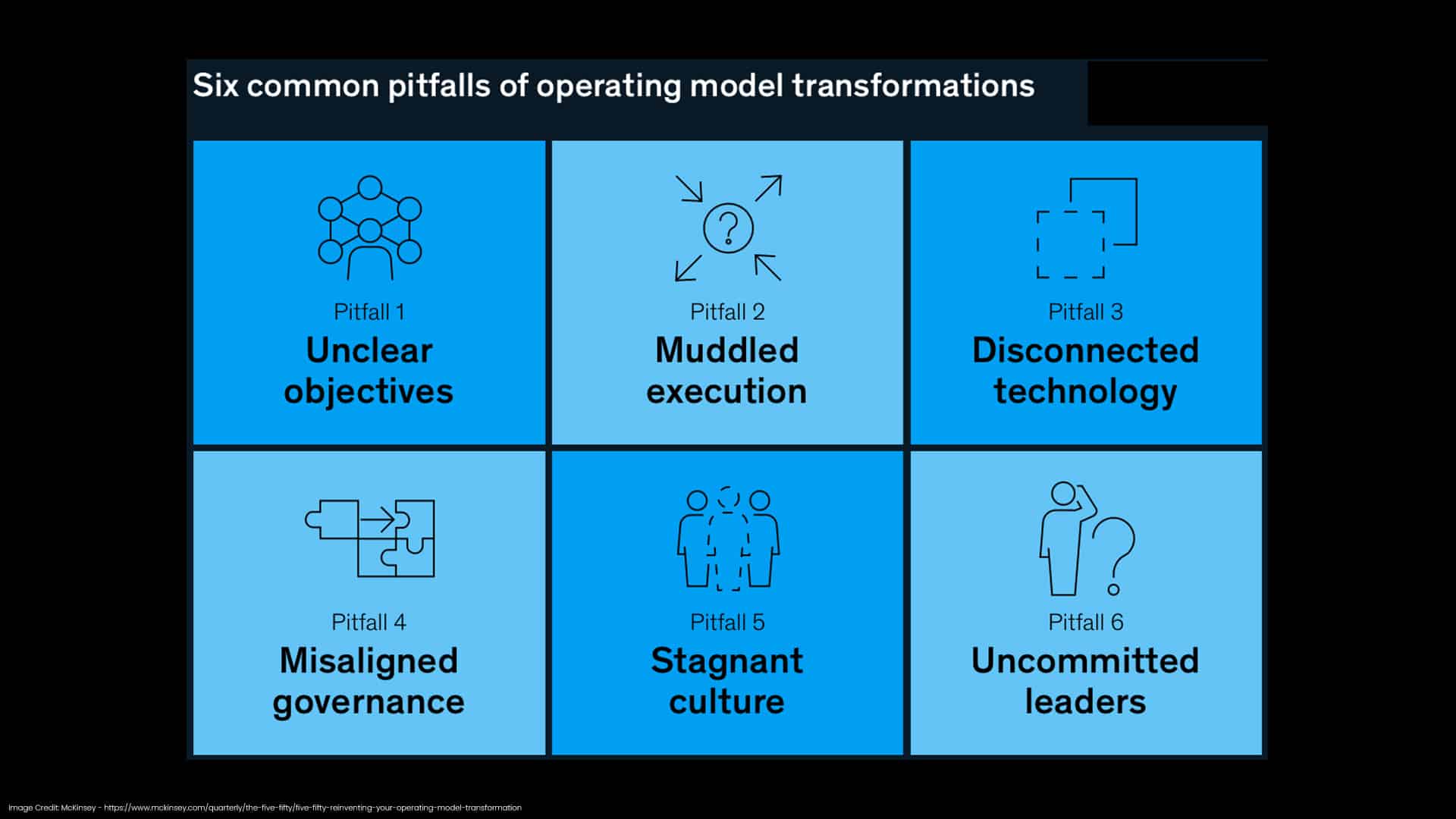
Yet, McKinsey highlights six pitfalls many teams face when trying to adopt the Positionless model, with only one being technological. The rest involve leadership and organizational issues.
Some key barriers include unclear objectives causing a focus on activity metrics over outcomes, misaligned governance that slows decision-making, and leaders who reinforce silos instead of enabling autonomy. Other obstacles are a stagnant culture resistant to change, muddled execution with no clear accountability, and disconnected technology further compartmentalizing efforts.
This kind of ‘assembly-line’ marketing, where tasks are segmented among different teams, hinders value creation. Peter Drucker famously said, “The purpose of business is to create and keep a customer.” However, when insights, creativity, and activation are siloed, value gets lost in between.
McKinsey’s ‘Organize to Value’ offers a practical path forward. It suggests designing organizations around value creation and impactful outcomes, rather than rigid job titles and processes designed to control.
To truly embrace Positionless Marketing, leaders must apply pragmatic solutions focused on improving marketing execution. This involves starting with a clear purpose, restructuring work to emphasize outcomes, streamlining decision-making processes, and aligning governance, technology, and talent. It empowers marketers to transcend traditional roles and independently deliver results.
This transformation requires commitment but staying with an outdated assembly-line structure is even costlier. Organizations like FDJ United and a major retailer have already seen the benefits: improved execution speed, increased purchase rates, and better use of resources.
As I see it, the window to act is narrowing. AI and data technologies are advancing rapidly, and customer expectations for personalized experiences are growing. Those who are quick to adapt will stay ahead, while those who hesitate may fall behind.
McKinsey’s insights confirm that the right structure and technology can unleash human potential, transforming marketing from within. Positionless Marketing is more than a strategy; it’s the future we need to embrace.
I’ve been following the latest updates from OpenAI, and they recently made some significant changes to their privacy policy, especially with the introduction of ads in ChatGPT. These updates are designed to allow advertisers to run personalized ads while ensuring that our chats remain private and secure.
OpenAI shared these updates with ChatGPT users, detailing how ads will function within the platform and clarifying what data is accessible to advertisers. It’s a refreshing assurance that our personal interactions remain confidential.
Why this matters to me. Privacy is paramount, and OpenAI emphasizes that personal chats and histories remain shielded from advertisers. They utilize anonymized engagement signals for ad personalization, ensuring advertisers can target relevant users without accessing sensitive information.
This method allows advertisers to evaluate the performance of their ads within a privacy-first framework, fostering user trust.
Ads in ChatGPT For users like me on Free and Go plans, ads might start appearing, but if you opt for paid tiers like Plus, Pro, Enterprise, Business, and Education, you can enjoy an ad-free experience. OpenAI promises clear labeling and separation of ads from chatbot responses.
Importantly, the content generated by ChatGPT remains unbiased and unaffected by these advertisements.
How ad targeting is handled. OpenAI uses in-platform signals such as ad interactions to personalize ads, but advertisers do not get access to our conversations, chat histories, or personal information.
Advertisers receive only aggregated metrics like total views or clicks, ensuring our personal data stays protected.
Additional privacy updates A new feature allows for optional contact syncing, helping us connect with friends who also use OpenAI services. It’s up to us whether to enable this feature.
They also provided more transparency on data storage durations, processing methods, and user control options, helping us understand our data management better.
Safety and product enhancements. The update encompasses new safety tools and age prediction systems aimed at ensuring a safer environment for teenagers. Documentation for new features like Atlas, Sora 2, and parental controls for teen accounts has also been included.
The bottom line. With the expansion of advertising in ChatGPT, OpenAI is committed to maintaining strict boundaries concerning user privacy, offering advertisers valuable insights without infringing on personal conversations or data.
This update was first spotted by Paid Media expert Arpan Banerjee, who shared insights on LinkedIn. It’s a promising move towards privacy-centric advertising in AI-powered platforms.
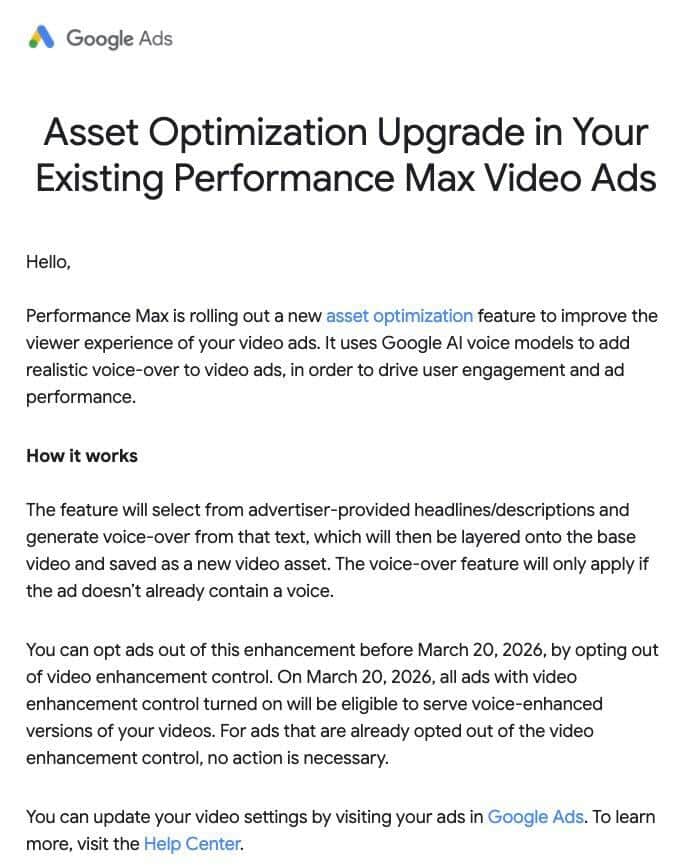
Have you heard the news? Google Ads is taking the advertising world by storm with its latest feature: AI voice-over for Performance Max video ads! They’re rolling out this innovative enhancement, automatically narrating video ads with realistic voice-overs, unless, of course, we choose to opt out by March 20.
Google is enhancing viewer engagement and ad performance by utilizing advanced AI voice models. This update will make ads more appealing without any additional creative output on our part. Exciting, isn’t it?
Why this matters to us. If we don’t actively opt out by March 20, our video ads will automatically benefit from Google’s AI voice models. This could transform how our ads sound to viewers, all without any creative effort on our part.
How does it work?
This feature kicks in only when videos lack a voice track.
Google’s AI chooses text from the headlines and descriptions we’ve provided and crafts a realistic voice-over from it.
The voice-over is seamlessly layered onto the original video, transforming it into a new asset.
The catch. This process is set to default, meaning our ads will be automatically eligible for voice enhancements unless we opt out proactively.
Key dates. We have until March 20 to decide if we want to exclude our ads from this feature. To step back from this feature, we need to adjust the video enhancement control settings. After the deadline, any ad with video enhancement control will be open to voice-enhanced updates automatically.
Action steps for us as advertisers. Configuring our video settings is simple. Just visit your Google Ads portal to make any necessary adjustments.
First seen. This update was brought to light by Paid Search specialist Arpan Banerjee in a LinkedIn post. Take a look at his insights here.
Automation and AI are revolutionizing the PPC landscape. Now, PPC teams are transforming into data teams, mastering data infrastructure, measurement, analysis, and experimentation.
Like many people, I worry about AI taking over jobs. Where do my ‘old school’ PPC skills fit in an AI-dominated landscape?
Relax. It’s not a binary situation. The shift is towards data and strategy. Media buying might look automated from the outside, but don’t be misled. The role is simply evolving once more.
Having been in PPC for over 15 years, I’ve learned that there’s nothing to fear. The real question is: am I riding the wave or getting left behind?
Let’s explore what the current PPC landscape looks like with ad network automation, and more importantly, where today’s PPC teams truly add value.
The Return of the Technical PPC Team
A decade ago, technical PPC agencies distinguished themselves by developing scripts, managing data on a large scale, and overseeing complex structures. As automation matured, many teams pivoted towards strategy and creativity.
Now, with AI’s help, producing quality creatives or analyzing massive datasets to create strategies is easier than ever. However, these outputs aren’t flawless.
From a client’s perspective, the typical creative-centric or strategy-focused agency might be out of the game. Therefore, rejoice, PPC folks: the technical edge is back, albeit in a different form. It’s time to bring back the spreadsheet enthusiasts from the 2010s who can now drive the PPC industry forward.
Still skeptical? Let’s rewind and get a clearer view of the necessary skill sets.
The PPC Edge: From Spreadsheet Skills to Data Nerds
Today, successful PPC agencies sell something vastly different than a decade ago, though the core mindset remains the same.
Why? Let’s consider the key performance drivers nowadays:
Integrating down-funnel data into strategy.
Building a data infrastructure to support strategy.
Providing accurate signals to ad algorithms.
Building systems to scale operations, including creative tasks.
See the pattern? A broken data model can’t be solved just by prompts. This is your advantage, what clients value most. Automation enhances the value of technical literacy rather than diminishing it.
Who do you turn to for technical literacy? The seasoned PPC marketers who thrived on manipulating paid search ads using custom Excel macros or managing extensive product feed items. They have the mindset: a love for automation, data, and math.
1. Data Engineer
The data engineer builds and maintains the infrastructure. Although they might come after the tracking specialist in the data chain, they are central, which is why we mention them first.
In today’s multi-platform world, think of CRM integration with Google Ads or blending online and offline data sets to strategize effectively.
Without a comprehensive data model, strategies become vague gut feelings needing constant reality checks. The data engineer’s role is to set a strong foundation to prevent such situations.
Without this role, you face repetitive manual exports and inconsistent numbers across teams, leading to sluggish decision-making.
What is the Data Engineer’s Scope?
Building a data infrastructure follows an ETL process: extract data, manipulate it, and make it usable in tools like Looker Studio, Power BI, or Tableau.
Build data pipelines from ad platforms, analytics, or CRM tools into the warehouse for data like spend and revenue.
Structure tables for these sources and merge them for specific use cases.
Maintain datasets and perform automated QA, including refresh schedules.
What Skill Sets and Tools Does the Data Engineer Use?
In a Google-centric world, we often hear about BigQuery, but there are alternatives like Microsoft Azure. The essential skills are coding, particularly SQL and Python.
These languages are used to structure tables within the data warehouse (using SQL) and to create data pipelines (using Python).
2. Tracking and Measurement Architect
Some might think this role overlaps with data engineers, but I strongly disagree. This person focuses solely on maintaining signal quality within tight deadlines when issues arise.
Tracking failures mean lost conversion data, impacting ad platforms’ performance because they’re built on conversion data insights.
Notice this when CPAs fluctuate unexpectedly or in-platform data varies drastically from your ‘source of truth’ (GA, CRM, others). These architects help stabilize bidding and improve event match quality for better data in Google Ads.
What is the Tracking Architect’s Scope?
They design comprehensive, regulation-compliant data collection mechanisms, making sure everything is aligned with privacy compliance.
Align tracking with privacy regulations.
Design client- and server-side tracking.
Implement GTM and server containers.
Co-manage Conversions API integrations with the data engineer.
Co-ensure deduplication logic with the media buyer.
What Skill Sets and Tools Does the Tracking Architect Use?
While many PPCs have used Google Tag Manager, few have set up server-side tagging. This role needs a deep understanding of Consent Mode frameworks, CAPI, among other tools.
3. Data Analyst
If data engineers build the pipes and tracking architects secure the signals, data analysts interpret what the data implies. It’s a role quite affected by AI, yet crucial due to the risk of misinterpretation.
Wrong interpretations can lead to costly errors. Fully relying on AI over data analysts could be a grave mistake, as misinterpreted metrics like ROAS versus actual contribution margins or CPA disparities can derail strategies.
What is the Data Analyst’s Scope?
While outsiders might think they only build dashboards, data analysts handle much more, like designing models aligned with KPIs and rigorous analysis, all while questioning platform narratives.
Align data models with business KPIs.
Analyze performance cohorts, churn rates, and profitability.
What Skill Sets and Tools Does the Data Analyst Use?
Think of data analysts as translators; understanding numbers doesn’t mean you’re ready to interpret them correctly. They need SQL for warehouse queries and modeling skills for strategic planning, along with strong statistical reasoning.
4. CRO and Experimentation Lead
Once data is cleaned and analyzed, CROs leverage insights to enhance visitor economics. A low conversion rate can mean higher CPA, which no one wants. Their expertise helps scale operations efficiently rather than throwing money at inefficient processes.
What is the CRO’s Scope?
CRO roles are not just about landing pages but full-funnel optimizations, identifying friction points, structuring tests, and working with creative teams to position offers effectively.
Navigate from impression to revenue.
Utilize heat maps to locate friction points.
Use proper methodologies instead of random experiments.
Coordinate with creative and product teams for best offer placements.
What Skill Sets and Tools Does the CRO Lead Use?
Core tools include GA4 and heat mapping software, with options to scale based on needs. Critical skills involve a firm grasp of statistical reasoning and translation of business metrics into actionable insights.
From Media Buyers to Data Teams
Today’s PPC teams resemble hybrids of marketing, data, and product roles rather than mere media buyers. Successful teams deliberately build capabilities around understanding algorithms, data dynamics, and economics, enabling AI to become a strategic asset rather than a threat.