Your pages can rank in traditional search while your brand remains absent, misrepresented, or poorly supported in an AI answer. That leaves you with a harder problem than a rankings drop: you may not know which customer questions expose the gap or what would actually fix it.
You need to see the whole journey. A person asks an AI system for an answer, evaluates the brands it names, and often moves to search or another source to verify what they were told. Your job is to make the brand eligible for the right answers, easy to verify, and consistent at every step.
Follow the answer-to-verification journey
AI search is not simply another source of referral traffic. It can compress discovery, explanation, comparison, and recommendation into a single response. A brand may influence a decision without receiving the click that would normally reveal that influence in analytics.
Among 500 active AI users surveyed, 37% started searches with AI rather than Google, while 85% still cross-checked AI responses. Because the sample consisted of active AI users, the 37% figure should not be treated as a population-wide forecast. The behavioral pattern is still useful: AI can shape the first impression, while traditional search remains part of the verification process.
Answer eligibility: Is the brand genuinely relevant to the question, audience, location, and use case?
Answer representation: If the brand appears, is it described accurately and in the right role: recommendation, alternative, example, provider, or warning?
Verification continuity: Do search results, your website, expert profiles, reviews, publications, and community discussions support the answer rather than contradict it?
This changes the unit of analysis. Instead of looking only at a keyword and its ranking URL, examine the decision prompt, the generated answer, the evidence attached to it, and the path a person would follow to confirm it.
Map the prompts where your brand is legitimately relevant
A brand-relevant prompt is a question for which your brand could reasonably form part of a useful answer. It is not every prompt containing a category keyword. If your product is unsuitable for the user’s situation, absence may be the correct outcome.
Start with customer decisions, not a list of phrases you want to win. People use AI during commercial research as well as early discovery. Within the same active-user sample cited above, 57% used AI to find the best prices, 54% to compare products, and 48% to summarize reviews. Your prompt map should therefore cover evaluation and verification questions, not just broad category discovery.
Prompt cluster
Example question
What you need to assess
Category discovery
Which platforms help regulated companies manage customer communications?
Whether the brand is associated with the correct category and audience.
Problem and solution
How can a finance team publish educational content without losing compliance control?
Whether your expertise is visible before a buyer asks for vendors.
Comparison
How does [Brand] compare with [Competitor] for an enterprise team?
Whether the answer uses accurate criteria, current capabilities, and credible evidence.
Trust and risk
Is [Brand] suitable for a regulated organization?
Whether important qualifications, limitations, governance, and third-party signals are represented correctly.
Branded verification
What does [Brand] do, and who is it for?
Whether the basic entity facts remain consistent across AI answers, search results, profiles, and your site.
Build the map as an operating sheet. Give each row a prompt, buyer stage, language and location where relevant, eligible brands, expected factual answer, observed answer, cited pages, accuracy status, and next action. Keep the exact prompt text so future checks are comparable.
You’re not really hiring for a new marketing label. You’re deciding whether someone can turn a volatile, partly observable search channel into a disciplined program that your content, SEO, public relations, analytics, and engineering teams can execute.
A candidate should be able to explain what they will inspect, what they can change, how they will measure progress, and what they cannot guarantee. You can use a curated roster of AI search and GEO experts to watch to build an initial candidate pool. Then evaluate every candidate against the same brief, evidence requirements, and pilot scope.
Start with the decision your visibility must influence
“Improve our AI visibility” is not a usable assignment. It leaves the expert free to choose convenient prompts, report flattering mentions, and produce activity that may never affect a customer decision. Define the business problem before you discuss tactics.
Your brief should identify:
The audience: Name the people whose questions matter. A procurement lead comparing vendors has different information needs from a practitioner troubleshooting a problem.
The decision: State what the person is trying to choose, verify, understand, or do. This keeps the program focused on useful answers instead of vanity visibility.
The prompt families: Group representative questions by problem discovery, category education, comparison, validation, implementation, and branded research. Do not simply turn a keyword export into questions.
The intended representation: Write down the facts, attributes, limitations, differentiators, and relationships that an answer should communicate accurately.
The relevant surfaces: Specify the answer engines, generative search experiences, markets, and languages that matter to your audience. Results from one surface should not be treated as a universal view of AI search.
The desired action: Decide whether success means an accurate recommendation, a citation, a qualified visit, a product evaluation, a lead, or another observable business event.
Keep four outcomes separate from the start. A mention means the brand appears in an answer. A citation means the answer displays a reference or link to a page. A referral is a visit you can identify in analytics. A business outcome is the action that visit or exposure eventually supports. None of these automatically proves the next one occurred.
Decide what kind of help you are buying as well. A strategist may be right for diagnosis, prioritization, and team education. An implementation partner may be needed when the work crosses templates, structured data, editorial workflows, analytics, and digital PR. A measurement specialist may be useful when your main problem is building a defensible baseline. If several parties will contribute, require one accountable owner for the program.
A practical brief can be written in one sentence: “Help this audience find and accurately understand this entity or offering when they ask these prompt families in these markets, with progress judged by these visibility, accuracy, citation, referral, and business measures.” Fill in every part before requesting a proposal.
Score demonstrated capability, not the GEO job title
GEO, AEO, AI SEO, and AI search optimization are overlapping labels. The title tells you very little about the candidate’s operating depth. Ask for sanitized work products and explanations that show how the person moves from an observed problem to a change and then to verification.
Capability
Evidence to request
Weak substitute
Prompt and intent modeling
A representative prompt set grouped by audience, decision, intent, and expected answer form, with a clear inclusion method
A sitewide score with no affected URLs or validation steps
Entity and evidence design
A map connecting important claims and attributes to authoritative pages, consistent names, supporting evidence, authorship, review, and conflicting facts
Advice to repeat the brand name or add more keywords
Answer-ready content
A sample revision that gives a direct answer, defines its scope, includes necessary caveats, explains the comparison basis, and supports the next decision
A blanket recommendation to make every page longer
Authority and distribution
Clear relevance criteria for third-party coverage, expert participation, and other credible mentions, plus a plan for earning and maintaining them
A promised volume of placements without audience or editorial context
Measurement and experimentation
The raw prompt log, answer records, cited-URL log, baseline method, change log, and definitions behind every reported metric
A proprietary visibility score with no underlying observations
JSON-LD belongs inside the technical and entity work; it is not the entire strategy. Accurate structured data can make explicit facts and relationships easier for machines to interpret. It cannot make an unsupported claim trustworthy, repair contradictory information across the web, or guarantee that an answer engine will cite the page. An expert who presents schema as a switch for AI visibility is skipping the harder work.
Content volume is another poor proxy for expertise. The useful question is not how much AI-assisted content a candidate can publish. It is whether they can identify missing answers, resolve factual inconsistency, improve evidence, consolidate duplication, and make each page serve a distinct user decision. Sometimes the correct recommendation will be to update, merge, or remove content rather than add more.
No individual needs to perform every discipline personally. They do need enough range to identify dependencies and bring in the right owner. A content recommendation that ignores rendering, a schema recommendation that ignores the visible page, or a PR plan disconnected from the entity’s core claims will break at the handoff.
Use a paid diagnostic to test the working method
A bounded diagnostic reduces the cost of choosing badly while giving the candidate room to demonstrate judgment. It should produce assets your team can inspect and use, not merely a presentation designed to lead into a larger retainer.
Require the diagnostic to deliver:
A measurement brief defining audiences, prompt families, surfaces, markets, metrics, and known limitations.
A reproducible baseline with the exact prompts, observed answers, brand representations, citations, cited URLs, and collection context.
An entity and content map showing which pages support priority facts, questions, comparisons, and claims.
A technical issue register tied to affected URLs, templates, or systems rather than a generic checklist.
A prioritized change backlog that distinguishes quick corrections, larger implementation work, and hypotheses that still need testing.
A verification plan describing what will be checked after each change and what result would support, weaken, or falsify the hypothesis.
A handoff that gives your team the raw observations, definitions, and implementation details needed to continue without the consultant.
Make every recommendation answer the same operational questions:
What exactly was observed?
Which entity, claim, URL, template, or workflow is affected?
Why could the issue influence discovery, interpretation, trust, or citation?
What precise change is proposed?
Who owns the change, and what dependencies could block it?
How will the team verify the implementation and evaluate the result?
The measurement plan should report distinct layers rather than blending them into one visibility score:
Access and eligibility: Can the relevant page be crawled, rendered, interpreted, and indexed where those concepts apply?
Presence: Does the monitored answer mention the brand, product, person, or organization for the intended prompt?
Representation: Are important attributes, relationships, limitations, and claims stated accurately?
Citation: Does the answer cite a relevant page, and is it a brand-owned page or a third-party page?
Referral: Do identifiable visits arrive from the monitored experience, and what landing pages receive them?
Outcome: Do those visits or influenced journeys produce qualified actions that matter to the business?
A mention rate is the share of monitored prompt runs in which the brand appears. A citation rate is the share that includes the defined type of citation. Those measures are useful only when the prompt set and collection method remain visible. A consultant should not add easy branded prompts, remove unfavorable prompts, or combine unrelated intents without showing how the change affects comparability.
Generative answers can vary between otherwise similar checks. Save the exact prompt, answer, citations, date, surface, language, market, account context when relevant, and any other setting used during collection. Repeat the method consistently and retain the raw records. A screenshot of one favorable answer is an example, not a baseline.
Keep a change log beside the answer log. Record content updates, structured-data changes, technical releases, major authority-building activity, and changes to the monitored prompt set. When practical, stage changes or use comparable page groups so that every possible intervention is not launched at once. You still may not prove that one change caused an external generative system to respond differently, but you will have a much stronger basis for deciding what to continue.
Reject guarantees and other expensive shortcuts
An expert can control the quality of the diagnosis, the work shipped on properties you own, the rigor of measurement, and the clarity of reporting. They cannot control whether an independent answer engine includes, describes, ranks, or cites your brand for every user. Treat a guarantee of those outcomes as a sales claim, not a delivery plan.
Walk away or investigate further when you see these warning signs:
Guaranteed citations, rankings, recommendations, or inclusion in generated answers.
A secret visibility score without the prompts, raw answers, cited URLs, calculation rules, and collection context behind it.
One favorable answer presented as proof of broad visibility across audiences, intents, markets, or surfaces.
Brand mentions, citations, visits, and conversions discussed as if they were interchangeable.
Schema markup sold as a complete GEO strategy or a direct route to guaranteed citations.
A mass publishing plan proposed before the candidate inventories existing pages, duplication, factual conflicts, and evidence gaps.
Recommendations to imitate cited pages without asking why those pages are relevant, authoritative, or useful to the answer.
A proposal that never assigns implementation owners or accounts for editorial, engineering, analytics, legal, or public-relations dependencies.
Production-level access requested before the diagnostic scope, data needs, security controls, and revocation process are agreed.
Case-study outcomes presented without the starting condition, intervention, measurement method, or plausible alternative explanations.
Use interview questions that force operational answers:
Show us your workflow from audience research and prompt selection to implementation and verification.
Which parts of the outcome do you regard as controllable, influenceable, and outside your control?
How do you keep a baseline comparable while prompts, interfaces, and generated answers vary?
How would you investigate an inaccurate statement about our brand, and how would you decide where to correct it?
What raw records and working files will we receive?
Which recommendations normally require content, technical SEO, engineering, analytics, public relations, or legal review?
What finding would cause you to stop, narrow, or reverse a tactic?
How do you distinguish a change in monitored visibility from a change that matters to the business?
Agree in writing who owns the prompt library, answer records, dashboards, content, code, accounts, and other deliverables. Grant only the access needed for the defined work, prefer staging or limited roles where practical, and document how access will be revoked. Unclear ownership can leave you paying to regain your own measurement history; excessive access creates avoidable security and operational risk. If contract, confidentiality, or data-handling terms are unclear, pause before granting access and have the appropriate procurement, security, or legal owner review them.
Key takeaways
Define the audience, decision, prompt families, relevant surfaces, intended representation, and business action before evaluating experts.
Judge candidates by inspectable work products across prompt modeling, technical discoverability, entities, content, authority, and measurement.
Use a bounded paid diagnostic to test the candidate’s reasoning and produce a reusable baseline before committing to broader work.
Report mentions, accuracy, citations, referrals, and business outcomes separately; movement in one does not prove movement in another.
Preserve exact prompts, raw answers, cited URLs, collection context, metric definitions, and a change log so results remain auditable.
Reject guaranteed placement and other claims that depend on systems the consultant does not control.
Your next move is to write the brief, choose a representative prompt set, and send the same diagnostic request to each serious candidate. Compare the specificity of their method, evidence, deliverables, and limitations. The right expert will make the work easier to inspect and govern before asking you to scale it.
If your conventional rankings look respectable but your brand rarely appears in AI-generated answers, adding more pages or rolling out schema across the site is a poor first move. You first need to locate the break: can the system find your content, understand it, select it for the question, and represent it accurately?
A useful answer engine optimization strategy connects those stages. It starts with the questions that matter to your audience, assigns each question to a credible page, removes technical barriers, and measures what actually appears across AI search surfaces. Here is how to build that system over a focused 90-day cycle.
Key takeaways
AEO does not replace SEO. A page still needs to be accessible, indexable, relevant, and understandable before an answer engine can use it.
Optimize around question-and-answer relationships, not isolated keywords. Each priority question needs a canonical page, a direct answer, supporting evidence, and clear boundaries.
JSON-LD should confirm what a visitor can already see. It cannot compensate for thin content, contradictory facts, or blocked pages.
Measure brand mentions, cited URLs, answer accuracy, and useful visits separately. A single visibility score hides the reason you are winning or losing.
Use a 90-day cycle to establish a baseline, repair priority pages, rerun the same prompt set, and decide the next round of work.
Diagnose the visibility failure before you optimize
AI visibility is not one event. It is a chain of events, and each link can fail for a different reason:
Discovery: the system must be able to reach or otherwise encounter the page.
Interpretation: it must identify the subject, entities, claims, and relationships correctly.
Selection: the content must be useful for the particular question, not merely related to its general topic.
Composition: the answer must preserve your meaning while deciding whether to name or link to you.
Conversion: the resulting mention or citation must help the reader take a relevant next step.
You usually cannot see an AI product’s internal retrieval process. Work from observable signals instead. If the preferred page is missing from conventional search indexes, fix technical discovery first. If competing pages answer the question precisely while yours circles the topic, repair the answer. If your brand appears with the wrong description, resolve inconsistent entity information across the site. If you earn citations but visitors reach a generic page with no useful continuation, fix the landing experience.
Keep these failure types separate in your reporting. A brand mention is not automatically a citation. A citation is not automatically an accurate recommendation. An accurate recommendation is not automatically a visit. Combining them into one score produces a number you can present, but not a diagnosis you can act on.
Your baseline should record the exact question, the AI surface and mode used, the response, whether the brand appeared, whether a source link appeared, which URL was cited, whether the answer was materially accurate, and when the observation was captured. Visibility now spans environments such as ChatGPT, Google, Perplexity, and Meta AI, but their behavior and access to web material can differ. Record the surface rather than treating AI search as one interchangeable channel.
Use the same wording and comparable conditions when you repeat a prompt. Even then, regard each response as an observation rather than a permanent ranking. Generated answers can vary, so a defensible trend comes from a consistent log, not a single favorable screenshot.
Build an answer map around decisions, not keyword variants
A keyword list tells you how people phrase a topic. An answer map tells you what they need to understand or decide. That distinction matters because an AI response normally resolves a question, combines supporting details, and anticipates a follow-up. A page targeting a broad phrase can rank conventionally yet still supply no clean answer to reuse.
Build the map in this order:
Choose the audience decision. Write down what the person is trying to choose, fix, verify, compare, or complete.
State the core question in natural language. Use the wording a buyer, practitioner, or stakeholder would recognize, not an internal product label.
Add the necessary follow-ups. Include the definition, criteria, process, limitations, alternatives, and failure conditions that affect the decision.
Assign a canonical page. Decide which existing or planned URL should provide the strongest complete answer.
Specify the required evidence. Mark which claims need primary citations, visible calculations, product documentation, examples, or a clear explanation of methodology.
Define the next useful action. Decide what the reader should be able to inspect, compare, configure, or request after receiving the answer.
For an AEO audit topic, for example, the cluster might include: What counts as an AI search appearance? Which questions should be monitored? What can prevent a page from being used? When does structured data help? How should an inaccurate brand description be corrected? What evidence would show that visibility improved? Those are connected information needs, not six excuses to publish near-duplicate pages.
Give each page an answer contract
Before revising a page, complete this sentence: For this audience making this decision, the page will answer this question using this evidence, while making these limits clear. If you cannot fill in every part, the brief is still too vague.
The answer contract prevents three common forms of content sprawl. It stops one page from trying to serve unrelated intents. It stops several pages from competing to provide the same answer. It also exposes evidence gaps before polished copy disguises them.
Do not create a separate URL for every prompt variation. Consolidate questions that share the same intent and evidence. Give a question its own page only when the answer, audience, proof, or next action is materially different. Otherwise, use descriptive subheadings and internal links to help readers and machines reach the relevant answer unit.
Engineer pages that are extractable and hard to misread
Clear technical access before rewriting copy
Review the preferred URL as a retrievable document. Confirm that it loads successfully without authentication, is not excluded by a robots directive, does not carry an unintended noindex instruction, and declares the canonical URL you expect. Make sure the important answer is present in the rendered page and can be reached through ordinary internal links.
Also look for contradictions created by migrations and templates: an old canonical pointing elsewhere, several live versions of the same answer, a title that names one product while the body describes another, or structured data carrying details that no longer appear on the page. Rewrite work will not solve those defects.
Place a direct response immediately after the heading that asks or frames the question. The opening sentence should name the subject explicitly and resolve the central point. Follow it with the qualification that changes how the answer should be used.
For example, a weak opening says that modern brands need to adapt to a changing landscape. A usable opening says: Answer engine optimization is the practice of making content easier for answer systems to find, interpret, select, and represent when responding to a question. The second version defines the entity and its purpose without forcing a reader to reconstruct the meaning from surrounding copy.
A strong answer unit usually contains:
The direct answer: a short passage that resolves the question without a promotional preamble.
The scope: the audience, platform, condition, or use case for which the answer holds.
The support: evidence or reasoning placed beside the claim it supports.
The boundary: an exception, limitation, or condition that prevents an overbroad interpretation.
The continuation: the next question or action a reader is likely to need.
Resolve ambiguous pronouns and labels. Use the full brand, product, organization, or method name where a passage must remain understandable outside its surrounding paragraphs. Keep terminology consistent unless you are explicitly defining synonyms. If two terms mean different things, say where the boundary lies instead of rotating them for variety.
Put evidence near the claim. Link material factual statements to the best available originating authority. Label proprietary observations as such, explain how internal figures were produced, and include the applicable date or version when a fact can change. Citation density is not the goal; claim-level traceability is.
Use JSON-LD to corroborate the visible page
Structured data works best as a machine-readable confirmation of content that is already clear to a visitor. Choose types and properties that accurately describe the page you have, not the search feature you hope to win. Keep names, URLs, organizational relationships, authorship, dates, and other shared facts aligned with the visible copy.
Only mark up information that genuinely appears on the page. An FAQ structure should correspond to visible questions and answers. An organization relationship should agree with the site’s About and contact information. If the JSON-LD calls something a product while the page presents a general service or an editorial resource, correct the model rather than adding more properties.
Validate syntax, but do not stop at syntax. A technically valid graph can still be semantically wrong. Review the rendered page and the JSON-LD side by side, compare identifiers and canonical URLs, and treat every mismatch as a data-quality defect. Schema can reduce ambiguity; it cannot manufacture authority, evidence, or relevance.
Internal linking should reinforce the same model. Link from supporting pages to the canonical answer using anchor text that describes the relationship. Connect definitions to procedures, procedures to limitations, and comparisons to the underlying product or service facts. That creates a navigable information structure rather than a collection of isolated articles.
Run the work as a 90-day AEO operating cycle
Use a 90-day operating window for AI-driven search visibility to separate diagnosis, implementation, and evaluation. This is a management cadence, not a promise that a particular system will cite you by a particular date.
Days 1-30: establish the baseline and choose the work
Create the answer map for topics tied to meaningful audience decisions.
Freeze a prompt set you can repeat. Store the exact wording, surface, mode, conditions, response, mentions, citations, accuracy judgment, and capture date.
Identify which domains and pages are being cited for those questions. Compare their answer coverage and evidence with your assigned canonical pages.
Audit technical access, canonicalization, rendering, internal discovery, visible entity information, and structured-data consistency on the priority URLs.
Classify each gap as discovery, interpretation, selection, representation, or conversion. Prioritize the pages where the question matters and the failure is specific enough to fix.
Do not begin by rewriting the entire site. A narrow baseline makes later movement interpretable. If you change templates, taxonomy, copy, schema, and internal links everywhere at once, you may improve the site while learning very little about what repaired the visibility chain.
Days 31-60: repair canonical pages and supporting signals
Rewrite each priority page around its answer contract. Put the direct answer, scope, evidence, boundary, and continuation in a logical sequence.
Consolidate overlapping answers so one preferred URL carries the strongest version. Update internal links to point to it consistently.
Correct unsupported, stale, or contradictory claims. Add traceable citations where a factual claim requires them.
Align visible entity information with titles, headings, author or organization details, canonical URLs, and JSON-LD.
Add structured data only after the visible content is accurate. Validate both syntax and meaning.
Record what changed, where it changed, and when it was published. That change log is essential when you evaluate the next baseline.
Keep the batch coherent. If several questions expose the same missing definition or entity conflict, repair the shared foundation once and then update the affected pages. If the questions require different evidence or serve different decisions, keep their answers separate even when the keywords overlap.
Days 61-90: retest, classify movement, and set the next cycle
Repeat the baseline prompts under comparable conditions. Preserve the complete responses rather than recording only favorable mentions.
Compare brand presence, linked citations, cited URLs, answer accuracy, and landing-page relevance as separate fields.
Review results by question class and surface. An average can hide strong definition coverage alongside weak comparison or troubleshooting coverage.
Inspect newly cited pages to learn which answer units were selected and whether the surrounding context represented your position correctly.
For unchanged questions, return to the failure chain. Recheck access, answer completeness, evidence, entity consistency, and the strength of the competing material.
Carry unresolved gaps into the next cycle with a stated diagnosis and proposed change. Do not turn every absence into a demand for more content.
Report outcomes in language the business can use. Named but not linked, cited and accurate, cited to the wrong URL, and visible but commercially irrelevant lead to different decisions. A visibility dashboard should preserve those distinctions.
Your first action does not need to be a sitewide initiative. Take the highest-value unanswered question in your baseline, open the canonical page meant to resolve it, and inspect the entire chain from crawl access to the reader’s next step. Fix that chain, document the change, and retest it through the cycle. Once you can explain why a page is or is not being selected, you have an AEO operating system rather than a collection of guesses.
I remember when link building was the cornerstone of SEO. While it’s still relevant, its role has evolved as Google set clearer standards, focusing more on quality, relevance, and intent.
Today, in our AI-driven search world, the focus has shifted towards brand mentions, which have become a critical SEO initiative. Brand mentions provide references similar to citations, but in AI search, they explain how brands appear in LLMs (Large Language Models).
Brand mentions are now influential factors for AI search strategies and are gaining more weight in traditional SEO algorithms. Focusing on them should be a priority in 2026 to ensure lasting organic visibility.
Let me guide you on how we can prioritize and benefit from brand mentions.
How and Why to Prioritize Brand Mentions
Brand mentions have become essential in our AI search environments, moving beyond just backlinks. LLMs focus on analyzing mentions, context, and the recurring links between your brand and your target topics.
These mentions form a competitive advantage, especially as they accumulate over time, creating a protective ‘ranking moat’ when competitors don’t invest similarly.
To properly prioritize, ensure your brand’s technical and content fundamentals are solid. This includes crawlability, structured data, and clear on-page content. Afterward, focus on brand mentions before engaging in large-scale content production without an existing citation footprint.
When seeking impactful brand mentions, it’s crucial to examine their sources. My agency goes beyond standard tools, looking for opportunities through systems like Profound that highlight relevant brand mentions aligned with key topics.
We also review AI Overview links for SEO queries and dive into top-ranking Reddit threads to identify frequently mentioned entities related to important keywords.
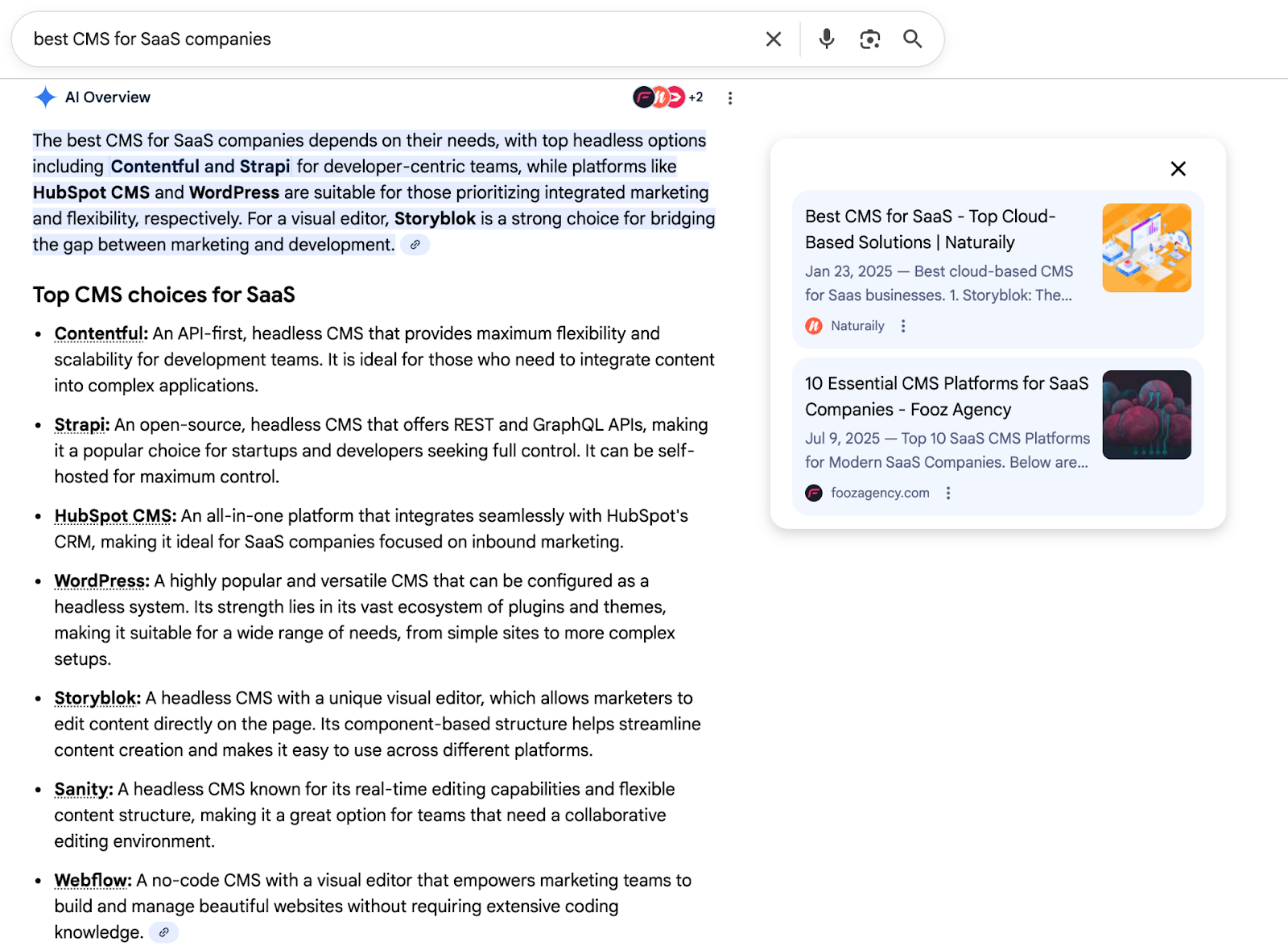
You can uncover links to source articles in AI Overviews by selecting the chain-link icon, enhancing your brand’s topical visibility.
Driving Passive Brand Mentions
Passive brand mentions come when your content naturally fills an informational gap. The aim is to become the go-to reference for certain topics, achieving this by creating assets that are easily referenced.
These can include original data, insightful reports, or highly scannable explanatory pages. By establishing your brand as the primary source, you’re better positioned for more mentions.
Actively Soliciting Brand Mentions
For proactive outreach to earn brand mentions, focus on building genuine relationships and providing valuable information. Start by sharing assets that offer clear benefits, without immediately asking for something in return.
When contacting journalists or content creators, make your pitches relevant and timely, with a clear angle that increases your inclusion chances. Combining outreach with thought leadership, through podcasts or panels, enhances discovery possibilities.
Our goal is to establish a robust outreach engine, nurturing relationships so that those individuals may naturally reference your brand in the future, potentially leading to collaborative content opportunities.
Deciding When to Engage a PR Resource
PR support is particularly beneficial when you have compelling stories or data but face distribution challenges. It’s also crucial for quick scaling of brand mentions, especially during fundraising, launches, or when competing in aggressive markets, like health or AI.
However, if foundational SEO or assets are lacking, focus on establishing those first. Once ready, PR will accelerate visibility across search engines and LLMs.
The core tenets of link building still apply: aim for quality over quantity and avoid low-impact sources. By keeping a clear focus on key sources and strategy, your brand can achieve significant improvements in search visibility.
If your organic traffic fell in 2025, the hardest question is not which update to blame. It is whether you are looking at a broad relevance reassessment, a spam-related risk, a technical failure, weaker click-through, or ordinary changes in demand. Those problems can produce similar charts, but they require very different responses.
You need a diagnosis before you need a rewrite. This framework uses Google’s confirmed 2025 update windows to help you isolate the affected pages, identify the likely mechanism, and build a recovery plan you can evaluate instead of making sitewide changes on instinct.
The 2025 update map: three core rollouts and one spam rollout
Google confirmed four algorithm updates in 2025: core updates in March, June, and December, followed by one spam update beginning in August. The count was lower than the seven confirmed updates in 2024 and nine in 2023. That does not make 2025 a quiet year. Google does not announce every change, and ranking volatility also appeared outside the official rollout windows.
Update
Confirmed rollout
What matters in your analysis
March 2025 core update
March 13 to March 27
The rollout lasted 14 days. Compare page and query cohorts across the completed window, not just the announcement date.
June 2025 core update
June 30 to July 17
Some sites reported partial recoveries. Movement in either direction does not by itself identify which pages or qualities changed Google’s assessment.
August 2025 spam update
August 26 to September 22
Effects appeared within 24 hours for some sites, with another period of fluctuation around September 9. Audit risky patterns at the system or template level.
December 2025 core update
December 11 to December 29
The rollout took a little over 18 days. Visible movement began around December 13, with another volatility spike around December 20.
Use those dates as annotations, not verdicts. A decline that overlaps an update is evidence worth investigating, but timing alone cannot tell you why rankings changed. It is especially easy to misread a long rollout when different page groups move on different days.
The December update was described as a regular effort to surface more relevant and satisfying content across all types of sites. That broad purpose matters. A core update is not a checklist of newly prohibited tactics, and a core-related decline is not automatically a penalty. A spam update raises a different question: whether some part of your visibility depends on patterns created primarily to influence rankings rather than serve users.
Key takeaways
Measure from the start through the completion of each rollout. Do not judge an update from its first volatile day.
Treat a core decline as a relevance, usefulness, and site-quality investigation. Treat a spam decline as a review of the methods and systems behind your rankings.
A drop does not prove that a page is defective or that a policy was violated. A lack of movement does not prove that the site is healthy.
Confirmed update dates are an incomplete map of search changes, so keep technical releases, demand shifts, and SERP changes in the diagnosis.
First decide whether the loss is algorithmic, technical, or presentational
Do not start by editing the pages with the largest traffic losses. Start by determining what changed in the path from crawling to conversion. A useful investigation moves through the following sequence.
Pin the first sustained change to a date. Add all four rollout windows to your reporting. Then add your own deployments, migrations, template releases, internal-link changes, content imports, and tracking changes. If the decline began before the update or precisely after your release, do not force an algorithm narrative onto it.
Separate impressions, rankings, and clicks. If impressions fell alongside ranking visibility, you may have a ranking problem. If impressions and positions are broadly stable while clicks fell, inspect the result page, title and snippet appeal, and changes in how the query is answered. If positions are stable and total impressions declined, search demand may have changed.
Break the site into cohorts. Segment by directory, template, topic, search intent, authoring workflow, publication period, country, and device where relevant. Sitewide totals hide the pattern you need. A concentrated loss across one template tells you more than an overall percentage ever will.
Rule out crawling and indexing failures. Inspect robots directives, canonical targets, noindex tags, status codes, redirects, sitemap inclusion, rendered content, and server availability. The 2025 calendar also included a brief June server issue and an August crawling bug that took days to resolve, which is another reason not to diagnose from date correlation alone.
Study replacement results. For queries where you lost visibility, inspect the pages that now rank above you. Compare intent, answer format, scope, evidence, freshness, and specificity. Do not reduce this exercise to word count or domain authority. You are looking for the reason another result may be more satisfying for that particular query.
Keep a control group. Identify comparable pages that remained stable or improved. Differences between affected and unaffected cohorts help you test a hypothesis. Without a control group, every feature of a losing page can look suspicious.
Average position needs careful handling because it can blend different queries, locations, devices, and URLs into one number. Read it alongside page-level and query-level impressions. A major loss on a valuable query cluster can disappear inside a stable sitewide average.
At the end of this stage, assign each affected cohort one working label: core-quality hypothesis, spam-risk hypothesis, technical issue, demand or click-through change, or unclear. The label is not a conclusion. It tells you which evidence to collect next and prevents one theory from swallowing every decline.
For a core-update loss, audit the site pattern, not one keyword
Google issued no new recovery instruction specific to the December update. Its standing position remained that a ranking loss does not necessarily mean something is wrong with an individual page and that creators should focus on satisfying, people-first content. This rules out the comforting idea of a universal fix. Changing a title, adding schema, increasing word count, or refreshing a date may improve a page for a valid reason, but none is a core-update recovery switch.
Build a scorecard for the affected cohort and a comparable stable cohort. Score each dimension as absent, partial, or strong. The score is an internal decision tool, not a model of Google’s algorithm.
Intent fit: Does the page solve the task implied by the query, or does it spend most of its space circling the topic? Put the answer, method, definition, or decision criteria where the reader needs them.
Distinct contribution: Identify what the page contributes beyond a rearrangement of commonly available information. Useful contributions can include original analysis, a worked example, a precise process, primary documentation, a decision framework, or clearly explained limitations.
Evidence and accuracy: Mark claims that need support, facts that may have aged, and language that overstates certainty. Replace circular citations and vague attribution with links to the originating authority when you have them.
Ownership and accountability: Make it clear who created or reviewed the material when that information helps the reader judge it. Remove credentials, testing claims, or experience statements that the site cannot substantiate.
Scope control: Check whether several URLs compete to answer the same question while none answers it completely. Choose a primary page, consolidate useful material where appropriate, and make the internal-link hierarchy unambiguous.
Usability: Inspect intrusive elements, broken navigation, misleading headings, buried answers, and layouts that make the main content difficult to distinguish. A technically indexable page can still be exhausting to use.
Site pattern: Look beyond the URL. Repeated introductions, generic section templates, unsupported claims, thin category pages, or indiscriminate topic expansion often originate in an editorial workflow rather than in one writer’s draft.
Use the comparison to write a falsifiable hypothesis. For example: “The affected pages cover broad informational queries but delay the direct answer and provide no evidence beyond information already present in stronger results.” That is testable. “Google dislikes our site” is not.
Fix the production cause as well as the visible pages. If generic sections come from a brief template, change the brief. If overlapping pages come from an automated keyword workflow, change the publishing rule. If facts age without review, assign an owner and a review trigger. Otherwise the same defect returns with the next batch of URLs.
Be cautious with deletion. Removing large groups of URLs can discard links, historical relevance, conversions, and information that could have been consolidated. Export performance and link data first, identify a genuine replacement where one exists, and map redirects deliberately. If a page still serves a distinct audience need, improving it may be safer than erasing it.
Where schema and AI optimization fit
Structured data belongs in the implementation layer of the recovery plan. Keep JSON-LD valid, specific, and consistent with the visible page. Correct inaccurate entities, unsupported properties, and markup left behind by a changed template. Do not use schema to manufacture authority or describe content the user cannot see.
Schema cannot make an unsatisfying page satisfying. The underlying content still needs a clear subject, direct answers, defensible claims, named entities, useful relationships, and reliable provenance. Those improvements also make the page easier for AI systems to interpret, but they do not guarantee inclusion or citation in an AI-generated response.
Keep AI visibility analysis separate from core-update attribution. Google expanded AI Mode more broadly during 2025, alongside other search and model changes. If conventional rankings remain stable while AI visibility changes, investigate the affected surface instead of assuming the nearest core update caused it.
For a spam-update loss, remove the incentive behind the pattern
The August spam update began on August 26 and ended on September 22. Some changes appeared within a day, rankings fluctuated again around September 9, and some sites later recovered. A mid-rollout rebound is not proof that the problem has been resolved. The full window matters, and sustained improvement matters more than one favorable day.
No single tactic was identified as the update’s exclusive target in the available 2025 record. Treat the following as audit candidates, not claims about which specific spam system changed:
Large groups of near-duplicate URLs created to capture small keyword or location variations without providing meaningfully different help.
Pages assembled or generated at scale without a reliable review process, clear audience need, or distinct contribution.
Doorway-like paths that promise different answers but funnel readers to substantially the same destination.
Internal or external link patterns whose placement, anchors, and scale make sense only as an attempt to manipulate ranking signals.
Third-party or newly added sections that do not fit the site’s audience and lack credible editorial control.
Redirect, rendering, or content-delivery behavior that gives crawlers and users materially different experiences.
The key question is not whether a page contains a certain word, tool, or content format. Ask why the pattern exists. If its business case disappears when ranking manipulation is removed from the explanation, it deserves immediate scrutiny.
Stop expanding the questionable pattern. Pause the template, feed, vendor workflow, link acquisition, or publishing rule while you investigate. Continuing production makes cleanup larger and weakens your ability to test remediation.
Map the full footprint. Find every URL, subdomain, link group, template, and internal navigation path created by the same mechanism. The pages with obvious traffic loss may be only a sample.
Choose an outcome for each group. Improve pages that answer a defensible user need, consolidate redundant pages into a useful primary resource, and remove material that has no legitimate purpose. Do not make one strong page carry redirects from unrelated pages merely to preserve signals.
Repair the workflow. Add editorial review, publication criteria, access controls, or quality gates at the point where the pattern entered the site. Cleanup without process change is temporary.
Document what changed. Preserve URL inventories, dates, responsible systems, and before-and-after examples. This gives you an audit trail and helps distinguish later reassessment from unrelated volatility.
Do not promise a recovery date. The fact that some sites recovered during the 2025 rollout does not establish a standard timeline or guarantee that removing one suspected pattern will restore previous positions. Your goal is to eliminate the underlying risk and then watch whether the affected cohort is crawled, indexed, and reassessed.
Build a recovery plan you can actually evaluate
A long audit becomes useful only when it produces a controlled queue of changes. Prioritize by confidence, reach, and reversibility:
P0 – Technical blockers: Fix accidental noindex directives, incorrect canonicals, failed rendering, broken redirects, crawl barriers, and server errors first. Content evaluation is unreliable when Google cannot consistently access or index the intended page.
P1 – Systemic spam risk: Stop and remediate a manipulative or indefensible pattern that affects many URLs. The potential downside grows while the system continues producing pages or links.
P2 – High-confidence content defects: Address a repeated weakness supported by affected-versus-control comparisons, such as intent mismatch, unsupported claims, or overlapping pages.
P3 – Experiments: Test lower-confidence changes on a coherent cohort. Do not combine title rewrites, template redesigns, consolidation, new schema, and internal-link changes if you need to learn which intervention mattered.
For every work item, record the hypothesis, affected URLs, control URLs, implementation date, owner, expected leading indicator, and expected business outcome. A leading indicator might be renewed impressions across the lost query cluster. The business outcome might be qualified visits or conversions. Keeping both prevents a ranking recovery from being mistaken for commercial success.
Evaluate cohorts, not isolated keywords. A credible improvement normally appears as a coherent change across relevant pages or queries and persists beyond a brief fluctuation. One returned ranking can be encouraging, but it cannot validate a sitewide theory.
If the edited cohort improves while the control group remains flat, your hypothesis gains support. If both groups move together, a broader change may be responsible. If neither moves after the revised pages have been processed, revisit the diagnosis instead of layering on unrelated fixes.
Start today by adding the four rollout windows to your analytics, exporting the affected landing-page and query cohorts, and labeling each cohort core, spam, technical, presentational, or unclear. Before changing anything, write one sentence describing the suspected mechanism and the metric that should move if you are right. That sentence is the difference between a recovery program and a sequence of guesses.
If conventional search traffic still looks healthy but your brand disappears when someone asks an AI assistant for recommendations, the problem is not necessarily your rankings. A page can be discoverable yet difficult to reuse in an answer because its category is unclear, its claims are separated from their proof, or no passage directly resolves the question.
Answer engine optimization gives you a practical way to close that gap. The goal is to make your expertise easy to retrieve, represent accurately, cite, and connect to a useful next step. That is when visibility inside AI-driven search systems becomes a business capability instead of an abstract marketing metric.
Decide what a successful AI answer should contain
Do not begin by asking how to rank in AI. An answer engine does not always produce a stable list of pages with a single position to improve. Begin with the customer decision you need to influence and define what a good response would look like.
A useful answer brief contains five elements:
User context: the role, problem, market, or constraint that changes the answer.
Prompt family: several natural ways a person could ask the underlying question, including an unbranded version.
Accurate representation: the category, audience, use case, differentiator, and limitation the answer should get right.
Supporting evidence: the page, documentation, comparison criteria, or proof that justifies inclusion.
Useful destination: the next page a reader should reach if the answer creates interest.
This brief prevents a common measurement error: treating every brand mention as a win. A recommendation based on the wrong category, audience, or capability can create poor-fit traffic and weaken trust. Correct representation comes before frequency.
Start with unbranded questions such as Which type of solution handles this problem? or What should I compare before choosing a provider? A branded prompt mainly tells you whether the system can repeat facts about you. An unbranded prompt shows whether your brand is associated with the decision before the user already knows your name.
Prioritize questions where you have a legitimate fit, a page that can prove it, and a meaningful next action. If you cannot support the inclusion you want, the task is not prompt optimization. It is an evidence gap.
Build passages that can stand on their own
Many pages contain relevant information without containing a reusable answer. The explanation is spread across an opening story, several feature sections, and a conclusion. A human may assemble the point, but a retrieval system has to locate the right passage before a model can use it.
For each priority question, create an answer unit with this sequence:
Use a descriptive heading that names the actual question or decision.
Answer it directly in the opening paragraph under that heading.
Add the conditions that determine when the answer applies.
Place the supporting explanation or evidence beside the claim.
Point to the next relevant page without interrupting the answer with a premature sales pitch.
The passage should remain understandable if someone reads only that section. Replace floating claims such as built for modern teams with explicit language: what the product is, who it is for, which task it supports, how it supports that task, and where its boundaries are.
A reusable product statement can follow this pattern: [Product] is a [category] for [audience]. It supports [task] through [mechanism]. It is appropriate when [condition], but it does not [limitation]. [Evidence or documentation] explains the claim. This is not copy to repeat everywhere. It is a checklist for removing ambiguity.
Evidence needs to be adjacent to the claim it supports. Do not make an answer engine infer that a case result on one page validates a broad promise on another. Distinguish product facts, editorial opinions, customer statements, and independently verifiable evidence. Precise attribution makes a passage easier for both readers and machines to evaluate.
Keep entity details consistent as well. Your brand name, category, product names, audience, canonical URLs, and capability language should not change casually between the homepage, product pages, documentation, author profiles, and structured data. If different wording reflects a real distinction, explain that distinction instead of leaving conflicting labels unresolved.
JSON-LD should mirror what a visitor can verify on the page. Use it to clarify identity, relationships, and page meaning, not to introduce invisible claims. Valid schema markup does not compel an answer engine to mention or cite you, and it cannot repair contradictory copy. Think of structured data as a verification layer built on clear content.
Update stale facts when they change, but do not manufacture freshness by changing a date without reviewing the substance. A visible review process is useful only when it corresponds to a real check of the claims, links, examples, and product status on the page.
Map content to decisions, not just keyword variations
AEO content planning works best when it follows the decisions a buyer must make. Keyword variations often describe the same need, while two similar-looking prompts may require completely different evidence. Group questions by the job the answer must perform.
Decision
Prompt shape
Content the answer needs
Understand the problem
What causes [problem], and how is it addressed?
A plain-language explainer with scope, terminology, and limitations
Choose an approach
Should I use [approach A] or [approach B] for [constraint]?
A comparison organized around explicit selection criteria
Create a shortlist
Which solutions fit [audience] with [requirement]?
A category or use-case page that states fit and supporting evidence
Verify a provider
Does [brand] support [requirement]?
Product documentation, capability details, and relevant boundaries
Take action
How do I implement [approach]?
A procedural page with prerequisites, sequence, and a clear next step
Build the map from questions people already ask in sales conversations, support requests, site search, community discussions, and conventional search data. For each question, record the current URL, the missing evidence, and whether the page should be improved, consolidated, or created. This keeps the plan tied to genuine decisions instead of producing dozens of near-duplicate pages.
Use internal links to connect the sequence. An explainer should lead naturally to an approach comparison; the comparison should lead to proof of fit; the proof page should lead to documentation or an appropriate conversion path. Each page still needs to answer its own question before asking the reader to move elsewhere.
Owned content can establish what you claim about yourself, but it should not pretend to be independent validation. Product capabilities belong in official documentation. Customer outcomes need clearly attributed proof. Broader category claims need evidence appropriate to their scope. Earned coverage and genuine brand mentions can corroborate your position, but fabricated reviews, planted endorsements, or undisclosed promotional content do not create trustworthy authority.
This is also where AEO and conventional SEO support each other. A well-structured page still needs to be accessible, internally connected, indexable where appropriate, and useful after the click. Answer formatting cannot compensate for a page that search systems cannot retrieve or a visitor cannot understand.
Measure representation, citations, and business impact separately
AI visibility cannot be managed from occasional screenshots. A repeatable prompt panel lets you observe whether the brand appears, how it is represented, and what evidence supports the answer. This turns tracking brand mentions in Claude and AI search into a diagnostic process rather than a vanity check.
Use a fixed prompt panel for the baseline
Include prompts from several intent types: category discovery, approach comparison, provider shortlisting, requirement validation, and branded fact checking. Preserve the exact wording, audience, geography, and constraints used in each prompt. Test in a fresh conversation when possible, then record the interface, displayed model label, test date, session conditions, and whether the response showed citations.
Save the complete response, not only the sentence containing your brand. The surrounding explanation reveals why the system included you, which competitors or alternatives framed the answer, and whether your positioning was central or incidental. Because generated responses can vary, treat an individual output as an observation. Repeated patterns are more useful than a single favorable or unfavorable result.
Score each observation across separate fields:
Presence: absent, mentioned, or recommended.
Representation: correct, incomplete, or materially wrong.
Evidence: cited to an owned page, cited to an external page, uncited, or supported by an irrelevant URL.
Decision fit: central to the requested use case, a secondary option, or unrelated to the stated constraint.
Competitive context: which alternatives appear and which selection criteria distinguish them.
Action path: whether the cited or likely landing page resolves the same question and offers an appropriate next step.
Do not collapse these fields into a blended visibility score too early. A prominent but inaccurate recommendation can look stronger than a modest, correct citation when reduced to a single number. The separate fields tell you what to fix.
Match the failure pattern to the right intervention
The brand is absent: check whether you have a page that answers the exact decision, whether your category is explicit, and whether the claim has credible support. More keyword repetition will not fill a missing evidence gap.
The brand appears in the wrong category: reconcile conflicting descriptions across core pages, documentation, profiles, and structured data. State category boundaries directly.
The description is correct but uncited: make the supporting passage self-contained, move proof beside the claim, and ensure the most relevant page has a clear title and opening answer.
The citation lands on the wrong page: align headings, internal links, canonical choices, and page introductions so the strongest destination is unmistakable.
Visibility improves but qualified demand does not: inspect the prompt intent, landing-page match, offer, and conversion path. The problem may be audience fit rather than answer visibility.
Connect the monitoring sheet to business evidence without pretending attribution is perfect. Review detectable referral traffic, behavior on cited landing pages, assisted conversions, branded demand, qualified inquiries, and self-reported discovery. The purpose is to learn where online visibility can become a business opportunity, not to assign every conversion to an answer that cannot be observed directly.
When you make a change, log the hypothesis before editing. Change the smallest useful content unit, publish it, confirm that the revised page is publicly retrievable, and retest against the stable prompt panel. Add experimental prompts as a separate challenger set so the baseline does not drift. If several pages, claims, and external signals change together, you may see movement without knowing what caused it.
Key takeaways
Define the customer decision and the correct brand representation before trying to increase mentions.
Create self-contained answer units with a direct response, applicable conditions, nearby proof, and a useful next step.
Organize coverage around discovery, comparison, validation, and action rather than publishing thin keyword variations.
Track presence, accuracy, citations, decision fit, and business outcomes as separate signals so each failure has a specific remedy.
Your next move is narrow and concrete: choose the highest-value unbranded question for which your brand has a defensible fit. Write the target answer brief, audit the page that should support it, and establish a saved prompt baseline before editing. That gives you a real AEO loop: question, evidence, representation, measurement, and revision.
You can still hold rankings and lose visits. Google can answer the query inside an AI Overview, while ChatGPT, Gemini, and Perplexity absorb searches that once began on a traditional results page. The referral traffic that reaches your site from these systems may not replace the clicks you lose elsewhere. That is a change in buyer behavior, not a reporting glitch, and waiting for the old traffic pattern to return is not a strategy.
Your response should not be to publish more AI-generated copy. You need an operating system that connects buyer questions, search visibility, useful assets, business outcomes, and a repeatable work queue. The workflow below gives you that system.
Key takeaways
Manage AI search around a fixed portfolio of commercially relevant buyer questions, not an unbounded list of prompts.
Separate business outcomes from classic search signals and AI visibility signals. Each layer answers a different management question.
Diagnose the visibility gap before choosing the tactic. A missing citation, a declining click-through rate, and an inaccurate brand description require different work.
Use content for questions that need explanation or evidence. Build an interactive asset when the user must provide inputs, compare scenarios, or complete a task.
Treat AI-assisted development as a fast prototyping method, not permission to bypass security, accessibility, compliance, or engineering review.
Report what changed, what you shipped, what you learned, and which decision or resource is needed next. Do not hide business declines behind a new visibility score.
Build a baseline that separates outcomes from visibility
Do not begin with an AI visibility score. Begin with the business result that prompted the investigation. Revenue, qualified leads, purchases, and other key actions tell you whether performance changed. Search and AI metrics help you diagnose why.
A useful baseline has four layers. Keeping them separate prevents a common reporting error: treating every mention, ranking, or visit as if it carried the same commercial value.
Measurement layer
Signals to record
Decision it supports
Business outcomes
Revenue, qualified leads, purchases, pipeline actions, and conversion rate
Whether search performance is helping the organization reach its goals
Classic search
Impressions, clicks, click-through rate, rankings, landing-page traffic, and conversions
Whether demand, visibility, result-page behavior, or on-site performance changed
AI answer visibility
Brand mention, citation, link, description accuracy, answer position, and competing brands across a fixed question set
Where the brand is absent, weakly represented, or represented incorrectly
Demand and competition
Search-interest direction, competitor visibility, competitor traffic estimates, and changes in the questions buyers ask
Whether the problem is specific to your site or reflects a broader market shift
Compare business outcomes and organic performance year over year where the data allows it. That helps distinguish a structural decline from ordinary seasonality. Confirm the numbers with whoever owns analytics before presenting them to leadership. A ranking report alone cannot show the business effect, although rankings remain useful as a diagnostic when you are trying to separate lost visibility from lost demand.
Next, inspect impressions, clicks, and click-through rate together in Google Search Console and Bing Webmaster Tools. AI-generated result-page answers can reduce third-party clicks, so annotate whether an AI Overview appears on queries or pages with a falling click-through rate. That association is evidence of a changed result page. It does not prove that the AI Overview caused every lost visit.
Impressions are steady while clicks and click-through rate fall: investigate result-page changes, including AI Overviews, and whether the visible answer now satisfies the basic question without a visit.
Impressions and clicks both fall: inspect demand, rankings, indexing, competitors, and the query mix before rewriting the page.
Traffic falls while conversions hold: determine which landing pages and query types lost visits. You may have lost low-intent discovery traffic, but that is a hypothesis to test, not a reason to dismiss the decline.
Traffic holds while conversions fall: inspect intent alignment, offer relevance, page experience, and conversion instrumentation. AI visibility work will not repair a broken on-site journey.
Use competitor estimates and demand tools such as Google Trends or Exploding Topics as context, not as substitutes for your own data. If several competitors decline around the same query group, the market or results page may have changed. If they gain while you decline, your content, authority, distribution, or technical implementation deserves closer inspection.
AI answer tracking needs similar discipline. Keep the question wording, platform, date, and any observable location or account conditions with each result. Generated answers can vary, so a single screenshot is an observation, not a trend. Track repeated patterns across the fixed question set, and label AI visibility as a leading indicator rather than revenue.
Turn buyer questions into a prioritized intervention queue
A keyword inventory is not yet an AI search workflow. The unit of work should be a buyer question connected to a decision: choosing a category, evaluating an approach, comparing options, estimating a result, reducing a risk, or completing a task.
Build the portfolio from queries in Search Console, tracked keywords, on-site search, sales conversations, support requests, and the language used on high-value conversion paths. Keep it deliberately bounded. If the list grows every time someone invents another prompt variation, you will produce activity without a stable baseline.
Choose the question. Write the natural-language version a buyer would use, then connect it to the relevant product, service, topic, and business outcome.
Label the user job. Record whether the person needs an explanation, comparison, recommendation, calculation, validation, or action.
Capture the current answer. Review the traditional results page and the AI surfaces that matter to your audience. Save the exact wording used for the check.
Code the brand outcome. Mark the brand as absent, mentioned, cited, linked, inaccurately described, or accurately represented. Record which competitors appear and which pages support them.
Diagnose the gap. Decide whether the problem is missing content, weak evidence, inconsistent entity information, insufficient web mentions, poor distribution, an uncompetitive offer, or an experience that a static page cannot provide.
Select the smallest credible intervention. Assign a page improvement, new evidence asset, digital PR task, entity correction, partnership, interactive experience, or technical fix.
Name the success signal. Use the signal appropriate to the intervention: a corrected description, a citation, improved qualified traffic, tool completion, lead quality, or a business conversion.
Assign an owner and review point. Every item needs someone responsible for shipping it and a future decision to continue, revise, expand, or stop.
The diagnosis matters because the same symptom can produce very different work. Use this matrix to keep the team from defaulting to another generic content brief.
Observed gap
Investigate first
Likely work item
The brand is absent while competitors are cited
Whether competitors have clearer evidence, broader topic coverage, stronger third-party mentions, or a better page for the question
Evidence-led content, digital PR, partnerships, or distribution to relevant external sites
The brand is mentioned but not cited or linked
Whether the site provides a clear, authoritative page that supports the claim being made
Improve the source page, factual specificity, internal relationships, and consistent entity information
The brand is described inaccurately
Conflicting claims across the website, profiles, product information, and third-party coverage
Correct first-party facts, align public descriptions, and pursue corrections where appropriate
A page still ranks but receives fewer clicks when an AI answer appears
Whether the result page now resolves the basic question and whether the brand appears in that answer
Improve answer inclusion while adding a deeper reason to visit, such as original evidence, a workflow, a tool, or a decision aid
Visitors arrive but do not complete the intended action
Query intent, landing-page promise, offer relevance, calls to action, and measurement
Conversion and journey improvements rather than more awareness content
The correct answer depends on the user’s inputs
Whether a generic explanation can genuinely help the person decide or act
A calculator, configurator, assessment, planner, template generator, or other interactive experience
When content is the right intervention, write for extraction and action at the same time. State the direct answer early, name the relevant entities and scope, support important claims, and keep business facts consistent across first-party pages. Then give the reader a useful next step that cannot fit inside a short generated response.
This is why the strategy has to move from isolated keyword pages toward coherent entities, topic coverage, expertise signals, and consistent web mentions. The goal is not to repeat the same phrase across more URLs. It is to build a connected body of useful information that explains what the organization is, what it knows, what it offers, and why those claims deserve support.
Relevant structured data can make visible page information easier for machines to interpret. It cannot manufacture evidence, authority, or a relationship that the page and the wider web do not support. Treat JSON-LD as an accurate machine-readable description of the content, not as a shortcut around the content and distribution work.
Build experiences when a generated answer is not enough
AI answers are strongest when the user wants a compact explanation assembled from existing information. They are less able to replace a branded experience that accepts meaningful inputs, applies transparent logic, and helps the person complete a specific job. That distinction gives you a practical way to decide when to publish and when to build.
A good interactive candidate passes a simple screen:
Does the user’s input materially change the output?
Will the output help the person decide, estimate, configure, diagnose, plan, or produce something useful?
Can you explain the underlying assumptions and data clearly enough for the user to judge the result?
Is there a natural next action after the result, rather than a forced lead form attached to an unrelated interaction?
Can the organization maintain the logic, dependencies, content, and data after launch?
Reject the idea if every user receives effectively the same answer. That should probably be a page, template, or downloadable resource. Reject it if the only purpose is to conceal a sales form behind a superficial quiz. Build when the interaction itself creates value.
AI-assisted development has shortened the path from a natural-language specification to a working prototype. The loose, exploratory version is often called vibe coding. It can let search teams test a calculator, assessment, content utility, or internal workflow before a conventional development cycle would normally begin. It does not make production engineering unnecessary.
Use a documented build workflow even when the prototype feels disposable:
Define the user problem. Name the audience, the decision they face, the information they possess, and the useful outcome they should receive.
Write the content and product specification. Include inputs, outputs, logic, assumptions, data sources, edge cases, error states, accessibility requirements, analytics events, calls to action, and acceptance criteria.
Design the states before the integrations. Map the empty, loading, completed, invalid-input, and failure states with static data. This exposes a confusing experience before implementation complexity hides it.
Build the smallest complete loop. The user should be able to enter information, receive a trustworthy result, understand it, and take the intended next action.
Validate the substance. A subject-matter owner should check the calculations, assumptions, language, and limitations. A polished interface does not make an unsupported result reliable.
Review the production risks. Check authentication, authorization, input handling, data storage, privacy, dependencies, error handling, accessibility, analytics, performance, backups, and rollback.
Test real tasks. Give representative users a goal without explaining the interface. Record where they hesitate, misread the result, abandon the flow, or lose trust.
Deploy with ownership. Document the architecture, prompts, dependencies, data, release process, known limitations, and maintenance owner before promoting the tool.
Treat AI-generated code as unreviewed code. Do not place production secrets, customer credentials, or sensitive data into an exploratory build. If the experience processes payments, makes consequential financial or health calculations, stores regulated data, or creates legal exposure, route it through qualified engineering, security, compliance, and legal review before release.
The failure modes are practical, not theoretical abstractions: security and compliance gaps, expanding platform costs, fragile systems, and technical debt can turn a fast prototype into an expensive obligation. Keep a rollback path, inspect third-party dependencies, and decide who will fix the tool when an input, API, model, data source, or business rule changes.
Measure the result as a product, not merely as a page. Acquisition signals include relevant queries, links, citations, and qualified entrances. Usage signals include starts, completions, errors, abandonment points, and repeat use. Business signals include qualified leads, purchases, pipeline actions, and assisted conversions. Maintenance signals include defects, dependency changes, operating costs, and the effort required to keep the output correct.
Run a learning loop that leadership can fund
AI search is not a campaign that ends when a group of pages is optimized. Answers change, competitors publish, result-page features expand, and buyer language shifts. Your workflow therefore needs a recurring loop that turns observations into decisions.
Observe: update business outcomes, classic search data, AI answer observations, demand context, and competitor presence.
Diagnose: identify whether each material change comes from demand, visibility, click behavior, representation, content quality, distribution, technical performance, or conversion.
Prioritize: rank work by commercial relevance, severity of the gap, confidence in the diagnosis, effort, risk, and the value of what the team expects to learn.
Ship: release the smallest credible intervention with an owner, baseline, expected signal, and review point.
Measure: record the business result and the leading signals without pretending that a mention is equivalent to a sale.
Decide: continue, revise, expand, or stop. Save the reasoning so the next team member does not repeat the same test without context.
Keep a decision log beside the backlog. Each entry should contain the buyer question, observed gap, evidence, chosen intervention, owner, expected signal, actual result, caveats, and next decision. The log is more valuable than a gallery of screenshots because it preserves why the team acted and what changed afterward.
Make ownership explicit
Search cannot produce this system alone. SEO can own the question portfolio, result-page diagnosis, and technical discoverability. Content and subject-matter teams own explanation and evidence. Public relations and partnerships help earn relevant mentions and citations beyond the website. Analytics owns definitions, instrumentation, and reporting integrity. Product, engineering, security, and legal review interactive experiences according to their risk. Leadership decides whether long-term brand visibility, experimentation, and cross-functional work receive the necessary priority and resources.
A leadership update should answer five practical questions in order:
What changed in the business? Show revenue, qualified leads, key actions, and organic traffic with an appropriate comparison period.
What changed in discovery? Show the relevant movement in impressions, clicks, click-through rate, rankings, AI answer presence, demand, and competitors.
What can we reasonably infer? Separate observed facts from hypotheses. Name missing data and alternative explanations.
What did we ship and learn? Connect each intervention to its buyer question, baseline, leading signal, business result, and next decision.
What decision is needed? Ask for the specific budget, data support, engineering review, content capacity, public-relations involvement, or expectation change required for the next work queue.
Do not use improved AI visibility to disguise falling revenue or leads. Do not attribute all direct traffic, branded search, or offline demand to AI without evidence. Do not promise that a citation will produce a click. Instead, show where the brand is becoming easier to discover, where the journey still breaks, and which experiment will reduce uncertainty next.
Forecasting needs the same honesty. If AI answers continue to absorb informational clicks, the old traffic baseline may no longer be attainable through incremental title changes and additional copy. Model the effect on leads and sales, improve conversion where visits still occur, invest in brand inclusion where answers replace clicks, and build experiences that give people a reason to continue to your site.
Start with a commercially important topic before the next planning meeting. Lock the buyer-question set, establish the four-layer baseline, diagnose the clearest gap, and ship the smallest intervention that can teach you something useful. Bring the result and the next decision to leadership. Once that loop works, expand it deliberately. That is how AI search becomes an operating discipline instead of another dashboard the organization stops checking.
Your team has a practical decision to make: keep investing in conventional SEO, redirect the budget toward answer engine optimization, or somehow do both without doubling the workload. Treating those as competing programs is the mistake.
The stronger approach is one discovery system. SEO makes your pages eligible to be found and trusted. AEO makes their answers easier to extract, verify, cite, and recommend. The work overlaps, but the outcomes and measurements are not identical.
Key takeaways: build one discovery system, not two
Protect the SEO fundamentals that still produce most discoverable traffic: query alignment, useful content, internal links, authority, freshness, performance, and conversion paths.
Give every important page a specific query, audience, intent, answer unit, supporting evidence, and next action.
Place direct answers near the headings that introduce them. Add conditions, evidence, and limitations close to the claims they support.
Use JSON-LD to clarify visible entities and relationships. It cannot compensate for thin content, ambiguous positioning, or unsupported claims.
For buying-intent queries, improve your presence on relevant review platforms, directories, publications, marketplaces, and video channels instead of relying only on your own domain.
Measure search performance, tested AI visibility, referral traffic, and conversions separately. A brand mention is not automatically a citation, a visit, or a sale.
Start with the query and the decision behind it
‘Optimize for AI’ is too vague to guide a page edit. A person asking for a definition needs a concise explanation. A person comparing vendors needs criteria, tradeoffs, and corroboration. A person ready to buy needs accurate product facts and a clear next step. Those are different retrieval tasks, even when they contain the same topic keyword.
Before changing content, create a discovery brief for each query cluster:
Write the actual query. Include the audience, use case, constraint, or purchase stage that changes the answer. ‘Payroll software’ is a topic; ‘payroll software for a small nonprofit’ expresses a decision.
Label the intent. Decide whether the person wants an explanation, instructions, a comparison, reassurance, a shortlist, or a transaction.
Define the answer unit. Choose the smallest useful form of the answer: a definition, ordered process, criteria list, comparison table, calculation, specification, or recommendation with conditions.
Identify the required proof. List the facts, examples, first-party details, independent reviews, author credentials, or other evidence a reader would need before relying on the answer.
Choose the next action. Decide what a satisfied visitor should do after receiving the answer. That could be reading a deeper explanation, checking compatibility, comparing plans, requesting a demonstration, or buying.
This brief tells you whether an existing page should be improved, merged with an overlapping page, or replaced with a more appropriate format. It also prevents a common AEO failure: adding repetitive FAQ sections to pages that still do not resolve the underlying decision.
Use the found-understood-extracted test
Review the page in three passes. First, can a search system find and interpret it? Check crawl access, indexability, canonicalization, internal links, title, main heading, and the relationship between the query and the page. Second, can a reader or machine determine who and what the page is about? Check named entities, terminology, authorship, dates, and contextual links. Third, can the answer be lifted without losing a critical condition? Check whether the conclusion, evidence, scope, and caveats appear together.
If the page fails the first pass, answer formatting will not rescue it. If it fails the third, it may rank and still be difficult to reuse in an AI-generated response.
Fix the SEO layer that AEO still relies on
AI discovery is growing, but it does not justify abandoning the channel already producing demand. One reported benchmark puts collective LLM referral volume at roughly 2%-3% of the organic traffic supplied by Google. That ratio is directional, not a universal forecast: it will vary by market, audience, attribution method, and the kinds of questions customers ask.
The implication is straightforward. Fund AI visibility by extending sound SEO work, not by suspending it. Audit in this order:
Align the title with the query and page promise. Include the language your audience uses when it accurately describes the page. A title should distinguish the page, not collect every keyword variation.
Resolve intent near the top. The opening should confirm the audience’s problem and provide the core answer. Do not make a reader cross a long general introduction before learning whether the page applies.
Strengthen the information architecture. Link to the page from relevant hub and supporting pages with descriptive anchor text. Link back to definitions or evidence when the current page depends on them.
Refresh substance, not only dates. Correct stale facts, remove obsolete recommendations, improve weak examples, close missing subtopics, and preserve a useful URL when its purpose has not changed. Updating a timestamp by itself creates no new value.
Resolve duplication. When several pages answer the same intent, choose the strongest destination and consolidate the useful material. Competing pages make it harder to establish a clear canonical answer.
Protect the visit after the click. Keep pages fast and stable, make navigation predictable, and give the visitor a next step that matches the query. More visibility has limited value if the page cannot convert attention into progress.
Make changes in identifiable batches and keep a log. If a title, internal-link module, content revision, and template redesign launch together, you will struggle to tell which intervention affected impressions, clicks, AI citations, or conversions.
Use JSON-LD as clarification, not decoration
Structured data should express what the page visibly contains. Mark up the real publisher, author, product, organization, or other applicable entity; keep identifiers consistent across templates; and connect related entities only when the relationship is supported on the page.
Select the most specific applicable schema type rather than attaching unrelated types in the hope of gaining visibility.
Keep names, URLs, dates, availability, prices, ratings, and other marked-up properties consistent with the visible content.
Do not manufacture reviews, ratings, authors, or credentials for markup.
Use stable identifiers for the same entity across pages instead of describing it as a new object on every URL.
Validate the generated JSON-LD after theme, plugin, field, or template changes. Correct source fields can still produce broken output when templates change.
Schema can reduce ambiguity. It does not force a model to quote the page, make an unsupported claim credible, or turn a generic article into the best answer.
Make text and images easy to extract without stripping context
AEO is partly an information-design problem. A useful answer must be easy to locate, but it must also remain accurate when a system separates the passage from the rest of the page. That requires more than writing a short paragraph.
Build answer units around complete claims
For every important heading, place the direct answer in the first paragraph that follows it. Then add the evidence, method, conditions, exceptions, and next level of detail. A reader should be able to understand the short answer immediately and inspect the reasoning without leaving the section.
State the conclusion. Answer the heading in plain language before expanding it.
Carry the scope with the answer. If a recommendation applies only to a platform, audience, use case, geography, or time period, name that boundary in the same passage.
Put evidence beside the claim. Link the words that depend on external evidence rather than dropping an unexplained reference at the end of the page.
Define terms once. Use the same name for the same concept or entity throughout the page. Unnecessary synonyms can make relationships less clear.
Use the format the answer requires. Processes belong in ordered lists, criteria in lists, and genuine field-by-field comparisons in tables. Do not force prose into a table simply to appear structured.
Separate fact from judgement. Label editorial recommendations as recommendations, and explain the criteria used to reach them.
This structure helps human readers scan while giving answer systems a coherent passage to reuse. It also reduces the risk that a caveat sits several paragraphs away from the claim it limits.
Audit images for the machine eye
Images now carry extractable information as well as visual appeal. OCR can read labels and annotations, while multimodal systems can interpret objects, context, and relationships inside a scene. Compression damage, tiny text, weak contrast, and ambiguous alt text can therefore change what a machine believes the image shows.
Keep the established performance work: serve appropriately sized files, compress them carefully, reserve their display dimensions, and use lazy loading where it does not interfere with important above-the-fold media. Then add a machine-readability pass:
Inspect the image at its rendered size, not only in the original design file.
Increase contrast between text and its background. Avoid placing essential wording over glare, reflections, textures, or visually busy areas.
Write alt text that identifies the meaningful subject and context. Do not turn it into a list of target keywords.
Place a useful caption or nearby explanation beside images whose meaning is not obvious from the pixels alone.
Use original diagrams, screenshots, and product photography when they add evidence or experience that generic stock media cannot provide.
Repeat essential specifications, prices, warnings, and instructions as accessible page text. Do not make OCR the only route to important information.
For a chart, annotated screenshot, or product label, perform a simple failure test: if the text inside the image vanished or was read incorrectly, would the surrounding page still communicate the fact? If not, add a textual equivalent.
Earn third-party validation and measure the right outcome
Informational visibility can often begin with a strong answer on your own site. Commercial recommendations are more dependent on corroboration. A model evaluating ‘best,’ ‘top,’ ‘most reliable,’ or ‘alternatives to’ queries may look for evidence beyond what a brand says about itself.
Within one company-run 2025 dataset of 36,127 ChatGPT buying-intent queries, product-recommendation media received 7,642 citations, consumer-review platforms 5,983, traditional media 4,581, commercial or brand sites 2,208, and forum communities 674. Treat those figures as a directional snapshot of one methodology, query definition, model, and period. They do not establish permanent citation weights or prove that placement on a particular site causes inclusion.
They do expose a useful planning error: publishing more brand copy is not the same as building recommendation evidence. For every high-intent query, create a citation-gap record with these fields:
Prompt and purchase stage: record the exact question and whether the person is exploring, comparing, validating, or ready to choose.
Named and cited brands: distinguish a brand mention from a linked or named supporting page.
Evidence surfaces: classify the cited domains as publications, review platforms, directories, marketplaces, video channels, communities, institutions, or brand sites.
Selection criteria: identify the features, reputation signals, use cases, or constraints used to justify the recommendation.
Legitimate gap: determine whether your brand actually qualifies. If it does, correct inaccurate listings, complete relevant profiles, make verifiable product information available, or pursue editorial coverage on its merits.
Owned-page correction: update the page that should act as the definitive first-party record for features, positioning, compatibility, policies, or other facts.
Do not fabricate reviews, seed undisclosed endorsements, or force a brand into irrelevant directories. Those tactics create reputation risk and unreliable evidence. The goal is consistent, independently supportable information across the places a buyer would reasonably consult.
Evaluate AEO vendors by the work behind the label
The AEO label covers a wide range of services: 78 firms were screened to create one eight-company shortlist during a 2025 provider review. The size of that field is a reason to inspect methods, not a reason to accept a category label as proof.
Ask a prospective provider to show how it handles technical SEO, answer architecture, structured data, entity consistency, off-site citations, reputation signals, image readability, controlled prompt tracking, and business attribution. Ask which changes happen on your site, which depend on third parties, which outputs you will own, and how it separates tested visibility from actual traffic and conversions. A single proprietary visibility score cannot answer all of those questions.
Keep four measurements separate
Search and AI discovery create different observable signals. Put them on one scorecard, but do not collapse them into one number.
Measurement
What it can show
What it cannot prove
Search impressions, rankings, and clicks
Whether pages are being surfaced and chosen in conventional results for tracked queries
Whether an answer engine mentions or cites the brand
Mentions and citations across a fixed prompt set
How the brand appears for the specific models, versions, prompts, locations, and test dates recorded
Universal visibility across every user, prompt variation, or generated answer
AI referral sessions and landing pages
Which answer platforms send trackable visits and what those visitors do next
The effect of unclicked mentions or answers whose referral data is missing or misclassified
Qualified actions and conversions
Whether discovery produces meaningful business progress on the destination page
Which individual edit caused the result when several changes launched together
For prompt monitoring, store the exact prompt, model and version when available, test date, response, brand mention, cited URL, and recommendation context. Reuse the same core set after material changes. Generated answers can vary, so look for direction across repeated observations rather than treating one response as a stable rank.
Start with one query cluster that matters to the business. Repair its titles and internal links, consolidate overlapping pages, rewrite the main answer units, validate the JSON-LD, audit the critical images, and map the third-party evidence gap. Record the baseline before publishing. Once that cluster gains stronger search visibility, more consistent answer inclusion, or better qualified actions, extend the same system to the next decision your customers need to make.
Your rankings can look stable while part of your customer journey quietly moves elsewhere. A prospect can ask an AI assistant to define the problem, build a shortlist and challenge each option before visiting a website. They may then use Google to verify a detail, arrive through a branded search and convert on a page that receives all the credit.
If your pages are inconsistent, duplicated or vague, the assistant may omit you, describe you incorrectly or send the prospect to an outdated URL. The answer is not a separate factory for AI content. You need one dependable set of business facts that search engines, AI systems, people and agents acting on their behalf can retrieve, evaluate and carry into a clear next step.
Plan around the customer’s task, not the search platform
Do not treat Google and AI assistants as interchangeable traffic sources. They often serve different parts of the same decision.
One modeled estimate for Q4 2025 placed Google at 77.9% of global digital queries and ChatGPT at 17.1%. The intent split was more revealing: Google held an estimated 90% share of transactional queries, compared with 5% for ChatGPT, while ChatGPT had a much stronger position in generative and creative work. These are directional figures from a model combining client analytics, third-party data and anonymized logs, not a universal census of every query.
The practical implication is straightforward. Do not dismantle the Google pages that capture high-intent demand. Strengthen the earlier stages where a person is framing a problem, learning terminology, comparing approaches or testing a recommendation. AI can influence the shortlist even when Google, direct traffic or a branded query produces the final visit.
Start by sorting the questions around one commercially important journey into four jobs:
Discover: What kind of solution exists for this problem?
Compare: Which options fit my budget, use case, location or constraints?
Verify: Is this claim current, supported and applicable to me?
Act: What do I need to do next, and what will happen when I do it?
For every job, name the page you want an AI system or search engine to select. If your team cannot agree on that URL, a retrieval system is unlikely to infer the right one consistently. That gap is more urgent than producing another loosely related blog post.
Device behavior also affects the handoff. The same 2025 model put 62% of ChatGPT usage on desktop and 63% of Google usage on mobile. That does not establish a conversion pattern, but it is a useful warning: someone may research with AI at a desk and resume through search on a phone. Use stable names, URLs and claims across devices so that the second session confirms what the first one established.
Map the human and AI journeys to the same pages
A conventional funnel describes what a person does. An AI-ready journey must also describe what a machine needs to retrieve and explain at each stage. Those are not separate funnels. They are two views of the same handoffs.
Journey stage
What the person needs
What the AI system must resolve
What the page should provide
Problem framing
Language for the problem and its possible causes
Whether your entity and content are relevant to the question
A direct explanation, clear scope and links to the next decision
Option discovery
A credible set of approaches or providers
What you offer, who it is for and how it differs
Consistent product or service names, use cases and qualification criteria
Evaluation
Comparable facts, limitations and proof
Which claims apply under which conditions
Explicit criteria, evidence, exclusions, dates and current commercial details
Action
A low-ambiguity next step
Where to send the person or how to relay the task
A stable destination, visible prerequisites, a specific call to action and a confirmation path
This map exposes two common failures. The first is an orphaned educational page that answers the question but never leads to a decision. The second is a conversion page that asks for a booking, trial or purchase without publishing enough information for the prospect to evaluate it. AI can compress several stages into one conversation, so both failures can remove you before a visit occurs.
Key takeaways
Keep strong transactional SEO pages, but connect them to the informational and comparison questions AI assistants handle upstream.
Assign one preferred URL to every material intent. If several URLs appear equally valid, consolidate or differentiate them.
Put decision-critical facts in visible page content. Do not hide them only in images, downloads, scripts or structured data.
Use JSON-LD to mirror the page’s visible facts, not to introduce a second version of those facts.
Measure whether AI selects the correct page and represents it accurately, not just whether an identifiable referral arrives.
Consolidate duplicate pages before expanding your coverage
AI visibility becomes harder when several URLs compete to answer the same question. Repeated or near-identical pages weaken intent signals, and large language models may cluster the variants and select an outdated one. Publishing more versions can therefore reduce your control over the answer rather than expand your reach.
Audit duplicates by intent, not just by matching text. Two pages can use different wording and still compete for the same customer task. Conversely, pages built from the same template may deserve to remain separate when they contain genuinely different local rules, prices, eligibility conditions or offers.
Create a working sheet with one row per indexable URL and these columns: primary question, audience, product or service, location or language, preferred URL, canonical target, last meaningful update and intended next action. Then classify each overlapping page:
Keep: It is the strongest, current page for a distinct intent. Make it the preferred destination and link to it consistently.
Differentiate: It serves a real audience or intent that the primary page does not. Add meaningful differences in examples, terminology, regulations, eligibility, availability or pricing. A swapped place name is not a local strategy.
Consolidate: It no longer deserves a separate destination. Move useful information into the preferred page and use a permanent redirect when the old URL is being retired.
Canonicalize: The variant must remain accessible, but search systems should select another version. Point the canonical tag to the preferred page and keep internal linking consistent with that choice.
Exclude: The page should not participate in discovery. This can apply to staging, archives and republished copies that exist for another operational purpose.
Campaign pages need the same discipline. Keep a separate landing page when the campaign changes the offer, audience, season, location or other decision context. If only the tracking code and headline change, use one primary interaction page rather than creating a cluster of weak alternatives.
Localization also requires more than duplicate translation or regional labels. Publish separate regional pages when the content answers a materially different need, use accurate language and regional targeting, and include the local facts a buyer must know. Otherwise, prefer a single strong page over multiple same-language pages serving an identical purpose.
Do not apply redirects or canonical changes to a large group of valuable pages without checking what each URL currently serves. A page that looks repetitive in a crawl may still satisfy a distinct query, campaign or local need. Test the classification on a small group, verify indexing and landing behavior, and then expand the cleanup.
Make the decision and action layers legible
Give every important page a decision block
An AI system should not have to assemble your position from a slogan, an old comparison page and a footnote in a downloadable file. Put the minimum complete decision near the top of the preferred page. This is not a demand for simplistic writing. It is a demand for explicit relationships between the question, answer, conditions and evidence.
A useful decision block contains:
Direct answer: State what the product, service or recommendation does in the language of the customer’s question.
Best-fit conditions: Name the use cases, audience or constraints under which the answer applies.
Exclusions: State when the offer is unavailable or when another approach would be more appropriate.
Decision facts: Show the specifications, coverage, requirements, pricing basis or process details needed to compare options.
Evidence: Connect important claims to visible support rather than relying on adjectives such as leading, advanced or seamless.
Freshness: Display a meaningful update date and revise dependent pages when the underlying fact changes.
Next action: Link to the exact place where the visitor can check, calculate, contact, book, buy or continue.
Write headings that identify the decision being resolved. A heading such as “Eligibility and exclusions” gives both a hurried reader and a retrieval system more information than “What you need to know.” Use tables only for real comparisons, and keep each row based on the same criterion. A table that mixes pricing, brand claims and feature descriptions looks structured while remaining difficult to evaluate.
JSON-LD belongs behind this visible decision layer. Use it to identify the entities and properties already stated on the page, with the same names, URLs and current values. Do not put an offer, rating, date or availability status in structured data if the visitor sees something different. Machine-readable markup can reduce ambiguity, but it cannot repair contradictory content or guarantee selection in an AI answer.
Let agents relay or complete a task without guessing
The machine visitor is usually an intermediary, not the person whose money, data or consent is at stake. Design the action path so an assistant can explain it clearly and an authorized agent can proceed only within the user’s intent.
Use stable action destinations. Send booking, checkout, application and contact traffic to durable URLs rather than temporary campaign variants.
Expose prerequisites before the action. State location limits, required documents, eligibility, fees, account requirements and expected next steps before asking for information.
Label controls by outcome. “Check availability” or “Request an assessment” is clearer than “Continue” because it describes what will happen.
Separate explanation from authorization. Public pages can make an offer understandable, while authenticated or consequential actions still require appropriate identity, consent and confirmation.
Return useful errors. If an option is unavailable, explain the failed condition and provide a valid alternative instead of sending the visitor back to a generic page.
Preserve a human route. Provide a clear support or contact path when the request is ambiguous, exceptional or too consequential to automate safely.
This work also improves the human journey. Clear prerequisites reduce abandoned forms. Specific controls reduce misclicks. Visible constraints prevent a sales conversation from beginning with a misunderstanding. Agent readiness is largely the discipline of removing guesswork without removing safeguards.
Measure selection, accuracy, handoff and outcome
Referral traffic is useful but incomplete. Analytics can identify a source only when a visit arrives with recognizable referral information. It cannot see a recommendation that was copied, remembered or followed later through a branded search. Last-click reporting can therefore reward the final route while hiding the system that shaped the shortlist.
Build a scorecard around four questions:
Layer
Question
What to record
What a failure means
Selection
Does the brand appear for an eligible question?
Prompt, platform, locale, date, brand inclusion and cited competitors
The topic, entity or evidence may not be sufficiently clear or available
Accuracy
Is the answer current and supported?
Correct claims, outdated claims, unsupported claims and missing conditions
Important facts may be ambiguous, duplicated or stale
Handoff
Does the answer lead to the preferred page?
Cited URL, canonical status, landing experience and next action
The system may be selecting a duplicate, weak or outdated destination
Outcome
Does the journey produce useful business activity?
Identifiable AI referrals, qualified actions, conversions and self-reported discovery
Visibility may not align with intent, or the page may fail after retrieval
Use a fixed, representative question set rather than collecting only flattering examples. Include discovery, comparison, verification and action questions. For each observation, preserve the exact wording and testing conditions so that later changes are interpretable. Separate questions for which your brand is genuinely eligible from questions where inclusion would be irrelevant.
When an answer is wrong, diagnose the failure at the right layer:
If the correct page is absent, inspect crawlability, indexing, internal links, duplication and canonical signals.
If the page is selected but the claim is wrong, make the fact and its conditions explicit in visible content, then align structured data and dependent pages.
If the answer is accurate but cites an old URL, consolidate the old version and update internal destinations.
If the handoff is correct but nobody acts, inspect whether the page answers the comparison and qualification questions that precede the call to action.
If conversions appear without identifiable AI referrals, add a concise discovery question to sales or checkout research and treat the result as supporting evidence, not perfect attribution.
Start with one high-value journey rather than rewriting the entire site. Choose a decision that already matters to the business, assign its preferred pages, consolidate competing versions, add the decision and action layers, and baseline the four-part scorecard. Expand only after an assistant can find the current page, describe its limits accurately and hand the person to a next step that requires no guesswork.
You want AI systems to recognize and cite your expertise, but you don’t want a generated answer to replace the page, dataset, or original work that paid for it. A blanket allow-or-block decision cannot resolve that conflict.
The workable approach is to decide separately what should be discoverable, available for live answers, eligible for model training, or kept behind real access controls. Connect those decisions to business value and rights status before anyone edits a crawler directive.
Stop treating crawl access as one permission
Traditional search indexing, result previews, live retrieval for an AI answer, and model training are different uses. A platform may offer separate controls for some of them, combine others, or provide no control that matches the choice you actually want to make.
The European Commission’s antitrust investigation puts this lack of choice at the center of the dispute: publishers argue that they cannot meaningfully reject generative use without jeopardizing search visibility. The investigation does not settle what is lawful for your content, but it does expose the strategic mistake of treating search inclusion as consent to every downstream use.
For every important group of URLs, answer four separate questions:
Should an ordinary search crawler be allowed to index this content?
Should a search result be allowed to display a preview or snippet?
Do you want an AI system to retrieve this page when constructing a live answer?
Do you want the content used to train or improve a model?
Do not assume that one directive answers all four questions. Write down the desired outcome first, and then identify whether each platform provides a documented control for it.
A robots.txt rule is also not a security boundary. It communicates a preference to crawlers that honor it; it does not make public material confidential or prevent every form of copying. If disclosure of a dataset, licensed report, client deliverable, or proprietary method would cause serious commercial or legal harm, protect it with authentication or another genuine access control. If ownership or licensing terms are unclear, have intellectual-property counsel review them before changing access or reuse terms.
Build a rights-to-visibility matrix before changing directives
Make decisions at the URL-family level rather than applying one sitewide rule. A public glossary, a product page, an original investigation, and a licensed database do not carry the same discovery value or substitution risk.
Decision factor
What to record
How it should affect your posture
Business role
Discovery, authority building, conversion, support, or paid deliverable
Discovery content usually benefits from broader access; a paid deliverable needs a stronger boundary
Rights status
Owned, licensed, contributor-supplied, user-supplied, or uncertain
Uncertain or restricted rights require review before you authorize new uses
Substitution risk
Whether a generated answer could satisfy the need without a visit
High-risk pages may need a useful public summary with the full asset kept under access control
Visibility dependency
Search impressions, qualified visits, leads, sales, or assisted conversions
Do not restrict a high-dependency URL group without a baseline and rollback plan
Distinctive value
Original data, reporting, methodology, tools, templates, or expert analysis
The harder the asset is to replace, the more deliberate its public surface should be
Available controls
Crawler, directive, affected product, documented behavior, and owner
Implement only controls that match the intended use closely enough to justify the tradeoff
Turn that matrix into an implementable policy:
Group URLs by template and business function. Start with categories such as public reference content, commercial pages, original editorial work, licensed material, and authenticated assets.
Assign a default posture to each group: open for discovery, public but bounded, restricted, or licensed for specific uses.
Record which team owns the decision. SEO can explain visibility consequences, but it should not silently decide rights questions for editorial, product, or legal teams.
Inventory the current robots.txt rules, page-level directives, authentication boundaries, and contractual restrictions before changing anything.
For each crawler instruction, record the exact crawler and product behavior it is meant to affect. Do not infer behavior from the directive’s name.
Apply the first change to a non-critical URL family. Preserve the previous configuration, capture the baseline, and define the condition that would trigger a rollback.
The same caution applies to noai, nopreview, and similar emerging conventions. A label does not tell you which systems honor it, whether it affects training or live retrieval, or whether it changes ordinary search eligibility. Platform-specific documentation has to answer those questions.
Make the public layer easy to cite and hard to confuse
Protecting high-value material does not require making your whole brand invisible. A stronger architecture separates a public reference layer from the asset that contains the complete commercial value.
Build a useful public reference layer
The public page must contain enough substance to deserve selection. A vague teaser gives an answer engine little reason to cite you, while publishing the entire asset may let the generated response replace you.
Use descriptive headings and answer one recognizable question directly under the relevant heading. Follow the short answer with scope, exceptions, evidence, and the next action.
Name your organization, authors, products, and subject entities consistently. Make authorship, expertise, editorial responsibility, and update history visible rather than leaving authority to be inferred.
Add structured data that agrees with the visible content. Appropriate schema, complete metadata, and meaningful image alt text can help machines connect the page to the correct entities, but markup does not grant a license or compel an AI system to cite you.
Show provenance for consequential claims. Identify who produced original data, explain the method at a useful level, state important limitations, and distinguish an observed fact from your interpretation.
Give the reader a reason to continue beyond the extracted answer: an interactive tool, complete dataset, implementation workflow, downloadable resource, consultation path, or transaction that the summary cannot reproduce.
Generic explanations are especially vulnerable to substitution because the answer contains little that belongs distinctly to your entity. The public layer should carry something attributable: a clear framework, original evidence, a named expert’s analysis, a transparent method, or a maintained record of change.
Keep the irreplaceable asset behind a real boundary
Keep full proprietary datasets, premium templates, licensed archives, and account-specific outputs behind authentication when public exposure is not an acceptable cost of discovery.
Publish a useful summary only if you are comfortable with that summary being publicly accessible and potentially reused.
State ownership and permitted uses in clear terms, and provide a licensing or permissions contact for organizations that want broader access.
Do not publish confidential material and rely on a bot instruction to protect it. Remove it from public delivery or require authorized access.
This creates a deliberate exchange: machines can understand what you know and why your entity is relevant, while the complete experience or asset still requires a relationship with you.
Measure whether visibility creates value or merely extraction
Organic sessions alone no longer describe search performance. Many AI interactions end without a click, so referral traffic cannot capture every useful mention or every instance in which your material satisfies the user elsewhere.
Capture a baseline before changing access controls, then monitor five layers:
Answer visibility: Use a fixed set of important prompts and record whether your brand, product, expert, or content appears. Keep the prompt wording stable enough to compare observations.
Attribution quality: Record whether the answer names you, links to the correct page, represents the claim accurately, and distinguishes you from similarly named entities.
Discovery: Track ordinary search impressions, clicks, AI referrals that can be identified, landing pages, and changes by URL family.
Business value: Measure qualified conversions, assisted conversions, sales conversations, subscriptions, branded search, and other downstream outcomes that matter to the page’s assigned role.
Exposure: Review server logs for crawler activity and document cases where protected or distinctive material appears elsewhere without the attribution or use you expected.
Interpret combinations of signals instead of chasing a single metric:
If AI mentions rise and qualified conversions also rise, the public layer is probably supporting discovery even when direct clicks are limited.
If mentions rise but links and downstream value do not, inspect whether the answer reproduces too much of the page, the citation is missing, or the page lacks a compelling next step. Blocking should not be your automatic first response.
If visibility falls after a directive change, compare crawler logs, indexing, and the affected URL family against the recorded intent. Roll back when the lost discovery is more valuable than the use you prevented.
If an AI answer misstates your position, improve the page’s explicit definitions, entity relationships, evidence, and limitations. Preserve examples of the error so you can determine whether the problem changed.
If licensed, confidential, or access-controlled material is reproduced, preserve the output, URL, date, relevant access logs, and configuration. Escalate to the platform and qualified counsel rather than trying to settle the rights question through SEO settings alone.
Keep a change log with the affected URL family, intended behavior, implementation owner, prior configuration, observed result, and rollback condition. Without that record, a later traffic change will tempt the team to assign causation to whichever AI event is most visible.
Key takeaways
Search indexing, snippets, live AI retrieval, and model training are separate uses, even when a platform does not provide separate controls for all of them.
Google-Extended can address Gemini training without necessarily removing indexed content from AI Overviews or preventing live use in generated answers.
Make rights decisions by URL family and business role, not with one sitewide allow-or-block rule.
Schema and clear HTML improve machine understanding; they do not create access control, waive rights, or guarantee attribution.
Use authentication for assets that must remain protected. Crawler preferences are not a substitute for a security boundary.
Judge AI visibility by attribution, accuracy, qualified outcomes, and exposure as well as traffic.
Your next move is to choose one important URL family and complete the rights-to-visibility matrix before touching its directives. Capture the current configuration and performance, decide which uses you actually want, and change only the control that can credibly serve that decision. The durable strategy is neither maximum exposure nor total disappearance. It is a deliberately designed public surface with a defensible boundary around the value you cannot afford to give away.