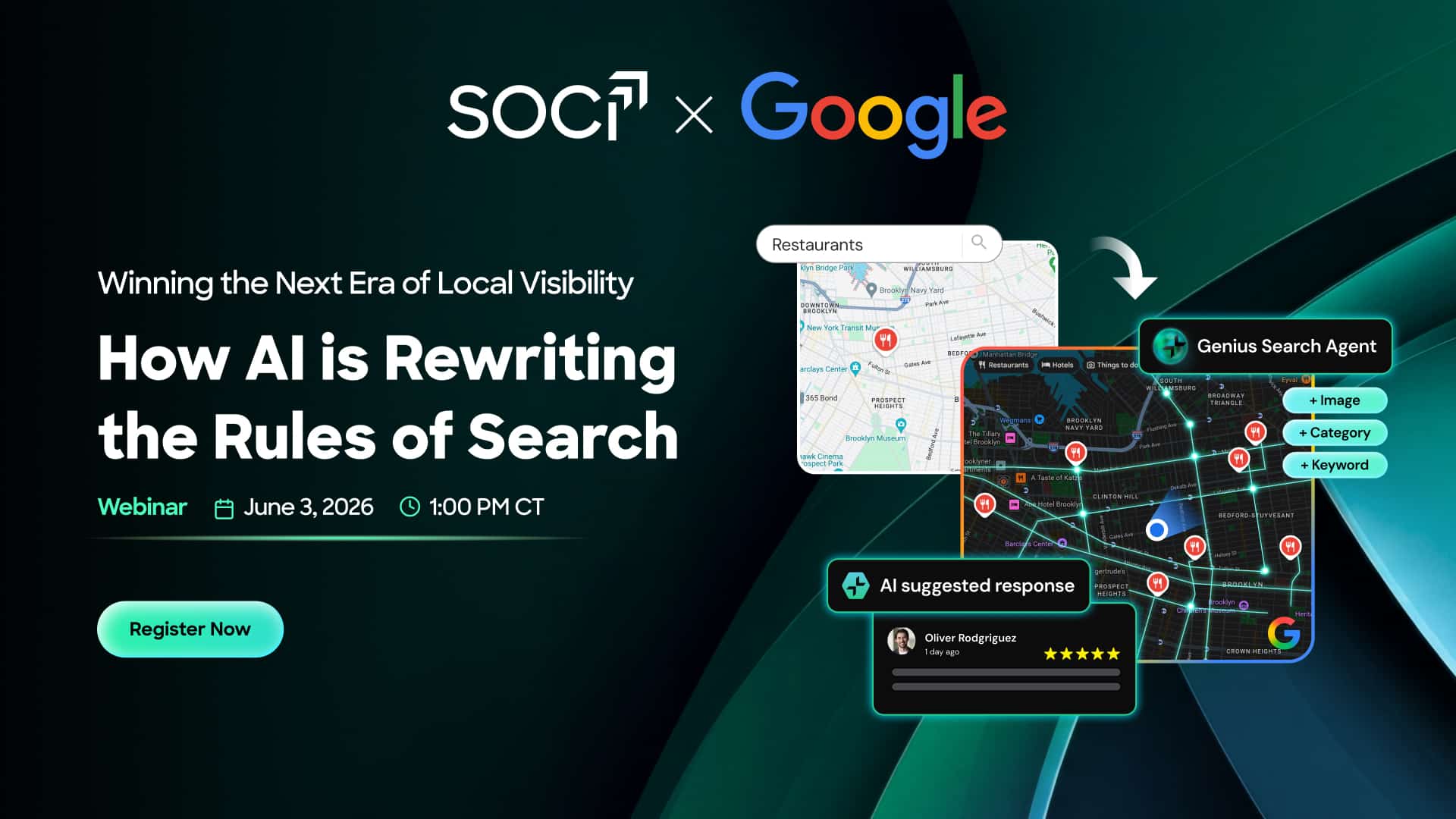
I recently discovered how AI is revolutionizing the way customers find local businesses. Tools like Google AI Overviews, Gemini, and Ask Maps are paving the way for more detailed, conversational searches.
It’s clear to me that traditional search rankings are no longer the sole factor in gaining visibility. Ensuring your business details are complete and accurate—like your Google Business Profile, reviews, and local content—can make a big difference.
I’m excited to join SOCi and Google for an exclusive webinar, Winning the Next Era of Local Visibility, on June 3. It’s a golden opportunity for anyone looking to stay ahead of the curve.
During this webinar, I look forward to learning:
How AI is transforming local search dynamics.
The types of signals that AI considers for recommendations.
Strategies to boost visibility on Search, Maps, and Gemini.
The implications of Ask Maps for your brand.
I’m convinced that AI is already shaping customer discovery, so it’s crucial to ensure your business isn’t left behind.
Your next prospect may not begin with your homepage, an ad, or even a conventional search result. They may ask an AI assistant to define the problem, compare possible approaches, narrow the field, and recommend a provider. Because AI tools can answer, compare, and recommend without sending the user to a website, your brand can lose consideration before a measurable visit ever occurs.
The practical response is not to abandon awareness marketing. It is to change the order in which you prepare for organic discovery. First make the brand understandable. Then make its claims credible and its expertise easy to retrieve. Only then should you expect AI systems to introduce it confidently. This bottom-up sequence gives your acquisition work a foundation instead of leaving an assistant to infer what your brand is from scattered pages and inconsistent mentions.
The buyer funnel remains top-down, but AI readiness starts at the bottom
People still move through a familiar progression: awareness, consideration, and decision. AI does not remove that progression. It changes who can influence the early stages and what that intermediary needs to know before it will mention you.
That creates two connected sequences:
The human sequence moves from discovering a need or brand to evaluating options and making a commitment.
The machine sequence moves from identifying your brand to validating its relevance and credibility, then deciding whether to include it in an answer.
The second sequence has to be built before it can support the first. An assistant cannot reliably recommend a company when it cannot determine what the company does, who it serves, how its products relate to the category, or whether anyone beyond the company supports its claims. That is why AI-oriented acquisition starts with understanding and credibility, even though the buyer still starts with awareness.
This distinction also prevents a costly overreaction. Paid media, direct outreach, events, and other controlled channels can still create reach. Keep using them when they produce qualified demand. Just do not assume that awareness spend also teaches organic answer engines how to represent you. A memorable campaign can increase human recognition while leaving the underlying entity confused.
Before expanding an awareness campaign, ask three readiness questions:
Can a machine identify the brand, its category, its offerings, and its intended customers without reconciling contradictory descriptions?
Can it find direct answers to the questions buyers ask while comparing and choosing?
Can it find credible corroboration outside the brand’s own website?
If any answer is no, the immediate acquisition problem is not reach. It is missing or unreliable information at the layer that produces reach.
Give machines a canonical version of your brand
Brand understanding begins with facts, not slogans. A buyer may appreciate an expressive positioning line, but a retrieval system still needs unambiguous answers to basic questions: What is this entity? What does it provide? Who is it for? Which problems does it address? Where does it operate? How are its products, services, founders, and parent organization related?
Create a canonical brand fact sheet before editing individual pages. It should record the approved form of your name, a plain-language category description, core offerings, primary audiences, supported locations or markets, important entity relationships, and the claims you are prepared to substantiate. Add the URLs where each fact should appear. Give every field an owner so that a positioning change does not produce five competing versions across the site.
Then reconcile the public surfaces in a deliberate order:
Correct the identity layer: the homepage, about page, contact information, organization profiles, and other pages that establish who you are.
Correct the offering layer: product, service, solution, integration, and category pages that explain what you provide.
Correct the decision layer: comparison criteria, use cases, limitations, implementation requirements, and proof that help a buyer judge suitability.
Align applicable structured data with the visible page content. Use the most specific relevant schema type, but do not add a relationship or claim that the page itself does not support.
Update important third-party profiles and partner descriptions so that the wider web is not repeating an obsolete category, name, or offering.
Prioritize incorrect information over missing information. An omitted detail limits what a system can say. A contradiction gives it competing versions to choose from, which can contaminate descriptions, comparisons, and recommendations. Resolve naming, category, audience, and product-relationship conflicts before producing another broad batch of content.
Structured data helps machines identify the type and relationships of information, but it is not a substitute for evidence. JSON-LD can label an organization, service, product, person, or relationship. It cannot make a vague claim credible or repair a visible page that says something different. Treat schema as a precise representation layer over clear, supported content.
You can turn this into a repeatable brand-understanding audit. Ask representative questions using several natural phrasings, inspect the answers, and classify each important fact as correct, absent, ambiguous, outdated, or unsupported. Each classification points to a different fix. Correct errors at the canonical location, add absent facts where they belong, clarify ambiguous relationships, retire outdated descriptions, and remove or substantiate unsupported claims.
This work may feel less visible than a campaign launch, but it is not administrative cleanup. Machines have been forming entity-level interpretations of brands since developments such as Google’s Knowledge Graph in 2012. Generative discovery makes the commercial effect more obvious because those interpretations can now appear directly inside an answer.
Turn expertise into passages an AI system can retrieve
Once the entity is clear, examine whether your content can supply a useful answer. Conventional SEO often encourages teams to think in pages: choose a query, publish a comprehensive URL, and earn a ranking. Generative systems may instead retrieve a passage that answers one part of a larger conversation. A page can be thorough and still be difficult to use if the answer is buried under scene-setting, dispersed across tabs, or dependent on context elsewhere.
A retrieval-ready passage usually needs five elements:
A descriptive heading that makes the question or decision clear.
A direct opening sentence that gives the answer before elaboration.
A qualifier that states the relevant audience, condition, market, product, or limitation.
An explanation or evidence that lets the reader judge why the answer holds.
A logical next step for someone who needs implementation detail, proof, or a related decision.
The goal is not to turn every heading into an awkward search query or reduce expert material to fragments. The goal is local clarity. If a passage is extracted from the page, it should retain enough nouns, qualifiers, and context to remain accurate. Replace unexplained pronouns such as “it” or “this solution” with the relevant entity or offering where confusion is possible.
Build this content around decisions rather than keyword variations. Cover the questions a buyer needs to resolve: how the category works, when an approach is suitable, when it is not, what requirements apply, which tradeoffs matter, how alternatives differ, and what evidence supports a claim. Comparison content should disclose the criteria and constraints behind the comparison instead of declaring a universal winner.
The technical layer must preserve that clarity. Clean HTML, structured data, directly available content, extraction-friendly sections, and capable on-site search all make it easier for systems to locate and interpret the answer. Important information should not exist only after an interaction that a crawler may never perform. Structured data should agree with the visible text, and headings should describe the section beneath them rather than act as decorative labels.
Use a practical extraction test on every high-value decision page:
Enter the buyer’s question into your own site search. Does the correct page appear?
Open the page without expanding accordions, switching tabs, or starting a tool. Is the essential answer already available?
Copy the most relevant passage into a blank document. Does it remain clear and correctly qualified on its own?
Compare the visible wording with the structured data. Do names, types, claims, and relationships match?
Follow the next-step links. Do they deepen the same decision, or send the reader back into generic navigation?
If your own search cannot find the answer, the page requires several interactions to reveal it, or the extracted text loses its meaning, fix retrieval before adding more schema. Machine readability begins with information architecture and writing; markup reinforces it.
Build external corroboration, then measure the recommendation layer
Earn descriptions that do not originate on your site
Your website establishes what you say about the brand. External coverage, profiles, discussions, reviews, and partner materials help a system judge whether that description is recognized elsewhere. This is why third-party mentions across publications, communities, Reddit, and social channels belong inside an AI-discovery strategy rather than being treated as unrelated PR activity.
Start with accuracy, not volume. Give PR, partnerships, social, community, and reputation teams the same canonical facts used on the website. Correct important external profiles that use an old name or category. Make current product details easy for partners to reference. Contribute useful, attributable expertise where relevant conversations already happen. Do not manufacture community discussions or seed disguised endorsements; unreliable promotion creates reputational risk and weak evidence.
Do not reduce this work to link building. A brand mention can contribute context even when it is not a conventional backlink, and a linked mention can still be unhelpful when it repeats the wrong positioning. Inspect the wording around the name, the relevance of the domain and discussion, the accuracy of the claim, and whether the mention helps distinguish the brand from similarly named entities.
Measure inclusion, accuracy, citation, and suitability
Traffic alone cannot reveal a decision that ended inside an AI answer. Add a prompt-based observation layer to your existing SEO and acquisition reporting. Build the prompt set from real buyer decisions, not from vanity questions designed to force a brand mention.
For discovery, test questions that ask how to solve the underlying problem or identify a suitable category.
For consideration, test comparisons involving actual requirements, constraints, and use cases.
For decisions, test questions about suitability, implementation, evidence, risk, or choosing among credible options.
For each observation, record the prompt, date, model or interface, whether the brand appeared, how it was described, whether it was recommended, which competitors appeared, and which URLs or domains were cited. Preserve the answer or relevant excerpt so that a later review can distinguish a real change from a reporting mistake.
A simple internal rubric can make the findings actionable:
Absent: the brand does not appear where it is genuinely relevant.
Present but unclear: the name appears, but the category, offering, or relationship is vague.
Present but inaccurate: a material description or claim is wrong or outdated.
Accurate but unsupported: the representation is correct, but no useful citation or external corroboration appears.
Accurately recommended: the brand is included for a suitable use case with correct context and defensible support.
Do not average a serious error into a visibility score. A wrong product relationship, unsupported capability, or obsolete brand description should become a correction task even when mention frequency is rising. Visibility without accuracy can amplify the problem you need to solve.
Make AI visibility an operating process
The work crosses too many systems to live in an isolated SEO backlog. Brand owners define canonical identity and positioning. Product and subject experts verify claims. Content teams create retrieval-ready answers. Web teams manage rendering, structured data, and on-site search. PR and community teams develop legitimate external corroboration. Analytics teams preserve observations and report changes.
Write a short publishing and maintenance SOP that specifies the canonical fact sheet, required reviewers, passage structure, structured-data checks, third-party update responsibilities, and the events that trigger revalidation. A rebrand, renamed product, changed audience, new market, retired capability, or revised claim should update the website, markup, profiles, partner materials, and prompt observations as one coordinated change.
Assign a decision owner who can resolve conflicts between teams. AI discovery becomes a leadership concern when inconsistent positioning, publishing incentives, or ownership boundaries prevent the organization from supplying one reliable version of itself. Governance, versioning, shared procedures, and new visibility metrics keep the system current after the initial cleanup.
Key takeaways
The buyer still moves from awareness to consideration and decision, but AI readiness must be built from identity and credibility upward.
A canonical brand fact sheet should resolve names, categories, offerings, audiences, relationships, markets, and supportable claims before awareness is scaled.
JSON-LD labels clear information; it cannot substitute for visible content, supporting evidence, or consistent positioning.
Decision content should provide direct, qualified passages that remain accurate when retrieved outside the full page.
External corroboration should be judged by relevance, context, and accuracy, not reduced to mention volume or backlinks.
AI-discovery reporting should track inclusion, accuracy, recommendations, competitors, citations, and citation locations alongside conventional traffic metrics.
Named owners, change triggers, and versioning turn GEO from a one-time optimization project into a maintained acquisition system.
Start with the offering closest to revenue and the buyer questions closest to a decision. Correct its identity gaps, make its answers retrievable, document credible external support, and establish a baseline across the recommendation layer. Expand only after that path is coherent. The result is a brand that can be introduced accurately before the prospect ever knows to search for it by name.
If your Yelp profile gets seen but still produces too few bookings, the problem may no longer be simple visibility. A customer can now ask a detailed question, compare the suggested businesses, and act without following the familiar path from search result to website.
Your job is to make that compressed journey work. Yelp needs clear business facts, customers need credible evidence of fit, and the booking or ordering connection needs to survive the handoff. A weakness in any one of those layers can turn a recommendation into an abandoned transaction.
That changes the optimization target. A conversational local request usually contains several constraints at once: the service, location, occasion, timing, preferences, and desired next step. A profile can be relevant to the broad category while failing to resolve one of those constraints. The customer may never reach your website to investigate further.
Audit your Yelp presence against four questions:
What does the business actually provide? Categories, service names, menu items, and descriptive copy should agree about your core offer.
Who or what situation is it suitable for? Include meaningful distinctions customers use when choosing, but only where they are accurate and supported by your operation.
Why should the customer believe the fit? Reviews and photos should give the customer evidence, not merely repeat promotional claims.
What can the customer do next? The appropriate reservation, appointment, quote, or ordering action should be visible, current, and connected to a working destination.
Build the audit from real customer language. Collect the questions that appear in calls, messages, quote requests, appointment notes, and reviews. Group them by intent, then check whether a person could answer each one from the information visible in Yelp. If the answer depends on an assumption or an old photo, you have found a content gap.
Correct the underlying field wherever possible. Put hours in the hours field, services in the relevant service area, menu information in the menu, and the primary transaction in the appropriate action. Descriptive copy can clarify the offer, but it should not become a container for disconnected phrases. Treat this as an answerability audit, not as a claim that repeating keywords will influence Yelp’s selection logic.
Your website still matters, including its LocalBusiness structured data. Keep the name, address, telephone number, URL, hours, and applicable business subtype aligned with the facts you publish elsewhere. Use a sameAs link when it accurately identifies your Yelp profile. That consistency helps search systems understand the same entity, but JSON-LD on your website cannot repair stale Yelp information or reconnect a broken booking calendar.
Close every gap between recommendation and transaction
A recommendation is not the conversion. The final action may depend on Yelp, your profile configuration, a scheduling or delivery partner, inventory or calendar data, and the confirmation experience. Every connection can look present while still sending the customer to the wrong service, location, or availability view.
Test the journey in the environment where customers encounter it:
Open the Yelp profile on a supported mobile experience and identify the primary action presented to a customer.
Confirm that the action matches the intent you want to win. A restaurant reservation, food order, healthcare appointment, service appointment, and home-service quote are not interchangeable conversions.
Follow the action into the connected system. Verify the business name, location, selected service, availability, and contact information at each step.
Continue to the final confirmation screen, but do not consume a real appointment or reservation unless your operation has a safe test procedure.
Check the resulting confirmation or lead record. It should give both the customer and your staff enough information to fulfil the request without another round of clarification.
Test more than the happy path. Try a service that has limited availability, a different location if you operate more than one, and a request that should become a quote rather than an instant booking. The purpose is to find mismatches between what the profile promises and what the connected system can actually accept.
Assign ownership for each layer. The person updating the Yelp profile may not control the scheduling platform, menu, delivery availability, or service calendar. Record who owns each one and where changes originate. Otherwise, a corrected profile can be overwritten by old partner data, or the profile can continue advertising an option that operations no longer fulfils.
The initial feature availability was described as mobile-first on iOS and Android, with broader category and desktop expansion planned. Rollout scope can differ by experience, so verify what customers can actually see instead of assuming that an announcement describes every account, category, or device.
Do not translate that into a campaign for generic praise. Broad comments such as great service reveal little about the specific situations in which the business succeeds. Honest reviews are more useful when customers naturally mention the service received, the type of need, the location, and the experience. Any request for feedback should remain neutral and comply with the platform’s current policies.
Use reviews as an operating dataset, not as copy you control:
Identify recurring service names and customer questions. Check whether your profile uses the same clear, accurate terminology.
Notice repeated misunderstandings. If customers arrive expecting an option you do not provide, correct the promise in your profile or connected flow.
Look for evidence gaps. A service may be listed but rarely described or photographed, leaving a customer with little basis for choosing it.
Respond to factual confusion calmly. Clarify the business detail that matters, then fix the underlying listing or operational issue when you control it.
Photos need a similar job-based audit. Cover the decision points a new customer cannot infer: what the exterior looks like on arrival, what the relevant space or service looks like, what is actually delivered, and how distinct options differ. Accuracy matters more than decorative volume. An attractive image that no longer represents the current offer can create a stronger expectation mismatch than having no image at all.
The same principle applies outside restaurants. A salon service name, healthcare appointment type, contractor quote category, and the evidence surrounding each one should remain consistent from recommendation through confirmation. The assistant can shorten the journey, but it cannot reconcile a profile, photograph, review pattern, and booking system that tell different stories.
Measure the compressed funnel with transaction outcomes
If a customer can complete more of the journey inside Yelp or a connected partner flow, website traffic alone becomes an incomplete scorecard. Flat website sessions do not prove that local visibility is stagnant, and more profile activity does not prove that qualified business increased.
Choose the completed outcome that matches the action:
For restaurants, distinguish completed reservations or orders from action taps.
For appointment businesses, track booked appointments separately from completed appointments and cancellations.
For home services, separate raw quote requests from requests that fit the service area and become qualified opportunities.
For delivery, distinguish an ordering action from a completed order that the business successfully fulfils.
Use the reporting fields available in Yelp and the connected platform, and keep definitions stable. If a partner exposes an origin label or channel field, preserve it through your export or customer-management workflow. If it does not, do not manufacture precise attribution from incomplete data. Record the limitation and compare only metrics that are defined consistently.
Read funnel patterns as diagnostic clues, not proof of a single cause. If profile visibility rises while actions stay flat, start by checking whether the listing resolves fit and presents a clear next step. If actions rise while completed transactions do not, inspect the partner handoff, availability, eligibility rules, and confirmation flow. If transactions rise but cancellations, no-shows, or poor-fit requests also rise, compare the promise in Yelp with what the customer can actually book.
Keep a change log alongside those measures. Record which profile fact, image set, menu item, service name, or transaction connection changed and when. Without that record, several simultaneous edits can make an improvement impossible to interpret and a regression hard to reverse.
Key takeaways
Optimize for the customer’s complete decision, not for a broad category phrase in isolation.
Keep business facts, customer evidence, and the connected transaction system consistent.
Test booking, ordering, appointment, and quote paths from Yelp through confirmation.
Use reviews and photos to find unanswered questions and expectation mismatches; do not treat them as keyword containers.
Measure completed business outcomes because an in-platform transaction may never appear as a website visit.
Use website schema to reinforce accurate entity information, not as a substitute for maintaining the Yelp profile itself.
Run the audit around one valuable customer intent
A full profile overhaul can hide the problem you need to solve. Start with one commercially meaningful intent: the reservation type, appointment, service request, or order you most need Yelp to support.
Write the exact questions and constraints a suitable customer brings to that intent.
Mark where each answer lives: profile field, service or menu information, review evidence, photo, booking system, or confirmation.
Correct contradictions and remove unsupported promises before adding more copy.
Test the transaction path on the customer-facing experience available to your category.
Record the current funnel outcomes, the change made, and the operational owner responsible for keeping it accurate.
Recheck the path whenever hours, services, locations, menus, calendars, or integration settings change.
The businesses best prepared for AI-assisted local bookings will not necessarily be those with the longest descriptions. They will be the ones whose facts answer the question, whose evidence supports the choice, and whose transaction path does exactly what the recommendation promised. Pick the path tied most closely to revenue or qualified demand, and make that one dependable first.
If your business appears for a broad search such as electrician nearby but disappears when the customer describes an older home, a panel upgrade, and a need for responsive service, a conventional ranking report is showing only part of the problem. Ask Maps may evaluate which businesses fit the stated situation, not merely which listings match the category.
Your practical goal is to make that fit understandable and supportable. Your Google Business Profile should establish what the business is, your website should explain the work in enough depth to resolve a specific need, and your reviews should provide credible customer evidence. The following process turns those surfaces into a local discovery system you can audit and improve.
Personalized recommendations change what visibility means
Traditional local tracking usually reduces visibility to a position: where did the business rank for a keyword in a location? That remains useful, but it misses an important layer of conversational discovery. A person can now supply the job, property type, constraint, urgency, trust concern, or decision criterion inside the request.
That distinction changes the question you should ask. It is no longer only, Can Google associate this business with electricians in this city? It is also, Can Google find enough consistent evidence to associate this business with panel upgrades in older homes, responsive communication, and the other details a customer included?
Use personalized carefully here. The actionable behavior is personalization to expressed intent: the result changes as the person gives the system a more specific problem to solve. You do not need to speculate about private account history or undocumented signals to work on that problem.
The observed pattern is directional rather than universal. It came from locality-specific testing and was not exhaustive across every market or query. Treat it as a reason to expand your audit, not as proof that every Ask Maps result follows an identical formula.
Build a consistent evidence map across profile, site, and reviews
Ask Maps can draw from Google Business Profiles, reviews, business websites, and external material. These surfaces play different roles. A useful working model is identity, explanation, and corroboration:
Google Business Profile establishes identity. It tells the system what the business is, where it operates, and which services it presents.
The website explains capability. It gives a specific service or situation enough context to be understood beyond a short listing.
Reviews corroborate experience. They show how customers describe the work, service, communication, and outcomes in their own words.
External mentions can reinforce or complicate the picture. Information elsewhere may help confirm the business, but stale or inconsistent claims can create ambiguity.
Create an evidence map before you edit anything. For every commercially important service, write down the customer need, the relevant profile fact, the page that explains it, and the review themes that could honestly support it. A blank cell is a content or data gap. A contradictory cell is an accuracy problem.
Make the Business Profile precise, not expansive
Your profile should describe the business customers can actually hire. Confirm that its category, services, description, hours, contact details, and service-area information are accurate. Do not add adjacent services merely to look comprehensive. A larger but unreliable service list makes it harder to build a consistent explanation across the rest of your presence.
Use operational language where the profile permits it. Electrical contractor offering residential panel upgrades communicates more than a string of broad adjectives. If responsiveness matters to customers, publish accurate contact and availability information. Let real customer accounts support the quality claim rather than describing the business as responsive without evidence.
Check consistency at the fact level. A service should not appear on the profile while the website gives no indication that you provide it. Hours, names, locations, phone details, and stated coverage should not conflict across your owned pages. Consistency does not guarantee selection, but inconsistency makes the business harder to interpret confidently.
Publish pages that resolve a situation, not just a keyword
A generic Electrician in City page can establish category and location. It may not answer whether the company handles a panel upgrade in an older home. That difference matters when the query contains the job and its context.
For each meaningful service-intent combination, give the reader a page that answers the decision they are making. Include:
The exact work offered: name the service plainly and distinguish it from neighboring services a customer may confuse with it.
The situations you handle: describe relevant property, equipment, business, or project contexts only where they genuinely affect fit.
The boundaries of the service: state exclusions, prerequisites, or geographic limitations that would otherwise produce a poor match.
How the next step works: explain what information you need, how scope is assessed, and what the customer should do next.
Decision-useful answers: address the questions customers ask when choosing a provider, not merely the phrases an SEO tool reports.
Visible evidence: use accurate examples, credentials, service details, and customer feedback when you have them. Do not manufacture specificity.
The page does not need to repeat every possible conversational prompt. It needs clear facts that can answer several versions of the same underlying need. Write for the decision, then use headings and direct language to make each answer easy to extract.
JSON-LD can encode those visible facts after the page is complete. Use the appropriate business and service vocabulary, keep marked-up information consistent with what a visitor can read, and avoid adding claims solely in structured data. Schema is a machine-readable clarity layer, not a substitute for missing service information or customer evidence. There is no basis for assuming markup alone will force Ask Maps to recommend a business.
Ask customers for honest feedback about the work they received. Open questions can invite useful context: What problem were you trying to solve? What work was completed? What part of the process was helpful? The customer should decide what to mention and how to say it.
Then analyze the patterns already present. Group review language by service, situation, communication, specialization, and trust. Compare those themes with your profile and service pages. If customers repeatedly describe a capability that the website barely mentions, you may have a documentation gap. If the site promotes a specialty that customers never discuss, investigate whether the claim is unclear, unimportant to buyers, too new to have accumulated evidence, or unsupported.
Do not turn that analysis into review manipulation. Repeating a target phrase is not the same as demonstrating fit. The useful signal is a coherent relationship between the stated service, the detailed explanation, and genuine accounts of customer experience.
Basic local need:HVAC company nearby. This checks whether the business enters a broad category-and-location result.
Defined service:Electrician for a panel upgrade in an older home. This introduces a named job and a meaningful context.
Situational fit:I need a panel upgrade in an older home and want a company that regularly handles this kind of work. This asks the system to interpret suitability rather than category alone.
Trust requirement:Which local electrician appears dependable for this job, and what evidence supports that? This tests whether the answer can attach a reason to the selection.
Decision request:Help me choose a local electrician for an older-home panel upgrade, prioritizing relevant experience and responsive communication. This combines service, context, trust, and a decision criterion.
These prompts are templates, not universal keywords. Replace the service and context with the real decisions your customers face. A plumber might test a specific repair and property situation. An HVAC company might test a system type, service need, and availability concern. A professional practice might test the matter handled, client context, and trust requirement.
Do not include your brand name unless you are deliberately testing branded comprehension. The purpose of an unbranded audit is to discover whether the business can be selected from evidence, not whether Google recognizes a name you supplied in the prompt.
Record more than presence or absence for every prompt:
Inclusion: Did the business appear anywhere in the answer?
Selection: Was it merely listed, or framed as a suitable option?
Explanation: What reason, if any, was attached to it?
Evidence: Did the explanation appear to rely on the profile, reviews, the website, or another visible source?
Accuracy: Was the description correct, incomplete, stale, or unsupported?
Missing fit: Which part of the prompt could not be connected to clear evidence about the business?
Document the locality, prompt wording, account context, and date alongside the output. A result from a particular setup is an observation, not a universal rank. Keeping the setup visible makes later checks interpretable and prevents a changed prompt from being mistaken for improved visibility.
Turn recommendation gaps into a prioritized backlog
The audit becomes useful when each failure leads to a different response. Do not answer every disappointing result by adding more keywords to the same page.
Broad discovery gap: The business is absent even for the basic local need. Check fundamental profile accuracy, business identity, locality, and whether the service is actually represented before expanding content.
Service comprehension gap: The business appears for the broad request but drops out when a specific job is added. Build or improve the page that explains that job, and align the profile service information with it.
Situational gap: The service is understood, but a property type, use case, or constraint breaks the match. Add the context only if the business genuinely serves it, and explain how it affects the engagement.
Evidence gap: The business appears but receives no meaningful rationale, or the rationale is thin. Look for credible detail across reviews, service pages, and external mentions rather than adding unsupported superlatives.
Accuracy gap: The answer describes the business incorrectly. Correct conflicting facts on surfaces you control and investigate visible third-party information that may be stale. Do not publish a new claim merely to overpower an old one.
Conversion gap: The recommendation is accurate, but the destination page leaves the customer unsure what to do. Make the service boundary, contact route, and next step explicit.
Prioritize accuracy first because an incorrect recommendation can create poor leads and erode trust. Then work from broader comprehension toward narrower situational evidence. There is little value in polishing a specialized page if the profile and site still disagree about the basic service.
Measure progress with a small set of diagnostic fields rather than one supposed Ask Maps ranking:
Intent coverage: which important customer situations have clear supporting facts across the profile and site?
Selection depth: at what point in the intent ladder does the business stop appearing or stop being treated as a fit?
Explanation accuracy: do the reasons attached to the business match what it actually provides?
Evidence alignment: do profile facts, website explanations, reviews, and visible external information tell a compatible story?
Change history: which factual or content update preceded a meaningful change in observed answers?
Avoid claiming causation from a single before-and-after check. Locality-based results are not exhaustive, and several information sources may contribute to an answer. Build a change log, repeat the same useful prompts over time, and look for consistent movement in selection and explanation.
Key takeaways
Ask Maps can move beyond listing nearby businesses and interpret which options appear to fit a detailed local request.
Your Business Profile establishes identity, your website explains capability, and reviews provide customer evidence. Improve them as one connected system.
Build service pages around real jobs, contexts, boundaries, and decisions rather than producing interchangeable city-and-keyword pages.
Test broad, service-specific, situational, trust-focused, and decision-oriented prompts to find where the system loses confidence in the match.
Track inclusion, selection, explanation, evidence, and accuracy. A single position cannot describe personalized local discovery.
Use structured data to encode accurate visible information, not to manufacture relevance that the page and business cannot support.
Choose a service that matters to your business and build its intent ladder now. The first useful output is not a better-looking rank report. It is the first point where the recommendation breaks, the evidence missing at that point, and a specific profile, page, or accuracy update you can make to close the gap.
You can earn a favorable mention in an AI answer and still lose the decision one sentence later. If the model closes by offering to find a cheaper option, compare competitors, or build a personalized shortlist, it has changed what the user is likely to consider next.
That closing prompt belongs in your AI visibility strategy. You need to inspect where it sends the conversation, follow the suggested path, and make sure your content supplies the evidence the model will need on the next turn.
The next-turn prompt is part of your visibility surface
An LLM nudge is the invitation that appears near the end of an answer: "Would you like a comparison?", "Tell me your budget," or "I can find current deals." It looks like a courteous way to keep the conversation open. Functionally, it creates a low-effort next action.
The user doesn’t have to formulate another query, choose a new search result, or decide which criterion matters. The model has already proposed the criterion and the next step. A brief "yes" can move the conversation from discovery to comparison, from quality to price, or from a general recommendation to a shortlist built around personal constraints.
That makes the nudge more than an engagement device. It can influence digital decision-making in three ways:
It frames the next question. An offer to compare prices makes cost more prominent, even when the original request was about quality or suitability.
It requests decision data. Asking for a budget, location, use case, or preference gives the model new filters for the next recommendation.
It narrows the action. An invitation to compare two named options can turn a broad market into a two-brand decision.
A nudge is not proof that the model prefers the suggested action or any brand involved. It is evidence about the direction of the conversation. Keep that distinction clear: the initial answer measures answer visibility, while the accepted nudge reveals journey visibility.
When you monitor AI responses, capture the final invitation as its own field. Don’t bury it in a screenshot or treat it as disposable wording. Record the proposed action, the decision criterion it introduces, and the information the user is asked to provide.
Read each nudge as a change in decision criteria
Budget and deal prompts are the dominant pattern in observed LLM interactions, representing roughly half of closing suggestions. Product comparisons are the next most common route. Specification-led follow-ups appear much less often, even though specifications can still help a model evaluate and rank competing options.
This distribution matters because each route changes what your brand must prove. A premium brand may enter the first answer on quality, expertise, or fit, then face a next-turn comparison organized around price. A challenger may receive an opportunity when the user accepts a comparison. A complex product may disappear when the model asks for details that its public content never states clearly.
The platforms also express these invitations differently. Their wording is less important than the behavior it produces, but the differences help you design a realistic monitoring set.
Platform
Typical closing style
Common next-turn behavior
What to inspect
ChatGPT
"If you want…"
Deals and product comparisons
Whether your brand survives a price-led or head-to-head follow-up
Microsoft Copilot
"If you tell me…"
Clarification and personalization
Which user details become filters and whether your content answers them
Google Gemini
"Would you like me…"
Permission-based continuation
The task proposed after permission is granted
Perplexity
"I can help…" or "If you’d like…"
Utility-oriented follow-up, often including commerce
The sources and attributes used when the offered help is accepted
Meta AI
"Let me know…"
More passive continuation, often involving comparisons or specifications
Whether a less forceful invitation still narrows the decision set
Don’t turn these platform tendencies into permanent rules. LLM outputs can vary with wording, context, model changes, and the conversation that came before. Use the patterns to choose what to test, then judge the responses you actually receive.
The practical question is not simply, "Did the model mention us?" Ask, "Which criterion did the model introduce next, and does our public evidence support us under that criterion?" That question exposes the content gap behind most nudge failures.
Audit the conversation chain instead of one answer
A conventional AI visibility check often stops once it records cited domains, named brands, and answer sentiment. A nudge audit continues until you can see how the model changes the decision after the user accepts its offer.
Start with a real decision. Choose a commercially important question your customer would ask, such as selecting between product types, finding an option within a constraint, or solving a post-purchase problem. A broad keyword without a decision behind it won’t reveal a useful journey.
Run the same intent across relevant platforms. Preserve the meaning but include natural variations in phrasing. Record the platform, available model identifier, prompt wording, and run date so later checks remain interpretable.
Separate the answer from the closing nudge. Save the exact invitation, classify it as budget, deal, comparison, clarification, specification, support, or another observed route, and note any brands or attributes named in it.
Accept the nudge as written. If the model offers a comparison, accept the comparison. If it asks for a budget, provide a plausible budget that fits the audience you are testing. Don’t substitute a different follow-up, because that would test your prompt rather than the model’s proposed journey.
Inspect the next response. Record which brands remain, which disappear, which new competitors enter, what evidence supports the recommendation, and whether the model introduces another nudge.
Map the missing evidence to a page. Every unsupported price, comparison criterion, qualification question, or support problem should point to a specific content asset that needs to be created, corrected, or made easier to retrieve.
Use a structured worksheet rather than a folder of screenshots. The minimum useful record looks like this:
Field
What to record
Starting decision
The user’s underlying choice, constraint, or problem
Initial brand position
Mentioned, recommended, omitted, or cited only as evidence
Closing nudge
The invitation exactly as displayed
Nudge category
Budget, deal, comparison, clarification, specification, support, or other
Accepted input
The reply used to continue the suggested path
Next-turn position
Whether the brand persists and how its role changes
Decision evidence
Prices, attributes, limitations, policies, proof, or support instructions used
Content action
The exact page or data element to create, update, or clarify
Build content for the four next-turn paths that matter
You cannot dictate the sentence an LLM will place at the end of an answer. You can make your brand easier to evaluate when the conversation moves into a predictable follow-up. Start with the route that creates the largest gap between your positioning and the model’s next criterion.
Comparison: make the decision legible
A useful comparison page does more than place two feature lists side by side. It explains which option fits which user, identifies the criteria that materially change the choice, and states where each option has an advantage or limitation. If your page claims that your product wins every category, it gives the model little reason to trust the distinction.
Build comparison content around the decision, not the competitor’s name alone. Include a direct summary, a consistent attribute table, audience-fit statements, pricing context, important constraints, and evidence for differentiating claims. Date facts that can change, and assign an owner to keep them current.
For health or financial choices, a comparison page must not pretend to make an individualized decision. Explain the criteria and scope, state material limitations, and direct personal decisions to an appropriately qualified professional.
Budget and deals: publish the facts without cheapening the brand
Ignoring price does not prevent an LLM from creating a price comparison. It leaves the model to assemble one from weaker, older, or third-party information. Even a premium brand needs a clear public explanation of what the buyer pays and what that price includes.
Keep the visible page and structured data aligned. Where Product and Offer markup applies, populate accurate values for price, priceCurrency, availability, and url. Use priceValidUntil only when an offer has a real expiry date. If a price depends on configuration, eligibility, contract length, or location, state that condition rather than publishing a misleading headline number.
Deal data needs the same discipline. Show the eligible products, start or end conditions, redemption requirements, exclusions, and the normal price where appropriate. Remove expired offers from the visible page and update the associated markup. The objective is not to manufacture a discount for AI visibility; it is to make valid commercial facts unambiguous.
If low price is not your position, publish the evidence that explains the premium. That may be included service, durability, specialist capabilities, support terms, or a lower total cost for a defined use case. Use only claims you can substantiate. The model may still compare prices, but it will have a better chance of comparing value as well.
Clarification: answer the filters the model asks for
A clarification nudge reveals the variables the model considers necessary for a better recommendation. Treat those variables as an editorial brief. If it asks about budget, experience level, location, compatibility, team size, or intended use, check whether your pages state who the offer is for and where it does not fit.
Add concise "best for," "not intended for," prerequisite, compatibility, and constraint sections where they genuinely help the decision. Use the same terminology across product pages, comparison pages, documentation, and structured data. Contradictory labels force the model to reconcile facts that your organization should have resolved first.
Support and specifications: own the quieter opportunity
LLMs are less proactive about troubleshooting and support than they are about commerce. That support gap creates a useful authority opportunity: publish the answer before the model learns to ask for it more often.
A support page should identify the product or version, describe the exact symptom, list prerequisites, give ordered steps, explain the expected result, document known limitations, and provide an escalation path. Avoid placing critical instructions only in an image or an undifferentiated PDF when the same information can be published as accessible HTML.
Specifications deserve similar care even though they account for a smaller share of closing nudges. Use consistent units, stable attribute names, explicit compatibility information, and version-specific values. Specifications may not trigger the next question, but they can supply the facts used inside a comparison, qualification, or support answer.
Measure whether the nudge keeps your brand in the decision
You generally won’t see a user’s private AI conversation in your analytics, so separate what you can observe in controlled prompts from what you can observe on your site. Combining the two as if they were one attribution trail creates false precision.
Use your prompt audit to track nudge direction, brand continuity, evidence quality, and destination readiness. Brand continuity is the share of tested conversation chains in which your brand remains relevant after the suggested follow-up is accepted. Review the underlying chains alongside the rate; a brand can persist as the recommended choice, a weak alternative, or merely a cited source.
Use analytics to monitor identifiable AI referrals, the landing pages they reach, engagement with comparison or pricing content, support journeys, and completed business outcomes. A referral from an AI platform does not prove that a particular closing nudge caused the visit. Treat referral behavior as supporting evidence, not a transcript of the user’s path.
Re-run the audit after material changes to pricing, products, documentation, positioning, structured data, or major model behavior. Keep the original prompts and classification rules stable enough to compare observations, while adding new prompts when customers develop genuinely new decision patterns.
Key takeaways
Capture the closing invitation separately from the main AI answer; it signals the next decision criterion.
Accept the model’s proposed follow-up and audit the second response before declaring an AI visibility win.
Prioritize accurate comparison, pricing, deal, qualification, support, and specification content based on the paths you actually observe.
Keep visible claims and structured data synchronized, especially when prices, availability, or promotions change.
Measure brand continuity across conversation chains, then use site analytics as supporting evidence rather than claiming perfect attribution.
Start with one decision that materially affects your business. Record the answer, follow the nudge, and fix the first evidence gap that causes your brand to disappear or lose its position. That small extension turns an AI mention check into a usable view of the customer journey.
Your pages rank, your crawl reports look clean, and your brand still disappears when an AI assistant answers the same question. That gap does not mean SEO has stopped working. It means ranking is now one checkpoint in a longer path through discovery, interpretation, citation, recommendation, and action.
You need a strategy that can diagnose where that path breaks. The framework below will help you make important pages easier for search engines and language models to understand, support, select, and represent accurately without abandoning the technical and editorial fundamentals that already earn search visibility.
Key takeaways
Keep technical SEO in place, but stop treating indexing as proof that an AI system understands the page correctly.
Make the primary entity, page purpose, relationships, authorship, scope, and date unmistakable in both visible copy and structured data.
Treat factual accuracy and citation grounding as separate requirements. An answer can be correct while its linked evidence fails to support it.
Give AI systems a defensible reason to recommend your brand, including a defined audience, meaningful distinctions, limitations, and corroborating evidence.
Measure mentions, factual representation, citations, recommendations, visits, and business outcomes separately. They are different stages, not interchangeable measures of success.
Treat AI visibility as four separate outcomes
AI visibility is too broad to be a useful diagnosis. A brand can be retrievable but misunderstood, correctly described but not cited, cited but not recommended, or recommended without receiving a visit. Calling all of these states visible hides the work you actually need to do.
Outcome
What must happen
What you should inspect
Eligibility
The page can be discovered, crawled, indexed, and retrieved for a relevant need.
Robots directives, index status, canonicals, internal links, renderability, page status, and information architecture.
Interpretation
The system identifies the correct entity, attributes, relationships, intent, scope, and authorship.
The page or brand is chosen as evidence, a citation, or a recommendation.
Claim clarity, extractability, qualifications, supporting evidence, external corroboration, and differentiation.
Business impact
The answer produces recognition, preference, a visit, or a valuable action.
Referral traffic, branded demand, assisted conversions, landing-page fit, lead quality, and revenue-related outcomes.
Not every engine exposes these stages, and different products implement retrieval differently. Use the model as a diagnostic framework, not as a claim that every system has an identical architecture.
A practical annotation model starts with gatekeepers such as language, geography, time, and entity identity. It then moves through attributes and relationships, query intent and expertise, confidence and corroboration, and finally extraction quality. A failure near the beginning contaminates everything that follows. If the system mistakes a reviewer for the author, an old price for the current price, or a regional service page for a global offer, more keyword coverage will not repair the underlying interpretation.
Make every important page easy to classify and quote
Start with pages tied to a meaningful audience decision: core service pages, product pages, category pages, comparison resources, original analysis, and authoritative explanations. Audit each page in the order below. The sequence matters because later improvements cannot reliably compensate for an ambiguous identity.
State the page’s category and job early. The opening should identify the subject before it introduces a slogan, story, or broad market claim. A useful pattern is: [entity] is a [category] for [audience]. It helps with [task] in [context].
Choose one primary entity. Decide whether the page is principally about a company, person, product, service, location, event, or concept. Use its exact name consistently, and make the relationship between that entity and any secondary entities explicit.
Align names and roles. The visible byline, author biography, reviewer credit, publisher identity, organization page, and structured data should describe the same relationships. Do not place a prominent expert biography where a system could reasonably interpret that expert as the author.
Qualify important claims locally. Put the relevant date, region, version, audience, unit, or limitation next to the claim it changes. A distant disclaimer is weak context for an extracted sentence.
Make useful passages self-contained. A heading and its following paragraph should identify the subject without depending on several earlier sections. Pronouns such as it, they, and this approach become ambiguous when a passage is retrieved on its own.
Remove competing answers. Reconcile old and new descriptions across product pages, help content, author profiles, location pages, PDFs, and structured data. If an old page must remain available, label its historical scope clearly.
Inspect the rendered page, not only the editor. Navigation, related-content modules, biographies, popups, templates, and injected markup can introduce entity signals that are more prominent than the copy you intended an engine to interpret.
Use JSON-LD to reinforce the visible page, not to create a second version of it. Entity names, authorship, publishing relationships, dates, page type, and material attributes should agree with what a reader can see. Passing a syntax validator only proves that the markup can be parsed. It does not prove that the graph identifies the correct entity or that its claims are supported.
Run a simple extraction test after editing. Copy each important section without its site header or preceding paragraphs. Check whether a reader can still identify who or what the section concerns, what is being claimed, where the claim applies, when it applies, and what supports it. If you have to reconstruct those details from elsewhere on the page, the passage is not yet robust enough for independent retrieval.
Give engines evidence to ground and reasons to recommend
Correctness is not the same as grounding. In Oumi’s 4,326-query SimpleQA benchmark, Google AI Overviews answered 91% correctly in the February test, up from 85% in the October test. Yet 56% of the correct February answers were classified as ungrounded because their linked references did not fully support them, compared with 37% in October.
For every commercially important or frequently repeated claim, create an evidence unit that contains the following information close together:
Claim: the precise assertion you want a person or system to understand.
Scope: the audience, location, product, plan, version, or situation to which it applies.
Basis: the method, documentation, data, policy, test, or first-party record that supports it.
Time: the publication, verification, or effective date when recency changes the meaning.
Limitation: the material exception, uncertainty, tradeoff, or condition that prevents overstatement.
Keep the evidence on the page that makes the claim whenever practical. A generic references page may help a diligent reader, but it forces an extraction system to join distant context correctly. A short local explanation, followed by a relevant link to deeper evidence, creates a cleaner relationship.
Do not manufacture certainty with structured data, repeated wording, or unsupported superlatives. No schema property can turn best, safest, fastest, or most trusted into evidence. Replace the superlative with a bounded fact the reader can evaluate, or remove it.
Make the recommendation case explicit
A page can explain a category perfectly and still give an answer engine no reason to favor its brand. Recommendation visibility requires a proposition, not merely topic coverage. The system needs evidence about who the offer suits, what makes it meaningfully different, and why that distinction matters in the user’s situation.
Define the audience and use case narrowly enough that suitability can be evaluated.
Describe meaningful differences in capabilities, process, scope, support, availability, or constraints.
Explain the consequence of each difference instead of presenting an unprioritized feature list.
State who or what the offer is not suitable for when that boundary affects the decision.
Support self-published claims with appropriate corroboration, such as substantive reviews, independent recognition, documented results, or consistent coverage beyond your own domain.
AI-mediated recommendations can draw on reviews, brand prominence, positioning, and other signals of authority and preference. That makes brand building, public relations, reputation management, product clarity, and SEO connected parts of the same job. Publishing more informational pages will not compensate for a proposition nobody can distinguish or evidence nobody else confirms.
Build topic coverage around decisions rather than endless keyword variations. Alongside a definitive category page, cover the problems that create demand, the situations in which different approaches work, evaluation criteria, important constraints, implementation questions, comparisons, and current facts that genuinely change the answer. Link these pages through shared entities and consistent terminology so the site forms a coherent explanation instead of a pile of loosely related posts.
Write headings that reflect real subquestions, then answer each one directly before adding nuance. This does not require robotic question-and-answer copy. It requires a reader to know, within the first sentence of a section, whether that section resolves the condition they included in their prompt.
Measure the path from answer to business result
Referral sessions are useful, but they are not a complete AI visibility metric. Many answers do not trigger a live web search, and many users receive enough information without clicking. A brand can therefore gain or lose influence inside an answer before analytics records a visit.
Semrush’s analysis of more than a billion lines of U.S. clickstream data from October 2024 through February 2026 found that ChatGPT referrals grew 206%, but the outbound traffic remained concentrated. Google received 21.6% of outbound clicks, while the ten largest destinations collectively received more than 30%. The number of sites receiving any referral traffic peaked around 260,000 in 2025 and later settled near 170,000.
Live search was also triggered for 34.5% of observed queries, down from 46% in late 2024. These findings concern one platform and one clickstream dataset, so they are directional rather than a universal forecast. They still expose the reporting error to avoid: more AI referrals across the market do not guarantee meaningful referral traffic for your site, and a missing referral does not prove your brand was absent from the answer.
Define stable query families. Include prompts about the brand, category discovery, problem solving, comparison, suitability, objections, and facts where freshness matters. Use prompts that contain the context a real buyer would provide.
Record the test conditions. Save the exact prompt, date, platform, visible model or mode, whether live search occurred, and whether the session had context that could affect the response.
Score each stage separately. Record whether the brand was mentioned, represented accurately, supported with a citation, linked to the correct page, included in a recommendation, visited, and associated with a valuable action.
Inspect the words around the brand. A mention framed as unsuitable, outdated, expensive, unverified, or intended for the wrong audience is not a visibility win. Capture the attributed category, strengths, weaknesses, and comparison set.
Preserve a baseline before editing. Document the affected pages and the specific change, then rerun the same prompts under comparable visible conditions. Individual answers can vary, so do not declare a trend from one response.
Observed pattern
Likely gap to investigate
Next action
No mention and no citation
Eligibility, relevance, or entity recognition
Check crawl and index status, internal linking, category clarity, and whether the page directly addresses the prompt’s need.
Move support closer to the claim, make passages self-contained, and strengthen the relationship between the assertion and its evidence.
Cited but not recommended
Positioning, suitability, or corroboration
Clarify the intended audience, meaningful differences, tradeoffs, and credible proof beyond the brand’s own assertions.
Recommended but rarely clicked
Possibly no failure at all, or an answer that satisfies the user before a visit
Assess brand representation and downstream demand alongside referrals; give users a legitimate reason to continue without withholding the basic answer.
Referral traffic without valuable action
Prompt-to-page or page-to-offer mismatch
Compare the referring conversation with the landing page’s promise, audience, next step, and conversion path.
Start with one query family tied to a real decision. Confirm technical eligibility, audit entity and claim clarity, strengthen the evidence and recommendation case, and then measure every stage with the same prompts. The first useful win is not a larger content calendar. It is knowing exactly where your current pages stop being understood, trusted, selected, or acted on.
You publish a precise title, a useful answer and a well-structured page. Then an AI system presents a different headline, compresses the answer into a few sentences or recommends a forum discussion instead. The immediate temptation is to chase whichever domain dominates the latest citation chart.
That reaction solves the wrong problem. In AI-mediated discovery, your audience may encounter a machine-generated interpretation before it encounters your page. You therefore need content that is easy to select, difficult to misrepresent, clearly attributable and still worth visiting after the summary appears.
Treat AI as a second presentation layer
Publishing controls the material you make available. It doesn’t fully control how an intermediary presents that material. A search engine, answer engine or content platform may select a passage, combine it with other material, rewrite its label or generate a summary. Ranking is only one part of that process.
Discovery outcome
Question to ask
Typical failure
Selection
Does the system use your content for the relevant question?
A competitor, forum or reference site supplies the answer instead.
Representation
Does the generated answer preserve your meaning and important conditions?
A caveat disappears, a comparison becomes absolute or an old claim is repeated without context.
Attribution
Can the user connect the claim to your brand, expert or page?
Your idea appears without a citation or with another entity presented as the authority.
Action
Does the presentation give the user a reason and a path to continue?
The summary answers enough to stop the journey, or the destination doesn’t match the generated promise.
Audit priority content against all four outcomes. Start with the rendered page, not just its keyword report, and ask:
Can someone identify the exact question the page answers from its title, opening and section headings?
If a single answer paragraph is extracted, do its subject, scope and conditions remain intact?
Does the passage name the relevant product, company, person or concept, or does it rely on pronouns and surrounding context?
Can a reader distinguish your verified claims from opinions, examples and predictions?
If the generated answer earns a visit, does the destination immediately continue the same task?
A page can rank and still fail this audit. It can also be quoted accurately without producing a visit. Those are different outcomes, so don’t hide them inside one visibility score.
Choose channels at the query level, not from citation charts
Make the query family your unit of analysis. Build a working inventory around the decisions your audience actually faces:
Problem recognition: What is happening, and what is the problem called?
Category education: How does the approach work, and when is it appropriate?
Comparison: Which options differ on the criteria that matter to this buyer?
Risk and objection: What can go wrong, what are the limitations and what evidence reduces uncertainty?
Implementation: What must the user configure, verify or troubleshoot?
Brand validation: Is this company or product credible for the stated use case?
For each family, inspect which kind of material supplies the answer. A reference page may win a definition query. A practitioner discussion may win a question about lived trade-offs. Product documentation may win a configuration question. An original analysis may win when the user needs evidence or a defensible comparison. The point is not to force your site into every role. It is to identify the role your content can credibly own and the gaps that require another channel.
Use community visibility only when participation is the real strategy
Wikipedia is a different environment. Its editorial constraints make it unsuitable as a brand-controlled distribution surface. Treating either community as inventory misses the mechanism that gives it value.
Use this decision gate before investing in an external community:
Would the contribution still help the reader if your company name and link were removed?
Can the contributor disclose an affiliation without weakening the substance of the answer?
Does your team have knowledge, evidence or direct product context that is missing from the discussion?
Can someone return to answer follow-up questions, correct errors and maintain the contribution?
Would the claim survive skeptical review from people who don’t share your commercial interest?
If those conditions aren’t met, put the effort into a stronger owned resource. If they are met, participate under the community’s rules and measure usefulness before citations. On Reddit, answer the actual question, disclose the relationship and avoid manufacturing consensus. On Wikipedia, limit involvement to verifiable corrections and respect editorial review. On YouTube, make the video’s subject and central claim clear within the content itself, while continuing to write accurate creator-controlled titles wherever the interface displays them.
Give every channel a defined job
Channel
Useful role
Warning sign
Owned website
Canonical explanations, product facts, original evidence, documentation and conversion paths.
The page makes claims that cannot be verified or understood without sales contact.
Reddit or another forum
Firsthand context, candid trade-offs, follow-up discussion and questions in the audience’s own language.
The plan depends on disguised promotion, disposable accounts or coordinated agreement.
Wikipedia
Neutral, verifiable reference information that meets the community’s editorial expectations.
The goal is to control brand positioning or insert unsupported commercial claims.
YouTube
Demonstration, explanation and visual evidence for questions that benefit from video.
The meaning exists only in a clever title and isn’t stated clearly in the content.
Build answer blocks that remain accurate after compression
AI optimization doesn’t require flattening every page into short, generic answers. It requires making the smallest useful answer unit complete enough to stand on its own. A strong unit identifies the subject, states the answer, carries the necessary boundary and provides a reason to trust or continue.
A practical answer block performs these jobs:
Name the entity and question. Don’t make an extracted passage depend on the previous heading or a chain of pronouns.
State the answer directly. Put the useful conclusion before background that only explains why the question matters.
Keep the qualifier attached. Version, market, audience, use case and exception should sit beside the claim they limit.
Show the mechanism or evidence. Explain why the answer holds, or point to the observable fact that supports it.
Offer the next useful step. Lead to a comparison, method, specification or decision that a short summary cannot fully replace.
A reusable pattern is: entity plus answer plus condition, followed by mechanism or evidence, then the next decision. It is a drafting aid, not a rigid sentence template. Use as much space as accuracy requires. There is no universal paragraph length that guarantees extraction or citation.
Keep the page, metadata and schema in agreement
Your page title, visible heading, opening answer, section labels, internal anchor text and structured data should describe the same entity and promise. If the title offers a comparison but the page delivers a category overview, an intermediary has to infer the relationship. If the JSON-LD identifies an author or entity differently from the visible page, you have created another avoidable ambiguity.
Use structured data for facts that are visible and supported on the page. Treat it as a consistency layer, not a citation switch. Schema cannot make a weak claim authoritative, force an answer engine to select the page or prevent a platform from generating a different presentation.
Also separate author-controlled fields from generated output in your audits. A rewritten headline is not evidence that the original title was changed in your CMS. Record what you published and what the platform displayed. You need both to diagnose whether the problem is in the content, the markup or the intermediary’s presentation.
Run a compression test before publishing
Choose one high-value question the section must answer.
Copy the smallest passage that contains the complete answer.
Review that passage without the page title, navigation or preceding paragraphs.
Identify the subject, conclusion, conditions, evidence and responsible entity using only that passage.
Rewrite any point that becomes broader, stronger or less attributable when removed from its surroundings.
Pay special attention to words such as it, this, they, best, always and should. They aren’t inherently wrong, but they often conceal a missing entity, comparison set, condition or rationale. Replace them when the isolated passage could support more than one reasonable interpretation.
This test also catches a common content-design mistake: placing the caveat several paragraphs after the claim. A human reader may connect them. A generated answer built from a smaller passage may not. Keep a condition beside the statement it changes, then expand on the edge case later.
Measure the generated answer and fix the correct layer
Referral analytics can’t tell you whether an AI system named your brand, represented a claim correctly, cited your page without a visit or recommended a competitor while borrowing your framing. Add output observation to your usual search and content reporting.
Start with a stable panel of real audience questions. Preserve the exact wording, group each query by decision stage and record the platform, mode and other conditions that could affect what you see. Capture the answer on a consistent cadence. The purpose is not to declare a permanent rank from one response; it is to identify repeated representation problems and useful patterns.
Signal
What to record
What it helps you decide
Selection
Whether your brand, page or claim appears at all.
Whether the content is eligible and relevant for this query family.
Representation
The claim as generated, including lost or added qualifications.
Whether the source material needs a clearer answer block.
Attribution
Which brand, author or organization receives credit.
Whether entity naming and ownership are explicit enough.
Citation
The destination cited and the passage that supports the answer.
Whether the system is reaching a canonical, current and useful page.
Recommendation
The option presented and the stated reason for choosing it.
Which buyer criteria and evidence your content fails to address.
Action path
Whether the user can continue to the relevant page or task.
Whether discovery can become a productive visit or decision.
Variation
What changes across repeated observations under recorded conditions.
Whether you are seeing a durable gap or unstable output.
Keep these signals separate until you understand them. A mention with an inaccurate claim is not a success. A correct uncited answer is not the same problem as total omission. A citation to an outdated page requires a different fix from a recommendation that favors a competitor on a criterion you never addressed.
Use the failure type to choose the response:
Selection failure: confirm that the page directly answers the query and that its purpose is clear in the title, opening and headings.
Representation failure: rewrite the relevant passage so the answer and its conditions survive extraction together.
Attribution failure: name the responsible entity inside the answer unit and align visible authorship with structured data.
Citation failure: consolidate duplicate explanations, strengthen internal paths to the canonical page and keep the preferred destination current.
Recommendation failure: address the actual decision criteria with evidence rather than adding more generic brand language.
Community-source dominance: determine whether users need experiential evidence that your owned page cannot credibly provide; participate only if you can contribute that evidence transparently.
Don’t overhaul a content program because one platform runs a small interface experiment or one broad citation chart changes. Look for the same failure across a meaningful query family, then repair the layer responsible for it.
Key takeaways
Optimize for selection, representation, attribution and action rather than treating a citation as the whole outcome.
Use query-level evidence to choose channels; a domain’s overall citation share is not a strategy for your audience.
Keep the answer, subject, qualifier and evidence close enough to survive compression as one coherent unit.
Align visible content, metadata and JSON-LD, while recognizing that no markup can force an AI-generated presentation.
Participate in Reddit, Wikipedia or another community only when you can add transparent, durable value under its rules.
Track generated claims and recommendations alongside referrals, then match each failure to the layer that can actually fix it.
Choose one commercially important query family and inspect the generated answers before expanding your program. Repair the clearest selection or representation gap on the page that should own the answer, then observe the same queries again under recorded conditions. That cycle gives you a defensible AI discovery strategy without surrendering it to whichever platform happens to lead a headline chart.
If ChatGPT has begun sending shoppers to your store, your immediate question is probably how to earn more of those referrals. The answer starts with measuring the opportunity correctly. A single recommendation, position, or shopping carousel cannot tell you whether your products are consistently visible.
The shopping carousel can reshuffle from one request to the next. Treat each response as one observation from a changing recommendation system, then look for patterns across repeated prompts before you change your content, product data, or acquisition strategy.
Stop treating the shopping carousel like a fixed ranking
Traditional rank tracking encourages a simple question: which domain occupies the first position? ChatGPT shopping referrals require several questions. A retailer can appear frequently without leading the carousel, while another can win the first buy link in a narrower set of responses.
That distinction is visible across an analysis of 22.5 million shopping offers. Walmart often led the rank-one buy links, while Target achieved stronger overall presence. Neither metric cancels the other. They describe different forms of visibility.
Appearance rate: How often your retailer, brand, or product appears across eligible prompt runs.
First-position rate: How often it appears first when it is included.
Buy-link rate: How often the response provides a purchasing path to your domain.
Product coverage: How many distinct products or product families earn visibility within a prompt cluster.
Volatility: How much the included retailers, products, and positions change when you repeat the same prompt.
This prevents a common reporting error. If you track only first position, you can miss broad consideration. If you track only appearances, you can mistake occasional inclusion for commercial preference. Keep the metrics separate, and interpret them together.
Build a repeatable ChatGPT referral visibility baseline
Your audit should begin with the decisions customers are trying to make, not a list of keywords copied from a conventional rank tracker. Shopping prompts often contain a product need plus constraints such as intended use, features, budget, compatibility, delivery, or retailer preference. Those qualifiers can materially change which options make sense.
Create prompt clusters around buyer jobs. Separate broad product discovery, constraint-heavy discovery, comparisons, replacement purchases, and branded requests. Include only prompt types that reflect a real path to your products.
Write prompts as customers would ask them. Preserve natural context and decision criteria. A prompt designed merely to force your brand into the answer does not measure discovery.
Repeat each prompt without rewriting it. The carousel can change between requests, so one run cannot establish a stable position. Repetition lets you distinguish a persistent pattern from a transient result.
Record the entire response set. Capture the prompt, run, retailer, brand, product, displayed order, buy-link destination, and landing page. Do not save only the result that mentions you.
Aggregate results by prompt cluster. Calculate appearance, first-position, and buy-link rates separately for each type of shopping decision.
Keep the test conditions as consistent as practical. If an account, location, device, or other environment detail changes, record that fact rather than silently combining the runs. You may not know why two responses differ, but you can avoid confusing a test change with a visibility change.
Your baseline is complete when it can answer more than whether you appeared. It should show where you appear repeatedly, where you lead, which products receive the exposure, where the purchase links go, and which prompt clusters produce unstable results.
Diagnose the visibility pattern before changing your site
Different metric combinations point to different investigations. They do not prove why ChatGPT selected an option; the exact recommendation logic is not exposed by a carousel response. Use the patterns as diagnostic hypotheses, then verify the underlying product and landing-page evidence.
Observed pattern
Working interpretation
What to inspect next
High appearance and high first-position rates
Your offer is broadly visible and often prioritized within the tested cluster.
Protect accurate product information, examine where buy links land, and determine whether the visibility produces qualified sessions and sales.
High appearance but low first-position rate
Your products are regularly considered but seldom presented first.
Compare the decision-critical details exposed on your pages: intended use, differentiators, price conditions, availability, variants, fulfilment, and returns.
Low appearance but high first-position rate when present
Your offer may fit a narrow set of needs particularly well.
Identify the prompt constraints associated with those wins. Decide whether that niche is commercially important before trying to broaden it.
Frequent mentions but few buy links
You have informational recognition without a consistent commerce handoff.
Check whether the correct product page is indexable, current, clearly purchasable, and preferable to an informational or category URL.
Large changes between identical prompt runs
The recommendation set is unstable for that decision.
Rely on aggregate rates, inspect which competitors recur, and avoid declaring a winner from a screenshot.
Prompt-level segmentation matters here. A strong aggregate can conceal a complete absence from an important use case, while one excellent response can make a weak aggregate look more promising than it is. Read the total first, then inspect the clusters that carry the most buying intent for your business.
Reduce uncertainty in the product decision
You cannot directly control the composition or order of a ChatGPT shopping carousel. You can control whether your product information gives a recommendation system clear, consistent evidence to work with. The goal is not to repeat marketing language more often. It is to remove ambiguity from the buying decision.
Make each purchasable page self-sufficient
A product page should make sense without requiring a system or shopper to reconstruct essential facts from several other URLs. Audit each commercially important page for the following:
A precise product name, category, model, and variant.
A plain-language explanation of who the product is for and which use cases it supports.
Decision-critical attributes written as text, not hidden only inside images or promotional graphics.
Clear differences among sizes, configurations, bundles, or generations.
Accurate purchase conditions, including price, currency, availability, fulfilment, and return information where applicable.
An unambiguous purchase action and a stable destination for the specific product.
Agreement among visible page copy, structured product data, and any commerce feed you maintain.
Do not treat structured data as a guarantee of inclusion. Markup cannot repair a vague offer, a missing variant distinction, or contradictory on-page information. Its useful role is to express facts consistently. The visible page still needs to help a person decide whether the item fits.
Build supporting pages around genuine decisions
A category page should explain the criteria that separate its products. A comparison page should state material differences rather than giving every option the same generic praise. Compatibility, sizing, delivery, warranty, and return pages should be easy to reach when those details can change the purchase decision.
Avoid creating a thin page for every possible wording of a shopping prompt. Consolidate overlapping questions into authoritative pages that cover the full decision. You want one dependable explanation of the product and its constraints, not a collection of near-duplicates that disagree after the next catalog update.
Connect visibility, handoff, and outcome
ChatGPT visibility is not the same as a referral, and a referral is not the same as a sale. Keep those stages separate in your reporting:
Visibility: Your appearance, first-position, product-coverage, and volatility measurements from repeated prompts.
Handoff: Whether a buy link is present, which domain receives it, and which landing page it uses.
Outcome: The sessions, product views, cart actions, leads, or purchases your analytics can actually observe.
Do not force a precise attribution claim when the stages cannot be joined. Instead, make one meaningful change within a defined product or prompt cluster, keep your audit method stable, and compare the aggregate pattern before and after the change. That gives you a defensible learning loop without pretending that every carousel movement came from your edit.
Key takeaways
There is no dependable single ChatGPT shopping rank when the carousel can reshuffle between requests.
Measure appearance, first position, buy links, product coverage, and volatility as separate signals.
Repeat unchanged prompts and aggregate the results before drawing a conclusion.
Use metric combinations to decide what to inspect; do not present them as proof of how ChatGPT selected a result.
Make product pages, supporting content, structured data, and commerce feeds consistent enough to support an unambiguous decision.
Report visibility, referral handoff, and business outcomes as distinct stages.
Start with one commercially important prompt cluster and establish its baseline before editing anything. Once you know whether the problem is inconsistent inclusion, weak prioritization, a missing buy link, or a poor landing destination, you can make a focused change and learn from the next set of runs.
Your Search Console chart can deteriorate even when your rankings have not obviously collapsed. An AI answer may satisfy the query before a click, while your brand can still be named, cited, or recommended inside that answer. If you count only sessions, those outcomes look identical to invisibility.
You need to separate lost clicks from lost discovery, measure each stage independently, and strengthen the evidence AI systems use when deciding which brands deserve inclusion. That gives you a practical response to declining traffic instead of a reflexive push to publish more pages.
First determine what actually fell
A decline in organic traffic can come from lower demand, weaker rankings, search features absorbing attention, or AI-generated answers removing the need to visit a page. Those causes require different remedies. Combining them in a sitewide traffic line hides the decision you need to make.
In a publisher-focused portfolio of 64 sites, organic search clicks were 42% below the pre-AI Overviews baseline by Q4 2025. The portfolio experienced an immediate 16% decline after AI Overviews launched, followed by a steeper drop as their reach expanded in May 2025. Informational and evergreen content absorbed most of the losses.
That 42% figure is evidence of a serious distribution change within a particular portfolio, not a universal benchmark for every website. Use your own query and page-level data to determine whether you have the same pattern.
Check impressions before blaming AI. When impressions and clicks fall together, investigate demand, indexing, rankings, seasonality, and competing results. AI answer displacement is only one possible cause.
Look for the impression-click split. Stable or rising impressions combined with falling clicks and click-through rate is a stronger sign that the search result is satisfying more people before they visit.
Segment by page purpose. Separate evergreen informational pages, commercial comparisons, product or service pages, local pages, and timely coverage. A sitewide average cannot show which search behavior changed.
Inspect representative result pages. Record whether affected queries show AI Overviews, answer panels, Top Stories, local results, shopping modules, or other elements competing for the click.
Compare branded and non-branded demand. A brand can gain exposure inside AI answers even when direct referral traffic is modest. Rising branded searches or direct visits can be supporting evidence, although neither proves that an AI answer caused the increase.
Build cohorts before changing content. If evergreen explainers lost click-through rate while commercial landing pages remained stable, rewriting every page would waste effort. Diagnose the affected query class, result-page format, and user intent first.
Measure AI visibility as a funnel, not a traffic source
AI search visibility is not a single rank. A system might know your company but omit it, mention it without a link, cite a page, recommend the product, send a visit, or influence a later branded search. Each is a different stage with a different failure mode.
Stage
Question to answer
What to record
What a weak result usually requires
Eligibility
Can the engine find and interpret the relevant entity and content?
Indexing, canonical page, crawl accessibility, consistent entity facts, and applicable structured data
Technical cleanup and clearer entity information
Presence
Does the answer include your brand?
Mentions, recommendations, competitors named, query type, and answer wording
Stronger topical relevance and independent corroboration
Citation
Does the answer link to or cite your content?
Cited domain, cited URL, supported claim, and citation position
A clearer answer passage, stronger evidence, or a more useful primary asset
Visit
Does the exposure produce a session?
AI referrer, landing page, query theme where available, engagement, and next action
A click-worthy continuation that the generated answer cannot provide
Business outcome
Does the visit or later brand interaction create value?
Qualified enquiries, sign-ups, sales, assisted journeys, and customer-reported discovery
Better intent matching, landing-page continuity, and conversion design
Start with a controlled query set instead of checking prompts at random. Include the questions that matter to revenue and reputation: category recommendations, product or provider comparisons, use-case questions, problem-led searches, branded questions, and local variants where relevant. Keep informational, commercial, and local prompts in separate groups.
For every check, preserve the exact prompt, engine, available model or mode, date, location context, login state, answer, citations, cited URLs, brands mentioned, and recommendation order. Personal context can change an answer, and generative outputs can vary between runs. Without those fields, an apparent visibility gain may be nothing more than a changed prompt or environment.
Report the stages separately. A generic visibility score can conceal a crucial distinction: you may be mentioned often but rarely cited, or cited often but sending poorly qualified visits. Executives need the roll-up, but the people fixing the problem need the underlying counts and examples.
Referral analytics alone will understate influence because many AI-assisted journeys do not begin with a trackable click. Add an open-text discovery question to lead or checkout forms, review changes in branded search demand, and compare direct visits to the relevant landing pages. Treat those as supporting indicators rather than assigning unsupported causal credit.
Build the evidence recommendation systems repeatedly encounter
Credible comparisons, rankings, and editorial recommendations deserve attention alongside your own pages.
Gemini, general searches
Authoritative list mentions
49%
Google-visible authority and corroboration can influence which companies enter the answer set.
Perplexity, general searches
Authoritative list mentions
64%
Prominent list and review pages can have an outsized role in commercial recommendations.
Claude
Traditional databases and directories
68%
Accurate, established entity records matter when the engine relies on structured reference sources.
These percentages are observational estimates from that query set, not ranking factors published by the platforms. They are best used to decide where to investigate, not as fixed formulas for predicting an individual answer.
Local recommendations need their own plan. Local business reviews were the leading observed factor for Gemini and Perplexity local searches, with estimated weights of 38% and 39% respectively. A national authority campaign will not compensate for a neglected local review footprint when the user asks for a provider nearby.
Run an evidence-gap audit around actual prompts
Choose the commercial prompts that represent a real buying decision. Include category, comparison, use-case, and local wording rather than testing only your brand name.
Record the domains that recur. Note the lists, review platforms, directories, publications, and customer evidence cited across multiple answers.
Inspect upstream search visibility. ChatGPT frequently drew on Bing-visible lists in the observed query set, while Gemini relied on Google-centric authority signals. Check the search results that are likely feeding discovery instead of looking only at the generated answer.
Create an evidence matrix. Give each important brand a column and record list inclusion, review coverage, credentials, affiliations, customer examples, usage evidence, community sentiment, and directory accuracy.
Prioritize the missing signal that repeatedly separates you from recommended competitors. If every named competitor appears on the same credible lists, that gap is more actionable than publishing another generic definition page.
Retest after a material change. Preserve the before-and-after answers, but require repetition across the controlled query set before treating the movement as meaningful.
This audit does not tell you why a model produced a particular sentence. It shows which public evidence repeatedly surrounds the companies it recommends. That distinction keeps you from claiming causal certainty while still giving you a defensible work queue.
Use structured data to clarify evidence, not manufacture it
JSON-LD can make the facts on your site easier for machines to interpret. Use applicable Organization, LocalBusiness, Product, or other relevant schema types to express the same identity, attributes, and relationships visible to a human reader. Keep names, URLs, identifiers, locations, product details, and organisational relationships consistent with your public records.
Schema is a transport layer, not independent proof. Markup cannot create an award, accreditation, customer relationship, rating, or third-party endorsement that the public evidence does not support. The strongest recommendation signals observed here were largely corroborative: lists, reviews, credentials, customer proof, sentiment, and established directories.
Authoritative lists: Identify credible comparisons already visible for your target queries. Give editors verifiable category information, public differentiators, relevant credentials, and usable customer evidence. Inclusion has to be earned; a disguised paid placement is not equivalent to independent editorial validation.
Reviews: Ask genuine customers to describe their experience on platforms relevant to your market. Monitor recurring complaints, answer factually, and fix operational problems that create negative patterns. Never fabricate reviews or seed scripted praise.
Awards, accreditations, and affiliations: Publish the exact credential, issuing organisation, scope, and current status. Link to verification where it exists. A vague badge without context is difficult for a person or machine to validate.
Customer examples and usage evidence: With permission, show who used the product, for which problem, and what verifiable result or usage pattern followed. A logo wall supplies less context than a specific case with a clear relationship.
Directories and databases: Correct stale names, categories, URLs, locations, and ownership relationships in established records. Conflicting identity data makes corroboration harder, especially in systems that lean heavily on traditional reference sources.
Community sentiment: Participate where buyers already discuss the category. Answer questions directly, disclose your connection, and correct errors with evidence. Astroturfing creates reputation risk and leaves the underlying information gap untouched.
Protect traffic by giving people a reason to continue
Being visible inside an answer does not guarantee a visit. If your page offers only the same concise explanation the engine can reproduce, the user has little reason to click. The page needs to be easy to cite and valuable beyond the citation.
For evergreen informational content, answer the core question clearly near the relevant heading, then continue with something the answer layer cannot fully substitute: first-party data, a decision framework, a downloadable working template, an interactive tool, original examples, detailed implementation steps, or analysis tied to a specific situation. Do not hide the basic answer to force a click. Make the continuation worth choosing.
Commercial pages need continuity between the recommendation and the landing experience. If an AI answer recommends you for a particular use case, the destination should substantiate that use case with product details, customer evidence, limitations, and a relevant next step. Sending every recommendation to a generic homepage wastes the intent that made the user click.
Timely publishing follows a different traffic pattern. Across the same 64-site publisher portfolio, breaking-news traffic from Google Search, Discover, and Google News grew 103% from November 2024 to early 2026, while Discover traffic across the portfolio grew 30%. AI Overviews appeared for about 15% of news queries, nearly three times less often than in health and science categories, and major events frequently triggered Top Stories results that linked directly to publishers.
That opportunity is conditional. It applies to organisations capable of covering genuine developments with speed and accuracy. Turning ordinary evergreen material into superficial news does not reproduce the mechanism. If timely coverage belongs in your editorial model, make the event and publication time clear, update changing facts visibly, and connect the immediate report to a durable explainer that remains useful after the event passes.
Match the content and distribution plan to the query class:
Evergreen informational queries: Optimize for accurate inclusion and citation, then offer a unique continuation that earns the visit.
Commercial recommendation queries: Strengthen authoritative list presence, independent reviews, credentials, and customer proof.
Local queries: Prioritize accurate local records, relevant local lists, and a healthy review footprint.
Breaking-news queries: Compete on genuine timeliness, accuracy, visible updates, and direct distribution through news surfaces.
Do not measure all four groups against the same click-through-rate expectation. A citation-friendly explainer, a commercial recommendation page, a local result, and a breaking-news report play different roles in discovery.
Key takeaways
A falling click-through rate is not automatically a loss of AI visibility. Separate demand, ranking, result-page displacement, mentions, citations, visits, and conversions.
Use a controlled query set and preserve the prompt, engine, context, answer, citations, and competitors. Random spot checks cannot support a trend.
Measure the whole funnel: eligibility, presence, citation, visit, and business outcome. Keep the component metrics visible beneath any executive score.
Commercial AI recommendations draw on evidence beyond your website. Credible lists, reviews, credentials, customer examples, public sentiment, and established directories all deserve an evidence-gap audit.
Use JSON-LD to clarify truthful, visible facts. It cannot substitute for independent corroboration.
Protect clicks by pairing a concise, citable answer with a useful continuation that an AI summary cannot fully deliver.
At your next reporting cycle, choose a declining page cohort and a commercially important query family. Build the visibility funnel for those queries, identify the corroboration gap that repeatedly separates you from recommended competitors, and improve the landing experience for the visits you still earn. That will tell you whether the next investment belongs in technical SEO, third-party authority, content differentiation, reputation work, or conversion design.
A customer no longer has to search for a broad category such as a restaurant, charging point, or tennis court. They can describe the whole situation: what they need, where they need it, which constraints matter, when they plan to go, and what they want to do next.
If your business is technically present on Google Maps but its listing does not answer those details, it may be difficult to match with that request. Preparing for Google Ask Maps is therefore less about adding more keywords and more about making your business accurate, specific, credible, and easy to act on.
Ask Maps matches a situation, not just a search phrase
Hard constraints: features or conditions that must be present.
Context: preferences, urgency, companions, or the purpose of the visit.
Time: whether the place must work tonight, during a journey, or at another relevant moment.
Location: nearby, in a particular area, or along an existing route.
Action: getting directions, making a reservation, saving a place, or sharing it.
That is a different optimization problem from trying to rank for a short phrase such as vegan restaurant near me. The useful question is no longer only, Does Google know our category? It is also, Can Google determine which real-world situations we fit?
A practical way to evaluate your local presence is to use four recommendation gates:
Eligibility: Is this actually the type of place or service the person requested?
Fit: Does it satisfy the stated location, timing, amenity, preference, or route constraints?
Confidence: Are the relevant facts consistent, current, and supported by useful customer context?
Actionability: Can the person complete the next step without encountering a broken link, unavailable option, or contradictory information?
Eligibility gets you into consideration. Fit and confidence help distinguish you from other eligible businesses. Actionability determines whether the recommendation can become a visit, booking, call, or direction request.
Personalization adds another layer. Ask Maps can use a person’s search and save history, so two people may receive different recommendations for similar questions. It can also surface route information, directions, estimated arrival details, and tips informed by a community of more than 500 million contributors. There is no single universal Ask Maps position that every customer will see.
Make your Maps profile answer the customer’s next question
Your Google Maps presence should do more than identify the business. It should resolve the follow-up questions a customer would normally ask before choosing it. Start with the facts you directly control, then examine the customer-generated context surrounding them.
Audit the facts you control
Confirm the canonical identity. Use the real business name, primary category, address or service area, phone number, and official website. Do not add promotional phrases or location keywords to the business name.
Describe the actual offer. Select the most accurate categories and complete the applicable product, service, menu, or description fields. A broad category may establish eligibility, but specific services help establish fit.
Keep availability dependable. Check regular hours, special hours, appointment requirements, and temporary changes. A recommendation for tonight is only useful if the customer can rely on the availability shown.
Complete relevant attributes. Record supported amenities, accessibility information, reservation options, service modes, and other fields available for your business type. Do not select an attribute merely because customers search for it.
Verify every action path. Test the website, call, directions, menu, ordering, and reservation links visible on the listing. The landing page should open the relevant location or service rather than forcing the customer to start again.
Use current, representative media. Photos should help a person verify the entrance, environment, products, facilities, or amenities that affect the decision. Remove or replace media you control when it no longer represents the experience.
Focus on decision-changing facts. A public tennis facility, for example, should make lighting, access, availability, and reservation requirements clear wherever the applicable fields allow it. A restaurant should not stop at its cuisine category if dietary suitability, booking, service mode, or opening hours are the details that determine whether it fits a request.
Do not hide a qualification. If an amenity is available only in part of the venue, during limited hours, or by prior arrangement, state that plainly on the website and in any profile field that can represent it accurately. A precise limitation is more useful than an attractive claim that produces a failed visit.
Build useful review context without scripting customers
Reviews can add real-world context that controlled business descriptions cannot. They may reveal which services people used, what conditions they encountered, and which details mattered during the visit. That makes a healthy body of honest, specific reviews more useful than a collection of repetitive compliments.
Ask customers for an honest account of their experience, not a required keyword or prewritten sentence. Neutral prompts such as What was most useful about your visit? or Is there anything another customer should know before arriving? leave the substance with the reviewer. Never manufacture reviews or ask people to claim they used a service they did not use.
Read reviews as a data-quality queue. When several customers mention confusing parking, an outdated menu, inaccessible directions, or a service that is difficult to locate, correct the underlying information. If a review contains a factual mistake, respond calmly with the accurate detail and update your controlled pages if the confusion is understandable.
There is no dependable Ask Maps threshold for a particular review count or rating. Treat reviews as evidence and customer feedback, not as a number you can mechanically convert into conversational visibility.
Keep your profile, website, and JSON-LD consistent
Your Maps listing, visible website content, and structured data have different jobs. They should describe the same business reality without being identical copies of one another.
Information layer
Primary job
What to include
Common failure
Google Maps and Business Profile
Provide immediate local facts and actions
Identity, category, location, hours, applicable attributes, contact details, and booking or direction paths
Incomplete fields, stale hours, duplicate listings, or broken actions
Location page
Explain details that require context
Services, restrictions, amenities, arrival instructions, availability, policies, and a clear next step
Generic copy that does not answer location-specific questions
JSON-LD
Restate supported facts in a machine-readable form
Business type, name, URL, telephone, address, hours, and relevant supported properties
Markup that conflicts with visible content or describes unavailable features
Customer reviews
Describe observed experiences
Unscripted details about actual visits, services, conditions, and outcomes
Manipulated, repetitive, irrelevant, or unanswered feedback
Use a dedicated page for each real location. The page should identify what is offered there, where it is, when it is available, which important constraints apply, and how the visitor can act. A generic corporate page that merely lists city names gives both customers and machines little evidence about the individual location.
Write nuanced facts in visible page copy before trying to encode them. If evening access ends earlier than the venue’s general opening hours, explain that limitation where a visitor can see it. Structured data should support visible, accurate information rather than introduce a more favorable version of the business.
For JSON-LD, choose the most specific LocalBusiness subtype that accurately represents the location. Common factual properties include name, url, telephone, address, and openingHoursSpecification. Add business-specific properties only when they apply and are supported by the page. Restaurant properties such as servesCuisine, menu, and acceptsReservations, for example, should not be copied into unrelated business types.
Do not promise that adding LocalBusiness JSON-LD will earn an Ask Maps recommendation. Schema can make website facts explicit; it cannot prove that Gemini will select the business for a personalized request. Treat structured data as corroboration and entity clarification, not as a hidden command to the recommendation system.
Consistency matters more than repetition. If Maps shows one closing time, the location page shows another, and JSON-LD contains a third, the solution is not to choose the most SEO-friendly version. Determine the real operating time, correct every controlled surface, and establish one internal source of truth for future updates.
Avoid creating thin pages for every conceivable conversational query. One detailed location page can answer many situations when it organizes accurate information clearly. Separate pages make sense when the underlying offer, place, audience need, or conversion path is genuinely distinct.
Test scenarios instead of chasing one Maps position
Conventional rank tracking asks where a business appears for a fixed keyword at a fixed point. Ask Maps requires a broader test because wording, timing, route, location, and personal history can change the answer. Your objective is to find out whether Google understands the situations your business can truthfully satisfy.
Build prompts from actual customer decisions using this pattern:
intent + hard constraint + time or context + location or route + desired action
A recreation venue might test a request for a public court with lighting that can be used in the evening. A restaurant might test a dietary preference, neighborhood, reservation requirement, and arrival time in the same question. A route-based business might test whether it is a suitable stop without forcing the traveler to leave the planned journey.
Use scenarios that reflect profitable or strategically important customer needs, but keep every constraint truthful. There is little value in being considered for a high-intent request that the location cannot reliably fulfill.
Write down the exact question. Small wording changes can alter which constraint receives the most weight.
Record the test context. Note the location, time, route context, device, and relevant search or save history rather than treating the response as neutral.
Capture the complete result. Record which businesses appear, which facts the answer cites, which pins are shown, and which actions are offered.
Check factual accuracy. Look for wrong hours, missing services, mistaken attributes, outdated links, or ambiguity about the correct location.
Trace each issue to a controlled surface. Correct the Maps profile, location page, structured data, booking flow, or internal operating record responsible for the gap.
Retest under comparable conditions. Treat movement as directional evidence, not proof that a single edit caused a universal ranking change.
Maintain an observation log with the query, context, recommendation set, cited details, available actions, factual errors, and changes made. This produces a more useful record than a screenshot labeled only with a rank.
Classify what you see before deciding what to change:
If the business is absent and a required fact is missing, complete or correct that fact first.
If the business appears for a poor-fit scenario, look for an overly broad category, ambiguous service description, or outdated customer-facing information.
If the business appears but the answer cites the wrong detail, repair the canonical information across controlled surfaces.
If the recommendation is accurate but the action fails, fix the booking, calling, website, or directions path before doing more visibility work.
If the profile is accurate and the business still does not appear, do not invent a feature or manipulate reviews. Continue improving legitimate local evidence and assess the pattern across several relevant contexts.
Measure business outcomes conservatively. Direction requests, calls, reservations, visits, and location-page conversions matter, but do not label every change as Ask Maps traffic unless the available analytics actually identify it. Recommendation inclusion, factual accuracy, and working actions are useful leading indicators; completed customer actions are the outcome.
Key takeaways
Optimize for customer situations, not isolated local keywords. Ask what intent, constraints, context, timing, location, and action a recommendation must satisfy.
Make the Maps profile operationally complete. Accurate hours, categories, attributes, service details, and action links determine whether a recommendation remains useful.
Encourage honest, specific reviews without scripting customers. Use recurring confusion in reviews to improve controlled business information.
Keep the Maps listing, location page, and JSON-LD aligned with one real source of truth. Schema should clarify supported facts, not promise selection.
Test realistic prompts and record personalization context. An Ask Maps response is an observation under particular conditions, not a universal rank.
Fix failed actions as seriously as missing visibility. A recommendation that leads to an unavailable service or broken booking path does not serve the customer.
Start with the highest-value situation your location genuinely serves. Write the customer’s full question, inspect whether your profile and location page answer every constraint, correct the first material gap, and test the scenario again. That turns Ask Maps optimization into a manageable data-quality practice rather than a guessing game about AI.