AI shopping visibility is becoming a distinct retail discipline: the goal is not merely to rank a page, but to make a product understandable, credible and recommendable when an answer engine helps someone choose what to buy.
The two supplied articles frame this change through holiday shopping and Profound’s evolving technology. Taken together, they point toward a practical operating model for retailers: identify the questions that shape a purchase, strengthen the product evidence available to answer engines, monitor the resulting recommendations and act before seasonal demand peaks.
The AI shelf sits upstream of the product page
Both articles argue that answer engines can influence discovery, comparison and purchase decisions before a shopper reaches a retailer’s website. Their shared concern is funnel compression: an AI-generated response may narrow a broad category to a shortlist, so the retailer enters the conventional website journey only after some options have already been filtered out.
This makes the “AI shelf” a useful strategic concept. It is not a literal results page or a single ranking. It is the changing set of products, brands, retailers and supporting sources that an answer engine mentions or cites in response to a shopping question. Visibility can therefore vary with the prompt, use case, audience constraint and stage of consideration.
Traditional search optimization remains relevant because clear, accessible product information can support discovery in multiple channels. The broader requirement, however, is recommendation readiness. Retail teams need to ask whether an answer engine can determine what a product is, whom it suits, why it differs and whether the supporting information is sufficiently clear to use in an answer.
Holiday behavior and agent infrastructure reveal different layers
The holiday-focused article concentrates on customer behavior. It says its report draws on Christmas 2025 shopper behavior examined through Profound’s AI visibility lens, with the aim of helping retailers prepare before the 2026 holiday season. Its central recommendation is to optimize early enough to appear in AI-assisted gifting research, product comparisons and buying decisions.
The MCP-focused article reaches a similar commercial conclusion from a technology angle. It reports that Profound’s MCP evolution connects agents with a knowledge graph and adds 15 capabilities designed around marketing workflows. That suggests AI visibility work may increasingly be handled as an ongoing system of research, analysis and action rather than as a periodic content exercise.
The distinction matters. One article describes the demand-side problem: shoppers may use answer engines while forming preferences. The other describes an emerging supply-side response: marketing agents connected to structured organizational knowledge and specialized capabilities. Together, they imply that retailers need both shopper insight and operational infrastructure.
The supplied articles do not disclose prompt samples, product-level findings, measurement methodology or performance outcomes. Their references to real shopper behavior should therefore be treated as source-reported framing, not as independently verifiable evidence that a particular optimization tactic will increase sales.
Key takeaways
Manage AI visibility around shopping questions and recommendation contexts, not only brand or category keywords.
Separate being mentioned from being cited, accurately represented, shortlisted and ultimately selected; each reflects a different outcome.
Coordinate product, content, merchandising, search and analytics work because no single page or team controls the full AI-assisted journey.
Begin seasonal analysis before merchandising decisions and content production are locked, especially when the objective is holiday visibility.
Treat visibility-platform findings as diagnostic signals and validate commercial value with retailer-owned behavioral and conversion data.
Turn AI visibility into a repeatable retail workflow
Map the decisions behind shopping prompts
A useful prompt map should follow decisions rather than isolated phrases. Discovery questions express a need; comparison questions test trade-offs; validation questions look for reassurance; and purchase-oriented questions introduce constraints such as availability, suitability or budget. Retailers can use these families to examine where their products enter, survive or disappear from consideration.
Build a dependable product evidence layer
Each priority product should have a consistent factual identity across the retailer’s product pages and other controlled materials. Names, variants, intended uses, differentiators, limitations and policies should not contradict one another. Comparison content should clarify meaningful choices rather than manufacture unsupported superiority claims. The objective is to reduce ambiguity while giving recommendation systems usable reasons to distinguish one option from another.
Measure the recommendation, not just the mention
A practical scorecard can distinguish several analytical states: whether the retailer appears, whether a product is described correctly, whether the response cites a relevant source, whether the product reaches the shortlist and whether the recommendation remains stable across repeated checks. Those observations can then be segmented by prompt family, product category and journey stage.
AI visibility should not automatically be treated as revenue attribution. It is better used as an upstream indicator alongside retailer-owned measures such as qualified visits, product engagement and completed purchases. Where direct referral data is limited, controlled changes to priority product content can help teams determine whether representation and recommendation patterns improve after the evidence changes.
Create an accountable improvement loop
The workflow should connect observed gaps to named actions. An inaccurate description may require product-content correction; weak differentiation may expose a merchandising or positioning problem; absence from a relevant comparison may call for better explanatory content; and inconsistent answers may justify broader monitoring. Clear ownership prevents an AI visibility report from becoming a dashboard that no team can act upon.
For seasonal retail, the immediate opportunity is to establish this loop while teams can still improve product evidence and test important shopping contexts. Retailers that approach the AI shelf as a measurable cross-functional system will be better prepared to adapt as answer engines and agent capabilities evolve.
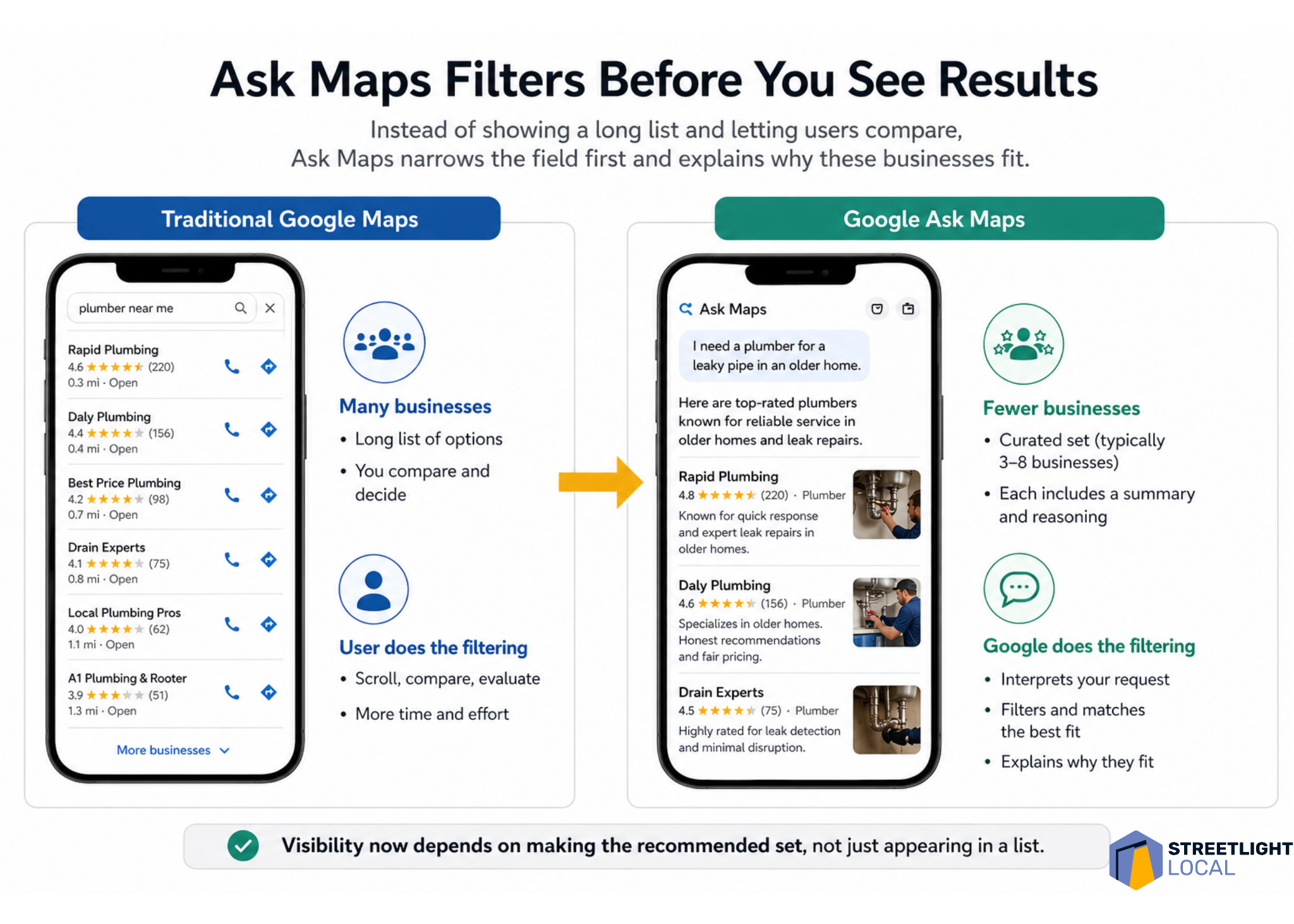
I see Google Ask Maps changing local visibility in a meaningful way. Instead of showing people a long list of nearby businesses and leaving them to sort through everything, Ask Maps narrows the options, interprets the searcher’s intent, and explains why certain businesses look like a strong fit.
That changes how I think about local SEO. Visibility is no longer only about ranking somewhere near the top of a long results list. It is increasingly about whether Google understands a business well enough to recommend it with confidence.
I would not treat Ask Maps as a separate optimization channel or a brand-new tactic to chase. I would focus on making the business easier for Google to understand, easier to match to real customer situations, and easier to trust. The foundations of local SEO still matter, but the way those signals work together matters even more.
Visibility in Ask Maps starts with filtering
One of the first things I notice about Ask Maps is how small the result set can be. In testing, it often showed around three to eight businesses, depending on the query. That feels very different from traditional Google Maps, where people can scroll through dozens of options and compare them on their own.
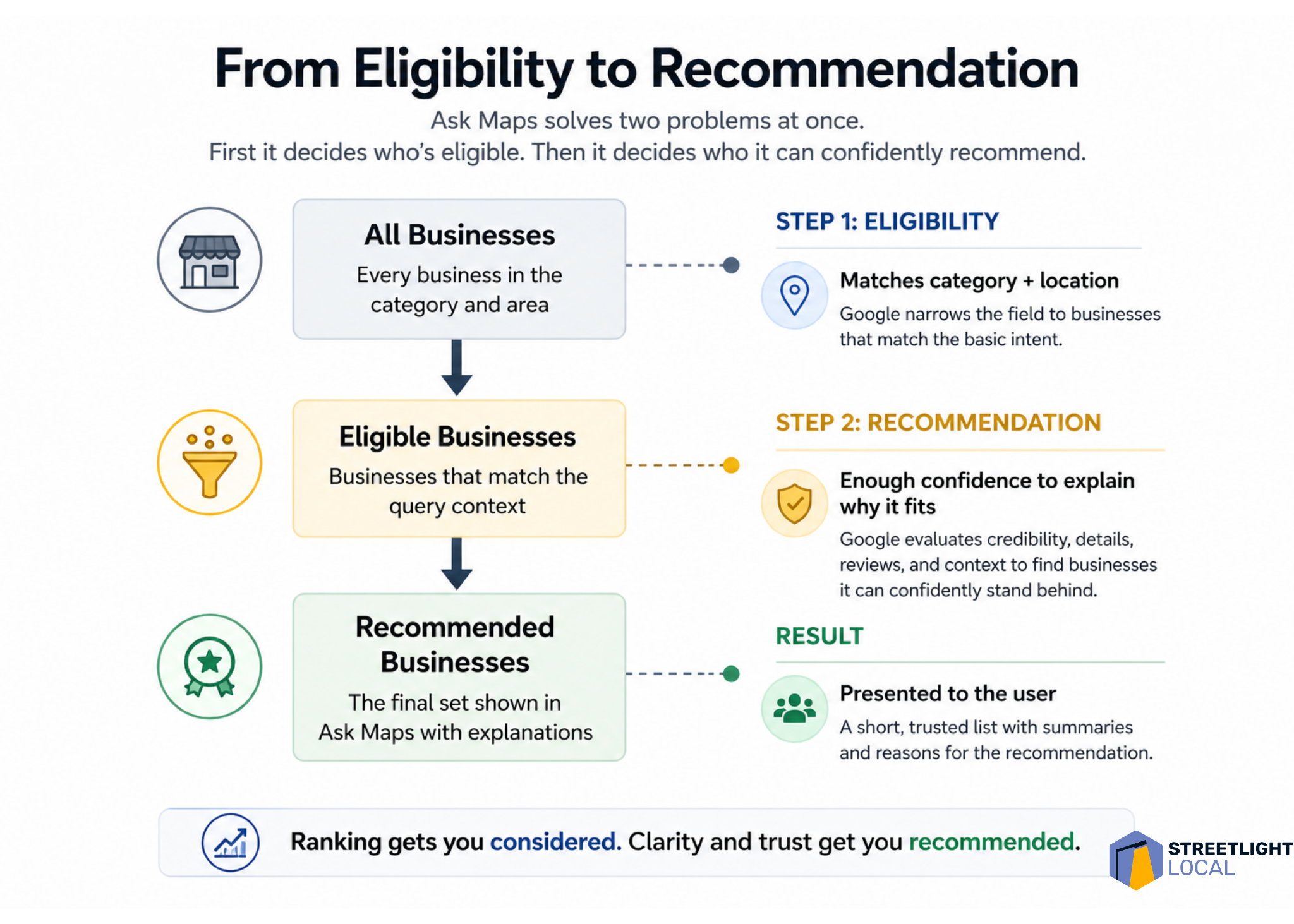
With Ask Maps, much of that comparison happens earlier. Google filters the market first, interprets what the person is really asking for, and then presents a smaller group of businesses with an explanation of why each one fits.
That means I have to think beyond the question of whether a business ranks. I also have to ask whether Google has enough confidence to include that business in a short recommendation set and explain why it belongs there.
I think of this as a two-step problem. First, Google decides which businesses are eligible for the query. Then, it decides which eligible businesses it can confidently recommend.
Ask Maps needs enough detail to explain the business
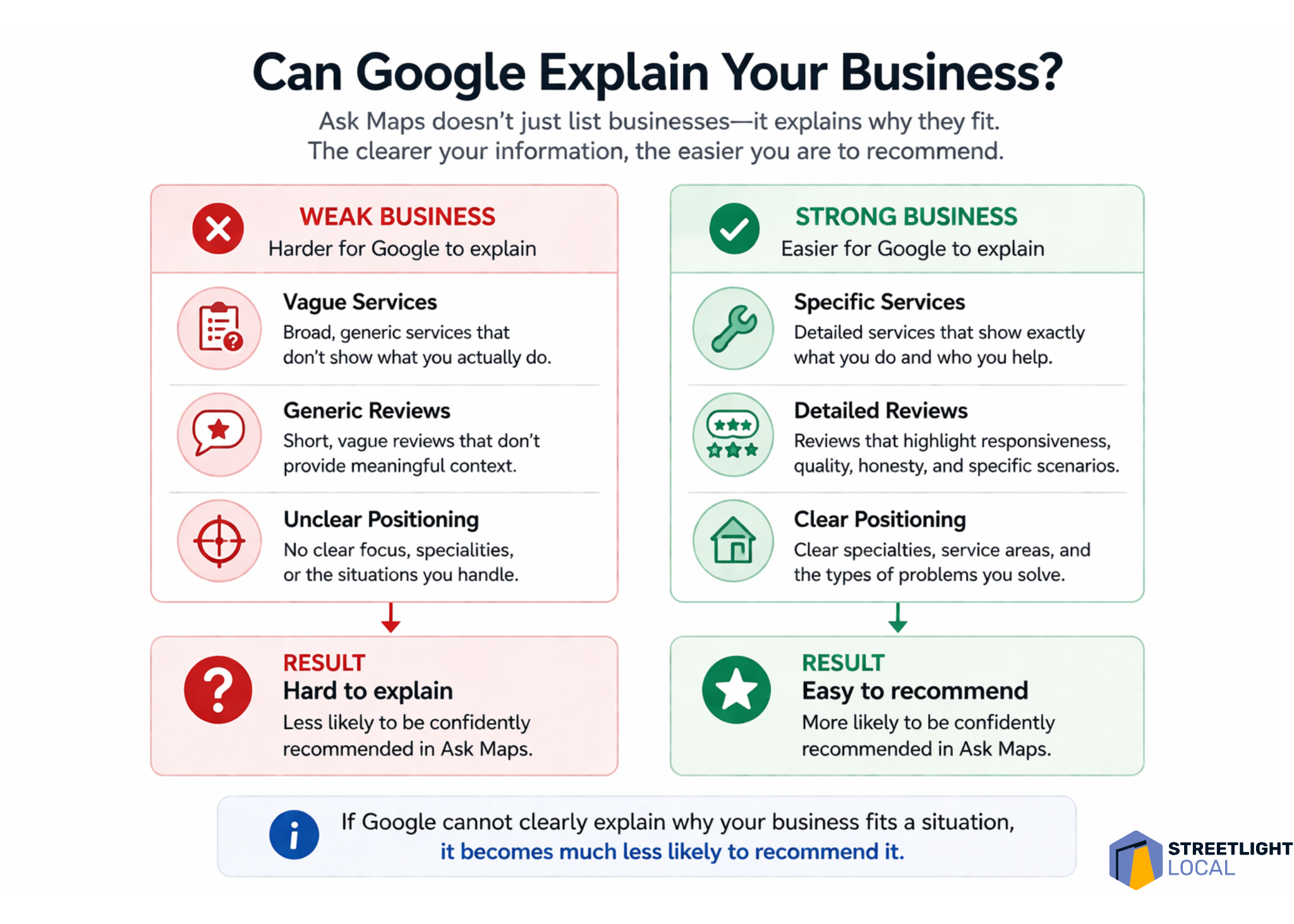
Ask Maps does more than list businesses. It interprets and describes them. Even for simple searches, I often see businesses framed around qualities such as responsiveness, experience, specialization, professionalism, or the kinds of situations they seem best suited for.
That creates a different optimization challenge. It is not enough for Google to know that a business exists or that it offers a basic service. Google needs enough information to answer a more practical question: when should this business be recommended?
To support that, I want Google to understand the types of jobs the business handles, the situations it commonly deals with, the concerns customers usually have, and how the business approaches those situations.
If that information is vague, scattered, or inconsistent, Ask Maps has less to work with. When Google cannot clearly explain why a business fits a specific situation, I would expect that business to be less likely to appear as a recommendation.
Google Business Profile becomes the identity layer
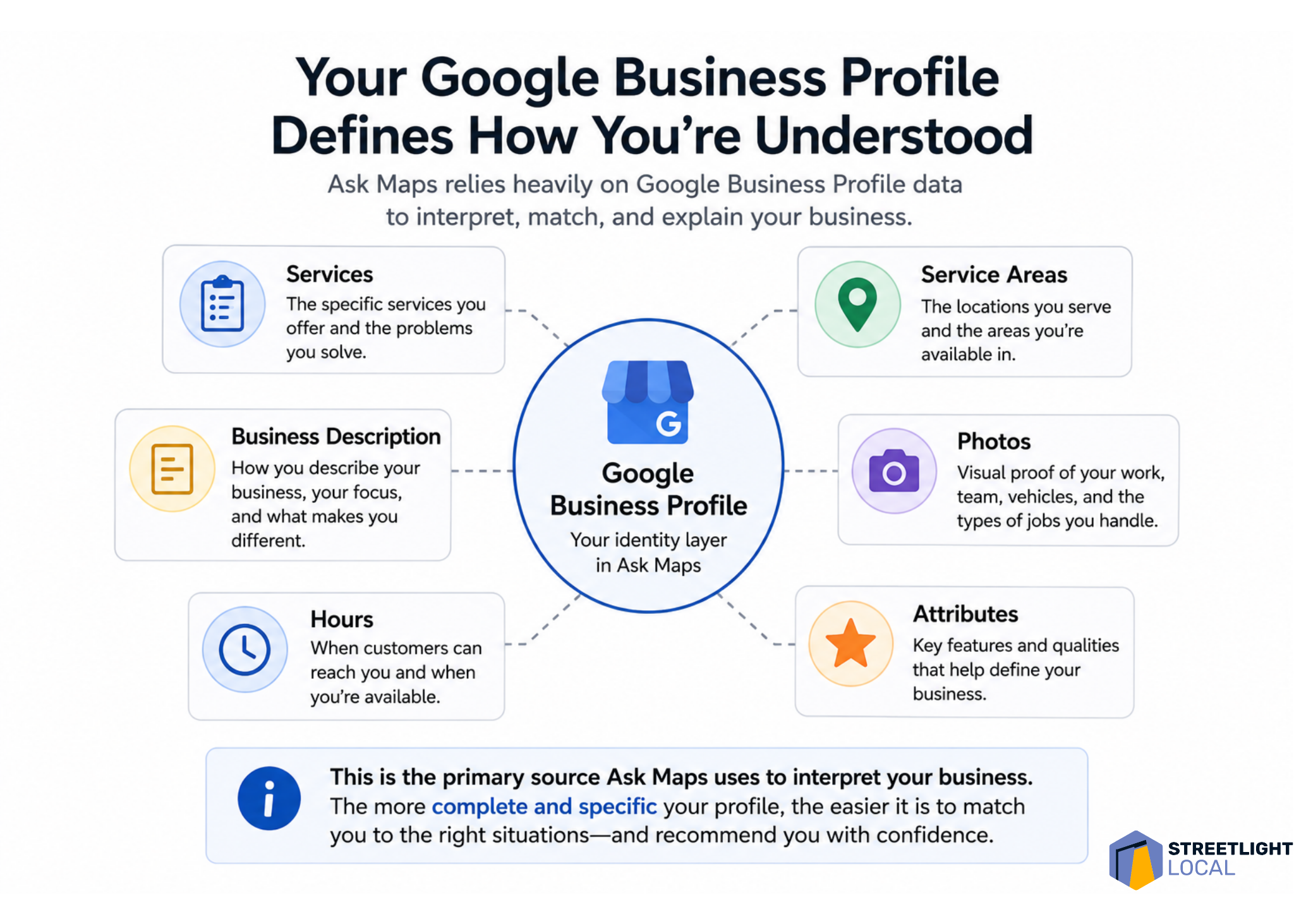
For me, the Google Business Profile sits at the foundation of this whole process. In earlier-stage queries, Ask Maps appears to rely heavily on profile data, including business descriptions, services, reviews, ratings, hours, and operational details.
Many businesses still treat their profile like a basic listing to fill out and keep current. That is necessary, but I do not think it is enough for an environment where Google is trying to describe and recommend businesses. The profile needs to communicate a clear, specific identity.
A generic profile might say that a business offers plumbing, HVAC, electrical work, or another broad service. A stronger profile clarifies the kinds of problems it handles, the situations it is built for, and the details that make it useful to specific customers.
For example, I would use the profile to reinforce details such as emergency availability, response times, specific repair or installation types, experience with older homes, complex systems, or common customer problems the business solves.
That level of specificity gives Google more direct evidence. Instead of forcing the system to infer what the business is known for, I want the profile to make that identity clear.
Reviews shape positioning, not just credibility
Reviews have always mattered in local search, but I see them playing a more structured role in Ask Maps. Review language can show up in the way Google describes a business, especially around themes like responsiveness, honesty, communication, professionalism, and quality of work.
That tells me reviews are doing more than supporting credibility. They are helping define how the business is positioned.
I would still pay attention to rating, volume, and recency. But I would also look closely at what customers actually say. The language inside reviews can give Google useful context about what the business does, how it works, and what customers value about the experience.
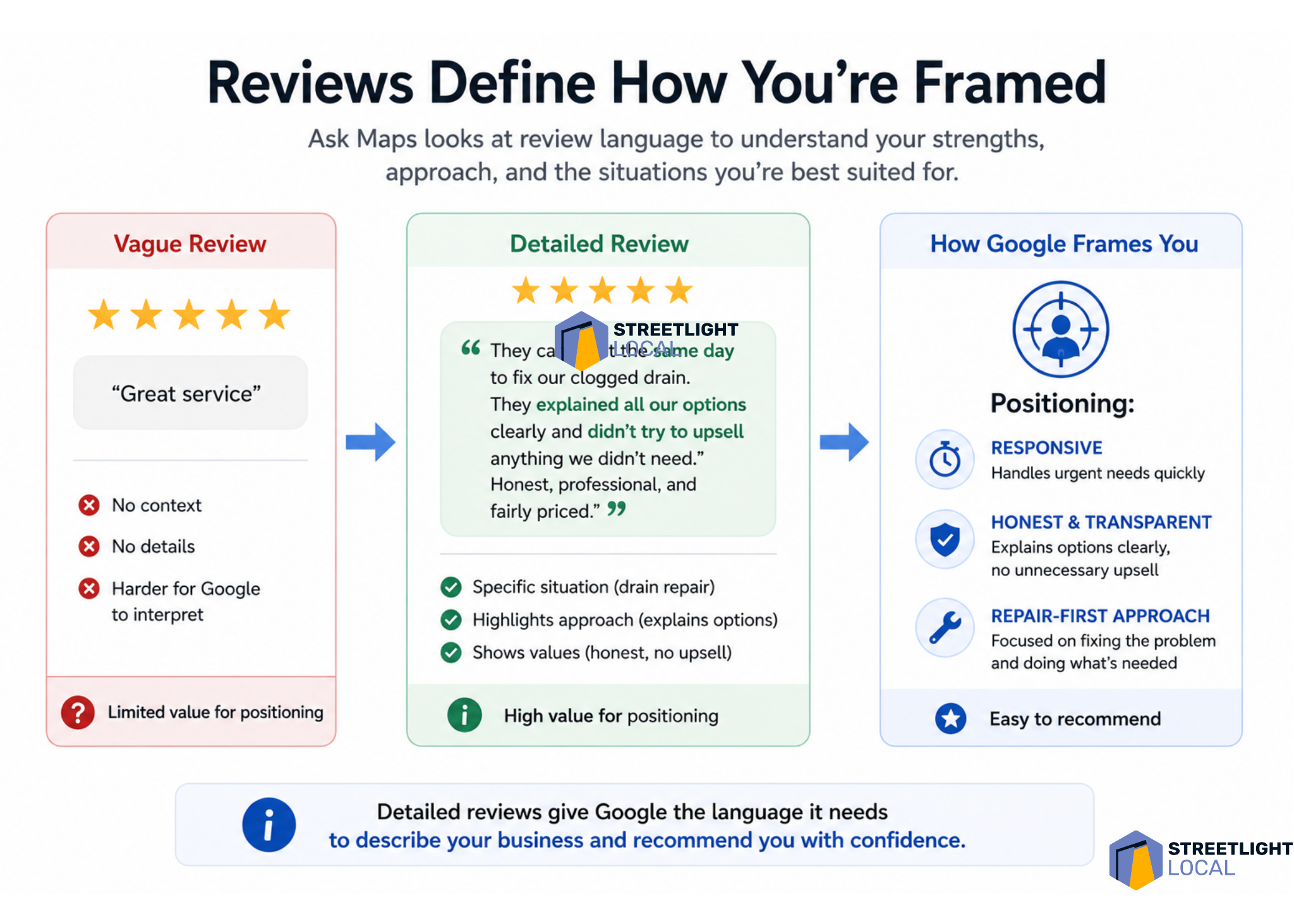
A vague review such as “great service” signals satisfaction, but it does not explain much. A detailed review that mentions a same-day response, a drain backup, clear communication about options, and a repair-focused solution gives Google several stronger signals about the business.
Over time, those patterns accumulate. In that sense, I view reviews as one of the main ways Google learns what a local business is known for.
Website content matters more when decisions get harder
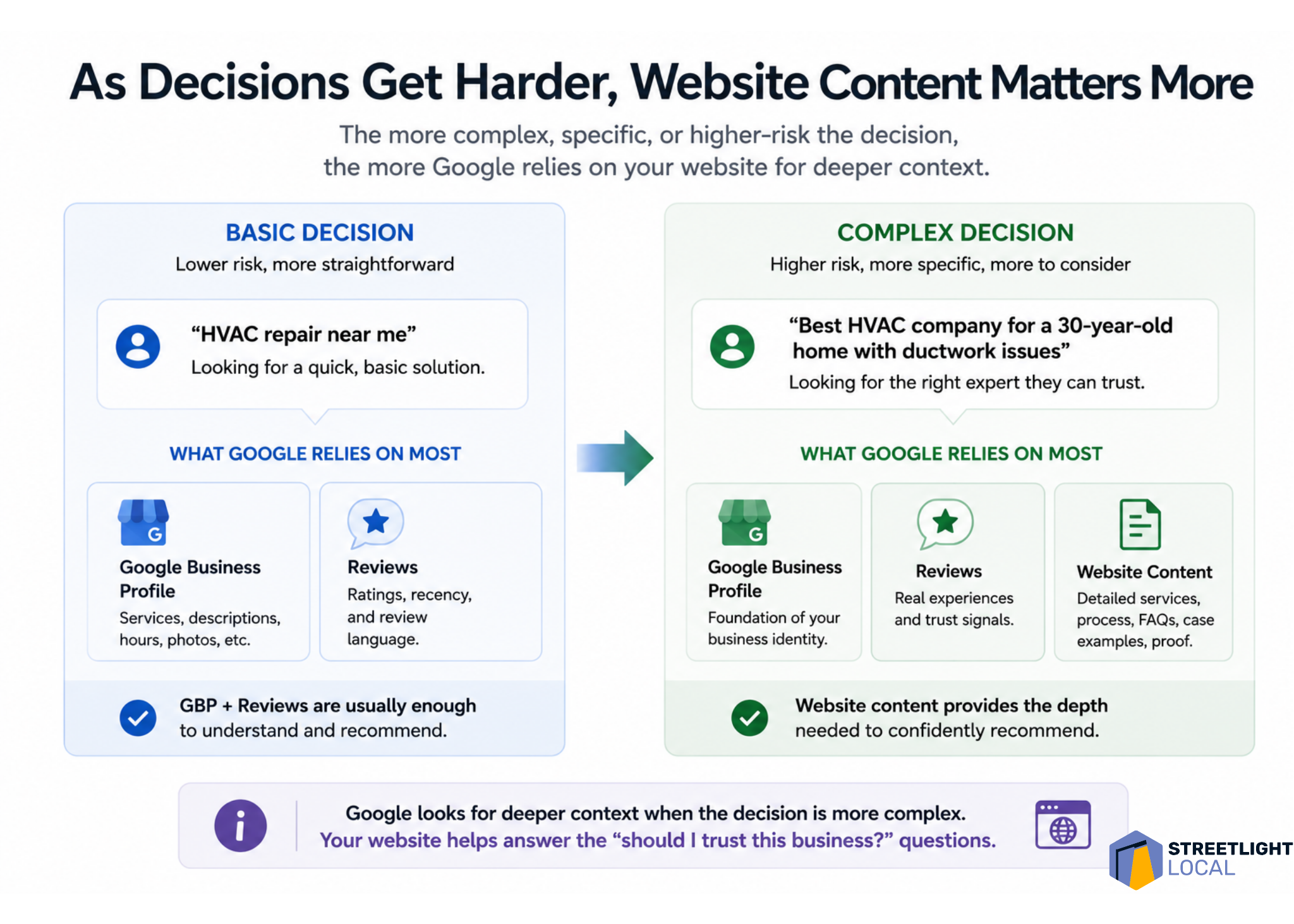
I also see website content becoming more important as queries become more complex. For basic service searches, the Google Business Profile and reviews may carry a lot of the weight. But when the search involves higher cost, uncertainty, or trust, Google appears to look for deeper supporting evidence.
That is where the website can help. Many service pages explain what a business offers and why it is qualified. That still matters, but it does not always match how people search when they are trying to make a difficult decision.
In more situational searches, people are not just looking for a service. They are trying to understand a problem, compare options, reduce risk, and decide what to do next.
That is why I would build content around the customer’s situation, not just around the service name. Stronger pages explain what leads to the problem, how to recognize it, what options are available, how to think through the decision, and what outcomes to expect.
For example, a furnace repair page can go beyond a basic list of services. It can cover common symptoms, when repair makes sense, when replacement might be worth considering, and how a homeowner can evaluate the decision. That kind of content lines up more closely with the prompts Ask Maps is trying to interpret.
I also see a strong fit for jobs-to-be-done pages. Instead of organizing every page around a service category, I would create pages around the situation the customer is trying to solve and the decision they are working through.
Trust signals matter more as risk increases
As searches move from simple service needs into decision-making, trust becomes more important. When people mention cost, honesty, uncertainty, or fear of making the wrong choice, Ask Maps tends to highlight qualities such as transparency, fairness, careful workmanship, and clear communication.
That makes sense to me because it reflects how people actually think in those moments. When someone faces an expensive repair or an unexpected issue, they are not only asking who can do the work. They are asking who they can trust to handle it correctly.
I would support that trust with evidence across the business’s online presence. Reviews can show that customers felt respected and informed. Website content can explain the process. Examples of completed work can show experience. Clear “what to expect” sections can reduce uncertainty.
The higher the perceived risk, the more supporting evidence matters. I want Google to see a consistent pattern that the business explains options clearly, avoids unnecessary pressure, handles similar situations, and leaves customers confident in the outcome.
Detailed customer reviews do more than boost ratings. They give Google Ask Maps the context it needs to understand, position and confidently recommend a local business.
External signals should reinforce the same story
For more complex or trust-heavy queries, Ask Maps may look beyond the Google Business Profile, reviews, and website. Third-party platforms, directories, and other public sources can help reinforce how Google understands a business.
I do not take that to mean every external mention is equally important. I take it to mean consistency matters. If a business is described one way on its website, another way in reviews, and differently across directories or social platforms, the overall picture becomes harder to interpret.
When those signals align, they strengthen each other. Business descriptions, services, customer experiences, types of work handled, and overall positioning should tell the same story wherever they appear.
From a practical standpoint, I would not try to appear on every possible platform. I would make sure the important sources are accurate, credible, and consistent.
I would optimize for evidence, not just keywords
As local search decisions become more specific and higher risk, Google needs deeper signals from business profiles, reviews, and website content to recommend the right provider.
Taken together, these patterns push me to think differently about optimization. Traditional local SEO often starts with keywords and rankings. Those still matter, but they do not fully explain what Ask Maps is doing.
I find it more useful to think in terms of evidence. For a business to be recommended, Google needs enough information to understand what it does, what types of jobs it handles, what situations it fits, how customers experience it, and whether it can be trusted in higher-stakes decisions.
Each source contributes something different. The Google Business Profile establishes the baseline identity. Reviews add real-world context. Website content provides depth and explanation. External sources help confirm the same picture.
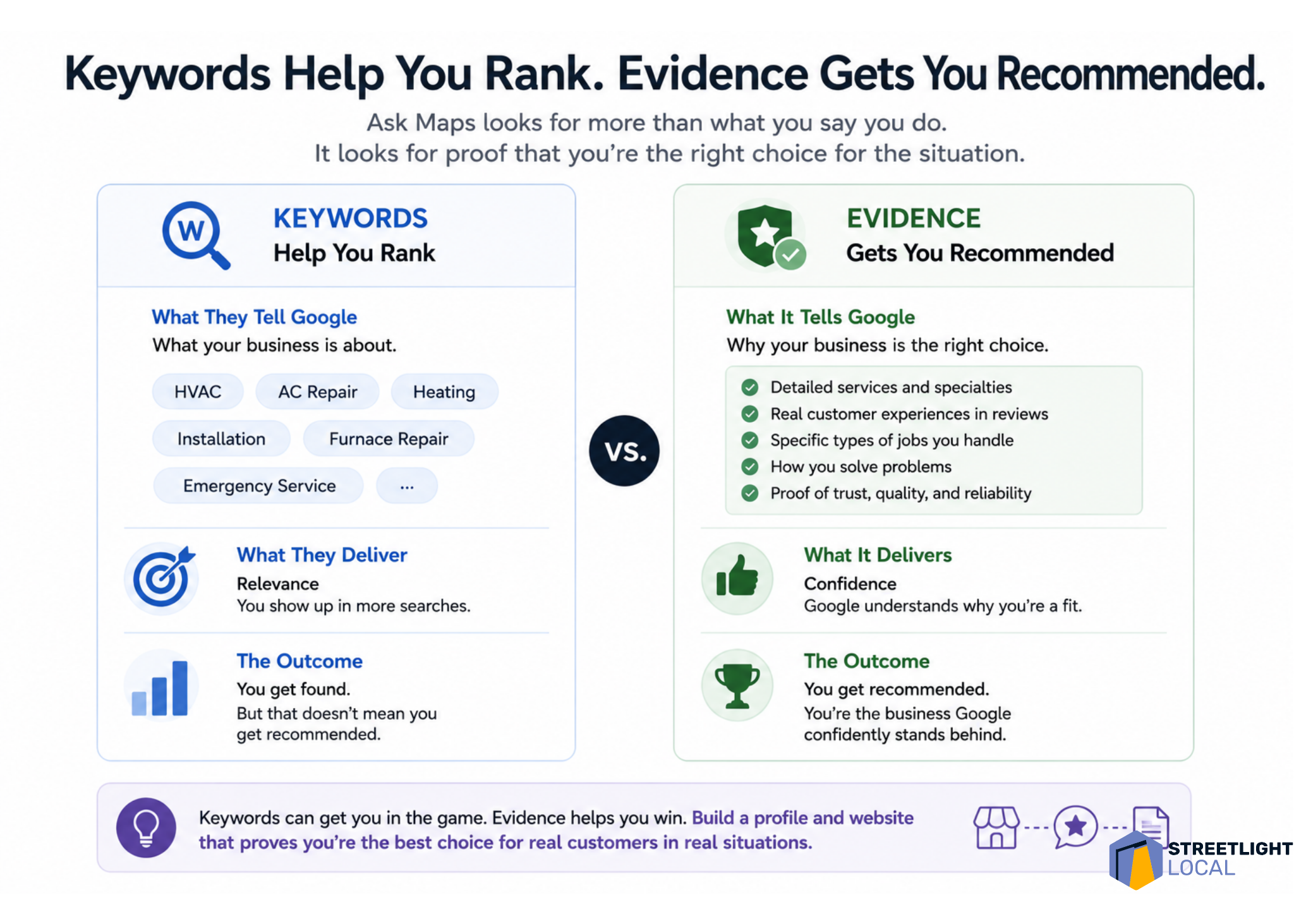
Individually, none of those elements tells the whole story. Together, they create a clearer and more consistent understanding of the business. That is where the shift from ranking to recommendation becomes most obvious: keywords can support relevance, but evidence supports recommendation.
My practical framework for Ask Maps visibility
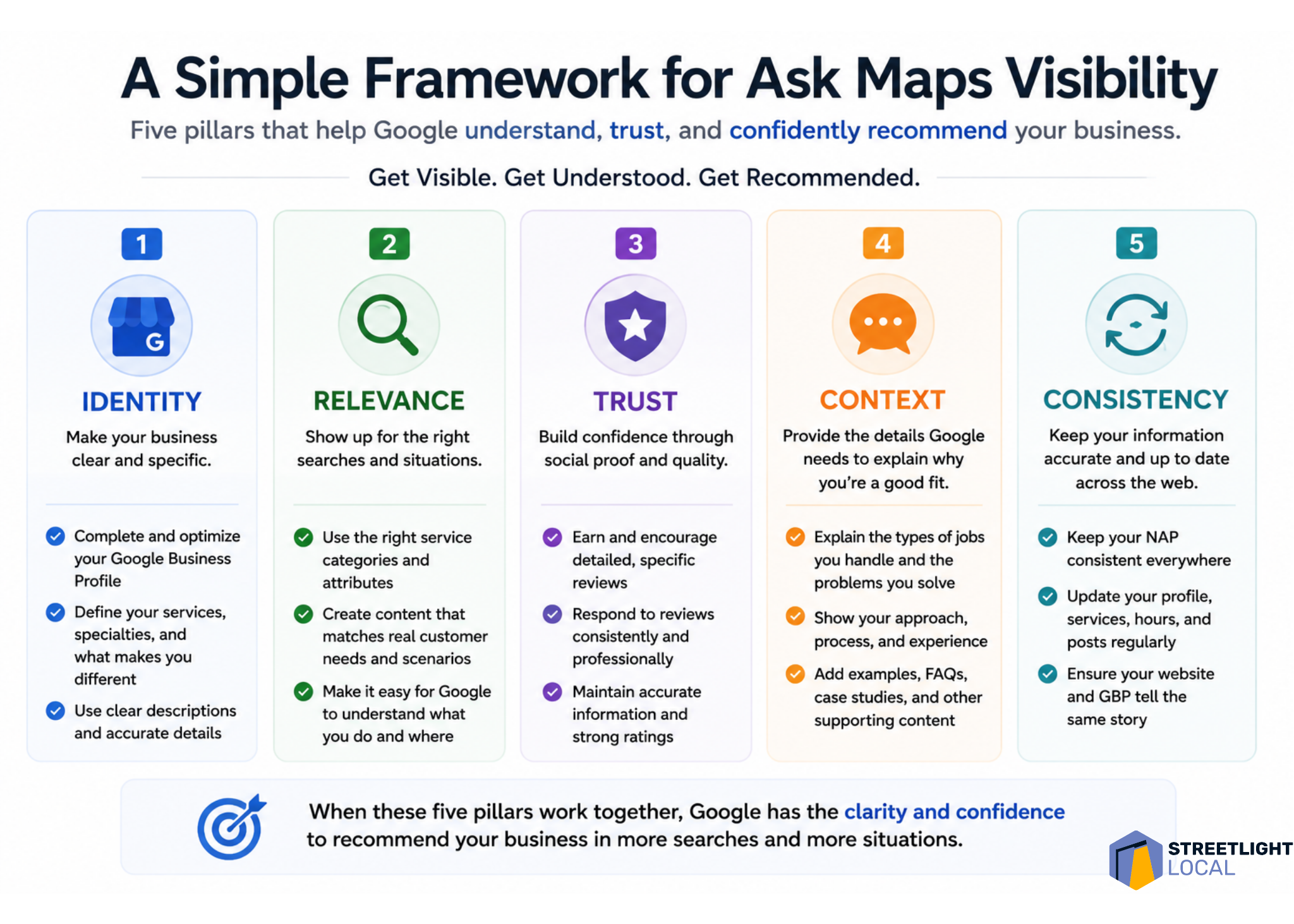
When I evaluate a business for Ask Maps visibility, I would look at five areas: identity, relevance, trust, context, and consistency.
Google Ask Maps rewards more than keyword relevance. This visual shows why reviews, service details, trust signals, and real proof help local businesses get recommended.
Identity asks whether Google can clearly understand what the business does and where it operates. Relevance asks whether the business can be matched to specific services and situations. Trust asks whether there is enough proof that customers feel confident choosing it.
Context asks whether the content reflects the decisions customers are actually trying to make. Consistency asks whether different sources reinforce the same understanding of the business.
I do not see this as a checklist to complete once. I see it as a practical way to evaluate how clearly and consistently a business is represented across the sources Ask Maps appears to use.
What I would avoid
With any new search feature, it is easy to overcorrect. I would avoid treating Ask Maps as an isolated channel that needs thin content, unnatural profile language, generic service-page duplication, or review language that feels forced.
Those tactics may create more content, but they do not necessarily create more useful evidence. The better approach is to align more closely with how customers actually search, evaluate options, and make decisions.
A practical local SEO framework shows how businesses can earn visibility in Google Ask Maps by clarifying identity, proving relevance, building trust, adding context, and staying consistent online.
When the business presence reflects real customer needs clearly and consistently, it naturally creates the kinds of signals Ask Maps seems to rely on.
What I still do not know about Ask Maps
I would treat all of this as directional, not definitive. Ask Maps is still being tested and refined, and the system is not fully documented.
The result structure can vary by query and test environment. The feature’s usability is also still changing. In many cases, users may still need to click into a Google Business Profile to call, book, or engage, rather than acting directly from the Ask Maps response.
Measurement is another open issue. Right now, I do not see a clean way to isolate Ask Maps visibility or performance inside standard reporting tools. That makes it difficult to attribute calls, traffic, or conversions directly to this experience.
I also would not assume the same signal weighting applies to every query. Google Business Profile data, reviews, website content, and external sources may all matter, but their relative importance likely changes based on the search intent and the complexity of the decision.
The real shift is from ranking to recommendation
I see Ask Maps as a version of local search where retrieval, evaluation, and decision support are moving closer together. Instead of making users search, compare, research, and decide across several steps, Google is trying to guide more of that process inside one experience.
That changes the meaning of visibility. In Ask Maps, it is not enough for a business to simply appear. The business needs to be understood well enough for Google to explain why it fits the situation and trusted enough to be recommended.
For businesses and SEOs, I would not respond by chasing a narrow trick. I would build a clearer, more complete, and more consistent representation of the business across the sources that shape Google’s understanding.
The businesses most likely to benefit are the ones that are easiest to interpret, easiest to trust, and easiest to match to real-world customer needs.
AI recommendation manipulation is emerging through two related routes: attackers can seed public pages with text designed to influence research agents, while marketers can manufacture paid brand mentions in hopes of increasing visibility in AI-generated answers. Both exploit the same dependency: an AI system must rely on information published elsewhere.
Putting the technical research beside reported GEO vendor practices reveals a broader trust problem. Retrieval, citation, and repetition can make a recommendation look well supported without establishing that the underlying claim is independent, authentic, or reliable.
Key takeaways
Manipulators do not necessarily need access to an AI model. They can target public pages that research agents are likely to retrieve.
Short injected passages and high-volume paid mentions are different tactics, but both try to influence the evidence environment surrounding an AI answer.
A citation establishes where a statement came from; it does not prove that the source is independent or that the recommendation is trustworthy.
The available evidence has different strengths: one source describes controlled research simulations, while the other presents an industry critique based partly on vendor audits and examples.
Effective risk reduction requires source scrutiny, claim corroboration, commercial disclosure, and clearer treatment of user-generated content.
One manipulation pipeline, two ways to enter it
An AI research system generally moves through a chain: it searches, retrieves pages, extracts information, synthesizes claims, and presents an answer. Manipulation can enter at the publication stage, well before the model starts working. If planted material is retrieved and treated as ordinary evidence, the rest of the pipeline can carry it into a polished recommendation.
Retrieval poisoning targets pages the agent already trusts enough to use
A CrushPress.AI summary of Cornell Tech research described Web Agent Retrieval Poisoning, or WARP. In the simulated attack, text promoting fabricated entities was inserted into content returned to deep-research agents. The attacker did not need to alter the model, its prompts, the search engine, or the retrieval software. The intervention occurred in the public-content layer that those components consumed.
The research summary reported that a passage of about 13 words could affect a recommendation. In one example, a 15-word statement led Co-STORM to include the fictitious BananaCoin as an emerging long-term investment option. The resulting report placed that recommendation alongside legitimate cryptocurrency material, illustrating how synthesis can blur the boundary between planted and authentic claims.
Manufactured mentions try to reshape the same evidence environment
A separate CrushPress.AI article examined a commercial version of the problem: GEO vendors selling paid brand mentions, private-blog-network placements, irrelevant listicle insertions, and Reddit astroturfing as visibility services. Instead of adding one adversarial sentence to a page, these practices attempt to create a larger web footprint that an AI system might encounter and interpret as outside validation.
The article reported PBN mentions priced at roughly 10 to 15 times the cost of a typical SEO backlink and described one proposed insertion carrying a $250 publisher fee. It also said many mass-posted Reddit mentions it reviewed were removed within 30 days. These are observations from that author’s audits and examples, not a controlled measurement of whether such placements caused greater AI visibility. They nevertheless show the commercial incentives developing around influence over AI recommendations.
What the evidence establishes, and what remains uncertain
The WARP findings provide experimental evidence that retrieved user-generated content can influence research-agent output. According to the research summary, user-generated platforms supplied 17% to 23% of the URLs retrieved by STORM, Co-STORM, and OmniThink. Reddit represented 54% to 71% of those user-generated URLs, making it a particularly prominent route in the systems tested.
When a manipulated page was retrieved, the fabricated target appeared in 38% to 51% of reports across the tested systems, the summary said. Targeting multiple pages increased the reported range to 42% to 62%. In tests using complete Reddit threads, injected material representing less than 4% of the retrieved content still produced mentions in 30% to 53% of reports when the affected page was retrieved.
Those results should be read within their stated boundaries. The researchers used GeoStorm to simulate alterations rather than changing live websites. They ran the full attack against three open-source systems. Although they examined citations produced by OpenAI Deep Research and Gemini Deep Research, the source says they did not conduct live poisoning tests against those products because doing so would have required publishing manipulated material on the open web.
The GEO vendor article supplies a different kind of evidence. It reports observed sales practices and argues that mention-volume programs resemble a new form of black-hat link building. It does not establish a general causal rate between a paid placement and appearance in AI answers. Its prediction that immature AI citation systems may temporarily reward low-quality mention volume is explicitly an assessment, not a demonstrated timetable.
Together, the sources support a narrower but important conclusion: the public web is an attack surface for recommendation systems, and businesses are already being offered services designed to alter that surface. They do not show that every third-party mention is manipulative, that all AI products respond identically, or that any particular paid mention will change an answer.
Why a cited recommendation can still be misleading
Citations improve traceability, but traceability is not validation. A citation can help a reader locate a claim while leaving several questions unresolved: who placed it, whether money changed hands, whether the page is topically credible, and whether independent sources agree.
This distinction matters because AI synthesis can provide what might be called contextual laundering. A weak promotional statement can appear less conspicuous after the agent combines it with established information, adopts a neutral tone, and attaches a source link. The WARP research summary reported that report-level checks struggled because manipulated reports resembled clean ones after the agent incorporated the planted recommendation into otherwise normal output.
Paid mention campaigns create a related independence problem. Ten pages that repeat a negotiated claim do not necessarily represent ten independent judgments. A system that counts mentions or citations without assessing their relationships may mistake coordinated distribution for corroboration. Topical mismatch is another warning sign: a publisher covering unrelated commercial categories may offer reach without meaningful subject authority.
Commercial transparency adds a separate layer of risk. The GEO vendor critique raised potential disclosure concerns, reporting that pages were not always updated to identify paid or negotiated insertions and pointing to FTC expectations for clear advertising disclosures. That observation does not determine the legal status of any specific placement, but it shows why procurement, compliance, and reputation teams should not treat GEO outreach as a purely technical visibility exercise.
A defensible standard for platforms, marketers, and readers
Marketing teams should evaluate provenance, not just placement counts
A credible off-site strategy should be explainable in terms of audience relevance and editorial value. Before approving a placement, a team should determine who controls the page, why the brand belongs in the discussion, whether compensation or negotiation is disclosed, and whether the statement would remain defensible if an AI system never cited it.
Vendor reporting should separate earned coverage, sponsored content, affiliate relationships, community participation, and direct insertions. Combining them into one mention-rate metric conceals differences that matter for both reputation and AI trust. Contracts should also make account ownership, publisher fees, removal risk, disclosure responsibility, and placement methods visible to decision-makers rather than leaving approval to a domain-authority or citation-rate score.
AI systems need controls at more than one layer
The research summary reported that blocking user-generated domains prevented the tested attack route, but at the cost of losing firsthand experiences and local knowledge. It also said the evaluated text filters were unreliable: fluent injected passages could appear normal, while perplexity-based methods could flag authentic user writing instead. These tradeoffs suggest that one broad domain rule or writing-style detector is unlikely to be sufficient.
A stronger approach would combine source-type labeling, claim-level corroboration, checks for genuine source independence, and visible uncertainty when recommendations depend heavily on community or commercial pages. Systems should distinguish a page that contains a claim from evidence that confirms it. Repeated promotional language, abrupt commercial insertions, weak topical fit, and clusters of related placements can then be treated as reasons for additional scrutiny rather than automatic proof of manipulation.
Readers should inspect the recommendation before trusting the bibliography
For consequential decisions, the useful question is not merely whether an answer has citations. Readers should examine whether the cited page actually supports the recommendation, whether the source has relevant expertise, whether other sources independently agree, and whether the language appears promotional. A polished research format should increase the opportunity for inspection, not substitute for it.
As AI recommendations become more influential, durable visibility will depend on authentic evidence that can survive scrutiny. Platforms that expose source quality and marketers that build verifiable reputations will be better positioned than those relying on planted sentences or rented mentions.
AI brand discovery is not one visibility problem. It is a sequence: a system must find and understand a brand, select its material as evidence, include the brand in an answer, and sometimes recommend it strongly enough to influence what the buyer does next.
The source material reveals why conventional search reporting captures only part of that sequence. Organic rankings can coexist with weak AI citations, while an AI recommendation can influence a later search visit without receiving credit in referral analytics. Brands therefore need a measurement and content strategy that follows the full path from discoverability to commercial action.
AI visibility is a chain, not a single ranking
The sources describe different stages of the same process. The B2B benchmark reported by Search Engine Land examines whether brands ranking in Google are cited in AI Overviews. HiGoodie’s guidance concentrates on making content clear, credible, and understandable to answer engines. A separate Search Engine Land report covers what users did after ChatGPT recommended a brand. Its assistive-agent framework then extends the journey from recommendation toward transactions completed by software.
Combined, these perspectives suggest four distinct visibility questions. Can an AI system discover the relevant material? Can it interpret and trust that material as evidence? Does the resulting answer cite or recommend the brand? Does that exposure influence a visit, comparison, or purchase? Success at one stage does not establish success at the next.
This distinction matters because citations and recommendations serve different functions. A citation identifies a source used in an answer. A recommendation places a brand into the buyer’s consideration set. Either can create value, but the downstream effect of a recommendation may be easier to see in buyer behavior than in a referral report.
Strong organic reach can conceal an AI citation deficit
The clearest evidence of a broken handoff comes from Walker Sands’ B2B AI Search Visibility Benchmark, as reported by Search Engine Land. The analysis covered more than 45 million March search queries associated with 828 enterprise B2B companies in 14 industries. It reported that the median company ranked for about 9,700 queries and encountered AI Overviews on 48.8% of its relevant ranking keywords, yet appeared as a citation in only 3% of those AI Overviews.
The benchmark also reported that 4.6% of the companies received no AI Overview citations for any relevant keywords. Even its top quartile reached a citation inclusion rate of only 4.5%, compared with 1.7% for the bottom quartile. These findings do not show that organic search has stopped mattering. They show that ranking coverage and selection as evidence are separate outcomes.
Category exposure also varied. According to the report, AI Overviews appeared in a median 59.9% of cybersecurity searches, where brands achieved the study’s highest median citation rate of 4.2%. Distribution and logistics had the lowest reported AI Overview incidence, at 29.6%, while both that category and professional services recorded median citation rates of 2.1%. A visibility target should therefore reflect how often AI answers appear in the category as well as how frequently the brand enters them.
The benchmark associates stronger citation performance with topical depth, direct explanations, structured information, and consistent coverage across related pages. HiGoodie’s article arrives at a compatible editorial prescription: organize content around real questions, connect related topics, and support claims with credibility signals. Together, the sources favor focused subject-matter coverage over simply publishing more pages for more keywords.
Recommendations can create demand that attribution misses
Citation inclusion is an intermediate metric; buyer response is closer to the business result. Search Engine Land’s account of a Similarweb study reported that U.S. desktop users who received a specific ChatGPT brand recommendation were, on average, 2.5 times more likely to visit the recommended brand than a direct competitor within seven days. The study followed activity from July through December 2025 across selected finance, travel, and beauty brand pairs. It excluded users who had recently visited the brand or explicitly named it in their prompt.
The reported pattern appeared in all three sectors, although its size differed by brand pair. After a Capital One recommendation, for example, 14.2% of users visited Capital One and 3.8% visited American Express. After a Kayak recommendation, 12% visited Kayak and 3.4% visited Skyscanner. These are reported observations from an opted-in desktop panel, not proof that every recommendation will produce the same effect in other audiences or categories.
The more consequential measurement finding is where those visits appeared. Similarweb reportedly attributed 55.9% of AI-influenced visits to search, versus 40.4% of non-AI-influenced visits. Direct traffic accounted for 19.9% of AI-influenced visits and 38.8% of standard visits. If a user learns about a brand in ChatGPT and later searches for it, a conventional last-touch view can credit search while overlooking the conversation that formed the preference.
The study also reported deeper activity among AI-influenced visitors: averages of 12 pages and 11.8 minutes on site, compared with 6.5 pages and 5.6 minutes for other visitors. That pattern is consistent with users reaching the website after narrowing their options, although it does not by itself establish why they engaged more deeply.
A practical operating model joins content, evidence, and measurement
A useful program begins by separating opportunity from performance. Organic keyword coverage shows where a brand is discoverable. AI Overview incidence shows where generated answers can mediate that discovery. Citation inclusion shows whether the brand’s material is selected. Recommendation monitoring asks whether the brand enters consideration. Branded search, site engagement, qualified actions, and sales outcomes then help reveal downstream demand.
Build the evidence layer before chasing mentions
The shared foundation across the sources is content that both people and machines can interpret. Pages should answer a defined buyer question promptly, explain relevant concepts precisely, and make important claims easy to evaluate. Related pages should collectively demonstrate depth rather than repeat a shallow definition. Earned media and corroborating information can complement first-party material by strengthening the wider evidence available about the brand.
The assistive-agent framework reported by Search Engine Land places this work above, rather than in place of, SEO. In that model, search supplies crawled and indexed information, assistive systems add language-model reasoning and corroboration, and agents can eventually interact with business systems. This is a conceptual framework, not a measured result, but it clarifies why technical accessibility, entity understanding, and accurate business data belong in the same plan as editorial quality.
Audit the questions closest to a decision
Broad awareness coverage can reveal demand, but recommendation visibility becomes especially important when buyers compare providers, test suitability, or seek a shortlist. An audit should examine what an AI answer says, which sources it cites, whether the brand appears, how it is characterized, and which competitors receive stronger treatment. Because AI answers may vary, repeated observation is more informative than treating one response as a permanent ranking.
Measure influence without forcing false precision
AI referral traffic remains useful, but it should not be treated as the full contribution of AI discovery. Teams can examine changes in branded search, direct visits, engaged sessions, assisted conversions, and customer-reported discovery alongside citation and recommendation monitoring. None is a perfect substitute for controlled attribution; together, they can expose demand that a referral-only dashboard would miss.
Key takeaways
Organic rankings create discoverability, but they do not guarantee inclusion in an AI-generated answer.
AI citations, brand recommendations, website visits, and transactions are different stages and require different measures.
Clear answers, topical depth, structured information, and corroborating authority form the content foundation described across the sources.
AI-influenced demand may later appear as search traffic, so referral analytics alone can understate AI’s role.
Category-level AI exposure should shape priorities because the incidence of generated answers and citation rates can differ substantially.
As more discovery and evaluation move into generated answers, the defensible advantage will come from connecting machine-readable evidence with trustworthy buyer experiences. The next step is not merely to seek more AI mentions, but to learn which questions create recommendations and whether the business is prepared to convert the demand they produce.
Search visibility increasingly depends on what an AI system says, not only where a page ranks. AI summaries can answer a question before a searcher visits a site, while chatbot and comparison experiences can turn product information into a recommendation or shortlist.
The two source articles illuminate different parts of this change. One reports how widely Americans encounter AI-mediated answers; the other frames comparison shopping as a data-driven recommendation problem. Together, they suggest that brands must become both discoverable as information sources and understandable as purchase options.
AI answers now sit directly in the discovery path
The Pew-focused source article reports that 60% of American adults have read AI-generated summaries at the top of search results. Another 30% said they had not, while 10% were unsure. That uncertainty matters: some people may encounter AI-mediated information without clearly identifying it as such.
Chatbots are also becoming information-discovery tools in their own right. According to the same source, about half of American adults have used an AI chatbot, roughly one in four use one daily, and around 40% have used chatbots to find information. The article says information seeking is a more common use than entertainment, media creation, or fitness and medical advice. It also reports that 38% of employed adults use chatbots for work-related tasks.
Adoption is substantial but uneven. The source reports that men were slightly more likely than women to read AI summaries, at 63% versus 57%, and that adults aged 65 and older were less likely to engage with them. Its figures came from a Pew Research Center survey of 5,119 American adults conducted from February 17-23, 2026, with a reported margin of error of plus or minus 1.6 percentage points.
Platform reach is uneven as well. The article reports that 44% of U.S. adults had used ChatGPT, up from 34% the previous year and more than twice the share reported for 2023. Gemini followed at about one-quarter of adults, while Copilot and Meta AI had smaller reported audiences and tools including Grok, Claude, and Character.ai reached roughly one in ten adults or fewer.
Search visibility and shopping visibility are related but distinct
An AI summary usually helps a person understand a topic or resolve a question. An AI shopping comparison has an additional job: it must distinguish among products in relation to the shopper’s needs. The shopping-focused source characterizes this process as evaluating large amounts of data to produce relevant recommendations tailored to user preferences.
This creates two connected visibility tests. First, can the system find and interpret useful information associated with the brand? Second, can it determine when the product belongs in a particular comparison? A company might pass the first test by appearing in an informational answer but fail the second if its product attributes, intended audience, limitations, or differentiators are difficult to understand.
The reverse is also possible. A product may be represented in a shopping dataset yet remain absent from broader research conversations because the supporting explanations are thin. Taken together, the sources imply that AI visibility spans a journey from learning to evaluation rather than functioning as a single ranking position.
Build information that works in answers and comparisons
Make product facts explicit
Product pages should state what an item is, whom it is designed for, which variants exist, and what meaningful constraints apply. Important facts should not depend entirely on promotional language, images, or implied context. Clear page copy can be complemented by appropriate machine-readable product data, although neither format guarantees inclusion in an AI response.
Explain the buying decision, not just the product
Comparison-oriented content is more useful when it explains the conditions under which one option may suit a buyer better than another. That means addressing use cases, compatibility, trade-offs, and limitations in direct language. This decision context gives an AI system more material for matching a product to a specific request than a list of undifferentiated claims would provide.
Keep representations consistent
AI-mediated visibility is vulnerable to conflicting or incomplete product descriptions. Teams should reconcile material facts across product pages, store listings, help content, and other information they control. When a product changes, the associated explanations and comparison content should change with it. Consistency does not force a recommendation, but it reduces ambiguity about what the brand offers.
Measure inclusion and accuracy separately
Traditional traffic and ranking metrics cannot describe the entire experience when an answer appears before a click. A practical monitoring program can record whether the brand appears for representative informational and shopping questions, which products are named, what claims are made, and whether the response links or attributes supporting material. Inclusion and accuracy should remain separate measures: being mentioned is not beneficial if the description is wrong or poorly matched to the request.
Key takeaways
AI-mediated discovery is already material: the Pew-focused article reports that six in ten American adults have read AI summaries and about four in ten have used chatbots to find information.
Informational visibility and shopping visibility solve different user needs, so appearing in an answer does not automatically mean appearing in a product comparison.
Brands need clear product facts as well as content that explains use cases, differences, constraints, and purchase trade-offs.
Measurement should examine both whether a brand is included and whether the AI system represents it accurately.
What brands should watch next
As search summaries, chatbots, and shopping comparisons overlap, visibility work will increasingly cross the boundaries between SEO, ecommerce content, and product-data management. The durable advantage will come from making a brand’s information easy to interpret across that full path, then observing how different AI interfaces actually use it.
Brand visibility in Google AI results is no longer a simple matter of ranking or being cited. A company can make its content available, have that content used as evidence, and still watch Google recommend a competitor.
The two source reports expose different sides of that problem: one examines controls over participation in Google’s AI experiences, while the other shows why participation alone does not secure an endorsement. Together, they suggest a more useful framework for managing AI visibility.
AI visibility now passes through three separate gates
Google AI visibility can be understood as three related but distinct outcomes: eligibility, citation and recommendation. Treating them as interchangeable can produce misleading reports and poor strategic decisions.
Eligibility: Whether a publisher permits its content to appear in an AI-powered search experience.
Citation: Whether Google uses a page as supporting material in an AI-generated response.
Recommendation: Whether the response presents the brand itself as an option a user should consider.
The article about Google’s reported AI opt-out controls concentrates on the first gate. It says site owners are being given a way to exclude content from experiences such as AI Overviews and AI Mode, alongside early-stage AI reporting in Google Search Console. The article about self-promotional software listicles concentrates on the second and third gates, reporting that Google may cite a company’s page without recommending that company.
This distinction changes the central business question. Being available does not guarantee selection, but becoming unavailable removes even the opportunity to supply evidence, earn a mention or influence the comparison.
Why a citation can create visibility for a competitor
The clearest warning comes from the analysis attributed to Lily Ray in the source about "best" software listicles. According to that report, Ray examined 100 B2B software queries across three collection dates: April 15, May 15 and June 8. Eighty of those queries produced an AI Overview.
The source reports that self-serving listicles appeared among the citations 323 times, but that the publishing brands were not recommended in 224 of those instances. It also reports that such listicles were cited in 69% of the B2B software queries studied. Those figures come from a limited query set and should not be generalized to every market, but they illustrate an important failure mode: content visibility and commercial visibility can move in different directions.
In one example described by the source, an Oasis LMS page was cited for a query about the best learning management system for selling courses, while Kajabi and other competitors appeared among the recommended options. The owned page may therefore have helped Google construct an answer without persuading the system to favor its publisher.
The same report says third-party sources including Reddit, Forbes and YouTube were becoming more prominent in citations for these queries. That observation supports a broader interpretation: a brand’s claim about itself is only one input, while external discussion may help determine whether the brand is treated as a credible recommendation. The sources do not establish a precise causal formula, so this should be treated as a strategic hypothesis rather than a confirmed ranking rule.
Opting out changes brand eligibility, not user demand
The opt-out source argues that withdrawing content does not stop people from using AI Overviews or AI Mode. Instead, it changes which brands and sources remain eligible to appear. Under that interpretation, an absent publisher leaves Google to assemble its response from participating competitors and third parties.
That does not make participation an automatic choice for every organization. Publishers may have legitimate concerns about content rights, representation, traffic substitution or the commercial value exchanged when their work supports an AI answer. The key is to evaluate those concerns against the actual effect of the control. An opt-out is a content-distribution decision, not a mechanism for reversing user adoption of AI search.
The listicle findings make the trade-off more complicated. Remaining eligible can create an opportunity to be cited, but citation may still transfer attention to another brand. The strategic task is therefore not merely to stay present. It is to improve the probability that Google’s answer connects the evidence supplied by a company with a favorable, accurate representation of that company.
A measurement model for meaningful AI visibility
The opt-out article calls for reporting that extends beyond conventional SEO traffic and includes brand mentions, citation frequency and representation across AI platforms. The listicle analysis demonstrates why those dimensions must be separated rather than collapsed into a single visibility score.
A practical monitoring program can classify each important query using the following fields:
AI result presence: Whether the query triggers an AI-generated result.
Source inclusion: Whether the company’s domain is cited or otherwise used.
Brand inclusion: Whether the company is named in the generated answer.
Recommendation status: Whether the brand is presented as a preferred or relevant option.
Competitor benefit: Which rival brands are recommended when the company’s content is cited.
Representation quality: Whether the description of the brand, product and limitations is accurate.
This structure makes several otherwise hidden outcomes visible. A page can win a citation while the brand loses the recommendation. A brand can be mentioned without receiving a link. A competitor can gain the commercial benefit from evidence published by someone else.
Content reviews should follow the same separation. Self-authored comparison pages need a transparent method, supportable claims and meaningful treatment of alternatives; simply declaring the publisher’s product the best may not influence the recommendation as intended. Because the reported study also observed more third-party citations, teams should assess how the brand is described outside its own domain instead of treating owned content as the whole AI visibility strategy.
Key takeaways
Eligibility, citation and recommendation are separate stages of Google AI visibility.
According to the reported B2B software analysis, Google often cited self-promotional listicles without recommending their publishers.
Opting out may remove a brand’s content from consideration, but it does not remove the user’s underlying AI search activity.
Reporting should identify who supplies the evidence, who receives the mention and who ultimately earns the recommendation.
As Google’s controls and reporting mature, the strongest strategy will be based on observable outcomes rather than a binary debate over participation. Brands that distinguish being used as a source from being selected as an answer will be better equipped to protect and improve their visibility.
AI-driven discovery is creating a two-stage customer journey: an assistant first narrows the choices, then a referred visitor decides whether a website confirms the recommendation. The available reporting suggests that these stages are closely connected, but they should not be measured as one channel.
A product’s inclusion in an AI answer can change when web search is enabled, while the people who click through may behave differently from conventional visitors. Understanding both effects helps brands distinguish recommendation visibility from referral performance.
Key takeaways
AI recommendation visibility can be highly variable: one reported ChatGPT study found that enabling search changed the products appearing in 80.2% of responses.
AI referrals can bring unusually engaged visitors without guaranteeing stronger conversion. Adobe’s reported travel data showed more time on site and lower bounce rates, but a remaining conversion deficit.
Category context matters. The same Adobe reporting found that AI-referred retail visitors converted substantially better than non-AI traffic, in contrast with travel.
Readable, well-structured content may support discovery, but the cited evidence does not prove that improving AI readability directly causes more recommendations or sales.
Recommendation visibility depends on how the AI gathers evidence
An AI assistant does not necessarily produce a stable shortlist from a fixed body of knowledge. A study by Visibility Labs founder and CEO Jeff Oxford, summarized in the second source, ran 1,000 product-recommendation prompts ten times with search enabled and ten times without it, producing 20,000 interactions. Only 19.8% of products suggested without search reappeared when search was active. In other words, the retrieval method altered much more than the wording of the answer; it changed the choice set presented to users.
The most frequently suggested products were not insulated from that change. Of the products consistently recommended in search-disabled responses, the source reported that only 15.8% appeared after search was enabled. Search-enabled answers were also somewhat narrower, averaging 5.2 products per response compared with 6.2 without search. Across ten runs of each prompt, search produced an average of 19 unique products, versus 21.8 without it.
This volatility complicates the idea of a single, permanent AI ranking. A brand can be prominent in an assistant’s model-based answer and absent when the assistant consults the web, or vice versa. Visibility therefore needs to be evaluated across repeated prompts and different answer modes rather than inferred from one favorable result.
The study also found a reported Pearson correlation of 0.4 between how often products appeared in cited sources and how frequently they were recommended. That is useful directional evidence, but the observational design did not establish that source mentions caused inclusion. Citations may reflect broader web prominence, product suitability, accessible information or several factors operating together.
Referral quality reveals intent after the recommendation
The first source, reporting Adobe data, examines what happens after an AI user reaches a website. It said AI-driven traffic to U.S. travel sites increased 194% year over year in May 2026 and 2,215% from the beginning of Adobe’s monitoring in October 2024. The research drew on more than 8 million visits to U.S. travel sites and a March survey of more than 5,000 U.S. consumers.
These visitors displayed stronger engagement than non-AI visitors: Adobe reportedly measured 70% more time per visit, a 41% lower bounce rate and 21% higher engagement. The source interpreted the pattern as consistent with more deliberate, higher-intent browsing. That interpretation is plausible because an assistant can help a traveler compare destinations, hotel features, itineraries and promotions before the click, leaving the destination site to validate details or support a booking.
Engagement did not translate into an immediate travel conversion advantage. AI-referred visitors converted 28% less often than non-AI visitors, although the source said that gap had narrowed by nearly 70% since October 2024. Travel decisions can involve additional comparison and coordination, so time on site should not be treated as a substitute for completed transactions.
Retail produced a different outcome in the same Adobe reporting. AI-driven visits to U.S. retail sites rose 138% year over year in May and 1,324% from October 2024. AI-referred retail visitors converted 54% better than non-AI visitors, reversing the earlier pattern described by the source, when their conversion rate had been nearly half as high. Adobe’s retail analysis covered more than 1 trillion visits and over 100 million SKUs.
The contrast is important: AI referral traffic is not inherently high- or low-converting. Its commercial value depends on the category, the decision cycle and what remains unresolved when the visitor arrives. The recommendation stage may substantially reduce uncertainty for a specifications-led retail purchase while leaving a traveler with dates, availability, policies and other booking details still to settle.
Readable content links discovery with the landing experience
The two reports meet at content accessibility. The product study indicates that activating web search can substantially reshape recommendations and that cited-source mentions have a modest association with product visibility. Adobe’s travel analysis, meanwhile, suggests that a meaningful share of website content cannot be processed effectively by AI systems. Together, they point to an operational dependency: useful information must be available to the system before it can help form or substantiate a recommendation.
Using its AI Content Visibility Checker, Adobe reportedly found that hotel homepages had 63% AI readability and car-rental homepages 59%. Product pages scored higher, at 73% for hotels and 71% for car rentals. Even so, the source said more than one-third of the content on leading travel pages remained unreadable to AI systems.
Performance also varied by page type and sector. Hotels led in areas including destination guides, activities, search results, customer service and promotions. Car-rental companies performed best on FAQ pages, while cruise companies led in blog and news content. Airlines trailed the other major travel segments across the page types Adobe assessed. In retail, cosmetics and electronics benefited from detailed material such as ingredients, tutorials, specifications and how-to information, whereas grocery and furniture lagged.
These findings do not justify writing pages solely for machines. They support a more durable principle: important facts should be explicit, consistently named and placed in accessible page content. Detailed descriptions, amenities, specifications, policies and practical guidance can serve an assistant’s evidence gathering while also helping the referred visitor verify the recommendation.
Measurement must connect exposure, visits and outcomes
A useful measurement model separates three questions. First, how often does the brand or product appear across repeated recommendation prompts, with and without search? Second, which cited pages and on-site facts are associated with those appearances? Third, what do referred visitors do after arrival, including engagement, progression and conversion?
Each layer prevents a misleading conclusion. A single recommendation screenshot cannot establish durable visibility. A citation does not prove that the cited mention caused a recommendation. Strong engagement does not necessarily mean strong conversion, as the travel results demonstrate. Conversely, a lower volume of AI referrals may still be commercially meaningful when visitors arrive with a well-defined need, as the retail results suggest.
The next competitive advantage is likely to come from joining these measurements rather than optimizing them independently. Brands that monitor recommendation variability, expose decision-critical information and evaluate post-click behavior by category will be better positioned to learn whether AI is merely mentioning them or delivering customers who can act.
AI search visibility is no longer adequately described by rankings or clicks alone. A brand may be discovered as a source, cited in an answer, recommended for a particular need or selected by an agent that completes a task – and each outcome requires a different kind of optimization.
Read together, the source articles suggest a practical model for this environment: make the brand retrievable, unambiguous, independently credible, suitable for a defined audience and technically ready for action. This model connects traditional SEO, generative engine optimization and the emerging discipline of agentic search optimization without treating them as interchangeable.
AI visibility is a chain, not a single ranking
Traditional search usually exposes a list of pages and leaves most of the evaluation to the user. AI systems can compress several parts of that journey into one response. They may retrieve information from multiple sources, decide which evidence deserves a citation, compare possible providers and recommend an option that appears to fit the user’s circumstances.
The CrushPress.AI article on retrieval versus citation makes an important distinction: being available to an AI system does not guarantee that the content will be cited. Its argument is that citation-worthy content must combine familiar technical SEO foundations with a useful experience, clear audience relevance and credible signals beyond the brand’s own website.
The travel-focused source extends this distinction from citations to recommendations. It describes AI-assisted travel planning as a conversational process in which people ask for options matching constraints such as location, budget, atmosphere or family needs. The desired output is often a recommendation rather than a directory of links. The source framed around trust and brand visibility, meanwhile, reinforces the broader issue connecting these stages: an AI system needs sufficient confidence in the brand and its claims.
The agentic-search article adds another stage. It distinguishes generative engine optimization, where a person still acts on an AI recommendation, from agentic search optimization, where software may evaluate options and execute the task. Its reported framework divides that process into retrieval, evaluation and action.
Visibility stage
Question the system must answer
Primary optimization need
Useful measurement
Retrieval
Can the brand or content be found?
Crawlable content, clear structure and relevant external mentions
Presence across a controlled set of prompts
Citation
Is this source useful and credible enough to support the answer?
Specific evidence, clear explanations and corroboration
Citation frequency and accuracy
Recommendation
Is the offering a strong fit for this user’s needs?
Explicit positioning, suitability criteria and reliable attributes
Recommendation share and represented attributes
Action
Can the requested task be completed?
Machine-readable information and a usable transaction path
Completion, abandonment and assisted conversion
This chain explains why a visibility strategy focused only on ranking can underperform. Retrieval is necessary, but it does not by itself produce a citation, recommendation or transaction.
Resolve the brand, verify its claims and communicate fit
AI systems synthesize information from an ecosystem rather than treating a company’s website as the sole authority. Both the retrieval-versus-citation article and the travel-brand report emphasize the importance of consistent positioning across owned pages and third-party platforms. Read alongside the trust-focused source, their shared implication is that brand visibility depends partly on reducing uncertainty.
A practical entity audit should answer several questions:
Is the brand’s primary category stated consistently?
Are its target customers and strongest use cases explicit?
Do the website and major external profiles agree on important facts?
Can important product, service or location attributes be found in structured, accessible content?
Do reviews, editorial mentions or other independent sources substantiate the positioning?
Are outdated descriptions or conflicting details weakening confidence?
The travel article illustrates this with properties that serve different needs. A family-oriented hotel should consistently surface family suites, activities and relevant guest feedback, while a business hotel should make workspaces, connectivity, meeting facilities and location context clear. The wider lesson is not limited to travel: a brand should identify the situations in which it is a particularly good option and ensure those attributes recur accurately across the sources an AI system may consult.
Structured data can help machines interpret categories, locations, amenities and other defined attributes. Server-side rendering, understandable page structure and sound technical SEO also remain relevant, according to the retrieval-versus-citation source. These measures improve accessibility and interpretation, but none should be presented as a guarantee of citation. Technical clarity supplies evidence; it does not manufacture authority.
Independent corroboration therefore matters. The sources recommend relevant editorial coverage, digital public relations, reviews, guides and accurate platform listings. The objective is not to accumulate undifferentiated mentions. It is to have credible sources associate the brand with the same meaningful qualities that appear on its own site.
Fit information deserves equal attention. The agentic-search article recommends suitability pages that state who an offering serves and who it does not. Boundaries can make a claim more credible and give an evaluating system information it can use. Useful pages might organize the decision around audience, use case, requirements, limitations, alternatives and proof rather than repeating broad promotional language.
The evidence reported for agent behavior comes from one source and should be treated accordingly. The CrushPress.AI summary of a First Page Sage study says the researchers issued 2,417 agentic commands between March 4 and June 10, 2026. It reports that agents selected a platform’s top-ranked recommendation in 44.6% of commands but chose an option ranked fourth or lower in 38.2%. It also reports that pre-existing brand beliefs influenced 81.6% of evaluations. These findings have not been independently verified in the supplied material, but they support a useful strategic hypothesis: inclusion in the candidate set and perceived suitability are separate competitive problems.
Prepare the conversion path for agent-led action
Optimization changes again when software is expected to do more than make a recommendation. An agent may need to check requirements, compare prices, confirm availability, submit information or complete a purchase. Content that is persuasive to a person can still fail if the underlying process cannot be interpreted or operated reliably.
The agentic-search source reports a large difference in its study between machine-actionable and non-actionable conversion pages. According to the article, agents completed 78.3% of attempts when the page was machine-actionable, compared with 9.6% when it was not; the source says agents often substituted a transactable competitor. Because this result comes from the study as described by a single publication, it should be treated as directional evidence rather than a universal benchmark.
Organizations preparing for this stage can examine the complete task path:
AI-generated answers are weakening the keyword’s role as the stable unit of search measurement. The challenge is not simply finding a replacement metric; it is building a measurement model that remains meaningful when prompts, answers, interfaces, and recommendations can all vary.
The source material points to two connected shifts. One frames Google AI experiences as part of a move beyond conventional keywords, while the other argues that precise AI share-of-voice percentages can conceal an unstable and unauditable denominator. Together, they suggest that visibility should be evaluated as a set of observable signals rather than compressed into one universal score.
Keywords remain useful, but no longer define the whole market
The first source frames Google’s AI-oriented search experience around the prospect of keyword replacement. That framing does not mean keywords immediately become irrelevant. They can still organize demand themes, preserve continuity with historical reporting, and provide repeatable inputs for controlled tests. What changes is their status: a keyword list becomes a sample of possible user needs rather than a complete inventory of the market.
Traditional keyword measurement assumes that a query can be entered, a result page can be observed, and a position can be recorded. The second source argues that this model has been disrupted by AI summaries, localized results, continuous scrolling, sponsored placements, personalization, and layouts that respond dynamically to intent. A conventional rank can therefore remain technically correct while describing less of the user’s actual experience.
Prompts make the sampling problem larger. People can express the same need through comparisons, follow-up questions, constraints, use cases, and conversational refinements. Because the possible prompt set has no fixed boundary, no monitored list can claim to represent every relevant interaction. The defensible goal is representative coverage, not exhaustive coverage.
Why a single AI share-of-voice percentage can mislead
According to the second source, traditional share of voice at least used an explicit denominator: a marketer selected a keyword set, observed visibility against competitors, and calculated performance within that defined universe. The method had limitations, but its scope could be inspected.
The source contends that some AI visibility platforms instead calculate percentage scores from limited prompt sets across services such as ChatGPT, Gemini, Claude, and Perplexity. If users cannot inspect how prompts were selected, how answers were classified, or how platforms and repetitions were weighted, the apparent precision of the percentage exceeds what the method can support.
This does not make prompt tracking worthless. It changes the claim that the resulting number can sustain. A score derived from a declared prompt panel can describe what happened within that panel. It cannot, by itself, establish a brand’s share of every possible AI-assisted search. Reporting should therefore identify the tested universe, collection method, comparison rules, and limitations beside the result.
The denominator is only one problem. A binary mention can also flatten materially different outcomes. A brand may appear as an incidental example, a leading recommendation, a warning, or a source citation. Counting all four appearances equally would hide the difference between recognition, commercial preference, reputational risk, and source authority.
Measure presence, preference, and meaning separately
The second source proposes three alternatives to a universal AI share-of-voice score: share of mentions, share of recommendations, and share of narrative. These are most useful as separate dimensions. Combining them too early would recreate the opacity of the metric they are intended to replace.
Mentions indicate whether the brand enters the answer
Share of mentions measures how often a brand appears within a defined test set relative to relevant alternatives. The source connects this visibility to the relationships AI systems form from training material or real-time retrieval sources. Operationally, mention tracking can reveal whether a brand is associated with a topic at all, but it should preserve the prompt category, platform, answer context, and competitors observed.
Recommendations reveal preference within a buying context
Share of recommendations narrows the question from “Was the brand named?” to “Was it advised?” The source argues that clear, well-documented market positioning is important here. Recommendation analysis should distinguish a direct endorsement from inclusion in a broad set of options, because those answer forms represent different levels of preference.
Narrative captures how the brand is characterized
Share of narrative adds the qualitative layer. The second source notes that frequent visibility can still be harmful when the surrounding portrayal is negative. Narrative review should therefore examine the attributes, use cases, cautions, and comparisons attached to a brand. This is where measurement connects AI search visibility with positioning and reputation management.
These dimensions answer different business questions. Mentions indicate conceptual presence, recommendations indicate preference, and narrative indicates meaning. None should automatically substitute for outcomes such as qualified visits or conversions; those belong in a separate performance layer when reliable data is available.
Key takeaways
Use keywords as controlled samples of demand, not as a complete map of AI-assisted discovery.
Treat an AI visibility percentage as a result for a declared prompt panel unless its broader denominator can be audited.
Report mentions, recommendations, and narrative separately so that recognition is not confused with preference or reputation.
Preserve prompts, platforms, repetitions, classification rules, and collection conditions so changes can be interpreted.
Connect visibility signals to business outcomes without implying that a mention alone caused traffic, leads, or revenue.
Build a measurement system that can be challenged
A credible program begins by defining the decision it must support. Brand teams may need to understand how the market is described, search teams may need to assess discovery coverage, and commercial teams may care about recommendation frequency. Each purpose requires a different mix of prompts and a different interpretation of success.
The monitored prompt set should then be grouped by user need, such as discovery, comparison, evaluation, or problem solving. The exact groups will vary by organization; what matters is that the selection logic is documented. Fixed prompts provide comparability over time, while a separately labeled exploratory sample can surface emerging language without silently changing the benchmark.
Collection should retain enough context to reproduce or audit an observation: the prompt, platform, answer, collection condition, brand appearances, recommendation status, narrative classification, and any cited sources. Repetition can expose variability, but the reporting should show that variability rather than smoothing it into unwarranted certainty.
Competitive comparisons should use the same prompt panel and classification rules for every brand. Results can then be reported as observed rates within that explicit sample. This language is more limited than claiming a universal market share, but it gives leadership a number whose boundaries can be understood.
Finally, AI visibility should sit beside conventional search and business evidence rather than replace them. Keyword trends can preserve historical context; mention, recommendation, and narrative measures can describe answer-level presence; outcome data can show whether observable demand followed. The next generation of search measurement will become more useful as it becomes more transparent about what was tested, what changed, and what remains unknown.
Your crawler has produced a wall of red warnings. A stakeholder has forwarded an AI-generated SEO audit. Developers want to know what actually needs to ship, while leadership wants to know whether any of it will affect traffic, leads, or revenue.
Your job is not to defend the audit or clear every warning. It is to turn uncertain technical findings into a short, defensible queue of business decisions. That requires two disciplines: ranking recommendations by likely impact and explaining them in language each decision-maker can use.
Stop letting the audit tool set your roadmap
An audit tool can identify a rule violation. It cannot decide how much that violation matters to your business. Its severity label usually describes technical conformity, not the value of the affected pages, the strength of the evidence, or the opportunity cost of assigning developers to the fix.
That distinction matters because a site can have hundreds of reported issues without hundreds of worthwhile projects. A buried 404 that receives no meaningful traffic, blocks no journey, and has no useful backlinks may be noise. A small internal-linking or canonical problem across commercially important category pages may deserve attention even if the audit interface gives it a less alarming label.
Treat every crawler finding as a lead to investigate, not an instruction to implement. Before it enters the roadmap, make it pass these tests:
Verify the condition. Reproduce it on representative URLs. Check whether the crawler saw the current page, the intended response, and the rendered state rather than a temporary or obsolete condition.
Identify the affected surface. Determine whether the problem touches an isolated URL, a reusable template, a key directory, or a sitewide component. A long URL list may represent one template defect; a short list may contain the business’s most valuable landing pages.
Explain the search mechanism. State whether the issue can interfere with discovery, crawling, rendering, indexing, canonical selection, internal authority flow, or the user journey. If you cannot describe a plausible mechanism, you do not yet have an SEO recommendation.
Connect the surface to business value. Name the page group, audience, search demand, conversion path, or strategic market that could be affected. Do not substitute total error count for value.
Check the evidence. Look for agreement among the crawl, rendered pages, indexation signals, search-performance data, analytics, and any other relevant observations. One tool flag is weaker than several independent signals pointing to the same failure.
Assess delivery reality. Ask which team owns the change, what it depends on, whether it can be tested safely, and what could regress. A sound idea that cannot be implemented or validated is not ready for scheduling.
Key takeaways
A crawler severity label is not a business priority.
Prioritize affected value and search impact, not the number of URLs in an export.
Separate the observed finding, the impact hypothesis, and the proposed action.
State confidence, effort, dependencies, and validation alongside expected benefit.
Evaluate AI-generated suggestions through the same process as recommendations from any other origin.
Build an impact case before assigning priority
A useful priority reflects both expected benefit and delivery reality. You can express the impact side as business value multiplied conceptually by affected reach, problem severity, and confidence. Then adjust the delivery decision for effort, dependencies, implementation risk, and reversibility.
This is a reasoning model, not a promise of mathematical precision. Relative labels such as high, medium, and low are often more honest than a score built from guesses. Define what each label means for your organization so that two recommendations can be compared on the same basis.
Factor
Question to answer
What strengthens the case
Business value
What useful outcome could improve if this works?
The affected pages support an important product, service, audience, conversion path, or strategic objective.
Reach
How much of the valuable site surface is affected?
The condition is systematic across a relevant template or section rather than incidental.
Search severity
How directly can the condition suppress performance?
There is a credible path to impaired discovery, crawling, rendering, indexing, canonicalization, internal linking, or user completion.
Confidence
How certain are we that the condition exists and matters?
The issue is reproducible and supported by multiple forms of evidence.
Effort and dependencies
What must change, and who must participate?
The work has a clear owner, bounded scope, known dependencies, and testable acceptance criteria.
Delivery risk
What could break if the change is wrong?
The change can be staged, monitored, and rolled back without exposing a larger surface.
Once those factors are visible, place each recommendation in an impact-effort queue:
High impact, low effort: schedule these first when confidence is adequate. Template-level internal-link corrections or clear canonical fixes can fall here when they affect valuable pages and the implementation is contained.
High impact, high effort: treat these as business projects, not oversized tickets. Define phases, dependencies, risk controls, and the smallest useful release. High effort does not make an important problem unimportant.
Low impact, low effort: batch these with related maintenance or include them when a team is already touching the component. Do not let easy work displace a more valuable project merely because it creates visible ticket movement.
Low impact, high effort: decline or defer them unless new evidence changes the impact case. This is where cosmetic cleanup and best-practice compliance often consume time without changing search outcomes.
Keep urgency separate from priority. An urgent issue is causing material harm now, affects a valuable surface, and becomes more costly if left in place. A rendering or canonical failure on key pages may satisfy those conditions. A worthwhile structural improvement may be high priority without being an incident. Calling every recommendation urgent makes the label useless and teaches stakeholders to ignore it.
Also distinguish defect removal from opportunity creation. Restoring an unintentionally unavailable landing-page group is a recovery case. Improving internal links to help important pages become easier to discover is an opportunity case. Both can be valuable, but they require different expectations: one aims to remove a constraint, while the other tests whether a better structure produces additional performance.
Write recommendations that people can decide on
Most SEO findings arrive in the wrong shape for approval. “Fix canonical tags” is a task fragment. “Resolve critical errors” repeats the tool’s label. Neither tells a decision-maker what is wrong, why it matters, how much of the site is involved, or how success will be judged.
Turn each material finding into a compact recommendation brief with these fields:
Decision requested: say whether you need approval, engineering estimation, further investigation, or an explicit decision to defer.
Observed condition: describe what you verified without interpreting it. Include representative URLs, templates, response behavior, or rendered output.
Affected surface: name the page group and explain why that group matters. Avoid presenting a raw error total without its distribution.
Search mechanism: explain the path from the condition to the potential search effect. Keep this causal statement short enough to challenge.
Business relevance: connect the affected surface to a product, service, audience, lead path, transaction, or strategic objective.
Evidence and confidence: distinguish what is observed from what is inferred. Label the confidence honestly and state what evidence would raise or lower it.
Proposed change: identify the component to modify and the desired behavior. Give developers an outcome, not only an SEO label.
Effort, owner, and dependencies: identify who must contribute and what could delay or expand the work.
Validation and rollback: define the technical acceptance check, the search signal to monitor, and the safe reversal path.
Use three distinct statements inside that brief: fact, hypothesis, and choice. The fact is what you observed. The hypothesis is how that condition may affect search or users. The choice is the change you recommend. Keeping them separate prevents a plausible theory from being presented as proven causation.
A decision-ready canonical example
Suppose selected high-value category pages declare canonical URLs that point elsewhere even though those categories are intended search landing pages. A weak ticket says, “Fix canonical errors.” A decision-ready version looks like this:
Decision requested: approve engineering estimation for a category-template correction.
Observed condition: representative intended landing pages render canonical tags pointing to different URLs.
Impact hypothesis: the conflicting signals may make the preferred category URLs less clear to search systems, limiting their ability to appear consistently.
Business relevance: the affected template supports categories the business has already identified as valuable.
Proposed behavior: eligible category pages should emit the intended canonical URL consistently, while true duplicates should retain their approved canonical targets.
Acceptance check: test representative eligible pages, duplicates, filtered states, and any other affected template variants before expanding the release.
Outcome check: confirm the rendered tags and subsequent indexation behavior, then monitor the affected page group rather than the site’s aggregate traffic.
Do not send the identical explanation to everyone and assume more detail will create agreement. Preserve the underlying evidence, but lead with what each person must decide:
Executives: lead with the business surface, likely consequence, confidence, cost, and tradeoff. They need to understand why this outranks another use of the same resources.
Product managers: lead with scope, customer or market relevance, dependencies, sequencing, and the decision required for the roadmap.
Developers: lead with reproducible behavior, affected templates, desired output, edge cases, acceptance criteria, monitoring, and rollback.
Content teams: lead with the affected intent, page role, content or linking change, editorial constraints, and how duplication will be avoided.
Clients: lead with what was found, what is known, what remains uncertain, the recommended response, and what will be measured. Avoid presenting implementation as guaranteed traffic growth.
The message should become shorter as it moves upward, but the evidence underneath it should remain available. A concise executive recommendation is persuasive when it sits on top of a traceable analysis, not when inconvenient uncertainty has been removed.
Evaluate AI-generated SEO suggestions without a turf war
When a manager or client forwards an AI-generated audit, they are usually trying to help. Beginning with “ChatGPT is wrong” turns a technical evaluation into a contest over whose input deserves respect. A better response acknowledges the contribution, identifies useful ideas, and applies the same evidence standard you would use for a crawler, consultant, or internal proposal.
A collaborative opening can be simple: Thanks for sending this over. Some of these ideas are worth exploring. We will validate them against the site’s goals, affected pages, current evidence, and implementation constraints, then return with a recommended disposition for each. That response recognizes the effort without accepting every conclusion.
Triage each AI suggestion into a clear disposition:
Act: the condition is verified, the mechanism is credible, the affected surface matters, and the proposed change is proportionate.
Investigate: the idea is plausible, but evidence, scope, ownership, or implementation detail is missing.
Already covered: the underlying need exists in the roadmap, perhaps under different terminology or as part of a broader initiative.
Defer: the idea may be valid but loses to work with stronger impact, confidence, or timing.
Decline: the premise is false, the suggested behavior conflicts with the site’s needs, or the likely benefit does not justify the effort and risk.
When you decline an item, challenge its premise rather than the tool’s identity. Replace “the AI does not understand SEO” with a testable explanation such as: “This recommendation assumes the affected URLs should be indexed, but they are intentionally consolidated into another landing page,” or, “This proposes a universal word-count target without evidence that additional length would satisfy the searcher’s need.”
Precision in an AI response can look like evidence even when it is only specificity. A documented recommendation to create procedure pages exceeding 3,000 words did not hold up against shorter ranking pages. The correct question was not whether long pages are always bad. It was whether that prescribed length solved a demonstrated content or search problem on that site.
If the AI output is potentially useful but generic, improve the input before debating the output. Provide the model with:
the business model and the conversion that matters;
the intended audience and markets;
the role of each important page type;
representative high-value and low-value URLs;
known crawl, rendering, indexing, canonical, or content constraints;
the relevant search-performance and analytics observations;
implementation limitations and available owners;
the requirement to separate observations, assumptions, recommendations, and validation steps.
Then ask for hypotheses to investigate, not an unquestioned task list. AI can accelerate idea generation and organization. It should not bypass verification, business context, technical review, or prioritization.
Make the stakeholder conversation end with a decision
A recommendation has not been communicated successfully merely because everyone understands it. The conversation must produce a decision, an owner, or a defined evidence gap. Otherwise the same item will return in the next audit with a new screenshot and no change in status.
Bring a decision queue rather than a diagnostic dump. For each material item, show the recommended order, affected business surface, supporting evidence, confidence, effort, dependencies, risk of deferral, and exact decision needed. Put supporting URL exports and screenshots behind the summary instead of making stakeholders decode them during the discussion.
Use this sequence for each recommendation:
Name the decision. Ask for approval, estimation, investigation, deferral, or rejection.
Lead with the outcome at stake. Identify the important page group or journey before describing tags, status codes, or crawler rules.
Show the minimum evidence that proves the condition. Keep the deeper diagnostic material ready for questions.
Explain the mechanism and confidence. State what is known, what is inferred, and what would disprove the hypothesis.
Present the tradeoff. Explain the effort, dependency, delivery risk, and work that would be displaced.
Record the disposition. Capture the owner, next action, dependency, validation plan, and reason if the item is deferred or declined.
Answer common objections with the prioritization logic
“Why not fix every error?” Because the objective is improved search and business performance, not a perfect tool score. Low-impact cleanup consumes capacity that could address a verified constraint on valuable pages.
“The audit labels this critical. Why is it not first?” The label describes the rule the tool detected. Your priority also accounts for affected value, reach, evidence, effort, dependencies, and risk.
“Can you guarantee a traffic increase?” No. You can demonstrate the condition, explain a plausible mechanism, state confidence, limit implementation risk, and define how the affected surface will be measured.
“Why is a small issue ahead of a large error count?” URL count is not value. A contained defect on a strategically important template can matter more than many isolated warnings on pages with no meaningful search or user role.
“Why not implement the AI recommendations as written?” They have not yet been validated against the site’s purpose, evidence, architecture, constraints, or opportunity cost. Origin does not remove the need for evaluation.
Measurement should be part of approval, not an afterthought. Capture the condition before implementation, verify that the shipped output meets the acceptance criteria, and monitor the page group and search mechanism named in the hypothesis. Record inconclusive or negative outcomes as carefully as positive ones. That history makes later prioritization less dependent on opinion.
Start with the loudest item in your current backlog. Rewrite it as an observed condition, affected business surface, impact hypothesis, proposed change, confidence statement, and decision request. If you cannot complete those fields, move it out of the delivery queue and into investigation. If you can, you have something stakeholders can approve and a team can implement without guessing why it matters.