I’m seeing Google Ads roll out a redesigned All Campaigns selector, and the goal is clear: make it easier to move through large, complicated account structures without wasting time hunting for the right campaign.
What’s happening is that Google is refreshing the All Campaigns selector across Google Ads with a cleaner layout and better navigation tools. For advertisers who manage bigger accounts, this should make day-to-day campaign work feel more organized.
The selector has also been moved to a new location in the interface, which means I’d expect some advertisers to need a short adjustment period before the new placement feels familiar.
The biggest improvement I notice is the new expandable hierarchy view. Campaigns now appear in a structure that makes campaign groups and nested setups easier to browse, especially when an account has grown beyond a simple list of campaigns.
Google has also added search inside the selector, which should help advertisers quickly find specific campaigns or campaign groups instead of manually scanning through long account lists.
Why I care: this update could save meaningful time for anyone managing large Google Ads accounts. When campaigns are split across multiple groups or complex organisational structures, faster navigation can make daily optimization work less frustrating.
The bottom line is that Google’s redesigned All Campaigns selector is meant to streamline campaign management with a clearer hierarchy and built-in search, helping advertisers navigate complex accounts more efficiently.
The update was first spotted by performance marketer Vivek Gupta on LinkedIn. Since the rollout is gradual, I would not expect it to be available in every Google Ads account immediately.
Two Google advertising updates point to a broader operating model for advertisers: eligibility must be maintained through clearer requirements, while campaign improvements should be validated through controlled experiments. The changes affect different products, but together they show how governance and optimization are becoming more structured.
For Local Services Ads, the reported emphasis is on clearer terminology and alignment with Google’s revised badge framework. For Performance Max, the emphasis is on testing creative decisions before applying them more broadly. Advertisers therefore need both reliable compliance processes and a repeatable approach to experimentation.
Two updates address different kinds of advertising risk
CrushPress.AI’s Local Services Ads coverage reported that Google plans to rename its “Local Services platform policies” as “Local Services Ads requirements” on July 6. The report characterized the change as a clarification and modernization of guidance rather than a major enforcement crackdown. It also connected the revised language to Google’s recent restructuring of its badge system and verification standards.
That update concerns participation risk: whether a business understands and satisfies the conditions associated with advertising and badge eligibility. Clearer requirements may reduce ambiguity, but a new label does not eliminate the need to keep credentials, verification information and operating standards current.
The separate Performance Max report focused on decision risk. Because creative changes can affect results, advertisers need evidence before committing budget across campaigns. The newly reported experiment capabilities are intended to provide a more controlled way to assess assets instead of treating every creative revision as an immediate full rollout.
Performance Max testing adds more useful creative comparisons
According to CrushPress.AI’s coverage, Performance Max advertisers can test entirely new asset groups, evaluate the effect of adding individual assets, and compare seasonal material with evergreen creative. The report also said that assets produced through Google’s Asset Studio can be included, allowing generated creative and other asset approaches to be assessed within the same experimentation framework.
The practical value is not simply the ability to declare one asset a winner. The report described an additional success metric that can help advertisers evaluate more than one objective, such as conversion volume alongside efficiency. This matters because a creative change can improve one measure while weakening another; a broader evaluation can expose that trade-off before the change is expanded.
The coverage also reported that experiments, including conversion lift studies, are being centralized on one Experiments page. Support for manager accounts and the Google Ads API was described as beginning to roll out soon, while further experiment and measurement capabilities were said to be forthcoming. Those rollout statements should be treated as reported product direction rather than proof that every account already has access.
Key takeaways
Local Services Ads guidance is reportedly being reframed as explicit requirements and aligned with Google’s revised badge and verification framework.
The Local Services Ads change was presented as a clarity initiative, but businesses still need dependable processes for maintaining eligibility information.
Performance Max experiments reportedly support tests of asset groups, individual additions, seasonal versus evergreen creative, and assets created with Asset Studio.
An additional success metric can help teams judge creative against multiple campaign objectives rather than a single headline result.
Centralized experiment management may simplify oversight, although manager-account and API support were reported as rolling out rather than universally available.
Advertisers need separate controls for eligibility and performance
The two updates should not be collapsed into a single workflow. Local Services Ads requirements concern whether an advertiser can participate and qualify under the relevant framework. Performance Max experiments concern whether a proposed creative change produces a desirable outcome. Passing a verification check says nothing about asset effectiveness, while a successful creative test says nothing about compliance or badge eligibility.
A practical response is to assign each issue to the appropriate review process. Local advertisers and their agencies can track requirement changes, verification materials and badge-related dependencies as governance work. Performance teams can document the hypothesis behind each asset experiment, the primary and secondary measures used to judge it, and the scope of any subsequent rollout.
This separation also makes accountability clearer. Eligibility reviews should answer whether the business remains qualified and whether its information is current. Experiment reviews should answer what changed, what comparison was made, which measures moved and whether the evidence supports broader deployment. Both disciplines reduce avoidable risk, but they do so in different ways.
Questions remain about access, enforcement and interpretation
The source material does not establish how the renamed Local Services Ads requirements will affect individual advertisers, whether enforcement practices will change, or exactly how compliance will determine badge status in every case. The reported alignment suggests that eligibility and trust signals should be reviewed together, but it does not justify assuming a new penalty or automatic badge outcome.
Likewise, the Performance Max report does not provide universal availability dates, account-level eligibility details or a guarantee that every experiment will produce a conclusive result. Advertisers should confirm which capabilities appear in their own accounts and avoid treating an announced rollout as completed access.
As Google develops both frameworks, the durable advantage will come from operational readiness: maintaining evidence for eligibility decisions and using experiments to support creative decisions. Teams that establish those routines can adapt to additional requirements and measurement features without rebuilding their processes around every product update.
A television ad can end on screen while its effects continue in search. Viewers who want to identify a brand, understand an offer, find a featured personality or act on the message often turn to Google or YouTube, making search the immediate response channel for interest created elsewhere.
The practical payoff is clear: television creative, SEO, paid search and landing-page planning should operate as one demand system. The available source provides an illustrative campaign case rather than a broad, independently verified evidence base, but it exposes several useful principles for capturing attention after an ad airs.
TV creates demand that search must resolve
Television and search play different roles in the same journey. A TV spot can introduce a story at scale, while search lets individual viewers pursue whatever part of that story matters to them. That pursuit may lead directly to the advertiser, but it can also lead to a publisher, video platform, retailer or competing brand with a more relevant result.
The supplied CrushPress.AI article uses Fox Sports’ World Cup campaign as its central example. It reports that DAIVID ranked the campaign’s emotionally driven “Miracle” spot as the most engaging World Cup ad in its study. The ad imagined Team USA winning the tournament and contained subjects that could prompt searches involving the U.S. team, the 2026 World Cup and Christian Pulisic. These details illustrate how one piece of creative can generate several distinct lines of inquiry rather than a single predictable brand search.
Speed is part of the challenge. The article cites a study claiming that 75% of search activity associated with a television ad occurs within the first two minutes. Because the underlying study is not identified in the supplied material, that figure should be treated as a reported planning signal rather than a universal benchmark. The broader operational lesson is still useful: pages, campaigns and budgets need to be ready before the broadcast, not assembled after a search spike becomes visible.
A query map connects the commercial to viewer intent
The strongest preparation begins by translating the ad into likely search intentions. The source groups those intentions into four useful families. Each represents a different viewer question and therefore calls for a different response.
Query family
What the viewer wants
Example reported by the source
Appropriate search response
Branded
The advertiser or destination seen in the commercial
Fox Sports
Accurate brand results, sufficient paid-search coverage and a clear route to the relevant experience
Campaign
The commercial, slogan or storyline itself
Miracle ad
A campaign page or video that uses the same naming and creative cues
Asset
A song, celebrity, athlete or other memorable element
Song in Fox World Cup ad
Content that identifies the asset and connects that curiosity back to the campaign
Category
A practical solution related to the subject of the ad
How to watch World Cup 2026
Useful information that answers the broader need while preserving a path to conversion
This framework prevents a common mismatch: optimizing only for the advertiser’s preferred language. Viewers may remember the story but not the brand, recognize an athlete but not the campaign name, or want to complete a task rather than replay the commercial. A query map should therefore be built from the actual components of the creative, including visible people, music, claims, products, locations, calls to action and implied questions.
Search readiness must begin before media goes live
Search teams need access to the campaign while it is still being developed. Early collaboration allows them to identify searchable elements, check whether campaign language is understandable outside the commercial and reserve suitable pages, metadata and paid-search terms. It also gives creative teams a chance to resolve ambiguous naming that could make the advertised experience difficult to find.
Organic and paid search have complementary jobs. SEO can establish durable pages for campaign, asset and category questions. PPC can provide immediate visibility, protect high-value branded demand and respond to sudden variation in query volume. Neither channel compensates for a weak destination: the landing experience should visibly continue the television story so viewers can confirm that they reached the right place.
Budget preparation also needs to reflect the media schedule. The source argues that advertisers should increase capacity around likely demand surges. In practice, that means sharing airtimes and geographic plans with search teams, reviewing campaign limits before each major broadcast window and monitoring whether relevant ads remain eligible. This is especially important when competitors or publishers can bid on the same emerging interest.
Measurement should connect airtime, queries and outcomes
A search lift observed after a broadcast is informative, but it does not automatically prove that television caused every additional query or conversion. Existing demand, news coverage, live events and other marketing activity may overlap with the campaign. Measurement should therefore compare several signals instead of relying on a single traffic chart.
A useful analysis aligns ad schedules with changes in branded, campaign, asset and category searches; paid-search impressions and clicks; organic visits to prepared pages; on-site engagement; and meaningful business outcomes. Geographic differences or comparable periods without an airing can add context when such comparisons are available. Query-level reporting is particularly valuable because it shows which parts of the creative generated curiosity and which viewer needs the search experience failed to satisfy.
The framework also improves interpretation. A rise in asset searches may indicate memorable creative without strong brand linkage. Increased branded searches paired with weak engagement may point to an inconsistent landing page. Category growth captured mainly by competitors may reveal insufficient coverage beyond the brand name. Search data can consequently inform both campaign performance and future creative decisions.
Key takeaways
Treat search as part of the television campaign architecture, not as a follow-up channel.
Map branded, campaign, asset and category queries from the finished creative before the first airing.
Prepare organic pages, paid-search coverage, landing experiences and budget capacity against the media schedule.
Use consistent campaign language across the commercial, search ads, metadata and destination pages.
Assess query patterns alongside traffic and business outcomes, while accounting for other possible demand drivers.
As viewing and searching continue to overlap, the advantage will belong to advertisers that design the handoff deliberately. Search planning can turn a fleeting moment of television interest into a coherent next step while giving creative and media teams better evidence for the campaigns that follow.
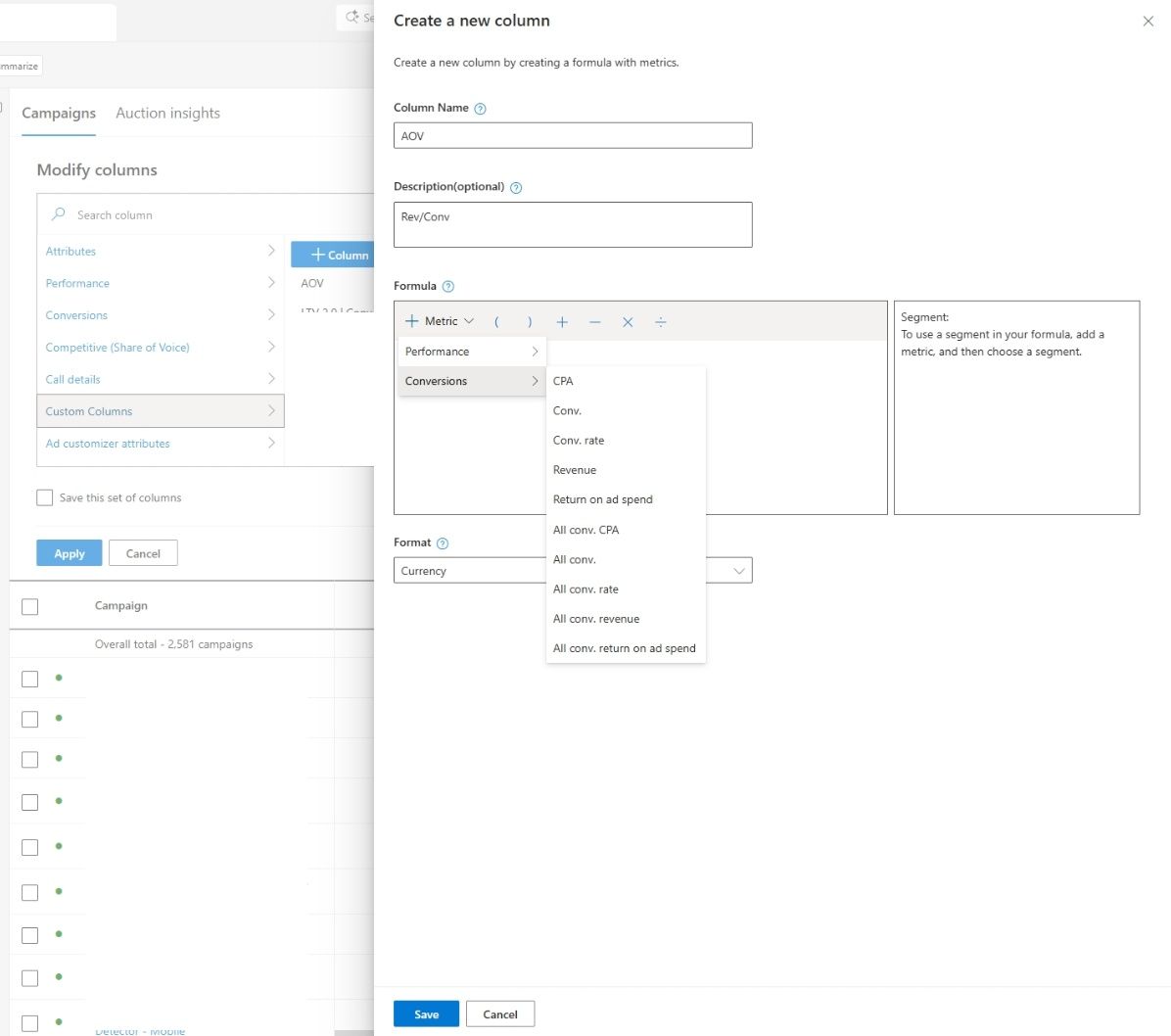
As someone exploring the ins and outs of Microsoft Advertising, I’ve discovered an update that’s sure to enhance our campaign analysis. Microsoft is now allowing us to customize columns with all conversion metrics, providing us with deeper insights and aligning reports with our unique business goals.
What does this mean for us? Well, according to Navah Hopkins, our go-to expert at Microsoft, we can now build custom metrics by leveraging the full spectrum of conversion data available in the platform. This means we can track all conversions and primary conversions, enabling us to tailor our reporting to meet our specific objectives more closely.
Please note the new image showcasing Microsoft’s enhanced custom columns feature. It’s a visual reminder of how these updates can transform our analytical capabilities.
Why am I excited about this? Because the standard reporting often doesn’t mirror how we truly measure success. By giving us the tools to expand custom columns, Microsoft allows us to define metrics that truly matter—be they lead quality, revenue, or a combination of conversion actions.
This flexibility is crucial for managing a variety of conversion types or navigating complex marketing funnels. Now, I can create custom columns, using ratios and metric combinations such as cost per qualified lead or conversion rates focused on primary goals.
Moreover, I appreciate that the revenue and ROAS calculations will now reflect the values that align with my conversion goals, providing more accurate insights directly linked to business outcomes.
What does this change imply for us in a broader sense? It represents a shift toward a more flexible and advertiser-defined measurement approach, instead of relying solely on standardized platform metrics.
This update highlights the ongoing demand for improved reporting customization as campaigns become increasingly automated and intricate.
So, what should we keep an eye on? I’ll be observing how advertisers like us utilize these custom metrics to guide optimization decisions, whether consistency in reporting improves across teams, and if similar flexibilities will roll out in other areas of the platform.
Bottom line? With Microsoft giving us more control over how we measure success, custom columns are evolving into a vital asset for campaign analysis. Read more about this update here.
If your parked-domain revenue dropped after Google’s Search Partner Network changes, do not move every name to the first network promising replacement income. First determine which domains lost a productive demand source, which never covered their costs, and which should be sold, developed, held, or allowed to expire.
The practical goal is not to recreate the old arrangement at any cost. It is to give every domain a defensible job, measure that job using net income rather than headline revenue, and avoid exposing an entire portfolio to an untested provider or a careless DNS change.
Google removed a monetization route, not every possible use
This distinction matters. The change affected a Google Ads inventory channel. It was not an organic search algorithm update, a domain-registration rule, or a declaration that an unused domain has no value. A domain can still receive direct traffic, attract a buyer, protect a brand, support a real website, or use a monetization provider operating through a different advertising ecosystem.
It also means SEO, AEO, and JSON-LD are not workarounds for the lost placement. Adding generated text or schema to a parking page does not turn it into a useful developed site. If you decide to develop a domain, build something that serves an identifiable audience and use structured data only to describe what is genuinely visible on the page.
When a replacement provider says its setup is compatible with Google, ask what that means. Is Google supplying the advertising demand, or is the provider using an independent network? If Google is involved, which product and policy govern the inventory? If Google is not involved, what ad formats, traffic restrictions, disclosures, and destination controls apply? A vague reference to Google is not a compliance answer.
Rebuild the economics one domain at a time
A portfolio total can hide weak domains. One valuable name may subsidize dozens of renewals, while dashboard revenue can look healthy even when deductions and recurring costs leave little cash. Build a domain-level ledger before testing a replacement.
Record the domain, registrar, renewal date, renewal cost, nameservers, and current purpose.
Preserve the longest comparable traffic history available. Separate direct, referral, search, geographic, and device data where the reporting supports it. Treat an analytics label such as direct as a traffic bucket, not proof that every visitor typed the domain.
Record estimated revenue, adjustments, invalid-traffic deductions, and the amount actually paid. The paid amount is the useful starting point for cash-flow decisions.
Keep the old Google-linked monetization period separate from any replacement-provider period. Blending them makes a declining domain look stable and prevents a fair test.
Add sale inquiries, offers, marketplace activity, and any evidence that the name has value independent of advertising income.
Flag email records, redirects, verification records, brand-protection reasons, trademark concerns, and other dependencies that make a DNS change or expiration risky.
Calculate net contribution as paid monetization revenue minus renewal fees, provider or marketplace charges, payment costs, and other direct operating expenses. If the available history does not cover a complete renewal cycle, mark the result as provisional instead of annualizing a short burst of traffic.
Then sort the portfolio by renewal date and net contribution. A domain approaching renewal with negative or unknown economics needs a decision before the charge occurs. A profitable domain still needs review if its traffic cannot be explained, its name creates legal exposure, or its provider can change the user experience without adequate controls.
Assign each domain a specific job
Do not force every domain into the same monetization model. Assign one primary role and document why the domain belongs there.
Cash-flow asset. Use this role when the domain has repeatable, explainable traffic and produces positive net contribution. Keep monitoring deductions, complaints, landing behavior, and traffic composition; passive does not mean unmonitored.
Monetized sale asset. A domain can remain monetized while it is listed for sale when the provider and marketplace support that arrangement. Give prospective buyers a clear route to the sale page, and retain clean revenue records that show dates, gross income, deductions, net income, traffic sources, and provider dependencies.
Development candidate. Choose this only when the name supports a credible subject, service, product, or community that you are prepared to maintain. A real site requires useful content, a clear owner, navigation, support, security, and ongoing operations. Thin pages created only to escape a parked-domain classification are not a durable strategy.
Defensive holding. Some names justify renewal because they protect a brand, campaign, product, or common variation even when they produce no ad revenue. Track that purpose separately so the domain is not judged by a monetization metric it was never meant to satisfy.
Exit or lapse candidate. Use this role when a domain has no meaningful traffic, buyer interest, development case, or defensive purpose. Expiration can be difficult to reverse because another party may register the name. Before allowing it to lapse, check email and recovery-address use, redirects, verification records, internal links, contracts, trademarks, and ownership obligations.
Revenue can strengthen a sale case, but it is not the domain’s entire value. A buyer needs to know whether the income is repeatable, whether it depends on one provider, and whether the traffic will survive a transfer. Do not present a short monetization run as a permanent yield.
Be especially cautious with mistyped or trademark-adjacent names. Advertising revenue does not cure an intellectual-property problem, and a provider’s willingness to accept a domain does not establish your right to monetize it. If ownership or use could conflict with another party’s mark, obtain advice from a qualified intellectual-property lawyer before monetizing, marketing, or transferring the domain.
Test replacement providers without risking the portfolio
Replacement platforms may use formats such as Direct Click or Related Search on Content. RSOC units direct visitors toward sponsored search results, while Direct Click is a provider label whose exact user flow should be demonstrated rather than assumed. Some platforms also use DNS-level integration to connect domains at scale. That can simplify deployment, but it also increases the cost of a configuration mistake.
Select a limited test cohort. Include domains with enough explainable traffic to produce useful observations, but exclude critical brand names, active email domains, and irreplaceable assets from the first migration.
Export the full DNS zone before changing nameservers. Record A, AAAA, CNAME, MX, TXT, and verification records, along with the current redirect behavior. A nameserver change can interrupt email, authentication, redirects, and third-party verification even when the parked page itself appears to work.
Read the provider agreement and ask which traffic types are accepted. Confirm how invalid traffic, deductions, clawbacks, account suspension, payout timing, exclusivity, domain sales, and termination are handled.
Inspect the actual visitor experience on relevant devices and locations. Record the page, ad disclosure, clicks, redirects, advertiser destinations, sale link, consent behavior, and any browser or security warning. Do not rely on a dashboard screenshot as evidence that the user experience is acceptable.
Measure paid revenue per valid visit, net contribution, geographic and device mix, deductions, complaints, and unexplained traffic changes. Compare the test cohort with its own preserved baseline rather than with a provider’s best-performing example.
Define rollback conditions before launch. Misleading presentation, unwanted redirects, broken email, malware warnings, abuse complaints, missing reports, or unexplained deductions should trigger investigation or restoration of the previous DNS configuration.
Provider case studies require particular care. One vendor-supplied example describes a redacted .ws domain acquired for $5.95 and earning about $7 per month after being connected exclusively to the platform. It also reports no abuse complaints during operation. The domain, traffic volume, audience mix, portfolio distribution, and full cost basis are not disclosed, and the publisher does not confirm or dispute the sponsor’s conclusions.
That example can show that monetization is possible; it cannot forecast your return. Do not multiply its monthly figure by the number of names you own. Your decision should come from paid results on your own traffic, after costs, with enough operational detail to explain why the result occurred.
Keep an abuse log even when no complaint has arrived. Record user reports, registrar notices, advertising-policy messages, security warnings, and provider responses by domain. The absence of a report is not evidence that every ad destination or redirect is safe; it only means no report has reached you through the channels you monitor.
Key takeaways
Google’s change removed the previous parked-domain placement route from its Search Partner Network; it did not eliminate every sale, development, defensive, or independent monetization option.
Judge each domain by paid net contribution and strategic purpose, not gross dashboard revenue or portfolio-wide averages.
Give every domain one documented role: cash-flow asset, monetized sale asset, development candidate, defensive holding, or exit candidate.
Treat provider projections and single-domain examples as sales evidence, not expected portfolio performance.
Test DNS-based monetization on a limited cohort, preserve the full DNS zone, inspect the visitor journey, and establish rollback conditions before migration.
Do not use thin content, AI-generated pages, or schema markup as a cosmetic workaround for a domain that has no genuine developed-site purpose.
Start with the renewal calendar and the domains responsible for most of your recorded income. Give each one a job before its next renewal, and test replacement demand only where you can explain the traffic and safely reverse the setup. The useful question is no longer whether parked domains still make money in general. It is whether each domain earns, protects, or supports enough value to justify another cycle.
Have you heard the news that OpenAI has introduced CPC ads to ChatGPT? This strategic shift has transformed it into a performance-driven channel, offering advertisers new avenues for engaging intent-driven audiences and tracking ROI.
OpenAI is moving away from a focus purely on impressions in ChatGPT to prioritize performance. This change places OpenAI in direct competition with giants like Google by adopting cost-per-click (CPC) ads, allowing advertisers to pay only when users click on their ads.
What’s happening? OpenAI has started testing CPC ads within ChatGPT, where advertisers only pay when their ads receive clicks. Initial reports highlight that these clicks are priced between $3 to $5. They’re rolling out this feature through a limited ads manager, alongside their existing CPM-based model.
Why now? The main catalyst seems to be pricing pressure. Since its launch, ChatGPT’s CPMs have significantly decreased from around $60 to approximately $25. Switching to CPC helps mitigate this decline by connecting revenue to tangible outcomes rather than mere impressions.
Why do we care? With its evolution into a performance channel, ChatGPT is now not just a branding space. The CPC pricing model makes it easier for us to connect budgets directly to measurable actions, test ROI, and compare these results with channels like Google Search.
I’m excited about the opportunity for advertisers to access what could be a high-intent audience in a new format. This presents a first-mover advantage before competition—and the associated costs—escalate.
The bigger picture: This isn’t just a pricing change; it’s a strategic pivot. By embracing CPC advertising, OpenAI challenges Google’s dominance in the market, thereby positioning ChatGPT as a contender for performance marketing budgets.
Reading between the lines: A major challenge lies in proving user intent. While search advertising is effective because it captures users actively searching for something, ChatGPT’s conversational context needs to generate clicks with equal value. Advertisers will likely compare these results directly with Google, setting a high standard for quality and conversion.
Zoom out: Advertising is becoming integral to OpenAI’s long-term revenue plan, supported by investments in ad infrastructure, measurement tools, and a wider self-serve platform.
Bottom line:By implementing CPC ads, OpenAI is vying for the performance-driven ad dollars that have long supported traditional search platforms.
For years, I’ve been told to stick to a set of guidelines: always use top-notch creatives, maintain a polished brand, follow scripts, and adhere to platform-recommended formats.
Lately, while navigating ad accounts or simply scrolling through feeds, I’ve noticed something intriguing. The ads that grab my attention often defy these rules. They’re less polished, scrappier, and sometimes referred to as ‘ugly ads.’ What’s fascinating is that they’re outperforming the traditional, polished ones.
More brands are deliberately breaking so-called best practices to stand out. It’s important to remember that these practices represent an average of what worked for others in the past. By the time a strategy becomes a platform-recommended rule, it might have already lost its edge.
This is why defying best practices can lead to success — but only if you understand the reasons behind them.
Why Breaking Best Practices Enhances Ad Performance
Before diving into what to change, it’s crucial to understand the rationale behind existing rules. Platforms like Meta and TikTok have dual objectives:
They aim for you to spend money on ads.
They want to keep users engaged on their platforms.
The best practices they promote are designed to ensure a seamless experience, encouraging ads to resemble others. The issue is that familiarity eventually breeds invisibility. When I adhere too closely to the rules, my ads risk blending into the background noise, overlooked by users.
Highly-produced ads often scream ‘this is an ad,’ prompting users to skip them before my message hits home. In contrast, when my ad resembles something a friend might share, users’ defenses remain down longer, potentially transforming a scroll into a conversion.
This is why many top-performing ads today don’t appear traditionally polished or on-brand. They break patterns instead. Consider:
Grainy phone footage.
Notes app screenshots.
Green-screened reactions or commentary videos.
Other lo-fi formats that outperform studio-quality creatives.
To implement this, I started intentionally reducing my production value and experimented with formats like point-of-view (POV) shots tailored to various personas.
Many brands have adopted guidelines that make them seem faceless and untouchable. They refrain from showing a messy office, an unpolished founder, or anything that challenges their corporate script. However, others are discarding that playbook, embracing founder-led ads that deviate from the polished executive version.
There’s a catch.
Breaking the rules works only when it’s genuine. I’ve learned that faking authenticity is easy to spot and can backfire. This was evident in a viral series of videos where McDonald’s CEO appeared to present a new burger, but his execution was criticized for being stiff and unconvincing.
As shown in a Dineline video, his performance appeared staged. Contrarily, Burger King’s president presented their burger with no hesitation, offering a genuine and relatable moment.
The distinction was evident: One was a product pitch, and the other felt authentic.
If my leadership doesn’t genuinely believe in the product, neither will my customers. Rule-breaking should allow us to be real, rather than simply appear unpolished.
You’ve probably encountered video hook best practices like ‘show the product in the first two seconds and state the value prop clearly.’ Sound familiar?
Imagine my ad starting with a screenshot of a negative comment, like one for a skincare product stating, ‘This probably smells like old socks, and does it even work?’ My ad would then show the founder confidently disproving this in an unscripted manner, applying the product.
Though this breaks the positive-association rule, it leverages viewers’ curiosity about digital conflicts. By the time they realize it’s an ad, they might already be engaged.
I learned not to abandon all polished assets just yet.
Rule-breaking is strategic, and often misunderstood when the ’80/20 rule’ is ignored.
Switching completely to shaky phone footage isn’t wise. Keeping 80% of the budget in traditional ads while using 20% for testing unconventional ones can be effective.
Next testing campaign, I plan to try:
The silent test: Running a silent ad with bold captions to stand out in a noisy feed.
The UI ghost: Using static images resembling platform notifications to pause scrolling.
The algorithmic trust fall: Disabling auto-optimizations in a campaign to test creative performance without constraints.
Don’t Follow the Rules; Understand Them
Best practices are a guide, not a strategy. To move beyond them, I do it systematically.
I start by questioning the rule’s existence, evaluating its current relevance, and testing its opposite in a structured manner. Comparing traditional and lo-fi approaches helps me understand user engagement better.
In an environment where brands play it safe, those who understand and strategically break the rules will capture attention and conversions. My goal is to learn faster than the competition, skipping guesswork.
Ever since learning about Google’s latest update to its YouTube and Discover Feed ad requirements, I’ve been intrigued by the clarification on election-related ads. This change, effective April 2026, doesn’t alter enforcement but provides much-needed transparency.
Why it matters. As someone navigating the complex landscape of YouTube and Discover ad placements, I understand how tightly regulated these spaces are. Historically, election ads have been surrounded by ambiguity. Now, the update helps clear up that confusion without imposing additional restrictions.
What’s new (and what’s not). It’s interesting to note that election ads are now clearly exempt from specific YouTube and Discover Feed ad requirements. However, no changes in enforcement mean that if compliance was achieved before, there’s no need for advertisers to shift gears.
Why we care. With this update, I’ve noticed how Google aims to eliminate the haze surrounding election ads on YouTube and Discover. Although these ads don’t need to meet placement-specific requirements, adherence to Google Ads policies remains essential, offering clearer guidance and more predictable campaign launches.
Zoom in. For election ad campaigns, this exemption is beneficial since these ads aren’t required to comply with the targeted YouTube and Discover Feed ad guidelines. However, advertisers must pass the Election Ads verification within the ad’s targeted region.
Between the lines. It’s vital to recognize this as a documentation clarification rather than a policy change. Google is distinguishing between the unique requirements for YouTube and Discover ads and its overarching ads policy framework.
What advertisers should do. If you’re running political campaigns, it’s crucial to maintain your verification status and continue adhering to Google Ads policies. Despite the exemption, keeping up with regulations is necessary for a smooth advertising process.
Your Shopping traffic has stopped, but the fastest-looking response—requesting another review immediately—is rarely the most useful first move. A review can assess the account you present; it cannot repair missing policies, inaccessible pages, or contradictions between your website and product feed.
Treat the suspension as a full commerce-system audit. Your business identity, customer policies, storefront, product data, checkout, and Merchant Center settings need to tell the same verifiable story before you ask Google to look again.
Start with the suspension reason, not the review button
Preserve the exact wording of the suspension notice. A broad label can tempt you into making broad, cosmetic changes, but your investigation needs testable questions: Is the business identifiable? Can a shopper understand the transaction before paying? Can Google reach every submitted product URL? Does the product feed describe what the landing page actually sells?
Copy the issue name and complete message into a remediation log. Save a screenshot so you can distinguish the original notice from any later messages.
Record the affected Merchant Center account, website domain, feed, and destinations. This prevents a fix in one system from masking an unresolved contradiction elsewhere.
Turn the policy label into verification questions. For example, a trust-related concern should trigger checks of business identity, contact information, policies, product pages, and checkout—not merely a rewrite of the About page.
Log every correction with its URL or setting, the previous state, the new state, and the person who verified it. That log becomes your review checklist and protects you from submitting based on memory.
Suspension recovery often depends on correcting a cluster of trust, policy, functionality, and product-data problems across the entire commerce setup. Finding one obvious defect does not mean you have found the only defect.
Make your storefront prove that the business is real
Your website needs to answer the questions a cautious shopper would ask before handing over money. Put the answers on public, easy-to-find pages. Do not rely on social profiles, checkout text, or information that appears only after a customer creates an account.
Verify business identity and contact details
Publish a dedicated Contact page with the business name, a legitimate physical address, and a professional email address.
Use information that agrees with the business identity shown in Merchant Center and throughout the storefront.
Give customers a clear support route. If different channels handle sales, returns, or order problems, explain which one to use.
Link the Contact page from a persistent location such as the site footer, then confirm that the link works on desktop and mobile.
Never invent an address, support channel, or business detail to complete the checklist. Information that cannot be verified creates a larger trust problem than a plainly explained limitation.
Consistency matters as much as presence. A trading name on the website, a different identity in Merchant Center, and an unrelated email domain can leave the customer—and an automated review system—without a coherent way to identify the seller.
Replace vague policy pages with operational terms
A policy page should explain what your business will actually do, not merely announce that a policy exists. Read each page as though you have already placed an order and now need a definite answer.
Shipping: State where you ship, how shipping charges are disclosed, and what customers should expect between ordering and delivery. Only publish commitments your operation can meet.
Returns: Explain which items are eligible, any applicable conditions, how a customer starts a return, and who is responsible for return costs.
Refunds: Explain how an approved refund is issued and when the customer should expect it. Keep the wording consistent with the returns process.
Cancellations: State whether an order can be cancelled, when cancellation stops being possible, and how the customer submits the request.
Payments: Identify the payment methods you actually accept. Remove methods that are advertised but unavailable at checkout.
Then compare the policies with the product page, cart, checkout, order emails, and customer-service process. A polished refund page will not resolve a suspension if checkout presents different terms or the published support channel does not work.
Test the storefront as an outsider
Open the site in a private browser window and follow a complete shopping path. Visit a product URL directly, select a variant, add the item to the cart, enter checkout, and locate the contact, shipping, return, refund, cancellation, and payment information. Repeat the critical path on mobile.
Fix broken navigation, error pages, redirect loops, non-working buttons, inaccessible policy links, and checkout failures. The goal is not merely to make the homepage look credible; every submitted product needs a usable path from landing page to purchase.
Reconcile the feed, product page, and checkout
Merchant Center does not exist separately from your storefront. The feed makes a product claim, the landing page substantiates it, and checkout completes it. Audit those three surfaces side by side rather than assigning them to separate teams with separate checklists.
Control point
What to compare
Required correction
Product URL
Submitted URL against the public landing page
Use a stable, working URL that resolves to the intended product without a login or error.
Price and currency
Feed against the selected product or variant, cart, and checkout
Correct the system that owns the inaccurate value, then refresh the downstream data.
Availability
Feed status against whether the item can actually be purchased
Synchronize inventory so an unavailable item is not represented as purchasable.
Product identity
Feed title and product details against the landing-page item
Make sure the submitted record identifies the same product the customer reaches.
Variant
Submitted variant against the size, color, image, price, and availability displayed
Use variant-specific data and ensure the intended selection is clear on the page.
Trace inaccuracies upstream. If your feed is generated from an ecommerce platform, repeatedly editing the exported feed may produce a temporary match that disappears during the next refresh. Correct the price, inventory state, URL, or product identity in the authoritative system, regenerate the feed, and verify the resulting Merchant Center data.
Crawlability deserves its own pass. Confirm that submitted URLs are public, load successfully, and are not blocked by site-wide access controls or crawl directives. Clean up malformed or unstable URL structures. If products are available only through internal search, session-specific links, or a gated experience, the submitted URLs are not providing a dependable public destination.
For a small catalog, verify every active product. For a larger catalog, first group products by template, data source, market, and variant pattern so you can find systemic failures, but do not treat a clean sample as proof that every submitted item is accurate. Use feed diagnostics and your remediation log to keep working through the remaining exceptions.
Request a review only after passing a release gate
A review request should be the release step, not a diagnostic experiment. Before submitting it, have someone who did not make the changes verify the account against a fixed gate:
The exact suspension concern has been translated into checks, and every check has a recorded outcome.
The Contact page contains a consistent business identity, physical address, professional email address, and working support route.
Shipping, returns, refunds, cancellations, and payment methods are public, specific, current, and mutually consistent.
Representative purchase paths work from product page through checkout on desktop and mobile.
Submitted URLs are reachable and lead to the intended products.
Prices, currencies, availability states, product identities, and variants agree across the feed, landing pages, cart, and checkout.
Merchant Center settings agree with the website and the business that is operating it.
The remediation log contains the relevant URLs, settings, feed corrections, and verification results.
Once the gate passes, use Merchant Center’s available review process. If you can provide an explanation, keep it factual: identify the issue addressed, name the pages or settings changed, describe the feed or storefront corrections, and indicate how you verified the current state. Do not claim that the account is compliant while known exceptions remain.
A useful internal format is: “Issue addressed: [suspension label]. Corrections completed: [specific pages, settings, and product-data fields]. Verification performed: [URLs and purchase-path checks].” The value is in the evidence behind those statements, not in persuasive language.
Keep the repaired system from drifting
After reinstatement, convert the recovery checklist into a change-control routine. Recheck affected surfaces whenever you change product templates, feed integrations, inventory systems, prices, currencies, shipping rules, payment methods, business details, or policy wording. Assign one owner to reconcile website and Merchant Center changes; otherwise, each system can be internally correct while the combined customer experience becomes contradictory.
Retain the remediation log as a baseline. When a future alert appears, you will be able to compare the current setup with the last verified state instead of rebuilding the investigation from scratch.
Key takeaways
Do not use a review request to discover whether a partial fix was enough; complete the audit first.
Inspect the whole commerce system because several small trust and data gaps can combine into one suspension.
Publish verifiable contact details and operational shipping, return, refund, cancellation, and payment policies.
Make the feed, landing page, selected variant, cart, and checkout agree on what is being sold.
Verify public URLs and crawlability instead of assuming that a page works because it opens inside an administrator session.
Document each correction and require an independent release check before requesting a review.
Your next move is simple: copy the suspension message into a remediation log and begin with the first fact Google or a customer cannot verify. Work through the account until there are no unresolved contradictions, then request the review from a position you can substantiate.
If Google Ads carries a large share of your pipeline, the useful question isn’t whether Google is finished. It isn’t. The question is whether your current level of dependence still makes sense when competitive momentum, platform reliability problems and legal challenges are converging on the same advertising business.
You don’t need to abandon profitable campaigns. You do need to know what would happen if Google became less efficient, an automated review stopped your ads, or another platform produced a better marginal return. That calls for a controlled resilience plan, not a panicked budget shift.
Three different forces are squeezing Google’s ad business
Pressure on Google is often treated as one sweeping story about the decline of search advertising. That framing isn’t useful. Competitive, operational and legal pressure work through different mechanisms, so each requires a different response from you.
Competitive pressure is following performance and automation
The gap is narrow, and a forecast is not a completed result. Google also remains enormous, continues to grow and operates one of the world’s most profitable search advertising engines. The strategic signal is subtler: incremental budgets are increasingly attracted to systems that automate creative production, targeting and campaign optimization while making return on investment easy to communicate.
That does not prove Meta will outperform Google in your account. It does show that Google can no longer be treated as the automatic home for every additional advertising dollar. Its performance must earn the budget against a credible alternative.
Operational pressure turns automation into a continuity risk
Automated ad review gives Google scale, but it can also interrupt otherwise sound campaigns. Advertisers have encountered sudden destination disapprovals attributed to DNS failures or HTTP 500 errors even when their landing pages appeared to work normally. In one account, more than 1,500 ads were reportedly disapproved at 1:30 p.m. UTC.
A page can load for your team while failing for an automated crawler because of a temporary DNS problem, timeout, redirect, geographic rule, firewall setting or origin-server error. It is also possible for the crawler or review system to be the source of the failure. Either way, the commercial effect is the same: eligible ads stop serving, and traffic, leads or sales can disappear while your team investigates.
This is more than a support inconvenience. When a platform can suspend a revenue-producing route through an automated decision, platform reliability belongs in your acquisition risk model.
Legal pressure has moved closer to advertiser economics
Federal courts found in 2024 that Google had unlawfully monopolized online search and parts of the ad technology infrastructure connecting advertisers with publishers. Google is appealing both decisions. Advertisers are also exploring mass arbitration claims tied to alleged overpayments for search and display advertising.
An economic analysis commissioned by claimant counsel estimated that potential claims could exceed $218 billion, while mass arbitration proceedings commonly take an estimated 12 to 24 months. Neither figure is an award, a settlement or a reliable receivable for an individual advertiser. Google says it has strong arguments and intends to defend itself.
The practical meaning is not that your ad costs are about to fall or that compensation is assured. It is that Google’s legal exposure is no longer confined to regulatory headlines. Advertiser claims could create direct financial and contractual pressure, but the outcome, timing and effect on the advertising market remain uncertain.
Key takeaways for the person holding the budget
Google remains a formidable and growing advertising platform. Pressure on the business is a reason to manage concentration, not evidence that every account should leave.
Meta’s projected revenue lead is an aggregate market signal. Your allocation still needs to follow qualified leads, profitable sales and incremental return in your own business.
Unexpected ad disapprovals can turn a technical review into an immediate revenue interruption. You need an incident procedure before the next alert arrives.
Antitrust rulings and proposed mass arbitration claims are consequential but contested. Do not budget for a payout or make legal decisions without qualified counsel.
The strongest response is to preserve profitable Google activity while building independent measurement, tested channel alternatives and owned search or AI visibility.
Reallocate budget from account evidence, not market headlines
Moving money from Google to Meta simply because Meta may become the larger ad company substitutes one form of platform dependence for another. Start by separating the jobs your campaigns perform. Search often captures explicit demand. Paid social can create or reactivate demand through audience and creative systems. You cannot evaluate those jobs honestly with one undifferentiated return figure.
Classify each campaign by its actual job. Use categories such as branded demand capture, non-branded demand capture, remarketing, prospecting and brand reach. Do not allow a campaign to claim credit for every stage of the buyer journey.
Connect platform activity to business outcomes. Evaluate qualified leads, accepted opportunities, completed sales, gross margin and acquisition cost where those measures are available. A cheap lead that sales rejects is not evidence of channel efficiency.
Separate platform-reported results from your own records. Keep first-party lead and sales data, campaign identifiers and attribution assumptions accessible outside Google and Meta. The platforms can inform the decision, but they should not be the only systems capable of grading themselves.
Compare the marginal dollar, not the historical average. A mature campaign may have an excellent blended return while its next increment of spend produces much less. That next increment is the money an alternative channel must beat.
Run controlled transfer tests. Keep the offer, business outcome and measurement logic as consistent as the channels permit. Judge results over a complete conversion cycle, especially when revenue closes well after the ad click.
Write the scale, hold and stop conditions before seeing the result. This prevents a team from explaining away weak performance because it prefers a platform, campaign type or creative idea.
Do not compare click-through rate or cost per click across fundamentally different campaign jobs and call the cheaper platform the winner. A high-intent search click may cost more because the user is closer to a decision. A social impression may influence demand without receiving the final conversion credit. Compare the business outcome each campaign was assigned to produce.
Also inspect concentration below the platform level. A Google account can appear diversified while most revenue depends on one campaign, match type, audience, product category or landing page. Record the percentage of paid-media revenue associated with each critical component. The point is to identify where one suspension, policy change or performance decline would be difficult to replace.
If Google still produces the best qualified acquisition economics after that review, keep funding it. Resilience is not the same as forced diversification. It means alternatives are measured and available before the core channel gives you a reason to need them.
Make ad disapprovals a rehearsed incident, not a surprise
An unexplained destination disapproval creates two bad instincts: assume Google must be wrong, or rebuild a working site before establishing what failed. Both waste time. Use a fixed diagnostic sequence so the team can distinguish a site defect from a transient or platform-side review problem.
Record the event before changing anything. Capture the account, campaign, affected ads, destination URLs, policy reason, first observed time and number of affected ads. Save the disapproval notice and relevant account views.
Read the exact reason in Google Ads Policy Manager. Do not troubleshoot a generic destination problem when the platform has supplied a more specific policy category.
Test the final URL as a new visitor. Check multiple devices and networks where practical, follow the complete redirect path and confirm that the intended landing page returns rather than an error, login wall or region block.
Inspect DNS, CDN, firewall and origin-server evidence. Look for lookup failures, timeouts, blocked automated requests, redirect loops and temporary 500 responses around the recorded incident time. A successful manual visit later does not prove the crawler could reach the page earlier.
Determine the scope. If unrelated accounts, domains or landing pages fail at roughly the same time, preserve that pattern. If one URL or infrastructure component is isolated, prioritize the local fault.
Correct a verified site problem, then request review. If the destination works and your logs do not support the stated error, submit an appeal with concise evidence instead of blindly reconfiguring production infrastructure.
Track the commercial effect. Record lost serving time, affected campaigns and the downstream lead or revenue impact you can substantiate. This supports internal incident analysis and any later escalation.
Assign ownership before an incident. The paid-media owner should know who can inspect DNS and server logs, who can approve a landing-page change, who submits an appeal and who informs sales or leadership when lead flow is interrupted. An escalation path buried in an agency inbox is not a continuity plan.
Set monitoring around business symptoms as well as website uptime. A generic uptime check may remain green while ads lose eligibility. Watch for abrupt changes in approved-ad counts, impressions and conversions, then investigate those signals together. The goal is not to assume every drop is a platform error; it is to discover the interruption before a full reporting cycle has passed.
Maintain compliant fallback assets for important offers where your operation supports them. That can include a separately verified landing destination, current creative files, approved messaging and a tested alternative acquisition channel. A fallback should present the same truthful offer and comply with platform policies. It should never be used to disguise a destination or evade review.
Build leverage before Google changes the terms
Your leverage does not come from predicting which pressure will matter most. It comes from reducing the number of decisions Google can make on your behalf without an effective response from you.
Keep the legal question separate from the media plan
Mass arbitration may become relevant to some advertisers because advertising contracts can require disputes to proceed through arbitration rather than ordinary litigation. A coordinated filing can change the economics of pursuing smaller individual claims, but participation, eligibility, deadlines, evidence and possible costs are legal questions specific to the advertiser and contract.
Preserve ordinary business records that already support your accounting and campaign decisions: applicable contracts, invoices, billing exports, campaign histories and the internal records used to connect spend with outcomes. Do not alter retention practices, assert damages or join a claim solely from a revenue estimate in public coverage. Ask qualified counsel to assess your actual position. A possible recovery should not appear in your forecast or justify continued inefficient spending.
Own the measurement layer
A platform has more leverage when it owns the auction, delivery, optimization and final performance narrative. Define conversions in business terms outside the ad interface. Reconcile ad-reported conversions with lead quality, sales acceptance, cancellations, returns and margin where those factors apply to you.
Document attribution rules as well. When Google and Meta both claim the same conversion, your team needs a consistent method for deciding how the result affects allocation. The method does not have to be perfect. It has to be stable enough that a platform’s reporting change cannot rewrite your entire performance history.
Diversify discovery, not just ad vendors
Moving spend between advertising platforms protects only part of the journey. Pressure from AI search also makes owned visibility more important. Organic search, answer-engine optimization and generative-engine optimization will not replace a high-performing paid campaign on command, but they can reduce the amount of demand you must rent one click at a time.
Start with the queries and sales questions that already signal commercial intent. Build pages that answer the central question early, distinguish your offer clearly, name relevant entities consistently and support important claims. Add structured data only when it accurately represents visible content. Maintain citations, authorship and update information so a search engine or AI system can understand what the page says and why it is trustworthy.
Measure this work against its assigned role. Some pages should create qualified organic leads. Others may improve brand discovery, support a later conversion or give prospects the evidence needed to return through a branded search. Treating every owned page as a last-click sales page will cause you to underinvest in the assets that create negotiating room with paid platforms.
Your next move can be concrete and limited: map where paid-media revenue is concentrated, write the destination-disapproval procedure, select one credible budget-transfer test and choose one high-intent question your business should answer without buying the visit. Google may remain your strongest advertising channel after all four steps. The difference is that it will be a measured choice rather than an unmanaged dependency.