I’ve been diving into some recent updates from Google regarding keyword match types, especially for those of us working with AI Overviews (AIO) and AI Mode ad placements. It’s crucial to understand these changes, particularly for those testing AI Max and using various match-type strategies. Let’s break it down so we can all optimize our ad reach effectively.
Why this matters to us. As the digital advertising landscape embraces AI-powered placements, it’s more important than ever to grasp which keywords are ready to serve ads and avoid unintentionally limiting our ad reach or misjudging performance metrics.
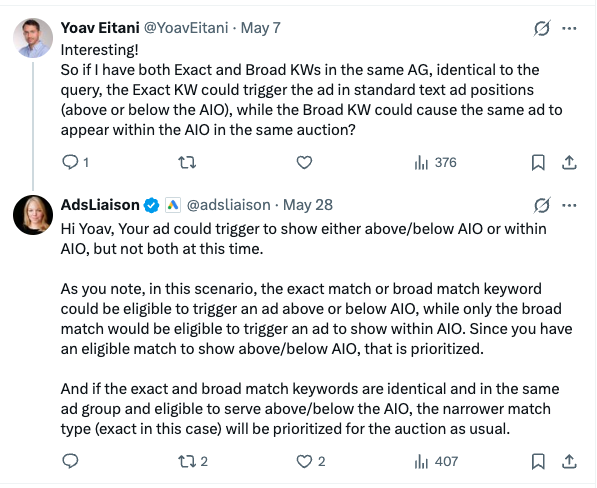
In May’s developments. When I followed the conversation between Marketing Director Yoav Eitani and Google’s Ads Liaison, Ginny Marvin, it was clarified that ads can serve either above or below an AI Overview—or appear within—but not in both placements simultaneously. Marvin stated, “Your ad could trigger to show either above/below AIO or within AIO, but not both at this time.”
When we talk about ad placements, it turns out both exact and broad match keywords can trigger ads above or below AIO. However, only broad match keywords (or those using keywordless targeting) have the privilege to appear within the AI Overviews.
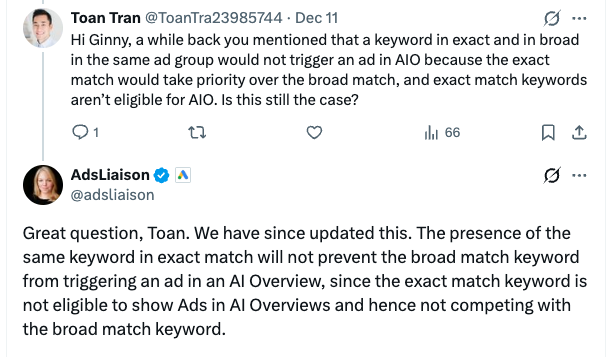
What’s different now. In a later discussion with Paid Search specialist Toan Tran, Marvin provided further insight into Google’s updated eligibility criteria. Before this update, the presence of an exact match keyword could block a broad match keyword from filling AIO spots. But thanks to Google’s revisions, that’s no longer an issue.
Marvin detailed, “The presence of the same keyword in exact match will not prevent the broad match keyword from triggering an ad in an AI Overview, since the exact match keyword is not eligible to show Ads in AI Overviews and hence not competing with the broad match keyword.”
This adjustment means that with exact and phrase match keywords not qualifying for AI Overview placements, they won’t compete with broad match keywords in those auctions. So, a broad match can still trigger successfully even if its exact match counterpart is present.
The broader perspective. Google’s strategic update strengthens the distinction between traditional keyword matching and AI-powered intent matching. Ads in AI Overviews now depend on a keen understanding of both user queries and AI-generated content, requiring broader targeting signals.
The takeaway for us. If you, like me, are pushing into AI Max and AIO placements, it’s clear that broad match and keywordless strategies are key to tapping into Google’s AI-driven ad spaces. Exact and phrase match keywords might not appear in AI Overviews, but crucially, they won’t stop us from leveraging broad matches.
I recently discovered that uncontested ads might be silently eating away at my holiday budget. Even when I’m the sole bidder, my CPCs remain stubbornly high. Here’s how I began to reclaim those wasted dollars.
This holiday season, Google Search and Shopping Ads are projected to surpass a staggering $70 billion in spending. However, many advertisers, myself included, overlook a critical flaw in Google’s auction system that drains our funds—even in the absence of competitors.
The team at BrandPilot identifies this issue as the “Uncontested Google Ads Problem,” a significant yet often ignored source of wasted ad spend during peak times.
During SMX Next, I learned from John Beresford, the Chief Revenue Officer at BrandPilot, about a little-known quirk in Google’s auction logic. It’s fascinating how this can lead advertisers like me to overspend on our brand terms, shopping placements, and category keywords because Google doesn’t automatically lower our CPCs when no one else is bidding.
Instead of enjoying lower costs as the sole bidder, I found myself paying the same high rate as if competitors were still active. It’s a situation that unfolds thousands of times a day for major brands, and like me, many marketers don’t even realize it.
In John’s session, we explored:
Understanding why “competition gaps” are far more frequent than we think.
Discovering how uncontested moments can warp CPCs, even on brand keywords.
The potential of real-time auction visibility—and how AI is revolutionizing the field.
He also shared how advertisers are deftly reclaiming wasted spending and channeling it back into growth, without giving up impression share, traffic, or revenue.
Identify why CPCs are artificially high when competitors are missing.
Calculate the true financial impact of the Uncontested Ads Problem on your budget.
Execute AI-driven bidding and suppression strategies to avoid self-bidding and increase ROAS.
If you’re managing Google Search or Shopping campaigns this holiday season, this session is a must-see. Learn how to keep Google from sneaking off with your budget and start converting those savings into real performance improvements.
I recently stumbled upon some intriguing developments from Bing, as they are experimenting with a new ad format that closely resembles Google’s approach. This revamped ‘Sponsored results’ grouping could potentially lead to more accidental ad clicks, given how seamlessly these paid listings blend with the organic search results.
Picture this: Microsoft is testing a redesign for search ads in Bing, wherein multiple sponsored links are grouped under a single ‘Sponsored results’ label. There’s also a handy ‘Hide’ button to collapse the ad block entirely, adding a layer of user control that’s quite novel.
What’s Happening? It was Sachin Patel who first noticed this Bing test in action, sharing screenshots and a video that spotlight this new layout. Interestingly, in the current test, only the first ad in the group is marked with a label. Any subsequent ads are listed without labels beneath it. This feature allows users to click ‘Hide’ to collapse these ads and ‘Show’ to display them once more.
Understanding the Mechanism. The design clusters ad units in such a way that blurs the lines between paid and organic content. By consolidating ad labeling to just one header, it makes each ad appear more like a standard search result.
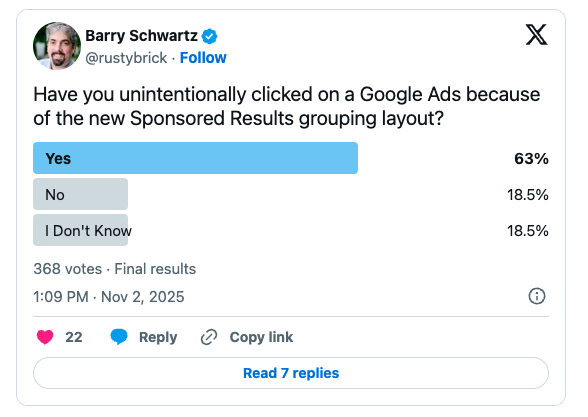
Looking Back. Google introduced a similar approach not too long ago, and it quickly drove discussions around unintended ad clicks. According to a recent poll conducted by Barry Schwartz on X, a remarkable 63% of respondents admitted to inadvertently clicking on Google Ads results due to this new grouping.
Bing following suit might indicate a broader industry trend in the labeling and display of search ads.
Why Should We Care? Bing’s new grouped ‘Sponsored results’ format could potentially raise ad visibility and enhance click-through rates by making ads blend more seamlessly with organic listings. The ‘Hide’ button introduces a refreshing control element for users, though the single-label approach may still lead to increased accidental clicks, as observed with Google’s recent redesign, potentially resulting in higher bounce rates.
Should Microsoft decide to implement this change broadly, it could significantly impact campaign performance, attribution, and spending efficiency across Bing’s search platform.
Initial Observations. This layout change was first shared by Sachin Patel, who took to X with his findings.
The Takeaway: While the experiment remains limited for now, if Bing rolls this format out extensively, it could lead to increased engagement — whether intended or accidental — and renew discussions about how clearly ads are disclosed in search results.
I never realized how much traffic I was losing every day until I learned about unauthorized bidding, affiliate violations, and ad hijacking. It’s a common issue, but don’t worry, I’m here to guide you through building a robust brand protection strategy in paid search.
Did you know that ad fraud reached an estimated $84 billion in global digital ad spend in 2023? If you’re facing a steady rise in branded CPCs or see competitors continuously appearing above you in searches for your own name, this guide is exactly what you need to understand why and what steps to take next.
Brand protection in PPC is about defending your brand from unauthorized use of your branded search terms in PPC ads and any deceitful ad placements. My main goal here is to make sure that people searching for my brand or product name find my official pages rather than those of a competitor, affiliate, or reseller.
Having a well-executed brand protection strategy not only safeguards my traffic but also reinforces my brand’s image and fosters customer loyalty. Without it, I risk facing significant losses, such as higher CPCs, rising affiliate costs, and losing customer acquisition opportunities.
My brand protection activities include:
Monitoring who bids on my branded keywords.
Spotting unusual spikes in CPCs or impression share.
Identifying unauthorized trademark use in paid search.
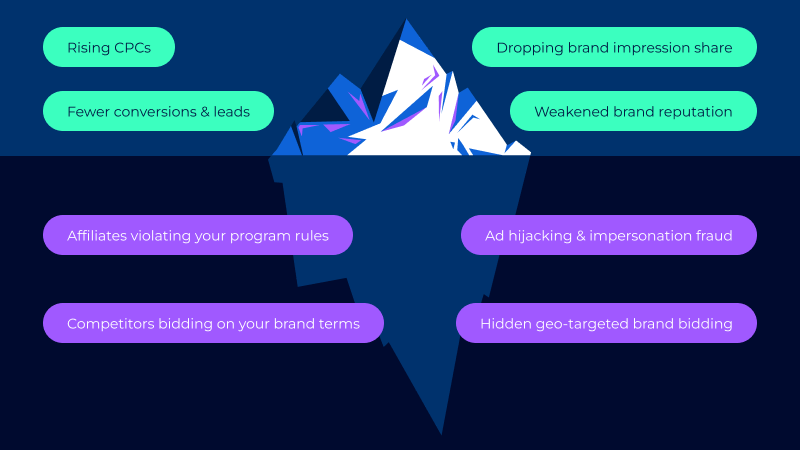
Detecting hidden, geo-targeted ads meant to evade detection.
Enforcing compliance rules for affiliates and partners.
Three main sources of threats exist:
Competitors: They target my branded searches to tap into high-intent traffic, intercepting my audience.
Affiliates: If I miss their dishonest tactics, I end up paying for leads I would have acquired anyway, increasing costs without gaining additional customers.
Fraudsters: Their advanced tactics can cause serious financial and reputational harm to my brand.
Without protecting my brand in paid search, I’m at risk of these common threats:
Brand bidding: Others bid on my branded queries to capture high-intent searches, driving up CPCs and reducing my impression share. Over time, this forces me to spend more to regain position, lowering my return on investment (ROI).
Ad hijacking: Competitors or fraudsters mimic my ad structure to deceive users into clicking what they believe is my official ad.
Malicious redirects: Users clicking on “brand-looking” ads might end up on phishing, malware, or low-quality pages.
Ad copy misalignment: Affiliates may use unapproved or outdated messaging harming my brand image.
Misleading ad copies: Ads that position another product as a direct substitute for mine to divert traffic and conversions.
Given these risks, a dedicated PPC protection strategy is crucial. Without it, my acquisition costs could rise significantly, and I might lose customers at the critical decision-making stage.
In today’s PPC landscape, not protecting my brand erodes trust, skews attribution, and weakens my marketing efforts over time. Consequently, conversions drop, ROI slips, and my paid media effectiveness diminishes.
Important stats to consider:
Global ad fraud costs are projected to rise to $172 billion by 2028 (Statista).
69.7% of marketers reported issues with “spam or fake lead submissions” in their paid media campaigns (Lunio).
U.S. advertisers saved $10.8 billion through anti-fraud initiatives in 2023 (TAG).
For an effective brand protection strategy, I employ these PPC tactics:
Account structure: I ensure my campaigns are clearly segmented to easily spot anomalies in CPCs and impression share.
Negative keyword strategy: I use targeted negatives—partner names, resellers, and irrelevant variations—to cut out the noise.
Affiliate rules: I set clear policies to minimize violations and facilitate compliance enforcement.
Automation and monitoring play a crucial role in a strong brand protection strategy. Relying on automated monitoring, I can catch threats early and resolve them promptly, preserving my budget and performance metrics.
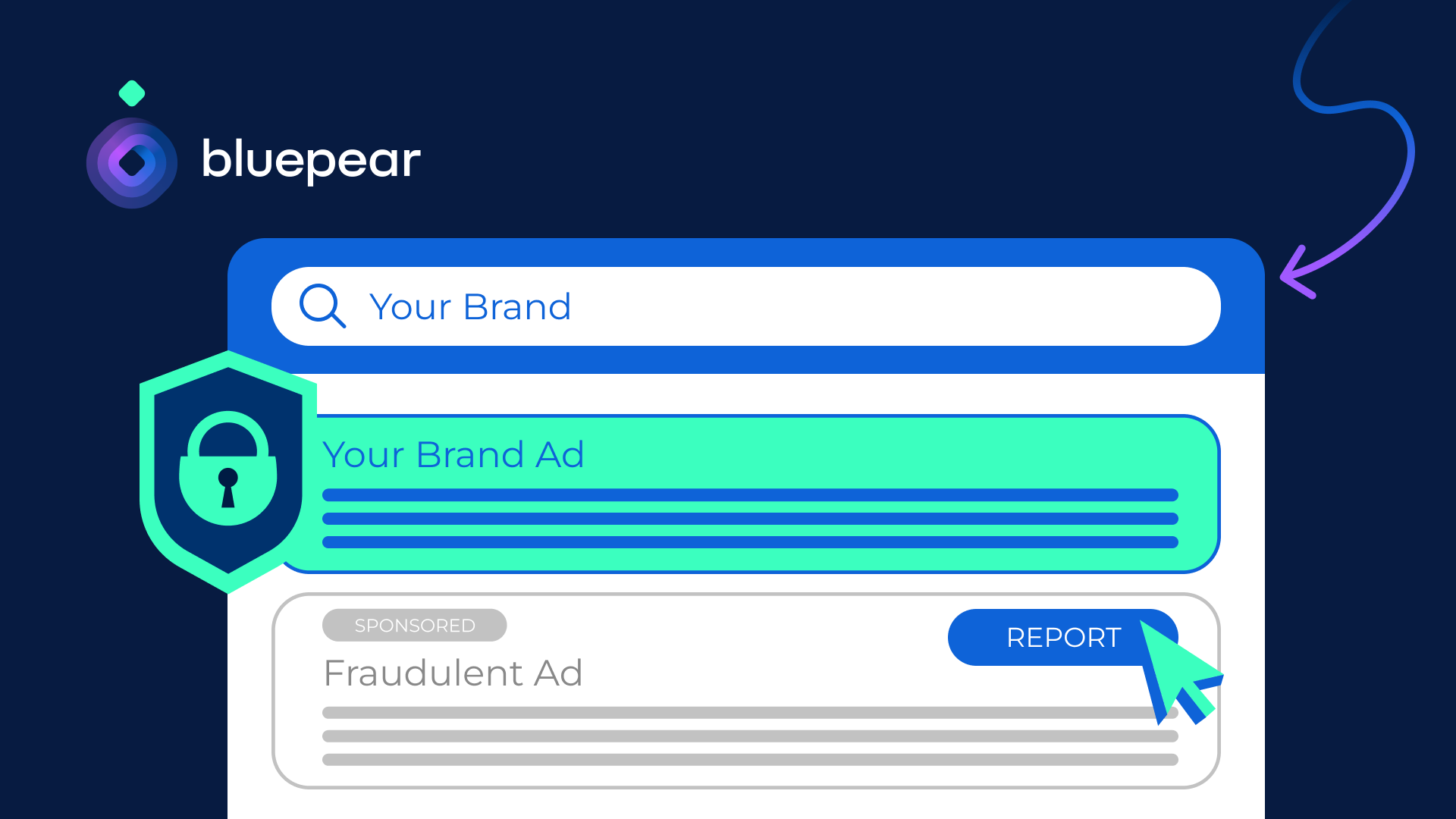
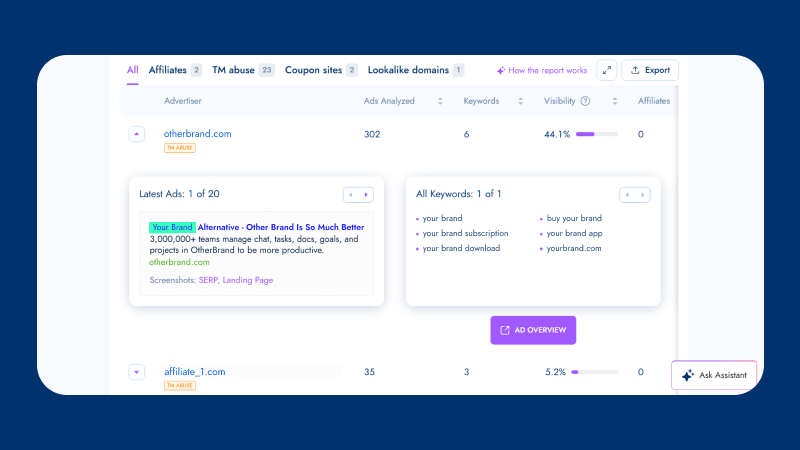
With Bluepear, I detect unauthorized bidding, affiliate violations, and suspicious competitor activities. Real-time alerts help me take swift action as issues appear.
Metrics are vital in measuring my brand protection strategy’s effectiveness. I track:
Violations count: The number of unauthorized activities detected on branded searches over time.
Enforcement rate: How efficiently I respond to and handle these violations.
Cost savings: The budget I recover by curbing CPC inflation and preventing commission leakage.
Branded CTR recovery: How removing violators improves my visibility and click-through rates.
Blueprint has helped companies like Car.co.uk and Rhino Affiliates successfully protect their brand from PPC threats. By adopting similar strategies, I ensure that my brand remains competitive and trustworthy in the digital landscape.
With Bluepear’s platform, I automatically protect my brand without dedicating significant time to manual monitoring. After signing up, I set up my account in just 10 minutes, gaining access to a powerful monitoring tool. This system has allowed me to quickly identify and act against brand bidding, affiliate violations, and hidden ads.
Ultimately, by using tools like Bluepear, I not only protect my brand but also enhance my marketing efficiency, leading to better ROI and more robust brand integrity.
In conclusion, a solid PPC brand protection strategy is no longer optional—it’s a necessity in today’s competitive landscape. By continuously monitoring, enforcing rules, and leveraging automation, I keep my brand safe and thriving.
Discover more about how you can protect your brand. Try Bluepear’s solution for brand protection and start detecting hidden brand bidding in minutes.
I’ve discovered that LinkedIn is rolling out some exciting ad tools aimed at making B2B brand advertising more predictable and personal. These new features are designed to enhance brand awareness using premium placements, personalized messaging, and scalable AI-powered creativity.
Recently, I learned about LinkedIn’s latest innovations for B2B marketers. These tools are all about helping us strengthen brand awareness and personalize our messaging. Their aim is clear: reach potential buyers early in the sales funnel.
What’s new in LinkedIn advertising:
Firstly, Reserved Ads provide prime visibility in the LinkedIn feed. This ensures a predictable number of impressions and grabs more attention than our competitors. This format works seamlessly with Video, Thought Leader, Single Image, and Document Ads, allowing us to maximize our creative impact.
Additionally, Ad personalization empowers us to tailor messages dynamically using member profile data like first name, job title, and company. Personalized ads matter: a McKinsey study shows that while 71% of consumers expect personalized ads, 76% feel frustrated in their absence.
This isn’t all. With AI-powered creative tools, I find it easier to test various ad versions. AI Ad Variants create fresh, on-brand content from a single input. Plus, the upcoming Flexible Ad Creation, expected in early 2026, will let us upload multiple assets, which LinkedIn will mix and optimize for top performance.
Why these updates matter to me. With these tools, building a brand on LinkedIn becomes more effective. The boost in visibility and enhanced personalization capabilities simplify our creative production process immensely. Reserved Ads, for example, guarantee prime placement at the top of users’ feeds, capturing attention even when the audience isn’t actively searching.
Meanwhile, by tailoring messages dynamically (like by name, company, or job title), Ad Personalization makes advertisements more relevant. Plus, AI tools such as AI Ad Variants and the soon-to-come Flexible Ad Creation streamline our creative workflows. This allows us to test more variants quickly, enhance engagement, and reach audiences effectively at the top of the funnel.
The big picture in advertising. As buyers take non-linear, self-directed paths, establishing an early-stage brand presence is crucial. These tools help deliver scalable, personalized creativity efficiently, boosting awareness, engagement, and conversion across campaigns.
What’s next for me as a marketer. I plan to experiment with Reserved Ads, delve into ad personalization, and leverage AI-driven creative tools. This approach should enhance my impact at the funnel’s top, refine our messaging, and optimize our performance—all with minimal manual effort.
The bottom line on LinkedIn’s ad innovations. These advancements are designed to make brand building more predictable, relevant, and scalable. They enable marketers to reach the right audience with the right message at the right time.
I’ve just come across some exciting news from Shopify. They’ve launched something called the Product Network, which essentially allows advertisers to connect with potential shoppers across various merchant sites using contextually relevant products. It’s a game-changer!
What’s amazing is that this system can suggest products from other merchants, even when I’m shopping at a store that doesn’t have what I’m looking for. For instance, if I search for “organic cleaning supplies” and the store doesn’t carry them, the Product Network might still offer me alternatives from different merchants. This means I can add everything to a single cart, without even realizing some items come from other merchants.
Here’s how Shopify is positioning themselves: It reminds me of ad platforms like Google Performance Max or Meta Advantage+ Shopping, where advertisers set a cost-per-acquisition goal, and the platform handles the rest. But Shopify is focusing more on the merchandising aspect rather than traditional advertising, which I find quite refreshing.
Amanda Engelman, who’s their advertising product director, summed it up nicely by saying, “It’s just a different approach to the world.”
Historically, Shopify has shied away from profiting heavily off advertising. Their Audiences program is a good example; it creates customer segments for various channels like Google and Meta, but doesn’t take a share of the ad spend.
For merchants, there’s an added incentive to join the network. They earn commissions on the sale of products from other merchants, either in cash or Shopify ad credits. It’s like getting extra ad budget support without the usual upfront investment.
In the early stages, placements in the Product Network are determined by context rather than being driven by revenue targets, though there’s potential for optimization in favor of higher commission items.
The reason this is relevant is that Shopify’s Product Network now allows brands to extend their reach with ease. Shoppers are introduced to relevant products seamlessly, as these can be featured on search results or even on different stores’ homepages.
Unlike typical ads, the focus here is on driving conversions through relevant, context-driven placements rather than simply filling ad space. This could mean better traffic quality and merchants benefiting from third-party sales commissions, thereby expanding the network’s reach and impact.
Looking ahead, Shopify is planning to further enhance the personalization and monetization of this network, all while keeping users within their ecosystem. The whole aim is to support merchants in selling more, even if the products aren’t their own.