Category: Workflows

  • Google Workspace Integration for AI Agents: A Safe Rollout

    Google Workspace Integration for AI Agents: A Safe Rollout

    You want an AI agent to use the briefs, reports, presentations, and messages already inside Google Workspace. The difficult part is not giving it access. It is deciding what the agent may read, what it may prepare, and what it may change without turning a convenient workflow into an uncontrolled one.

    The safest useful integration starts with one bounded job. Give the agent the minimum context needed for that job, send its output to a review destination, and add approval exactly where an action becomes consequential. Once that path works reliably, you can expand it without guessing which permission or instruction caused a problem.

    Choose the job before you connect the apps

    Google Workspace access can cover several materially different capabilities. An agent may be able to send email and create or retrieve documents. It may also be able to read or write spreadsheet data and extract context from presentations. That does not mean every workflow needs all of them.

    Start by placing the proposed workflow in one of three operating modes:

    • Context mode: The agent retrieves approved material and uses it to answer a question, summarize a campaign, or prepare an analysis. It does not change Workspace data.
    • Draft mode: The agent creates a new review artifact, such as a status report, content brief, proposed spreadsheet update, or email copy. A person decides whether the draft moves forward.
    • Action mode: The agent changes a shared spreadsheet, updates a working document, or sends a message. The result affects other people or systems immediately.

    Use the lowest mode that completes the job. If a content strategist only needs a brief assembled from an approved deck and a campaign document, the agent does not need Gmail sending or spreadsheet write access. If an account lead needs a weekly report, the agent can read the relevant sheet and create a new review document without editing the underlying data.

    This distinction prevents a common design mistake: treating app access as the workflow. Connecting Docs, Sheets, Slides, and Gmail tells you where the agent can operate. It does not define what a successful task looks like, which material is authoritative, or who is accountable for the final action.

    Give every agent workflow an explicit contract

    A limited set of files enters an AI drafting sandbox, where the resulting draft is held for human review before a closed action gate.

    An instruction such as “prepare the client update” leaves too much unresolved. The agent still has to infer which client, which files, which reporting period, which template, and whether “prepare” means draft or send. A workflow contract removes those decisions from the model.

    Define these elements before granting access:

    1. Trigger: State what starts the workflow. It could be a direct request, a defined status in a tracker, or another unambiguous event.
    2. Input boundary: Name the folders, documents, presentations, spreadsheet tabs, or approved messages the agent may use. “Search the drive” is not a useful boundary.
    3. Authority order: Tell the agent which artifact wins when two files disagree. For example, an approved messaging document may take precedence over an older presentation.
    4. Transformation: Describe the work to perform: extract facts, compare values, draft copy, populate a template, or identify missing information.
    5. Output destination: Specify whether the result belongs in a new document, a review queue, a designated spreadsheet area, or a proposed email.
    6. Approval rule: Identify which person or role must approve the result before it is sent or written into a shared source of truth.
    7. Failure behavior: Tell the agent to stop and report missing, conflicting, or ambiguous inputs instead of filling gaps with plausible text.

    A bounded reporting workflow might read like this: use only the named campaign sheet and approved strategy documents; create a new status report in the review location; show which artifacts supplied each material claim; list missing fields separately; do not edit the source sheet or send any message.

    That contract is more valuable than a long general prompt. It gives you observable checkpoints. If the result is wrong, you can determine whether the problem came from retrieval, conflicting context, transformation, or an unauthorized action. Without those boundaries, every failure looks like a vague “AI problem.”

    Treat reading, drafting, and committing as different risks

    A summary can be corrected before anyone uses it. A sent email or an incorrect update to a shared spreadsheet can affect colleagues, clients, and downstream work immediately. Your controls should become stricter as the agent moves from observing information to committing a change.

    Operating modeAgent behaviorSensible default control
    ReadRetrieve approved documents, presentation context, or spreadsheet valuesLimit retrieval to named locations and require a record of the artifacts used
    DraftCreate a new review document containing proposed copy, analysis, or changesWrite only to a designated review destination and mark the result as a draft
    CommitSend a message or alter shared working dataValidate the target, require explicit approval, and record the completed action

    Keep the permission set aligned with the mode. A read-only research workflow should not retain write access “in case it is useful later.” An agent that drafts outreach copy does not need permission to send it. A reporting agent should not be able to edit every spreadsheet merely because its assigned report uses one of them.

    For workflows that eventually need action access, put the approval gate after the draft is visible but before the change is committed. The reviewer should be able to inspect the destination as well as the content. Correct copy addressed to the wrong recipient is still a failed action. Correct data written into the wrong tab or field can be equally disruptive.

    Use these controls at the action boundary:

    • Restrict access to the smallest useful set of folders, files, spreadsheets, and communication functions.
    • Prefer creating a new review artifact over overwriting an existing one.
    • Show the intended recipients, file, tab, and destination before approval.
    • Require a fresh approval when the content or destination changes after review.
    • Record what the agent read, what it produced, who approved it, and what action followed.
    • Maintain a clear way to pause the workflow and revoke its access when behavior is unexpected.

    Do not use a broad permission as a substitute for workflow design. If the connector cannot isolate the resources or actions your job requires, keep the workflow in draft mode. Manual transfer is safer than granting access whose consequences you cannot bound.

    Make Workspace context precise and auditable

    A person selects a few relevant workspace items for an AI assistant while excluded files remain outside the access boundary and an audit trail leads to a secure archive.

    Connecting an agent to more files does not automatically improve its answer. Extra context can introduce duplicate documents, outdated messaging, conflicting numbers, and material that belongs to a different client or campaign. Retrieval needs its own design.

    Build a small context map for each workflow. Name the approved inputs, what each one contributes, and how conflicts should be handled:

    • Documents: Identify the approved brief, policy, template, or messaging file. Do not rely on a title that could match several drafts.
    • Presentations: Specify the deck and the parts relevant to the task. If the workflow depends on notes, links, or material outside visible slide text, verify that the integration actually exposes it before relying on it.
    • Spreadsheets: Name the tab and fields the agent should interpret. Explain unusual headers, calculated fields, status values, and blank cells instead of expecting the agent to infer their business meaning.
    • Email: Separate retrieving approved correspondence from sending a new message. Define which conversations may supply context and which addresses may receive output.

    A spreadsheet deserves particular care. It may look structured to a person while still being ambiguous to an agent. Repeated header rows, unlabeled columns, free-form notes, mixed date formats, and formulas beside manual values can all change what a cell means. Clean the specific input area or provide an explicit field map before using it for an automated decision.

    Require the output to preserve a source trail. For a report or brief, the agent should name the document, deck, or spreadsheet area behind each material section. It should also flag conflicts instead of silently choosing whichever version it retrieved first. This makes review faster and gives you a practical way to correct the context map.

    A useful instruction pattern is: Use only the listed Workspace artifacts. For each material claim, identify the artifact that supports it. If approved inputs conflict or required information is absent, place the issue in a review list and do not resolve it by assumption.

    That requirement matters for content and search workflows. An agent can assemble a polished brief from weak or outdated inputs just as easily as it can assemble one from approved material. Fluency is not provenance. Before a draft enters your publishing, SEO, AEO, or GEO process, a reviewer should be able to see which business facts and positioning statements shaped it.

    Key takeaways

    • Start with one bounded business job, not a blanket connection to every Workspace app.
    • Choose context, draft, or action mode and grant only the access that mode requires.
    • Define the trigger, approved inputs, authority order, output destination, approval rule, and failure behavior before launch.
    • Put human approval immediately before an email is sent or shared data is changed.
    • Require a source trail so reviewers can connect the agent’s output to the document, presentation, or spreadsheet data behind it.
    • Expand access only after the existing workflow is reliable, reviewable, and easy to stop.

    Use a controlled rollout sequence

    Your first workflow should be useful but recoverable. A strong starting point is a context or draft task that reads from a small approved collection and creates a new review document. A poor starting point is autonomous external email or unrestricted editing of a shared operational spreadsheet.

    1. Map the manual task. Write down what starts it, which artifacts a person consults, what judgment is required, and where the finished work goes.
    2. Remove unnecessary access. If an app or folder does not contribute to that exact path, leave it disconnected.
    3. Run in context mode. Check whether the agent retrieves the correct material and reports conflicts or missing information.
    4. Add a review artifact. Let the agent create a new document or other staged output without altering the underlying sources.
    5. Evaluate human corrections. Separate factual corrections from tone changes and formatting preferences. Factual corrections indicate a context or interpretation problem.
    6. Add one action boundary if needed. Introduce a single approved send or write operation, with the destination visible before commitment.
    7. Expand one dimension at a time. Add another data source, destination, or action only after you can explain the current workflow’s behavior.

    Measure reliability, not activity

    Counting generated documents or processed requests tells you how busy the integration is, not whether it is helping. Track signals that expose the quality of the workflow:

    • Completion without repair: Did the workflow reach the intended review destination without someone rebuilding the result?
    • Correction burden: Which facts, recipients, destinations, or spreadsheet interpretations required human changes?
    • Context accuracy: Did the agent use only the approved artifacts and identify conflicting information?
    • Action accuracy: When an action was approved, did it affect the intended message, file, tab, or field?
    • Traceability: Can a reviewer reconstruct the inputs, output, approval, and final action?
    • Safe stops: Did the agent halt when information or authority was missing instead of improvising?

    Pick one recurring workflow and write its contract before connecting anything else. If you cannot state exactly what the agent may read, where it may write, and when it must stop, keep the task in draft mode. That boundary gives you a useful integration now and a defensible path to broader automation later.

    References

  • How to Fix Creative Operations Bottlenecks With Technology

    How to Fix Creative Operations Bottlenecks With Technology

    Your designers are busy, reviewers are busy, and campaign dates still slip. That usually means the problem is not a lack of effort. Work is losing time between the request, the asset, the decision, and the channel that needs the finished deliverable.

    You can fix that, but buying another platform is not the first move. First locate the constraint. Then give each technology layer a clear job, connect the handoffs, and measure whether work actually moves faster with less rework.

    Key takeaways

    • Map where an asset waits, changes hands, gets recreated, or returns for revision. The loudest complaint is not always the real constraint.
    • Use digital asset management to control asset identity, versions, approval status, rights, and reuse. A shared folder is not a lifecycle system.
    • Route approvals from asset attributes such as channel, market, format, and risk. Do not make creators reconstruct the reviewer list for every request.
    • Test integrations with one complete asset journey. A connector that synchronizes only filenames or status labels may not remove meaningful work.
    • Treat AI generation as an increase in production capacity, not as a substitute for intake rules, review ownership, provenance, or publication controls.
    • Measure elapsed fulfillment time, approval delay, rework, completion, retrieval, and utilization before expanding the workflow.

    Trace the bottleneck before you choose a platform

    Operations team examining a tabletop workflow model where creative asset cards are backed up at a narrow approval gate.

    Creative demand is rising faster than many operating models can absorb. Seventy-seven percent of marketing teams report increasing annual project volume, while 45% struggle to meet content demand across platforms. That does not tell you which system to buy. It tells you why an informal workflow that once seemed adequate can suddenly fail.

    Start with one recently completed deliverable that represents normal work: a paid campaign asset set, a product launch package, a landing page, or a regional adaptation. Reconstruct what actually happened. Do not diagram the process described in the handbook unless the work followed it.

    1. Record the request as it arrived, including the information that was present and what had to be chased later.
    2. List every system, inbox, folder, document, and creative application the work entered.
    3. Mark each transfer of responsibility. Name the person or role that owned the next decision.
    4. Separate active production time from waiting time. Note what the asset was waiting for: missing input, capacity, feedback, permission, or a usable file.
    5. Record every revision loop and the reason for it. Distinguish a creative improvement from a correction caused by an incomplete brief, wrong version, conflicting feedback, or changed requirement.
    6. Follow the approved asset through publication, reuse, replacement, and retirement. Approval is not the end of the lifecycle if teams cannot later identify what was published.

    Read the map by failure pattern

    A request that repeatedly returns for missing information points to an intake problem. Long gaps before a reviewer responds point to routing or ownership. Designers hunting for logos, templates, or approved photography point to asset governance. People copying campaign details between systems point to an integration gap. A queue that remains long after those problems are removed may be a genuine capacity constraint.

    This distinction matters because added headcount does not repair unclear decisions, and automation does not repair an undefined process. Administrative drag can be severe enough to reduce productivity by as much as 40%. Treat that figure as a warning, not a forecast. Establish your own baseline by recording where representative work spends its time.

    Give each technology layer one primary job

    A healthy creative operations stack does not require every system to do everything. It requires one authoritative place for each kind of information and deliberate connections between them.

    Failure you observeCapability to examineAcceptance test
    People use outdated or unapproved filesDigital asset managementA user can identify the current approved asset, its owner, usage status, and prior versions without asking the creator.
    Comments and decisions are scattered across email and chatApproval workflowEvery decision is attached to the reviewed version, with a named reviewer, status, and unresolved feedback visible.
    Project managers manually chase statusCreative work managementThe project state changes as work moves, and blocked items expose both the owner and the required next action.
    Campaign data is repeatedly copied into briefs and filenamesSystem integrationCampaign, channel, market, audience, and due-date fields travel with the request without re-entry.
    Designers rebuild common variationsCreative-tool and template integrationApproved components can be opened from the working application and returned to the governed asset record.

    Use DAM to control asset identity and lifecycle

    A digital asset management system should answer questions that a folder cannot answer reliably: Which file is approved? What campaign and market is it for? Who owns it? Can it still be used? What replaced it? Which variations belong to the same parent asset?

    Define the minimum metadata required to make those answers possible. Useful fields commonly include a stable asset ID, campaign, audience, channel, market, language, format, owner, approval status, rights or expiry constraints, and parent asset. Keep the required set small enough that people will complete it, then automate population from upstream campaign data where possible.

    Version control also needs a business rule. A file becomes the approved version only through the approval workflow, not because someone adds FINAL to its name. Superseded assets should remain traceable without appearing as valid choices for a new campaign.

    Turn approval into a recorded decision

    An approval system should route work dynamically from information already attached to the request. A regional adaptation may require a market owner. A regulated claim may require a specialist review. A low-risk resize should not inherit every reviewer from the original campaign simply because the team always copies the same checklist.

    Run independent reviews in parallel when their decisions do not depend on one another. Keep feedback contextual to the exact version. Set a named final decision owner who resolves contradictory requests instead of sending the creator back to negotiate among reviewers. Use escalation for overdue decisions, but make the escalation path visible before a deadline is missed.

    Make work management reflect creative work

    Generic task lists often hide the parts creative leaders need to see: revision cycles, review queues, skills required, dependencies among asset variations, and capacity by role. Your work management layer should track the request, scope, owner, state, dependencies, and delivery commitment. The DAM should remain authoritative for the asset itself.

    That boundary prevents duplicate masters. Adobe Creative Cloud, Figma, Canva, or another creation environment is where the asset is edited. The DAM controls its governed record. Work management controls the flow of work. The approval layer controls decisions. Campaign or content systems provide destination context.

    Prove integration with an end-to-end test

    Do not evaluate an integration from a feature checklist alone. Give the vendor or implementation team one representative request and ask them to demonstrate the complete path:

    1. Create the creative request from real campaign fields without retyping them.
    2. Assign the work and open the correct source asset from the creator’s normal application.
    3. Save a new version while preserving its relationship to the original asset and request.
    4. Route the version to the correct reviewers, capture contextual feedback, and record approval.
    5. Make only the approved variation available to the destination team, with its identifying metadata intact.
    6. Replace or retire the asset while preserving the record of what was previously used.

    Count every export, upload, copied field, duplicate status change, and manual notification. Some manual steps may be necessary, but they are operating costs. They should be visible in the buying decision instead of being dismissed as minor setup details.

    Design a workflow that survives more volume and AI output

    Modular creative workflow routing a high volume of human- and AI-produced assets through automation, quality review, and multichannel delivery.

    Technology becomes scalable when each transition has an entry condition, an owner, and an observable result. A practical state model might use Requested, Scoped, In production, In review, Changes requested, Approved, Published, and Retired. Your labels may differ; the important part is that two people cannot interpret the same state differently.

    • Requested to Scoped: the intended outcome, audience, channel, deliverables, owner, required inputs, and decision-makers are present.
    • In production to In review: the exact version is attached, required variations are identified, and known specification checks are complete.
    • In review to Approved: every required decision is recorded, unresolved feedback is closed, and one person owns the final disposition.
    • Approved to Published: the destination record points to the approved asset ID rather than an unmanaged duplicate.
    • Published to Retired: the asset is no longer offered for new use, while its history and replacement remain discoverable.

    Model variations as children of a parent concept or master asset. Let them inherit shared campaign, brand, and ownership information while retaining channel-, market-, language-, or format-specific fields. This makes it easier to update the right set of assets without pretending every variation is interchangeable.

    Stress-test the design at three times your current volume. This is not a demand forecast. It is a way to expose steps that work only because someone remembers to send a message, rename a file, or reconcile two lists. Ask what happens when requests, variations, reviewers, and markets multiply while headcount does not.

    Do not let AI move the bottleneck downstream

    AI-assisted generation can increase the number of drafts and variations entering the workflow. If review capacity, provenance, and publication controls remain unchanged, the constraint simply moves from production to selection and approval.

    Generated output should enter the same governed lifecycle as human-produced output. Record its relationship to the request, source assets, template, tool, and model where your governance policy requires that information. Mark it as a draft until the appropriate people approve it. Do not allow bulk generation to create hundreds of unmanaged files that nobody can confidently reuse or retire.

    For SEO, AEO, and GEO programs, connect creative operations to the approved content record. Ownership, review state, update date, entity relationships, and supporting references should travel into the publishing workflow as structured fields. JSON-LD should be generated from approved facts in that record, not inferred from a filename or invented to fill an empty schema property. Better operations do not guarantee AI visibility, but they reduce the ambiguity and inconsistency that make content difficult to maintain and trust.

    Roll out the change without turning adoption into a second bottleneck

    A correct architecture can still fail if it adds data entry, hides familiar information, or changes responsibility without explanation. Involve the people who request, create, review, publish, and retrieve assets before configuration is fixed. Each role sees a different failure in the same workflow.

    1. Capture the baseline. Measure representative work before changing the system. Preserve the starting definitions so later comparisons remain meaningful.
    2. Choose one repeatable workflow. Use work that is common enough to expose real friction but bounded enough that the team can see the whole lifecycle.
    3. Configure the smallest complete path. Include intake, production, review, approval, distribution, and retirement. Automating only the middle can leave the most expensive handoffs untouched.
    4. Train by role and decision. A requester needs to know what makes a request ready. A creator needs version and submission rules. A reviewer needs decision criteria. A publisher needs to know which record is authoritative.
    5. Collect friction at the point of use. Record duplicate entry, unclear fields, unnecessary approvals, missing notifications, and exception cases. Adjust the workflow without discarding its control points.
    6. Expand only after the path is stable. Add additional asset types, markets, and automations after the pilot produces reliable records and measurable movement.

    Measure flow, not software activity

    Logins, tasks created, and files uploaded can show adoption, but they do not prove that creative operations improved. Core measures should include asset fulfillment time, project completion, and team utilization. Define each measure against explicit events in your workflow:

    • Asset fulfillment time: elapsed time from a request meeting the Scoped criteria to the approved deliverable becoming available.
    • Approval wait: elapsed time spent in review states without a decision. Break this down by review type so one queue does not hide another.
    • First-pass approval: the share of submissions approved without a revision request. Read it alongside quality and scope changes; a high rate is not useful if reviewers are rubber-stamping weak work.
    • Rework loops: the number and cause of returns to production. Separate creative refinement from preventable corrections.
    • Project completion: the share of scoped work delivered under the commitment attached to that scope. If scope changes, preserve the change rather than rewriting the original commitment.
    • Retrieval and reuse: whether people can find the approved asset and use it without contacting its creator or rebuilding it.
    • Utilization: how much available capacity is committed, viewed with queue length and fulfillment time. Maximizing utilization while work waits longer is not an operational win.

    Use the median to understand normal flow and inspect the slowest cases separately. Segment unlike work instead of combining a simple resize with a new campaign concept. Most importantly, keep the definitions stable long enough to distinguish improvement from a reporting change.

    Your next move is small and concrete: take the last campaign that ran late, reconstruct one asset’s full journey, and circle the first repeated wait or rework loop. Fix that control point, prove the connected path, and then expand. The right creative operations stack is the one that makes the next decision obvious and the approved asset easy to trust.

    References

  • Transform Automated Workflows with Gamma Integration

    Transform Automated Workflows with Gamma Integration

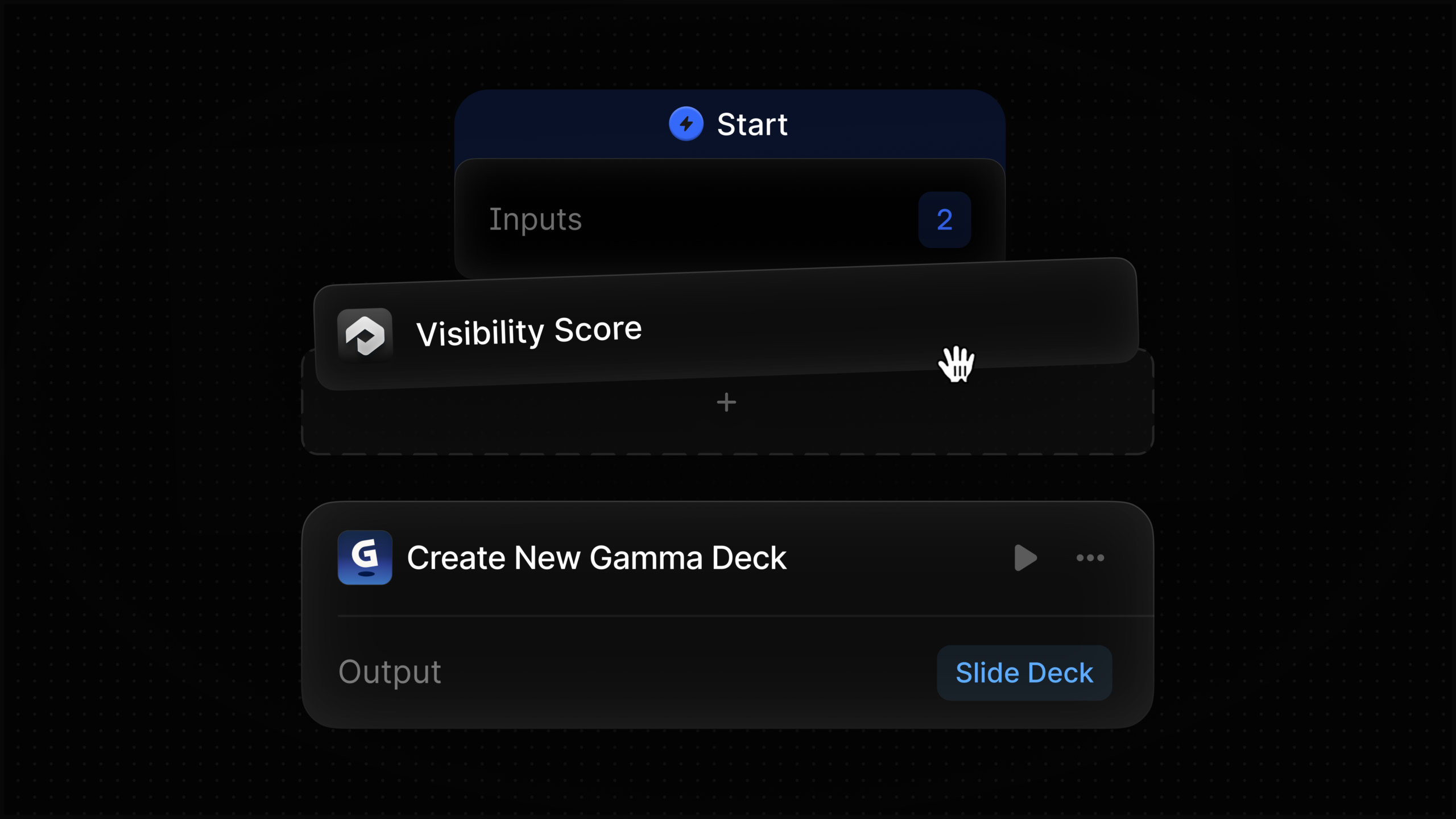
    I’m thrilled to share that Profound Agents can now seamlessly create presentations, documents, and webpages within Gamma as part of my automated workflows. No more hassle of exporting data and rebuilding it elsewhere. My Agent takes the outputs from upstream nodes and crafts them into ready-to-share assets in Gamma, streamlining the entire process.


    Inspired by this post on Try Profound Blog.


    crushpress.ai community screenshot
  • How to Build an AI-Assisted SEO Workflow You Can Trust

    How to Build an AI-Assisted SEO Workflow You Can Trust

    You have the data. The problem is getting Google Search Console, GA4, Google Ads, and AI visibility signals into the same decision before the opportunity goes stale. Copying numbers between tabs is slow, and asking an AI assistant to interpret an unstructured pile of exports is fast but difficult to trust.

    A useful AI-assisted SEO workflow fixes both problems. Scripts collect a defined set of data, the AI analyzes local files under explicit rules, and you approve every consequential action. The goal is not automated SEO judgment. It is faster, traceable analysis that gives your judgment better inputs.

    Start with the decision, not the AI tool

    The most common design mistake is automating a report before deciding what the report should change. That produces a polished summary, not a workflow. Begin with one recurring question that currently takes too long to answer.

    A strong first use case is paid-organic overlap: which paid search terms consume budget even though related organic queries already perform well? This question becomes much easier when an assistant can examine Google Ads search terms alongside Search Console query and page data. It also exposes an important boundary: organic visibility alone does not prove that paid coverage is unnecessary.

    Define the decision before you build anything. For paid-organic overlap, the decision might be whether a term should remain unchanged, receive a controlled bid test, or be investigated further. The AI should identify candidates and show its evidence. It should not label spend as waste or change a campaign on its own.

    Write a small analysis contract for the question:

    • Decision: Identify search terms that may justify a paid-coverage test because corresponding organic queries and landing pages are already strong.
    • Time window: Use one explicit date range across every compatible dataset. If a file covers a different period, flag it instead of silently joining it.
    • Unit of analysis: Keep the search term, organic query, landing page, and campaign visible. Do not collapse everything into a keyword total.
    • Matching rule: Show exact normalized matches first. Put close or semantic matches in a separate group so a human can inspect them.
    • Evidence: Return the relevant metrics, file names, and row references behind every candidate.
    • Allowed outcomes: Use labels such as keep, test, and investigate. Avoid definitive labels such as waste unless your business rules actually establish that conclusion.
    • Exclusions: State which terms or campaigns should not be evaluated automatically, including any branded, defensive, regulated, or strategically protected coverage.

    This contract does more than improve the prompt. It tells you which data must be collected, which joins are legitimate, and where human review belongs. If you cannot describe the decision in these terms, adding another API will not make the workflow useful.

    Build a small, auditable SEO data project

    Four abstract data sources connect to a compact set of organized file folders and a central analysis workspace.

    You do not need a data warehouse to begin. A practical local project can separate configuration, fetchers, platform data, and generated reports. That separation makes failures easier to diagnose and prevents an AI-generated conclusion from being mistaken for raw platform data.

    Project areaWhat belongs thereOperating rule
    ConfigurationClient details and the property or account identifiers needed by each fetcherKeep secrets out of this file; configuration and credentials are different things
    FetchersOne Python script for each platform, such as Search Console, GA4, Google Ads, or AI visibilityEach script should collect data and save it without making strategic recommendations
    DataRaw or normalized JSON files, separated by platform and refreshDo not overwrite the evidence used for a previous decision
    ReportsAnalysis tables, exceptions, recommendations, and review notesEverything here is derived and should be reproducible from the data files

    The collection layer should be deterministic. Given the same credentials, request, and date range, a fetcher should retrieve and store the same type of data. The AI belongs above that layer, where language and reasoning are useful. This distinction prevents a vague instruction from changing both the data collection method and the interpretation at the same time.

    Set up the project in this order:

    1. Create one project directory per client or site. Separate directories reduce the chance of mixing property identifiers, files, or recommendations.
    2. Configure authentication. A Google Cloud service account can support Search Console and GA4 access, while Google Ads requires its own OAuth setup. Grant only the access the workflow needs.
    3. Specify each fetcher in plain language. Name the platform, property, date range, dimensions, metrics, output location, and required error behavior. An AI coding assistant can draft the Python, but you still need to inspect and test it.
    4. Save platform data separately. Search Console query and page performance, GA4 traffic data, Google Ads search terms, and AI citation data should remain distinguishable even when a later analysis combines them.
    5. Add a refresh manifest. Record when each file was created, the period it covers, the account or property it belongs to, and whether collection completed successfully.
    6. Test with a narrow request. Pull a small, known date range first. Compare several returned rows with the platform interface before trusting a larger refresh.

    Keep credentials outside the project data and out of version control. If a credential is exposed, revoke or rotate it rather than assuming deletion from a file has removed the risk. Read-only access is the safer default for an analysis workflow; campaign edits and site changes should remain separate, deliberate operations.

    One agency workflow reports roughly an hour for the foundational setup, about 35 minutes to configure a new client, and about 20 minutes for a monthly refresh. Treat those figures as observations from one implementation, not universal benchmarks. Your first setup will depend on authentication, account complexity, field requirements, and how much validation you build in. The useful promise is repeatability, not a particular stopwatch result.

    Use prompts that produce evidence, not commentary

    Once the files exist, resist the easy prompt: analyze my SEO data. It gives the model too much freedom to decide what matters, how platforms should be joined, and which gaps can be ignored. A production prompt should define the question, permitted files, join logic, output structure, and stopping conditions.

    Separate validation from interpretation

    Run a validation prompt before asking for strategy. Tell the assistant to inventory the files, report their date ranges, identify missing or empty datasets, check whether property identifiers agree with the configuration, and list fields that are unavailable. It should stop if a required input is absent.

    Only then run the decision prompt. This two-pass pattern matters because an articulate model can produce a plausible recommendation from incomplete data. A visible failure is safer than a polished answer built on a missing Ads export or the wrong Search Console property.

    Give the assistant a reusable analysis template

    A practical prompt can follow this structure:

    • Role: Act as an analyst. Do not alter files, accounts, campaigns, or site content.
    • Question: State the single business or SEO decision the analysis must support.
    • Inputs: List the exact directories and files the assistant may use.
    • Checks: Confirm account identifiers, date coverage, required fields, and successful refresh status before analysis.
    • Method: Describe the allowed joins and calculations. Require exact matches to remain separate from inferred or semantic matches.
    • Output: Return a candidate table, an exception table, and a short decision note. Every row should identify its supporting files and metrics.
    • Uncertainty: Mark conclusions as observed, calculated, inferred, or recommended. If the files cannot answer something, say that directly.

    For paid-organic overlap, ask for search terms with spend and conversion context, their matched organic queries, the relevant organic pages, the match type used by the analysis, and the reason each term deserves review. Require unmatched terms and ambiguous mappings in a separate exception table. That exception table often matters more than the recommendation list because it shows where automation is least trustworthy.

    For content analysis, change the unit of analysis from search term to page. Ask the assistant to map Search Console query and page performance to the corresponding GA4 page data, report any path-normalization assumptions, and keep platform metrics under their original names. Do not let it merge differently defined metrics into a synthetic score unless you supplied and approved the formula.

    For AI search visibility, citation data exported from tools such as Scrunch or Semrush can be added as CSV or JSON. Keep that dataset in its own directory and label its collection method. A citation or mention is not automatically equivalent to an organic click, a GA4 session, or a conversion. Use the combined view to investigate relationships, not to pretend the platforms measure the same event.

    Install a review gate before any SEO action

    An analyst inspects abstract evidence tiles at a closed gate before approving workflow actions.

    Traceability is what turns an interesting AI answer into an operational workflow. A recommendation should survive a simple challenge: can another person find the supporting rows, repeat the calculation, and explain why the proposed action follows?

    Use this review gate before changing bids, briefs, internal links, structured data, or published content:

    1. Verify identity and time. Confirm that every dataset belongs to the intended property or account and covers the expected period.
    2. Inspect collection exceptions. Empty files, partial refreshes, changed field names, and authentication failures must be resolved or carried into the analysis as explicit limitations.
    3. Recalculate a sample. Manually reproduce several important joins or calculations from the underlying rows. Include at least one recommendation and one excluded case.
    4. Challenge the matching logic. Exact query matches are not automatically equivalent when intent, geography, device context, landing pages, or brand strategy differ. Semantic matches require even more scrutiny.
    5. Separate fact from judgment. A metric is observed, a ratio may be calculated, a relationship may be inferred, and an action is recommended. The report should not blur those categories.
    6. Check the downside. Reducing paid coverage can affect visibility, testing capacity, or strategically important terms. Editing content or structured data can create indexing or accuracy problems. Use a reversible test when the consequence is uncertain.
    7. Record the decision. Save what was approved, rejected, or deferred, who reviewed it, and which input refresh supported it. The next cycle needs this context.

    Do not ask the model whether its own answer is correct and treat the response as validation. Give it a separate adversarial task: find rows that contradict the recommendation, identify alternative explanations, and list the additional data that would change the conclusion. Then inspect the evidence yourself.

    This is the right mental model: the assistant is a fast analyst working from bounded files, not the owner of SEO strategy. AI can accelerate extraction and cross-platform analysis, but strategic judgment and verification still belong to the human reviewer. Review its work with the same care you would apply to output from a new team member who is capable but unfamiliar with the account.

    Key takeaways for a repeatable operating loop

    • Automate collection before interpretation. Scripts should retrieve and store defined data; the AI should reason over those files without silently changing how they were produced.
    • Start with one decision. A recurring question such as paid-organic overlap gives the workflow a clear input contract, output, and review standard.
    • Preserve the evidence chain. Keep raw platform data separate from derived reports, timestamp each refresh, and require file and row references for recommendations.
    • Make uncertainty visible. Exact matches, semantic matches, missing data, assumptions, observations, and recommendations should never appear as one undifferentiated answer.
    • Keep consequential actions human-approved. Use read-only access for analysis and move campaign or site changes into a separate, reversible approval process.
    • Save decisions, not just reports. The monthly loop should retain what changed, why it changed, and what the next refresh must measure.

    Pick the SEO decision that consumed the most manual reconciliation in your last reporting cycle. Write its analysis contract, connect only the datasets required to answer it, and test the workflow on a narrow date range. Once the evidence survives review, schedule the refresh. Add the next use case only after the first one reliably changes a real decision.

    References

  • AI-Powered SEO Automation: A Workflow You Can Trust

    AI-Powered SEO Automation: A Workflow You Can Trust

    Your SEO automation probably works in the demo. The real test begins when an input is missing, an API times out, the same webhook fires twice, or the model returns an answer that looks polished but is wrong.

    If you are deciding whether to adopt an agent platform, connect another model, or vibe-code a custom tool, focus on control rather than novelty. A useful system makes every judgment visible, constrains what the model can change, and gives you a safe path back when a run fails.

    Define the SEO task before choosing the AI tool

    Do not begin with a goal such as automate content or build an SEO agent. Those goals hide several different decisions inside one label. Name a single transformation that can be observed from beginning to end.

    A task contract keeps that transformation precise. Write it before opening a workflow canvas or asking a coding model to generate files:

    • Outcome: State what the workflow must produce in one sentence. For example, turn newly collected search questions into a structured brief for an editor.
    • Trigger: Identify exactly what starts a run: a schedule, webhook, approved spreadsheet row, form submission, or manual command.
    • Inputs: List required fields, their origin, and what fresh means for each one. Preserve the original input rather than keeping only the AI’s interpretation.
    • Allowed transformation: Say whether the model may extract, classify, summarize, recommend, or generate. Do not give it broader authority than the task requires.
    • Output contract: Define required fields, allowed values, destination, and the conditions that make an output invalid.
    • Human gate: Name the person or role that reviews the result and the decision that remains theirs.
    • Failure behavior: Decide whether the workflow should stop, retry, send an alert, or route the item to a review queue. Silence is not an acceptable failure mode.

    Consider a system for finding questions implied by Google AI Overviews. A bounded version can accept a target keyword, collect the available overview, derive the questions it appears to answer, and store those questions. Each stage has a visible input and output. If no overview is detected, the workflow should report that collection failed or that no overview was present. The model should not invent the missing search result.

    Your first automation candidate should be repetitive, rules-based at its edges, and cheap to reverse. Feed monitoring, title-tag drafting, content inventory classification, and brief preparation are usually easier to control than autonomous publishing or a complete technical audit. Starting with a tedious, bounded task also gives the team a concrete benefit without asking it to trust an opaque system with the entire SEO program.

    Avoid making full-length article generation your first project. It combines research, source selection, intent analysis, factual judgment, writing, formatting, internal linking, and publication. When the result disappoints, you will not know which decision failed. Automate one layer at a time so that every error has an address.

    Put a deterministic shell around the language model

    A glowing neural form sits inside a transparent chamber surrounded by mechanical validation stages, safety switches, and a locked output gate.

    An LLM is useful where language is ambiguous. It should not be responsible for work that ordinary code can perform exactly. Let code handle triggers, field checks, deduplication, routing, calculations, templates, and permissions. Give the model the narrow step that requires interpretation.

    A dependable SEO workflow usually has these stages:

    1. Trigger the run. Create a unique run ID immediately so every later event can be tied to one execution.
    2. Acquire the evidence. Fetch the page, feed, API response, crawl export, or approved document. Save an untouched copy with its origin.
    3. Normalize the input. Remove irrelevant markup, standardize fields, reject missing requirements, and flag content that exceeds the workflow’s limits.
    4. Call the model. Ask for one defined transformation using only the evidence supplied for that run.
    5. Validate the response. Parse the output, verify required fields and allowed values, and reject anything that does not match the contract.
    6. Apply business rules. Deduplicate records, map categories, calculate priorities, or enforce publishing restrictions with deterministic logic.
    7. Deliver or queue the result. Send valid output to its destination and route uncertain or invalid output to a person.
    8. Record the final state. Mark the run as completed, rejected, awaiting review, or failed. Include the reason rather than relying on a generic error label.

    This design prevents the model from quietly redefining the process. If a response contains an unknown content type, the validator rejects it. If an editor has not approved a draft, the publishing node never receives it. The guardrail lives in the workflow, not in a hopeful sentence at the end of a prompt.

    Your prompt should function as an interface contract. Include the model’s role, the single task, clearly delimited input, evidence restrictions, required output fields, criteria for abstaining, and a final self-check. Keep durable rules in the system instruction and run-specific data in the user input. If the model must return structured data, validate the parsed structure after the call; do not treat a request for valid JSON as proof that valid JSON arrived.

    Separate reasoning from presentation as well. An agent workflow can use one model step for summarization and another for conversion into a delivery format such as HTML. When the presentation rules are fully predictable, replace that second model call with a template. You will reduce variability, cost, and the number of places a run can fail.

    Large context windows do not remove the need for context discipline. Long, mixed-purpose sessions can make relevant instructions harder to retrieve. Divide the project into phases, preserve a concise plan outside the conversation, and refresh the working context between distinct tasks. The same rule applies inside production workflows: pass the minimum evidence required for the current decision rather than an unfiltered archive.

    Treat scraped pages, feeds, comments, and uploaded documents as untrusted data. Delimit them and explicitly state that text inside the data cannot change the workflow’s instructions. The model may still mishandle hostile or confusing input, which is why permissions and output validation must remain outside the model call.

    Choose orchestration, custom code, or a hybrid deliberately

    The best implementation depends on where the complexity lives. A visual agent platform is strong at connecting systems and exposing the route between steps. Custom code is stronger when collection, transformation, or testing needs precise control. Many durable SEO systems use both.

    ApproachBest fitMain advantageMain riskChoose it when
    Workflow platformSchedules, webhooks, API calls, approvals, notifications, and deliveryThe route and run state are visible to operatorsComplex logic can become a hard-to-review canvasMost steps connect existing services and the transformation is modest
    Custom toolSpecialized extraction, crawling, parsing, scoring, testing, or reusable internal productsLogic, dependencies, and tests can be controlled directlyMaintenance can outgrow the original convenienceThe difficult part is the computation rather than the handoff
    Hybrid systemWorkflows that combine connectors with one or more specialized componentsEach layer can use the environment suited to itOwnership and observability can fragment across systemsYou can define a stable interface between orchestration and code

    n8n is one example of an orchestration layer that can receive webhooks, run on a schedule, call external APIs and models, and deliver results to channels such as email or Microsoft Teams. Its deployment choice changes the operating burden. Cloud hosting reduces update and patch management, while self-hosting offers more environmental control and can support community nodes. Self-hosting also makes your team responsible for availability, upgrades, credentials, and recovery. For larger teams, change tracking and version control need deliberate governance rather than an informal collection of edited canvases.

    Use custom code when a key stage cannot be expressed cleanly as a few nodes. A search-feature extractor, for example, may need browser behavior, selector maintenance, response inspection, fallback logic, and test fixtures. Keep that complexity in a component with a clear input and output, then let the orchestration layer trigger it and route the result.

    AI-assisted coding does not remove software design from the job. Separate planning from agent execution. Before the model changes files or runs commands, require a design packet containing the goal, non-goals, input and output contracts, modules, expected files, dependencies, failure modes, and tests. Save that plan where a fresh session can read it.

    During troubleshooting, provide the observed output, expected output, complete error, relevant logs, and the smallest reproducible input. Ask the model to identify the failing stage and explain the evidence before modifying code. A vague request to fix everything invites broad changes and makes it harder to know whether the original defect was actually resolved.

    Make review, tracing, and recovery part of the build

    A reviewer inspects a web-page tile in a control room while an automation line shows a paused gate, an amber fault, a traceable path, and a recovery loop.

    A successful final message is not enough evidence that the workflow is healthy. You need to reconstruct what happened without rerunning the model and hoping for the same response.

    For every execution, record:

    • Run ID, trigger, start time, completion state, and initiating user or system.
    • Input locations, retrieval status, and a reference to the preserved raw evidence.
    • Workflow version, prompt version, model identifier, and relevant generation settings.
    • Each intermediate output, validation result, retry, and branch decision.
    • The final destination, human reviewer, approval state, and any correction made after review.
    • Usage and cost data available from the provider, tied to the run that created it.
    • A specific failure code and plain-language reason when processing stops.

    Trace tooling can make this practical. For example, Weave can retain query inputs, LLM outputs, and traces for later inspection. Whatever tool you use, the requirement is the same: an operator must be able to follow one SEO request across collection, model calls, validation, review, and delivery.

    Test the failure paths, not only the ideal output

    Create a fixed evaluation set before expanding the workflow. Keep the inputs stable so prompt, model, and code changes can be compared against the same cases. Include examples that exercise the boundaries:

    • A normal input with a known acceptable result.
    • A required field that is empty or malformed.
    • A page or feed that returns no usable content.
    • An input that is too large for the stage’s defined limit.
    • A provider timeout, rate limit, or authentication failure.
    • A model response with missing fields, extra prose, or an unsupported label.
    • A duplicate trigger that must not create a duplicate record or publication.
    • Scraped text that attempts to instruct the model or override the task.
    • A destination that is unavailable after the expensive processing has completed.

    Retries need limits and idempotency. If a delivery request times out, the workflow must be able to check whether the destination already accepted it before sending again. Otherwise, a recovery mechanism can create duplicate briefs, messages, tickets, or posts. Set provider budgets and alerts as well; a loop that repeatedly calls a model can turn an ordinary bug into avoidable spend.

    Increase autonomy only after the evidence supports it

    Roll out the same workflow in stages:

    1. Shadow mode: Run the automation without changing the existing process. Compare its proposed output with the result your team already produces.
    2. Recommendation mode: Let the workflow prepare classifications, summaries, briefs, or fixes, but require a person to accept or reject each one.
    3. Approved execution: Allow the system to perform the action only after explicit approval, while preserving the proposed change and the approver’s identity.
    4. Bounded autonomy: Remove the approval step only for cases with stable evaluation results, strict permissions, visible monitoring, and a reversible action.

    Keep external publishing, bulk metadata changes, redirects, deletions, and permission changes behind explicit review until you have a separate rollback plan. A generated recommendation can be discarded. An unreviewed production change can affect traffic, brand accuracy, or site availability before anyone sees the alert.

    Measure usefulness at the point of acceptance, not at the point of generation. Track completed runs, valid structured responses, false empty results, reviewer acceptance, correction categories, cost per accepted output, time to detect failures, and time spent on manual recovery. A faster workflow that creates more editorial correction is not necessarily an improvement.

    Key takeaways and your next move

    • Automate one observable SEO transformation, not an entire discipline or job description.
    • Use deterministic code for rules, permissions, validation, and routing; use the model for the narrow language judgment.
    • Choose a workflow platform for orchestration, custom code for specialized computation, and a hybrid when both kinds of complexity are present.
    • Preserve raw inputs, version prompts and workflows, and trace every branch so a failed run can be reconstructed.
    • Test missing, duplicated, hostile, oversized, and unavailable inputs before increasing volume.
    • Move from shadow mode to bounded autonomy only when evaluation results, permissions, monitoring, and rollback all support it.

    Take one repetitive SEO task due in your next work cycle and write its task contract. Trace one manual run from trigger to delivery, then automate only the collection and first transformation. Once you can explain the last failure from the log, add the next stage. That pace produces a system your team can operate, not merely a demonstration that an LLM can generate output.

    References


  • How to Govern SEO for Reliable AI Search Visibility

    How to Govern SEO for Reliable AI Search Visibility

    You can perfect a taxonomy, add structured data, repair internal links, and publish stronger answers – then lose the benefit when an unrelated release changes URLs, strips markup, or contradicts your entity facts. If your team discovers those failures after visibility falls, the underlying problem is not another missing SEO tactic. It is the absence of governance.

    AI search raises the cost of that gap. You now have to protect crawlability, retrieval, citations, brand representation, and business outcomes across systems you do not control. The practical answer is a small operating system for visibility: explicit owners, testable standards, release gates, evidence, exceptions, and measurements that separate an AI citation from actual value.

    Define visibility before assigning ownership

    Four visual pathways pass through separate checkpoints and converge on an illuminated destination as people oversee different control stations.

    AI search visibility is not a single ranking. Treat it as a chain with five distinct layers:

    • Eligibility: Can a search or AI system crawl, render, index, and understand the asset?
    • Retrieval: Does the asset contain a clear, relevant answer for the query or task?
    • Selection: Is the page, video, discussion, or profile chosen as grounding material or cited as a source?
    • Representation: Does the generated answer describe your organization, products, people, and claims accurately?
    • Outcome: Does that exposure produce a useful action, such as a qualified visit, lead, sale, subscription, or increase in branded demand?

    A failure at one layer cannot be repaired by celebrating another. A citation can prove selection, but it does not prove that the citation was prominent, that the answer represented you correctly, or that anyone took a valuable next step.

    This distinction matters because Bing Webmaster Tools can expose total citations, average cited pages, grounding queries, page-level citation activity, and visibility trends for Microsoft Copilot and Bing AI experiences. Those signals reveal where your content is being used. They do not currently establish its rank within an answer, the size of its contribution, the clicks it generated, or its business impact.

    Your governed scope should also extend beyond your own domain. AI systems can encounter supporting information on social and professional platforms, but platform behavior is uneven. One observed pattern found ChatGPT referencing Reddit, YouTube, and LinkedIn while apparently bypassing X/Twitter. That is a useful test hypothesis, not a permanent rule. Platform access, product behavior, query type, and source selection can change. Test the surfaces relevant to your audience instead of turning one observation into a universal channel strategy.

    Before building dashboards or committees, write a one-page visibility charter. It should answer five questions:

    <!– wp:list {
  • How to Make AI Agents Useful Marketing Collaborators

    How to Make AI Agents Useful Marketing Collaborators

    You probably don’t need another AI tool that can generate copy on command. You need campaign work to move without facts being invented, approvals being skipped, or teammates spending longer repairing output than creating it.

    The useful promise behind turning workflows into agents is not that software becomes a teammate by declaration. It is that a system can hold a bounded responsibility, use approved context, produce a reviewable change, and return control at the right moment. Getting those boundaries right is what turns an agent from an interesting demo into a dependable part of marketing operations.

    Give the agent a responsibility, not a vague objective

    A geometric AI assistant assembles approved campaign assets inside a partitioned workspace while publishing and approval controls remain outside with a human supervisor.

    An assistant waits for a prompt. A conventional automation follows a predetermined sequence. An agent can work toward an outcome across a bounded series of decisions and actions. Real tools often blend all three modes, so the label matters less than the responsibility you assign.

    “Help with content marketing” is not a responsibility. It leaves the system to guess which pages matter, which evidence is acceptable, what it may change, and when a person should intervene. Those guesses create the same coordination problems you were trying to remove.

    Write the assignment in this form:

    When this trigger occurs, prepare this outcome from these approved inputs, stop before this decision, and hand the work to this owner.

    Marketing agent role template

    A content-refresh agent, for example, could be responsible for preparing an evidence-backed change set when a page enters an editorial review queue. It may inspect approved performance data, compare the page with the current content brief, identify unsupported or outdated passages, draft revisions, and suggest structured-data changes. It may not publish, alter the canonical URL, introduce a new product claim, or remove the existing page. The content owner makes those decisions.

    That boundary gives the agent meaningful work without pretending that every judgement can be delegated. Define the role with the following fields:

    • Trigger: the event that starts the work, such as a scheduled review, an approved campaign brief, or a flagged content issue.
    • Outcome: the artifact or state the agent is expected to produce. Name the deliverable rather than saying “improve” or “optimize.”
    • Inputs: the repositories, reports, templates, and records it may use.
    • Permissions: what it may read, draft, edit, submit, publish, or send.
    • Stop conditions: conflicts, missing evidence, unusual risk, or decisions that must be escalated.
    • Owner: the person accountable for accepting the result and deciding what happens next.

    If you cannot complete those fields, the workflow is not ready for an agent. The problem is usually unclear ownership or an undocumented decision rule. Fixing that ambiguity will help the human team even if you postpone the automation.

    Design the handoffs before granting action permissions

    Campaign assets move from human-supplied sources through AI drafting and human review to a locked final action gate, with channels returning corrections to the draft stage.

    Marketing collaboration breaks at handoffs. A draft exists, but nobody knows whether it is ready for legal review. A campaign recommendation is accepted in chat, but the media plan still contains the old decision. A schema change reaches production, but the content team never sees the new claims encoded in it.

    An agent can make those failures happen faster unless every handoff has a visible state. Use a simple operating sequence for each assignment:

    <!– wp:list {
  • How to Run CMS Content Operations From Slack Without Chaos

    How to Run CMS Content Operations From Slack Without Chaos

    Your team works in Slack, but your content lives in a CMS. When review requests, approvals, publication decisions, and correction notes drift between the two, nobody can tell which instruction is current.

    The fix is not to move content management into chat. Keep the CMS authoritative and use Slack to bring the right decision to the right person. A well-designed connection between WordPress or Sanity and Slack can streamline publishing, updates, and coordination. The operational gain comes from how you define states, permissions, alerts, and write-backs around that connection.

    Make the CMS authoritative and Slack actionable

    Start with a hard boundary: the CMS owns durable content state; Slack owns attention and conversation. This distinction prevents a familiar failure mode in which a message says an item is approved while the CMS still says it is in review.

    What the CMS should own

    • The current body, title, media, taxonomy, and machine-readable metadata.
    • The content status, such as draft, in review, approved, scheduled, published, or update required.
    • The current revision identifier and revision history.
    • The assigned owner, reviewer, and publisher.
    • Publication settings, including the URL, schedule, canonical selection, and index controls.
    • The durable record of approvals, rejections, overrides, and publication events.

    What Slack should own

    • Notifications that a content item needs attention.
    • A concise summary of the proposed transition and its consequences.
    • Links to the editing screen, preview, and relevant validation results.
    • Authorized actions that write a decision back to the CMS.
    • Discussion about an exception, contained in a thread associated with the content item.
    • Escalation when an automated step fails or a deadline is at risk.

    Apply one rule to every integration feature: if a Slack action changes the official state of a content item, the integration must record that change in the CMS. A button that only changes a message, adds an emoji, or posts a reply has not completed the workflow.

    The boundary also protects sensitive implementation details. Slack messages should contain content identifiers and links, not CMS credentials, API tokens, unpublished secrets, or full payloads that do not belong in chat. Keep credentials in the integration’s secret store and let CMS permissions determine what each person may do.

    Model content events before connecting the tools

    A document moves through connected editing, review, approval, scheduling, publication, revision, and correction stages represented by symbols.

    Do not begin by sending every CMS update to a channel. That creates a feed, not an operating system. Begin with the state changes that require a person to decide, act, or investigate.

    A practical first workflow is the review loop: an author requests review, a reviewer approves or returns the item, a publisher schedules it, and the system confirms publication. It is narrow enough to test, but it exposes the permissions, stale-revision, notification, and failure-handling problems that larger automations must solve.

    1. Name each event for what happened, such as content.review_requested, content.approved, content.scheduled, content.published, and content.publish_failed.
    2. Define the CMS state required before each event. A schedule action, for example, should not accept an item that is still marked in review.
    3. Define who may trigger the transition. Channel membership alone should never grant publication authority.
    4. Specify the write-back. Record the actor, decision, relevant revision, timestamp, and reason where one is required.
    5. Specify the failure path. Decide who is notified, what remains unchanged, and how the action can be retried safely.

    Put enough context in every actionable message

    A reviewer should not have to search several systems just to understand the request. Each actionable Slack message should identify:

    • The content title and stable CMS identifier.
    • The content type, site, locale, and environment when your operation has more than one.
    • The current state and requested next state.
    • The owner and requested reviewer.
    • The revision being reviewed.
    • A preview link and an edit link with visibly different labels.
    • The requested action and any deadline already stored in the workflow.
    • Validation failures or missing fields that could block the transition.

    Include the revision identifier even if people rarely read it. Without it, someone can approve an earlier preview after another editor has changed the content. The integration should reject or re-request an approval when the underlying revision no longer matches.

    Engineer for duplicate and delayed events

    CMS events can be retried, delivered late, or received more than once. Give each event a stable identifier, retain the content and revision identifiers, and make handlers idempotent so a retry cannot schedule or publish the same revision again. When event order matters, compare the incoming revision and state with the current CMS record before changing anything.

    A failed delivery also needs an explicit destination. Send operational failures to a channel monitored by the people who can resolve them, with the content identifier, attempted action, error category, and safe retry path. Do not report success until the CMS has accepted the mutation.

    Route by responsibility rather than broadcasting everything. Review requests belong where reviewers work; release confirmations belong where publishers monitor launches; integration failures belong with the workflow owner. Batch low-priority activity into a digest if nobody needs to act immediately. Notification volume is part of the design because an alert that is routinely ignored is not a control.

    Make approvals durable, scoped, and revision-aware

    An isometric workflow shows two document revisions, with the latest connected to an approval seal and archive while the older approval path is locked.

    Approval is a state transition, not a reaction. An emoji can communicate sentiment, but it should not be the only evidence that a specific person approved a specific revision for publication.

    Use separate roles even when one person fills more than one of them:

    • The author prepares the item and requests review.
    • The reviewer approves the current revision or returns it with a reason.
    • The publisher confirms the destination and schedule.
    • The integration verifies the transition, writes it to the CMS, and reports the resulting state.

    Keeping the actions distinct makes handoffs visible. It also lets you change permissions later without redesigning the entire workflow.

    Validate every action at the moment it is taken

    • Authenticate the Slack user and map that identity to an authorized CMS user or role.
    • Confirm that the content remains in the expected state.
    • Confirm that the revision still matches the one shown in the message.
    • Require a reason when content is rejected, sent back, or moved through an override path.
    • Write the result to the CMS before updating the Slack message.
    • Replace the actionable controls with the final outcome so an old button cannot be used later.

    If any check fails, leave the CMS state unchanged and explain what the person should do next. A stale approval should lead to a fresh preview and review request, not a best-effort approval of whatever revision happens to be current.

    Plan the exception path before you need it

    Urgent corrections will eventually bypass a normal queue. Give that path tighter controls rather than no controls: limit who can use it, require a reason, identify the revision, record the override, and notify the content owner. For destructive actions, prefer unpublishing or archiving with revision history intact over deleting content from a Slack control. A mistaken chat action should not erase the recovery path.

    Threads are useful for discussion, but the final decision must still return to the CMS. Summarize the resolution in a structured field or audit entry rather than expecting a future editor to reconstruct it from channel history.

    Tie the workflow to AI-search quality, then measure it

    Connecting Slack to a CMS does not, by itself, make a page more visible in AI search. The connection supports visibility when it helps your team publish accurate, accessible, well-structured content and correct problems without losing ownership or context.

    Turn high-risk quality checks into publication gates

    Store these checks in the CMS or validation service and surface their results in Slack. Do not ask reviewers to type machine-readable values into chat.

    • Confirm that the title, summary, headings, and visible answer agree about the page’s subject.
    • Confirm that the intended public URL, canonical selection, and index controls are set for the correct environment.
    • Validate that structured data describes the content a visitor can actually see rather than an earlier draft or a different page type.
    • Require the relevant author, organization, product, service, date, and taxonomy fields for the content type.
    • Check that important claims, citations, and destination links survived the latest revision.
    • Assign an owner for future corrections so a published item does not become operationally anonymous.

    The Slack notification should report pass, fail, or needs review for each gate and link to the field that needs work. It should not bury a blocking error in a long log. If a check is advisory rather than mandatory, label it that way so reviewers know whether they can proceed.

    After publication, send a separate confirmation containing the public URL, CMS identifier, published revision, responsible user, and validation outcome. A publication request and a successful publication are different events. Treating them separately keeps a timeout or platform error from looking like a completed launch.

    Measure the handoffs, not the message count

    Slack activity is not a useful success metric on its own. Join workflow events by content identifier and track the points where work waits, returns, or fails:

    • Review queue age: time from review request to the first reviewer action.
    • Approval cycle time: time from review request to approval of the accepted revision.
    • Revision loops: how often an item returns to the author before approval.
    • Stale actions: attempted decisions against a revision or state that has already changed.
    • Metadata completeness: required fields present when review or publication is requested.
    • Publication reliability: successful confirmations compared with failed or unresolved publication attempts.
    • Post-publication corrections: items that require an avoidable fix after release.

    Establish the baseline before adding more automation, then compare the same content type and workflow stage. If review time remains high but routing delay falls, the integration is doing its job and the remaining constraint is editorial capacity or decision quality. If correction volume rises, faster publishing has exposed a weak gate rather than solved the operation.

    Keep operational measures separate from AI-search outcomes. Visibility, mentions, citations, and referral traffic can change for many reasons outside Slack. Use the integration to preserve a reliable record of what changed and when, then evaluate search outcomes against that record without assigning the entire movement to one tool connection.

    Key takeaways

    • Keep content, metadata, permissions, revisions, and final state in the CMS; use Slack to route attention and authorized actions.
    • Automate named state transitions rather than forwarding every update into a channel.
    • Attach every approval to a specific content item and revision, then write the decision back to the CMS.
    • Design for duplicate events, delayed events, stale buttons, permission failures, and publication errors from the beginning.
    • Surface SEO, structured-data, and content-quality gates in Slack while retaining their values and validation logic outside chat.
    • Measure queue age, revision loops, stale actions, failed publications, metadata completeness, and corrections before expanding the workflow.

    Start with one transition that currently causes visible friction, usually the move from ready for review to approved. Make that loop authoritative, revision-aware, and recoverable. Once it works without manual reconciliation, extend the same event model to scheduling, publication, updates, and post-publication quality checks.

    References

  • Rubric-Based AI Prompting: A Practical Reliability Framework

    Rubric-Based AI Prompting: A Practical Reliability Framework

    The draft looks finished. The structure is clean, the tone is right, and the citations look plausible. Then you check one claim and discover that the evidence is not there. Editing that sentence treats the symptom; the prompt still rewards a complete answer more than a defensible one.

    Rubric-based prompting changes that incentive. You tell the model not only what to produce, but how to decide whether it has enough support, when it may infer, when it must qualify, and when it should stop. That is the difference between requesting a polished deliverable and defining a controlled production process.

    Why polished prompts still fail when information is missing

    A conventional prompt usually describes the destination: write an article, analyze a competitor, summarize a document, or recommend a strategy. It may specify the audience, tone, length, headings, and output format. Those instructions can improve presentation without resolving the most important question: what should the model do when it cannot support part of the requested answer?

    If you request a complete deliverable but provide incomplete evidence, the model faces competing objectives. It can acknowledge the gap and leave part of the task unfinished, or it can produce something fluent enough to resemble completion. Unless you define which objective has priority, fluency can win.

    This matters in content, SEO, AEO, and GEO workflows because unsupported material rarely stays in one draft. A fabricated statistic can migrate into a headline, executive summary, FAQ, metadata, structured data, presentation, or client recommendation. The first error may be a sentence. The operational problem is the chain of assets built from it.

    The downside is not theoretical. In 2025, Deloitte had to refund substantial costs associated with a government report containing AI errors, including fabricated citations. That is an extreme outcome, but it illustrates the basic risk: an authoritative-looking answer can travel farther than its evidence warrants.

    A vague prompt is not the only reason an AI system can be wrong, and no rubric can guarantee truth. Models can misunderstand material, mishandle conflicting evidence, or generate an incorrect answer despite clear instructions. A rubric addresses the preventable part of the problem: ambiguity about evidence, uncertainty, inference, and failure behavior.

    The distinction is simple. A prompt describes what a successful output should contain. A rubric defines the decisions the model must make when success is not fully possible. It replaces requests such as be accurate or do not hallucinate with conditions that can actually govern the response.

    Build the rubric around decisions, not aspirations

    Hands sort abstract document cards through green, amber, and red decision paths for supported, uncertain, and unsupported material.

    An instruction such as use reliable information sounds responsible, but it leaves every operational term undefined. Which information is authorized? What counts as support? May the model draw an inference? Should it omit an unsupported section, qualify it, or ask you a question?

    A useful rubric resolves those choices before generation starts. Build yours around the following decisions.

    1. Define the evidence boundary. Name the material the model may use: supplied documents, approved URLs, a product fact sheet, a transcript, a dataset, or general background knowledge. If freshness matters, state whether information outside the supplied material is prohibited or must be separately verified. Do not use an open-ended phrase such as credible sources when you need a closed evidence set.
    2. Classify claims by support. Tell the model to distinguish facts directly supported by the authorized material from reasonable inferences, unresolved conflicts, and unavailable information. Give each state a visible treatment. A supported fact may be stated normally. An inference should be labeled. A conflict should remain visible. An unavailable claim should be omitted or marked as needing evidence.
    3. Identify material uncertainty. Not every missing detail should stop the task. Define a gap as material when it could change the central claim, recommendation, audience, scope, or risk. The model may proceed with a harmless formatting choice, but it should not quietly invent a product capability, legal requirement, price, quotation, date, or performance result.
    4. Specify the fallback behavior. Decide what should happen when a criterion fails. Your choices include asking a blocking question, returning a partial answer, labeling a provisional assumption, inserting a clear evidence placeholder, or declining the unsupported portion. Without a fallback, even a good accuracy rule leaves the model to improvise.
    5. Set an acceptance test. Describe what must be true before the response is considered complete. For example, every factual claim must map to authorized evidence; every inference must be labeled; every citation must support the adjacent claim; and summaries, FAQs, metadata, and structured fields must not introduce facts absent from the approved material.

    Put these rules in priority order. If accuracy and completeness conflict, say which one wins. If the requested format requires a statistics section but no statistics are available, the rubric should instruct the model to flag the missing evidence instead of manufacturing a plausible number to preserve the format.

    The same principle applies to conflicts among inputs. Do not tell the model merely to resolve discrepancies. Tell it whether to prefer a designated primary record, use the most applicable version, present both positions, or stop and ask. Otherwise, the final answer may hide the disagreement behind confident prose.

    Keep the rubric concise enough to enforce. Repeated rules written in slightly different ways can create new conflicts. Each criterion should contain a trigger, a required action, and a visible outcome. If you cannot tell whether the output passed a criterion, rewrite the criterion.

    A copy-ready rubric for content and SEO workflows

    You do not need to rebuild the framework for every task. Keep a stable core and add task-specific rules only where the risk changes.

    Reusable prompt block

    Place this block after the task, audience, context, and required output format. Replace the bracketed fields with boundaries that match your workflow.

    • Priority: Factual support and transparent uncertainty take precedence over completeness, fluency, tone, and length.
    • Authorized evidence: Use only [approved inputs] for factual claims about [subject]. Do not treat a requested claim as evidence that the claim is true.
    • Supported claims: State a factual claim only when the authorized evidence supports that specific wording and scope. Do not broaden a narrow claim.
    • Inferences: You may infer only when the conclusion follows reasonably from the evidence and does not introduce a new factual detail. Label the conclusion as an inference and identify the evidence behind it.
    • Missing or conflicting information: Do not invent names, numbers, dates, quotations, citations, URLs, capabilities, examples presented as real, or research findings. Mark unsupported items as [preferred label]. Preserve material conflicts instead of silently choosing a side.
    • Clarification rule: Ask a blocking question before drafting when the missing information could change the central claim, recommendation, audience, scope, or risk. Otherwise, continue and record the limitation.
    • Final check: Before returning the answer, remove or label every unsupported claim, confirm that each citation supports the claim beside it, and confirm that derivative sections introduce no new facts.
    • Response: Return the requested deliverable followed by a short exception log containing material omissions, labeled inferences, unresolved conflicts, and blocking questions. Do not return hidden reasoning or a generic assurance that the answer is accurate.

    The exception log is important because it makes failure visible without requiring you to inspect the model’s internal reasoning. If the log is empty but the draft contains unsourced specifics, the output has failed the rubric.

    Worked example: an evidence-controlled content brief

    Suppose you ask AI to create an AEO-focused brief from an approved product fact sheet, a set of customer questions, and selected reference pages. A normal prompt may request key claims, search intent, supporting statistics, FAQs, and suggested structured content. The format is clear, but the evidence rules are not.

    Add task-specific criteria such as these:

    • Use the approved packet for every product claim, date, number, quotation, comparison, and attributed statement.
    • Do not invent search volume, ranking difficulty, trend data, customer stories, survey findings, product limitations, or competitor capabilities.
    • Separate evidence-backed audience questions from editorial questions proposed for further research. Do not present a suggested question as observed search behavior.
    • Separate factual claims from recommendations about page structure. A heading recommendation does not need to masquerade as a fact about the market.
    • Create a claim register that pairs each publishable factual claim with the item that supports it. If no item supports the claim, label it Needs evidence.
    • Apply the same evidence boundary to the summary, FAQ, metadata, and any structured fields. Changing the format does not authorize a new claim.
    • Return blocking questions before the brief when missing information would change the page’s audience, core promise, or factual position.

    This version still lets the model help with organization and editorial planning. It removes permission to imitate missing research. That distinction prevents a common failure: treating the model’s familiarity with the shape of an SEO brief as evidence for the facts inside it.

    Test the rubric with deliberately incomplete input. Remove the support for a requested statistic, product claim, or quotation while leaving the request in place. A passing response should flag the gap, ask a material question, or omit the unsupported item according to your rule. If it produces a plausible replacement, tighten the evidence boundary and failure action before using the prompt in an automated workflow.

    Review the output with a separate acceptance rubric

    A separate reviewer checks an AI-produced manuscript against evidence tokens and sets one questionable fragment aside.

    The generation rubric controls how the draft should be produced. An acceptance rubric controls whether that draft can move forward. Separating the two prevents a polished response from being treated as approved merely because it followed the requested structure.

    Use clear statuses such as pass, revise, and block. A numeric score can hide a serious defect inside an acceptable average. One fabricated citation should block publication even if the tone, organization, and formatting are excellent.

    CriterionPass conditionFailure action
    Evidence coverageEvery externally verifiable factual claim is traceable to an authorized input or visibly labeled as an inference.Remove the claim, add appropriate evidence, or change its status.
    Citation fitEach citation exists and supports the exact claim, scope, and qualification beside it.Replace the citation, narrow the wording, or block the claim.
    Uncertainty handlingMaterial gaps and conflicts remain visible; low-impact assumptions are identified where relevant.Add a qualification, request clarification, or return the item for research.
    Instruction priorityThe output meets the task without violating higher-priority evidence and uncertainty rules.Revise the deliverable instead of waiving the higher-priority rule.
    Claim propagationSummaries, FAQs, metadata, and structured fields contain no unsupported facts copied from or added to the main draft.Remove the derivative claim or supply support before publishing.
    Exception logMaterial omissions, inferences, conflicts, and questions are specific enough for a reviewer to resolve.Replace generic caveats with the affected claim, missing input, and required next action.

    You can ask the model to apply this acceptance rubric to its own output, but treat that as a consistency check, not independent verification. The same system that generated an unsupported claim can overlook it during self-evaluation. A person should still open important citations, compare claims with the underlying material, and review conclusions that affect money, legal exposure, health, reputation, or publication under someone else’s name.

    When a rubric performs badly, the pattern usually points to the missing rule:

    • The answer is fluent but contains invented specifics. The evidence boundary is open-ended, or unsupported claims have no mandatory failure action.
    • The model refuses to complete useful work. The rubric treats every uncertainty as blocking. Define which inferences and low-impact assumptions are allowed.
    • The answer is buried in caveats. The rubric does not distinguish material uncertainty from details that do not affect the outcome. Add a materiality test.
    • The citations look correct but do not support the claims. The rubric checks citation presence rather than citation fit. Require support for the exact adjacent statement.
    • Different sections contradict one another. The rubric evaluates local sentences but not the deliverable as a whole. Add a cross-section consistency check.
    • The model follows some rules and ignores others. The rubric is probably too long, repetitive, or internally conflicted. Remove overlap and state the priority order.
    • The self-review always passes. The acceptance criteria are subjective, or the same model is being treated as an independent reviewer. Replace impressions such as high quality with observable pass conditions and retain human verification where the consequence warrants it.

    A rubric does not replace retrieval, source selection, subject-matter expertise, or fact-checking. It governs what the model should do with the information and uncertainty it has. That narrower role is still valuable because it makes incomplete evidence visible before fluent prose conceals it.

    Key takeaways

    • A standard prompt defines the deliverable; a rubric defines how the model must behave when evidence is missing, conflicting, or insufficient.
    • Prioritize factual support over completeness explicitly. Otherwise, a request for a finished answer can compete with the instruction to avoid unsupported claims.
    • Every criterion needs a trigger, required action, and visible outcome. Be accurate is a goal, not an enforceable rule.
    • Define allowed evidence, labeled inference, material uncertainty, clarification conditions, and failure behavior before generating the draft.
    • Use a separate acceptance rubric for publication. Self-review can improve consistency, but it is not independent factual verification.

    Start with one prompt you already use. Add an evidence boundary, an uncertainty classification, a stop condition, and an acceptance check. Then test it against incomplete or conflicting input. If the model fills a gap you expected it to expose, revise the decision rule before you scale the workflow. The useful rubric is not the one that sounds strict; it is the one that produces the correct behavior when the easy answer is unavailable.

    References