The strongest AI model on a leaderboard is not automatically the right model for a product, research program or engineering team. Cost, latency, deployment control and input formats can matter as much as raw reasoning performance.
A comparison reported by First Page Sage Blog evaluated 42 large language models and ranked 15 of them using benchmark, pricing and technical data available in June 2026. Its findings offer a useful starting point, provided buyers treat the ranking as a decision aid rather than a universal purchasing order.
How the source built its model ranking
The source weighted eight factors: the Artificial Analysis Intelligence Index at 25%, SWE-bench Verified at 20%, GPQA Diamond at 15%, and context window, output speed and blended API cost at 10% each. Supported modalities and open-weight availability each accounted for the remaining 5%.
Those measures address different questions. SWE-bench Verified tests the resolution of real GitHub issues in a standardized environment, while GPQA Diamond focuses on graduate-level science questions. Context size indicates how much material a model can accept in one call; it does not, by itself, prove that the model will use every part of a long prompt effectively. Speed affects interactive experiences, and open weights can support self-hosting or fine-tuning without dependence on a single API vendor.
When public data was missing, the source applied a conservative below-average score. That choice makes a complete ranking possible, but it can also push models with incomplete reporting below models with more extensive published results.
Key takeaways
Claude Fable 5 led the composite ranking. First Page Sage reported an Intelligence Index score of 60, 95.0% on its standardized SWE-bench source and a blended price of $7.70 per million tokens.
GLM-5.2 stood out among open-weight choices. It was reported at 82.8% on SWE-bench Verified, with a $0.90 blended cost and an MIT license.
Qwen 3.7 Max was the speed leader. Its reported output rate of 198 tokens per second makes it especially relevant to interactive products.
DeepSeek V4 Flash had the lowest estimated blended price. The source listed it at about $0.15 per million tokens, while noting that its Intelligence Index score was unavailable.
No single benchmark settles the decision. Capability, latency, price, modalities, context and deployment requirements need to be considered together.
Match the model to the workload
The most useful way to read the reported results is by operating constraint. A team paying for failed reasoning has different priorities from one serving millions of short customer interactions.
Primary need
Model highlighted by the source
Reported reason to consider it
Maximum overall capability
Claude Fable 5
Highest composite and standardized coding scores in the dataset
Long-running software agents
Claude Opus 4.8
Strong coding and command-line results at a lower price than Fable 5
One multimodal platform
GPT-5.5
Text, vision, audio and image generation in one model
Low-cost open-weight coding
GLM-5.2
Strong reported SWE-bench performance, MIT licensing and a $0.90 blended price
High-speed user interfaces
Qwen 3.7 Max
Fastest confirmed output rate in the comparison
Scientific and multimodal research
Gemini 3.1 Pro
94.1% reported GPQA Diamond performance and support for text, vision, audio and video
Lowest API cost
DeepSeek V4 Flash
Lowest estimated blended price in the dataset
Self-hosted multimodal deployment
Llama 4 Maverick
Open weights and compatibility with major inference frameworks
Where benchmark comparisons need caution
The source explicitly warned that SWE-bench Verified results above roughly 80% should be interpreted carefully because of debate about saturation and practical utility. It also noted that standardized harness results may differ from developer-published figures produced with proprietary tools.
Several entries carry additional uncertainty. MiniMax-M3’s 80.5% SWE-bench result was flagged for possible training-data contamination. Grok 4’s Intelligence Index was estimated rather than officially confirmed, while Llama 4 Maverick lacked published SWE-bench Verified and GPQA Diamond figures in the materials reviewed. GPT-5.3 Codex also lacked a standardized SWE-bench Verified result, and the listed Intelligence Index figure was preliminary.
Pricing deserves similar scrutiny. A blended figure depends on the assumed balance of input and output tokens, while self-hosting introduces infrastructure and operational costs that an API price does not capture. Latency can also vary by provider even when the underlying model is the same.
A practical way to make the final choice
Define the task and the cost of an incorrect result.
Eliminate models that fail hard requirements such as data residency, modalities, context capacity or licensing.
Shortlist options using benchmark results that resemble the actual workload.
Run the same representative test set against every shortlisted model.
Measure quality, latency and total cost together, including retries and human review.
Model rankings will continue to move, but a repeatable evaluation process is more durable than any leaderboard position. The best deployment is the one that meets a clearly defined quality threshold at an acceptable operational cost.
I use Conductor’s MCP Server to ground the AI tools my team already relies on in verified AEO and SEO intelligence, instead of depending on a stale snapshot of the web.
A bold launch visual introduces an AEO and SEO Intelligence Layer, framing verified search and AI visibility data as a modern layer for marketing teams.
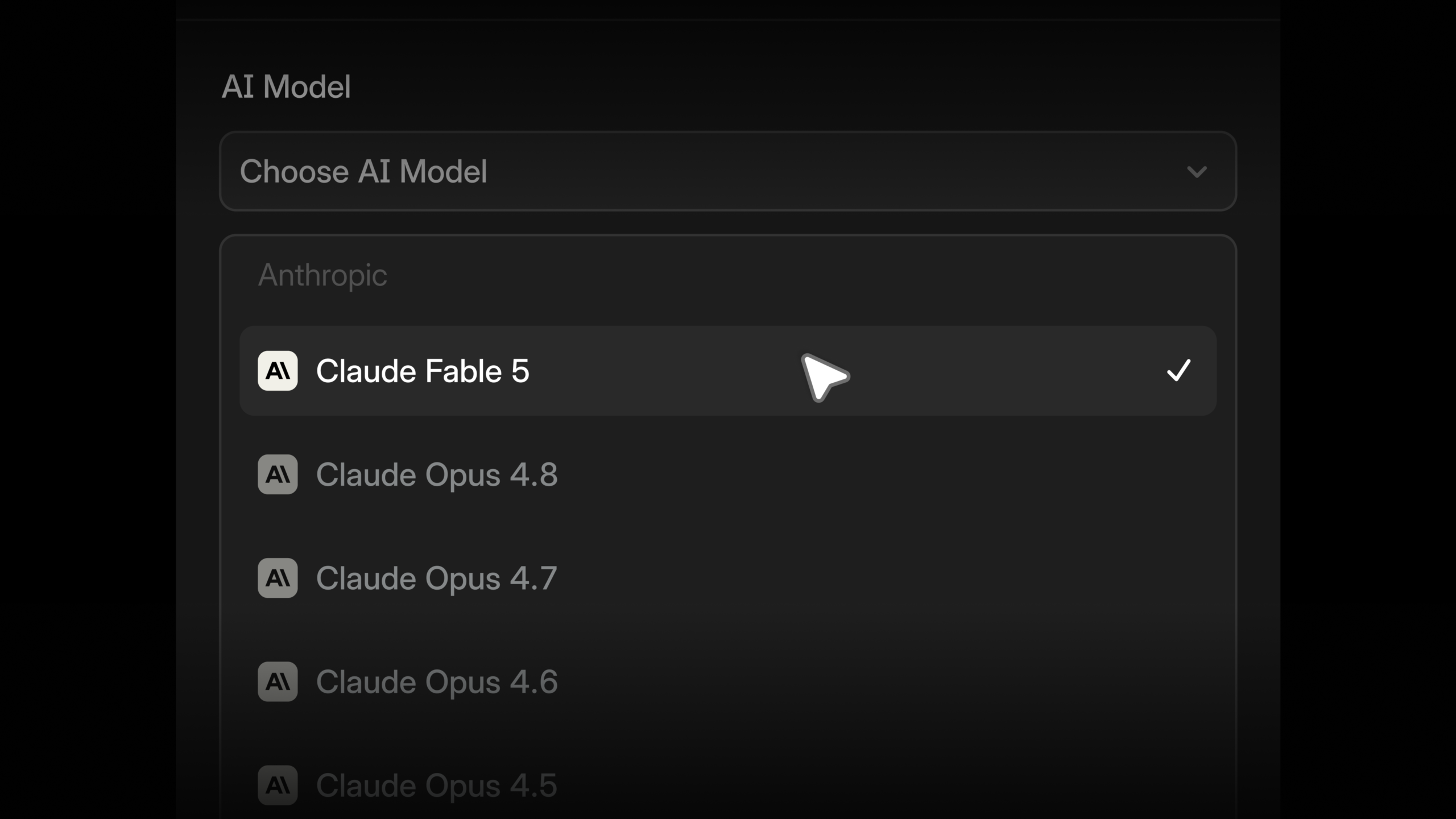
I’m thrilled to share some fantastic news with you. We’ve just launched support for Claude Fable within Profound, and it’s an upgrade that I’m genuinely excited about.
Incorporating Claude Fable into our system not only enhances user experience but also brings a new level of efficiency to our platform. This integration is designed to provide seamless functionality and improve overall productivity.
I’m confident that this addition will greatly benefit all users by offering enhanced capabilities and features that are both intuitive and powerful. Stay tuned for more updates as we continue to innovate and evolve.
Hey there! I’m excited to introduce you to something that has truly changed the way I approach coding projects—the Profound API Cookbook. If you’ve ever started with the thought, ‘I want this number,’ and wished for a seamless way to transform that into runnable code, this is for you.
Imagine having a collection of end-to-end recipes right at your fingertips, perfectly layered on top of our REST API references. This isn’t just about coding; it’s about enhancing your workflow and efficiency in a whole new way. Each recipe is designed to guide you from concept to execution with ease.
You have budget, stakeholder expectations, and a shortlist of firms that all claim they can modernize the same systems. The risky decision is not who can produce software. It is who can understand your operating constraints, make sound tradeoffs, ship into your environment, and leave you able to run what you paid for.
For a 2026 procurement, use a selection process that exposes how each provider actually works. Match the provider to your dominant risk, give every candidate the same decision brief, test claims with artifacts and working sessions, protect your exit path in the contract, and run a pilot through the hardest part of the system.
Match the provider model to the risk you need to retire
There is no generally best enterprise custom software provider. A firm can be excellent at integrating known systems and poor at discovering an uncertain product. Another can design a strong customer experience but lack the governance needed for a sensitive migration.
Start by naming the dominant risk in the initiative. Do not begin with a preferred programming language or a list of recognizable firms. Technology matters, but it rarely explains why an enterprise program is difficult.
Your dominant risk
Provider model to examine
Evidence to request
The workflow, product, or user need is still uncertain
A product engineering partner with strong discovery capability
A discovery plan, examples of decisions changed by user evidence, a product leadership role, and a backlog that separates assumptions from validated requirements
The work crosses many internal and third-party systems
A systems integrator or integration-focused engineering firm
System context maps, API and data-contract examples, dependency management, cutover planning, and a reference project with comparable integration boundaries
A fragile legacy platform must change without interrupting operations
A modernization specialist
An incremental migration approach, dependency analysis, data reconciliation, rollback design, and evidence that old and new components can coexist during transition
The system handles sensitive or regulated data
A provider with mature security, privacy, and delivery governance
Named control owners, secure-development practices, audit artifacts, incident procedures, data-flow documentation, and clear subcontractor oversight
The architecture and backlog are already well defined, but capacity is constrained
A managed delivery squad or staff-augmentation provider
The actual proposed team, technical screening methods, onboarding plans, delivery accountability, and a clear boundary between your leadership duties and theirs
This distinction changes your shortlist. Staff augmentation can be appropriate when you already have product ownership, architecture, security, and delivery management. It is a poor substitute for those functions when they are missing. A large integrator may be well suited to a multi-system program but unnecessarily heavy for a focused product build. A specialist can reduce technical risk while still needing your organization to own business adoption.
Write a short risk statement before you contact providers: We need to achieve this operating outcome, and the hardest uncertainty is this constraint. If stakeholders cannot agree on that sentence, the procurement is not ready for a meaningful vendor comparison.
Apply non-negotiable filters next. These can include deployment environment, data location, security obligations, integration platforms, accessibility requirements, support coverage, language or time-zone needs, procurement rules, and restrictions on subcontracting. Treat them as pass-or-fail conditions. A polished proposal cannot compensate for a provider that is unable to operate inside your mandatory boundaries.
Give every candidate a brief that cannot be gamed
Vague requests produce proposals that look comparable but are built on different assumptions. One provider may include discovery, migration, testing, and production support. Another may quote only implementation. The lower number then reflects a narrower interpretation, not necessarily a more efficient team.
Your decision brief should give every candidate the same view of the problem while leaving room for them to challenge the proposed solution.
Current state: Describe the workflow, systems, users, data sources, ownership boundaries, and recurring failure points. Include diagrams where they exist, but mark anything that may be outdated.
Desired business outcome: State what must become observably different. Replacing a platform is an activity; removing duplicate entry, improving decision visibility, or enabling a new service is an outcome.
Scope boundaries: Identify what is included, what is excluded, and what remains undecided. Hidden exclusions tend to reappear as change requests.
Known constraints: List mandatory platforms, identity systems, integration protocols, data classifications, accessibility expectations, release controls, and operational windows.
Unknowns: Name uncertain data quality, undocumented interfaces, unresolved ownership, pending policy decisions, or dependencies on other programs. You are testing how the provider handles uncertainty, not whether it pretends uncertainty is absent.
Internal responsibilities: Name the people who own product decisions, architecture, security, data, operations, procurement, and acceptance. If a role is unfilled, say so and ask how the provider would cover or help establish it.
Commercial boundaries: Explain the available budget process, approval gates, target window, and any required pricing structure. Ask providers to separate assumptions, exclusions, optional work, and third-party costs.
Decision method: Tell candidates which evidence will be evaluated, who will participate, and which conditions are mandatory. This discourages proposals designed mainly to impress an executive audience.
Require a common response structure. Each proposal should identify the proposed first phase, the questions it will answer, the actual roles needed, major dependencies, technical unknowns, delivery governance, security responsibilities, acceptance approach, commercial assumptions, support model, and exit plan.
Do not reward false precision. A detailed estimate built before the provider has seen the systems can still be a guess with professional formatting. Ask what evidence supports the estimate, which assumptions have the greatest cost impact, how uncertainty is represented, and what event would trigger re-estimation. Compare the boundaries behind the numbers before comparing the numbers themselves.
Also let candidates disagree with your requested solution. A credible provider should be able to explain which requirement it would validate first, which architectural commitment it would delay, and which part of the proposed scope creates avoidable risk. Blanket agreement is not proof of collaboration.
Test delivery behavior, not presentation quality
A proposal tells you what a provider wants to promise. Your evaluation needs to reveal how its team reasons when information is incomplete, dependencies conflict, or a release fails.
Create the scorecard before demonstrations begin. Otherwise, a charismatic presenter or attractive prototype can quietly redefine what matters. Choose criteria that reflect the consequences of your program, assign their relative importance, and define the evidence required for each rating.
Problem fit: Does the provider understand the operating problem, users, constraints, and adoption burden?
Technical judgment: Can the team explain architecture choices, integration boundaries, tradeoffs, failure modes, and migration sequencing?
Delivery discipline: Are decisions, risks, dependencies, testing, releases, and changes managed visibly?
Security and privacy: Are responsibilities embedded in delivery, or deferred to a review near launch?
Team quality: Have you met the people who will perform the work, and do their roles match the proposal?
Operational readiness: Will your organization receive the monitoring, documentation, deployment assets, and knowledge needed to operate the system?
Commercial clarity: Are assumptions, exclusions, third-party costs, change mechanisms, and support obligations understandable?
Independence: Can you retain, operate, modify, and transition the software without being trapped by undocumented knowledge or proprietary dependencies?
Have evaluators record their ratings independently before the group discussion. The goal is not mathematical certainty. It is to make disagreements visible. A security lead and a product owner may rate the same proposal differently for valid reasons, and those differences point to decisions the steering group must resolve.
Use a scenario workshop to expose the real team
Give shortlisted providers the same time-boxed scenario based on a genuine risk in your environment. For example, an upstream system begins returning incomplete records during a staged release, or a new identity requirement conflicts with the planned user journey. Ask each team to work through questions, options, ownership, validation, deployment, monitoring, rollback, and stakeholder communication.
Do not grade the workshop on whether the provider guesses your preferred answer. Notice whether the team:
asks about business impact before selecting a technical response;
separates known facts from assumptions;
identifies who has authority to make each decision;
considers data integrity, security, operations, and user impact together;
offers reversible steps while evidence is incomplete;
makes disagreement visible instead of hiding it behind consensus language; and
records decisions and unresolved questions in a form another team could use.
Follow every important claim with an evidence request
Use a simple chain: claim, artifact, reference, and working explanation. If a provider claims mature DevSecOps, inspect a redacted pipeline or control artifact and ask the proposed delivery lead to explain how exceptions are handled. If it claims expertise in legacy modernization, ask for a migration decision, the tradeoff behind it, and a client reference who can discuss the difficult part of the transition.
Reference calls are not character checks. Confirm whether the people presented during procurement remained involved, where the estimate changed, how bad news was communicated, which responsibilities stayed with the client, how production incidents were handled, and what the client had to rebuild or document after handover.
Red flags include unnamed delivery personnel, heavy reliance on sales demonstrations, estimates without assumptions, security deferred until the end, proprietary components without a transition path, undisclosed subcontracting, and an unwillingness to describe a failed decision. Strong providers do not need to pretend every previous engagement was frictionless.
Protect operability, data, and your exit before work starts
The contract should do more than authorize development and payment. It should define how you inspect the work, accept it, operate it, change direction, and leave the relationship without losing control of the system.
Turn handover requirements into delivery requirements
Repositories and access: Specify where source code, configuration, infrastructure definitions, tests, documentation, and deployment assets reside. Your authorized personnel should have appropriate access throughout delivery, not only at the end.
Ownership and licensing: Distinguish custom work, pre-existing provider assets, open-source components, commercial dependencies, and third-party services. Record the licenses and restrictions that apply to each.
Acceptance: Connect acceptance to observable behavior, quality checks, security requirements, data reconciliation, operational documentation, and agreed non-functional needs. A feature being demonstrated is not the same as it being ready to operate.
Change control: Define how changes are raised, analyzed, approved, priced, scheduled, and recorded. Preserve the decision history so a later dispute does not depend on memories of a meeting.
Security and privacy: Assign responsibility for access, secrets, vulnerabilities, audit evidence, incident notification, data retention, deletion, and subcontractor controls.
Continuity: Address key-person changes, replacement standards, knowledge transfer, staffing visibility, and the conditions under which subcontractors can be added.
Operations: Define logging, monitoring, alert ownership, deployment procedures, backup and recovery responsibilities, support boundaries, and escalation paths.
Transition: Require current documentation, environment inventories, dependency registers, known-issue records, runbooks, credentials transfer procedures, and reasonable cooperation with an internal or replacement team.
Ambiguity in these areas can create financial exposure, operational disruption, security gaps, or loss of practical control over the software. Have qualified legal, procurement, security, privacy, and technical reviewers adapt the terms to your organization. This is especially important when sensitive data, cross-border processing, regulated workflows, or material business continuity risks are involved.
Separate AI used during delivery from AI embedded in the product
AI-assisted delivery needs its own due diligence. Ask which coding assistants, models, and external services the provider permits; what code, requirements, logs, or data may be sent to them; whether submitted material is retained or used for training; how access is controlled; and how usage is logged. Require human review, testing, provenance controls, and an incident path appropriate to the sensitivity of the work.
If the product itself contains an AI feature, the risk is different. Document the model or service dependency, data flow, evaluation method, acceptable and unacceptable behavior, human escalation, fallback behavior, monitoring, version-change process, cost boundaries, latency constraints, and what happens when the model or provider is unavailable.
Ask how your organization would replace the model, export relevant data, reproduce an evaluation, and investigate a harmful or incorrect output. A general corporate AI policy does not answer those product-level questions.
Use a pilot to test the hardest boundary, then decide
A useful pilot is a thin vertical slice through real delivery risk. It is not a disconnected interface mockup or a convenient feature chosen because it will look good in a demonstration.
Choose a workflow that crosses the boundaries most likely to cause trouble: identity, representative data, an important integration, business rules, deployment, observability, and operational ownership. Use controlled environments and approved data access. Do not expose production systems or sensitive data merely to make the pilot feel realistic.
The pilot charter should state:
the business and technical hypotheses being tested;
the risks and unknowns the work must reduce;
what is in scope and deliberately out of scope;
the acceptance tests and evidence required;
the security, privacy, and access rules;
the artifacts that must remain with your organization;
the commercial cap and approval mechanism;
the conditions for stopping, extending, or proceeding; and
the handover required even if the provider is not selected for the next phase.
Evaluate the working relationship as closely as the resulting code. Look at the quality of questions, the visibility of decisions, the treatment of uncertainty, the handling of defects, the completeness of tests, the repeatability of deployment, and the usefulness of documentation. Notice whether risks arrive early enough for you to act or appear only when they threaten a deadline.
At the decision gate, do not ask only whether the pilot works. Ask whether your team understands why it works, can see how it is operated, knows what remains uncertain, and could transfer it to another capable team. A successful demonstration with no durable knowledge is weak evidence for an enterprise partnership.
Key takeaways
Choose a provider for the dominant risk in your initiative, not for name recognition or the longest capability list.
Give every candidate the same problem, constraints, unknowns, responsibilities, and response format before comparing proposals.
Test claims through artifacts, scenario workshops, proposed-team interviews, and reference calls tied to comparable work.
Make repository access, ownership, security, operability, documentation, subcontracting, and transition obligations explicit before delivery begins.
Evaluate AI-assisted development separately from AI features embedded in the software.
Run a controlled vertical-slice pilot through the hardest system boundary, with acceptance and exit requirements defined in advance.
Your next move is to write the short risk statement and decision brief before adding another provider to the shortlist. Once every candidate is answering the same problem and producing the same kinds of evidence, the choice becomes less about sales confidence and more about whether you can trust the team with the system after the kickoff meeting is over.
I’m thrilled to share that Profound Agents now seamlessly integrate with Webflow. This new capability transforms your CMS into an active automation endpoint, streamlining processes and boosting efficiency.
This integration is designed to elevate how you manage content, providing newfound ease and automation right at your fingertips. It marks a significant step forward in optimizing digital workflows, empowering me to focus more on creativity and less on manual tasks.
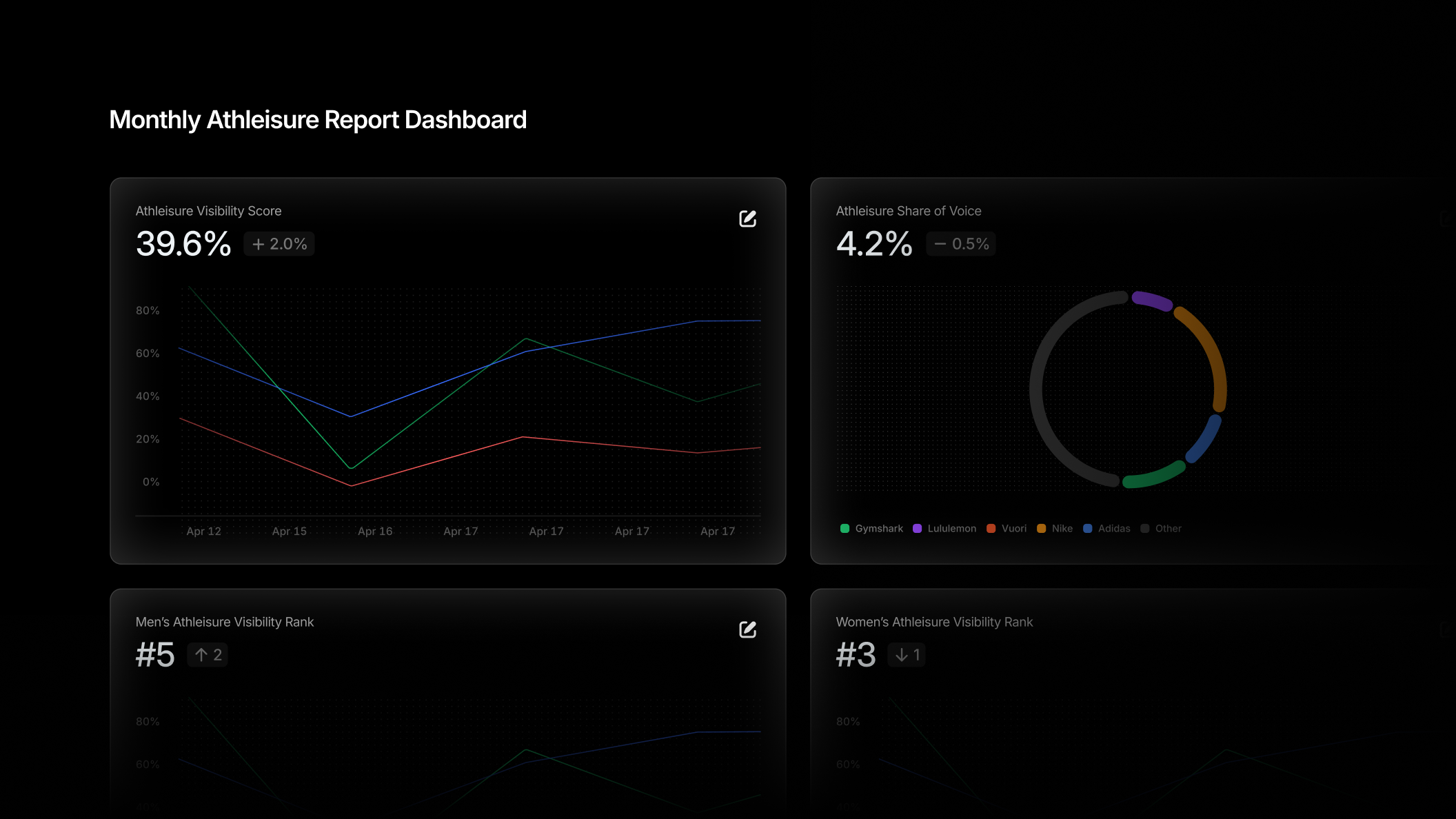
I’m excited to share with you the newest feature in Profound: Custom Dashboards! This innovative tool lets me create personalized, fully configurable, and shareable views of my data, all tailored to fit my unique needs.
Having the ability to build these dashboards transforms how I interact with my data. With just a few clicks, I can design views that help me better understand and analyze crucial insights. Whether for personal use or sharing with a team, these dashboards are an invaluable addition to my data toolkit.
The convenience and flexibility of Custom Dashboards have genuinely enhanced my workflow. Now, I can focus on making data-driven decisions with confidence, knowing that my data is presented precisely the way I need it. Join me in exploring this exciting feature, and let’s make the most of our data together.
I’m excited to share that I can now effortlessly integrate Google Search Console data directly into any of my Profound Agents. This powerful combination, uniting Search Console insights with Profound’s answer engine data, is transforming how I handle reporting, content creation, monitoring, and optimization.
Staying on the Profound platform makes the entire process seamless, allowing me to focus on what truly matters—building and optimizing my digital strategies without the hassle of platform switching.
Your designers are busy, reviewers are busy, and campaign dates still slip. That usually means the problem is not a lack of effort. Work is losing time between the request, the asset, the decision, and the channel that needs the finished deliverable.
You can fix that, but buying another platform is not the first move. First locate the constraint. Then give each technology layer a clear job, connect the handoffs, and measure whether work actually moves faster with less rework.
Key takeaways
Map where an asset waits, changes hands, gets recreated, or returns for revision. The loudest complaint is not always the real constraint.
Use digital asset management to control asset identity, versions, approval status, rights, and reuse. A shared folder is not a lifecycle system.
Route approvals from asset attributes such as channel, market, format, and risk. Do not make creators reconstruct the reviewer list for every request.
Test integrations with one complete asset journey. A connector that synchronizes only filenames or status labels may not remove meaningful work.
Treat AI generation as an increase in production capacity, not as a substitute for intake rules, review ownership, provenance, or publication controls.
Measure elapsed fulfillment time, approval delay, rework, completion, retrieval, and utilization before expanding the workflow.
Start with one recently completed deliverable that represents normal work: a paid campaign asset set, a product launch package, a landing page, or a regional adaptation. Reconstruct what actually happened. Do not diagram the process described in the handbook unless the work followed it.
Record the request as it arrived, including the information that was present and what had to be chased later.
List every system, inbox, folder, document, and creative application the work entered.
Mark each transfer of responsibility. Name the person or role that owned the next decision.
Separate active production time from waiting time. Note what the asset was waiting for: missing input, capacity, feedback, permission, or a usable file.
Record every revision loop and the reason for it. Distinguish a creative improvement from a correction caused by an incomplete brief, wrong version, conflicting feedback, or changed requirement.
Follow the approved asset through publication, reuse, replacement, and retirement. Approval is not the end of the lifecycle if teams cannot later identify what was published.
Read the map by failure pattern
A request that repeatedly returns for missing information points to an intake problem. Long gaps before a reviewer responds point to routing or ownership. Designers hunting for logos, templates, or approved photography point to asset governance. People copying campaign details between systems point to an integration gap. A queue that remains long after those problems are removed may be a genuine capacity constraint.
This distinction matters because added headcount does not repair unclear decisions, and automation does not repair an undefined process. Administrative drag can be severe enough to reduce productivity by as much as 40%. Treat that figure as a warning, not a forecast. Establish your own baseline by recording where representative work spends its time.
Give each technology layer one primary job
A healthy creative operations stack does not require every system to do everything. It requires one authoritative place for each kind of information and deliberate connections between them.
Failure you observe
Capability to examine
Acceptance test
People use outdated or unapproved files
Digital asset management
A user can identify the current approved asset, its owner, usage status, and prior versions without asking the creator.
Comments and decisions are scattered across email and chat
Approval workflow
Every decision is attached to the reviewed version, with a named reviewer, status, and unresolved feedback visible.
Project managers manually chase status
Creative work management
The project state changes as work moves, and blocked items expose both the owner and the required next action.
Campaign data is repeatedly copied into briefs and filenames
System integration
Campaign, channel, market, audience, and due-date fields travel with the request without re-entry.
Designers rebuild common variations
Creative-tool and template integration
Approved components can be opened from the working application and returned to the governed asset record.
Use DAM to control asset identity and lifecycle
A digital asset management system should answer questions that a folder cannot answer reliably: Which file is approved? What campaign and market is it for? Who owns it? Can it still be used? What replaced it? Which variations belong to the same parent asset?
Define the minimum metadata required to make those answers possible. Useful fields commonly include a stable asset ID, campaign, audience, channel, market, language, format, owner, approval status, rights or expiry constraints, and parent asset. Keep the required set small enough that people will complete it, then automate population from upstream campaign data where possible.
Version control also needs a business rule. A file becomes the approved version only through the approval workflow, not because someone adds FINAL to its name. Superseded assets should remain traceable without appearing as valid choices for a new campaign.
Turn approval into a recorded decision
An approval system should route work dynamically from information already attached to the request. A regional adaptation may require a market owner. A regulated claim may require a specialist review. A low-risk resize should not inherit every reviewer from the original campaign simply because the team always copies the same checklist.
Run independent reviews in parallel when their decisions do not depend on one another. Keep feedback contextual to the exact version. Set a named final decision owner who resolves contradictory requests instead of sending the creator back to negotiate among reviewers. Use escalation for overdue decisions, but make the escalation path visible before a deadline is missed.
Make work management reflect creative work
Generic task lists often hide the parts creative leaders need to see: revision cycles, review queues, skills required, dependencies among asset variations, and capacity by role. Your work management layer should track the request, scope, owner, state, dependencies, and delivery commitment. The DAM should remain authoritative for the asset itself.
That boundary prevents duplicate masters. Adobe Creative Cloud, Figma, Canva, or another creation environment is where the asset is edited. The DAM controls its governed record. Work management controls the flow of work. The approval layer controls decisions. Campaign or content systems provide destination context.
Prove integration with an end-to-end test
Do not evaluate an integration from a feature checklist alone. Give the vendor or implementation team one representative request and ask them to demonstrate the complete path:
Create the creative request from real campaign fields without retyping them.
Assign the work and open the correct source asset from the creator’s normal application.
Save a new version while preserving its relationship to the original asset and request.
Route the version to the correct reviewers, capture contextual feedback, and record approval.
Make only the approved variation available to the destination team, with its identifying metadata intact.
Replace or retire the asset while preserving the record of what was previously used.
Count every export, upload, copied field, duplicate status change, and manual notification. Some manual steps may be necessary, but they are operating costs. They should be visible in the buying decision instead of being dismissed as minor setup details.
Design a workflow that survives more volume and AI output
Technology becomes scalable when each transition has an entry condition, an owner, and an observable result. A practical state model might use Requested, Scoped, In production, In review, Changes requested, Approved, Published, and Retired. Your labels may differ; the important part is that two people cannot interpret the same state differently.
Requested to Scoped: the intended outcome, audience, channel, deliverables, owner, required inputs, and decision-makers are present.
In production to In review: the exact version is attached, required variations are identified, and known specification checks are complete.
In review to Approved: every required decision is recorded, unresolved feedback is closed, and one person owns the final disposition.
Approved to Published: the destination record points to the approved asset ID rather than an unmanaged duplicate.
Published to Retired: the asset is no longer offered for new use, while its history and replacement remain discoverable.
Model variations as children of a parent concept or master asset. Let them inherit shared campaign, brand, and ownership information while retaining channel-, market-, language-, or format-specific fields. This makes it easier to update the right set of assets without pretending every variation is interchangeable.
Stress-test the design at three times your current volume. This is not a demand forecast. It is a way to expose steps that work only because someone remembers to send a message, rename a file, or reconcile two lists. Ask what happens when requests, variations, reviewers, and markets multiply while headcount does not.
Do not let AI move the bottleneck downstream
AI-assisted generation can increase the number of drafts and variations entering the workflow. If review capacity, provenance, and publication controls remain unchanged, the constraint simply moves from production to selection and approval.
Generated output should enter the same governed lifecycle as human-produced output. Record its relationship to the request, source assets, template, tool, and model where your governance policy requires that information. Mark it as a draft until the appropriate people approve it. Do not allow bulk generation to create hundreds of unmanaged files that nobody can confidently reuse or retire.
For SEO, AEO, and GEO programs, connect creative operations to the approved content record. Ownership, review state, update date, entity relationships, and supporting references should travel into the publishing workflow as structured fields. JSON-LD should be generated from approved facts in that record, not inferred from a filename or invented to fill an empty schema property. Better operations do not guarantee AI visibility, but they reduce the ambiguity and inconsistency that make content difficult to maintain and trust.
Roll out the change without turning adoption into a second bottleneck
A correct architecture can still fail if it adds data entry, hides familiar information, or changes responsibility without explanation. Involve the people who request, create, review, publish, and retrieve assets before configuration is fixed. Each role sees a different failure in the same workflow.
Capture the baseline. Measure representative work before changing the system. Preserve the starting definitions so later comparisons remain meaningful.
Choose one repeatable workflow. Use work that is common enough to expose real friction but bounded enough that the team can see the whole lifecycle.
Configure the smallest complete path. Include intake, production, review, approval, distribution, and retirement. Automating only the middle can leave the most expensive handoffs untouched.
Train by role and decision. A requester needs to know what makes a request ready. A creator needs version and submission rules. A reviewer needs decision criteria. A publisher needs to know which record is authoritative.
Collect friction at the point of use. Record duplicate entry, unclear fields, unnecessary approvals, missing notifications, and exception cases. Adjust the workflow without discarding its control points.
Expand only after the path is stable. Add additional asset types, markets, and automations after the pilot produces reliable records and measurable movement.
Measure flow, not software activity
Logins, tasks created, and files uploaded can show adoption, but they do not prove that creative operations improved. Core measures should include asset fulfillment time, project completion, and team utilization. Define each measure against explicit events in your workflow:
Asset fulfillment time: elapsed time from a request meeting the Scoped criteria to the approved deliverable becoming available.
Approval wait: elapsed time spent in review states without a decision. Break this down by review type so one queue does not hide another.
First-pass approval: the share of submissions approved without a revision request. Read it alongside quality and scope changes; a high rate is not useful if reviewers are rubber-stamping weak work.
Rework loops: the number and cause of returns to production. Separate creative refinement from preventable corrections.
Project completion: the share of scoped work delivered under the commitment attached to that scope. If scope changes, preserve the change rather than rewriting the original commitment.
Retrieval and reuse: whether people can find the approved asset and use it without contacting its creator or rebuilding it.
Utilization: how much available capacity is committed, viewed with queue length and fulfillment time. Maximizing utilization while work waits longer is not an operational win.
Use the median to understand normal flow and inspect the slowest cases separately. Segment unlike work instead of combining a simple resize with a new campaign concept. Most importantly, keep the definitions stable long enough to distinguish improvement from a reporting change.
Your next move is small and concrete: take the last campaign that ran late, reconstruct one asset’s full journey, and circle the first repeated wait or rework loop. Fix that control point, prove the connected path, and then expand. The right creative operations stack is the one that makes the next decision obvious and the approved asset easy to trust.
The landscape of AI is rapidly shifting in 2026. I’ve noticed that AI models are losing their once shared data access, resulting in fragmented and less cohesive answers.
This change is primarily due to the surge in platform-controlled data, which is significantly altering how visibility and search functions within AI systems. It’s intriguing to see how these developments are reshaping the way we interact with and trust AI-driven responses.