I’ve noticed a shift in how Google is choosing content for its Discover feed, and it seems less tied to traditional search rankings these days.
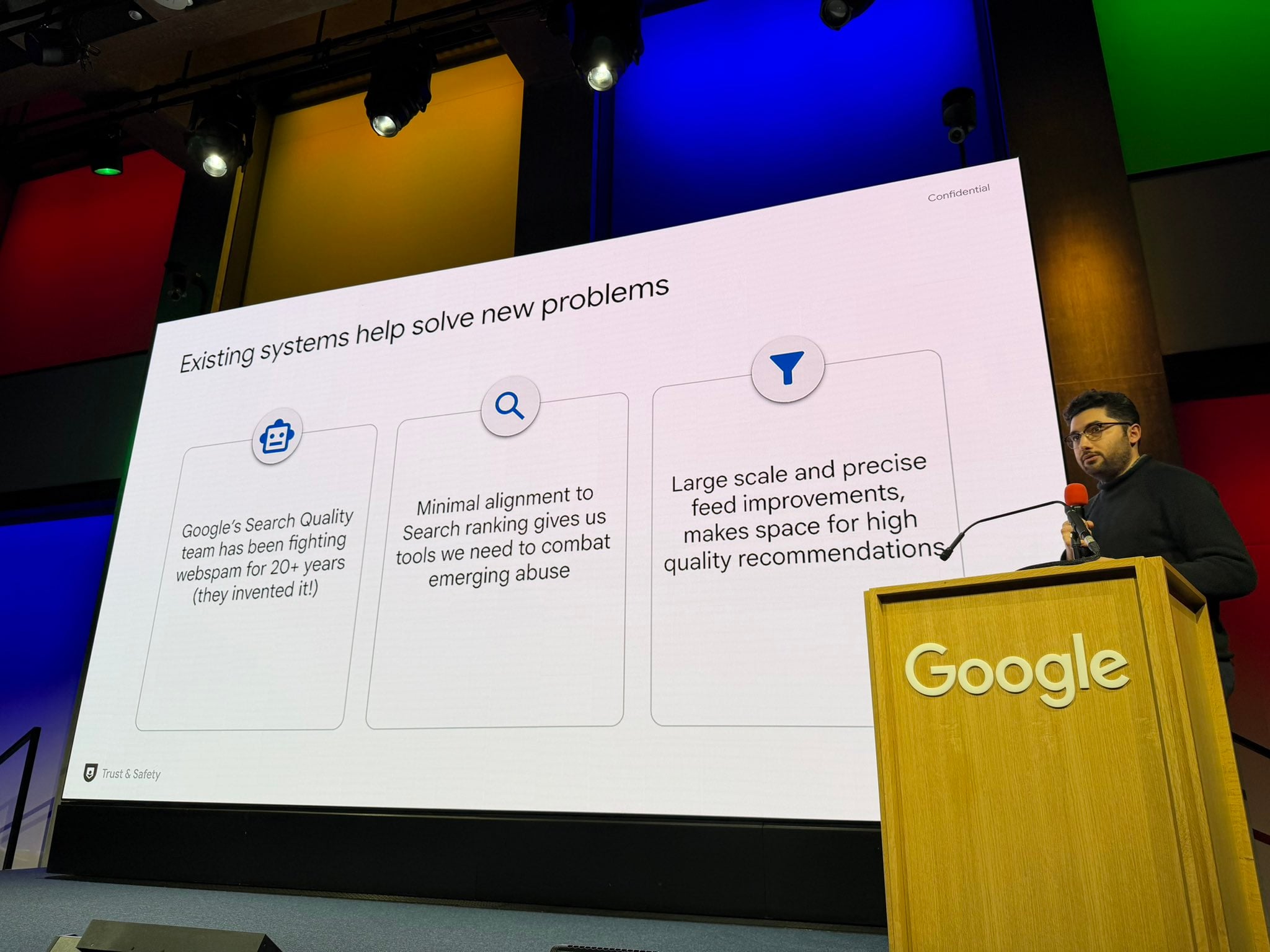
Yesterday, Andy Almeida from the Google Trust and Safety team shared some insights at the Google Search Central Live event in Zurich. He mentioned that Google Discover isn’t as closely aligned with Google Search rankings as it once was.
Andy presented a slide illustrating how existing systems assist the Google Discover team in addressing challenges. The slide highlighted:
“Minimal alignment to search ranking gives us the tools we need to combat emerging abuse.”
Understanding the Implications. This indicates that Google Discover is moving away from relying heavily on Google’s established search systems, particularly concerning combating platform abuse.
When I asked Andy what this meant for publishers, he explained that Google Discover aims to showcase content from lesser-known and smaller publishers. It seems while Google Search may not always favor them, Discover does, focusing more on its own evaluation systems.
The Challenge with Spam. I’ve been aware of the significant spam issues confronting Google Discover, primarily caused by sites exploiting expired or throwaway domains for spam content. This is a challenge not as prevalent in Google Search.
Back in 2019, Google stated that its core ranking systems affected visibility in Google Discover, especially after a core update. However, this new approach seems to diverge from that stance.
Why This Matters. As Google continues to address these spam problems, it’s balancing the visibility of smaller sites on Discover while curbing spam. This is great news for emerging publishers who focus on niche topics, as long as the spam issue can be effectively managed.
AI search has expanded far beyond just Google. I discovered that understanding where my brand appears across tools like ChatGPT, Claude, Gemini, and Perplexity is crucial.
Living in the era of generative engine optimization (GEO), tracking my brand’s AI presence has become essential. Without it, I’d be navigating blind.
The AI Search Revolution is Here
The shift is undeniable: 58% of people now use AI tools over traditional searches for product recommendations, and traditional search traffic might fall by 50% by 2028.
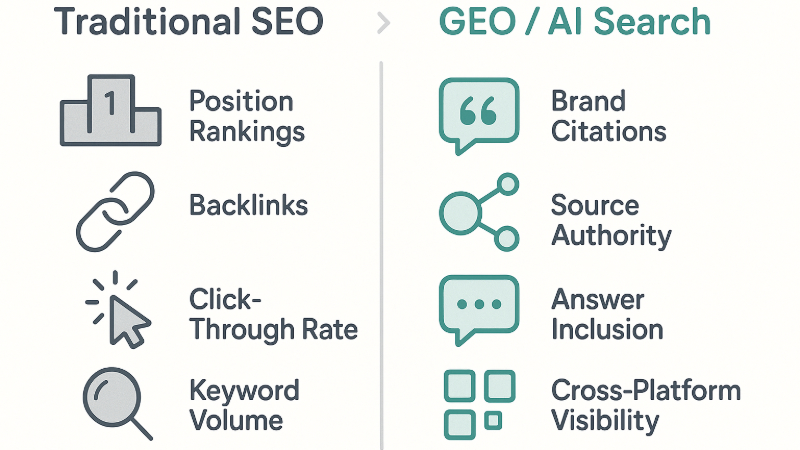
Unlike before, where ranking on search pages was key, AI searches like those on ChatGPT or Claude provide direct answers and cite fewer sources. It’s critical for my brand to be one of those sources.
Here’s where a GEO rank tracker proves invaluable. With tools like Geoptie’s free GEO Rank Tracker, I can see where my brand stands on these AI platforms.
What is a GEO Rank Tracker?
A GEO rank tracker evaluates my brand’s citations, recommendations, and mentions on AI search engines. Unlike traditional metrics, it offers insights into brand mention frequency, citation rates, share of voice, and cross-platform visibility.
With these insights, I can now optimize not for a list of results but for AI mentions and perceptions.
Why Traditional Rank Tracking Falls Short
Traditional tracking misses out on the unique ways AI engines operate, like using retrieval-augmented generation (RAG). It’s not just about being visible—it’s about being mentioned in AI responses.
Through GEO tracking, I realized that monitoring across all platforms ensures my brand isn’t just visible in one, but across many, ensuring wider reach.
Key Metrics Every GEO Rank Tracker Should Measure
When diving into AI search visibility, focusing on citation frequency, brand visibility score, AI share of voice, and sentiment is paramount. These metrics provide a comprehensive view of how my brand stands.
How to Track Your Brand’s AI Search Rankings
Embarking on GEO tracking involves identifying core prompts, monitoring multiple platforms, tracking by location, and benchmarking against competitors. I found starting with resources like Geoptie’s free GEO Rank Tracker simplified this process.
Interpreting Your GEO Rank Tracker Results
By analyzing my brand’s visibility data, I can see where to strengthen content, which platforms need more focus, and how to address any declines or gaps found.
From Tracking to Optimization: Building Your GEO Strategy
Data is just the beginning. By expanding my brand’s semantic footprint, increasing fact density, and building entity authority, I can turn insights into action for greater visibility.
The Cost of Ignoring GEO Tracking
Ignoring AI visibility means missing out on being discovered, falling behind competitors, and misallocating resources. It’s crucial to adapt to this shifting landscape.
Getting Started Today
Starting GEO tracking is easier than it seems. A simple first step is to use tools that provide an initial visibility snapshot and document the findings for strategic improvements.
The Future of AI Search Visibility
As AI search evolves, those who prioritize understanding and optimizing for AI visibility now will be better positioned in the future.
Key Takeaways
GEO tools, like Geoptie, are essential for AI visibility.
Understanding core metrics aids in effective optimization.
AI search varies by platform, necessitating diverse monitoring.
Insights from GEO metrics drive smarter, more effective strategies.
Beginning with Geoptie’s free GEO Rank Tracker offers insights into finding and expanding AI visibility.
I recently discovered something fascinating about how people interact with AI. It turns out most AI chats don’t have any commercial intent! This insight came from a thorough analysis by Dan Petrovic, the director of AI SEO agency Dejan, who scrutinized millions of conversational turns to shed light on actual AI assistant usage.
Why is this important to us? As someone involved in SEO and marketing, I’m often focused on optimizing for AI. However, Petrovic’s research suggests we might be misunderstanding how people genuinely engage with AI assistants. They don’t typically flood AI with purchase queries. Instead, they explore issues and weigh options.
By the numbers, Petrovic dived into 4.4 billion characters across 613 million words and 3.9 million conversation turns. Here’s what that looks like:
Median chat: Just 2 turns, usually involving a quick question and an immediate response.
While most interactions are short, there are lengthy sessions when users paste documents for summarization or analysis.
Median words per session: 430 words.
Astonishingly, more than 80% of chats contain fewer than 1,000 words.
Only a small fraction, 4.2%, exceed 2,500 words. These are often complex tasks, like editing, coding, or tutoring.
Mean words: 732. This statistic is heavily influenced by long document submissions.
Assistant output: Typically, it’s 1.5 times more than what users contribute.
Median user contribution: Users make up about 16-17% of the conversation.
In exploring how people utilize AI assistants, Petrovic examined 24,259 sessions across 42 intent categories. Surprisingly, 64.6% of chats didn’t align with any purchase funnel. People used AI for writing, brainstorming, planning, learning, analyzing, or just simply chatting. Here’s the breakdown:
Other: 25%
Included are jailbreak attempts, role-playing, and specific requests.
Brainstorming: 7.7%
Planning: 6.5%
Conversation / emotional support: 6.2%
Analysis: 5.7%
Learning: 4.7%
Transformation (summaries, translations): 4.6%
Creation (writing, code, docs): 3.9%
Only 35.4% of chats showed any commercial intent, and most were in the early stages of the buying process. Other insights:
Awareness (10%) and consideration (8.5%) combined to form 18.5%, which Petrovic noted as prime territory for product content.
Post-purchase needs (5.1%) outpaced transactional support (4.8%), discovery (4.1%), and decision support (2.8%), suggesting users seek AI more for ‘How do I use or fix this?’ rather than ‘Should I buy this?’
Bottom line, my takeaway is that AI assistants are utilized far more for creation, cognition, and conversation than for commerce.
As I navigate the ever-evolving world of SEO, evaluating tools in 2026 has become a complex task. Rising costs and the AI frenzy often make it difficult to justify the investment in new platforms.
The challenge lies in demonstrating the business value of these tools to leadership, who are more interested in results than in the number of keywords we can track or the speed of content optimization.
Most tools fail to meet the demand to connect SEO work directly to business outcomes. The offerings often come bundled in convoluted packages, further complicating the decision-making process.
This article offers a framework to approach SEO tool evaluation in 2026, focusing on must-have features, efficient tool comparison methods, and effective vendor conversations.
Understanding the forces reshaping SEO tools can help. Many platforms lag in connecting SEO to measurable business value, complicating budget approvals.
AI advancements are setting new expectations. Whether to train a custom AI agent or invest in a ready-made tool is a key question every team faces.
Small teams need automation that truly saves time. Without context, many tools only generate noise, failing to deliver tailored insights for specific markets or businesses.
Technical SEO tools remain relatively stable, yet the assumption that AI can solve all problems presents a budgeting challenge.
Real impact in tool evaluation lies in focus areas like advanced data analysis, SERP intelligence, meaningful automation, robust multilingual support, and transparent pricing.
To avoid wasting time comparing tools, start with clear pricing, align tests with typical weekly tasks, and ensure you always secure a free trial.
When it comes to vendor interactions, concise goals and informed questions can streamline discussions and facilitate more productive evaluations.
Business considerations should include presenting a range of options, avoiding overpromising, and ensuring that proposed tools align with strategic business objectives.
As we look to the future of SEO tools, connecting searches to tangible business outcomes will define premium offerings, though such solutions remain rare.
I’m always fascinated by how technology evolves, especially when it comes to AI models. Recently, I stumbled upon some compelling data showing how these AI systems are reshaping brand hierarchies and influencing buyer decisions at an unprecedented speed.
AI models like ChatGPT, Gemini, and Claude have become a part of our daily interactions, from search to content creation and product recommendations.
According to a survey conducted by Responsive, a significant 80% of tech buyers now use generative AI to research vendors just as often as they use traditional search methods. This shift in how buyers build trust with AI-driven discovery tools quietly determines which brands stay top-of-mind and which fade into oblivion.
At Previsible, we’ve been analyzing this intriguing phenomenon through what we call LLM perception drift. It’s a new metric revealing how AI models are dynamically organizing brands within specific categories over time. (Disclosure: I am the CEO and co-founder of Previsible.)
Our case study on project management software, comparing data from September to October 2025, highlights just how quickly AI brand perception can change. This volatility is set to become the next major metric for SEO strategies.
Key insights
The concept of LLM perception drift is emerging as a crucial visibility metric in SEO and B2B marketing.
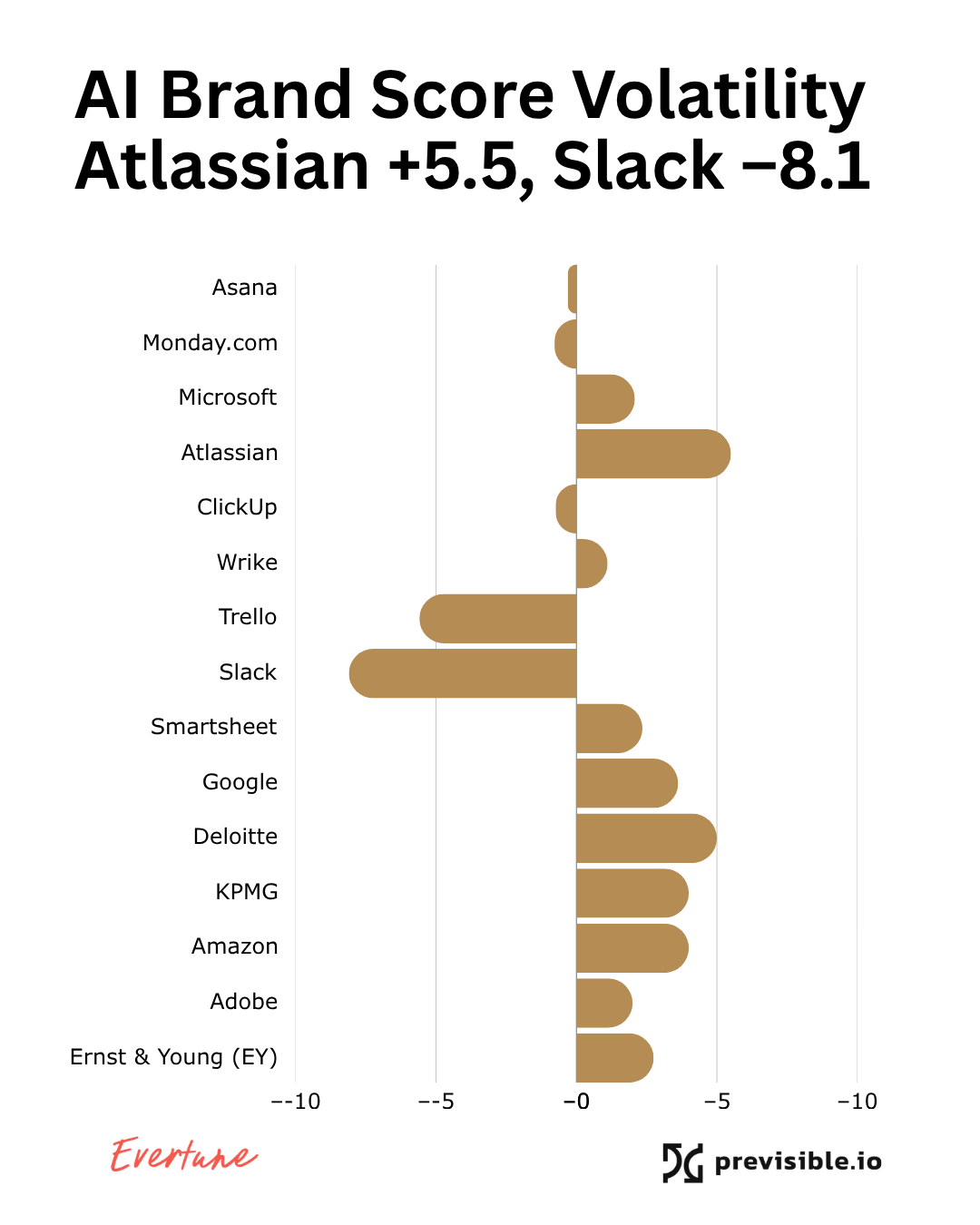
Brands like Atlassian gained prominence, while others like Trello and Slack saw declines, indicating the dynamic nature of AI perception.
Understanding AI brand perception is pivotal for marketers aiming to grasp authority and relevance in language models.
By 2026, maintaining digital visibility will hinge on AI brand signal stability as LLMs rapidly evolve.
A subtle shake-up inside the AI mind
Evertune’s AI brand score provides insights into how likely a model is to recommend a brand without specific prompting. It measures both visibility and ranking within AI responses.
September to October shifts highlight considerable changes in the internal brand landscape of AI models. Notably, Slack saw a significant decline, while Atlassian experienced a boost.
This seemingly simple reshuffle reveals a deeper transformation in AI’s nonspecific brand awareness, altering how the model discerns and prioritizes brands despite market stability.
The meaning behind the drift
We’re seeing two main forces driving these shifts:
Category entanglement
Rather than declining, categories are blurring — project management tools are being integrated into broader conceptual frameworks.
Operations
Digital transformation
Workflow orchestration
Enterprise productivity
IT consulting
Names like Deloitte and KPMG rise alongside Smartsheet and Atlassian.
Ecosystem advantage
Brands with multi-product ecosystems are getting noticed more. Atlassian’s lift, for example, stems from its robust documentation and integration abilities. Brands like Microsoft, Google, and Amazon are also seeing positive movement.
Models increasingly prefer brands that span multiple ecosystems, echoing entity-based SEO patterns but at a faster, more volatile pace.
We observe emerging trends in newer brands like Celoxis and Workfront, showcasing how fine-tuned LLMs draw from diverse datasets.
SaaS directories
GitHub repositories
Technical documentation
Reviews
Community content
For smaller B2B brands, this represents a gateway to visibility without needing to dominate traditional SEO metrics.
Why this shift matters for B2B discovery – and why it’s speeding up
Traditional SEO focuses on visible search results, whereas LLMs synthesize knowledge based on associations and contextual richness.
This means that brand recall in AI systems relies on deeper semantic connections, and these can fluctuate significantly over short periods.
Understanding and leveraging this LLM perception drift is crucial — being consistently recognized in AI outputs is now as vital as traditional search rank.
A new AI optimization KPI: AI brand signal stability
In working with B2B clients, we’re focusing on AI brand signal stability as an emerging metric — tracking how consistently a brand’s presence is maintained in AI outputs.
Fluctuations suggest fragile brand perception, influenced by data changes and model retraining, while stable scores indicate strong semantic grounding.
In coming years, AI brand signal stability will be essential alongside share of voice and traditional SEO metrics.
From project management to every B2B vertical
This transformation isn’t limited to project management — it’s happening across all B2B sectors.
The recalibration of category contexts by AI models alters the buying journey, influencing brand appearance in AI-generated content.
The rise or fall of brand attention affects which brands occupy summative or comparative outputs, making AI memory a new realm of marketing focus.
This shift marks SEO’s evolution — from focusing on search indices to emphasizing model memory optimization. Our goals now include measuring how AI interprets and recalls brand identity.
It’s about ensuring that AI systems correctly interpret and represent brands across their expansive digital landscapes.
This demands new strategies and tools tailored to how dynamic perception systems function, rather than treating them as static outcomes.
Evertune’s dataset highlights more than monthly position changes — it showcases a quick shift in AI’s category perception, which marketing teams must monitor to stay competitive.
By 2026, brand appearance in AI-generated summaries will play a bigger role in decision-making than traditional metrics like pageviews or clicks. Brands that effectively manage their model-driven visibility will set themselves apart as AI becomes a mainstay in digital research.
I’m excited to share with you that SMX Advanced is gearing up to make its mark in Boston from June 3rd to 5th, 2026, hosted at the Westin Boston Seaport. This is the premier event for those of us committed to mastering search marketing.
We’re really keen on highlighting the advanced strategies in SEO, PPC, and AI, and we can’t do it without your expertise.
The world of search is evolving incredibly fast.
As SEOs, we find ourselves adapting to AI SEO trends, making sense of AI Overviews dominating SERPs, and navigating Google’s ever-changing landscape and algorithm updates.
For those in PPC, there’s the challenge of making informed, data-driven decisions while seamlessly integrating new AI tools and maintaining that essential human touch.
We’re looking for speakers at SMX Advanced who can provide real solutions to these complex issues.
Do you have proven, high-level strategies for today’s marketing landscape? Now is the perfect time to share your session idea with us. Even if you haven’t spoken at SMX before, in person or virtually, we encourage diverse voices and perspectives to come forward.
The deadline for submitting your SMX Advanced session pitch is January 30th. Don’t delay—spots are limited and fill up quickly.
Consider these tips for crafting a compelling session proposal:
Ensure that your topic is truly advanced and tailored for intermediate to advanced professionals in search marketing.
Introduce an original idea or a unique session format.
Include a case study or specific examples to illustrate your points.
Be mindful of what can realistically be covered in a 20-minute timeframe.
Provide clear, actionable takeaways for participants to implement.
Clarify what skills or insights attendees will gain from your session.
I’m excited to share that Profound has been recognized as the definitive Leader in G2’s Winter Reports for the AEO (Answer Engine Optimization) category. This achievement highlights our continued dedication to innovation and excellence in AEO.
Our hard work and commitment to improving search optimization solutions have clearly paid off, reaffirming Profound’s position at the forefront of the industry. It’s rewarding to see our efforts acknowledged by such a respected platform.
I recently had a thought-provoking conversation with Nils Rooijmans, a respected figure in the world of Google Ads and a top PPC influencer. He shared with me a critical experience that highlights the importance of not overlooking Google’s consent mode warnings.
On episode 333 of PPC Live The Podcast, Nils revealed how a seemingly small oversight led to a significant drop in conversions and traffic for one of his managed accounts. This experience serves as a stark lesson for all of us in the paid search industry.
The story began with a rushed account onboarding after Nils’ existing client acquired another company involved in airport parking services. The client sought to avoid additional fees for a proper onboarding process, setting the stage for future challenges.
Nils agreed to transition the account into their existing setup gradually. However, this compromise led them to neglect the new account, which soon proved to be an expensive mistake.
After six weeks of minimal oversight, clicks and conversions plummeted. Upon investigation, Nils found that Google had been sending warnings about incorrect consent management implementation, threatening to halt conversion tracking if unresolved.
Ignoring these emails, originally thought to be routine noise, allowed the issue to escalate. As Nils admitted, this oversight stopped Google from processing conversion data, leading their smart bidding algorithm to adjust bids, reducing traffic further.
The root cause was identified as a bypassed onboarding process. Without this critical step, the account missed essential safeguards, including monitoring scripts and regular health checks.
Breaking this news to the client was complicated, especially since the financial implications were severe. The CFO demanded compensation despite actual bookings continuing, demonstrating further complications from the original oversight.
Technically resolving the issue was also challenging. Although Google support was contacted multiple times, they couldn’t fix the flagged domain problem, necessitating a workaround.
This story taught several key lessons: never skip onboarding, monitor conversion tracking meticulously, and pay close attention to Google’s communications. These steps can prevent minor issues from becoming major problems.
In the broader picture, embracing mistakes as learning opportunities strengthens team dynamics and enhances PPC strategies. Nils’ experience is a testament to the value of maintaining vigilance and the power of systematic approaches in digital marketing.
Since July 1, I’ve been closely following Cloudflare’s battle against AI bots. Our CEO, Matthew Prince, recently shared that we have successfully blocked 416 billion AI bot requests for our customers during this time.
This insight sheds light on Google’s significant advantage in AI. They’re currently capable of viewing 3.2 times more web pages than OpenAI, underlining the challenge smaller AI companies face.
Why this matters. The flood of AI systems consuming vast amounts of web content is concerning, especially without a mechanism for publishers to counteract this. Our statistics at Cloudflare show just how aggressively these AI bots are searching for data.
The current scenario. Ever since we launched our pay-per-crawl initiative on July 1, our clients have been automatically blocking AI crawlers. At the recent WIRED Big Interview event, Prince highlighted that so far, 416 billion AI bot requests have been turned away.
Analyzing Cloudflare’s data reveals that Google sees:
3.2 times more webpages than OpenAI.
4.6 times more than Microsoft.
4.8 times more than Anthropic or Meta.
As Prince mentioned, Google enjoys “this incredibly privileged access.”
The bigger picture. As it stands, Google offers publishers a difficult choice: either block AI training and risk disappearing from Google Search or allow it and accept AI scraping.
Prince said, “You can’t opt out of one without opting out of both, which is crazy. You shouldn’t get to use your monopoly of yesterday to secure a monopoly of tomorrow.”
Cloudflare aims to prevent market consolidation, ensuring the web remains open while assisting creators and businesses in adapting to this shift.
Encouragingly, publishers that already block AI crawlers report positive results, Prince noted.
Looking ahead. As AI models pursue superior training data, the worth of “creative, original human thought” will climb, potentially leading to opportunities in paid licensing, Prince forecasted. Meanwhile, Cloudflare is advocating for AI giants, particularly Google, to distinguish between search and AI crawling.
Prince asserted, “Google is the problem here. It is the company that is keeping us from going forward on the internet, and until we force them – or hopefully convince them – that they should play by the same rules as everyone else and split their crawlers up between search and AI, I think we’re going to have a hard time completely locking all the content down.”
I’ve discovered incredible ways to optimize for Perplexity Shopping. Join me as I explore how AI-driven search is transforming the eCommerce landscape, giving brands like ours the opportunity to shine in ‘Shop Like a Pro’ outcomes.