Every week, I sift through fresh data that showcases both the common ground and the differences in effective organic search techniques. These insights span traditional SEO methods on Google SERPs and newer practices like GEO for platforms such as ChatGPT and AI-driven overviews.
It can feel overwhelming. One moment, we read how traditional SEO methods suit ChatGPT; the next, discussions highlight how one platform favors Reddit while another favors a different approach.
As this landscape rapidly evolves, I’m eager to share the approach, process, and resources my team is utilizing to craft content for 2026.
Our strategy stretches beyond a mere content calendar. It involves merging insights about our audience with the dynamics of organic platforms, alongside our brand’s unique perspective, to create a content system that truly adds value.
The goal is to create high-quality content that stands out. E-E-A-T principles remain core to our strategy, applicable to both AI search discoverability and traditional SEO.
Understanding the audience is the foundation of strong content creation. I constantly ask myself: Who are they? What do they need? What type of content will guide them?
Content, like any product or service, requires identifying a need and addressing it, understanding the involved emotions, and demonstrating credentials through third-party brand mentions, a leading factor in AI search visibility.
For content to be effective in both Google and LLM search realms, it should be crafted as an authoritative source with structured data, prioritizing clarity, depth, and a consistent brand voice AI models will quote.
In a world teeming with AI content, what sets us apart are original insights and data. Therefore, our content systems incorporate a step for “original proof” like data, interviews, or unique commentary.
I’m also focusing on how our content fits into AI experiences, placing value on summaries, bullet points, and explainers that address complexity effectively.
Optimizing for retrieval and credibility rather than just ranking is critical. This approach ensures our content is impactfully represented by AI systems through schema, structured data, and a consistent brand voice.
The content strategy process I recommend starts with empathy, acknowledging the audience’s problem, and providing objective solutions, thus establishing trust. The goal is to transform this understanding into a modular engine, creating multiple media forms aligned to a central theme.
Adaptation is crucial, and my team utilizes a range of resources to achieve a detailed, audience-focused content strategy. This includes qualitative interviews and audience analysis from AI tools, helping shape informed structural decisions.
Social media platforms are instrumental for real-time audience insights and increasing brand mentions, signaling relevance to AI platforms.
Competitor analysis has shifted focus too, evaluating content depth and originality, and identifying opportunities to showcase the expertise our brand brings to the table.
Our KPIs must now reflect the evolution in search, weighing brand mentions alongside traditional metrics to capture content’s full impact on conversions and cross-channel engagement.
In the end, continually adapting to trends ensures we don’t rest on past successes. The real-time changes in user behavior driven by ChatGPT and similar platforms require us to stay vigilant and prepared.
I recently discovered that uncontested ads might be silently eating away at my holiday budget. Even when I’m the sole bidder, my CPCs remain stubbornly high. Here’s how I began to reclaim those wasted dollars.
This holiday season, Google Search and Shopping Ads are projected to surpass a staggering $70 billion in spending. However, many advertisers, myself included, overlook a critical flaw in Google’s auction system that drains our funds—even in the absence of competitors.
The team at BrandPilot identifies this issue as the “Uncontested Google Ads Problem,” a significant yet often ignored source of wasted ad spend during peak times.
During SMX Next, I learned from John Beresford, the Chief Revenue Officer at BrandPilot, about a little-known quirk in Google’s auction logic. It’s fascinating how this can lead advertisers like me to overspend on our brand terms, shopping placements, and category keywords because Google doesn’t automatically lower our CPCs when no one else is bidding.
Instead of enjoying lower costs as the sole bidder, I found myself paying the same high rate as if competitors were still active. It’s a situation that unfolds thousands of times a day for major brands, and like me, many marketers don’t even realize it.
In John’s session, we explored:
Understanding why “competition gaps” are far more frequent than we think.
Discovering how uncontested moments can warp CPCs, even on brand keywords.
The potential of real-time auction visibility—and how AI is revolutionizing the field.
He also shared how advertisers are deftly reclaiming wasted spending and channeling it back into growth, without giving up impression share, traffic, or revenue.
Identify why CPCs are artificially high when competitors are missing.
Calculate the true financial impact of the Uncontested Ads Problem on your budget.
Execute AI-driven bidding and suppression strategies to avoid self-bidding and increase ROAS.
If you’re managing Google Search or Shopping campaigns this holiday season, this session is a must-see. Learn how to keep Google from sneaking off with your budget and start converting those savings into real performance improvements.
When I watch a TV commercial that truly connects with me, it’s more than just a fleeting moment of entertainment. It triggers curiosity, encourages me to search online, and often leads to making a purchase.
This is precisely why the “Breaking TV Ads Report,” collaboratively launched by Kinetiq and DAIVID, should be on every search marketer’s radar.
The report ranks the top-performing new TV ads in the U.S., combining Kinetiq’s real-time ad detection with DAIVID’s AI-driven creative analytics to identify which ads truly stand out, why they connect with audiences, and what brands can learn from their success.
It’s a powerful reminder that search doesn’t begin with typing into Google, it starts with a spark in our mind.
As Barney Worfolk-Smith, chief growth officer at DAIVID, said to me via email:
“Search + TV matter – together. TV can boost search volume by up to 60%, and even more in well-coordinated campaigns. AI has altered, and will continue to shape, the TV-to-search relationship, though the principle remains constant: impactful, emotive TV advertising leads to all favorable brand outcomes – search being a prominent one. It’s also key to note that search volume itself is an invaluable indicator of TV ad effectiveness.”
How LeBron James and Indeed Captured Attention
In the first issue of the “Breaking TV Ads Report,” one commercial stood out: Indeed’s “What If LeBron James’ Skills Were Never Seen?”
The ad traces James’s journey from his early days, linking it to Indeed’s “skills-first” hiring message, resonating with viewers due to its authenticity and star power.
Indeed’s ad sparked 11% higher intense positive emotions and garnered 7% more attention than an average U.S. TV ad according to DAIVID. It was among the top 10 ads, alongside campaigns from TikTok, Subaru, and Taco Bell, each with themes revolving around family, mentorship, and belonging.
These ads aren’t merely entertaining stories – they ignite search actions.
When an emotional bond is formed with a brand message, I, like many others, am compelled to explore more – often turning to Google or YouTube for details, reviews, or purchase options.
In 2011, Google introduced the “Zero Moment of Truth” concept, emphasizing that the initial “stimulus” step, like a TV ad, precedes the ZMOT buying journey step.
For many search marketers, focus remains on the measurable second step – insights from clicks and conversions – neglecting the initial step which drives search but often feels like it drains our budgets.
However, research over the past decade indicates that TV advertising significantly extends into search behavior:
In 2015, a Google and Nielsen study revealed TV ads could increase branded search queries by up to 20%, often within just hours after airing.
By 2022, Thinkbox found UK TV advertising provided the strongest multiplier effect on search, social, and web traffic.
In 2024, Comscore identified that coordinated TV and digital campaigns deliver stronger engagement, prompting “second-screen” actions.
In essence, successful TV campaigns quickly translate into search demand – sometimes within mere minutes.
For those of us in SEO and PPC, this generates a clear call to action: be ready to capitalize on these moments.
The Integration of TV and Search by Leading Brands
Prominent brands have effectively demonstrated that coordinated TV stories and search strategies boost performance across both channels.
Apple: Building Curiosity to Ignite Search
Apple’s product launches exemplify cross-channel synergy. Airing an iPhone ad leads to skyrocketing search for “iPhone 17 Pro Max” or its release date.
Following major campaigns, Apple’s branded search traffic can see a up to 40% spike, per Semrush data.
Apple crafts its TV ads to spur questions, not provide answers – nudging viewers to seek more online, where Apple’s search-optimized content completes the user journey.
Progressive: Tying Humor to Searchability
Progressive’s “Flo” campaign is a lesson in how consistent creative narration cultivates search interest.
The campaign’s narratives arouse curiosity, leading to increased branded searches like “Progressive car insurance” or “Flo from Progressive.”
Their media team precisely aligns search and display campaigns with TV schedules, ensuring spikes in interest are met with ready search ads.
Coca-Cola: An Ad Both Shareable and Searchable
Coca-Cola’s historic success with “Share a Coke” underlines TV’s capacity to drive search behavior.
The original campaign, born in Australia in 2011, replaced Coke logos with popular names, enhancing emotional connections and boosting sales globally through a focus on personalization.
The 2025 relaunch targets Gen Z, fostering digital and in-person connections, featuring personalized cans and new interactive tools.
Strategies like QR codes invite consumers to Google “custom Coke” or “share a Coke names.”
Data insights support their approach. By monitoring spikes in branded searches and social mentions, Coca-Cola fine-tuned its campaign strategies.
Assessing Creative Success with Real Audience Indicators
The “Breaking TV Ads” report stands out due to its data-centered approach to measuring creativity.
Kinetiq deploys propietary technology to capture TV ads across the U.S., while DAIVID’s AI gauges emotional responses and attention, yielding a comprehensive creative effectiveness score based on real audience experience.
In today’s fleeting media landscape, such insights are vital to understanding which narratives break through, directly connecting with downstream behaviors like searches or site visits.
As Kinetiq CEO Kevin Kohn highlighted, this partnership offers marketers a panoramic understanding of TV and CTV advertising – not only insights into aired content, but its audience resonance.
This type of insight is what performance marketers, like me, need to bridge the gap between creative resonance and measurable outcomes.
In February 2025, Neal Mohan, YouTube’s CEO, shared that TV has overtaken mobile, becoming the primary device for YouTube viewing in the U.S., according to Nielsen.
Search marketers can apply insights from the Breaking TV Ads Report in various strategic ways:
Expect search spikes: With emotionally charged or celebrity-driven TV ads, branded search activity is likely to rise. Tailor PPC budgets, ad messaging, and keywords to match campaign themes and taglines.
Target intent-rich moments: TV spots spark “navigational” and “informational” queries. Ensure that organic content – landing pages, FAQs, YouTube videos – caters to such queries.
Coordinate search campaigns with TV airings: Use ad scheduling to sync with TV airings or streaming releases. Nielsen Catalina Solutions research shows that coordinated efforts can greatly amplify conversion rates.
Monitor branded search as a creative KPI: Tracking branded search volume can signal advertising impact. Utilize Google Trends or Search Console for tracking shifts post major media campaigns.
Adopt emotional cues in marketing copy: Insights from DAIVID highlight the need for emotionally resonant headlines, ad extensions, and meta descriptions that align with TV-driven sentiment.
Why Cross-Channel Strategies Are the Future of Performance Marketing
Traditionally seen as a response channel, search today functions as the connective tissue between inspiration and action.
Whether it’s a QR code at the end of a TV ad, or a YouTube masthead following a TV broadcast, search seamlessly bridges storytelling and sales.
As brands increasingly embrace connected TV (CTV) and streaming, the lines between “brand” and “performance” marketing will increasingly blur.
Creative effectiveness data helps bridge that gap by highlighting which emotional and visual cues drive search and conversions.
The “Breaking TV Ads” report is a vital reminder that the most impactful search strategies start long before the search itself.
They start with captivating attention and sparking emotions, usually on the biggest screen in the house.
I’ve embarked on a journey to understand how we can transition from traditional SEO to an approach I call brand-focused algorithmic education. With algorithms powering AI-driven results, this multi-speed strategy aims to strengthen our brand’s authority and online presence.
It all started when I recognized the importance of an AI-driven resume for brands. This asset has become a critical part of our strategy, especially as we explore various research modes to align with evolving technologies.
To thrive in this new landscape, I realized we need to shift our focus from just ranking to educating these algorithms. This involves understanding platforms like Google AI, ChatGPT, and Microsoft Copilot, which synthesize information instead of just providing links.
Conversations I had with industry leaders, such as Google’s Gary Illyes and Bing’s experts like Frédéric Dubut, have been enlightening. They all emphasize the importance of mastering what I call the algorithmic trinity.
Let’s dive into each part of this trinity.
Firstly, traditional search engines form the foundation, offering real-time web data. AI uses this for current events and niche topics, acting as its “here and now” window.
Next, knowledge graphs serve as the AI’s encyclopedia, storing a brand’s core identity. Google’s Knowledge Graph is massive, and maintaining accuracy here is crucial for avoiding AI hallucinations.
Finally, large language models (LLMs) are the conversational face of AI, synthesizing information to deliver user-friendly answers.
For our brand strategy to succeed, we must operate on three timelines: short-term, mid-term, and long-term. Each requires a nuanced approach.
In the short term, boosting our visibility through search results is key. Implementing simple SEO tactics can get us noticed in AI search results quickly.
Mid-term, we focus on educating the Knowledge Graph over several months, ensuring our brand’s factual foundation is robust and accurate.
Long-term, our aim is to become part of an LLM’s training data, ensuring our brand is ingrained in AI knowledge over many years. This is the pinnacle of algorithmic authority.
Central to achieving these goals is building our strategy on solid entity SEO. I’ve even expanded on Google’s E-E-A-T framework to include notability and transparency, aligning with the underlying questions algorithms ask: Who are we, can we be trusted, and are we authorities?
Looking ahead, AI’s role as a decision-making assistant is growing. I’ve personally tested ChatGPT to assist in purchasing decisions, and its potential as a personal agent is vast.
In essence, our digital strategy must continually evolve. We can no longer chase outdated SEO strategies but should instead cultivate comprehensive algorithmic education for our brand.
To thrive, our content must be frictionless for bots, digestible for accurate indexing, and tasty to establish authority. This ensures we remain top of mind for AI engines.
Let’s commit to this holistic strategy today, as AI assistive agents of tomorrow are already preparing. Our work will not only build a formidable AI resume but establish a lasting brand legacy.
In recent developments, I discovered that Google has announced updates to its AI Mode link features and expanded the Web Guide test to the ‘all’ tab on the search interface.
I noticed that Google is actively improving links within AI Mode to make searchers more inclined to click. They’ve now expanded the Web Guides labs test into the all tab, though participation still requires opting into the experiment.
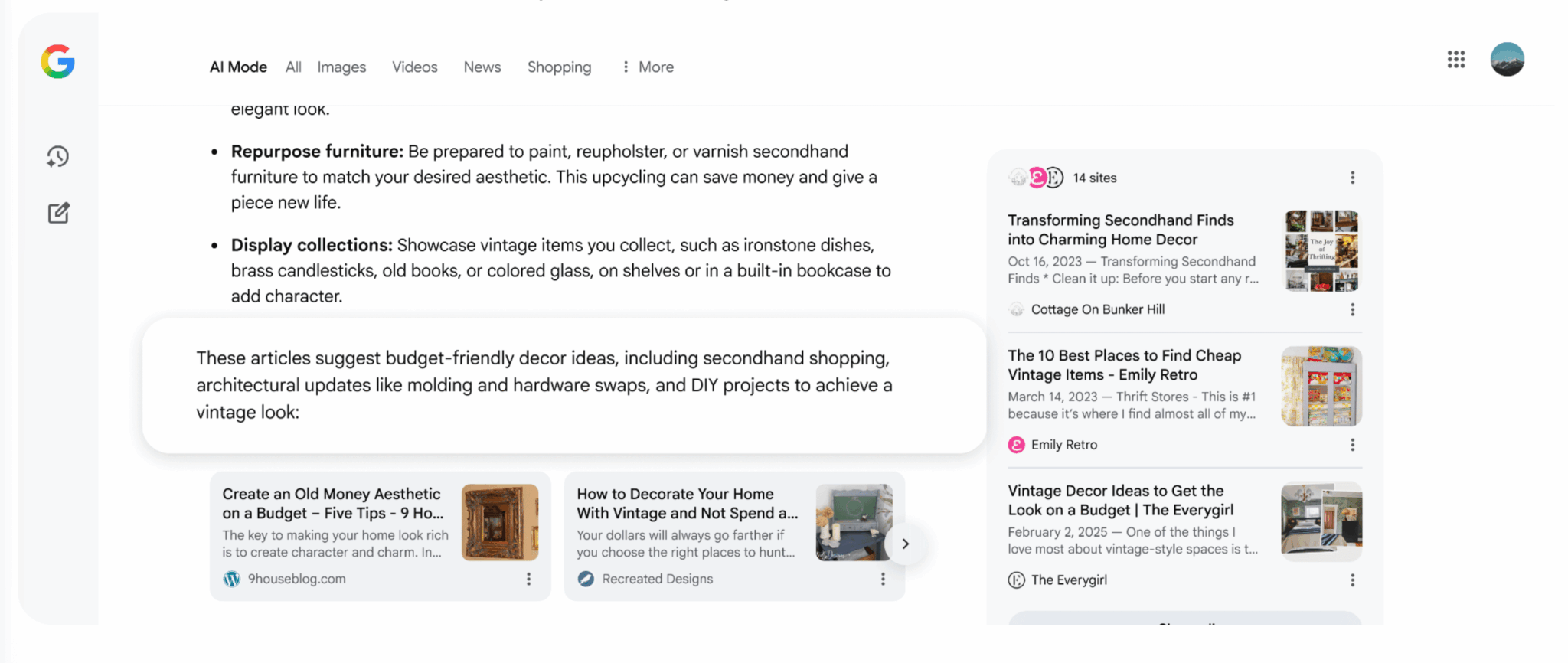
Links in AI Mode. Robby Stein, Google’s VP of Product for Search, shared that they’re increasing the number of inline links in AI Mode and refining their design to enhance usability. Google has been experimenting with inline links and contextual links, and now some of these user experiences are officially rolling out. Stein had mentioned back in August that these features would see the light, and here they are.
Additionally, Google’s adding contextual introductions to the embedded links in AI Mode responses. These brief statements help you understand why a particular link could be beneficial to explore.
Here’s a visual representation:
Expanding Web Guide to all tab. Google first introduced its Web Guide within the ‘web’ tab for those participating in the experiment. Now, this feature is accessible through the ‘all’ tab of Google Search, still requiring experiment opt-in.
According to Google’s statement, “We’ve heard positive feedback from users and websites about Web Guide, as it helps in discovering new links and uses AI to organize these links into helpful topic groups.”
Google also says they’ve optimized Web Guide to be twice as fast, adding to its efficiency.
What is Web Guide. As per Google’s explanation, Web Guide groups web links in useful manners. This allows pages related to specific facets of your query to be compartmentalized effectively.
“Web Guide utilizes a custom version of Gemini to better interpret both search queries and web content, enhancing its ability to bring up pages you might not have found before,” Google explained to me.
Additionally, Web Guide employs a query fan-out technique, similar to AI Mode, which launches multiple related searches at once to deliver more relevant results.
Why it matters. The enhancement of link engagement through Google’s AI features like AI Mode and AI Overviews is a positive move. I hope this leads to boosted traffic for publishers and website owners.
Web Guide is also a feature that’s gaining appreciation in the search marketing realm. I’m hopeful that Google can eventually offer this experience without needing opt-ins via the Search Labs.
I just heard some exciting news from Google! They’re expanding their Preferred Sources feature globally, after previously rolling it out in the US and India. But that’s not all—Google has announced a new feature called Spotlighting subscriptions, which will emphasize links from my news subscriptions in Gemini, and eventually, it will be integrated into Google Search through AI Overviews and AI Mode.
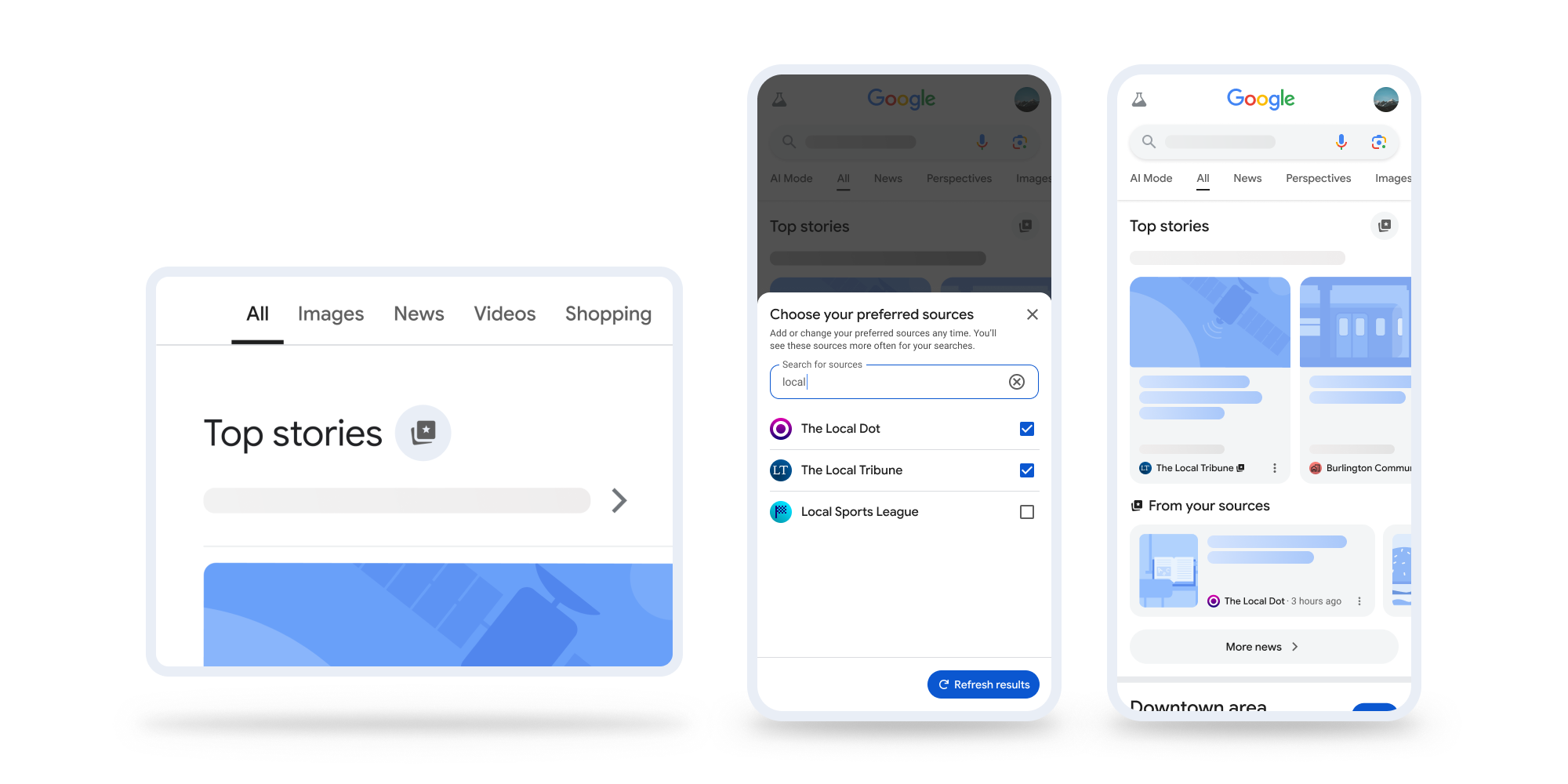
When it comes to Preferred Sources, it allows me to star sources in Google Search’s Top Stories section. This means Google will prioritize showing me more stories from those sources I’ve starred. It was first in beta last June, launched in the US and India last August, and now it’s going global!
According to Robby Stein, VP of Product at Google Search, “We’re now launching this feature globally: in the coming days, it will be available for English-language users worldwide, and we’ll roll it out to all supported languages early next year.” He also mentioned that people like me have chosen nearly 90,000 unique sources, ranging from local blogs to global news outlets.
Google shared that when I select a preferred source, I tend to click on that site twice as often on average.
So how does it work? All I have to do is click the star icon next to the Top Stories header in search results. If the site has fresh content, I can then pick it as a preferred source. Google will then display more of the latest news from those sites directly in Top Stories. This happens when those sites have relevant new articles or posts related to what I’m searching for.
Next up, let’s talk about Spotlighting subscriptions. Google is making it easier for me to notice content from my trusted subscriptions by showcasing these links prominently. It’s designed to ensure I get more value from these subscriptions by prioritizing them in a special carousel format.
This feature will launch in Gemini first, with AI Overviews and AI Mode following soon after.
Why do I care about all of this? Preferred sources in Top Stories offer a great opportunity for driving traffic to publishers. If I can encourage my loyal readers to select my site as a preferred source, it could significantly bump up my site’s traffic.
In conclusion, these enhancements from Google could offer me and the publishing community more avenues for boosting traffic and potentially increasing revenue.
I’ve discovered that LinkedIn is rolling out some exciting ad tools aimed at making B2B brand advertising more predictable and personal. These new features are designed to enhance brand awareness using premium placements, personalized messaging, and scalable AI-powered creativity.
Recently, I learned about LinkedIn’s latest innovations for B2B marketers. These tools are all about helping us strengthen brand awareness and personalize our messaging. Their aim is clear: reach potential buyers early in the sales funnel.
What’s new in LinkedIn advertising:
Firstly, Reserved Ads provide prime visibility in the LinkedIn feed. This ensures a predictable number of impressions and grabs more attention than our competitors. This format works seamlessly with Video, Thought Leader, Single Image, and Document Ads, allowing us to maximize our creative impact.
Additionally, Ad personalization empowers us to tailor messages dynamically using member profile data like first name, job title, and company. Personalized ads matter: a McKinsey study shows that while 71% of consumers expect personalized ads, 76% feel frustrated in their absence.
This isn’t all. With AI-powered creative tools, I find it easier to test various ad versions. AI Ad Variants create fresh, on-brand content from a single input. Plus, the upcoming Flexible Ad Creation, expected in early 2026, will let us upload multiple assets, which LinkedIn will mix and optimize for top performance.
Why these updates matter to me. With these tools, building a brand on LinkedIn becomes more effective. The boost in visibility and enhanced personalization capabilities simplify our creative production process immensely. Reserved Ads, for example, guarantee prime placement at the top of users’ feeds, capturing attention even when the audience isn’t actively searching.
Meanwhile, by tailoring messages dynamically (like by name, company, or job title), Ad Personalization makes advertisements more relevant. Plus, AI tools such as AI Ad Variants and the soon-to-come Flexible Ad Creation streamline our creative workflows. This allows us to test more variants quickly, enhance engagement, and reach audiences effectively at the top of the funnel.
The big picture in advertising. As buyers take non-linear, self-directed paths, establishing an early-stage brand presence is crucial. These tools help deliver scalable, personalized creativity efficiently, boosting awareness, engagement, and conversion across campaigns.
What’s next for me as a marketer. I plan to experiment with Reserved Ads, delve into ad personalization, and leverage AI-driven creative tools. This approach should enhance my impact at the funnel’s top, refine our messaging, and optimize our performance—all with minimal manual effort.
The bottom line on LinkedIn’s ad innovations. These advancements are designed to make brand building more predictable, relevant, and scalable. They enable marketers to reach the right audience with the right message at the right time.
I’m excited to share that Semify, a leading white-label digital marketing platform, has acquired Dragon Metrics, a prominent international SEO and AI reporting provider based in Hong Kong. This acquisition marks a significant enhancement in our reporting capabilities and AI optimization tools as we adapt to a shifting search landscape increasingly focused on AI.
Why this matters to you. If you’re a Dragon Metrics customer, you can continue to expect the same great service, along with more frequent product updates. According to co-founder Simon Lesser, who shared on LinkedIn, the platform will still operate as an independent brand retaining its existing contacts and product experience. Additionally, you’ll now benefit from Semify’s expanding AI optimization strategies and the potential for future software integrations.
Details of the acquisition. On December 8th, Semify announced the acquisition of Dragon Metrics:
Semify was founded in 2008 and operates as a U.S.-based white-label digital marketing platform.
Dragon Metrics was founded in 2011 and supports multinational brands and agencies in over 50 countries, especially in regions where Google isn’t the main search engine, like China, Korea, and Japan.
This acquisition provides Semify with an enterprise-grade reporting system and comprehensive global data coverage as we intensify our focus on AI-driven metrics.
The finer points. Simon Lesser will take on the role of chief product officer at Semify, steering our AI optimization product strategy.
The Dragon Metrics engineering team will join forces with Semify’s team under the leadership of CTO Brian Sappey.
Our resellers are set to experience improved reporting capabilities via Dragon Metrics accounts, with more integrated solutions on the horizon.
Dragon Metrics customers will remain on their distinguished platform but with the advantage of increased engineering support.
White-label fulfillment will continue to be exclusive to approved agencies, aligning with our existing reseller model.
When it comes to optimizing B2B SaaS for artificial intelligence, I am constantly exploring new strategies to enhance visibility. It’s crucial to stay ahead of the curve, especially with the rise of zero-click searches driven by AI.
I’ve discovered that employing Answer Engine Optimization (AEO) can make a significant impact. By focusing on key strategies like defining relevant schemas, building trust signals, and utilizing citation tactics, I can ensure that my SaaS solutions remain visible in these challenging search environments.
When I think about Google’s Local Pack, I realize it’s not a random selection process. It’s a calculated move to reward ‘signal-fit’ brands that truly reflect user expectations.
From my experience, I see that Google isn’t prioritizing brands based on flashy ads or perfect images. Instead, they favor businesses that align with immediate user needs. This is why the traditional checklist for local SEO is outdated; it fails to account for varying customer behaviors.
In essence, Google is selective, but it favors those who fit the ‘signal-fit’ criteria. Their algorithm is far from arbitrary—it is finely attuned to intent and behavior within specific categories.
Recent trends challenge the old assumptions about Google’s algorithm. It’s not a one-size-fits-all formula; rather, it adjusts based on how individuals search. Expecting a generic strategy to work across different industries—like a burger place versus a dental practice—is unrealistic.
What the Data Shows
Through Yext’s analysis of 8.7 million Google Business Profiles, it’s clear that neither brand size nor ad budget guarantee visibility. What truly makes a difference is ‘signal fit’—how well a listing meets local users’ expectations. (Disclosure: I’m the senior director of Yext Research.)
Factors like review frequency, photo quality, and profile completeness all matter, but their impact varies by industry and region. Google’s priorities differ based on these specifics, highlighting its preference for alignment with local contexts and user needs.
For businesses with multiple locations, a distinct strategy for each is essential. You can’t force your way into the Local Pack. Industry-specific signals are key to success in this dynamic environment.
The concept of ‘signal-fit’ is best seen through industry-specific nuances where Google’s algorithm adapts to unique consumer expectations.
Hospitality: Practical information outweighs visual appeal. Hours, descriptions, and comprehensive profiles are crucial, while excessive photos offer little extra value. Travelers prioritize essential details over pretty pictures.
Healthcare: Patient satisfaction and accessibility are paramount, with reviews, accurate hours, and clear location details being more impactful than visuals. In healthcare, trust stems from reliability.
Retail: Customer opinions carry significant weight. Review volume and sentiment sharply define leaders from laggards, second only to healthcare. A polished listing indicates a well-run store, while neglect hints at mismanagement.
Food and Dining: This category is competitive, with review ratings and consistent engagement being the most important signals. Profile completeness matters less than responsiveness and active feedback.
Financial Services: Trust is built through reputation and real-world experience, with genuine reviews far outweighing polished photos in establishing confidence.
Regional variations influence these rules slightly but don’t overturn them. For instance, Northeast restaurants benefit from social media links, while healthcare listings in certain areas value other attributes.
Google’s notion of ‘relevance’ remains inherently local, always aligning with regional consumer expectations.
How to Align Each Location with Local Consumer Signals
Optimizing Google Business Profiles requires attention to vertical-specific nuances. Treating each location identically simplifies processes but sacrifices visibility where it counts.
Local SEO strategies must be regularly reassessed because a universal checklist approach is no longer viable. Agility is key.
Measure the localization effects: Evaluate each location within its unique context, understanding user interactions and preferences.
Prioritize relevant signals: Focus on GBP features that matter most for your business category, optimizing for relevance rather than routine.
Implement continuous testing: Treat local SEO as an ongoing experiment. Utilize test markets to compare strategies and identify effective approaches rapidly.
Foster authentic engagement: Engage with reviews as part of an ongoing conversation. Quick, sincere responses build credibility with both customers and algorithms.
Maintain your digital footprint: Keep information current. Even small updates can lead to significant gains; a 1% increase in updates can boost Google clicks by 2.23%.
Why Precision Will Decide Who Gets Seen Next
Google continually evolves with user behavior, learning and adapting. Generic SEO approaches have their limits and can cost revenue.
While ‘best practices’ might keep you on the radar, they won’t ensure success in a competitive landscape. As AI condenses search choices, visibility depends more than ever on precision.
A localized GBP strategy isn’t just beneficial—it’s essential. Google’s Local Pack rewards relevance, not routine. By transcending generic methods and embracing precision, marketers can leverage local SEO powerfully.
Align with consumer signals, and your brand will keep its visibility even when the SEO playbook changes.
The real threat is not doing anything differently; it’s doing the same thing everywhere.