I recently learned that Google’s first core update of 2026 has finally wrapped up after a 12-day rollout. Now, it’s time to understand its impact and refine our content strategies accordingly.
Google confirmed the conclusion of this update at 06:12 PDT through their Search Status Dashboard. The changes began on March 27, affecting search rankings globally.
Google described this as “a regular update designed to better surface relevant and satisfying content for searchers from all types of sites.”
Initially, Google estimated that the update would take up to two weeks, starting on March 27 and concluding on April 8, lasting exactly 12 days and 4 hours.
This update was the first of the year following the March 2026 spam update and the February 2026 Discover update. Core updates generally result in noticeable changes in search results due to broad alterations to Google’s ranking systems.
If you’ve been affected by these changes, it’s important to remember Google’s standing advice: drops in rankings are not necessarily indicative of issues with your site.
Recovery is often tied to future updates rather than immediate fixes. Try to focus on creating helpful, reliable, and people-first content.
With the rollout complete, I can now evaluate its impact with greater confidence. It’s time to analyze changes in rankings and traffic, pinpoint key changes, and adjust our content to align with what this update favors.
Here’s a brief timeline of recent core updates for reference:
Most product feeds are traditionally geared towards paid media. But I’ve discovered aligning them with organic search behaviors significantly enhances visibility across Shopping and AI platforms.
When I ask most e-commerce brands who manages their product feed, the response is usually the same: the paid media team is in charge.
Often, a feed management tool is categorized under PPC. It might even be a relic created by the shopping team years ago, with titles that haven’t been updated since. SEO, unfortunately, rarely has its say in these strategies.
Whether you’re focused on AI-powered search or traditional clicks, excluding SEO from your product feed strategy means missing out on substantial opportunities.
AI Shopping Results Are Connected to Google Shopping Data
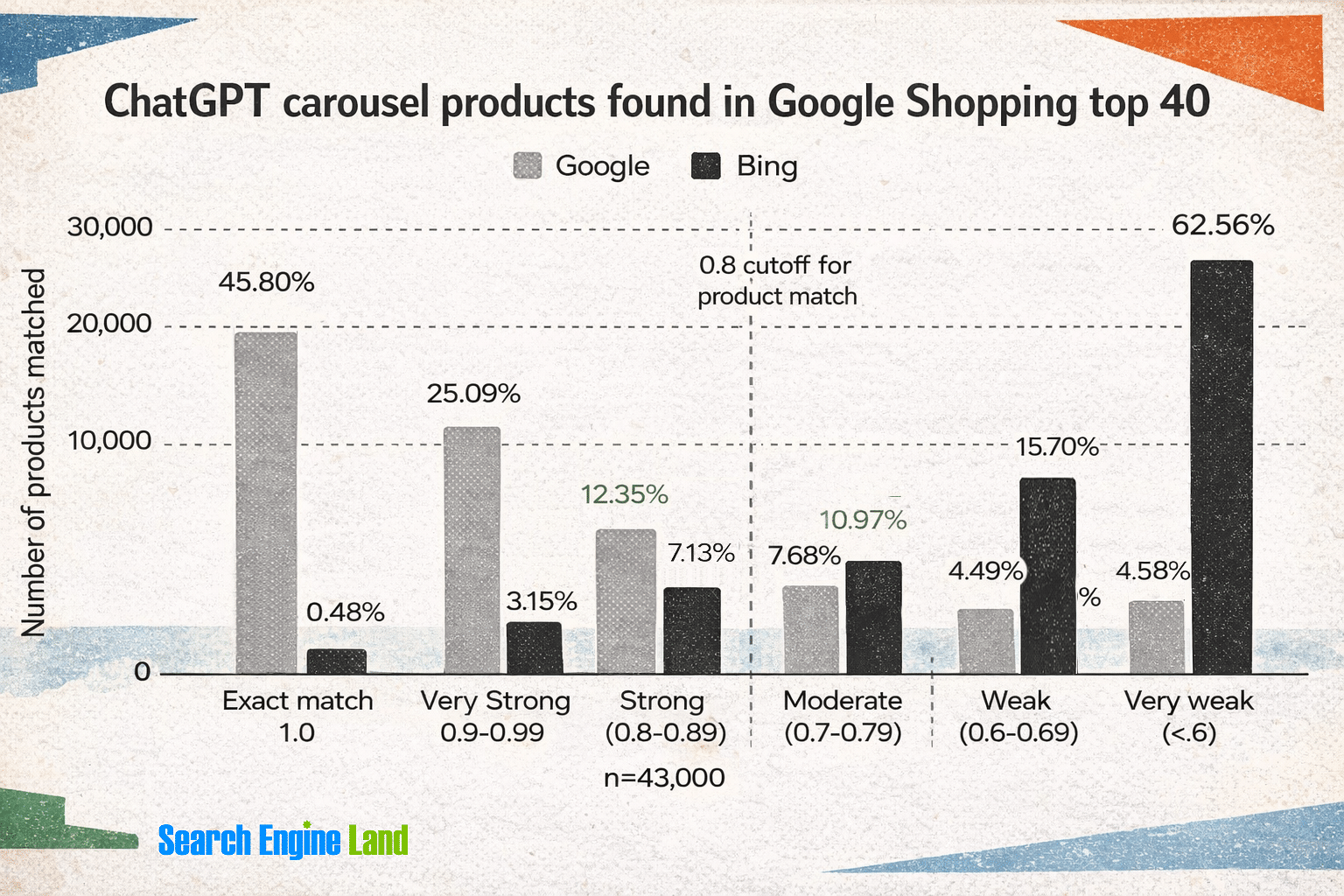
According to a recent Peec AI study, up to 83% of ChatGPT carousel products reflect Google’s organic Shopping results—and 60% of those are from Shopping positions 1-10.
Data shows how ChatGPT’s product carousel matches Google Shopping’s organic results, with Google dominating over Bing.
On Google’s side, their Shopping Graph includes over 50 billion product listings, directly feeding AI Overviews, AI Mode, and Gemini. AI Overviews now appear in about 14% of shopping inquiries, a leap from roughly 2% in late 2024. As I’ve seen, AI search results are still largely based on the traditional search engine result page (SERP).
SEO is vital for establishing brand authority. It opens up valuable opportunities to collaborate across channels for improved search visibility. It’s time for SEOs, commerce, and paid media teams to come together.
The Case for a Dedicated Organic Feed
Most brands run a single product feed aimed at Google paid shopping campaigns. The focus is often on optimizing titles for bid relevance and descriptions for Quality Score rather than for user search behaviors.
As user search habits evolve, aligning product data with search queries becomes increasingly important. A title with too many paid-friendly modifiers doesn’t necessarily match natural search queries.
When we tested this with a major ecommerce brand, our agency’s AI SEO team worked with the commerce team to create a dedicated product feed just for organic listings. Optimizing specifically for organic visibility made a world of difference.
After implementation, we saw the following results:
Organic listing CTR increased by 10% month over month and purchasing rates rose by 4%.
A product-level test revealed a 92% increase in revenue for free listings, with an 83% increase in visibility and a 14% rise in add-to-cart rates.
Organic optimizations alone generated 35,000 impressions with a 1.4% CTR—55% higher than paid CTR for the same period.
We recognized that our paid and organic strategies serve different needs, so they should be optimized independently. Organic feed titles should reflect how customers naturally search.
What to Prioritize in an Organic Feed Strategy
Not all feed attributes are equally important. Whether you’re setting up a dedicated organic feed or auditing an existing one, these elements are essential starting points.
Focus on Titles as the Key Lever
Google’s algorithm favors feed titles highly in matching products to queries. As Google documentation suggests, including significant attributes can lift performance. Consider what customers might conversationally say when searching for your product.
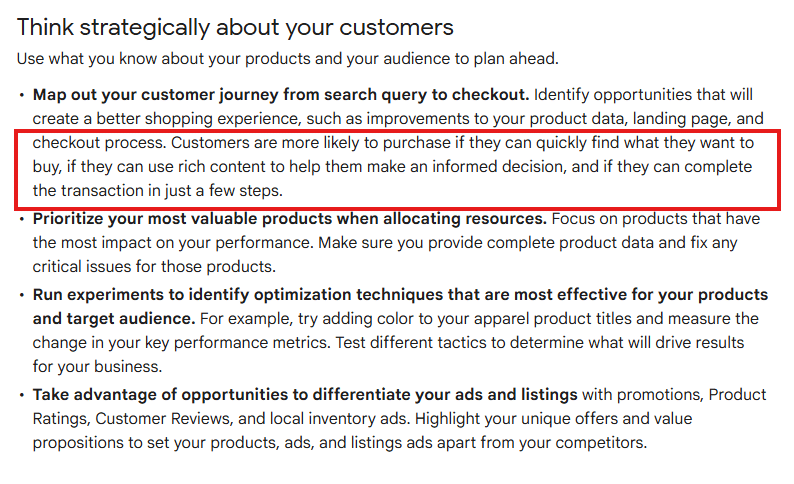
Google’s Merchant Center documentation emphasizes aligning your feed strategy with how customers shop, enhancing their search journey.
Don’t Neglect Global Trade Item Numbers (GTINs)
According to Google’s GTIN documentation, products with accurate GTINs gain significant visibility. Data shows well-matched products can attract up to 40% more clicks and are key in aggregating reviews.
Images Add Value
Images are often flagged in Merchant Center disapprovals. Products with both standard and lifestyle images engage more users. Google’s Product Studio can assist in editing, helping SEO and creative teams work together on feed assets.
Optimize Key Attributes: product_highlight and product_detail
product_highlight allows you to add concise benefit statements in Shopping views. Descriptions like “water-resistant for light rain commutes” are more beneficial than vague terms like “high-quality material.”
product_detail gives structured specs that influence Google’s filters in product grids.
The semantic optimization SEOs apply to product pages should guide feed attributes. Product and content teams’ insights are vital not just for PDPs but also for feeds.
Your Feed is Your Agentic Commerce Foundation
Investing in feed optimization for organic visibility will prepare your brand for the agentic commerce landscape.
Google’s Universal Commerce Protocol is essential for AI agents to complete transactions directly in AI Mode and Gemini. Feeds entering the Shopping Graph fuel AI responses to shopping requests.
Google added the native_commerce attribute for UCP-powered buy buttons across Google services. Several new conversational commerce attributes will soon be available, which means feed and on-page content must be in sync.
Building a Cross-Channel Strategy for AI Search
Product feed strategy is ideal for cross-team collaboration to test, execute, and measure brand visibility. A harmonized approach across all surfaces benefits both traditional and AI-driven search outcomes.
SEOs contribute keyword intelligence and semantic insights about AI system matching.
Commerce teams manage product data and retail relationships.
Paid teams have the infrastructure and expertise in feed health management.
These teams should collaborate to create a unified AI SEO strategy. Reviewing existing feeds and gathering all relevant stakeholders is essential to developing a comprehensive and effective product feed strategy.
I’ve noticed that the search landscape is evolving quickly, and it’s crucial for our companies to adapt. Are we appearing in Large Language Model (LLM) and AI-driven searches?
To thrive in this new era, understanding the Answer Engine Optimization (AEO) landscape is essential. Let me guide you on how to optimize your presence in AI search to stay ahead.
I’ve been intrigued by how Google Search is set to transform. Sundar Pichai, the CEO of Alphabet, recently shared on the Cheeky Pint podcast that search is moving away from just providing information and answers. Instead, it’s evolving into a dynamic system that can complete tasks for us.
Why this matters to us: This shift marks Google’s transition from being a tool for information retrieval to becoming an assistant in task execution, which I’m sure will enhance our web interactions significantly.
Search’s agentic evolution: Sundar Pichai illustrates that our traditional way of searching is already seeing changes, and it’s only going to continue evolving.
He mentioned, “If I fast-forward, a lot of what are just information-seeking queries will be agentic in Search. You’ll be completing tasks. You’ll have many threads running.”
Pichai envisions a future where Google Search serves more as an agent manager, coordinating various actions for us. It’s like having multiple agents accomplishing different tasks, allowing us to get so much more done efficiently.
The CEO notes, “Search would be an agent manager in which you’re doing a lot of things. I think in some ways, I use Antigravity today, and you have a bunch of agents doing stuff. I can see search doing versions of those things, and you’re getting a bunch of stuff done.”
AI Mode’s impact: Pichai highlights that users are adapting their search behavior with Google’s AI functionalities. Even now, people perform deep research queries that redefine traditional search activities, implying that we’re already on a path to using search for more complex, long-running tasks.
He explains, “But today in AI Mode in Search, people do deep research queries. That doesn’t quite fit the definition of what you’re saying. But people adapted to that. I think people will do long-running tasks.”
Search and Gemini coexistence: Despite the introduction of Gemini, Sundar assures us that Google Search isn’t going anywhere. Instead, both will coexist and evolve together, balancing between some areas of overlap and profound divergence. This dual strategy aims to enhance how we utilize these technologies daily.
“We are doing both Search and Gemini. They will overlap in certain ways. They will profoundly diverge in certain ways. I think it’s good to have both and embrace it,” he shared.
I recently came across an intriguing Semrush study that revealed some fascinating insights into ChatGPT’s traffic patterns. Despite a whopping 206% increase in referrals, surprisingly few sites actually see significant traffic. This is largely because many queries are backed by pre-trained knowledge rather than live web searches.
According to the study, over 30% of outbound clicks go to just 10 domains. Google alone claims more than 20% of these clicks. It’s intriguing to see how much weight the tech giant holds in this landscape.
ChatGPT is gradually leaning less towards live web searches. It only triggers search functions in 34.5% of queries now, a decline from 46% in late 2024. This shift indicates a change in how the platform’s role is evolving in navigating the web.
Let me break it down further. Although ChatGPT’s referral traffic saw a significant rise, the traffic mainly flows towards a limited number of sites. In fact, about 21.6% of this traffic heads straight to Google, followed by nine other domains that make up a total of just over 30%.
Many other websites are left with a small fraction of residual traffic. The number of domains receiving any referrals peaked at around 260,000 in 2025 but has since settled near 170,000.
Why is this important for us? The visibility on ChatGPT doesn’t always translate directly into traffic. Often, the impact of referrals may seem marginal. Plus, the decline in search-triggered queries makes securing citations and traffic even more challenging.
While ChatGPT defaults to pre-trained knowledge, it resorts to web searches in certain scenarios, like when users request sources, inquire about current events, or when the model shows uncertainty.
I’ve noticed a shift in user behavior—most ChatGPT prompts don’t mirror typical search queries. Instead, between 65% and 85% reflect complex, conversational inputs, indicating a transformation in engagement. Interestingly, the number of queries per session jumped 50% in late 2025.
Looking into the data, Semrush analyzed over a billion lines of U.S. clickstream data between October 2024 and February 2026. This analysis tracked prompts, referral destinations, and patterns in search usage.
For those interested, more detailed insights can be found in the ChatGPT traffic analysis. The study, titled “ChatGPT traffic analysis: Insights from 17 months of clickstream data,” is an enlightening read.
I’ve been exploring some fantastic new features on Google Maps, and I’m excited to share how they’ve transformed my experience. With recent updates, sharing photos, reviews, and local insights has become more intuitive, thanks to the introduction of AI-generated captions powered by Gemini.
Local Guides Redesign. If you’re like me, who enjoys contributing to Google Maps, you’ll appreciate the revamped Local Guides profiles. Now, our total points and levels are prominently displayed, and the badges have received a fresh new look!
Top contributors like us can enjoy greater visibility in reviews, thanks to new gold profile indicators that help us stand out.
AI Caption Drafts. Another noteworthy addition is the AI-generated caption drafts. Gemini is there to assist us by analyzing selected images and suggesting text we can either edit or discard, offering a smoother captioning experience.
Currently, these caption suggestions are available in English on iOS in the U.S., with plans for broader availability on Android and globally.
Media Sharing. Sharing photos and videos has never been easier. Recent uploads are now showcased directly in the Contribute tab, speeding up the sharing process.
By allowing media access, Google Maps helps us by suggesting images from our camera roll that are ready for sharing with just a tap. This feature is live on iOS and Android across the globe.
Why We Care. These updates not only enhance content creation but also potentially boost our local content visibility and search rankings. This could influence which reviews we trust and which businesses receive more attention.
The journey into SEO’s future is personal for me. When I think of ‘Mad Men,’ it’s more than a show; it’s an era of advertising where persuasion reigned supreme. It’s fascinating to see how today’s AI influences SEO in a similar way, deciding visibility based on a brand’s positioning, proof, and online presence.
I recall the early days of the internet, where simply getting a brand found was the goal. Google streamlined that process, making SEO a crucial part of marketing. But now, AI drives a new layer of SEO that many still misinterpret.
Interestingly, AI is revealing gaps in traditional SEO practices. Brands won’t capture AI’s attention by just pumping out content; rather, they must appeal through strategic positioning and persuasive narratives, just like Madison Avenue did.
Back when SEO was emerging, content felt like king, but it was a means to an end. For many businesses, it shifted from serving customers to gaming search algorithms—it’s a narrative that’s changing.
I can see how AI is absorbing the informational retrieval once handled by search engines, pushing users straight to answers rather than through a maze of links. This shift highlights how SEO is becoming more about impactful marketing.
Reflecting on the “4 Ps” of marketing, traditional SEO was all about place. Today, I feel the challenge lies more in earning preference through AI’s lens, transforming from being found to being favored.
Those AI-driven recommendations boil down to good old advertising principles. It’s about guiding choices invisibly, which AI does through recommendations rather than ads.
Understanding AI recommendations is crucial. These systems weigh evidence like reviews and brand prominence, similar to how we humans rely on social proof and authority to make decisions.
I realize that if a brand isn’t actively testing and optimizing for AI recommendations, it’s missing out, especially as these recommendations can quietly sway market outcomes.
Now, I see my website—our digital face—as more than a stopping point. It’s an advocate for preference, needing clear differentiation and purpose to stand out in AI and human evaluations alike.
True commercial copywriting must articulate value and sharpen the proposition for potential customers, standing out in a sea of content vying for attention.
The future seems to demand that we move beyond keyword-centric strategies. To truly prepare, we need to craft compelling arguments for why our brand deserves to be recommended and seen.
As I explore strategies to remain relevant, it’s clear—the focus shift is from visibility to building persuasive, evidence-based branding through various channels, including digital and traditional PR.
Even amidst all the change, core SEO fundamentals still hold their ground. Understanding technical optimization, site architecture, and secured recommendation visibility remain indispensable.
Winning in this landscape means embracing a hybrid approach, merging SEO with branding, PR, and strategic infrastructure. It’s about ensuring our brand is not just found, but chosen, guided by both traditional tactics and cutting-edge AI understanding.
I am thrilled to share the news of an exciting new partnership that is set to revolutionize the way we connect AI visibility data to tangible citation outcomes and impacts.
This collaboration promises to enhance the visibility of AI-generated insights and effectively translate them into actionable citations, thereby amplifying their real-world influence.
In a world where AI continues to drive change and innovation, ensuring that these contributions are recognized and used is crucial, and this partnership is a significant step in that direction.
Recently, I’ve found myself pondering whether low-quality listicles are starting to lose their footing in Google Search. Imagining the golden days when simple top-ten lists ruled the web raises the question: will they continue to thrive or face obsolescence?
I’ve learned that Google has noticed these weak ‘best of’ lists and is actively working to combat this issue in both Search and Gemini. Interestingly, if I were to rank my own product as number one in my “best of” list, it could not only be a search-quality dilemma but also a possible violation of new FTC regulations that took effect in October 2024.
Driving the news. Lily Ray pointed out on LinkedIn that the FTC’s Consumer Review Rule (16 CFR Part 465) bans several deceptive practices involving reviews and testimonials. Examples include presenting company-managed content as independent reviews, publishing reviews of products never used, and attributing reviews to unwritten sources.
Presenting company-controlled content as independent reviews.
Publishing reviews of products or services never actually used.
Attributing reviews to people who didn’t write them.
Faced with penalties reaching up to $53,088 per violation, where each page could potentially be judged separately, it’s wise to rethink our approach. Lily also shared a reference table created alongside Claude, providing further insight.
Why now? Over the past couple of years, “Best X” and “Top 10 Y” listicles have become a popular GEO tactic, performing well in search and even influencing AI-generated answers. But their heyday may now be at risk.
The backstory. Before the FTC rule was finalized, some companies faced legal challenges for producing hundreds of “best of” pages that ranked their own services top, fabricated competitor reviews, and used counterfeit testimonials.
Ranked its own services #1.
Included fabricated competitor reviews.
Used fake reviews on third-party platforms.
The Better Business Bureau later reprimanded these companies for their unsubstantiated claims.
What’s happening. Today’s listicles frequently follow this pattern: publishing “best tools” lists, including untested competitors, applying subjective scoring, and placing their own brand at the top. They often give the illusion of independence or firsthand evaluation.
A brand publishes a “best tools” list.
Includes competitors it hasn’t tested.
Uses subjective or invented scoring systems.
Ranks itself #1.
The nuance. While it’s still possible to create comparison content featuring your own product, the FTC suggests heightened risk when implying objectivity, using non-genuine reviews, or failing to disclose material relationships.
You imply objectivity, but promote your own product.
You present reviews not based on real experience.
You fail to clearly disclose material relationships.
What Google is saying. Google acknowledges the trend towards low-quality listicles. A spokesperson informed The Verge that Google imposes protective measures against such manipulation in both Search and Gemini. They continue to advise creating content intended for real people, ensuring it’s comprehensible to search systems.
Why we care. The strategy that once provided high visibility might now bear risks, not only from regulatory authorities but also from possible changes to Google’s search algorithms. Consequently, this former GEO mainstay might see a rapid decline as its influence diminishes.
Caveat. I must emphasize I’m not a lawyer. It’s always best to consult your own legal counsel if you’re contemplating the continued use of this tactic.
I’ve come across some fascinating findings that demonstrate the prowess of human-written content on Google. According to data from Semrush, it turns out that content crafted by us, humans, stands a significant chance of claiming the top spot in Google’s search results, unlike its AI-generated counterpart.
The Semrush study, analyzing 42,000 blog posts, revealed that human-written content dominates the No. 1 position on Google 80% of the time. In comparison, purely AI-generated pages manage to capture this coveted spot only 9% of the time.
The details. Semrush conducted an analysis of 20,000 keywords and their top 10 results, utilizing an AI detector to classify the content.
Human-authored pages outshined both AI-generated and mixed content across all top 10 positions.
The gap was most pronounced at Position 1, where human content had an 8x higher likelihood of ranking.
Meanwhile, I noticed that AI-generated content tended to appear more frequently in the lower spots on Page 1, with a nearly double increase from Positions 1 to 4.
Yes, but. AI detection tools, as widely acknowledged, can be inconsistent. This inconsistency often leads to misclassifications between human and AI-generated content, introducing a degree of “fuzziness” in these classifications.Why we care. While AI-generated content can occasionally perform well, the data suggests that the insights and intuition of human writers still drive superior results. For competitive queries, originality, expertise, and sound editorial judgment remain valuable advantages.Perception vs. data. It’s intriguing that 72% of SEO professionals regard AI content as performing as well as or even better than human content. Yet, the actual ranking data clearly indicates a strong advantage for human-written content at the top.How teams use AI. It doesn’t surprise me to find that AI is widely adopted, especially in creating a hybrid workflow:
A substantial 87% of teams retain significant human involvement during content creation.
64% employ a human-led, AI-assisted approach.
AI proves most beneficial in research, drafting, and optimization stages.
However, AI usage noticeably declines for multimedia, localization, and tasks requiring heightened judgment.
What’s driving adoption. While AI speeds up output, it doesn’t consistently enhance content quality.
73% of respondents highlighted faster production as AI’s primary benefit.
Yet, only 19% asserted that it improves content quality.
About the data: The analysis’s foundation lies on 42,000 blog pages from 200,000 URLs associated with 20,000 keywords. GPTZero was used to classify content for this study, which also includes insights from a survey of 224 SEO professionals involved in content and search.The study. Does AI content rank well in search? [Survey + Data study]