I’m seeing an important shift for Standard Shopping campaigns: Google is bringing Maximize Conversion Value bidding to these campaigns without requiring a Target ROAS. That gives advertisers more room to pursue value-based optimization without immediately being locked into a specific return target.
What’s happening. Google is rolling out Maximize Conversion Value bidding for Standard Shopping campaigns, and advertisers no longer have to set a Target ROAS to use it.
Before this update, if I wanted to optimize around conversion value in Standard Shopping, I generally had to use a Target ROAS bidding strategy. Now, this new option lets campaigns focus on maximizing conversion value while giving Google’s bidding system more flexibility to find the highest-value opportunities.
Why I care. This matters because I can now use Google’s value-based bidding in Standard Shopping without being constrained by a Target ROAS goal. That gives me more flexibility while preserving the control and transparency that many advertisers still prefer in Standard Shopping campaigns.
It may also reduce the need to run feed-only Performance Max campaigns just to access Maximize Conversion Value bidding. For advertisers who prefer tighter campaign control, that is a meaningful change.
Between the lines. I know many advertisers have continued to favour Standard Shopping because it offers more visibility and control than Performance Max. But when they wanted flexible value-based bidding, they often created feed-only Performance Max campaigns as a workaround.
With this update, that workaround may no longer be necessary for some accounts.
Why advertisers should care. I can now combine the structure and transparency of Standard Shopping with a more flexible automated bidding strategy. In practical terms, this could simplify campaign setups, reduce unnecessary Performance Max usage, and make account management cleaner.
The bottom line. Google is narrowing one of the biggest feature gaps between Standard Shopping and Performance Max. For me, this gives advertisers another reason to keep using Standard Shopping while still benefiting from automated value-based bidding.
First spotted. Performance marketer Yash Mandlesha spotted the update and shared the option on LinkedIn.
I think every PPC professional has at least one mistake they wish they could erase. For Danny Gavin, founder of Optidge, it was not a failed bidding strategy, a blown budget, or a campaign that never found its footing. It was something much simpler, and in many ways, much more painful.
When Danny joined me on PPC Live The Podcast, he shared the story of a technical issue that kept landing page leads from reaching the client. For one to two months, the campaigns were still generating qualified prospects, but the client believed nothing was working because those enquiries never appeared in their inbox.
The mistake that no one spotted
At the time, Danny’s agency was still small, with only a handful of people managing client accounts. One client, an autism therapy provider, appeared to be getting strong results inside Google Ads.
Clicks were rising. Cost per lead looked healthy. From inside the ad platform, everything pointed to success.
But the client was growing more frustrated because no enquiries were coming through.
The problem was not Google Ads.
It was not the landing page.
It was the email notification system.
Every form submission was being stored correctly in the database, but a technical failure stopped the notification emails from reaching the client. Because neither side realized those emails had failed, the issue went unnoticed for weeks.
By the time the problem was found, dozens of leads had already gone cold.
Why the emotional impact was worse than the technical problem
What stood out to me was that the financial loss was not the part Danny remembered most. The harder part was the feeling that his agency had let the client down. Because he knew the client personally, the mistake felt even more personal.
His team had spent weeks reporting positive campaign performance while the client saw no return from their investment. That disconnect created guilt, regret, and a real sense of helplessness.
As Danny explained it, the agency felt as if it had taken the client’s money without delivering value, even though the campaigns themselves were actually working.
Honesty became the first step
Once the problem became clear, Danny did not try to hide it. His view is straightforward: when mistakes happen, honesty is the only response that gives you any chance of repairing trust.
Instead of making excuses, the agency investigated immediately, exported every lead stored in the database, and gave the client everything they could recover. Many of those opportunities had already gone cold, but at least the client had access to the data that still existed.
From there, the focus had to move from blame to prevention.
Building systems that stop the same mistake happening twice
That experience changed the agency’s processes in a lasting way.
Instead of relying on one notification email, Danny’s team introduced multiple safeguards:
CC’ing the agency on every lead notification.
Automatically logging every lead into a shared Google Sheet.
Testing forms regularly to confirm submissions and notifications both work.
Checking with clients routinely to confirm leads are actually being received.
Those checks are now part of the agency’s standard operating procedures. They are no longer assumptions about technology working in the background.
Why communication matters as much as optimisation
Looking back, Danny sees the technical failure as only part of the issue. Communication failed too. No one had asked the simple question: “Are you actually receiving the leads?”
Today, communication is one of Optidge’s core values.
Rather than expecting PPC specialists to manage constant client communication while also running campaigns, the agency brought in dedicated account managers whose primary role is to keep clients informed.
The lesson I took from this is simple: campaign metrics alone do not define success.
Success only happens when the client experiences the results you are reporting.
Sometimes clients remember how you responded
At first, the relationship with the client ended. Danny assumed the mistake had permanently damaged the trust they had built.
Years later, though, that same client reached out again about potentially working together. In her email, she described Optidge as the most professional agency she had worked with. For Danny, it was a reminder that clients do not forget mistakes, but they also remember how agencies respond to them.
Transparency, professionalism, and a genuine effort to improve can leave a stronger impression than perfection.
Common PPC mistakes Danny still sees today
Although this happened years ago, Danny still sees agencies making similar mistakes today.
One of the biggest is focusing only on traffic instead of business outcomes. Sending visitors to a page is no longer enough.
Strong lead generation requires understanding what happens after someone clicks.
When Danny audits accounts, he often finds agencies failing to:
Feed qualified lead data back into advertising platforms.
Review search terms thoroughly and maintain negative keywords.
Build landing pages that match campaign intent.
Measure lead quality instead of simply counting conversions.
Without those fundamentals, campaign optimisation is based on incomplete information.
Where AI is genuinely helping lead generation
Danny believes AI has real potential in lead generation, but not always in the way marketers expect.
One of the most useful opportunities is phone call analysis.
Instead of manually listening to every conversation, AI can now help agencies:
Generate call transcripts.
Categorise calls by quality.
Identify whether a call became a genuine sales opportunity.
Feed qualified conversion data back into Google Ads.
That makes it possible to optimise around real business outcomes instead of surface-level metrics.
Why AI still needs human oversight
Even though Danny is using AI, he does not treat it as an infallible system.
Like automation inside advertising platforms, AI can make mistakes, miss context, and confidently reach the wrong conclusion.
For industries with strict privacy requirements, such as healthcare, AI may not be appropriate for handling sensitive customer information at all.
His advice is to trust AI enough to improve efficiency, but always verify the work.
Human expertise still matters.
The biggest lesson
I do not think any PPC professional can avoid mistakes completely.
What defines a strong agency is how it responds when something goes wrong.
That means being honest, fixing the immediate problem, building safeguards, and making sure the same issue does not happen again.
As Danny puts it, a mistake only becomes valuable when you have genuinely learned from it.
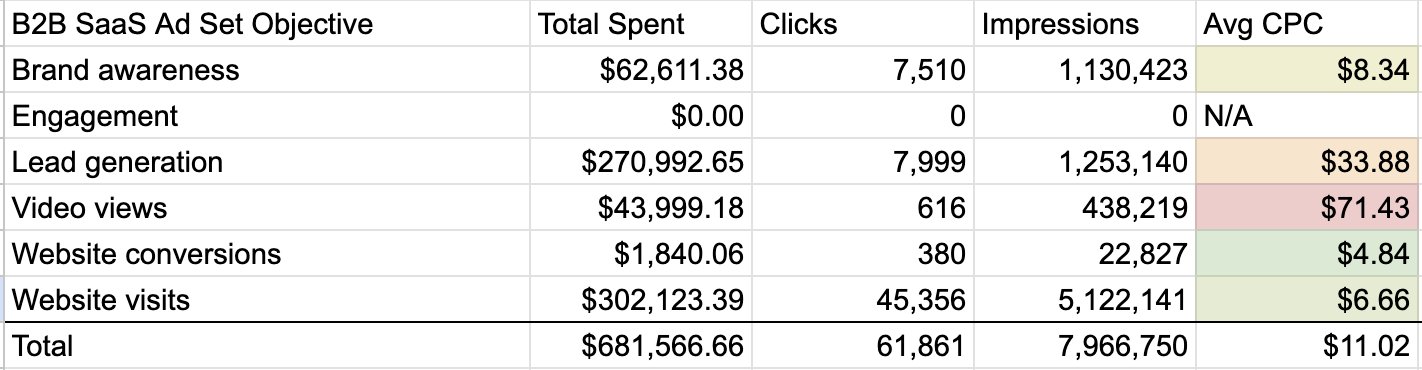
I know LinkedIn Ads has a reputation for being expensive, and at first glance, the data backs that up. Across the client accounts I analyzed, LinkedIn’s average CPC was $11.12, compared with $5.45 on Google Ads.
But that simple comparison misses the more useful story. When I compare the cost of reaching new, high-intent B2B buyers, the gap gets much smaller. Non-branded Google Search campaigns averaged a $12.48 CPC, while comparable LinkedIn prospecting campaigns averaged $13.94.
To understand how LinkedIn CPCs really compare with Google Ads across campaign types and industries, I reviewed more than $700,000 in LinkedIn ad spend and compared it with CPC data from the same accounts on Google Ads.
What I included in this analysis
I focused on CPC and performance data from clients that had active campaigns on both LinkedIn Ads and Google Ads over the past year.
The main questions I wanted to answer were straightforward: What CPCs are we actually seeing? Do CPCs change by ad objective and industry? And how do those costs compare with Google Ads?
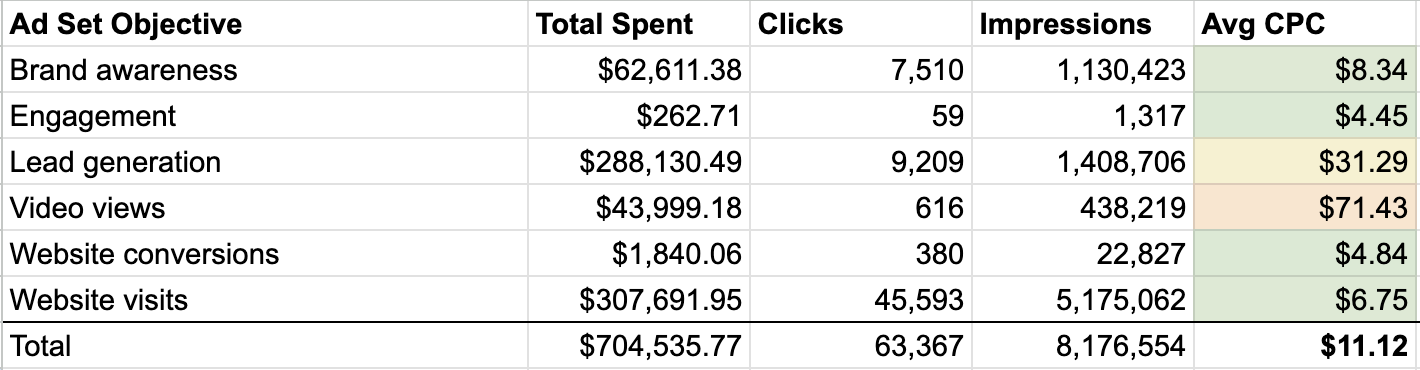
For LinkedIn Ads, I analyzed more than $700,000 in spend across 63,000+ clicks and 8.1 million impressions.
The clients fell into two main business categories: B2B SaaS, which represented approximately 97% of spend, and professional services.
I looked at LinkedIn CPCs by ad set objective and business category. For Google Ads, I pulled CPC data from the same client accounts across branded search, non-branded search, Demand Gen, and display campaigns.
Client names are withheld. The date range for this analysis was May 2025 through May 2026.
LinkedIn looks more expensive, but the comparison needs context
LinkedIn’s blended average CPC across all objectives was $11.12. Google’s blended average CPC across all campaign types was $5.45. On the surface, LinkedIn costs about twice as much per click.
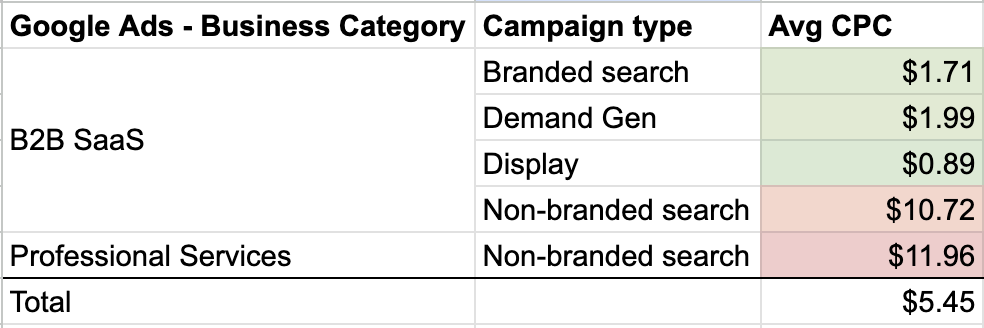
There is an important caveat. In Google Ads, a large share of those lower-cost clicks came from display campaigns, which averaged $0.89 per click, and branded search, which averaged $1.71 per click. Both are naturally less expensive because display generally reaches lower-intent audiences, while branded search captures people already looking for your company.
When I narrow the comparison to the cost of reaching new, high-intent audiences, the difference becomes much less dramatic.
Google Ads non-branded search averaged a $12.48 CPC across the clients in this study.
LinkedIn prospecting campaigns, excluding retargeting and using lead generation, website conversion, or website visit objectives, averaged a $13.94 CPC.
I used those LinkedIn objectives because they most closely represent high-intent direct-response campaigns, which makes the comparison with non-branded search more useful.
When I compare the cost of reaching a new audience, LinkedIn is still more expensive, but it is not twice as expensive. In practical terms, I am looking at roughly $12 CPCs on Google and $14 CPCs on LinkedIn.
LinkedIn CPCs change a lot by objective
One of the clearest findings in this data set is how widely LinkedIn CPCs vary by campaign objective.
Website visits: $6.75
Brand awareness: $8.34
Website conversions: $4.84
Engagement: $4.45
Lead generation: $31.29
Video views: $71.43
Lead generation campaigns, where LinkedIn lead gen forms capture contact information directly inside the platform, cost nearly five times more per click than website visit campaigns.
That higher CPC can still make sense because these campaigns often convert at much higher rates than ads that send people to a website or landing page.
Here is the full breakdown of CPCs by campaign objective:
The number that jumps out most is video views. CPCs for those campaigns look extremely high, but cost per view is the more relevant metric there, so CPC alone can be misleading.
If I were planning a LinkedIn campaign focused on click volume or site traffic, I would budget for CPCs in the $6-$8 range. For lead gen ads, which in my experience often produce stronger conversion rates and better lead quality, I would plan for $30+ CPCs.
LinkedIn CPCs also change by industry
The two business categories in this analysis showed noticeably different CPC profiles on LinkedIn.
B2B SaaS: $11.02 average CPC on $681,000 in spend
Professional services: $15.25 average CPC on $23,000 in spend
I would be careful not to overstate that comparison because the spend levels were very different. B2B SaaS had a much broader mix of campaign types, which likely affected the average CPC. The professional services campaigns also used very specific targeting, which may have pushed CPCs higher.
B2B SaaS CPCs by campaign objective:
Professional services CPCs by campaign objective:
One interesting twist is that lead gen CPCs in professional services were lower than website visit CPCs. Lead gen CPCs were also much lower for professional services than they were for B2B SaaS.
If I were budgeting for a professional services firm on LinkedIn, I would factor in $15-$20 CPCs. For B2B SaaS, I would plan for a wider range, roughly $7-$35, depending on the campaign objective.
How this compares with Google Ads
The pattern is fairly consistent across channels. Professional services had higher CPCs than B2B SaaS in this data set. Even when I compare only non-branded search between the two industries, the CPCs are closer, but professional services still comes out higher.
Here is the breakdown of Google CPCs by campaign type:
What I would budget for LinkedIn Ads
Your targeting will have a major impact on CPCs and budget needs, but I use this data as a practical planning framework.
Minimum viable budget: $3,000-$5,000 per month
Below this level, I would not expect enough traffic to drive meaningful lead volume or conversions. You may still be able to get started, but trend-spotting will be slow, and you will probably be limited to one or two campaigns.
Testing and learning: $5,000-$10,000 per month
At this level, I would expect enough budget to run two or three objectives, launch more campaigns, test creative and audiences, and generate more meaningful lead volume.
Scaling: $10,000+ per month
With this budget, I can run always-on brand awareness and thought leadership campaigns alongside lead gen and website visit campaigns. I can also support event registrations, test more advanced list-targeted campaigns, and use retargeting without starving direct-response efforts.
For B2B SaaS or professional services companies with an ACV above $20,000, I would rarely recommend starting LinkedIn with less than $5,000 per month. A single closed deal worth $30,000-$50,000 in ACV can justify meaningful investment, even at a $500+ CPL, as long as the pipeline quality is there.
The B2B channel mix I recommend
For most B2B clients, I do not see LinkedIn and Google as either-or channels. I use them for different jobs.
Use Google Ads and Microsoft Ads for intent capture
Non-branded search reaches buyers who are actively researching. Branded search and remarketing are lower-cost and essential. If someone is searching for your category keywords, I want your brand to be visible.
I also use Demand Gen and Performance Max where they make sense to fill gaps and support brand awareness.
Use LinkedIn Ads for audience-led demand generation
If the ideal customer profile is highly specific, such as VP-level decision-makers at mid-market SaaS companies, LinkedIn’s targeting is hard to replace. No other platform gives me the same ability to reach that kind of professional audience at scale.
Run both channels in parallel
The strongest setup is to run both channels together. Google captures existing demand. LinkedIn helps create new demand and keeps the brand visible to the exact buyers I want in the pipeline.
Why I still think LinkedIn is worth the higher CPCs
LinkedIn is more expensive than Google on a raw CPC basis. But when I compare the platforms more fairly, with both reaching cold, qualified B2B buyers, the gap narrows significantly.
Higher CPCs can still be worth paying if they put the brand in front of the right customers earlier in the decision-making process. Over time, that can be more valuable than relying only on high-intent keywords after buyers have already narrowed their list of options.
The best scenario is for the brand to become an active part of the buyer’s decision, shaping the narrative before competitors do it instead.
My take is simple: I use LinkedIn Ads to build intent and tell the story, and I use Google Ads and Microsoft Ads to capture intent. The right budget depends on targeting, but I want enough spend to generate at least 100 clicks per month. Anything less usually means spending money without giving the system enough data to learn from.
I used to think bad data mainly meant bad reporting. Now, in Google Ads, I see it as something much more expensive: bad delivery. When conversion data is wrong, it does not just make a dashboard confusing. It can train campaigns to spend budget chasing the wrong people.
As automation takes over more of the ad-buying process, from creative generation to bidding, data has become one of the few inputs I can still control. It may also be the most important one, because automation can only optimize toward the signals I give it.
I keep coming back to one question: what is worse, a brilliant ad shown to the wrong audience or an average ad shown to the right one? The first burns budget on people I do not want. The second may not win every click, but when someone does engage, at least they are closer to the customer I actually need.
That is why I have to ask myself a harder question before launching any automated campaign: did I spend more time verifying the data than writing the ad copy?
The cost of bad data has changed
A few years ago, bad tracking was mostly a reporting problem.
If a tag fired twice, a conversion was mishandled, a value came through incorrectly, or offline conversions stopped working for a few weeks, the main result was a dashboard that did not add up. It was frustrating, but the damage was usually limited. Someone would eventually question the numbers in a monthly review, I would trace the issue, fix it, and the next report would look cleaner.
That same data now feeds the algorithm buying paid media. Smart Bidding does not wait for me to interpret a report or sit through a monthly review. It reads conversion data and acts on it before I may even notice that something is broken.
The same wrong number now creates a very different outcome. A bad number in a report requires an explanation in a meeting. A bad number in a conversion action used for bidding costs money immediately, because the algorithm does not know the signal is wrong.
It simply optimizes toward that signal the moment it sees it, and it does so efficiently.
Google does not understand my funnel or my business
Google may let me label conversion actions as “lead,” “opportunity,” or something similar, but those labels are mainly for organization. The platform does not truly understand where each conversion event sits in my funnel.
What it sees is a conversion event with a numeric value attached to it, usually a currency value. It does not inherently know that a newsletter signup might be worth $2 in eventual value, a lead might be worth $60, and an opportunity might be worth $400. To Google, those are conversion events. Without better signals, it has no real context that one may be worth 200 times another.
The algorithm is not optimizing for my business outcome by default. It is optimizing for the data I provide. If that data is wrong, the optimization will be wrong too.
For example, if every form submission fires the same conversion with the same default value, I give the system no clean way to separate low-intent inquiries from high-value prospects. The algorithm treats them the same. And because low-quality leads are often cheaper to acquire, it can quickly flood the account with them.
The cost per lead may drop from $40 to $25, and the dashboard may make performance look more than 35% better. But behind that cleaner metric, the pipeline can dry up as genuinely qualified inquiries quietly fall by half.
Bad data can show up in different ways, but I see three issues that are especially likely to derail campaign delivery.
1. Wrong event
If I optimize for a top-of-funnel action like a page view while the real conversion events happen further down the funnel, the algorithm learns to buy more of those cheap events. The problem is that the lower-funnel activity may never follow.
2. Wrong value
If I count every conversion equally, or assign every conversion the same placeholder value, I hide the real differences in business value. When actual value can vary by 10 times or more, the algorithm will often chase the easier, lower-value conversions because they are cheaper to acquire.
3. No data
This problem does not get discussed enough. A complete break in conversion data can damage a campaign faster than almost anything else.
On Day 1, the algorithm starts wondering where the conversions went. By Day 2, it begins assuming they may not be coming back. By Day 3, it can start making serious bidding changes. Within a week, many campaigns can throttle themselves down to almost nothing.
How I pick the right signal for Google
So how do I fix this? I start by choosing the signal that best represents business value, not just the easiest action to count.
Take a typical lead generation business. Some leads will never convert, while others may be worth 10 times as much as the rest.
If the form asks the right qualifying questions, I may already know which leads are which. But if I optimize for every submitted lead using a target CPA, I am telling Google that all leads are equally valuable.
Imagine an account spending $20,000 a month at a $40 target CPA and generating about 500 leads. Only 150 qualify, and maybe just 50 are genuinely high value. A basic lead may be worth $60, a qualified lead may be worth $200, and a high-value lead may be worth $600. That is a 10 times spread in value.
In that situation, I have several ways to improve the optimization signal.
Optimize for a qualified lead: I can create a new conversion action, such as “qualified lead,” and fire it only when a lead has real value. Then I can move the target CPA strategy to that conversion action, knowing the campaign will ignore leads with no value. The advantage is that I train the campaign on a more meaningful signal. The downside is that every qualified lead is still treated equally.
Assign conversion values and use target ROAS: I can add a currency value to the qualified lead based on the potential revenue it could generate if it becomes a sale. Then I can switch the campaign to target ROAS, allowing Google to optimize for return instead of simply counting leads. The tradeoff is that it may still buy larger numbers of lower-value leads if it can acquire them at the right price.
Optimize for a high-value lead: I can create a “high-value lead” conversion event that fires only for top-tier leads, with or without a conversion value. Then I can optimize with either target CPA or target ROAS, depending on whether I care more about acquisition cost or return. The advantage is stronger lead quality. The downside is that, depending on spend and volume, the data may be too limited to support this approach until the account scales.
These are only a few possible optimization signals, and they do not even go deeper into the funnel. I can apply the same thinking to lower-funnel milestones by creating separate conversion actions for events such as contacted lead, qualified contact, or high-value contact.
Targeting and measurement can be different
This sounds simple, but the conversion event I optimize for and the one I report on are not always the same. In many cases, they should not be the same. One trains the algorithm. The other tells me how that training is performing.
In the example above, a client or internal stakeholder may still want to see cost per lead. That is a valid metric. But the campaign may be optimizing for the Qualified Lead conversion, not the original lead submission.
I can keep the original lead conversion running purely as a reporting metric, so stakeholders still get their cost-per-lead view while the campaign bids on the qualified lead signal that actually reflects business value.
Same campaign. Two conversions. Two very different jobs.
That brings me back to the question I started with: did I spend more time verifying the data than writing the ad? In an automated account, data is no longer just measurement. Data is strategy.
I have seen traditional competitor campaigns turn into expensive click traps. When someone searches for a competitor’s brand, they are often already close to buying, which means my ad can become little more than a brief detour on their way to converting somewhere else.
That does not mean I have to give up on competitor-aware audiences. Instead of relying only on competitor brand bidding, I can use Demand Gen campaigns and negative-intent keywords to reach those buyers more efficiently, often at a lower cost.
Demand Gen: Reaching the right audience for less
Before I focus on negative-intent keywords, I like to look at Demand Gen because it gives me another way to reach people who may not know my brand yet but are already showing signs of interest in my market.
For Demand Gen to work well, I need two things: strong targeting and strong creative. Within that targeting, custom audience segments and lookalike audiences are essential.
Custom segment targeting lets me reach people who have searched for specific terms on Google or who show certain interests and purchase intentions. It is also one of the most practical ways I can get in front of users researching my competitors without paying the higher price of a search click.
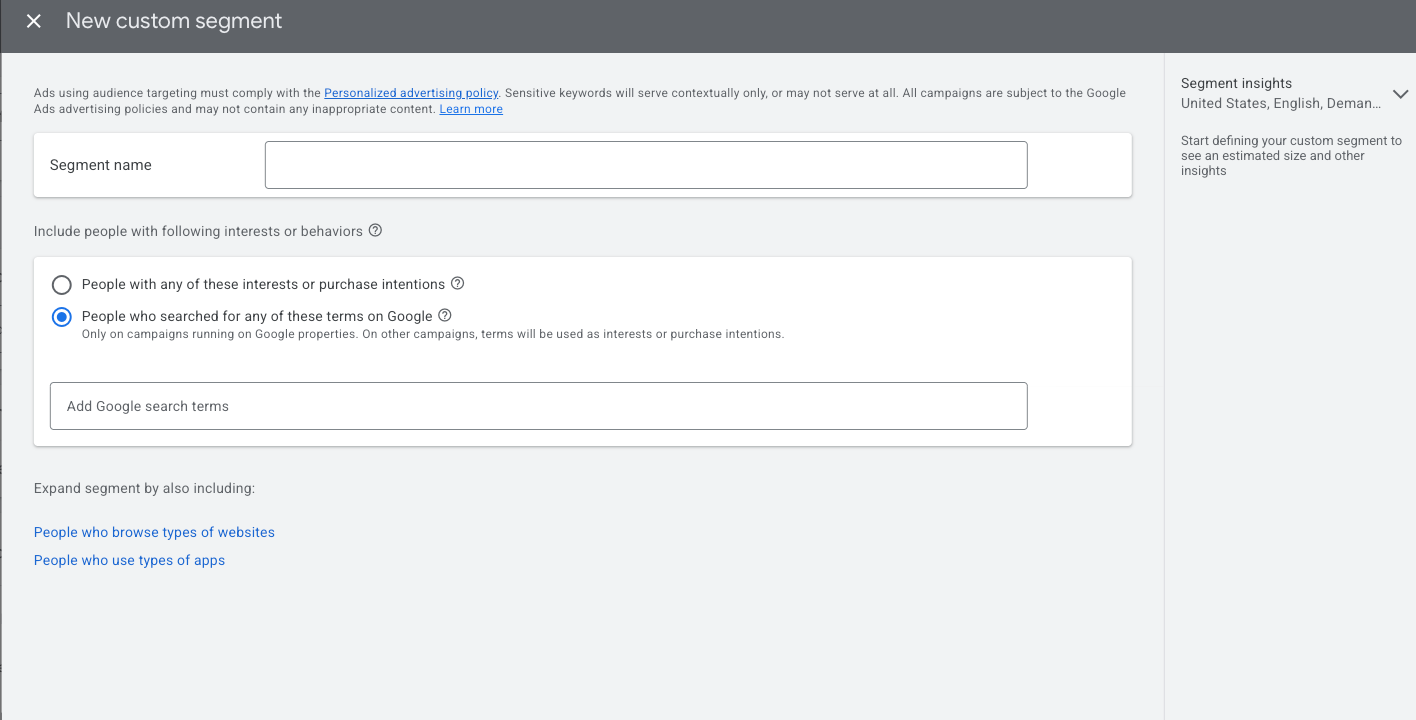
When I create a new audience inside a Demand Gen campaign, custom segments are one of the first targeting options I see, right after the audience name.
From there, I choose the option for People who searched for any of these terms on Google and add as many relevant competitors as I can. This helps me reach a highly relevant audience across Google’s inventory at a lower cost than a traditional search network click.
If I am not sure which competitors to include, I start by typing my main product or service into Google Ads and reviewing who appears. Those businesses are usually my primary competitors, and depending on the networks I opt into, my ads can appear across YouTube, Discover, and Gmail.
Designing conquesting landing pages for Demand Gen
When I use Demand Gen for conquesting, I need a landing page built specifically for that audience. I want to highlight my key differentiators, show social proof, and make it obvious why my product or service deserves consideration.
The click is only the first step. Once someone lands on my page, the offer has to be clear, specific, and aligned with the ad they just clicked. I need to explain the value thoroughly and guide the visitor toward a call to action that matches the promise I made in the ad.
But Demand Gen is not always the right starting point. If I do not have strong image or video assets, I may be better off staying closer to the search network.
Because high-quality creative tends to perform best across Demand Gen placements, search can make more sense when those assets are not available. That is where negative-intent conquesting becomes useful.
Most advertisers understand traditional competitor search campaigns, but many overlook the people who are not simply searching for a competitor. They are searching for alternatives, comparisons, cheaper options, or signs that another company can solve the problem better.
I often see this happen during the consideration phase. A user may search for terms like “companies like X,” “companies cheaper than X,” or, for branded products, “dupe for X.” Not every variation will have enough volume to bid on, but these searches reveal where serious comparison research is happening.
Building campaigns around competitor pain points
If I know a competitor has a reputation for poor customer service, I might test keywords such as “customer service complaints for [competitor].” I would keep this focused in a single ad group with closely related keyword variations.
In the ad copy, I would focus on what makes my customer service stronger, faster, or more helpful. Because of trademark policies, I would avoid naming the competitor directly in the ad text and instead emphasize the benefit I can prove.
Traditional competitor campaigns focus on bidding against a brand name. Negative-intent conquesting focuses on the weakness behind the search. The audience already knows the competitor, but they are actively looking for a better option.
I can also pair this approach with a separate custom audience, which lets me reach people searching for these alternatives across Google’s networks.
For this to work after the click, the landing page matters just as much as the keyword and ad. If my ad promises a better solution to poor service, high prices, or another competitor weakness, the landing page has to validate that claim and present a unique value proposition that directly addresses the concern.
Target competitor audiences before the decision is made
The biggest challenge with traditional competitor campaigns is not always the competitor. It is timing.
When someone searches for a competitor’s brand name, they may have already narrowed their options and moved close to a decision. That is why competitor keyword campaigns can become expensive and hard to scale profitably.
Demand Gen and negative-intent conquesting help me approach the same audience from different angles. Demand Gen lets me reach potential customers before they commit to a brand, while negative-intent conquesting reaches them when they are actively questioning their current options.
My goal is simple: I want to reach potential customers when they are most open to considering a different choice. If I can do that with the right targeting, message, and landing page, competitor traffic becomes much easier to win without overspending on traditional brand bidding.
I see Google’s latest Google Ads API change as another clear move away from legacy automation and toward newer AI-driven campaign types, especially Performance Max.
Beginning August 3, 2026, Google says developers will no longer be able to create new Smart Campaigns through the Google Ads API. For me, the key detail is that this change is about new campaign creation only.
Existing Smart Campaigns are not being shut down. They can keep serving ads, and advertisers and developers will still be able to update and manage those campaigns through the API.
What changes is the ability to create brand-new Smart Campaigns through API workflows. If I depend on automated campaign setup, that is the part I would review now.
I care about this because it signals where Google wants advertisers to go next. Smart Campaigns may continue running, but the path for new API-based campaign creation is moving toward newer products such as Performance Max, Search campaigns, and Demand Gen campaigns.
Google is specifically pointing advertisers toward Performance Max as the primary alternative. Since Performance Max runs across Google’s advertising inventory and uses AI to automate more of the campaign process, it fits the broader direction Google has been taking for years.
I also see this as part of a wider consolidation around automated campaign formats. Google has increasingly emphasized systems that handle bidding, targeting, and creative optimization across channels, and limiting new Smart Campaign creation reinforces that shift.
For developers, the practical next step is to audit any application that creates Smart Campaigns before the August 3, 2026 deadline. The affected requests are campaign creation operations where advertising_channel_type is set to SMART and advertising_channel_sub_type is set to SMART_CAMPAIGN.
After August 3, attempts to create new Smart Campaigns through the API will fail. In version 24 of the Google Ads API, developers will receive a SmartCampaignError.CREATION_FAILED error.
In version 23 and earlier, the same type of request will return an OperationAccessDeniedError.CREATE_OPERATION_NOT_PERMITTED error.
My main takeaway is that advertisers, agencies, and software providers should not treat this as a last-minute technical cleanup. If campaign creation is built into an internal tool, onboarding flow, or platform integration, I would start mapping the replacement path now.
Google is not ending existing Smart Campaigns, but it is removing a key creation path for new ones. To me, that is a strong signal that future campaign planning should center on Performance Max and other AI-driven Google Ads campaign types.
Paid search relevance is no longer just a matter of matching a keyword to an ad. It spans the searcher’s intent, the platform’s quality signals, the promise made in the ad, the information on the landing page and, in regulated sectors, the boundaries imposed by advertising and privacy policies.
Taken together, the source reports point to a practical model: use query analysis to understand demand, translate that demand into accurate ads and pages, apply compliance checks before launch, and measure whether the resulting leads are genuinely useful. Each layer constrains the others, so optimizing one in isolation can produce misleading gains.
Relevance is becoming visible to searchers
Google’s reported test of “Strongest match” and “Strong match” labels could make an internal assessment of relevance more noticeable in the search results. According to the source report, Google Ads Liaison Ginny Marvin confirmed that the experiment was intended to help people identify ads closely aligned with their queries. The test was described as limited to a small percentage of users in the United States, with no indication that the labels would become permanent.
The report also said the labels relied on existing ad-quality and relevance signals rather than a new ranking factor. That distinction matters. Advertisers should not treat an experimental badge as a separate optimization target; the durable work remains the alignment among query, ad and destination. What may change is the visibility of that alignment. If a platform explicitly identifies some ads as stronger matches, relevance can influence attention before a searcher has evaluated the copy or brand.
This creates a useful distinction between auction relevance and experienced relevance. A platform can judge an ad to be a close match, but the searcher still encounters a complete journey. A prominent label cannot compensate for an ambiguous offer, an inaccurate claim or a landing page that fails to answer the query. In sensitive categories, a message can also be highly specific yet unsuitable under advertising policy. Relevance therefore has to be assessed as an end-to-end quality, not merely a platform score.
Semantic analysis turns search terms into intent evidence
The semantic PPC report describes a set of methods for finding useful patterns in large, noisy search-term datasets. N-gram analysis separates queries into one-word, two-word and three-word units, then aggregates performance around those recurring components. In the source’s example, “private caregiver nearby” can be examined as individual words, adjacent pairs and the complete three-word phrase.
This approach connects relevance decisions to observed behavior. A recurring term associated with spend but no conversions may warrant exclusion, while a component associated with strong performance may justify its own messaging, budget treatment or landing-page experience. The source specifically described using measures such as cost, impressions, clicks, conversions and conversion value to calculate performance for each n-gram. It also cautioned that the technique needs substantial search-term volume and becomes less manageable as the size of the word combinations increases.
Two additional techniques address different forms of similarity. Levenshtein distance counts the edits needed to turn one string into another, making it useful for misspellings and near-duplicate wording. Jaccard similarity measures the overlap between sets of terms, so it can recognize queries containing the same words in a different order. The semantic PPC report presented thresholds of three and six as examples for tighter or broader grouping with Levenshtein distance, but those examples should not be treated as universal account rules.
These techniques organize evidence; they do not settle meaning by themselves. As the source notes, Jaccard similarity does not inherently understand that “New York” and “NYC” refer to the same place. Edit distance likewise measures textual change, not whether two searches express the same need. Human review and business context remain necessary, especially when similar wording can refer to different services, professional roles or levels of urgency.
Healthcare shows where relevance and compliance diverge
The medical and mental-health PPC guide illustrates why closer query matching is not sufficient on its own. It groups patient searches into symptom or treatment research, informal descriptions of a service, and correct professional or service terms. The report recommends concentrating most budget on the latter two groups, where people are generally closer to taking action, while testing broader informational demand when resources allow.
That search behavior creates a translation problem. A prospective patient may use an imprecise phrase that still communicates a legitimate need. Semantic analysis can identify recurring language and cluster variants, but the advertiser must decide whether the service actually fits the need and how to describe it accurately. Negative keywords are therefore not merely a cost-control device in this context; they also help prevent ads from appearing for services the practice does not provide.
Ad copy introduces another boundary. The medical PPC source advises against guaranteed outcomes and blunt language, including terms such as “cure,” while emphasizing practical information such as accepted insurance, payment arrangements, specializations and professional credentials. It reports that Google and Meta restrict the promotion of medical, mental-health and wellness services, and that some providers may face additional requirements. Addiction-treatment advertisers, for example, may need a LegitScript listing depending on the practice and applicable Google Ads requirements.
The implication is that the most direct wording is not always the most appropriate wording. Strong paid-search communication should recognize intent without making unsupported promises or addressing a person in an intrusive way. When an ad is rejected, the source recommends revising the language or seeking manual review where appropriate; it does not characterize every isolated rejection as evidence of an account-level problem.
An operating model for relevant, defensible campaigns
A sound workflow begins with the actual search-term record rather than an AI-generated keyword list alone. N-grams can reveal recurring modifiers, edit distance can consolidate close variants, and set overlap can expose duplicated themes. Those outputs should then be labeled by business meaning: the service requested, the searcher’s apparent stage, location or urgency, and whether the advertiser can truthfully meet the need.
Campaign structure should follow meaningful differences, not every textual variation. The semantic PPC source warns that excessive granularity can complicate reporting, bidding and account management. Consolidation is appropriate when terms share an offer and intent; separation is warranted when they require different budgets, messages, destinations or compliance treatment. This keeps semantic analysis tied to decisions rather than turning clustering into an end in itself.
Each resulting theme then needs a message-and-page review. The ad should accurately state what is available, while the landing page should resolve the questions raised by the query and explain the next action. For healthcare, the source recommends drawing on common intake questions and clearly covering matters such as eligibility, insurance, payment, treatment availability and the appointment process. Clear calls to book, call, request a consultation or submit an inquiry reduce uncertainty without requiring exaggerated claims.
Measurement completes the relevance test. The medical PPC guide argues that form submissions alone are insufficient and that inbound calls should also be tracked because they can represent high-intent inquiries. It further recommends connecting campaign data with a CRM so the practice can distinguish raw leads from people who become patients or clients. This feedback can reveal a crucial failure mode: a query may generate clicks and conversions while repeatedly producing unsuitable inquiries.
Compliance should be a recurring review rather than a launch gate that is never revisited. Search terms change, landing pages accumulate edits, platform policies evolve and automated matching can expose campaigns to unexpected queries. A defensible account keeps a record of exclusions, copy revisions, landing-page claims, approval outcomes and lead-quality findings so that optimization decisions can be explained and reassessed.
Key takeaways
Google’s limited match-label experiment, as reported, makes existing relevance judgments more visible but does not introduce a separate ranking factor for advertisers to chase.
N-grams, Levenshtein distance and Jaccard similarity can reduce search-term noise, but textual similarity must still be interpreted through service, intent and policy context.
Negative keywords protect both budget and promise accuracy by filtering demand the advertiser cannot appropriately serve.
In regulated categories, a close query match does not authorize aggressive personalization, guaranteed outcomes or claims unsupported by the destination.
Lead quality, including qualified calls and downstream outcomes, is the strongest practical check on whether apparent relevance produced useful demand.
If relevance indicators become more prominent, advertisers with coherent query, copy, page and measurement systems will be better positioned than those optimizing only for a visible platform label. The next competitive advantage is likely to come from making that coherence auditable as well as persuasive.
I’ve come across important news about Google Ads that could significantly impact how we manage our campaigns. Google is on the verge of altering its target-based bidding strategies, particularly for campaigns running on limited budgets.
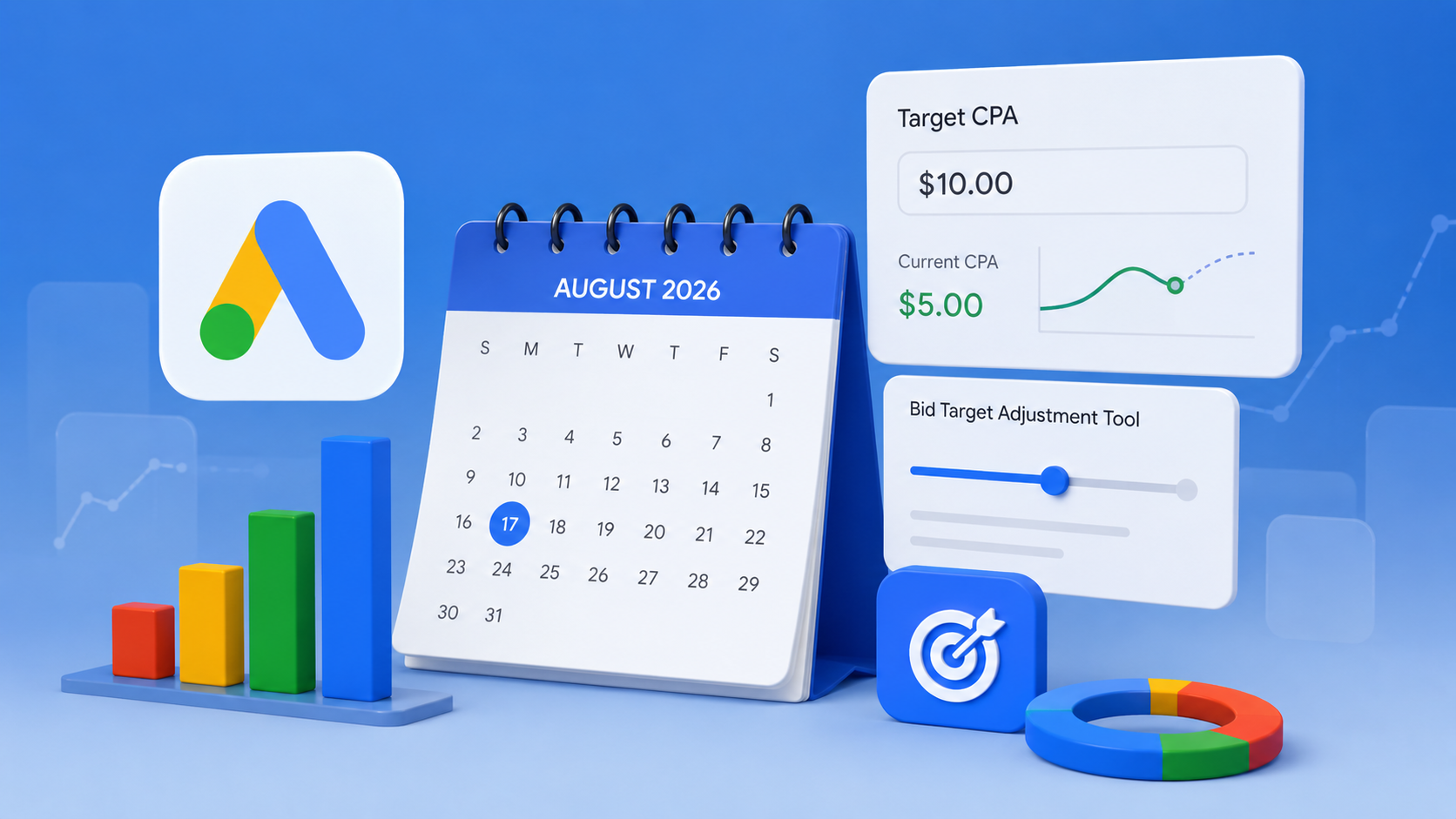
Mark your calendar for August 17th when these changes will take full effect. But don’t worry, a Bid Target Adjustment Tool will be available as of July 6 to help us prepare and adjust our goals accordingly.
What’s going on? Google’s update aims to closely align target-based bidding strategies such as Target CPA with our set goals, even when budget constraints come into play.
They’re introducing a new tool that allows us to tweak our targets before the updates hit, which is crucial for maintaining our campaign performance.
Why should we care? If your campaigns are currently exceeding their target CPA or ROAS goals, they might not continue to do so post-update without adjustment. This update is meant to ensure budget-constrained campaigns stay true to their targets.
For example, if my campaign is achieving a $5 CPA against a $10 target, the performance might shift towards $10 unless I make some changes.
Thankfully, the new tool is there to help us proactively update our bidding goals before the changes roll out. If we don’t take advantage of this, we might end up paying more per conversion or see our performance realign with Google’s targets instead of our historical results.
Why is Google doing this? Google wants to reduce fluctuations and provide more predictable results when we tweak or adjust our budgets.
The tool is designed to help us synchronize our bidding targets more closely with actual business outcomes before the automatic implementation begins.
What should we do? It’s a good time for us to reevaluate campaigns using target-based strategies and verify if our current targets still align with desired results.
Notifications will be sent through Google Ads accounts before the update, and the Bid Target Adjustment Tool can highlight which campaigns might be affected.
Key takeaway: For those of us with campaigns that consistently outperform their targets, maintaining current performance might require tweaking target settings instead of leaving them unchanged.
When it comes to PPC, some of the toughest lessons aren’t about bidding strategies or keywords. It’s about knowing when to walk away from a client. On a recent episode of PPC Live The Podcast, I, Laura Abreu, a performance marketing strategist, shared a pivotal experience from early in my career that taught me invaluable lessons.
My first client was launching an ecommerce store featuring beauty products from well-known brands. On paper, it looked promising, but deep down, something felt off. The products were available at the same price elsewhere, giving consumers little reason to choose our store. Despite this, I ignored my instincts and accepted the project.
Despite our team’s best efforts with search campaigns, Meta ads, seasonal offers, and product bundles, we didn’t manage a single sale over three months. The issue wasn’t with our marketing strategies—it was the lack of a unique value proposition in the business model itself.
I’ve learned that great marketing won’t fix a weak business proposition. Engaging with a new client now involves ensuring they’ve done market validation before investments in advertising.
This experience also revealed the importance of not letting personal preferences cloud judgement in marketing. We focused heavily on creating visually appealing content without realizing that resonating with customer needs and desires is what truly drives sales.
The emotional turmoil from this misstep was profound, affecting my confidence to the point where I took a break from PPC clients. I realized I was unfairly shouldering the blame for a structural business issue beyond my control.
Setting clear expectations from the start with every client has become another cornerstone of my practice. I ensure advertising is positioned as a way to test assumptions instead of promising immediate growth. This approach helps in maintaining honest conversations and prevents misunderstandings.
I’ve also decided never to mix business with personal relationships. Working with friends and family often involves emotional challenges that can interfere with objective decision-making.
Protecting one’s reputation is crucial, especially when campaigns don’t meet expectations. Honest dialogue, even if it means discussing failures or refunding fees, is necessary to build trust, which is invaluable in our referral-driven industry.
Through auditing various PPC accounts, I often encounter the mistake of treating campaigns as “set and forget.” It’s vital to constantly refresh ad copy, scale winning creatives, and streamline lead-generation processes for better conversion rates.
AI has become a significant asset in automating routine tasks, allowing more time for strategic thinking and client interactions. However, I advise marketers to maintain human oversight to avoid the pitfalls of poor-quality AI outputs.
Two Google Ads updates illustrate why the word automation needs careful interpretation. One reorganizes how established bidding strategies are named, while the other automatically begins processing eligible advertisers’ conversion data into customer lists.
The practical distinction is consequential: the bidding update is reported as cosmetic, but the audience update changes an account default. Advertisers therefore need different responses to each development rather than treating both as changes to campaign optimization.
Two updates, two different forms of automation
The bidding report says Google is restoring the standalone Target CPA and Target ROAS names. It also says the underlying bidding behavior and expected campaign performance remain unchanged, with no advertiser action required.
By contrast, the customer-list report describes an operational default: eligible accounts will have conversion-based customer lists enabled automatically, with data processing reported to begin on August 18. The sources therefore cover complementary but materially different issues. One changes the language used to describe automated decisions; the other changes how an audience-data feature is activated.
Restored bidding names make campaign intent easier to read
According to the bidding report, “Maximize conversions with a Target CPA” will again be called Target CPA, while “Maximize conversion value with a Target ROAS” will return to Target ROAS. Maximize Conversions and Maximize Conversion Value remain available as separate strategies for advertisers prioritizing conversion volume or conversion value.
This creates a clearer conceptual boundary between an unconstrained maximization objective and an objective governed by a stated efficiency target. It should not, however, be interpreted as a new bidding model, a performance intervention or a reason to reset campaigns. The source explicitly characterizes the change as naming-only.
The report also connects the revised interface labels with Google Ads API terminology. Teams maintaining integrations or reporting systems are advised to watch for adjustments involving the BiddingStrategyType enum, standalone TargetCpa and TargetRoas messages, and optional targets within MaximizeConversions and MaximizeConversionValue. That makes taxonomy mapping a more relevant concern than bid-performance troubleshooting.
Automatic customer lists require a governance decision
The customer-list report says automatic enablement applies to qualifying advertisers already using both Enhanced Conversions and Customer Match but not conversion-based customer lists. Google will process existing conversion data to make the lists available without additional implementation work, according to the source.
Availability is not the same as campaign use. The report says advertisers can subsequently decide whether to add the resulting audiences to campaigns or ad groups. The immediate decision is therefore whether the account should permit list generation at all; targeting decisions remain a separate step.
Advertisers that do not want the feature enabled can disable conversion-based customer lists in account settings before the reported August 18 processing date. This opt-out makes the update relevant to account ownership, consent practices and internal audience-data policies even when no campaign is scheduled to use the lists.
Key takeaways for Google Ads teams
Treat the Target CPA and Target ROAS update as a terminology change, not evidence that bidding logic or campaign performance has changed.
Keep Maximize Conversions and Maximize Conversion Value distinct from target-based strategies when documenting objectives and reporting results.
Review eligible accounts before the reported August 18 date and make an explicit decision about conversion-based customer-list processing.
Separate list creation from list activation: automatic availability does not require an advertiser to use an audience in a campaign or ad group.
Check API integrations and internal naming maps as Google aligns interface labels with standalone bidding-strategy types.
What advertisers should monitor next
Together, the updates point toward a Google Ads environment in which interfaces may become clearer while data features become more automatic. Strong account management will depend on identifying which changes merely improve labels and which alter defaults, permissions or data flows. Teams that document both bidding intent and audience-data choices will be better prepared for subsequent interface and API adjustments without mistaking automation for loss of control.