Expanding beyond paid social? Discover how I learned to structure campaigns, control spend, and unlock demand without depending solely on the Meta playbook.
My paid social campaigns were thriving. I understood my audience intimately, had a tight creative process, and watched results improve each year. Naturally, when leadership proposed expanding into Google Ads, I was thrilled—envisioning it as a new revenue channel.
But sticking to our existing strategy only led to difficult conversations. Google demands different tactics—intent signals and campaign structures vary, and common budget-draining mistakes aren’t always obvious. Many brands mirroring their Meta strategy end up with flashy dashboards but disappointing balance sheets.
From my experiences, six frequent mistakes can cause substantial damage before they’re even noticed. They’re what I’ve seen most often with ecommerce brands transitioning to Google Ads—and each error is reversible.
Mistake 1: Treating Google like a retention channel
Utilizing Google Ads for retention and brand defense is possible, but relying solely on it as a strategy is problematic. I often notice brands new to the platform diving straight into Performance Max. Initially, the ROAS shines bright, making everyone happy. However, when the right question surfaces—”Are we truly growing or just capturing purchases?”—issues arise.
For example, a client approached me with branded search and retargeting doing most of the work in PMax—a mere tax on demand already created elsewhere, leading to stagnant revenue. Although ad spend was soaring, growth wasn’t.
Acquiring new customers requires a different setup, like:
Shopping campaigns to highlight products to new audiences.
Search campaigns centered on non-branded, high-intent keywords.
Layered PMax configurations to bypass defaulting to easy conversions.
When Google grants vast access to new audiences, focusing solely on closing disregards most of this opportunity.
Mistake 2: Not knowing how to leverage Google’s core levers
Although paid social expertise is somewhat transferable to Google, I’ve observed four major gaps. Let me share them with you in more detail.
Search intent: Social media ads interrupt, but search ads meet users actively seeking your offerings, transforming campaign structure, ad copy, and keyword targeting entirely.
Data feed optimization: An optimized product feed enhances visibility and targeting in Shopping or Performance Max campaigns.
Keyword research: Understanding match types and search intent is critical for reach and cost efficiency.
Landing pages: Engaging landing pages outperform product pages for high-intent but unfamiliar visitors.
Mistake 3: Allowing operational issues to interrupt campaign momentum
Consistent data is key for Google’s algorithms. Every unintended campaign pause can reset learning, causing weeks of degraded performance and wasted spend.
Common disruptions include:
Payments: Bill lapses, leading to campaign pauses, overshadow the actual cost when factoring in downtime recovery.
Tracking and feed integrity: Broken pixels and feed errors silently degrade performance.
Setting up automated alerts and regular audits can prevent these costly errors.
Mistake 4: Overly granular campaign structures
Detail-oriented advertisers may over-segment campaigns, believing it provides control. However, widespread budget allocation hinders Google’s automation from optimizing effectively.
Instead, tight, well-funded campaigns optimize better and are more manageable.
Mistake 5: Leaving campaigns on Max Conversion Value without ROAS targets
Max Conversion Value aims for conversion volume, neglecting cost efficiency. A realistic ROAS goal encourages the algorithm to maximize efficiency. Setting this correctly is crucial.
Mistake 6: Underfunding campaigns, keeping them in learning mode
Underfunding during the learning phase results in indefinite stalled progress. Adequately funding new campaigns from the outset fosters quicker, more accurate results.
Expanding beyond Meta to include Google is a strategic move, accessing actively expressed demand. These pitfalls aren’t deterrents but guideposts for smoother transitions and optimized strategies.
You have creator candidates, a product catalog, and a paid-media budget. The hard part is connecting them: the creator must make the product relevant, the shopping surface must preserve the promise, and your measurement must show where the campaign actually worked or failed.
The practical model is a single creator-commerce loop, not separate influencer, advertising, and ecommerce projects. You choose the buying action first, match creators to that job, plan the paid uses of their content, configure the offer shoppers will encounter, and measure every handoff.
Treat creator marketing and AI shopping as one buyer journey
A creator can introduce the problem, demonstrate the product, answer an objection, or give a buyer a reason to act. Commerce systems have a different job: they present the product, price, availability, and eligible benefits when that interest becomes purchase intent.
AI is bringing those jobs closer together. YouTube can use Gemini to help advertisers find relevant creators and then distribute creator-made content through paid formats. Google has also extended member pricing and shipping benefits into AI Mode and Gemini, as well as local inventory and regional Shopping ads.
For you, the important change is the handoff. A shopper can encounter a creator’s recommendation, see the same message in a paid placement, and later find a personalized benefit during product discovery. If those touchpoints contradict one another, AI-powered distribution merely spreads the inconsistency faster.
Start each campaign by writing the promise that must survive the journey. If the creator discusses exclusive shipping for loyalty members, verify that the eligible shopper can actually see and receive that benefit. If the listing emphasizes member pricing, the creator’s call to action should explain why membership matters instead of sending everyone to a generic product page with no visible connection.
This also changes how you divide responsibility internally. The creator team should know which offer the commerce team has configured. The commerce team should know which claims and calls to action appear in the creator asset. Paid media should not receive the content only after it has been produced; its required placements and audiences should shape the brief from the beginning.
Build the campaign backward from a commerce event
Do not begin with a broad request to find popular creators. Begin with the behavior you need from a specific kind of buyer. That decision determines the offer, brief, creator criteria, destination, and measurement plan.
Name the commercial event. Decide whether the campaign is meant to generate product discovery, a qualified product-page visit, a first purchase, a loyalty enrollment, or another defined action. Use one primary event to make campaign decisions. Secondary metrics can explain performance, but they should not quietly replace the original goal.
Define who can receive the offer. Separate prospects from recognized members and distinguish a public promotion from a loyalty benefit. If eligibility depends on a membership tier, country, region, or local inventory, record that before the creator writes the call to action.
Choose the proof the buyer needs. A creator brief should identify the buyer’s problem, the product’s role, the objection that must be answered, and the evidence the creator can show. A product demonstration, use case, or clear explanation usually gives you more to evaluate than a generic endorsement.
Shortlist creators for that job. YouTube’s Gemini-powered matching can suggest candidates from more than three million YouTube Partner Program creators. Use that scale to widen discovery, then apply human review to audience relevance, creative quality, product credibility, and suitability for paid distribution.
Plan distribution before production. Decide whether the partnership will remain on the creator’s channel or also become a paid Short, an in-stream ad, or both. Confirm that the partnership permits every planned placement, market, and period of use before allocating media spend.
Instrument the handoff. Give each creator and placement an identifiable destination or campaign parameter. Align the platform conversion event with the commercial event you selected. Where appropriate, add a creator-specific code, but do not treat code use as the only evidence of influence; shoppers may return through another route.
Keep the first test interpretable. If you change the creator, audience, offer, landing experience, bid strategy, and product selection at the same time, a good result will not tell you what to repeat and a bad result will not tell you what to repair.
Use AI matching as a shortlist, not a strategy
Creator matching solves a discovery problem. It can help you navigate a large pool, but it cannot decide what your buyer needs to hear, whether the creator’s authority transfers to your product, or whether the resulting content will work outside the creator’s existing audience.
Use a scorecard that forces every recommendation to produce observable evidence. The model’s recommendation can open the review; it should not end it.
Decision
Evidence to inspect
Reason to pause
Audience relevance
Recurring subjects, viewer questions, purchase problems, and use cases connected to the product
The connection depends mostly on a broad demographic label or follower count
Product credibility
A natural reason for the creator to discuss, use, compare, or demonstrate the product
The endorsement would require a sudden change in the creator’s established subject matter
Creative strength
A clear opening, understandable product role, concrete proof, and a call to action that fits the content
The product appears only as an interruption with no useful explanation
Paid-media portability
A message that a cold viewer can understand without knowing the creator’s backstory
The asset depends entirely on channel-specific context or an inside joke
Offer alignment
A benefit the intended audience can receive in the markets and membership tiers being targeted
The creator would be promoting an offer that many reached viewers cannot access
Measurement readiness
A distinct asset, placement identifier, destination, and agreed conversion event
Performance can only be read as a blended campaign total
Follower count belongs in the context, not at the center of the decision. A smaller relevant audience can reveal stronger buying intent than a large audience gathered around unrelated content. Conversely, topical relevance alone is not enough if the creator cannot communicate the product clearly or if the asset cannot survive paid distribution.
Review the likely failure mode before approving a match. If the creator understands the audience but not the product, improve the briefing or reject the match. If the content is persuasive to existing followers but confusing to cold viewers, separate the organic asset from the paid edit. If the offer is compelling but limited to recognized members, prevent the campaign from implying that every viewer will receive it.
Turn creator content into a connected distribution system
A creator partnership should produce more than an isolated upload. YouTube allows creator-made content to run as paid Shorts and in-stream ads, giving you a route from creator credibility to controlled media distribution.
That does not mean one edit should be copied everywhere. Give each placement a defined job while preserving the same product truth and offer:
The creator-channel asset establishes context, credibility, and the full product story for an audience that already knows the creator.
The paid Short introduces the buyer problem and product quickly enough to make sense to a cold viewer.
The in-stream ad has room to develop the use case, proof, or objection that cannot fit into the shortest edit.
The product or local inventory listing confirms the purchasable product and displays the applicable price or benefit.
The loyalty layer shows recognized members the pricing or shipping advantage for which they are eligible.
Create a message ledger before editing begins. Record the approved product promise, supporting proof, exact offer wording, call to action, destination, market eligibility, membership requirements, and the placements where the asset will run. Every version can vary in pacing and length, but it should remain consistent with that ledger.
Market eligibility is part of the brief, not a footnote. The stated expansion covers Australia, Brazil, Canada, France, Germany, India, Italy, Japan, Mexico, the Netherlands, South Korea, Spain, the United Kingdom, and the United States. If your creator reaches viewers outside the relevant campaign market, use wording that does not imply universal access.
Local inventory and regional Shopping ads can be especially useful when the benefit or product availability varies by location. Match the creator’s geographic targeting, the inventory being promoted, the Merchant Center configuration, and the landing experience. Otherwise, you pay to generate interest that the next surface cannot satisfy.
There is also a U.S. pilot that uses Customer Match as a relationship data source for free listings. Treat pilot access as an optional opportunity, not as inventory you can assume in a forecast. Build the core campaign around placements and features actually available to your account.
Measure the chain instead of celebrating one platform number
Creator commerce can look successful at the top of the funnel while leaking value at the final handoff. A popular video does not prove product demand, and a strong click-through rate does not prove profitable sales. Your reporting should show how attention moved through the campaign.
Matching: Track which creator-selection criteria were expected to matter and whether the content attracted relevant viewer questions or actions.
Creative: Read view rate, completion, engagement, and product clicks by asset. These metrics help locate attention loss; they are not substitutes for the commercial event.
Media: Separate organic creator delivery from paid Shorts and in-stream distribution. Report cost, reach, click-through rate, conversion rate, and acquisition cost by placement.
Commerce: Measure product-page behavior, purchases, order value, and offer redemption using consistent definitions.
Relationship: Where loyalty is part of the objective, distinguish existing recognized members from new enrollments and non-member buyers.
Document every denominator. A conversion rate based on clicks is not interchangeable with one based on sessions, and a customer acquisition cost should not silently include returning customers if the campaign goal is new-customer growth. Definition drift can make two dashboards appear to agree when they are measuring different events.
Platform lift figures are useful for forming a hypothesis, not for writing your revenue forecast. YouTube reports an average 30% conversion lift from boosting creator content through Shorts and in-stream ads. Google reports that some retailers saw up to a 20% increase in click-through rate when tailored loyalty offers were shown to members.
Those numbers should not be combined or treated as guaranteed. One is an average conversion result for creator advertising formats; the other is an upper-end click-through result reported for some retailers using tailored offers. They describe different interventions, outcomes, and populations. Your baseline, margin, audience, creative, product, and offer determine whether either benchmark is relevant.
Use controlled comparisons to learn what contributed. Hold the offer, audience, and destination steady when comparing creator-made and brand-made assets. Evaluate loyalty presentation separately instead of mixing it into the creative test. If several creator assets run together, retain asset-level and creator-level identifiers so a blended result does not hide the winner or the failure.
Read mismatches as diagnostic signals. Strong viewing with weak product clicks points you toward the call to action or offer handoff. Strong clicks with weak conversion points you toward the destination, price, eligibility, or product experience. Strong conversion with limited reach points you toward distribution. These are places to investigate, not automatic diagnoses, but they are more useful than labeling the whole campaign good or bad.
Key takeaways
Choose the buying action and eligible offer before asking AI to find creators.
Use AI matching to expand and organize discovery, then require human evidence for audience fit, product credibility, creative quality, and paid-media suitability.
Plan creator-channel content, paid Shorts, and in-stream ads as related assets with different jobs, not automatic duplicates.
Verify Merchant Center tiers, pricing, shipping attributes, Customer Match connections, markets, and destinations before a creator promises a loyalty benefit.
Measure the full path from creator attention to commerce and customer relationship outcomes. Treat vendor-reported lift as a hypothesis, not your forecast.
Your next move is to choose a product, a buyer action, and an offer that the intended audience can actually receive. Write the creator brief, placement plan, commerce configuration, and measurement event on the same page. If that chain remains clear from first view to purchase, you have a campaign worth testing.
I’ve recently delved into the world of AI search engines like ChatGPT, Google AI Mode, and Perplexity, and how they’re transforming the way consumers find and buy products online. It’s clear to me that if my product pages aren’t optimized for these AI assistants, I’m likely missing out on significant traffic and revenue.
What I’ve discovered is that AI assistants evaluate product pages differently than traditional search engines. They require a deep understanding of products to recommend them confidently to users with varied needs.
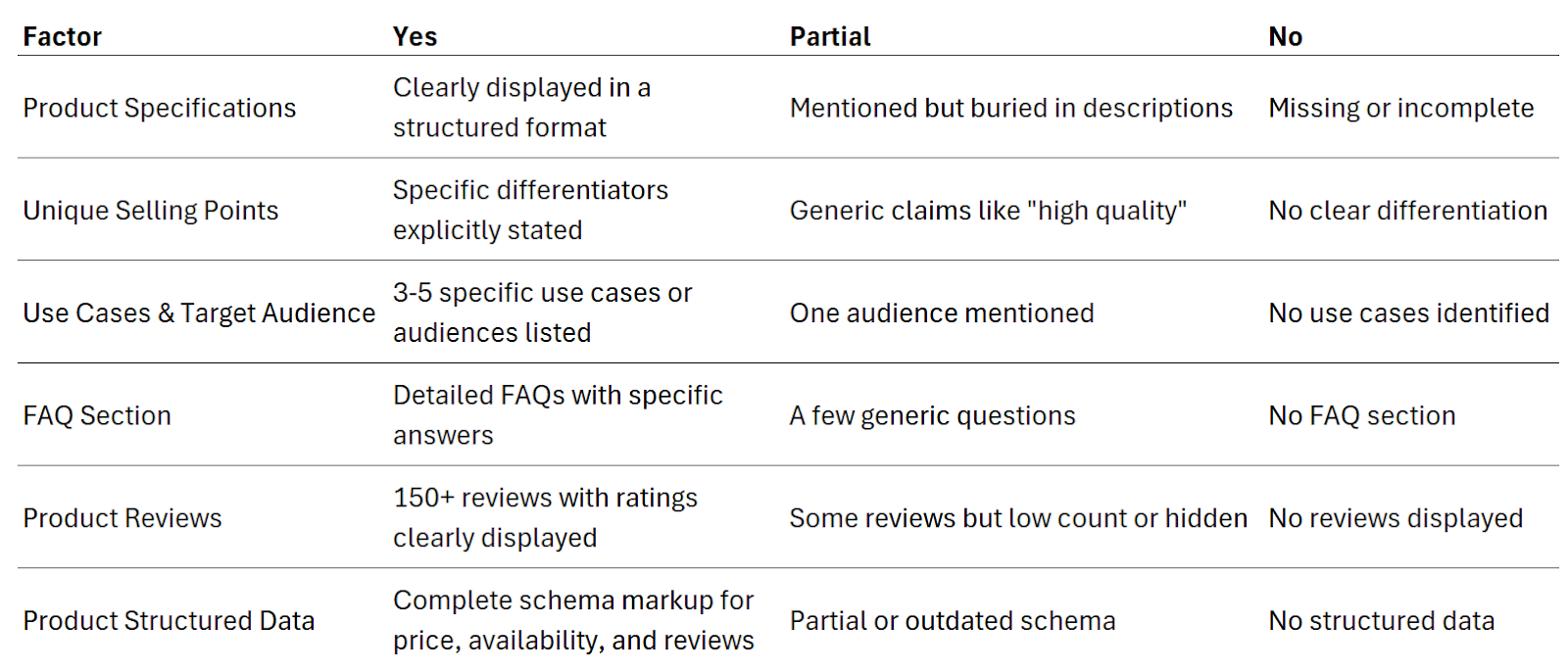
To ensure my product pages are AI-ready, I’ve crafted a simple scorecard focusing on six key factors:
1. Product specifications
Does the product page clearly display the product’s attributes and specifications?
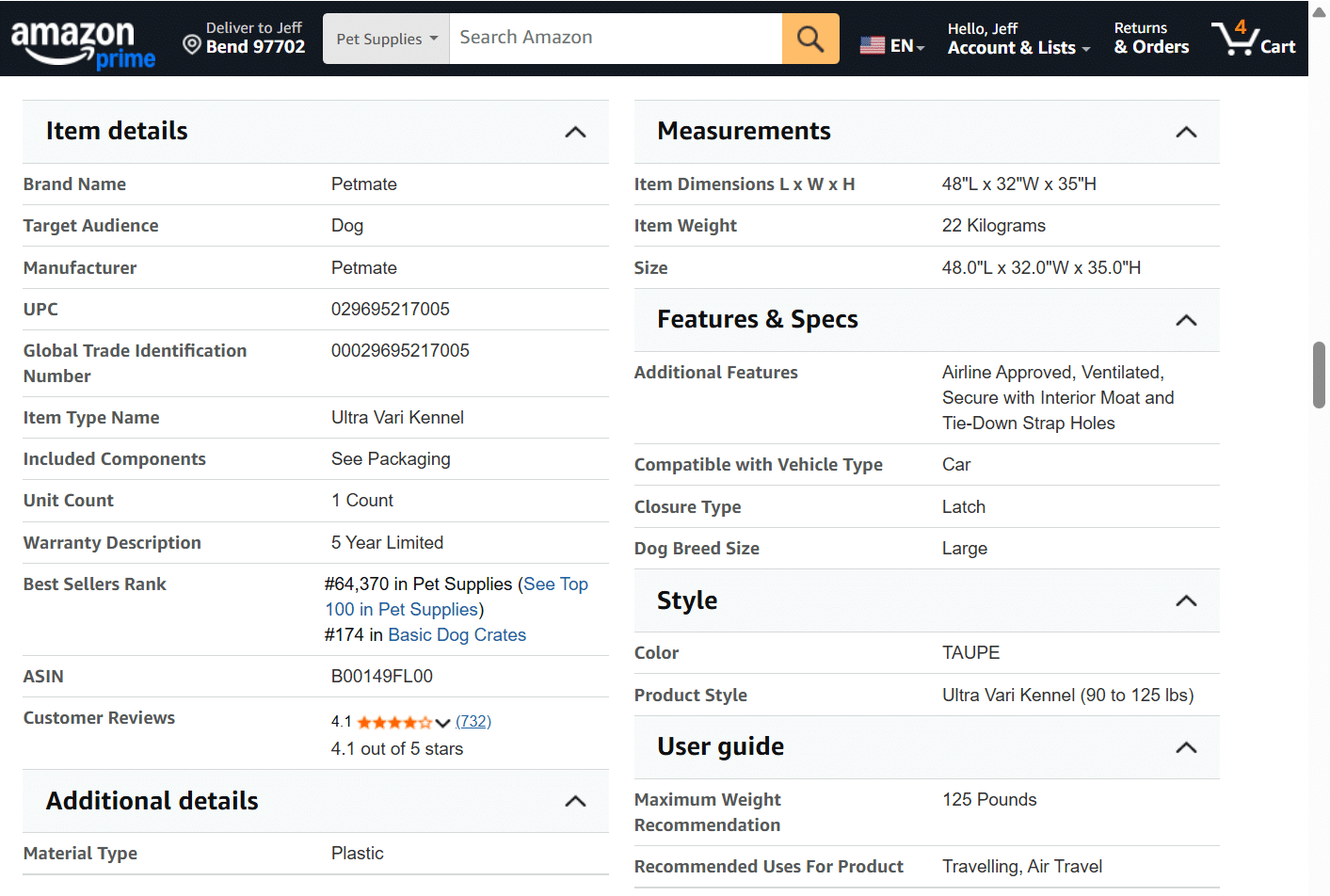
AI assistants need explicit specifications to understand my products and match them with customer needs. For example, if someone asks for “an airline-friendly crate for a 115-pound dog,” the AI must see the weight limit clearly to recommend it.
Amazon excels at this, as their product pages display detailed specifications that likely boost their AI search performance.
Action item: I ensure all specifications are clearly presented on my product pages, ideally in a structured table or a list, rather than burying them in the description or marketing copy.
2. Unique selling points
Are the product’s unique benefits clearly described?
Highlighting what makes my products special gives AI a reason to recommend them over competitors. It’s crucial for AI to grasp these unique features to decide on recommendations.
Action item: I emphasize key features that set my products apart, avoiding vague claims like “high-quality craftsmanship” and instead focusing on specific differentiators.
3. Use cases and target audience
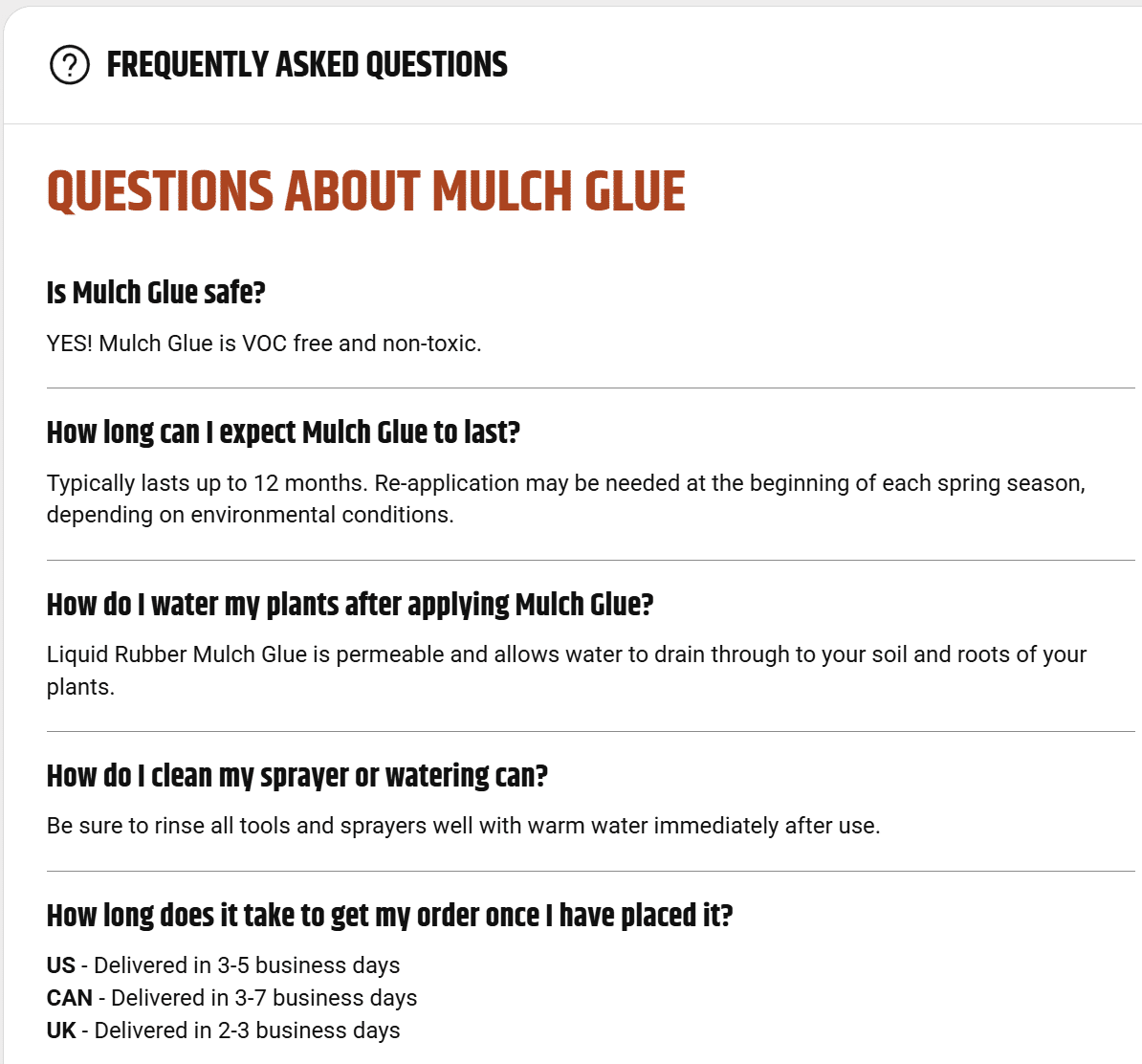
Discover everything you need to know about Mulch Glue, from safety and longevity to watering tips and delivery times.
Are the product’s intended use cases and audience clear?
AI matches products with people and their needs, not just keywords. Explicitly stating who the product is for and how it’s used makes it more likely to be recommended by AI.
Action item: I list the top use cases and audience segments for each product, considering situations, pain points, and goals.
4. FAQ section
Does the product page include an FAQ section answering common questions about the product?
FAQs can bolster AI’s confidence in recommending my products by showing they’re a good fit for specific queries. The more detailed the FAQ section, the more it helps in AI search contexts.
Action item: I gather and answer the most common questions from customer inquiries, reviews, and even competitor analysis to include on product pages.
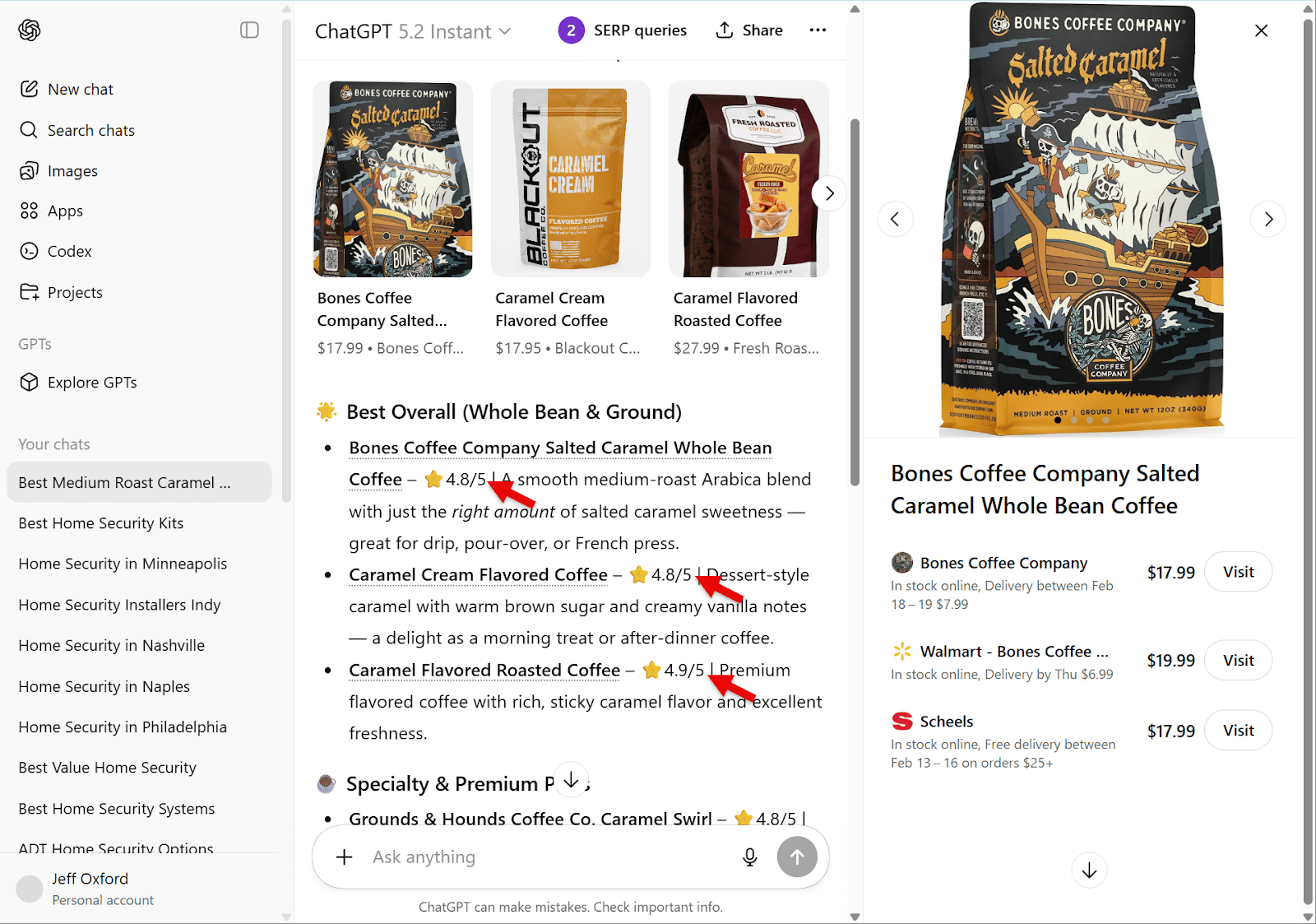
5. Product reviews
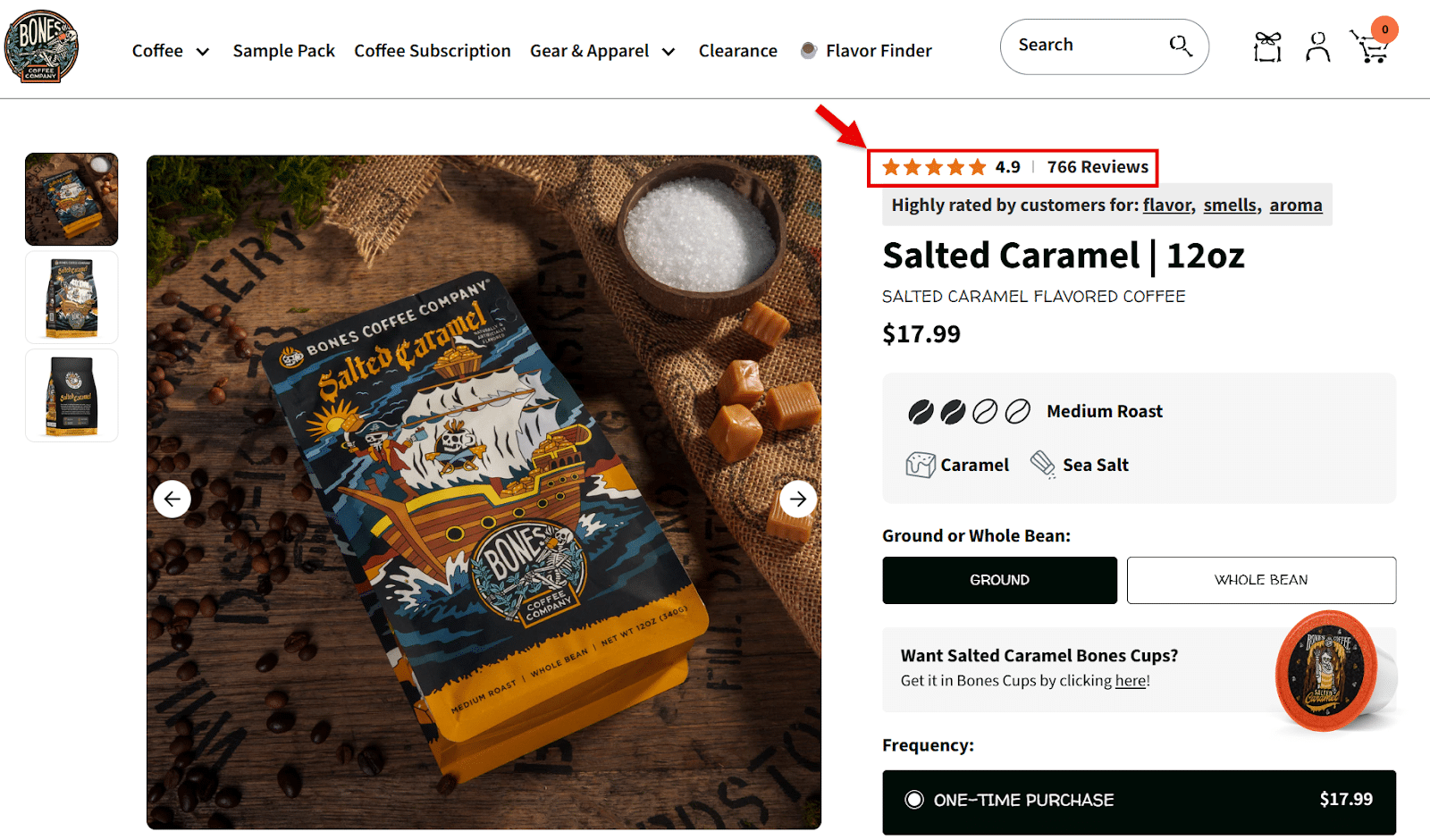
Does the product page display customer ratings and review counts?
AI recommends products with proven reputations. Displaying a high rating and substantial number of reviews increases the chances of my products being recommended by AI.
Action item: I ensure high visibility for product ratings and review counts on every product page, possibly using third-party platforms to solicit reviews.
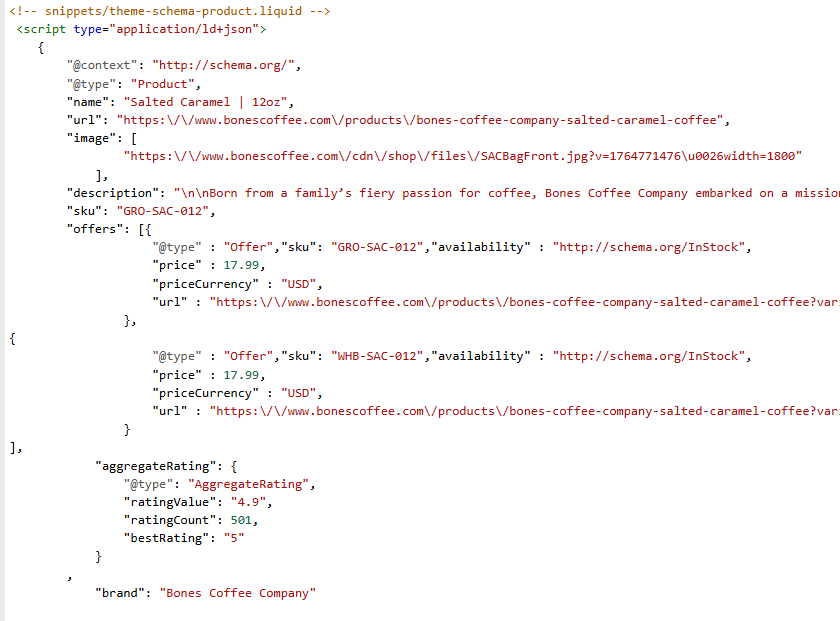
6. Product structured data
Does the product page include structured data for price, availability, reviews, and other key attributes?
Structured data helps AI understand my product information effortlessly and even feeds into knowledge graphs that power AI recommendations.
I understand that as AI agents engage more deeply in commerce, detailed product data becomes crucial for comparisons and purchasing.
Putting the scorecard to work
Here’s my concise strategy to audit and enhance my product pages for AI optimization, focusing on closing gaps where AI might overlook my products.
Prioritizing these optimizations means I’m not only engaging effectively but also increasing my competitiveness in the AI-driven market landscape.
That removes the support handoff, but it does not make either change instantaneous. A store name goes through editorial review, while a new domain must be verified. Your safest plan is to keep the existing setup operational until the relevant check is complete, then finish the migration in a controlled second step.
Key takeaways
You can edit a Merchant Center store name or domain within the Microsoft Advertising platform instead of submitting a support ticket.
Ads continue to use the old store name while a replacement name is under editorial review.
Ads continue to use the old domain while Microsoft verifies the replacement domain.
After the new domain is approved, update the product URLs that still point to the old domain.
A previously used store name or domain can be reused, but it must still satisfy the relevant editorial or verification requirements.
Know which Merchant Center setting you are changing
A store name change and a domain change may belong to the same rebrand, but Microsoft treats them as separate updates. They have different approval gates and different follow-up work. Distinguishing them before you start prevents a common planning error: assuming that changing one field completes the entire transition.
Change
Required check
What ads use while pending
Your next action
Store name
Editorial review
The old store name
Wait for approval, then confirm the new name appears correctly
Domain or URL
Verification of the new domain
The old domain
After approval, change product URLs to the new domain
If you are changing both, manage them as two tracked work items. The store name can be ready for review while the website team is still preparing the new domain, or the domain can be technically ready before the public brand rollout. Do not mark the rebrand complete merely because one of the two changes has been submitted.
The distinction also matters when assigning responsibility. A brand or advertising owner can confirm the exact store name, but domain verification and product URL migration may require access from an ecommerce, development, or feed-management owner. Identify those owners before touching the settings.
Change the store name without promising an instant switch
Submitting a new store name starts an editorial review. During that review, your campaigns do not have to stop: ads continue serving with the old store name. This protects campaign continuity, but it also creates a transition period in which your website or other channels may show the new brand while Microsoft ads still show the old one.
Plan for that temporary mismatch instead of trying to force every public surface to change at the same moment. Microsoft has not attached an approval duration to the documented workflow, so treat editorial approval as an external dependency rather than a minute-perfect launch step.
Confirm the final spelling, capitalization, spacing, and punctuation of the new store name with the people responsible for the rebrand.
Check that the proposed name accurately represents the storefront shoppers will reach. A convenient internal label is not necessarily the right customer-facing store name.
Submit the new name through Merchant Center.
Expect the old name to remain on ads during editorial review. Tell campaign and customer-support teams that this is a pending state, not evidence that the submission failed.
Wait for approval before declaring the advertising portion of the rename complete.
After approval, inspect live customer-facing placements and confirm that the new name is rendered as intended.
Do not repeatedly resubmit the name simply because the old one remains visible during review. The documented behavior is to keep serving the existing name until the replacement passes the check. A submission and an approved public change are two different milestones.
If you need to return to a former store name, Microsoft permits reuse as long as the name passes editorial checks. Treat that reuse as another controlled review event, not as an automatic restoration of a previously accepted value.
Move to a new domain in the correct order
A domain change carries more operational risk than a name edit because product ads must lead shoppers to working landing pages. Microsoft requires verification of the replacement domain, and ads continue serving on the old domain while that verification is underway. The old site therefore remains part of the live advertising path until the new domain is approved.
Do not disable the old domain merely because the new site is available. If ads are still being served against the old domain, taking it offline can send paid visitors to broken or unavailable pages. Keep the existing storefront and its product destinations functional throughout the pending period.
Finish the new storefront before requesting the switch. Test representative product pages, navigation, cart behavior, checkout, policies, and mobile rendering on the new hostname.
Keep the old domain active and keep its current product URLs working.
Enter the replacement domain in Merchant Center and complete the required domain verification.
While verification is pending, monitor the old-domain landing pages that current ads still use. Do not assume that requesting the new domain has already moved ad traffic.
Wait until the new domain has been approved.
After approval, update product URLs so they point to the corresponding pages on the new domain.
Test a representative set of ads and products after the URL update. Confirm that the landing pages load, the products match the ads, checkout works, and measurement parameters have not been lost.
Domain approval is a gate, not the final migration step. Your catalog can still contain old-domain product links after the replacement domain is verified, which is why the product URL update needs its own owner and completion check.
Redirects can protect shoppers who encounter an old link, but they should be a safety net rather than the operating plan. Update the product URLs themselves after approval. Also review any feed rules, tracking templates, campaign parameters, canonical URLs, and analytics settings that contain the old hostname. Those systems sit outside the Merchant Center domain field and may not change merely because the new domain was accepted.
A former domain can be reused if it passes verification. That flexibility can help when reversing a migration or reorganizing stores, but previous use does not remove the need to prove control of the domain again when Microsoft requires the check.
Use a preflight checklist before submitting either update
The editable settings make the administrative step easier. They do not coordinate your brand, website, catalog, analytics, and campaign teams for you. A short preflight prevents the platform change from getting ahead of the assets it depends on.
Final value confirmed: Record the exact store name or domain that should replace the current value. Have the accountable brand or website owner approve it before submission.
Current setup recorded: Save the existing store name, domain, and a sample of current product URLs so you can diagnose a mismatch during the transition.
Old destination protected: Keep the old domain and its landing pages available while the new domain is being verified.
Verification owner available: Make sure the person who can complete domain verification is ready when the change is submitted.
Product URL work prepared: Prepare the new product URLs in advance, but schedule their deployment for after the domain has been approved.
Dependent systems checked: Search feed rules, redirects, tracking templates, analytics configuration, and other campaign settings for the old hostname.
Pending-state expectations shared: Tell stakeholders that the old name or domain can remain in active ads while the replacement is being checked.
Post-approval test assigned: Name the person who will verify live ads, landing pages, checkout, and measurement after the switch.
For a store-name-only change, your operating pattern is simple: submit, allow the old name to remain during review, and confirm the replacement after approval. For a domain migration, use a two-stage deployment: verify the new domain while the old one stays live, then update and test product URLs after approval. Build your launch plan around those confirmed states, and the new self-service controls can save administrative effort without turning the rebrand into an avoidable campaign outage.
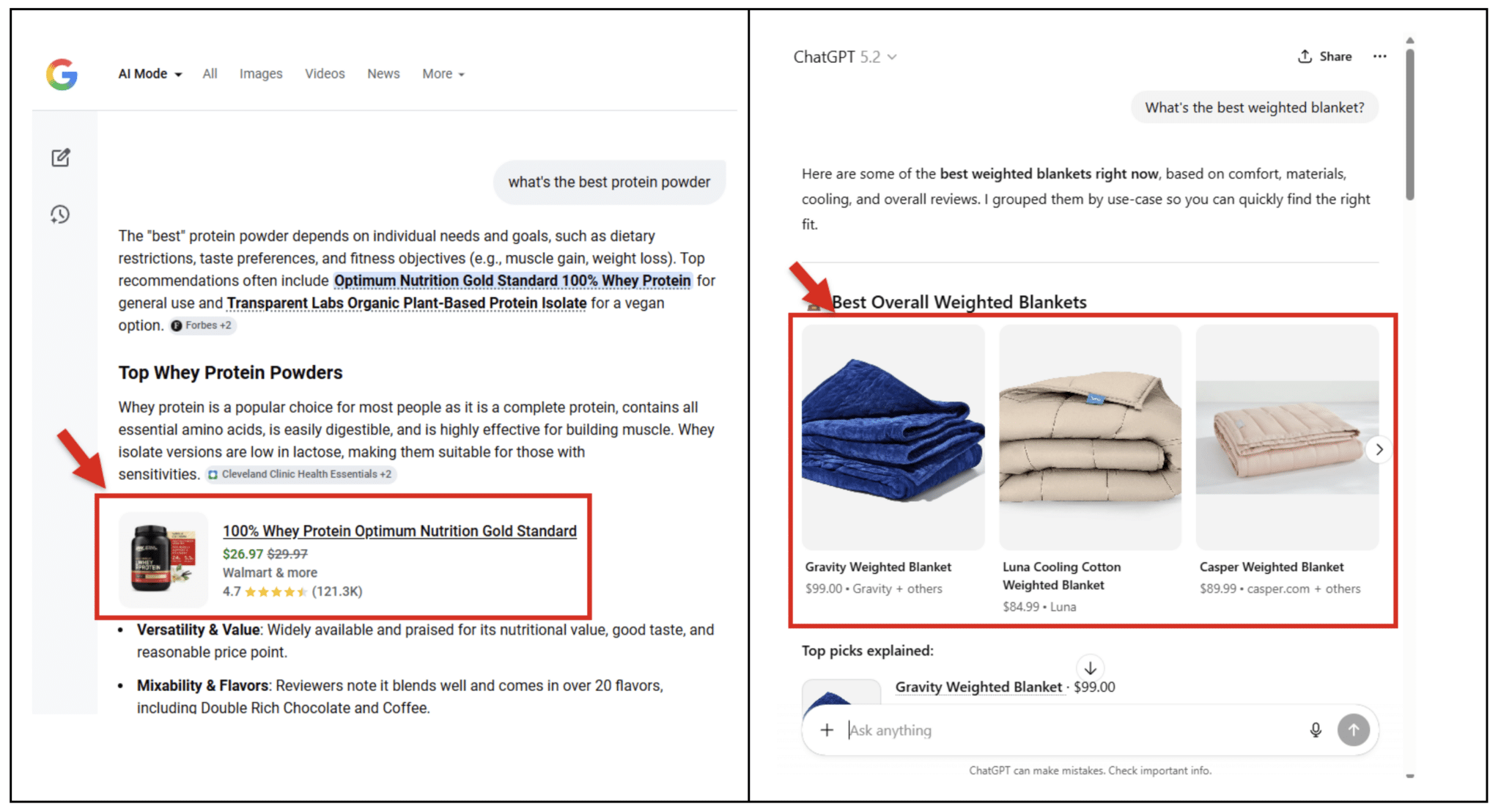
If ChatGPT has begun sending shoppers to your store, your immediate question is probably how to earn more of those referrals. The answer starts with measuring the opportunity correctly. A single recommendation, position, or shopping carousel cannot tell you whether your products are consistently visible.
The shopping carousel can reshuffle from one request to the next. Treat each response as one observation from a changing recommendation system, then look for patterns across repeated prompts before you change your content, product data, or acquisition strategy.
Stop treating the shopping carousel like a fixed ranking
Traditional rank tracking encourages a simple question: which domain occupies the first position? ChatGPT shopping referrals require several questions. A retailer can appear frequently without leading the carousel, while another can win the first buy link in a narrower set of responses.
That distinction is visible across an analysis of 22.5 million shopping offers. Walmart often led the rank-one buy links, while Target achieved stronger overall presence. Neither metric cancels the other. They describe different forms of visibility.
Appearance rate: How often your retailer, brand, or product appears across eligible prompt runs.
First-position rate: How often it appears first when it is included.
Buy-link rate: How often the response provides a purchasing path to your domain.
Product coverage: How many distinct products or product families earn visibility within a prompt cluster.
Volatility: How much the included retailers, products, and positions change when you repeat the same prompt.
This prevents a common reporting error. If you track only first position, you can miss broad consideration. If you track only appearances, you can mistake occasional inclusion for commercial preference. Keep the metrics separate, and interpret them together.
Build a repeatable ChatGPT referral visibility baseline
Your audit should begin with the decisions customers are trying to make, not a list of keywords copied from a conventional rank tracker. Shopping prompts often contain a product need plus constraints such as intended use, features, budget, compatibility, delivery, or retailer preference. Those qualifiers can materially change which options make sense.
Create prompt clusters around buyer jobs. Separate broad product discovery, constraint-heavy discovery, comparisons, replacement purchases, and branded requests. Include only prompt types that reflect a real path to your products.
Write prompts as customers would ask them. Preserve natural context and decision criteria. A prompt designed merely to force your brand into the answer does not measure discovery.
Repeat each prompt without rewriting it. The carousel can change between requests, so one run cannot establish a stable position. Repetition lets you distinguish a persistent pattern from a transient result.
Record the entire response set. Capture the prompt, run, retailer, brand, product, displayed order, buy-link destination, and landing page. Do not save only the result that mentions you.
Aggregate results by prompt cluster. Calculate appearance, first-position, and buy-link rates separately for each type of shopping decision.
Keep the test conditions as consistent as practical. If an account, location, device, or other environment detail changes, record that fact rather than silently combining the runs. You may not know why two responses differ, but you can avoid confusing a test change with a visibility change.
Your baseline is complete when it can answer more than whether you appeared. It should show where you appear repeatedly, where you lead, which products receive the exposure, where the purchase links go, and which prompt clusters produce unstable results.
Diagnose the visibility pattern before changing your site
Different metric combinations point to different investigations. They do not prove why ChatGPT selected an option; the exact recommendation logic is not exposed by a carousel response. Use the patterns as diagnostic hypotheses, then verify the underlying product and landing-page evidence.
Observed pattern
Working interpretation
What to inspect next
High appearance and high first-position rates
Your offer is broadly visible and often prioritized within the tested cluster.
Protect accurate product information, examine where buy links land, and determine whether the visibility produces qualified sessions and sales.
High appearance but low first-position rate
Your products are regularly considered but seldom presented first.
Compare the decision-critical details exposed on your pages: intended use, differentiators, price conditions, availability, variants, fulfilment, and returns.
Low appearance but high first-position rate when present
Your offer may fit a narrow set of needs particularly well.
Identify the prompt constraints associated with those wins. Decide whether that niche is commercially important before trying to broaden it.
Frequent mentions but few buy links
You have informational recognition without a consistent commerce handoff.
Check whether the correct product page is indexable, current, clearly purchasable, and preferable to an informational or category URL.
Large changes between identical prompt runs
The recommendation set is unstable for that decision.
Rely on aggregate rates, inspect which competitors recur, and avoid declaring a winner from a screenshot.
Prompt-level segmentation matters here. A strong aggregate can conceal a complete absence from an important use case, while one excellent response can make a weak aggregate look more promising than it is. Read the total first, then inspect the clusters that carry the most buying intent for your business.
Reduce uncertainty in the product decision
You cannot directly control the composition or order of a ChatGPT shopping carousel. You can control whether your product information gives a recommendation system clear, consistent evidence to work with. The goal is not to repeat marketing language more often. It is to remove ambiguity from the buying decision.
Make each purchasable page self-sufficient
A product page should make sense without requiring a system or shopper to reconstruct essential facts from several other URLs. Audit each commercially important page for the following:
A precise product name, category, model, and variant.
A plain-language explanation of who the product is for and which use cases it supports.
Decision-critical attributes written as text, not hidden only inside images or promotional graphics.
Clear differences among sizes, configurations, bundles, or generations.
Accurate purchase conditions, including price, currency, availability, fulfilment, and return information where applicable.
An unambiguous purchase action and a stable destination for the specific product.
Agreement among visible page copy, structured product data, and any commerce feed you maintain.
Do not treat structured data as a guarantee of inclusion. Markup cannot repair a vague offer, a missing variant distinction, or contradictory on-page information. Its useful role is to express facts consistently. The visible page still needs to help a person decide whether the item fits.
Build supporting pages around genuine decisions
A category page should explain the criteria that separate its products. A comparison page should state material differences rather than giving every option the same generic praise. Compatibility, sizing, delivery, warranty, and return pages should be easy to reach when those details can change the purchase decision.
Avoid creating a thin page for every possible wording of a shopping prompt. Consolidate overlapping questions into authoritative pages that cover the full decision. You want one dependable explanation of the product and its constraints, not a collection of near-duplicates that disagree after the next catalog update.
Connect visibility, handoff, and outcome
ChatGPT visibility is not the same as a referral, and a referral is not the same as a sale. Keep those stages separate in your reporting:
Visibility: Your appearance, first-position, product-coverage, and volatility measurements from repeated prompts.
Handoff: Whether a buy link is present, which domain receives it, and which landing page it uses.
Outcome: The sessions, product views, cart actions, leads, or purchases your analytics can actually observe.
Do not force a precise attribution claim when the stages cannot be joined. Instead, make one meaningful change within a defined product or prompt cluster, keep your audit method stable, and compare the aggregate pattern before and after the change. That gives you a defensible learning loop without pretending that every carousel movement came from your edit.
Key takeaways
There is no dependable single ChatGPT shopping rank when the carousel can reshuffle between requests.
Measure appearance, first position, buy links, product coverage, and volatility as separate signals.
Repeat unchanged prompts and aggregate the results before drawing a conclusion.
Use metric combinations to decide what to inspect; do not present them as proof of how ChatGPT selected a result.
Make product pages, supporting content, structured data, and commerce feeds consistent enough to support an unambiguous decision.
Report visibility, referral handoff, and business outcomes as distinct stages.
Start with one commercially important prompt cluster and establish its baseline before editing anything. Once you know whether the problem is inconsistent inclusion, weak prioritization, a missing buy link, or a poor landing destination, you can make a focused change and learn from the next set of runs.
If an out-of-stock product page still lets shoppers add the item to their cart, or if the purchase control disappears entirely, you now have a Merchant Center problem. The compliant state sits between those two behaviors: keep the buy button visible, make it clearly disabled, and show an explicit out-of-stock message.
The product feed must declare the same availability as the landing page. That alignment matters as much as the button itself because conflicting availability information can lead to product disapprovals. Here is how to implement the control without creating a new gap between your storefront, inventory system, and feed.
The correct purchase control depends on the availability state
Out of stock is not a general label for every product you cannot ship immediately. It is a specific commercial state. When you declare an item out of stock, the shopper must not be able to buy it. The page should nevertheless retain a recognizable purchase control so the unavailable state is obvious rather than looking like a broken or incomplete product page.
Two common storefront patterns no longer satisfy that requirement:
Removing the buy button: The shopper sees no purchase control and may not understand whether the product is unavailable, discontinued, or affected by a page error.
Leaving the buy button active: The page claims that the item is out of stock while continuing to accept a purchase.
Use the availability state to determine both the message and the control:
Availability
Landing-page message
Purchase control
Feed treatment
In stock
Explicitly identify the item as available
Allow the normal purchase action
Declare in stock
Out of stock
Explicitly say out of stock
Keep the buy button visible but disabled
Declare out of stock
Back order
Explicitly say back order
Accept the order only if that is the offer you intend to make
Declare back order
Pre-order
Explicitly say pre-order
Make the purchase experience consistent with the pre-order offer
Declare pre-order
The important distinction is whether you are accepting an order. If customers may order an item that is not currently available, treating it as back order keeps the offer internally consistent. Do not label it out of stock in the feed while using an active Add to cart button on the page.
Implement a disabled button, not merely a gray decoration
A visual change alone is not a purchase control. A button can look disabled while remaining clickable with a mouse, keyboard, or touch input. Your implementation needs to make the action inactive as well as visually unavailable.
Calculate the product state first. Resolve the current item or selected variant to in stock, out of stock, back order, or pre-order before rendering the purchase area.
Print a visible availability message. Place the words Out of stock near the purchase control. Do not rely on button color alone to communicate the state.
Keep the control in the purchase area. Render the button where a shopper would normally expect to find it, with a clear disabled appearance.
Disable the action itself. For a native HTML button, use its disabled behavior. If a custom element or link acts as the control, make sure it cannot activate through pointer, keyboard, or touch input.
Block stale purchase requests. Treat the disabled interface as the first line of control, not the only one. The cart or commerce layer should recheck availability so an old page, direct request, or delayed script cannot create an order for an item still classified as out of stock.
Change the commercial state when orders are allowed. If the business decides to accept orders before stock is available, update the product to back order on both the page and feed instead of quietly re-enabling an out-of-stock button.
JavaScript storefronts need one extra check: do not render an enabled button first and disable it only after inventory data arrives. Resolve the state before exposing the action, or use an inactive loading state until the product record is ready.
Products with selectable variants also need state-specific controls. When a shopper changes a size, color, or other option, update the availability message and button together. An unavailable variant should not inherit the active button of the variant that was selected previously.
Make the page and feed read from the same inventory decision
The most durable fix is not a second rule inside your product-feed exporter. It is one availability decision that every output consumes. Your catalog or inventory layer should determine the commercial state; the product template and feed generator should translate that same state into their respective formats.
Separate logic creates predictable mismatches. A storefront may switch to out of stock as soon as inventory reaches zero while a scheduled feed still contains the earlier in-stock value. A feed rule may convert low inventory to out of stock while the page continues to sell. A manually edited product badge may say back order even though the underlying record and feed still say out of stock.
Map the flow before changing the interface:
Identify the field or rule that decides whether an order may be accepted.
Document how each internal value becomes in stock, out of stock, pre-order, or back order.
Use that mapping to render the visible landing-page label.
Use the same mapping to enable or disable the buy button.
Use the same mapping when generating the Merchant Center feed value.
Account for cached pages, cached product data, and feed-generation delays when inventory changes.
Do not solve a disagreement by changing only the wording. If the feed says back order but your commerce system rejects every order, the label is still inaccurate. If the page says out of stock but the cart accepts the item, disabling a cosmetic button has not corrected the underlying state. The message, control, feed, and order behavior should describe one offer.
Audit transitions, variants, and alternate purchase paths
A static screenshot can confirm that a disabled button exists, but it cannot prove that the full inventory workflow is correct. Test the transitions that cause the page and feed to drift.
Choose representative products. Include at least one product in each availability state your store supports, plus products with and without variants.
Compare the declared states. For each selected item, check the internal inventory state, visible page message, purchase control, and exported feed value.
Test the disabled control. Confirm that the out-of-stock button remains visible but cannot be activated with a mouse, keyboard, or touch interaction.
Change variants. Move between available and unavailable options and confirm that the label and button change together every time.
Test inventory transitions. Move a test item from in stock to out of stock, then to back order if your system supports it. Verify every output after each transition.
Check delayed outputs. Revisit cached product pages and the next generated feed to find timing gaps between the storefront and Merchant Center data.
Check the cart boundary. Confirm that the commerce layer rejects an item still classified as out of stock even when a stale page or alternate request reaches it.
Review Merchant Center after deployment. Watch for availability-related disapprovals and trace any affected product back through the shared state mapping.
Add these cases to regression testing if inventory or product templates change frequently. The highest-value automated checks are simple: an out-of-stock item renders an explicit label, its button is disabled, its feed value agrees, and the cart cannot accept it. For a back-order item, test that the back-order label and feed state remain aligned with the intended ordering behavior.
Key takeaways
An out-of-stock product page needs a visible but disabled buy button; neither removing the control nor leaving it clickable is the correct state.
The page must explicitly communicate availability using a state such as in stock, out of stock, pre-order, or back order.
The landing-page state and Merchant Center feed must agree, or the product may be disapproved.
If you accept orders for inventory that is not currently available, classify the offer as back order and synchronize that state across the page and feed.
A shared inventory mapping is safer than separate storefront and feed rules.
Test state transitions and variant changes, not just the final appearance of one product page.
Start with one out-of-stock SKU that currently removes its button or leaves it active. Trace that SKU from the inventory record through the product template, cart, and feed. Once all four surfaces express the same state, turn the mapping into a reusable rule and test it across the rest of the catalog.
When I first heard about Walmart’s experiment with ChatGPT’s Instant Checkout, I was intrigued. But after testing 200,000 items, Walmart discovered that conversions through this method were three times lower compared to their website.
Why This Matters: This experiment highlights an important point: traditional shopping environments still hold the crown when it comes to conversions. Even in a world dominated by AI, guiding users to owned environments proves more effective.
The Experiment Details: Starting last November, Walmart introduced around 200,000 products available for purchase directly inside ChatGPT through OpenAI’s Instant Checkout. The goal was to let users buy items without ever leaving ChatGPT.
Daniel Danker, Walmart’s EVP of Product and Design, revealed that these purchases had a conversion rate one-third lower than similar transactions on their website. He described the experience as “unsatisfying,” which prompted Walmart to reconsider their approach.
Farewell to Instant Checkout: Originally, Instant Checkout aimed to complete transactions within ChatGPT. However, OpenAI recently confirmed plans to phase it out, leaning towards merchant-handled app checkouts.
Changes on the Horizon: Walmart plans to integrate its own chatbot, Sparky, within ChatGPT. This will allow users to log into Walmart’s system, sync their carts across platforms, and finalize purchases seamlessly.
A similar integration with Google Gemini is expected next month, broadening Walmart’s technological reach.
The WIRED Report: For those interested in the comprehensive story, WIRED provides further insights into how Walmart and OpenAI are revolutionizing agentic shopping (subscription required).
Your product can be visible in Google and still lose an AI-led sale. The failure may have nothing to do with rankings. An AI system might be unable to confirm the right variant, reconcile two prices, understand a shipping condition, or complete the transaction without handing the shopper back to a conventional store journey.
Google’s Universal Commerce Protocol, or UCP, gives commerce teams a framework for closing that gap. It is still in beta and intended to support purchases within Gemini and AI search environments, so this is a readiness project rather than a reason to replace your working checkout. The practical goal is to make your catalog understandable, your offer trustworthy, and your transaction systems ready for controlled participation.
AI search is compressing discovery and checkout
A conventional ecommerce search journey contains several opportunities for the shopper to fill in missing information. They can open a product page, inspect variants, read the returns page, compare prices, add an item to the cart, and correct a mistake before paying.
An AI-mediated journey can compress those decisions into one request: find a highly rated waterproof hiking boot in size 10 for less than $200, then buy it. In that flow, the system has to identify a suitable product, select the correct variant, verify the price and terms, and connect the choice to checkout. UCP is designed to standardize communication between consumer AI interfaces and merchant checkout systems.
That changes the unit of optimization. You are no longer optimizing only a page that persuades a person to click. You are also maintaining a set of facts that an AI system can use to decide whether your offer satisfies a constrained request.
Do not treat UCP as a new ranking shortcut. A transaction protocol cannot repair an ambiguous product record, an unavailable variant, or a policy that conflicts with checkout. Keep three questions separate:
Discovery: Can Google understand when the product is relevant to the shopper’s request?
Selection: Can the system confirm that a specific product and variant meet every important constraint?
Execution: Can the selected offer move through checkout with the correct price, terms, and merchant relationship intact?
Map one representative product through all three stages before discussing a broad rollout. If your team cannot identify the system that supplies each important fact, you have found a readiness problem.
Separate product understanding from transaction plumbing
Commerce teams often distribute ownership across SEO, merchandising, feed operations, ecommerce engineering, payments, analytics, and customer service. UCP crosses those boundaries. Someone therefore needs to connect the systems without pretending that one feed or protocol owns the entire customer experience.
Use this model to define what each layer must provide:
Layer
Question it must answer
Merchant-controlled inputs
Discovery
What is this product, and which requests is it relevant to?
Product identity, descriptions, category context, and distinguishing attributes
Qualification
Does the exact offer meet the shopper’s constraints?
Variant details, size or other options, price, availability, and product attributes
Trust
Are the commercial terms clear enough to support a decision?
Shipping terms, return policy, reliable pricing, and consistent offer information
Transaction
Can the chosen product and variant move through checkout correctly?
Checkout integration, selected offer, payment flow, and order handling
Relationship
Who sells the product and owns the customer relationship?
Merchant-of-record status, customer communication, fulfillment, and support
UCP can build on existing Google Merchant Center shopping feeds. That makes feed quality a sensible starting point, but it does not make the feed your only source of truth. Your product page, catalog platform, policy pages, checkout, and Merchant Center data still need to agree.
Create a simple ownership register for the fields that affect a purchase. For each field, record its canonical system, business owner, update path, and downstream destinations. Start with product identity, variant identity, price, availability, shipping terms, and returns. When two systems disagree, the register tells the team where the correction belongs.
This avoids a common operational trap: manually repairing the visible feed while leaving the underlying catalog or policy system unchanged. The temporary correction disappears during the next synchronization, and the contradiction returns. Repair the canonical value first, then verify every downstream representation.
Build product records that can answer constrained requests
The fastest way to audit AI-commerce readiness is to turn a buying request into a fact checklist. Consider the request to find a highly rated, waterproof hiking boot in size 10 for less than $200. The candidate record must support several independent decisions: product type, intended use, waterproof status, size availability, price, and rating evidence.
A page can look complete to a shopper while still leaving one of those decisions unresolved. A lifestyle image might imply outdoor use without confirming waterproof construction. A size selector might show size 10 on the page even though that variant is unavailable. A promotional headline might promise a lower price that is not reflected in the feed or checkout.
Run a query-to-record audit in this order:
Choose a commercially important product. Use an item with real variants, attributes, and policy conditions. A product with no options will not expose the difficult gaps.
Write realistic constrained requests. Include only requirements your catalog can honestly prove. Do not manufacture a rating, certification, feature, or use case to make the test easier.
Break each request into atomic facts. One fact should answer one decision: product type, attribute, variant, price, availability, shipping condition, or return term.
Locate the canonical value. Identify where each fact originates and where it is transformed before appearing in Merchant Center, on the product page, or at checkout.
Compare every representation. Check the same product and variant across the catalog, feed export, live page, policy content, cart, and checkout.
Classify each failure. Mark a fact as missing, vague, contradictory, stale, or unsupported. Those labels make the remediation clear.
Repair the source and retest. Confirm that the corrected value reaches every surface instead of checking only the system you edited.
Prioritize facts that can change the purchase decision or the order itself. Product identity and variants come first because the wrong selection creates the wrong order. Price, availability, shipping, and returns come next because they determine whether the offer remains valid at checkout. Rich descriptive copy matters, but it should not conceal a missing operational fact.
Write product information so that important attributes stand on their own. If waterproof construction affects eligibility, state it as a supported product fact rather than asking a model to infer it from words such as “trail-ready.” If a feature applies only to certain variants, attach it to those variants rather than the entire product family. If the evidence is unavailable, leave the claim out until the business can support it.
Use the same discipline for product descriptions. Google-oriented copy still needs to help a person, but completeness matters more in an agentic decision. A useful record answers what the item is, which option is being offered, which constraints it satisfies, what it costs, and which conditions apply. Repetition and promotional adjectives do not compensate for a missing fact.
Treat trust signals as transaction data
When a shopper browses your store, design, reviews, support content, and policy pages can gradually build confidence. A compressed AI journey gives those cues less room to work. The commercial terms themselves have to carry more of the trust burden.
Present: The relevant term is available where the product or transaction system needs it.
Precise: Conditions, exclusions, applicable regions, variants, or order requirements are stated instead of hidden behind a broad promise.
Consistent: The feed, product page, cart, checkout, confirmation, and policy page do not tell different stories.
Review terms from the perspective of one exact order. Do not ask whether your site “has a returns policy.” Ask which return terms apply to this product, in this condition, for this customer and destination. Do not ask whether you advertise free shipping. Ask whether the selected order actually qualifies and whether checkout produces the same result.
Use plain operational wording. “Easy returns” is a marketing description, not a usable rule. The real policy should explain the applicable period, product conditions, exclusions, costs, and initiation process as they actually operate. Likewise, a price is useful only when it refers to the selected variant and remains true when the order reaches checkout.
Contradictions carry a direct commercial cost. A shopper can authorize a purchase based on a term that your checkout, fulfillment team, or support policy cannot honor. That can lead to abandoned transactions, cancellations, returns, support work, and damaged trust. If a condition cannot be represented reliably, keep that offer out of an automated buying path until the systems agree.
UCP is also designed so that the seller remains the merchant of record and preserves its customer relationship and data. Treat that as an operating responsibility, not just a benefit. Decide who sends confirmations, handles fulfillment questions, processes returns, manages consent, and resolves disputes before accepting an AI-originated order.
Roll out UCP as a controlled commerce capability
A beta protocol should not become a hidden dependency for your entire revenue path. Keep your current store and checkout working while you develop the data, governance, and integration needed for AI-assisted transactions. The aim is to learn which parts of your commerce stack are ready without turning early access into a full migration gamble.
A practical rollout sequence looks like this:
Name one accountable owner. Give that person authority to coordinate SEO, feed operations, merchandising, engineering, payments, analytics, fulfillment, and support.
Define the canonical commerce record. Document where product, variant, price, availability, shipping, and return facts originate.
Audit a narrow product set. Select products that expose meaningful attributes and variants, then complete the query-to-record and trust-signal checks.
Preserve the existing purchase path. Do not remove a proven checkout merely because an AI-native path is being evaluated.
Set release gates. Require accurate product data, consistent policies, correct variant transfer, valid checkout behavior, order confirmation, and clear operational ownership before expanding scope.
Expand by evidence. Add products only after the previous group can move from request to fulfilled order without unresolved data or policy conflicts.
Measure the rollout as a funnel with operational checks, not as a single conversion-rate experiment. Your dashboard should distinguish data health, product selection, checkout execution, and post-purchase outcomes. Useful measures include missing or rejected product data, stale offer information, selected products and variants, checkout starts, completed orders, cancellations, returns, and support issues tied to AI-originated transactions. Use only the signals your systems and pilot access can identify reliably.
Do not combine all failures under “AI traffic.” A product that was never considered has a discovery or qualification problem. A selected product that arrives at checkout with the wrong variant has an integration problem. A completed order that is later canceled because a shipping promise was wrong has a policy or operations problem. The remedy depends on the stage.
Keep a decision log during the beta. Record which products were included, which systems supplied their facts, which assumptions were made, and why an offer was removed or expanded. That record becomes the foundation for governance when access, interfaces, or program requirements change.
Key takeaways
UCP connects AI consumer interfaces with merchant checkout systems; it does not substitute for accurate product data.
Optimize for a purchasable answer: a specific product and variant with enough evidence to satisfy the shopper’s constraints.
Assign a canonical source and owner to every fact that can change product selection, price, shipping, returns, or fulfillment.
Treat pricing, shipping, and return terms as decision data, then verify that they remain consistent through checkout.
Preserve your existing checkout while UCP remains in beta, and start with a narrow, representative product set.
Diagnose discovery, qualification, transaction, and post-purchase failures separately so each team fixes the right system.
Start with one product that has real variants and meaningful policy conditions. Write the request an informed shopper would give an assistant, trace every required fact to its source, and follow the selected offer through checkout. The gaps you find will tell you what to repair before AI-powered commerce becomes a larger part of your Google strategy.
Your ecommerce dashboard can show that an affiliate, content page, or campaign touched an order. It cannot tell you, by itself, whether that activity created the order. That gap is where apparently healthy revenue can conceal discounts, commissions, and production costs that bought little or no new demand.
If you need to decide what to keep, pause, or scale, ask a harder question: what changed because this investment existed? Answering it turns incrementality from a reporting label into a practical way to allocate your budget.
Key takeaways
Attribution records a touchpoint. Incrementality estimates the sales, customer value, or profit caused by that touchpoint.
A credible ROI calculation needs a counterfactual: what comparable customers, products, or markets did without the investment.
Measure incremental profit after product costs, discounts, commissions, fees, returns, fulfillment, and the investment itself. Attributed revenue is not ROI.
Judge each affiliate by the job it performs. Discovery, comparison, trust, conversion assistance, and checkout interception do not deserve the same commission merely because they appear in the same report.
Organic content should remove a specific buyer uncertainty, express its evidence clearly for machines, and work across search, AI, social, and other discovery environments.
Start with profit that would not exist otherwise
Attribution and incrementality answer different questions. Attribution asks which recorded interaction receives credit. Incrementality asks whether the business outcome would have happened without that interaction.
This distinction produces four useful categories:
Attributed sale: an order assigned to a channel under your reporting rules.
Incremental value: additional value created even when the underlying order might still have happened, such as a larger basket or a conversion enabled by trust the brand could not create alone.
Cannibalized sale: an order credited to a paid touchpoint even though the customer was already likely to buy through an unpaid or less expensive path.
Consider a shopper who reaches checkout and then searches for your brand plus the word “coupon.” A coupon publisher appears, the shopper clicks, and the affiliate platform credits the sale. The touchpoint had high intent, but the brand may have created that intent before the affiliate appeared. If comparable shoppers complete their purchases without the affiliate, the commission is paying for interception rather than growth.
That does not make every coupon or deal publisher unhelpful. A partner may reach an audience you cannot reach, distribute an exclusive offer, increase the basket, or rescue purchases that would otherwise be abandoned. The important point is that high intent is not evidence of incremental value. You still have to test what changes when the partner is absent.
Revenue alone also gives you the wrong economic answer. Use a profit bridge that both marketing and finance accept before the test begins:
Incremental revenue equals revenue from the exposed group minus the revenue you would expect without the intervention.
Incremental operating gain equals incremental revenue minus the product, discount, return, payment, fulfillment, and other variable costs attached to those orders.
Net incremental profit equals that operating gain minus commissions, network fees, media, content production, distribution, and other investment costs.
Incremental ROI equals net incremental profit divided by the investment cost used in the calculation.
Agree on the cost boundary and evaluation period first. Otherwise, one team can present gross revenue while another includes commissions and production costs, leaving both with different versions of “ROI.” For a reusable content asset, document how you will treat its creation cost and future maintenance. For an affiliate campaign, include the commission, discount, platform costs, and any placement fee.
Build a counterfactual before opening the dashboard
You cannot observe the same customer both receiving and not receiving an intervention at the same moment. An incrementality test solves that problem by creating a comparison that estimates the missing outcome.
Name the intervention precisely. Test a specific partner, offer, content asset, or distribution method. “Affiliate” and “organic content” are too broad because they combine activities with different jobs and economics.
Choose the eligible unit. Depending on what you can control, this may be a customer, audience, product group, category, or geographic market. The treatment and comparison groups must be similar enough for the difference to be meaningful.
Choose the business outcome before viewing results. Completed orders, incremental revenue, contribution profit, new-customer profit, or basket value can all be valid. Pick the one connected to the investment’s intended job.
Define the counterfactual. A randomized holdout is the cleanest option when it is operationally possible. Otherwise, use comparable markets, audiences, or product groups. A temporary pause can help, but a simple before-and-after comparison is more vulnerable to promotions, seasonality, inventory changes, and other events occurring at the same time.
Protect the comparison. Keep pricing, inventory, promotions, tracking rules, and other material conditions aligned. Record contamination, such as a coupon leaking into the holdout group or customers moving between exposed and unexposed devices.
Calculate the net difference and apply a prewritten decision rule. Decide in advance what evidence would justify scaling, modifying, retesting, or stopping the investment. Do not move the rule after seeing a favorable revenue number.
When a randomized holdout is not feasible, be candid about the limitation. A matched comparison can inform a decision without proving perfect causality. Record what else could explain the result and reduce your commitment until stronger evidence is available.
Do not switch off a large revenue partner across the whole business merely to satisfy curiosity. That can create avoidable financial exposure if the partner is genuinely incremental. Use the smallest bounded holdout that can answer the decision, preserve a rollback path, and monitor operational effects while the test runs.
Watch for measurement shortcuts that inflate ROI
Treating attributed sales as the baseline: this assumes causation instead of testing it.
Comparing unlike periods: a promotional treatment period and a quiet comparison period cannot isolate the effect of the channel.
Pooling unlike partners: a creator introducing the brand and a coupon page appearing at checkout may average into a respectable channel result while having opposite incremental effects.
Stopping at revenue: a lift can disappear after discounts, commissions, returns, and fulfillment costs.
Judging content only by last-click sessions: content that resolves uncertainty earlier in the journey may influence a sale without owning the final recorded visit.
Ending a test when the result looks convenient: define the stopping condition before launch and avoid making a large decision from sparse or unstable observations.
Judge affiliate partners by the customer decision they change
An affiliate program is not one behavior. Its partners can introduce an unknown brand, shape a comparison, lend trust, distribute an offer, answer a product question, or appear after the customer has already decided to buy. Start your audit by assigning each partner a role.
Partner role
Evidence worth testing
Main measurement risk
Discovery
Additional qualified customers or sales in an exposed audience
Crediting demand created elsewhere
Comparison and evaluation
A change in which product or brand customers choose
Counting shoppers who had already selected your brand
Trust and recommendation
Higher conversion among a comparable audience exposed to the recommendation
Confusing audience affinity with the effect of the endorsement
Exclusive distribution
Sales or customer value unavailable through your owned channels
Paying for an offer the brand could distribute directly
Checkout assistance
Recovered orders, additional basket value, or reduced purchase friction
Paying commission on customers who would have completed anyway
Review and comparison publishers can create real value because they influence which seller receives the order. For a smaller brand, appearing beside established alternatives can provide context and credibility while introducing the brand to another company’s potential customers. Useful formats include comparison sites, listicles, YouTube reviews, communities, forums, and shopping guides.
Creators can play a similar role even when they do not publish a formal review. A trusted recommendation or distinctive presentation can expose the product to an audience the brand does not already own. The right test compares outcomes among eligible people who did and did not receive that exposure; the creator’s tracked clicks alone do not establish the difference.
For every partner, ask:
Where does the partner usually enter the buyer journey?
What customer uncertainty or distribution gap can it resolve that your brand cannot resolve as effectively on its own?
Would the same offer, recommendation, or product information exist without the partnership?
Does the partner change the probability of purchase, the selected product, the basket value, or the customer acquired?
What happens to completed orders and profit when a comparable group cannot use the partner?
Does the incremental profit remain positive after commissions, discounts, placement fees, and network costs?
Do not use a “new customer” label as automatic proof. A first-time buyer may already be at checkout before encountering the affiliate. Conversely, an existing customer can still represent incremental value if a partner causes an additional purchase or a more valuable order that would not otherwise occur. The counterfactual, not the customer label, settles the question.
Also compare the commercial model with realistic alternatives. A one-time placement in an independent comparison may cost less over its useful life than recurring commissions on every referred order. That does not make fixed-fee coverage universally better; it means you should compare the full cost of ongoing commissions with the cost and durability of a non-affiliate placement.
Fund organic assets that change a purchase decision
Organic content has the same incrementality burden, even though its cost structure is different. Publishing more URLs is not a business outcome. The asset has to change what a potential customer knows, trusts, compares, or chooses.
That matters because discovery now happens across AI experiences, social platforms, and search engines. AI summaries and shopping features can answer part of a customer’s question before a website visit occurs. Clicks therefore remain useful, but they do not capture every valuable discovery touch.
Start with a blocked decision. Choose a real question that prevents the customer from selecting or trusting a product. Product comparisons, fit questions, use-case constraints, offer eligibility, and evidence behind a claim are stronger starting points than a broad keyword with no clear purchase decision attached.
Build the evidence before the prose. Gather the product facts, comparison criteria, limitations, examples, and offer terms required to resolve the question. If the page cannot support its answer, polished wording will not create durable trust.
Make the answer explicit. Use descriptive headings, stable product names, direct answers, visible tables where a comparison is genuinely tabular, and internal links that expose the relationship between products and supporting evidence.
Keep structured data faithful to the page. JSON-LD and other machine-readable markup should restate visible, accurate facts. Markup is packaging for evidence, not a substitute for it.
Adapt the evidence to the discovery environment. A comparison page, creator brief, shopping guide, short video, and community answer may express the same verified facts differently. Preserve the substance while fitting the format and audience.
Test the business effect. A staggered rollout across comparable product groups or markets can provide a counterfactual. Evaluate the outcome at the eligible-group level rather than requiring the content URL to receive the last click on every influenced order.
Assign the content costs before evaluating it: research, writing, design, expert review, technical implementation, distribution, and updates. Then select an evaluation period that matches how long you expect the asset to remain useful. Changing that period after results arrive is another way to manufacture a favorable ROI.
Use one decision record for every growth investment
Affiliate, content, paid media, and other channels become easier to compare when every owner completes the same short record:
Hypothesis: which customer behavior should change, and why?
Counterfactual: what represents the outcome without the investment?
Primary outcome: which business metric decides the result?
Cost basis: which variable and investment costs are included?
Result: what changed in revenue, operating gain, and net profit?
Evidence quality: what contamination, imbalance, or outside event could explain the difference?
Action: scale, modify, renegotiate, retest, or stop.
The action should follow the combination of economics and evidence. Strong attributed revenue with no measurable lift is a reason to change the arrangement, not celebrate the dashboard. Incremental sales with negative net profit call for a lower commission, smaller discount, cheaper distribution, or better margin. A promising but inconclusive result calls for a cleaner test, not an unrestricted rollout.
Start with the investment making the largest revenue claim and offering the weakest causal proof. Define a bounded holdout before the next promotion or rollout, agree on the profit calculation with finance, and write the decision rule before results appear. Your next growth decision will then be based on value the business actually gained, not credit a platform happened to assign.
If your shopping plan starts and ends with getting products into a native ChatGPT checkout, it is aimed at a moving target. The more durable opportunity is to help ChatGPT understand your products, select them for the right shopping questions, and send an informed buyer into a purchase path that works.
Treat ChatGPT as a decision channel, not merely a checkout
A shopper rarely begins with your product identifier. They begin with a constraint: a budget, use case, compatibility requirement, delivery concern, size, material, feature, or reason another option did not work. ChatGPT can influence which products enter the shortlist before the shopper reaches a retailer.
Build around three separate jobs:
Eligibility: Give AI systems enough accurate product information to determine when an item fits the request.
Selection: Supply clear evidence, limitations, comparisons, and policies that help the shopper choose among plausible options.
Conversion: Preserve the selected product, variant, price, and context when the shopper moves to your site or connected app.
Do not combine these jobs into a single metric. A product can be recommended but lose the sale during the handoff. It can receive qualified visits but fail because the product page contradicts the information used during discovery. It can also convert well once visited yet remain absent from relevant AI answers because its differentiators are vague or inaccessible.
Use a measurement ladder instead. Monitor whether your products appear for a stable set of relevant shopping questions. Track identifiable traffic from AI surfaces when a referrer, campaign parameter, or app link survives the handoff. Measure product-detail views, variant selections, add-to-cart actions, checkout starts, and purchases. Add a post-purchase discovery question if your analytics cannot observe the complete journey. Keep those signals separate so that a weak checkout does not get mistaken for weak discovery.
Build a product truth layer before creating more content
AI shopping optimization breaks when the same product has different facts across its page, structured data, feed, app, and checkout. A persuasive description cannot compensate for conflicting prices, ambiguous variants, or stale availability. Establish one operational product record and make every public representation inherit from it.
For each product and variant, maintain the fields a buyer actually needs to make a decision:
A stable product identifier, variant identifier, canonical URL, and exact product name.
Brand, category, intended use, defining features, dimensions, materials, compatibility, and other category-specific attributes.
Current price, currency, availability, condition, and a clear relationship between the parent product and its variants.
Images that correspond to the selected variant rather than a generic family image.
Shipping scope, fulfillment limitations, return conditions, warranty terms, and any purchase restrictions that can change the decision.
Evidence for material claims, with unsupported superlatives and vague labels removed.
Use Product and Offer JSON-LD to represent applicable facts in a machine-readable form, but treat markup as a copy of the truth rather than a separate marketing layer. The name, price, currency, availability, URL, image, brand, SKU, and offer details in the markup should agree with the visible page. If a rating, price range, or availability claim is not supported on the page, do not manufacture it in structured data.
JSON-LD is also not an inclusion switch for ChatGPT. It reduces ambiguity and gives machines a cleaner representation of the page; it does not guarantee that a product will be discovered, recommended, or ranked. Visible product copy still needs to explain fit, tradeoffs, and purchase conditions in language a shopper can understand.
Before expanding the work, run a sampled audit that compares the visible page, rendered JSON-LD, feed output, app view, cart, and checkout. The release gate should be simple: no sampled price, currency, availability, product identity, or variant mismatch. If you cannot meet that gate, adding more discovery content will amplify unreliable information.
Create pages around shopping constraints, not keyword permutations
A conventional product page often describes what an item is without explaining when someone should choose it. ChatGPT shopping questions tend to expose that gap because the user can combine several conditions in one request. Your content needs to resolve those conditions explicitly.
Build a question map from the language already present in customer support, on-site search, product reviews, returns, sales conversations, and merchandising filters. Group the questions by decision type:
Fit: Who is this product for, and when is another option more suitable?
Compatibility: What systems, sizes, accessories, materials, environments, or use cases does it support?
Tradeoffs: What does the buyer gain, and what must they accept in exchange?
Comparison: Which factual criteria distinguish this item from the closest alternatives?
Purchase conditions: What will shipping, setup, returns, replacement, or ongoing use require?
Map each question to the most appropriate page instead of forcing every answer into the product description. Put item-specific facts on the product page. Use category pages to explain selection criteria. Use comparison pages when buyers repeatedly choose between named options. Use support content for setup and compatibility details, then link it directly from the commercial page.
On a product page, answer the decision in a useful order: state the best-fit use case, show the facts supporting that fit, disclose meaningful limitations, explain the available variants, and present the purchase conditions. A clear not-suitable-for statement is often more useful than another paragraph of universal claims. It helps an AI system and a human buyer avoid a recommendation that will produce a return or a poor experience.
Comparison content should define the decision rule before declaring a winner. If the correct choice changes with budget, environment, compatibility, or desired feature, say so. Do not create a false universal ranking merely to target a best-product query. A conditional answer is more accurate and more reusable across the specific prompts shoppers actually ask.
Keep decisive facts in visible HTML. Structured data can reinforce those facts, but it should not contain essential claims that a shopper cannot verify on the page. The same principle applies to FAQs: publish them when they answer recurring purchase questions, not as a container for hidden keyword variants.
Make the external handoff trustworthy and measurable
The handoff is now a core part of ChatGPT shopping strategy. If discovery occurs in an AI conversation and the purchase occurs in a retailer app or site, any lost product context creates friction at the point of highest intent.
Resolve links to the exact product and selected variant whenever the originating surface provides that context. Show the same name, image, price, availability, and offer conditions the shopper just encountered. Keep return and shipping information easy to find before checkout. Avoid sending a buyer to a category page where they must reconstruct the selection from scratch.
Trust matters alongside technical capability. Consumers are accustomed to familiar purchase processes such as Apple Pay, Google Wallet, and Amazon. An external checkout is not automatically a strategic failure if it gives the buyer a recognizable, reliable place to complete the transaction. The failure is an external handoff that changes the offer, loses the variant, hides important terms, or cannot be measured.
Instrument the journey with a shared product and variant identifier across the landing view, variant selection, add-to-cart, checkout start, and purchase events. Add campaign parameters to links you control, but do not depend on referrer data alone. App transitions and privacy controls can interrupt the chain. Use session-level analytics, transaction data, and a customer-reported discovery field to create a more defensible view.
Run a narrow pilot before rebuilding your commerce stack:
Select a category in which buyers ask meaningful comparison or compatibility questions.
Audit the product truth layer and correct disagreements across pages, schema, feeds, apps, carts, and checkout.
Create or revise content for the real constraints that determine product fit.
Test every discovery-to-product link, including variant resolution, offer consistency, mobile behavior, and return paths.
Record baseline discovery, referral, engagement, cart, checkout, and purchase signals before judging the pilot.
Review failed recommendations and abandoned handoffs as separate problems, then fix the layer responsible for each one.
Expand only when the pilot can answer three operational questions: Did the right products appear for the right constraints? Did the landing experience preserve what the shopper selected? Did qualified AI-led visits produce downstream commercial actions? If one answer is unclear, improve its measurement before scaling.
Key takeaways
Optimize first for accurate product discovery and selection; native ChatGPT checkout is not the only route to value.
Separate eligibility, selection, and conversion so you can locate the actual failure in the journey.
Create one product truth layer and keep visible pages, JSON-LD, feeds, apps, carts, and checkout consistent.
Answer fit, compatibility, tradeoff, comparison, and purchase-condition questions in visible content.
Treat an external checkout as a designed handoff, preserving the exact product, variant, offer, and measurement context.
Pilot connected commerce narrowly and expand only after catalog accuracy, customer trust, and attribution are working together.
Start with a narrow product category and inspect the journey from a constrained shopping question through the completed order. Fix the first point where product truth, decision support, or handoff context breaks. That work will remain useful whether ChatGPT sends the transaction to your site, a connected app, or a future commerce protocol.