For years, I measured digital success through impressions, backlinks, and clicks. Ranking high in search results and getting those clicks meant I controlled the funnel. But, the landscape is rapidly shifting.
Large Language Models (LLMs) like ChatGPT, Claude, Gemini, and Perplexity are now often the first stop for decision-makers seeking answers. These systems don’t provide a list of links; instead, they offer synthesized responses. Whether my brand is part of those answers or overlooked greatly affects its relevance in the buyer’s journey.
This evolution requires a new playbook. It’s no longer just about Google rankings. It’s about being present in AI-generated responses, how those responses frame my brand, and what sources they credit. In this new paradigm, being mentioned is the new click.
The challenge I face is not just tracking these new AI KPIs. It’s about understanding the signals and turning them into actionable strategies. Let’s explore four core AI KPIs: mentions, sentiment, competitive share of voice, and sources, and see how each can shape my approach.
The first KPI, mentions, assesses how often my brand appears in LLM responses. An absence from queries such as “top SaaS tools for analytics” indicates my brand is missing from key conversations before they even start.
But mentions go beyond vanity metrics; they serve as diagnostic tools. Patterns in appearance can reveal which areas of my content strategy resonate and which need reinforcement.
If mentions are sparse in educational queries, I’m focused on developing thought-leadership content that establishes my voice in defining the category. If mentions are lacking in solution-oriented queries, I work on assets that clarify my unique differentiators. Mentions signal where my brand is either visible or invisible.
Now, let’s consider sentiment. Being mentioned is positive, but the accompanying descriptors—“fast,” “trusted,” “expensive”—impact deeply. These adjectives reflect the existing narrative in the data the model has processed.
By capturing the language used around my brand, I can track whether descriptors lean positive, neutral, or negative. Themes that consistently present my brand as “enterprise-grade” but “complex” suggest areas for messaging adjustments.
Negative sentiment shines a light on gaps that need addressing. If I’m perceived as costly, I create ROI calculators or case studies demonstrating value. For complex perceptions, content that simplifies onboarding can help. Positive sentiment means amplifying narratives that work, such as emphasizing “trust” in campaigns.
The competitive share is about more than mentions and sentiment. It’s about measuring my brand’s presence in LLM responses compared to my competitors.
Understanding not just how often I appear relative to them, but also the nature of these appearances, I can strategize accordingly. Insights from competitive share turn into actionable battle plans.
Finally, sources reveal who the AI trusts to tell the story. If a competitor’s whitepaper is cited over my content, it’s time to establish authority with comprehensive, structured, and credible content.
Crafting content recognized as authoritative helps shift my brand from being merely mentioned to being foundational to the answers generated by AIs.
The convergence of these KPIs forms a compass to guide my strategic efforts:
Marketers embracing AI KPIs now will not only forge ahead in this era but actively shape it as well.
It might seem early, with tools still in development and no universal dashboard available, but early adopters will reap the benefits.
Reflecting on the early 2000s and the birth of SEO, those who optimized early found themselves owning search visibility, a parallel moment for AI KPIs emerges now.
The effort required isn’t complex. Simply monitoring prompts, logging responses, and analyzing mentions, sentiment, share, and sources provides valuable insights that can shape strategies today.
The advent of LLMs redefines what visibility means. Increasingly, my brand’s story is communicated within AI-generated responses long before a prospect visits my website.
Thus, KPIs become crucial. Mentions are the new clicks in this evolving landscape. Embracing these insights allows me to fill visibility gaps, reshape perceptions, benchmark competitors, and secure authoritative positions.
At Brightspot, we’re guiding organizations in this shift, translating AI insights into actionable strategies that secure brands’ visibility and trust. Learn more at brightspot.com.
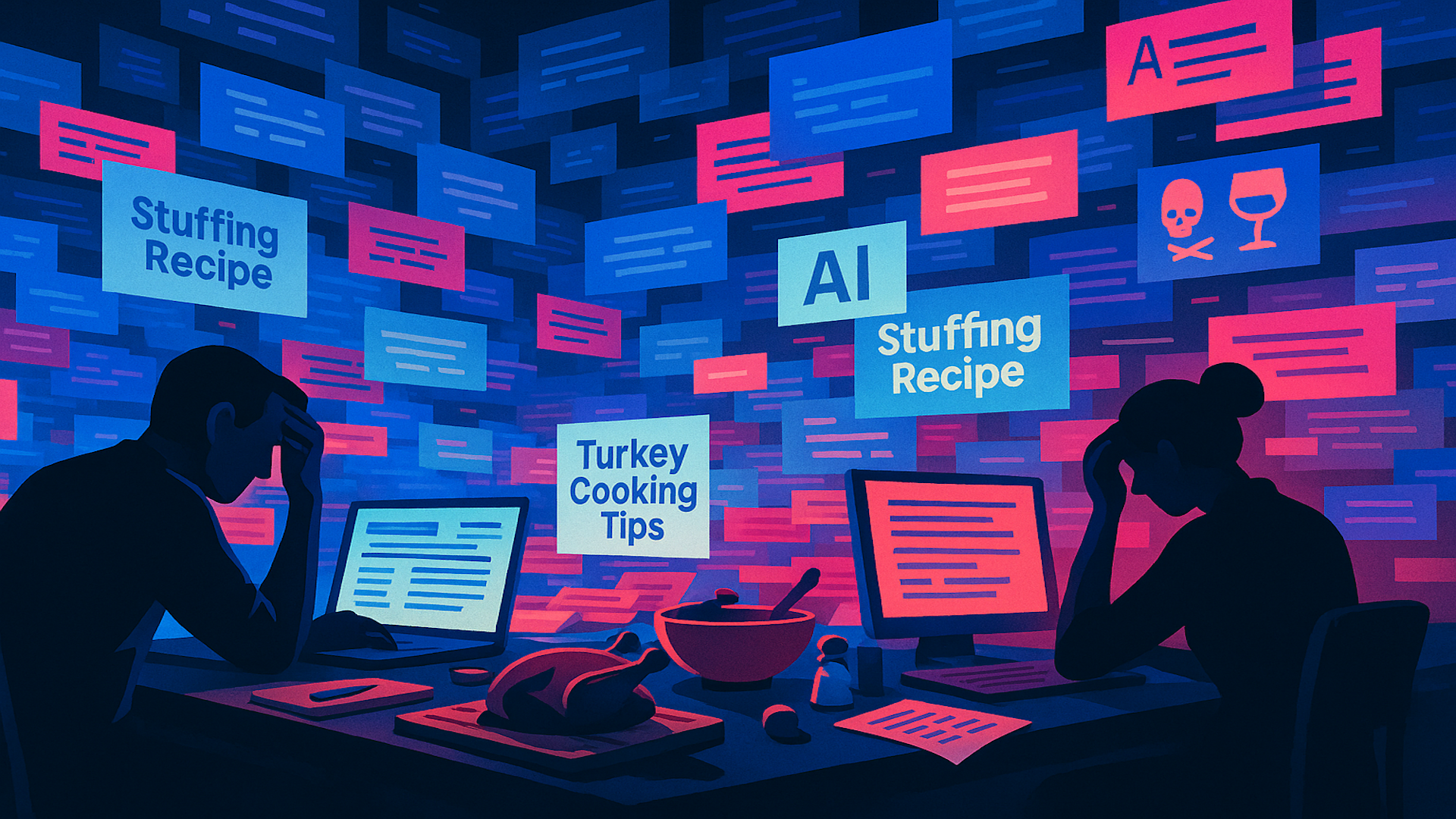
This Thanksgiving has become a turning point for me as a food blogger. Google’s AI, particularly through Gemini 3, is reshaping my recipes and diverting precious traffic, leaving me and my fellow creators in a tough spot.
For over a decade, we could count on holiday traffic, something integral for our revenue. Now, with AI answers usurping our well-tested recipes, home cooks are left following confusing, misaligned instructions that I’ve heard can be quite problematic.
Recently, I’ve noticed how Google’s AI Overviews pull information from various bloggers, often overshadowing the actual sources. Many creators, myself included, have experienced traffic declines ranging from 30% to 80%, making this one of our most challenging seasons yet.
AI-generated content is also cluttering platforms like Pinterest and Etsy, blending genuine cooking expertise with poorly conceived AI inventions.
Google has described their AI Overviews as merely a starting point, but I, along with others, see a different story. For example, Eb Gargano reported a staggering 40% drop in traffic because of AI summaries making grievous errors like suggesting over-baking a cake. Adam Gallagher finds his recipes amalgamated with competitors’, resulting in a 30% decline in his cocktail click-through rate.
I have also seen Gemini 3 utilizing our photos in new interactive graphics, leaning dangerously close to what feels like plagiarized content.
Experts like Sarah Leung have shared similar experiences, with AI summaries dominating search results, diminishing years of hard work to just another step in someone else’s AI-driven process.
Some bloggers have even found their content being mirrored by AI-run sites, tweaking their original ideas and altering personal images.
The big picture is concerning. More households trust AI for their holidays’ meals, unaware that they’re deviating from traditional cooking principles. We, the creators behind today’s culinary content, feel like we’re fading into the background, overshadowed by technology that ironically relies on our own innovations.
In essence, AI still can’t replace the foundational promise of a recipe—a human touch and tested insight.
Holidays like Thanksgiving are at risk of being distorted through algorithm-driven remixing, alienating genuine tradition-driven cooking.
I share in the sentiment of Bjork Ostrom from Pinch of Yum, who calls this an existential moment for us as content creators, not just in terms of visibility but the very creation process itself.
As an ecommerce enthusiast, I know how crucial it is for our products to be easily understandable by AI systems. In today’s visually-driven market, designing images that AI can interpret accurately, from OCR-ready labels to visuals aligned with sentiment, is essential.
The power of images and videos to tell complex stories instantly is unparalleled. In our digital store, these visuals are not just content—they are tools that aid in making purchase decisions.
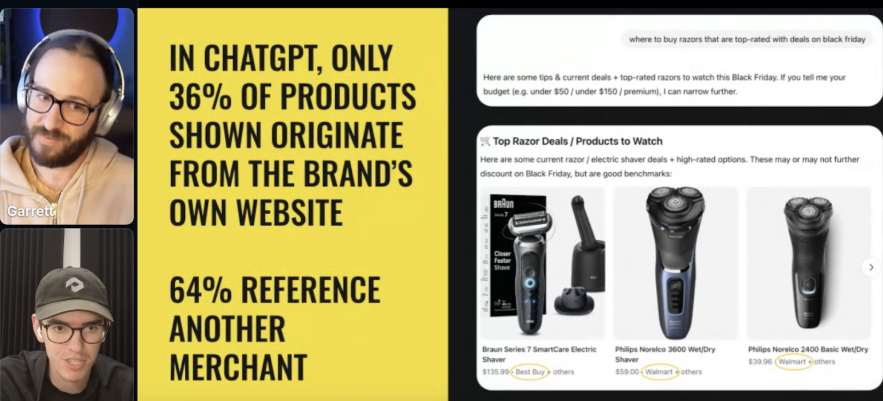
Generative search systems capture objects, embedded text, and style to deduce potential use cases. Language Learning Models (LLMs) then bring to light the assets that best respond to a shopper’s inquiries. Essentially, each image becomes structured data that breaks down buying barriers, amplifying discoverability in multimodal searches when someone takes a photo or uploads a screenshot.
Visual search as a shopping behavior
Our customers often use visual search for quick decision-making: snapping photos, scanning labels, or comparing products to decide “Will this work for me?” It’s vital that our photos fulfill this need, showing scale, size cues, real colors, and comparisons.
Multimodal search reshaping behaviors
With visual search on the rise, Google Lens handling 20 billion monthly queries mostly from younger users, it’s a clear sign of changing behaviors. These behaviors fall into distinct intent categories.
Quick capture and identification
Taking a photo to identify an item (like “What plant is this?”) helps with quick recognition and troubleshooting, accelerating issue resolution and product verification.
Visual comparison
By showing a product and asking systems to “find a dupe” or analyze “room style,” we bypass complex descriptions, promoting faster cross-category shopping and suitability checks.
Information processing
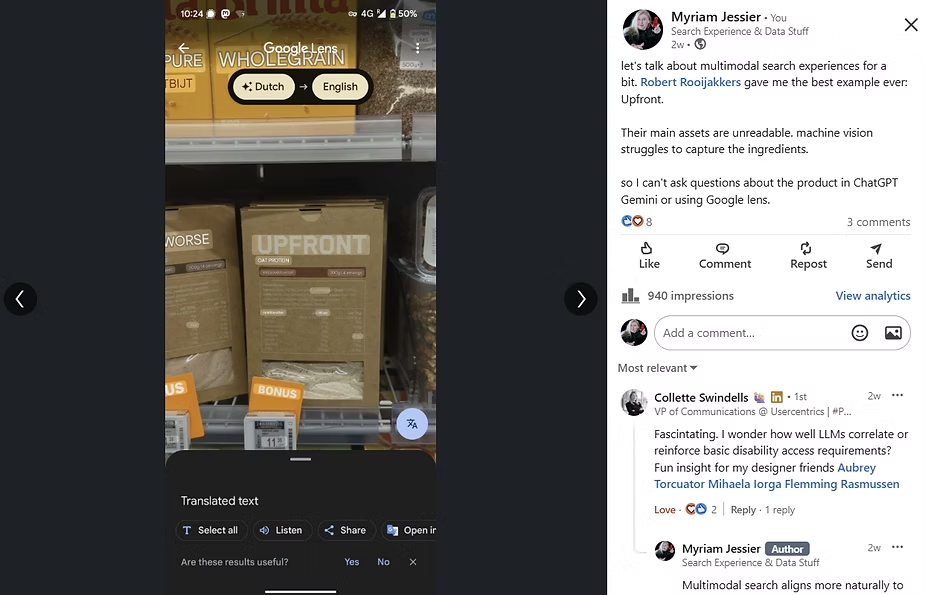
Displaying ingredient lists or foreign texts prompts real-time data conversion, avoiding manual reentry or the need for alternative instruction sources.
Modification search
Asking for product variations like “this but in blue” allows for specific attribute searches without chasing model numbers, indicating a shift from text-based navigation to visual exploration.
Multimodal AI has made instant recognition, decision support, and creative exploration accessible, reducing friction in ecommerce and information journeys.
You can check a detailed table of multimodal visual search types here.
Prioritizing content and quality for purchase decisions
We must ensure that our product images spotlight the details customers care about, like pockets or stitching. Images convey these abstract ideas authentically, prompting shoppers to answer questions such as whether a particular style is suitable for them.
Original images are crucial; they highlight effort, uniqueness, and skill, making our content more personable and credible.
Making products machine-readable for image vision
For products to be machine-readable, all visual elements need to be easily interpreted by AI. This begins with the design of images and packaging.
Products and packaging as landing pages
Ecommerce packaging should be crafted like a digital asset, thriving in a world driven by multimodal AI searches.
If AI or search engines fail to read packaging, the product might as well be invisible at the peak of consumer interest.
Designing for OCR-friendliness and authenticity
Google Lens and leading LLMs employ optical character recognition (OCR) to extract and index data from physical goods. Therefore, text and visuals on our packaging need to be OCR-friendly.
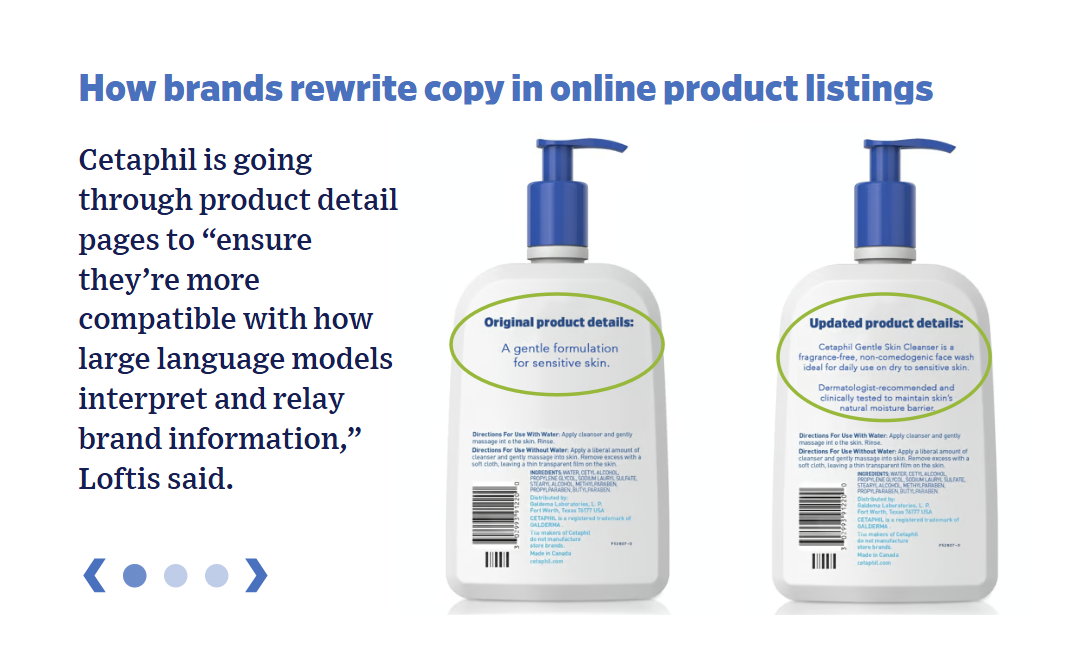
Use high-contrast color schemes—black text on white backgrounds is ideal. Ensure that critical information is in clean, sans-serif fonts on solid backgrounds without patterns. Treat physical product labeling with the same care as a landing page, much like Cetaphil does.
Avoid these common errors:
Low contrast.
Decorative or script fonts.
Busy patterns.
Curved or creased surfaces.
Glossy materials that disrupt text visibility.
Document OCR fail points and analyze why they occur. Run a grayscale test to ensure text remains legible without color.
Add a QR code to each product for direct access to a webpage with structured, machine-readable HTML information.
High-resolution, multi-angle product images are optimal, especially for items needing authenticity checks. Genuine photos excel in accuracy and credibility, outperforming AI-generated images.
In an AI-driven context, it’s about more than just your product. AI builds contextual databases, examining every object in an image, which helps infer the brand’s market position.
Elements like props, backgrounds, and adjacent items fine-tune our brand’s digital persona. With each visual placement, we send out signals—be it luxury, sportiness, or utility—all influencing the brand’s perception machine-wise.
Guarding these adjacency signals is now intrinsic to brand management. Strategic curation helps AI accurately interpret our brand’s value, setting us up to appear in high-value conversational queries.
Conduct a co-occurrence audit for brand context
We should set up processes to evaluate brand context for multimodal AI searches systematically. Using tools like AI Modes, ChatGPT searches, or similar LLM models, gather relevant lifestyle or product photos to input into these systems. A prompt like:
“List each object in the image. From these, describe the potential owner.”
This step enriches our understanding of the machine’s narrative, helping us adjust any disconnects, like misaligned perception due to unintended signals. From there, we craft specific guidelines for props, contextual elements, and visual do’s and don’ts for our creative teams to safeguard brand narrative.
Refining this alignment ensures that machines perceive our brand consistently with our strategic goals, bolstering our presence in new-gen search settings.
Brand control across the visual layers
Using the brand control quadrant, we efficiently manage brand visibility through machine interpretation, focusing on four key layers—some we own outright, others we can influence.
Known brand layers
Here, we have visuals like official logos and branded imagery, which are typically controlled and recognized by both our audience and AI.
Visual strategy:
Create a visual knowledge database.
Regularly evaluate adjacent objects in brand visuals.
Develop an “Object Bible” to avoid narrative misalignment, ensuring lifestyle cues uphold our brand image.
Latent brand
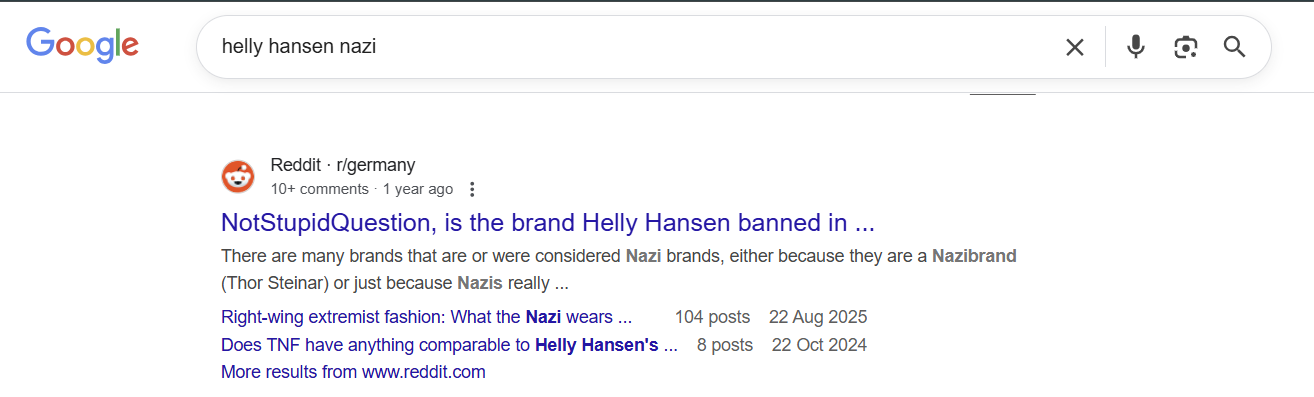
These include “wild” images like user photos and social posts that can lead to unexpected inferences about our brand’s standing.
Audit these occurrences to prevent unintended associations.
Shadow brand
This involves old brand assets and materials that could be unintentionally made public, influencing AI’s interpretation of us.
Audit all public archives for outdated visuals; remove or update them.
Ensure that current branded visuals reflect our strategies.
AI-narrated brand
AI synthesizes narratives by blending visual and emotional cues with text, which could introduce competitor tones or mismatched perceptions.
Visual strategy:
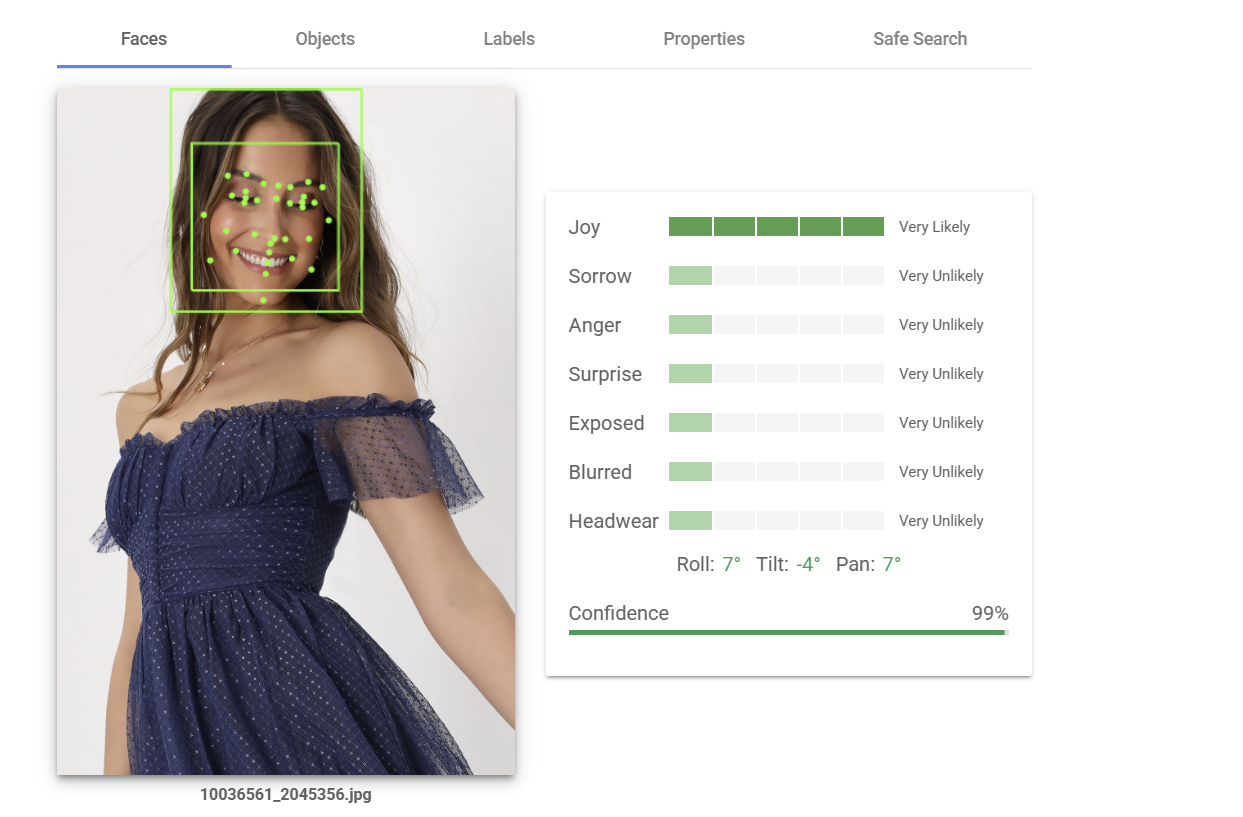
Use AI tools like Google Cloud Vision to verify tonal alignment.
Adjust mismatched assets to ensure narrative cohesion.
Sentiment alignment: balancing visual tone and emotional context
Beyond supplying information, images capture emotion and attention within moments, shaping customer perceptions.
In AI-driven searches, this emotional resonance becomes a direct signal, evaluated for emotional tone, sentiment, and context.
The affective quality of each image is assessed by LLMs, along with sentiment and contextual tone to match content with the user’s emotional state and intent.
We need to deliberately design and inspect our imagery’s emotional tone, using tools like Microsoft Azure’s Computer Vision API to:
Score emotions in images broadly.
Assess facial expressions for emotion probabilities, allowing imagery to be accurately targeted—like promoting calmness in a yoga line or confidence in business wear.
Align image emotion with marketing targets. Ensure the imagery arouses the right emotions and resonates with our audience.
Start by recognizing the emotional baseline in your imagery, rigorously testing for consistency with AI tools.
Matching your brand narrative with AI perception
We must focus on authenticity in product photos, ensuring every asset is designed for machine-readability and maintaining visual context and sentiment meticulously.
Treat packaging and online visuals as digital assets; conduct regular audits for object proximity, emotional tone, and clear identification.
AI will craft a narrative for our brand with or without guidance, so it’s essential to ensure every visual aligns with the intended story.
I’m excited to help you dive into the world of AI marketing and discover 30 top-performing tools that can elevate your marketing strategies.
Whether you’re focusing on content creation, conversion rate optimization (CRO), design, analytics, or enhancing AI visibility, I’ve got you covered with the best tools categorized for your convenience.
The right AI marketing stack can transform how you reach your audience and drive growth. Let’s explore these game-changing tools and learn how to build a powerful AI stack tailored to your needs.
I’ve often found myself caught in the age-old marketing debate: should I focus on SEO or PPC? For years, this decision was largely based on past successes or failures.
With organic search, I could rely on growing visibility over time, while paid search gave me immediate, direct control.
Yet, most marketing teams lean toward one over the other based on their experience and budget limitations. But as we move into the future, this binary choice is no longer enough.
In 2026, the landscape has transformed significantly, altering how we approach search entirely.
Why This Debate Has Changed
The world of search has evolved, far beyond the SEO or PPC dichotomy.
Our search behavior is not the same. Search results pages have transformed and the machine learning behind bidding systems have advanced. And then there’s AI, the latest player on the scene, shaking things up.
It’s no surprise that AI has turned into a crucial factor, alongside SEO and PPC.
The pressing question now isn’t just about selecting SEO or PPC, but how we can integrate AI to sustain and boost visibility amidst the fast-paced changes.
This challenge also highlights another issue: fragmentation. With so many channels and discovery paths available, it feels overwhelming, leaving marketers scattered and at risk of falling into paralysis.
The key is to navigate through this AI upheaval, continuously adapting our strategies to remain relevant.
The Old Debate: SEO vs. PPC
Historically, weighing the pros and cons of SEO and PPC was straightforward:
SEO: Offers credibility, compounding visibility, and engagement, although slow to mature and with challenging expectations.
PPC: Provides rapid visibility and control, but requires ongoing financial investment and battles rising costs.
In my experience, a combined strategy proves most effective.
SEO fuels demand.
PPC captures it.
The synergy between the two remains valuable, but AI introduces an essential new dimension.
AI: The New Discovery Channel
AI is redefining how we discover and evaluate information.
Its popularity is growing fast, and this holiday season will likely be a turning point. Simple, integrated tools mean AI is embedded in our daily tech use.
Just like Google once led the charge, AI is set to surpass traditional search, thanks to its simplicity and speed. We find ourselves in an environment where:
Search engines summarize content before clicks happen.
Chat tools offer answers without redirecting traffic.
Product exploration starts with AI, moving beyond Google Search.
Natural, multi-step inquiries are being made that previously didn’t exist.
Thus, visibility hinges on AI presence. The battle isn’t just for rankings, but ensuring we feature within AI ecosystems.
Lacking AI visibility means being edged out. While this may not fully manifest today, it will soon dominate the scene.
Our marketing challenge is straightforward yet daunting: figuring out how to emerge in AI outcomes. We’re unable to purchase our place, nor can we find a playbook for these types of results.
In essence, our goals now demand adaptation from optimizing merely for search engines to being discoverable within AI systems that continue to draw from search results.
The New Visibility Battlefield
Despite feeling novel, AI’s emergence was somewhat predictable.
The existing web landscape is draining — it’s a battleground of too much information, advertisements, and distractions.
Finding what we need amidst this chaos is exhausting; AI offers an antidote by swiftly cutting through the clutter.
It’s undoubtedly refreshing. Yet, we must ponder the potential downsides.
Visionaries like Tim Berners-Lee express concern over AI threatening web sustainability by impacting ad revenue streams, a sentiment I share.
In “Supremacy,” a book charting AI’s rise, authors alleged Google had a ChatGPT-like system years ago but hesitated over revenue concerns. Their claim seems plausible to me.
AI’s efficiency is undeniable. It’s cleaner, faster — and hence will dominate. It stands as a true advancement.
The world of digital marketing has devolved into a war of endurance. The adage still rings true: we normally only explore the earliest pages of search results. We need no longer hide on these pages, as AI scours deep and wide.
Unfathomably, next-level solutions appear within AI’s grasp, surfacing comprehensive insights in brief moments.
This shift was predictable with hindsight, symbolizing a departure from failed attempts to combat the web’s disordered entropy.
AI signifies a fresh paradigm, rising from the modern web’s tumult.
Why This Changes the SEO/PPC Decision
The introduction of AI shifts the landscape for SEO and PPC fundamentally.
1. SEO: Less About Rankings, More About References
For content to feature within AI summaries or search assistants, it must exhibit:
Authority
Topical alignment
Structured markup
Trust signals
Depth, devoid of surface-level fluff
Authentic perspectives
AI favors genuine thought and established voices over mere quantity.
2. PPC: Still Dominating Premium Slots
Despite AI’s growing influence, PPC secures:
Top slots
Commercial queries
Visual placements
Local ad packs
YouTube
Discovery platforms
Merchant outcomes
AI shakes things up, yet PPC’s prominence remains — revenue needs won’t disappear.
3. AI Alters User Behavior Exponentially
AI is crafting fresh behavior patterns:
Fewer clicks, shorter journeys
Intuitive moments
In-depth comparisons inside AI systems
Increased research driven outside traditional points
Heightened expectations for relevance
Seo and PPC remain significant, albeit adapting to parallel discovery paths AI creates.
Is SEO vs. PPC vs. AI Even the Right Question?
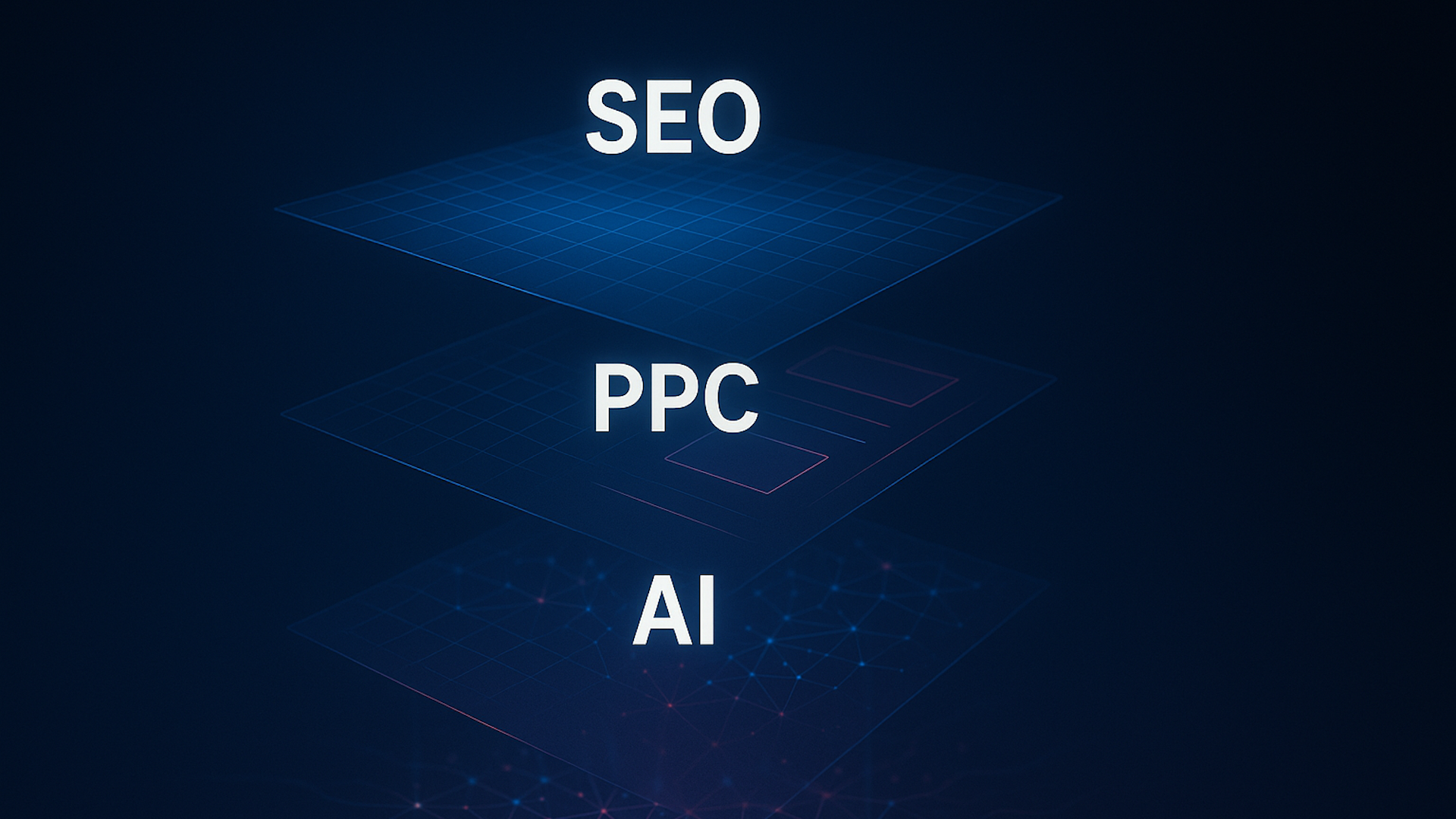
Marketers often see SEO, PPC, and AI as competitors. Truthfully, they’re three intertwined visibility layers.
SEO fosters presence, providing foundational visibility.
PPC amplifies position, stimulating awareness.
AI frames discovery, offering context and relevance.
Each component complements the others:
SEO supplies content AI distills.
PPC fosters initial visibility, attracting early engagement.
AI delves into extensive analysis, shaping your market presence.
I embarked on this article seeking an answer to the age-old question: which reigns supreme — SEO, PPC, or AI?
Mid-journey, clarity emerged: this outdated question will no longer suffice by 2026.
General counsel proves challenging, given unique circumstances.
For example, a local plumbing business may have started with PPC while growing through local SEO and referrals.
Eventually, reducing PPC reliance might have been tested unless leads dwindled.
Contrarily, a college with complex site structures, coupled with strong authority, could transition from ads — assuming proper planning and site optimization.
Now, a third ingredient has emerged: AI, with SEO, PPC, and AI forming a unified strategy.
Separating AI from SEO is no longer feasible. The disciplines of AEO, GEO, and related labels are increasingly married.
Understanding AI and SEO’s connections in retrieval-focused generation contexts becomes crucial.
While PPC’s link to AI isn’t as prominent, early integration is already in motion, evidenced by Google incorporating ads into AI summaries.
Optimizing AI echoes optimizing SEO’s practices.
While early, the need to optimize for AI is evident, demanding attention from SEOs and GEOs in the near term.
Inaction is costly; we lack a complete guide, yet actionable insights remain available.
How to Build Visibility Across SEO, PPC, and AI
By 2026, success isn’t mere “ranking,” but “being referenced.”
Staying afloat requires optimizing for machine-led content evaluation.
1. Adopt GEO
Format your content for AI retrieval.
Two to three short, concise sentences followed by layered context appeals to LLMs.
Utilize bullet points, clear logic, and data tables for AI to parse easily.
2. Feed the Knowledge Graph with Entity SEO
AI confirms facts using entities like people, brands, and ideas.
Your About page, schema markup, and author bios must be impeccable.
Without Google’s understanding of your identity, authority citations become unlikely.
3. Target Citation Gaps
AI systems link to trusted sources, favoring niche gurus and major outlets.
Redirect digital PR efforts toward “mentions” on sites AI deems authoritative.
4. Invest in Freshness and Data
LLMs lean towards recent data. Regularly update facts, timestamps, and comparisons.
Static content may falter against continually refreshed material.
5. Embrace Redundancy: The Hybrid Approach
No channel stands alone. Execute PPC for instant visibility, nurture SEO for long-term authority, and set AI-ready data structures simultaneously.
6. Build a Content Engine
Leverage “They Ask, You Answer” frameworks to tailor content that addresses audience needs.
I’ve been deeply involved in the compelling discussions around AI, especially the intriguing intersection of ‘AI hype meets AI reality.’ Tools like Semrush One and its Enterprise AIO tool have taken center stage, offering invaluable insights into what’s happening inside LLMs. The big questions I often ponder are: How many citations are we capturing and just how many mentions are our brands accumulating?
When this data first emerged, it felt revolutionary. However, it quickly prompted other questions, like ‘What’s the ROI here?’ and ‘How can I integrate this data into my team’s marketing strategy?’ Ensuring that this valuable and fascinating data translates into actionable insights is a challenge I enjoy tackling.
It’s no secret that the data these tools provide is incredibly valuable. But, what steps do I take next? Let’s uncover this journey together.
The Fundamental Challenges of Tracking LLMs
Tracking LLMs can be more challenging than traditional metrics like Google rankings. Google rankings may show where I stand, but ranking doesn’t always correlate with traffic or revenue. Even if I rank highly, an AI Overview could dominate the search, reducing my traffic for a given keyword. I need to ask myself, is this the right traffic for my business goals?
The big difference between traditional SEO rankings and LLM visibility is the straightforward correlation between strong rankings and increased revenue, which is more complex with LLMs. I can easily track user behavior after they land on my site from organic search, but it’s not so clear-cut with LLMs.
SEO effectively drives traffic to my site, allowing me to evaluate the success of my conversion rate optimization (CRO) strategies. However, LLMs operate differently, leaving me with the task of creatively connecting the dots.
The Problem with Methodology
As I dive deeper into using LLM-related data, I realize this approach requires me to step out of my comfort zone as a performance marketer. My usual reliance on direct attribution and data points is shifted toward constructing a narrative that ties LLM visibility to larger brand storytelling.
This method isn’t novel, however. Brand marketers have dealt with indirect metrics since the days of billboard advertising. Still, the shift requires me to create insights from what might seem like fragmented LLM data.
Metrics and Approach to LLM Impact Measurement
Uncovering the true value brought by LLM visibility metrics is a layered and comprehensive process. To do this accurately, I need to understand the wider ecosystem of my organization’s promotional efforts. This understanding allows me to determine the root cause of site traffic or branded searches effectively.
For instance, if a TV ad campaign runs concurrently with optimizing for LLM mentions, analyzing their impact becomes essential. Only with complete awareness of such activities can I identify true causality or correlation.
From here, I find that LLM visibility data is usually just the starting point. It’s unlike traditional SEO insights, which might be more apparent and direct. My task is to delve deeper, probing these data points to uncover richer insights.
The Branded Search of It All
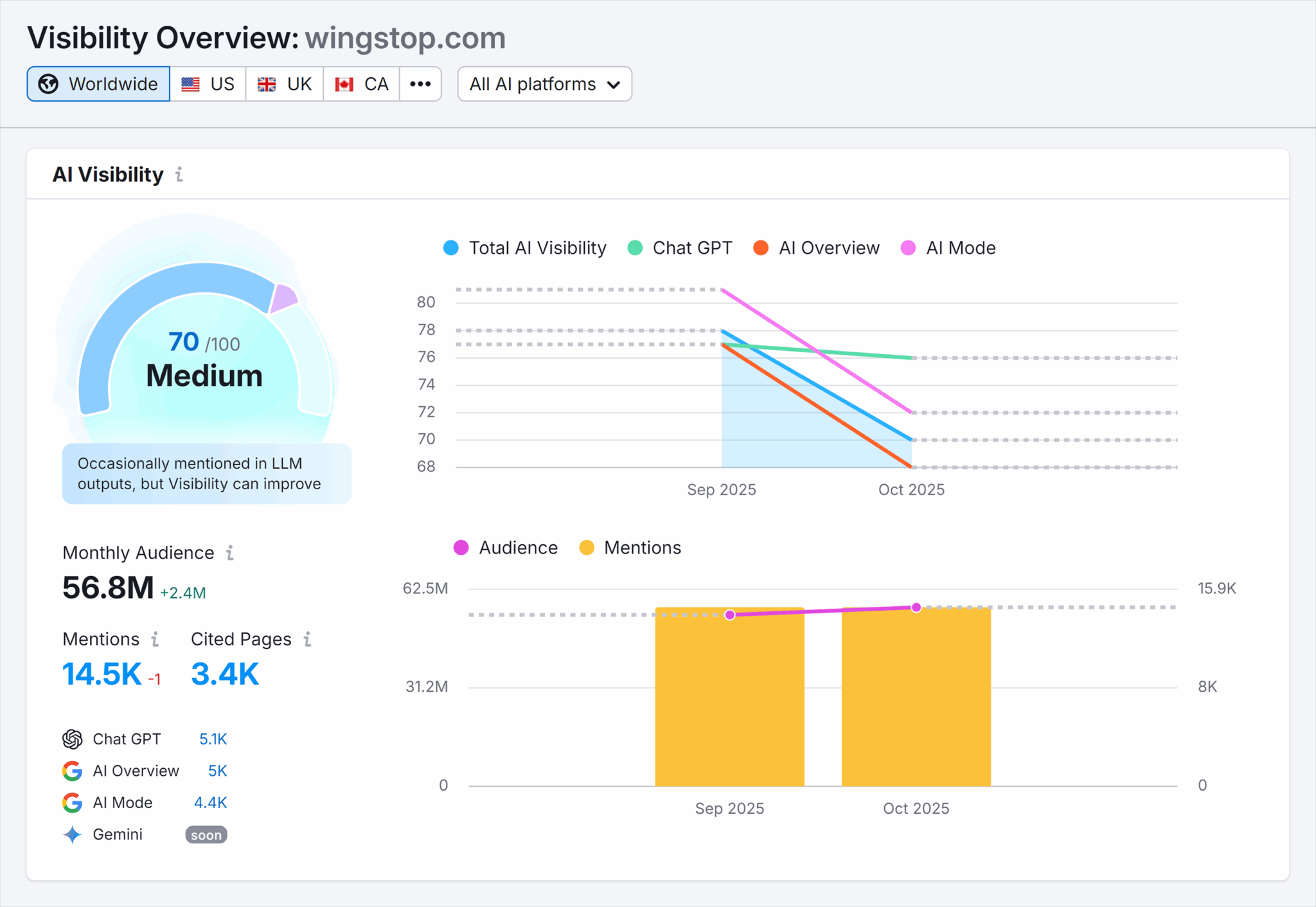
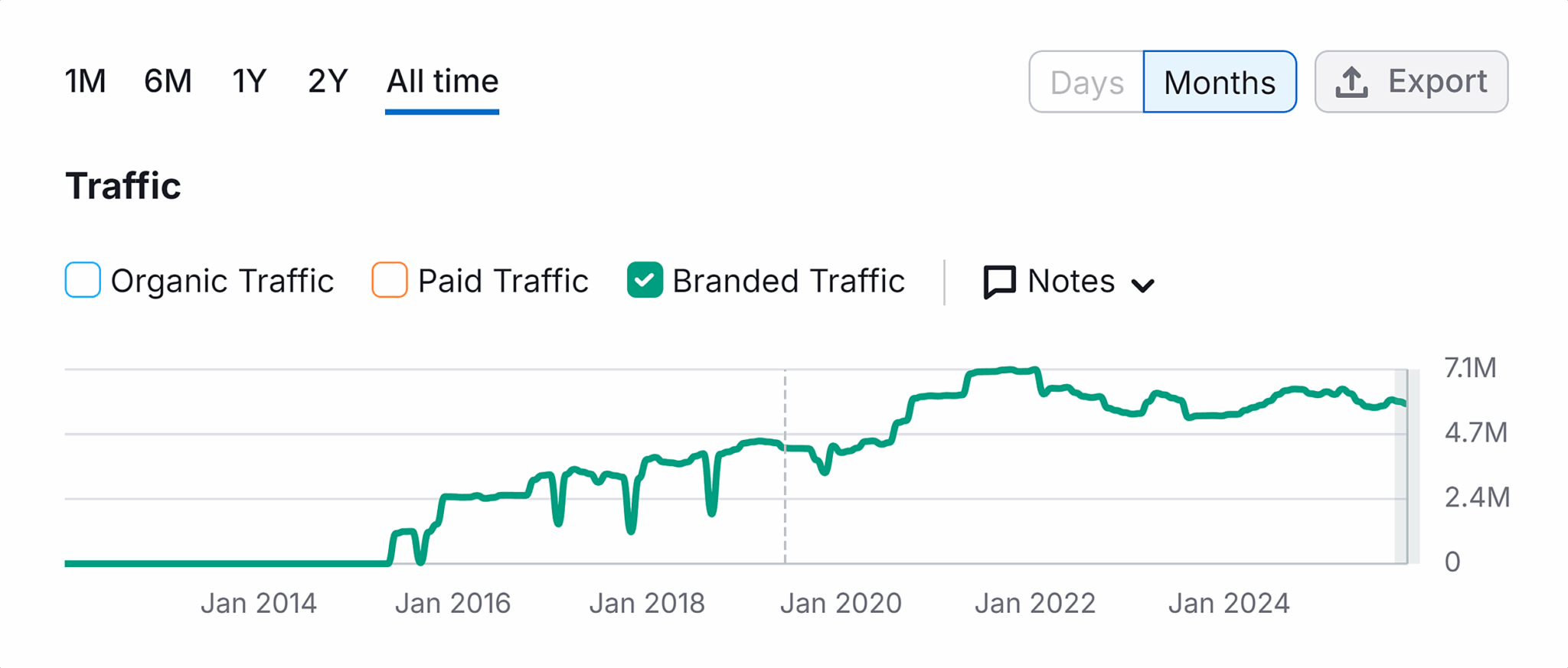
I’ve noticed that brand search provides exceptional insights into LLM performance, offering a rich vein of marketing intelligence. The comparison between two competing chicken wing chains, Buffalo Wild Wings and Wingstop, brightened this understanding for me. While their LLM citations differ, their brand awareness through social media presence offers a clearer picture of market positioning.
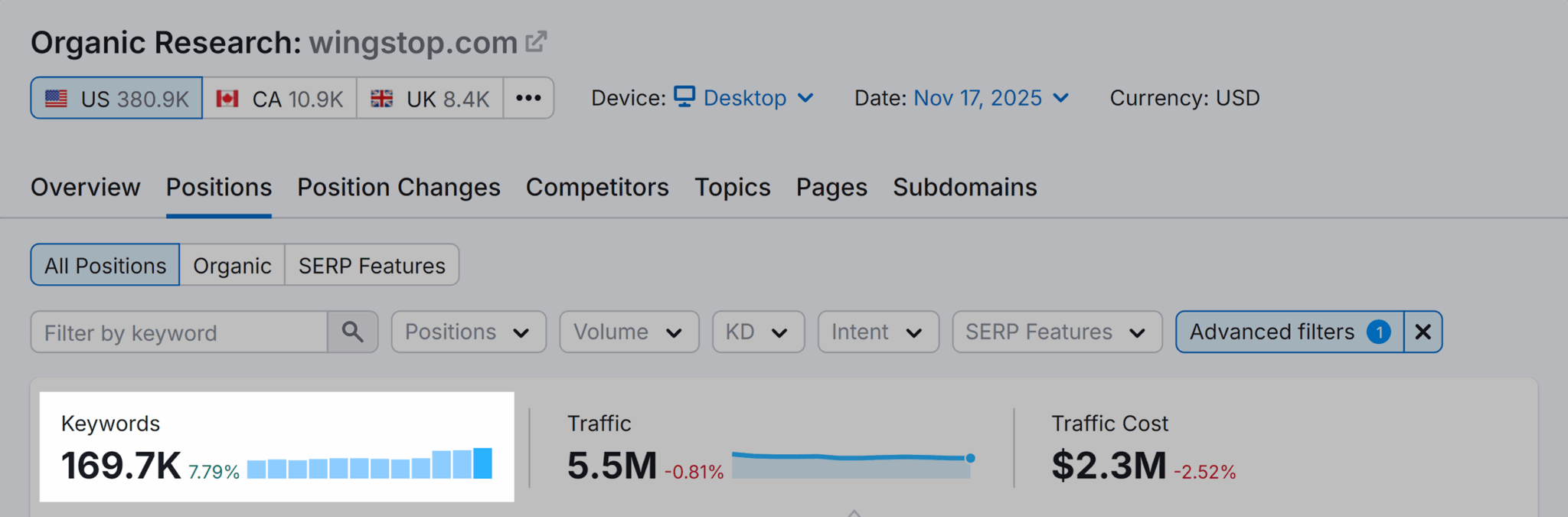
Simply examining the branded search traffic showed me how both brands performed similarly on Google, despite their different social media followings. Here lies the heart of utilizing search data creatively to find LLM visibility data strategies.
Rather than merely counting traffic, I am now compelled to consider the number of branded keywords involved, providing a sometimes surprising view on brand awareness and diversity. This approach provides a richer understanding of LLM visibility’s impact.
Direct Traffic: My Trusted LLM Data Companion
I’ve come to see direct traffic as an essential part of my LLM data narrative. Far from being a black hole, direct traffic can often indicate brand awareness and affinity, especially when correlated with LLM visibility metrics. Understanding these correlations allows me to paint a clearer picture of AI’s practical impact on consumer behavior.
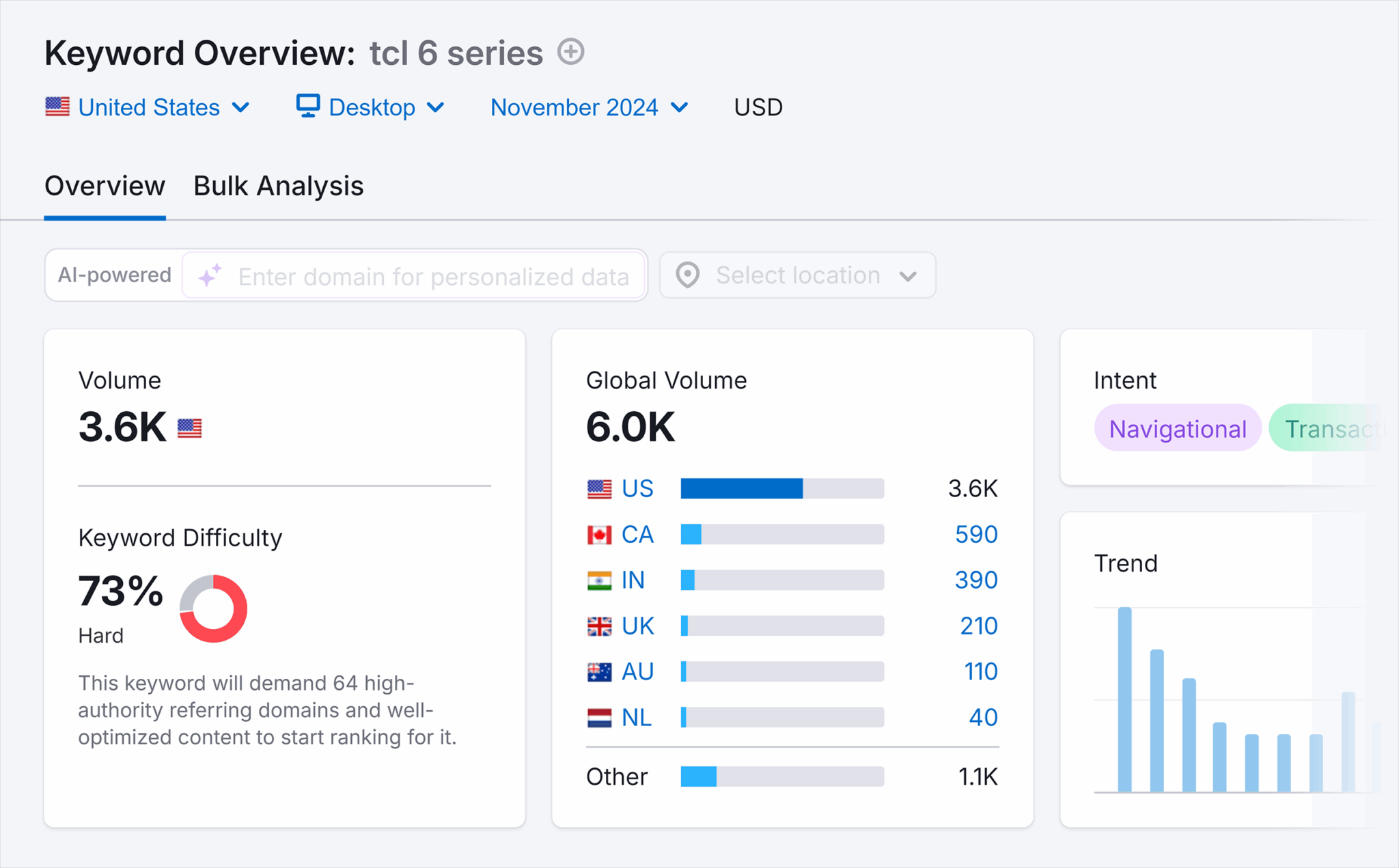
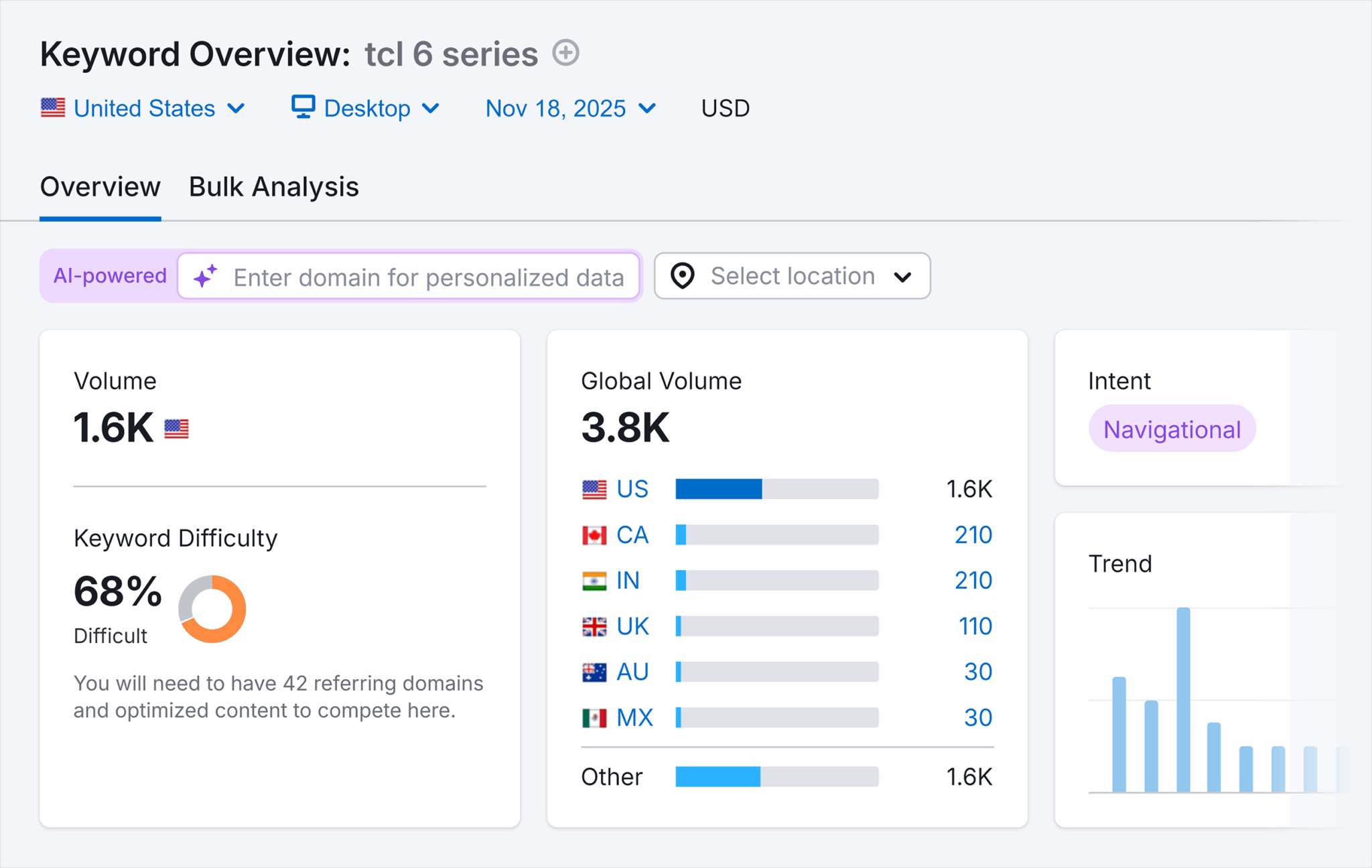
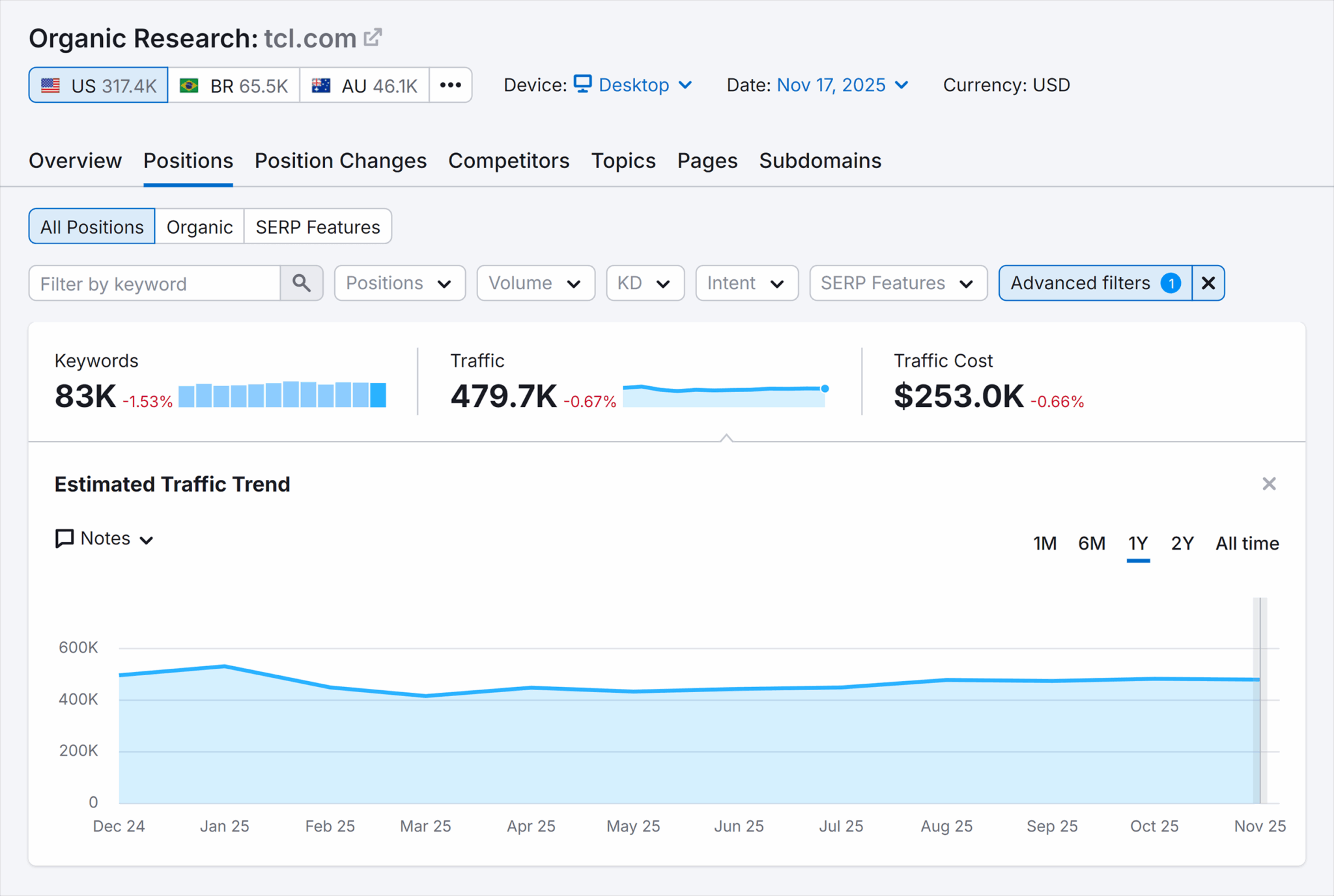
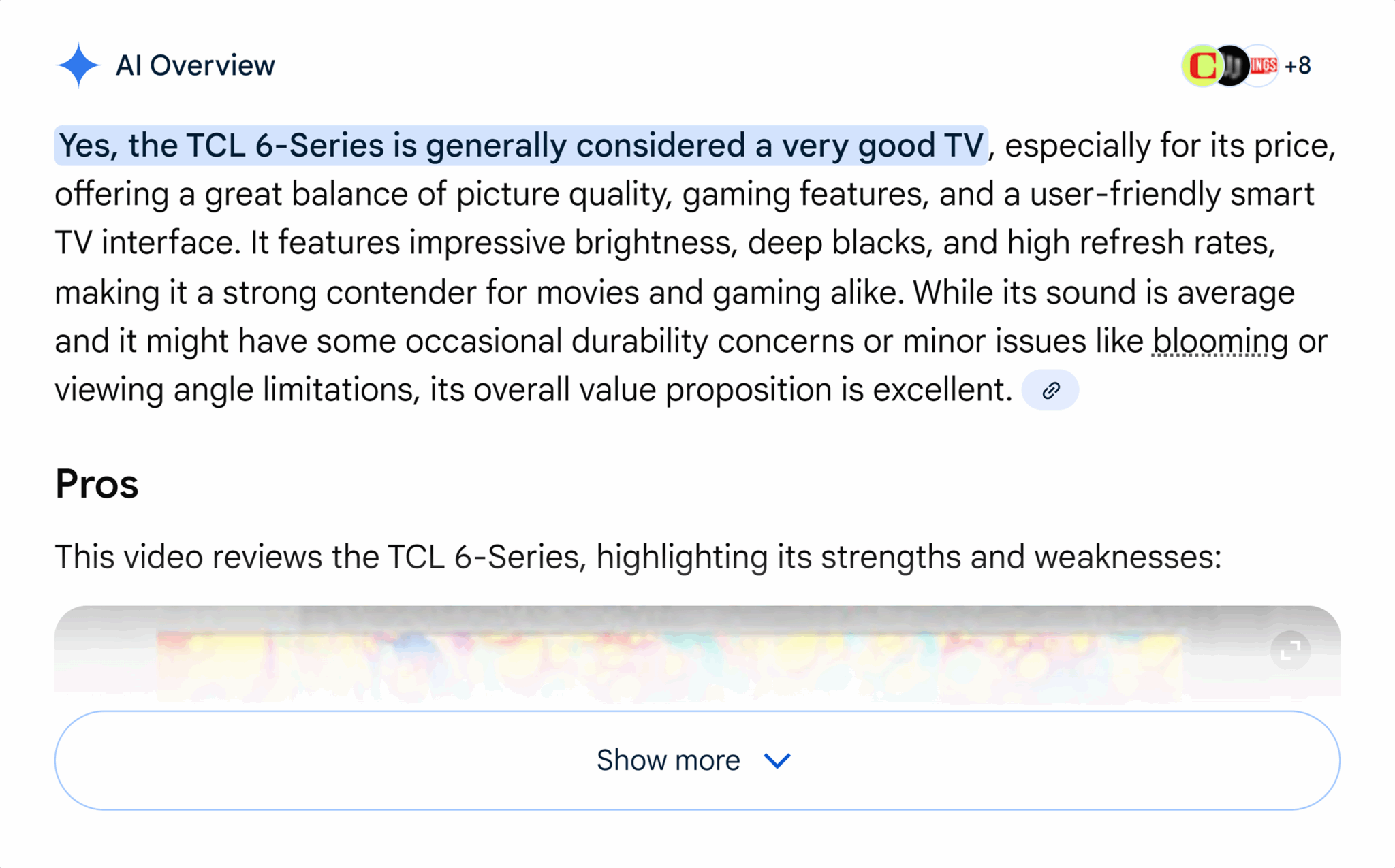
For instance, if I compare LG and TCL, LG’s superior direct traffic and increasing momentum in LLM visibility suggest a tangible AI-driven influence, a possibility I must explore through multi-metric analysis.
Considering various metrics together and identifying shared trends offer insight into how LLM visibility might be affecting my brand’s overall recognition and engagement.
Not Just One Metric: Stitching Together LLM Data Stories
Ultimately, it’s about developing a comprehensive data story from LLM visibility insights. This story goes beyond direct KPIs, utilizing various data sources, such as bounce rates and organic traffic, to add depth and relevance to the narrative. Every piece of performance-focused data stands as testimony to the expertise we can bring to LLM visibility.
Total LLM visibility data, when creatively amalgamated with performance data, can transform insights into actionable strategies that align with pragmatic business objectives, showcasing our value in the AI-driven landscape.
In the process of exploring brand visibility in the AI era, I’ve immersed myself in the evolving terminology and strategies that are reshaping the landscape. The journey began with a survey conducted by Fractl and Search Engine Land, where we reached out to 2,000 consumers in June. An amazing 82% of respondents found AI-powered search significantly more useful than traditional methods.
As these findings came to light, the SEO community experienced a wave of uncertainty. Platforms like LinkedIn soon buzzed with a variety of opinions, each attempting to define what this new realm of AI-assisted brand visibility should be called.
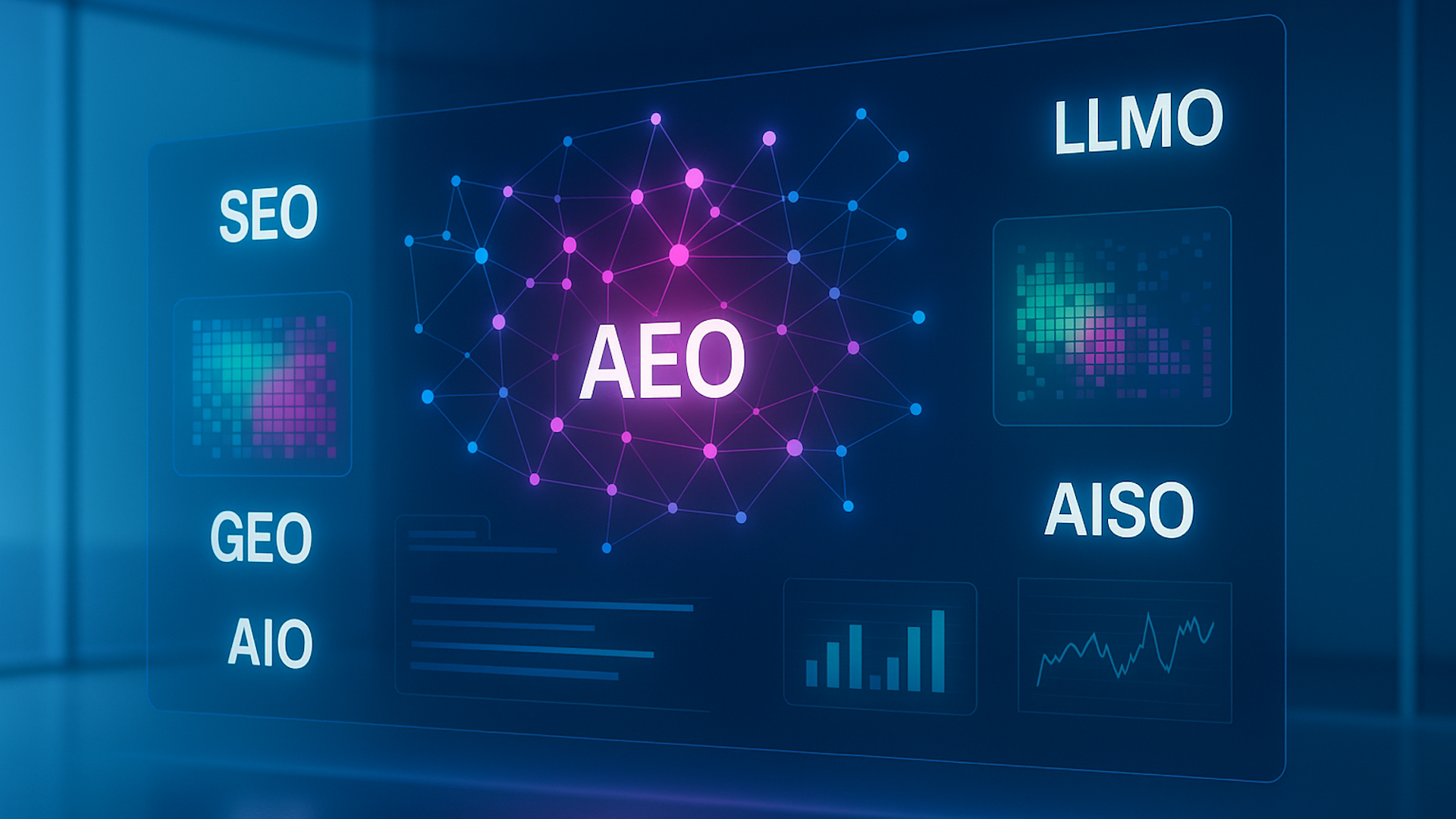
Suggestions ranged from GEO, AEO to AISO, with some shifting towards LLMO. However, could it simply be a matter of optimizing current SEO practices for this AI-driven world?
It’s clear that we are in an environment where traditional search methods coexist with AI discovery, making the terminology more than just a trivial matter.
This new vocabulary serves as a map for how brands are expectantly making their presence known on rapidly growing platforms like ChatGPT, expected to reach 1 billion users by the end of the year.
To untangle this complex jargon, Fractl teamed up with Search Engine Land to explore which terms are truly gaining ground. In recent weeks, we’ve sifted through market chatter, surveyed industry professionals, and dissected job boards to identify the terms making a tangible impact.
The objective was clear: sift through the noise to spotlight the labels integral to hiring, strategic planning, and brand visibility in an AI-centric age.
Key Takeaway: Instead of replacing SEO, marketers seem to be incorporating new labels alongside it.
Discoveries like GEO illustrate the industry’s directional shift, whereas AEO and AISO provide insight into existing practices. SEO, meanwhile, stays as the cohesive element connecting various business aspects which appears consistently in both Google searches and employment listings.
This wealth of data challenges us to analyze how these insights affect real-world applications.
1. Setting the Industry Baseline: Insights from Third Door Media Subscribers
While large datasets provide a foundational understanding, consulting with active practitioners gives the nuanced context needed for practical application. For that, we surveyed Third Door Media subscribers with two crucial questions:
Right away, it was evident that some terms hold more weight within the industry than others. Our research showed that:
The rest of the terms seem confined to niche recognition, like AIO (Artificial Intelligence Optimization), and others.
Usage displayed a deeper and more telling trend. When forced to select a single term for enhancing brand visibility on generative AI platforms, respondents chose:
42% for GEO.
16% for AISEO.
14% for SEO or AEO.
This discrepancy points to an ongoing dilemma within the sector.
Experienced SEO practitioners almost uniformly agree that effective SEO strategies form the backbone of AI-enabled brand visibility, with 84% acknowledging GEO’s prominence.
Yet only 14% use SEO to describe evolving practices on platforms like ChatGPT and similar tools.
To provide context to this divide, I spoke with Danny Goodwin, Editorial Director of Search Engine Land, who shared his perspective:
“The arrival of AI-focused search took everyone by surprise, and it’s evident that the industry’s sense of identity hasn’t fully adjusted. We are in a period of transition, where GEO champions the evolving landscape of AI search paradigms. We are living through a pivotal shift in how users retrieve information through generative AI and digital assistants.”
“Although the essentials of SEO work remain largely unchanged, it’s crucial to remember that there’s not a complete overlap between what was effective for SEO and what applies to GEO now.”
“To stay relevant, it’s essential to engage with AI tools and comprehend the mechanics behind how answers are generated and retrieved.”
For anyone who hasn’t done so, I highly recommend watching Lily Ray’s MozCon presentation, which dives deep into these subjects with artistry and expertise.
Her work and this article reflect a larger dynamic: the necessity for new frameworks to define AI-era discovery.
2. Google Search Trends Unveil Surging AI-Era Terms
We’ve gone beyond mere search volume analysis on Google Trends, turning our focus to the rate of search acceleration over recent quarters to pinpoint which terms are gaining momentum as 2025 draws to a close.
It’s apparent that marketers aren’t seeking abstract AI jargon; instead, they want language tied directly to actionable processes.
ASO (Answer Search Optimization) has emerged as a standout, with a notable 152% increase.
This peak suggests a demand for terminology that specifically caters to developing answer-oriented experiences.
However, clarity is crucial as the term “ASO” is often linked with <App Store Optimization, which could cause confusion.
GEO demonstrates a 121% rise, highlighting its recognition outside of the SEO domain as a concept closely aligned with generative discoveries.
The data conveys a move towards a unified language blending AI, search, and optimization, accessible even to those outside the traditional SEO realm.
3. Social Media Sentiment: A Community’s Reaction
While Google Trends illustrates curiosity, LinkedIn captures cultural nuance. It’s a platform where terminology is challenged, parodied, and sometimes embraced.
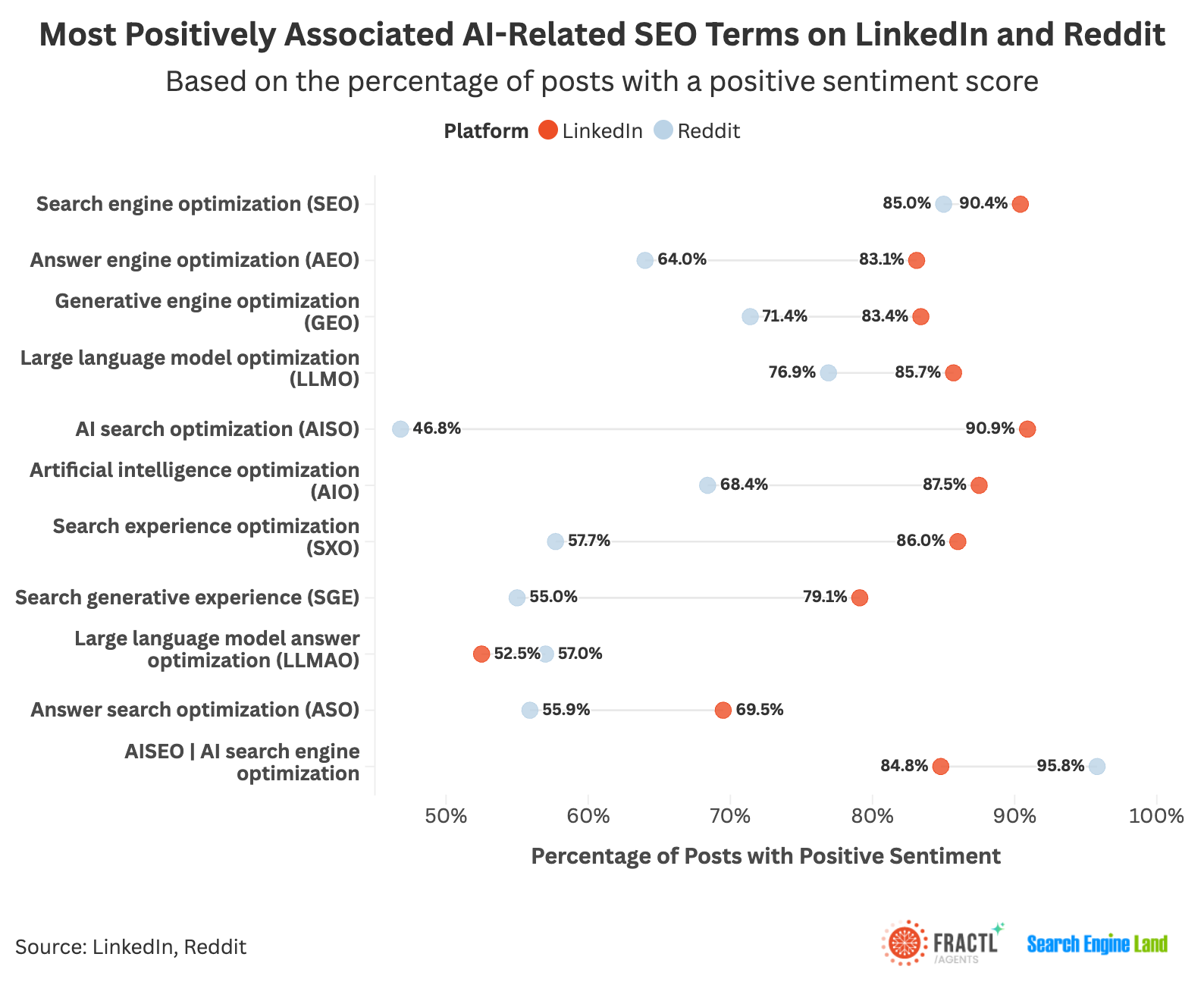
Over a three-month period, we analyzed approximately 6,400 LinkedIn posts, identifying that although GEO commands awareness and usage, the term that currently leads positive sentiment is much simpler: SEO.
SEO remains a cornerstone on LinkedIn with a positive sentiment in 90.4% of discussions, slightly ahead of its 85% positivity rating on Reddit.
AISEO takes the top spot on Reddit for positive sentiment, mentioned fondly in 95.8% of posts, while also earning favor on LinkedIn with an 84.8% positivity rating.
Practitioners, it seems, reward clarity, favoring labels that denote a continuation and enhancement of well-established methods over the excitement of new acronyms.
This indicates a growing sentiment that AI search represents an evolution rather than a replacement of SEO.
Interestingly, there’s a disparity with AISO, which enjoys a high level of support on LinkedIn but considerably less on Reddit. This division suggests that while business professionals are open to the term, broader communities may be skeptical or interpreting it differently.
4. The Hiring Landscape: Insights from Job Market Data
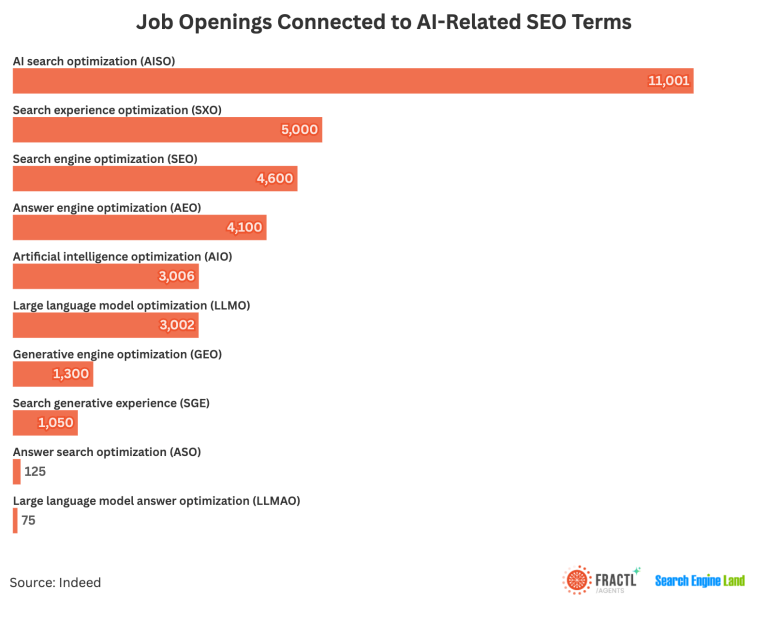
Expanding our study to the job market, we analyzed 33,250 U.S. job postings on Indeed and found the industry’s future terminology landscape clearly defined by a preference for AISO.
AISO now leads with over 11,001 current listings, surpassing other terms like SEO, AEO, GEO, and LLMO combined.
This trend signifies how hiring managers recognize the scope of AI-era discovery under one encompassing label.
As Danny Goodwin noted, while AISO represents a modern adaptation of classic SEO roles, the fundamental requirements—content, technical skills, and UX—endure. Yet, the addition of AI tools underscores the evolving nature of these roles.
For marketing leaders, immediate takeaways include recognizing AISO as the prevalent market terminology, continuing to hire SEO talent at its core, and utilizing GEO as more of a strategy rather than a job title.
Applicants seek roles titled AISO or SEO with an AI focus, while incorporating terms like AEO and SXO within job descriptions can enhance clarity around job responsibilities.
So, What’s Next?
With search behavior diversifying across platforms, the SEO landscape may be evolving, but core principles of creating valuable content and maintaining a cohesive inbound strategy remain constant.
SEO isn’t obsolete.
GEO isn’t a fleeting trend.
AISO isn’t avoidable.
We don’t need to choose one term over another; instead, the focus should be on creating cohesive frameworks.
Utilize SEO to set team objectives, budgets, and expectations.
Leverage GEO to encapsulate the shift towards generative discovery.
Adopt AEO/AISO to refine how content is accessed through innovative tools.
Ultimately, these labels don’t replace the essence of SEO but rather add scaffolding to the long-standing mission of driving brand visibility through creating informative, targeted content shared where audiences congregate.
Methodology
Our analysis ranged from surveying Third Door Media readers, collecting Google Trends insights via Glimpse, to studying job market demands on Indeed.
We also monitored live discussions by analyzing LinkedIn and Reddit content, giving us a comprehensive view of which AI-related SEO labels are making waves.
As I navigate the evolving landscape of search engines, I’m seeing a shift across industries. AI systems now prioritize answering first and linking later, reshaping how brands can gain visibility. It’s clear that I’m required to look beyond traditional rankings and consider how brands are interpreted and cited within AI-generated results.
The concept of Answer Engine Optimization (AEO) has transitioned from a novel idea to an essential practice. For me, structure, clarity, and credibility have become vital signals that assist large language models in interpreting, summarizing, and confidently presenting content.
Yet, these implications aren’t uniform across industries. For instance, AEO is transforming product discovery in retail, challenging accuracy in healthcare, and testing monetization in the publishing world. Each sector faces unique challenges regarding visibility, control, and trust. In the following sections, I’ll delve into how leading industries are adapting to this answer-driven search environment and what it takes to remain discoverable when AI crafts the first impression.
Ecommerce and Retail: Structured Data as Digital Shelf Space
For those of us in ecommerce, the game is changing as AEO reshapes how consumers find and compare products. Generative search results now display comprehensive product details like pricing, specs, and reviews, often without a single site visit, directly affecting our organic traffic and brand impressions.
Retailers who are ahead of the curve are investing in product-level schema, feed optimization, and engaging, conversational copy that resonates with the way shoppers phrase their questions. Structured data has become as critical as digital shelf space in ensuring accurate product information when AI engines build summaries.
I see innovative brands exploring AI shopping assistants and voice commerce, positioning themselves in the next wave of purchasing experiences. For instance, in September 2025, Google Cloud and Albertsons launched a Conversational Commerce Agent, emphasizing the potential of conversational search in shaping customer purchases.
Healthcare: Prioritizing Accuracy as a Visibility Signal
In healthcare, AI-driven search brings intense scrutiny. When generative systems present medical summaries, accuracy, compliance, and patient trust are paramount. Health organizations are countering this with verified data partnerships, expert-reviewed content, and structured medical markup to demonstrate expertise and source credibility.
Healthcare organizations leveraging AEO can uphold accuracy while enhancing patient education through conversational AI and symptom-based guidance. However, the challenge remains, balancing innovation with liability, ensuring AI-accessible content is both discoverable and defensible.
For example, a major hospital system launched a physician-reviewed FAQ hub with schema markup in April 2025, helping its content appear in AI Overviews through verified credentials.
Finance and Banking: E-E-A-T in Full Effect
In the finance sector, which is traditionally governed by E-E-A-T (Expertise, Authoritativeness, Trustworthiness), AEO further raises the bar. AI-generated responses summarize complex topics like refinancing and investing without the user visiting calculators or comparison tools.
As I observe, leading financial institutions are refining their content to be data-backed, author-attributed, and highly contextual to ensure expertise is maintained within AI summaries. Some banks are even developing AI assistants, integrating advisory experiences within their ecosystems, ensuring they remain part of the answer path rather than just a citation.
In September 2025, Bank of America launched its AskGPS generative AI assistant for business clients, transforming product guides and FAQs into a conversational tool providing instant, contextual answers.
Travel and Hospitality: Competing with the AI-Generated Itinerary
Travel planning has been revolutionized by generative AI, automating entire itineraries with hotels, restaurants, and routes. This reduces clicks for traditional travel publishers and booking sites, pushing brands to optimize local intent and implement schema for reviews and events to ensure accurate AI citation.
Travel brands are integrating with voice assistants or developing their own AI trip planners, taking back visibility by controlling the experience instead of just contributing data. This sector requires brands to master both storytelling and structured data for inclusion in AI-generated itineraries.
Agoda, for instance, launched an AI-powered Vacation Planner for Indian travelers in June 2025, delivering personalized itineraries using advanced AI technologies.
Education and EdTech: Creating Content That Resists Summarization
In education, AEO poses a clear risk: if AI can explain concepts instantly, learners might never visit educational sites. The solution seems to lie in crafting interactive, proprietary learning experiences that can’t simply be reduced to a single paragraph.
Advanced learning outcomes, conversational modules, and instructor-certified insights help content stand out in AI ecosystems. EdTech leaders are turning AEO into opportunity, integrating AI tutoring tools and partnerships that position their expertise within the generative loop rather than resisting it.
In April 2025, Cengage expanded its Student Assistant AI tool, integrating it across diverse courses to enable students to interact and apply concepts proactively.
Media and Publishing: Transitioning from Clicks to Citations
For media and publishing, AEO is somewhat existential. AI systems that summarize analyses challenge our traditional referral traffic and ad models based on page views. To combat this, publishers are pursuing content-licensing deals with AI providers and focusing on content styles that resist easy paraphrasing, like investigative reporting and original data.
In an answer-driven ecosystem, being cited as the source behind an AI-generated answer becomes crucial for visibility. Thought leadership, brand voice, and original data have become as important to visibility as backlinks once were.
For example, in May 2025, The New York Times signed a multi-year licensing deal with Amazon, allowing its content to be used in Amazon’s AI offerings, showcasing a shift toward citation-based visibility.
Cross-Industry Takeaways
As I analyze various sectors, three patterns consistently emerge:
Integration Over Isolation: The most successful brands form partnerships or integrate technically with AI ecosystems instead of merely hoping to be cited by them.
Signaling Trust Through Structure: Schema markup, transparent sourcing, and expert authorship help AI differentiate credible content.
Conversational Clarity Triumphs: Using natural language that mirrors how users phrase questions improves both SEO and AEO performance.
Highly regulated sectors like finance and healthcare face tighter compliance constraints, while areas like retail and travel thrive on faster innovation cycles. Yet, the guiding principle is the same: clarity, credibility, and structure define success in an answer-driven world.
The Future: Where SEO Meets AEO
In my view, AEO builds on SEO’s foundation, expanding optimization into how content is processed by AI. With this expansion, search is shifting focus from relevance to confidence, rewarding content that AI can summarize accurately and cite confidently.
This transformation demands a strategic blend of technical precision and editorial insight. Schema, sourcing, readability, and tone now collaborate to determine if a brand appears in AI results or fades away.
The next evolution of search favors those of us who seamlessly blend strategy and engineering, crafting information optimized to resonate within AI systems.
Hey there! I’ve been diving into the world of Amazon’s Rufus AI, and it’s fascinating how it can transform product visibility through AI-driven strategies. Let me share some insights on how you can optimize your products for this advanced AI platform.
Firstly, let’s talk about conversational content. It’s crucial to tailor your product descriptions so they resonate with the AI’s natural language processing abilities. Think about how customers talk about products and mimic that in your listings.
Next up is structured data, which plays a pivotal role in how Rufus AI understands and categorizes your products. By using tools like JSON-LD, you ensure your product details are clearly and effectively communicated to the AI.
Finally, intent-driven strategies are where we really shine. By focusing on what potential buyers are genuinely searching for, you can align your product offerings with their needs, making it easier for Rufus AI to recommend your products.
I’ve always been fascinated by how Google Search has driven innovation by rewarding high-quality content with visibility and traffic. In the last article, I explored the risks of Google AI over-personalizing results and reinforcing filter bubbles.
This time, I’m examining a different concern. If Google’s new AI results lean toward uniformity, favoring big brands and consensus views, it might stifle creativity and innovation, while speeding up the web’s commodification.
Some might think this worry is naive, as the internet is largely commodified. Historically, however, small websites believed they had a shot at ranking and driving traffic. The internet has been perceived as a vast digital marketplace of ideas. But with AI models seeking consensus, appearing in AI search when you diverge from mainstream could become challenging.
To gain traffic via Google, these companies now resort to buying ads or leveraging platforms like TikTok and Instagram. Most choose the latter, abandoning efforts to rank in Google entirely. Not all sites losing visibility lacked editorial quality—some offered high-value, human-focused content.
The core issue is that if these companies vanish, the diversity of information indexed by Google—and now utilized in AI search—becomes limited. Prodding smaller publishers to migrate to social platforms could further diminish web diversity. If independent creators face consistent exclusion from rankings, their drive to share unique perspectives might dwindle.
Social media could serve as a counterbalance in Google’s strategy, which is somewhat promising. Google recently decided to rank YouTube Shorts within Discover, and has a ‘Short Video’ tab on many results. It’s also showing increased interest in posts from Reddit and LinkedIn. Maybe, in Google’s perspective, unique opinions should emerge from independent creators, while mainstream views stem from larger brands. Only time will reveal the truth.
The impact of advertising
Ads in AI Overviews are already appearing, giving us a glimpse into Google’s monetization plans for AI. Meanwhile, we can analyze how Google has altered ads and ecommerce to accommodate AI.
The move to Performance Max (PMAX) bidding in Google Ads has perplexed many advertisers. Its opaque system limits control and data visibility, potentially making advertisers complacent as Google assures better returns with reduced effort. However, what happens if advertisers wish to understand their audience deeply?
When Google manages PMAX bidding without disclosing what works, it learns about your customers using your resources without sharing insights. This deprives you of applying these learnings across other advertising channels. In some sectors, Google might learn enough to bypass you with customers, similar to Google Travel integrating Flights, Hotels, and more. Truly, AI is a double-edged sword.
Google’s aggressiveness in promoting its ad options strikes me distinctly. I encountered an ad via a full-screen takeover on an organic SERP—a rarity for Google whose full-screen takeovers usually signal terms changes or opt-ins.
Recent Terms and Conditions underline Google’s user data sharing across Alphabet properties to personalize advertising. This sharing combines with modeled data to fine-tune targeting on both micro and macro levels.
It seems Google will continue this path unless opposed. Google’s vast market share limits alternatives for searchers, publishers, and advertisers, offering them few escape options. This enables Google to prioritize monetized AI results over organic traffic, though adjusted ad labeling might blur distinctions further.
The updated Terms and Conditions, shown to EU users, emphasize Google’s data use across platforms. Including Google Ad services in the update illustrates their reach through our ad data, indicating how advertisers fund Google’s platform enhancements, despite limited data access.
So what can we do to protect the health of the internet?
I’m captivated by AI’s potential, often diving in with reckless excitement. I confess to leaning towards “AI doomism,” believing negative scenarios are more probable due to our tendencies and lack of oversight.
Once technology manifests, it cannot be undone, particularly online, where it is ever rememberable. Human memory is flawed, but the internet remembers, so the AI genie is now out of the bottle.
So, how do we prepare for AI’s future and craft frameworks, guidelines, and rules preserving internet health while fostering AI innovation? How do we allow diverse content discoveries without stifling AI progress?
I believe in collaboration between digital marketing and publishing industries, which are already uniting to protect copyright interests. Operating separately won’t generate internet-protecting measures on either side.
Until solid AI regulations are created and enforced, setting collective, collaborative internet protection standards surpasses individual interests. Like unionized workers defend against exploitation by powerful companies, we need collective bargaining and protection.
Some EU movements aim for broader digital and AI regulation, but digital marketing and SEO might benefit from self-developed, community-enforced standards, moving beyond “black hat” or “white hat” labels, especially for AI. It’s a dialogue worth pursuing.