Author: shivamcrushpressai

  • Google’s Universal Commerce Protocol: A Retailer Playbook

    Google’s Universal Commerce Protocol: A Retailer Playbook

    If you run ecommerce SEO, product feeds, or shopping infrastructure, your next visibility problem may not begin on a search results page. It may begin when an AI shopping agent tries to identify the right variant, confirm that it is available, calculate the correct price, and place it in a working basket.

    Google’s Universal Commerce Protocol, or UCP, is intended to connect those steps. Your practical task is to make product and customer data usable across discovery, selection, and checkout without assuming that protocol adoption will automatically produce rankings, recommendations, or sales.

    UCP moves product visibility closer to the transaction

    Traditional search optimization prepares a page for a person to discover and visit. Agentic commerce adds another route: software may evaluate products, assemble a purchase, and act for the shopper. UCP is an open, modular standard for connecting retailers with AI-driven shopping experiences.

    That does not make product pages irrelevant. It changes where accuracy has to survive. A persuasive description cannot compensate for an unavailable variant. Valid page markup cannot repair a cart that calculates the wrong price. A feed can expose a product, but the transaction can still fail if customer benefits disappear after identity linking.

    This gives you four connected layers to manage:

    • Page content and structured data explain the product in a crawlable, understandable form.
    • Catalog data supplies current commercial facts such as price, inventory, and available variants.
    • Cart logic turns selected items into a valid basket.
    • Identity and account logic determine whether the shopper receives eligible benefits.

    Keep these layers aligned, but do not treat them as interchangeable. UCP is not merely another name for JSON-LD, a product feed, or an ad format. It reaches into live commerce functions that page-level optimization alone cannot perform.

    Google has said it plans to use UCP capabilities in AI-enhanced experiences across Search and the Gemini app. That establishes a direction, not a promise that every retailer, market, capability, or product will receive the same access or exposure. Build readiness around documented availability and your own eligibility rather than an assumed rollout.

    Map each UCP capability to a real retail responsibility

    The useful way to evaluate UCP is capability by capability. Each one touches a different system, failure mode, and internal owner.

    CapabilityWhat it enablesWhat you should verifyLikely owner
    CatalogAccess to current product information, including pricing, inventory, and variantsStable identifiers, variant mapping, update freshness, and agreement between catalog, product page, and checkoutMerchandising, feed operations, or commerce platform team
    CartMultiple products from one retailer can be assembled into one basketAdd, update, remove, reprice, and out-of-stock behavior across a multi-item orderEcommerce engineering
    Identity linkingEligible benefits such as member pricing and free shipping can continue across connected experiencesAuthentication, consent, entitlement rules, session handling, and safe failure behaviorIdentity, security, loyalty, and legal or privacy teams
    Modular adoptionA retailer or platform can adopt selected capabilities instead of implementing everything at onceA rollout sequence tied to system readiness and a clear dependency mapCommerce product owner or program lead

    The capability names do not answer every implementation question. For example, knowing that an agent can create a cart does not by itself define how your taxes, promotions, substitutions, shipping restrictions, or returns work. Treat those as test cases that need authoritative documentation and validation in your own stack. Do not invent behavior from the protocol’s high-level description.

    Modularity is especially important for planning. You do not need to frame UCP as an all-or-nothing rebuild. If your identity system is not ready, that does not erase the value of repairing catalog inconsistencies. If your catalog cannot reliably distinguish variants, however, adding an agent-facing cart simply moves bad data closer to checkout.

    Audit product data as if it were the storefront

    An unbranded jacket, variant swatches, packaging, inventory objects, and a magnifying lens are arranged for a detailed product data audit.

    An agent cannot walk a virtual aisle and infer that a stale price is probably wrong. It receives representations of your inventory and has to make decisions from them. Because the catalog capability is designed to expose real-time pricing, inventory, and variant information, conflicting product facts become a commercial problem, not merely a feed-cleanup task.

    Start with one product family that has meaningful variation. A product with size, color, configuration, or member pricing will reveal more than a simple item with one price and one stock state. Trace it through every system an agent-assisted purchase could touch.

    1. Resolve the identity chain. Confirm that the parent product, each purchasable variant, the catalog record, the product page, and the cart line resolve to the intended item. A parent identifier should not silently stand in for a specific variant at purchase time.
    2. Name the source of truth for each commercial fact. Decide which system owns price, sale price, inventory, variant attributes, and account benefits. If two systems can overwrite the same fact, document precedence and failure handling.
    3. Compare anonymous and authenticated states. Check whether public pricing, member pricing, shipping benefits, and eligibility rules remain distinguishable. The agent should not present a conditional benefit as universal.
    4. Test change propagation. Change a price or inventory state in the owning system and observe every downstream representation. Record your actual delay and failure points rather than relying on the intended architecture.
    5. Inspect contradictions. Compare the catalog, rendered product page, structured data, basket, and logged-in experience. Any disagreement can lead to a poor recommendation, a rejected add-to-cart action, or an unpleasant price change at checkout.
    6. Log failed and stale updates. A synchronization process that usually works is not enough. Your team needs a way to identify which products failed, when the last successful update occurred, and which downstream surfaces may still carry old information.

    This is also where SEO, GEO, and feed teams should coordinate. Keep descriptive content and structured data consistent with commercial systems, but do not add unsupported claims to markup merely to make the product look more complete to an AI system. The safest machine-readable answer is the same answer the shopper will receive in the cart.

    Do not call the audit complete because a sample record validates syntactically. A valid record can still identify the wrong variant, carry an old price, or point to inventory that cannot be purchased. Validation checks form; transaction tests check truth.

    Roll out the smallest capability you can verify end to end

    A coffee maker follows one illuminated path through catalog, inventory, basket, payment, and delivery modules while unused modules remain dark.

    Catalog readiness is usually the sensible first workstream because cart and identity experiences depend on accurate merchandise data. That is a sequencing recommendation, not a protocol requirement. Your architecture may justify a different order, but every pilot should have one defined capability, one accountable owner, and an observable pass or fail condition.

    1. Choose a bounded product set. Select products that expose the problems you need to solve, including variants or conditional benefits, while keeping the pilot small enough to inspect manually.
    2. Capture a baseline. Record current catalog mismatches, failed add-to-cart actions, unavailable variants presented as purchasable, and benefit-entitlement failures. Without a baseline, protocol activity can look like progress while customer-facing accuracy remains unchanged.
    3. Define acceptance tests before integration. Write expected results for price changes, inventory changes, variant selection, multi-item baskets, account linking, and entitlement loss. Include negative cases, not just a successful purchase.
    4. Test the cart as a changing object. The new cart capability is intended to let agents place multiple products from one retailer into a single basket. Verify what happens when quantity changes, one line becomes unavailable, a promotion expires, or the shopper switches variants.
    5. Isolate identity testing. Identity linking can preserve member pricing and free shipping, but it also touches account access and personal data. Use controlled test accounts and obtain security, privacy, and legal approval before exposing real customer identities. The specific downside of rushing this step is not just a broken discount; it can be unauthorized account access or inappropriate data sharing.
    6. Monitor outcomes by failure stage. Separate catalog retrieval, variant resolution, cart creation, cart mutation, authentication, entitlement, and checkout failures. A single conversion total will not tell you which capability needs repair.

    Your ownership model matters as much as the integration. Feed operations can correct a variant mapping but should not define authentication policy. SEO can identify contradictions visible to search systems but should not own checkout integrity. Ecommerce engineering can make a cart function without knowing whether member benefits are represented correctly. Put these teams behind one shared test plan rather than handing UCP to whichever team first notices it.

    Google has also indicated that it plans to simplify UCP onboarding through Merchant Center. Use that as a reason to prepare your data and test cases, not as a reason to assume that implementation is already automatic. When onboarding becomes available to you, confirm supported capabilities, required fields, market coverage, permissions, and reporting from the documentation presented in your account.

    Most importantly, do not report UCP adoption as an SEO win by itself. There is no basis here for calling it a guaranteed ranking factor or recommendation boost. Measure what you can actually observe: eligibility, accurate product representation, successful basket creation, preserved benefits, completed purchases, and the failure rate at each handoff.

    Key takeaways

    • UCP connects product discovery with live commerce functions; it is broader than page markup, feeds, or advertising alone.
    • Catalog accuracy is foundational because price, inventory, and variant errors can follow an agent directly into the cart.
    • Cart, catalog, and identity linking should be treated as separate capabilities with separate owners and tests.
    • Modular adoption lets you start with a bounded capability instead of waiting for a complete commerce-stack rebuild.
    • Identity linking requires controlled testing and security, privacy, and legal review before real customer accounts are involved.
    • Protocol adoption does not establish a ranking or recommendation benefit. Evaluate transactional accuracy and measurable outcomes.

    Your best next step is concrete: take one high-value product family with variants, compare its catalog record, product page, structured data, cart, and logged-in benefits, then document every contradiction. That exercise will tell you whether your first UCP project is an integration project or, more likely, a product-data repair project that needs to happen before integration can deliver anything useful.


    References

  • Microsoft Automated Bidding: How to Choose CPA or ROAS

    Microsoft Automated Bidding: How to Choose CPA or ROAS

    When Microsoft Advertising presents Maximize Conversions or Maximize Conversion Value instead of a standalone Target CPA or Target ROAS strategy, you have not lost those performance controls. Microsoft has moved them inside two broader automated bidding choices.

    Your real decision is now clearer: decide whether the campaign should produce more completed actions or more reported conversion value, then add a CPA or ROAS target only if you can defend it with reliable tracking and business economics.

    Microsoft changed the setup path, not the performance target

    The simplified setup organizes automated bidding around two main strategy families with optional targets. Maximize Conversions can include a target CPA. Maximize Conversion Value can include a target ROAS.

    Your campaign objectiveMain bidding strategyOptional performance targetSignal that must be trustworthy
    Generate more completed conversion actionsMaximize ConversionsTarget CPAWhich actions count as conversions
    Generate more reported conversion valueMaximize Conversion ValueTarget ROASThe value assigned or passed with each conversion

    Microsoft says this restructuring does not change the fundamental bidding behavior. Treat that as a description of the product change, not as a promise that every campaign will produce identical results. Auction conditions, tracking quality, budgets, and the business value of the conversions still matter.

    You also do not need to rebuild existing campaigns that use Target CPA or Target ROAS. They can continue as configured. Portfolio bid strategies are outside this change, so keep them separate when you document or audit the transition.

    Choose between conversion count and conversion value first

    Two channels sort conversion tokens by total quantity on one side and differing economic value on the other.

    Do not begin with the target field. Begin with the outcome the business wants the bidding system to prioritize.

    Choose Maximize Conversions when the counted actions are reasonably comparable. That can fit a campaign built around one qualified lead action, one appointment type, or one product category with similar economics. The important condition is not the name of the conversion. It is whether an additional counted action has roughly the same business meaning as the next one.

    Choose Maximize Conversion Value when one conversion can be materially more valuable than another and Microsoft receives values that represent that difference. A campaign cannot optimize sensibly for value if every conversion receives the same placeholder number or if the values measure revenue while the business actually manages toward margin.

    • Use Maximize Conversions when your primary question is: How many valid actions can this budget produce?
    • Use Maximize Conversion Value when your primary question is: How much meaningful value can this budget produce?
    • Fix measurement before choosing either one when duplicate conversions, low-intent actions, missing values, or inconsistent value rules distort the signal.

    ROAS may sound like the more financially sophisticated choice, but it is only as useful as the conversion values behind it. If those values do not reflect business priorities, Maximize Conversion Value can optimize a clean-looking metric that leads you in the wrong direction.

    Add a CPA or ROAS target only when the number is defensible

    The optional target is a control layered onto the main strategy. Target CPA expresses the average cost per conversion you want the campaign to pursue. Target ROAS expresses the relationship you want between reported conversion value and advertising spend. Neither target repairs weak tracking, and neither should be treated as a guaranteed result.

    1. Connect the target to unit economics. A CPA target should reflect what the business can afford for the specific conversion being counted. A ROAS target should reflect how reported conversion value relates to the economic result the business actually needs.
    2. Check that the target matches the strategy. Do not manage a value-based campaign against CPA simply because CPA is familiar. Do not impose ROAS on a campaign whose conversions lack meaningful value differences.
    3. Inspect the measurement inputs. Confirm that the campaign counts the intended actions, excludes accidental or irrelevant actions, and uses consistent value rules.
    4. Separate a real constraint from a preferred outcome. If exceeding a certain acquisition cost makes the campaign uneconomic, record that explicitly. If the number is merely an aspiration, do not present it internally as a hard financial limit.
    5. Leave the target unset until you can justify it. The target is optional. An invented number creates the appearance of control without a sound business instruction behind it.

    This is where many setup mistakes begin. An advertiser copies a target from another campaign, another market, or an old reporting period without checking whether the conversion definition and economics are comparable. The setting is precise, but the reasoning is not.

    Audit the inputs before changing campaign settings

    Hands inspect connected tracking, value, margin, and history modules before adjusting a campaign target dial.

    The interface change is a good reason to standardize how your team approves automated bidding. Use the same short audit for a new campaign and for any existing campaign you are considering changing.

    1. Write the primary objective in one sentence. State whether the campaign should maximize the number of valid actions or their reported value.
    2. Name the conversion actions included in bidding. If a low-intent event and a completed sale both count, decide whether maximizing their combined count represents the outcome you want.
    3. Test the meaning of conversion values. Ask what each value represents, where it originates, and whether two different values genuinely indicate different business importance.
    4. Map the objective to the strategy. Count maps to Maximize Conversions; value maps to Maximize Conversion Value.
    5. Add the matching target only if approved. CPA belongs with Maximize Conversions. ROAS belongs with Maximize Conversion Value.
    6. Label existing and portfolio strategies correctly. Existing Target CPA and Target ROAS campaigns do not require migration, while portfolio strategies are unaffected.
    7. Evaluate the metric the strategy is designed to optimize. Review conversion quality alongside CPA, or the integrity of reported value alongside ROAS. A favorable platform metric is not enough if the underlying business outcome deteriorates.

    Avoid changing strategy, target, conversion definitions, and value rules at the same time unless a measurement error makes an immediate correction necessary. Multiple simultaneous changes make it harder to identify which decision altered the result and can expose more budget to a poorly understood setup.

    Key takeaways

    • Microsoft Advertising now centers setup on Maximize Conversions and Maximize Conversion Value.
    • Target CPA remains available as an optional control within Maximize Conversions.
    • Target ROAS remains available as an optional control within Maximize Conversion Value.
    • Existing Target CPA and Target ROAS campaigns can continue without required changes.
    • Portfolio bid strategies are unaffected.
    • Your most important choice is whether reliable conversion counts or reliable conversion values better represent the business objective.

    Before your next setup, add four fields to the campaign brief: primary outcome, bidding strategy, optional target, and measurement owner. If the team cannot complete all four with a clear rationale, resolve the tracking or economics question before handing more control to automation.

    References

  • AI Search Foundations for an Assistant-Led Browser

    AI Search Foundations for an Assistant-Led Browser

    You can no longer judge a page only by whether it earns a traditional search listing. The same page may need to attract that listing, supply a direct answer, support a broader synthesis, and give a browser assistant enough clarity to help someone finish a task.

    If you are deciding what to fix first, do not start with AI-only copy tactics. Map the user’s task to the search experience likely to handle it, then make the underlying facts crawlable, consistent, extractable, and usable.

    The browser now routes tasks, not just queries

    The familiar model of search assumes a short sequence: someone enters a query, chooses a result, and visits a page. An assistant-led browser can keep that route, replace part of it with an answer, or continue beyond the page into research and task completion.

    Comet on iOS makes the split unusually clear. It uses Google Search by default for fast, local, and high-intent searches while providing an integrated Perplexity assistant for more involved knowledge work. This is not proof that every browser will make the same product choices. It is a useful operating model for content teams: traditional search and AI answers can serve different moments in the same journey.

    Classify each important page by the outcome its visitor needs:

    • Reach a destination: The user wants a site, location, product page, service page, or other known endpoint. Traditional search visibility and accurate navigational information remain central.
    • Resolve a focused question: The user needs a concise fact, definition, requirement, or procedure. Build a direct-answer module for AEO.
    • Understand a complicated decision: The user needs relationships, conditions, alternatives, or consequences explained together. Build enough connected material for GEO.
    • Complete an action: The user needs to submit, book, contact, select, or prepare something. The page and its interface must remain understandable to both the person and an assisting system.

    Do not assign a page to a category based only on keyword length. A short query can conceal a complicated decision, while a long query can still point to a specific destination. Write down the intended outcome, the facts required to reach it, and the step that should follow. Those three notes will tell you more than a generic label such as informational or transactional.

    Key takeaways

    • Plan for a hybrid search environment. Traditional results, direct answers, synthesized responses, and assistant-led actions can all matter within one journey.
    • Technical SEO, stable entity information, and verifiable facts are shared infrastructure. They are not optional work that begins only after an AI strategy is complete.
    • AEO and GEO solve different retrieval problems: AEO makes a focused answer easy to extract, while GEO makes relationships and context easy to synthesize.
    • Browser readiness extends beyond prose. Navigation, instructions, forms, labels, and completion states must be unambiguous.
    • Fix inaccessible pages, conflicting facts, and unclear task paths before expanding content. More copy cannot repair an unreliable foundation.

    Build the fact layer before optimizing the answer

    Organized layers of connected data tiles and document shapes form a foundation beneath a clear crystalline answer object.

    AI search did not appear without a technical lineage. Many mechanisms associated with modern search can be traced to patent blueprints filed between 2007 and 2016, including work concerned with entities and verification. The practical lesson is not that you need to read every patent. It is that durable search work still depends on machine-accessible information, recognizable entities, consistent relationships, and evidence.

    Create a single operational fact set

    Before rewriting pages, establish the facts every surface should agree on. For a business, product, service, or named expert, that set may include the canonical name, description, role, location, availability conditions, defining attributes, and relationships to other entities. Include only facts you can maintain.

    Then compare that set with the visible page, title and headings, internal links, structured data, profile pages, and any local or commercial landing pages you control. A disagreement is more important than a missing adjective. If one template calls an offering a product, another calls it a service, and the schema describes something else, a machine has to reconcile a conflict you created.

    Check the four controls every page depends on

    • Discovery: Confirm that the page can be reached through ordinary links and that its important content is available to the systems you expect to retrieve it. An orphaned or inaccessible answer is not an AI optimization opportunity.
    • Identity: Name the main entity consistently. Use clear relationships between the organization, people, products, services, locations, and topics represented on the page.
    • Information structure: Give each section a descriptive heading, place the answer near the question it resolves, and keep qualifications beside the claim they modify.
    • Evidence: Connect important claims to specific, trustworthy support. A link should help verify the claim beside it, not merely point to a generic homepage.

    Apply the same controls whether the site uses a traditional CMS or a headless architecture. A headless frontend can still hide essential content from retrieval, and a conventional CMS can still generate contradictory templates. Architecture changes where you inspect the problem; it does not remove the problem.

    JSON-LD belongs in this fact layer. Use it to express the same entities and relationships that a visitor can verify on the page. Do not use structured data as a second, invisible version of the business. Schema cannot make conflicting visible content trustworthy, and it should not introduce claims the page itself does not support.

    Give AEO and GEO different jobs on the same page

    Two illuminated paths lead from the same structured page, one to a single concise answer and the other to a multifaceted synthesis.

    AEO and GEO are often bundled together as AI optimization, but they require different content structures. AEO is built around direct answers, while GEO depends on synthesis and the relationships between concepts. Treating them as synonyms produces pages that are broad without being useful and concise without being complete.

    Build the AEO module around a bounded question

    An answer-engine module should let a reader isolate a question and still understand the response. Use this pattern:

    <!– wp:list {
  • SEO Governance Maturity: Build a Program That Survives You

    SEO Governance Maturity: Build a Program That Survives You

    Your SEO program can look healthy right up until a key specialist takes leave, a regional team publishes outside the normal process, or a platform release bypasses SEO review. If approvals, standards, and quality checks live in one person’s memory, the program’s apparent maturity is borrowed from that person.

    The practical goal of SEO governance is to make good decisions repeatable. You need clear decision rights, standards that appear where work happens, evidence that controls are being used, and enough shared capability for the system to keep working through ordinary organizational change.

    Maturity begins where the expert stops

    A technical SEO audit asks what is wrong with a website. A governance maturity assessment asks why the organization produced that condition, whether it can prevent a recurrence, and who is accountable for doing so.

    That distinction matters because execution and maturity are not the same thing. A team can run sophisticated crawls, write detailed recommendations, and resolve difficult indexing problems while remaining organizationally fragile. The stronger test is whether the capability survives when the usual expert is away, promoted, or gone.

    You can expose that fragility without launching a large transformation project. Choose one recently completed change that could affect search visibility. Trace it from request to release:

    • Who decided that the change should happen?
    • Who had authority to approve or reject it?
    • What documented standard governed the decision?
    • Where was SEO quality checked?
    • What evidence shows that the check occurred?
    • Who would have performed each step if the usual specialist had been unavailable?
    • Who owned the response if the release produced an unexpected result?

    If the path breaks when one named person is removed, you have found a single point of failure. That person may be highly capable and generous with their time. The problem is still structural. Access to their memory is not an organizational control.

    Watch for softer versions of the same problem. A manager may know that an SEO process exists but not who owns it. A standard may live in a slide deck that delivery teams never open. Quality assurance may happen, but leave no record. A specialist may repeatedly correct the same defect because the publishing or release workflow never changed. Each condition tells you that expertise has not yet become shared capability.

    Maturity does not mean eliminating experts. It means using their expertise to design standards, controls, training, and escalation paths that other people can follow. The expert should handle genuinely difficult judgment calls, not serve as the organization’s only memory of how routine work gets done.

    Define governance domains around your failure paths

    Regional publishers, engineers, and marketers guide web content and release components through separate checkpoints into one shared system.

    There is no useful universal list of SEO governance domains. Your domains should match the ways your organization makes changes and the places where visibility can be damaged. A business with one editorial site has a different governance surface from a marketplace, an international company, or a brand with hundreds of locations.

    Start by mapping the operating areas that can independently create, alter, consolidate, or remove search-facing assets. Common domains include:

    • Technical change governance: platform releases, templates, migrations, crawling directives, indexing controls, redirects, rendering, and performance changes.
    • Content governance: topic ownership, briefing, approval, duplication, updating, consolidation, retirement, and the relationship between editorial and commercial pages.
    • Structured data governance: eligible page types, required properties, factual approval, implementation ownership, validation, and maintenance when templates change.
    • Local visibility governance: location-page ownership, business information, local contributions, shared templates, and the boundary between central and regional publishing.
    • Measurement governance: metric definitions, reporting ownership, annotations, access, data-quality checks, and escalation when tracking changes.
    • AI visibility and answer governance: ownership of entity facts, answer-oriented content, citations, structured information, and claims that require specialist approval.

    Do not include a domain merely because it appears on someone else’s checklist. Include it when a team in your organization can make decisions in that area, when the area has distinct owners or workflows, or when failure there needs a specific control.

    Multi-location SEO shows why the boundary matters. If central marketing, regional teams, and individual locations can all publish for the same demand without agreed page ownership, the organization can create internal competition between its own pages. An optimization tool can identify overlap, but it cannot decide which organizational layer owns a topic or which team has final publishing authority.

    For a multi-location domain, settle those governance questions before debating individual keywords:

    • Which needs belong on national, regional, or location-specific pages?
    • Who decides the intended page when multiple teams want to target the same need?
    • Which facts must remain consistent across every location?
    • Which sections require genuinely local input?
    • Who can create a new location page or change its purpose?
    • What review is required before a shared template is changed?
    • Who resolves an overlap between pages owned by different teams?

    Create a short governance card for each domain. Record its purpose, decisions in scope, accountable role, participating teams, controlling standards, quality checks, exception path, backup owner, and evidence location. A domain that cannot be described this way is not ready to be scored.

    Give every material SEO decision an owner and a control

    The person completing a task is not automatically the person who owns the decision. A developer may implement a directive, an editor may change a page, and a regional marketer may submit local information. Governance identifies who has the authority and accountability to decide what should happen.

    Name roles rather than individuals wherever possible. “Content operations lead” remains meaningful when employees change; a person’s name does not. Then name a backup role with the access and training needed to act. Listing a backup who cannot reach the system, interpret the standard, or approve an exception creates the appearance of resilience without the capability.

    Governance elementQuestion it must settleAcceptable evidence
    ScopeWhich changes and assets are governed?A domain definition linked from the relevant workflow
    AuthorityWho can approve, reject, or escalate a decision?A named accountable role and an enabled backup role
    StandardWhat does acceptable work require?A versioned, testable rule available at the point of work
    Quality assuranceHow is compliance verified before or after release?A completed check, test result, or review record
    ExceptionWho can permit a departure, and for how long?An approval with rationale, owner, review condition, and expiry or closure
    ContinuityCan the capability operate without its usual owner?Access, training, documentation, and a completed handoff or coverage test

    A policy that says “follow SEO best practices” does not provide a usable standard. A working standard states what triggers it, what must happen, who verifies the result, what evidence must be retained, and how an exception is handled. It should be specific enough that two qualified people can reach a consistent decision without reconstructing the original author’s intent.

    Put the control where the risk enters the system. If a content requirement matters during briefing, add it to the brief rather than relying on a final audit. If a template change requires SEO review, make that review part of the release workflow. If local teams need approval before creating a new page, put the approval in the request path. A document stored elsewhere may support the control, but it does not replace the trigger.

    Use the lightest control that fits the possible impact. A small edit to one page may need only the page owner’s review. A template change that affects every location needs clearer approval, recorded quality assurance, an accountable release owner, and a response path if the outcome is wrong. Governance becomes bureaucracy when every change receives the same treatment; it becomes useful when scrutiny rises with the reach and reversibility of the decision.

    Score evidence, not confidence

    A balance scale weighs tangible audit artifacts and control tokens against empty translucent shapes on a governance workbench.

    A maturity assessment is not a survey of how professional the SEO team feels. It tests whether governance is understood, documented, used, and resilient. Ask managers and senior leaders questions they should be able to answer about ownership and accountability. Ask practitioners for the standards, workflow records, and quality evidence that show what happens in practice.

    Collect initial answers separately. If everyone aligns in a workshop before answering, the specialist can unknowingly supply the missing knowledge for the group. The gap you need to see is whether responsible leaders already know the operating model.

    Use the same core questions for every domain:

    • Which role is accountable for this domain?
    • Which events trigger its review or approval process?
    • Where is the current standard, and who maintains it?
    • How is an exception approved and revisited?
    • What is the most recent evidence that the control was used?
    • Who covers the accountable role when its usual owner is unavailable?
    • How are affected teams trained when the standard changes?
    • How does a repeated defect become a workflow or control improvement?

    An answer such as “the SEO lead handles that” identifies a dependency, not ownership. “I would need to ask our specialist” is also a result. It shows that the knowledge has not been institutionalized at the level where accountability is supposed to sit.

    You can use this simple internal scale to make the findings comparable over time. It is a working rubric, not a universal industry standard.

    ScoreMaturity stateWhat must be true
    0Person-dependentOwnership or standards are unclear, and correct execution relies mainly on individual memory.
    1DocumentedAn owner and standard exist, but adoption is inconsistent or evidence of use is missing.
    2OperationalThe workflow triggers the control, quality evidence is retained, and exceptions follow a defined path.
    3ResilientEnabled backup ownership, maintained training, and demonstrated continuity allow the capability to operate through absence or role change.

    Require evidence before assigning a score. A confident verbal answer is weaker than a current standard. A current standard is weaker than a completed workflow record. A completed record still does not prove continuity unless another enabled person can operate the process.

    Keep the domain scores and the underlying findings visible. A single enterprise average can hide a critical zero in migration governance, local publishing, or another high-impact domain. Record single points of failure separately so that a reasonable average does not make them disappear.

    Use the first assessment as an internal baseline. Comparing your number with another company is not meaningful when business models, domain combinations, organizational structures, and scoring evidence differ. The useful comparison is your own movement from person-dependent work toward shared, documented capability.

    Turn the score into an operating system

    A maturity score has little value if it ends as a presentation. Convert each important gap into an operating change with an owner and observable completion criteria.

    Prioritize the remediation in this order:

    1. Remove dangerous single points of failure. Start where one unavailable person can block a release, permit an uncontrolled change, or leave a widespread problem without an owner.
    2. Control changes with the widest reach. Shared templates, platform rules, migrations, and multi-location publishing deserve attention before isolated low-impact edits.
    3. Fix recurring failure paths. When the same defect returns, stop treating each instance as a new task. Change the brief, ticket, CMS workflow, release check, or training that keeps allowing it.
    4. Move standards to the point of work. Link requirements from the systems where people request, create, approve, and release changes.
    5. Enable and test backup ownership. Give the backup role access, context, and decision authority, then use a planned handoff or coverage period to expose missing knowledge.
    6. Reassess with the same evidence rules. Raise a score only when the control is being used and continuity is demonstrated, not merely because a document was created.

    Write remediation items as capability outcomes. “Create SEO documentation” is an activity with no clear finish line. “A trained backup can approve a location-page request using the current standard, and the workflow retains the approval record” describes a capability you can verify.

    Every completed governance improvement should leave behind six things: an accountable role, an enabled backup, a usable standard, a workflow trigger, quality evidence, and an exception path. If one is missing, record the remaining dependency instead of declaring the domain mature.

    Key takeaways

    • SEO maturity is the organization’s ability to preserve good decisions through routine change, not the sophistication of one expert’s work.
    • Score ownership, standards, adoption, evidence, and continuity separately from technical execution.
    • Define governance domains around your business model and actual failure paths rather than copying a universal checklist.
    • Treat dependence on a named person as a single point of failure, even when that person is highly capable.
    • Place controls inside briefs, tickets, publishing workflows, and release processes so that standards appear when decisions are made.
    • Use maturity scores as an internal baseline over time, not as a competitive benchmark.

    Start with one failure-prone domain and trace one recent change from request to release. Name the first point where the process depends on memory, then replace that dependency with an owner, a standard, a control, and a working backup. That is the smallest useful unit of SEO maturity.

    References

  • Google’s AI Mode: Revolutionizing Ad Monetization

    Google’s AI Mode: Revolutionizing Ad Monetization

    As I explore the ever-evolving landscape of Google’s AI Mode, it’s fascinating to witness how ad formats, reporting, and control are taking shape. Google seems to have a master plan in place that competitors just can’t keep up with.

    I find myself intrigued by Google’s entry into this next phase of conversational search. It’s not just about user numbers but who can effectively monetize them. Google’s mature ad systems and extensive advertiser base offer a significant edge.

    The initial panic surrounding Google’s position is over. Google’s long-standing advantages and huge investments have leveled the playing field with ChatGPT in LLM search.

    Back in December 2025, when Google declared code red, it became clear that they were serious. Apple’s decision to partner with Google for its AI needs is indeed telling.

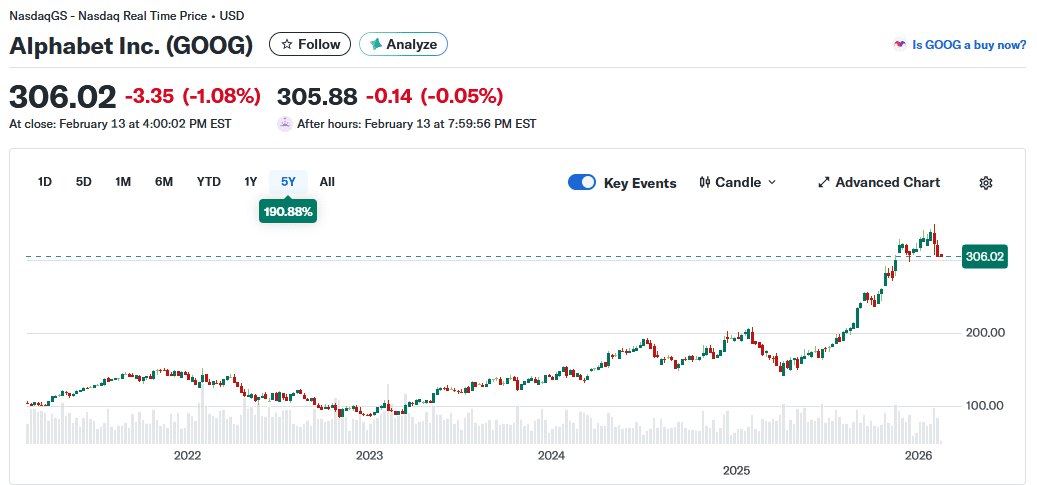
    Initially, it seemed plausible that Google would struggle against ChatGPT, but the market has since adjusted its views. The company’s valuation reflects renewed confidence, rivaling even Apple at a substantial $3.6 trillion.

    As I dive deeper into how monetization will shape this race, I’m struck by how Google’s recent advances have significantly boosted its valuation.

    ```json
{
  "alt": "Alphabet Inc. (GOOG) stock performance chart over five years, showing growth of 190.88%.",
  "caption": "Alphabet Inc.'s (GOOG) stock chart reveals a significant upward trend over the past five years, with a marked growth of 190.88%.",
  "description": "This image displays a five-year stock performance chart for Alphabet Inc. (GOOG), highlighting a substantial gain of 190.88%. The chart features key stock prices at the market close on February 13, with a closing price of 306.02, reflecting a decrease of 1.08%. The after-hours price is 305.88, down by 0.05%. The chart tracks the stock's fluctuations, offering insights into significant trends and key events impacting performance in the NasdaqGS market."
}
```

    It’s clear that the visibility of financial projections plays a massive role in how the company is perceived financially. Google’s approach to shifts in user behavior is crucial in maintaining its robust business model.

    From my perspective, much of your digital advertising budget likely goes to Google. Its prominence demands attention, not just in search but also in emerging AI platforms like ChatGPT and Claude.

    The competition in LLM conversations is intriguing. Google and ChatGPT are vying for different monetization models, a fascinating case study of differing strategies.

    For those of us in advertising, it’s essential to monitor developments like ad formats, rollout pace, and public reception to ads within these platforms.

    OpenAI’s current monetization model is intriguing but still nascent, reliant on a small group of major advertisers. We’ll see how they expand and fine-tune this model over time.

    ```json
{
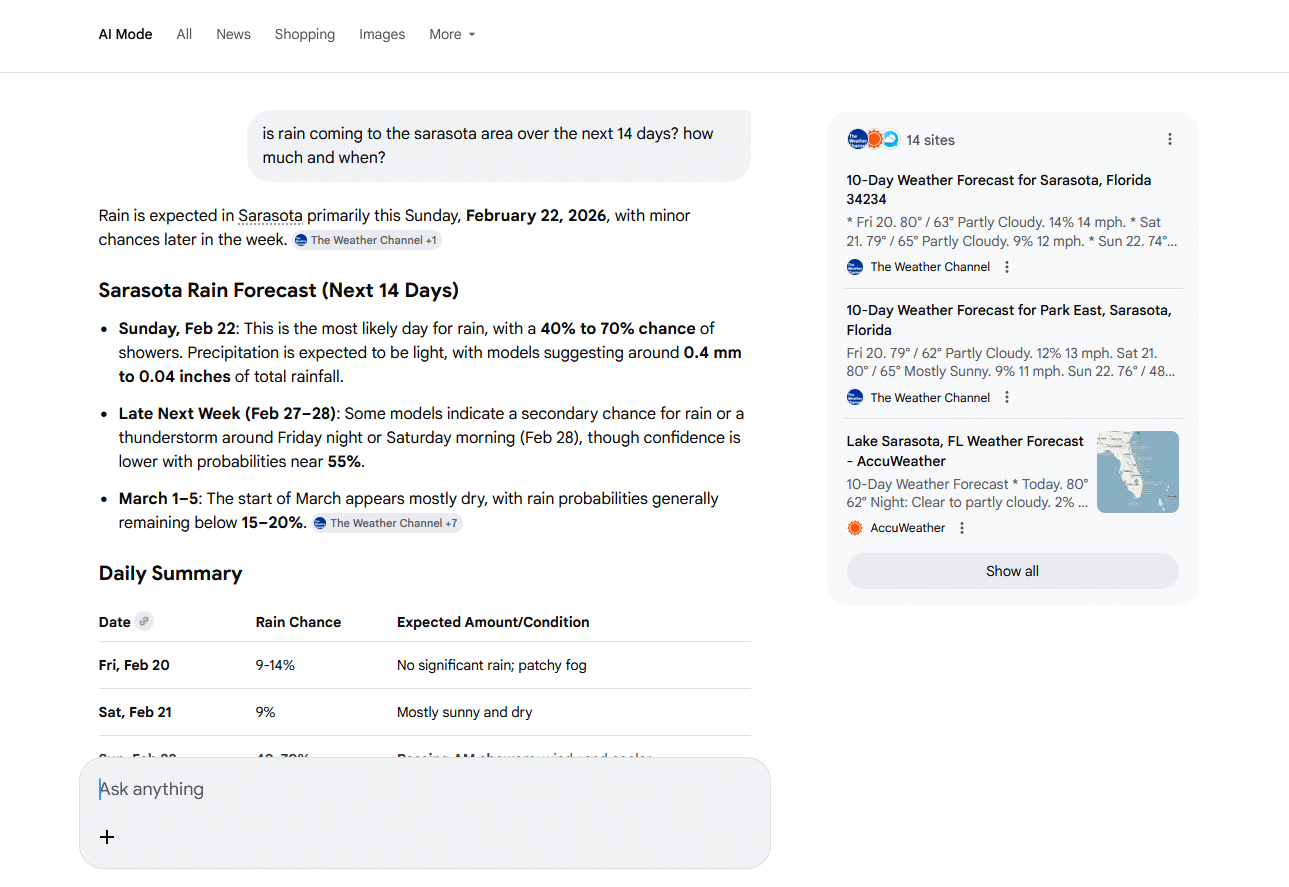
  "alt": "Weather forecast indicating rain in Sarasota on February 22, 2026, with a summary of rain chances over the next 14 days.",
  "caption": "Stay prepared, Sarasota! Rain is likely on February 22, with varying chances throughout the next two weeks. Know what's coming your way!",
  "description": "This image shows a weather forecast for Sarasota, highlighting expected rain on February 22, 2026, with a 40% to 70% chance of showers. The forecast includes a detailed 14-day rain outlook with additional chances of rain later in the week and into March. A summary table provides daily rain chances and expected conditions. A side panel lists various weather services providing localized forecasts."
}
```

    Outsourcing inventory to programmatic partners is a smart move for OpenAI but highlights their early stage in building an ads business.

    For Google advertisers, the shift to AI Mode need not be alarming. I’m watching for the ways these LLM sessions are shaping user experiences and ad placements.

    One thing is for sure; the enhancements in AI Mode continue, promising more seamless and user-friendly interactions. The potential for ads remains, though their form is still evolving.

    Monitoring key areas like the extent of monetization, advertiser control, and campaign types becomes more important as we navigate this new landscape.

    Ultimately, the future of advertising in AI-driven search is one of adaptability and strategic planning, aligning closely with user and advertiser behaviors in this exciting yet challenging era.


    Inspired by this post on Search Engine Land.


    crushpress.ai community screenshot
  • AI Search Traffic Surges 180% in 2025: Key Trends and Insights

    AI Search Traffic Surges 180% in 2025: Key Trends and Insights

    As I look back on 2025, it’s astonishing to see the AI search traffic growth leap by an impressive 180% year-over-year. I’m diving into the data to better understand how this impacts our visibility strategies. We’ll explore insights on ChatGPT, Gemini, Perplexity, and Claude usage trends in this review.

    With AI technologies rapidly advancing, I’ve noticed how they continue to reshape how we think about search and brand visibility. The increased use of AI-powered tools signifies a pivotal shift in the way we approach digital marketing strategies.

    In 2025, ChatGPT saw a remarkable surge in use, closely followed by interest in platforms like Gemini and Claude. This data is crucial as we plan for future visibility tactics, ensuring that our brand remains competitive in an ever-evolving digital landscape.

    How does this data affect your brand’s approach? I believe understanding and leveraging these trends will be key to optimizing AI-driven search capabilities and visibility while crafting more personalized and effective content strategies.


    Inspired by this post on genmark.ai Blog.


    crushpress.ai community screenshot
  • Marketing Agency Executive Search Firms: How to Choose

    Marketing Agency Executive Search Firms: How to Choose

    You are not simply hiring a senior marketer. You are choosing the person who may set your agency’s growth strategy, protect its creative culture, retain important clients, and decide how the business adapts when its current model stops working.

    That makes the search partner consequential. The right executive search firm will sharpen an unclear mandate, reach leaders who are not actively applying, and test candidates against the realities of agency leadership. The wrong one can produce an impressive slate that solves a different problem from the one you actually have.

    Define the leadership mandate before comparing firms

    Executives arrange a compass, wooden pieces, relationship tokens, a bridge model, and creative swatches during a leadership planning workshop.

    It is tempting to begin with firm names, presentations, and fee proposals. Begin with the business decision instead. Until you can explain why the agency needs this executive, you cannot tell whether a search firm understands the assignment.

    A marketing agency leader usually has a dual mandate. The person must improve commercial performance without damaging the creative, technical, or client-service capabilities that make the agency valuable. A candidate who knows growth but treats culture as decoration can lose the people clients came to work with. A respected creative leader who cannot manage delivery or profitability may preserve the work while weakening the business.

    Turn the job description into a one-page search brief

    Your brief should answer five questions:

    1. What triggered the search? Name the actual event: succession, stalled growth, new ownership, a changing service mix, international expansion, operational strain, or a broader transformation.
    2. What must be different after the hire? Write three to five observable outcomes. Examples include a clearer growth model, stronger new-business leadership, better integration between creative and performance teams, more disciplined operations, or a credible succession bench.
    3. What authority will the executive have? State the reporting line, decision rights, budget control, ownership expectations, and relationship with founders, investors, or a parent company.
    4. Which agency context matters? Specify whether you operate primarily in creative, digital, performance marketing, public relations, consumer communications, CRM, or marketing technology. Include the ownership model and geographic scope.
    5. What cannot be compromised? Separate genuine requirements from preferences. Client credibility, commercial judgment, transformation experience, technical depth, and creative leadership are not interchangeable.

    Do not disguise a conflicted mandate with a broad title. If the founders want a CEO to professionalize the business but do not intend to transfer meaningful authority, the search problem is governance, not candidate supply. Resolve that before paying a firm to approach the market.

    Give the firm enough economic context to assess fit

    An agency-savvy recruiter should want to understand how the business earns money, where growth comes from, how work is delivered, what clients expect from senior leaders, and which capabilities are difficult to scale. That context changes the candidate profile.

    For example, a growth mandate based on winning large accounts is different from one based on expanding CRM services inside existing relationships. A creative agency protecting a founder-led reputation needs a different successor from a performance agency integrating data, technology, and delivery operations.

    Share sensitive financial or client information carefully. Use sanitized figures, ranges, and anonymized examples during initial discussions, then provide deeper access after confidentiality terms and the working team are clear. An executive search does not require you to expose every commercial detail to every firm that submits a proposal.

    Match the search partner to the change you need

    No firm is the universal choice for every agency role. Your first shortlist should reflect the ownership model, function, seniority, geography, and kind of change the new executive must lead.

    Your situationWhat the search partner must understandFirms to investigate
    Agency CEO, president, or VP search with a broad growth mandateThe tension between commercial growth, creative culture, client relationships, and agency operationsTalentfoot has an agency-focused C-suite and VP practice covering traditional and digital businesses.
    Private equity-backed agencyGrowth expectations, operational discipline, financial leadership, and the relationship between management and ownershipJM Search is particularly aligned with private equity-backed agencies and growth-oriented leadership mandates.
    Marketing technology, CRM, or technically complex digital leadershipHow technical operations connect with creative services, client delivery, and commercial strategyIce Capital Recruitment specializes in martech and CRM leadership.
    Larger consumer, media, or communications agencyComplex stakeholder environments and leadership across consumer-facing and communications businessesCaldwell Partners has established consumer, media, and communications coverage.
    Multinational agency or cross-border communications roleGeographic reach, local market credibility, and assessment across multiple regionsOdgers Berndtson is suited to global agency and communications searches.
    Director-level creative or digital role where speed is centralSpecialist talent networks and fast access to creative and digital candidatesMondo is more naturally aligned with rapid creative and digital hiring at the director level than with a strategy-heavy C-suite search.
    C-suite transformationLeadership assessment, cultural alignment, and the executive’s ability to change the organizationN2Growth combines executive search with leadership consulting for transformation mandates.

    Treat those alignments as routing signals, not automatic endorsements. A firm’s market reputation does not tell you which partner will lead your assignment, how much agency experience the researcher has, or whether recent placements resemble your mandate.

    Push one level deeper when you make the shortlist. For a private equity-backed agency, ask for searches involving comparable ownership pressure and operating expectations. For a chief creative officer, ask how the firm distinguishes creative reputation from the ability to lead people, retain clients, and participate in commercial decisions. For a martech role, test whether the recruiter can discuss technical operations and agency delivery in the same conversation.

    Global reach deserves the same scrutiny. A multinational logo and a long office list do not prove that the proposed team has access to the markets you need. Ask which offices will participate, who owns candidate communication, and how assessments will remain consistent across regions.

    Use a 100-point scorecard to test the evidence

    A search professional and an agency executive sort colored tokens among unlabeled compartments beside objects representing leadership evidence.

    Presentations make most search firms sound experienced, connected, and consultative. A weighted scorecard forces you to compare evidence instead of adjectives. One practical 100-point model gives the greatest weight to agency leadership specialization and documented executive placements.

    CriterionWeightEvidence to request
    Marketing agency leadership specialization25 pointsComparable CEO, president, chief creative officer, and other C-suite or VP mandates; relevant backgrounds of the proposed partner and researcher
    Documented agency executive placements20 pointsRecent placements with the role, agency model, ownership context, location, and scope clearly identified; anonymized examples can be acceptable when confidentiality prevents naming the client
    Agency function expertise15 pointsEvidence that the team understands growth, creative leadership, operations, client relationships, and agency profitability rather than marketing as a generic corporate function
    Industry coverage and specialization15 pointsRelevant work across the agency types that matter to you, such as creative, digital, performance, public relations, CRM, martech, media, or communications
    Review quality and volume15 pointsRecent review patterns, referenceable clients, and direct references for comparable assignments; distinguish client evidence from employee commentary
    Visibility and relevant thinking10 pointsUseful material showing that the proposed team understands agency leadership issues; treat visibility as supporting evidence, not proof of placement performance

    Have each decision-maker score the firms independently before the selection meeting. Give no points when the proposal merely repeats your brief. Give partial credit for plausible but unverified experience, and full credit only when the firm supplies specific, relevant evidence. Discuss the scoring differences before calculating a final total; disagreement often exposes an unresolved assumption about what the agency really needs.

    Translate impressive metrics into definitions

    Talentfoot’s reported 98% client success rate and five-week average placement timeline sound highly persuasive. They are useful only after you understand what is being counted. This is true of every firm’s performance claims, not just Talentfoot’s.

    • Does success mean an accepted offer, a candidate who started, or a placement still in the role after a defined period?
    • Does the timeline begin when the contract is signed, when the brief is approved, or when outreach starts?
    • Does it end with the first slate, the accepted offer, or the executive’s start date?
    • Which roles, seniority levels, locations, and client types are included in the average?
    • How are cancelled searches, changed mandates, and replacement searches treated?

    The same rule applies to methodology. AI-enabled sourcing and a HOGAN assessment may support a disciplined process, but neither tells you whether the firm has defined the right competencies or interpreted the assessment in the context of your agency. Ask what decision each tool informs, who interprets the result, and how it changes the candidate recommendation.

    References should validate the team as well as the brand. Ask former clients whether the senior partner stayed involved, whether the initial slate matched the brief, how the firm handled difficult feedback, and whether it disclosed problems early. A polished launch followed by junior execution is a different service from a genuinely partner-led search.

    Interview the firm and run the search with the same discipline

    The finalist meeting should resemble a working session, not a credentials presentation. Give every firm the same one-page brief and ask it to show how it would execute the assignment.

    1. Ask for a read-back of the mandate. The team should explain the business problem, the tradeoffs in the profile, and which requirement will be hardest to satisfy. If it simply repeats the job description, it has not added much value.
    2. Request a sample market map. You do not need a free candidate list. You do need to see which kinds of organizations and leadership backgrounds the firm considers relevant, including adjacent talent pools you may have overlooked.
    3. Examine two or more analogous searches. Ask what made each mandate comparable, where the search became difficult, what changed during the process, and who on the proposed team did the work.
    4. Meet the operating team. Identify the partner, researcher, project lead, and candidate contact. Clarify their workload, responsibilities, and access to you after kickoff.
    5. Inspect the assessment plan. Require a direct connection between every interview, assessment, and reference question and the competencies in your candidate scorecard.
    6. Put commercial and process terms in writing. Confirm fees, expenses, payment events, off-limits restrictions, confidentiality, data handling, replacement provisions, anticipated timing, deliverables, and update cadence before authorizing outreach.

    A vague off-limits answer deserves particular attention. Search firms may be unable to approach people at certain clients because of existing relationships. That constraint can materially change the available market. Ask for a clear explanation of how it affects your search before you sign, especially when your candidate universe is small.

    Build the candidate scorecard before the first name arrives

    The firm-selection scorecard tells you who should run the search. A separate candidate scorecard tells everyone what a successful executive looks like. Do not let an impressive biography become the standard after the process starts.

    Choose competencies that follow directly from the mandate. A CEO or president scorecard may cover growth judgment, client leadership, operating command, culture, and the ability to build a leadership team. A chief creative officer scorecard should distinguish creative quality from talent leadership and commercial contribution. An operations or finance search should test the candidate’s command of delivery and profitability. A martech leader should be assessed across technical depth, service integration, and client-facing leadership.

    Assign weights that total 100 and define what strong, acceptable, and weak evidence looks like for each competency. Interviewers should score candidates independently before discussing them. This keeps charisma, pedigree, or enthusiasm from quietly replacing the agreed mandate.

    Require an evidence trail throughout the search

    At kickoff, approve the final role narrative, candidate scorecard, market boundaries, and confidentiality rules. Before outreach, approve how the opportunity will be described. During the search, require a written update on outreach, responses, candidate status, recurring decline reasons, compensation or location friction, and any assumption the market is challenging.

    Every candidate memo should map evidence to the scorecard, identify gaps, and explain why the firm recommends an interview. A biography is not an assessment. Claims such as “growth leader” or “strong cultural fit” should be supported by the situations the candidate handled, the decisions made, and the relevance to your mandate.

    Use references to investigate the same competencies, including any concern that emerged in interviews. Generic questions tend to produce generic praise. Ask for a concrete example of how the candidate handled a comparable growth, client, creative, operational, or transformation problem.

    If the slate remains weak, diagnose the cause before lowering standards. The obstacle may be compensation, location, authority, ownership dynamics, an unrealistic combination of requirements, or an unconvincing business story. Changing the specification without identifying the constraint merely makes the search less coherent.

    Key takeaways

    • Define the business change, decision rights, agency context, and measurable outcomes before comparing executive search firms.
    • Match the partner to the mandate: private equity, martech, global communications, creative leadership, director-level hiring, and C-suite transformation require different strengths.
    • Use a 100-point firm scorecard weighted toward agency specialization and documented placements, then score finalists independently.
    • Do not accept success rates, timelines, technology, or assessment tools at face value. Ask what they measure, which searches they cover, and how they affect decisions.
    • Run the search against a separate candidate scorecard and require evidence at every stage, from the market map through references.

    Your next move is simple: write the one-page mandate, invite two or three appropriately specialized firms to the same working session, and score the evidence. The safer choice is usually the team that makes your mandate more precise and proves it has solved a comparable leadership problem, not the one with the most polished credentials deck.

    References

  • Google Shopping AI Overviews: A Practical Ecommerce Plan

    Google Shopping AI Overviews: A Practical Ecommerce Plan

    Your ecommerce rankings can look stable while the search journey changes above them. When an AI Overview answers a product question, compares options, or frames the buying decision, your organic result and Shopping placement may have to compete for attention later than they used to.

    This is no longer a fringe scenario. AI Overviews appeared on 2,919,229 of 20,900,323 shopping-related queries in a large visibility analysis. If product discovery matters to your revenue, you now need to audit AI Overview exposure alongside rankings, Shopping visibility, clicks, and conversions.

    What the 14% figure should change in your strategy

    The headline number needs a precise reading. The keyword set consisted of product-intent searches whose results contained a Shopping box, whether paid or organic. Queries included products and categories such as weighted blankets, mushroom coffee, protein powder, and blue T-shirts. Within that defined set, 14.0% produced an AI Overview.

    That does not mean every ecommerce site lost 14% of its traffic. It does not measure click loss, revenue loss, AI Overview citations, or the percentage of shoppers who saw the feature. It measures how often the feature appeared across the monitored keyword set. Treating penetration as a traffic-loss estimate would turn a useful warning signal into a bad forecast.

    The direction is still hard to dismiss. Penetration had been 2.1% in November 2025 before reaching 14.0% in the later sample. The practical implication is that ecommerce exposure cannot be judged from ten blue links, conventional rankings, or Shopping positions alone.

    Your first response should be measurement, not a sitewide rewrite. Establish which valuable queries trigger AI Overviews, whether your brand or pages appear in them, and what happens to clicks when they do. Until you separate those questions, you cannot tell whether you have an inclusion problem, a click-through problem, or no material problem at all.

    Key takeaways

    • The 14.0% figure describes AI Overview penetration within a large set of product-intent queries that also returned a Shopping box. It is not a universal ecommerce traffic-loss rate.
    • Audit exposure by query intent and commercial value. A high-value comparison query deserves more attention than dozens of low-value searches combined.
    • Keep visible product information, JSON-LD, and commerce feeds consistent. Structured data can clarify facts, but it cannot guarantee AI Overview inclusion.
    • Measure AI Overview presence, brand inclusion, organic click-through rate, and conversion separately. A single visibility score cannot diagnose all four.
    • Improve the pages that already match exposed queries before producing large volumes of new content.

    Map AI Overview exposure by query intent and value

    Three search pathways pass through a translucent AI layer, leading to a single product, a product comparison, and a shopping basket.

    A useful audit starts with the searches that already matter to your business. Export product-intent queries from Google Search Console, add priority terms from your keyword tracking, and connect each query to its most relevant category or product page. Include revenue or conversion value where you have it.

    Do not examine this as one undifferentiated keyword list. Label the job the shopper is trying to complete. The page requirements are different when someone is exploring a category, narrowing by an attribute, comparing alternatives, or verifying a particular product.

    Query patternShopper’s taskWhat the landing page should make clearCommon audit question
    Broad category, such as weighted blanketsUnderstand the category and available choicesScope, meaningful differences, selection criteria, and routes to relevant productsDoes the page help someone choose, or does it merely repeat the category name?
    Attribute-led, such as blue T-shirtsNarrow the catalog using a required featureMatching products, visible attributes, filters, variants, and accurate availabilityDo the page title, copy, filters, products, and structured data agree?
    Comparison or best-fit queryChoose between optionsFactual differences, limitations, intended use, and a defensible basis for comparisonCan every comparative claim be verified on the page?
    Branded or model-specific queryConfirm exact product detailsName, brand, model, identifiers, price, availability, variants, and offer detailsAre facts consistent across the visible page, markup, and feed?
    Use-case queryJudge whether a product fits a particular needSupported suitability information, constraints, specifications, and relevant alternativesDoes the page answer the use case without making claims the evidence cannot support?

    For every tracked query, record whether an AI Overview appears, which pages or products it includes, whether your brand is visible, the result type around it, and the observation context. Search results can vary by device, location, and observation time, so save those details instead of treating one check as permanent.

    Also distinguish an AI Overview from the Shopping box used to define the original keyword set. They are separate search features. Record whether the Shopping element is paid or organic when your tooling exposes that distinction, and avoid attributing every change in click-through rate to the AI Overview.

    Prioritize the intersection of commercial value and exposure. Start with queries that contribute meaningful impressions, clicks, sales, or assisted conversions and repeatedly show an AI Overview. A long list of exposed keywords is less useful than a short list tied to products and categories you can improve.

    Make product information easy to verify and reuse

    A generic countertop appliance is surrounded by dimension, material, packaging, warranty, and image symbols connected to blank search and storefront panels.

    AI-search optimization for ecommerce is not a request to turn every product page into an essay. It is a data-quality and decision-support problem. Your pages should make important product facts explicit, keep them consistent across systems, and answer the questions that determine whether a shopper considers the product relevant.

    Give category pages a decision-making job

    A category page should do more than display a grid. Add concise information that helps a shopper understand the range and move toward a suitable option. The right content depends on the category, but the audit can use the same questions:

    • Is the category defined clearly enough to distinguish it from adjacent categories?
    • Are the attributes that genuinely change the buying decision explained in plain language?
    • Can the shopper identify which product groups fit different needs, constraints, or preferences?
    • Do links lead directly to useful subcategories, filters, comparisons, or products?
    • Are limitations and eligibility conditions visible where they affect the choice?

    Keep this material specific to the products on the page. Generic buying-guide copy creates words without resolving uncertainty. If a paragraph could be pasted onto a competitor’s category unchanged, it is probably not carrying enough product information to help either the shopper or a retrieval system.

    Reconcile the product page, JSON-LD, and feed

    Review each priority product as one record expressed through several surfaces. The visible page is what a person reads. Product and Offer structured data describe machine-readable facts. A commerce feed may supply another version of the same product and offer information. Contradictions among those surfaces create ambiguity you can remove.

    Check the product name, brand, model, stable identifiers such as SKU or GTIN when available, variant attributes, price, currency, availability, and offer details. Use the same canonical facts everywhere. If the displayed price changes by variant, make that relationship clear rather than exposing one value in the page copy and another in JSON-LD or the feed.

    Structured data should describe information that is accurate and supported by the page. Do not add properties merely because they look relevant to AI search, and do not mark up promotional, review, or availability claims that a shopper cannot verify. JSON-LD improves clarity; it is not a switch that forces Google to cite, summarize, or rank a product.

    After the core facts agree, look for unanswered decision questions. These may involve dimensions, materials, compatibility, care, included components, variant differences, usage constraints, shipping conditions, or returns. Add only what is applicable and supportable for that product. The goal is not maximum page length. It is minimum ambiguity.

    Comparison content deserves the same discipline. State the criteria, compare equivalent attributes, and separate facts from editorial judgement. Avoid unsupported superlatives. A claim such as best, safest, or healthiest needs a defensible basis; repeating it in schema does not make it more trustworthy.

    Measure visibility, clicks, and sales as separate outcomes

    An AI Overview can affect several stages of search performance, and each stage calls for a different response. Build a small measurement framework rather than compressing everything into an AI visibility score.

    • Exposure rate: the share of your monitored shopping queries on which you observe an AI Overview.
    • Inclusion rate: the share of observed AI Overviews that include your brand, product, or URL under the inclusion rule you define in advance.
    • Organic response: impressions, clicks, click-through rate, and average position for the same query cohort.
    • Commercial response: conversions, revenue, lead quality, or another outcome appropriate to the catalog and buying journey.

    Keep the monitored query set stable when comparing periods. Segment by intent, landing-page type, device, country, and approximate ranking band where the data supports it. Otherwise, a shift toward broader queries or lower organic positions can look like an AI Overview effect even when the query mix caused the change.

    When you change a template or content cluster, record the release and preserve an unchanged comparison group when practical. Recheck the same queries and note other factors that could move results, including rankings, price, availability, promotions, seasonality, and changes to paid Shopping activity. This will not create perfect experimental control, but it will stop you from assigning every movement to the newest search feature.

    Use the results to choose the next action:

    1. No AI Overview on a valuable query: continue conventional SEO, merchandising, feed, and Shopping work. Keep monitoring rather than rebuilding the page for a feature you have not observed.
    2. AI Overview present, brand absent: inspect the decision the overview resolves and the information its included pages provide. Check whether your relevant page lacks supported facts, comparison context, clear entity information, or consistent commerce data.
    3. Brand included, clicks healthy: preserve the useful page elements and data consistency. Apply the pattern selectively to closely related pages instead of redesigning the whole site.
    4. Brand included, clicks weakening: create a stronger reason to visit. Useful inventory depth, live variants, a complete comparison, detailed specifications, a selector, original product information, or a clear offer may provide value that a short summary cannot.
    5. AI Overview appearance is inconsistent: gather more observations before making a major change. A single screenshot is evidence of one result state, not a durable performance trend.

    Start with one commercially important category. Freeze its query list, capture the current search layouts, correct disagreements among the page, JSON-LD, and feed, and improve only the decision questions the existing pages leave unresolved. Then measure that same cohort again. This gives your next catalog release a clear hypothesis and gives you evidence for what to scale.

    References

  • AI Search Is Reshaping Brand Visibility: What to Do Now

    AI Search Is Reshaping Brand Visibility: What to Do Now

    If your important pages still rank but organic visits keep thinning out, the old SEO scorecard is no longer telling you enough. AI answers, shopping modules, discovery feeds, and other search surfaces can influence a decision before a conventional click reaches your site.

    You do not need to abandon SEO or chase every new interface. You need a wider visibility system: diagnose where attention moved, make your brand easy to retrieve and verify, measure whether AI systems select and cite it, and give people a reason to return directly.

    Key takeaways

    • Treat falling organic traffic as a distribution problem before treating it as a ranking problem.
    • Measure AI visibility in distinct stages: discovery, selection, citation, and business impact.
    • Match content to the surface. A page that can earn an explanatory citation is not automatically eligible for a shopping result.
    • Keep brand facts, claims, evidence, and structured data consistent across the channels you maintain.
    • Do not use fast percentage growth in AI referrals as proof that AI traffic can replace lost search traffic.

    Diagnose the traffic loss before changing your SEO strategy

    The disruption is not evenly distributed. Chartbeat data covering global publishers found that sites with 1,000 to 10,000 daily pageviews lost 60% of search referral traffic over two years. Larger publishers also declined, but the effect was less severe.

    Publisher sizeDaily pageviewsSearch referral decline over two years
    Small1,000 to 10,00060%
    Mid-sized10,000 to 100,00047%
    LargeMore than 100,00022%

    The channel details matter just as much as the headline decline. In the same reporting window, Google Search pageviews fell 34% year over year and Google Discover fell 15%. ChatGPT referrals grew 200%, yet still represented less than 1% of overall traffic. A rapidly growing channel can remain too small to close the absolute gap left by a much larger one.

    Traffic has not simply disappeared. Total weekly publisher pageviews declined by 6% from 2024 to 2025 while direct, internal, and messaging channels expanded. That pattern should change your diagnosis: do not assume every organic loss means your rankings, technical SEO, or content quality suddenly failed.

    Start by separating four signals that are often blended together:

    • Impressions: If impressions fell, investigate demand, topic coverage, indexing, and ranking visibility.
    • Clicks: If impressions or positions are steady but clicks fell, inspect the search-result experience and query intent before rewriting the page.
    • Landing-page outcomes: Identify which lost visits previously generated leads, sales, subscriptions, or meaningful engagement. A pageview decline and a qualified-demand decline are not automatically the same problem.
    • Channel mix: Track conventional search, Discover, AI referrals, direct visits, messaging, and internal recirculation separately. Combining them hides where attention is moving.

    Also split branded from non-branded demand. Falling non-branded clicks indicate a discovery problem. Falling branded demand points to a broader brand problem. That distinction determines whether your next investment belongs in page-level optimization, wider distribution, reputation work, or audience retention.

    Replace the ranking funnel with a visibility funnel

    Glowing signals pass through a series of transparent chambers and gather around a central object before forming a returning orbit.

    A ranking is an intermediate signal. In an AI-mediated journey, your brand must first enter the system’s candidate set, then be chosen for the response, and sometimes be cited as supporting evidence. AI search can use query fan-outs to retrieve information across related subquestions before selecting material. A page can therefore rank for one visible query while missing the supporting questions that influence an AI-generated answer.

    Use three AI-specific stages, then attach a business outcome to them:

    1. Discovery: Can the system retrieve your page, brand, product, expert, or claim for the relevant topic and its related subquestions?
    2. Selection: Does the system name or use your brand when composing its answer, recommendation, comparison, or summary?
    3. Citation: Does the response provide a link or identifiable reference to a page you control?
    4. Business impact: Does that exposure produce qualified visits, branded demand, leads, sales, subscriptions, or returning users?

    This sequence gives you a better troubleshooting method than a single visibility score. If the brand is not discovered, look at crawlability, entity clarity, topical coverage, and whether you answer the related questions. If it is discovered but rarely selected, strengthen relevance, evidence, differentiation, and fit for the user’s constraints. If it is named without a citation, make the supporting page easier to identify and substantiate. If citations produce no useful action, examine prompt intent, audience fit, and the destination page rather than celebrating the mention.

    A practical GEO program therefore needs separate measurement for discovery, selection, and citation impact. Combining those stages into one percentage may look tidy, but it conceals the exact failure you need to fix.

    Engineer content for retrieval, evidence, and the right surface

    Begin with one commercially important topic and map the questions an AI system may need to resolve around it. Include the core problem, relevant entities, selection criteria, user constraints, use cases, comparisons, tradeoffs, supporting proof, and conditions that change the answer. You do not need to force all of this onto one oversized page. You do need an intentional cluster with clear relationships and internal links.

    Every important page in that cluster should pass a practical retrieval test:

    • The opening states what the page resolves without making the reader decode a long preamble.
    • Headings follow real tasks and decisions, not a list of loosely related keyword variations.
    • Products, services, organizations, people, locations, versions, and categories are named precisely where they matter.
    • Evidence sits close to the claim it supports, with limitations and applicable conditions stated plainly.
    • Comparison content explains who each option fits, what changes the decision, and where a fair comparison is not possible.
    • Important facts agree across visible copy, metadata, structured data, product information, and maintained public profiles.

    JSON-LD can reinforce this work by expressing page entities and relationships in a machine-readable form. It cannot rescue vague copy, manufacture authority, or guarantee a citation. Mark up facts that are actually visible and supported on the page, choose schema types that match the content, and remove conflicting or obsolete values when the underlying information changes.

    Surface eligibility also changes the optimization job. Across 1.18 million prompts and a reviewed set of 7,500 labeled examples, shippable consumer-goods categories were much more likely to activate ChatGPT Shopping than software, services, travel, or financial products. Price, feature, and intended-use constraints increased the trigger likelihood within eligible product categories, but purchase-intent wording did not override an ineligible category. The pattern could reproduce observed shopping behavior with about 95% to 97% accuracy within that work.

    Treat that result as a strong platform-specific testing hypothesis, not a permanent specification. Interfaces and triggers can change. The immediate lesson is still useful: optimize for the result type your offer can realistically enter.

    • If you sell shippable goods: Make the product category, intended use, meaningful features, and relevant buying constraints explicit. Keep those facts consistent between the product page, supporting content, and product data.
    • If you sell software or services: Do not stuff purchase-intent phrases into pages in the hope of forcing a shopping card. Focus on explanatory retrieval, comparison context, evidence, qualification criteria, and a clear path to evaluation.
    • If you cover travel or financial products: Separate informational visibility from shopping visibility in your reporting. A useful citation or brand selection may be the realistic win even when a product card is not.

    This is why universal AI optimization checklists fail. The query, entity category, interface, and desired result type determine what visibility can look like.

    Make your brand verifiable beyond its own website

    Independent reference, storefront, product, document, microphone, archive, and publisher objects illuminate a blue object at the center of a connected network.

    As search referrals shrink, an unknown publisher or brand has fewer chances to turn a borrowed visit into recognition. The safer position is to be consistently identifiable across the places where people encounter, validate, and return to you.

    Omnichannel visibility does not mean opening an account everywhere. It means maintaining a coherent set of facts and evidence wherever your audience actually evaluates you. Create a simple brand evidence map with the following fields:

    • Canonical identity: The preferred brand name, primary website, category, audience, and concise description of what the organization does.
    • Core entities: Products, services, authors, experts, locations, and other named things that repeatedly appear in your content.
    • Material claims: The statements that affect a buying or trust decision, paired with the page or evidence that supports each one.
    • Public consistency: The profiles, listings, documentation, media, community pages, and other maintained surfaces where those facts should agree.
    • Update ownership: The person or workflow responsible for correcting outdated descriptions, renamed products, changed URLs, and unsupported claims.

    Use that map to fix contradictions before producing more content. If your category changes from one profile to another, an offer has several names, or an author bio makes expertise impossible to verify, additional publishing scales the ambiguity.

    Distribution should then carry useful evidence, not cloned promotional copy. Publish the definitive explanation on the most appropriate owned page. Adapt it for the channels where the audience discusses or validates the subject. Link back when a link genuinely helps the user. Earn independent mentions through work worth referencing; do not try to simulate corroboration with duplicated properties or fabricated consensus.

    At the same time, strengthen the path from first encounter to direct relationship. Direct, internal, and messaging channels expanded while search became a smaller share of publisher traffic. Give a qualified visitor an obvious next step: subscribe, save a tool, follow an update stream, join a relevant community, or move to the next useful page. The right action depends on your business, but relying on another search click should not be the only way someone can find you again.

    Measure AI visibility without mistaking noise for progress

    Referral analytics alone cannot measure AI visibility. A system may mention a brand without linking, cite a page that earns few clicks, or influence a later direct visit. Conversely, one unusual referral can look important when the underlying volume is tiny.

    Build a stable prompt set around decisions that matter to the business. Include category discovery, problem-solving, comparison, constrained recommendation, and branded verification prompts. Add shopping-constrained prompts only where the offer category makes them relevant. For every observation, record:

    • The engine and specific interface tested.
    • The exact prompt, including its constraints.
    • The date of the observation.
    • Whether the brand was absent, discovered, selected, or cited.
    • The wording and context of the mention, including any material inaccuracy.
    • The cited URL and the page a user would reach.
    • The business intent represented by that prompt.

    Keep the core prompts unchanged when you repeat the check. Otherwise, you cannot tell whether the system changed or your test changed. Treat an isolated appearance as an observation, not a trend, and retain screenshots or response records so that later reviews are based on evidence rather than memory.

    Pair that prompt log with three groups of business data:

    • Acquisition: Search, Discover, AI referrals, direct visits, messaging, and other meaningful channels.
    • On-site behavior: The destination pages, next-page paths, subscriptions, enquiries, and other qualified actions.
    • Commercial outcomes: Leads, sales, retained users, or the outcome your organization is actually trying to create.

    Then prioritize by value and failure stage. Protect topics that produce meaningful outcomes and remain highly dependent on search. Repair high-value topics where your brand is retrieved but not selected. Strengthen the supporting page when the brand is selected without a useful citation. Improve the destination when citations arrive but qualified action does not. Leave low-value visibility gaps alone until the evidence gives you a business reason to pursue them.

    For your next work cycle, choose one revenue-relevant topic and take it through the entire system: channel diagnosis, query fan-out, page and entity cleanup, evidence mapping, appropriate structured data, distribution, and a repeatable visibility baseline. One complete loop will teach you more than a broad collection of disconnected AI SEO tactics.

    References

  • Technical SEO for Local Leads: Fix the Path to Inquiry

    Technical SEO for Local Leads: Fix the Path to Inquiry

    Your local website can rank for a service name and still miss the customer who eventually buys. The gap often appears one step earlier, when that customer is searching for a symptom, trying to understand the problem and deciding whether professional help is necessary.

    To generate more qualified inquiries, treat technical SEO and local content as one system. The right page must exist for the customer’s question, search engines must be able to crawl and index it, and the page must move the visitor toward an appropriate service without forcing them to translate their problem into your internal terminology.

    Find the demand that appears before the service query

    Most local sites are organized around what the business sells: plumbing, drain cleaning, furnace repair, roof replacement or another named service. That structure serves people who already know what to request. It does much less for someone asking why a sink keeps backing up, why a room never gets warm or whether a roof stain needs urgent attention.

    Those searches aren’t merely informational. The person is diagnosing a visible symptom, estimating the seriousness of the situation and deciding what to do next. A site that answers only service-name searches can therefore miss high-intent demand during the decision stage that precedes a direct local-service query.

    Start by separating three jobs your pages need to perform:

    • Problem pages help a visitor understand a symptom, its plausible causes, safe next steps and the point at which professional help makes sense.
    • Service pages explain the professional solution, what the work involves and how to request it.
    • Location pages establish where the service is available and give locally relevant information rather than repeating a generic service page with a different place name.

    Build your initial problem-page list from actual customer language. Review search queries, on-site searches, inquiry forms, call notes, sales questions and customer-service messages. Record the symptom as the customer describes it, the service it normally maps to and the decision the person is trying to make. A question such as “Can this wait?” represents a different content need from “What causes this?” even when both eventually lead to the same service.

    Don’t turn every wording variation into a separate URL. If several phrases describe the same condition and require the same answer, consolidate them on one strong page. Create a new page only when the symptom, likely causes, available options or appropriate service materially changes. That distinction prevents a useful resource library from becoming a collection of overlapping, low-value URLs.

    Prioritize technical fixes by their effect on leads

    A technician repairs blocked pathways in a website structure while local customers wait near the route to an inquiry point.

    A technical audit can produce hundreds of findings, but a long export isn’t a delivery plan. Development capacity is a real constraint: up to 67% of respondents have identified non-SEO development work as an impediment to technical implementation. Your backlog must distinguish a blocked revenue path from a cosmetic imperfection.

    Triage issues in this order:

    1. Make priority pages accessible and indexable. Confirm that each important service, problem and location URL returns a successful response, isn’t blocked from crawling, doesn’t carry an unintended noindex directive and identifies the correct canonical URL. Check the rendered page, not only its raw source, when JavaScript supplies essential copy, navigation or forms.
    2. Resolve competing URL signals. Look for duplicate paths, outdated URLs, parameter versions and inconsistent canonical tags. Redirect retired URLs to the closest relevant replacement, link internally to the preferred version and keep noncanonical duplicates out of the XML sitemap.
    3. Remove architectural dead ends. Every priority page should be reachable through a relevant hub or service page. A URL that exists only in a sitemap has far less contextual support than one connected to the site’s visible customer journey.
    4. Fix performance where it interrupts action. Address backend delays before polishing minor front-end details. Then inspect excessive JavaScript, rendering dependencies, late layout movement and resources that delay the information or controls a visitor needs first.
    5. Test the complete mobile journey. Check navigation, readable content, tap targets, telephone links, forms, validation messages and confirmation states on a narrow screen. A fast landing page still fails commercially if the form becomes difficult to complete.

    Score each task against four questions: Does it affect a page capable of generating a lead? Does it prevent crawling, indexing, understanding or conversion? How many priority URLs inherit the problem? What implementation effort and coordination does it require? A shared template defect affecting every service page should usually outrank an isolated warning on an old resource, even if an audit tool labels both issues the same way.

    Performance work should also follow the user’s sequence. Prioritize the page heading, main explanation, navigation and primary action before secondary widgets. Backend bottlenecks can affect the whole experience; after those are addressed, techniques such as critical CSS, selective preloading and reserving space for dynamic elements can improve perceived speed and stability. The point isn’t to chase a score in isolation. It is to keep the visitor’s path to an informed decision usable.

    Build an architecture that connects problems to solutions

    Your site structure should reflect the customer’s journey without abandoning clear service organization. A practical model contains a main service hub, individual service pages, a problem or advice hub, focused problem pages and useful location pages. The exact folder names matter less than the relationships between those pages.

    Make the internal links intentional:

    • A problem page should link to the service that resolves the issue, using language that explains the relationship.
    • A service page should link back to the common symptoms or situations that lead customers to need it.
    • A service hub should help visitors distinguish between related services instead of presenting an undifferentiated list.
    • A location page should link to services genuinely available in that area and to any problem resources that add local relevance.
    • Breadcrumbs and visible parent navigation should preserve the hierarchy for visitors as well as crawlers.

    This structure does more than distribute internal authority. It tells search engines that a symptom page, a professional solution and a service area belong to the same topic. It also gives a visitor an obvious next step without making every page behave like a hard-sell landing page.

    Watch for signal dilution as the site grows. Multiple URLs competing for the same intent, inconsistent canonical choices and weak internal links can prevent search engines from identifying the page you consider most important. Consolidating overlapping topics and strengthening links to priority pages are often more achievable than a complete architecture rebuild, especially when development resources are limited.

    Avoid automatically multiplying every service by every city and every symptom. A service-location page deserves its own URL when it can provide distinct, accurate value about that service in that place. A problem page deserves its own URL when it answers a distinct decision. Swapping a place name across otherwise identical pages creates inventory, not usefulness.

    Write problem pages that turn uncertainty into action

    A resident with a leaking sink follows a visual path through a mobile problem page to a visiting plumber.

    A useful problem page follows the visitor’s reasoning. It doesn’t open with a company history, a broad definition or a sales pitch. It begins with the situation the person can observe and then helps them make a safer, better-informed decision.

    Use this page sequence:

    1. Name the symptom precisely. Put the customer’s description in the title, opening paragraph and relevant subheadings. Confirm what the page covers and distinguish it from a similar-looking problem when that distinction matters.
    2. Give the short answer early. Explain what the symptom commonly indicates, whether several causes are possible and what the visitor should determine next. Don’t force someone to read an essay before learning whether the page applies to them.
    3. Order plausible causes usefully. Move from simpler or more common explanations toward causes that require inspection or specialist work. Explain the signs that separate one possibility from another without pretending to diagnose an unseen situation.
    4. Offer only safe checks. A visual observation or a basic setting check may be reasonable. Instructions involving gas, live electricity, structural damage, hazardous materials or equipment disassembly are not appropriate DIY lead magnets. State the stop condition and identify the qualified professional needed.
    5. Explain the available options. Tell the reader what can sometimes be monitored, what may require maintenance and what generally calls for professional diagnosis or repair. This is where the page earns trust by helping the visitor decide, not merely urging them to call.
    6. Set honest cost expectations. Publish a range only when it is supported by the business’s real service data and can be qualified appropriately. Otherwise, explain the factors that change the price, such as the underlying cause, access, parts, extent of damage or work required. Cost context and explicit signals for professional help reduce uncertainty without making an unsupported promise.
    7. Connect the problem to the service. Name the relevant service, explain how a professional would investigate the issue and offer an action that matches the urgency: request an assessment, call about an urgent condition or review the service before deciding.

    Place these pages inside a visible resource or problem hub, not in a forgotten chronological blog archive. A permanent position in the architecture makes their purpose clearer and lets service pages support them with relevant internal links.

    Make each answer easy for search and AI systems to interpret

    Clear structure helps beyond conventional rankings. Use headings that state the question being answered, concise paragraphs for direct explanations, lists for causes or decision criteria and consistent names for the symptom, service and location. A predictable symptom-to-cause-to-option-to-service relationship gives both search systems and AI-generated summaries less ambiguity about what the page means. Problem-led pages can therefore support indexing accuracy and visibility in AI-mediated search experiences, although no format guarantees inclusion.

    Clarity is more valuable than repetition. Don’t force the city, service and symptom into every heading. State the location where it changes the answer or establishes availability, and keep the diagnostic explanation readable for the person who actually has the problem.

    Key takeaways: measure the whole local lead path

    Don’t judge this work from rankings alone. Measure the handoffs between technical eligibility, discovery, consideration and inquiry:

    • Eligibility: priority service, problem and location URLs are crawlable, canonicalized correctly, rendered properly and eligible for indexing.
    • Discovery: problem pages receive impressions for symptom and decision-stage queries, not only for branded terms.
    • Movement: visitors use contextual links from problem pages to the relevant service pages or inquiry actions.
    • Conversion: calls, forms or bookings can be attributed to the landing page and page type that began the session.
    • Lead quality: the inquiries concern services the business provides in areas it actually serves.
    • Prioritization: the next fix is selected by lead impact, affected page reach and implementation effort, not by the raw number of audit warnings.

    The pattern in the data tells you what to change. Impressions without visits point toward a mismatch between the query, title and promised answer. Visits without movement to a service page suggest that the page isn’t resolving the visitor’s decision or making the next step clear. Service-page visits without inquiries shift attention to relevance, mobile usability, form friction and the offer itself. No impressions at all require you to revisit demand, internal linking and indexability before rewriting the call to action.

    Choose one commercially important service area for the next implementation cycle. Map its symptom questions, identify the existing service and location pages, fix the technical barriers across that small cluster, publish only the missing problem pages and connect the journey with deliberate internal links. Once you can measure that path from crawl to qualified inquiry, extend the model to the next service cluster.

    References