In this report, I’m going to walk you through a comparison of conversion rates among the four leading AI chatbots: ChatGPT, Gemini, Claude, and Perplexity.
From May 2025 through April 2026, my research team conducted an in-depth study on AI conversion rates across various industries. We used anonymized data from more than 150 client companies, honing in on the most popular generative AI chatbots. Building on our previous analysis of ChatGPT conversion rates, we noted that most companies in our dataset had invested in generative engine optimization. The fascinating results of our study are presented below.
While all chatbot traffic converts at higher rates than traditional SEO, my study shows that ChatGPT and Perplexity typically have higher conversion rates compared to Gemini and Claude. This might be due to the greater user trust vested in ChatGPT and Perplexity’s recommendations.
Claude stands out in knowledge-driven and regulated industries. Its performance in Healthcare, Higher Education, and Industrial IoT indicates that professionals in these fields favor Claude for more detailed, analytical queries.
Industries such as Engineering, Software Development, and Transportation & Logistics exhibit relatively low conversion rates overall. This might suggest less dependence on AI tools or more specialized workflows not captured within this dataset.
B2B SaaS and Financial Services demonstrate moderate but closely clustered conversion rates across all models, likely reflecting significant but cautious AI adoption given potential compliance concerns and familiarity with AI limitations.
If you want a PDF copy of this report or wish to know more about our GEO services, reach out here.
First Page Sage Internal Research Study, February 2026, First Page Sage.
If your Search Console impression line falls while clicks stay steady, don’t treat the chart as proof that your search visibility collapsed. Google confirmed that a logging error over-reported impressions from May 13, 2025 onward, so corrected reporting can produce a visible drop without removing any clicks you actually received.
The right response is to audit the measurement before changing your SEO. You need to separate the reporting correction from any genuine performance movement, rebuild affected comparisons, and explain why impression-based ratios may change even when user behavior does not.
What the correction changes and what it doesn’t
The confirmed problem was impression logging inside Google Search Console. It was not a change to how many people clicked your results, and Google said clicks were unaffected by the error. As fixes were implemented, the Performance report could therefore show fewer impressions without showing a corresponding loss of clicks.
That distinction matters because the metrics answer different questions. Impressions describe how often your result appeared in search results. Clicks describe visits initiated from those results. Conversions describe what visitors did afterward. A correction to the first metric does not retroactively remove the activity measured by the other two.
Click-through rate needs special handling because it is calculated from both affected and unaffected values:
CTR equals clicks divided by impressions.
An inflated impression denominator makes CTR appear lower.
If corrected impressions decrease while clicks stay unchanged, CTR can rise automatically.
That mathematical increase does not prove that titles, descriptions, rankings, or search intent improved.
The correction also isn’t a blanket explanation for every decline after May 13. A real SEO loss can occur during the same period as a reporting repair. Treat the bug as a measurement issue to test, not as a reason to dismiss contradictory evidence.
Use three signals before diagnosing an SEO decline
Don’t respond to the impression chart in isolation. Run the following check with the same Search Console property, search type, date range, country, device, page, and query filters throughout. Changing a filter halfway through creates another explanation for the difference.
Compare impressions and clicks on the same timeline. A sharp impression change accompanied by stable clicks is consistent with a reporting correction. If clicks also decline, the impression bug does not explain the entire movement.
Check an independent outcome. Review organic landing-page sessions, leads, sales, or another meaningful conversion in your analytics system. These numbers do not have to match Search Console clicks exactly because the systems measure differently; you are looking for corroborating direction, not identical totals.
Inspect where the change appears. A broad impression step across many pages and queries, with clicks remaining steady, fits a logging correction better than a decline concentrated in one directory, page type, country, device, or query group. A concentrated loss deserves a separate technical, content, or ranking investigation.
Google described the correction as a rollout taking several weeks rather than a single instantaneous rewrite. That means you should not expect every affected chart or saved report to change at exactly the same moment. Multiple movements during the correction window may still be reporting-related, but stable clicks remain the most useful first check supplied by this incident.
Hold off on reactive title rewrites, content deletions, internal-link changes, or technical deployments until this check identifies an independent problem. Those changes can introduce real performance movement and make an already messy reporting period harder to diagnose.
Rebuild comparisons around the May 13 boundary
May 13, 2025 is the important boundary. Impression data before that date was outside the confirmed error period. Impression data from that date onward was subject to over-reporting and subsequent correction.
May 2025 is therefore not a clean monthly baseline: it contains days before the confirmed start and days after it. Any longer reporting period that crosses May 13 also blends data from two measurement conditions. A smooth monthly or quarterly chart can hide that break unless you annotate it.
Add a visible annotation at May 13, 2025 in every dashboard that uses Search Console impressions or CTR.
Preserve exports created before the correction. Label them as pre-correction snapshots rather than silently replacing them; the old files will not update themselves.
Re-export affected date ranges from the current Performance report when you need a corrected analysis. Record the export date so another analyst can distinguish it from the earlier snapshot.
Recalculate every derived metric that uses impressions, including CTR, impression growth, impression forecasts, and custom visibility indices.
Prefer clicks and downstream conversions when an immediate business comparison is required, while still investigating any independent decline in those metrics.
Do not invent a flat correction factor. No reliable percentage was supplied for subtracting the overcount, and there is no basis here for assuming that every property, page, query, or day was inflated by the same proportion. Re-exporting corrected records is safer than multiplying old exports by an estimated adjustment.
Year-over-year reporting needs the same care. If one side of the comparison came from an inflated export and the other did not, the calculated growth rate is partly a measurement difference. Rebuild both sides from a consistent dataset before presenting the percentage as an SEO result.
Fix dashboards, forecasts, and the stakeholder narrative
The correction has different consequences for different reports. Update each one according to the metric it actually uses:
Impression dashboards: refresh affected ranges and retain a data-quality annotation.
CTR reports: recalculate the ratio after impression values are corrected, then avoid crediting the mechanical change to optimization work.
Click reports: keep using click totals, but investigate any genuine click movement on its own evidence.
Conversion reports: use them as an independent business check, while remembering that attribution rules can make them differ from Search Console clicks.
Forecasts: retrain or rebuild models that learned from inflated impressions. Otherwise, the model may set an unreachable impression baseline even if future search performance is healthy.
Your explanation to clients or leadership should distinguish a reporting change from an outcome change. It should also avoid promising that every unfavorable number is caused by the bug. The following status note keeps those boundaries clear.
Google confirmed that Search Console over-reported impressions from May 13, 2025 onward because of a logging error. Corrected reporting may reduce the displayed impression total, while clicks were not affected by this error. We are rebuilding impression and CTR comparisons and separately checking clicks and conversions for evidence of any real performance change.
Suggested stakeholder status note
That wording is more defensible than saying rankings definitely did not change. The correction proves that impression reporting was wrong; it does not prove that every site’s underlying search performance remained unchanged throughout the same period.
Google Search Console impression correction FAQ
Did my rankings drop when reported impressions fell?
The impression decrease alone cannot answer that question. If the drop appears as corrected reporting while clicks and independent organic outcomes remain stable, there is no evidence in that chart alone of a ranking loss. If clicks, conversions, or a specific group of pages and queries also decline, investigate that movement separately.
Can I compare CTR from before and after May 13?
Only after confirming that both sides use consistently corrected impression data. Clicks may be accurate on both sides while the impression denominator is not, producing an apparent CTR change that reflects data repair rather than different searcher behavior. Re-export the affected period and recalculate the ratio before drawing a conclusion.
Can I keep using an old Search Console export?
Keep it for the audit trail, but label it clearly if it includes impressions from May 13, 2025 onward and was captured before the correction. Do not combine its impression values with corrected exports or use it as an unqualified forecasting baseline. Create a new export for current analysis and retain the export date with the file.
When was the correction complete?
Google’s notice did not provide a precise completion date. It said the fixes would be implemented over several weeks. Avoid selecting an unsupported end date for the anomaly; document when each report was exported and verify affected historical ranges again before finalizing a high-stakes comparison.
Start with one report that crosses May 13. Annotate the boundary, place clicks beside impressions under identical filters, and relabel any earlier exports. Once the measurement history is clean, you can see whether anything remains that genuinely requires SEO work.
You can publish more content, refine your metadata and add structured data, yet still leave AI systems with a vague picture of your brand. The problem is often upstream of SEO: your site never makes one coherent case for who you help, when you matter and what specific outcome you enable.
Fix that before you scale production. A clear solution definition gives your pages, schema, brand mentions and conversion paths the same job. It also makes it easier for an AI-generated answer to place your brand in the right decision, rather than describing you as one more member of a broad category.
The real failure is ambiguity, not a lack of content
People no longer have to search with a short category phrase, open a row of tabs and assemble their own shortlist. They can describe a situation, constraint and desired result in one prompt. Generative systems can then break that request into related questions and synthesize an answer.
That changes the competitive unit. Your product category may get you considered, but the problem you solve determines whether you belong in the final answer. An AI system needs enough consistent information to connect your brand to a particular customer situation.
Four ideas are commonly blurred together:
Category: what kind of company or product you are.
Offering: what the customer can buy or use.
Problem: the undesirable situation that creates a reason to act.
Outcome: the progress the customer expects after choosing you.
A project-management platform is a category. Automated client approvals may be an offering. Work stalling because feedback is scattered across email and chat is a problem. Getting approved work into production without repeated follow-up is an outcome. Those statements are related, but they are not interchangeable.
Category-only language is especially weak in AI discovery. Phrases such as complete platform, innovative solution and tools for growing businesses give a system almost nothing with which to match your brand to a specific request. They omit the trigger, the affected customer, the consequence and the reason your approach fits.
Look for ambiguity wherever your company could give several plausible answers to the same question. If the homepage emphasizes efficiency, the sales deck leads with cost control, the About page claims innovation and product pages focus on collaboration, you have activity without a stable position. Each claim may be defensible alone. Together, they make the brand harder to classify.
Define the decision in which your brand should appear
Start with a solution statement written for internal use. It should be precise enough to guide a homepage, a content brief and a structured-data review:
For [specific customer] facing [trigger or situation], [brand] helps [desired progress] through [relevant mechanism], especially when [important constraint or decision criterion].
This is not a tagline. It is a decision rule. Each field forces a useful choice:
Specific customer: name the role, operating context or level of need that changes the decision. A useful audience is narrower than businesses or consumers.
Trigger or situation: identify what has happened to make the problem urgent. The trigger might be a failed handoff, an expanding workload, a new requirement or an existing process that no longer works.
Desired progress: describe what becomes easier, safer, faster or more reliable for the customer. Do not substitute a feature for the result it supports.
Relevant mechanism: explain how your approach produces the result. This may be a workflow, service model, specialization or product capability.
Constraint or criterion: state the condition under which your difference matters. This is often where real positioning appears.
Do not force every capability into the statement. Choose the situation in which you have the clearest combination of relevance, differentiation and evidence. Secondary use cases can branch from that center. If every use case has equal priority, no use case guides the rest of the brand.
Stress-test the statement before publishing it
Put the draft through these tests:
Substitution test: remove your name and insert a typical competitor. If the statement remains equally true, the mechanism or criterion is too generic.
Prompt test: turn the situation into a natural-language request beginning with Which option is right for someone who… Your brand should be a logical candidate without adding facts that are absent from your site.
Exclusion test: state who would not be well served by the promise. A position that excludes nothing usually distinguishes nothing.
Evidence test: underline every implied claim. Each one should connect to visible support such as a demonstrated capability, documented process, relevant credential, customer result or clearly explained limitation.
Internal consistency test: ask people responsible for leadership, sales, product and support to complete the statement independently. Materially different answers reveal a positioning decision that has not actually been made.
If the evidence test fails, narrow the promise. Do not compensate with stronger adjectives. Clear, supportable language is more useful than a sweeping claim that your public footprint cannot substantiate.
Make every public signal support the same solution
Once the solution statement is stable, translate it across the places where people and machines encounter the brand. Consistency does not mean repeating one sentence word for word. It means preserving the same audience, problem, outcome and explanation while adapting the detail to each page.
Use a simple signal hierarchy:
Identity signals: the brand name, category, primary offering and audience should not change casually between the homepage, About page, profiles and structured data.
Positioning signals: core pages should connect the brand to the same primary problem and desired outcome.
Explanatory signals: service, product and educational pages should show how the approach works, when it fits and where it does not.
Evidence signals: claims should lead to the appropriate proof rather than relying on unsupported superlatives.
Action signals: the next step should match the visitor’s decision stage, whether that means inspecting technical detail, comparing options, reviewing evidence or starting a conversation.
Create a small messaging record that lists the approved category, primary audience, problem, outcome, mechanism and evidence. Add preferred names for products and services. Use that record when editing webpages, writing press materials, creating partner profiles or implementing schema.
Use structured data to confirm facts, not manufacture positioning
JSON-LD can help label an Organization, Product or Service and connect related facts. It cannot rescue a proposition that remains contradictory in visible copy. The structured version should describe the same entity, offering and relationship that a reader sees on the page.
Check for mismatches such as these:
The homepage calls the company an enterprise platform while pricing and customer examples point primarily to individual operators.
A service page promises strategic consulting while structured data describes only a software application.
The About page defines the mission around one problem while the main navigation organizes every offering around a different one.
Product names, company names or category labels vary enough across profiles that they appear to describe separate entities.
Resolve the underlying business language first, then update both visible copy and markup. Adding more schema properties to conflicting statements only makes the conflict more elaborate.
Build content around situations, not isolated funnel stages
Your content plan therefore needs to create, capture and help convert demand at the same time. That does not mean turning every page into a sales pitch. It means giving each page enough context to connect a problem with an informed next step.
Replace the generic keyword brief with a decision-situation brief containing:
Trigger: what caused the person to seek help now?
Stakes: what happens if the problem remains unresolved?
Constraints: what limits the acceptable options?
Alternatives: what other approaches could reasonably solve the problem?
Decision criteria: what would make one approach a better fit than another?
Evidence: what would a careful buyer need before trusting the answer?
Next action: what is the smallest useful step after reading?
A useful page answers the immediate question near the top, explains the important distinction, identifies fit and non-fit conditions, supports its claims and offers a relevant next action. That structure helps a reader make a decision and gives an AI system explicit passages it can associate with the underlying situation.
Organize the plan in a working matrix with one row for each decision situation. Track the natural-language question, the best page, the claim being made, the available evidence and the next action. Empty cells reveal what to create. Repeated rows reveal where several pages compete to say the same thing.
This also prevents volume from becoming the strategy. A large library of loosely related content can expand your topical footprint while weakening the connection between the brand and its best problem. Publish when a page fills a real decision gap, clarifies an important tradeoff or supplies missing evidence.
Audit brand clarity before scaling AI visibility work
A brand-clarity audit is a claim audit, not a design critique. Its purpose is to discover what an outside system could reasonably conclude from the signals you already publish.
Collect the major surfaces. Include the homepage, About page, primary offering pages, high-visibility educational content, public profiles and relevant structured data.
Extract the claims. Copy the exact language each surface uses for the audience, problem, outcome, mechanism, category and evidence.
Group equivalent language. Different wording is acceptable when it preserves the same meaning. Separate genuine synonyms from statements that point to different positions.
Mark contradictions and omissions. Flag surfaces that target a different buyer, imply a different outcome, rename the offering or make claims without visible support.
Repair the central surfaces first. Align the homepage, primary offering pages, About page and structured data before updating peripheral content. Those central definitions should guide the rest.
Test realistic decision prompts. Use prompts that include a customer situation, constraint and desired result. Record whether the resulting description places your brand in the intended category and whether it connects the brand to the intended problem.
Do not treat one generated answer as a verdict. Outputs can vary by model, prompt and available context. Look for a pattern across relevant prompts: Is the brand described consistently? Does it appear for the right situations? Are the cited pages the ones that contain your clearest explanation and evidence?
Pair visibility observations with business signals. Relevant discovery should lead the right people toward the right pages and actions. A higher mention count is not automatically useful if the brand appears for a problem it does not solve well.
Repeat the audit when you introduce a major offering, change the target customer, reposition the company or restructure the site. Those changes can create conflicting definitions even when every individual update appears reasonable.
Key takeaways
AI discovery depends on whether your public signals connect the brand to a specific customer situation, not merely a broad product category.
Define one primary audience, trigger, outcome, mechanism and decision criterion before producing more content.
Keep visible copy, product naming, public profiles and JSON-LD aligned around the same facts.
Plan pages around complete decision situations so they can educate, establish fit and support a sensible next action.
Measure whether your brand appears in the right context, not just whether it receives more mentions.
Before approving the next content brief, write your solution statement and compare it with the homepage, primary offering pages, About page and structured data. If those surfaces tell different stories, pause expansion and repair the central promise. Once the brand is clear at its core, every SEO, AEO and GEO effort has a more coherent signal to amplify.
You did not lose control of paid search when platforms automated bidding, audience expansion, and ad assembly. Control moved upstream. The expensive mistake is still managing the account as though a perfect keyword list can compensate for weak conversion data, muddled economics, thin creative, or a poor product page.
Your job now is to give the system a clear commercial objective, reliable evidence, and firm boundaries. Do that well and automation can explore more demand than a person could manage manually. Do it poorly and it will scale the wrong outcome with impressive efficiency.
Control the system through the inputs it learns from
That is why an automation feature should never be evaluated only by whether it finds additional conversions. Some AI Max campaigns have been credited with up to 27% more conversions, but that is a reason to run a controlled test, not a forecast you should put into a budget. More conversions help only when they are valid, incremental enough to matter, and economically acceptable.
Control area
Decision you own
Evidence to inspect
Business outcome
Which conversion is primary and how it is valued
Completed orders, revenue, margin proxy, cancellations, and returns
Learning data
Which customer and transaction signals are accurate enough to use
Duplicate events, missing values, currency consistency, and match quality
Demand
How discovery traffic is separated from proven demand
Search terms, product-level sales, conversion rate, ROAS, and ACOS
Experience
Which product information, creative, and destination represent the offer
Message continuity, availability, price, page relevance, and purchase completion
Risk
Where automation may spend and when a person must intervene
Budgets, exclusions, brand traffic, inventory, and unexplained mix changes
Start with a conversion contract: a short, explicit definition of what the bidding system is supposed to maximize. This is not a tracking implementation document. It is the agreement between marketing, commerce, and analytics about what counts as success.
Name the primary event. For a commerce campaign, that will usually be a completed purchase. Add-to-cart, product-view, and checkout events can remain useful diagnostics without being treated as equivalent to revenue.
Define the value. Decide whether the platform receives gross order revenue, a margin-weighted value, or another consistent commercial proxy. If two orders produce very different contribution margins, equal revenue values may teach the system to prefer the less profitable mix.
Define validity. Document how duplicate purchases, cancellations, refunds, taxes, shipping, and currency are handled. A bidding model cannot infer that an inflated or duplicated value is wrong.
Define the observation window. Review performance only after the normal conversion and reporting lag has had time to mature. Otherwise, recent traffic will look artificially weak and invite unnecessary changes.
Name an owner. Someone must be accountable for detecting broken events, abrupt value changes, and gaps between platform reporting and the commerce system.
Well-structured first-party data now does much of the strategic work once associated with exhaustive keyword research. It helps the platform distinguish valuable customers and transactions from activity that merely looks busy. But volume does not cure bad measurement. A larger stream of duplicated purchases is still bad data, and automation can magnify its effect faster than a manual bidder would.
Before expanding automation across the account, validate the contract in a bounded campaign or product group. Changing conversion definitions, bidding targets, audience inputs, and creative at the same time can expose the business to avoidable spend while making the result impossible to interpret.
Separate discovery from profitable scale
Commerce advertising has two jobs that pull in different directions. Discovery needs freedom to test unfamiliar queries, audiences, and products. Performance needs concentration: more budget behind combinations already linked to acceptable sales. Put both jobs in one undifferentiated campaign and the blended result hides what each dollar is doing.
A stronger architecture creates a deliberate path from exploration to scale. Search environments are especially useful here because shoppers express intent in their queries, while Google Shopping and Amazon Ads can connect that demand to product-level or keyword-level revenue. That creates a feedback loop between search behavior, sales, and budget allocation.
Discovery captures uncertainty. It explores a wider set of eligible demand under its own budget and economic limits. Its purpose is to find useful search terms and product-demand combinations, not to look as efficient as a mature campaign.
Performance concentrates evidence. It gives proven converters dedicated budgets and targets so they do not have to compete with every exploratory term for spend.
Brand protection isolates known demand. Branded searches often behave differently from generic acquisition. Separate reporting prevents strong brand results from disguising weak prospecting.
Ranking activity has an explicit cost. If you spend more aggressively to improve visibility or marketplace position, keep that objective distinct from a profit-maximizing campaign.
The handoff between discovery and performance should use written promotion rules. A term or product is not proven because it converted once, and it should not stay in discovery forever after building credible evidence. Define the minimum evidence your business needs, then test that evidence against four questions:
Has the query or product produced enough mature sales to reduce the chance that one unusual order controls the decision?
Does its ROAS or ACOS fit the contribution economics of that product after the costs the business actually bears?
Can inventory and fulfillment support more demand without creating cancellations or a poor customer experience?
Does the landing page or marketplace listing genuinely satisfy the intent that generated the sale?
Use demotion rules as well. A proven term can return to discovery or lose budget when its economics deteriorate after a mature measurement window, when stock becomes unreliable, or when the offer no longer matches the query. Graduation is a status based on current evidence, not a permanent award.
Do not impose one universal efficiency target on every layer. Discovery may operate under a stricter spending cap while accepting more variance. A performance campaign may receive more budget but face a firm profitability requirement. Brand and ranking campaigns need their own definitions of success. The crucial point is that each layer has a known job, budget, and exit condition.
Use platform-specific structures without losing the common logic
Google Shopping and Amazon Ads can share the same discovery-to-scale strategy, but their campaign mechanics and commercial roles are different. Reproducing the same campaign map on both platforms creates superficial consistency at the cost of useful control.
Route Google Shopping demand through distinct layers
Branded layer: A shopping-focused, assetless Performance Max campaign can be used to concentrate on shopping inventory and reduce unintended expansion into other channels. Inspect the actual traffic and placement mix rather than assuming the setup label guarantees isolation.
Catch-all layer: Keep a wide net for search-term discovery, but contain it with a separate budget and lower bids or a suitably conservative target. Its output is evidence: which queries and products deserve focused investment.
Performance layer: Move reliable, high-intent demand into a dedicated campaign where budget and bidding can reflect its demonstrated economics.
This structure is useful only if routing works as intended. Inspect search terms, product distribution, brand share, and channel mix. If the catch-all keeps taking proven demand, or the branded layer expands beyond its assignment, the labels on the campaigns are not describing the account you actually have.
Performance Max can also operate alongside AI Max for Search, but overlap should have a reason. Decide which campaign is responsible for known product demand, which is exploring broader intent, and how you will detect duplication or channel substitution. Reach is not automatically incremental growth.
Organize Amazon Ads around the SKU and the commercial objective
Amazon gives you a different feedback loop. The shopper is already in a marketplace, reporting can be granular at the product and category level, and ad conversion can contribute to stronger organic position. The practical structure is therefore SKU-level research, performance, and ranking tiers.
Research tier: Explore broad keyword possibilities and collect evidence about how shoppers describe the need. Control the downside with a defined budget and ACOS boundary.
Performance tier: Concentrate proven converters and manage them toward the product’s profit requirement.
Ranking tier: Bid more aggressively only when improving organic position is a deliberate objective and the business has approved the cost of doing so.
ROAS and ACOS describe the same relationship from opposite directions. ROAS is attributed revenue divided by ad spend. ACOS is ad spend divided by attributed revenue. Neither metric knows your profit. Set the acceptable range from contribution margin after relevant product costs, marketplace fees, fulfillment, discounts, and expected returns. A generic benchmark can make an unprofitable SKU look healthy or constrain a high-margin SKU that could support more growth.
Higher conversion rates on Amazon can support organic ranking and reduce later acquisition pressure, but do not count that future benefit twice. Keep direct ad economics visible, document when ranking is the primary objective, and check whether organic position actually changes before continuing the extra spend.
Across Google and Amazon, use the same product economics as the common language. The campaigns may optimize differently, but both should ultimately answer whether the next unit of spend creates acceptable commercial value.
Make product data, creative, and landing pages part of targeting
When automation assembles ads and expands matching, every customer-facing input can affect both eligibility and persuasion. Creative is not decoration added after targeting. Landing-page content is not merely the place traffic goes. These assets help the system interpret what you sell, who may want it, and which message belongs with a particular intent.
Build a message system for each important product group before asking the platform to generate combinations. It should cover:
Product identity: What the item is, using the language a qualified shopper would recognize.
Use case: The job, occasion, or problem the product genuinely addresses.
Differentiator: A factual reason to choose it over a plausible alternative.
Proof: Verifiable product details, policies, or other substantiation available on the destination.
Offer conditions: Price, eligibility, availability, shipping, or promotional limits that could change the buying decision.
That framework gives automation useful variety without inviting random claims. It also makes creative testing interpretable. If one asset emphasizes a use case and another emphasizes price, you can learn something from the difference. If every asset changes the product, audience, offer, and tone at once, a winning combination tells you little about why it worked.
Then audit continuity from query to ad to destination. A shopper who searches for a specific variant should not land on a generic category page and be expected to restart the search. A promotion in an ad should be visible with the same conditions on the page. Product names, images, price, availability, and purchase options should agree across the feed, creative, and destination.
Landing-page quality matters twice. It affects whether a visitor can complete the purchase, and automated systems can use the post-click experience and page content as relevance signals. Diagnose a weak product group accordingly. The problem may be bidding, but it may also be a page that sends an ambiguous signal or fails to finish the promise made by the ad.
Confirm that the destination resolves to the correct product or tightly matched category.
Keep price, inventory, variant, and promotion information synchronized with the advertisement.
Make the primary purchase action obvious and functional on the devices receiving paid traffic.
Remove claims from generated or assembled creative when the destination cannot substantiate them.
Separate products with materially different margins, availability, or buying intent instead of forcing them into one undifferentiated asset and bidding group.
Do not compensate for a weak offer with broader automation. Broader matching can find more people, but it cannot make an unclear product, unavailable variant, or contradictory price more attractive. Fix the commercial experience before paying the system to expose it at greater scale.
Run a human operating system around the automation
The human role is not to outbid the bidding model one adjustment at a time. It is to decide what the model should learn, recognize when the evidence has become unreliable, and intervene at the level that caused the problem.
Use a repeatable review loop:
Observe mature performance. Wait for the normal reporting and conversion lag, then compare actual results with the campaign’s stated job.
Locate the failure class. Check measurement, demand mix, product economics, inventory, creative, destination, and campaign routing before changing bids.
Change one class of input. For example, repair conversion values, adjust a budget boundary, refine routing, or replace weak assets. Avoid simultaneous changes that erase causal clarity.
Write the expected effect. Record what should change, which metric should reveal it, what observation window is appropriate, and what would justify reversal.
Promote, hold, demote, or stop. Use the rules established for discovery and performance rather than making a fresh subjective decision every time.
Not every bad-looking period calls for intervention. Hold when conversion data is still immature and spend remains inside the approved boundary. Change the campaign when mature evidence shows a persistent problem with an identifiable input. Stop or contain it immediately when tracking breaks, spend escapes its guardrail, inventory cannot support orders, or an ad makes an inaccurate claim. Those failures can waste money or harm customers while the model continues optimizing against corrupted conditions.
Your review should also distinguish a performance change from a mix change. A stable blended ROAS can conceal a shift from new-customer demand toward branded traffic, from high-margin products toward low-margin products, or from direct shopping placements toward less valuable inventory. Look below the account total before calling automation successful.
Keep an intervention log. For every material change, record the campaign, business reason, affected products, input changed, expected outcome, and rollback condition. This turns account management into an accumulating decision system instead of a sequence of reactions. It also prevents one operator from undoing another operator’s test without knowing why it exists.
Key takeaways
Keywords remain useful signals and diagnostics, but conversion quality, first-party data, creative, and landing pages increasingly determine what automated campaigns learn.
Define the primary conversion, its value, its validity rules, and its owner before expanding automation.
Give discovery, proven performance, branded demand, and ranking activity separate jobs, budgets, and exit conditions.
Use the same discovery-to-scale logic across Google Shopping and Amazon Ads, but adapt the campaign mechanics to each platform.
Judge ROAS and ACOS against product contribution economics rather than a generic account benchmark.
Let people own measurement, commercial judgment, guardrails, creative truth, and the decision to promote or stop an experiment.
Start with one meaningful product group. Write its conversion contract, calculate its acceptable economics, identify which traffic is discovery and which is proven, and audit the message from query through purchase. Only then widen automation. If you cannot explain the value entering the bidding system, the system is not ready to scale it.
I remember the days when a Google search was akin to embarking on a quest for information. It was an adventure of navigating various links and forming my own opinions.
Nowadays, tools like AI Overviews, ChatGPT, and Perplexity condense all that information into a single, simplified answer. This transformation often strips away the finer details while amplifying certain perspectives.
This shift has redefined online reputation management. Now, search engines not only present information but shape the underlying narratives. This raises the stakes for brands, as even a top-ranking status doesn’t guarantee influence if AI stories tell a different tale.
For brands, the game has changed. Being number one doesn’t ensure visibility and influence anymore. The underlying narrative holds far greater power.
AI Narrative Formation: Crafting User Answers
AI platforms now utilize what I like to call ‘AI narrative formation.’ This process crafts the responses we receive from various search engines. Let me walk you through how this system works.
Source Pooling
These systems pull content from numerous sources. Contrary to expected reliance on peer-reviewed articles, they gather data from Reddit, YouTube, and social platforms like Instagram and TikTok.
Signal Weighting
Not all sources are equal. Often, a popular yet low-quality source can outweigh a singular, credible entry. A bustling Reddit thread with negative feedback might overshadow a well-researched Wikipedia page.
Narrative Compression
The summarization process compresses diverse inputs, often losing nuance along the way. Complex reputations are simplified into general statements like, ‘Users find this company untrustworthy.’
Continued Reinforcement
These summaries transcend their original context, getting shared and re-shared across social media. As these echoes return as new data, they further entrench the narratives in AI responses.
Unraveling a Finance Company’s Reputation in AI Search
To illustrate AI narrative formation, consider a recent case I worked on involving a financial company, which we’ll call Company X.
Company X’s reputation remained strong on traditional SERPs. High Trustpilot ratings and reputable endorsements were the norm until Google AI Overview threads surfaced a forgotten Reddit forum rife with grievances against them.
The AI Overview skewed the narrative, suggesting Company X had unresolved customer service issues, even though these concerns had been addressed years prior. This created a skewed perception that was hard to counteract.
The Amplified Risk from AI Searches
AI dramatically increases reputational risk through several mechanisms:
The Spread of Negative Narratives: Negative content surfaces faster and more prominently than before.
AI Hallucinations: Despite growing awareness, AI inaccuracies continue to deceive.
The Snowball Effect: Repeated narratives gain momentum, complicating reputation management efforts.
It has become evident that in ORM, repetition often overrides accuracy.
Auditing AI-Generated Narratives: A Step-by-Step Approach
Let’s consider a situation involving an AI-generated narrative challenge faced by CEO X of a well-known SaaS company.
After an out-of-context quote from CEO X’s podcast appearance went viral, AI summarized him unfavorably. Quickly, his reputation transformed negatively across major platforms.
Step 1: Mapping Queries
I initiated a process to understand what queries AI outputs were generating about CEO X. This helped identify the underlying issues.
Step 2: Capturing Outputs
Identifying repeated claims revealed how CEO X was perceived. Narratives from Google AI and ChatGPT were consistently portraying him negatively.
Step 3: Delving Through Sources
The next step involved examining the quality of sources contributing to these narratives, often outdated or lacking accuracy.
Step 4: Analyzing the Narrative Gap
This involved assessing discrepancies between AI narratives and his actual reputation, contextualizing the initial quote, and examining the long-standing perception of CEO X.
Step 5: Correcting and Replacing Sources
Finally, I focused on directly addressing, correcting, and replacing those negative narratives. This involved engaging directly with platforms that contributed to the misinformation and reinforcing positive content elsewhere.
A New Perspective: From SEO to Narrative Management
The focus has shifted from merely achieving top SEO rankings to understanding and adapting to narrative shifts. We must rethink our strategy from content engagement to managing the narratives AI disseminates.
To succeed, it’s important to reinforce AI systems with quality inputs, including crafting high-quality content, pursuing credible mentions, disseminating structured data, and managing misinformation directly.
Your ChatGPT ad may appear at the exact moment someone is comparing options, checking a price, or deciding what to do next. If the reader has to decode a slogan before understanding the offer, the useful answer around the ad will usually be more compelling.
Treat the ad as a compact decision aid. Identify the brand, state the relevant benefit, support it with something concrete, and offer one sensible next action. Creativity still matters, but it has to make the decision easier rather than make the message harder to parse.
Clarity fits the way people use a conversational interface
A person asking ChatGPT for help is not necessarily browsing for entertainment or waiting to be intrigued. A prompt about pricing, alternatives, features, or suitability can signal that the person is already evaluating a decision. In that setting, the ad competes with an answer designed to be immediately useful.
That changes the job of the copy. A conventional brand slogan can ask the audience to remember an idea now and understand its relevance later. A conversational ad has less room for that delay. It needs to explain who is speaking and why the offer belongs in this particular decision.
Across an analysis covering more than 40,000 ChatGPT ad placements, the recurring style was concise, structured, contextual, and oriented toward high-intent users. The dominant headline pattern put the brand before the benefit, often separated by a colon.
Think of this as paid search translated into dialogue. Relevance is still central, but matching a keyword is not enough. The copy must fit the question behind the prompt and sound like assistance rather than an interruption.
This does not mean every ChatGPT user is ready to buy, or that short copy wins by itself. The placement observations show useful patterns, not a universal causal rule. Use them as a starting architecture, then validate them against your own audience, offer, and conversion data.
Give the headline and body one job each
The observed average headline was about 30 characters and five words. Body copy averaged roughly 116 characters and 19 words. Those are descriptive averages, not known platform limits. Do not remove a necessary condition or qualification merely to hit a character count.
Use the averages as an editing discipline. If your message cannot fit near that range, the problem may be that the ad is trying to communicate several benefits, answer several objections, or serve several intents at once.
Make the headline identify the choice. Start with [Brand]: [Primary benefit]. The brand tells the reader who is making the offer; the benefit explains why it deserves attention.
Make the first body sentence substantiate the benefit. Use an applicable price, a defensible performance metric, or a precise description of what the offer provides.
Make the second body sentence advance the decision. Ask for one direct action such as Compare, Shop now, or Book.
The working template is simple:
Headline: [Brand]: [Benefit] Body: [Concrete proof relevant to the prompt]. [Direct next action].
Write the full, truthful claim before compressing it. Then label every phrase as brand, benefit, proof, action, or necessary qualification. Remove anything that does not perform one of those jobs. This protects the substance of the offer while exposing filler.
A useful headline test is whether an unfamiliar reader can answer two questions immediately: who is offering this, and why should it be considered? A useful body test is whether each sentence either reduces uncertainty or moves the reader to the next step.
Mirror the decision, not just the words in the prompt
Context mirroring is more than repeating a term from the user’s question. You need to identify the decision the person is trying to make, then place the information required for that decision in the ad.
If someone is comparing options, a broad awareness message is a mismatch even when it contains the right product keyword. If someone is checking cost, an abstract promise of value leaves the central question unanswered. The strongest observed messages reflected the query or conversational environment instead of relying on keyword overlap alone.
Decision behind the prompt
What the ad should resolve
Suitable action
Comparing alternatives
The brand’s relevant differentiator, supported by concrete evidence
Compare
Checking affordability
The price or priced term that actually applies
Shop now, when an immediate purchase is possible
Checking suitability
The capability that matches the stated requirement
Book, when evaluation requires a conversation or demonstration
Reducing commitment
A genuinely free trial or demo and the condition that defines it
Book or the most direct available trial action
Build separate messages for these decisions. One all-purpose ad usually becomes vague because it has to accommodate incompatible questions. A comparison message needs a differentiator. A price message needs a price. A suitability message needs evidence of fit.
Do not mirror irrelevant details merely because they appear in the prompt. Repeat only the context that changes the recommendation or the next step. The goal is recognition – the reader should see that the offer addresses the task at hand – without producing copy that feels mechanically assembled.
Use concrete proof and a low-friction action
Specificity matters because a high-intent reader is trying to reduce uncertainty. Generic claims such as better, smarter, or leading do not provide much material for a comparison. A concrete price or measurable result can.
Dollar signs and specific numerical claims, including prices and performance metrics, were associated with stronger performance than generic promises. That does not make any number persuasive. The figure must answer the user’s question, apply to the advertised offer, and remain consistent with the destination page.
Use a price when price affects the decision. State the applicable amount or pricing term instead of claiming that the offer is simply affordable.
Use a performance metric when it can be supported. Preserve the scope and qualification needed to keep the claim accurate.
Use a precise capability when no responsible number is available. A truthful, concrete description is more useful than numerical decoration.
Use free only when the offer is genuinely low-friction. Make any material limitation, required payment method, or conversion to a paid plan clear at the point where it matters.
Free trials and demos can lower the commitment required from someone who is still evaluating. The word itself is not the strategy. The strategy is reducing the size of the next decision while accurately explaining what the reader receives.
The call to action should name that next decision. Direct actions such as Shop now, Compare, and Book fit this format better than a vague Learn more prompt because they tell the reader what will happen next. Choose the verb that matches the destination. Do not use Shop now for a form that merely starts a sales conversation, or Book for a page with no scheduling path.
Keep the tone calm. Heavy punctuation, inflated superlatives, and rhetorical questions make the ad sound less like useful guidance and more like an interruption. Confidence comes from a clear claim, relevant proof, and an honest next step.
Test clarity as a message system, not a character count
The observed averages give you a credible place to begin, but your own testing must determine what converts for your offer. A shorter variant is not automatically clearer. It can also be incomplete. Define the decision your ad must support before deciding which words to cut.
Key takeaways
Put the brand and primary benefit in the headline so the reader can identify the choice immediately.
Use the body to provide one concrete proof point and one direct next action.
Match the message to the decision behind the prompt: comparison, price, suitability, or commitment.
Use numbers and free offers only when they are accurate, relevant, and consistent with the destination.
Treat 30 headline characters and 116 body characters as observed averages, not mandatory limits or guarantees of performance.
A practical testing sequence
Choose one intent group. Start with prompts that represent the same decision. Mixing price research, comparisons, and general discovery can conceal which message actually worked.
Write a specific hypothesis. For example, test whether placing the brand before the benefit improves qualified actions, not whether a broadly different ad is better.
Change one component. Test the headline structure, proof point, action, or contextual wording separately. Keep the offer, destination, and other controllable conditions consistent.
Select the conversion before the test. Use the business action the ad is meant to produce as the primary measure. Treat clicks or other engagement signals as diagnostic measures when they do not represent the final objective.
Inspect post-click quality. A curiosity-driven ad can attract attention without helping the right person act. Check whether the destination behavior supports the same conclusion as the initial engagement metric.
Record the context with the result. Save the prompt intent, copy element changed, offer, destination, and outcome. A reusable lesson is more valuable than an isolated winning variant.
Avoid changing the headline, proof, offer, and call to action in the same comparison. You may find a winner, but you will not know which decision to carry into the next campaign. Also avoid declaring success from an early fluctuation. Set the sample and decision rule appropriate to your traffic and analytics process before looking at the result.
Start with the highest-intent prompt category you can identify. Rewrite one ad so the brand, benefit, proof, and action are visible without interpretation, then test whether that clarity improves the action that matters after the click. Expand the pattern only after it proves useful for your audience.
Expanding beyond paid social? Discover how I learned to structure campaigns, control spend, and unlock demand without depending solely on the Meta playbook.
My paid social campaigns were thriving. I understood my audience intimately, had a tight creative process, and watched results improve each year. Naturally, when leadership proposed expanding into Google Ads, I was thrilled—envisioning it as a new revenue channel.
But sticking to our existing strategy only led to difficult conversations. Google demands different tactics—intent signals and campaign structures vary, and common budget-draining mistakes aren’t always obvious. Many brands mirroring their Meta strategy end up with flashy dashboards but disappointing balance sheets.
From my experiences, six frequent mistakes can cause substantial damage before they’re even noticed. They’re what I’ve seen most often with ecommerce brands transitioning to Google Ads—and each error is reversible.
Mistake 1: Treating Google like a retention channel
Utilizing Google Ads for retention and brand defense is possible, but relying solely on it as a strategy is problematic. I often notice brands new to the platform diving straight into Performance Max. Initially, the ROAS shines bright, making everyone happy. However, when the right question surfaces—”Are we truly growing or just capturing purchases?”—issues arise.
For example, a client approached me with branded search and retargeting doing most of the work in PMax—a mere tax on demand already created elsewhere, leading to stagnant revenue. Although ad spend was soaring, growth wasn’t.
Acquiring new customers requires a different setup, like:
Shopping campaigns to highlight products to new audiences.
Search campaigns centered on non-branded, high-intent keywords.
Layered PMax configurations to bypass defaulting to easy conversions.
When Google grants vast access to new audiences, focusing solely on closing disregards most of this opportunity.
Mistake 2: Not knowing how to leverage Google’s core levers
Although paid social expertise is somewhat transferable to Google, I’ve observed four major gaps. Let me share them with you in more detail.
Search intent: Social media ads interrupt, but search ads meet users actively seeking your offerings, transforming campaign structure, ad copy, and keyword targeting entirely.
Data feed optimization: An optimized product feed enhances visibility and targeting in Shopping or Performance Max campaigns.
Keyword research: Understanding match types and search intent is critical for reach and cost efficiency.
Landing pages: Engaging landing pages outperform product pages for high-intent but unfamiliar visitors.
Mistake 3: Allowing operational issues to interrupt campaign momentum
Consistent data is key for Google’s algorithms. Every unintended campaign pause can reset learning, causing weeks of degraded performance and wasted spend.
Common disruptions include:
Payments: Bill lapses, leading to campaign pauses, overshadow the actual cost when factoring in downtime recovery.
Tracking and feed integrity: Broken pixels and feed errors silently degrade performance.
Setting up automated alerts and regular audits can prevent these costly errors.
Mistake 4: Overly granular campaign structures
Detail-oriented advertisers may over-segment campaigns, believing it provides control. However, widespread budget allocation hinders Google’s automation from optimizing effectively.
Instead, tight, well-funded campaigns optimize better and are more manageable.
Mistake 5: Leaving campaigns on Max Conversion Value without ROAS targets
Max Conversion Value aims for conversion volume, neglecting cost efficiency. A realistic ROAS goal encourages the algorithm to maximize efficiency. Setting this correctly is crucial.
Mistake 6: Underfunding campaigns, keeping them in learning mode
Underfunding during the learning phase results in indefinite stalled progress. Adequately funding new campaigns from the outset fosters quicker, more accurate results.
Expanding beyond Meta to include Google is a strategic move, accessing actively expressed demand. These pitfalls aren’t deterrents but guideposts for smoother transitions and optimized strategies.
Your page ranks, the answer is on the page, and your technical SEO looks sound. Yet Google AI Overviews does not cite it, and chatbot answers either omit your brand or mention it inconsistently. That is not a contradiction. It means organic rank and AI visibility are measuring different selection systems.
You need a baseline that separates AI-answer eligibility, brand mentions, citations, accuracy, and business outcomes. Once those signals are split apart, a visibility problem stops being mysterious: you can tell whether to change the query set, the page, the answer structure, the evidence, or nothing at all.
Rankings and AI visibility answer different questions
An organic ranking tells you where a page appears in a conventional result set. An AI citation tells you whether an answer system retrieved that page for a particular response. A brand mention tells you whether the system represented the entity in its answer. These outcomes can overlap, but none is a substitute for the others.
Record rank and citation status together. The four possible states point to different work:
Ranked and cited: preserve the passage that is being retrieved, then look for ways to improve the accuracy and prominence of the brand representation.
Ranked but not cited: investigate a retrieval gap. The page is competitive in organic search, but its answer may be buried, mismatched to the prompt, weakly structured, or insufficiently supported.
Not highly ranked but cited: inspect the selected passage closely. It may reveal an answer format, level of specificity, or intent match worth extending elsewhere without assuming that the page’s organic SEO is complete.
Neither ranked nor cited: check query-to-page relevance, crawlability, indexation, topical coverage, authority, and content quality before making narrow AI-focused edits.
AI-answer eligibility is another separate variable. One late-2025 estimate put AI Overviews at 16% of searches, with uneven coverage across query types. Transactional, navigational, and local searches were less likely to trigger them than many informational searches. If a query produces no AI Overview, do not record the page as a failed citation. Record no trigger, then continue measuring organic visibility and any other AI surfaces relevant to that query.
This distinction prevents a common reporting error. A falling citation rate can mean your content lost retrieval visibility, but it can also mean fewer tracked searches produced an AI answer. Trigger rate gives you the denominator needed to tell those situations apart.
Build a tracker that makes every observation reproducible
An API model response should also remain distinct from the corresponding consumer product. The model, system instructions, browsing or grounding capability, account state, and product interface can change what appears. Labeling everything ChatGPT or Gemini without those qualifiers creates a trend line that cannot be interpreted.
Define the surface and environment. Store the platform, product or API, model identifier when available, browsing or grounding state, locale, language, device class, and signed-in state where those conditions apply.
Create a query inventory around decisions and problems. Include unbranded discovery questions, comparison prompts, implementation questions, troubleshooting prompts, and branded fact checks. Assign each prompt to a topic, intent, funnel stage, market, and target page.
Freeze the wording. Give every prompt a stable ID and preserve its exact text. If you want to test conversational variants, create separate prompt IDs rather than silently changing the original.
Save the complete output. Store the raw answer, cited URLs, cited domains, response timestamp, and any visible ordering. A screenshot is useful for visual evidence, but searchable response text is better for rescoring and analysis.
Choose a repeatable cadence. Weekly checks can suit an active launch or optimization cycle; monthly checks can suit a stable portfolio. Consistency matters more than an aggressive schedule you cannot maintain.
Your query inventory should reflect the questions that matter to the business, not merely prompts that are likely to mention the brand. Include current search demand, sales objections, support questions, category-selection decisions, and prompts where competitors are already visible. Keep branded and unbranded prompts in separate cohorts so improved branded recognition does not disguise weak category discovery.
At minimum, each observation should contain a run ID, prompt ID, exact prompt, topic cluster, surface, model or product, environment, timestamp, completion status, AI-answer trigger status, raw response, brand mentions, owned citations, other cited domains, accuracy assessment, prominence assessment, and organic position where applicable. Add the target landing page and business outcome fields if you can connect the observation to analytics.
Protect the evidence before automating the score
Use persistent storage from the first working version. Keep the original response even after you add parsing, classification, or scoring. Raw API responses make parsing failures visible, while saved outputs let you apply a revised rubric to historical observations without rerunning every prompt.
If you build the tracker yourself, connect one surface and validate it before adding the next. Test authentication, response persistence, citation extraction, long-answer handling, and error states separately. Save a working version before changing a connector or parser. Otherwise, a software regression can look like a visibility loss.
Measure trigger, mention, citation, accuracy, and outcome separately
A single visibility percentage conceals the mechanism behind the result. Keep the component metrics visible, even if leadership also wants a roll-up score.
Metric
Calculation
What it tells you
AI-answer trigger rate
Completed searches with an AI answer divided by all completed searches
How often the tracked surface created an AI visibility opportunity
Conditional brand mention rate
Generated answers naming the brand divided by all generated answers
How often the brand appears when an answer exists
Owned citation rate
Generated answers citing an owned domain divided by all generated answers
How often your content is retrieved as supporting material
Accurate mention rate
Materially accurate brand mentions divided by all reviewed brand mentions
Whether visibility represents the brand correctly
Portfolio reach
Completed searches producing a brand mention or owned citation divided by all completed searches
Exposure across the whole tracked query set, including searches with no AI answer
Business outcome
Observed visits, assisted actions, leads, or conversions connected to the cited page or AI referral
Whether exposure contributes to a useful result
The denominators matter. Conditional brand mention rate answers what happens when an AI answer appears. Portfolio reach answers what happens across every tracked opportunity. Reporting only the first can make performance look strong when AI answers rarely trigger. Reporting only the second can make good content look weak when the surface itself has limited coverage.
Treat failed requests as null observations, not zero visibility. Retry timeouts, authentication failures, truncated outputs, and parsing errors. Treat a completed AI answer with no brand or owned citation as a genuine zero. For Google AI Overviews, treat a completed search with no Overview as no trigger: it belongs in the trigger-rate denominator but not in an answer-quality score.
Use a transparent five-signal response score
If stakeholders need one roll-up number, use a five-point rubric whose components remain auditable. A generated answer can earn one point for each of these signals:
The brand is named.
The brand is described materially accurately.
The brand appears in the main answer or an explicit shortlist rather than in incidental text.
An owned page is linked or cited.
The cited owned page directly supports the claim or recommendation beside it.
Define borderline cases before the first run. Decide, for example, whether a source carousel without an in-text citation counts, what qualifies as prominent placement, and which factual errors fail the accuracy signal. Keep those rules unchanged during an optimization cycle.
Average the response score by surface, query cluster, intent, and market. Always display mention rate, citation rate, and accuracy beside it. Two portfolios can have the same average score while needing opposite fixes: one may receive frequent uncited mentions, while the other earns citations that never surface the brand.
Do not add organic rank to the five-point score. Rank is a diagnostic dimension, not another form of AI visibility. Keeping it separate preserves the ranking-citation gap you need to investigate.
Turn each miss into a specific content change
Optimization should begin with the failure state, not with a sitewide rewrite. The smallest change that addresses the observed mechanism is easier to evaluate and less likely to disrupt content that already performs.
No AI answer appears for the query. Move the query out of the AI Overview citation cohort, but retain it for organic search and other AI surfaces. Recheck it at the next scheduled run. A missing Overview is not evidence that the page needs rewriting.
The page answers the topic but not the prompt’s version of the question. Write down the exact decision, constraint, or task expressed by the prompt. Add a section that resolves that need directly, or map the prompt to a more suitable page. Repeating the target keyword will not repair an intent mismatch.
The page is difficult to parse. Replace vague headings with headings that name the actual question or subproblem. Keep each section focused, use concise paragraphs, and make essential qualifiers part of the answer rather than scattering them through unrelated sections.
The answer lacks visible reasons to trust it. Add an accurate byline, relevant author credentials, dates, named evidence, methodology for original analysis, and links supporting consequential claims. Credibility needs to be visible on the individual page, especially for health, financial, legal, educational, and other high-consequence subjects.
The page is cited but the brand is absent or misrepresented. State the relevant entity facts plainly near the answer. Keep product names, organization details, authorship, and descriptions consistent across visible copy and structured data. Do not force promotional language into an informational answer; that can make the passage less usable.
One page carries the entire topic. Fill genuine coverage gaps with supporting pages that answer adjacent questions, comparisons, implementation needs, and limitations. Broader topical coverage gives an answer system more precise passages to retrieve than one oversized page trying to satisfy every intent.
JSON-LD can clarify entities and page attributes, but it is not an AI citation switch. Use applicable types such as Article, Person, Organization, Product, or FAQPage only when the markup accurately describes visible content and meets the relevant eligibility rules. Structured data cannot compensate for an answer that is vague, unsupported, or aimed at the wrong question.
Keep a query-to-page diagnosis sheet with six columns: prompt ID, intent, required answer, current target page, observed failure state, and proposed change. That sheet forces every edit to answer a measurable problem. It also exposes prompts competing for the same page and pages expected to satisfy incompatible intents.
When another domain is cited, compare the exact passage, not the entire competing page. Note how quickly it answers, which qualifiers it includes, what evidence is visible, and whether its heading makes the passage understandable out of context. The goal is not to imitate wording. It is to identify the retrieval need your page leaves unresolved.
Run controlled cycles and judge results by query cluster
AI outputs can vary between runs, so one favorable answer is not a durable win. Collect repeated baseline observations, preserve the raw outputs, and compare cohorts under the same conditions. You may not have enough observations for formal statistical claims, but you can still avoid declaring success from a screenshot.
Freeze the test cohort. Keep prompt wording, surface, model or product, locale, and other recorded conditions stable.
Choose one hypothesis. Examples include a buried answer, an intent mismatch, weak page-level evidence, or inconsistent entity information.
Change the smallest relevant unit. Edit the introduction, one answer section, one evidence block, or the applicable structured data rather than rewriting unrelated material.
Record the deployment. Save the prior page version and note the publication time, changed section, hypothesis, and expected metric movement.
Rerun the same observations. Compare trigger rate, mention rate, citation rate, accuracy, prominence, and the five-signal score by query cluster and surface.
Check guardrails. Review organic rankings, search clicks, engagement, conversions, factual accuracy, and content readability. A citation gain is not worthwhile if the page becomes less useful or loses the outcome it was built to produce.
Use different success criteria for different goals. An informational publisher may prioritize owned citations and qualified visits. A recognized brand may care more about accurate representation in category answers. A newer brand may focus first on unbranded mention reach. The metric should follow the decision the business needs to make.
Keep AI visibility and business impact connected but distinct. A citation is evidence of retrieval, not proof of traffic or revenue. A brand mention can shape awareness without producing a trackable click. Report the visibility event honestly, then attach referral traffic, assisted behavior, leads, or conversions only where your analytics can support the connection.
Key takeaways
Track AI-answer triggers, brand mentions, owned citations, accuracy, prominence, and outcomes as separate signals.
Record the exact prompt, surface, model or product, environment, timestamp, raw answer, and cited URLs for every observation.
Keep organic rank beside AI visibility as a diagnostic; do not blend it into the same score.
Classify the failure before editing: no trigger, wrong intent, buried answer, opaque structure, weak evidence, inconsistent entity information, or insufficient topical coverage.
Test one hypothesis on a stable query cohort, preserve the prior version, and judge movement across repeated observations rather than one response.
Start with one commercially important topic cluster and build a clean baseline before changing its pages. Your first useful result is not a bigger visibility score. It is knowing whether the next action belongs in measurement, retrieval optimization, brand representation, or content strategy. Once that distinction is visible, the next edit becomes much easier to defend.
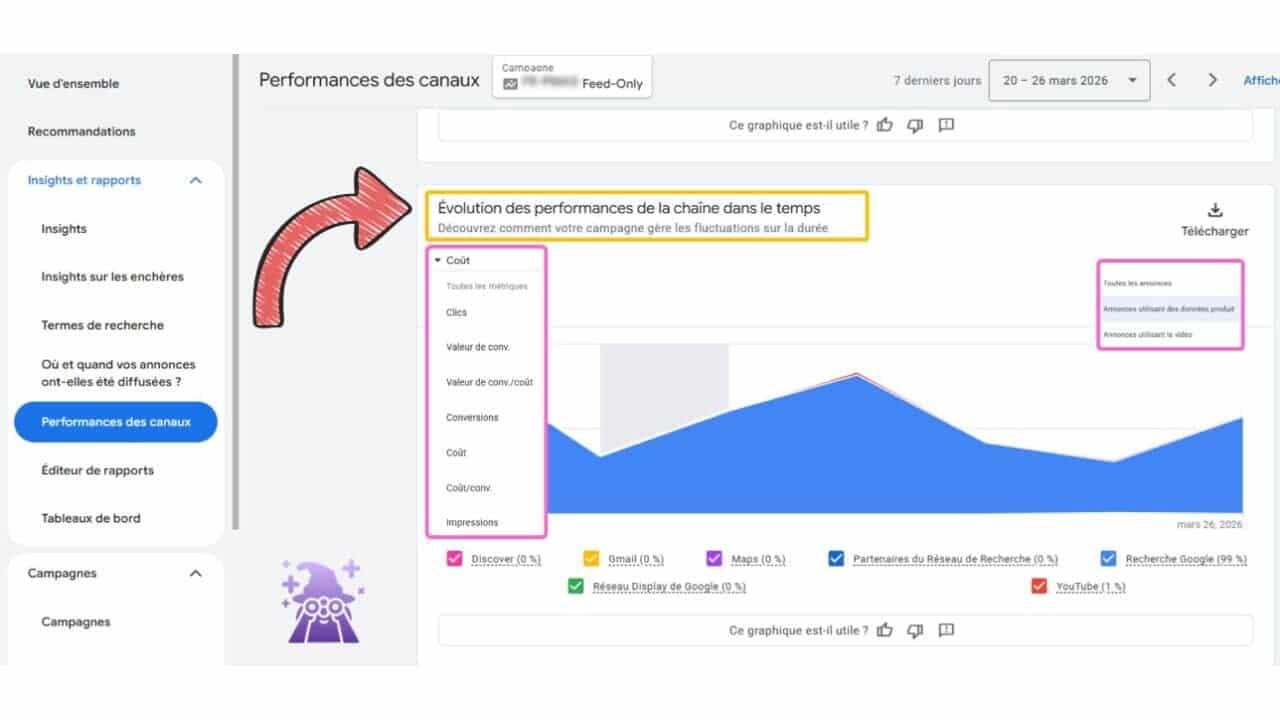
Recently, I discovered that Google has launched an exciting new feature for Performance Max campaigns. As an advertiser, I’m always on the lookout for tools that provide clearer insights, and this new channel performance timeline view does just that. It offers a comprehensive breakdown of how different channels like Search, YouTube, and Display contribute to my campaign results over time.
What’s New
The latest update introduces a timeline graph that showcases channel-level contributions over a selected period, complete with investment and performance filters. This means I can quickly identify which channels are excelling and which ones might need a bit more attention.
The chart features helpful visual cues—like a yellow box highlighting channel performance evolution over time, and a pink box indicating different ad types, such as All Ads, Ads Using Product Lists, and Ads Using Video.
Why I Care
Managing Performance Max campaigns across multiple channels often left me guessing about where my budget was working best. This new view provides valuable insights into channel-level trends, allowing me to adjust strategies or budgets more efficiently. If I notice YouTube underperforming while Search is thriving, I can now make informed decisions without relying purely on guesswork or exported data.
The Big Picture
This new view empowers me to evaluate PMAX performance more effectively, without relying solely on Google’s automated decisions. Now, I can see consistent underperformance or excellence across channels, which guides my budget and asset strategies moving forward.
The Bottom Line
Though it’s not full transparency, this update is a significant move in the right direction. I now have a more structured way to detect trend anomalies in PMax campaigns early and make necessary adjustments to optimize performance.
First Spotted
This feature was first noticed by Axel Falck, Head of Search at Le Mage du SEA, who shared his insights on LinkedIn.