I find it fascinating that Google’s Universal Commerce Protocol (UCP), which was initially limited to AI Mode, is now expanding into regular search results. It’s not just a fleeting trend; some retailers have already begun integrating this technology into their listing pages, making our online shopping experience even more intuitive.
Earlier this year, Google rolled out UCP for AI-agents to facilitate direct purchases from search results. It first launched exclusively within Google’s AI Mode but now, we’re seeing it implemented in Google’s main search results for retailers who support UCP.
Discovering what the UCP checkout looks like was made easier thanks to a post by Brodie Clark. He shared a screenshot showing how Wayfair’s listings on Google Search now feature a UCP-powered ‘Buy’ button. This button is a game-changer because it allows purchases directly from Google’s interface without navigating to Wayfair’s website.
The UCP protocol is paving the way for seamless transactions by establishing a common language for AI agents and commerce systems. No longer do we have to worry about bespoke integrations across different platforms.
Collaboratively developed with big names like Shopify, Etsy, Wayfair, and Target, UCP aligns with existing standards, such as Agent2Agent and Agent Payments Protocols, creating a more cohesive digital commerce space.
What really excites me is the potential for profit growth for retailers who embrace this technology. Although Wayfair might miss out on direct site traffic for specific searches, their affiliation with Google through UCP can still result in conversions.
While it’s clear that not everyone will bypass the traditional shopping journey, as many of us still prefer exploring products on the retailer’s site, the option to ‘Buy’ directly adds a layer of convenience. It’s definitely something worth monitoring as its prevalence in search results increases.
You have access to a promising new ad placement, the first click-through rates look excellent, and someone wants to know whether to increase the budget. That is exactly when measurement discipline tends to slip. A strong dashboard number feels like an answer even when it only describes the first step in the journey.
Your real task is to determine whether the platform creates valuable outcomes that would not otherwise happen, whether those outcomes remain economical as the test expands, and whether the available inventory can absorb more spend. This framework helps you answer those questions without expecting one attribution model to do every job.
Separate channel discovery from budget proof
An emerging platform can be interesting before it is investable. That distinction matters because discovery metrics and budget metrics answer different questions.
Click-through rate tells you whether people respond to a placement. It does not tell you whether the resulting customers are profitable, whether the ad caused those customers to act, or whether similar performance will survive broader distribution. This is especially important for conversational advertising, where early engagement has been strong but inventory and testing remain limited.
Run the test as a sequence of decisions. Each decision requires different evidence:
Decision
Evidence to inspect
What it does not prove
Does the placement attract attention?
Impressions, clicks, click-through rate, and engagement by query or audience segment
That the attention creates business value
Does the traffic produce the right outcome?
Purchases, qualified leads, subscriptions, revenue, lead quality, and downstream completion
That the advertising caused the outcome
Is the outcome incremental?
Holdout testing, geo experimentation, or another credible counterfactual
That the same return will persist at a larger spend level
Can the platform scale efficiently?
Available inventory, spend delivery, reach, frequency, conversion quality, and cost as exposure expands
That it improves the entire media portfolio
Should the portfolio budget change?
Experiment-calibrated media mix modeling alongside commercial constraints
That every individual conversion can be assigned to one touchpoint
This separation protects you from two common mistakes. The first is rejecting a potentially useful channel because it has not yet accumulated enough evidence for a permanent budget allocation. The second is scaling it because a high early click-through rate has been mistaken for incremental profit.
Label the stage of the evidence in every internal update. Use plain terms such as discovery signal, conversion signal, incremental evidence, and scale evidence. If the team only has a discovery signal, say so. That small piece of language prevents a preliminary result from hardening into a forecast.
Write the measurement contract before the first impression
A measurement plan should be a decision contract, not a list of every metric the platform can export. Write it before launch so the team cannot redefine success after seeing the results.
Name one primary business outcome. Choose the event closest to value that the test can credibly observe: a completed purchase, a qualified opportunity, a subscription, or another commercially meaningful result. Keep clicks and engagement as diagnostics unless attention itself is the campaign objective.
State the causal question. Write what you are trying to learn in counterfactual terms: how many desired outcomes occurred because the ads ran, beyond what would have happened without them? This wording exposes the limit of ordinary attribution before anyone treats credited conversions as incremental conversions.
Define the test unit. Decide whether results will be examined by query theme, audience, geography, product, offer, creative, or another controlled unit. The unit must match the mechanism you expect to drive performance.
Set the comparison rules. Document the conversion definition, attribution window, revenue basis, treatment of returns or cancellations, and handling of duplicate records. Use the same definitions for the emerging platform and the benchmark channel.
Choose guardrails. Track conversion quality, acquisition cost, spend delivery, reach concentration, and any operational consequence such as low-quality leads. A channel that creates more form submissions but overwhelms sales with poor prospects is not passing the business test.
Predeclare the verdicts. Specify what evidence would justify scaling, continuing the test, pausing for an instrumentation repair, or stopping. Your thresholds should come from the economics of your own business rather than a generic platform benchmark.
The contract also needs a data lineage section. For every result, record where the event originates, how it is passed, which identifier joins it to campaign data, and which system is authoritative when two systems disagree. If a purchase appears in the ad platform but not in the commerce system, the team should already know which record governs the decision.
Do not postpone this work until reporting begins. Missing identifiers and inconsistent event definitions cannot always be repaired after exposure has occurred. If the primary outcome is not reliably captured, pause the test and fix the measurement path before buying more traffic. Otherwise, additional spend produces a larger dataset without producing a better answer.
Read early AI ad performance without fooling yourself
Conversational ads may appear beside a response at the moment a user is expressing a need. That context can make the placement feel more relevant than an interruptive format. It also creates several reasons for early results to look unusually strong.
Intent mix is the first reason. Prompts about Mother’s Day have been observed to trigger ads about three times more often than the overall average. A test concentrated in gift-seeking conversations is not representative of every prompt, product category, or stage of the buyer journey. Report results by intent class instead of averaging all conversations into one channel-wide figure.
Format novelty is the second reason. People may inspect a new placement because they have not seen it before. You cannot prove that novelty caused the clicks from an initial campaign, but you can watch for the pattern. Repeat the test across cohorts or campaign waves, keep the offer and conversion definition stable, and check whether engagement and downstream quality hold as the format becomes more familiar.
Inventory selection is the third reason. Limited supply can concentrate delivery in the prompts, advertisers, or use cases most likely to perform. Expansion may introduce weaker contexts, more competition, and different pricing. Track how much of the planned budget is actually delivered, where impressions cluster, whether new query categories enter the mix, and how acquisition cost changes as spend rises. A channel that cannot spend the approved amount is not yet a scalable acquisition engine, even if its small pool of impressions performs well.
The comparison channel matters too. Early conversational-ad click-through rates have exceeded display and podcast benchmarks, but that comparison describes engagement, not equivalent economics. Search, paid social, display, podcast advertising, and conversational placements differ in intent, buying method, inventory, and the role they play in a journey. Compare them on the same final outcome and accounting basis before moving budget.
At the review meeting, force the result into one of four decisions:
Scale: the primary business outcome meets the predeclared requirement, the evidence supports incrementality, data quality is intact, and the platform has enough inventory to test a higher spend level.
Continue testing: engagement and conversion quality are promising, but incrementality, pricing stability, or inventory depth remains uncertain. Name the next uncertainty and design the next test specifically around it.
Pause and repair: event loss, inconsistent definitions, broken joins, or missing downstream outcomes make the result unreliable. Fix the data path before resuming.
Stop: the test has enough reliable evidence to show that the business outcome does not meet your requirement, or repeated expansion causes economics or conversion quality to deteriorate beyond the accepted limit.
“Promising” is not a fifth verdict. It is a description that must be followed by a specific next decision.
Build an evidence ladder instead of trusting one model
No single measurement method can tell you whether an ad was served correctly, influenced an individual journey, created incremental demand, and deserves a larger share of the portfolio. Use a ladder in which each layer answers a narrower question and checks the layers below it.
Layer 1: instrumentation and platform diagnostics
Start with clean event collection. Connect ad delivery, site or app behavior, commerce results, and CRM outcomes. Preserve campaign identifiers where possible, deduplicate events, and reconcile totals against the system that records the actual transaction or qualified lead.
The direction of Google’s tooling shows how central this plumbing has become. Data Manager is being expanded with a map-based view of connections involving systems such as BigQuery, HubSpot, and Shopify, while Google tag changes are intended to extend existing setups without requiring additional code. The useful principle is broader than any vendor: make the flow of data visible enough that a marketer can locate a missing connection before it distorts a campaign decision.
Platform reports remain useful at this layer. They help you diagnose delivery, creative response, query mix, and conversion paths. Treat attributed conversions as claims that need reconciliation, not as automatic proof of causality.
Layer 2: controlled experiments
An experiment estimates the counterfactual that ordinary attribution cannot observe. A holdout keeps an eligible group from receiving the treatment. A geo experiment varies advertising across comparable regions and evaluates the difference in business outcomes. Neither method is a decorative validation step. It is the evidence used to decide how much of the platform-reported performance is genuinely incremental.
Choose an experimental design only when the platform and your market provide a defensible control. If exposure leaks heavily between groups, the regions behave differently for unrelated reasons, or the outcome volume is too sparse to distinguish change from noise, do not dress the result up as causal proof. Document the limitation and continue at the lower rung of the evidence ladder.
Layer 3: media mix modeling
Media mix modeling examines aggregated changes in spend and outcomes across channels and time. It is suited to portfolio questions: how channels work together, how budget shifts may affect total results, and where marginal investment may be more productive. It does not need to identify a single ad as the exclusive cause of a single purchase.
An emerging channel may initially be too small or too stable in spend for a portfolio model to isolate reliably. That is not a reason to invent precision. Use controlled testing to establish an initial incremental read, create meaningful and documented variation when expanding the channel, and add it to the model when the underlying data can support the distinction.
Keep a measurement change log alongside the model. Record tag updates, consent changes, platform launches, campaign restructures, pricing changes, promotions, and breaks in source data. When performance moves, this log helps you distinguish a market effect from a measurement artifact.
Key takeaways for your next platform test
High click-through rate is a discovery signal. It is not evidence of incremental revenue, efficient scaling, or portfolio impact.
Define the business outcome, counterfactual, comparison rules, guardrails, and decision thresholds before the campaign begins.
Segment conversational-ad results by intent and query class. A concentration of high-intent prompts can make the channel average look more transferable than it is.
Evaluate scale separately from efficiency. Limited inventory can produce good economics while preventing meaningful budget deployment.
Use platform reporting for diagnostics, experiments for causal lift, and media mix modeling for portfolio allocation.
Pause when instrumentation is broken. More spend cannot repair missing identifiers, inconsistent events, or an unreliable outcome definition.
Before accepting the next emerging-platform test, write the measurement contract on one page and identify the weakest rung in your evidence ladder. Fund the test that resolves that uncertainty. Increase the budget only when the business outcome, incremental effect, data quality, and available inventory all support the same decision.
Your page can rank for an obvious phrase and still disappear when someone asks an AI assistant to recommend, compare, or solve. The page may answer the words in the prompt without helping the person make the decision behind it.
Improving AI search visibility requires two kinds of alignment. First, connect query intent to the outcome the person actually wants. Then trace whether your content can pass from discovery to selection, citation, and action. That turns a vague visibility problem into a sequence of checks you can act on.
Optimize for the decision behind the prompt
Query intent is the need expressed through the search or prompt. Conversion intent is the goal revealed by what the person is trying to accomplish and how they behave. Those intents can overlap without being identical.
Conversion does not have to mean a sale. It might mean reaching a login screen, confirming whether a product fits, comparing providers, downloading technical information, or deciding that no action is needed. If you optimize only for the wording, you can produce a relevant answer that leads nowhere useful.
Treat query specificity as a confidence signal, not a verdict. A prompt such as “brand login” states a narrow navigational need. A brand name by itself may represent navigation, support, product research, or purchase consideration. A non-branded category term signals a general area of interest, while added attributes reveal constraints that the answer must address. More explicit wording supports a stronger intent hypothesis, but observed behavior should still validate it.
Before changing a page, write a short intent brief:
Query family: the prompt and its close conversational variants.
User situation: what the person already appears to know.
Immediate need: the answer required in the current interaction.
Underlying decision: what the person must choose, verify, or complete next.
Desired conversion: the useful action, including a non-commercial action where appropriate.
Required evidence: the facts, qualifications, comparisons, or proof needed to support that decision.
Entity focus: the product, organization, person, place, or concept that must be identified without ambiguity.
This brief prevents a common mismatch: writing an educational page for a person who needs to choose, or pushing a high-commitment call to action at someone who is still defining the problem.
Build the page as an intent chain, not a keyword container
An intent-optimized page should move cleanly from the prompt to the decision. The goal of generative engine optimization is not to mention AI or repeat more variations of a phrase. It is to make your information easier to understand, use, and recommend in a generative answer.
Use this sequence when outlining or revising the page:
Answer the expressed question immediately. Put the direct answer under a heading that describes the question or decision. Do not require an AI system or reader to combine several distant paragraphs to find it.
Expose the decision behind the question. State the criteria that change the answer: use case, prerequisites, compatibility, limitations, tradeoffs, or audience fit.
Attach proof to the claim it supports. Place the relevant explanation, example, qualification, or citation near the claim instead of collecting unsupported assertions in one section and evidence in another.
Clarify the entities and relationships. Use consistent names for the brand, product, service, category, and alternatives. Explain how they relate in visible copy.
Offer the next appropriate action. A broad exploratory prompt may need a comparison or diagnostic next step. A narrow action prompt may justify a direct login, purchase, booking, or contact path.
One URL does not need to satisfy every possible intent. Group close variants when they lead to the same decision and require substantially the same evidence. Split them when they demand different answers, qualifications, or next actions. A page that tries to educate beginners, resolve technical support, compare vendors, and close a purchase often makes each job harder to recognize.
Structured data can reinforce this work, but it cannot replace it. JSON-LD should describe entities and relationships already supported by the visible page. Marking up an unclear, thin, or contradictory claim does not make the underlying answer more useful or trustworthy.
Trace visibility through the ten-gate AI search pipeline
Check technical eligibility before rewriting the answer
Discovered: confirm that the URL is reachable through intentional internal links and the discovery mechanisms you maintain. An orphaned page should not be treated as a wording problem.
Selected: determine whether crawlers choose the URL from the pages they know. If comparable URLs receive requests but this one does not, inspect linking depth, duplication, crawl directives, and competing URL versions.
Crawled: use server logs where available to verify requests, response codes, and repeated access problems. A request is evidence of crawling, not evidence of indexing or citation.
Rendered: compare the essential answer in the delivered HTML with the rendered page. If the useful content depends on a failed script, delayed interaction, or inaccessible component, downstream systems may receive an incomplete version.
Indexed: use the engine-specific diagnostics available to you to check canonical selection, indexing status, and exclusions. Do not infer indexing merely because the URL loads in a browser.
These first gates are mainly infrastructure work. If the page is not being fetched, rendered, or indexed as intended, adding another section or changing a call to action will not solve the immediate constraint.
Then test whether the content is competitive enough to be used
Annotated: check whether the central entity, attributes, and relationships are explicit and consistent. Align visible language, page metadata, internal links, and structured data rather than letting each describe a different subject.
Recruited: test whether the page or domain appears to become a candidate for the relevant prompt family. Recruitment is usually inferred from repeated output patterns, not directly exposed as a public status.
Grounded: make each important claim easy to support. State it plainly, qualify its scope, and place the relevant proof nearby. A page can be topically relevant without providing a usable basis for an answer.
Displayed: record whether the resulting answer visibly mentions, quotes, links to, or cites your content. Separate a brand mention from a clickable citation because they represent different outcomes.
Won: evaluate whether the visibility produces the intended user result. That might be a qualified visit, a completed task, a useful comparison, a signup, or a purchase.
The later gates are competitive. Passing them depends on more than technical availability. The answer must fit the prompt, identify its entities clearly, support its claims, and earn selection against other eligible material. Clear entity signals can improve several downstream gates, which is why entity work can have effects beyond a single page element.
Measure the symptom, identify the gate, and fix the constraint
You cannot directly observe every internal decision an AI system makes. Keep observed evidence separate from inferred causes. Otherwise, a single missing citation can trigger an unnecessary rewrite when the real problem is crawling, indexing, ambiguous entities, or weak alignment with the tested prompt.
Evidence you can collect
What it supports
What it does not prove
Server-log request
The URL was crawled by the identified requester
The content was indexed, understood, or used
Indexing diagnostic
The engine reports the URL as indexed or excluded
The URL will be recruited for a relevant prompt
Consistent entity information on the page
The subject and relationships are explicit
The system annotated them exactly as intended
Visible mention or citation in an AI answer
The content passed through display for that test
The result will persist across prompts, sessions, or later answers
Qualified action after exposure
The visibility contributed to the intended outcome
Which earlier gate caused the selection
Create one audit row for each combination of an intent family and its best-fit URL. Add a column for every gate and mark it pass, fail, or unknown. Store the evidence beside the status. Unknown means you need a better test; it should not be silently upgraded to pass.
Do not average the gate scores. An average hides hard failures. Start with the earliest confirmed failure because every later result depends on it. Once the technical gates pass, prioritize the competitive gate with the clearest evidence of weakness.
Use these symptom-to-action starting points:
The URL is not indexed: investigate discovery, crawling, rendering, canonicalization, and indexing before expanding the copy.
The URL is indexed but absent across a controlled prompt set: test intent fit, entity clarity, and whether the page provides a distinct answer with usable evidence.
The brand appears but the preferred page is not cited: inspect whether the page states the relevant claim directly and whether another page creates a clearer claim-to-proof connection.
The page is cited for informational prompts but not decision prompts: add the criteria, constraints, comparisons, and qualifications needed for the decision. Do not merely make the call to action louder.
The page is displayed but produces the wrong visits or actions: revisit conversion intent, promise clarity, and the next step. Visibility to the wrong audience is not a win.
Run prompt tests with a fixed set of close variants and conversational follow-ups. Record the exact prompt, result type, mention, cited URL, answer framing, and intended conversion. Keep the test conditions as consistent as practical, and avoid drawing a firm conclusion from one generated response.
Audit existing assets before commissioning more content. A useful planning frame separates return on past investment, present investment, and future investment: recover claims and proof you already own, repair the current bottleneck, and create new material only for an intent or evidence gap the existing library cannot satisfy. This outside-in approach prevents production volume from masking a distribution or selection failure.
Key takeaways
Map every important prompt family to both its immediate question and its underlying conversion goal.
Build the page as a chain from direct answer to decision criteria, evidence, entity clarity, and an appropriate next action.
Diagnose visibility across all ten gates instead of treating every absence as a content-quality problem.
Separate observable evidence from inferred system behavior, especially at the annotation, recruitment, and grounding stages.
Fix the earliest confirmed failure before investing in downstream refinements or additional pages.
Run your next optimization cycle on one intent family
Choose one intent family tied to a meaningful user outcome.
Name the existing URL that should satisfy it and complete the intent brief.
Mark every pipeline gate pass, fail, or unknown, with evidence.
Make the smallest change that addresses the earliest confirmed failure.
Repeat the same crawl, index, prompt, display, and conversion checks before widening the work to more URLs.
If you can name the decision the person is making and the gate where your content stops, the next action becomes much clearer. Start with one intent family and one failed gate. Earn the right to scale only after that path works from discovery through the user outcome.
If you manage bot access at a CDN, firewall, reverse proxy, or application layer, Google Web Bot Auth presents an awkward decision: prepare for stronger bot identity without blocking legitimate traffic that does not yet use it.
The safe approach is to add Web Bot Auth as a new verification signal, not replace your existing controls. You can then learn from signed requests, distinguish authentication from permission, and tighten access only when coverage is reliable enough for the agents and routes you care about.
What Web Bot Auth actually changes
A user-agent string tells you what a requester claims to be. IP and reverse-DNS checks can associate a request with known infrastructure. Neither gives you the same kind of identity evidence as a cryptographically signed request.
Web Bot Auth is an experimental cryptographic protocol that lets participating bots sign requests. A compatible verifier can use that proof to determine whether the request came from the claimed agent rather than trusting a label that another client could copy.
Signal
What it tells you
How to use it now
User-agent string
The identity a requester claims
Keep it as classification context, not proof by itself
IP and reverse DNS
Whether the request is associated with expected network infrastructure
Keep using these checks during the limited rollout
Web Bot Auth
Whether a participating agent supplied valid cryptographic identity proof
Add it as a stronger signal where verification is supported
This is an authentication improvement, not a complete bot-management policy. A valid signature can help establish who sent a request. It does not decide whether that agent may crawl a page, use an expensive endpoint, access licensed material, or bypass rate limits. Those are authorization decisions that remain yours.
That distinction prevents the most dangerous implementation mistake: treating “authentic” as a synonym for “allowed.” A verified agent can still request a route your policy excludes. An unsigned agent may still be legitimate while adoption remains partial.
Why Web Bot Auth must remain an additional signal
Web Bot Auth is in a limited test involving some AI agents hosted on Google infrastructure. Not every Google user agent uses it, and Google is not signing every bot request. Requiring a valid Web Bot Auth result across your site would therefore turn incomplete deployment into an access-control failure.
In practice, the absence of a signature has three possible meanings: the requester is not participating, a participating agent did not sign that request, or the requester is not what it claims to be. The rollout does not yet let you collapse those cases into “fraudulent.” Keep IP, reverse-DNS, and user-agent checks operating alongside the new protocol, as Google advises during gradual adoption.
Your internal classification should represent that uncertainty. A binary “Google bot” field is no longer enough. Use separate states such as:
Cryptographically verified: Web Bot Auth verification succeeded and resolved to an identity you recognize.
Legacy verified: the request passed your established network and identity checks but did not carry usable Web Bot Auth proof.
Unverified: the request supplied no acceptable proof and did not pass your legacy verification path.
Contradictory or failed: the claimed identity conflicts with your verification results, or supplied authentication material fails verification.
Do not silently translate “legacy verified” into “untrusted.” That would make a protocol coverage gap look like a security finding. Conversely, do not let a familiar user-agent string upgrade an unverified request into a trusted one.
Failed proof deserves more scrutiny than absent proof. An unsigned request may simply sit outside the test. A request that presents authentication material but cannot be validated has actively failed the verification path. Your system should preserve that distinction for policy decisions and incident review.
A safe adoption plan for your edge and application stack
You do not need to redesign every bot rule at once. Start by separating verification from enforcement, then introduce the new result in stages.
Map the current decision path. Identify where user-agent checks, IP rules, reverse-DNS verification, rate limits, robots directives, and application permissions affect a request. Note whether the decisive action happens at the CDN, firewall, reverse proxy, application, or more than one layer.
Define the verdicts before integrating them. Decide how your system will represent valid, absent, failed, unsupported, and indeterminate Web Bot Auth outcomes. Do not force these states into one Boolean field.
Add verification without changing access. In the first phase, calculate and log the Web Bot Auth result while preserving existing allow, limit, challenge, and deny behavior. This gives you evidence about real coverage without risking accidental exclusions.
Compare signals. Review requests that claim the same agent identity but produce different network and cryptographic results. Investigate disagreements before using the new signal to make blocking decisions.
Introduce graded enforcement. Prefer lower-risk actions, such as applying ordinary rate limits to unverified automation, before making a signature mandatory. Reserve strict requirements for routes where you have confirmed support and where the cost of unauthorized access justifies the tighter rule.
Keep a rollback path. Authentication failures should be visible, attributable to a specific policy, and reversible without redeploying unrelated application code.
Place verification where request data can be inspected before an irreversible allow-or-deny decision. That may be at the edge in one architecture and inside a trusted gateway in another. Do not assume your CDN, security plugin, or bot-management service supports the protocol merely because it can read headers. Cryptographic verification requires a compatible implementation and a defined trust process.
Before enabling enforcement, make the implementer answer the operational questions that matter for any signed-request system: What parts of the request are covered? How is the signing identity trusted? How are invalid, stale, or unverifiable proofs handled? How does verification behave during key or service changes? Which failure mode applies if the verifier is unavailable? If your stack cannot answer those questions, keep the integration in observation mode.
Your logs should store conclusions that operators can use, not just a dump of unfamiliar authentication data. Useful fields include the claimed user agent, legacy-verification result, Web Bot Auth result, resolved identity, requested route, policy action, response status, and the component that made the decision. Apply your normal security, privacy, and retention rules to those records.
Build AI-agent access rules around identity and purpose
Once you can verify an agent, resist the urge to create a single global allowlist. Public articles, resource-intensive APIs, account pages, and licensed datasets do not have the same risk or purpose. The identity result should feed a route-specific policy.
Verified identity plus permitted route: allow the request under the limits assigned to that agent and content class.
Verified identity plus prohibited route: deny it. Authentication does not override the route policy.
No Web Bot Auth proof plus successful legacy verification: continue the established bot policy while coverage remains incomplete.
Claimed known identity plus failed verification: treat the request as untrusted and preserve the failed result for investigation.
Unknown automation: apply your general unknown-bot controls rather than granting access based on a recognizable name.
Private or account-bound routes still need their ordinary application authentication and authorization. Bot identity proof is not a substitute for a user session, API credential, subscription entitlement, or content license.
The same separation applies to robots instructions and other content-use rules. Web Bot Auth can help determine which agent is asking. Your published directives and internal access policy determine what that identity may receive. Keep those systems aligned, but do not merge them conceptually.
For SEO, AEO, and GEO teams, the immediate benefit is cleaner observability rather than a promised visibility gain. Nothing in the limited rollout establishes Web Bot Auth as a ranking, citation, or inclusion mechanism. Do not change canonical tags, structured data, content architecture, or indexation rules merely because signed bot requests appear in your logs.
Use the stronger identity signal to answer narrower operational questions: Which verified agents request your content? Which sections do they reach? What status codes do they receive? Where do rate limits or access rules interrupt them? How often does a claimed identity match a verified identity?
Do not label a verified crawl as an AI citation, recommendation, or referral. A request proves an interaction with a URL, not what an agent later generated for a user. Keep server-side agent activity separate from user referral traffic and from any evidence that your brand appeared in an AI answer.
Key takeaways and your next move
Web Bot Auth adds cryptographic identity evidence to participating bot requests.
The protocol remains experimental and is being tested with only some AI agents on Google infrastructure.
Not every Google user agent or request is signed, so missing proof is not proof of impersonation.
Keep user-agent, IP, and reverse-DNS verification running alongside Web Bot Auth during the rollout.
Authentication establishes identity; your route, content, and rate-limit policies still decide permission.
Use verified requests to improve bot observability, but do not treat a crawl as evidence of an AI citation or ranking benefit.
Your next move is concrete: map the component that currently decides whether a bot request is allowed, add a multi-state Web Bot Auth verdict to that path, and run it without enforcement first. Preserve your existing controls until signed-request coverage is confirmed for the exact agents and routes you intend to govern.
That design lets you benefit as adoption expands without making today’s legitimate unsigned traffic pay for tomorrow’s authentication model.
Your organic rankings can improve while your real search visibility gets worse. A buyer may encounter an AI answer, a sponsored result, a Reddit discussion, a video, a marketplace listing and your website during the same decision. A rank report that captures only the blue links will call that journey a success or failure without seeing most of it.
An integrated search strategy fixes that blind spot. It makes the customer’s question the unit of planning, then coordinates organic search, paid search, AI visibility, third-party authority, social discovery, marketplaces and local platforms around it. The goal isn’t to appear everywhere. It is to earn the right kind of visibility at each point where a customer explores, compares, verifies or acts.
Map each customer job to the surfaces that can satisfy it
Search is no longer a synonym for a traditional search engine, but traditional search is not disappearing either. Reported referral estimates still put Google at roughly 300 times the combined referral traffic of AI platforms, while AI accounts for less than 1% of U.S. web traffic. That makes abandoning SEO for generative engine optimization a poor trade. It also makes ignoring AI-assisted research a serious strategic gap.
The important change is behavioral. In Wynter’s 2026 B2B research, 68% of buyers reportedly began research in an AI tool before moving to Google. Treat that as a B2B finding rather than a universal consumer rule. Its practical lesson is still valuable: one system can shape the shortlist while another validates it. Your plan must cover both moments.
Customer job
Surfaces to inspect
What your brand must provide
Useful success signal
Understand a problem
AI answers, informational results, video, forums and social discovery
A direct explanation, clear terminology, credible evidence and a useful next step
Your explanation is visible, cited or repeated accurately
Build a shortlist
AI recommendations, review sites, comparison pages, Reddit, organic lists and paid results
Explicit use cases, differentiators, limitations and evidence that survives comparison
Your brand enters the relevant consideration set
Validate a choice
Branded search, your website, customer discussions, knowledge platforms and review profiles
Consistent facts, proof, current product information and answers to objections
Third-party descriptions agree with your canonical facts
Complete an action
Landing pages, ecommerce platforms, local results, maps and native booking experiences
A low-friction path with accurate availability, pricing or contact information where applicable
Qualified leads, purchases, bookings or another defined business outcome
Resolve an immediate need
Local services, maps, logistics platforms and mobile search
Correct location, hours, service area and fulfillment information
The customer can act without having to reconcile conflicting details
If you operate across markets, build a separate surface map for each one. Do not translate a Google keyword plan and call it international strategy. Identify where people in that market discover options, where they verify expertise, where they transact and which platforms can answer without sending a click to your site. That tells you which native profiles, content formats and external mentions matter.
Audit total visibility across your most valuable questions
Start with your top 20 commercial and pre-commercial questions. Twenty is large enough to expose repeated gaps while remaining small enough for a team to inspect manually. Do not select them solely by search volume. Include the questions that create demand, shape a shortlist, test a claim, compare alternatives and precede a conversion.
Organic position cannot stand in for total visibility. Moz found that 88% of AI Mode citations did not appear in the organic results for the same query. Even a first-place organic result therefore tells you little about whether an AI system mentions the brand, which external pages influence its answer or whether a sponsored, video, forum or product result captures the attention first.
Define the intent behind each question. Record what the searcher is trying to decide, what evidence would resolve the decision and which business outcome makes the question valuable.
Capture the visible experience. Record organic listings, ads, AI answers, cited domains, videos, discussions, product units, local results and suggested follow-up searches. Note the date, market, language, device context and location because the result mix can vary.
Record your type of presence. Separate an owned result from a paid placement, an AI citation, an uncited AI mention and an independent third-party recommendation. These are not interchangeable forms of visibility.
Inspect the answer, not just the brand name. Mark whether your positioning, capabilities and limitations are represented accurately. An incorrect mention can create more friction than no mention because the customer arrives with a false expectation.
Identify the next handoff. Ask where the user is likely to go after each surface. An AI answer may lead to branded Google research; a comparison page may lead directly to a product page; a local result may end in a call. Your content and measurement should connect those steps.
Keep the audit simple enough to repeat. A useful query record contains the question, intent, relevant surfaces, your presence on each surface, the page or entity shown, the message a user receives, the strongest competing presence, the desired next action and the observed business outcome. Use present, absent, inaccurate and unverified as operational statuses instead of inventing a composite score that hides the problem.
AI-heavy results make this broader audit more important. Estimates place AI Overviews on approximately 25% to 48% of Google queries, with the range reflecting different measurement methods. In a dataset covering 25 million organic impressions, the presence of an AI Overview was associated with a 61% drop in organic click-through rate and a 68% drop in paid click-through rate. Those figures should not be treated as a forecast for every site, but they show why position and impressions no longer explain the whole outcome.
Citation can change what happens below the generated answer. Within that same dataset, brands cited in AI Overviews had 35% more organic clicks and 91% more paid clicks than brands that were not cited. This is an association, not proof that a citation caused every additional click. It is still a reason to track citation status alongside organic and paid performance. A generated answer can reduce total clicking while making the cited brand more credible to users who continue.
Build an evidence network that machines can cite and people can verify
Your website remains the canonical place for your facts, but it is not the only place that shapes an answer. A brand’s own site may account for only 5% to 10% of the material AI systems reference. The rest can include review sites, publishers, affiliates, communities, forums and other external properties. You therefore need an evidence network, not merely more blog posts.
Make your owned facts easy to extract
Create a canonical fact set for the brand, each important product or service and every location you operate. It should answer the questions that repeatedly cause ambiguity: what the offering is, who it is for, where it is available, what it does, what it does not do, how it differs, what supports each material claim and when the information was last reviewed.
Lead each important page with a direct answer that matches the user’s question. Do not make a crawler or a person assemble the definition from several sections.
Keep claims and proof close together. If a performance, compatibility or market claim depends on conditions, state those conditions beside it.
Use descriptive headings, explicit entity names and consistent terminology. Pronouns and clever substitutes can make a page pleasant to read, but they should not obscure who did what.
Separate durable facts from frequently changing details. Review availability, pricing, product status, leadership, location and policy information on an appropriate operational cadence.
Link related explanations so that a reader can move from the short answer to methodology, evidence, limitations and the action page without guessing.
Use JSON-LD as a consistency layer
JSON-LD should describe the entities and relationships already visible on the page. It should not introduce claims that the reader cannot verify in the content. Keep names, URLs, identifiers, offers, authorship and organizational relationships consistent across templates. Validate the generated markup after deployment, then check rendered pages rather than assuming the content management system emitted what you configured.
Schema is not a citation switch. It reduces ambiguity and helps machines interpret a page, but it cannot manufacture authority, independent corroboration or useful evidence. If the visible copy, structured data, product feed, business profile and third-party descriptions disagree, fix the underlying facts before adding more markup.
Strengthen the external record without manufacturing consensus
For every priority question, inspect which external properties appear in organic results and which domains AI systems cite. Then decide what legitimate contribution you can make. That may mean correcting an inaccurate profile, supplying a publisher with verifiable information, earning coverage through original data, helping customers leave honest reviews or participating transparently in a relevant community.
Do not seed undisclosed endorsements or copy the same promotional paragraph across communities. Artificial repetition may create short-lived mentions, but it does not give a buyer independent evidence. The useful objective is agreement among accurate, separately maintained records.
In China, that entity work can extend beyond the company site to knowledge and discussion platforms such as Sogou Baike, Baike.com and Zhihu. The specific properties will differ elsewhere, but the test is the same: when an answer system checks several places, does it encounter a clear and consistent entity or a collection of contradictory descriptions?
Technical access belongs in the same review. Check robots.txt, page-level directives, authentication barriers and rendered content for the crawlers and search systems you intend to support. Make an explicit policy for each crawler rather than allowing or blocking everything by default. Access creates the possibility of discovery; it does not guarantee indexing, inclusion or citation.
Coordinate paid, organic and AI work around incremental value
A unified strategy does not mean one team performs every task. It means every team works from the same demand map and makes spending decisions against the same business outcome. SEO owns technical discoverability and durable page visibility. Paid search controls auction coverage and message testing. Content, public relations and community teams influence the broader evidence record. Analytics connects exposure to qualified business results. One portfolio owner resolves conflicts between them.
Branded search is the easiest place to see why coordination matters. A paid ad may protect the result, communicate a current offer or prevent a competitor from taking attention. It may also purchase clicks that strong organic visibility would have captured. Neither assumption is safe without an incrementality test.
Segment before testing. Separate branded from non-branded queries, strong organic positions from weak ones, and AI-cited experiences from uncited ones. A blended account average will hide the interaction you need to understand.
Choose a defensible control. Where volume and market coverage allow, compare matched geographies, audiences or schedules. Avoid changing ad coverage, landing-page content and major SEO elements at the same time.
Measure business outcomes. Compare qualified conversions, revenue or another agreed outcome, not only paid clicks or cost per click. A cheaper click is not a gain if total qualified demand falls.
Set risk guardrails. Do not abruptly remove coverage from high-value terms when the downside is unclear. Limit the initial test, watch competitor presence and define the condition that restores spend.
Reallocate, do not merely cut. Move budget released from demonstrably redundant coverage toward questions or surfaces where the brand lacks visibility and the customer has meaningful intent.
Use AI citation status as another segmentation variable. If a generated answer names you before the user sees the ad, the ad may serve as validation rather than initial discovery. If the generated answer omits you, paid visibility may temporarily compensate while content and authority work address the underlying gap. If the answer misrepresents you, buying more traffic without fixing the evidence can amplify confusion.
The shared scorecard should retain channel detail while preventing channel-local success from becoming the final verdict. At query level, track organic presence, paid coverage, AI mention and citation, external corroboration, message accuracy and the next available action. At portfolio level, track qualified demand, acquisition cost, conversion quality and revenue where available. This lets you see whether a falling click-through rate reflects lost demand, a zero-click answer or stronger pre-qualification.
Turn the framework into a repeatable search operating system
Launch the strategy in phases so that measurement and execution do not collapse into one large project. Begin with a shared baseline, close the clearest gaps, then test whether the changes create incremental business value.
Baseline: Select the top 20 questions, classify their customer jobs, capture every relevant surface and document message accuracy. Assign an owner to each unresolved gap.
Repair: Correct contradictory entity facts, strengthen the pages that answer high-value questions, align JSON-LD with visible content, resolve accidental crawler barriers and update important native profiles.
Expand: Build legitimate third-party corroboration where AI answers and search results rely on external properties. Create native assets for the social, marketplace, video or local systems that actually serve the customer’s job.
Test: Run controlled paid-versus-organic incrementality checks and compare citation status with downstream behavior. Keep the tests narrow enough to understand what changed.
Review: Re-run the same question set, inspect new competitors and citations, and compare results with qualified demand. Add or remove questions when customer behavior or commercial priorities change.
Prioritize gaps using three judgments: business importance, customer dependence on the surface and the credibility of the action available to you. A high-value buying question with an inaccurate AI answer deserves urgent attention. A broad informational query with no realistic connection to your customers may not. A marketplace listing matters greatly when the transaction starts and ends there, but far less when buyers require a verified technical website before contacting a supplier.
Key takeaways
Plan around customer questions and decisions, not separate SEO, PPC and AI keyword lists.
Keep traditional search in the portfolio; AI changes discovery and evaluation without replacing Google’s referral scale.
Audit the full result experience for your top 20 questions, including AI citations, ads, third-party discussions, video, commerce and local surfaces.
Make your website the canonical factual record, then build accurate corroboration across the external properties answer systems and customers use.
Use JSON-LD to clarify visible entities and relationships, not to conceal missing evidence or contradictory claims.
Test the incremental value of paid coverage instead of assuming that an organic ranking makes ads redundant or that every paid click is additional.
Start with the 20 questions that most influence your customers’ decisions. Put organic results, ads, AI answers and external recommendations in the same view, then fix the first place where an important customer can no longer find, verify or act on the right information. That is the smallest useful unit of an integrated 2026 search strategy.
The way we search for information has shifted dramatically—not slowly and not slightly. I’ve witnessed firsthand the transformation in search behaviors that make AI search visibility crucial for brands seeking to remain competitive.
Brands need to adopt AI search visibility services now more than ever to ensure they’re not only visible online but also standing out in an overcrowded digital space.
With the right AI tools, brands can refine their search visibility strategies to reach target audiences more effectively, leveraging cutting-edge technologies to stay ahead of competitors.
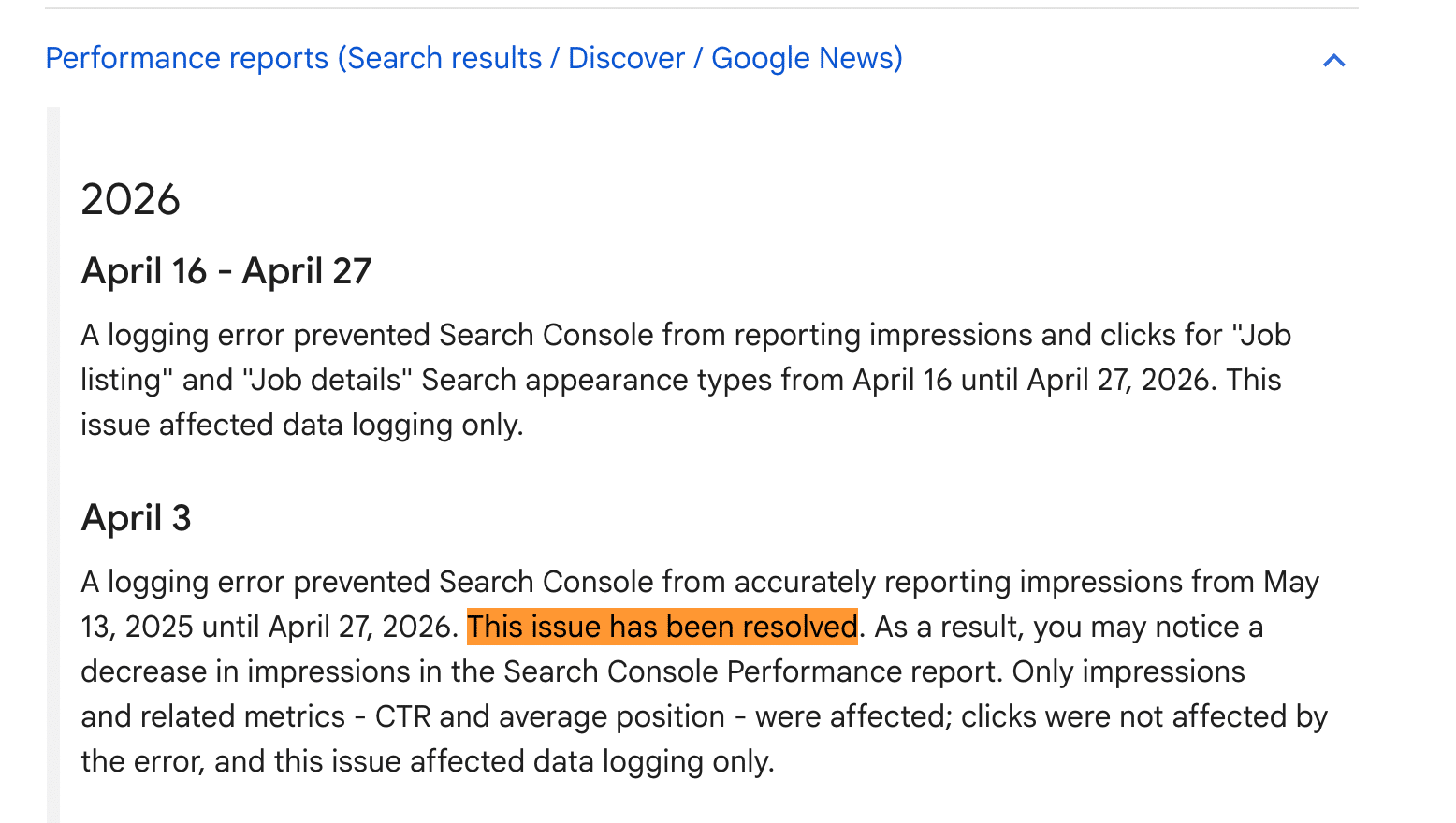
It feels like a moment of relief as Google recently announced a resolution to a longstanding data logging issue within Google Search Console. This glitch affected data between May 13, 2025, and April 27, 2026, spanning approximately 50 weeks. However, it’s important to note that while the root cause has been addressed, historical data from this period remains unfixed.
Google shared this update in a rather understated post, bringing light to a problem that many of us have been grappling with for quite some time. According to their post, “A logging error prevented Search Console from accurately reporting impressions from May 13, 2025, until April 27, 2026. This issue has been resolved.” It was a relief to hear, but also a bit frustrating knowing that impressions, CTR, and average position data were affected for such a significant period. Thankfully, clicks weren’t influenced by this error, which was some consolation.
As I sift through my Search Console data, I must remind myself of this anomaly, particularly when analyzing metrics from that problematic timeframe. The good news is that any data collected from this point forward should be accurate.
Further confirmation came from John Mueller on Bluesky, who reiterated that past data would not be retroactively corrected, but the issue has indeed been resolved going forward.
This development is crucial for all of us who rely heavily on precise data for SEO strategies. If your impressions appear lower and, consequently, your CTR and average position figures seem skewed during this period, this is likely why.
As someone passionate about the convergence of AI and healthcare, I’m thrilled to share monthly updates from the Goodie team. We dive into the latest breakthroughs and trends in artificial intelligence and the medical field. It’s all here, waiting for you to explore.
Your team can buy an AI visibility dashboard and still have no idea what to fix. The hard part is not detecting a brand mention. It is deciding whether that mention reflects accurate representation, genuine authority, growing demand, or one unstable answer.
A useful strategy connects AI answers to the conditions that produced them and the business result that followed. That means testing real prompts, examining who gets recommended and cited, strengthening the evidence around your brand, and measuring demand and behavior outside the AI platform.
Measure AI visibility as a chain, not a single score
Build your scorecard in layers. Each layer answers a different question, so a change in one cannot silently stand in for all the others.
Measurement layer
Question it answers
What to record
Business result
Did AI exposure contribute to valuable behavior?
Qualified visits, leads, purchases, subscriptions, assisted conversions, or revenue where your attribution setup supports it.
Brand demand
Are more people actively looking for you?
Branded queries, branded search interest, direct visits, and other demand indicators relevant to your business.
AI representation
Do answer engines include your brand, and how do they describe it?
Brand presence, recommendation role, factual accuracy, sentiment, citations, named competitors, and omitted capabilities.
Search and site foundations
Can search systems find the relevant pages, and what happens after a visit?
Indexing, impressions, clicks, landing-page engagement, conversion behavior, and referral traffic from identifiable AI platforms.
Define the business result before collecting visibility data. For one company, the meaningful action might be a completed purchase. For another, it might be a qualified inquiry rather than every form submission. Without that definition, an impressive mention count can become a reporting endpoint instead of evidence for a decision.
Give branded demand its own place in the scorecard. Growth in people deliberately searching for your name is a clearer indicator of rising market demand than citations alone. Google Trends, Keyword Planner, and Search Console can help you examine that demand from different angles, while GA4 can show what identifiable AI-referred visitors do on your site.
Do not turn the layers into one opaque composite score. If citations increase while branded demand and qualified activity remain flat, you have learned something specific: machine visibility changed, but you have not yet demonstrated greater preference or business impact. That is a diagnosis, not necessarily a failure.
Build a prompt benchmark you can repeat
Your benchmark should represent decisions a potential customer makes, not merely the keywords your site already targets. Include prompts from distinct stages of the decision so you can see where your brand enters, disappears, or gets described incorrectly.
Category discovery: prompts such as Which [category] options suit [audience and constraint]? reveal which brands are associated with the market before the user names one.
Problem solving: prompts such as How should [audience] solve [problem] when [constraint] applies? show which methods, entities, and providers become part of the answer.
Evaluation and comparison: prompts about tradeoffs, selection criteria, alternatives, or use-case fit expose how the system differentiates brands.
Brand verification: prompts about what your brand does, who it serves, where it fits, or how it compares reveal factual and positioning errors.
Use the language customers would use. A prompt set written entirely in your internal product vocabulary will measure whether an assistant can repeat your positioning, not whether your brand appears in the buyer’s actual decision process.
For every test, save enough context to reproduce and interpret it:
A stable prompt ID and the exact prompt text.
The intent category and audience represented by the prompt.
The platform, available mode, test date, and any conditions you controlled.
Every brand named and its role: primary recommendation, alternative, example, warning, or passing mention.
The claims made about your brand, including omissions and factual errors.
The pages and domains cited, when citations are available.
The competitors that recur and the evidence used to support them.
The action the observation triggered, or a clear note that no action is justified yet.
Keep the original output or a sufficiently complete capture. A binary present-or-absent field cannot tell you whether your brand was the preferred option, an unsuitable alternative, or an incidental example.
If your brand appears only when named, the system may recognize it without associating it strongly enough with the broader category. Investigate category coverage, independent mentions, demand, and positioning.
If competitors repeatedly appear in category and comparison prompts, inspect the claims and third-party evidence supporting them. The gap may be authority or distribution, not another missing keyword page.
If your brand appears but is described inconsistently, create an entity and messaging issue list. Separate incorrect facts from legitimate differences in how the market sees you.
If citations increase but visits do not, remember that a direct answer can satisfy the user without a click. Check branded demand, later visits, and business outcomes before declaring the citation worthless.
If visibility looks strong only in low-value prompts, revise the benchmark. You may be measuring questions that are easy to win but irrelevant to a buying decision.
Build the authority that keyword coverage cannot create
Publishing more pages does not automatically make your brand authoritative. Keyword coverage can show that you have discussed a subject. It cannot, by itself, show that the market trusts your expertise or thinks of your brand when the subject arises.
The more useful question is: what do credible people, publications, customers, and communities say about you? Consistent brand co-occurrence connects a brand with a topic across independent mentions. Those associations help explain why one company becomes a routine recommendation while another has a larger content library but little presence outside its own domain.
Create an evidence map around the association you want to earn. State it in a working sentence: For [audience] dealing with [problem], [brand] is relevant because [verifiable proof]. Then audit each part:
Do you have first-party evidence for the proof, or only a marketing claim?
Does the evidence contain original data, a useful method, a distinctive tool, or an insight another person would have a reason to reference?
Do independent mentions connect the brand to the intended problem and audience?
Do reviews and customer discussions support the positioning, qualify it, or contradict it?
Are the relevant facts stated consistently on pages that search systems can find?
Do competitors have stronger recurring evidence for the same association?
The answers tell you which intervention belongs next. If the underlying evidence is weak, produce work worth citing: original data, a transparent method, a practical resource, or an analysis that advances the conversation. If the evidence is strong but unseen, the bottleneck is distribution, public relations, community participation, or outreach. If independent mentions exist but describe the company inconsistently, fix the positioning and entity facts before adding more topic coverage.
Reviews, customer testimony, and genuine recommendations matter because they show human preference rather than self-description. Treat them as evidence to understand, not text to manufacture. Record which use cases customers associate with your brand, the language they use, and where their experience narrows or challenges your preferred positioning.
Your owned content still has an important job. It should explain the product or expertise accurately, answer consequential questions, expose the evidence behind claims, and give other people something precise to reference. Technical SEO should keep those pages discoverable and indexable. Structured data can state entities and relationships more explicitly, but it remains self-declared markup; use it to describe visible facts, not as a substitute for reputation.
This changes content planning. Do not ask only which keywords remain uncovered. Ask which claim your market needs help evaluating, what evidence would resolve it, who would find that evidence useful, and why anyone outside your company would mention it. Original data and useful insights that earn attention do more for authority than a stack of interchangeable pages.
Choose each tool for a decision it can support
No tool covers the complete chain from prompt exposure to market authority and revenue. Start with the question you need to answer, then choose the smallest tool set that provides the necessary evidence.
Tool or tool group
Use it to decide
What it gives you
What it cannot prove
ChatGPT, Claude, and Perplexity
Where and how does the brand appear in real answer formats?
Manual prompt tests, competitor framing, content gaps, entity coverage, cited pages where available, and preferred answer structures.
A one-off output cannot establish a stable ranking or market share. Manual testing also becomes time-consuming without a fixed framework.
Profound
Do you need repeatable cross-platform visibility and competitor monitoring at greater scale?
Brand mentions, sentiment, citation share, competitor visibility, and identification of content associated with AI mentions.
Its metrics remain snapshots of changing outputs. Cost also needs to be justified by a decision your team will make from the data.
Google Trends and Google Keyword Planner
Is demand growing, declining, seasonal, or too small to prioritize?
Search Console is Google-centric, while Analytics depends on correct configuration. Neither reveals every interaction that happened inside an answer engine.
Ahrefs
Which competitors have stronger external authority or reference-worthy content?
Backlinks, content gaps, and discovery of high-performing content that may support broader authority and citation opportunities.
These are indirect AEO signals, not a direct view of what an AI system will answer.
AI Trust Signals and Roadway AI
Is an emerging specialist tool able to close a defined credibility or revenue-attribution gap?
AI Trust Signals focuses on credibility indicators, while Roadway AI is developing attribution between AEO activity and revenue.
Both should be evaluated against your own workflow and decision requirements rather than assumed to be mature, universal replacements for the core stack.
A spreadsheet or database remains the connective tissue even when you use specialist software. Keep separate views for prompts, outputs, citations, authority evidence, actions, and outcomes. Join them with stable prompt, page, topic, and intervention identifiers. Otherwise, your answer tracker and analytics data will remain adjacent dashboards with no diagnostic relationship.
Use decision rules to turn observations into work
Write the rules before the next reporting cycle. This prevents the most visually dramatic metric from dictating your priorities.
Freeze the benchmark. Keep the core prompts, intent labels, platforms, and recorded conditions stable enough to make later observations interpretable. Add emerging prompts without rewriting the baseline.
Locate the bottleneck. Decide whether the problem is discovery, inaccurate representation, weak external authority, low underlying demand, or poor business response.
Check corroborating evidence. Compare prompt observations with cited pages, competitor mentions, backlinks, branded searches, Search Console data, and Analytics outcomes. Do not let one system confirm itself.
Choose one intervention tied to the bottleneck. That may be correcting facts, improving a decision page, publishing stronger evidence, earning independent coverage, repairing indexing, or revising a low-value prompt portfolio.
Record the expected movement. Name the measurement layer that should change if the intervention works. An authority campaign should not be judged solely by immediate referral clicks, and an analytics repair should not be credited with creating demand.
Retest the full chain. Recheck AI representation, citations, branded demand, search performance, and qualified behavior. Keep the intervention only if the combined evidence supports it.
Some patterns deserve especially careful interpretation. High Search Console impressions with falling click-through rate can justify inspecting whether direct search answers or AI Overviews are affecting clicks, but it does not prove the cause. A recurring competitor citation can reveal a useful evidence gap, but copying the competitor’s page structure will not reproduce the reputation behind it. Better diagnosis usually leads to a different action than surface imitation.
Paid AI monitoring becomes worthwhile when manual testing has already established a useful benchmark and the volume of platforms, prompts, markets, or competitors exceeds what your team can review consistently. If you cannot name the decision that additional tracking will change, more coverage will create a larger reporting burden rather than a better strategy.
Key takeaways
Treat AI visibility as a chain connecting machine representation, external authority, brand demand, site behavior, and business outcomes.
Benchmark category, problem-solving, comparison, and brand-verification prompts using exact, repeatable prompt records.
Interpret AI answers as variable observations. Look for recurring patterns across prompts and platforms instead of declaring a precise rank from a snapshot.
Build authority through verifiable work, independent mentions, reviews, public relations, and useful distribution. Keyword coverage and schema cannot manufacture market preference.
Select tools by the decision they support: assistants for firsthand testing, Profound for scaled monitoring, Google tools for demand and behavior, and Ahrefs for external authority analysis.
Connect every intervention to the layer expected to move, then validate it against the rest of the measurement chain.
Your first move is to create the benchmark before buying another dashboard. Put category, problem, comparison, and brand-verification prompts in one working file. Add the brands, claims, citations, demand signals, and business outcomes beside them. The first column that repeatedly lacks credible evidence is where your next optimization effort belongs.
I’ve seen how crucial it is to understand that AI visibility starts long before users hit that search bar and ends with citations.
These insights are vital in shaping what gets seen, summarized, and cited by AI systems.
Currently, the focus has shifted towards improving the AI ROI story, and I’m right in the thick of it, learning what strategies truly work.
This year, attending SMX Advanced will be more enlightening than ever, bringing unique perspectives and strategies.
Let’s dive into why influence matters everywhere, and how it impacts AI citations.
Rand Fishkin’s study, ‘Influence Happens Everywhere,’ reveals that, although Google commands the majority of search traffic, it’s the influence happening outside of search that truly dictates what people look for online.
For many, wandering through social media or news sites builds their understanding and interest long before the actual search occurs.
Despite the exciting growth of AI tools, achieving a stable presence online requires understanding how fragmented channels contribute to this influence.
When crafting content, it’s essential to dominate the influence phase so thoroughly that an AI assistant doesn’t just suggest your brand—it demands it.
That’s the strategic thrust behind the discussions at SMX Advanced in Boston and why I align my content calendar accordingly.
My colleagues at Search Engine Land are among those shaping these discussions. Insights from thought leaders like Dave Davies and Carolyn Shelby are invaluable.
They emphasize the importance of structured visibility signals and entity recognition, helping AI systems select the right brands to highlight.
In my own analysis, the various AI models like ChatGPT, Perplexity, and others have unique methodologies for selecting sources, reinforcing the idea that an engaged, multi-platform strategy is critical.
So, what does full-stack content truly mean today? It’s more than crafting blog posts; it’s about commanding entire topics with authority and depth, enhanced by AI tools like Jasper’s Enterprise Suite.
The ability to integrate real-time data, identify competitive content gaps, and create diverse multimedia content packages mean we’re shifting from simply generating content to dominating entire narratives.
But AI tools can only serve the overarching strategy if our content offers the original insights that help us stand out in AI retrieval systems.
This year, Purna Virji’s insights at SMX Advanced will challenge us to think critically about the real ROI in AI investment.
I’m particularly interested in seeing how Google Vids is democratizing video content by eliminating the high entry barriers of previous video production methods.
Now, video content can be produced and localized for a multitude of markets rapidly, a paradigm shift in how we engage audiences across the globe.
The standards AI is setting for content — whether text, video, or multimedia — require a strategic framework that aligns with evolving platforms like GEO and AEO.
For those in the trenches like me, adjusting focus towards an integration of structured data and earned media becomes imperative.
The real challenge isn’t in the buzzwords but effectively navigating the volatile landscape of AI-driven citations.
I recognize the adjustments needed in approach, especially when considering the stark differences in referral and conversion rates from traditional search versus AI platforms.
So, practical actions for the rest of 2026? Audit your AI presence thoroughly, stop gating original research, secure your place in vibrant communities, and refine your focus towards citatability rather than simple visibility.
Ultimately, the brands ready to adapt will continue to thrive in this AI-enhanced environment.
Indeed, the bots are crawling, and it’s time I ensured my brand is worth citing.