Month: June 2026

  • Google Ads Customer Match: Setup, Uses, and Privacy Checks

    You have customer data that competitors can’t copy. The question is whether you’re giving Google Ads a clean, current, consented version of it—or leaving its automation to learn from the same broad signals available to everyone else.

    Customer Match can support acquisition, retention, exclusions, bidding, and audience discovery. You can get some of that value even before your account qualifies to target a customer list directly.

    Key takeaways

    • Upload eligible first-party customer data even if your account hasn’t reached the spending threshold for direct Customer Match targeting.
    • Choose one job for each list: find new customers, retain existing ones, prioritize high-value customers, or exclude people who shouldn’t see an offer.
    • Use a direct integration when possible; otherwise, establish a recurring CSV refresh schedule.
    • Upload only data collected with appropriate consent, and make sure your privacy policy explains advertising-related data sharing.
    • Judge a list by matchable scale, freshness, and business relevance—not by its raw row count.

    Upload your list before direct targeting becomes available

    A common mistake is treating the US$50,000 lifetime-spend threshold as a reason to postpone Customer Match entirely. That threshold affects direct targeting and exclusions. Eligibility also requires an account in good standing and at least 90 days of spending history.

    If you haven’t met those conditions, you can still upload a customer list for use as an automation signal. Google can use the characteristics of those customers to inform Smart Bidding and optimized targeting. This matters because your first-party data gives the system information that isn’t available from generic market signals alone.

    An uploaded list can also unlock Audience Insights in Audience Manager. Inspect the demographic patterns and Google audience segments associated with your customers. Then turn the findings into testable decisions: adjust a landing page for the audience you actually attract, develop Demand Gen creative around a recurring interest, or challenge an assumption about who buys from you.

    Don’t read an insight as proof of causation. Use it to form a campaign hypothesis, then validate that hypothesis with conversion data.

    Give each Customer Match list one clear campaign job

    Customer Match can work across Search, Shopping, Gmail, YouTube, and Display once your account is eligible. Performance Max doesn’t offer conventional audience targeting, but customer lists can still shape Customer Lifecycle goals.

    Business objectiveHow to use the listWhat to check
    Acquire only new customersUse New Customer Only mode so known customers are excluded.Confirm that the list covers enough existing customers to make the exclusion meaningful.
    Pay more for new customersUse New Customer Value to distinguish acquisition value from an ordinary conversion.Make sure the added value reflects your economics rather than an arbitrary premium.
    Drive repeat purchasesUse Customer Retention mode to concentrate on known customers.Exclude people whose purchase timing or status makes the offer irrelevant.
    Prioritize your best customersBuild a high-value customer segment from a defensible business rule.Define value consistently, such as the customer status already used in your CRM.
    Prevent wasted impressionsExclude matched customers from acquisition campaigns when they shouldn’t receive the offer.Check that your list is refreshed frequently enough to catch recent customers.

    Scale determines whether these controls will materially change delivery. One practical heuristic is the 1% rule: compare the active list with the population in your target geography. In a US-wide campaign, 1% of a population of 340 million would be about 3.4 million people. This is a planning heuristic, not a Google eligibility rule. A smaller list can still be useful, but you shouldn’t expect it to redirect a large national campaign by itself.

    Use the narrowest list that still has enough scale for its job. A list of all historical leads may be large but strategically muddy. A current-customer list, lapsed-customer list, and high-value segment give you cleaner decisions, provided each status is defined and maintained.

    Build a repeatable upload and refresh process

    Start in Tools > Data Manager and look for a direct connection to the system that holds your customer records. Shopify, HubSpot, and Salesforce integrations can keep data synchronized without repeated manual exports. If a suitable connection isn’t available, use a CSV upload through Tools > Shared Library > Audience Manager.

    Your operating process should be simple enough that it still happens during a busy month:

    1. Define the list’s purpose and the customer status that qualifies a person for it.
    2. Remove records that don’t belong, including test accounts and people outside the intended segment.
    3. Confirm that the data was collected with the consent required for advertising use.
    4. Connect the platform or upload the CSV.
    5. Check whether the resulting audience has enough matched users to serve its intended campaign function.
    6. Set an owner and a refresh cadence.
    7. Review campaign settings after every major list-definition change.

    Match the cadence to the speed of your business. Daily synchronization makes sense when leads or purchases arrive regularly and recent customer status affects exclusions. A slower business may be adequately served by a bi-weekly or monthly refresh. The key is to choose the interval deliberately instead of relying on someone to remember.

    If you’re also using Enhanced Conversions, examine conversion-based customer lists. These can automatically maintain audiences of people who completed selected conversion actions. A conversion records an event; a data segment represents a group that can continue to inform campaign decisions. Connecting the two reduces manual list maintenance.

    Put consent and list quality ahead of match volume

    Customer Match is not permission to upload every email address your organization possesses. Use your own customer data, collected with suitable consent. Bought third-party lists can violate Google policy and applicable privacy law. Your privacy policy should clearly disclose that customer data may be shared with providers such as Google for advertising.

    Healthcare and finance require particular caution because sensitive-industry restrictions can prevent Customer Match use. Don’t try to work around a restriction by renaming a segment or broadening its label. If eligibility is unclear, verify the proposed use against Google policy and your organization’s legal requirements before uploading anything.

    Assign operational responsibility as well. Marketing can define the campaign objective, but someone must own consent status, suppression rules, customer-status logic, and refresh failures. Record the list’s purpose, inclusion criteria, update frequency, and connected campaigns in the same place your team documents campaign settings.

    Finally, monitor outcomes that match the list’s job. For acquisition exclusions, watch how much spend and conversion volume move toward new customers. For retention, evaluate repeat-purchase performance. For an automation signal, compare campaign performance over a meaningful period without crediting every change to the list. Customer Match improves the information available to Google Ads; it doesn’t replace sound bidding, creative, measurement, or offer strategy.

    Your next step is concrete: identify one consented customer segment, give it one campaign purpose, and either connect it in Data Manager or schedule its first upload. Then put the refresh date on the calendar before you leave Audience Manager.


    References

  • AI-Driven SEO Strategy: Build Monitoring That Leads to Action

    You can lose search visibility without seeing one dramatic ranking drop. A robots change can block discovery, a stale claim can weaken trust, and a page can keep receiving traffic while disappearing from AI citations. If your dashboard reports only clicks and conversions, it may reveal the damage too late.

    A useful monitoring system works as a control loop: detect a meaningful change, identify the affected layer, assign an owner, repair the cause, and verify recovery. That gives you something more valuable than another dashboard: a repeatable way to protect and improve visibility.

    Key takeaways

    • Monitor access, meaning, selection, and business outcomes separately so you can locate failures quickly.
    • Use alerts for changes that require a decision, not every movement in a metric.
    • Track AI citations alongside rankings because retrieval and selection are different stages.
    • Keep page copy, entity details, internal links, and structured data consistent.
    • Pair monitoring with original information, brand building, distribution, and public relations.

    Monitor the full path from discovery to conversion

    Start by separating the signals in your dashboard. Search performance can fail at several points, and each point needs a different response.

    Monitoring layerWhat to watchWhat the signal tells you
    AccessStatus codes, robots directives, noindex tags, canonicals, sitemaps, rendered content, and important resource filesWhether crawlers and AI systems can reach the intended version of a page
    MeaningCore claims, headings, organization and author details, internal links, JSON-LD, and consistency across related pagesWhether machines can interpret the page and connect it to the right entities
    SelectionRankings, AI-answer inclusion, citations, brand mentions, competitor inclusion, and visibility by query intentWhether an eligible page is being chosen for an answer or search result
    OutcomeLanding-page visits, identifiable AI referrals, conversions, assisted actions, and engagement with priority pagesWhether visibility is producing useful business activity

    This separation matters because AI-facing search introduces a selection problem. A system may discover and understand your page without choosing it for a generated response. Broader candidate pools place more weight on verification, semantic relationships, trust signals, and distinct information. A crawl report cannot tell you whether you are winning that stage.

    Build your monitored inventory around business importance. Include revenue pages, high-value informational pages, core entity pages, important query groups, and the prompts or questions that lead customers toward a decision. Record the expected URL, canonical, indexability, main claim, schema type, conversion action, and responsible owner for each asset. That expected state becomes your baseline.

    Create alerts that point to a decision

    An alert is useful only when someone knows what it means and what to do next. Continuous monitoring can protect visibility from technical failures, but 24/7 detection and real-time notification still need sensible routing and response rules.

    Favor state changes over routine noise. A priority page becoming non-indexable deserves an alert. So does an unexpected canonical change, a missing schema block, a mismatch between visible copy and JSON-LD, or the disappearance of rendered content. Normal day-to-day movement in one query usually belongs in a trend report unless it repeats across a meaningful group.

    Give every alert a severity, owner, and response note. Reserve the highest severity for failures that affect access or conversion across important assets, such as a sitewide robots change or unavailable purchase path. Use a lower severity for isolated visibility changes that require investigation but do not establish a systemic failure.

    Your alert should answer these questions without requiring a separate investigation just to understand it:

    • What changed?
    • Which URLs, entities, queries, or prompts are affected?
    • What was the last known good state?
    • Was there a deployment, content update, migration, or schema change nearby?
    • Who owns the next action?
    • How will recovery be verified?

    Keep ranking, citation, and conversion alerts connected rather than blended. If citations decline while access and rankings remain stable, investigate content distinctiveness, entity clarity, and corroborating signals. If rankings and citations decline together after a template release, start with technical and rendering checks. If visibility improves but conversions do not, inspect intent alignment and the landing-page journey.

    Use one response workflow for every visibility incident

    A shared workflow prevents teams from making unrelated edits until a metric happens to recover. Use the same sequence whether the first signal comes from crawling, rankings, AI citations, or analytics.

    1. Confirm the symptom. Check the affected URL, query, prompt, device, and market. Determine whether the change is isolated or appears across a coherent group.
    2. Classify the failure. Decide whether the problem concerns access, interpretation, selection, or outcomes. Do not rewrite content to solve a blocked crawler.
    3. Compare with the baseline. Review the last known good crawl, rendered page, structured data output, citation record, and relevant deployment or editorial notes.
    4. Repair the smallest plausible cause. Restore the intended directive, correct the conflicting fact, repair the markup, strengthen an unclear answer, or realign the page with its query intent.
    5. Validate both human and machine views. Check the visible page and its rendered output. Confirm that structured data describes the same facts a reader can see.
    6. Annotate and watch recovery. Record the change, affected assets, owner, and validation result. Keep monitoring the original symptom and downstream business outcome.

    Do not treat recovery as proof that every edit helped. When several changes are bundled together, you lose the ability to identify the effective fix. Small, documented interventions produce a more useful operating history.

    Improve the information that AI systems can select

    Monitoring protects existing visibility, but it cannot create information worth selecting. Pages need precise claims, clear entity relationships, and details that add something beyond the same summary already available elsewhere.

    Review important pages at the claim level. Each answer should state one clear idea, explain its scope, and avoid mixing several loosely related claims in a long paragraph. Remove outdated facts and reconcile contradictions between product pages, help content, author profiles, organization details, and structured data. JSON-LD should reinforce the page’s meaning, not introduce unsupported facts that readers cannot verify.

    Strengthen internal relationships as well. Link an organization to its people, products, policies, evidence, and relevant expertise using descriptive language. This creates a coherent path for readers while helping machines interpret how the entities relate.

    Then look beyond on-page optimization. Keyword research and page improvements remain foundational, but sustainable growth also depends on original research, proprietary information, brand visibility, distribution, and public relations. Track those activities as visibility inputs. Monitor whether new findings earn mentions, whether expert contributions create relevant connections, and whether distribution reaches the communities where your audience already looks for answers.

    Start with one group of commercially important pages. Define their expected technical state, record their core claims and entity relationships, add citation and outcome tracking, and assign each alert to a named owner. Once that loop works, extend it to the next group. A smaller system that produces action is more valuable than a large dashboard nobody trusts.

    References

  • AI Brand Sentiment Intelligence: Turn Signals Into Action

    AI Brand Sentiment Intelligence: Turn Signals Into Action

    Your AI visibility dashboard says brand sentiment declined. That sounds urgent, but it doesn’t tell you whether an answer contains a factual error, repeats a legitimate customer complaint, favors a competitor, or simply uses cautious language.

    You need the explanation behind the label. Basic monitoring may reveal whether sentiment moved, even at the platform level, while leaving the cause and next action unresolved. AI brand sentiment intelligence closes that gap by connecting each signal to evidence, business impact, ownership, and a response you can test.

    Separate sentiment from the signals around it

    A positive, neutral, or negative label is only the start. Before acting, separate five questions that dashboards often compress into one score.

    Was your brand present?

    An answer cannot influence perception of your brand if it never mentions you. Track visibility separately from sentiment. A favorable description appearing in a small fraction of relevant answers is a different problem from broad visibility paired with unfavorable framing.

    What position did the answer take?

    Capture the exact wording that creates the impression. Terms such as expensive, specialized, complicated, reliable, established, or suitable for beginners carry different implications. A seemingly neutral qualification can matter more than an obviously negative adjective when it discourages the reader from considering your product.

    Was the claim accurate?

    Accuracy and sentiment need separate fields. An unfavorable statement may be accurate. A favorable statement may be wrong. Labeling both dimensions prevents your team from treating a product problem as a messaging problem or celebrating praise that could later undermine trust.

    What appears to drive the claim?

    Look for recurring themes and cited evidence. Pricing, reliability, customer support, security, ease of use, market position, and product fit are drivers. Positive or negative is the output. The driver is what gives you something to change.

    Could the wording change a decision?

    Not every unfavorable mention deserves escalation. Give priority to answers shown for prompts that influence evaluation, comparison, risk assessment, and purchase. A minor criticism attached to a low-relevance query may matter less than a cautious recommendation delivered when a buyer asks for a shortlist.

    Build a diagnosis workflow your team can repeat

    An isometric investigation workspace routes abstract AI response tiles through triage, evidence review, impact assessment, and team ownership stations.

    Start with decisions, not random brand prompts

    Create a stable prompt set around the questions your audience asks while discovering, evaluating, comparing, and validating a purchase. Include unbranded category questions, brand-specific questions, direct comparisons, use-case prompts, and risk or objection prompts. This reveals whether the narrative changes with user intent.

    Keep the core wording stable so later runs remain comparable. Record the platform, model or experience when visible, date, prompt, complete answer, relevant passage, citations, competing brands, and sentiment label. AI responses can vary between runs, so preserve the answer itself rather than storing only a dashboard score.

    Classify the reason before assigning the owner

    Give each meaningful passage a primary driver and, where needed, a secondary one. Keep the taxonomy small enough that two reviewers can apply it consistently. When everything becomes its own theme, you cannot see patterns. When every issue is simply called reputation, nobody knows what to fix.

    Add an evidence status: supported, unsupported, outdated, ambiguous, or not yet verified. Then record where the claim appears to come from, such as your own site, a review platform, editorial coverage, a community discussion, or an unidentified origin. This turns a vague perception problem into an evidence map.

    Prioritize patterns, not isolated answers

    Review a finding across relevant prompts, AI experiences, and repeated runs before treating it as a narrative shift. A single answer is evidence to inspect, not a trend by itself. Give each recurring issue a priority based on audience relevance, potential decision impact, recurrence, factual confidence, and your ability to change the underlying condition.

    Your working record should end with an owner and a next action. Product teams can address real capability gaps. Customer experience teams can address service patterns. Communications teams can correct public facts. SEO and content teams can improve discoverability, clarity, comparison content, and machine-readable entity information. Legal or compliance teams should review sensitive claims rather than leaving marketers to interpret them alone.

    Match each sentiment driver to the right intervention

    Four abstract sentiment problems surround a central diagnostic hub, each paired with a different corrective tool or mechanism.

    Correct factual gaps at the canonical location

    If AI answers repeat an incorrect price, feature, policy, location, or company relationship, first make the correct fact explicit on the page that should own it. Use consistent wording across important profiles and supporting pages. Add appropriate structured data when it accurately represents visible page content, but don’t treat schema as a guarantee that an AI system will adopt the correction.

    Make the correction easy to extract. State the fact directly, give it a clear heading, include necessary qualifications nearby, and show when time-sensitive information was updated. If multiple official pages disagree, resolve that conflict before producing more content.

    Fix substantiated criticism before trying to outrank it

    When unfavorable framing reflects real customer experience, the durable response begins outside SEO. Document the operational issue, route it to the team that can change it, and publish clear information about the remedy only when the facts support that message. More promotional copy will not neutralize a pattern that customers continue to confirm.

    Strengthen weak or generic positioning

    If AI systems describe your brand accurately but generically, clarify who the product serves, what problem it handles, when it is a strong fit, and where it is not. Create comparison and use-case pages that answer the criteria buyers actually evaluate. Support claims with verifiable details rather than broad superlatives.

    This is also where competitor context matters. Do not chase every favorable phrase attached to another company. Identify the decision criterion behind it. If a competitor is repeatedly preferred for ease of implementation, decide whether you need a better implementation experience, clearer documentation, stronger independent evidence, or a more precise statement of the segment you serve best.

    Treat absence as its own problem

    A brand that is missing from relevant recommendations does not have a sentiment problem yet; it has a representation or discovery problem. Check whether your entity is described consistently, whether important product and company facts are accessible, and whether credible third parties discuss you in the contexts you want to enter. Measure visibility gains before expecting sentiment gains.

    Validate movement without confusing noise for progress

    Establish a baseline before making a change. Preserve the prompt set and evidence records, then document the intervention: which page changed, which operational issue was addressed, which claim was clarified, and when the change became public. Without that change log, later movement is easy to misattribute.

    Re-run the same core prompts and examine several layers. Did brand visibility change? Did the relevant claim change? Did the driver appear less often? Did citations shift? Did the recommendation outcome change? A higher positive-sentiment share is useful only when you can connect it to meaningful language and buyer-relevant prompts.

    Keep discovery prompts separate from your fixed measurement set. New prompts help you find emerging narratives, while stable prompts help you compare performance. Combining both into one score can make normal changes in the prompt mix look like a brand shift.

    Report uncertainty plainly. Distinguish a repeated pattern from an isolated observation, and a verified error from an interpretation. Your stakeholders should be able to open any reported issue and see the prompt, answer passage, classification, evidence status, owner, intervention, and subsequent result.

    Key takeaways

    • Track visibility, sentiment, accuracy, narrative drivers, and decision impact as separate fields.
    • Use a stable set of prompts tied to real discovery, evaluation, comparison, and risk decisions.
    • Preserve complete answers and citations so every label can be audited.
    • Prioritize recurring, buyer-relevant patterns instead of reacting to one generated answer.
    • Route factual, operational, positioning, and discovery problems to different owners.
    • Measure the language and recommendation outcome that changed, not just the aggregate score.

    Begin with one important prompt group and one recurring narrative driver. Capture the evidence, name the owner, make the smallest credible intervention, and test the same prompts again. That cycle turns AI sentiment from an alarming dashboard indicator into a manageable brand intelligence practice.

    References

  • How to Align SEO and Affiliate Strategy Without Wasting Spend

    How to Align SEO and Affiliate Strategy Without Wasting Spend

    Your SEO team is trying to win valuable search demand. Your affiliate team is paying partners to influence many of the same buyers. If those efforts are managed separately, you can end up paying commission on demand your brand already created while leaving more valuable third-party coverage to chance.

    The answer isn’t to restrict affiliates across the board. It is to decide which searches your brand should own, where partners add incremental reach, and how both teams will measure the difference.

    Key takeaways

    • Keep high-intent branded searches under SEO ownership when your own pages can satisfy the user.
    • Use affiliates to reach comparison, review, and best-of searches where independent coverage adds credibility and discovery.
    • Separate incremental affiliate sales from conversions captured on demand the brand already generated.
    • Prevent affiliate tracking URLs from becoming competing indexed pages.
    • Give SEO and affiliate managers one scorecard tied to revenue, cost, visibility, and partner contribution.

    Draw an ownership line around branded search

    A central website sits inside a highlighted boundary while affiliate pathways operate outside it.

    Start with the queries closest to a purchase. Searches such as “[brand] discount code” and “[brand] promo code” usually come from people who already know you. If an affiliate ranks above your brand for that demand, the buyer may click through the partner and complete the same purchase with an added commission attached.

    Build a query ownership sheet before changing partner terms. For every important branded query, record the current ranking page, the page your brand wants to rank, the leading affiliate result, search intent, and the commercial action available on your site.

    Query typePreferred ownerReasonNext action
    Brand plus discount or promo codeBrandThe customer already has strong brand intentCreate or improve an official offers page
    Brand plus login, delivery, returns, or supportBrandThe user needs an authoritative answerImprove the relevant service page
    Best product for a use caseBrand and selected affiliatesFirst-party education and independent evaluation can both helpPublish useful guidance and recruit relevant partners
    Brand versus competitorBrand and selected affiliatesBuyers may want both your explanation and an outside viewSet evidence and disclosure standards

    This isn’t a universal ban on affiliates bidding or ranking for brand terms. It is a commercial decision. If a partner reaches a customer you couldn’t otherwise reach, that may be incremental. If the partner simply intercepts a buyer immediately before checkout, you are paying for conversion capture rather than acquisition.

    Reclaim searches your brand should already win

    Run a manual search review for your priority branded terms. Check whether your intended page appears, whether its title and heading match the query, whether the offer is current, and whether a visitor can complete the expected action without hunting around.

    The commercial cost can be meaningful. In one example, “trainline promo code” attracted 17,000 monthly searches in the UK while Trainline’s promotional page was not optimized for the term. That gap allowed affiliates to capture traffic from people explicitly looking for the brand.

    Fix the page in this order:

    1. Confirm that the page satisfies the query. A promo-code page should show valid offers, eligibility conditions, expiry information when available, and what to do if no code is required.
    2. Align the title, main heading, and introductory copy with the language customers use. Don’t force a term onto an unrelated page.
    3. Link to the page from relevant navigation, offer, campaign, and help content so visitors and search engines can find it.
    4. Compare rankings, organic conversions, affiliate-assisted conversions, and commissions after the change.
    5. Review affiliate terms if partners continue targeting searches that have been assigned to the brand.

    Small on-page changes can move commercial visibility quickly when the right page already exists. One managed brand increased search share of voice from 14% to 31% after a focused content update. Treat that as a reason to test neglected pages, not as a guaranteed outcome for every site.

    Use affiliates where independent coverage adds value

    Once you protect the demand your brand should own, redirect affiliate effort toward searches where partners can create new discovery. Comparison pages, category roundups, and best-of lists can put your product in front of buyers who have not chosen a brand yet.

    These placements can serve two channels at once. A relevant partner may drive referral traffic and sales, while repeated mentions across reputable niche content can strengthen the signals that help AI systems recognize and recommend a brand. The goal is not indiscriminate mention volume. Relevance, accuracy, context, and publisher credibility matter.

    Give partners a usable brief rather than asking them to “feature the brand.” Include:

    • The audience and use case your product genuinely fits.
    • Accurate product names, positioning, availability, and limitations.
    • Claims that can be supported and claims they must not make.
    • Comparison topics where an independent evaluation would help a buyer decide.
    • The preferred destination page and approved tracking method.
    • A request to update outdated prices, offers, features, and availability.

    Let publishers keep editorial control. Coverage that reads like copied brand copy is less useful to the reader and less persuasive as independent evidence. Your job is to make accuracy easy, not to manufacture a verdict.

    Keep tracking URLs out of the search index

    Affiliate tracking is necessary for attribution, but tracking variants shouldn’t become alternative search results. Indexed tracking URLs can split visibility across duplicates, expose campaign parameters, and create pages that compete with the destination you actually want people to find.

    Ask SEO and engineering to map every tracking pattern used by the affiliate program. Apply a noindex directive to templates that should never appear in search, and make sure search engines can access the URL long enough to process that directive. Then monitor for newly indexed parameter and redirect URLs instead of waiting for them to appear in a reporting dispute.

    Your recurring check should cover:

    • New indexed URLs containing affiliate or campaign parameters.
    • Tracking links that resolve to errors, expired offers, or irrelevant destinations.
    • Multiple URL versions ranking for the same branded query.
    • Partners linking to a weaker page when a better converting canonical destination exists.
    • Unexpected growth in indexed URL counts after a campaign launch.

    Assign one owner to resolve each issue. SEO can identify indexation and ranking risk, affiliate operations can contact the partner, and engineering can correct the underlying URL behavior.

    Manage both channels with one commercial scorecard

    SEO and affiliate streams feed into one shared measurement console that filters out duplicate spend.

    Traffic and total affiliate revenue aren’t enough to show whether alignment is working. The shared scorecard should reveal where the company gained new demand, where it recaptured existing demand, and where it paid twice for the same customer journey.

    • Branded search ownership: Which priority queries are won by your pages, affiliates, competitors, or coupon sites?
    • Organic commercial performance: How much qualified traffic and revenue reach the brand’s intended landing pages?
    • Affiliate incrementality: Which partners introduce new customers or influence earlier consideration, rather than appearing only at the final click?
    • Commission efficiency: Did commission costs fall on brand-owned demand without reducing total sales?
    • Independent visibility: Is the brand appearing in relevant comparisons and recommendations, and are those descriptions accurate?
    • Technical hygiene: How many tracking URLs were indexed, and how quickly were they removed?

    Review this scorecard with both teams on a fixed cadence. Use the meeting to approve query ownership changes, prioritize pages, choose partner opportunities, and resolve tracking problems. Avoid rewarding one team for a metric that makes the other team’s economics worse.

    Your first move is simple: export your highest-value branded queries, mark who owns each result, and investigate every affiliate ranking above a weak or missing brand page. That gives SEO and affiliate managers a concrete place to start, with revenue and cost attached.

    References

  • AI-Driven PPC Optimization: A Practical Signal Strategy

    AI-Driven PPC Optimization: A Practical Signal Strategy

    Your automated PPC campaign can hit its platform target and still be bad for the business. If accidental clicks, weak leads or low-margin sales count as success, the system will pursue more of them with impressive efficiency.

    The fix isn’t constant bid tinkering. You need to improve the signals, values and boundaries that shape each decision. Use the framework below to diagnose an underperforming campaign and give its automation a better problem to solve.

    Start with the question the bidding system must answer

    AI-driven PPC changes your job from controlling every keyword and bid to designing the inputs that guide the system. That starts with a clear business objective. “Get more conversions” is not clear enough when a form submission, qualified opportunity and completed sale have very different value.

    Write the campaign objective as a decision the system can repeatedly make: find additional qualified demo requests within an acceptable acquisition cost, sell available products while protecting margin, or reach relevant prospects without allowing low-quality inventory to consume the budget.

    1. Name one primary outcome. Choose the action that best represents business success, not merely the event that is easiest to track.
    2. Define what counts. State the conditions that distinguish a useful lead, order or visit from an irrelevant one.
    3. Assign value where outcomes differ. Reflect meaningful differences in revenue, margin, lead quality or customer value instead of treating every conversion as equal.
    4. Select the matching bidding objective. Target CPA makes sense when qualifying outcomes have comparable value. Target ROAS needs values that reliably represent what the business gains.
    5. Record the guardrails. Note brand restrictions, excluded inventory, geographic limits, inventory constraints and any claims the ads must not make.

    Then apply a blunt test: if the campaign doubled the primary conversion tomorrow, would the business be pleased with every additional result? If the answer is no, repair the definition before asking automation to scale it.

    Make conversion data harder to fool

    A translucent sorting system separates strong customer and purchase signals from weak click data while an analyst observes.

    Smart Bidding can only learn from the events you send back. A thank-you page that fires twice, a spam form submission or a low-intent micro-conversion can teach the system that poor traffic is desirable. More data does not compensate for the wrong data.

    Audit every conversion action included in bidding. For each one, answer these questions:

    • Does this event represent a business outcome or only progress toward one?
    • Can duplicate, accidental, internal or fraudulent activity trigger it?
    • Does the platform receive any later signal about lead qualification, completed purchases or cancellations?
    • Does its assigned value reflect revenue alone, or the economic measure the campaign is meant to improve?
    • Would you intentionally buy more of this exact action at the target cost?

    Keep primary and diagnostic signals distinct. A brochure view or form start can help you understand the journey without carrying the same bidding weight as a qualified lead. When the buying cycle continues beyond the website, connect later outcomes back to the original ad interaction where your measurement setup permits it. That gives the system evidence about customer quality rather than just form completion.

    Value design matters just as much. If two products generate the same revenue but have very different margins, revenue-only values can push spend toward the less profitable sale. The same problem appears in lead generation when every inquiry receives equal credit even though only some become viable opportunities.

    Do not start by changing the bid target when reported performance and commercial results disagree. First verify the event, its deduplication, its value and the feedback coming from downstream systems. A bidding adjustment cannot correct a broken definition of success.

    Use exclusions as signal control, not just brand protection

    Placement exclusions still protect your brand, but they also protect the learning process. Display inventory that produces cheap clicks, accidental taps or automated traffic can create attractive engagement metrics without producing useful outcomes. Strategic exclusions help prevent those interactions from distorting the signals used for optimization.

    Review placements by business result, not click-through rate alone. Start with the inventory consuming meaningful spend, then inspect conversion quality, downstream lead status and the context in which the ad appeared.

    1. Remove clear contamination. Exclude malicious, bot-heavy or obviously irrelevant placements as soon as you can identify them.
    2. Question high-click, low-outcome inventory. A placement producing many interactions but no useful commercial result may be training the campaign toward cheap activity.
    3. Treat mobile apps intentionally. If app inventory is not part of the campaign strategy, exclude it rather than allowing accidental taps to become a hidden acquisition channel.
    4. Match exclusions to the objective. A reputable broad-reach placement may suit awareness while being too expensive or unfocused for direct response.
    5. Keep an audit trail. Record why each exclusion was added so that a temporary performance decision does not become an unexplained permanent rule.

    Avoid building a blocklist simply because a placement has not converted yet. Sparse data can make normal variation look conclusive, and indiscriminate exclusions can remove useful reach. Look for a defensible reason: irrelevant context, suspicious interaction patterns, poor downstream quality or economics that conflict with the campaign objective.

    Apply obvious safety and quality exclusions before launch when possible. During the learning phase, early low-quality traffic does more than spend money; it gives the system examples of the behavior it should seek. Clean boundaries let automation explore without making every corner of the network equally eligible.

    Operate automation through inputs, budgets and diagnosis

    A marketer manages input channels, budget reservoirs, diagnostic tools, and exclusion gates around an automated advertising system.

    Give audience and query expansion a useful starting point

    Broad match, keywordless targeting, URL expansion and audience signals can uncover demand that a fixed keyword list misses. They are discovery tools, not substitutes for positioning. Supply accurate first-party audience data where available, keep landing pages tightly aligned with the offer, and review the new queries and destinations the system finds.

    Judge expansion by the quality of the resulting customers. If volume rises while lead quality falls, inspect the newly reached queries, audiences, placements and pages before constraining the entire campaign. You are trying to locate the weak input, not eliminate discovery.

    Write a brief that automation can use

    When AI assembles or adapts ads, your brief becomes part of campaign control. Include the intended audience, the problem being solved, the offer, approved proof points, brand tone, required qualifications and prohibited claims. Specify which landing page supports each promise.

    Product campaigns also depend on feed quality. Make sure product names, attributes, availability and other business data describe what can actually be bought. A bidding system cannot recover from an ambiguous feed or an ad promise that the destination page fails to support.

    Build budgets around business constraints

    Set budget architecture with margin, inventory, lifetime value, cash flow and growth priorities in view. Daily spend is an output of that structure, not the strategy itself. Use missed-opportunity reporting to distinguish a campaign constrained by budget from one constrained by demand, eligibility or weak inputs.

    Before increasing budget, ask whether the next unit of spend is likely to produce an outcome the business wants. Before reducing it, ask whether the campaign is genuinely inefficient or simply being judged against incomplete conversion data. Budget changes amplify whatever signal architecture is already in place.

    Diagnose the symptom before changing the target

    • Conversion volume rises but quality falls: inspect spam, placement mix, query expansion and the definition of the primary conversion.
    • CPA looks healthy but profit falls: check conversion values, product margin, cancellations and which outcomes receive bidding credit.
    • Traffic grows but conversions do not: compare the ad promise with the landing page, then review newly reached queries, audiences and placements.
    • Volume remains limited: verify tracking first, then examine eligibility, exclusions, budget constraints and available demand.
    • Brand representation drifts: strengthen the creative brief, approved claims and destination mapping before broadly restricting delivery.

    Change the input closest to the diagnosed problem. If you alter the conversion setup, exclusions, creative, budget and bid target at once, you lose the ability to tell which intervention helped. Keep a decision log that records the symptom, evidence, change and expected business effect.

    Key takeaways

    • AI-driven PPC improves when you define a valuable outcome clearly enough for the system to recognize and pursue it.
    • Clean conversion events and realistic values matter more than feeding the platform the largest possible volume of signals.
    • Placement exclusions can protect both brand safety and the quality of campaign learning.
    • Audience expansion, feeds and AI-generated creative need accurate starting inputs plus human review of the results.
    • Diagnose tracking, traffic quality and economics before responding to weak performance with a bid or budget change.

    For your next optimization session, choose one campaign and audit its primary conversion, assigned value and highest-spend placements. Fix the clearest signal problem first, document the change, and let the next decision follow from business results rather than platform activity alone.

    References

  • Shopify Outage Response: Protect Sales, Ads and SEO

    Shopify Outage Response: Protect Sales, Ads and SEO

    Your Shopify admin will not load, customers are reporting checkout errors, and paid campaigns are still sending people to the store. The worst response is to change everything at once.

    You need to identify which part of the buying journey is broken, stop avoidable losses, preserve reliable data, and keep a temporary platform failure from becoming a lasting search problem.

    Key takeaways

    • Test the store as a customer. An inaccessible admin does not automatically mean the storefront or checkout is unavailable.
    • Pause conversion campaigns when customers cannot complete payment, and record when you changed each campaign.
    • Do not noindex products, redirect product URLs, or mark inventory as out of stock solely because Shopify checkout is unavailable.
    • Resume promotion only after you have tested the complete journey from product page to order confirmation.

    Triage the customer journey before changing campaigns

    An isometric customer purchase journey shows working storefront and cart stages followed by an interrupted payment connection.

    Start outside Shopify Admin. Open a private browser window and follow the same path a new customer would take: load a product page, add the product to the cart, begin checkout, and attempt to reach the final payment stage. If you operate physical locations, check Retail POS separately.

    This separation matters because one service can fail while another remains usable. During the reported Tuesday disruption, Shopify acknowledged problems involving Admin and Retail POS at 9:27 a.m. EDT, while merchants and customers also encountered trouble with storefronts, checkout, and support access. Shopify was still investigating at 9:45 a.m. and reported an identified cause and improving service at 10:37 a.m. That improvement did not, by itself, prove that every merchant’s customer journey had recovered.

    What you observeWhat it means for your response
    Admin is unavailable, but a customer can browse and complete checkoutKeep monitoring sales. Do not pause every campaign merely because store management is difficult.
    Storefront loads, but checkout failsPause campaigns intended to produce immediate purchases and hold scheduled promotional sends.
    Storefront does not loadStop traffic whose landing pages are unavailable and publish a clear service notice on a channel you can still control.
    Retail POS fails while online checkout worksSeparate the retail response from the ecommerce response. Do not treat all revenue channels as unavailable.
    Support is inaccessibleMaintain an internal incident log and use the platform’s available public updates without waiting for a support reply.

    Assign one person to maintain the incident record. Capture what failed, how it was tested, when the failure was first confirmed, which promotions were active, and which actions the team took. This prevents several people from making conflicting campaign, site, or customer-service changes.

    Control paid traffic without destroying useful evidence

    If checkout cannot accept orders, each additional conversion-focused click can add cost without creating a sale. Pause the affected campaigns rather than deleting them. A pause preserves campaign settings and makes it easier to compare performance before, during, and after the interruption.

    Make decisions by destination and objective. A campaign leading to a failed product or checkout path should stop. A campaign serving a functioning market, store, or non-transactional resource may not need the same treatment. The test result should decide, not the frustration of being locked out of Admin.

    Record the time of every pause, budget adjustment, promotional cancellation, and restart. Add the incident window to your analytics annotations or reporting notes. Keep Shopify’s acknowledgement and recovery updates in the record, but use your own customer-path tests to define the period when your store was actually unable to convert.

    Do not evaluate that window as an ordinary campaign-performance decline. Separate traffic sent during the failure from normal traffic, then reconcile ad-platform conversions with completed Shopify orders after access returns. Otherwise, automated bidding changes and human budget decisions may both react to a platform problem as though it were weak demand or poor creative.

    Protect SEO, product schema and AI-facing answers

    A temporary checkout failure is not an inventory change. Do not switch Product or Offer structured data to OutOfStock unless the item is genuinely unavailable. Machine-readable availability can remain visible after the checkout problem ends, leaving search engines, shopping systems, and AI assistants with an inaccurate description of the product.

    Likewise, do not noindex product pages, remove canonical tags, delete URLs, or redirect the catalog to the homepage as an emergency measure. Those changes can outlive the incident and create crawling, indexing, and reporting problems that are harder to reverse than the outage itself.

    If you can publish outside the affected storefront, maintain one plain-language status message. State which customer action is failing, which channels still work, and when you last verified the condition. Use the same wording in social updates, support replies, and internal scripts. Consistent public language gives customers a clearer answer and reduces the chance that search or AI systems encounter contradictory explanations.

    Avoid promising a recovery time you do not control. A platform update saying that services are improving is a reason to retest, not a reason to declare your own store operational.

    Restart only after a complete purchase succeeds

    A merchant verifies a successful test payment as a package enters fulfillment and customer traffic begins to reopen.

    Recovery should be verified from the customer’s side. Restored Admin access is useful, but it does not establish that product pages, carts, checkout, payment, confirmation, and order recording are all working together.

    1. Repeat the full purchase path in a clean browser session.
    2. Confirm that the completed order appears where your team expects to manage it.
    3. Check Retail POS separately if physical stores were affected.
    4. Review the incident window for incomplete, delayed, or unexpectedly repeated customer activity before sending more promotion.
    5. Resume campaigns in a controlled order, starting with the paths you have directly verified.
    6. Update the public service message only after your own checks pass, and preserve the incident notes for reporting.

    Once operations are stable, save a short outage runbook containing the incident owner, customer-path tests, campaign controls, analytics annotation process, and status-message template. The next Shopify disruption should trigger a familiar sequence, not a fresh argument about what to do.

    References

  • Navigate AI-Driven Searches with Engaging Reading Strategies

    Navigate AI-Driven Searches with Engaging Reading Strategies

    I’ve realized that AI Overviews are fundamentally changing how users interact with search results. Gone are the days of simple, task-oriented searches. Today, AI Overviews encourage users to dive into comprehensive reading sessions right on the search engine results pages (SERPs).

    Let’s talk about some critical insights. AI Overviews merge multiple search intents into a single reading session, disrupting the traditional understanding of search behavior. Winning what I call the ‘second impression’ is crucial for different types of web pages.

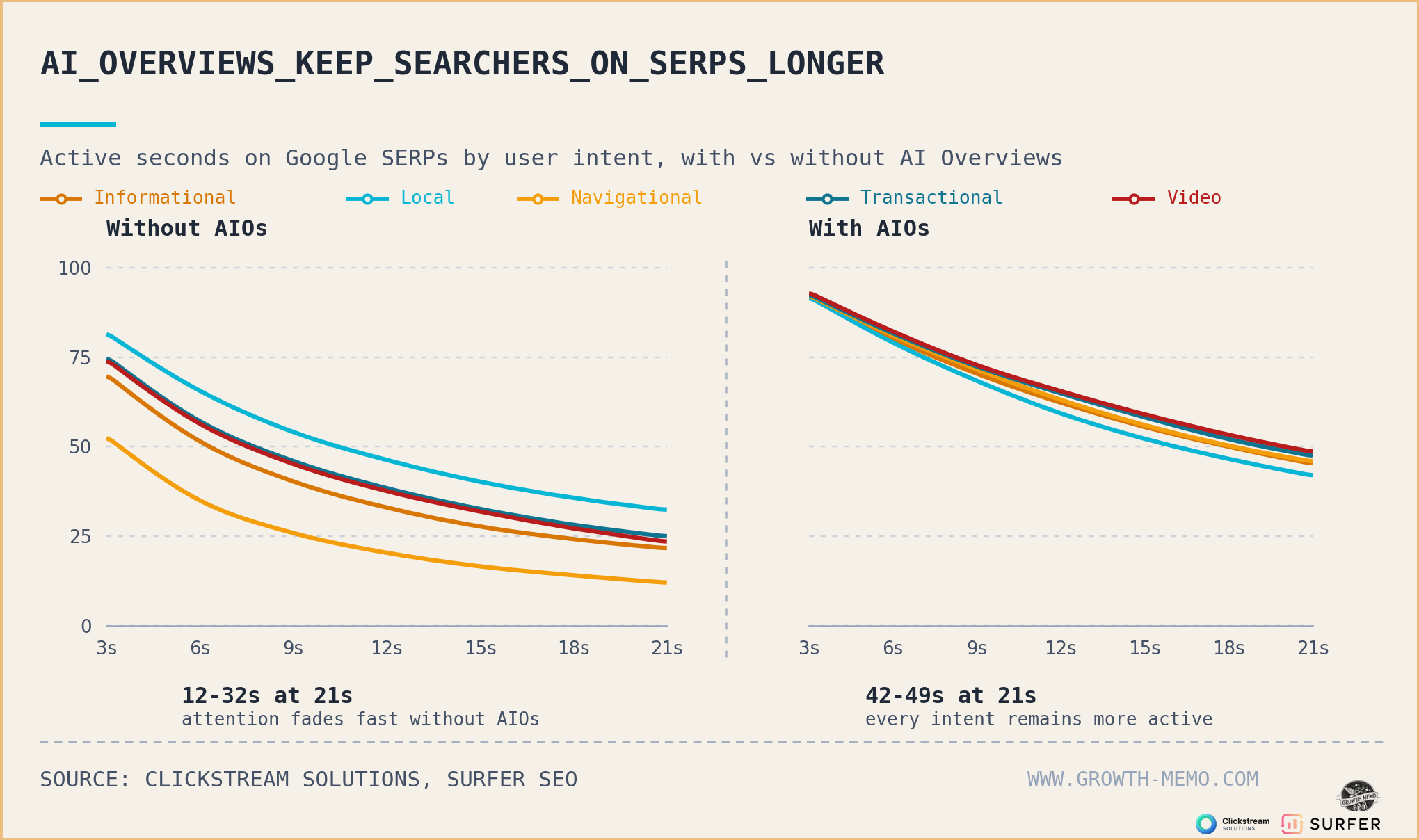
    Recently, I teamed up with Eric Van Buskirk from Clickstream Solutions to analyze vast amounts of anonymized clickstream data. We discovered that time-on-SERP is no longer solely dependent on search intent when AI Overviews are in play.

    Historically, search intent—navigational, informational, etc.—predicted user behavior. But with AI Overviews, now users spend similar amounts of time regardless of their initial intent.

    ```json
{
  "alt": "Graph comparing active seconds on Google SERPs by user intent with and without AI overviews, showing increased engagement with AI.",
  "caption": "AI Overviews Enhance Engagement: A comparative graph shows user activity on Google SERPs is prolonged with AI overviews across various intents.",
  "description": "This image displays a graph depicting the active seconds users spend on Google SERPs, categorized by user intents: informational, local, navigational, transactional, and video. The left side shows activity without AI overviews, while the right illustrates increased engagement with AI overviews. The data highlights a significant extension in user activity across all intents when AI overviews are applied. Source: Clickstream Solutions, Surfer SEO."
}
```

    These insights are crucial. Consider Google’s change in approach: it’s less about presenting links and more about providing exact answers. This requires us to think differently about how we engage users.

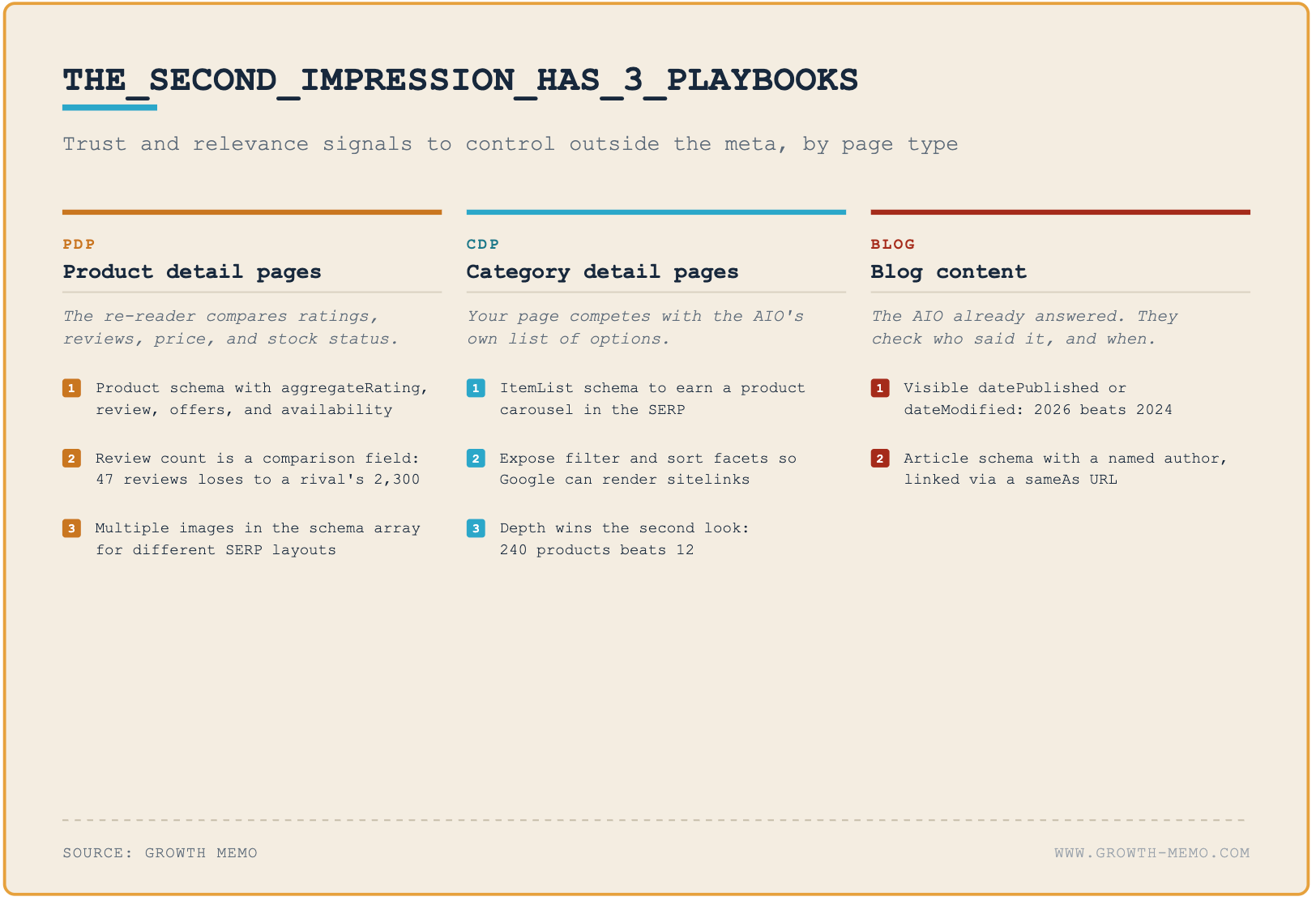
    For operators like me, understanding the significance of the ‘second impression’ helps us adapt our strategy for product, category, and blog pages.

    In product detail pages (PDPs), it’s important to manage schemas and compare competitors’ offerings. On category detail pages (CDPs), having visible filters and vast product arrays can make all the difference.

    ```json
{
  "alt": "Visual guide outlining three playbooks for PDP, CDP, and Blog content focusing on trust and relevance signals.",
  "caption": "Discover strategic playbooks for product detail, category detail pages, and blogs to boost trust and relevance. Enhance online visibility with targeted schema and content strategies.",
  "description": "This image presents a structured guide titled 'THE_SECOND_IMPRESSION_HAS_3_PLAYBOOKS', focusing on enhancing online trust and relevance through three types of content: Product Detail Pages (PDP), Category Detail Pages (CDP), and Blogs. It details strategies like using product schemas, comparison review counts, and exposing filter facets for better Google sitelinks. The guide emphasizes the importance of visible publication dates and article schemas. Ideal for SEO and content strategists aiming to enhance SERP visibility. Source: Growth Memo."
}
```

    As for blog content, I’m focusing on credibility signals like publication dates and author names within schema markup to gain trust and validation clicks.

    Instead of predicting user behavior as before, the new focus is on optimizing my content’s visibility and trustworthiness in an AI-influenced SERP landscape. This shift doesn’t change our core content strategy but adds new layers of intricacy to how we optimize for SERP.


    Inspired by this post on Search Engine Land.


    crushpress.ai community screenshot
  • Unveiling Google Search Console’s AI Controls and Reports

    Unveiling Google Search Console’s AI Controls and Reports

    As someone who eagerly follows Google’s updates, I was thrilled to learn about the latest developments in Google Search Console. Recently, Google has started to roll out new Search Generative AI performance reports. These reports, along with a feature to block your content in AI responses, are designed to give website owners more control.

    Currently, these features are being introduced to a select group of website owners in the UK, but there are plans to expand access in the near future. This gradual rollout allows us to get accustomed to these changes before they become widely available.

    Exploring the Search Generative AI Performance Report

    The new AI performance report in Google Search Console is something I’ve been anticipating. Although it doesn’t cover everything, it does provide some important insights into how our content is performing within AI responses, AI Mode, and AI Overviews on Google Search. The report includes data on impressions, pages, countries, devices, and dates. However, a notable omission is click data, so we’re left guessing about the exact number of searchers clicking through to our sites from AI responses.

    Google stated:

    – We’re rolling out new insights for website owners regarding their pages’ appearances in generative AI Search features. These insights include impressions metrics and information on which pages appear in AI responses and in which countries. We’re working closely with website owners to determine what insights would be most helpful and will expand the metrics available over time. 

    Additionally, Google shared more details about the metrics we can expect:

    Impressions: Frequency of your site’s URLs appearing in generative AI features in Search and Discover.

    Pages: Identifying URLs that appeared within AI features.

    Countries: Understanding visibility on a country basis.

    Devices: Identifying the devices used to view your website. Available for Search results.

    Dates: Monitoring performance with hourly, daily, weekly, and monthly granularity.

    I inquired about click data from a Google representative, who mentioned that they are exploring additional metrics that will help inform our strategies in the future.

    Initially, this report is available to a subset of users in the UK, with plans to expand globally in the future.

    If you want to explore more about this report, I recommend checking out the Google help center document.

    Introducing AI Blocking Controls

    Another exciting feature Google introduced is the ability to block your content from appearing in AI search features like AI Overviews, AI Mode, or AI Discover. Google described this as a “new toggle” within Google Search Console, allowing us to decide whether or not our site should be part of these AI search features.

    Google notes that opting out will prevent your site from receiving traffic or impressions from these features. Importantly, this control won’t affect your ranking in standard search results outside of generative AI Search features, so there’s no risk of negatively impacting core web search visibility.

    Again, like the performance report, this toggle is currently available to a subset of UK website owners, with plans to widen access as they complete further testing. Google had promised these controls after facing some backlash from the EU, and it’s promising to see them starting to roll out now.

    One study even showed that 1/3rd of SEOs are willing to block Google from showcasing their content in AI search features.

    Why It Matters

    As site owners and publishers, many of us have been asking for control over how and if our content appears in Google’s AI features. Now, we have just that. Although it’s initially limited, I’m hopeful these features will eventually be available to all.

    Moreover, we’ve been requesting AI Search reporting from Google from day one. With Google’s announcement following Bing’s release of its own AI performance report, we’re taking a significant step forward. While Google’s report currently targets UK site owners and lacks click data, it holds promise for a global rollout soon.


    Inspired by this post on Search Engine Land.


    crushpress.ai community screenshot
  • Microsoft Web IQ: How to Optimize for AI-Agent Search

    Microsoft Web IQ: How to Optimize for AI-Agent Search

    If you’re wondering whether Microsoft Web IQ requires a new SEO playbook, the short answer is no. You don’t need a Web IQ schema or a separate version of your site. You do need content that an AI agent can discover, interpret, verify, and reuse across a chain of searches.

    That shifts the work from chasing one visible ranking to making every useful fact easy to retrieve. Here’s how to adapt without abandoning the technical SEO and content standards that already matter.

    Key takeaways

    • Web IQ connects AI systems with current web pages, news, images, and videos through AI-native grounding APIs built on Bing’s index.
    • AI agents may run several searches, refine their questions, and collect evidence before producing an answer.
    • A conventional rank position is a limited way to judge visibility when an agent is assembling an answer from multiple retrieval steps.
    • Clear answer sections, crawlable HTML, consistent entities, supported claims, and accurate structured data make your content easier to use.
    • There is no confirmed Web IQ-specific markup shortcut. Optimize the underlying information, not an imagined scoring system.

    What Web IQ changes about search

    Web IQ is a suite of AI-native grounding APIs that connects AI systems to fresh online information. It can retrieve web, news, image, and video material from Bing’s index. The underlying infrastructure also serves Microsoft Copilot, ChatGPT, and other large language model experiences.

    The important distinction is the customer. A traditional search results page is arranged for a person who scans titles, compares choices, and clicks. Web IQ is designed for software that needs to extract information quickly and continue working.

    An agent may begin with a broad request, identify missing details, issue narrower searches, and repeat that process until it can complete its task. Microsoft therefore reworked more than the presentation of results. The system extends from indexing into orchestration, with an emphasis on relevance, speed, and economical token use.

    This is why a single rank number becomes less informative. Microsoft has said that human-style ranking isn’t the priority for this service. That doesn’t mean relevance has disappeared. It means an agent’s repeated retrieval and extraction process may matter more than whether your page occupies one fixed blue-link position.

    Optimize for a search chain, not one keyword

    A luminous agent follows multiple branching paths through document nodes before reaching a verified result.

    Start with the task behind the query. A person asking how to choose accounting software may cause an agent to investigate pricing, integrations, security, migration, support, and suitability for a particular business. A page that repeats the broad keyword but leaves those questions unanswered offers little material for the later steps.

    Map one primary question and the follow-up questions a careful buyer would ask before acting. Give each substantial follow-up its own descriptive heading. If a follow-up requires a full explanation, publish a dedicated page and link it from the main page with anchor text that names the question it answers.

    Build self-contained answer sections

    Each important section should make sense when retrieved without the paragraphs above it. State the subject explicitly, answer the question early, and then add conditions or evidence. Replace vague openings such as “it depends on several factors” with language that identifies what depends on what.

    For example, don’t hide a product’s eligibility rule inside a long narrative. Put the rule under a heading that names the product and decision. Explain who qualifies, who doesn’t, and what the reader should check next. That structure helps people scan the page and gives an agent a coherent passage to extract.

    Cover adjacent questions without bloating the page

    Agent-search readiness isn’t permission to add every remotely related keyword. Include a subtopic when it changes a decision, resolves a likely ambiguity, or supplies evidence for the main answer. Move tangents to their own pages. Thin expansions make the central answer harder to identify.

    Use internal links to form a deliberate evidence path: overview to requirements, requirements to implementation, and implementation to troubleshooting. The destination should answer the promise made by the link. This gives an agent a useful route for deeper retrieval while keeping each page focused.

    Make each page economical for an agent to process

    Web IQ was engineered for frequent searches and low token use. You can’t control how an external agent budgets its context, but you can remove avoidable interpretation work from your pages.

    Lead with the usable answer

    Place the direct answer near the start of the relevant section. Follow it with the reasoning, limitations, and examples. Don’t make a reader or agent work through a brand story before reaching the fact promised by the heading.

    Keep entities and claims consistent

    Use one clear name for each company, product, service, or concept, then explain aliases where necessary. Keep prices, availability, policies, and specifications consistent across landing pages, documentation, feeds, and structured data. Conflicting facts force an agent to resolve ambiguity and weaken the page’s usefulness as grounding material.

    Attach qualifications to the claim they modify. If an offer applies only in one region or a feature requires a certain plan, say so in the same section. A technically correct statement can still mislead when its condition sits several screens away.

    Use structured data as corroboration

    JSON-LD can clarify entities and relationships, but it isn’t a Web IQ access pass. Choose schema types that match the page, populate properties from visible information, and keep the markup synchronized with the content. Don’t mark up answers, reviews, prices, authors, or dates that visitors can’t verify on the page.

    Treat structured data as a machine-readable confirmation of the page, not a substitute for an explicit answer. The visible copy still needs to explain what the entity is, what the claim means, and when it applies.

    Give media enough context to stand alone

    Because Web IQ can source images and videos as well as pages, don’t publish important media with a generic filename and a one-word caption. Use accurate alternative text, descriptive captions, transcripts where appropriate, and nearby copy explaining what the media demonstrates. Keep the media attached to a canonical page with enough context to identify its subject.

    Run an AI-agent readiness audit

    Scanning beams inspect a modular website structure, with accessible content blocks and connections glowing green.

    You can audit a high-value page without access to Web IQ itself. Use the primary question the page should answer, then work through this sequence:

    1. Check discovery. Confirm that the canonical URL is crawlable, returns the intended content successfully, and isn’t blocked by an accidental robots directive or login requirement.
    2. Inspect the delivered page. Verify that the main answer, headings, links, and essential facts exist in the rendered output available to a crawler. Don’t leave the core answer dependent on an interaction that may never occur.
    3. Extract sections out of context. Read each important section by itself. Add the subject or qualification when the passage becomes ambiguous without its surrounding copy.
    4. Trace every consequential claim. Link to supporting documentation where readers need verification. Remove stale claims and unsupported precision.
    5. Compare visible content with JSON-LD. Resolve differences in names, dates, offers, authorship, and entity relationships.
    6. Follow the likely next questions. Make sure internal links lead to complete answers rather than thin category pages or unrelated sales copy.
    7. Test the task in AI assistants. Ask the same realistic question in experiences relevant to your audience. Record whether your brand appears, which page is used, whether the claim is represented correctly, and which competing evidence fills the gaps.
    8. Watch your own evidence. Review referral traffic and server logs where available, but don’t treat either as a complete count of agent visibility. Use them alongside repeated answer checks and conversion data.

    Prioritize corrections that affect the answer itself: inaccessible pages, conflicting facts, missing qualifications, unclear entity names, and unsupported claims. Cosmetic rewrites can wait. An agent can’t use a polished passage it can’t retrieve or trust.

    Web IQ access may broaden as Microsoft scales the service, but you don’t need to wait for a new dashboard. Choose one commercially important topic this week, map the likely follow-up searches, and repair the weakest answer path. That work improves your site for human visitors now while making its information more usable in agent-driven search.

    References

  • Google Ads AI Changes: A Practical Policy and Audit Plan

    Google Ads AI Changes: A Practical Policy and Audit Plan

    If you run Google Ads, the uncomfortable part of deeper automation isn’t simply that software can make more decisions. It’s that Google may have broader latitude to build and manage ads while your team still owns the consequences.

    You don’t need to abandon automation. You do need a clearer record of what Google can use, which changes require human review, how regulated placements are handled, and whether invalid activity credits are reflected in your performance numbers. Here’s a practical way to put those controls in place.

    Key takeaways

    • Treat the July 1, 2026 terms as a change in operating permissions, not a routine administrative notice.
    • Document which inputs, URLs, accounts, claims, and assets Google may use before expanding campaign automation.
    • Keep compliance requirements ahead of eligibility for ads in AI-generated search experiences, especially in regulated sectors.
    • Add invalid activity credits to recurring campaign reviews so media performance and billed costs tell the same story.

    Reset your risk boundary before July 1

    The updated Google Ads terms take effect July 1, 2026. They apply to Google Ads accounts rather than unrelated products such as Workspace, and advertisers aren’t being asked to complete an immediate account action.

    That lack of an account prompt shouldn’t become a reason to ignore the change. Updated language covers how your inputs may be used across Ads features, information supplied through conversational tools, and the URLs and accounts authorized for automated campaign setup. It also gives automation a larger role while leaving advertisers accountable for campaign review and outcomes.

    Control areaWhat to examineDecision you need to record
    Input rightsCopy, images, product data, prompts, audience material, and other information supplied to AdsWho owns it, who approved its use, and whether Google may reuse it across campaign features
    Authorized propertiesWebsites, landing pages, feeds, accounts, and connected properties available to automated setupWhich properties are in scope and which must remain excluded
    Automated managementCampaigns where Google can create, combine, select, or optimize elementsWhat can run automatically and what requires human approval
    Regional termsContract entity, arbitration language, fees, and local legal requirementsWhich legal or procurement owner must review each affected account

    Start with your highest-spend, highest-risk, and regulated accounts. Create a simple inventory of active automation, connected properties, approved asset libraries, and responsible owners. For every input, be able to answer two questions: do you have the right to provide it, and would you be comfortable seeing it adapted into a live ad?

    Regional language deserves separate review. Changes involving arbitration, fees, legal compliance, and Google BR’s transactional authority in Brazil won’t affect every advertiser in the same way. Route the relevant terms to counsel or procurement instead of relying on a universal account-level interpretation.

    Put human approval around the decisions that matter

    Two reviewers evaluate automated campaign recommendations at a digital approval checkpoint with security and verification symbols.

    A useful AI policy doesn’t require a person to approve every bid adjustment. It identifies the decisions where an error could create a legal, financial, reputational, or measurement problem.

    1. Set the generation boundary. List the materials automation may use, including authorized pages, feeds, existing assets, and conversational inputs. Exclude expired offers, unapproved claims, restricted pages, and material with uncertain ownership.
    2. Set the activation boundary. Decide whether generated assets can go live automatically or require review. Regulated claims, brand promises, pricing language, and required disclosures should have a named approver.
    3. Set the inspection cadence. Review live combinations, destination pages, policy status, and account changes on a recurring schedule. Assign the task to a role, not a vague team.
    4. Set stop conditions. Pause or remove an asset when its rights are unclear, a required disclosure is missing, a claim hasn’t been approved, or the destination doesn’t support the promise made in the ad.
    5. Preserve evidence. Keep the approved wording, reviewer, date, authorized property, and reason for any exception in one change record.

    Conversational tools need the same discipline. A prompt can contain customer information, internal positioning, licensed copy, or an unapproved claim. Treat prompt content as material supplied to an advertising system, not as a private scratchpad. A conversational shortcut is not an approval workflow.

    This separation lets you retain fast bidding and optimization while keeping human control over the assertions customers actually see. It also gives an agency a defensible answer when a client asks who approved a generated asset or why a particular property was available to automation.

    Handle AI Mode ads without weakening compliance

    Google has begun a small healthcare advertising test in AI Mode for English-language queries in the United States. Eligible participation can come from Performance Max, AI Max with search term matching, Shopping, and broad match campaigns. Those campaign types can also place ads in AI Overviews.

    The current creative boundary matters: healthcare ads with pinned assets or text disclaimers aren’t eligible for this initial test. That is an eligibility condition, not a reason to remove a disclosure your organization requires. If a disclaimer or pinned message is necessary for compliance, accuracy, or patient safety, keep it and accept that the ad may not qualify.

    Healthcare advertisers should maintain a small eligibility register for candidate campaigns. Record the market, query language, campaign type, pinned assets, required disclaimers, approval owner, and whether an AI Mode or AI Overview appearance has actually been observed. Don’t label every eligible campaign as participating, and don’t assume a test has expanded beyond its stated sector or market.

    If you work outside healthcare, use the test for planning rather than access claims. Review which creative controls your sector cannot surrender and which landing pages are suitable for an AI-generated search context. You will be ready if eligibility expands, without rebuilding compliant assets around a placement that isn’t available to you.

    Keep paid and organic AI visibility separate in reporting. An ad shown near an AI-generated response is paid distribution; it isn’t an organic citation, brand recommendation, or proof of generative search authority. Your AEO or GEO dashboard should identify those outcomes separately even when they appear in the same user interface.

    Make invalid activity credits part of campaign reporting

    More automated distribution makes cost reconciliation more important. Google says its systems filter invalid traffic before it creates a charge, but activity detected later may result in a credit. The Invalid Activity Credit Report for Search and Performance Max exposes credited clicks, credited interactions, credited spend, campaign-level effects, and performance after credits are applied.

    You can generate it in Google Ads by opening Report Editor, going to the Template Gallery, and selecting Invalid Activity Credit Report: Search & PMax. Add the campaign metrics used in your normal performance review so the credit information isn’t examined in isolation.

    1. Use the same date range as the billing and campaign review you are reconciling.
    2. Include campaign name, cost, clicks or interactions, and the applicable credited columns.
    3. Compare campaign-level credits with billing and transaction records.
    4. Use adjusted performance fields where provided, and avoid subtracting the same credit twice in a separate spreadsheet.
    5. Investigate concentration. A credit clustered in one campaign deserves more attention than the same amount dispersed across an account.
    6. Annotate material credits before making budget, bidding, or client-reporting decisions.

    An invalid activity credit doesn’t, by itself, prove deliberate click fraud or identify an attacker. It shows that spend or interactions were adjusted. Use it to reconcile costs and spot patterns, then keep any stronger conclusion tied to evidence you actually have.

    Build one operating record for policy, placement, and spend

    An analyst reviews a central audit ledger connected to organized policy, placement, approval, activity, and credit records.

    These changes become manageable when one campaign record connects permissions, approvals, placement eligibility, and financial adjustments. At minimum, track the campaign owner, automation in use, authorized URLs or accounts, rights owner, creative approver, regulated-sector status, mandatory disclosures, AI Mode eligibility or observation, invalid activity credits, and the latest review date.

    Before July 1, review that record for your most consequential accounts and close any ownership or approval gaps. Then add the invalid activity report to your recurring performance process and keep AI-generated search placements distinct from organic AI visibility. You can continue using automation, but you’ll know where it is allowed to act, who checks its work, and which numbers belong in the final decision.

    References