Month: January 2026

  • Open-Source Marketing Mix Modeling Tools: How to Choose

    Open-Source Marketing Mix Modeling Tools: How to Choose

    You have a budget decision to make, channel data in hand, and four prominent open-source names on your shortlist: Robyn, Meridian, Orbit, and Prophet. The expensive mistake is not choosing the least sophisticated model. It is choosing a framework your team cannot validate, explain, refresh, or use when the next allocation decision arrives.

    The first question is not which tool is best. It is whether you need a working marketing mix modeling system or a forecasting component from which your team will build one. Once you make that distinction, the shortlist becomes much clearer.

    First, separate MMM systems from forecasting components

    A split illustration shows a connected end-to-end measurement machine beside a standalone forecasting engine surrounded by components that still need assembly.

    Marketing mix modeling uses aggregated business, marketing, and contextual data to estimate how different factors relate to an outcome such as revenue, orders, or qualified leads. A useful MMM workflow must do more than forecast that outcome. It also has to represent delayed advertising effects, account for diminishing returns, estimate channel contributions, communicate uncertainty, and turn the result into a budget scenario.

    That difference divides the four tools into two groups. Robyn and Meridian are designed to produce marketing insights and allocation guidance, while Orbit and Prophet are primarily forecasting tools. Orbit or Prophet can support an MMM system, but neither gives you a complete attribution and budget-optimization workflow on its own.

    ToolPrimary jobBest fitOperational cost to expect
    RobynAutomated MMM model exploration, channel response analysis, and budget optimizationA marketing analytics team that wants a relatively direct route from prepared data to actionable scenariosYou still have to choose among plausible models, validate the attribution, and monitor whether performance relationships have changed
    MeridianBayesian MMM with geo-level modeling and budget-reallocation scenariosA team with statistical expertise, geographic data, and market-specific allocation questionsThe methodology, diagnostics, assumptions, and uncertainty require informed statistical ownership
    OrbitBayesian time-series forecasting with time-varying coefficientsEngineers and data scientists building a custom measurement systemYour team must add MMM-specific transformations, attribution logic, validation, reporting, and optimization
    ProphetForecasting and separation of trend and seasonal patternsA team that needs a temporal modeling component inside a broader pipelineIt does not provide a complete channel-attribution or budget-allocation system

    This is more than a feature comparison. A model can predict next period’s sales accurately while assigning the wrong reason for those sales. Forecasting performance does not, by itself, establish credible marketing attribution. If your question is where to move budget, start with an MMM framework. If your goal is to build proprietary measurement infrastructure, a forecasting library may be the more flexible foundation.

    Open source removes a software-licensing barrier. It does not remove the cost of data preparation, statistical review, engineering, documentation, or ongoing model ownership. Include those jobs in your tool decision from the start.

    Match the tool to the way your team will operate it

    Choose Robyn when the priority is a usable MMM workflow

    Robyn is the practical starting point for many teams because it automates a large part of model exploration. It can evaluate thousands of configurations and return multiple strong candidate solutions, reducing the amount of manual tuning needed to reach a usable model set.

    Multiple solutions are a strength only if you have a rule for choosing among them. Do not automatically select the model with the most attractive return on ad spend or the most aggressive budget recommendation. Require acceptable overall fit, plausible channel behavior, stability across candidate models, and consistency with any experimental evidence you possess.

    Robyn also carries an important operating assumption: marketing performance is treated as reasonably consistent over the modeled period. A product launch, pricing change, tracking migration, major distribution shift, or campaign redesign can break that assumption. Mark known structural changes in the data and revalidate the relevant period before treating an old channel coefficient as current.

    Choose Meridian for geo-level questions and Bayesian depth

    Meridian is better suited to teams that want an advanced Bayesian model and can use geographic variation in their analysis. Its geo-level orientation is valuable when the real decision is not simply how much to spend by channel, but how channel performance and allocation may differ across markets.

    Do not choose Meridian merely because Bayesian sounds more rigorous. Bayesian modeling moves important judgment into model structure, prior assumptions, diagnostics, and interpretation of uncertainty. The right team should be able to explain those choices to the budget owner and rerun the analysis without depending on one person who understands the implementation.

    Meridian’s scenarios describe what may happen under the fitted model and its assumptions. They are not promises about the next planning period. That distinction should remain visible in every budget recommendation.

    Choose Orbit when you intend to build the MMM yourself

    Orbit is a forecasting foundation, not a shortcut to a finished MMM program. Its Bayesian time-varying coefficients are useful when relationships may evolve, but your team must still design the marketing-specific parts of the system. That includes carryover and saturation transformations, channel-contribution logic, scenario generation, validation, reporting, and an interface that planners can actually use.

    Orbit makes sense when custom behavior is the requirement and you have engineers and statisticians who will own the framework as a maintained product. If the custom build is only a way to avoid adapting to an existing MMM workflow, the maintenance burden will probably exceed the benefit.

    Use Prophet for temporal structure, not standalone attribution

    Prophet can help separate trend and seasonal patterns from a time series. That can make it useful in preprocessing, baseline forecasting, or another supporting role. It does not independently tell you how much incremental revenue a channel created or how the next budget should be allocated.

    If a proposed Prophet implementation ends with channel-level return figures, ask where the attribution assumptions, response curves, delayed effects, and optimization rules enter the pipeline. If those layers have not been designed and validated, you have a forecast labeled as an MMM.

    Build the minimum viable measurement plan before installing a tool

    Analysts arrange channel, outcome, calendar, external-factor, and experiment modules on a table before connecting them to several modeling devices.

    An MMM project should begin with a decision specification, not a package installation. The specification prevents a technically valid model from answering a question no one needs to ask.

    1. Write the allocation decision in one sentence. Name the business outcome, the budget that can move, the channels or markets in scope, and the planning decision the model must support. A request to understand marketing is too broad to determine the right model.
    2. Fix the unit, calendar, and boundaries. Choose one outcome definition and one consistent time interval. Align spend, exposure, business outcomes, promotions, and other controls to the same calendar and market coverage. Mismatched cutoffs can make an ordinary timing error look like an advertising lag.
    3. Create a channel dictionary. Record what each column includes, whether it represents spend or exposure, how platform names map to planning channels, and where definitions changed. Grouping should be detailed enough to support a decision but not so fragmented that several nearly identical series compete to explain the same movement.
    4. Identify demand drivers and structural breaks. Marketing is not the only reason an outcome changes. Record known effects such as promotions, price changes, distribution changes, launches, and tracking migrations. A model cannot infer a business event that is absent or incorrectly encoded in its inputs.
    5. Decide how delayed effects and saturation should behave. Advertising may continue to influence outcomes after the spend occurs, and additional spend may produce progressively smaller gains. Robyn and Meridian include mechanisms for these behaviors, but the resulting curves still need to make sense for the channel and the observed data.
    6. Define acceptance checks before seeing ROI estimates. Specify how you will assess fit, channel plausibility, stability across acceptable models, agreement with experiments, and sensitivity to changed assumptions. Setting the rules first reduces the temptation to accept whichever model supports the preferred budget narrative.
    7. Assign an operating owner. Name who refreshes the data, investigates failed checks, approves model changes, documents assumptions, and translates scenarios into planning constraints. If no one owns the second run, the first run is a demonstration rather than a measurement capability.

    Data variation matters throughout this process. A channel that barely changes cannot reveal much about how different spending levels affect the outcome. Two channels that always rise and fall together are difficult to separate cleanly. The tool may still return precise-looking contributions, but interface precision cannot create information the data does not contain.

    The budget optimizer belongs at the end of this workflow. If the outcome, calendar, channel definitions, or response assumptions are wrong, optimization simply reallocates the error with greater confidence.

    Treat allocation outputs as testable scenarios, not account ledgers

    MMM contributions are model-conditioned estimates. They are not transaction records showing exactly which channel caused each sale. This matters because the most visually convincing output is often the optimizer: it turns uncertain relationships into a clean allocation. The neatness of that recommendation can hide the uncertainty underneath it.

    Run four checks before moving material budget

    1. Check direction across acceptable models. If one credible model says to increase a channel and another says to decrease it, the decision is not robust. Report the disagreement instead of averaging it into false certainty.
    2. Separate interpolation from extrapolation. A response curve is more defensible within spending levels represented in the data. A recommendation far beyond that range depends heavily on the assumed curve shape. Label that dependence and use a staged change rather than treating the estimate as observed behavior.
    3. Use experimental outcomes where available. Robyn can incorporate real-world experiment results. Treat those results as calibration evidence and investigate meaningful conflicts between the experiment and the observational model rather than selecting the answer with the better financial story.
    4. Apply real planning constraints. Contracts, minimum brand presence, inventory, market capacity, and operational limits do not disappear because an unconstrained optimizer prefers a different allocation. Put those constraints into scenario design or apply them before presenting the recommendation.

    A full reallocation based on a first model can waste budget if the model has learned a temporary correlation or extrapolated beyond the available evidence. Stage consequential changes where possible, observe the outcome, and feed that evidence into the next model cycle. The objective is not to obey an optimizer. It is to make a better decision and create evidence for the decision after it.

    Your final output should show more than a single return estimate. Keep the modeled period, outcome definition, channel mapping, major assumptions, candidate-model uncertainty, scenario constraints, and known structural breaks beside the recommendation. A planner should be able to see why the number may change before acting on it.

    Key takeaways

    • Robyn is the practical default when you need an accessible, end-to-end MMM workflow and can actively validate its candidate models.
    • Meridian fits geo-level allocation questions when your team has the statistical depth to own a Bayesian model and explain its uncertainty.
    • Orbit is a foundation for a custom time-series and MMM system, not a ready-made attribution and optimization product.
    • Prophet can model trend and seasonality, but it does not become a complete MMM simply because marketing variables are added.
    • Choose the tool only after defining the budget decision, data boundaries, validation checks, planning constraints, and long-term owner.

    If you need a usable MMM workflow, start by testing Robyn against one clearly defined allocation decision. Evaluate Meridian instead when geographic variation is central and Bayesian expertise is available. Reserve Orbit for a deliberate custom build, and use Prophet only for the supporting forecasting job it is designed to do.

    Before installing anything, complete this sentence: We will use [outcome] at [time and geographic level] to decide [specific budget action], and we will trust the result only if it passes [named validation checks]. If your team cannot fill in those four blanks, tool selection is premature.

    References

  • Discover Google’s Universal Commerce Protocol: Revolutionizing AI Shopping

    Discover Google’s Universal Commerce Protocol: Revolutionizing AI Shopping

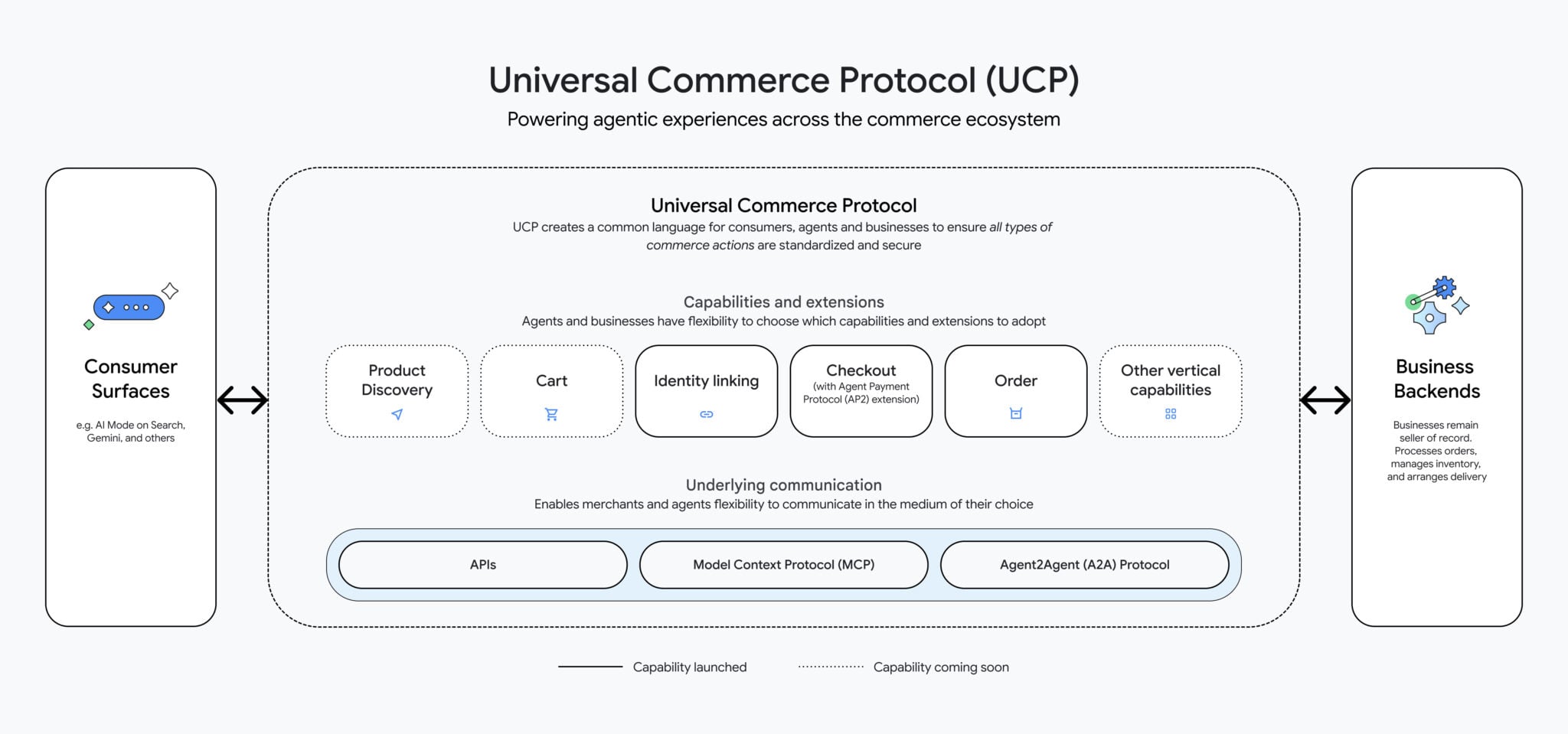
    Have you heard the news? Google has just launched the Universal Commerce Protocol (UCP), an innovative open standard that integrates AI agents throughout the entire shopping experience. From discovering products to making purchases and even receiving support after the sale, UCP facilitates it all.

    In exciting developments for retailers, Google is also rolling out new AI tools. These include branded shopping agents and ad formats that enhance AI-driven discovery, making the shopping experience more streamlined and engaging.

    About UCP

    This protocol offers a common language for AI agents and commerce systems, greatly simplifying the need for custom integrations across different platforms.

    • UCP is compatible with existing standards like Agent2Agent and the Model Context Protocol.
    • The protocol was co-developed with prominent partners such as Shopify, Etsy, Wayfair, and Target.
    • It’s already endorsed by over 20 additional companies in the retail and payments sectors.

    What’s Changing

    The UCP is set to enhance the checkout experience for Google product listings via AI Mode in Search and the Gemini app. Shoppers can make purchases through Google Pay, with options to use saved payment and shipping details. Integration with PayPal is also on the horizon.

    ```json
{
  "alt": "Diagram of Universal Commerce Protocol showing interaction between consumer surfaces and business backends with capabilities like product discovery and checkout.",
  "caption": "Exploring the Universal Commerce Protocol (UCP), this diagram illustrates seamless connections between consumer interfaces and business operations, highlighting essential capabilities such as product discovery and checkout.",
  "description": "This image of the Universal Commerce Protocol (UCP) depicts a framework that connects consumer interfaces with business operations. The diagram highlights capabilities like Product Discovery, Cart, Identity Linking, Checkout, and Order, along with extensions for various vertical capabilities. It shows underlying communication methods including APIs and protocols to facilitate flexible merchant-agent interactions, aimed at enhancing commerce actions' standardization and security."
}
```
    • Google aims to lower cart abandonment and provide retailers with tailored integration options suited to their needs.
    • Upcoming features include loyalty rewards and personalized shopping experiences.

    Business Agent

    In tandem with UCP, Google is unveiling the Business Agent, a branded AI assistant that provides shoppers with direct interaction opportunities on Search. Think of it as a virtual sales associate offering real-time responses in your brand’s own tone.

    • Major retailers like Lowe’s, Michael’s, Poshmark, and Reebok are already on board. Future capabilities may include deeper customization, data training, and a seamless agent-led checkout.

    Direct Offer

    Google is also testing Direct Offers, a fresh initiative within Google Ads tailored for AI adoption. When AI senses that a shopper is likely to make a purchase, a special discount can be presented.

    • This pilot will soon expand to incorporate offers such as product bundles, complimentary shipping, and more enticing incentives.

    Why It Matters

    The rise of agent-led shopping reshapes where and how buying choices are made. Google’s new AI tools and protocols are taking the lead, allowing advertisers to influence these pivotal moments during an AI-driven shopping journey.

    ```json
{
  "alt": "A smartphone screen displaying 'Meet AI Mode' with a virtual assistant query typed below.",
  "caption": "Explore the future of AI interaction with a sleek smartphone interface showcasing the 'Meet AI Mode' feature.",
  "description": "Image of a smartphone screen highlighting the new 'Meet AI Mode' feature, where a user has typed a query seeking a modern, stylish rug for a dining room. The keyboard and various icons such as GIF, voice input, and settings are visible, providing a glimpse into the seamless integration of AI in everyday tech use. This dynamic interface suggests an empowered user experience with cutting-edge AI capabilities."
}
```

    Tools like Direct Offers and branded agents create new pathways for advertisers to finalize sales efficiently, all while safeguarding profit margins. The balance between conversion improvements and losses in direct site traffic remains an open discussion.

    Bottom Line

    According to Google, agentic shopping is unstoppable. With innovations like UCP and its complementary retail tools, Google ensures that AI-driven commerce remains inclusive and accessible, keeping retailers engaged as agents transform the buying landscape.


    Inspired by this post on Search Engine Land.


    crushpress.ai community screenshot
  • How to Build Trust in AI-Driven Financial Research

    How to Build Trust in AI-Driven Financial Research

    You can make financial research easy for an AI system to find, summarize, and cite. The harder question is whether the answer remains trustworthy after the system compresses it. A careful analysis can become a dangerously confident sentence when its evidence, assumptions, or limits disappear.

    Your job is therefore larger than increasing AI visibility. You need to publish answers whose meaning survives extraction: the claim stays connected to its evidence, the reasoning can be inspected, and the boundary between general research and personal financial advice remains unmistakable.

    Key takeaways

    • Optimize financial research for verification before visibility. Search exposure cannot make an unsupported conclusion reliable.
    • Place the evidence, reasoning, relevant date, and limiting condition close to every consequential claim.
    • Connect technical signals, fundamentals, alternative data, and portfolio context without forcing them into artificial agreement.
    • Write important qualifiers into the sentence an AI system is most likely to extract, not into a distant disclaimer.
    • Use structured data and on-page optimization to describe trustworthy content, never to manufacture the appearance of authority.

    Trust begins where the answer can be checked

    Financial information has a short trust fuse because weak or inaccurate research can produce fast, measurable consequences. A vague answer about an ordinary purchase might waste time. A vague answer that influences a trade, allocation, credit decision, or risk assessment can lose money.

    That changes the minimum standard for a useful page. A reader should be able to identify what you know, how you know it, what you inferred, and what could invalidate the inference. An AI-generated summary should preserve those distinctions instead of presenting every sentence as an equally established fact.

    Use a six-field answer card

    Before drafting a financial answer, complete these six fields. They can live in your editorial brief, content management system, or review checklist:

    1. User question: Record the exact decision or uncertainty the page will address. A broad topic such as market risk is not yet a usable question.
    2. Bounded answer: Write the shortest conclusion the available evidence can support. Include the market, asset, period, or scenario that limits the claim.
    3. Evidence: Identify the underlying observations and where they came from. Preserve relevant dates, units, definitions, and methodology.
    4. Reasoning: Show how the evidence leads to the conclusion. Name any assumption that the argument needs in order to hold.
    5. Limit: State what the evidence does not establish, which alternative explanation remains possible, and what would change the conclusion.
    6. Ownership: Assign responsibility for reviewing, updating, correcting, or withdrawing the answer when its basis changes.

    If you cannot complete the evidence or limit field, do not ask a language model to fill the gap. Its fluent transition may disguise the absence of support. Publish a narrower answer, label the uncertainty, or withhold the conclusion until it can be checked.

    Separate observation, calculation, and interpretation

    A trustworthy answer distinguishes three layers that are often blended together:

    • Observation: What was measured, reported, or recorded?
    • Calculation: What transformation or comparison did you apply to those observations?
    • Interpretation: Why might the result matter, and which assumptions connect it to that meaning?

    Labeling these layers prevents an interpretation from inheriting the apparent certainty of the underlying data. It also gives an AI system clearer units of meaning to retrieve. Instead of receiving a paragraph that mixes facts and forecasts, the system encounters an explicit evidence chain.

    Keep the safety boundary close to the consequential statement. If a conclusion could influence an individual’s financial decision, present it as general research and direct the reader to a qualified financial professional for advice based on their circumstances. A footer disclaimer does not repair personalized or overly certain language in the main answer.

    Connect the evidence without hiding disagreement

    Blue and amber evidence trails remain visibly separate while connecting to a shared transparent model on a research table.

    Trust weakens when readers have to assemble an answer from unrelated dashboards, definitions, charts, and commentary. Each extra handoff introduces another opportunity to misread the period, use a different definition, or miss an important qualification. Fragmentation also makes it harder to demonstrate that you understand how the pieces relate.

    A stronger research experience connects technical signals, fundamentals, alternative data, and portfolio analysis in context. This does not mean squeezing every available metric onto one screen. It means giving the user a coherent route from question to conclusion.

    For a consequential research question, organize that route in this order:

    1. Answer: Give the bounded conclusion and its main limitation.
    2. Change: Show what happened and the comparison that makes the change meaningful.
    3. Drivers: Explain the mechanisms that could account for it.
    4. Cross-checks: Show which other evidence supports, weakens, or contradicts the interpretation.
    5. Relevance: Explain how the finding may affect a general research or portfolio question without turning it into personal advice.
    6. Method: Make definitions, provenance, calculations, and update information available where the reader needs them.

    The cross-check stage matters. Connected research is not research in which every indicator agrees. If a technical signal points one way while fundamentals or alternative data point another, preserve the disagreement. Explain whether the measures cover different time horizons, definitions, or mechanisms. If you cannot reconcile them, say that plainly.

    Clarity does not mean removing complexity. It means helping the reader distinguish relevant complexity from clutter. Even an experienced investor benefits when you explain why a development is significant rather than merely reporting that it occurred.

    A useful explanation answers five questions: What happened? Compared with what? Through which mechanism could it matter? What else could explain it? What evidence would make us revise the conclusion? Those questions turn a data display into reasoning the reader can inspect.

    Centralization can be achieved without creating an enormous page. Use shared definitions, consistent labels, visible dates, stable identifiers, and direct links between related modules. The goal is continuity of meaning. A reader moving from a chart to a methodology note should not have to guess whether the same term, period, or calculation still applies.

    Optimize for AI retrieval without manufacturing authority

    Keyword coverage can help a page become discoverable, but it cannot establish financial expertise. In AI-driven discovery, visibility increasingly depends on being consistently useful and demonstrating depth, consistency, and reasoning. That requires three separate layers of work.

    LayerQuestion to askWhat to doWhat it cannot fix
    Technical accessCan a search or AI system reach and read the main answer?Keep the substantive answer in accessible page content, maintain clear internal links, and make machine-readable descriptions consistent with what users can see.Missing evidence or an unsupported conclusion.
    Semantic extractionCan a passage retain its meaning when removed from the page?Use descriptive headings, stable terminology, explicit relationships, and short passages that keep claims beside their qualifiers.Ambiguous reasoning or conflicting definitions.
    Epistemic credibilityCan a reader inspect why the claim should be believed?Expose provenance, calculations, assumptions, counterevidence, limitations, and review ownership.Stale, inaccurate, or fabricated inputs.
    Decision safetyCould the answer be mistaken for individualized advice?Define the intended use, avoid prescriptive language about personal circumstances, and place warnings beside the relevant conclusion.A risky claim hidden behind a general disclaimer.

    Apply these layers in order. Making weak analysis easier to crawl only distributes the weakness. Adding structured data to vague content only describes the vagueness more efficiently. Technical optimization should expose a sound evidence structure that already exists on the page.

    At the page level, use these rules:

    • Lead with the bounded answer. State the conclusion, scope, and main qualification before expanding the analysis.
    • Use headings that describe the reasoning. A heading such as “Why the indicators disagree” carries more information than “Analysis.”
    • Keep one main claim per paragraph. This makes extraction cleaner and reduces the chance that a qualifier will attach to the wrong conclusion.
    • Put evidence links beside the supported claim. A generic bibliography forces readers and machines to reconstruct the relationship.
    • Keep critical qualifiers in the same sentence. Write “under these assumptions” or “for this period” where the conclusion appears.
    • Define terms once and use them consistently. If two metrics sound similar but differ, explain the distinction before comparing them.
    • Make visible content and machine-readable markup agree. Structured data should reflect the answer, authorial responsibility, and other information actually available to the reader.

    Avoid producing thin pages for every wording of the same query. Financial authority emerges from linking concepts and showing their relationships in a comprehensive answer. One well-maintained explanation with clear subtopics is usually a stronger foundation than a collection of near-duplicates that omit context.

    Run a trust audit before the page becomes an AI answer

    Three analysts inspect linked evidence nodes, blank source documents, and output layers during a research trust review.

    Your final review should test more than grammar, keyword use, and formatting. It should simulate what happens when a search engine, assistant, analyst, or hurried reader extracts only the most quotable part of the page.

    1. Build a claim ledger. Copy each consequential claim into a review sheet. Label it as an observation, calculation, interpretation, scenario, or recommendation. If the label is unclear, the sentence probably blends categories.
    2. Trace the evidence. Confirm that every observation has identifiable provenance and that the relevant date, definition, unit, and scope remain available. Do not accept a citation that merely discusses the same topic.
    3. Reperform the reasoning. Follow the path from evidence to conclusion without relying on the prose’s confidence. Check whether a missing assumption or alternative explanation breaks the chain.
    4. Test the qualifier. Copy the key conclusion into a blank document. If it becomes misleading without a nearby paragraph, rewrite the sentence so its essential boundary travels with it.
    5. Look for forced agreement. Identify evidence that conflicts with the conclusion. Explain the disagreement, narrow the claim, or state that the result is unresolved.
    6. Check the decision boundary. Ask whether a reasonable reader could mistake general research for an instruction tailored to their finances. If so, revise the language and position professional-help guidance next to the risk.
    7. Assign the next review. Record what type of change would trigger reassessment and who can correct or withdraw the conclusion. Trust depends on how you handle changed information, not only how carefully you launch a page.

    Use a simple release gate. Publish when the evidence, reasoning, scope, and limits are all inspectable. Revise when the evidence is sound but the extracted answer could mislead. Hold the page when a consequential conclusion cannot be verified. Do not let polished AI-generated prose turn that third condition into the second.

    Start with one financial page that already attracts an important question. Rebuild it around the six-field answer card, connect the evidence that a reader would otherwise have to assemble, and run every key sentence through the extraction test. Once it passes, use that page as the editorial pattern for your wider AI search strategy.

    References

  • From Mailroom to PPC CEO: Anthony Higman’s Journey of Redemption

    From Mailroom to PPC CEO: Anthony Higman’s Journey of Redemption

    I recently spoke with Anthony Higman, the CEO of AdSquire, on episode 336 of PPC Live The Podcast. Anthony’s remarkable journey took him from the mailroom of a law firm to the helm of his own company with a panoramic view of Philadelphia. His story exemplifies how dedication, learning from missteps, and perseverance can forge a successful career path.

    Learning from Client Missteps

    Anthony opened up about one of his early blunders with a client, where he allowed them to chase after quick-win promises in numerous emails. Though some were outright scams, others were genuine but unaligned with the client’s goals. His decision to let a client engage with an ineffective SEO agency resulted in subpar outcomes and a revolving door of agencies for the client.

    The lesson learned was clear: building trust with clients is vital, but it’s equally important to provide them with strategic guidance. Striking a balance between educating them and respecting their autonomy is key.

    A Career Lesson from ‘Cowboy Moves’

    Recalling another early career incident at a large advertising agency managing car dealership accounts, Anthony described how he took independent action to correct widespread account mismanagement, considerably enhancing results. However, his proactive steps clashed with company norms, leading to his dismissal.

    This taught him invaluable lessons: knowing one’s values and finding workplaces aligned with them is crucial. Moreover, balancing client success with company expectations is crucial. Today, at AdSquire, he emphasizes consistent account management and clear communication within his team.

    Managing Client Expectations in a Complex Industry

    Anthony highlighted the challenges of managing expectations in competitive industries like legal marketing. While clients often seek various services like SEO and social media, focusing on core strengths rather than spreading resources thin is essential for achieving the best results.

    The Role of Mistakes in Growth

    He believes that mistakes are fundamental to growth. At AdSquire, he encourages his team to learn from their errors without fear of losing their jobs, as long as they remain honest and aligned with the company’s vision. This approach cultivates a culture of learning, accountability, and innovation.

    Common Mistakes in Modern Paid Search

    With AI advancements in Google Ads, Anthony has noticed frequent mistakes such as improper search partner and location settings, automated assets misuse, and auto-apply recommendations. While AI can streamline processes, strategic oversight is essential to avoid undermining performance.

    Key Takeaways from Anthony’s Stories

    Anthony’s experiences offer two main insights:

    1. Guide clients strategically, steering them away from scams while presenting genuine growth opportunities.
    2. Understand your values and choose environments where your ethics and skills align. Never compromise on your principles.

    His philosophy illustrates that mistakes can lead not to failure but to redemption, innovation, and enduring success.

    Looking Ahead: AI and the Future of Google Ads

    Anthony envisions continued AI integration in Google Ads by 2026. While some tools may falter or conflict with specific needs, maintaining strategic oversight and adding a personal touch will remain crucial. Misguided use of AI, such as automated video inventory creation, can yield inconsistent results and demands vigilant monitoring.

    Conclusion: F-Ups Lead to Redemption

    Reflecting on his career, Anthony draws parallels with The Shawshank Redemption. Every misstep contributed to future opportunities, eventually enabling him to establish AdSquire and earn recognition as a top PPC influencer. The overarching lesson: embrace your mistakes, learn from them, and let them serve as pathways to success.


    Inspired by this post on Search Engine Land.


    crushpress.ai community screenshot
  • Performance Max Creative and Targeting Controls That Matter

    Performance Max Creative and Targeting Controls That Matter

    If you manage Performance Max, the uncomfortable choice can seem to be full automation or a maze of duplicated campaigns. That is the wrong choice. You can give the system better creative and stronger intent signals without rebuilding the account every time a limit changes.

    The useful distinction is simple: video assets shape what Performance Max can show, while search themes help steer the demand it should explore. Neither gives you deterministic control. Each gives the automation better inputs, and each needs a different plan.

    Know which Performance Max controls are signals

    A hand places colored beacons beside branching routes that guide an automated system without forcing it onto one fixed path.

    Performance Max controls do not all behave like conventional campaign settings. A hard limit determines what you can upload. A signal communicates what matters to your business. Confusing those roles leads to two common mistakes: treating themes like exact-match keywords and treating every new asset slot as an instruction to create another variation.

    ControlWhat it changesWhat it does not guaranteeDecision to make
    Video assetsThe creative ideas, formats, and ratios available within an asset groupThat every upload becomes an isolated or equally weighted testWhich missing asset would add meaningful coverage or test a clear idea?
    Search themesThe queries and intent patterns you want automation to prioritizeA strict keyword boundary around the traffic the campaign can pursueWhich customer intents deserve a stronger signal?
    Audience signalsAdditional context about the people likely to matterA fixed audience that automation can never move beyondWhich customer characteristics improve the meaning of the intent signal?

    This distinction gives you a useful operating rule: diagnose whether the campaign lacks material to show, clarity about demand, or a coherent asset-group structure. Add the control that addresses that specific deficit.

    Expand video coverage without filling slots for its own sake

    A creative director arranges a small set of distinct video scenes in horizontal, square, and vertical display frames while leaving extra frames empty.

    Google has been testing a change from a five-video limit to as many as 15 videos per asset group. The observed option had not received a formal announcement, so treat it as a test or gradual rollout until your own interface exposes it. Do not restructure a live campaign in anticipation of capacity your account does not yet have.

    If the larger limit is available, use the extra room in this order:

    <!– wp:list {
  • How to Turn AI Search Visibility Into Useful Engagement

    How to Turn AI Search Visibility Into Useful Engagement

    Your page can be readable, technically clean and still fail in AI search in two very different ways: it may never be selected, or it may be cited without giving anyone a reason to continue. Those are not the same problem, so they should not get the same fix.

    The practical goal is not the largest possible mention count. It is a reliable path from a query, to a useful AI-generated answer, to a next step your page is uniquely equipped to support. That requires content an AI system can extract without misreading and an experience worth visiting after the immediate answer is known.

    Separate AI visibility from user engagement

    AI visibility is often treated as a single metric, but it contains several handoffs. A page can succeed at one and fail at the next. Unless you record them separately, you won’t know whether to rewrite the answer, improve the landing experience or leave the page alone.

    HandoffWhat must happenTypical failure to inspect
    Machine comprehensionThe system can identify the subject, answer, conditions and supporting information.Vague headings, buried conclusions, ambiguous pronouns or missing context.
    Answer selectionThe page is useful enough to inform or support the generated response.The section does not answer the exact task, lacks necessary qualification or is difficult to extract cleanly.
    Reader continuationThe searcher has a legitimate reason to open the cited page.The page merely repeats the answer already visible in search.
    On-page outcomeThe visit leads naturally to a relevant decision or action.The landing section, next step or call to action does not match the original query.

    Google has said it tries AI Overviews for different kinds of questions, retains them when people find them useful and removes them when engagement is weak. The learning can then influence whether the feature appears for similar questions.

    That statement is easy to overread. It describes engagement with AI Overviews as a search feature. It does not establish that clicks on an individual publisher determine whether that publisher is cited. On this evidence, you should not present publisher click-through rate as a confirmed AI citation ranking factor.

    The distinction changes your diagnosis. If no AI result appears for a query, the feature itself may not have been served. If an AI result appears but your page is absent, inspect the page’s relevance, clarity, accessibility and support. If the page is cited but attracts little useful activity, examine what remains for the reader to learn or do. These conditions may look identical in a traffic chart, but they call for different work.

    Build answer units that can be extracted without losing context

    An intact modular information block is lifted from a larger structure with its supporting pieces attached, beside a second block broken into loose fragments.

    Machine-friendly writing is not robotic writing. It is writing in which the question, answer and boundaries stay together. Concise headings, plain language, structured data, accessible mobile delivery, fast loading and current information can all make content easier for AI systems to interpret and use. None of them guarantees inclusion, but each removes an avoidable source of uncertainty.

    1. Replace topic-label headings with task-specific headings. Implementation is a topic; How do you implement the change without losing existing data is a question with an identifiable answer.
    2. Put the conclusion before the long explanation. A reader and an extraction system should not have to reconstruct your position from several setup paragraphs.
    3. Attach qualifications to the claim they limit. If an answer applies only to a particular platform, plan, region, use case or version, name that boundary in the same answer unit.
    4. Use explicit nouns when a pronoun could point to more than one thing. Repeating a product, feature or process name is better than leaving the meaning of it or this unclear.
    5. Separate the direct answer from its support. State the answer, explain why it holds, show the conditions or exceptions, and then provide the evidence or example.
    6. Use lists for real sequences and criteria. Use a table only when the reader needs to compare the same fields across several options. Formatting should reveal the relationship between facts, not decorate the page.
    7. Make freshness visible where it matters. Review facts that can change, identify the applicable version or period, and remove outdated claims instead of relying on a generic updated date.
    8. Apply schema that describes the visible content and the correct entity or page type. Markup should reinforce what the page clearly says; it cannot repair an answer that is vague, unsupported or missing.
    9. Check whether the useful content is actually accessible. The page needs to load reliably, work on mobile and expose its main information without avoidable technical barriers.

    A strong answer unit is complete enough to stand on its own but connected to deeper material. For a choice query, that usually means naming who should choose each option, the constraint that changes the recommendation and any important exception. For a process query, it means stating the starting condition, the ordered actions and how the reader can tell the task is complete.

    Do not split a necessary qualification into a distant section simply because the page looks cleaner that way. An extracted sentence can become misleading when its boundary is several screens away. Put optional depth elsewhere; keep meaning-critical context beside the answer.

    Schema belongs at the end of this editorial sequence, not the beginning. First make the visible page accurate and structurally clear. Then use markup to identify what is already there. Schema is a description layer, not a substitute for the thing being described.

    Offer continuation value without withholding the answer

    An AI response may satisfy the basic question before the searcher visits you. If your page offers only the same fact in many more words, the click has no clear payoff. The answer is not to hide the conclusion or manufacture curiosity. Give the immediate answer plainly, then provide value the generated summary cannot conveniently deliver.

    • For an understand query, add boundaries, examples, exceptions and the relationship to easily confused concepts.
    • For a decide query, add selection criteria, trade-offs, disqualifying conditions and a path through the decision.
    • For a do query, add the complete workflow, prerequisites, reusable templates, implementation details and checks that reveal whether the result is correct.
    • For a verify query, show dates, scope, definitions, assumptions and the evidence needed to assess the claim.
    • For a product or service query, connect each option to the situation it fits instead of presenting an undifferentiated feature list.
    • For a visual query, use images that help a person identify, compare, match or complete the task. Add nearby text that explains what the image demonstrates and why it matters.

    Visual continuation deserves particular attention when the task is naturally visual. Visual search usage was reported as growing 70% year over year, with around 1 billion people using tools such as Google Lens. If your audience is trying to identify an object, compare a product, match an outfit or solve a physical-world problem, a text-only page leaves part of the task unanswered.

    That does not mean adding generic images to every page. The image must carry information. Show the relevant differences, label important features, provide useful captions and place the visual beside the decision or instruction it supports. Decorative imagery creates weight without creating continuation value.

    The call to action should continue the same job. Someone asking what a concept means may be ready for an example, checklist or implementation path, but not an immediate sales conversation. Someone comparing options may need a requirements worksheet or a deeper breakdown of trade-offs. Do not make a generic contact button the only route forward.

    Place the next step beside the section that earns it. A citation may land the reader in the middle of a long page, so the relevant explanation and action cannot depend on a journey from the top. Every major answer section should work as a useful entry point.

    Measure each handoff at the query level

    Colored glass spheres follow separate channels through selection gates and answer platforms, with some continuing to books and research tools at the end.

    Page-level organic traffic cannot tell you which handoff failed. A citation can appear without producing many visits, and a traffic change can come from something unrelated to AI visibility. Build a small, repeatable query-level record so that your edits have a diagnosis behind them.

    1. Define a fixed query set around real user tasks. Group together questions that express the same job, even when the wording differs. The unit you are managing is the query need, not an isolated keyword.
    2. Record the starting search state. Note whether an AI answer appears, which page is cited, what role the citation plays and whether the generated response already completes the task.
    3. Inspect the cited or candidate section. Record its heading, direct answer, qualifications, supporting material, visible freshness cues and relevant structured data.
    4. Name the continuation asset. Identify exactly what the reader gains by visiting: a decision framework, workflow, example, tool, template, visual explanation, evidence trail or another concrete resource.
    5. Name the desired on-page action. It might be reading the implementation section, using a tool, downloading a relevant resource, subscribing or beginning a commercial step. Choose the action that fits the query rather than the action that is easiest to count.
    6. Change the layer associated with the failure. Keep extraction-oriented edits separate from landing-page and call-to-action edits when possible, or you will not know which change affected the outcome.
    7. Repeat the observation using the same method. Compare AI-result presence, citation presence, landing behavior and meaningful actions instead of collapsing them into one success label.

    A practical log can contain these fields: query, user task, AI answer present, cited domain, cited URL, role of the citation, answer gap, continuation asset, intended action, observed outcome and next edit. This is enough to expose patterns without pretending that you can see the platform’s internal ranking process.

    Interpret the patterns carefully. No AI answer across a query group may mean the feature is not being retained for that kind of question; it is not proof of a page penalty. An AI answer with no citation from you points toward comprehension, relevance or selection. A citation with no useful visit points toward weak continuation value. Visits without the intended action point toward an expectation or landing-experience mismatch.

    Keep commercial exposure in a separate column. AI-powered search experiences may include ads around shopping, comparisons and product research, with sponsored material intended to remain distinguishable. A paid placement, an organic citation and a brand mention are different outcomes. Combining them will make both your visibility reporting and your budget decisions less reliable.

    Keep the observation method stable as well. Small personalization adjustments can alter ordering, such as moving video higher for someone who frequently clicks videos. A casual spot check is therefore a weak baseline. Use the same query definitions and checking procedure, preserve what you observed and look for a repeated pattern before assigning a cause.

    Key takeaways

    • Treat AI-result presence, publisher citation, site visit and meaningful on-page action as separate outcomes.
    • Do not call publisher click-through rate a confirmed citation ranking factor based on statements about engagement with AI Overviews as a feature.
    • Write answer units in which the question, conclusion, conditions and supporting detail remain understandable when extracted.
    • Use schema to describe accurate visible content, not to compensate for weak or ambiguous writing.
    • Answer the immediate question fully, then earn the visit with decision support, implementation depth, evidence, tools or task-relevant visuals.
    • Track a stable set of queries by user task, diagnose the failed handoff and keep paid exposure separate from organic citations.

    Start with the query that matters most and inspect the whole path. Capture the current search result, rewrite the weakest answer unit, add one honest continuation asset and align the next action with the original task. Then observe citation and on-page behavior separately. That gives you a testable improvement cycle instead of another vague AI visibility initiative.

    References

  • 30-Day E-commerce SEO Execution Plan: Audit to Impact

    30-Day E-commerce SEO Execution Plan: Audit to Impact

    You probably do not need another long diagnosis of your store. If you already have a backlog of crawl, template, category, and product-page issues, the immediate constraint is delivery: deciding what deserves attention, assigning an owner, releasing the change safely, and proving that it works as intended.

    Use the next 30 days to build that delivery rhythm. You will not finish e-commerce SEO in a month, and you should not promise a ranking increase on a fixed date. You can finish the month with important changes in production, a reliable validation record, and a smaller, sharper backlog for the next sprint.

    Why e-commerce SEO audits stall before production

    An audit recommendation is not executable work. It becomes executable only when it has a defined scope, an owner, known dependencies, an acceptance test, and a release path.

    The gap can be expensive. One $4 million Shopify brand had paid $12,000 for a 127-page audit containing 53 recommendations. Six months later, the company had changed titles and meta descriptions and added a few blog posts, while 41 recommendations remained untouched and unscheduled.

    The problem was not a shortage of ideas. It was the absence of a mechanism that converted ideas into releases. A backlog without sequencing lets easy, visible tasks displace less glamorous work that may affect entire templates. A recommendation without an owner waits for someone to volunteer. A change without an acceptance test can be deployed without anyone knowing whether the defect was actually removed.

    Key takeaways

    • Treat the 30 days as a delivery window, not a promise that search performance will improve on your schedule.
    • Prioritize confirmed problems affecting crawlable, indexable, revenue-relevant page types over a long list of loosely supported observations.
    • Prefer a safe template-level correction when the same defect appears across many pages, but test its reach before a full release.
    • Track implementation, technical validation, search response, and business impact as separate states.
    • Give canonicals, redirects, indexing directives, URL changes, and template edits an explicit rollback plan.

    Your month-end deliverable should not be another presentation. It should be a release log, a set of validated changes, evidence of what happened after release, and a prioritized next sprint.

    Days 1-3: Turn recommendations into a release backlog

    Day 1: Create one source of operational truth

    Bring recommendations from audits, crawlers, analytics reviews, support tickets, developer notes, and merchandising requests into one board. Merge duplicates. Do not leave technical work in one spreadsheet and content work in another if both compete for the same developers, templates, or approvals.

    Each backlog item needs these fields before it can enter the sprint:

    • Problem: Describe the observed condition, not a generic instruction such as “improve category SEO.”
    • Evidence: Record affected URLs, templates, screenshots, crawl output, or search-performance data that confirms the condition.
    • Scope: State whether the change affects one URL, a page group, a template, navigation, structured data, or a platform rule.
    • Expected effect: Explain what should become possible after the fix, such as consistent canonicalization, clearer page differentiation, or stronger internal discovery.
    • Owner: Name the person responsible for moving the item to its next state. A department name is not an owner.
    • Dependencies: Identify development, design, legal, merchandising, analytics, or platform access needed before release.
    • Acceptance check: Write the observable condition that will prove the implementation is correct.
    • Rollback: Record how you will reverse the change if it damages navigation, indexing signals, product information, or conversion paths.

    If you cannot describe the affected pages or the expected post-release condition, the item is still an investigation. Label it that way instead of allowing it to masquerade as an implementation ticket.

    Day 2: Prioritize by reach, commercial relevance, and readiness

    Do not copy a crawler’s severity label into your roadmap and call it prioritization. A technically severe warning on an irrelevant page type may deserve less attention than a confirmed template defect affecting category or product pages.

    Ask these questions in order:

    1. Does the problem prevent an intended page from being crawled, indexed, understood, or reached through internal navigation?
    2. Does it affect a revenue-relevant page type, such as a category, collection, product, or commercially useful supporting page?
    3. Is the problem systemic, or would the team be editing individual URLs without addressing the template that created them?
    4. Is the diagnosis supported by direct evidence from the affected pages?
    5. Can the team implement, inspect, and reverse the change within this sprint?

    Place the resulting work into three lanes: release this month, prepare for the next sprint, and park pending evidence. The release lane should contain work that is both important and ready. A high-impact idea that still needs legal approval, a platform migration, or an unresolved architecture decision belongs in preparation, not in a sprint where it will remain blocked.

    Day 3: Assign owners and freeze the baseline

    Assign one accountable owner to every selected item, even when several specialists will contribute. Then record the pre-change condition for the exact page set in scope.

    Your baseline can include:

    • Organic clicks, impressions, and click-through rate for the selected pages and relevant queries.
    • Organic sessions, transactions, revenue, and conversion rate when the analytics setup can support those measurements reliably.
    • Current response codes, index directives, canonical targets, sitemap inclusion, and internal-link paths.
    • Existing titles, primary headings, visible product facts, and structured-data output.
    • A dated record of promotions, stock changes, redesigns, or campaign activity that could complicate later interpretation.

    Save the filters, date settings, and URL list with the baseline. A screenshot without its query, segment, or date context will not help you make a defensible comparison at the end of the month.

    Days 4-10: Fix the technical path to money pages

    Layered illustration of a storefront page structure with home, category, and product cards connected by a clear highlighted route, while broken routes sit at the edges.

    Start implementation with confirmed technical conditions that obstruct intended category and product pages. Content improvements cannot compensate for a page that is unintentionally excluded, canonicalized elsewhere, isolated from navigation, or served incorrectly.

    Days 4-5: Validate the diagnosis on real page types

    Inspect representative URLs from every affected template before changing code. Include ordinary products, variants, categories, paginated or filtered states where relevant, and edge cases such as unavailable products. A warning seen on one URL does not prove that every similar-looking URL has the same cause.

    • Confirm the response code and whether the page is available to crawlers.
    • Check index directives and the final canonical target.
    • Verify whether an intended indexable URL appears in the correct sitemap.
    • Trace how a shopper and a crawler can reach the page through navigation, breadcrumbs, categories, or contextual links.
    • Determine which template, component, application, or rule creates the output before assigning the fix.
    • Separate intentional handling of filters, sorting, variants, and duplicate states from genuine mistakes.

    This step often changes the ticket. What looked like hundreds of page-level defects may be one template condition. The reverse also happens: superficially similar URLs can be controlled by different components and require separate releases.

    Days 6-8: Implement the smallest systemic correction

    Choose the smallest change that resolves the confirmed cause across the intended scope. If a template emits the wrong canonical, repair the template logic rather than manually overriding pages. If navigation fails to expose an important category, correct the navigational relationship rather than adding isolated links wherever someone happens to notice the problem.

    Keep unrelated change families out of the same release when possible. Combining canonical logic, title generation, navigation, structured data, and design changes makes failures harder to diagnose and rollback. The team should be able to connect a changed output to a specific ticket.

    Template edits can reach far beyond the sample that revealed the problem. Generate an affected-URL estimate, inspect a test set, and preserve the previous configuration or template version before deployment.

    Days 9-10: Release with a technical safety check

    Validate the change in a staging environment when the platform permits it, then inspect production after release. Check both the rendered page and the machine-readable output where relevant. Re-crawl the defined scope and compare the result with the ticket’s acceptance check.

    Changes to robots directives, noindex rules, canonicals, redirects, URL structures, or sitewide templates can remove valuable pages from search or send shoppers to the wrong destination. Do not mass-redirect, noindex, or canonicalize pages merely because an automated tool calls them duplicates. Preserve the current rules, test representative URLs, review the proposed targets, and keep a verified rollback path.

    A URL migration is also not routine backlog cleanup. If changing URLs is genuinely necessary, treat the mapping, internal links, redirects, sitemap output, analytics continuity, and post-release monitoring as a separate controlled project.

    Days 11-20: Improve the pages that answer buying intent

    Once the technical path is sound, improve the pages that help a shopper choose a category or product. Publishing more blog posts is not a substitute for making commercially important pages clear, differentiated, and internally connected.

    Days 11-12: Build a page-to-intent map

    For each page in scope, write down the searcher’s likely need, the page’s job, the relevant products or subcategories, and the next useful action. Then identify pages competing to perform the same job.

    • Choose a primary destination for each important buying need.
    • Improve an existing suitable page before creating another near-duplicate destination.
    • Merge or differentiate overlapping pages based on what each page can genuinely offer.
    • Record the internal links that should lead into and out of the destination.
    • Flag inventory, compliance, or merchandising facts that require approval before publication.

    This is not an exercise in assigning one exact phrase to every URL. It is a decision about which page should satisfy a distinct need. If the team cannot explain why two pages both need to exist, adding more copy to each will not resolve the overlap.

    Days 13-17: Strengthen categories and products

    For category and collection pages: make the title and primary heading describe the actual selection. Add concise information that helps a buyer understand what belongs in the category, how meaningful options differ, and where to go next. Link to useful subcategories or buying paths. Remove generic boilerplate that could be pasted onto any category without changing its meaning.

    For product pages: make the product identity and differentiators explicit. Include accurate attributes, dimensions or specifications where relevant, fit or compatibility, variants, what is included, and the conditions that affect the buying decision. Keep price, availability, shipping, returns, and warranty information consistent wherever those facts appear. Do not invent certainty when a product team has not verified a claim.

    Answer genuine product questions in direct language. Do not generate paragraphs simply to make a page longer. Repeated filler can hide the few details that actually distinguish one product from another, while creating a factual-review burden for the team.

    Days 18-20: Connect pages and synchronize structured data

    Make the site’s relationships visible. Categories should lead to appropriate subcategories and products. Product pages should expose their category context through navigation or breadcrumbs. Supporting content should link to the commercial destination when that destination genuinely answers the reader’s next question.

    Review Product, offer, and breadcrumb markup alongside the visible page. Names, prices, currencies, availability, variants, and navigational relationships should not contradict what a shopper sees. Structured data can express information more clearly to machines, but it cannot repair a blocked page or substitute for missing and inaccurate product information.

    If AI helped produce descriptions, FAQs, or attribute summaries, send every affected page through factual and merchandising review. Automation can accelerate drafting, but ownership of price, compatibility, safety, availability, and policy claims remains with the business publishing them.

    Days 21-30: Release, validate, and protect the next sprint

    Quality-assurance specialist comparing an abstract product page on desktop, tablet, and phone beside link, speed, shield, and green validation symbols.

    Days 21-23: Ship controlled batches

    Release in batches small enough for the team to inspect but large enough to exercise the template or page group you intended to fix. For every batch, record the deployment time, owner, change family, affected templates or URLs, expected output, and rollback location.

    Run the acceptance checks immediately after production deployment. Confirm that important navigation, product selection, add-to-cart behavior, analytics collection, and page rendering still work. An SEO change is not successful if it damages the shopping experience or your ability to measure it.

    Days 24-27: Validate implementation before judging performance

    Keep three questions separate:

    1. Was it shipped? The code, content, navigation, or markup is present in production.
    2. Is it correct? The affected pages meet the written acceptance conditions without creating a new defect.
    3. Did performance change? Search visibility, qualified traffic, engagement, transactions, or revenue moved after the release.

    The first two questions can often be answered within the sprint. The third may remain open because search systems do not discover and reevaluate every changed page according to your internal calendar.

    Re-crawl the released scope, inspect representative pages manually, and compare current output with the frozen baseline. Check whether measurement still works before interpreting a flat or missing metric. If an acceptance check fails, fix or roll back that batch before adding another layer of changes.

    Days 28-30: Close every item with evidence

    Do not allow tickets to end the month in an ambiguous “done” column. Give each item a precise final state:

    • Shipped and validated: The production output meets its acceptance check.
    • Shipped, response pending: Implementation is correct, but search or business effects cannot yet be judged.
    • Blocked: The missing dependency and its owner are named.
    • Rejected: Validation disproved the diagnosis, the risk exceeded the benefit, or the item no longer serves the store’s goals.
    • Prepared for the next sprint: Scope, evidence, owner, and dependencies are ready for scheduling.

    Review leading indicators such as corrected page output, internal discovery, index eligibility, impressions, and click-through rate alongside business measures such as qualified organic visits, transactions, conversion, and revenue. Keep promotions, stock changes, paid campaigns, redesigns, and other overlapping events in view. A metric moving after a release does not by itself prove that the SEO change caused it.

    Finish with a short closeout record containing what shipped, what passed validation, what remains uncertain, what was blocked, and what enters the next sprint. Preserve the detailed evidence in the backlog instead of recreating a large report that the delivery team must interpret again.

    Open your backlog now and choose the first change whose scope, owner, acceptance check, and rollback are all clear. If no item meets that standard, your first job is not ranking the recommendations. It is turning vague recommendations into work that can safely reach production.

    References

  • A Practical Playbook for Automated Google Ads Optimization

    A Practical Playbook for Automated Google Ads Optimization

    You turned on Google Ads automation so the system could handle more of the bidding and delivery work. Now the campaign is spending, results are uneven, and every available adjustment seems capable of disrupting the learning you have already paid for.

    The answer is not to make more changes. It is to make changes that answer specific questions. Give the campaign one measurable job, diagnose the layer that is failing, and isolate one variable long enough to learn from it. That is how you optimize Performance Max and Demand Gen without turning the account into a collection of unexplained edits.

    Give the automation one precise job

    Automated bidding and delivery are execution systems, not business strategies. Google can pursue the outcome you define, but it cannot decide whether that outcome represents useful growth for your business.

    Before changing an asset, audience, channel, or bid strategy, complete this sentence: “This campaign exists to generate [specific outcome] from [specific audience or demand source], and we will judge it by [specific business metric].” If you cannot complete it without using a vague phrase such as “more visibility,” the campaign is not ready for detailed optimization.

    Write a short optimization brief containing four decisions:

    1. Primary outcome: Name the action that matters, such as a purchase or qualified lead. Do not let a convenient secondary action become the campaign’s de facto goal.
    2. Conversion definition: Confirm that the conversion category and tracking represent the outcome you intend to buy. A campaign trained toward the wrong event can become efficient at producing the wrong result.
    3. Decision metric: Choose the metric that will determine whether a change stays. Click volume, conversion volume, cost per conversion, and conversion value answer different questions.
    4. Campaign role: Decide whether the campaign is capturing existing demand, re-engaging known users, finding similar prospects, or creating demand among new audiences. Do not evaluate an audience-expansion campaign as if every user had already expressed search intent.

    Demand Gen makes the bidding decision especially concrete. It requires a conversion category and supports Maximize Clicks, Maximize Conversions, Maximize Conversion Value, Target CPC, Target CPA, and Target ROAS. Match the strategy to the brief: use a click-oriented strategy when qualified traffic is the actual objective, a conversion-oriented strategy when action volume matters, and a value-oriented strategy only when the values passed into Google reflect meaningful differences between conversions.

    Target CPC is a useful Demand Gen option when controlling the amount you are willing to target per click matters more than giving bidding full freedom. It does not remove the need to assess traffic quality. Cheap clicks are not an optimization win when the audience, placement, or landing experience cannot produce the intended action.

    Once the brief is set, keep it stable during the test. If you change the conversion definition, bid strategy, audience, and creative together, a better result will not tell you which decision worked. A worse result will be equally uninformative.

    Diagnose the failing layer before touching settings

    Four transparent campaign layers float above a table while a diagnostic beam highlights one broken creative connection.

    A weak automated campaign does not automatically have an automation problem. The failure may sit in measurement, inventory, audience selection, creative, or the offer itself. Treating all five as one problem leads to account-wide changes that conceal the cause.

    Audit in this order:

    1. Measurement: Check that the recorded conversion is the action named in your brief. Inspect whether duplicate, secondary, or low-value actions are influencing your interpretation before you blame bidding.
    2. Inventory and channel: Determine where the ads appeared. A blended campaign total can hide meaningful differences between YouTube, Discover, and Gmail.
    3. Audience: Check whether the people engaging with the campaign resemble the users you intended to reach. An audience mismatch should be addressed before you conclude that the creative proposition is wrong.
    4. Creative: Look for patterns across headlines, images, videos, and formats. Use those patterns to form a testable hypothesis, not as permission to replace every asset at once.
    5. Offer and destination: Confirm that the promise made by the ad continues on the landing page and that the requested action makes sense for the user’s stage of awareness.

    Demand Gen gives you several views for this diagnosis. Its asset reporting, audience insights, channel segmentation, and YouTube placement reporting can help you locate the layer worth investigating. Use these reports as directional evidence. An asset-level performance label can identify a candidate for testing, but it does not prove that the asset alone caused the result because audience, placement, and delivery can differ.

    What you noticeCheck firstNext controlled action
    Reported conversions do not match business outcomesConversion action and categoryCorrect or separate the measurement problem before testing creative or audiences.
    One Demand Gen channel behaves differently from the othersChannel and placement reportingInspect that inventory, then decide whether the channel belongs in the campaign’s role.
    Audience insights do not resemble the intended buyerAudience constructionChange one audience boundary while keeping the offer and creative stable.
    Several assets built around one idea underperformCreative propositionBuild a coherent challenger around a different idea and test it against the original.
    Ads earn attention but the intended action does not followOffer and landing-page continuityCheck the promise, destination, and conversion ask before buying more traffic.

    Record the diagnosis before making the change. A useful optimization note states what you observed, what you think caused it, what single variable will change, and what result would support or reject the hypothesis. Without that record, campaign management tends to become a sequence of plausible edits with no cumulative learning.

    Run Performance Max asset tests as controlled experiments

    Two matching automated test chambers compare different creative tiles while an analyst observes the experiment.

    Performance Max has historically made creative diagnosis difficult because automation decides how assets are combined and delivered. The Performance Max asset A/B testing beta allows two asset sets to be compared while common assets remain fixed. It extends the earlier retail experiment model across Performance Max campaigns and gives you a cleaner way to test creative ideas without rebuilding the entire campaign.

    If the beta is available in your account, look for the experiment from the Experiments area under Assets. Because it is a beta, document the setup outside the interface as well: campaign, hypothesis, common assets, challenger assets, start date, intended end date, and decision metric.

    Use this sequence:

    1. Write one creative hypothesis. Examples include benefit-led versus proof-led headlines, product-focused versus lifestyle imagery, or two distinct video concepts. The hypothesis should explain why one approach may work better for the intended audience.
    2. Choose the level of the test. If you change one asset family, you can learn about that family. If you change headlines, images, and videos together, you are testing two creative systems and will only learn which complete system performed better.
    3. Protect the common assets. Keep every asset that is not part of the hypothesis the same across both versions. These shared elements form the control surface of the experiment.
    4. Freeze unrelated campaign decisions. Avoid changing audiences, bidding logic, conversion definitions, the offer, or the landing page while the asset experiment is running unless there is a material tracking or business problem that makes the test unsafe to continue.
    5. Choose the decision metric in advance. Judge the test by the outcome in the campaign brief. Do not promote a challenger solely because it attracted more engagement when the campaign exists to generate profitable conversions.
    6. Allow at least four weeks. Performance Max tests need a minimum four-week window to accommodate learning and delivery stabilization. Avoid ending the experiment because of an encouraging or alarming interim swing.
    7. Apply only the supported lesson. If a complete asset set wins, you have evidence for the set, not proof that every component in it is superior. Keep the winning direction and use the next experiment to isolate the headline, image, or video question that remains.

    The distinction between an asset report and an asset experiment matters. Reporting helps you find a question. A controlled experiment is what helps answer it. Replacing assets based only on descriptive labels may change the audience and delivery mix before you have learned whether the creative itself was responsible.

    Do not run a test merely to keep the account active. A useful challenger represents a meaningful alternative: a different message, visual argument, proof point, or format. Small cosmetic changes may produce a winner, but they often leave you without a reusable insight for the next campaign.

    Use Demand Gen for intentional audience expansion

    Performance Max creative optimization and Demand Gen expansion solve different problems. If your real goal is to reach people beyond an immediate search query, repeatedly changing Performance Max assets may be an indirect way to pursue it. Demand Gen is designed around the user rather than the keyword and can distribute image or video creative across YouTube, Discover, and Gmail.

    This changes the optimization question. Search campaigns react to expressed demand. Demand Gen asks which audience, creative story, and Google-owned surface can create or develop interest. Its goal is clicks or conversions rather than the impression or view objectives commonly associated with video advertising.

    Build the audience around one reason for inclusion

    Demand Gen supports several audience approaches:

    • Remarketing for people who have already interacted with the business.
    • Lookalike audiences for reaching users who resemble existing converters.
    • In-market, life event, and affinity segments for interest and behavior-based expansion.
    • Detailed demographics when the offer is relevant to defined demographic characteristics.
    • Custom segments based on the search terms, websites, or apps associated with the intended audience.

    Give each audience a clear rationale. A segment called “high intent” is not useful documentation unless you can state what behavior or characteristic earned that label. Keep in mind that combined segments are not compatible with Demand Gen, and audience exclusions are limited to your data segments. Build the test around the targeting controls the campaign actually supports rather than importing a structure from another campaign type.

    Match the test structure to your constraint

    Your first Demand Gen campaign should answer a narrow question that matters to the business:

    • If you are working with $5 to $40 per day: Keep the structure simple. A practical starting test combines the Google Engaged remarketing audience with a Custom Segment based on top-performing search terms. Treat that range as a test constraint, not a promise of sufficient volume or a universal budget recommendation.
    • If you run ecommerce campaigns: Compare feed-backed product advertising with non-feed lifestyle creative. Demand Gen can use a Google Merchant Center feed, while its standard image, carousel, and video formats let you test whether the product itself or the surrounding story is the stronger route to action.
    • If you have enough budget for sustained audience development: Assign distinct jobs to in-market, life event, demographic, or affinity audiences instead of combining every prospect into one expansion pool. An always-on structure is useful only when each audience has a reason to exist and a business outcome by which it can be judged.

    Start with the relevant Google-owned channels enabled when you need to learn where the idea travels, then use channel segmentation and placement reporting to decide what belongs in the next iteration. If you already know that a channel cannot support the campaign’s format, audience, or objective, scope it out deliberately. Channel control should follow the campaign brief, not a blanket belief that more inventory is always better.

    Keep creative and audience questions separate when possible. If you test a new audience with a new video, new images, and a different offer, you are testing an entire go-to-market package. That can be appropriate when the package is the decision. It is the wrong design when you need to know whether the audience itself is viable.

    Key takeaways

    • Define one business outcome, one conversion definition, one campaign role, and one decision metric before adjusting automation.
    • Diagnose measurement, channel, audience, creative, and landing-page continuity in that order so you change the layer that is actually failing.
    • Use Performance Max asset reporting to form hypotheses and the asset A/B testing beta to test them.
    • Hold common assets and unrelated campaign settings steady during a Performance Max experiment.
    • Run Performance Max asset experiments for at least four weeks so learning and delivery have time to stabilize.
    • Use Demand Gen when the job is audience-led expansion across YouTube, Discover, and Gmail, then segment channel, placement, audience, and asset performance.
    • Make every optimization produce a reusable lesson, not merely a different dashboard result.

    Choose one campaign for your next optimization cycle. Write its job in a sentence, identify the first failing layer, and log one hypothesis. If the question is creative, build a controlled Performance Max asset experiment. If the question is audience expansion, scope a Demand Gen test around one audience and one outcome. Your next change should buy information as well as performance.

    References

  • Revolutionize Your Marketing with AI: Discover Genmark Flow

    Revolutionize Your Marketing with AI: Discover Genmark Flow

    Have you ever imagined a marketing approach where the emphasis is on outcomes rather than just the tools? Let me introduce you to Genmark Flow, a groundbreaking concept in AI marketing that is more than just software; it’s a comprehensive service.

    Genmark Flow is an AI Service as Software solution that delivers results through expertly managed growth strategies. This revolutionary system prioritizes delivering tangible results over merely providing tools. AI-powered and expertly managed, it ensures your marketing goals are not just met, but exceeded.

    With Genmark Flow, you’re not only accessing cutting-edge technology, but you’re also leveraging a service that supports you in achieving your growth ambitions. Get ready to transform your marketing strategies and witness significant outcomes.


    Inspired by this post on genmark.ai Blog.


    crushpress.ai community screenshot
  • How to Build Content That Earns Visibility in AI Search

    How to Build Content That Earns Visibility in AI Search

    Your pages can rank, answer the right questions, and still disappear when someone asks an AI assistant for help. Publishing more content will not necessarily solve that. The missing piece is often the chain between the user’s decision, the evidence on your page, the format an answer engine selects, and the citation it ultimately shows.

    You need a content system that can earn inclusion across generated answers without turning useful pages into fragments written for machines. That means choosing queries more carefully, making claims easier to verify, using video where demonstration matters, and measuring citations separately from rankings and clicks.

    Stop treating AI visibility as one ranking

    A central content page connects through branching pathways to abstract response, voice, video, and source-card formats.

    Traditional rank tracking gives you a position for a query, device, location, and search engine. AI visibility is less tidy. The same question can produce a brand mention, an owned citation, a third-party citation, a video, or no reference to you at all. A single visibility score can hide those differences.

    The scale of that variation is not theoretical. Across 85 million citations from ChatGPT, Gemini, and AI Overviews, citation origins were organized into eight distinct categories. The practical lesson is that being visible is not only a matter of getting one page selected. You also need to understand which kinds of material supply answers in your market.

    Your plan also has to account for different discovery systems. AI-assisted discovery now spans ChatGPT, Perplexity, Google AI, and Siri, among other interfaces. Absence from one response does not prove universal invisibility, while one favorable citation does not establish broad coverage.

    Build your strategy around decision clusters rather than isolated keyword variants. A decision cluster is the connected set of questions someone asks while trying to understand, compare, choose, implement, or troubleshoot something. For each cluster, define:

    • The decision: What is the person trying to do, and what would a useful answer let them decide?
    • The canonical asset: Which owned page should provide the complete, maintained answer?
    • The evidence: Which claims, examples, specifications, or demonstrations make that answer credible?
    • The supporting formats: Would the user benefit from a video, visual demonstration, comparison, or other representation?
    • The target surfaces: Which search engines and AI assistants matter to this audience?
    • The success signals: Are you looking for an accurate mention, an owned citation, a video inclusion, referral traffic, or some combination?

    This prevents a common planning error: producing several pages that repeat the same basic answer while leaving the actual decision unsupported. One strong canonical page, backed by the right evidence and formats, is usually a better foundation than a collection of near-duplicates.

    Build a complete human answer, then make its evidence legible

    Two people assemble a page while glowing lines connect its content blocks to source cards, a camera demonstration, and comparison shapes.

    The wrong response to AI search is to break every subject into tiny pages or disconnected answer fragments. Google has explicitly discouraged creating special bite-sized content for LLMs and has warned against maintaining one version for people and another for generative systems. Google has acknowledged that narrow tactics may sometimes show an advantage, but its stated direction is toward systems that reward content made for people.

    That is Google’s position, not proof that concise passages never help an AI system. The useful distinction is between fragmentation and structure. Fragmentation removes the context a reader needs. Structure keeps the complete explanation while making its answer, reasoning, proof, and limits easy to locate.

    A citation-ready page should give the reader the following elements in a natural order:

    <!– wp:list {