Month: January 2026

  • Google Ads Automation Without Losing Control of Your Brand

    Google Ads Automation Without Losing Control of Your Brand

    You want Google Ads automation to remove setup work, not remove your authority. The distinction matters most at launch, when a convenient default can quietly become a live campaign decision before anyone has checked it against your brand rules.

    The practical answer is not to reject automation. Give it a defined operating boundary. Decide which choices Google may make, which require human approval, and which must remain locked. Then audit the two places where that boundary is particularly easy to miss: accelerated campaign creation and location-based imagery.

    Treat automation as delegated authority, not a feature toggle

    Brand control is not the same as manual control. A campaign can use automation extensively and still be well governed. The real question is whether the system is making decisions inside a boundary you approved.

    For every automated area, define five things before launch:

    • Scope: What is Google allowed to select, assemble, or change?
    • Inputs: Which images, locations, claims, landing pages, and business data may it use?
    • Approval level: Can the decision go live automatically, or must someone review it first?
    • Consequence: What could happen if the output is wrong – wasted spend, brand inconsistency, an incorrect location, or a compliance problem?
    • Owner: Who checks the setting, approves exceptions, and acts when an unwanted asset appears?

    Use those answers to divide decisions into three control classes. Keep legal claims, regulated language, required disclaimers, protected visual assets, and prohibited imagery in a locked class. Put new creative sources and unfamiliar location imagery in a review-required class. Delegate routine choices only when their possible outputs are already acceptable.

    This classification avoids two common mistakes. The first is approving automation in the abstract without approving its inputs. The second is locking down every campaign decision so tightly that automation cannot do useful work. You need control at the points of consequence, not manual effort everywhere.

    Audit a faster campaign setup as if it were a draft

    A reviewer inspects generic campaign cards at a checkpoint beside an automated advertising setup line.

    Google Ads has tested an onboarding option labeled Create an account with campaign for faster setup. It bundles account creation with a pre-built campaign, reducing the decisions a new advertiser must make before reaching a launch-ready state.

    That convenience changes the order of work. In a conventional setup, you make choices while constructing the campaign. In a pre-built flow, you may inherit choices and review them afterward. The work has not disappeared; it has moved into the approval step.

    Treat anything created by the onboarding flow as a proposed configuration. Before it can spend, review it in this order:

    1. Confirm the business outcome. Make sure the campaign is built around the action you actually value. A polished setup is still wrong if it optimizes for an incidental action rather than the outcome your team intends to fund.
    2. Check measurement. Verify that the conversion action and destination correspond to that outcome. Resolve ambiguous or duplicate actions before using their data to steer automated decisions.
    3. Verify geography and locations. Confirm where the campaign should operate, which business locations belong to it, and whether any location should be excluded. This is especially important when several branches or franchisees share an account structure.
    4. Inspect the spending boundary. Check the budget, campaign status, and any settings that determine when the campaign can begin spending. Do not let completion of the setup flow serve as approval to launch.
    5. Review every customer-facing element. Open the ads, assets, images, copy, business information, and landing-page destinations. Look at what a customer could actually encounter, not only the campaign name and summary screen.
    6. Identify automated choices. Record which parts of targeting, creative assembly, or asset selection can change without another manual approval. Labels and available controls can vary by campaign type, so document the settings that are present in the account rather than relying on a generic checklist.
    7. Name the approver. One person should be accountable for the launch decision. Shared access is not the same as clear ownership.

    The faster setup appeared as a test rather than an officially announced universal workflow, so your operating procedure should not depend on every account displaying it. Write the procedure around the control objective: any pre-configured campaign receives the same pre-launch review, regardless of what Google calls the entry point.

    Lock down location imagery before it reaches an ad

    A brand manager reviews storefront and streetscape image tiles as an approval gate filters location-based advertising imagery.

    Campaign settings are only one part of the control surface. Google has also extended automation into creative inputs. In the Shared Library, under Location Manager, a setting called Google Owned Location Data may allow imagery from Google’s database to appear in ads connected to your business locations. When active, that creates a route for images your brand team did not directly approve.

    The critical distinction is simple: an image associated with a location is not automatically an image approved to represent your brand. It may show an outdated storefront, inconsistent signage, an unsuitable angle, a product that is no longer offered, or a visual that does not meet your organization’s rules. For a regulated business or franchise network, the problem can extend beyond aesthetics into compliance and local brand obligations.

    Use this location-creative audit:

    1. Open the Google Ads Shared Library and go to Location Manager.
    2. Look for Google Owned Location Data. If it is present, record whether it is active and which locations could be affected.
    3. Compare the possible image source with your brand policy. Ask whether imagery must receive individual approval or whether an approved source is sufficient.
    4. If the setting is active but conflicts with that policy, turn it off through the available account control and record the change.
    5. Review the ads and location-related assets separately. Changing a source setting is not a substitute for checking what is already associated with the campaign.
    6. Keep evidence of the approved state: the setting name, its value, the account or location scope, the reviewer, and the date of review.

    Do not disable the setting reflexively if your brand can accept a broader image pool. A local business with flexible visual standards may decide that the additional imagery is useful. That is a valid governance choice when it is explicit, owned, and monitored. It is not a valid choice when nobody knew the image source existed.

    If individual creative approval is mandatory, source-level permission is too broad. Keep the setting off and provide approved assets through a controlled workflow. If your policy permits automated selection from a wider pool, assign someone to review live output and define what would trigger removal.

    Build controls that survive handoffs and interface changes

    A one-time audit protects one moment. Durable brand control needs a small operating record that another employee, agency, or franchise manager can understand without reconstructing past decisions.

    Create an automation control register with one entry for each consequential setting. It does not need to be elaborate. Record:

    • the account, campaign, or location in scope;
    • the exact setting or feature name shown in the interface;
    • the approved state and the reason for it;
    • the assets or data sources automation may use;
    • the person who owns the decision;
    • the evidence captured during the last review;
    • the event that requires another review.

    Use event-based review triggers instead of relying only on a calendar reminder. Recheck controls when you create an account, accept a pre-built campaign, connect or change business locations, add a franchise or agency user, broaden an asset source, or notice unexpected creative in a live ad. These are the moments when the system’s authority can change even if your written brand policy has not.

    Performance reporting also needs a brand-control layer. Alongside the campaign’s primary business metric, track exceptions: unapproved images, incorrect location data, copy that required replacement, compliance reviews, and time spent tracing the origin of an asset. A campaign can improve a performance metric while creating unacceptable governance work. If the report excludes that work, the automation will look safer than it is.

    When an unwanted asset appears, use a consistent response:

    1. Contain it. Pause or remove the affected customer-facing output, or disable the relevant source, using the narrowest action that prevents further exposure.
    2. Capture evidence. Record the asset, campaign, location, setting state, and where the output appeared before changing multiple variables.
    3. Trace the authority path. Determine which setting, data source, inherited configuration, or user action permitted the asset to appear.
    4. Correct the control. Fix the source condition, update the register, and review other campaigns or locations that share it.
    5. Restore deliberately. Resume delivery only after the output and the enabling setting both match the approved policy.

    If the creative could create regulatory, contractual, or legal exposure, involve the appropriate compliance or legal owner before restoring it. A media buyer should not make that judgment alone.

    Key takeaways

    • Automation should operate within an approved boundary covering its scope, inputs, approval level, consequences, and owner.
    • A pre-built campaign is a draft, not a launch decision. Verify the outcome, measurement, geography, budget, customer-facing assets, and automated choices before it can spend.
    • Check Shared Library > Location Manager for Google Owned Location Data. If it is active, decide explicitly whether Google’s location imagery meets your approval policy.
    • Separate source permission from creative approval. Allowing an image source does not mean every image from that source is suitable for your brand.
    • Record consequential settings and recheck them when accounts, campaigns, locations, asset sources, or responsible teams change.
    • Evaluate automation with both performance results and brand exceptions. Efficiency that creates compliance or reputation problems is not a net gain.

    Your next step is narrow and concrete: audit the newest automated campaign in your account, then inspect Location Manager. For each choice you find, write down who authorized it and what inputs it may use. Any setting without a clear answer is not yet under brand control.


    References

  • Gemini Trends and Personal Intelligence: An SEO Workflow

    Gemini Trends and Personal Intelligence: An SEO Workflow

    You have a topic worth covering, but two questions are blocking the brief: which language reflects real search demand, and whether the answer will remain relevant when Gemini knows something about the person asking.

    Google’s Gemini integrations now touch both questions. Gemini in Google Trends can suggest related terms and place them into a trend comparison. Personal Intelligence can use selected information from connected Google apps to shape an individual response. The opportunity is useful, but only if you keep those signals separate: Trends helps you map public demand, while Personal Intelligence introduces private context.

    Treat the integrations as two different signal layers

    The Trends integration is an editorial research tool. You give it a keyword or a natural-language description, and Gemini proposes related search terms for comparison. Personal Intelligence operates later in the journey. With the user’s permission, Gemini can draw on information associated with Search, Gmail, Google Photos, and YouTube to produce a response that may be more useful to that person.

    Gemini surfaceInputUseful decisionWhat it cannot establish
    Google Trends ExploreA keyword or natural-language topicWhich terms, variants, and rising questions deserve closer investigationWhether a term will convert, whether two terms share the same intent, or whether you should publish a separate page for each suggestion
    Personal IntelligenceA prompt plus the Google apps and history the user has chosen to connectWhich details could make an answer more relevant in a particular personal contextA universal ranking position, a reusable audience profile, or access to other users’ private context

    This distinction prevents two common mistakes. A rising query is not automatically a content brief, and a personalized answer is not automatically a public search result. The first is a lead that needs editorial judgment. The second is an individual output whose conditions must be recorded before you draw conclusions from it.

    Access conditions also matter when you plan a workflow. The Trends redesign was introduced through a gradual desktop rollout, so the Gemini control may not appear in every interface at the same time. Personal Intelligence initially launched as a U.S. beta for Google AI Pro and AI Ultra subscribers using personal Google accounts across the web, Android, and iOS; Workspace accounts were excluded from that initial availability. Treat those as launch conditions to verify in the account you will actually use, not as permanent assumptions.

    Turn Gemini’s Trends suggestions into a defensible query map

    Blank query tokens pass through an analysis lens, branch into thematic clusters, and organize into page modules.

    The useful output from Gemini in Trends is not a list of titles. It is a query map: a record of how people describe a problem, which terms appear related, and where the language may represent a genuinely different need. Build that map before you decide whether to update a page, add a section, or create something new.

    1. Start with the editorial decision. Write the question you need the data to resolve. For example: Do searchers treat two product categories as alternatives, or are they looking for different jobs to be done? A clear decision keeps Gemini’s suggestions from becoming an unfiltered brainstorming exercise.
    2. Describe the topic in natural language. In the desktop Explore interface, use Suggest search terms and enter either a seed keyword or a sentence describing the audience and problem. Natural language is especially useful when the market uses several labels and you do not yet know which one belongs in the comparison.
    3. Curate the suggestions before accepting them. Ask whether each term describes the same entity, the same task, a narrower condition, or an unrelated meaning. Remove ambiguous lookalikes. Keep a term when it exposes a meaningful vocabulary choice or a separate intent worth testing.
    4. Compare the terms as a group. The redesigned interface allows more terms to be compared and gives each one a distinct icon and color. Look for divergence, convergence, and sudden movement. Similar movement can indicate a shared external trigger, but it does not prove that searchers want the same answer.
    5. Inspect the rising queries for the mechanism behind the movement. The updated timeline exposes twice as many rising queries as the earlier layout. Use them to identify new modifiers, questions, products, or events that may explain the trend. Treat a rising query as an investigation lead, not a forecast that demand will last.
    6. Make one of three explicit content decisions. Add a missing answer to an existing page when the intent is already covered. Create a focused page when the searcher needs a materially different answer. Put the term on a watchlist when the meaning or durability is still unclear.

    Your query map should record the core question, accepted term variants, excluded ambiguities, notable rising queries, and the content decision attached to each cluster. Save the comparison context shown in Trends as well. Without that record, a later editor cannot tell whether a page was built around sustained demand, a temporary spike, or an AI-generated suggestion that was never validated.

    Do not publish one page per suggested term. If several phrases express the same task, a single strong page can define the shared concept and use the variants naturally. Separate pages make sense only when the reader needs a different decision, procedure, constraint, or outcome. That is an information-architecture choice, not something Gemini can decide from term similarity alone.

    Build pages for context without trying to predict the user

    Personal Intelligence changes the selection problem. Gemini was already able to retrieve information from connected apps; in the announced Gemini 3 implementation, it can reason across that information and use it in recommendations. Your public page cannot know the private facts available in a particular conversation. It can, however, make its answer easy to adapt when different facts matter.

    • Lead with the stable answer. State what remains true regardless of the user’s history. Do not bury the definition, process, or central recommendation beneath persona language.
    • Branch on explicit conditions. Label the cases that change the answer: platform, account type, experience level, objective, compatibility requirement, or other relevant constraint. A reader and an answer system should be able to identify the applicable branch without inferring what the page meant.
    • Name entities consistently. Use the canonical product, organization, feature, and version names that the answer depends on. Introduce genuine search-language variants from your Trends map, but do not alternate among labels in a way that makes separate concepts look identical.
    • Explain relationships in visible prose. State which feature belongs to which product, which step precedes another, and why a condition changes the recommendation. Do not expect a heading, internal link, or schema property to carry an important relationship by itself.
    • Separate facts from judgment. Identify what a feature does before recommending who should use it. Personalized systems may combine a factual passage with private context, so an unsupported universal recommendation is especially fragile.
    • Keep structured data aligned with the page. JSON-LD should describe entities, authorship, content types, and other information that visitors can verify in the visible content. The announced Gemini integrations do not establish a new Gemini-specific schema or a markup switch that guarantees selection in personalized answers.

    Consider a hypothetical page about organizing a photo library. A context-ready page would answer the universal setup question first, then separate paths for finding images, sharing collections, creating a backup, and cleaning up duplicates. It would not guess which path applies to the reader. It would label the paths clearly enough for the reader or an answer system to select the relevant one.

    This is the practical GEO implication: public content establishes what your organization knows, while personal context can influence which part of that knowledge is useful. You control the clarity, completeness, and consistency of the public material. You do not control the private context or the final selection, so promises of guaranteed personalized visibility do not hold up.

    Measure public visibility and personalized usefulness separately

    One blank content page connects to separate stations for measuring anonymous public visibility and private personalized usefulness.

    A personalized Gemini response can vary with connected apps, personalization settings, and past conversations. Compressing all of that into one rank number strips away the conditions that produced the answer. Use a small controlled test matrix instead.

    Run a controlled visibility check

    1. Record the demand evidence. Save the Trends prompt, comparison set, relevant rising queries, date, and comparison context visible in the interface. This becomes the public-demand side of the test.
    2. Document the personalization state. Establish a baseline with personalization off. If you test a connected condition, record which permitted apps are active without copying private contents into the report.
    3. Hold the prompts constant. Use the same wording, task, and follow-up sequence across conditions. If you change the prompt and the personalization state at once, you will not know which change affected the response.
    4. Log treatment instead of claiming a fixed rank. Record whether your page or brand appeared, which question the response answered, which details it used, whether it cited or linked to a public page, and whether it represented the entity accurately.
    5. Translate differences into content changes carefully. Revise a page only when the test exposes a public-content gap, such as an omitted condition, unclear entity relationship, outdated fact, or unsupported recommendation. You cannot repair a private-context mismatch by adding speculative personal details to the page.
    6. Repeat under the same conditions. After an editorial change, rerun the fixed prompts with the same documented settings. The useful comparison is the change in answer quality and representation under matched conditions, not a screenshot from an unrelated conversation.

    Make privacy part of the test design

    Personal Intelligence is off by default and lets the user choose which apps to connect. Connected apps do not personalize every response automatically, and users can manage past chats and provide feedback when personalization misses the mark. Those controls are not implementation details. They are variables that determine what your test actually measures.

    Do not ask employees, clients, or research participants to expose personal Gmail, Photos, Search, or YouTube information merely to generate a marketing screenshot. Use only an account and data that the owner has explicitly authorized for the test. If private information affects an output, report the pattern at a high level and omit the underlying email, image, search, or viewing history.

    The initial exclusion of Workspace accounts also means you should not present a personal-account test as proof of an enterprise workflow. Google indicated that Personal Intelligence would expand to Search in AI Mode, but a planned expansion is not the same as universal availability. Verify the feature, account type, country, and personalization state whenever you interpret a result.

    Key takeaways

    • Use Gemini in Google Trends to expand and compare a query cluster, not to automate your editorial calendar.
    • Treat rising queries as clues about changing language or demand. Validate their meaning before creating or restructuring a page.
    • Prepare for personalized answers by publishing a stable core answer with clearly labeled branches for the conditions that change it.
    • Keep visible content and JSON-LD consistent. Neither markup nor trend data guarantees inclusion in a personalized Gemini response.
    • Measure public demand and personalized usefulness as separate layers, documenting the prompt, account state, app connections, and answer treatment.
    • Keep private Google data out of shared SEO artifacts unless the data owner has explicitly authorized its use.

    Start with one existing page rather than a site-wide overhaul. Build its query map in Trends, add the most important missing conditional branch, and run one baseline and one authorized personalized check with the same prompt. That gives you a defensible editorial action now, plus a repeatable method as Gemini’s integrations reach more accounts and search surfaces.

    References

  • How to Build a Cross-Channel SEO Strategy for AI Search

    How to Build a Cross-Channel SEO Strategy for AI Search

    If your website gives one answer, a retailer gives another, and community discussions repeat an outdated claim, an AI system has no clean version of your brand to trust. You can rank well in traditional search and still be described inaccurately when an answer is assembled from several public surfaces.

    The fix is not to publish everywhere at once. Build a controlled source of truth, earn corroboration for its important claims, and use real audience conversations to expose what your internal language misses. That turns cross-channel SEO from a collection of campaigns into an operating system for AI visibility.

    Treat AI visibility as a verifiable-consensus problem

    Traditional SEO often treats the indexed page as the main unit of work. AI search expands that unit. Generated answers can be informed by websites, press coverage, retail platforms, social posts, user-generated content, YouTube and Reddit discussions. An optimized page remains important, but it cannot reliably overcome a wider ecosystem of missing, vague or contradictory information.

    This does not mean every channel needs the same copy. It means the important facts must survive every retelling. A product name, capability, limitation, use case or availability statement can be expressed differently in a product page, interview, retailer listing and community response. The underlying claim should not change unless a version, market or other stated condition explains the difference.

    A practical cross-channel model has three layers:

    • Definition: Your owned properties state what the product, service or organization is, what it does, who it serves and where its limits are.
    • Validation: Relevant external entities independently confirm the claims that matter to a buyer or evaluator.
    • Experience: Customers and communities discuss how those claims hold up in real situations, using language that may differ from your internal terminology.

    Start by creating a claim registry rather than another keyword spreadsheet. Give each important claim its own row and record:

    • The question a person would ask before needing the claim.
    • The approved factual answer, written without promotional language.
    • Any version, location, plan, customer type or other condition that changes the answer.
    • The team responsible for confirming the fact.
    • The primary page where the fact should be explained.
    • The retailer listings, profiles, media materials and other external surfaces that repeat it.
    • The event that should trigger a review, such as a product, policy, price or availability change.

    This registry separates three problems that teams often mix together. A missing fact is a content problem. A hard-to-extract fact is a structural problem. A conflicting fact is a governance problem. Publishing more content only solves the first one.

    Key takeaways

    • Make your owned website the clearest and most current expression of each priority claim.
    • Pursue relevant third-party corroboration, not backlink volume without context.
    • Keep facts consistent across channels while adapting the format and language to each audience.
    • Use community discussions to find unanswered questions and weak brand associations, not to manufacture praise.
    • Give one SEO lead authority to route evidence, resolve conflicts and decide which layer needs work next.

    Phase 1: Make owned pages the cleanest truth source

    A central information module distributes matching visual tokens to organized desktop and mobile page components, with an obsolete module set aside.

    Begin with the surfaces you control. Before you try to influence how an AI system describes your brand, make sure it can find an unambiguous answer on your site. The work shifts from optimizing only for search terms toward presenting facts in a form machines can extract accurately.

    The first input should come from customer-facing reality. Ask sales, support and product teams which questions recur, which capabilities prospects misunderstand and which details customers discover too late. Search demand can tell you that a topic matters. These teams can tell you what a useful answer must contain.

    Turn that input into an owned-content workflow:

    1. Collect the actual questions. Preserve the audience’s wording, including comparisons, constraints and use-case language. Do not translate everything into internal product vocabulary before the content team sees it.
    2. Assign each question to one primary page. A reader and a machine should not have to reconcile several pages to determine the basic answer. Supporting pages can add context, but one page should carry the complete claim.
    3. State the answer explicitly. Name the relevant entity, capability and condition in the same passage. Replace phrases such as “flexible options are available” with the options, eligibility rules or limitations you can actually substantiate.
    4. Structure the supporting detail. Use descriptive headings, direct explanatory paragraphs, lists for genuine sets of items and tables for attributes that readers need to compare. Keep labels stable when the same concept appears on several pages.
    5. Match structured data to visible content. Schema and JSON-LD should represent facts a reader can verify on the page. Markup is another machine-readable expression of the page, not a place to introduce a stronger or different claim.
    6. Install a change path. When the underlying product fact changes, the owner should know which page, markup, feed, retailer record and communications material must be reviewed.

    A useful answer pattern is simple: identify the thing, answer the question, qualify the answer, and show the evidence or detail needed to interpret it. For example, a capability section can follow this template: “[Product] supports [named capability] for [applicable users or plans]. It works through [relevant method]. It does not include [important limitation].” The brackets must be replaced with approved facts, not broad marketing language.

    Do not confuse extractability with brevity. A one-sentence answer can establish the fact, while the surrounding page explains selection criteria, exceptions, setup or consequences. The goal is to make the core answer easy to lift without stripping away a condition that changes its meaning.

    Phase 1 is ready to support wider distribution when:

    • Every priority question has an approved answer and a responsible subject-matter owner.
    • Each answer has a clear primary location on the site.
    • Visible copy, structured data and first-party product feeds agree.
    • Important qualifications are written beside the claim rather than buried on an unrelated page.
    • Teams can identify which records must change when the fact changes.

    If those conditions are not met, external promotion will distribute ambiguity. Fixing the owned layer first gives every other team something dependable to reference.

    Phase 2: Turn external coverage into factual corroboration

    Once your owned facts are stable, identify where an external voice would make them more credible or discoverable. AI search can validate information across the public web, and independent mentions may carry more weight than a brand repeating its own narrative. That changes the purpose of outreach: you are not merely acquiring links; you are building a coherent body of relevant corroboration.

    Plan earned visibility claim by claim. For each one, decide:

    • What needs validation: a capability, use case, category association, product detail or other approved fact.
    • Who needs the answer: the audience and decision context in which the claim matters.
    • Which external surface fits: specialist media, a retailer page, an affiliate resource, a video, an expert contribution or another relevant entity.
    • What can be substantiated: the product detail, demonstration, documentation, customer evidence or subject-matter access available to support the claim.
    • Where the complete answer lives: the owned page external coverage should be able to verify.
    • Who maintains consistency: the person responsible for checking published details and resolving conflicts.

    This is a better filter than a domain list sorted only by link metrics. A citation is useful when the external entity is relevant to the subject, the context supports the intended association, and the claim remains understandable. A passing brand mention on an unrelated page may add little. A detailed, accurate reference in the right niche can help both a potential customer and a system trying to validate the answer.

    PR should operate as a continuing narrative function rather than a sequence of disconnected launches. A single approved theme can support a media pitch, expert commentary, a video brief, organic social material and updates to partner resources. Reuse the factual core, but adapt the treatment to the channel. Identical copy is not required; factual agreement is.

    Commerce pages deserve the same attention as editorial coverage. Retailer product detail pages can act as external verification points for specifications, availability and product positioning. Audit them against the claim registry. If a marketplace lists an old attribute or uses a name that no longer matches the site, decide whether the difference reflects a legitimate version or market. If it does, label that condition. If it does not, correct the conflicting record rather than publishing another page that adds a third answer.

    Give communications teams a compact evidence package for every priority narrative:

    • The exact claim and its important qualifications.
    • The audience question it answers.
    • The primary owned URL containing the full explanation.
    • The approved product details or evidence that support it.
    • The terms that must remain consistent across coverage.
    • The likely objection or misunderstanding the content should address.
    • The person who can approve a factual correction.

    This keeps creative work flexible without allowing the facts to drift. It also makes monitoring actionable. When a mention is incomplete, classify the gap: wrong fact, missing qualification, weak context, outdated terminology or no link to a complete answer. Each class points to a different correction.

    Phase 2 is working when relevant external entities repeat the same factual core, retailer records agree with first-party product data, and PR themes build on one another instead of resetting with each campaign. The aim is not artificial uniformity. It is enough independent agreement that an evaluator can determine what is true without guessing.

    Phase 3: Use community signals without manufacturing them

    Owned pages explain your position. Earned coverage adds independent context. Community material reveals whether people use, understand or challenge the same narrative. AI systems can draw on Reddit, YouTube, review sites and niche communities when interpreting public preferences and perceptions, so recurring questions in those spaces belong in your search intelligence.

    Treat community work as listening and service, not a placement exercise. Fabricated praise, undisclosed promotion and scripted imitation of customer language can damage trust. They also produce poor strategic data because the team ends up measuring its own intervention instead of learning what customers actually think.

    Build a community insight log around observable conversations. Capture:

    • The question or comparison being discussed.
    • The exact words people use for the need, product category and desired outcome.
    • The answer receiving support and the reason participants find it credible.
    • The misconception, missing fact or negative experience behind disagreement.
    • Whether your owned content already resolves the issue.
    • The team that can act: product, content, support, PR, commerce, paid media or community management.

    Keep facts and sentiment separate. “This plan includes a feature” is a claim that can be verified. “This option feels easier” is a preference that depends on the user and context. Both are useful, but they should not be processed as the same kind of evidence. The first may require a factual correction; the second may reveal an audience association you need to understand.

    When participation is appropriate, answer the question in the community’s own context. Disclose the brand relationship, correct factual errors without attacking the person, and link to your site only when the destination materially helps. A clear limitation can be more useful than a promotional response because it prevents the wrong buyer from carrying an inaccurate expectation forward.

    Community insight should also inform paid and partner channels. Repeated audience language can become an ad-copy hypothesis. A persistent objection can shape a landing-page test. A misunderstood distinction can be added to an influencer brief or affiliate resource. These channels can expand and test a message, but their performance does not prove that the underlying product claim is true. Keep the approved claim registry as the factual control.

    Use a closed loop rather than a listening report that disappears into a folder:

    1. Capture a recurring question, association or misunderstanding.
    2. Classify it as a factual gap, language gap, experience issue or product issue.
    3. Route it to the team that can resolve the cause.
    4. Update the owned answer when the public information is incomplete.
    5. Brief PR, commerce, social, affiliate and paid teams on the corrected narrative.
    6. Return to the relevant community only when you can add a transparent, useful answer.

    Phase 3 is mature when community managers can trace repeated questions to content or product decisions, paid teams test language drawn from genuine demand, and partners receive the same factual guardrails as internal teams. The output is not a larger volume of brand posts. It is a more accurate understanding of how people describe and evaluate the brand.

    Run SEO as the cross-channel decision function

    Owned-page modules, media artifacts, and community conversations flow into a central decision mechanism watched by two strategists, then branch toward three workstations.

    Cross-channel execution fails when SEO can identify a problem but cannot convene the teams that own its cause. The SEO lead needs a meaningful seat in strategy, with responsibility for routing search intelligence, setting priorities and coordinating the AI search operating system. That person is a decision owner, not an approval bottleneck for every sentence.

    A dedicated internal lead is a practical default because product knowledge, organizational context and internal relationships matter. An agency can add outside pattern recognition, specialist execution and additional capacity, but it should strengthen a named internal owner rather than leave the operating model ownerless.

    The exchange between teams should be explicit:

    TeamInput to the SEO leadWhat it receivesShared decision
    ContentSubject expertise, editorial judgment and creation capacityAudience questions, optimization requirements and performance gapsWhich owned answer needs to be created or improved
    PR and communicationsBrand messaging, media relationships and outreachSearch trends, mention gaps and authority targetsWhich claim needs independent corroboration
    Commerce and marketplacesProduct records, reseller feedback and purchase-stage questionsProduct-page requirements and identified inconsistenciesWhich external listings need correction or expansion
    Social and communityAudience language, engagement patterns and recurring concernsPriority themes, factual references and response contextWhich conversation requires listening, content or participation
    Web developmentTechnical infrastructure, templates and site constraintsImplementation priorities and extraction requirementsWhich structural change removes the largest information gap
    Creative and paid mediaVisual assets, campaign feedback and message-test resultsAudience themes, factual guardrails and landing-page prioritiesWhich message should be expressed or tested next

    Give the group one decision log. For each issue, record the affected claim, evidence, conflicting surfaces, owner, chosen action and review trigger. This prevents a correction from being trapped in an SEO ticket while retailer copy, media briefs and social responses remain unchanged.

    Measure the failure mode, not just visibility

    A single AI visibility score may tell you that something changed, but it cannot tell you what to fix. Use a diagnostic scorecard tied to the three phases:

    • Answer accuracy: For a stable set of priority questions, record the generated answer, the cited or surfaced URLs and the exact factual error or omission. Keep the platform, query wording and observation context with the record because generated responses can vary.
    • Owned fact coverage: Check whether each priority claim has a complete primary page, an approved owner and machine-readable markup where appropriate.
    • Cross-channel agreement: Compare the primary page with important retailer listings, profiles, media materials and partner pages. Classify differences as valid conditions, stale records or true contradictions.
    • Relevant authority coverage: Track which priority claims receive substantive mentions from entities that matter in the niche. Do not reduce this to a raw backlink count.
    • Community question closure: Track whether recurring questions lead to an answer, content change, product escalation or documented decision. Engagement alone does not show that the information problem was solved.
    • Business relevance: Connect the monitored questions to the pages and actions that matter to the audience. Visibility for an irrelevant association is not a successful outcome.

    The scorecard should tell you which phase deserves the next unit of effort:

    • If the generated answer is factually wrong and your site is also unclear, return to Phase 1.
    • If your site is explicit but the claim lacks credible external support, prioritize Phase 2.
    • If the facts are correct but the language or preferences in the answer do not reflect customer reality, investigate Phase 3.
    • If channels contradict one another, pause broader distribution and resolve ownership before adding more campaigns.
    • If visibility improves without helping the intended audience act, revisit the question set, landing experience and business relevance rather than chasing more mentions.

    Start with one decision area, not the whole brand

    You do not need an immediate company-wide reorganization. Choose one product, service or decision area with meaningful demand and visible information gaps. Build its claim registry, assign its primary pages, compare its most important external records, and inspect how people discuss it in relevant communities. That contained scope will expose the handoffs your operating model needs without turning the first attempt into an inventory of the entire internet.

    At your next planning meeting, bring one disputed or under-supported claim instead of a generic request for more AI content. Decide who owns the fact, where its complete answer belongs, which independent entities could validate it, and which audience conversations can test your understanding. Once that path works, apply it to the next decision area. Cross-channel AI search strategy becomes manageable when each expansion begins with a verified claim, not another channel calendar.

    References

  • AI Search Marketing Optimization: A Practical Operating System

    AI Search Marketing Optimization: A Practical Operating System

    Your page can hold a respectable organic position and still disappear inside an AI-generated answer. It can also earn a citation that sends no qualified business your way. Visibility, attribution, and commercial value are related, but they are not the same result.

    Effective AI search marketing optimization connects those results. You make the right page discoverable, turn it into a clear and defensible answer, give machines enough context to interpret it correctly, and measure whether that visibility influences a useful decision.

    Start with the decision you want to influence

    Do not begin with a tool, a prompt-tracking dashboard, or a vague goal to appear in more AI answers. Begin with the decision your audience is trying to make and the page that should help them make it. Testing tools without a defined purpose creates activity, but it does not tell you whether the work improved pipeline, retention, sales, or another business outcome.

    Traditional SEO and Generative Engine Optimization, or GEO, overlap, but they emphasize different outcomes. SEO helps a page become discoverable in search results. GEO extends the job to selection, citation, and accurate representation inside generated answers. You need both. A page that cannot be found is unlikely to be used, while a discoverable page with an ambiguous answer gives an AI system little reason to rely on it.

    Plan the work around three gates:

    • Discovery: Can search and AI systems crawl, index, retrieve, and associate the page with the question?
    • Selection: Does the page contain a direct answer, credible evidence, clear entities, and useful context?
    • Action: If a person reaches the page, is the next step relevant to the question that brought them there?

    A weakness at any gate limits the value of the other two. More schema will not fix an inaccessible page. Better rankings will not rescue an evasive answer. More citations will not create revenue if the cited page addresses an informational query but pushes an unrelated sales action.

    Build a query-to-page map before editing content

    1. Name the business outcome. Choose a concrete result such as a qualified inquiry, product evaluation, account creation, purchase, or successful implementation.
    2. Identify the decision stage. Decide whether the reader is defining a problem, comparing approaches, checking risk, validating a provider, or preparing to act.
    3. Write the question in the reader’s language. Use a complete question, not a two-word keyword. Record important constraints such as audience, use case, platform, location, or product category.
    4. Assign a primary answer page. Avoid making several pages compete to answer the same question. Create a separate page only when the intent, answer, or required evidence changes materially.
    5. Specify the proof. Record what will substantiate the answer: original data, a primary reference, product documentation, a transparent method, an expert byline, or a concrete example.
    6. Choose the next action. Match it to the reader’s stage. Someone defining a problem may need a diagnostic or related explanation; someone comparing options may need requirements, limitations, or implementation details.

    The resulting brief should identify the audience, decision, question set, direct answer, evidence, important entities, intended action, and success signal. This prevents a common failure mode: optimizing a page for a phrase without deciding what useful role the page is supposed to play.

    Turn each important page into a set of answer units

    A page-shaped slab separates into modular content cards that assemble into a compact answer object.

    An answer unit is a self-contained section that resolves one meaningful question. It is not a fragment written for a robot. It is a compact piece of useful reasoning that still makes sense if an AI system extracts it from the surrounding page.

    Build each answer unit in this order:

    • A descriptive heading: State the question or decision plainly instead of inserting a vague keyword label.
    • A direct opening answer: Give the conclusion before background, brand positioning, or a long definition.
    • The mechanism: Explain why the answer holds and what causes the result.
    • The evidence: Support factual claims with current, authoritative material or clearly described original evidence.
    • The boundary: State when the answer changes, what it does not cover, and which tradeoffs matter.
    • The next step: Tell the reader what to check, change, compare, or measure.

    For example, a section titled What is AI search marketing optimization? should not open with a history of search. It can answer directly: AI search marketing optimization combines technical discoverability, answer-focused content, entity clarity, supporting evidence, and performance measurement so a brand can be found and represented accurately in generated search experiences. The following paragraphs can then distinguish SEO, AEO, and GEO, explain their overlap, and show the reader what to implement.

    Use the extraction test when editing. Read the opening answer without its heading or previous paragraph. If words such as it, this, or they make the subject unclear, name the subject again. If the answer requires several paragraphs of setup, move the conclusion forward. If it makes an absolute claim but the explanation later introduces exceptions, put the most important qualifier in the answer itself.

    Clear headings, front-loaded answers, lists, tables, authoritative support, and plain language make information easier to parse and reuse. Apply each format according to its job. Use prose for reasoning, a list for a sequence or criteria, and a table only when a reader needs to compare repeated fields across several options.

    Do not turn every page into a wall of shallow questions. Keep related questions together when they support one decision. Split a section only when the reader would reasonably search for the answer on its own or when the answer needs distinct evidence. A coherent page provides context that isolated snippets cannot.

    Make evidence, entities, and schema tell the same story

    Readable formatting cannot compensate for unsupported claims. Before adding structured data, strengthen the page as a source. Give every important factual claim evidence that is appropriate to its weight. Explain the method behind original data. Link to primary authorities when they are available. Identify the author and relevant credentials. Remove or revise statistics that can no longer be verified.

    Entity clarity matters as much as sentence clarity. A company name, product name, author, service, location, and category should not change casually between the page copy, metadata, structured data, author profile, and other first-party pages. When several names are genuinely necessary, explain their relationship instead of expecting a machine to infer it.

    Schema markup can express those relationships in a machine-readable form. It is an interpretation aid, not a citation switch. Use a type because it truthfully describes the visible page, not because the type appears on an optimization checklist.

    Primary page jobPotential schema typeWhat the visible page must support
    Publish an editorial explanationArticleHeadline, author, publication details, dates, and the article body
    Answer recurring questionsFAQPageThe same questions and answers displayed to readers
    Teach a procedureHowToThe ordered steps, requirements, and relevant outcomes
    Establish organizational identityOrganizationConsistent name, URL, logo, and organizational details
    Describe a productProductAccurate product information that is also visible on the page

    Article, FAQ, HowTo, Organization, and Product markup can help machines interpret the purpose and structure of suitable pages. The markup still has to agree with the content. FAQPage markup attached to invisible answers, Product properties that contradict the offer, or an author entity with inconsistent names creates ambiguity instead of resolving it.

    Use this structured-data review before publishing

    • Choose the schema type that matches the page’s main visible purpose.
    • Include only properties that you can support with accurate, accessible information.
    • Use consistent names and identifiers for the page, author, publisher, organization, and product.
    • Make dates, prices, availability, steps, and other changeable details agree with the visible content.
    • Validate the JSON-LD syntax and review the meaning of the output, not just whether the validator reports an error.
    • Update structured data whenever the corresponding page content changes.

    Treat the content and JSON-LD as two expressions of one claim. If your team cannot agree on what the page is about, who created it, or what entity it describes, schema will encode the disagreement rather than solve it.

    Measure citations without losing sight of business value

    Two measured pathways lead from a generated answer to source-reference tokens and to a qualified business outcome.

    Ranking reports alone cannot show whether an AI system names, cites, or accurately describes your brand. At the same time, a citation count cannot tell you whether the underlying questions matter commercially. Your scorecard needs visibility, representation, and outcome metrics.

    Competition for a citation can be tight because generated answers may use only two to seven cited sources on average. That makes the denominator important. Ten citations mean little without knowing the number and value of the prompts tested.

    Create a repeatable prompt panel

    1. Select prompts from the query-to-page map rather than inventing a disconnected list for the tracking tool.
    2. Record the AI product, exact prompt, relevant market or account context, and test date.
    3. Capture the generated answer and its cited links. Do not record only a yes-or-no visibility score.
    4. Label each result separately as a brand mention, linked citation, recommendation, comparison inclusion, or no appearance.
    5. Judge whether the answer attributes facts correctly and represents the brand, product, and limitations accurately.
    6. Annotate content, schema, technical, and distribution changes so movement can be connected to a plausible intervention.
    7. Repeat comparable observations before treating movement as a trend. A single generated response is an observation, not a stable performance conclusion.

    Use that panel to calculate metrics with clear definitions:

    • Answer presence: The share of tracked prompts in which the brand or domain appears.
    • Citation rate: The share of tracked prompts that include a link to your domain.
    • Citation share: Your cited appearances compared with the cited appearances of the competitors in the same panel.
    • Attribution accuracy: The share of appearances that assign claims, products, capabilities, and limitations correctly.
    • Qualified engagement: The behavior of detectable AI referrals on the destination page, interpreted in the context of the query.
    • Business contribution: Leads, purchases, assisted conversions, pipeline, retention, or another outcome chosen before optimization begins.

    Not every AI-influenced visit will arrive through an easily labeled referral. A person may read an answer and return later through branded search or a direct visit. Treat observable referrals as one signal, preserve campaign and conversion tracking where possible, and avoid claiming attribution that the data cannot support.

    Measurement should stay connected to genuine business goals. Set diagnostic rules before you review a test. If citations rise but qualified engagement does not, inspect query relevance, the destination page, and the next action. If mentions rise while accuracy falls, repair explicit facts and entity consistency. If visibility remains absent, check crawlability, indexing, topical coverage, evidence, and the strength of competing answers before rewriting everything.

    Keep AI automation inside accountable guardrails

    AI can accelerate query clustering, outlining, extraction, schema drafting, content review, and monitoring summaries. It can also reproduce an incorrect premise across many pages faster than a manual workflow. Scale the review system with the production system.

    Assign each automated task a risk level. Internal ideation and formatting are usually easier to reverse. Public factual claims, structured data, live publishing, customer information, and campaign spending deserve tighter controls because an error can affect trust, privacy, visibility, or money.

    Before automating a workflow, document:

    • The owner: One person or role remains accountable for the released result.
    • The permitted inputs: Specify which documents and data the system may use, including information that must never enter the workflow.
    • The success condition: Name the business or quality improvement the automation is expected to produce.
    • The failure condition: Define what would stop publication or trigger a rollback, such as an unsupported claim, conflicting schema, privacy exposure, or a material brand error.
    • The review point: Identify where a qualified person checks facts, meaning, brand fit, ethics, and technical validity.
    • The recovery path: Preserve versions and know how to remove or replace a faulty output.

    Accountability remains with the marketer and organization, even when a model produced the draft or a platform executed the change. Governance is therefore part of search optimization, not a separate administrative concern. The person responsible for performance should participate in decisions about data use, approvals, brand safety, and monitoring.

    Key takeaways

    • Optimize for a specific audience decision and assign one primary page to answer it.
    • Write self-contained answer units that lead with the conclusion, explain the mechanism, show evidence, and state important limits.
    • Use structured data only when it accurately mirrors visible content and stable entity relationships.
    • Track mentions, citations, citation share, attribution accuracy, qualified engagement, and business contribution separately.
    • Benchmark a fixed prompt panel before changing a page so later observations have a meaningful comparison point.
    • Give every AI-assisted workflow an owner, permitted inputs, review point, failure condition, and recovery path.

    Start with one page tied to qualified demand. Build its query brief, rewrite its highest-value answer sections, align the evidence and JSON-LD, and benchmark the relevant prompts before publishing the change. That gives you a controlled learning loop you can improve and repeat, rather than a collection of disconnected AI tactics.

    References

  • How to Protect Brand Visibility in Google AI Search

    How to Protect Brand Visibility in Google AI Search

    You search your brand in Google and the AI-generated answer sounds confident, polished, and wrong. An old complaint has become a present-tense fact. A forum opinion outweighs your published policy. Or your brand is visible, but the answer frames it in a way no conventional ranking report would reveal.

    You cannot solve that problem by publishing more generic brand content. You need to identify the exact claim Google is repeating, trace the information environment behind it, correct the weakest evidence, and make the current facts easier to retrieve and interpret. This gives you a practical way to do that.

    Separate visibility from accurate representation

    A brightly lit geometric object appears distorted in one mirror and accurately reflected in another.

    A high organic ranking tells you that a page can be found. It does not tell you whether Google will use that page in an AI answer, whether the answer will cite it, or whether the resulting description will represent your brand accurately.

    That distinction matters because Google AI Overviews can draw information from conversational platforms such as Reddit and Quora. In some cases, old or inaccurate discussions can be resurfaced without enough context. An anecdote may then sit beside an official statement without a clear distinction between personal experience, verified fact, and current policy.

    This creates three separate jobs for your team:

    JobQuestion it answersWhat to inspect
    DiscoverabilityCan Google find and understand your material?Indexable pages, internal links, crawl access, page purpose, and entity naming
    InclusionDoes your material influence the AI answer?Citations, linked pages, quoted facts, and competing domains
    RepresentationIs the answer accurate, current, and properly qualified?Individual claims, dates, scope, omitted context, and opinion presented as fact

    Do not combine these into one visibility score. A brand can rank well but be represented poorly. It can also be described accurately without receiving a citation. Each condition requires a different response.

    Key takeaways

    • Audit what Google says about your brand, not only where your pages rank.
    • Break an AI answer into individual claims before deciding how to respond.
    • Correct factual errors at the pages and platforms that support them; publishing an unrelated positive story will not repair the evidence chain.
    • Make official facts explicit, dated, scoped, and consistent across visible copy and structured data.
    • Treat legitimate criticism differently from false or outdated claims. Reputation management should improve accuracy, not erase disagreement.

    Audit the questions that can change a decision

    Searching only your brand name produces an incomplete audit. People encounter reputation problems through questions about trust, policies, products, comparisons, and specific incidents. Build your query set around those decisions.

    Start with query families such as:

    • Identity: what is the brand, who owns it, where does it operate, and which similarly named entity is it?
    • Trust: is the brand legitimate, reliable, safe, or suitable for a particular use?
    • Customer experience: what problems do customers report, and how does support handle them?
    • Policies: what are the refund, cancellation, warranty, privacy, or eligibility terms?
    • Products and services: what does an offering include, exclude, cost, or require?
    • Comparisons: how does the brand differ from a named alternative, and what tradeoffs matter?
    • Events: what happened during a controversy, outage, recall, policy change, or other decision-relevant development?

    Add the language customers actually use. Support tickets, sales objections, review themes, branded search terms, and community discussions can expose questions that your marketing navigation does not. The goal is not to generate every conceivable prompt. It is to cover the questions where a wrong answer could change trust or action.

    For each query, use the following workflow:

    1. Save the query exactly as entered. Small wording changes can turn a factual lookup into a request for opinions.
    2. Capture the complete AI answer, its visible citations, linked pages, and any language expressing uncertainty.
    3. Record the date, location context, account state, device context, and other setup details needed to repeat the check.
    4. Split the answer into atomic claims. A statement about poor support, for example, might contain separate claims about response availability, refund handling, complaint volume, and current policy.
    5. Label each claim as accurate, incomplete, outdated, unsupported, subjective, or attached to the wrong entity.
    6. Map the page or discussion that appears to support each problematic claim. If no visible citation supports it, record that rather than guessing.
    7. Assign a correction owner and a verification step. Ownership may sit with content, SEO, public relations, customer support, product, or legal review depending on the claim.

    Prioritize consequence before sentiment. A mildly negative opinion is usually less urgent than a false statement about eligibility, pricing, safety, availability, contractual terms, or the identity of the company. An error that could cause a customer to take the wrong action should move ahead of a complaint that is unpleasant but clearly framed as opinion.

    Also check whether the claim is reproducible. One captured answer is evidence of an occurrence, not proof that every searcher sees the same thing. Use a documented setup and repeat the important query variants before estimating the size of the problem.

    Repair the evidence chain, not just your homepage

    Blank source documents and archive objects connect to a clear sphere through an evidence chain with one broken link being repaired.

    When a misleading answer cites a community thread, rewriting your homepage may have little effect on that specific claim. The correction needs to reach the part of the information environment that is unclear, stale, or unsupported.

    Choose the response according to the type of problem:

    • Factual error: publish the correct fact on the most relevant official page and provide the primary evidence that supports it. If a third-party page contains the error, send its owner the exact sentence, correction, evidence URL, and applicable date.
    • Outdated fact: state what changed, when the current position took effect, which products or regions it covers, and whether the old condition still applies anywhere.
    • Missing qualification: add the condition that changes the meaning. A policy may depend on product type, purchase channel, location, account status, or another clearly defined circumstance.
    • Identity collision: use the full entity name, location, legal or trading relationship, and distinguishing details consistently. Create an explicit clarification page if people regularly confuse separate organizations.
    • Legitimate complaint: acknowledge the underlying experience and explain the current resolution path. Do not relabel a genuine customer opinion as misinformation merely because it is unfavorable.
    • Unsupported generalization: answer with bounded language and checkable facts. A handful of complaints does not establish a universal condition, but a vague assurance that customers are happy does not rebut it either.
    • Operational failure: fix the underlying process. Content cannot permanently compensate for a policy or customer experience that continues to generate the same criticism.

    A useful correction packet is short and specific. It should contain the disputed claim, the corrected wording, the evidence, the effective date, the affected product or market, and a contact who can answer verification questions. This format gives editors, community moderators, partners, and internal teams something they can act on without reconstructing the issue themselves.

    When you respond in a forum, write for the later reader as much as the current participant. Identify your relationship to the brand, answer the factual point directly, link to the relevant evidence, and stop once the correction is clear. Arguing through every comment can make the factual answer harder to find. Fabricated endorsements and undisclosed brand advocacy are not correction strategies.

    Do not create a public rebuttal page for every fringe remark. Repeating an obscure accusation on an authoritative brand domain may give it a clearer association with your entity. A dedicated response becomes more reasonable when the claim is already discoverable, affects a real decision, and requires context that cannot fit on an existing policy, product, or company page.

    Publish facts that machines cannot easily misread

    AI-readable content is not content written in a robotic style. It is content in which the subject, claim, scope, date, and evidence are difficult to confuse.

    For every brand fact that affects a decision, inspect the page that is supposed to establish it:

    • Answer the central question near the beginning. Do not bury the current policy below a long brand narrative.
    • Name the entity and offering explicitly. Pronouns and internal product nicknames can create ambiguity when a passage is read outside the page.
    • State scope beside the claim. If a term applies only to a region, plan, product version, or purchase channel, put that condition in the same passage.
    • Show the effective or reviewed date where freshness changes the meaning. A generic site copyright date does not establish when a policy was checked.
    • Explain exceptions in plain language. A clean headline followed by contradictory fine print is easy for people and machines to misinterpret.
    • Link related facts to a stable, canonical destination. Conflicting policy summaries across help pages, campaign pages, PDFs, and partner sites create avoidable uncertainty.
    • Identify editorial or organizational ownership. Readers should be able to tell who maintains the information and how to report an error.
    • Keep critical facts in accessible HTML rather than only inside images, video, or downloadable material.

    Structured data can reinforce this clarity, but it cannot certify a claim or suppress criticism. Use JSON-LD that matches the visible page. Choose a schema type that describes the actual entity or content, connect consistent identifiers, and include only properties you can support on the page. Organization markup can clarify organization-level identity; product markup belongs with an actual product; FAQ markup should reflect questions and answers people can see. Markup that contradicts the page creates another inconsistency rather than an authority signal.

    Technical health belongs in the same operating program but a different diagnostic lane. Crawl restrictions, broken internal links, inaccessible content, accidental duplication, and unstable pages can obstruct your official information. Core Web Vitals and AI visibility also deserve careful separation: improving page experience may strengthen the site, but it does not correct an external factual error by itself. If the AI answer repeats a stale forum claim, a performance score is not the evidence repair.

    Review consistency outside your site as well. Business profiles, social biographies, distributor pages, app listings, support portals, press materials, and executive profiles should not disagree on basic identity or policy facts. You do not need identical prose everywhere. You do need compatible facts, dates, names, and relationships.

    Build a reputation workflow that survives the next answer

    A one-time cleanup will not catch narrative drift. Products change, policies change, complaints accumulate, and old discussions remain available. Monitoring should therefore be tied to both a recurring review and events that alter what searchers need to know.

    Recheck priority queries after a product launch, policy revision, naming change, service disruption, public controversy, major correction, or update to a page that previously supported the wrong answer. Keep the original captures so you can distinguish a genuine change from a difference in wording.

    Your scorecard should track more than whether the brand appears:

    • Presence: does an AI-generated answer appear for the query?
    • Accuracy: which atomic claims are correct, incomplete, unsupported, outdated, or misattributed?
    • Source mix: do the visible links include official material, independent reporting, community discussion, or pages unrelated to the correct entity?
    • Freshness: do the answer and supporting pages reflect the current policy or product state?
    • Framing: are opinions labeled as opinions, or converted into broad factual language?
    • Consequence: could the answer change a purchase, support action, application, visit, or trust decision?
    • Remediation status: which page, platform, or process is being corrected, who owns it, and what evidence will show that the work is complete?

    Set escalation rules before a problem becomes emotional. A false claim involving safety, legal status, contractual terms, or another high-consequence matter should go to the relevant subject-matter and legal reviewers before a public response is improvised. A current service complaint belongs with the operational owner as well as the reputation team. A low-consequence opinion with no factual error may need observation, not intervention.

    The objective is not to force every AI answer to sound positive. It is to make important answers accurate, current, attributable, and properly qualified. That standard gives SEO, content, public relations, support, and leadership a shared definition of success.

    Start with the branded query where an incorrect answer could do the most damage. Capture the result, split it into claims, and repair the first weak link in the evidence chain. Once that workflow works for one query, apply it to the rest of your decision-critical set. That is how Google AI reputation management becomes an operating practice instead of a reaction to the next unpleasant screenshot.

    References

  • Choosing the Perfect Link Building Agency in the AI Era

    Choosing the Perfect Link Building Agency in the AI Era

    I remember when a few strategic links from niche-related sites could consistently boost organic traffic. Those days have passed.

    Now, with Google’s AI Overviews and the emergence of answer engines like ChatGPT, the visibility stakes are higher. Hiring a seasoned link building agency is critical to navigating this challenge effectively.

    Choosing the right partner is a vital investment. It’s not just about link building; it’s about establishing your brand as a trusted authority in this AI-dominated landscape.

    So, how do you find the ideal agency for your business?

    Despite changes in interfaces, core ranking signals are largely unchanged, though their priorities have shifted.

    Large Language Models (LLMs) require credible sources for accurate answers, making authoritative link building more crucial than ever.

    In this article, I’ll guide you through vetting and selecting a link building agency that comprehends these new priorities and aids your brand in earning AI trust in the evolving SEO landscape.

    Gartner forecasts a 25% decline in search engine volume by 2026 due to AI chatbots taking over more answers. Partnering with an agency that grasps AI SEO is essential.

    But how can you be sure they actually do?

    The key indicators lie in holistic authority and AI visibility. According to an Authoritas study, only 1 in 5 links in Google’s AI Overviews aligned with a top-10 organic result, and 62.1% of cited links didn’t rank in the top 10 at all.

    ```json
{
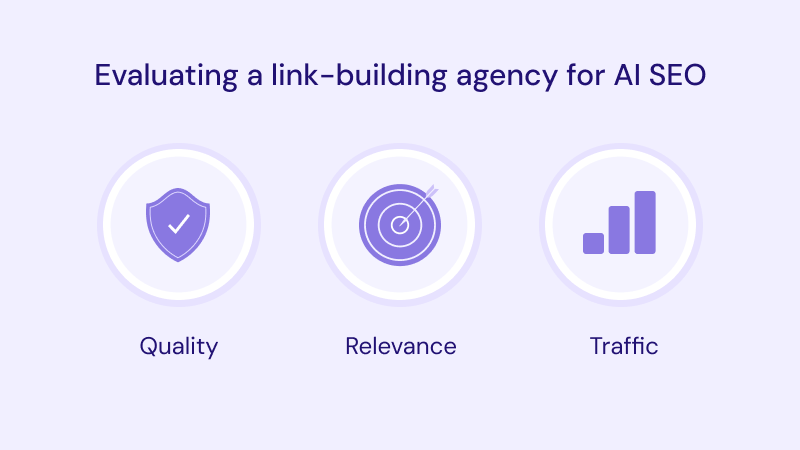
  "alt": "Infographic titled 'Evaluating a link-building agency for AI SEO' with icons for Quality, Relevance, and Traffic.",
  "caption": "Discover the key factors in selecting a link-building agency for AI SEO: Quality, Relevance, and Traffic highlighted through intuitive icons.",
  "description": "This infographic titled 'Evaluating a link-building agency for AI SEO' visualizes three essential evaluation criteria: Quality, Relevance, and Traffic, each represented by distinct icons. Quality features a shield with a check mark, Relevance is symbolized by a target, and Traffic is depicted with a bar graph. The design uses a violet color scheme and a clear layout, making it ideal for SEO professionals seeking to enhance their decision-making processes."
}
```

    The conclusion is clear. AI systems and search engines assess websites differently now. We’re no longer just building links for Google’s crawler.

    Link equity alone won’t suffice. Sites must establish topical authority, brand mentions, and a genuine market presence, aiming to build a footprint recognizable and unavoidable by AI models.

    Choosing the ideal link building agency depends on their alignment with current priority factors.

    Here’s what to focus on.

    Prioritizing Quality, Relevance, and Traffic

    I’ve seen many marketing directors judge link quality solely by Domain Rating (DR).

    While high DR is important, at uSERP, we recognize it’s not the ultimate measure. Additional factors to consider include:

    • Relevance: A niche-specific site with a DR of 60 often provides more value than a DR 80 general news site that covers diverse topics.
    • Minimum traffic standards: A site’s ranking for keywords and real traffic are critical; hence, strict traffic minimums are essential.

    When vetting an agency, request contractual site-traffic guarantees.

    An agency confident in their capabilities will gladly sign a Statement of Work guaranteeing each link comes from a site with a traffic threshold, such as 5,000+ monthly organic visitors.

    If they refuse to document traffic minimums, they may intend to place links on “ghost town” sites—domains appearing robust but lacking a real audience, safeguarding their margins rather than fostering your growth.

    ```json
{
  "alt": "uSERP webpage on backlink strategies for SEO in 2025, includes an article about white hat link building.",
  "caption": "Discover what over 800 SEO experts predict for backlinks by 2025 in this insightful article from uSERP. Explore strategies for ranking success in a changing digital landscape.",
  "description": "This image shows a screenshot from a uSERP webpage discussing the future of backlinks for SEO in 2025. The page highlights insights from over 800 SEO professionals on link building strategies. Emphasized are quality backlinks via white hat methods. The site includes SEO Power Plays subscription options and boasts content from reputable sources and SEO tips. Keywords include backlinks, SEO, link building, and strategies."
}
```

    Look for a Content-Driven Approach and Digital PR

    Links thrive as part of genuine conversations.

    Leading agencies now function like content marketing and digital PR teams, not traditional link builders.

    Instead of requesting links, they craft linkworthy assets—data studies, expert commentary, and in-depth guides publishers want to cite, understanding that:

    • Google’s algorithms and AI models are adept at spotting paid placements, making a content-led approach crucial for ensuring links remain natural and valuable.
    • Guest posting in the AI SEO era is about thought leadership, not throwaway articles, positioning your CEO as a credible expert.

    At uSERP, for example, we’ve developed and continue to update our State of Backlinks for SEO report.

    Red Flags: Recognizing Outdated or Dangerous Tactics

    Choosing a misguided partner doesn’t just squander your budget—it jeopardizes your brand reputation and future prospects.

    Here are the major red flags to steer clear of when engaging an agency:

    Guaranteed Rankings

    No one can promise a top Google ranking. Any agency offering fixed timeline keyword positions is likely either:

    • Using risky, short-lived tactics to create fleeting spikes.
    • Offering empty promises.

    Such agencies commonly leverage private blog networks (PBNs) or manipulate anchor text for quick gains.

    Though you may witness initial growth, the subsequent decline and potential penalties when Google catches on aren’t worth the risk.

    ```json
{
  "alt": "Image highlighting red flags in choosing a link-building agency, such as guaranteed rankings and lack of transparency.",
  "caption": "Beware of red flags when selecting a link-building agency, like promises of guaranteed rankings and lack of transparency. Choose wisely!",
  "description": "This image presents important red flags to be aware of when selecting a link-building agency. Key warnings include guaranteed rankings, lack of transparency, self-serve link portfolios, and dirt-cheap packages. The background is light purple, featuring an icon of a red flag with text highlighting these cautionary points. This is a helpful reference for those seeking quality digital marketing partnerships. Keywords: link-building, red flags, agency selection."
}
```

    Lack of Transparency

    If an agency can’t disclose link acquisition strategies or placement sources upfront, it’s wise to be cautious.

    Trustworthy agencies are transparent and will share genuine past placement examples and relevant case studies from your industry.

    Agencies concealing their inventory often do so to hide affiliation with low-quality networks or link farms.

    If you’re active on LinkedIn, you may have received messages offering self-serve link portfolios.

    I understand the temptation—strategic link acquisition is challenging, while buying and flipping links is straightforward.

    The issue is the lack of uniqueness. If an agency secures a link through a simple form, anyone can replicate it, including malicious entities.

    Such practices don’t create a natural link profile. Google usually identifies and devalues these domains.

    At best, you waste money on ineffective links. At worst, Google associates your site with link schemes.

    Dirt-Cheap Packages

    Quality SEO and link building offer substantial ROI but aren’t inexpensive endeavors.

    ```json
{
  "alt": "Email offering guest posting and link building services for website ranking.",
  "caption": "Boost your website's ranking with expert guest posting and link building services.",
  "description": "This image contains an email offering services in guest posting and link building to enhance website ranking on search engines. It mentions the provision of high authority backlinks from Google News approved sites and permanent posts with do-follow backlinks on websites with high domain authority. The email aims to attract interest by promising organic traffic and growth, with an invitation to check a website list for more details."
}
```

    Acquiring quality articles with genuine, authoritative links is a costly process that cannot be cheapened.

    Therefore, inexpensive packages boasting multiple high-authority links raise red flags, often involving:

    • AI-generated, poorly edited content.
    • Low-value or resold inventory links.
    • Toxic backlinks.

    These approaches fail to enhance your AI search visibility or Google ranking.

    In the AI era, link building is a lasting investment, focusing on solid market presence over temporary gains.

    The right partner functions as an extension of your team, prioritizing:

    • Your backlink gap relative to competitors.
    • Your brand mentions in LLMs.
    • Your aggregate search and AI presence.

    They assist in content syndication, backlink audits, content marketing, and modern link building with a cohesive strategy.

    If you’re ready to move beyond surface metrics and build revenue-driving AI credibility, carefully choose who to trust with your domain.

    The perfect link building agency is out there. You just need to recognize them.


    Inspired by this post on Search Engine Land.


    crushpress.ai community screenshot
  • How Publishers Can Adapt as AI Reduces Search Traffic

    How Publishers Can Adapt as AI Reduces Search Traffic

    Your stories can keep ranking and still deliver fewer visits. When an AI answer absorbs the headline fact, definition, or short explanation, the reader may finish the task without opening your page. That changes the value of a ranking, but it does not make search irrelevant.

    If you run a publishing operation, the wrong response is to produce more interchangeable articles and hope volume compensates for a lower click-through rate. You need to identify the pages AI can replace, make your distinctive work easier to cite, preserve a compelling reason to visit, and connect that visibility to revenue.

    Key takeaways

    • Do not treat every lost organic visit as the same problem. Separate easily answered queries from stories that provide original evidence, continuing updates, analysis, or utility.
    • AEO and GEO should make your claims easier to understand and attribute. They cannot make generic content distinctive or guarantee inclusion in an AI answer.
    • Give readers the direct answer, then earn the visit with proof, depth, freshness, tools, or an ongoing relationship.
    • Measure search visibility, AI citations, referral traffic, audience retention, and revenue as separate stages. A citation is not a visit, and a visit is not a business result.
    • Keep investing in technical SEO while reducing your dependence on any single distribution platform.

    Find the search traffic AI can replace

    A publisher sorts text-free story tiles on a table, separating generic content from reporting based on interviews, photography, investigations, and community coverage.

    A 43% decline in publisher search referrals by 2029 has been projected. That is a planning estimate, not a guaranteed result for every publisher. Your actual exposure depends on what people search for, what your pages provide, and whether an AI interface can satisfy the need without sending the reader elsewhere.

    Start with a page-level exposure map. Export your organic landing pages with their impressions, clicks, entrances, conversions, and revenue contribution where available. Group pages by template and query purpose rather than reviewing thousands of URLs as unrelated items.

    <!– wp:list {
  • Apple’s Gemini-Powered Siri: An AI Search Action Plan

    Apple’s Gemini-Powered Siri: An AI Search Action Plan

    If you lead SEO or content discovery, Apple’s deal with Google changes what you should prepare for, but not what you can claim to measure. A more capable, personalized Siri could answer more questions inside Apple’s interface, leaving fewer searches that begin with a conventional results page.

    Your job now isn’t to chase a secret Siri ranking factor. It is to make your best information easy for an answer system to retrieve, understand, verify, and hand off, then preserve enough evidence to recognize when the upgraded Siri actually changes discovery.

    What Apple has confirmed, and what remains unknown

    Apple and Google have entered a multi-year collaboration covering Gemini models and cloud technology. Apple’s next generation of foundation models will be based on that technology and will help power future Apple Intelligence features, including a more personalized Siri expected later this year. Apple says Apple Intelligence will continue to run on its devices and through Private Cloud Compute.

    The architecture matters. Calling the upgrade “Gemini-powered Siri” is convenient shorthand, but it can create the wrong mental model. The confirmed relationship places Gemini beneath Apple’s next generation of foundation models. It does not establish that every Siri request will go directly to the public Gemini service, that Siri will become a reskinned Gemini app, or that Google will control the Siri experience.

    AreaConfirmedNot yet confirmed
    Model foundationApple’s next-generation foundation models will be based on Google’s Gemini models and cloud technology.The exact Gemini model, request-routing logic, and division of work between models.
    Siri upgradeA more personalized Siri is among the future Apple Intelligence features the collaboration will help power.An exact release date, supported-device list, language coverage, and regional availability.
    Privacy architectureApple says Apple Intelligence will continue to operate on Apple devices and Private Cloud Compute.How each category of Siri request will be partitioned across device, private cloud, and underlying model infrastructure.
    Content discoveryNo Siri-specific ranking, citation, or publisher-reporting mechanism has been disclosed.Which indexes Siri will use, how sources will be selected, when links will appear, and what referral data publishers will receive.

    Use that boundary in your roadmap. Put confirmed capabilities in the planning column and everything else in a testing backlog. If a proposed project depends on Siri supporting a particular schema type, exposing citations, or copying Google rankings, it is not ready to become a production requirement.

    Treat Siri as a distribution layer, not a Google ranking tab

    A smartphone routes an abstract question through connected information sources and produces a concise answer with several handoff paths.

    Gemini beneath Apple’s model stack does not mean Siri will inherit the Google Search index, ranking system, or citation behavior. A model can formulate an answer without owning the retrieval system that found the facts. Apple can also apply its own interfaces, policies, personalization, and privacy controls after a model generates or interprets information.

    That distinction changes the goal. A traditional search program often treats the ranked page and the resulting visit as the main units of success. An assistant can split that journey into three separate outcomes:

    • Selection: Your information helps form the answer, whether or not the page is shown.
    • Attribution: Siri names your organization, product, expert, or page as the source of a claim.
    • Action: The user visits, calls, navigates, subscribes, buys, books, or completes another useful next step.

    Do not collapse those outcomes into a vague idea of “ranking in Siri.” A page could influence an answer without receiving a visit. A brand could be named without a clickable citation. A linked page could earn traffic while contributing little to the generated wording. Each outcome needs its own observation and objective.

    Assign the objective by task. For an educational question, prioritize factual inclusion, accuracy, and attribution. For a commercial comparison, prioritize correct qualification and a useful destination page. For a local or service task, prioritize accurate entity data and a low-friction handoff. This keeps your strategy useful even if Apple’s final interface differs from current AI answer products.

    Build content Siri can extract, verify, and hand off

    Structured content cards pass through an illuminated verification system before reaching a smartphone and a webpage handoff.

    You do not need a speculative Siri optimization layer. You need pages whose important facts survive when separated from navigation, brand language, and surrounding prose. Audit the pages closest to a decision or action in this order:

    1. Start with assistant-shaped tasks. Collect the questions people ask before contacting support, choosing a product, visiting a location, or completing a purchase. Preserve the natural wording instead of converting every task into a short keyword. “Does this work with my current plan?” carries conditions that a generic phrase such as “plan compatibility” loses.
    2. Put the decisive answer before the sales argument. The first relevant subsection should identify the subject and answer the question directly. Follow it with conditions, exceptions, evidence, and the next step. Avoid introductions that require an answer system to infer the conclusion from several paragraphs of positioning.
    3. Scope every fact that can change. Name the product edition, software version, location, audience, availability condition, or effective date when it affects the answer. Replace floating statements such as “it is included” with language that identifies what is included, for whom, and under which plan or version.
    4. Align visible content with JSON-LD. Use structured data to label facts a visitor can verify on the page, not to insert claims that the page does not make. Names, descriptions, relationships, availability, authorship, locations, and other entity details should agree across markup and visible copy. More schema is not automatically better; accurate schema attached to a clear page is the useful target.
    5. Give important entities a stable home. Maintain a canonical page for the organization, product, service, location, or expert that matters to the query. Use consistent names and internal links so an answer system does not have to guess whether abbreviations, old product names, and near-duplicate pages describe the same entity.
    6. Make proof adjacent to the claim. Link consequential claims to the primary policy, specification, methodology, or other supporting material. Identify who owns the information and when it was last reviewed where freshness matters. A generic references page is less useful than evidence connected to the exact statement it supports.
    7. Remove retrieval barriers. Check that the intended page returns a successful response, is not accidentally excluded from indexing, declares the correct canonical URL, and exposes its main answer without requiring a login or an interaction. Do not place an essential fact only inside an image, video, downloadable file, or script-dependent interface when it can also appear as clear HTML text.
    8. Design the handoff. When a user needs to continue, provide a destination that matches the answer: the relevant booking screen, product configuration, support procedure, location page, or contact route. A generic homepage forces both the assistant and the user to reconstruct the journey.

    This work is not a guarantee of inclusion in Siri. It improves the properties that any retrieval-and-answer system needs: identifiable entities, explicit facts, credible support, accessible pages, and a coherent next action. It also strengthens your content before Apple reveals any Siri-specific controls.

    Measure Siri visibility without inventing a rank

    No query-level Siri reporting, citation rule, or referral format has been confirmed. A single “Siri rank” is therefore not a defensible key performance indicator. Build a repeatable observation system instead.

    Create a query ledger before the rollout

    Save the tasks that matter while your team still has a clean baseline. Record the exact prompt, not just its topic. Because Apple is promising a more personalized Siri, context will matter when you compare results. Keep test conditions consistent where possible and record meaningful differences rather than treating every response as universal.

    FieldWhat to record
    Business taskThe decision or action the user is trying to complete.
    Exact promptThe full wording, including follow-up questions in a multi-turn interaction.
    Test contextDate, device, operating-system version, language, region, and any relevant account state that can be documented safely.
    Observed answerThe material claims, recommendations, omissions, and errors in the response.
    AttributionWhether the brand, expert, page, or another source is named or linked.
    HandoffThe page, app, action, or service offered as the next step.
    OutcomeWhether the user could complete the intended task accurately and with reasonable effort.

    Classify each result rather than assigning an improvised position. Was your information included? Was the entity identified correctly? Was there visible attribution? Did the handoff reach the right destination? Was the task completed? Those questions reveal where the discovery chain works and where it breaks.

    Use web analytics conservatively. A recognizable referral can support attribution when one is exposed, but missing referral data does not prove that Siri had no influence. An unexplained increase in direct traffic does not prove Siri caused it either. Corroborate analytics with captured responses, destination-page changes, and repeated tests from your defined query set.

    Once the upgraded Siri reaches the devices, languages, and regions relevant to your audience, rerun the same tasks before changing your content strategy. Look for stable patterns across repeated observations. One surprising answer is a test case, not an algorithm update.

    FAQ for SEO and AI visibility teams

    Will strong Google rankings automatically produce Siri visibility?

    No automatic relationship has been confirmed. Gemini is part of the model foundation in Apple’s plan, but a model foundation is not the same thing as a search index or ranking pipeline. Keep improving conventional search performance, but measure Siri selection, attribution, and handoffs independently when the upgrade becomes available.

    Do you need special Siri schema markup?

    No Siri-specific schema requirement has been announced. Use the schema vocabulary that accurately describes the visible page and validate the resulting JSON-LD. Do not add irrelevant types, invented properties, or hidden claims merely to mention Apple, Siri, Gemini, or AI.

    Should you change traffic forecasts before Siri launches?

    No. Model the upgrade as a discovery scenario, not a booked traffic gain or loss. Fund improvements that help across search and answer systems now, such as entity cleanup, answer-focused editing, evidence mapping, technical accessibility, and baseline testing. Wait for observable Siri behavior before attaching a platform-specific forecast.

    In your next planning cycle, choose the assistant-shaped questions tied to real decisions, audit the pages responsible for answering them, and start the query ledger. When the upgraded Siri reaches your audience, test those same tasks first. Let observed selection, attribution, and action patterns determine the next investment, not the presence of the Gemini name.

    References

  • Google Ads and PPC Strategy for 2026: A Practical Plan

    Google Ads and PPC Strategy for 2026: A Practical Plan

    Your 2026 Google Ads plan can fail while the dashboard looks healthy. If a bidding system is rewarded for generating cheap leads, it will find cheap leads. It will not infer which leads became profitable customers unless that outcome returns to the platform as a usable signal.

    The practical job is to decide where automation has earned freedom, where manual control still protects your budget, and which business result settles each spending decision. Use the framework below to audit an existing account or build your next planning cycle.

    Set the optimization contract before changing campaigns

    Every campaign needs an optimization contract: the business result you want, the event the platform can observe, the delay between those two events, and the guardrails that limit spending while the system learns. If those fields are vague, changing bids, match types, audiences, or creative only changes how efficiently Google pursues an undefined goal.

    Separate the metric used to diagnose delivery from the metric used to allocate money. Cost per lead can tell you how cheaply a campaign generates leads. Customer acquisition cost tells you whether those leads become customers at an acceptable cost. ROAS can guide revenue-oriented decisions, but it still needs to reflect the revenue that matters to the business rather than an intermediate action.

    The size of that distinction is easy to underestimate. In one account, exact, phrase, and broad match produced nearly identical lead costs but radically different acquisition costs:

    Match typeCost per leadCustomer acquisition costSearch impression share
    Exact€35€45024%
    Phrase€34€1,48517%
    Broad€33€2,11618%

    A €2 range in lead cost concealed a €1,666 difference between the lowest and highest acquisition costs. The platform was not malfunctioning. It was following the cheaper-lead objective it had been given. This does not prove that exact match is always superior. It proves that a low-cost proxy was not safe enough to control budget in that account.

    Build your optimization contract in this order:

    1. Name the economic outcome. Decide whether the account must acquire customers, produce revenue, protect margin, or support another business-level result.
    2. Identify the observable conversion. Write down what Google receives: a lead, qualified lead, completed purchase, subscription, or another recorded event.
    3. Map the gap. Note what can happen between the recorded event and the economic outcome, including lead rejection, cancellation, discounting, or delayed sales qualification.
    4. Record the reporting delay. Automation cannot respond promptly to a result that reaches the platform late. The longer the delay, the more carefully you need to control short-term interpretation.
    5. Assign each metric a job. Use delivery metrics to diagnose auctions, business metrics to allocate budget, and financial metrics to judge whether growth is worth buying.
    6. Set a spending boundary. Decide how much exposure you can tolerate while testing a new structure, signal, audience, or channel.

    Do not increase live budgets while the account is optimizing toward a proxy you already know is weak. That turns a reporting gap into a real cash loss. Keep the test capped, improve the downstream signal, or stay with a structure you can inspect until the business outcome is visible.

    Make automation pass a graduation test

    An autonomous machine travels through a guarded test lane with symbolic customer, transaction, target, and balance checkpoints while a strategist watches from a control station.

    Automation is neither the default answer nor the default problem. AI-led targeting depends on sufficient volume, high-quality signals, and timely conversion reporting. When those conditions are missing, automation can scale activity without improving business performance.

    Use four gates before granting more freedom

    1. Relevance: Does the conversion represent the result you actually want, or merely a convenient action such as an unqualified form submission?
    2. Signal quality: Are duplicate, accidental, low-value, or rejected outcomes being counted in the same way as valuable ones?
    3. Signal sufficiency: Does the campaign produce enough meaningful outcomes for the system to distinguish a pattern? Low-volume lead generation often needs more manual intervention than purchase-heavy ecommerce.
    4. Signal speed: Does the platform receive the outcome soon enough to connect it with the decisions that produced it?

    If a campaign fails any gate, do not pretend the answer is simply more automation. Improve the conversion path, return a better business event, consolidate fragmented signal where appropriate, or use tighter keyword and audience controls. Traditional structures remain useful when they expose differences that an account-level average hides.

    Run a controlled graduation test

    A graduation test should answer one question: can the more automated setup improve the business KPI without exceeding the risk you approved?

    1. Choose a baseline whose tracking and economics you understand.
    2. Define the candidate change, such as broader targeting or greater bidding freedom.
    3. Keep the conversion definition, offer, and business KPI consistent enough to make the result interpretable.
    4. Protect a comparison group or another credible baseline where the account structure permits it.
    5. Judge the result on CAC, ROAS, margin, or the chosen business outcome. Use CPL and other platform metrics to explain the result, not replace it.
    6. Expand only after the candidate passes. If it fails, diagnose the signal or structure before increasing spend.

    This framing prevents a common mistake: letting the automated campaign grade itself using the same proxy it was instructed to maximize. The platform can report that it produced more conversions, but your business records must decide whether those conversions were worth buying.

    Build measurement that can settle a budget decision

    Abstract ad signals pass through customer interactions to completed purchases, with verified outcome signals returning to a budget control console.

    Measurement disagreement is not a reason to jump immediately to a more complicated model. Differences between GA4 and advertising-platform data have created real mistrust, but another layer of modeling will not repair missing conversions, inconsistent definitions, or a broken customer journey.

    Give each measurement layer a defined purpose

    • Delivery layer: Use platform data to understand spend, auction participation, search impression share, and the actions recorded by the campaign.
    • Acquisition layer: Connect leads and purchases to qualified prospects, customers, revenue, and the CAC or ROAS used to manage the account.
    • Financial layer: Check whether the acquired business preserves enough margin to justify further investment.

    Write down the system of record for each layer. Then document why the figures may differ. A platform may credit an ad interaction while your business system counts only a completed customer. Those numbers answer different questions; forcing them to match can be less useful than making the difference explicit.

    Reporting delay deserves its own field in your dashboard. A campaign can appear efficient before rejected leads, cancellations, or downstream sales outcomes arrive. Mark results as preliminary until the business outcome has had time to mature, and compare like-for-like reporting windows when making allocation decisions.

    Use MMM only when the business has earned the complexity

    Marketing mix modeling can be valuable when media activity, business outcomes, and channel complexity give the model something meaningful to explain. It is less likely to clarify decisions when spend is concentrated across Google and Meta, the customer base is narrow, and other channels play only marginal roles.

    Before funding MMM, answer four questions:

    • Do you have reliable business outcomes rather than only platform conversions?
    • Is there enough meaningful variation across channels and periods to support useful analysis?
    • Will the model change a real budget decision that simpler reporting cannot answer?
    • Have you already fixed known tracking, CRO, and conversion-path problems?

    If the answer is no, spend the next measurement dollar on the data foundation. Clean conversion definitions, stronger downstream reporting, and a better path from click to customer create value whether or not you eventually adopt advanced modeling.

    Spend the next dollar on the constraint, not the trend

    More ads do not automatically create more learning. Creative volume becomes useful when it is tied to a strategy, measurable business outcomes, and enough quality conversions. Without those conditions, additional variants divide attention and production budget without resolving a decision.

    Give every creative test a decision card before production starts:

    • Question: What uncertainty will this test resolve?
    • Audience and context: Who should see the message, and in what situation?
    • Variable: Are you testing the pain point, proof, offer, format, or another defined element?
    • Business metric: Which downstream result determines the winner?
    • Next action: What will you pause, revise, or scale after the result?

    If you cannot fill in those fields, pause production. The bottleneck may be tracking, conversion rate, offer clarity, customer journey, or product margin rather than a shortage of ads. Fixing that constraint can also produce better signals for the automation already running.

    Turn 2026 Shopping promotion rules into an offer test

    Google’s January 2026 Shopping policy expansion created practical room for merchants to compete on offer structure, not just the displayed price. Subscription promotions can include a free trial or a discount on initial billing cycles. Merchants can select Subscribe and save in Merchant Center or use the subscribe_and_save redemption option in a promotion feed.

    Common retail abbreviations including BOGO, B1G1, MRP, and MSRP also became eligible. In Brazil, promotions can be restricted to particular payment methods, including digital-wallet cashback, by choosing Forms of payment in Merchant Center or using the forms_of_payment redemption restriction. That payment-method option was limited to Brazil, with no wider rollout announced at the time.

    Use the additional eligibility as a disciplined merchandising test:

    1. Choose an offer that fits the buying model, such as a subscription incentive for a genuine recurring product.
    2. Calculate the effect of the free period, discount, or cashback on acquisition cost and margin before launching.
    3. Configure the matching redemption type in Merchant Center or the promotion feed.
    4. Make the ad, promotion data, price, and landing experience agree so the customer receives the offer they were shown.
    5. Compare the business result with the existing offer, including customer quality and margin rather than conversion rate alone.
    6. Verify the current Merchant Center policy before launch because eligibility rules can change.

    Policy eligibility is not evidence that an offer is profitable. A discount can improve conversion while weakening margin or attracting customers who do not continue after an introductory subscription period. Let the business outcome, not the promotion badge, decide whether the offer remains funded.

    Treat biddable live sports as expansion inventory

    Google’s opening of NBCUniversal’s Olympic Winter Games connected-TV inventory through Display & Video 360 illustrates a broader change in channel planning: premium live sports can sit inside a biddable, cross-screen buying workflow rather than a separate traditional purchase.

    The available capabilities include Google audience activation, reach across connected TV and YouTube, household-level frequency management, curated sports packages, and platform-reported links between CTV impressions and purchases. These controls make a test more manageable; they do not make the inventory automatically incremental or profitable.

    Before moving money into live sports or other premium CTV inventory, require clear answers:

    • Are you trying to reach households that the current mix does not reach, or merely buying a more prestigious placement?
    • Does the creative make sense on the large screen and connect coherently with the follow-up experience on YouTube or another Google surface?
    • Can your measurement distinguish platform-attributed purchases from a credible business lift?
    • Is the test budget ring-fenced so a disappointing result does not weaken proven demand-capture campaigns?
    • What result will cause you to expand, revise, or stop the buy?

    Live sports is outside narrow search PPC, but it belongs in the same portfolio decision when one team manages Google investment across screens. Do not move money from a profitable search campaign simply because premium inventory has become easier to buy. Fund it when the account has a reach problem, suitable creative, usable measurement, and an approved loss limit.

    Key takeaways for your 2026 PPC plan

    • Make a business KPI such as CAC, ROAS, or margin the authority for budget allocation; use platform metrics to diagnose how campaigns produced the result.
    • Grant automation more freedom only when conversion signals are relevant, clean, sufficiently frequent, and returned promptly.
    • Keep manual keyword, audience, and budget controls when low volume or weak downstream data prevents reliable automation.
    • Do not scale creative output without a defined hypothesis, business metric, and decision that the test will unlock.
    • Repair tracking, CRO, and conversion paths before adding MMM or another layer of measurement complexity.
    • Use expanded Shopping promotions and biddable CTV inventory as controlled business experiments, not automatic claims on incremental budget.

    Before your next budget meeting, create a one-page contract for every major campaign: economic outcome, observable conversion, reporting delay, and spending boundary. Any proposed expansion should explain how it improves one of those fields or why the existing contract is strong enough to support more risk.

    References

  • AI-Era Copywriting: Turn Positioning Into Recommendations

    AI-Era Copywriting: Turn Positioning Into Recommendations

    Your team can produce more words than ever, yet your homepage may still leave a buyer asking three basic questions: Is this meant for me? Does it solve my problem? Why should I believe you?

    That gap is where copywriting matters in AI-era marketing. You do not need another layer of generic content. You need language that makes your offer easy for a person to choose and easy for a generative system to match to the right buying situation.

    Key takeaways

    • AI has reduced the value of generic explanation, not the value of persuasion. Information can be compressed; a credible reason to choose you still has to be established.
    • Write from the buyer’s situation rather than from a broad description of your company. State who the offer is for, what problem it solves, how it works, and what supports the claim.
    • Generative engine optimization is partly a positioning problem. Your brand must be available as a relevant solution when a person describes a need, not merely visible for a category keyword.
    • Create separate pages only for meaningfully different decisions. If the audience, offer, proof, and next step are unchanged, changing a few nouns does not justify another page.
    • Use AI to organize evidence, expose gaps, and produce controlled variations. Keep positioning, promises, exclusions, and factual approval under human control.
    • Judge copy by commercial movement: qualified visits, revenue-page actions, lead quality, conversions, and branded demand. Raw traffic is not the final objective.

    Start with the decision, not the draft

    Hands arrange audience, problem, and proof symbols around a product prototype while a blank sheet and capped pen sit nearby.

    A page can be accurate, readable, and optimized without helping anyone decide. That usually happens when the writing explains a category but never establishes a position inside it.

    AI is particularly capable of summarizing, synthesizing, matching patterns, and compressing familiar information. That makes undifferentiated publishing easier to reproduce and easier to replace. It does not remove the need to influence a real choice. In practice, AI exposed the difference between informational production and persuasive copywriting.

    Before writing a headline, complete a positioning brief. If your team cannot agree on the brief, polishing sentences will only conceal the disagreement.

    <!– wp:list {