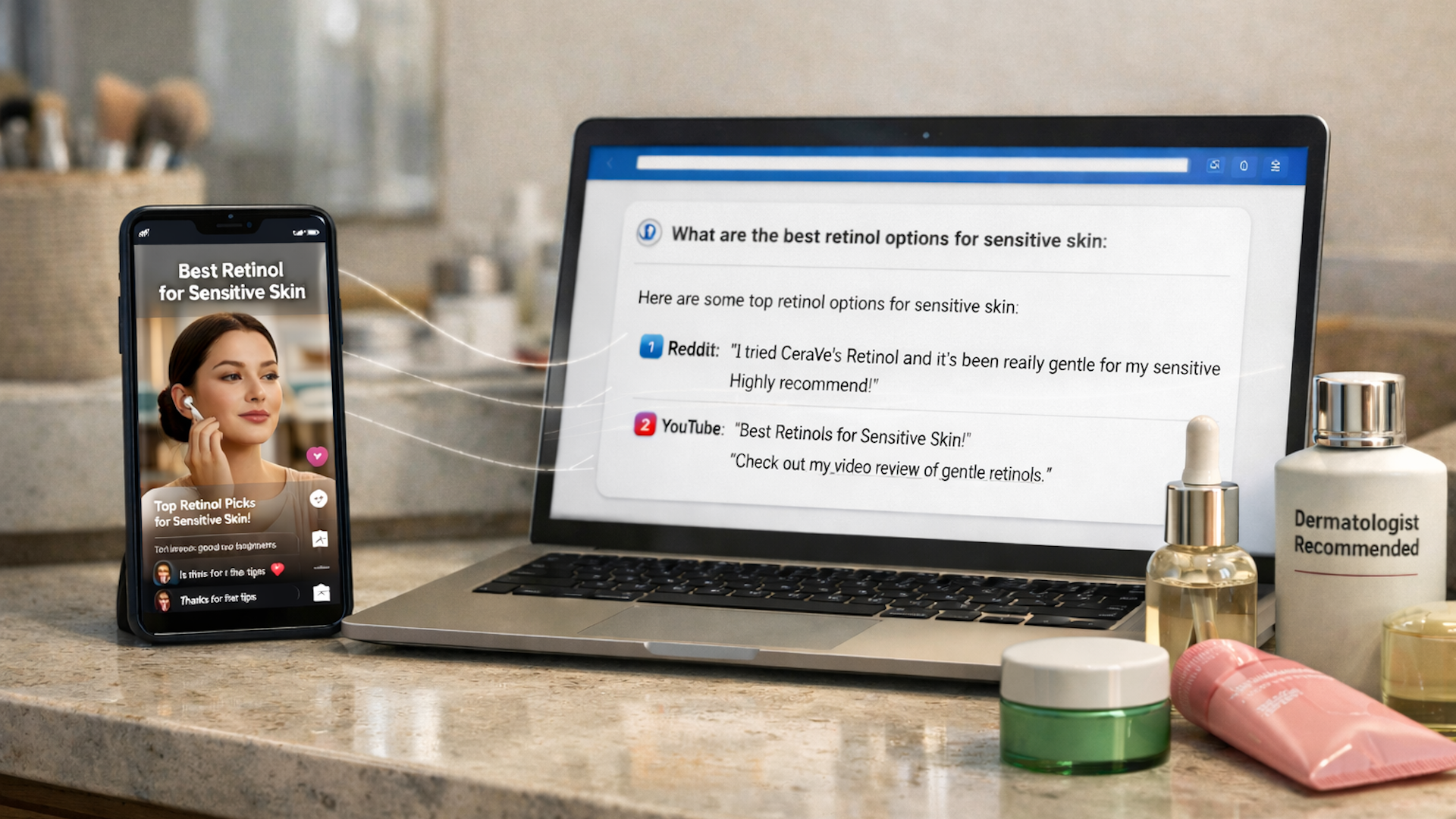
Tag: SEO

  • ChatGPT Ads: Bridging the Gap Between SEO and Paid Media

    ChatGPT Ads: Bridging the Gap Between SEO and Paid Media

    ChatGPT ads are reshaping the landscape, merging the once distinct worlds of SEO and paid media through prompt intelligence, fanout keywords, and LLM visibility.

    For years, our focus has been split between optimizing for SEO and paid media. The questions were always the same: Who controls the keyword? Who deserves the budget? Who can prove ROI more convincingly?

    Traditionally, SEO focused on organic rankings, while paid media honed in on auctions. They each aimed for visibility on the same search results page but functioned under different motivations and systems.

    Now, with the advent of ChatGPT ads, that distinction is fading. The divide between organic and paid is not only blurred—it’s being dismantled by conversational AI.

    The new battleground for visibility isn’t the SERP; it’s the prompt. The convergence of PPC and SEO is happening within ChatGPT ads.

    Keywords have always been the foundation of search marketing, shaping bidding strategies, landing page optimization, and attribution modeling.

    In contrast, generative AI thrives on multi-variable, intent-driven prompts. General terms like “Best CRM” evolve into nuanced queries like “What’s the best CRM for a B2B SaaS company under 50 employees?”

    Such prompts encapsulate richer context and specificity, unlike traditional keyword research which often simplifies complex inquiries to fit SERP strategies.

    When ChatGPT ads appear under its contextual answers rather than next to a search term, everything changes.

    ChatGPT ads are unique in their structure, as they appear beneath AI-generated responses, clearly labeled as “Sponsored,” and don’t manipulate the AI’s answers. They focus on context and the user’s session.

    This is not merely a keyword auction strategy. It’s about aligning context within a conversational user experience. This affects us as marketers by emphasizing the importance of enriched intent and context, requiring tight coordination of SEO and PPC at the prompt level.

    Leveraging prompt intelligence becomes crucial in this new demand capture environment, raising the question: Which prompts should we prioritize?

    ```json
{
  "alt": "The CapmatchOne logo with a gradient circle and bold text.",
  "caption": "Discover innovation with the CapmatchOne logo, featuring sleek typography and a modern gradient circle.",
  "description": "The CapmatchOne logo features bold, modern typography coupled with a gradient circle, symbolizing connection and innovation. The sleek design conveys a sense of progress and creativity. This image can be used for branding or promotional purposes, appealing to audiences interested in innovative solutions and forward-thinking designs."
}
```

    The solution lies not in traditional tools like Google Search Console or Keyword Planner, but in analyzing LLM performance, which SEO teams have been doing in recent months.

    We can jumpstart a ChatGPT ads strategy by examining high-performing LLM prompts, understanding when our brand appears, the types of prompts we want to be part of, and the most cited use cases.

    This process reveals fanout keywords, the new long-tail indicators embedded within prompts, like in the query “Best CRM for B2B SaaS startups with under 50 employees that integrates with HubSpot.”

    Traditional tools target root terms, but fanout keywords highlight specifics like “SaaS startups with under 50 employees” or “HubSpot integration.” They offer layered quality, uncovering underserved audiences and potential gaps in paid strategies.

    Aligning these fanout keywords with paid strategies is crucial. By auditing our paid coverage, we can ensure we address these nuanced variants and don’t overly rely on base keywords.

    The opportunity lies where organic LLM visibility and paid gaps meet. Frequently appearing conversationally in responses without targeting paid ads around that intent is missing out on additional demand.

    Optimizing landing pages is another overlooked area. Traditionally, SEO and PPC teams have driven traffic to the same pages, optimizing them based on different criteria, but this won’t suffice with conversational AI.

    To reduce conversion friction, our landing pages must reflect the nuanced specifics of prompts, allowing deeper engagement with tailored content and conversational phrasing.

    By improving landing page clarity, we boost both conversion and the likelihood of LLMs recognizing and appropriately surfacing our brand, forming a crucial feedback loop between SEO and paid strategy.

    In the realm of conversational AI, the once distinct worlds of SEO and paid are now intersecting, requiring us to think in systems rather than channels. ChatGPT ads highlight this shift, showing that AI isn’t just influencing search methods—it’s redefining growth strategy.


    Inspired by this post on Search Engine Land.


    crushpress.ai community screenshot
  • Unlocking SEO Success: AI’s Role in Authority Building

    Unlocking SEO Success: AI’s Role in Authority Building

    In an AI-driven search world, authority outweighs optimization

    As someone deeply immersed in the world of SEO, I’ve witnessed a fascinating evolution. In the early 2000s, if you were like me, you probably focused on gaming PageRank with enough links and keywords to achieve visibility. It was a mechanical process, and frankly, relatively simple to exploit.

    Fast forward two decades, and the search landscape has radically transformed. Algorithms have become sophisticated, mirroring Google’s deeper understanding of brands, individuals, and reputations. This transformation, driven by AI-powered discovery, means authority is now the cornerstone of search rankings. The journey culminates in an era where brand legitimacy is sustained through genuine visibility.

    ```json
{
  "alt": "Google Hotel Finder review snippet on Hallam Internet by Susan Hallam.",
  "caption": "Discover Susan Hallam's insights on Google Hotel Finder's UK launch. Her verdict? A thumbs up! Dive into the detailed review.",
  "description": "This image displays a snippet from Hallam Internet featuring a review of Google Hotel Finder by Susan Hallam. The service has recently launched in the UK, and the review is positive, with a recommendation to try it. The snippet includes the website link, author photo, and mentions Google+ circles."
}
```

    I witnessed Google’s first significant stand against manipulation with the Penguin update, prompting many of us to rethink our link-building strategies. “Digital PR” began to replace traditional notions, while Google’s experiments with entity-based understanding introduced innovations like author photos in search results and knowledge panels.

    Although Google eventually phased out some features like authorship, the message was clear: authority assessment was being redefined. Instead of asking, “Who links to this page?” Google’s algorithms started considering “Who authored this content, and how is this author recognized?” This shift, propelled by AI-driven search enhancements over the past year, is now impossible to ignore.

    ```json
{
  "alt": "The CapmatchOne logo with a gradient circle and bold text.",
  "caption": "Discover innovation with the CapmatchOne logo, featuring sleek typography and a modern gradient circle.",
  "description": "The CapmatchOne logo features bold, modern typography coupled with a gradient circle, symbolizing connection and innovation. The sleek design conveys a sense of progress and creativity. This image can be used for branding or promotional purposes, appealing to audiences interested in innovative solutions and forward-thinking designs."
}
```

    Helpful content and the end of synthetic authority

    When Google integrated the helpful content system into its core algorithm, it marked a turning point for us in SEO. Sites that once thrived on over-optimization saw their performance crumble. In contrast, brands demonstrating authentic expertise and brand authority began to rise.

    It’s now vital that search systems accurately evaluate whether content reflects true expertise. As someone who’s navigated the core updates, I’ve seen larger brands with robust reputations consistently outperform technically proficient but less well-known sites. Authority has evolved from being a differentiator to a necessity.

    ```json
{
  "alt": "Line graph showing top cited domains in ChatGPT with Wikipedia and Reddit as leading sources.",
  "caption": "A visual dive into ChatGPT's source preferences reveals Wikipedia and Reddit as predominant domains before a notable mid-September drop.",
  "description": "This line graph illustrates the percentage of times specific domains were cited as sources in ChatGPT responses from July to September 2025. Wikipedia.org and Reddit.com show initial dominance with citation rates over 40%, followed by a significant decline around mid-September. Other domains like Medium, Forbes, and LinkedIn remain low. Based on a Semrush study of 230K prompts in October 2025, sourced from semrush.com."
}
```

    Authority in an AI‑mediated search world

    In diving into resources about large language models (LLMs), I’ve learned that they source their information from diverse platforms—journalism, forums, reviews, and video transcripts. It’s through these platforms that reputation is built, highlighting the power of consistent, positive mention of your brand.

    This revelation has profound implications for our SEO strategies. Platforms like Reddit, Quora, LinkedIn, YouTube, and trusted review platforms such as G2 are regularly cited in AI search responses. These platforms organically reflect what people genuinely think about brands, rather than what we aim to claim.

    ```json
{
  "alt": "Bar chart comparing factors correlating with AI mentions among ChatGPT, AI Mode, and AI Overviews.",
  "caption": "Explore how ChatGPT, AI Mode, and AI Overviews differ in correlation factors related to AI mentions, based on a study of 75,000 brands by Ahrefs.",
  "description": "This image features a bar chart that compares correlation factors with AI mentions among ChatGPT, AI Mode, and AI Overviews. The data includes metrics such as YouTube mentions, branded web mentions, and URL rating, derived from a study of approximately 75,000 brands by Ahrefs Brand Radar and Site Explorer. The chart reveals varying correlation levels, providing insights into digital presence and AI-related discussions."
}
```

    This doesn’t mean the end of Google

    Despite AI’s growing integration, Google continues to dominate with over 90% of global search usage. Even among frequent AI platform users, reliance on Google persists. Google’s interfaces now absorb AI-style answers, meaning users experience AI directly within Google platforms. This hybrid presence offers an exciting opportunity for building cross-platform authority.

    Brand building is the new SEO multiplier

    As someone who bridges the gap between paid and organic strategy, I’ve seen that effective authority signals often emerge from outside traditional search channels. Digital PR, brand advertising, events, and offline activities increasingly shape organic performance. This sphere where paid and organic strategies converge enhances your brand’s legitimacy.

    ```json
{
  "alt": "Graphic showing three types of authority: Category, Canonical, and Distributed, with descriptions and examples.",
  "caption": "Exploring the pillars of authority: Learn how Category, Canonical, and Distributed Authority help shape perceptions and build credibility across various platforms.",
  "description": "This graphic illustrates three essential types of authority: Category Authority, Canonical Authority, and Distributed Authority. Each type offers unique methods to build credibility. Category Authority involves defining the narrative with POV, thought leadership, and research. Canonical Authority focuses on creating trusted, reusable content like pillar pages and guides. Distributed Authority emphasizes credibility through external channels like PR, social media, and partnerships. © 2026 Hallam."
}
```

    Brand awareness significantly boosts click-through rates, with familiar names drawing references across various media. I’ve noticed mentions in YouTube videos or long-form journalism reinforcing topical authority that simple links cannot. The digital ecosystem now validates authority externally, and this multiplication effect is constantly evident in the results I oversee.

    A practical framework: The three pillars of authority

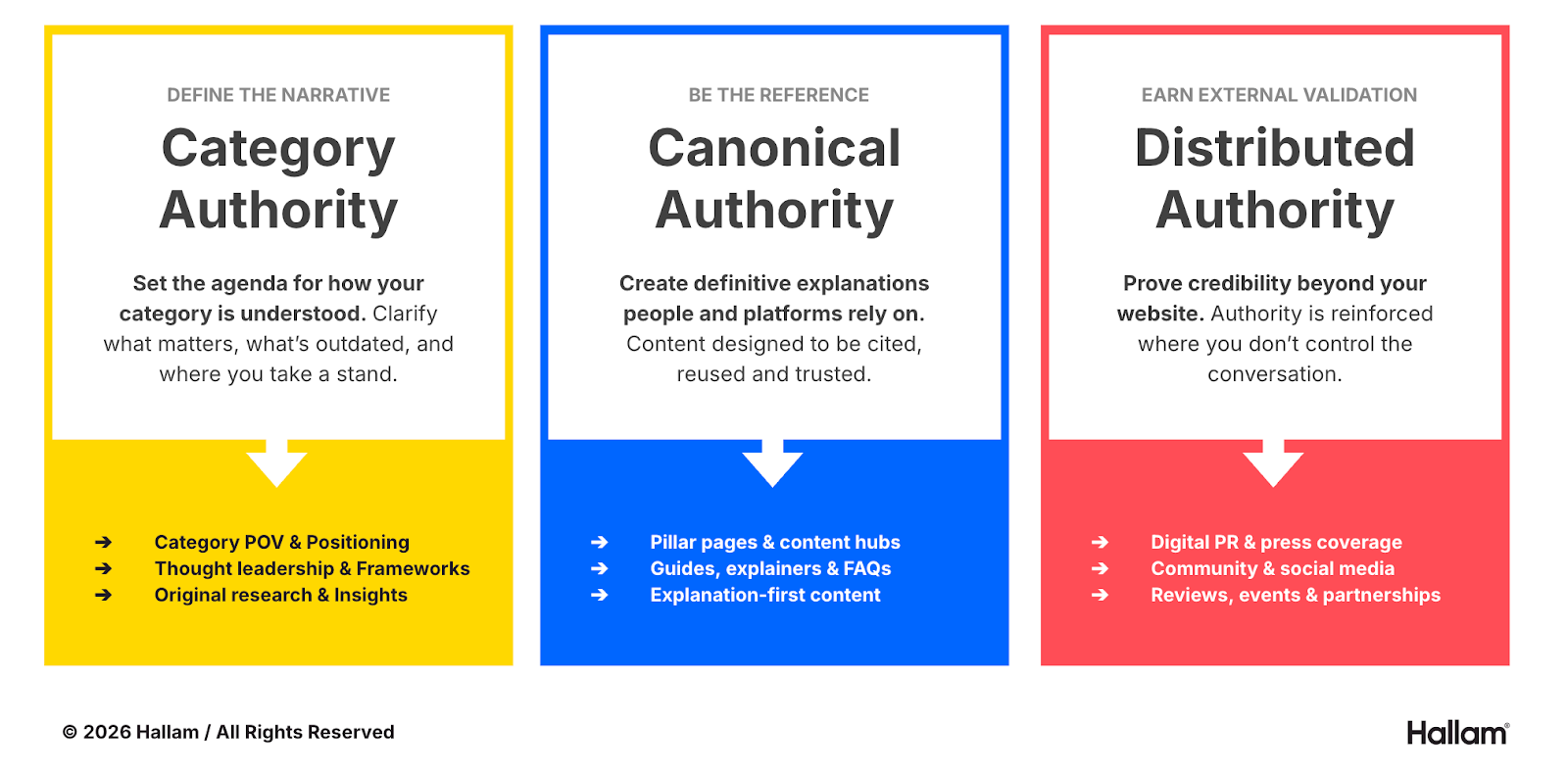
    Building enduring authority requires an integrated approach. Drawing from my experience, I’ve devised a framework focusing on three core areas: Category, Canonical, and Distributed authority. Each pillar strengthens your position as an industry leader, beyond mere SEO tactics.

    1. Category authority: Owning the truth, not just the traffic

    It begins with shaping how the category is defined. Instead of chasing keywords, the focus is on establishing your brand as the reference point others turn to for clarity. This strategy cultivates an authentic authority that search engines and AI increasingly reward.

    2. Canonical authority: Creating the definitive explanations

    This involves crafting explanation-focused content that thoroughly answers queries, becoming the go-to resource cited across various platforms. The content serves as the backbone across the digital landscape, ensuring enduring visibility through AI and future technologies.

    3. Distributed authority: Proving legitimacy beyond your website

    Genuine authority thrives through widespread credibility on platforms outside your control, including PR coverage, social media mentions, and product experiences. These elements amplify your brand’s presence and solidify trustworthiness.

    Ultimately, focusing on brand authority ensures durability amidst evolving algorithms. It’s about becoming the undisputed leader in your niche, where authority extends beyond traditional SEO into the realm of comprehensive digital engagement.


    Inspired by this post on Search Engine Land.


    crushpress.ai community screenshot
  • ChatGPT Prefers Early Content: 44% of Citations from Opening Sections

    ChatGPT Prefers Early Content: 44% of Citations from Opening Sections

    I recently stumbled upon a fascinating study that shows how ChatGPT pulls most of its references from the beginning sections of content. It’s clear from this research that the AI favors straightforward definitions, a balanced tone, and densely packed entities.

    According to Kevin Indig, a Growth Advisor who analyzed 1.2 million AI responses and 18,012 citations, ChatGPT has a strong preference for using citations from the top of the content. This was a revelation for me and definitely something to keep in mind when writing.

    Why we care. The traditional search landscape often rewards depth and gradual payoffs. However, AI is changing that game by favoring clear entities and direct answers right at the start. If I don’t make sure my key information is front and center, it’s less likely to be cited by AI.

    By the numbers. In examining various datasets, Indig’s team found a “ski ramp” pattern—44.2% of citations originate from the first 30% of content, 31.1% from the middle, and only 24.7% come from the final third, with a noticeable drop towards the end.

    Breaking it down even further, I learned that at a paragraph level, AI citations largely come from the middle sentences (53%), with 24.5% from the first sentence and 22.5% from the last.

    The big takeaway. This really drives home the importance of front-loading critical insights at the article level. Within paragraphs, focusing on clarity and meaningful content rather than trying to hook readers with a dramatic first sentence seems to be more effective.

    Why this happens. Large language models like ChatGPT are trained on various styles of writing that prioritize a “bottom line up front” approach. It seems these models use the early sections as a framework for interpreting the rest of the data.

    Efficiency and context establishment remain key priorities for these models, even though they can process large sets of data.

    What gets cited. Indig noted five key traits of content frequently cited by ChatGPT: definitive language, a Q&A structure, entity richness, balanced sentiment, and business-grade clarity. Learning this has been incredibly insightful for how I craft my content.

    Indig’s team looked at a massive volume of data, identifying the traits of highly cited content by analyzing 18,012 verified citations from ChatGPT responses. The study focused on where and why the AI pulls content, using advanced techniques to match responses to source sentences.

    Bottom line. It seems the narrative approach of crafting an “ultimate guide” might not be the best for AI retrieval. Instead, a more structured, briefing-style format appears to be more successful.

    This study convinced me that writers now face what Indig calls a “clarity tax.” We need to present definitions, entities, and conclusions upfront rather than saving them for the conclusion.

    The report. For those interested, you can delve deeper into these findings in The science of how AI pays attention.


    Inspired by this post on Search Engine Land.


    crushpress.ai community screenshot
  • Mastering AI Visibility: Applying ‘They Ask, You Answer’

    Mastering AI Visibility: Applying ‘They Ask, You Answer’

    Why answering pricing, problems, and comparisons drives AI visibility

    As someone who’s deeply involved in SEO, I’ve noticed how search behavior has evolved significantly. It’s not just about typing keywords into Google anymore. People are asking questions, and sometimes, they’re even outsourcing their thinking to Large Language Models (LLMs).

    With Google transitions from a traditional search engine to more of a question-and-answer machine, it’s crucial for businesses to have a robust and time-tested strategy to respond to these customer inquiries.

    AI has transformed how we research and compare options — making what used to be a painstaking process much simpler. But the machine only knows what it can discover about us online.

    To achieve the broadest visibility for your business, it’s vital to understand your customers’ needs, desires, and pain points thoroughly.

    This is where the “They Ask, You Answer” framework becomes invaluable. It assists businesses in identifying and formulating answers to the numerous questions potential customers might have. In the age of AI, this approach is not just useful but essential to making progress.

    An Answer-First Strategy and Its Importance Now

    “They Ask, You Answer,” crafted by Marcus Sheridan, is more than just a book — it’s a strategic shift. I highly recommend diving into it.

    The premise is straightforward: buyers have questions that businesses should address candidly and transparently. Avoid burying leads with vague responses like “Contact us for a quote.”

    This isn’t merely an inbound marketing strategy but a practical extension of your customer-facing content with an E-E-A-T focus.

    The framework includes five essential content categories: Pricing and cost, problems, versus and comparisons, reviews, and best in class.

    These align with the key moments buyers experience in seeking solutions, assessing risks, and making decisions. Nowadays, many of these interactions happen in AI environments, making the TAYA process particularly relevant.

    The modern web can be overwhelming with its chaos and distractions. AI steps in to simplify this — providing a clean, orderly way to find information. This is why TAYA, with its question-and-answer foundation, works so seamlessly with AI systems.

    Your customers are searching everywhere, so it’s crucial to ensure they can find your brand.

    Transforming E-E-A-T into a Practical Strategy

    Although we have E-E-A-T as an ideal for content creation, effectively building a strategy around it can be challenging. “They Ask, You Answer” places this focus on tracks.

    E-E-A-T categories: Pricing supports trust, experience, and expertise. Problems demonstrate experience. Versus content builds authority and expertise. Reviews enhance experience and trust. Best-in-class content fortifies authority and trust.

    Building trust through E-E-A-T might be complex given the myriad ways to exhibit it. TAYA helps organize these signals within each category, creating a comprehensive repository of content that AI readily surfaces.

    Ready to dig deeper? Discover how to build an effective content strategy for 2026.

    Integrating TAYA with Traditional SEO Research

    Drawing from our SEO skills and tools positions us strongly in the AI era. These resources aid in forming an integrated SEO, PPC, and AI strategy.

    ```json
{
  "alt": "The CapmatchOne logo with a gradient circle and bold text.",
  "caption": "Discover innovation with the CapmatchOne logo, featuring sleek typography and a modern gradient circle.",
  "description": "The CapmatchOne logo features bold, modern typography coupled with a gradient circle, symbolizing connection and innovation. The sleek design conveys a sense of progress and creativity. This image can be used for branding or promotional purposes, appealing to audiences interested in innovative solutions and forward-thinking designs."
}
```

    The action plan includes using Google Search Console, Google Business Profile, semantic maps from tools like AnswerThePublic, and competitive analysis with Semrush or Ahrefs to identify unique opportunities.

    Explore your internal resources: Sales calls, live chat transcripts, emails, and customer feedback can reveal valuable insights.

    This understanding allows us to collect and categorize questions under the TAYA framework.

    TAYA and Your AI-Era Content Marketing Strategy

    Here’s what TAYA looks like reinterpreted for an AI-driven landscape where Google and other systems anticipate user needs.

    1. Pricing and Cost: Why Discussing Money Matters

    Clarity on pricing helps potential buyers in their decision-making process. If businesses don’t provide detailed, transparent information, AI will present whatever it finds, which might not reflect your brand accurately.

    To own this narrative, I recommend publishing price ranges, elaborating on cost-driving factors, and setting transparent expectations.

    2. Problems: Leveraging Weaknesses as Strengths

    Being candid about drawbacks and limitations fosters trust. Acknowledge potential issues constructively to reinforce credibility.

    Craft content that addresses these issues head-on, providing practical advice and solutions.

    3. Versus and Comparisons

    Comparisons help simplify decision-making by highlighting differences clearly. Ensuring that your content reflects this can help in establishing your brand as a reliable source.

    Focus on creating structured, easy-to-digest comparisons that guide potential buyers through their options.

    4. Reviews and Credibility

    This isn’t just about gathering positive reviews but creating genuine, review-like content to assist in evaluating options.

    Offer honest evaluations and showcase your first-hand experiences to stand out as a truthful source.

    5. Best in Class: Recommending Others at Times

    Sometimes, acknowledging that another service might be best for certain needs builds trust. People appreciate honesty, enhancing your credibility as a fair evaluator.

    Creating comprehensive and unbiased “best of” lists based on transparent criteria can place your brand as a trusted advisor.

    TAYA as the Guide for Answer-First Visibility

    In AI-driven content marketing, middle-of-the-funnel content plays a pivotal role. Your website retains its foundational importance as SEO remains crucial for AI visibility.

    Using TAYA as a map empowers you to create a strategy that ensures presence across the AI spectrum. Each piece of content should respond to a real buyer question, emphasizing decision-stage content over mere branding awareness.

    With AI and SEO, success is measured beyond clicks. It’s about becoming a trusted source and cementing the relationship with potential customers through quality content.


    Inspired by this post on Search Engine Land.


    crushpress.ai community screenshot
  • Unveiling Google’s AI Search: Classic Methods Meet Modern AI

    Unveiling Google’s AI Search: Classic Methods Meet Modern AI

    AI search stack

    As someone deeply fascinated by how AI influences search engines, it’s intriguing to know that behind Google’s AI search facade, there is a robust system at work. This system diligently narrows down tens of thousands of documents to just a handful, relying heavily on traditional signals for visibility.

    Jeff Dean, Google’s chief AI scientist, recently shared some insights on the Latent Space: The AI Engineer Podcast, where I learned how much Google’s AI still draws from its classic search engine architecture.

    The architecture: filter first, reason last. In essence, for any content to be visible, it must navigate through various ranking thresholds. It starts with entering a broad candidate pool, goes through intense reranking, and only then becomes part of an AI-generated response. Essentially, AI builds on top of traditional ranking metrics.

    Dean elaborated that an LLM-powered system doesn’t skim through the entire web in a single go. Instead, it begins with Google’s comprehensive index, utilizing lightweight techniques to sift through a large pool of potential documents. Dean described this process:

    “You start by pinpointing a subset that seems relevant using very lightweight methods. Initially, you might have around 30,000 documents, and this number gradually refines as increasingly sophisticated algorithms and signals are applied, ultimately leading to the final 10 results or so.”

    These robust ranking systems further trim this set. Consequently, it’s only after multiple filtering rounds that the most capable model steps in to analyze a significantly smaller group and generates a response. Dean continued:

    “An LLM-based system isn’t vastly different. Although it processes trillions of tokens, it seeks the key 30,000-ish documents with those maybe 30 million significant tokens. From there, it derives the crucial 117 documents needed to accomplish the task.”

    Dean referred to this as an “illusion” of engaging with trillions of tokens. In practice, it’s a structured pipeline: retrieve, rerank, synthesize. Dean elaborated:

    “Google search isn’t about an illusion; it’s genuinely searching the internet but distilling it down to a very relevant subset.”

    Matching: from keywords to meaning. Although it’s not novel, emphasizing that comprehensive topic coverage is more important than repeating exact keywords was refreshing.

    Dean explicated how LLM-based representations revolutionized query-to-content matching by moving beyond word-for-word alignment. Now, Google evaluates whether pages or even paragraphs are topically relevant to a given query. He explained:

    “Implementing an LLM-based text representation means we’re no longer bound by the need for specific words on a page. Instead, we delve into the topical relevance of a page or paragraph to a query.”

    This paradigm shift allows Search to connect queries to answers notwithstanding different phrasings, increasingly focusing on intent and subject matter rather than mere keyword placements.

    Query expansion didn’t start with AI. Dean highlighted Google’s 2001 achievement of moving its index into memory, enabling swift query expansion. He noted:

    “We significantly scaled in 2001, wanting a larger index for better retrieval, accommodating growing traffic through a sharded system, evolving to fit the entire index in memory across machines. This dramatically improved query quality.”

    Before this, expanding queries with additional terms was cost-intensive due to disk accesses. Once the index resided in memory, Google could enrich short queries with synonyms and variations to capture broader meanings. Dean recalled:

    “Previously, term lookup was constrained by disk seek penalties. Post-memory transition, handling 50-term queries became feasible, enhancing definition and meaning extraction, far ahead of LLMs.”

    This transition steered Search towards intent and semantic matching, setting the stage for today’s LLM-driven advancements, which amplify meaning-based retrieval through more refined systems and advanced computing power.

    Freshness as a core advantage. Dean’s insights revealed that one of Search’s pivotal transformations involved accelerating update rates. Early on, pages refreshed monthly. Now, Google’s systems can refresh in under a minute. He observed:

    “Google’s early index expansion coincided with ramping up refresh rates, now a vital parameter. Swift updates remain crucial.”

    This advancement significantly enhanced news search results and overall user experience, as current data is a consumer expectation. Dean added:

    “A stale index, like last month’s news, loses utility fast.”

    Google’s sophisticated systems decide the frequency of page crawls, weighing potential change against the value of the latest version. Even less frequently updated important pages might be crawled often due to high update value. Dean shared:

    “An intricate system determines update rates and page importance, ensuring often-updated important pages remain current.”

    Why I find this crucial. The fascinating aspect is realizing that AI answers don’t bypass fundamental elements like ranking, crawl prioritization, or relevance signals. These aspects remain critical. Although LLMs reshape content synthesis and presentation, they don’t circumvent the underlying search mechanics essential for eligibility and quality.

    Listen to the full interview. Discover more insights from Owning the AI Pareto Frontier — Jeff Dean.


    Inspired by this post on Search Engine Land.


    crushpress.ai community screenshot
  • Strengthen Your SEO Results with Effective Agency Collaboration

    Strengthen Your SEO Results with Effective Agency Collaboration

    From the very first kickoff to the technical execution phases, I’ve learned that the true value of hiring an SEO agency lies in our partnership and collaboration. Together, we can eliminate bottlenecks, empower cross-functional teams, and clearly demonstrate the ROI of our SEO investment.

    Hiring an SEO agency can truly transform how your brand stands out in search results. But remember, an agency’s effectiveness relies heavily on the partnership we build. Realizing the full potential of SEO requires a shared commitment to our goals and maintaining high momentum.

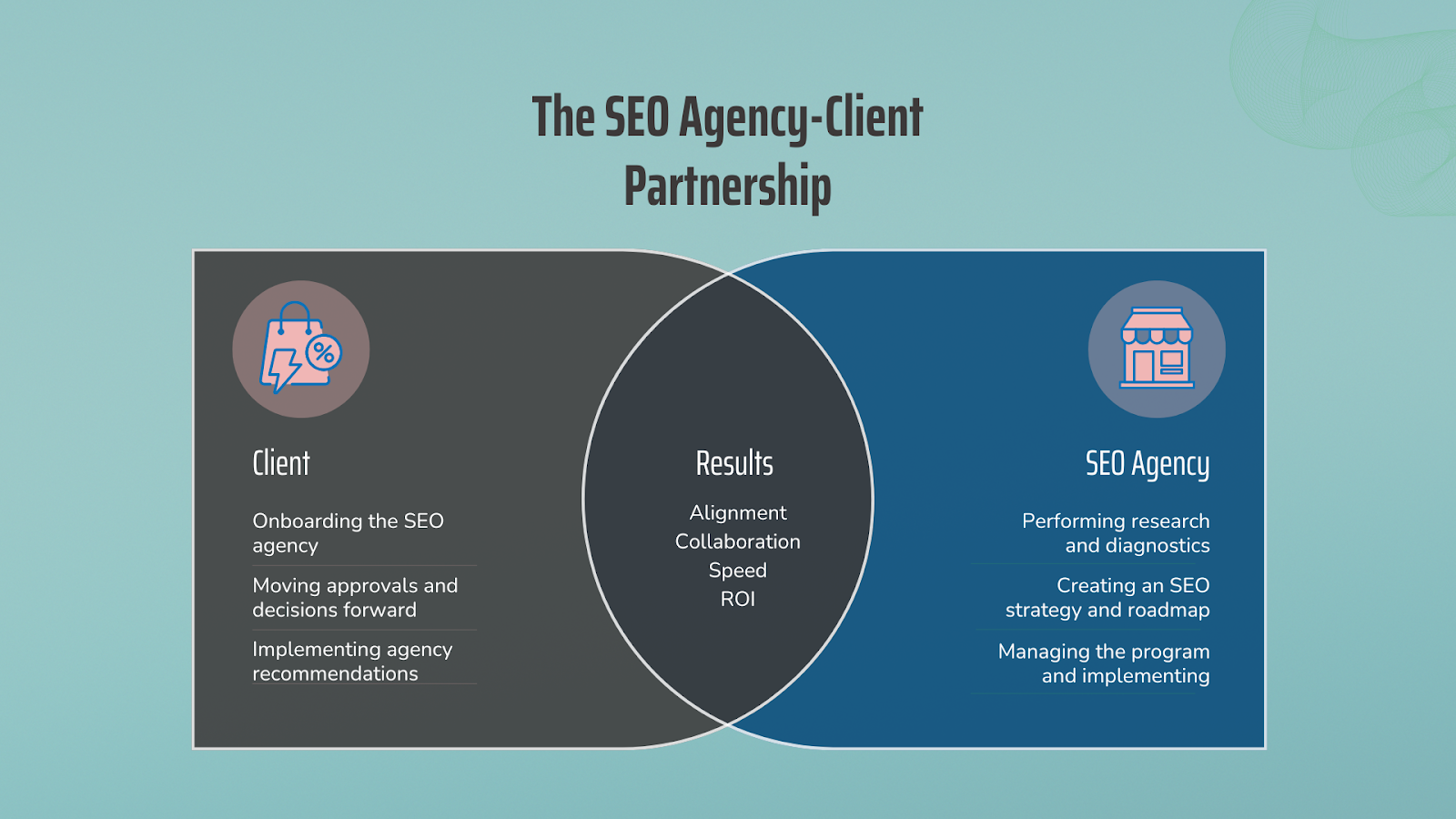
    Here’s what I’ve discovered about maximizing the benefits of working with my SEO agency: Alignment leads to faster progress, which makes it easier for us to prove the value of our efforts.

    To ensure we get the most out of this partnership, it’s crucial to align our SEO strategy with what truly drives our business. The company sets the business goals, and it’s the agency’s job to attract the traffic that helps achieve them.

    ```json
{
  "alt": "Venn diagram illustrating the SEO agency-client partnership detailing roles and results.",
  "caption": "Exploring the symbiotic relationship between SEO agencies and clients, this diagram reveals how collaboration leads to optimal results.",
  "description": "The image displays a Venn diagram titled 'The SEO Agency-Client Partnership' with three sections: Client, Results, and SEO Agency. The client side includes onboarding and implementing recommendations. The SEO agency side lists performing research and strategy creation. The overlapping area highlights shared results like alignment and ROI. The graphic visually represents the importance of collaboration and mutual goals in a successful SEO partnership."
}
```

    Having open discussions with the agency about how to align these goals right from the start enhances the effectiveness of our SEO program. Including cross-departmental stakeholders only reinforces the alignment and ensures everyone is on the same page.

    When the entire team understands the foundation of SEO, they can comprehend its role and their contribution to its success. In this spirit of collaboration, I facilitate SEO training across teams to empower everyone involved.

    I always come to the kickoff meeting fully prepared, ready to set agendas for productivity. Sharing pain points, detailing business operations, and clarifying the program’s scope helps everyone understand what to expect and what’s expected of them.

    ```json
{
  "alt": "The CapmatchOne logo with a gradient circle and bold text.",
  "caption": "Discover innovation with the CapmatchOne logo, featuring sleek typography and a modern gradient circle.",
  "description": "The CapmatchOne logo features bold, modern typography coupled with a gradient circle, symbolizing connection and innovation. The sleek design conveys a sense of progress and creativity. This image can be used for branding or promotional purposes, appealing to audiences interested in innovative solutions and forward-thinking designs."
}
```

    Regular communication with my agency, whether through emails, Slack, or meetings, is vital. Clear reporting methods are another key aspect, ensuring everyone remains accountable and the results are measurable.

    Switching from seeing the agency as just a vendor to viewing them as a true expert partner helps cultivate trust in their guidance, the very reason I hired them in the first place.

    By giving our agency visibility into past and present performance data, I ensure they have all vital information for optimizing our SEO efforts from day one. This setup includes access to essential tools and crucial performance metrics.

    ```json
{
  "alt": "Diagram showing SEO as a cross-functional effort involving leadership, marketing, product, dev/IT, design, and content.",
  "caption": "Explore SEO as a dynamic cross-functional collaboration! This diagram highlights the vital roles of leadership, marketing, and more in optimizing search visibility.",
  "description": "This image features a hexagonal diagram with 'SEO' at the center, surrounded by six connected blue circles labeled: Leadership, Marketing, Product, Dev/IT, Design, and Content. The background is light blue, and the text 'SEO as a Cross-Functional Effort' is displayed below. This graphic emphasizes the collaborative nature of SEO across various business functions, making it a key visual for presentations or educational materials related to digital marketing strategy."
}
```

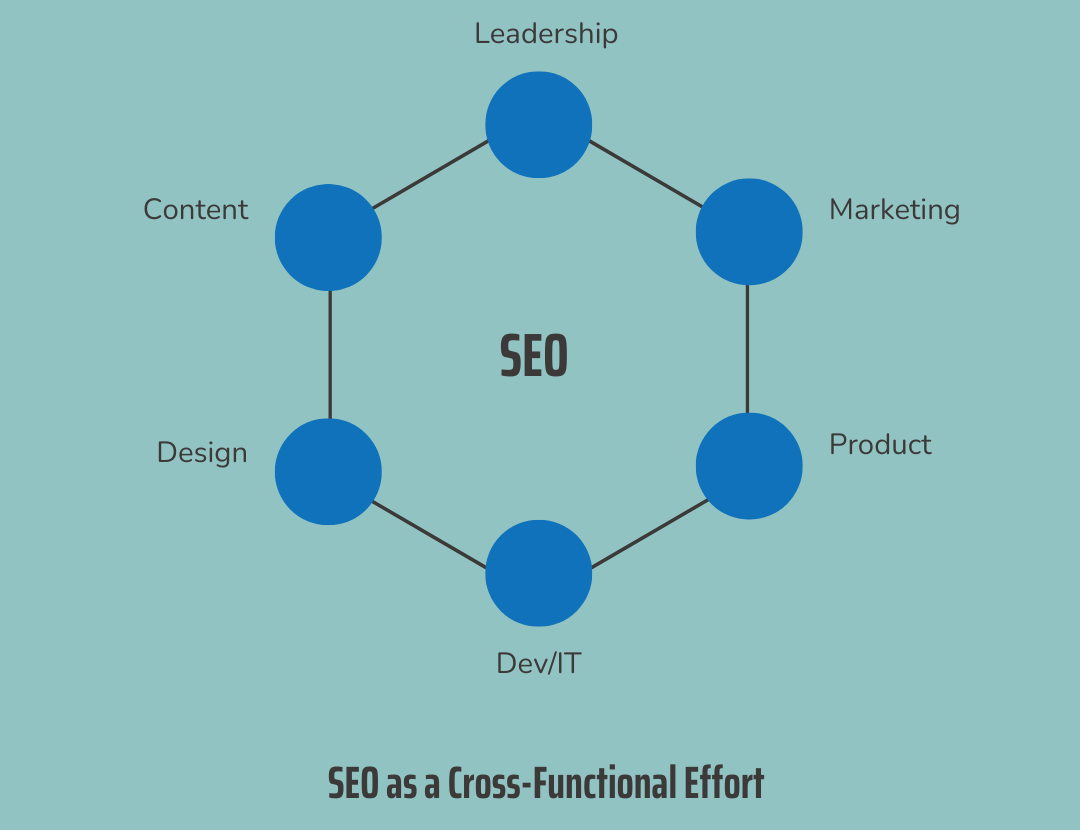
    SEO isn’t just an isolated activity—it requires contributions from multiple teams within the company. By including team leaders early in planning, I make sure everyone is engaged and accountable, from SEO briefings to content collaboration.

    My agency excels in SEO, but I bring invaluable brand knowledge to create content that aligns both with business goals and customer needs. By maintaining active involvement in content development, we produce material that truly resonates.

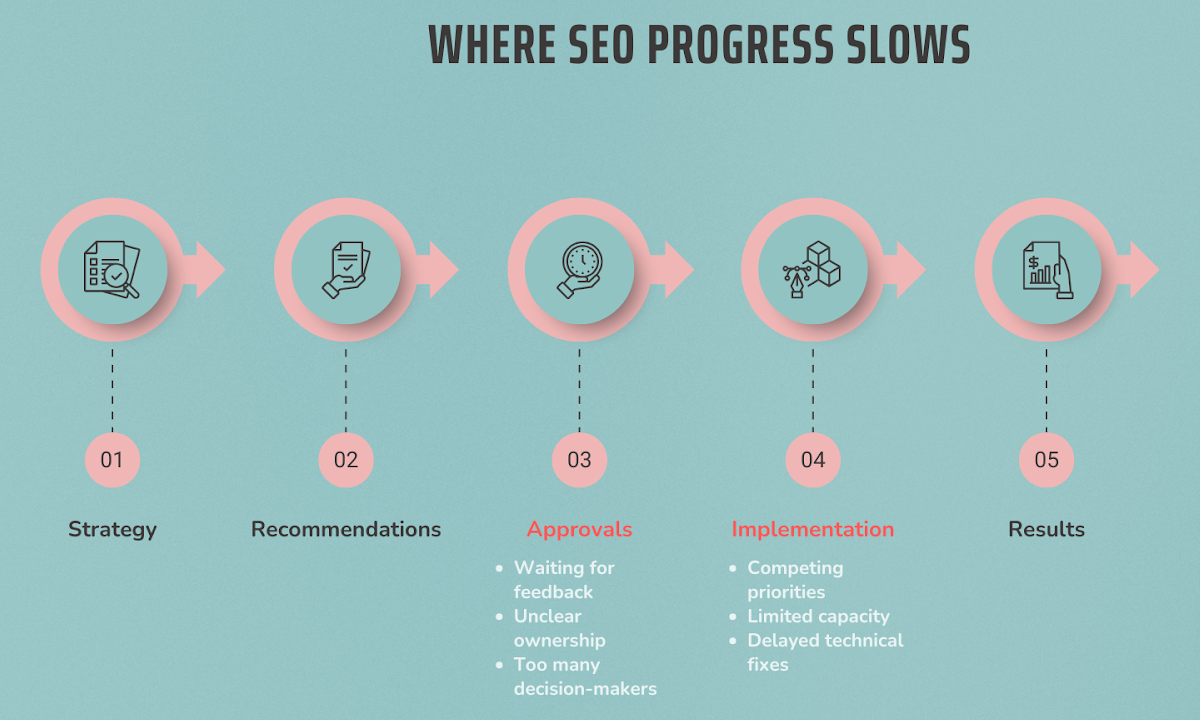
    Streamlining content reviews and setting clear guidelines helps eliminate approval hurdles that can slow down our SEO progress. Prioritizing high-impact tasks ensures we stay competitive in search results.

    ```json
{
  "alt": "Infographic showing five stages where SEO progress slows: Strategy, Recommendations, Approvals, Implementation, and Results.",
  "caption": "Explore the five critical stages where SEO progress often stalls, from strategy and recommendations to approvals, implementation, and final results.",
  "description": "This infographic highlights five key stages where SEO progress typically slows down: Strategy, Recommendations, Approvals, Implementation, and Results. Each stage is represented by icons within pink circles, connected by arrows. Approvals and Implementation are specifically noted for challenges like unclear ownership and competing priorities. Keywords: SEO, progress, strategy, recommendations, approvals, implementation, results."
}
```

    Each implementation, however small, contributes significantly to our overall SEO success. I prioritize these tasks during planning phases and involve technical teams early to ensure seamless execution.

    Maintaining engagement with my agency beyond the initial excitement stage is crucial for ongoing success. Continual communication, involvement in reviews, and flexibility help adjust to shifting business landscapes effectively.

    Ultimately, strong SEO results are built on strong partnerships. By working together, my agency and I drive our SEO program forward, creating a strategic and valuable business initiative.


    Inspired by this post on Search Engine Land.


    crushpress.ai community screenshot
  • Cloudflare’s Markdown Feature: A Game Changer or a Cloaking Risk?

    Cloudflare’s Markdown Feature: A Game Changer or a Cloaking Risk?

    Yesterday, I stumbled upon some exciting news from Cloudflare. They’ve introduced a feature called Markdown for Agents, which provides machine-friendly versions of web content alongside the traditional pages we all see.

    Cloudflare describes this update as a proactive measure in response to increasing AI crawler activities and agentic browsing.

    When a client requests text/markdown, Cloudflare fetches the HTML from the origin server, converts it right at the edge, and then hands over a Markdown version.

    Interestingly, the response includes a token estimate header, which helps developers like me manage context windows more effectively.

    Early feedback highlighted not only the efficiency gains but also the potential implications of offering alternate representations of web content.

    What’s happening. Being part of the 20% of the web that Cloudflare powers, I learned that Markdown for Agents utilizes standard HTTP content negotiation. If a client sends an Accept: text/markdown header, Cloudflare immediately converts the HTML response on-the-fly to Markdown format. The response, marked with Vary: accept, ensures caches store separate versions.

    Cloudflare views this opt-in feature as a shift in content discovery and consumption, benefitting AI crawlers and agents with its structured text that requires less overhead.

    They claim Markdown can reduce token usage by up to 80% compared to HTML, which is quite impressive!

    Security concern. SEO consultant David McSweeney raised a concern, citing that Cloudflare’s Markdown for Agents feature might make AI cloaking incredibly simple because the Accept: text/markdown header tips off origin servers that the request is AI-related.

    Regular requests deliver the usual content, but those for Markdown can trigger a unique HTML response that gets converted for AI consumption, McSweeney explained on LinkedIn.

    The worry is that sites might inject hidden instructions, altered product data, or other machine-only content, creating a hidden “shadow web” for bots, unless the header is stripped before reaching the origin.

    Google and Bing’s markdown smackdown. Here’s the kicker. Representatives from Google and Microsoft advised against creating separate markdown pages for large language models. Google’s John Mueller noted:

    “Given that LLMs have always trained on and parsed normal web pages, it seems obvious they have no issues with HTML. Why serve a page that no end user sees? Plus, if they validate equivalence, why not stick to HTML?”

    Microsoft’s Fabrice Canel added:

    “Do you really want to double crawl load? We’ll check for similarity anyway. Non-user versions (like crawlable AJAX) are often neglected and broken. Human oversight fixes both user and bot views. Schemas help, and AI makes us even better at deciphering web pages. Less is more in SEO!”

    Cloudflare’s feature doesn’t generate another URL but does create varied representations based on request headers.

    The case against markdown. Technical SEO consultant Jono Alderson pointed out that once a machine-targeted representation exists, platforms must choose to trust it, verify it against the human version, or outright ignore it:

    “Flattening a page to markdown doesn’t only remove clutter. It strips away judgment and context.”

    “The instant you publish a machine-exclusive page representation, you craft a secondary candidate version of reality. Regardless of source promises or claims of identical content, a system now views two representations and must determine the true reflection of the page.”

    Dig deeper. Why LLM-only pages aren’t the answer to AI search

    Why we care. With Cloudflare’s advancements, AI ingestion might become more cost-effective and streamlined. But does serving distinct content to humans and crawlers verge on cloaking? Stay tuned…


    Inspired by this post on Search Engine Land.

    crushpress.ai community screenshot
  • Why SaaS AI Traffic Declined by 53%: Insights and Lessons

    Why SaaS AI Traffic Declined by 53%: Insights and Lessons

    I recently discovered some fascinating insights into what’s really behind the 53% drop in SaaS AI traffic. It turns out, AI traffic isn’t actually collapsing—it’s just becoming more focused. While Copilot experiences a surge in in-workflow engagement, a significant 41% lands on search pages, all influenced by the ebbs and flows of Q4 budget cycles.

    As the SaaS market navigates a downturn, driven largely by the emergence of autonomous AI agents like Claude Cowork, new data reveals a substantial 53% decline in AI-driven discovery sessions. This phenomenon has been dramatically labeled the “SaaSpocalypse” by Wall Street.

    The overarching question of whether AI agents will eventually replace SaaS products looms larger than what this particular dataset can resolve. However, amidst the panic, the data offers clarity for SEO teams, highlighting key areas they should be monitoring closely.

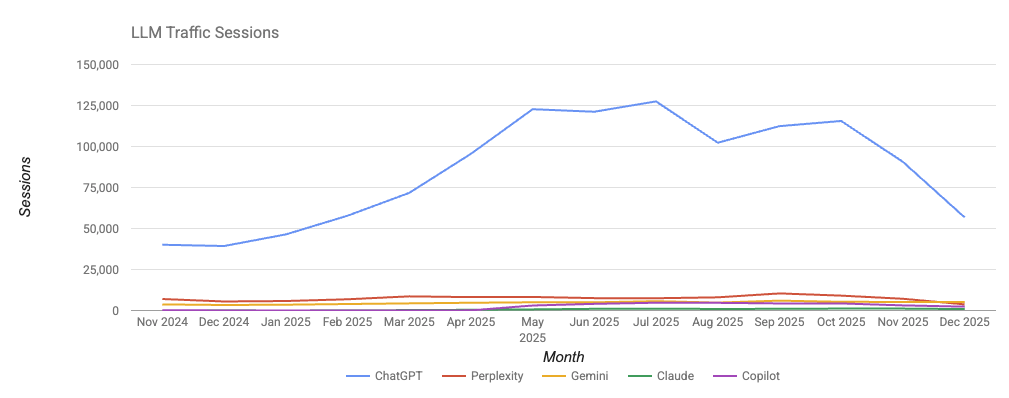
    Between November 2024 and December 2025, the SaaS sector experienced 774,331 sessions driven by large language models (LLM). Interestingly, ChatGPT was responsible for 82.3% of this traffic, yet Copilot’s remarkable growth tells a unique story.

    Copilot started with a modest 148 sessions at the close of 2024, only to expand more than twentyfold by May 2025. From there, it averaged 3,822 sessions monthly from June through December, emerging as the second biggest AI referrer by year-end 2025.

    This data indicates that while investor sentiment wiped out $300 billion from SaaS market caps over concerns about AI replacing enterprise software, the real driver of change is occupancy in the workflow. Copilot is flourishing because it seizes the moment of intent within a given task. By comparison, standalone AI tools suffered a steep 53% traffic drop, while workflow-embedded AI solutions saw an exponential 20x growth.

    ```json
{
  "alt": "Line graph showing LLM traffic sessions from November 2024 to December 2025 for ChatGPT, Perplexity, Gemini, Claude, and Copilot.",
  "caption": "Exploring AI Trends: LLM Traffic Sessions from Nov 2024 to Dec 2025. Observe the rise and fall in ChatGPT usage, the leading model, among others.",
  "description": "This line graph illustrates the traffic sessions of various LLMs, including ChatGPT, Perplexity, Gemini, Claude, and Copilot, from November 2024 to December 2025. ChatGPT shows a significant upward trend, peaking mid-2025 before a decline. The Y-axis represents sessions, and the X-axis covers months from November 2024 to December 2025. Each line color corresponds to a different LLM for easy differentiation, providing insights into the popularity and usage patterns."
}
```

    AI-led SaaS discovery predominantly directs users to internal search pages rather than directly to product or pricing pages. Over 320,615 sessions were directed to search results—surpassing blogs, pricing, and even product pages—reflecting potential LLM shortcomings rather than content superiority. Essentially, when LLMs lack direct answers, they lean on internal search as a fallback.

    This scenario isn’t detrimental but points to a crawlability issue that can be rectified; it underscores the importance of well-structured, indexable search pages. Smart design strategies can ensure that your internal search feature becomes an effective API for AI agents.

    Seasonal work cycles also play a role. SaaS AI traffic hits its zenith in July, attributable to active work cycles and available Q3 budgets, before waning through Q4 due to holiday pauses and budget limitations, following typical B2B purchase patterns.

    For SEO teams out there, it’s crucial to concentrate efforts not merely based on traffic numbers but on penetration rates and landing page relevance. Consider tracking AI traffic by page type, ensuring indexability of search results, and structuring both pricing and blog content to be LLM-friendly by making crucial data visible and accessible.

    In essence, AI discovery is here to stay, but to thrive in this evolving landscape, SaaS companies must enhance their visibility. Those who invest in transparent, crawlable, and comparison-centric content now are setting themselves apart in a competitive space.


    Inspired by this post on Search Engine Land.


    crushpress.ai community screenshot
  • Unlocking AI Search Visibility Through Social Engagement

    Unlocking AI Search Visibility Through Social Engagement

    I’ve noticed how beauty brand visibility in AI searches is increasingly influenced by social discovery and third-party validation.

    Even before a user inputs a prompt, AI search visibility is shaped by conversations on social platforms. Brands featured in generative responses are typically those actively discussed and validated across these channels. By the time someone turns to AI search, the groundwork has often been laid.

    Using beauty as an example, I’ve explored how social discovery impacts brand visibility and why AI search reflects these signals.

    Discovery Didn’t Move to AI – It Fragmented

    Brand discovery is now fragmented across many platforms. While AI tools affect the middle of the funnel, much discovery happens before someone engages with a prompt.

    Social platforms significantly influence the signals determining AI visibility. By the time users reach decision points in generative search, their opinions and perceptions may already be shaped. Delaying influence until AI search might narrow the window of opportunity.

    Social interactions are a major upstream influence. According to eMarketer research, about two-thirds of U.S. consumers use social platforms like search engines. 

    It’s not just Gen Z—this trend shows how people validate information and discover brands. These platforms are frequently cited in AI results, particularly in the beauty sector.

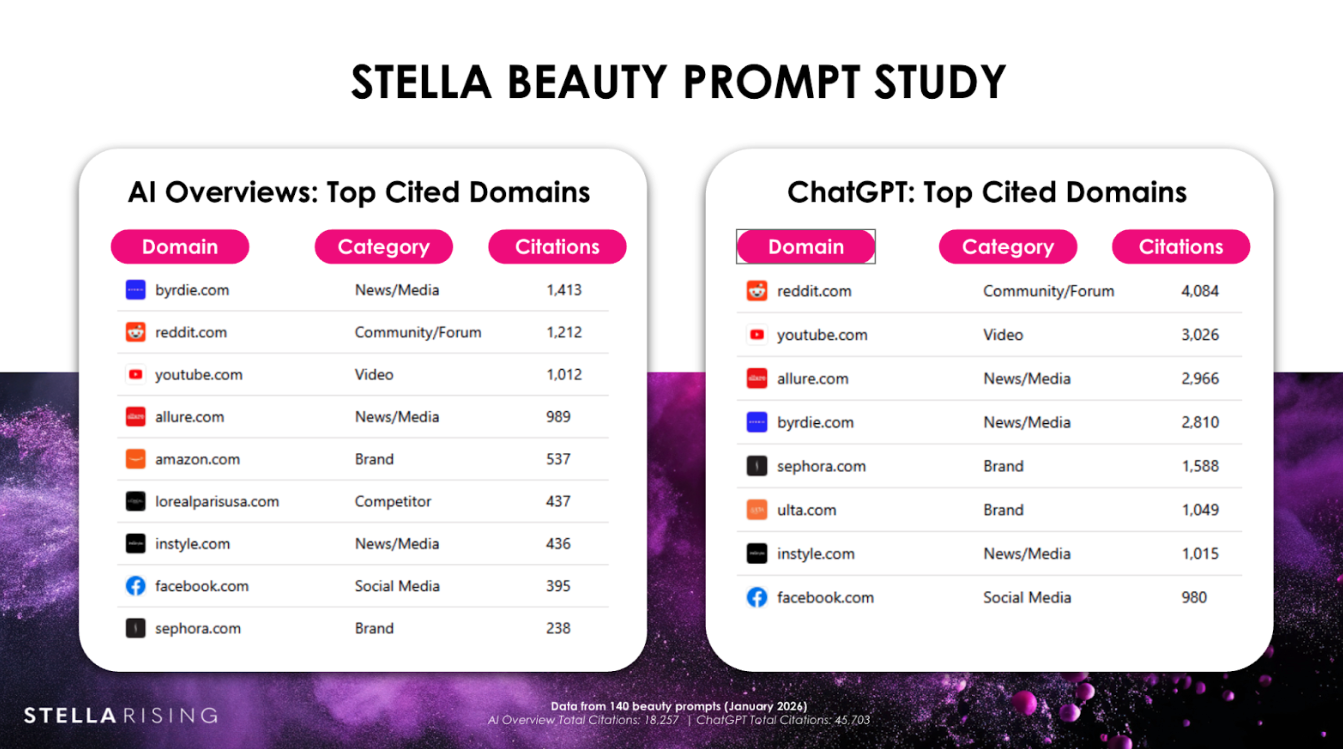
    In a study I worked on with a beauty brand, platforms like Reddit, YouTube, and Facebook often topped the list of cited domains in AI Overviews and ChatGPT.

    Stella beauty prompt study

    While Reddit might seem anti-brand, YouTube frequently appears in citation data, posing a valuable, yet often overlooked, opportunity for citation optimization.

    Dig deeper: Social and UGC: The trust engines powering search everywhere

    @media (max-width: 768px) {.headline-responsive {font-size: 30px !important; line-height: 1.3 !important;}}

    The Volume Reality: Social Behavior Outpaces AI

    It’s easy to be drawn to stats about AI usage, from prompt numbers to daily activity levels. Yet when you compare these figures against business goals like traffic or transactions, the reality shifts.

    Social platforms are a core part of mainstream search behavior. For many, searching on TikTok or YouTube is second nature. In fact, almost 40% of TikTok users search the app multiple times a day, with 73% doing so at least once daily.

    ```json
{
  "alt": "Comparison of top cited domains from AI Overviews and ChatGPT in the Stella Beauty Prompt Study.",
  "caption": "Explore how AI Overviews and ChatGPT rank top cited domains in the beauty industry. Reddit, YouTube, and news media sites dominate the rankings in this unique study.",
  "description": "The Stella Beauty Prompt Study reveals the top cited domains for AI Overviews and ChatGPT. AI Overviews mention sites like byrddie.com and reddit.com, while ChatGPT frequently cites reddit.com and youtube.com. Categories include News/Media, Community/Forum, and Brand. The study highlights the influence of various platforms in beauty discussions, based on a data set from January 2026, comprising 140 beauty prompts."
}
```

    Referral data highlights the difference. In a 12-month review of 973 ecommerce sites, only about 0.2% of traffic came from ChatGPT referrals, while Google’s organic search was nearly 200 times larger.

    Though AI search is growing and valuable, social platforms and traditional search still dominate in terms of behavior, sessions, and transactions.

    The Validation Loop: Why AI Needs Social

    Optimizing for social is akin to optimizing for AI. Large language models don’t serve as primary truth sources. Instead, they reflect human consensus from the data they process.

    AI systems often regard brand-owned sites skeptically. A study showed that just 25% of sources in AI-generated responses were brand-managed.

    Conversely, these engines prioritize third-party validation. Research by OtterlyAI showed up to 6.4% of AI citation links came from Reddit, surpassing many traditional publishers.

    A measurable link exists between sentiment and visibility. Positive brand sentiment on social platforms correlates with higher visibility in AI results.

    Dig deeper: The social-to-search halo effect: Why social content drives branded search

    Video and Expert Authority Shape AI Visibility

    Seeing video solely as a social or branding channel rather than a search surface misses the mark.

    On platforms like TikTok and YouTube, AI uses spoken language, text, and captions to assess trust. Within beauty, for example, Google’s daily search volume dwarfs ChatGPT’s, yet “how-to” prompts find favor with video due to its detailed advice.

    Beauty has split into two realms according to Yotpo’s analysis. Brands like Paula’s Choice excel in AI for their detailed educational content, while traditional marketing brands lag.

    Terms like “dermatologist recommended” rank high in AI as language models prefer expert endorsements for ranking.

    Breaking the High-Production Barrier: Content at Scale

    ```json
{
  "alt": "The CapmatchOne logo with a gradient circle and bold text.",
  "caption": "Discover innovation with the CapmatchOne logo, featuring sleek typography and a modern gradient circle.",
  "description": "The CapmatchOne logo features bold, modern typography coupled with a gradient circle, symbolizing connection and innovation. The sleek design conveys a sense of progress and creativity. This image can be used for branding or promotional purposes, appealing to audiences interested in innovative solutions and forward-thinking designs."
}
```

    Budget is often seen as a blocker. Many assume Hollywood-level production is needed for success. This is an outdated view.

    Today’s landscape rewards authenticity over perfection with viewers seeking real stories, not polished ads.

    Effective video optimization doesn’t require film school. Brands can tap into internal skills without new hires.

    • Partner with creators: Using platforms like Billow or Social Native, brands can collaborate with creators for as little as $500. This investment can translate into tangible search visibility.
    • Utilize social-savvy staff: Often, your best asset is internal. Encourage team members who use social media to generate authentic content while fostering a creative culture.
    • Focus on strategy: Major followings aren’t essential. I’ve seen a TikTok account start modestly with a part-time creator end up generating significant views in months by targeting valuable search terms.

    Starting fresh with a limited budget doesn’t mean limited reach. Businesses need clarity on their goals and a disciplined approach.

    Dig deeper: How to optimize video for AI-powered search

    @media (max-width: 768px) {.headline-responsive {font-size: 30px !important; line-height: 1.3 !important;}}

    The New Beauty SEO Playbook for 2026

    The fact is clear. Brands can’t excel in generative AI without dominating social discussions.

    AI models are mirrors of web consensus. If there’s no buzz around a brand on platforms like Reddit or YouTube, AI has little to work with.

    If brands wait until users hit a ChatGPT prompt to influence perceptions, they’re too late.

    Discovery and validation are driven by social proof and algorithmic citations.

    To capitalize on this, brands should rethink their team structures and priorities:

    • Eliminate silos: My SEO and social teams should collaborate, not operate in isolation. Both need to focus on search visibility.
    • Focus on “why”: Beyond technical fixes, we should build cases for how social sentiment and expert endorsements improve market share.
    • Be resourceful: Leverage $500 creator partnerships or internal social enthusiasts to create authentic content now.

    We’re moving towards community-driven discovery rather than just algorithm-centric approaches.

    This approach is multidisciplinary and, if done right, can significantly boost business results.


    Inspired by this post on Search Engine Land.


    crushpress.ai community screenshot
  • Enhance Marketing Success with Profound’s Knowledge Bases

    Enhance Marketing Success with Profound’s Knowledge Bases

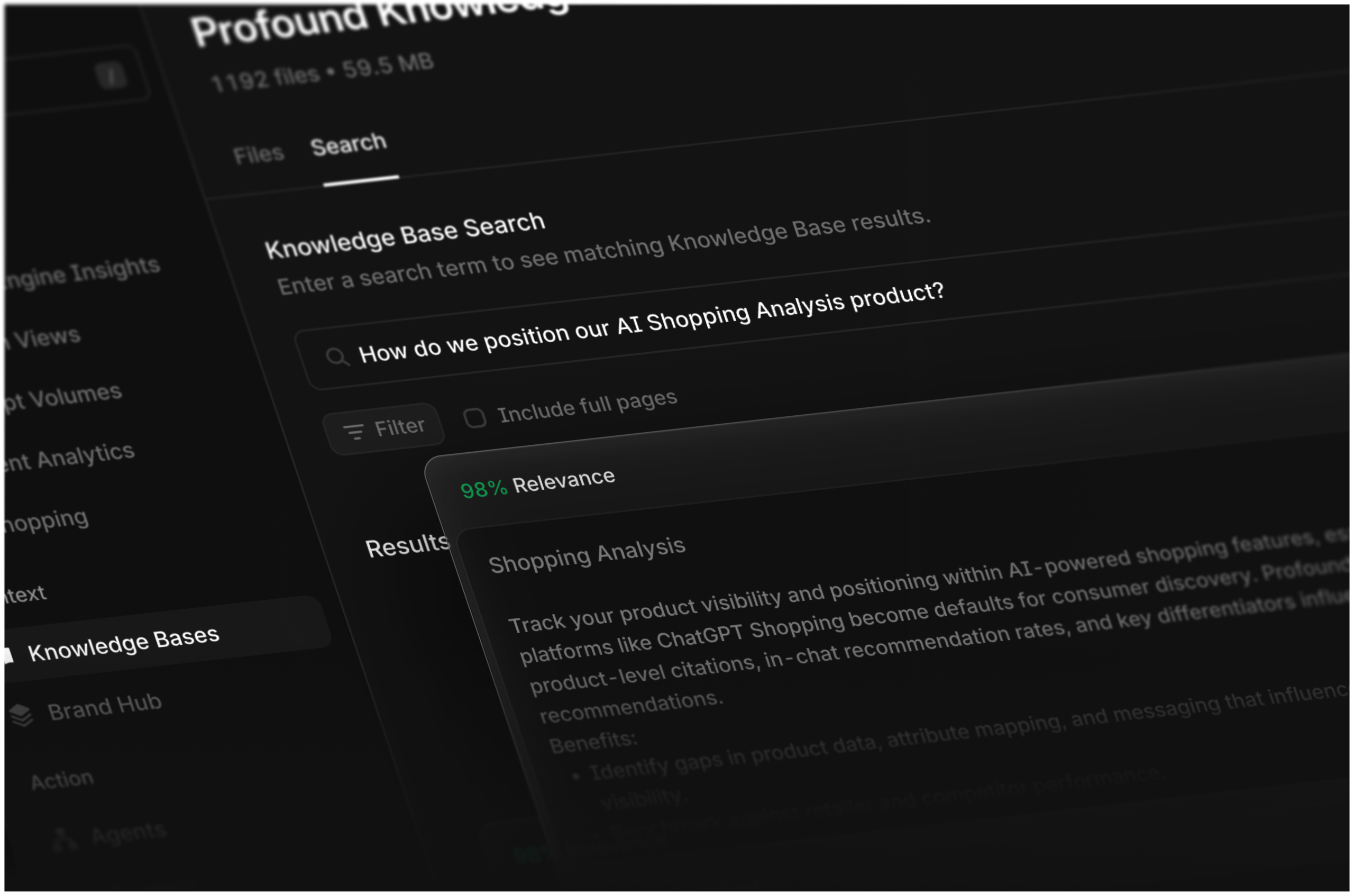
    As someone deeply involved in marketing, I know how crucial it is to have access to accurate and comprehensive company information. That’s why when our marketing team uses Profound to upload Knowledge Bases, it gives us a single source of truth for company-specific data.

    This capability empowers us, as agents, to provide the right context about your brand every time we execute a marketing action on your behalf. This streamlined approach ensures consistency and accuracy in representing your brand.


    Inspired by this post on Try Profound Blog.


    crushpress.ai community screenshot