I keep hearing people suggest that AI understands their brand. It really doesn’t. Let’s clarify that upfront.
What AI actually does is pattern-match at a large scale. It condenses your brand’s positioning, product features, and tone into a series of signals that can be rapidly retrieved and remixed.
These patterns originate from two main processes:
Training: This involves what the AI model has previously absorbed.
Retrieval: This pertains to what the model can access in real-time from the current web and other sources.
The concept of “AI SEO” isn’t about creating a new channel; rather, it presents a representation challenge: which version of your brand is encoded, retrieved, and reiterated.
Many brands are already participating, but they often lack a deliberate strategy.
The Internet Has Evolved Beyond a Library
Traditional SEO operated like a library issue: you publish, Google indexes, and human searches lead to discovery.
Today’s AI-driven search is more conversational, gradually moving visibility from simple head terms to context-rich prompts like:
“With these constraints”
“Similar to this competitor but more affordable”
“Which tool suits a team like mine with these criteria?”
“Based on what you know about me, recommend…”
My role is to ensure that my brand stands out as the most relevant match within a model’s memory and retrieval pipeline.
It’s not about being ranked; it’s about how you’re represented.
AI relies on associations, not opinions.
From Keywords to Entities to Embeddings
Classic SEO targeted keywords, moved to entities, and now AI operates at a deeper level by translating entities into vectors.
This means my brand becomes a point in a dimensional space—close to some concepts, distant from others, shaped by repeated associations in content and mentions.
If my brand is consistently linked with terms like “enterprise analytics,” “real-time dashboards,” and “data governance,” it clusters near those concepts.
If my messaging leaks into unrelated areas due to repetitive content fatigue, my brand’s vector becomes less precise, resulting in lower confidence and a higher chance of being overshadowed by a competitor who signals more clearly.
Three Layers of AI Brand Visibility
Before tackling “AI SEO” issues, I need to pinpoint which layer my brand is failing on. Different strategies are required for each layer.
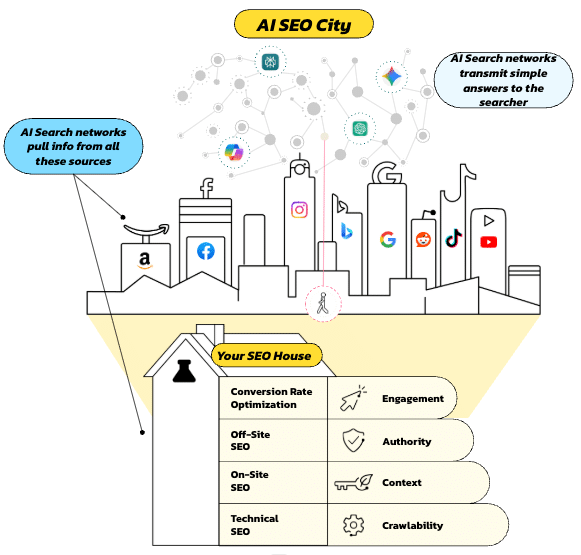
Training Layer
This encompasses my brand’s historical presence—press releases, blogs, documentation, reviews, even forgotten forum threads.
While full control isn’t possible, I can minimize fragmentation by updating past mentions to foster a consistent online identity.
Grasp the training layer by asking an AI chatbot to describe my brand with web search disabled.
Retrieval Layer
This involves my brand’s active web presence—indexed pages, product feeds, APIs—where traditional SEO of crawling, indexing, and rendering is crucial for defining accessible information.
Grasp the retrieval layer by conducting branded intent and market category prompts regularly using a large language model tracker, and observing consistently cited sources.
Generation Layer
In AI Overviews, AI Mode, or ChatGPT instances, my brand’s paragraph only appears if it’s essential.
I need to ask myself: what unique, quotable content ensures the LLM mentions my brand?
Grasp the generation layer by analyzing brand mentions in responses and their semantic relationships using LLM tracker data.
Four Mechanics that Decide What AI Says
Consider these mechanisms as the subtle forces shaping representation across the layers.
1. Consolidation (Identity Resolution)
AI systems consolidate brand references if there’s an obvious connection.
My brand might have varied forms:
A brand name (inconsistent spacing or casing).
A legal name.
A domain name.
An abbreviation.
A legacy name.
Humans merge these effortlessly; models don’t. They consolidate based on patterns, not intent. Every inconsistency spells fragmentation.
Allowing multiple representations of my brand divides its visibility signals.
2. Co-occurrence (Association Formation)
Models learn through co-occurrence:
Brand + category
Brand + use case
Brand + audience
Brand + competitor
Consistent pairing strengthens associations; inconsistency weakens them. It’s that straightforward.
3. Attribution (Who Says It, Where)
Models monitor who describes the brand, by whom, and in which context.
First-party mentions hold one layer; third-party mentions are another. High-trust sources carry greater significance.
This isn’t due to “authority” in traditional SEO, but because these sources frequently emerge within reliable contexts in both training data and retrieval corpora.
4. Retrieval Weighting (What Gets Used in AI Answers)
When generating answers, AI systems choose which data to use, based on clarity, relevance, uniqueness, and extraction ease.
If essential facts are hidden between metaphoric lines, models will source elsewhere. Explicit repetition and structured, direct facts foster selection by the model.
You’re Not Writing Poetry, You’re Building a Graph
In both on-page and off-page content, core entities must be unmistakable: my brand, products, categories, audience, and differentiators.
Crafting a consistent, clear, canonical position ensures that machines comprehend it without errors.
Brand is a market category for audience needing use case, differentiated by proof.
I must honestly evaluate if my answers could apply to competitors, or better yet, ask AI to determine that. If validation is positive, a rewrite makes it distinctively me.
Subsequently, roll out the positioning consistently across various media: on-page with structured chunks, in data references, in “sameAs” links, industry publications, partner sites, user reviews, community discussions, and social media.
Deliberate repetition and reduction of unnecessary terminology variation fortifies associations, compounding strength over time.
AWarn against brand drift where inconsistencies allow for misrepresentations and information gaps invite AI hallucination. Vigilance on content edges, consolidation, or removal of conflicting pages is crucial.
It’s not about outsmarting AI, but minimizing entropy.
If this sounds mundane, that’s a positive sign. Brands poised to thrive in the AI era won’t rely on clever tactics but on disciplined execution.
Inconsistent answers lead to your brand’s misrepresentation. AI systems might unintentionally pass along an unintended version of your brand to potential customers.
First 5 Steps to AI Brand Visibility
1. Establish your brand’s canonical bio: Define spacing, casing, abbreviation norms, and clear positioning for the brand name.
2. Implement graph-based schema: Identify linkage between your brand (consolidated by “sameAs”) and vital entities.
3. Make proofs easily quotable: Ensure that awards, benchmarks, customer figures, policies, and notable brand details are prominent and retrievable.
4. Rectify historical identity fragmentation: Address and unify past mentions to reinforce canonical positioning wherever possible.
5. Intentionally repeat key associations: Brand with category, use case, audience, competitor. Not only on your site, but expand on high-trust third-party sites.
It’s Not About You
If AI systems lack confidence in resolving your brand representation, they default to a safer choice, typically a competitor sending clearer signals. This doesn’t mean the competitor is superior, just more machine-friendly.
AI doesn’t require perfect understanding of your brand; it needs an approximation accurate enough to endorse you. My job is to manage that approximation through consistency, structure, and strategic distribution.
Not by overwhelming content production, but by ensuring my brand’s story is clear and unmistakable.
Inspired by this post on Search Engine Land.