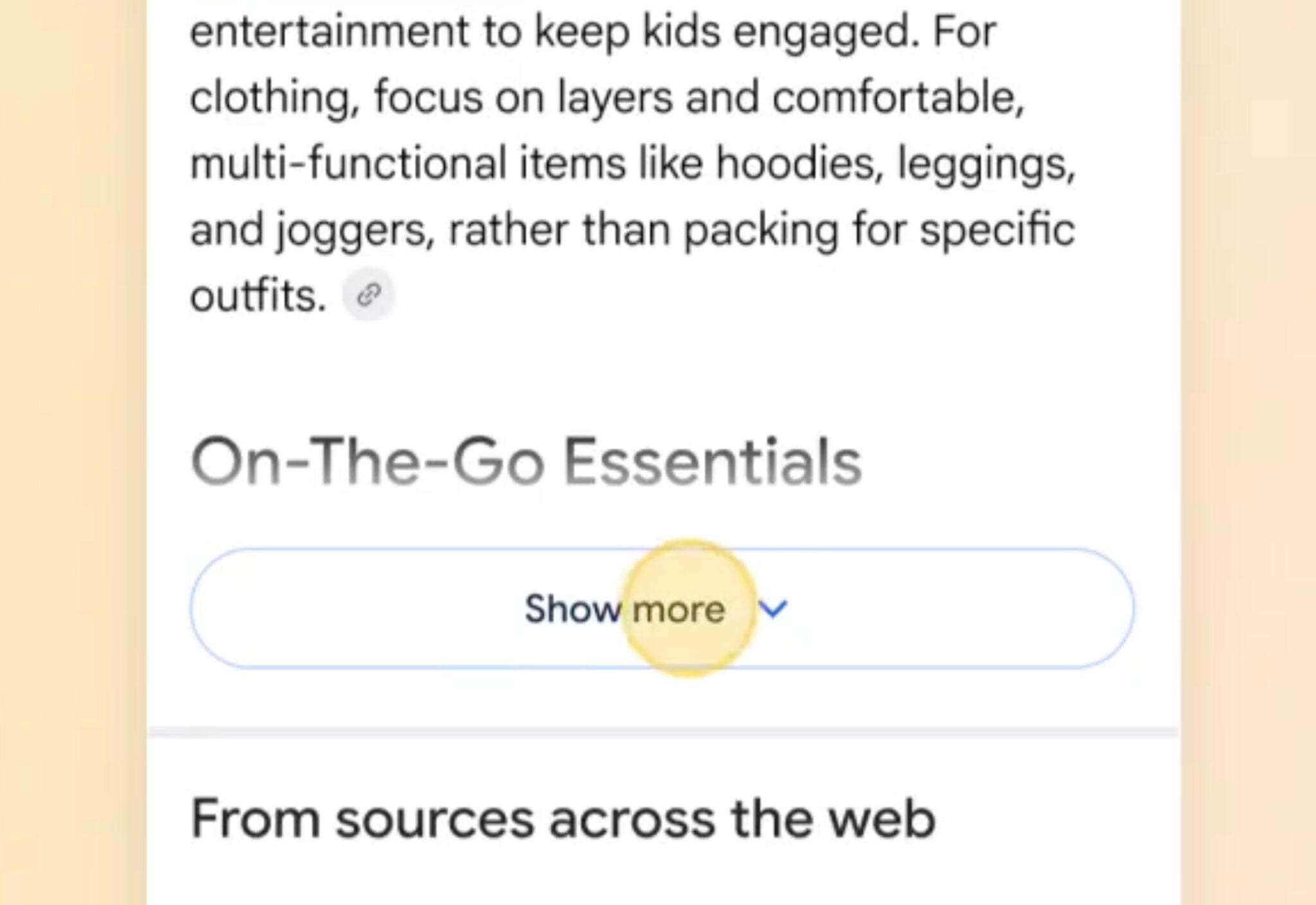
Recently, I’ve noticed that Google is testing new ways to push us from AI Overviews into their AI Mode interface on Search. When I click the “Show more” button in some AI Overviews, I’m automatically taken into AI Mode. It’s fascinating because I can continue to explore deeper into topics directly within this interface, enhancing my search experience.
Insight From Google. Robby Stein from Google recently announced that this testing is taking place on a global scale. As I use my mobile device, I can easily delve deeper into AI Mode without leaving the search results page. This seamless integration is designed to enhance how we interact with AI-driven search features.
There’s even a video that showcases how this works, sourced directly from Robby Stein’s announcement:
(2/2) This means you’ll continue to get an AI Overview as a helpful starting point, and now you can also ask conversational follow-up questions in AI Mode – right from where you are.
It’s one seamless experience: a quick snapshot when you need it, and deeper conversation when…
Previous trials. It’s intriguing to me that Google has been experimenting with this since October 2025. The frequent tests likely suggest they’re moving toward a full rollout. This makes me optimistic about how this feature might evolve over time.
The potential downside. I am concerned that fewer people might click through to external sites from Google Search AI Overviews. Instead of providing expanded links and resources, the “Show more” button directs users to a detailed AI response, potentially reducing the traffic to our websites.
Our focus. It’s crucial for us to stay informed about these tests and prepare for any potential impacts on our web traffic. This change might make it more challenging to generate visits from Google Search, affecting the overall visibility of our content and websites.
Last week, I was eager to see if Google would incorporate Gemini 3 into their AI systems. Now, it’s official: some responses in AI Mode are powered by Gemini 3, but it’s only available to Google AI Pro & Ultra subscribers in the U.S.
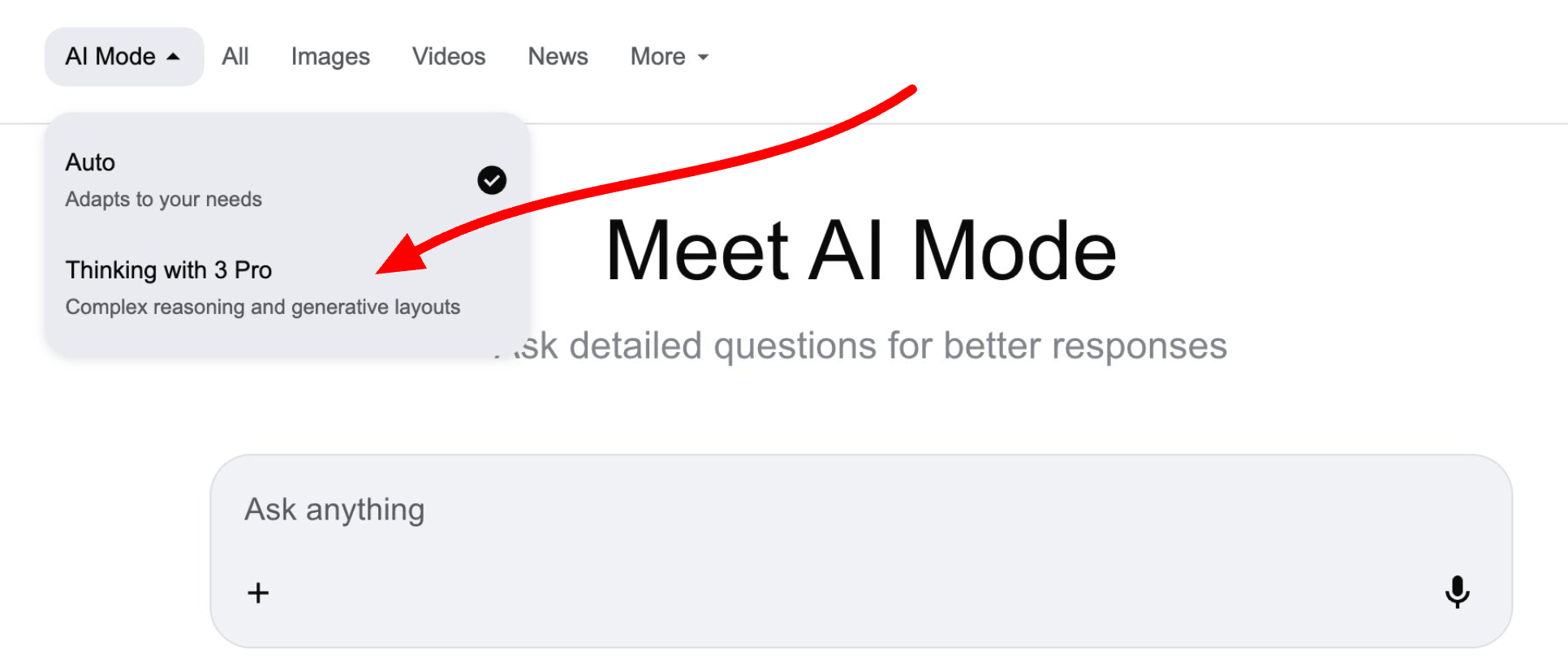
Nick Fox, Google’s SVP of Knowledge and Information, mentioned on X that the rollout of Gemini 3 in search is ongoing. He highlighted that they’ve implemented intelligent automatic model routing to Gemini 3 Pro, aimed at tackling the most challenging questions in AI Mode.
Previously, Fox included AI Overviews in this rollout. However, his latest updates have corrected this to focus solely on AI Mode. If you are a subscriber, you’ll know this feature is available if it’s an option within the AI Mode tab’s carrot menu.
From a recent blog post by Google’s Head of Search, Liz Reid, there’s an emphasis on enhancing automatic model selection in Search with Gemini 3 over the coming weeks. This means your complex queries in AI Mode could soon be channeled to this advanced model.
Introduced on November 18, 2025, Sundar Pichai, Google’s CEO, described Gemini 3 as their most intelligent model yet. It combines all of Gemini’s capabilities, aiming to bring any idea to life.
I’m particularly excited because some users might notice more visual and comprehensive results in AI Mode, especially if you’re an AI Pro or Ultra subscriber in the U.S. These changes indicate that Gemini 3 is already reshaping the search landscape.
Eventually, all AI responses will be powered by Gemini 3 until the next update is rolled out by Google. I can’t wait to see how this further enhances search experiences.
Have you ever wondered how to make your products stand out in Google AI Shopping and its AI Mode? I’ve discovered that optimizing feeds, utilizing schema, improving imagery, and crafting conversational Product Detail Page (PDP) content are key strategies to enhance visibility.
Recently, I’ve noticed more Google Ads appearing directly within Google’s AI Mode results. This change suggests that Google’s test has been quietly advancing, signaling the emergence of a new ad space in Google Search.
Here’s what I’ve observed. Back in May, Google confirmed they were testing ads in AI Mode on desktop, and these sightings have notably increased:
One notable instance was when Greg Sterling shared a screenshot related to an HVAC repair query, marking the first time he noticed an AI Mode ad in the wild.
Brodie Clark soon after replicated this behavior, declaring “the time has come” as he provided multiple screenshots showing ads within the generated answers.
Additionally, Barry Schwartz reported ongoing instances of users encountering these AI Mode ads on Search Engine Roundtable.
Why this matters to us. The inclusion of ads within AI Mode represents a substantial shift in how Google’s merging sponsored content with AI-generated answers. This development could significantly alter visibility, click-through rates, and the overall search experience. For early adopters, this offers opportunities for reduced competition, novel formats, and greater engagement. It’s becoming clearer that AI Mode is transforming into a legitimate advertising channel rather than just an experiment.
Reading between the lines. This expansion indicates Google’s move to integrate ads within AI experiences, likely preceding a broader rollout in Search.
The bottom line. Starting as a small test, this feature appears more commonly now. Advertisers should prepare for AI Mode to evolve into a mainstream advertising surface in Google Search.
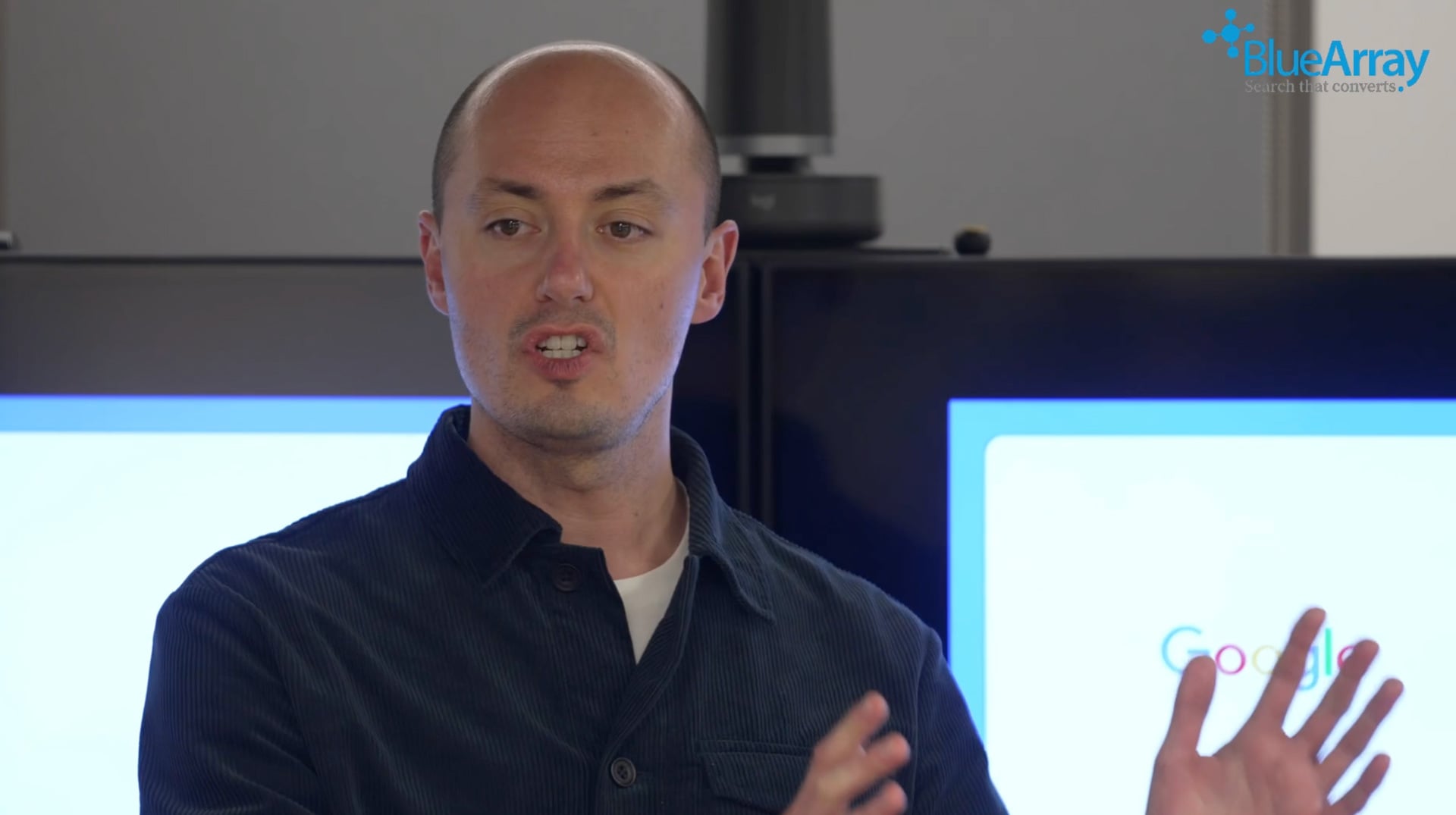
I attended a fascinating talk yesterday at the Simply Business headquarters in London, where Jonathon Heard, the Industry Head, Insurance at Google, shared some groundbreaking insights. He revealed that Google Search is gearing up to direct complex queries straight to AI Mode, effectively bypassing the traditional search process.
Heard also hinted at future enhancements in Google Search Console, aiming to provide separate reports for AI Mode and AI Overviews.
Bypassing Google Search. According to Heard, with the advent of Gemini 3, complex queries will be automatically channeled through AI mode, a feature currently being tested in the US.
One curious attendee asked about the implications of these changes. Heard confirmed that any query entered in the standard Google search could indeed be redirected to AI Mode. This revelation sparked a lively discussion, as the audience realized the significant shift this represents.
Although Google previously hinted that AI Mode might become the default search experience, they later retracted those statements. Robby Stein from Google downplayed the speculation, emphasizing the company’s focus on easy access to AI Mode for interested users.
AI Mode & AI Overview Search Console data. During the panel discussion, Simon Schnieders, Founder of Blue Array, inquired about the potential for separate AI Mode and AI Overview data within Search Console. Currently, these data points are lumped together, making it challenging to assess their individual performance.
Heard responded that Google is actively exploring this possibility, acknowledging the need for new data structures as search interfaces evolve. Schnieders welcomed this openness, noting it was the first time a Google representative had mentioned it.
Heard further elaborated, highlighting the rapid pace of change and the necessity to adapt reporting structures to keep up. He mentioned that although nothing is publicly announced yet, the transformation in reporting is a constant conversation within Google.
Here is the video of the event:
Why we care. I’ve reached out to Google to confirm the accuracy of Jonathan Heard’s statements. If Google transitions to an AI-centric approach bypassing traditional search, it will dramatically alter how users discover websites, content, and services.
Additionally, Google’s reticence to discuss AI Mode and Overview data in Search Console since the SGE demo could signal substantial upcoming changes. We will update this story as soon as we receive new information.
I’m excited to share that Google has just introduced its latest AI marvel, Gemini 3. Sundar Pichai, Google’s CEO, described it as ‘our most intelligent model, combining all of Gemini’s capabilities to bring any idea to life.’
As I delve into Gemini 3, I find it fascinating that it’s already powering the AI Mode in Search, bringing more complex reasoning and dynamic experiences right at our fingertips. Sundar Pichai highlighted, ‘This is the first time we are shipping Gemini in Search on day one.’
AI Mode with Gemini 3. I’m thrilled to see how AI Mode in Search has evolved with Gemini 3, offering new generative UI experiences like immersive visual layouts and interactive simulations, all dynamically created based on our queries.
Here’s a video demonstration showing how RNA polymerase functions with generative UI in AI Mode in Search. Watching it helped me better grasp these complex concepts.
Robby Stein, VP of Product at Google Search, emphasizes how ‘Gemini 3 with generative layouts will make it easy to understand anything on your mind.’ It offers state-of-the-art reasoning, deep multimodal insights, and advanced agentic capabilities, making it shine in explaining advanced concepts or even coding interactive visuals instantly.
More on Gemini 3. Diving deeper, I discovered that Gemini 3 features:
State-of-the-art reasoning
Deep multimodal understanding
Powerful vibe coding for seamless transitions from prompts to apps
Enhanced agentic capabilities for executing tasks efficiently
Availability. I’m pleased to report that Gemini 3 is not just limited to AI Mode; it’s also accessible in:
The Gemini app and for Google AI Pro and Ultra subscribers in AI Mode in Search
Developers can integrate it via the Gemini API in AI Studio, on Google’s new agentic development platform, Google Antigravity; and through Gemini CLI
Enterprises can leverage its power through Vertex AI and Gemini Enterprise
Why It Matters. For me, understanding Gemini 3’s impact is crucial as it continues to drive the future of Google Search. Staying ahead of these advancements is vital as they influence search dynamics and potentially impact sites and Google Ads strategies.
Recently, I’ve been exploring the latest features Google has introduced to streamline travel planning. With the release of AI Mode, Google now offers advanced ways to book flights and hotels, along with new tools to organize trips and discover deals more efficiently.
Among these updates is the introduction of Canvas in AI Mode, which aids in travel planning, and the global rollout of flight deals. Additionally, Google’s agentic booking now allows for seamless dinner reservations, flights, and hotel bookings directly through their platform.
I noticed these features are quite similar to the AI Shopping updates that were announced last week. But, what stands out is the agentic capability of Google AI Mode. It not only suggests restaurants, hotels, and flights but also assists with the booking process. Previously, these features were exclusive to Google Labs, but now anyone can access them without opting into Labs.
The dinner reservation feature is particularly exciting. In the U.S., it’s now rolling out with integration through platforms like OpenTable, Resy, and more.
Looking ahead, Google plans to enhance its AI Mode to assist in booking flights and hotels. They’re collaborating with industry partners to allow users to describe their travel preferences and effortlessly compare options based on schedules, prices, and reviews before completing bookings with chosen partners.
I’m really intrigued by how the travel booking process will evolve with these innovations. Google is working closely with well-known partners like Booking.com, Expedia, and Marriott to refine this experience.
Further enhancing our travel experience is the Canvas feature in AI Mode. It’s now available on desktops in the U.S., offering a space to manage and strategize travel plans effectively.
Google’s flight deals feature is also expanding into over 200 countries and supporting multiple languages, making it easier to find great travel bargains by simply describing your travel desires as you would to a friend.
The landscape of travel planning is changing, and as someone who’s invested in these innovations, I see these AI tools as pivotal in shaping the future of travel-related businesses. If you’re in the travel sector, understanding and adapting to these changes is crucial.
Have you ever wondered which brands are thriving, which are waning, and which remain steady within AI search platforms? I’ve delved deep into Semrush’s AI Visibility Index, and I’m here to share strategies to safeguard and enhance your visibility.
AI search is a dynamic field that’s evolving rapidly. Over the past three months, it’s become clearer which brands stand out and which sources AI models prefer to trust.
In examining three months of AI Visibility Index data, particularly from ChatGPT and Google AI Mode, I’ve realized just how volatile AI search truly is, a pattern likely to persist in the near term.
Brands that come out on top are those who consistently monitor and adjust to these changes as they unfold.
The research includes a study of 2,500 real-world prompts across five crucial sectors: Business & Professional Services, Digital Technology & Software, Consumer Electronics, Fashion & Apparel, and Finance. It unveils dramatic shifts in source diversity, brand mentions, and model behavior—info no marketer can afford to ignore.
What Changed at a Model Level?
ChatGPT: Unique brand mentions fluctuated, while the number of sources cited grew by 80% in October alone, showing a move toward greater source diversity.
Google AI Mode: From August to October, brand mentions dropped by 4%, hinting at stricter recommendation controls. Source diversity saw a moderate 13% rise, indicating a more conservative stance compared to ChatGPT.
Key Trends Over Three Months
Reddit’s Correction and Resurgence: ChatGPT reduced Reddit mentions by 82% but maintained it as the fourth most-cited source. Meanwhile, Google AI Mode’s use of Reddit increased by 75%, becoming the second top source. Both platforms are recognizing Reddit’s value, albeit differently.
Brand Diversity Varies by Vertical and Model: ChatGPT noted a 20% rise in unique brand mentions in Consumer Electronics, while Finance saw a 15% decline. Conversely, Google AI Mode saw a decline across almost every vertical, underscoring the need for model-specific strategies.
Top Brands Remain Relatively Stable: Over three months, 25 new brands joined the top 100, yet only two cracked the top 50. Leading brands’ visibility changes stayed within a ~20% range, much narrower than the overall market turbulence.
Source Strategies Must Be Model-Specific: ChatGPT and Google AI Mode agree on brand mentions 67% of the time, but agree on sources only 30% of the time. Dominant sources include Wikipedia, Forbes, and Amazon for ChatGPT, while Google AI Mode favors Amazon and YouTube.
I’ve learned that maintaining AI visibility requires ongoing vigilance. Both platforms are testing diversity, adjusting for past overdependencies, and refining strategies.
What This Means for Your Strategy
In the ever-evolving world of AI search, past visibility doesn’t secure future success.
Both ChatGPT and Google AI Mode feature 61 of the top 100 brands, indicating strong brand overlap. However, source overlap is much less and has decreased from August to October.
Translation: Enhance your brand’s visibility on both platforms but customize your source strategy based on each model’s nuances.
Explore the AI Visibility Index to access full rankings, interactive leaderboards, and comprehensive trends across all five sectors. Download proven strategies to bolster your visibility in this swiftly changing domain. It’s complimentary!