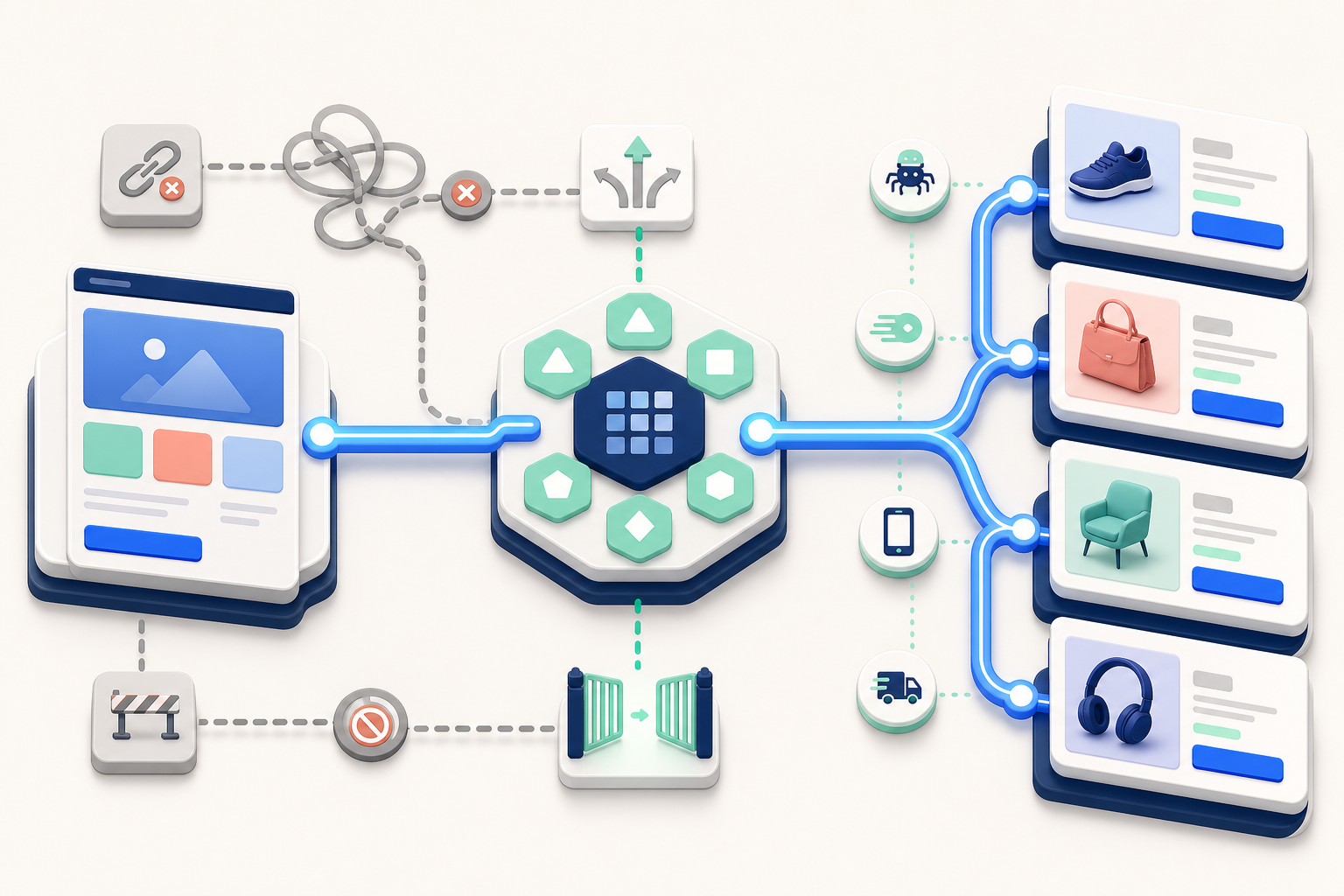
Tag: Analytics

  • How to Measure AI Search Visibility, Traffic, and Results

    How to Measure AI Search Visibility, Traffic, and Results

    Your AI search dashboard can look healthy while telling you almost nothing. A brand mention is not a citation, a citation is not a visit, and a visit is not a business result. Some visits are also hidden inside direct traffic, so even the traffic line is incomplete.

    You need a measurement system that keeps exposure, traffic, and outcomes separate until the evidence connects them. That gives you defensible reporting, reveals attribution gaps, and tells your content team what to improve next.

    Measure visibility, traffic, and outcomes as separate layers

    The first mistake is forcing AI search into a single channel metric. Conventional analytics starts when somebody reaches your site. AI visibility starts earlier, when an answer engine decides whether to mention your brand, cite your page, or use another domain instead.

    That distinction matters because AI search optimization depends on understanding intent and satisfying the underlying need. A useful answer may earn visibility without earning a click. Conversely, a person may encounter your brand in an AI answer and visit later through branded search, a bookmark, or an untagged direct session.

    Measurement layerWhat you recordQuestion it answers
    VisibilityPrompt observations, brand mentions, citations, cited URLs, answer accuracy, competing domainsAre AI systems representing and recommending you?
    TrafficRecognized AI referrals, landing pages, engagement, and unattributed visits kept in a separate uncertainty cohortWhich observable visits came from AI experiences?
    OutcomesQualified actions, leads, sales, subscriptions, assisted conversions, or another result matched to the page’s purposeDid the exposure or visit create value?

    Do not add these layers into one score. They have different denominators and different blind spots. Report them together, but preserve the path from observation to result.

    Keep individual surfaces separate as well. Google AI Overviews and AI Mode can be measured as distinct environments; the same principle applies whenever platforms offer materially different answer experiences. A combined “AI visibility” total can hide a gain on one surface and a loss on another.

    Build a repeatable AI visibility panel

    A circular monitoring instrument repeatedly samples blank query cards, web-page tiles, citation symbols, and geometric brand tokens arranged in a grid.

    A visibility score only means something when it comes from a stable observation panel. If the prompts, locations, devices, or account conditions change between runs, a rising score may reflect a different sample rather than better performance.

    Start with the questions that matter to the customer’s decision, not a large list of convenient keywords. Include the different jobs an answer engine may be asked to perform:

    • Problem discovery: questions describing the pain, task, or desired outcome before the customer knows the category name.
    • Category evaluation: requests for approaches, tools, providers, or methods that could solve the problem.
    • Comparison: prompts asking about differences, trade-offs, alternatives, or selection criteria.
    • Validation: questions about implementation, compatibility, limitations, trust, or evidence.
    • Brand and entity checks: prompts that test whether the system understands what your organization does and when it is relevant.

    Group those prompts by topic and intent. Assign each prompt a permanent identifier so wording changes do not break the historical series. When you add, remove, or rewrite prompts, version the panel and mark the change on the dashboard.

    For every observation, retain enough context to reproduce or explain it:

    • Platform and answer surface
    • Exact prompt and prompt identifier
    • Observation time
    • Country, language, device class, and account state when those conditions can affect the answer
    • Full answer or a durable capture of it
    • Whether the brand appears
    • Whether the brand is recommended, merely listed, or mentioned in another context
    • Every cited domain and URL
    • Whether an owned page receives a clickable citation
    • Competing brands and domains appearing in the same answer
    • Whether important claims about the brand are accurate, incomplete, or wrong

    The raw observation is essential. A dashboard total cannot explain whether a lost citation resulted from answer variability, a changed prompt, a removed page, or a competitor becoming more useful for the question.

    Use metrics with explicit denominators

    Define every visibility metric in the measurement specification before publishing it. Useful definitions include:

    • Answer presence rate: observations in which the brand appears, divided by eligible observations in the tracked panel.
    • Citation rate: observations containing a link to any supporting page, divided by eligible observations.
    • Owned citation rate: observations citing an owned URL, divided by eligible observations.
    • Recommendation rate: observations that recommend or shortlist the brand, divided by observations in which a recommendation could reasonably occur.
    • Cited-page distribution: the owned URLs receiving citations and their share of all observed owned citations.
    • Accuracy rate: brand-containing observations without a material factual problem, divided by all brand-containing observations reviewed for accuracy.

    Label these as observed rates within your tracked panel. They are not market-wide shares. A prompt set weighted toward your strongest topics will naturally produce a better result than one weighted toward unfamiliar categories.

    Mentions and citations also need separate fields. A brand can be visible without receiving a link, while an owned page can be cited without the brand playing a prominent role in the answer. Treating both as “wins” prevents you from knowing whether to strengthen entity clarity, improve page-level evidence, or fix a specific claim.

    Repeat observations under declared conditions and preserve the individual results. AI answers can vary, so one response should not become a permanent ranking claim. Any platform used to monitor brand visibility and authority in AI search should let you inspect the observations behind its aggregate score and export them for independent analysis.

    Recover AI referral traffic without relabeling direct visits

    Tagged and untagged visit particles flow through a website gateway, where an analysis device reconnects some hidden visits to their referral source.

    Referral reporting gives you a useful lower bound, not a complete count. When an AI experience passes a recognizable referrer, analytics can map that visit into an AI referral channel. When it does not, the session may land in direct traffic.

    This is particularly important on mobile: clicks from LLM apps such as ChatGPT can appear as direct traffic. That behavior creates an attribution gap, but it does not make every mobile direct visit an AI visit. Direct traffic also contains other sessions with missing or unavailable acquisition information.

    Create a known AI referral channel

    Build the channel from acquisition values you can actually observe. The implementation should be auditable:

    1. Preserve the original referrer, source, medium, landing URL, device class, and timestamp before applying channel rules.
    2. Maintain a version-controlled mapping of observed AI-related referrer hostnames and acquisition values. Record when each rule becomes active.
    3. Normalize matching visits into a “Known AI referral” channel while retaining the original value for investigation.
    4. Separate human referral sessions from crawler or bot requests. A request from an AI crawler is not evidence that a person saw or clicked an answer.
    5. Review unmatched referrals and sudden direct-traffic changes as part of routine data quality work. Update the mapping only when the evidence supports the classification.

    Never overwrite the raw acquisition field. Platform naming and referral behavior can change, and you will need the original value when rebuilding historical classifications.

    Keep possible AI visits in an uncertainty cohort

    You can create a diagnostic cohort for unattributed visits that have characteristics consistent with AI discovery. For example, a direct session may land on a deep informational page shortly after that page begins appearing as a citation in your visibility panel. That is a useful investigation signal, not proof of origin.

    Name the cohort honestly, such as “Unattributed direct visits to AI-visible pages.” Show it beside known AI referrals, not inside them. Do not use the entire cohort as an upper estimate of AI traffic unless you have a validated model that accounts for the other reasons referrer data may be absent.

    UTM parameters help only on links you control. Use consistent utm_source, utm_medium, and utm_campaign values in owned assistant experiences, profile links, campaigns, or other placements where you set the destination URL. You cannot reliably retrofit tracking parameters onto citations independently generated by a third-party answer engine.

    This produces two honest traffic views: confirmed referrals and a separately labeled attribution gap. That is less dramatic than claiming every unexplained session, but it gives analytics, SEO, and leadership a number they can defend.

    Connect AI exposure to business outcomes

    Visibility is useful only in relation to the job the page and brand need to perform. An informational page may be expected to move a reader toward another resource. A product page may need to generate a trial, purchase, or sales conversation. A support page may need to resolve a task without creating another contact.

    Assign a primary outcome to every URL that appears in the visibility panel. Then inspect the complete path:

    • Observed exposure: the brand or owned page appears in an answer.
    • Citation opportunity: the answer includes a clickable owned URL.
    • Attributable visit: analytics records a known AI referral.
    • Qualified action: the visitor completes the action appropriate to that page.
    • Commercial or operational outcome: the action becomes revenue, pipeline, retention, resolution, or another defined business result.

    Preserve the denominator at each transition. Referral conversion rate uses known referral sessions, not all visibility observations. Citation click-through cannot be calculated unless you know both the eligible citation exposures and the resulting clicks. When the exposure count is unavailable, call the visit count a referral count rather than a click-through rate.

    Use page and query cohorts when evaluating broader search effects. AI Overviews can affect website traffic, but a before-and-after change in total organic sessions does not isolate that effect. Rankings, demand, seasonality, site releases, measurement changes, and competing search features can move at the same time.

    A more defensible impact analysis follows this sequence:

    1. Define the event you are evaluating, such as an AI Overview beginning to appear for a tracked query group or an owned page gaining citations.
    2. Freeze the affected query and landing-page cohort so its membership does not drift during the comparison.
    3. Select a comparison cohort with similar intent or page type that did not experience the same observed change.
    4. Compare trends by query group, landing page, device, and geography where the data supports those cuts.
    5. Annotate ranking changes, content releases, tracking changes, campaigns, and demand shifts that could explain movement.
    6. Report the result as an observed association unless the design supports a stronger causal conclusion.

    Low traffic does not automatically mean low value. An unclicked mention can still influence later discovery, while a high referral count can fail to produce qualified actions. Keep brand representation, referral performance, and business contribution visible as separate outcomes.

    Your operating dashboard should therefore include the panel version and observation conditions, mention and citation metrics, known referral sessions, the unattributed diagnostic cohort, landing-page outcomes, and annotations for material changes. Set alerts from your own historical variation rather than adopting a generic threshold that ignores the size and stability of your prompt panel.

    Key takeaways

    • Measure AI visibility, referral traffic, and business outcomes as connected but distinct layers.
    • Use a fixed, versioned prompt panel and retain the raw answers behind every aggregate score.
    • Separate brand mentions, recommendations, citations, and owned-page citations because each calls for a different optimization decision.
    • Treat recognized AI referrals as a defensible lower bound. Keep suspicious direct visits in a clearly labeled uncertainty cohort rather than reclassifying them as confirmed AI traffic.
    • Evaluate traffic changes with fixed page and query cohorts, comparison groups, and annotations for other changes that could affect performance.

    Start with a high-value topic cluster and write the measurement specification before building the dashboard. Capture the prompts, answer conditions, cited pages, known referrals, and page-level outcomes in the same workflow. Once that chain is visible, your next content decision will come from evidence instead of a single opaque AI visibility score.

    References

  • Google SERP Changes: How to Keep Rank Tracking Reliable

    Google SERP Changes: How to Keep Rank Tracking Reliable

    Your ranking report drops overnight, dozens of keywords disappear, and the obvious reaction is to start fixing pages. Pause there. If Google changed what a rank tracker can collect, the chart may be showing a measurement break rather than a search-performance loss.

    You need to establish which system changed before you rewrite content, alter internal links, or escalate the result to stakeholders. The process below will help you separate collection failures from genuine ranking movement, preserve usable history, and rebuild a baseline you can trust.

    First decide whether search visibility or measurement changed

    A tracked rank is an observation, not a permanent property of a page. A tool submits a query with a defined location, language, device, and collection method, then records what it can retrieve and parse. The resulting position depends on both Google’s SERP and the tracker’s ability to observe it.

    When Google changes how a 100-result SERP can be collected, a tracker designed around the previous result set may receive different structure, shallower coverage, or incomplete observations. That can make keywords appear to fall out of the tracked range even when the underlying pages have not suffered an equivalent loss.

    This distinction matters because “not found” is not a rank. It means the tracker did not observe the URL within the result set it successfully collected. The page may have moved lower, the collection may have ended sooner, parsing may have failed, or a different URL may have appeared. Treating every missing observation as the worst possible position turns a technical unknown into a false SEO conclusion.

    Clues that point to a collection problem

    • The change begins on the same crawl or reporting date across unrelated keyword groups, directories, and sites.
    • Most of the apparent losses come from keywords that previously sat near the deepest part of the collected result set.
    • Missing, unknown, timeout, or error statuses rise at the same time as reported visibility falls.
    • The maximum observed depth changes, or the tracker stops returning URLs that used to appear below the most visible result bands.
    • Several unrelated competitors also seem to disappear rather than replace one another.
    • Google Search Console impressions, clicks, and landing-page patterns do not show a comparable break.

    Clues that point to genuine ranking movement

    • Fresh SERPs are collected successfully, and other domains consistently occupy the positions your pages lost.
    • The decline clusters around a meaningful unit such as a template, directory, page type, topic, market, or search intent.
    • The same URLs lose impressions or clicks in Google Search Console, after accounting for changes in search demand.
    • Multiple observations made with equivalent settings reproduce the movement.
    • The loss appears in the visible result bands, not only at the collection boundary.

    Google Search Console and a rank tracker should corroborate one another, but they will not match exactly. Search Console aggregates positions from real impressions across users and contexts. A tracker records controlled snapshots under its configured conditions. Use Search Console to test whether the direction and affected pages make sense, not to force a one-to-one position match.

    Audit the measurement contract behind every ranking chart

    An open data-collection device is inspected beside symbols for device type, location, language, browser, and time.

    Before changing a tool, project, or keyword set, preserve the evidence. Export the raw observations, keyword configuration, tags, error statuses, and latest unaffected report. Overwriting the setup first can erase the information you need to locate the break. A dated export is the safer starting point.

    Next, write down the measurement contract for the project. This is the exact set of conditions under which a rank is considered comparable. Because Google’s search environment and operational guidance continue to evolve, this contract should be versioned like any other analytics configuration.

    • Search engine and search property being queried.
    • Country, language, and city or regional targeting.
    • Desktop or mobile device profile.
    • Keyword universe, tags, exclusions, and ownership rules.
    • Collection cadence and the timing of scheduled runs.
    • Maximum depth the tracker attempts to inspect.
    • Whether organic results and SERP features are counted separately.
    • How canonical URLs, redirects, parameters, and alternate URLs are consolidated.
    • How missing results, collection errors, and successful no-rank observations are stored.
    • The provider, collector, or configuration version used for the run.

    If one of these dimensions changes, the observation series may no longer be directly comparable. A switch from desktop to mobile is not a continuation of the same experiment. Neither is a change in location, checked depth, keyword membership, URL consolidation, or SERP-feature handling.

    Run a controlled side-by-side check

    1. Select a stable basket containing branded and non-branded queries, visible and deep-ranking pages, and more than one site section.
    2. Run the queries with the same location, language, device, and search property used in the historical project.
    3. If the old and revised collection methods are both available, run them close enough together that normal SERP movement is unlikely to dominate the comparison.
    4. Compare observation coverage, maximum collected depth, returned URL, organic position, error status, and visible SERP features.
    5. Open a manual sample only as a diagnostic check. Match the tracker’s settings as closely as possible and do not treat your personalized browser view as a definitive benchmark.

    A clear pattern is more useful than a large sample with mixed settings. If the revised method repeatedly finds the same URLs while the historical method returns missing observations, you have evidence of a collection discontinuity. If both methods collect valid SERPs and show competitors replacing your pages, investigate an actual visibility loss.

    Rebaseline the data without erasing useful history

    Once a collection change is confirmed, resist the temptation to splice the new numbers onto the old chart as if nothing happened. Keep the historical series, mark the discontinuity, and establish which metrics remain comparable.

    Your data model should distinguish these states:

    • Observed and ranked: the SERP was collected successfully and the tracked URL was found.
    • Observed but not ranked within the configured depth: collection succeeded, but the URL was not present in the checked range.
    • Unobserved because collection failed: no valid ranking conclusion can be made.
    • Not scheduled or excluded: the keyword was intentionally absent from that run.

    Store an unknown observation as null with a separate status code. Do not convert it to a worst rank, carry the previous rank forward, or quietly remove the keyword from the denominator. Each shortcut changes the meaning of the metric and can manufacture a trend.

    Use these rules when establishing the revised baseline:

    • Annotate the first affected crawl and the first run made with the revised method.
    • Preserve raw pre-change and post-change data in separate views, even if the dashboard presents a continuous timeline.
    • Calculate comparable visibility using only keywords observed under equivalent device, location, depth, and processing rules.
    • Keep a fixed keyword cohort for trend reporting. Report additions and removals separately so keyword-set churn does not masquerade as growth.
    • Show “not comparable” for position deltas that cross the method boundary unless you have validated equivalence.
    • Backfill only when the historical collection conditions can genuinely be reproduced. A modeled reconstruction is not an observed historical rank and should be labelled accordingly.
    • Recalculate alert thresholds after the revised method has completed the normal reporting cadence used for decisions. Thresholds based on the previous distribution may trigger false alarms.

    You can still retain a long-term view. Present the historical series with a visible method-change marker, then use a separate comparable cohort for trend analysis. This preserves context without pretending the two measurement regimes are identical.

    Report coverage, visibility, and business outcomes separately

    Three connected chambers depict data collection, search-result visibility, and customer outcomes as separate measures.

    A single average rank cannot tell you whether the collector failed, positions moved, demand changed, or clicks fell. A defensible report separates those questions so the reader can see both the SEO result and the quality of the measurement.

    SignalQuestion it answersReporting rule
    Collection coverageCould the tracker observe the scheduled SERPs?Show valid observations against scheduled observations, with collection errors reported separately.
    Comparable visibilityDid rankings move for a consistently measurable keyword set?Use the intersection of keywords collected under equivalent depth, device, location, and processing rules.
    Position distributionWhere did movement occur?Show visible, deeper, and unobserved bands instead of relying only on an overall average.
    Search demandDid the available opportunity change?Review Google Search Console impressions by query, page, country, and device using consistent filters.
    Search outcomesDid organic visits or valuable actions change?Review clicks, click-through rate, landing-page sessions, and relevant conversions alongside rankings.
    Competitor replacementDid another domain take the observed space?Count actual replacements in valid SERPs; do not interpret shared missing data as a competitive gain.
    SERP compositionDid the result layout change around the organic listings?Track result features separately from organic position so layout changes remain visible.

    Lead each recurring report with collection coverage. If coverage is unhealthy, qualify every downstream ranking metric. Then show comparable visibility and position distribution, followed by Search Console and conversion outcomes. This order prevents a broken collector from becoming an unsupported story about traffic or revenue.

    Use an explicit note when the method changes: “Measurement note: On [date], the SERP collection method changed. Pre-change and post-change positions are shown for context, while trend calculations use the validated comparable keyword cohort. Coverage errors are excluded from ranking-loss counts.” Replace the placeholders with the actual date, scope, and treatment.

    Do not bury that explanation in a dashboard footnote. Anyone deciding whether to change content, budgets, forecasts, or team priorities needs to know where measurement comparability ends.

    Key takeaways for your next rank-tracking review

    • Diagnose the collection layer before treating a sudden visibility decline as an SEO loss.
    • Keep “not ranked” separate from “not observed”; they describe different events and require different responses.
    • Version the location, device, depth, keyword set, URL rules, and collection method behind every ranking series.
    • Preserve raw history, annotate the method boundary, and compare only observations gathered under equivalent conditions.
    • Pair rank data with collection coverage, Google Search Console signals, competitor replacements, and business outcomes.
    • Explain measurement changes in the main report so stakeholders do not act on a false trend.

    Before your next scheduled report, export the last clean dataset, mark the suspected transition date, and rerun a stable keyword basket under matched settings. That gives you the evidence to decide whether the next task belongs in your content backlog or your measurement pipeline.

    References

  • How to Choose AI Visibility and AEO Tools That Pay Off

    How to Choose AI Visibility and AEO Tools That Pay Off

    You have a shortlist of AI visibility tools, but every dashboard appears to promise the same thing: better presence in AI-generated answers. The difficult part is determining whether a platform will help you make better decisions or simply give you another score to report.

    The right choice starts with a narrower question: what must the tool help you observe, explain, or change? Once you define that job, you can test coverage, evidence quality, workflow fit, pricing, and business value without relying on a polished demo.

    Key takeaways

    • Choose the primary job first: monitoring AI answers, diagnosing visibility gaps, or implementing content and product-data changes.
    • Require the underlying answer, citation, query, surface, and observation time behind every visibility score.
    • Keep mentions, citations, recommendations, sentiment, and factual accuracy as separate measures. They answer different questions.
    • Evaluate pricing against your actual workload: queries, AI surfaces, markets, observation frequency, users, exports, and implementation needs.
    • Run a controlled pilot on a fixed query set before committing. Measure both AI visibility signals and the business outcomes the work is supposed to support.
    • For ecommerce, test whether the platform can keep product pages, structured data, and commercial facts consistent across ChatGPT, Google, and Amazon workflows.

    Match the tool to the job you actually need done

    AEO now spans tools, software, and broader platforms. That wide label can hide important differences. A visibility monitor, a content recommendation system, and a product-page optimizer may all call themselves AEO tools, even though they solve different operational problems.

    We find it useful to divide the market into three jobs:

    Primary jobWhat the tool should produceWhat should make you cautious
    ObserveCaptured AI answers, mentions, citations, linked domains, query context, and changes over timeA proprietary visibility score with no underlying responses
    ExplainQuery-level and page-level evidence showing where coverage, accuracy, authority, or content is weakGeneric advice that could apply to any page or brand
    ActSpecific edits, structured-data changes, product-data corrections, workflow assignments, or implementation exportsAutomated publishing without a preview, approval record, or rollback path

    A single platform may do more than one job. That is useful only if each capability is strong enough for your workflow. A content optimizer with a small tracking widget is not automatically a robust monitoring system. A tracker that identifies a weak answer is not automatically capable of fixing the page behind it.

    Write your primary use case in one sentence before you attend a demo. For example: “We need to see when our brand is cited for high-intent category questions, identify which competing domains are cited instead, and assign the affected pages to the content team.” That sentence gives you a testable requirement. “We need better AI visibility” does not.

    Ask which surfaces are truly covered

    Do not treat “AI search” as one channel. Name the surfaces that matter to your audience and ask the vendor to demonstrate each one. For an ecommerce company, that might include ChatGPT, Google, and Amazon. For another business, the relevant set may be different.

    • Which named AI experiences can the platform observe directly?
    • Does it store the complete generated answer or only a derived score?
    • Can you see the cited URL and domain, rather than a citation count alone?
    • Can results be segmented by brand, product line, market, language, and query group?
    • Does the tool distinguish a brand mention from a linked citation or explicit recommendation?
    • Can you export the observations and their metadata for independent analysis?

    Ask the salesperson to run one of your real queries and open the evidence behind the result. If the platform cannot move from a summary chart to the captured answer, you will struggle to investigate changes or defend the number internally.

    Normalize pricing to your workload

    The practical buying decision includes both feature fit and pricing fit. Sticker prices are difficult to compare until you identify what consumes the allowance. A “query” might mean a saved prompt, one observation on one AI surface, or a recurring set of observations. Those are not equivalent units.

    Build a workload estimate using the variables you control: your tracked query set, required AI surfaces, markets or languages, observation frequency, team seats, reporting needs, and implementation volume. Then ask for the cost of that workload, including exports, API access, onboarding, additional projects, and overages where applicable.

    The least expensive plan can become the wrong choice if it forces you to remove important query segments or makes raw evidence inaccessible. The most expensive plan can also be wasteful if your immediate need is a focused baseline and a content workflow. Buy enough coverage to support a decision, not the largest dashboard available.

    Require evidence you can audit and explain

    An analyst traces glowing connections from an abstract AI response to source documents and examines the evidence with a magnifying lens.

    A visibility score is a summary, not a fact by itself. Before you trust it, you need to understand the observations underneath it and the denominator used to calculate it.

    At minimum, each observation should let you recover:

    • The exact query or prompt.
    • The AI surface on which it was checked.
    • The complete answer captured by the platform.
    • The brand, product, or entity detected in that answer.
    • Any cited or linked URLs and domains.
    • The time of the observation.
    • The market, language, and other execution context you asked the platform to control.
    • The rule used to classify the result.

    This record matters because several different events are often compressed into the word “visibility.” Your brand can be mentioned without being cited. Your page can be cited without the answer describing your product accurately. Your competitor can appear more often while your own brand receives the stronger recommendation. One blended score can conceal all of those situations.

    Define each metric before the dashboard defines it for you

    You do not need an elaborate measurement model at the beginning. You do need stable definitions. A workable starting set is:

    • Mention rate: eligible observations in which the brand appears, divided by all eligible observations.
    • Citation rate: eligible observations that cite an owned URL, divided by all eligible observations.
    • Recommendation rate: eligible observations in which the brand is presented as a suitable choice, divided by all eligible observations.
    • Answer accuracy: assessed brand or product claims that match your approved facts, divided by all assessed claims.
    • Query coverage: tracked intents with usable observations, divided by the full query set you intended to monitor.
    • Cited-domain distribution: the domains receiving citations within each query segment, shown separately from brand mentions.

    Document what “eligible” means for every measure. A navigational query containing your brand name should not be allowed to inflate performance for non-branded discovery questions. Likewise, a category query and a product-support question represent different jobs for the reader and should not be blended without segmentation.

    Accuracy deserves its own review process. Automated classification can help sort a large queue, but a human should assess claims that could misrepresent the product, price, availability, compatibility, policy, or regulated information. A highly visible wrong answer is not a successful outcome.

    Demand recommendations tied to evidence

    A useful recommendation identifies the affected query, the observed answer, the competing or cited material, the relevant page, and the proposed change. “Add more authority” is not an actionable diagnosis. “Clarify the compatibility requirements on this product page because the tracked answer describes the supported model incorrectly” gives a team something it can verify and fix.

    Apply the same standard to schema recommendations. The tool should identify the page, property, current value, proposed value, and reason for the change. Structured data must remain consistent with the information a visitor can see. Schema is not a safe place to insert claims that the page itself cannot support.

    Run a controlled pilot before making the tool operational

    A demo shows whether a platform can tell a convincing story. A pilot shows whether your team can use it to improve a real workflow. Keep the pilot narrow enough that you can trace an observation to a decision, an implementation, and a measured result.

    1. Freeze the query set. Group questions by intent, such as category discovery, comparison, brand validation, product detail, purchase support, and post-purchase support. Keep branded and non-branded questions separate.
    2. Capture a baseline. Store multiple observations before editing pages. Generated answers can vary, so a single before-and-after pair is weak evidence.
    3. Select a focused page group. Choose pages connected to the tracked queries. Keep a comparable group unchanged where practical so normal movement is easier to distinguish from the effect of your work.
    4. Change one class of problem at a time. Examples include correcting product attributes, making an answer explicit in visible copy, resolving conflicting descriptions, or aligning structured data with the page.
    5. Record the implementation. Log the page, previous value, new value, publication time, owner, approval, and reason. Without that record, later movement is difficult to interpret.
    6. Repeat the same measurement. Use the same queries, segments, surfaces, and review rules. Do not quietly replace difficult prompts with easier ones after the baseline.
    7. Evaluate AI and business outcomes separately. Look at mentions, citations, recommendations, and accuracy, then compare those changes with the relevant onsite behavior or conversion measure available in your analytics.

    Set the pass conditions before the pilot begins. A reasonable decision rule should specify which query groups matter, which visibility signals must improve, which accuracy checks must pass, and what workflow burden is acceptable. This prevents a vendor’s strongest dashboard movement from becoming the success criterion after the fact.

    Do not call a pilot successful merely because the tool generated a long task list. Judge whether your team could understand the recommendation, approve the right change, publish it safely, and see the resulting evidence. A tool that creates more tickets without improving decisions is adding activity, not capability.

    Check operational fit while the pilot is running

    The best analysis still fails if it cannot enter your production process. During the pilot, ask the people who will use the platform to test the full handoff:

    • Can an analyst assign an issue to the correct page and owner?
    • Can an editor see the observed answer and the evidence behind the proposed change?
    • Can technical teams export or integrate the required data without rebuilding the report manually?
    • Can reviewers approve, reject, or amend generated recommendations?
    • Can the team see who changed what and restore the previous version?
    • Can reports preserve query segments instead of collapsing everything into one brand score?

    These are not secondary conveniences. They determine whether insight survives the handoff from an SEO or AEO specialist to content, engineering, ecommerce, legal review, or product operations.

    Ecommerce needs a product-data workflow, not just tracking

    Unbranded products move through linked data-validation stations before reaching digital answer channels and online shoppers.

    Ecommerce raises the cost of vague or stale information. A customer may ask about a product’s fit, specification, variant, availability, or use case rather than searching for the product name alone. The optimization workflow therefore has to connect AI observations with the product detail page and the system that owns each commercial fact.

    Some commerce-focused products are explicitly positioned around AI visibility, product detail page improvement, and conversion support across ChatGPT, Google, and Amazon. Treat that positioning as a use-case claim to test, not proof of an outcome. Better conversion performance requires measurement in your own commerce analytics; an AI visibility dashboard cannot establish it by assertion.

    For every product included in a pilot, review the information AI systems and shoppers are expected to reconcile:

    • Entity identity: the product name, brand, model, category, and relationship to variants or bundles.
    • Core attributes: dimensions, materials, compatibility, intended use, limitations, and other facts that affect the purchase decision.
    • Commercial facts: price, availability, shipping information, and return conditions, with clear ownership for keeping them current.
    • Variant boundaries: which attributes belong to the parent product and which change by size, color, model, region, or configuration.
    • Visible explanations: concise page copy that answers important product questions without requiring an inference from scattered fields.
    • Structured representation: schema and feed values that agree with the visible page and the approved product record.
    • Supporting evidence: documentation or approved internal material that lets an editor verify claims before publishing them.

    Ask the tool to show how it handles a conflict. If the page description, structured data, and product feed disagree, does it identify the conflicting values and their locations? Can it route the problem to the owner of the authoritative product record? An optimizer that simply rewrites the description may make the conflict harder to detect.

    Also test each target surface independently. Coverage in ChatGPT does not demonstrate coverage in Google or Amazon, and an improvement on one surface does not prove the same change caused movement on another. Keep observations segmented, then look for changes that improve product clarity everywhere without creating channel-specific contradictions.

    Put guardrails around automated changes

    Automation is most useful after your ownership and approval rules are clear. Require a preview or diff before publication, retain the previous value, and route high-impact fields through the appropriate reviewer. Price, availability, compatibility, safety language, policies, and regulated claims should not be silently rewritten from an AI recommendation.

    Your next move is simple: write the one-sentence job for the tool, build a fixed query set around that job, and ask each shortlisted vendor to demonstrate the underlying evidence with your data. If it cannot connect an AI answer to a defensible action and a measurable outcome, remove it from the shortlist.

    References

  • AEO Visibility Strategy: Build Authority and Measure Results

    AEO Visibility Strategy: Build Authority and Measure Results

    You can publish technically clean, accurate content and still disappear from AI answers. Standard web analytics may not explain why. An answer can omit your brand, describe it incorrectly, mention it without a link, or cite a competitor without sending anyone to your site.

    The practical fix is to stop treating answer engine optimization as a publishing checklist. Connect the questions you want to own, the evidence an answer engine can use, the authority supporting that evidence, and repeated measurement of the answers themselves. You can then tell whether you have a discovery problem, an authority problem, a citation problem, or simply a measurement gap.

    Define visibility as an answer-level outcome

    A goal such as rank in AI search is too loose to manage. It doesn’t identify the audience, the relevant questions, the surfaces being measured, or what a successful answer should contain.

    Write a testable goal instead: when a defined audience asks a defined class of questions on a named AI surface, your organization should be accurately associated with the relevant category, included when it is genuinely eligible, and supported by an appropriate citation when the interface provides citations.

    That qualification matters. Not every answer should mention your brand, and not every interface displays links in the same way. Decide which prompts make your brand eligible before you inspect the results. Otherwise, teams tend to label irrelevant omissions as failures and flattering but commercially useless mentions as wins.

    The V3 AEO Periodic Table organizes 15 visibility elements from 2.2 million live prompts across platforms including ChatGPT, Gemini, and Claude. Treat that breadth as an important warning: visibility is a multivariable outcome. It is not proof that one fixed checklist controls every engine or interface.

    Keep the following measures separate in your scorecard:

    • Eligible mention rate: Of the tracked prompts where your brand could reasonably help, how often is it named?
    • Owned citation rate: How often does the answer link to a relevant page you control when citations are displayed?
    • Corroborating citation rate: How often does an independent reference support the claim or association you want to establish?
    • Framing accuracy: Are your category, capabilities, limitations, audience, and other material facts represented correctly?
    • Prominence: Is the brand a primary recommendation, one item in a longer set, a passing example, or a caution?
    • Competitive inclusion: Which eligible competitors appear when you do not, and what evidence is cited for them?
    • Action quality: Does the answer expose a useful next step, such as a relevant page, branded lookup, qualified referral, or measurable conversion path?

    Do not collapse those measures into one opaque visibility score. A brand can have a healthy mention rate and poor factual accuracy. It can earn citations for informational questions while disappearing from purchase-oriented comparisons. One average conceals both problems.

    Preserve the raw evidence behind every result. Record the exact prompt, query group, platform and interface, visible model label when available, language, market, date, session conditions, full answer, displayed URLs, competitors, sentiment or recommendation type, factual errors, and reviewer notes. A percentage without the underlying answers cannot tell your content, technical, or PR teams what to change.

    Build a prompt portfolio around real decisions

    AEO measurement starts with prompts, not keywords. A keyword can indicate a subject; a prompt exposes the decision, constraints, and evidence the user expects. Your tracked set should represent the questions that move someone from recognizing a problem to evaluating a solution and verifying a choice.

    Organize prompts into decision groups so that a gain in one part of the journey cannot disguise a loss elsewhere:

    • Problem discovery: Questions about symptoms, risks, causes, or ways to approach a problem without naming a product category.
    • Category education: Questions asking what a type of solution is, how it works, or when it is appropriate.
    • Criteria and comparison: Questions about alternatives, tradeoffs, required capabilities, and fit under specific constraints.
    • Validation: Questions about credibility, evidence, safety, compatibility, implementation, limitations, or reputation.
    • Branded facts: Questions about your entity, offering, policies, integrations, leadership, or other facts you should be able to support directly.
    • Post-selection use: Questions a customer asks while adopting, operating, troubleshooting, or expanding the solution.

    Use two prompt sets. Keep a core set unchanged so you can compare performance over time. Maintain a separate exploratory set for new customer language, competitor movements, emerging objections, and product changes. If a core prompt needs revision, create a new version and retain the old wording in the record. Silently rewriting a prompt after an unfavorable result destroys the trend line.

    Brand-heavy prompts are useful for checking entity accuracy, but they are a poor proxy for discovery. A system may repeat your name correctly when the user supplies it and still fail to associate you with the unbranded problem you solve. Report branded and unbranded results separately.

    Keep test conditions as consistent as the interface permits. Use the same language, market, session state, and prompt wording for trend checks. If repeated runs produce different answers, preserve the variation instead of selecting the most favorable response. Likewise, do not merge ChatGPT, Gemini, Claude, and other surfaces into one trend line. A change on one surface is a finding about that surface until the others confirm it.

    Match monitoring speed to consequence. Reputation-sensitive inaccuracies and active launches justify alert-oriented observation, while stable category prompts can be evaluated in consistent batches. The value of real-time content monitoring is faster response to meaningful changes, not a busier dashboard. An alert should identify the affected prompt, changed claim, cited URL, and responsible owner.

    Turn your content into an authority system

    A modular knowledge hub connects blank document tiles, research materials, experts, independent source nodes, and glowing answer orbs.

    Authority is not a confident tone, a high word count, or a page labeled definitive. For AEO, a useful authority system makes important claims explicit, gives those claims verifiable support, defines their scope, and keeps the same entity facts consistent wherever they appear. Trust and earned citations are central to authoritative GEO content because an answer needs more than a sentence it can extract; it needs a reason to rely on that sentence.

    Start with a claim-evidence ledger. For every answer you want your brand to influence, record:

    • the audience question and intent;
    • the precise claim you are qualified to make;
    • the canonical page responsible for that claim;
    • the evidence, method, policy, documentation, or primary record supporting it;
    • the conditions and limitations that prevent overstatement;
    • the person or team accountable for accuracy;
    • the last meaningful verification date;
    • independent corroboration, where it exists; and
    • the structured data that accurately describes the visible page.

    This ledger exposes a common failure: several pages make slightly different versions of the same claim, while none is clearly maintained as the source of truth. Consolidate the fact on one canonical destination. Let supporting pages summarize it accurately and link back rather than inventing another formulation.

    Audit each priority page for citation readiness:

    • Answer the primary question directly near the relevant heading.
    • Name the entity, category, audience, and scope without forcing the reader to infer their relationship.
    • Place supporting evidence and necessary caveats beside the claim they qualify.
    • Identify the author, editor, reviewer, organization, or accountable team where that context affects credibility.
    • Use descriptive headings and stable URLs so a specific section can be found and referenced.
    • Make important facts available as text rather than hiding them only in images, interactive elements, or downloadable files.
    • Connect the page to related definitions, methodology, documentation, comparison criteria, and entity pages through purposeful internal links.
    • Show a meaningful updated date only when the underlying information has actually changed.
    • Ensure JSON-LD describes the visible content and uses the appropriate entity relationships.

    JSON-LD can clarify what a page and its entities represent. It cannot turn an unsupported assertion into evidence, repair contradictory facts across your site, or force an answer engine to cite you. Treat schema as a precise description layer over trustworthy content, not as a substitute for it.

    A citation-ready passage should still make sense when read outside the surrounding page. A practical pattern is: [Entity] is a [category] for [audience]. It provides [capability] within [defined scope]. The claim is supported by [method, documentation, or primary record], current to [date or version]. Replace every placeholder with information you can substantiate. If you cannot complete the evidence field, narrow the claim before publishing it.

    Self-contained does not mean stripped of nuance. Put material qualifications next to the sentence they constrain. If the caveat is several screens away, the extracted claim may become broader than your evidence allows.

    Use PR to close corroboration gaps

    Your website can establish what you say about yourself. It cannot create independent agreement by repeating the same claim across more owned pages. When an important answer requires outside confirmation, PR and content distribution should be planned around the evidence gap rather than raw mention volume.

    AI-assisted media monitoring can connect PR activity with AEO visibility, but the connection only becomes useful when both teams work from the same target claims. A publicity report counting every mention will not show whether the market now associates your brand with the right category or whether an answer engine has found stronger evidence.

    Use this workflow for each priority claim:

    1. Write the target answer. State the accurate association or fact you want an eligible user to find.
    2. Inspect current answers. Note which entities are included, how they are framed, and which URLs provide support.
    3. Identify the proof gap. Decide whether you lack an owned source, independent corroboration, current evidence, clear category language, or consistent entity facts.
    4. Create a referenceable asset. Publish the methodology, documentation, data, definition, criteria, or other evidence needed to support the claim.
    5. Distribute the evidence. Brief relevant external channels on the substantiated finding or resource, not a stack of unsupported superlatives.
    6. Monitor the resulting language. Check whether coverage preserves the correct entity, scope, caveats, and canonical link.
    7. Reconcile your owned content. Update the claim-evidence ledger and correct conflicting pages or structured data.

    Evaluate an external mention by asking whether it names the entity and category correctly, carries a verifiable fact, links to the appropriate evidence, appears in a context relevant to your tracked prompts, and remains publicly accessible. A vague brand name-drop may increase a PR count while adding almost no authority to the answers you care about.

    Do not manufacture apparent consensus by syndicating an unproven statement or publishing near-duplicate claims on low-relevance sites. That creates more copies of the weakness. Strengthen the underlying evidence, correct inaccurate profiles or references where appropriate, and seek coverage from contexts that genuinely understand the subject.

    Operate AEO as a measured evidence loop

    A circular system moves abstract question tokens through an answer chamber, an observation lens, evidence markers, and refined source modules before looping back.

    The useful question after a monitoring run is not simply whether the score went up. Ask where the path from prompt to answer failed, then choose the smallest intervention that tests that diagnosis.

    What you observeLikely constraint to testNext action
    No mention on an eligible promptMissing topic coverage, weak entity-category association, discovery difficulty, or insufficient corroborationMap the prompt to a canonical page, make the relevant relationship explicit, improve purposeful internal links, and examine the outside evidence available for competitors.
    Your brand is mentioned but a competitor is citedYour page may be less specific, supportable, current, or citation-readyCompare the cited evidence with your own. Strengthen the precise claim, provenance, scope, and stable passage instead of merely adding more copy.
    Your brand is cited but described inaccuratelyConflicting, ambiguous, or stale entity factsDesignate a canonical source of truth, reconcile visible content and schema, correct material external errors where possible, and monitor the affected prompt.
    You appear on branded prompts but not category promptsWeak unbranded problem or category authorityBuild content around problem definitions, selection criteria, use-case constraints, and comparisons, then pursue corroboration for the claims those pages make.
    Visibility rises without useful business activityThe prompt portfolio or destination path may be commercially misalignedReclassify prompts by business relevance, inspect cited destinations, and connect identifiable AI referrals and assisted outcomes without claiming attribution you cannot prove.
    One platform improves while others stay flatA surface-specific retrieval, selection, or presentation differencePreserve separate platform trends and verify the change elsewhere before declaring a general AEO gain.

    Modern search visibility depends on multiple kinds of AI algorithms and applications. The operational inference is straightforward: do not assume an intervention that changes one surface will transfer unchanged to every other surface. Observe the transfer.

    Use a controlled improvement cycle:

    1. Capture a baseline with raw answers, citations, and test conditions.
    2. Classify each material failure as coverage, discovery, entity clarity, authority, citation readiness, framing, or business alignment.
    3. Choose one primary intervention for the affected prompt group.
    4. Annotate exactly what changed, where it changed, and which claim it was meant to improve.
    5. Run the unchanged core prompts under comparable conditions.
    6. Compare the answer, cited evidence, framing, and competitors rather than checking only the aggregate score.
    7. Retain the change when the intended signal improves without introducing factual or user-experience problems; otherwise revise the diagnosis.

    Your reporting should have separate executive and diagnostic views. The executive view can show eligible coverage, citation, accuracy, prominence, and commercially relevant outcomes by platform and prompt group. The diagnostic view should expose the raw answer, cited URLs, unsupported or incorrect claims, competing entities, proposed intervention, owner, and status. Without that second layer, the dashboard describes the problem but cannot run the work.

    Keep business attribution honest. AI-referred sessions and conversions are useful when they can be identified, but they do not capture answers that influence a later branded search, direct visit, or offline decision. Report answer-level visibility and observable business activity as connected but distinct evidence. Do not assign revenue to an AEO change merely because both moved in the same period.

    Key takeaways

    • Define success for eligible prompts, named surfaces, accurate framing, and appropriate citations before collecting results.
    • Track mentions, owned citations, independent corroboration, accuracy, prominence, and business activity separately.
    • Preserve a fixed core prompt set for trends and a separate exploratory set for discovery.
    • Build authority through explicit claims, verifiable evidence, clear scope, consistent entities, and schema that matches visible content.
    • Use PR to close specific corroboration gaps, not to accumulate undifferentiated mentions.
    • Diagnose the failed stage, change one primary layer, annotate it, and rerun comparable tests.

    Start with one commercially meaningful query group. Freeze its core prompts, capture the baseline across the surfaces your audience uses, and build a claim-evidence ledger for the pages that should support those answers. Your first valuable result is not a larger score. It is knowing why your brand was omitted, misframed, or passed over for a citation, and having a specific piece of evidence to improve next.

    References

  • AI Observability Integrations: From Bot Logs to Decisions

    AI Observability Integrations: From Bot Logs to Decisions

    You can have a dashboard full of AI crawler requests and another full of citation results, yet still be unable to answer the question that matters: what should your team change?

    The answer is not another chart. You need an evidence chain that connects agent access, content delivery, AI visibility, and an owned decision. This guide shows you how to design that chain across CDN data, citation analytics, MCP tools, and software development kits without treating correlation as proof.

    Key takeaways

    • Start with a recurring decision, then choose the integrations needed to support it. A connector without a decision is only data movement.
    • CDN and server evidence can show that an identified AI agent requested a URL and received a response. It cannot, by itself, show that the content was indexed, understood, cited, or used to form an answer.
    • Give request data and citation data the same stable content identifier. Raw URLs are too inconsistent to serve as your primary join key.
    • Use MCP for bounded, interactive questions and SDKs for scheduled, repeatable workflows. Both should return the same definitions, filters, freshness information, and failure states.
    • Treat missing telemetry as unknown, not as zero activity. Every dashboard and alert should expose its observation window, coverage, and last successful ingestion time.
    • Keep analytics tools read-only by default. Publishing, crawler-control, and configuration changes need separate permissions and explicit human approval.

    Build an evidence chain before choosing connectors

    Four modular devices representing access, delivery, visibility, and action are connected in sequence on a dark investigation table.

    AI observability becomes useful when it separates four different questions. Combining them into a single visibility score hides the exact failure your team needs to fix.

    Evidence layerQuestion it can answerUseful recordsWhat it cannot prove
    AccessDid an identified or suspected AI agent request the content?Request time, observed URL, agent classification, hostThat the agent retained or understood the content
    DeliveryWhat did your infrastructure return?Response status, redirect target, cache or edge result when availableThat the returned content was eligible for an AI answer
    VisibilityDid your monitored prompts produce a mention or citation?Prompt set, model or surface, market, answer, cited URL, observation timeThat a particular crawler request caused the citation
    ActionWho will respond, and what decision will the evidence change?Owner, trigger condition, runbook, change recordThat the intervention will improve performance

    Write the operational question before you configure any integration. Good questions contain a defined content set, an observation window, a comparison, and a possible action. For example: which priority product pages received identified agent requests but remained absent from our monitored citation set during the same reporting window?

    That question tells you what must be joined. You need a priority-page inventory, normalized request events, citation observations, a shared time convention, and a stable content key. It also tells you what not to collect. If a field cannot filter the question, explain the result, or trigger an action, it does not belong in the first implementation.

    A practical integration map should also name the system of record for every concept. Your CDN can own request evidence. Your visibility platform can own prompt and citation observations. Your content inventory can own canonical identity. Your workflow system can own the resulting task. Do not allow several connectors to redefine the same metric independently.

    Use CDN data as access evidence, not citation evidence

    For websites delivered through Akamai, an Agent Analytics integration can bring AI crawler and bot interactions at the CDN into the observability layer. That moves analysis closer to the point where requests are actually served, which is valuable when application analytics do not provide a dependable view of non-human traffic.

    The important word is access. A request event can establish that your infrastructure observed traffic matching a classification rule. The corresponding response can establish what the infrastructure returned. Neither event tells you whether an AI system indexed the page, incorporated its claims, or cited it later.

    Preserve the raw event and add a reporting identity

    Do not overwrite source fields while cleaning the data. Keep the observed URL and bot identifier, then create normalized reporting fields beside them. This lets you change a classification or canonicalization rule without losing the evidence that produced the original result.

    • Event time: Store a consistent timezone and retain enough precision to diagnose ingestion delays.
    • Observed host and URL: Preserve what was requested before redirects or canonical mapping.
    • Content ID: Map URL variants to a stable identifier owned by your content inventory.
    • Response result: Retain the status and relevant edge outcome supplied by the integration.
    • Agent family: Use a normalized label for reporting while preserving the raw identifier.
    • Classification basis: Record whether identity is verified, claimed, inferred, or unknown.
    • Ingestion metadata: Include the connector, processing time, and schema version so data gaps can be distinguished from traffic gaps.

    A user-agent string is a claim, not conclusive identity. Where a bot operator publishes a verification mechanism and your data supports it, keep verified traffic separate from traffic classified only by its declared name. Do not silently discard ambiguous requests. Put them in an unknown or suspected group so a classifier update does not rewrite history invisibly.

    Define metrics that answer delivery questions

    Keep edge metrics narrow enough that their names remain true. Useful definitions include:

    • Priority-content request coverage: Distinct priority content IDs with at least one qualifying agent request divided by all content IDs in the declared priority set.
    • Accepted-response rate: Qualifying requests that received a response your team has explicitly classified as usable, divided by all qualifying requests. Publish the accepted status rules beside the metric.
    • Request distribution: Qualifying requests grouped by content type, directory, locale, or template.
    • Delivery friction: Qualifying requests returning an error, an unintended redirect, or another response state that your runbook treats as a problem.
    • Telemetry freshness: Time of the latest successfully ingested event compared with the end of the displayed reporting window.

    Keep query parameters only when they change the content you need to analyze. Strip known tracking parameters from the reporting URL, but retain the untouched observed URL under restricted access. This prevents campaign variants from fragmenting page-level coverage while preserving the evidence needed to investigate a mismatch.

    Most importantly, distinguish no observed request from no request. A connector outage, an unsupported property, an excluded hostname, a parsing failure, or a delayed export can all produce an empty chart. Add an ingestion heartbeat and coverage status to the dashboard. If the pipeline is incomplete, display unknown rather than a reassuring zero.

    Choose MCP or an SDK according to the decision path

    Collection is only half the integration problem. The data must reach the person or system making the decision. An MCP server can make visibility reports, bot analytics, and citation data queryable from Claude Desktop and other AI workflows. TypeScript and Python SDKs provide another route for software that needs repeatable access without requiring every user to construct raw API calls.

    These interfaces serve different operating patterns:

    • Use MCP for investigation: An analyst asks a bounded question, examines the result, changes a filter, and decides what to inspect next.
    • Use an SDK for repetition: A scheduled job applies a stable query, validates the response, stores normalized output, and triggers a defined downstream workflow.
    • Use your analytics store for history: Retain the governed data needed for trends and reproducibility rather than expecting a conversational session to become the long-term record.

    MCP should expose small, well-described tools rather than a vague tool that can fetch everything. A tool named for a business question is easier to govern than a generic query endpoint. Its contract should state required inputs, permitted filters, output fields, timezone, freshness behavior, pagination, and known gaps.

    Every response should carry enough context to survive outside the chat where it was requested. Return the observation window, timezone, applied filters, dimensions, last successful ingestion time, classification version, and completeness status with the result. An answer such as “twelve pages were not observed” is unsafe if the recipient cannot tell which property, bot class, page set, or window produced it.

    Apply read-only and least-privilege defaults

    Analytics access can expose private URLs, query values, unpublished content paths, customer identifiers, or internal prompt sets. Minimize that exposure before an AI assistant receives the data.

    • Give each integration only the properties, reports, and fields required for its named use case.
    • Use read-only credentials for investigation tools and keep secrets outside prompts, tool descriptions, and returned records.
    • Redact or aggregate sensitive URL parameters and payload fields before they enter the conversational layer.
    • Log tool name, caller, filters, execution time, result status, and returned record count for later review.
    • Treat text retrieved from pages, answers, and metadata as data, not as instructions that can redefine the assistant’s task.
    • Return explicit permission, timeout, partial-data, and rate-limit errors. Do not convert them into empty results.

    Do not give the same assistant silent permission to change robots controls, publish content, purge caches, or alter production configuration. A mistaken interpretation could affect site availability or discoverability. Put mutating actions behind separate tools, narrower credentials, a preview of the proposed change, and human approval.

    Join access and citations without inventing causality

    Separate cyan request tokens and violet citation nodes meet at a transparent matching surface while an analyst compares the joined evidence.

    The edge event and the AI answer usually do not share a request ID. Join them for analysis through governed dimensions: stable content ID, canonical URL, agent or surface family, locale when available, and aligned observation windows. That produces a useful relationship, but not proof that one particular request caused one particular answer.

    Your content ID is the critical bridge. The same page may appear as an HTTP and HTTPS URL, with tracking parameters, behind redirects, or under several cited URL forms. Keep observed_url, canonical_url, and content_id as separate fields. The first preserves evidence, the second supports URL reporting, and the third gives you a stable entity for longitudinal analysis.

    Observed agent accessObserved citationWhat you can concludeNext investigation
    NoNoYou do not yet know whether the issue is delivery, observation coverage, prompt coverage, or content selection.Validate both pipelines, then inspect delivery rules and whether the page belongs in the monitored prompt set.
    YesNoAccess was observed, but citation was not observed in the declared prompt set and window.Compare the page with cited alternatives, confirm the returned content, and inspect relevance, clarity, and entity alignment.
    NoYesCitation was observed without matching access evidence in the current dataset.Check timing, alternate URLs, cached access, agent classification, hostname coverage, and ingestion gaps.
    YesYesBoth signals were observed. The data still does not establish request-level causation.Inspect consistency, citation context, answer accuracy, and changes across comparable windows.

    Keep referral traffic as a separate downstream signal. A bot request is not a citation, and a citation is not a visit. Combining the three can help you see a pathway from technical access to visibility to site activity, but each transition has its own coverage limits. Label the stages rather than collapsing them into a single number.

    Put the integration into production with a decision-first runbook

    1. Select one recurring decision. Name the person who makes it and the action they may take.
    2. Declare the analysis scope. Record the properties, hostnames, priority content set, agent classes, prompt set, surfaces, locale, timezone, and observation window.
    3. Write the data contract. Define every field, accepted response state, normalization rule, null behavior, freshness expectation, and source of record.
    4. Connect data with read-only access. Start with the smallest permissions and fields that can answer the chosen question.
    5. Reconcile samples. Trace selected records from the originating system through normalization and into the final query. Confirm that redirects, parameter variants, unknown bots, duplicates, and missing fields behave as documented.
    6. Create the shared content key. Map observed and cited URL variants to a stable content ID without deleting their original forms.
    7. Expose one bounded query. Return the result together with scope, freshness, filters, and completeness metadata through MCP or an SDK workflow.
    8. Test failure states. Disable or restrict a test credential, supply an invalid filter, simulate delayed input, and confirm that each problem produces an explicit error or unknown state rather than an empty success.
    9. Attach an action. Give every alert an owner, diagnostic query, safe response, escalation path, and change record.
    10. Review the decision, not just the pipeline. If the output does not change what the owner does, narrow the question or retire the integration.

    A strong first production query is deliberately narrow: show priority content that received qualifying agent activity but had no citation in a specified prompt set, and include the reporting window, data freshness, classification basis, and coverage state. That result gives an SEO or content owner a finite investigation queue without pretending to explain the cause.

    Start there. Once your team can trace a decision from raw event to normalized evidence to an owned action, add another question. That sequence turns integrations into an observability system your team can challenge, maintain, and actually use.

    References