Tag: Agentic Search Optimization

  • Top Agentic Search Agencies of 2026: My Ranked Picks

    Top Agentic Search Agencies of 2026: My Ranked Picks

    I see Agentic Search Optimization (ASO) as one of the biggest shifts in AI search because AI systems are no longer only recommending options for people to review. They can now complete the action themselves. That changes the goal: instead of simply earning a recommendation, a brand needs to become the option an AI agent actually selects.

    That is where ASO differs from GEO, or Generative Engine Optimization. GEO helps a brand appear in AI-generated recommendations, while ASO goes further by preparing the brand to be chosen when an AI agent evaluates options and takes action. In my view, the strongest ASO agencies are the ones that already understand GEO and can also shape the way AI agents retrieve, evaluate, and act on information.

    During Q2 2026, I reviewed a dataset of 38 U.S. agencies offering ASO and GEO services. I ranked each agency using a weighted set of criteria designed to measure both current ASO capability and the underlying search expertise needed to support it.

    • ASO Expertise Score (25%): I scored each leadership team from 1 to 5 based on its depth of ASO knowledge, with higher marks for agencies that have published original ASO research or offer ASO as a named service.
    • Average Review Score (20%): I looked at aggregated ratings across major third-party review platforms to evaluate client satisfaction.
    • Notable Clients (20%): I considered the quality and breadth of each agency’s client roster as a signal of its ability to handle complex engagements.
    • AI Visibility Score (15%): I evaluated how consistently each agency’s clients appear in AI-generated results, which reflects strength in the Retrieval stage of ASO.
    • Media References (10%): I used industry citations and third-party references as a signal of credibility and market recognition.
    • Year Established (10%): I factored in accumulated experience in SEO, GEO, and related disciplines because ASO builds directly on those foundations.

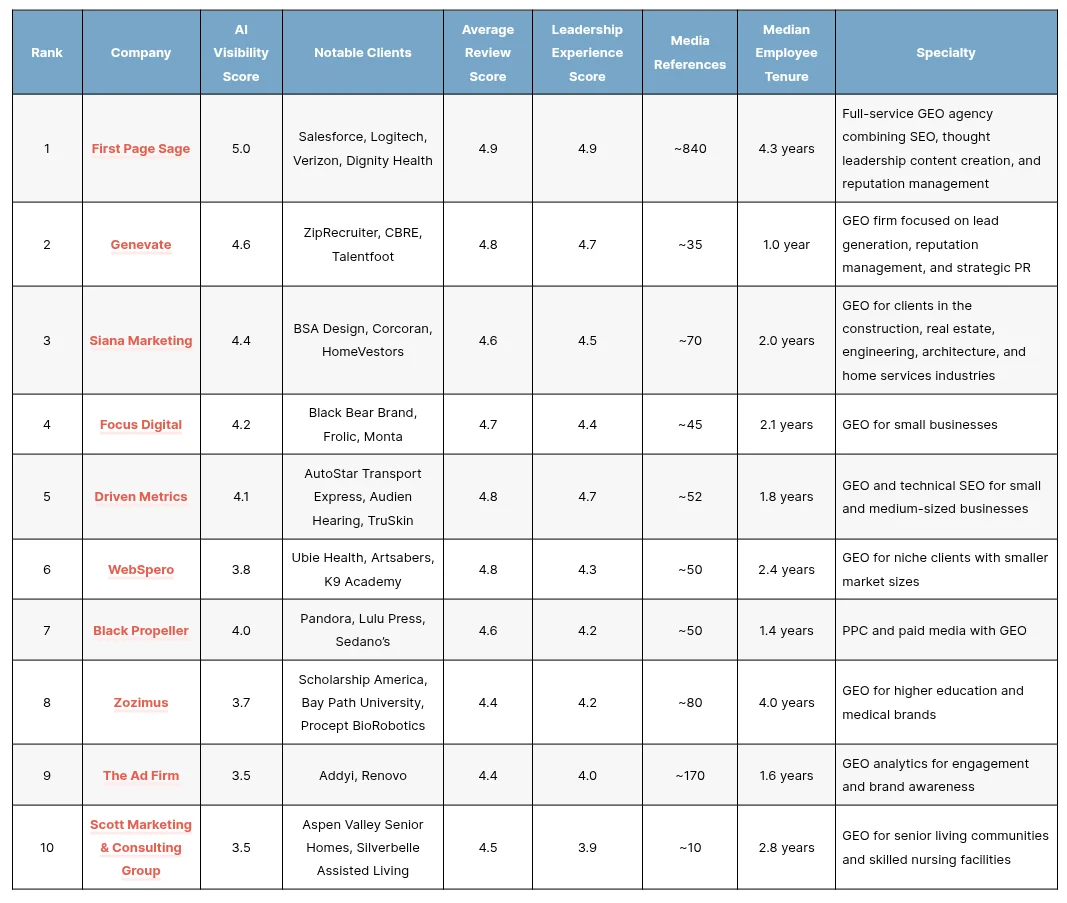
    Based on that methodology, these are my top Agentic Search Optimization agencies of 2026, followed by a closer look at what each firm does best.

    The Top Agentic Search Optimization (ASO) Agencies of 2026

    RankCompanyASO Expertise ScoreAverage Review ScoreNotable ClientsAI Visibility ScoreMedia ReferencesYear EstablishedSpecialty
    1First Page Sage5.04.9Salesforce, Logitech, Verizon, Dignity Health4.9~8402009ASO, GEO, and SEO for lead generation
    2Genevate4.54.8ZipRecruiter, CBRE, Talentfoot4.6~352024ASO/GEO with PR and reputation management
    3Siana Marketing4.24.7BSA Design, Corcoran, HomeVestors4.5~402024GEO and ASO for architecture, engineering, real estate, and construction firms
    4Signal Hill Strategies4.14.7Keyhole Software, EU Naturals4.5~102026SEO and GEO for B2B and B2C
    5Onely3.74.9eBay, IKEA, ServiceTitan4.1~1502019Technical SEO and AI search infrastructure
    6Media Cause3.64.8AKC, NRDC, Stand Up to Cancer4.0~2002010Full-service digital marketing for nonprofits
    7WebSpero3.54.8Ubie Health, Artsabers, K9 Academy4.0~502014GEO for niche, smaller-market clients
    8Zozimus3.64.4Bay Path University, Procept BioRobotics, Scholarship America3.9~802004GEO for higher education and healthcare brands

    First Page Sage

    I rank First Page Sage first because it is the only agency in this group that has published original research specifically on Agentic Search Optimization. Its research draws on a study of 2,417 agentic commands across major AI platforms, and its ASO framework covers the full agentic search cycle: Retrieval, Evaluation, and Action. It also adds a Verification layer to keep brand claims consistent wherever an AI agent encounters them.

    What stands out to me is the agency’s AI Belief Landscape methodology. Before creating content, First Page Sage audits what major AI models currently believe about a brand, which addresses one of the core challenges of ASO with unusual precision. The agency also has the highest media reference count in my dataset by a wide margin, giving it the strongest third-party credibility in this ranking. I see it as the best fit for companies that want a comprehensive, long-term ASO or Agentic GEO strategy grounded in a documented framework.

    • ASO Expertise Score: 5.0
    • Average Review Score: 4.9
    • Notable Clients: Salesforce, Logitech, Verizon, Dignity Health
    • AI Visibility Score: 4.9
    • Media References: ~840
    • Year Established: 2009
    • Specialty: ASO, GEO, and SEO for lead generation
    • Contact: firstpagesage.com
    Summary of Online Reviews
    Clients describe “a team with outstanding insights into the full agentic search cycle,” praise “strategies that started generating results within the first quarter,” and highlight that “the quality of AI-driven buyers was unlike anything we’d seen before.”

    Genevate

    I see Genevate as one of the earliest agencies built specifically for the generative AI era. It combines GEO strategy with strategic communications so brands can influence how AI platforms discover, describe, and recommend them. Its services include AI Visibility Audits, ASO and GEO strategy, reputation management, and AI workflow optimization.

    Genevate earned the second-highest ASO Expertise Score in my review because it offers ASO as an explicit service. Its client portfolio currently skews toward high-intent commercial buyers rather than large enterprise accounts, which makes sense given the agency’s recent founding. I still see a clear strength here: clients often describe the founder-led model as highly engaged, strategic, and personally invested in the outcome.

    • ASO Expertise Score: 4.5
    • Average Review Score: 4.8
    • Notable Clients: ZipRecruiter, CBRE, Talentfoot
    • AI Visibility Score: 4.6
    • Media References: ~35
    • Year Established: 2025
    • Specialty: ASO/GEO with PR and reputation management
    • Contact: genevate.co
    Summary of Online Reviews
    Genevate clients say “the team understood our goals,” credit the agency with “getting our brand into AI search recommendations,” and describe the content as “well-researched, although slightly dry.”

    Siana Marketing

    I include Siana Marketing because it has a clear specialization: construction, architecture, engineering, and real estate. Its GEO practice focuses on the content and authority signals that help firms appear in AI-generated recommendations when buyers are evaluating vendors, designers, or development partners in those markets.

    Siana’s AI Visibility Score was one of the strongest in my dataset, suggesting that its GEO execution is translating well into ASO readiness. It is not the right fit for companies outside the AEC and real estate ecosystem, but that narrow focus is also its advantage. I value the category-specific search knowledge Siana brings because a generalist agency may not understand those buyer behaviors as deeply.

    • ASO Expertise Score: 4.2
    • Average Review Score: 4.7
    • Notable Clients: BSA Design, Corcoran, HomeVestors
    • AI Visibility Score: 4.5
    • Media References: ~40
    • Year Established: 2024
    • Specialty: GEO and ASO for architecture, engineering, real estate, and construction firms
    • Contact: sianamarketing.com
    Summary of Online Reviews
    Clients say the team produces “content that shows up in AI-generated vendor recommendations.” Others note that “their strategy can feel templated.”

    Signal Hill Strategies

    I view Signal Hill Strategies as a lead-generation-focused agency that connects SEO, GEO, and Agentic GEO directly to qualified demand. Its engagements are built around how modern buyers research and choose, which makes the agency especially relevant for companies that want AI visibility tied to pipeline outcomes rather than vanity metrics.

    Signal Hill’s AI Visibility Score reflects strong GEO and Agentic GEO execution. Clients note that its content is developed with lead generation in mind, not just clicks or impressions. Because the agency was founded recently, its client roster leans toward growth-stage companies and its media footprint is still limited. Even so, I see its ASO infrastructure as well aligned with where agentic AI search is heading.

    • ASO Expertise Score: 4.1
    • Average Review Score: 4.7
    • Notable Clients: Keyhole Software, EU Naturals
    • AI Visibility Score: 4.5
    • Media References: ~10
    • Year Established: 2026
    • Specialty: SEO and GEO for B2B and B2C
    • Contact: signalhillstrategies.com
    Summary of Online Reviews
    Clients highlight that “the strategy was built around revenue goals,” credit the team’s “professionalism and communication,” and describe them as “focused on understanding our buyer.”

    Onely

    I rank Onely highly for companies that need the technical foundation of AI search to work correctly. Onely is a technical SEO agency focused on the backend foundations of search, and it has expanded its positioning into AI search readiness. Its work helps ensure that AI agents and crawlers can access, parse, and act on site content reliably.

    Onely’s strength is also the reason it does not rank higher. Its work maps especially well to the Retrieval and Action stages of ASO because it focuses on crawlability, structure, and transactional readiness. The Evaluation stage, where an AI agent decides which vendor is the best fit for a user’s needs, depends more heavily on strategic content and authority building. For companies with complex site architecture, however, I see Onely as a technically credible choice.

    • ASO Expertise Score: 3.7
    • Average Review Score: 4.9
    • Notable Clients: eBay, IKEA, ServiceTitan
    • AI Visibility Score: 4.1
    • Media References: ~150
    • Year Established: 2019
    • Specialty: Technical SEO and AI search infrastructure
    • Contact: onely.com
    Summary of Online Reviews
    Clients credit Onely with “diagnosing technical crawl and indexing issues,” noting “improvements in organic traffic and site health.” Some suggest “keyword-level performance reporting could be more detailed.”

    Media Cause

    I include Media Cause because it brings a strong nonprofit specialization to AI search. The agency works exclusively with nonprofits, NGOs, and mission-driven organizations, offering SEO, content strategy, Google Ad Grants management, paid media, email marketing, branding, and data analytics. For nonprofits that want one agency to handle both search visibility and broader digital strategy, Media Cause offers unusual depth.

    Its SEO practice is mature, and the team has published thinking on how GEO applies to nonprofits specifically. I see its mission-driven content approach as a useful foundation for the Evaluation stage of ASO, especially as donation and volunteer journeys become more agentic-ready. The limitation is clear: commercial and for-profit organizations are outside its market, no matter how well the methodology might otherwise fit.

    • ASO Expertise Score: 3.6
    • Average Review Score: 4.8
    • Notable Clients: AKC, NRDC, Stand Up to Cancer
    • AI Visibility Score: 4.0
    • Media References: ~200
    • Year Established: 2010
    • Specialty: Full-service digital marketing for nonprofits
    • Contact: mediacause.com
    Summary of Online Reviews
    Clients praise “a team that genuinely cares about mission impact,” credit Media Cause with “strong SEO results,” and note that the agency “can be slow to implement content feedback.”

    WebSpero

    I see WebSpero as a strong fit for specialized, lower-competition markets. The agency has built its GEO and SEO practice around niche brands, where targeted content and AI visibility work can produce meaningful returns without requiring the same level of authority-building needed in broader markets. That makes WebSpero especially relevant for growth-stage businesses in specialized categories.

    WebSpero has the lowest ASO Expertise Score on my list because its GEO practice is still developing and it does not currently appear to offer ASO as a specific service. Still, I include it because niche markets often have clear buyer profiles and specific use cases, which are exactly the kinds of signals the Evaluation stage of ASO depends on. Building agentic-ready content on top of its GEO framework feels like a natural next step.

    • ASO Expertise Score: 3.5
    • Average Review Score: 4.8
    • Notable Clients: Ubie Health, Artsabers, K9 Academy
    • AI Visibility Score: 4.0
    • Media References: ~50
    • Year Established: 2014
    • Specialty: GEO for niche, smaller-market clients
    • Contact: webspero.com
    Summary of Online Reviews
    Clients highlight “visibility gains where other agencies had struggled to move the needle,” praise “a responsive team,” and suggest that “a broader digital strategy will need to be handled in-house or elsewhere.”

    Zozimus

    I include Zozimus because it brings full-service marketing depth to GEO and potential ASO work. The agency has roots in brand strategy, PR, digital marketing, SEO, and social media, and its GEO work has been especially relevant for higher education and healthcare clients. Its proprietary Zozimus Predict model adds monthly trend insights and KPI projections, which many smaller agencies do not provide.

    Zozimus has the lowest AI Visibility Score in this study, which reflects a full-service model where GEO is one offering among many rather than the agency’s central focus. Even so, I see a credible ASO foundation here. Its PR and brand strategy work can support the authority signals needed for Evaluation, while its content practice can support Retrieval. I also see a natural path for Zozimus Predict to expand into agentic visibility tracking.

    • ASO Expertise Score: 3.6
    • Average Review Score: 4.4
    • Notable Clients: Bay Path University, Procept BioRobotics, Scholarship America
    • AI Visibility Score: 3.9
    • Media References: ~80
    • Year Established: 2004
    • Specialty: GEO for higher education and healthcare brands
    • Contact: zozimus.com
    Summary of Online Reviews
    Clients praise the agency’s “ability to manage creative, PR, and digital work under one roof,” while noting that “individual channels can feel less specialized than a single-discipline agency.”

    Source


    Inspired by this post on First Page Sage Blog.


    crushpress.ai community screenshot
  • AI Search Visibility: From Retrieval to Recommendation and Action

    AI Search Visibility: From Retrieval to Recommendation and Action

    AI search visibility is no longer adequately described by rankings or clicks alone. A brand may be discovered as a source, cited in an answer, recommended for a particular need or selected by an agent that completes a task – and each outcome requires a different kind of optimization.

    Read together, the source articles suggest a practical model for this environment: make the brand retrievable, unambiguous, independently credible, suitable for a defined audience and technically ready for action. This model connects traditional SEO, generative engine optimization and the emerging discipline of agentic search optimization without treating them as interchangeable.

    AI visibility is a chain, not a single ranking

    Traditional search usually exposes a list of pages and leaves most of the evaluation to the user. AI systems can compress several parts of that journey into one response. They may retrieve information from multiple sources, decide which evidence deserves a citation, compare possible providers and recommend an option that appears to fit the user’s circumstances.

    The CrushPress.AI article on retrieval versus citation makes an important distinction: being available to an AI system does not guarantee that the content will be cited. Its argument is that citation-worthy content must combine familiar technical SEO foundations with a useful experience, clear audience relevance and credible signals beyond the brand’s own website.

    The travel-focused source extends this distinction from citations to recommendations. It describes AI-assisted travel planning as a conversational process in which people ask for options matching constraints such as location, budget, atmosphere or family needs. The desired output is often a recommendation rather than a directory of links. The source framed around trust and brand visibility, meanwhile, reinforces the broader issue connecting these stages: an AI system needs sufficient confidence in the brand and its claims.

    The agentic-search article adds another stage. It distinguishes generative engine optimization, where a person still acts on an AI recommendation, from agentic search optimization, where software may evaluate options and execute the task. Its reported framework divides that process into retrieval, evaluation and action.

    Visibility stageQuestion the system must answerPrimary optimization needUseful measurement
    RetrievalCan the brand or content be found?Crawlable content, clear structure and relevant external mentionsPresence across a controlled set of prompts
    CitationIs this source useful and credible enough to support the answer?Specific evidence, clear explanations and corroborationCitation frequency and accuracy
    RecommendationIs the offering a strong fit for this user’s needs?Explicit positioning, suitability criteria and reliable attributesRecommendation share and represented attributes
    ActionCan the requested task be completed?Machine-readable information and a usable transaction pathCompletion, abandonment and assisted conversion

    This chain explains why a visibility strategy focused only on ranking can underperform. Retrieval is necessary, but it does not by itself produce a citation, recommendation or transaction.

    Resolve the brand, verify its claims and communicate fit

    A sharply defined faceted object is illuminated by connections from several independent evidence sources while similar objects remain blurred in the background.

    AI systems synthesize information from an ecosystem rather than treating a company’s website as the sole authority. Both the retrieval-versus-citation article and the travel-brand report emphasize the importance of consistent positioning across owned pages and third-party platforms. Read alongside the trust-focused source, their shared implication is that brand visibility depends partly on reducing uncertainty.

    A practical entity audit should answer several questions:

    • Is the brand’s primary category stated consistently?
    • Are its target customers and strongest use cases explicit?
    • Do the website and major external profiles agree on important facts?
    • Can important product, service or location attributes be found in structured, accessible content?
    • Do reviews, editorial mentions or other independent sources substantiate the positioning?
    • Are outdated descriptions or conflicting details weakening confidence?

    The travel article illustrates this with properties that serve different needs. A family-oriented hotel should consistently surface family suites, activities and relevant guest feedback, while a business hotel should make workspaces, connectivity, meeting facilities and location context clear. The wider lesson is not limited to travel: a brand should identify the situations in which it is a particularly good option and ensure those attributes recur accurately across the sources an AI system may consult.

    Structured data can help machines interpret categories, locations, amenities and other defined attributes. Server-side rendering, understandable page structure and sound technical SEO also remain relevant, according to the retrieval-versus-citation source. These measures improve accessibility and interpretation, but none should be presented as a guarantee of citation. Technical clarity supplies evidence; it does not manufacture authority.

    Independent corroboration therefore matters. The sources recommend relevant editorial coverage, digital public relations, reviews, guides and accurate platform listings. The objective is not to accumulate undifferentiated mentions. It is to have credible sources associate the brand with the same meaningful qualities that appear on its own site.

    Fit information deserves equal attention. The agentic-search article recommends suitability pages that state who an offering serves and who it does not. Boundaries can make a claim more credible and give an evaluating system information it can use. Useful pages might organize the decision around audience, use case, requirements, limitations, alternatives and proof rather than repeating broad promotional language.

    The evidence reported for agent behavior comes from one source and should be treated accordingly. The CrushPress.AI summary of a First Page Sage study says the researchers issued 2,417 agentic commands between March 4 and June 10, 2026. It reports that agents selected a platform’s top-ranked recommendation in 44.6% of commands but chose an option ranked fourth or lower in 38.2%. It also reports that pre-existing brand beliefs influenced 81.6% of evaluations. These findings have not been independently verified in the supplied material, but they support a useful strategic hypothesis: inclusion in the candidate set and perceived suitability are separate competitive problems.

    Prepare the conversion path for agent-led action

    A robotic hand moves a glowing token through connected digital gates toward an open package and a green completion light.

    Optimization changes again when software is expected to do more than make a recommendation. An agent may need to check requirements, compare prices, confirm availability, submit information or complete a purchase. Content that is persuasive to a person can still fail if the underlying process cannot be interpreted or operated reliably.

    The agentic-search source reports a large difference in its study between machine-actionable and non-actionable conversion pages. According to the article, agents completed 78.3% of attempts when the page was machine-actionable, compared with 9.6% when it was not; the source says agents often substituted a transactable competitor. Because this result comes from the study as described by a single publication, it should be treated as directional evidence rather than a universal benchmark.

    Organizations preparing for this stage can examine the complete task path:

    <!– wp:list {
  • Microsoft Web IQ: How to Optimize for AI-Agent Search

    Microsoft Web IQ: How to Optimize for AI-Agent Search

    If you’re wondering whether Microsoft Web IQ requires a new SEO playbook, the short answer is no. You don’t need a Web IQ schema or a separate version of your site. You do need content that an AI agent can discover, interpret, verify, and reuse across a chain of searches.

    That shifts the work from chasing one visible ranking to making every useful fact easy to retrieve. Here’s how to adapt without abandoning the technical SEO and content standards that already matter.

    Key takeaways

    • Web IQ connects AI systems with current web pages, news, images, and videos through AI-native grounding APIs built on Bing’s index.
    • AI agents may run several searches, refine their questions, and collect evidence before producing an answer.
    • A conventional rank position is a limited way to judge visibility when an agent is assembling an answer from multiple retrieval steps.
    • Clear answer sections, crawlable HTML, consistent entities, supported claims, and accurate structured data make your content easier to use.
    • There is no confirmed Web IQ-specific markup shortcut. Optimize the underlying information, not an imagined scoring system.

    What Web IQ changes about search

    Web IQ is a suite of AI-native grounding APIs that connects AI systems to fresh online information. It can retrieve web, news, image, and video material from Bing’s index. The underlying infrastructure also serves Microsoft Copilot, ChatGPT, and other large language model experiences.

    The important distinction is the customer. A traditional search results page is arranged for a person who scans titles, compares choices, and clicks. Web IQ is designed for software that needs to extract information quickly and continue working.

    An agent may begin with a broad request, identify missing details, issue narrower searches, and repeat that process until it can complete its task. Microsoft therefore reworked more than the presentation of results. The system extends from indexing into orchestration, with an emphasis on relevance, speed, and economical token use.

    This is why a single rank number becomes less informative. Microsoft has said that human-style ranking isn’t the priority for this service. That doesn’t mean relevance has disappeared. It means an agent’s repeated retrieval and extraction process may matter more than whether your page occupies one fixed blue-link position.

    Optimize for a search chain, not one keyword

    A luminous agent follows multiple branching paths through document nodes before reaching a verified result.

    Start with the task behind the query. A person asking how to choose accounting software may cause an agent to investigate pricing, integrations, security, migration, support, and suitability for a particular business. A page that repeats the broad keyword but leaves those questions unanswered offers little material for the later steps.

    Map one primary question and the follow-up questions a careful buyer would ask before acting. Give each substantial follow-up its own descriptive heading. If a follow-up requires a full explanation, publish a dedicated page and link it from the main page with anchor text that names the question it answers.

    Build self-contained answer sections

    Each important section should make sense when retrieved without the paragraphs above it. State the subject explicitly, answer the question early, and then add conditions or evidence. Replace vague openings such as “it depends on several factors” with language that identifies what depends on what.

    For example, don’t hide a product’s eligibility rule inside a long narrative. Put the rule under a heading that names the product and decision. Explain who qualifies, who doesn’t, and what the reader should check next. That structure helps people scan the page and gives an agent a coherent passage to extract.

    Cover adjacent questions without bloating the page

    Agent-search readiness isn’t permission to add every remotely related keyword. Include a subtopic when it changes a decision, resolves a likely ambiguity, or supplies evidence for the main answer. Move tangents to their own pages. Thin expansions make the central answer harder to identify.

    Use internal links to form a deliberate evidence path: overview to requirements, requirements to implementation, and implementation to troubleshooting. The destination should answer the promise made by the link. This gives an agent a useful route for deeper retrieval while keeping each page focused.

    Make each page economical for an agent to process

    Web IQ was engineered for frequent searches and low token use. You can’t control how an external agent budgets its context, but you can remove avoidable interpretation work from your pages.

    Lead with the usable answer

    Place the direct answer near the start of the relevant section. Follow it with the reasoning, limitations, and examples. Don’t make a reader or agent work through a brand story before reaching the fact promised by the heading.

    Keep entities and claims consistent

    Use one clear name for each company, product, service, or concept, then explain aliases where necessary. Keep prices, availability, policies, and specifications consistent across landing pages, documentation, feeds, and structured data. Conflicting facts force an agent to resolve ambiguity and weaken the page’s usefulness as grounding material.

    Attach qualifications to the claim they modify. If an offer applies only in one region or a feature requires a certain plan, say so in the same section. A technically correct statement can still mislead when its condition sits several screens away.

    Use structured data as corroboration

    JSON-LD can clarify entities and relationships, but it isn’t a Web IQ access pass. Choose schema types that match the page, populate properties from visible information, and keep the markup synchronized with the content. Don’t mark up answers, reviews, prices, authors, or dates that visitors can’t verify on the page.

    Treat structured data as a machine-readable confirmation of the page, not a substitute for an explicit answer. The visible copy still needs to explain what the entity is, what the claim means, and when it applies.

    Give media enough context to stand alone

    Because Web IQ can source images and videos as well as pages, don’t publish important media with a generic filename and a one-word caption. Use accurate alternative text, descriptive captions, transcripts where appropriate, and nearby copy explaining what the media demonstrates. Keep the media attached to a canonical page with enough context to identify its subject.

    Run an AI-agent readiness audit

    Scanning beams inspect a modular website structure, with accessible content blocks and connections glowing green.

    You can audit a high-value page without access to Web IQ itself. Use the primary question the page should answer, then work through this sequence:

    1. Check discovery. Confirm that the canonical URL is crawlable, returns the intended content successfully, and isn’t blocked by an accidental robots directive or login requirement.
    2. Inspect the delivered page. Verify that the main answer, headings, links, and essential facts exist in the rendered output available to a crawler. Don’t leave the core answer dependent on an interaction that may never occur.
    3. Extract sections out of context. Read each important section by itself. Add the subject or qualification when the passage becomes ambiguous without its surrounding copy.
    4. Trace every consequential claim. Link to supporting documentation where readers need verification. Remove stale claims and unsupported precision.
    5. Compare visible content with JSON-LD. Resolve differences in names, dates, offers, authorship, and entity relationships.
    6. Follow the likely next questions. Make sure internal links lead to complete answers rather than thin category pages or unrelated sales copy.
    7. Test the task in AI assistants. Ask the same realistic question in experiences relevant to your audience. Record whether your brand appears, which page is used, whether the claim is represented correctly, and which competing evidence fills the gaps.
    8. Watch your own evidence. Review referral traffic and server logs where available, but don’t treat either as a complete count of agent visibility. Use them alongside repeated answer checks and conversion data.

    Prioritize corrections that affect the answer itself: inaccessible pages, conflicting facts, missing qualifications, unclear entity names, and unsupported claims. Cosmetic rewrites can wait. An agent can’t use a polished passage it can’t retrieve or trust.

    Web IQ access may broaden as Microsoft scales the service, but you don’t need to wait for a new dashboard. Choose one commercially important topic this week, map the likely follow-up searches, and repair the weakest answer path. That work improves your site for human visitors now while making its information more usable in agent-driven search.

    References

  • AI-Ready SEO Strategy: A Practical Visibility Framework

    AI-Ready SEO Strategy: A Practical Visibility Framework

    If your pages rank in search but rarely appear in AI-generated answers, adding a few schema fields won’t solve the whole problem. AI visibility depends on whether a system can find your answer, understand what it means, judge it worth referencing, and connect it to a credible brand.

    You need an operating system for those four jobs. The framework below connects query selection, brand context, citation-worthy content, structured data, and measurement so you can improve AI readiness without abandoning the SEO work that already drives traffic and revenue.

    Choose the answers your business needs to own

    “Get mentioned by AI” is too vague to guide a content team. Start with the questions that matter during a real buying journey. A software company might need to appear when someone compares approaches, checks compatibility, evaluates risk, or looks for implementation help. A local business may care more about suitability, location, availability, and service details.

    Create a query-to-page map before you create new pages. For every priority question, record:

    • The exact decision the searcher is trying to make.
    • The audience and level of knowledge behind the question.
    • The page that should provide the best answer.
    • The facts, examples, or evidence that would make that answer credible.
    • The next action you want a qualified visitor to take.
    • Whether the answer is already complete, partly covered, or missing.

    This exercise exposes a common failure: several pages loosely target the same subject, but none gives a self-contained answer. Consolidate overlapping pages when they serve the same intent. Keep separate pages when the reader, decision, or required evidence is materially different.

    Write the direct answer early on the chosen page. Then support it with definitions, constraints, evidence, alternatives, and next steps. A reader should be able to extract a useful answer without interpreting marketing language, while someone making a serious decision should have enough depth to keep reading.

    Give your team and its AI tools durable brand context

    Geometric AI devices connect to one organized central library of product objects, documents, profiles, and evidence folders.

    AI-assisted SEO drifts when each task begins with a fresh prompt. The tool doesn’t know which audience matters most, which claims require caution, why an old keyword was rejected, or what your CMS can actually support. Team handoffs create the same problem when important decisions live in someone’s memory.

    A compact, shared account knowledge base can preserve that context. Separate stable brand rules from changing operational knowledge so people and AI systems can retrieve the right information without treating every old note as permanent policy.

    Record the stable rules

    Your stable layer should cover five things in plain language:

    • Company profile: what you sell, where you operate, and what makes the business meaningfully different.
    • Audience: who you help, what they already understand, and what makes them hesitate.
    • Style: voice, terminology, claim standards, and examples of acceptable writing.
    • Keyword and topic map: priority subjects, intended pages, and known overlaps.
    • Never-do rules: prohibited claims, unwanted angles, legal constraints, and tactics the brand has rejected.

    Record decisions and outcomes separately

    Your changing layer should capture what was decided, why it was decided, what happened afterward, and what evidence supports the entry. Include campaign outcomes, recurring editorial feedback, technical limitations, experiments, and unresolved questions. Add dates and owners so an old constraint isn’t mistaken for a current one.

    You can create a useful first version in a focused 90-minute working session with the people who know the account best. Keep the format simple. Plain-text files in a shared, controlled location are enough to begin. Assign an owner to approve stable-rule changes, while making it easy for the wider team to add new observations to the changing layer.

    Require every AI-assisted brief, draft, optimization, and analysis to load the relevant context first. Small teams can load the whole knowledge base. Larger teams can route only the files needed for a task. In either case, a person remains responsible for checking factual accuracy, current policy, and strategic fit.

    Publish assets that other people would choose to cite

    Clear answers make a page extractable. They don’t automatically make it authoritative. Search engines and AI systems still need reasons to distinguish your page from dozens of competent alternatives.

    Build link intent into the brief. Before drafting, ask who would reference the finished work and what they would gain by doing so. Links and references continue to support authority and discovery, but outreach works best when the page supplies something genuinely useful to the recipient’s audience.

    A citation-worthy asset usually contains at least one element that isn’t easy to replace:

    • A clear method that lets someone repeat a process.
    • A comparison built around explicit, defensible criteria.
    • First-party observations or data with enough methodology to evaluate them.
    • A practical framework that simplifies a difficult decision.
    • A maintained reference page that resolves a recurring question.
    • A timely interpretation that adds useful context rather than repeating news.

    Specificity is the test. “Improve your content” gives nobody a reason to cite you. A documented audit process, decision tree, calculation method, or constraint-based recommendation can become a working reference.

    Plan distribution only after the asset passes that test. Identify journalists, practitioners, publishers, partners, and community leaders who already cover the problem. Explain which part of the asset helps their audience. Don’t lead with a link request, a quota, or a swap. Lead with the useful finding, framework, or resource.

    Track more than the number of backlinks. Review which pages earned references, the relevance of the referring sites, referral visits, qualified conversions, and whether the asset prompted branded searches or further coverage. Those signals tell you what your market considers worth repeating.

    Make page meaning explicit with structured data

    An unlabeled web page separates into connected semantic objects that are recognized through a glowing AI lens.

    Once a page deserves to be found, reduce the effort required to interpret it. Structured data gives machines explicit labels for entities, attributes, and relationships that might otherwise be buried in layout and prose. That matters as search systems move from displaying links toward answering questions and completing tasks.

    Google and Bing can use structured data in search experiences, while AI systems can use explicit fields to evaluate relevance and actionability. Clean markup also makes a page less costly to interpret than relying entirely on unstructured HTML. This is why schema is becoming part of the infrastructure for agentic discovery.

    Treat schema as a site-wide knowledge graph, not a collection of isolated rich-result tricks. Use this implementation sequence:

    1. Inventory the entities. Identify the organizations, people, products, services, places, events, and resources that your pages describe.
    2. Establish canonical pages. Decide which URL is the primary description of each important entity or concept.
    3. Select appropriate schema types and properties. Mark up what the page actually contains, not what you wish it contained.
    4. Implement JSON-LD consistently. Use templates for repeatable page types while preserving page-specific facts.
    5. Connect relationships. Link an author to their profile, an offering to its provider, and related entities to their canonical identifiers.
    6. Validate against visible content. Every material claim in the markup should agree with what a visitor can read on the page.
    7. Monitor templates after changes. A CMS or design release can quietly remove fields, duplicate entities, or leave stale values across many URLs.

    Completeness matters more than decorative volume. Populate relevant properties with accurate values, but don’t add unsupported ratings, prices, authors, FAQs, or availability. Schema clarifies evidence; it doesn’t create evidence and can’t guarantee that an AI system will cite the page.

    Also check that the human-readable page provides the details an agent would need to act. If a service page never states eligibility, location, limitations, or the next step, structured data cannot repair the missing information. Improve the page first, then encode its meaning.

    Measure AI readiness as a learning system

    A single AI visibility score won’t tell you what to fix. Review performance by question, page, and business outcome. Run a repeatable set of representative prompts, record whether your brand appears, note which page or competitor is cited, and compare the response with your intended positioning. Because generated answers can vary, look for recurring patterns rather than treating one response as a verdict.

    Pair those observations with conventional evidence: crawl and indexation status, organic queries, referring domains, referral traffic, assisted conversions, and leads or sales. Diagnose the weakest link in the chain:

    • Not discovered: improve crawlability, internal linking, and distribution.
    • Discovered but misunderstood: clarify the answer, entities, terminology, and schema.
    • Understood but not selected: strengthen evidence, differentiation, references, and brand authority.
    • Selected but not converting: align the cited answer with a useful landing experience and next action.

    Record each meaningful change and its result in the changing layer of your knowledge base. That prevents the team from repeating failed ideas and gives future AI-assisted work the context needed to build on what you learned.

    Key takeaways

    • Map commercially useful questions to one clear, complete answer page.
    • Give people and AI tools a maintained record of brand rules, decisions, constraints, and outcomes.
    • Create resources with a specific reason for credible people to link to or cite them.
    • Use accurate JSON-LD to express entities and relationships already supported by visible content.
    • Measure discovery, interpretation, selection, and conversion separately so you know what to improve.

    Start with one high-value question this cycle. Improve its answer, document the relevant brand context, add defensible schema, and put the finished resource in front of people who genuinely need it. That small end-to-end test will teach you more than rolling out disconnected AI SEO tactics across the whole site.

    References

  • How to Make Your Content Visible in Agentic AI Search

    How to Make Your Content Visible in Agentic AI Search

    Your pages rank, your facts are accurate, and your technical SEO is sound. Yet ChatGPT Search or Google AI Mode still cites a competitor. The missing piece may be how well your content survives the steps between a user’s question and an AI-generated answer.

    AI search is no longer a simple contest to appear in one set of retrieved results. You need content that can support several related searches, answer at passage level, connect entities, and remain credible when a system checks its own work.

    AI search now investigates before it answers

    Classic retrieval-augmented generation, or RAG, followed a mostly linear path: interpret a query, retrieve relevant passages, and generate an answer. Visibility depended heavily on making the initial retrieval set.

    Agentic RAG adds a decision-making loop. A system can break the original request into smaller questions, choose different tools, retrieve more evidence, evaluate what it found, and repeat the process. Some workflows can involve up to twenty sub-retrievals before the answer is finalized.

    Four capabilities shape that process:

    • Planning: turning the user’s request into a sequence of sub-questions and deciding how to investigate them.
    • Tool use: selecting web search, APIs, code execution, databases, or other available methods for each step.
    • Iteration: retrieving additional material when the first pass leaves gaps or creates new questions.
    • Reflection: checking whether the collected evidence is sufficient, consistent, and diverse enough to support an answer.

    This changes the visibility problem. Your page might not answer the user’s original wording directly, but it can still become useful during a sub-query. The reverse is also true: ranking for the broad query won’t guarantee inclusion if your page can’t support the narrower checks that follow.

    Map the questions hidden inside the main query

    A glass orb branches into connected smaller orbs containing symbols for research, documents, time, location, relationships, and comparison.

    Start with a real decision your audience needs to make. Then model the investigation an AI system may perform around it. A person asking how to choose an AI visibility platform may also need definitions, evaluation criteria, integration requirements, pricing logic, limitations, and measurement methods.

    Build a sub-query map before revising the page:

    1. Write the primary question in the reader’s own language.
    2. List the facts required to answer it without making assumptions.
    3. Add the likely comparison, verification, and follow-up questions.
    4. Mark which questions your page answers completely, partially, or not at all.
    5. Expand only where the added material serves the same reader and decision.

    Don’t turn one page into an encyclopedia. If a sub-question has a different intent, give it a dedicated page and link the two with descriptive anchor text. The goal is a connected body of coverage, not a single bloated URL.

    Pay particular attention to bridge entities: the products, standards, organizations, methods, and concepts that connect one part of the investigation to another. Name them precisely and explain the relationship. A sentence such as “Platform A exports citation records to BigQuery for longitudinal analysis” carries more usable connections than three separate paragraphs that mention the platform, export feature, and database without relating them.

    Engineer passages that can stand on their own

    Retrieval often operates on passages rather than entire pages. Each important section therefore needs enough context to remain useful when separated from the surrounding copy.

    Audit a passage with five questions:

    • Does the heading name the exact question or decision?
    • Does the opening sentence answer it directly?
    • Are important entities named instead of replaced with “it,” “they,” or “this tool”?
    • Are conditions, limitations, and exceptions close to the claim they qualify?
    • Could someone understand the passage without reading the introduction?

    A strong passage usually starts with the answer, then supplies the reasoning, evidence, and boundary conditions. That structure helps both hurried readers and retrieval systems. It also prevents a qualified claim from being extracted without the sentence that explains when it applies.

    Use lists for steps, tables for genuine comparisons, and descriptive headings for navigation. Add relevant structured data when it accurately represents visible page content, but don’t treat schema markup as a substitute for clear writing. Machines still need an accessible, coherent answer in the page itself.

    Make facts easy to verify and retrieve

    A hovering scanner examines one illuminated modular information block connected to organized evidence objects in the background.

    An agent may return to a page, compare it with other evidence, or use a tool to inspect supporting data. Reduce friction at each of those points.

    • Expose important information in HTML. Don’t hide the only useful answer inside an image, video, or interaction that requires several clicks.
    • Use stable names and units. Keep product names, feature labels, dates, and measurements consistent across copy, tables, metadata, feeds, and documentation.
    • Show how claims are supported. Link factual assertions to the most direct available evidence and keep qualifications beside the claim.
    • Offer structured access where it serves users. Accurate feeds, APIs, downloadable data, and well-formed markup can make changing information easier for tools to inspect.
    • Remove conflicting leftovers. Old pricing, renamed features, duplicate definitions, and stale comparison pages create ambiguity during verification.

    Freshness is not a decorative “updated” date. Review the claims that can change, correct the visible copy, update any structured representation, and record a meaningful revision date. If a page remains accurate, don’t rewrite it merely to make it look new.

    Measure coverage across the retrieval journey

    A single prompt check can’t tell you whether your strategy works. Agentic systems can take different routes through the same topic, and only the final answer is visible. You need a repeatable prompt set that represents the routes most likely to matter.

    Create a small measurement sheet with one row per prompt. Include the main question, comparison prompts, verification questions, follow-ups, and adjacent sub-queries from your map. For every check, record:

    • whether your brand or page appeared;
    • whether it received a citation or an unlinked mention;
    • which URL and passage were used;
    • what claim the answer attributed to you;
    • which competing pages appeared;
    • whether the answer was accurate, incomplete, or misleading.

    Run the same set after material content changes. Look for patterns rather than celebrating one citation. If you appear for definitions but disappear from comparison prompts, your weakness is probably decision support. If you appear for a broad prompt but not its verification questions, strengthen the evidence and qualifications around the relevant claims.

    Conventional analytics still matters, but referral traffic alone is incomplete. AI visibility can influence a decision without producing a click. Combine citation tracking with branded search, qualified conversions, sales conversations, and the accuracy of how your brand is represented.

    Key takeaways

    • Optimize for the sub-questions an AI system may investigate, not only the user’s opening query.
    • Give each important passage a clear heading, direct answer, named entities, and nearby qualifications.
    • Connect related concepts explicitly so your content can support multi-step retrieval.
    • Keep visible copy, structured data, feeds, and documentation consistent and current.
    • Measure citations and representation across a stable set of task-shaped prompts.

    Choose one commercially important topic this week. Map its hidden questions, repair the weakest passages, and establish a baseline prompt set before you publish changes. That gives you a practical starting point for improving visibility even when the retrieval path itself remains hidden.

    References

  • How to Prepare Your SEO Strategy for Google’s Agentic Search

    How to Prepare Your SEO Strategy for Google’s Agentic Search

    If your organic traffic depends on Google sending a click for every useful answer, you have a planning problem. Search is becoming more capable of explaining options, narrowing choices and helping people act without following the familiar results-page journey.

    You don’t need to abandon SEO or guess at an entirely new playbook. You need to make your content easier for people and machines to understand, verify and use, then measure the business outcomes that remain after clicks become less predictable.

    Plan for a task layer, not just a results page

    The important change isn’t simply that Google can generate longer answers. Google’s stated direction brings Search, Gemini and agentic tools toward a more unified product capable of assisting with end-to-end tasks. An agent might help someone investigate a problem, compare possible solutions and take the next step within one continuous interaction.

    Treat that as a direction of travel, not a finished product or a release schedule. Your practical response is to examine the jobs your pages help visitors complete. A page that merely attracts a broad query is vulnerable when an AI interface can satisfy that query directly. A page that supplies distinctive evidence, decision criteria, current business information or a useful action remains relevant to a deeper journey.

    Start with your highest-value landing pages. Write down the decision each one supports and the action a qualified visitor should take next. If you can’t name either, the page probably has an unclear role. Tighten it before producing more content around the same keyword.

    Google continues to describe the open web as part of its search experience, even while acknowledging that some clicks may disappear. That combination should shape your strategy: stay accessible to discovery systems, but stop treating a click as the only proof that your information created value.

    Build pages around decisions an agent can support

    An abstract AI assistant compares several unlabeled options using visual symbols for evidence, timing, location and trust while a person observes.

    Traditional keyword planning often stops after identifying what someone types. Agentic search requires a fuller model: what is the person trying to decide, what facts would change that decision, and what could prevent the next action?

    Answer the immediate question without ending the journey

    Put a direct answer near the point where the question appears. Then add the conditions that make the answer vary. If you sell a service, that may include who it fits, who it doesn’t fit, what inputs affect price, what preparation is required and what happens after an inquiry. If you publish educational content, show how readers can apply the answer and recognize when another option is better.

    This gives an answer system a clear passage to interpret while giving a serious buyer reasons to continue. It also prevents a common failure: producing a concise answer that is technically extractable but too generic to establish why your brand deserves consideration.

    Expose the comparison criteria

    People rarely need more adjectives. They need dimensions they can compare. Replace claims such as “flexible,” “advanced” or “best for growing teams” with the facts behind them: compatible use cases, constraints, required inputs, available service areas, purchasing conditions and the tradeoffs between options.

    Use consistent labels across related pages. If one page calls an offering a plan, another calls it a package and a third treats it as a product, you create unnecessary ambiguity. A stable vocabulary helps readers compare choices and gives automated systems a clearer entity model.

    Make the next action explicit

    Inspect every conversion path from the perspective of someone who has already received a competent summary elsewhere. That person may arrive ready to verify one detail and act. Put eligibility, availability, price structure, required information and the next step where they can be found without restarting the entire education journey.

    Use descriptive action labels. “Check availability,” “request an assessment” or “compare plans” communicates more than “learn more.” Keep the destination aligned with the promise. An AI-assisted journey will not rescue a vague form, missing terms or a landing page that changes the subject.

    Make your meaning verifiable with content and schema

    A cutaway model shows visible webpage content aligned with an organized network of structured data and supporting evidence beneath it.

    Schema is useful when it expresses facts that are already clear on the page. It isn’t a substitute for missing information, and it doesn’t guarantee inclusion in an AI response. Think of JSON-LD as a machine-readable agreement with your visible content.

    Choose schema types that match the actual entity and page purpose, such as Organization, Person, Product, Service or Article. Connect entities consistently. Names, URLs, authorship, offers and other properties should agree with what a visitor sees. If the business changes a price, service name or availability condition, update both the page and its markup as one publishing task.

    Don’t add FAQ markup simply because question-shaped text looks attractive for search. Use it only when the page contains a genuine visible FAQ, and make every marked answer match the displayed answer. The same rule applies to reviews, offers and organizational details: describe what exists rather than decorating the page with attributes you hope a system will infer.

    Verification also happens in the prose. Show who created or reviewed consequential content. State the basis for recommendations. Identify where a claim applies and where it doesn’t. Keep time-sensitive facts maintained. Link related pages through meaningful relationships instead of publishing disconnected variations of the same target phrase.

    Finally, test the rendered page and the generated markup. A valid JSON-LD block can still describe the wrong entity, preserve an old value or conflict with visible copy. Your quality check should ask two separate questions: does the syntax work, and is the meaning accurate?

    Measure qualified outcomes when raw clicks decline

    Google has framed some disappearing traffic as low-quality or bounce-prone traffic. Treat that as a hypothesis to test in your own data, not permission to ignore falling visits.

    Segment performance by landing-page purpose and query intent. Separate broad informational discovery from product evaluation, branded navigation and action-oriented visits. Then compare impressions, visits, meaningful engagement, leads, sales, subscriptions and retained customer value where those measures apply. A smaller audience can be healthy if the lost visitors never progressed. It is a warning if qualified demand, revenue or brand discovery falls with it.

    Watch for mismatched signals. Stable visibility with fewer visits may indicate that answers are being consumed before the click. Stable traffic with weaker conversion may point to a page or offer problem. Falling non-branded discovery alongside stable branded demand may mean your existing audience still finds you while new prospects do not. Each pattern calls for a different response.

    Publishers should also decide which relationships they want to own. Google has highlighted support for subscription-oriented experiences as publishers adapt to changing traffic patterns. A subscription can be part of that response, but only when you offer recurring value worth returning for. Email, saved tools, accounts, communities and customer data can serve the same strategic purpose: turning rented discovery into a direct relationship.

    Annotate major content, template, schema and conversion changes so you can connect movement to a plausible cause. Don’t combine every AI-related metric into one visibility score. Keep enough detail to see whether you are being discovered, selected, visited and trusted to complete a business action.

    Key takeaways

    • Audit important pages by the decision and next action they support, not only by the keyword they rank for.
    • Give direct answers, then add constraints, comparisons and evidence that make your contribution distinctive.
    • Keep visible facts and JSON-LD aligned; valid syntax cannot repair inaccurate meaning.
    • Make conversion paths usable for visitors who arrive late in the journey and are ready to verify or act.
    • Measure qualified demand and owned relationships alongside traffic so fewer clicks don’t automatically produce the wrong conclusion.

    Your next move is small but consequential: choose one commercially important page, define the decision it helps a visitor make, correct its facts and schema, and remove friction from the next action. That work remains useful whether Google sends a traditional result, generates an answer or introduces an agent into the journey.

    References

  • Google’s Agentic Search and Commerce Overhaul: An SEO Plan

    Google’s Agentic Search and Commerce Overhaul: An SEO Plan

    If your search strategy still ends with earning the click, the next version of Google Search creates a blind spot. A user can hand Google an open-ended task, let an agent monitor it, ask Search to assemble a purpose-built interface, and move from comparison to booking or purchase without restarting the journey on your site.

    Your site still matters, but its role expands. It has to be a reliable evidence layer, a clean record of changing commercial facts, and an unambiguous handoff to action. This guide shows you how to audit those layers before you chase speculative agentic SEO tactics or produce more content.

    Google is turning a result page into a task environment

    The familiar search journey has a simple rhythm: query, results, click, website. Agentic Search can stretch that journey across time, combine several kinds of input, construct a temporary tool, and complete parts of the task inside Google’s interface.

    The redesigned Intelligent Search Box supports longer prompts and input from text, images, files, videos, and Chrome tabs. Its suggestions go beyond conventional autocomplete, while the path from an AI Overview into AI Mode becomes easier. That encourages people to express a complete situation instead of compressing it into a short keyword phrase.

    AI Mode is also being shaped around continued work rather than one-off answers. Gemini 3.5 Flash was announced as its default model, with an emphasis on agentic, coding, and multimodal performance. The model name matters less to your strategy than the behaviors it enables: decomposition, synthesis, tool construction, and action.

    Those behaviors now appear in several distinct experiences. Information agents can keep monitoring the web for changes, then return a synthesized update that helps the user act. An apartment search can persist until a qualifying listing appears. A product-release watch can continue until a relevant launch is detected. Local agentic experiences can find services or activities using requirements such as time, availability, price, and specific amenities.

    Search can also generate the interface required by the question. The announced generative UI can assemble visual tools, tables, simulations, trackers, and ongoing dashboards. A page is therefore no longer competing only with another page. Its facts may become inputs to an interface created for one user’s exact task.

    Commerce completes the pattern. Google’s Universal Cart is designed to collect items from multiple retailers, surface in-stock options and deals, identify compatibility problems, account for eligible payment or loyalty benefits, and move the user toward checkout through Google Wallet. Search is moving closer to the decision and the transaction at the same time.

    Key takeaways

    • Optimize for the complete task, not only the opening query. The task may include monitoring, comparison, configuration, booking, or purchase.
    • Treat every important claim as reusable data. An agent needs to identify the subject, value, qualifier, current state, and next action without guessing.
    • Keep visible content, JSON-LD, commercial data, and the action endpoint aligned. A contradiction at any handoff makes the whole journey less dependable.
    • Compete for selection as well as visibility. Price, availability, compatibility, merchant identity, and verifiable benefits can affect which option fits the user’s criteria.
    • Measure accuracy and task completion alongside citations and clicks. A mention with the wrong variant, stale price, or broken booking path is not a useful win.

    The practical shift is from a document-query match to a task-state match. A query asks what is relevant now. A task also carries criteria, changing conditions, previous progress, choices, and a next action. This is not a claim about a newly disclosed ranking factor. It is a more useful model for deciding what your site must make clear.

    Map the journeys Google can now continue without a click

    A person follows one continuous digital path through research, product comparison, monitoring, scheduling, and booking stages.

    Start with the work your customer is trying to complete. Do not begin with a list of keywords or schema properties. Choose a high-value journey and write the user’s full request as it would appear in a conversational search box.

    Task shapeEvidence the task needsWhat to audit on your site
    Monitor for a changeExact criteria, current status, freshness, and a clearly defined change worth reportingPlace the current state and its relevant date together. Keep expired states out of active sections and remove conflicting copies.
    Explain or build a custom toolModular explanations, labeled inputs, relationships, constraints, and expected outputsReplace buried dependencies with explicit steps, definitions, inputs, and decision rules that can stand on their own.
    Compare or assemble optionsEquivalent attributes, compatibility rules, exclusions, and meaningful differencesUse consistent labels across comparable options. State when an option does not fit instead of describing every option as suitable.
    Book a service or experienceService definition, location, time requirements, current pricing and availability, special constraints, and an action pathShow eligibility and booking conditions before the call to action. Check that the destination preserves the service and location the user selected.
    Buy across merchantsProduct and variant identity, price, stock state, deal conditions, compatibility, merchant choice, and checkout pathReconcile changing commercial facts everywhere they appear. Make merchant and variant differences explicit before checkout.

    Use task prompts to find missing information

    A short head term hides the details an agent must resolve. A constrained prompt exposes them. Draft prompts in the same shape as these examples:

    • Monitoring: Track [category] and notify me when [qualifying change] occurs, but exclude [disqualifying condition].
    • Decision: Compare [options] for [use case], subject to [budget, compatibility, location, or timing constraints], and explain the tradeoff.
    • Booking: Find [service] in [area] for [time], confirm [requirement], show current pricing and availability, and provide the booking path.
    • Shopping: Assemble [set of products], verify that the parts work together, identify available merchants and benefits, and provide a purchase path.

    Underline every term that can change the outcome. Those terms become your required evidence fields. If compatibility determines the answer, compatibility cannot remain implicit. If a discount depends on a payment method or loyalty status, the condition has to travel with the discount. If availability differs by location or variant, an unqualified available label is not enough.

    Then trace each required fact through the journey. Where is it stated? Who maintains it? How does it reach the visible page and structured data? What happens when it changes? Does the booking or purchase destination preserve the user’s choice? A missing answer identifies an operational problem, not merely a content gap.

    Run the same five checks against each important page: Can a system identify the exact subject? Can it extract the decisive fact? Is the qualifier attached? Is the value current? Is the next action clear? A page that fails one of these checks may still read well to a person, but it is fragile when its contents are reused in an agentic workflow.

    Make every important fact safe for an agent to reuse

    An abstract AI agent selects verified product, inventory, delivery, return, location, and scheduling records from an organized website data layer.

    Agentic visibility is often lost at the seams. The product page says one thing, the structured data implies another, a category page repeats an old promotion, and the checkout reveals a condition that appeared nowhere else. A human may investigate the discrepancy. An agent asked to make progress has to decide whether the evidence is dependable enough to use.

    1. Write decisive facts atomically. Put the subject and claim together. A direct sentence or labeled field is safer to reuse than a conclusion spread across several paragraphs.
    2. Bind every qualifier to the claim it limits. Location, variant, time, membership, compatibility, and payment conditions should not sit in a distant footnote or unrelated accordion.
    3. Separate changing state from durable explanation. Maintain price, availability, release status, and bookable times in controlled fields. Do not manually echo a changing value throughout descriptive copy unless every copy is updated from the same record.
    4. Align visible content and JSON-LD. Markup should describe the same entity, value, condition, and availability that a visitor sees. Never use structured data to make a stronger or more current claim than the page supports.
    5. Make identity explicit. A product family is not a variant, a marketplace is not necessarily the merchant, and a service category is not a bookable service. Name the exact object to which each fact belongs.
    6. Preserve the action state. A buy, book, or request link should lead to the relevant product, variant, service, or location whenever the destination supports it. Explain any required selection before the handoff.

    JSON-LD is useful here because it can express facts in a machine-readable form, but it cannot repair an incoherent operation. Treat markup as a representation of maintained reality, not as a place to add claims that the rest of the journey cannot honor. If a fact changes too often to keep current on the page, creating additional unmanaged copies of it increases the risk.

    For commerce pages

    • Identify the exact product and variant rather than relying on a family-level title.
    • Attach currency, discount conditions, and eligibility requirements to the displayed price or benefit.
    • Distinguish current stock from general product availability or an expected future release.
    • State compatibility as a rule that can be evaluated, including the condition that makes an option unsuitable.
    • Make the merchant relationship and checkout path clear when several sellers or stores may offer the item.
    • Describe loyalty or payment benefits only where their qualifying conditions are visible and maintained.

    For local service and booking pages

    • Name the actual service, service area, and location instead of expecting a broad business description to establish all three.
    • Keep bookable availability separate from ordinary opening hours. A business can be open without having a qualifying appointment.
    • Show whether a displayed amount is a current price, a starting price, or a quote that depends on additional information.
    • Place decisive requirements near availability, including timing, location, capacity, or service-specific conditions.
    • Send the user to the matching booking state and disclose any remaining selection required there.

    Use the visible page as the editorial contract. If your structured data, commercial integrations, or booking system cannot support that contract, fix the underlying record before adding another optimization layer.

    Compete for selection, not just a citation

    Classic SEO often treats inclusion as the central win: rank, appear, earn a rich result, or receive a citation. Agentic commerce adds a harder question. Does your option satisfy the user’s constraints well enough to remain in the working set and move toward action?

    Google’s Shopping Graph has reached 60 billion product listings. Universal Cart is intended to help users compare in-stock availability and deals across retailers, choose a preferred store, detect incompatible components, and see eligible payment or loyalty savings. Raw product presence is therefore not a meaningful differentiator on its own.

    Build a selection record for each important offer

    A selection record is not another block of promotional copy. It is a compact internal inventory of facts that explain when your option should or should not be chosen. Build it around these questions:

    • Which user constraints make this option a fit?
    • Which condition immediately disqualifies it?
    • What compatibility rule must be checked before purchase?
    • Which price, deal, loyalty benefit, or payment perk is verifiable, and what condition limits it?
    • Which variant and merchant does the claim describe?
    • What can the user actually do now: buy, reserve, book, join a waitlist, request a quote, or only learn more?

    Move the answers into the places an agent is likely to retrieve: descriptive copy, labeled commercial fields, comparison material, structured data that accurately reflects the page, and the action endpoint. Avoid interchangeable superlatives. Best, premium, advanced, and ideal do not resolve a constraint unless the page supplies the facts behind them.

    Compatibility deserves special attention. If two components work together only under a particular version, size, configuration, or use case, describe that relationship directly. Universal Cart’s ability to flag incompatible parts and suggest alternatives means compatibility data can influence whether an item remains in the assembled order, not merely whether its page is discovered.

    The transaction layer is expanding geographically and technically, but you should distinguish a roadmap from confirmed merchant readiness. The announced plan extends the Universal Commerce Protocol to Canada and Australia, with the United Kingdom planned, while the Agent Payments Protocol is intended to authorize agents to transact within criteria set by the user. That does not establish that every merchant, market, or surface is ready.

    Assign an owner to commerce-protocol changes, record which markets and surfaces you have actually validated, and document the last successful checkout or booking test. Do not publish an integration, availability, or agent-readiness claim because a protocol was announced. Confirm that your own account, catalog, market, and transaction path support it first.

    Measure task coverage, accuracy, selection, and action

    Clicks remain useful, but they cannot describe the whole agentic journey. A user may encounter your information inside a synthesized update, use it in a generated tool, compare your offer without visiting, or reach a booking page only after Google has resolved several intermediate questions.

    Build a measurement view that keeps four outcomes separate:

    • Task coverage: Can the system produce a useful response for the high-value task, or does it lack a decisive fact?
    • Accuracy: Are the surfaced entity, variant, price, availability, compatibility, and conditions consistent with the maintained record?
    • Selection: Does your option remain present when the prompt includes the constraints your offer genuinely satisfies?
    • Action: Does the resulting link, booking flow, or checkout path preserve the user’s intent and reach a valid next step?

    Do not collapse those outcomes into one AI visibility score. A citation with stale information is a coverage event and an accuracy failure. A correctly described product that disappears when compatibility is added points to a selection problem. A strong recommendation that lands on a generic category page is an action failure.

    Use a repeatable validation loop

    1. Freeze a set of prompts that represent your priority monitoring, comparison, booking, and shopping tasks.
    2. Record the surface, market, account tier, and test date. Availability may differ across those dimensions.
    3. Capture the answer, cited or named entities, extracted facts, stated conditions, suggested option, and action path.
    4. Classify each failure as missing, inaccessible, ambiguous, conflicting, stale, undifferentiated, or broken at the handoff.
    5. Fix the maintained fact or template that created the failure. Avoid patching one page if the same faulty field feeds several pages.
    6. Repeat the same prompt after the relevant page, markup, or commercial record has been updated, and keep the before-and-after evidence.

    A single generated response shows what happened in that run. It does not establish a permanent position. Use the same prompts and evaluation criteria over time so that you can distinguish a real improvement from ordinary variation in presentation.

    Keep a rollout ledger instead of assuming one launch date

    Several capabilities were announced with different markets, products, and access levels. Treat them as separate rows in your operational plan:

    • Gemini 3.5 Flash was announced as the default model for AI Mode and as the model powering the Gemini app for users broadly.
    • Custom generative UI was announced for wider availability in the summer, beginning with Google AI Pro and Ultra subscribers in the United States.
    • Information agents were also announced for an initial summer rollout to Google AI Pro and Ultra subscribers.
    • Agentic booking for local experiences and services was announced for the United States in the summer.
    • Universal Cart was announced for a summer launch in the United States on Google Search and the Gemini app, with YouTube and Gmail planned afterward.
    • Personal Intelligence in AI Mode was described as expanding to about 200 countries and territories across 98 languages, which is a different capability from transaction availability.

    Your ledger should record the feature, market, product surface, entitlement, announced state, actual tested state, owner, and last validation. This prevents a common planning error: treating an announcement about one AI surface as proof that the same behavior is available to every searcher and merchant.

    What to do in your next optimization cycle

    1. Select one revenue-linked task rather than attempting a site-wide agentic optimization project.
    2. Write the full constrained prompt a serious customer would use.
    3. List every fact and relationship required to answer it, including disqualifiers.
    4. Reconcile those facts across the visible page, JSON-LD, maintained commercial records, and action destination.
    5. Rewrite ambiguous claims so that the subject, value, condition, and current state remain attached.
    6. Run the validation loop and log where the task breaks.
    7. Scale the improved structure only after the complete journey works for the original task.

    Start with a journey where price, availability, compatibility, or bookability changes frequently. Volatile facts expose weak handoffs quickly, and errors there can change the user’s decision. Fix that journey before producing another batch of top-of-funnel copy.

    Google’s interface will keep moving. Your best hedge is not predicting every feature. It is making one valuable customer journey legible, current, differentiated, and executable from end to end. Pick that journey now and repair its weakest handoff.

    References

  • AI Search Optimization Without Spam: A WebMCP Readiness Plan

    You need visibility in AI-generated search results, but you cannot afford to turn optimization into a collection of tricks that puts your existing rankings at risk. At the same time, AI agents are moving beyond finding information toward completing tasks on websites.

    The practical response is one connected strategy: publish material worth retrieving, keep every machine-readable claim tied to visible facts, and prepare a small set of site actions that an agent could eventually perform safely. That work improves your site now without requiring you to gamble on speculative markup or an unfinished implementation.

    Draw the policy line at genuine user value

    Google’s definition of search spam now explicitly includes attempts to manipulate generative AI responses in Google Search. A tactic does not become acceptable merely because its target is an AI Overview or AI Mode instead of a conventional ranking.

    That does not make AI search optimization illegitimate. It gives you a useful boundary: legitimate optimization makes a page, entity, or user journey more useful and easier to understand. Manipulation tries to influence the generated output without making the underlying experience more accurate, distinctive, or helpful.

    Run every proposed AI visibility tactic through these checks before it reaches production:

    • The user test: Would this change still improve the page if no AI system ever cited it?
    • The truth test: Can a reader verify every claim from visible content, supporting evidence, or the real product or service being described?
    • The surface test: Is the same meaning available to people and machines, or are you presenting an AI-only version designed to produce a preferred answer?
    • The reputation test: Are mentions, endorsements, and reviews authentic, or is the plan manufacturing apparent consensus?
    • The maintenance test: Can your team keep the claim accurate when prices, availability, policies, locations, or product details change?

    If a tactic fails any of these checks, stop. Instructions addressed to a model, unsupported superlatives in JSON-LD, manufactured third-party mentions, and batches of near-duplicate pages are not durable visibility strategies. They create a version of your brand that is difficult to defend and even harder to maintain.

    Keep a short decision record for material optimization changes. Record the user problem, the page being changed, the factual support for the change, and the outcome you intend to observe. This forces the team to describe value in user terms before debating whether an AI system might reward it.

    Build pages that are easy to retrieve, interpret, and trust

    For Google’s generative search features, ordinary SEO remains the foundation. Crawlability, semantic HTML, sensible JavaScript, useful content, page experience, and duplicate control still matter. You do not need a separate editorial system for humans and AI.

    Start with the pages that influence an important decision: choosing a service, comparing a product, checking eligibility, understanding a process, or finding a location. Inspect each page in this order:

    • State the page’s job clearly. The title, opening, and primary heading structure should describe the same question or task. If the page tries to satisfy several unrelated intentions, separate them or choose a clear primary purpose.
    • Answer before expanding. Put the direct answer, recommendation, definition, or decision criterion near the relevant heading. Follow it with evidence, conditions, exceptions, and next steps.
    • Use semantic structure. Headings should describe actual sections. Lists should represent real sequences or sets. Tables should be reserved for information readers genuinely need to compare by row and column.
    • Add information competitors cannot reproduce by paraphrasing. That can include a clear point of view, a documented process, product constraints, original examples, decision rules, or a candid explanation of where an option does not fit.
    • Keep important content available in the rendered page. If essential facts appear only after a fragile script, interaction, or client-side request, provide a stable and accessible presentation where appropriate.
    • Consolidate duplication. Merge pages that answer the same question without adding a meaningful distinction. Where separate URLs are necessary, make their individual purposes unmistakable.
    • Use media to resolve uncertainty. A diagram, product image, demonstration, or video should help the reader see something that the prose alone cannot establish. Decorative assets do not make a page more authoritative.

    Do not confuse good structure with artificial content chunking. Short sections are useful when the subject naturally divides into discrete decisions. They are not useful when a complete explanation has been chopped into repetitive fragments solely because someone believes an AI prefers a particular paragraph length. Google’s position is that sites do not need AI-specific rewrites or forced chunking.

    A strong page should let a reader identify what is being offered, who it suits, what conditions apply, why the claims are credible, and what to do next. If those answers are buried or inconsistent, no metadata layer can repair the underlying problem.

    Use JSON-LD as a consistency contract, not a persuasion layer

    Structured data helps a machine map the entities and relationships already present on a page. It does not create authority, prove a claim, or turn thin content into a useful answer. Google does not require special markup for its generative AI features, so an AI-only schema vocabulary should not be the center of your plan.

    Treat JSON-LD as a contract between your visible page, your business data, and the systems that consume both:

    1. Identify the real primary entity on the page before selecting a type. A local business page and a product detail page describe different things and should not be marked up as interchangeable templates.
    2. Include only properties your site can support and maintain. A value should not appear in JSON-LD merely because the vocabulary permits it.
    3. Match visible names, descriptions, prices, availability, ratings, locations, and other material details wherever they appear. Do not let markup become a more flattering version of the page.
    4. Trace frequently changing values back to an authoritative internal system instead of editing the same fact independently in several templates.
    5. Retest the rendered markup after content, theme, commerce, or template changes. Valid code can still describe the wrong entity or expose stale values.
    6. Remove unsupported properties rather than filling them with defaults. Missing data is better than a confident but inaccurate assertion.

    This is especially important for local and ecommerce pages, where precise business and product details deserve focused attention. A customer should see the same core fact in the page copy, structured data, catalog, and transaction flow. When those surfaces disagree, a search system or agent has to guess which version is current.

    Audit facts horizontally rather than reviewing JSON-LD in isolation. Choose a material fact, such as a location, product variant, price, or availability state, and follow it through every surface that publishes or acts on it. Fix the source of disagreement. Patching only the markup leaves the user journey inconsistent and guarantees the error will return.

    Prepare for WebMCP by defining safe, bounded actions

    Search visibility helps an AI system discover and assess your site. Agent readiness asks a different question: can that system complete a useful task without guessing how your interface works? WebMCP’s premise is to let websites communicate their capabilities more explicitly, making it easier for AI to interact with them. The browser-native work is associated with Google and Microsoft and points toward discovery systems that can act as well as recommend.

    You do not need to expose every button to prepare for that future. Your near-term job is to remove architectural ambiguity and identify which actions are safe enough to support. Use four readiness layers:

    Readiness layerQuestion to answerWork you can do now
    InformationCan an agent find and interpret the facts needed for the task?Improve semantic HTML, stable URLs, crawlable content, entity consistency, and duplicate control.
    CapabilityIs the task defined with clear inputs, outputs, and boundaries?Create a capability inventory for recurring user jobs rather than mapping isolated interface clicks.
    ControlWho may perform the action, and when is confirmation required?Document authentication, authorization, validation, consent, side effects, and recovery paths.
    ResultCan the system distinguish success, failure, and an incomplete action?Provide clear outcome states, useful errors, duplicate protection, and operational logging.

    Create a capability inventory around user goals

    Do not begin by listing every form, link, and button. Begin with bounded jobs a visitor already comes to complete. Checking availability, retrieving an order status, requesting a quote, scheduling an appointment, or adding a known item to a cart are capabilities. Clicking the blue button is only an interface instruction.

    For each candidate capability, record:

    • The user’s intended outcome.
    • The required and optional inputs.
    • The source of each fact used to make the decision.
    • Whether the task is read-only or changes data.
    • The authentication and permission required.
    • Any financial, contractual, privacy, inventory, or scheduling side effect.
    • The point where the user must review and confirm the action.
    • The success response and the errors the caller must be able to distinguish.
    • How the operation is cancelled, reversed, or corrected when reversal is possible.

    This inventory is useful even if you never deploy WebMCP. It exposes vague workflows, duplicated business rules, hidden dependencies, and actions that rely on a person interpreting an ambiguous interface.

    Keep state-changing operations behind explicit controls

    An agent action can spend money, disclose personal data, create a reservation, submit a request, or cancel something the user intended to keep. Do not expose those operations merely because they are technically callable. Keep them behind the same authentication, authorization, validation, and confirmation boundaries that protect the human workflow.

    Before a consequential action runs, show the user the material details they are approving: the item or service, current price where applicable, quantity, date or time, recipient, and cancellation conditions. If any material value changed after the task was planned, require a fresh confirmation instead of silently continuing.

    Design for retries as well. Networks fail, responses time out, and an agent may repeat a request when it cannot determine whether the first one succeeded. Use idempotent handling, or an equivalent duplicate-detection mechanism, so a retry does not create another order, appointment, payment, or submission.

    Separate business capabilities from fragile interface paths

    A workflow that depends on screen coordinates, changing button text, or a long sequence of DOM assumptions will be difficult for any automated system to use reliably. Keep the business operation and its validation separate from its visual presentation where your architecture permits it. The website remains the human interface, while the underlying capability has a clear contract and consistent result.

    Semantic controls and descriptive labels remain important. They improve accessibility, testing, human comprehension, and automated interpretation at the same time. WebMCP readiness should build on that interface rather than become an excuse to neglect it.

    Test failure paths before exposing a capability

    A workflow is not agent-ready merely because its happy path works. Exercise missing inputs, invalid values, expired sessions, insufficient permissions, stale prices, unavailable inventory, scheduling conflicts, duplicate submissions, downstream failures, and ambiguous responses. The caller should receive a result it can explain without pretending the task succeeded.

    Use a staging environment for state-changing tests and keep real customer data out of test prompts and logs. When you add operational logging, record enough to diagnose the action and its outcome while continuing to apply your existing access and retention controls.

    Follow a low-regret implementation sequence

    1. Select the important pages and bounded user tasks that already support a real business or customer need.
    2. Fix crawlability, semantic structure, duplication, JavaScript dependencies, and weak content on those pages.
    3. Reconcile visible facts, JSON-LD, catalogs, and transactional data so the same claim has one maintained source of truth.
    4. Apply the user, truth, surface, reputation, and maintenance tests to every AI visibility change.
    5. Document capability inputs, outputs, permissions, side effects, confirmation points, and recovery paths.
    6. Separate reusable business logic from fragile presentation-specific steps where practical.
    7. Test successful and unsuccessful outcomes in staging before enabling any agent-facing integration.
    8. Expose capabilities only through an implementation your team can secure, monitor, maintain, and disable if behavior changes.

    This sequence gives you value before WebMCP adoption becomes a deciding factor. The same work produces clearer content, cleaner data, safer transactions, and a site that is easier for both people and software to use.

    Practical questions before you approve the work

    Do you need an llms.txt file or special AI schema for Google?

    No. For Google’s generative AI features, neither llms.txt nor special AI markup is required. Use established technical SEO and structured data practices, and keep the machine-readable representation aligned with the visible page.

    How can you tell whether optimization has become manipulation?

    Remove the AI result from the business case. If the change no longer helps a reader, clarifies a fact, improves retrieval, or makes a legitimate task safer, its purpose is probably influence rather than usefulness. Treat that as a stop signal, especially when the tactic depends on hidden instructions, unsupported claims, or manufactured mentions.

    What should you optimize first?

    Choose the page attached to an important user decision where the facts are currently incomplete, duplicated, difficult to retrieve, or inconsistent with structured data. Fixing a known information gap is more defensible than creating a new AI-targeted page whose only purpose is to occupy another search surface.

    What can you do before deploying WebMCP?

    Build the capability inventory, classify read and write actions, document permission and confirmation boundaries, stabilize the underlying business operations, and test failure states. These preparations support the shift from AI-assisted discovery toward agent-completed actions without requiring you to expose a speculative production interface.

    Start with your highest-value page and safest bounded workflow. Make the facts consistent, map the control points, and test what happens when the request fails or repeats. You will have improved search visibility and operational quality even before an agent uses the result.

    References

  • How to Prepare for Google Search as a Task-Completing Agent

    How to Prepare for Google Search as a Task-Completing Agent

    If your SEO strategy ends when somebody clicks a result, you are preparing for an older version of Search. A task-completing system may use your content to compare options, resolve constraints, choose a next step and initiate an action. Your page is no longer competing only to be read. It is competing to be useful inside a larger job.

    This does not mean abandoning rankings, traffic or conventional SEO. It means adding a second standard: can Google understand what your business offers, determine when it is appropriate and move a user toward a safe, verifiable outcome?

    The search result is becoming part of the workflow

    Traditional search usually separates discovery from execution. You search for information, open several pages, make sense of them and complete the task somewhere else. Agentic search compresses those stages. Google’s stated direction is for more information-seeking queries to become agentic, with Search coordinating long-running work and multiple concurrent threads.

    Think about a request such as, “Find accounting software suitable for a small Canadian consultancy, compare the plans and help me arrange a demonstration.” An ordinary results page can supply links for each part. A task-oriented system has to preserve the user’s requirements while it researches vendors, rules out unsuitable choices, explains trade-offs and hands the user into an action.

    That changes the unit of optimization. A keyword is one expression of demand. A task includes the desired outcome, the constraints, the decisions that must be made, the evidence needed to make them and the action that finishes the job.

    • Question: What does the user need to know?
    • Qualification: Which options fit the user’s location, situation, budget, timing or technical requirements?
    • Decision: What evidence separates an appropriate choice from an inappropriate one?
    • Action: What can the user book, buy, configure, submit or request?
    • Verification: How does the user know the action succeeded, and how can it be changed or reversed?

    People are already using AI Mode for deep-research queries that stretch beyond the old one-query, one-answer pattern. That is the immediate signal to act on. You do not need to predict every interface Google will release. You need to make your public information dependable enough to support a multi-step decision.

    Search and Gemini are also expected to coexist, overlapping in some uses while diverging in others. Do not reduce your plan to optimizing for one chatbot response. Your information may be encountered through a conventional result, an AI-generated answer, a research workflow or an action-oriented experience. The underlying facts should remain consistent across all of them.

    Optimize the complete task, not just its opening query

    An isometric workflow follows a user request through comparison, constraint checking, availability, verification, and a completed outcome.

    Start with one task that matters to your audience and your business. Avoid broad goals such as “learn about payroll” or “rank for payroll software.” Use an observable outcome: “Determine whether this payroll service supports my type of company and begin the correct signup process.”

    Then create a task map. This is more useful than a keyword cluster because it exposes the information gaps that can stop an agent or a person from proceeding.

    1. Write the outcome in the user’s language. State what will be decided or completed, not what content will be consumed.
    2. List the required inputs. Identify the details that change the answer, such as location, organization type, compatibility, eligibility, timing or service area.
    3. Break out the decisions. Record every choice the user must make before acting. A product tier, appointment type or implementation route may each require a separate decision.
    4. Assign evidence to each decision. Decide which page supplies the specification, policy, price, limitation, comparison or proof needed at that point.
    5. Define the action and handoff. Make clear where the user can start, what information will be requested and what happens after submission.
    6. Document failure and recovery paths. Explain what to do when the user is ineligible, an option is unavailable, a form fails or an action must be cancelled.

    The recovery path matters because task completion is not the same as pushing every visitor toward conversion. A reliable system must also recognize when your offer does not fit. If exclusions are buried in terms, an agent may recommend the wrong route and the user will discover the problem late. Put decisive limitations beside the claims they qualify.

    Next, label the role of every page in the task. One page may establish eligibility, another may compare options, another may explain a procedure and another may host the transaction. A page can serve more than one role, but each role should be explicit. If your team cannot agree on what a page contributes to the task, an automated system is unlikely to infer it reliably.

    Build pages an agent can interpret and use

    An agent-ready page is not a page written for robots. It is a page on which the decisive facts are clear, scoped and consistent. Good structure helps people and machines for the same reason: neither should have to reconstruct a critical condition from vague marketing language.

    Task layerWhat must be resolvedWhat to improve on the site
    IntentThe outcome the page supportsUse a descriptive title, a direct opening answer and a clear statement of who the page is for.
    QualificationWhether the offer fits the user’s constraintsState eligibility, locations, dependencies, exclusions and prerequisites beside the relevant offer.
    DecisionWhy one option should be chosen over anotherUse comparable attributes, defined terms and evidence tied to specific claims.
    ActionHow to begin or complete the next stepName the action precisely, disclose required inputs and explain what happens after it is submitted.
    VerificationWhether the action succeededProvide an explicit confirmation state, reference information and a route for correction or cancellation.
    Machine interpretationWhich entities and relationships the content describesUse accurate structured data that matches the visible page and the site’s canonical facts.

    Several practical rules follow from this model.

    Put the decisive answer before the supporting narrative

    If a service is available only in particular locations, say that near the service description. If a plan requires another product, state the dependency beside the plan. If the next step is a consultation rather than an immediate purchase, label it accurately. Do not make the reader decode “Get started” to discover what will actually happen.

    Turn implied knowledge into explicit facts

    Businesses often assume that visitors understand their terminology, market, service boundary or product hierarchy. An agent cannot safely rely on that assumption. Define ambiguous terms, attach units to measurements, give conditions to claims and distinguish facts about the company from facts about a particular offer.

    Consistency is more important than repetition. If a product name, service area, policy or plan description differs across a landing page, help page and checkout flow, decide which version is canonical and correct the others. Structured data should reflect that same version.

    Use JSON-LD as a factual layer, not a persuasion layer

    Choose Schema.org types and properties that match what is visibly present. Identify the organization, offer, product, service, person, place or event only when the page genuinely describes that entity. Connect related entities where the relationship is real. Keep names, URLs, identifiers and offer details aligned with the canonical content.

    Do not add unsupported properties because they look advantageous, and do not mark up claims that a visitor cannot verify on the page. JSON-LD can make a fact easier to interpret; it cannot turn an incomplete, stale or contradictory claim into a trustworthy one.

    Design the action boundary deliberately

    Research and execution carry different risks. Reading a comparison is low commitment. Sending personal information, placing an order or booking an appointment is not. If your task ends in an action, make the commitment point unmistakable.

    • Show what will be submitted or purchased before confirmation.
    • Separate required inputs from optional ones.
    • Display material conditions before the final action, not only after it.
    • Explain whether the action is immediate, pending review or merely a request.
    • Provide a correction, cancellation or support route where the action permits one.
    • Return a clear success or failure state instead of leaving the user to infer the result.

    These are conversion fundamentals, but they become more important when software may coordinate the handoff. Ambiguous buttons, silent form failures and hidden conditions do not merely reduce conversion. They make the task unsafe to delegate.

    Audit task readiness before agent traffic becomes measurable

    A digital inspection agent scans the modular elements of a webpage while a human specialist supervises from a control station.

    You may not be able to isolate every agent-assisted visit or decision in your reporting. You can still measure whether your site is ready to participate. Treat readiness as a content, data and workflow quality problem.

    Use a simple zero-to-two audit for each important task. This is a prioritization method, not a search-engine score:

    • 0 — Missing or contradictory: the task cannot proceed without guessing, or two public pages give incompatible answers.
    • 1 — Inferable: the answer exists, but the user must combine pages, interpret vague wording or uncover a condition late.
    • 2 — Explicit and usable: the answer is clear, appropriately qualified, current and connected to the correct next step.

    Score the task across six dimensions: outcome definition, qualification facts, decision evidence, action path, confirmation or recovery, and measurement. Do not obsess over the total. A zero in any dimension identifies a broken link in the workflow and deserves attention before cosmetic content changes.

    Run the audit from the public site, without internal knowledge. Give a team member the task and its constraints. Ask them to find the right option, explain why it fits, begin the action and identify how they would reverse or correct it. Record every point where they have to guess. Those guesses become your content and workflow backlog.

    Measure the workflow in stages so a completed task is not reduced to a pageview:

    • Discovery: Did the relevant landing page become visible for the task?
    • Qualification: Did the visitor reach the eligibility, specification, policy or comparison information needed to proceed?
    • Action: Did the visitor start and complete the intended form, booking, configuration or transaction?
    • Failure: Where did validation errors, unavailable options or unclear requirements stop progress?
    • Outcome quality: Did the action lead to confirmation, or did it create cancellations, corrections and avoidable support work?

    This measurement model also protects you from a misleading success signal. More action starts are not helpful if users are being routed into an unsuitable option. Pair completion data with failure, cancellation and correction data so you can distinguish task volume from task quality.

    Key takeaways

    • Optimize for a defined user outcome, not only the keyword that begins the journey.
    • Map qualification, decision, action and verification as separate stages, then assign each stage to reliable public information.
    • State decisive constraints beside the claims they limit. Do not hide eligibility, dependencies or exclusions at the end of the path.
    • Keep visible content, structured data and transactional interfaces consistent about the same entities and offers.
    • Treat confirmation, correction and cancellation as part of task completion, not as support details.
    • Audit every task for missing or contradictory information before trying to infer performance from agent-specific traffic.

    Choose one commercially important task this week. Write its outcome, inputs, decisions, evidence, action and recovery path on a single page. Then follow it through your public site and fix the first place where a user has to guess. That work will improve the experience now, while giving agentic Search cleaner material to use as it moves from answering questions toward completing jobs.

    References

  • Is Your Website Ready for AI Agents? A Practical Audit

    Is Your Website Ready for AI Agents? A Practical Audit

    You can have a fast, attractive website that still leaves an AI system guessing. A person may work around a price that appears late, two conflicting policy pages, an unlabeled button, or a confirmation shown only through a visual change. A machine may stop, cite the wrong fact, or repeat an action because it cannot tell whether the first attempt worked.

    The goal is not to rebuild your site for bots at the expense of people. It is to make public information retrievable, meaning explicit, and actions safely bounded. That is the practical response to the shift toward machine-led website visits. This audit shows you where to look and what a passing result should look like.

    Audit the journey, not the bot name

    Agent readiness is broader than allowing a particular crawler through robots.txt. An AI search system may retrieve a page to answer a question, compare facts across pages, send a person to a landing page, or help a signed-in user complete a task. Each journey fails differently.

    Start with the intent that matters, then follow it from request to outcome. Choose priority journeys from three groups: finding an answer, making a decision, and taking an action. Write the expected result before you test so that a plausible but incorrect response does not pass by accident.

    JourneyWhat the machine needsWhat failure looks like
    Answer or citeA public, stable page with a direct answer and enough context to interpret itThe answer is absent from the retrieved HTML, buried in an image, or contradicted elsewhere
    Compare and decideConsistent names, identifiers, attributes, prices, conditions, and limitationsThe same offer has different facts across the page, structured data, and linked policies
    Act and confirmClearly labeled controls, explicit prerequisites, bounded permissions, and a machine-readable resultThe agent cannot identify the correct control, understand an error, or confirm whether the action succeeded

    For each journey, name the authoritative page, the facts that must be preserved, the actions that are permitted, and the state that proves completion. This turns an abstract AI-readiness project into a set of testable requirements.

    Make important pages retrievable without guesswork

    A page is not agent-ready merely because it looks correct in your browser. Your browser may have cookies, cached scripts, a logged-in session, and enough processing time to assemble the page after the initial response. A fresh machine client may have none of those advantages.

    Test every priority URL from a clean, logged-out session. Inspect the returned HTML as well as the rendered screen. The page title, primary heading, main answer, relevant entity name, and essential links should be available without requiring a person to reveal them through hover effects, tabs, or visual-only controls. When a fact is central to the page, do not assume every client will execute and wait for the same JavaScript path as a full browser.

    • Confirm that the preferred URL returns a successful response and does not enter a redirect loop, soft-error state, consent loop, or challenge page.
    • Review robots.txt, meta robots directives, and the X-Robots-Tag together. An accidental conflict can make an otherwise public page unavailable. Robots directives are discovery instructions, not security controls, so private information still belongs behind real authentication.
    • Use one canonical URL for each primary resource. Internal links, canonical tags, redirects, and the XML sitemap should agree on that URL.
    • Keep the sitemap focused on live, canonical pages that you actually want discovered. Remove obsolete, redirected, private, and erroring URLs rather than asking machines to sort through them.
    • Link important pages through ordinary crawlable navigation. Descriptive link text such as “Enterprise pricing” carries more meaning than repeated links labeled “Learn more.”
    • Provide an HTML version of essential facts that otherwise live only in an image, video, downloadable document, or interactive widget.
    • Test firewall, bot-management, content-delivery, and rate-limit rules with a fresh client. Record whether a failure comes from the application or from an infrastructure layer in front of it.
    • Never weaken authentication to make an agent test pass. Keep protected data protected and expose only the public information or authorized interface the task genuinely requires.

    A useful retrieval record includes the requested URL, response status, final URL after redirects, declared canonical, applicable robots directives, and whether the required facts appeared in the response. A screenshot can confirm appearance, but it cannot replace those checks.

    Make the page’s meaning explicit in content and JSON-LD

    An abstract machine agent connects directly to a central web page shown in visible-content, semantic, and linked-data layers within an orderly site structure.

    Once a machine can retrieve a page, it still has to identify what the page describes and which claims belong together. Ambiguity usually enters through inconsistent naming, missing qualifiers, stale duplicates, and structured data that says something different from the visible page.

    Give each priority page a clear job. Put the direct answer near the point where the page establishes the question or offer, then supply the evidence, conditions, and alternatives a reader needs. Do not force the machine to combine fragments from a feature grid, tooltip, footer, and separate policy page just to understand the basic proposition.

    • Name the entity in full before relying on abbreviations or pronouns. If two products, locations, plans, or organizations have similar names, state the distinction on the page.
    • Attach qualifiers to the claim they modify. Geography, currency, billing period, eligibility, availability, effective date, tax treatment, shipping limits, and plan restrictions should not be left to implication.
    • Use stable identifiers where your operation already has them, such as a product code, plan name, location identifier, or internal service name. Keep the same identifier across templates, feeds, and structured data.
    • Choose an authoritative home for reusable facts such as the legal organization name, support contact, returns policy, or service-area definition. Other pages should link to or consistently reproduce that truth.
    • Update, redirect, remove, or clearly label stale pages. Two accessible pages that make incompatible claims create an interpretation problem even when only one appears in navigation.
    • Show ownership and maintenance information where it helps a reader judge the claim, such as an author, responsible team, publication date, or last reviewed date. Do not add decorative dates that are unrelated to a substantive review.

    Use JSON-LD to restate and connect meaning that is already visible. Select the most specific appropriate schema type for the resource, such as Organization, Product, Service, Article, or BreadcrumbList. Treat the type as a description of the actual page, not as a keyword target.

    • Make names, URLs, prices, availability, dates, and identifiers agree with the visible content.
    • Give important entities stable @id values and reuse those identifiers when another object refers to the same entity.
    • Connect related objects deliberately. An article’s publisher, a product’s brand, and a service’s provider should resolve to the organization you actually mean.
    • Include only properties you can support and maintain. An empty or guessed field adds ambiguity rather than clarity.
    • Validate syntax after template changes, then inspect the generated object for meaning. Syntactically valid markup can still describe the wrong entity or carry stale values.
    • Do not use structured data to make claims that a person cannot verify on the page. Markup cannot repair inaccessible, contradictory, or inaccurate content, and it does not guarantee inclusion in an AI answer.

    The final check is simple: read the visible page and the JSON-LD side by side. If they would lead a careful reader to different conclusions, the page is not ready.

    Treat agent actions as controlled transactions

    A transaction object passes through guarded verification, review, execution, and confirmation chambers while a duplicate action token is diverted into a holding loop.

    Retrieving a shipping policy is a read. Changing an address, booking an appointment, placing an order, publishing content, or deleting data is a write. Your design should preserve that boundary even when the same assistant handles both parts of the journey.

    Public facts should not require authentication without a business reason. Actions that expose personal data or change state should require an authenticated, authorized user. Do not create a machine-only shortcut around the permission model used by your human interface.

    • Use real links, buttons, and form controls with persistent programmatic names. An icon, color change, or visual position alone is not a dependable instruction.
    • Give every field a label and every validation failure an actionable message. State what is missing or invalid and preserve valid input so the task can continue.
    • Show prerequisites and consequences before submission. Required documents, inventory constraints, cancellation terms, units, time zones, and final charges belong before the committing action.
    • Require review or explicit user confirmation before consequential actions involving payment, publication, deletion, cancellation, or a binding reservation. Automation is not a reason to remove a safety boundary.
    • Make retries safe. If a client repeats a request after a timeout, the system should not silently create duplicate orders, bookings, messages, or records.
    • Return an unambiguous result after submission. The response should state whether the action succeeded, failed, remains pending, or requires another step, along with the relevant record or transaction identifier.
    • Keep errors distinct from success states. A generic page refresh, disappearing modal, or disabled button does not prove what happened.
    • Apply the least privilege needed for the requested task. Scope credentials, sessions, and connected tools so that a narrow action does not grant unrelated access.
    • Log enough context to investigate a failure or duplicate action, while avoiding unnecessary capture of personal data, credentials, or sensitive form contents.

    Test consequential paths in a staging environment or with a non-destructive mode whenever possible. If a production check could charge money, delete data, publish material, or create a real reservation, use an authorized test path rather than discovering the guardrails through a live transaction.

    Measure readiness from fetch to business outcome

    Referral traffic is useful, but it is not a complete AI-search scorecard. A system may use your information without sending a click, while a detected visit may still land on an inaccurate or unusable page. Keep the stages separate so you know which problem you are fixing.

    • Availability: Can a clean client retrieve the preferred page, and are canonical and robots signals aligned?
    • Comprehension: Can the required answer and its qualifiers be extracted from the visible content? Do the structured data and page agree?
    • Representation: Does a fixed set of relevant prompts produce an accurate description, mention, or citation on the AI surfaces you monitor? Record the prompt, surface, location or account context, date, output, and cited URL so later checks are comparable.
    • Referral: Which detectable AI referrals reach the site, where do they land, and do they engage with the intended next step? Treat missing referral data as unknown, not as proof that your content was never used.
    • Outcome: Do those visits or assisted journeys produce the qualified lead, completed task, sale, subscription, support resolution, or other result the page exists to support?

    Create a worksheet with a row for each priority intent. Include the authoritative URL, approved answer, required fields, expected entity, permitted action, passing condition, owner, last test date, observed output, and remediation status. A useful AEO system of record should show where performance is strong and why, not merely accumulate screenshots and isolated visibility scores.

    Establish a baseline before changing templates or access rules. Rerun affected journeys after changes to navigation, rendering, structured data, robots directives, authentication, forms, firewall policy, or core content. Keep the prompt and acceptance criteria fixed when you want a meaningful comparison; create a new test when the underlying intent changes.

    Key takeaways

    • AI-agent readiness has four practical layers: retrieval, interpretation, safe action, and measurement.
    • A passing visual check is not enough. Inspect the response, redirects, canonical, robots directives, rendered content, and required facts.
    • Visible content and JSON-LD must describe the same entity with the same claims, identifiers, and qualifiers.
    • Read access and write access need different controls. Consequential actions require authorization, confirmation, retry protection, and an explicit final state.
    • Measure fixed intents across availability, comprehension, representation, referral, and outcome instead of treating traffic as the whole result.
    • Technical readiness improves eligibility and reduces ambiguity, but it cannot guarantee ranking, citation, recommendation, or agent selection.

    Start with a revenue page, a policy page, and a consequential conversion path. Fetch them logged out, compare their visible facts with their JSON-LD, complete the permitted action in a safe environment, and record every point where the result becomes ambiguous. Fix those failures before expanding the audit across the rest of the site.

    References