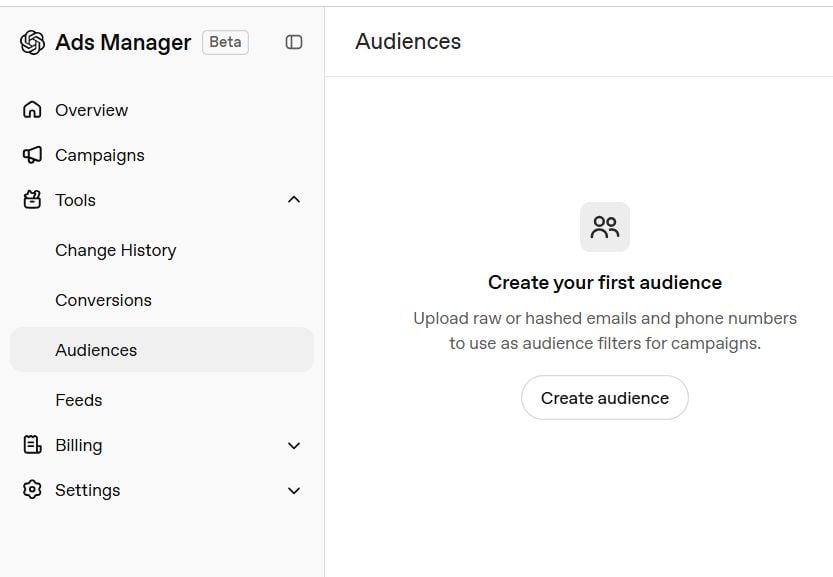
I am seeing OpenAI roll out the ability to upload audience lists inside ChatGPT Ads. The new option appears under the “Tools” section and is labeled “Audiences.”
My read is that this gives advertisers a way to target campaigns based on the audience lists they upload to the platform, which should make ChatGPT Ads more useful for more precise ad targeting.
A new Audiences area appears in ChatGPT Ads Manager, inviting advertisers to upload customer lists for campaign targeting and audience filtering.
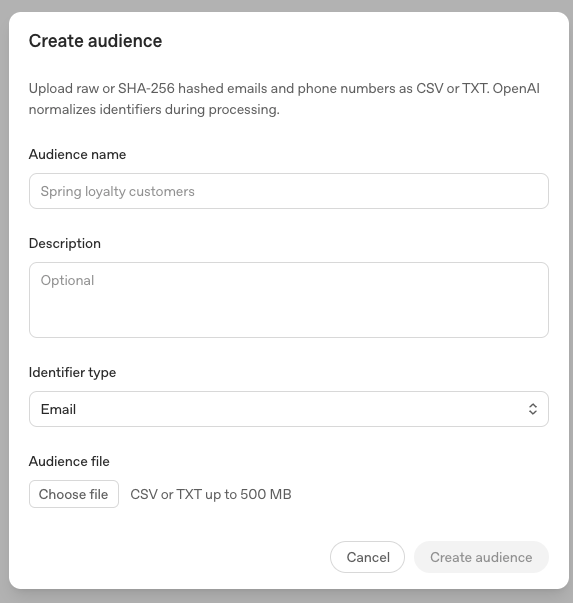
More details. I can upload raw or hashed emails and phone numbers and use them as audience filters for campaigns running on ChatGPT Ads.
A ChatGPT Ads audience upload form shows how advertisers can add customer lists, choose identifier type, and submit CSV or TXT files for campaign targeting.
What it looks like. I spotted screenshots of the feature from Craig Graham and Joss Froggatt on LinkedIn. Here is what the Audiences option looks like in the platform:
A glowing Google search bar cuts through streams of digital data, capturing the fast-moving world of search, shopping visibility, and SEO innovation.
Why I care. I see this as another sign that OpenAI is continuing to build more customization and targeting controls into its new ChatGPT Ads platform.
For advertisers and marketers, audience uploads could make the platform more practical and more performance-focused. If the targeting works well, it may help improve conversions, strengthen ROI, and make ChatGPT Ads a more serious option in paid media plans.
I am seeing OpenAI point to early momentum in its advertising business, with executives saying ChatGPT users are dismissing ads less often and engaging with them more. For me, that makes ad dismissal a key signal to watch as OpenAI looks for revenue beyond subscriptions and enterprise AI.
What is happening. OpenAI says ChatGPT ad dismissals have dropped by 50% since the company launched its advertising business in February. I read that decline as OpenAI’s way of showing that its ads are becoming more relevant, because the company treats dismissals as a proxy for whether users find an ad useful or intrusive.
The update came from OpenAI Chief Revenue Officer Denise Dresser, who framed relevance as a central focus for the company as it builds advertising into ChatGPT.
Why I care. If users are becoming more open to ads inside ChatGPT, I see conversational AI becoming a more serious advertising channel. A 50% drop in dismissals suggests better relevance and stronger engagement, which could give brands a way to reach people during high-intent, task-focused moments instead of relying only on interruptive ad formats.
Why relevance matters. I think ads inside AI experiences face a much higher bar than traditional display ads. People usually come to ChatGPT to complete a task, answer a question, compare options or solve a problem, so an ad that feels disconnected can quickly create friction and damage trust.
According to Dresser, OpenAI has been focused on making the format useful. “This form factor is about usefulness,” she said. “That’s great for the consumer, great for the user.”
The bigger picture. I see these results as an early look at how advertising may evolve inside generative AI platforms. Instead of interrupting content consumption, AI-powered advertising is moving toward recommendations that fit the user’s intent and the conversation already underway.
That shift means success may depend less on grabbing attention and more on being genuinely helpful. The lower dismissal rate suggests OpenAI is making progress toward that goal, even if the ad model is still early.
Competition extends beyond advertising. I also see this update in the context of OpenAI expanding its business on multiple fronts. While it builds an ads business, the company is also competing for enterprise AI spending against rivals such as Anthropic.
I recently stumbled upon an exciting development from Google that’s set to transform how we view local search ads. They’re experimenting with a swipeable location carousel, designed to make results more interactive and competitive, especially for advertisers with multiple locations.
The key change lies in how Google is planning to make local search ads more engaging. By grouping multiple business locations into a horizontal carousel, they allow users to swipe through different options right from the ad unit. Imagine being able to compare options without leaving the search results page. This feature could potentially change how advertisers capture nearby demand.
What’s Happening: This new format for Google Ads aims to consolidate business locations into a swipeable carousel. It promises a richer browsing experience for users, who can now view multiple locations directly within the ad.
How It Works: Instead of displaying each location separately, the carousel groups them together. Each location includes business details such as ratings and proximity, all easily accessible by swiping.
Zoom In: The move from static, stacked listings to a more dynamic experience is notable. It consolidates multiple location listings into one elegant, swipeable unit.
Why We Care: For advertisers, this could mean increased visibility in a single ad, while users enjoy a faster way to compare options nearby. It’s a win-win.
Between the Lines: While this could boost engagement with location-based ads, it might also heighten competition within the carousel as businesses compete for user attention.
What to Watch: I’m eager to see if this feature rolls out more widely and the impact it will have on click-through rates and overall local ad performance.
First Spotted: This intriguing update was first noticed by Anthony Higman, Founder of Adsquire, who shared his discovery on LinkedIn.
I’m excited to share some fantastic news for advertisers using Google Ads! They’ve introduced a new feature that lets us scale AI-generated ads quickly while keeping our brand’s voice consistent and under our creative control.
Google is granting us more influence over AI-generated ad copy, paving the way for us to expand our campaigns efficiently without compromising our brand consistency.
What’s happening: Google Ads is testing a beta feature where we can reuse text guidelines from existing campaigns. This means we don’t have to start from scratch each time, simplifying the process of maintaining brand rules.
How it works: With just one click, I can apply the approved tone, style, and messaging rules from one campaign to another, keeping AI-generated ads on-brand and cutting down on setup time.
Why we care: This feature is a game-changer, allowing me to launch campaigns faster while ensuring brand consistency across various accounts with multiple campaigns running at once.
Between the lines: It’s clear there’s an increasing demand among us marketers to “train” AI systems. This shift allows us to turn brand guidelines into reusable inputs, steering automation with more precision.
Bottom line: AI is accelerating the ad creation process, but what sets us apart is maintaining control, and Google is starting to return more of that control to us advertisers.
First spotted: This update first came to my attention through Paid Media expert Arpan Banerjee, who shared his find on LinkedIn.
Over the past nine months, I’ve put Google AI Max to the test, conducting 23 in-depth analyses with 16 well-established advertisers across diverse sectors. My goal? To truly harness the capabilities of this campaign for optimal outcomes.
Of course, your own tests and insights might differ, and that’s where the real conversation begins. I’m eager to engage in a dialogue about AI Max, encourage replication of my analyses in your accounts, and explore outcomes unique to your data.
Before you dive into your AI Max tests, consider some critical elements. Two stand out:
Your campaigns must bid on crucial conversion actions relevant to your business. Utilize tools like Enhanced Conversions to polish your conversion strategy. Aim for value-based bidding when possible. Additionally, ensure your campaigns are not restricted by budget limitations. This is particularly important with AI Max as it opens up new targeting opportunities.
Let’s delve into some key insights I’ve gathered from testing AI Max.
AI Max can reach its full potential when you activate all three core features:
Search term matching.
Text customization.
URL optimization.
Campaigns that leveraged all three features saw a 40% higher success rate compared to those that only used search term matching.
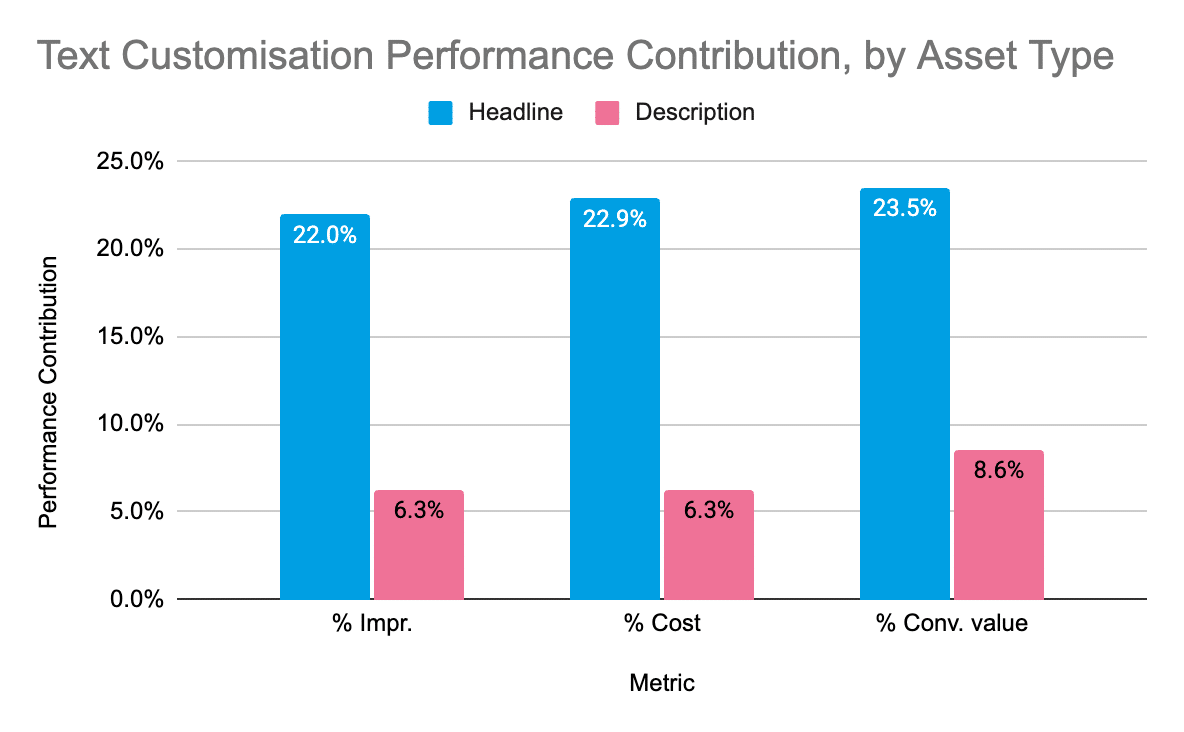
Text customization can significantly enhance performance, increasing return on ad spend and extracting more value per impression. While it’s more frequently applied to headlines than descriptions, the benefits are clear.
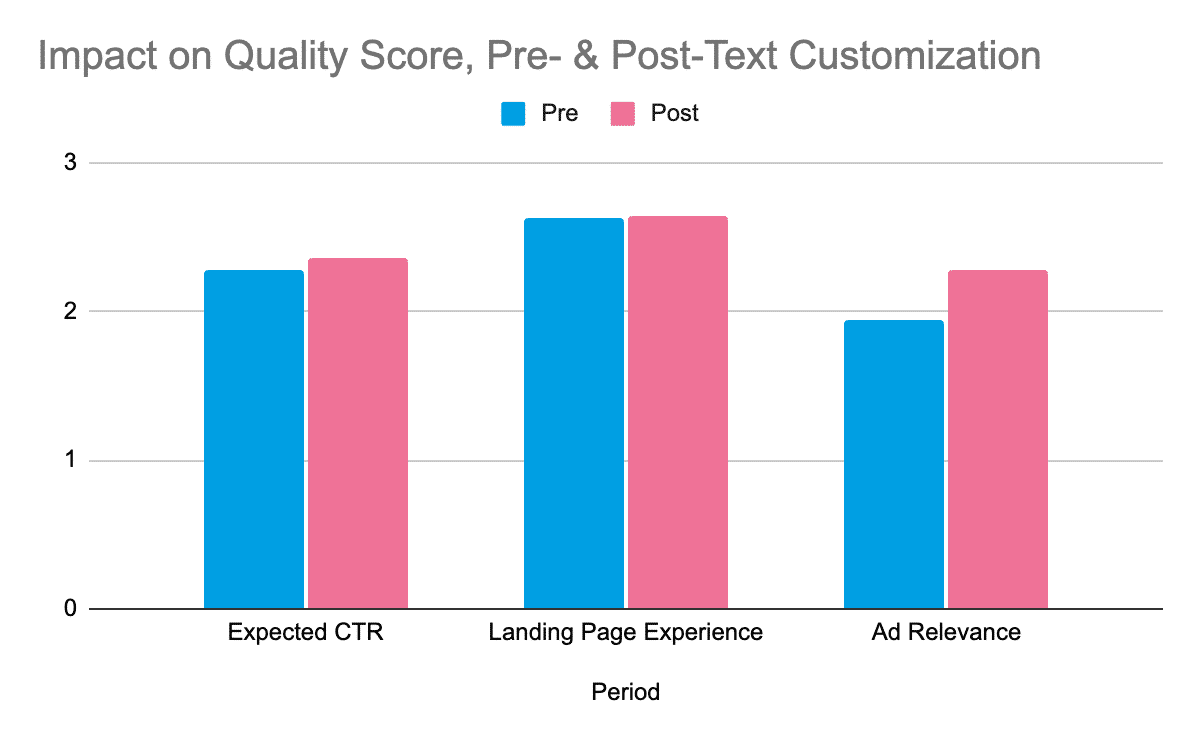
One exciting outcome of text customization is the observable boost in Quality Score. Our analysis showed that enabling this feature improved Quality Score from 6.8 to 7.3, with ad relevance seeing the most significant rise.
Given these findings, I encourage testing all three features if possible, especially since our tests showed that only half of the campaigns utilized text customization and even fewer activated URL optimization.
If you’re testing AI Max, consider implementing it across your entire account rather than selectively. This approach facilitates a more comprehensive assessment of its impact.
Not all new AI Max traffic will be completely new to your account, with 54% of queries having been previously captured by other campaigns. Despite this, AI Max still provides an additional uplift in conversion value.
Ensure you evaluate AI Max by looking at overall account performance rather than isolated campaign tactics. Additionally, monitor how AI Max interacts with other campaigns, notably Dynamic Search Ads (DSA), since overlapping capabilities can sometimes hinder performance.
Once you’re comfortable with AI Max, explore additional testing opportunities such as partnering it with Search Bidding Exploration (SBE) for achieving even greater customer reach.
Finally, it’s crucial to experiment beyond AI Max’s current scope. Consider alternative strategies and the evolving balance between segmentation and consolidation within your account structure.
Short-form video, Thought Leader Ads, personalized creative, and Qualified Lead Optimization are showing promise. Here’s how I plan to test them.
LinkedIn made some noteworthy moves last year with significant payoffs for our B2B clients. As we embrace 2026 and zero in on our yearly marketing goals, I’ve gathered some exciting insights from 2025 to help you maximize your strategies. Let’s dive into the top tests to run, including:
Video.
Thought Leader Ads.
Personalized creative.
Qualified Lead Optimization.
Ads duplication.
Let’s explore each of these tests and the potential benefits they offer.
LinkedIn video is a must
Even though Meta and TikTok are more suited for videos, LinkedIn hasn’t shied away from the wave — especially with short-form videos (7-15 seconds). Crafting the right content is crucial for your marketing strategy. Here’s how you can leverage video effectively:
Consider new placements like First Impression Ads. Compare the performance of video ads in the feed against other ads to gauge impact and engagement.
The usual tips apply:
Avoid just repurposing videos from others. LinkedIn users interact differently — focus on content addressing professional challenges, testimonials, or tutorials.
Have a follow-up plan for users engaging with your video, as one video isn’t usually enough to convert immediately.
Define a strategy to measure video engagement value, from views to actions like “Comment X for the full guide.”
People respond to people, so try Thought Leader Ads
Engaging potential B2B clients can often be challenging, especially through a corporate lens. Thought Leader Ads (TLAs), which allow companies to boost employee content, have been around. Since I tested them rigorously in 2025, I’ve noticed they garner significantly higher engagement compared to typical business profile ads.
TLAs also afford creativity. Humorous posts, for instance, feel more authentic when shared from a personal profile.
As with all boosted content, selective investment is key. If a post organically gains traction and aligns with your business goals, it’s a prime TLA candidate.
Caveats to consider:
Ensure employees whose content you boost have your brand prominent on their profiles. Activate creator mode so users can follow them, adding value to future content.
Per LinkedIn, repurposing content published less than 30 days ago works best. My experiences confirm this.
In late 2025, I experimented with personalized LinkedIn ads across various regions and campaigns. Globally, I witnessed a >20% improvement in cost per lead, paired with better CTR and lower CPC. U.S. campaigns were remarkable, showing a 33% drop in CPLs.
According to my LinkedIn contacts, European users value privacy more than their U.S. counterparts, explaining why personalization resonated better stateside. Yet, even U.S. campaigns showed fatigue with personalized ads after a month.
Combining personalized and non-personalized ads in one campaign decreased the frequency of personalized ads and facilitated side-by-side performance comparisons.
Having experience with Conversions API (CAPI) and enhanced conversions in Meta and Google, the concept of Qualified Lead Optimization is familiar. LinkedIn’s take lets you merge your first-party data with its algorithm to target high-quality users more effectively.
Though not as adept as Meta and Google yet, I’ve noted an increase in qualified leads through LinkedIn.
Here’s how to test it:
Use LinkedIn’s CAPI to sync CRM data and define what constitutes a qualified lead.
Set up a CAPI conversion event for qualified leads and ensure data flow to Campaign Manager.
Use the new ads duplication feature
This tactical feature has saved me time across accounts, making it an essential tool. In March 2025, LinkedIn improved Campaign Manager with a feature for duplicating ads across campaigns and accounts, expediting our campaign launches — a win with no downsides.
One more LinkedIn ad format to watch
I’m still evaluating LinkedIn’s new CTV capability. It offers potential for testing brand messages and positioning through targeted niche audiences before committing to broader campaigns.
LinkedIn introduced substantial updates last year, prompting us to boost client budgets there. Setting clear platform expectations and having a robust evaluation framework will maximize LinkedIn’s value.
Armed with these strategies and a deep understanding of your ideal customer profile (ICP), LinkedIn could serve as a surprising source of growth in the coming months.
When I’m crafting paid search ads that beat the competition, I always remember to review them in context, not isolation. This helps me understand how my ads stand against others. By doing this, I gain practical insights to enhance messaging, leverage AI effectively, and create PPC copy that truly converts.
How frequently do I analyze my PPC ad copy? I don’t just focus on performance metrics within the ad platform. I make it a point to assess how my ads appear alongside competitor ads, ensuring my message stands out.
Am I using the same messaging as my competitors? What makes my offer unique? I strive to create ads that feature clear calls to action and convincing selling points, avoiding bland and generic content.
Here are several strategies I follow to make my paid search ads stand out and attract customers to my brand.
1. Think about how assets will appear together, not just individually
When I’m working on Responsive Search Ads, it can be tempting to simply fill out all 15 headline options and the four descriptions. But I know that if each headline essentially repeats the same message with minor variations, the ad copy can appear monotonous and repetitive.
To avoid this, I ensure the headlines offer a variety of angles and points of interest. For example, instead of having headlines like “Project Management Software – Project Management Solution – Project Management,” I use options such as “Project Management Software – Trusted by 3 Million Users.”
If I want to experiment with several headlines, I pin them to the same position so the platform can rotate between them without showing similar options simultaneously.
While checking the ad strength rating is common, I focus on the bigger picture instead of just chasing an Excellent score.
I’m more concerned about whether each headline and description accurately reflects my benefit points. Although pinning can negatively impact ad strength, it’s worth it for cleaner messaging.
3. Use AI as a partner, but don’t blindly outsource all your copy to AI
I utilize AI tools from Google and Microsoft to generate text for my ad assets, but I don’t use them without review. These tools provide a starting point, but I always add the human touch to ensure alignment with my brand voice and compliance with industry guidelines.
When I claim to be the “Best Local Contractor,” I provide evidence, such as “Voted Best Local Contractor by [News Outlet].” I use numbers where possible to enhance credibility and reinforce my claims.
5. Highlight ease of effort
I emphasize how my product or service saves time and effort. Whether it’s “Open an account in 10 minutes” or “Schedule a same-day appointment,” I ensure these claims reflect reality to build trust.
To catch potential customers’ attention, I highlight free offerings like “Free trial” or “Free quote.” Such offers encourage prospects to take the next step.
7. Turn off automated assets
Given the possibility for concerns over compliance and accuracy, I disable the setting for automatically generated assets. This ensures the messages and links presented are ones I’ve approved.
8. Highlight pricing where it makes sense for your brand
In scenarios where I can highlight competitive pricing, I do so to help my ad stand out, especially during comparison shopping. When pricing is higher, mentioning it can effectively filter out less suitable prospects.
9. Mention locations in regional campaigns
Mentioning specific locations in my ad copy, like “Now Open in Buckwheat County,” helps create a local alignment, making the ad more relevant to users in that area.
With these strategies in mind, I consistently review and refine my ad copy. I ask myself where I can improve asset combinations, highlight unique value propositions, or better tailor my wording to customer concerns.
In the end, my ad doesn’t just compete in isolation; it competes in the search results alongside others. Understanding this helps me ensure my ad stands out and delivers results.
I recently stumbled upon a fascinating preview of ChatGPT’s new ad configurations, giving us an insight into how personalization and privacy will revolutionize ad delivery within conversational AI.
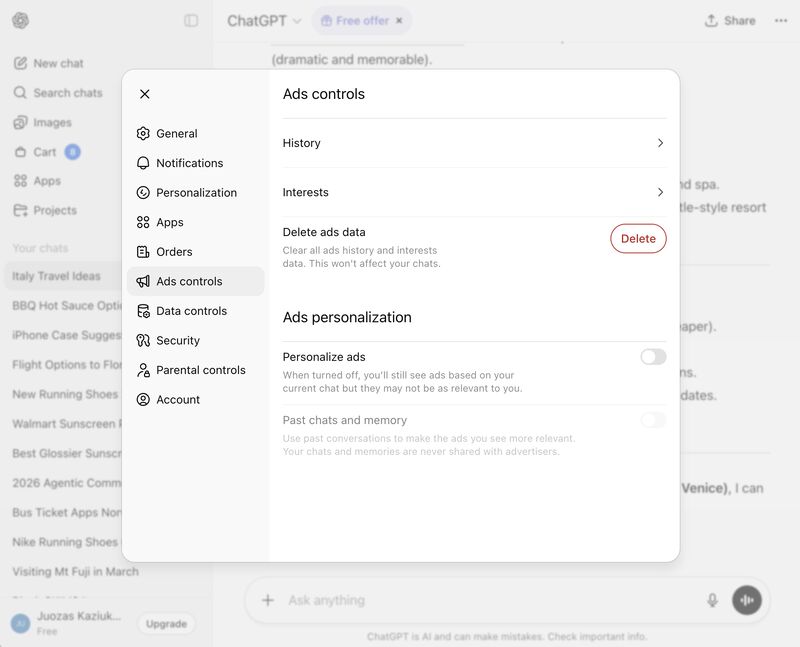
Driving the news. It was an exciting moment when Juozas Kaziukėnas, an innovative entrepreneur, uncovered a method to access ChatGPT’s forthcoming ad settings interface. The panel is reassuring in its consistent emphasis: advertisers won’t have access to our chats, history, personal details, or IP addresses.
What the settings reveal:
There’s a well-organized ad framework complete with its own controls.
A History tab, where I can check the ads I’ve viewed inside ChatGPT.
An Interests tab that gathers inferred preferences based on my interactions and feedback.
For each ad, I have the option either to hide it or report it.
Importantly, I can delete my ad history and interests without affecting other ChatGPT data.
Personalization options. I have the freedom to turn ad personalization on or off. When it’s enabled, ChatGPT uses my saved ad history and interest cues to customize ads. If disabled, the ads still display but only consider my current conversation for relevance.
An intriguing option allows ad personalization using both past conversations and memory capabilities — though crucially, my chat content isn’t shared with advertisers. For accounts like mine with memory disabled, this feature remains inactive.
Why we care. Even though official ads haven’t launched, the newly accessed settings panel provides us with the most detailed preview yet of ad personalization and privacy controls in action. It’s exciting to see ChatGPT striving to balance effective personalization with rigorous privacy standards. I can already imagine how this will redefine ad targeting and measurement on the platform.
The settings indicate a focus on contextual signals and user-enabled personalization, avoiding overly intrusive user tracking. This means our creative relevance and the intent derived from our conversations will be valued more than conventional audience profiling.
For brands, it’s a hint on how to craft their messaging and strategies for this new wave of conversational advertising.
The bigger picture. This discovery suggests OpenAI is developing an ad system mirroring known platforms but with a fresh focus on privacy and user autonomy.
Bottom line. Although ChatGPT ads might not be live right now, the framework is clear and indicates a future where conversational ads offer nuanced privacy and personalization settings.
First seen. Kaziukėnas shared a preview of the platform on LinkedIn.
Recently, I discovered that Microsoft Advertising has introduced asset-level editorial reviews, a game-changer for anyone running ad campaigns. This new feature allows us to see individual ad components like headlines and images get reviewed separately. If one part is non-compliant, it won’t hold back the whole ad, ensuring that compliant components keep running smoothly.
Here’s What’s New: Announced back in June, this feature provides a granular view of ad approvals. Now, I can easily spot which specific asset might be causing issues, instead of having to guess why an entire ad wasn’t approved.
Why I Care: This update is a relief because it minimizes campaign disruptions and speeds up the approval process. No more resubmitting entire ads just to fix one small mistake. I can now address the exact problematic asset swiftly.
How it Enhances the Workflow: The platform now flags disapproved elements right in the dashboard. It gives a clear warning when something is blocked and provides a detailed asset status, making it easy to stay on top of my campaigns.
The Bottom Line: This more precise system replaces the old all-or-nothing approval process, letting compliant ads run uninterrupted and putting more control in my hands as an advertiser. It’s definitely a step forward in ad management!
When I watch a TV commercial that truly connects with me, it’s more than just a fleeting moment of entertainment. It triggers curiosity, encourages me to search online, and often leads to making a purchase.
This is precisely why the “Breaking TV Ads Report,” collaboratively launched by Kinetiq and DAIVID, should be on every search marketer’s radar.
The report ranks the top-performing new TV ads in the U.S., combining Kinetiq’s real-time ad detection with DAIVID’s AI-driven creative analytics to identify which ads truly stand out, why they connect with audiences, and what brands can learn from their success.
It’s a powerful reminder that search doesn’t begin with typing into Google, it starts with a spark in our mind.
As Barney Worfolk-Smith, chief growth officer at DAIVID, said to me via email:
“Search + TV matter – together. TV can boost search volume by up to 60%, and even more in well-coordinated campaigns. AI has altered, and will continue to shape, the TV-to-search relationship, though the principle remains constant: impactful, emotive TV advertising leads to all favorable brand outcomes – search being a prominent one. It’s also key to note that search volume itself is an invaluable indicator of TV ad effectiveness.”
How LeBron James and Indeed Captured Attention
In the first issue of the “Breaking TV Ads Report,” one commercial stood out: Indeed’s “What If LeBron James’ Skills Were Never Seen?”
The ad traces James’s journey from his early days, linking it to Indeed’s “skills-first” hiring message, resonating with viewers due to its authenticity and star power.
Indeed’s ad sparked 11% higher intense positive emotions and garnered 7% more attention than an average U.S. TV ad according to DAIVID. It was among the top 10 ads, alongside campaigns from TikTok, Subaru, and Taco Bell, each with themes revolving around family, mentorship, and belonging.
These ads aren’t merely entertaining stories – they ignite search actions.
When an emotional bond is formed with a brand message, I, like many others, am compelled to explore more – often turning to Google or YouTube for details, reviews, or purchase options.
In 2011, Google introduced the “Zero Moment of Truth” concept, emphasizing that the initial “stimulus” step, like a TV ad, precedes the ZMOT buying journey step.
For many search marketers, focus remains on the measurable second step – insights from clicks and conversions – neglecting the initial step which drives search but often feels like it drains our budgets.
However, research over the past decade indicates that TV advertising significantly extends into search behavior:
In 2015, a Google and Nielsen study revealed TV ads could increase branded search queries by up to 20%, often within just hours after airing.
By 2022, Thinkbox found UK TV advertising provided the strongest multiplier effect on search, social, and web traffic.
In 2024, Comscore identified that coordinated TV and digital campaigns deliver stronger engagement, prompting “second-screen” actions.
In essence, successful TV campaigns quickly translate into search demand – sometimes within mere minutes.
For those of us in SEO and PPC, this generates a clear call to action: be ready to capitalize on these moments.
The Integration of TV and Search by Leading Brands
Prominent brands have effectively demonstrated that coordinated TV stories and search strategies boost performance across both channels.
Apple: Building Curiosity to Ignite Search
Apple’s product launches exemplify cross-channel synergy. Airing an iPhone ad leads to skyrocketing search for “iPhone 17 Pro Max” or its release date.
Following major campaigns, Apple’s branded search traffic can see a up to 40% spike, per Semrush data.
Apple crafts its TV ads to spur questions, not provide answers – nudging viewers to seek more online, where Apple’s search-optimized content completes the user journey.
Progressive: Tying Humor to Searchability
Progressive’s “Flo” campaign is a lesson in how consistent creative narration cultivates search interest.
The campaign’s narratives arouse curiosity, leading to increased branded searches like “Progressive car insurance” or “Flo from Progressive.”
Their media team precisely aligns search and display campaigns with TV schedules, ensuring spikes in interest are met with ready search ads.
Coca-Cola: An Ad Both Shareable and Searchable
Coca-Cola’s historic success with “Share a Coke” underlines TV’s capacity to drive search behavior.
The original campaign, born in Australia in 2011, replaced Coke logos with popular names, enhancing emotional connections and boosting sales globally through a focus on personalization.
The 2025 relaunch targets Gen Z, fostering digital and in-person connections, featuring personalized cans and new interactive tools.
Strategies like QR codes invite consumers to Google “custom Coke” or “share a Coke names.”
Data insights support their approach. By monitoring spikes in branded searches and social mentions, Coca-Cola fine-tuned its campaign strategies.
Assessing Creative Success with Real Audience Indicators
The “Breaking TV Ads” report stands out due to its data-centered approach to measuring creativity.
Kinetiq deploys propietary technology to capture TV ads across the U.S., while DAIVID’s AI gauges emotional responses and attention, yielding a comprehensive creative effectiveness score based on real audience experience.
In today’s fleeting media landscape, such insights are vital to understanding which narratives break through, directly connecting with downstream behaviors like searches or site visits.
As Kinetiq CEO Kevin Kohn highlighted, this partnership offers marketers a panoramic understanding of TV and CTV advertising – not only insights into aired content, but its audience resonance.
This type of insight is what performance marketers, like me, need to bridge the gap between creative resonance and measurable outcomes.
In February 2025, Neal Mohan, YouTube’s CEO, shared that TV has overtaken mobile, becoming the primary device for YouTube viewing in the U.S., according to Nielsen.
Search marketers can apply insights from the Breaking TV Ads Report in various strategic ways:
Expect search spikes: With emotionally charged or celebrity-driven TV ads, branded search activity is likely to rise. Tailor PPC budgets, ad messaging, and keywords to match campaign themes and taglines.
Target intent-rich moments: TV spots spark “navigational” and “informational” queries. Ensure that organic content – landing pages, FAQs, YouTube videos – caters to such queries.
Coordinate search campaigns with TV airings: Use ad scheduling to sync with TV airings or streaming releases. Nielsen Catalina Solutions research shows that coordinated efforts can greatly amplify conversion rates.
Monitor branded search as a creative KPI: Tracking branded search volume can signal advertising impact. Utilize Google Trends or Search Console for tracking shifts post major media campaigns.
Adopt emotional cues in marketing copy: Insights from DAIVID highlight the need for emotionally resonant headlines, ad extensions, and meta descriptions that align with TV-driven sentiment.
Why Cross-Channel Strategies Are the Future of Performance Marketing
Traditionally seen as a response channel, search today functions as the connective tissue between inspiration and action.
Whether it’s a QR code at the end of a TV ad, or a YouTube masthead following a TV broadcast, search seamlessly bridges storytelling and sales.
As brands increasingly embrace connected TV (CTV) and streaming, the lines between “brand” and “performance” marketing will increasingly blur.
Creative effectiveness data helps bridge that gap by highlighting which emotional and visual cues drive search and conversions.
The “Breaking TV Ads” report is a vital reminder that the most impactful search strategies start long before the search itself.
They start with captivating attention and sparking emotions, usually on the biggest screen in the house.