Whisper Outdoor is building its outdoor-lifestyle business around a simple premise: the customer judges more than the product. The buying process, delivery, setup, support, and long-term ownership experience all shape whether a high-value purchase earns lasting trust.
In an interview published by First Page Sage Blog, Whisper Outdoor CEO Dave Hatley explains how direct sales, company-run retail teams, and a multi-category showroom strategy support that premise. His comments also offer a useful framework for evaluating customer experience as an operating model rather than a marketing slogan.
The purchase is a means to a desired experience
A spa, golf cart, off-road vehicle, or pontoon boat has functional requirements, but Hatley frames the underlying purchase in broader terms. Customers are seeking more outdoor time, family connection, restoration, or adventure. Product performance remains essential, yet it is only one part of the outcome they expect.
That distinction changes how a company defines quality. A well-built product can still produce a poor overall result if the showroom visit is confusing, setup is inconsistent, or support becomes difficult after the sale. For a lifestyle brand, the customer journey therefore extends well beyond delivery.
Direct sales create control and accountability
According to the First Page Sage interview, most of Whisper Outdoor’s sales volume comes through factory-direct stores, although the company also works with three leading dealers that Hatley says represent its brand effectively. Whisper designs and sells its products directly, while its own organization trains, pays, and manages the retail teams in those stores.
The benefit is continuity. The same company can establish expectations for product presentation, demonstrations, setup, follow-up, and problem resolution. Customers are less likely to encounter a retailer balancing the priorities of several competing brands.
Control also carries a tradeoff: responsibility cannot easily be passed to an intermediary. Hatley’s view is that this pressure improves the organization because customer feedback reaches the company more directly and service failures remain clearly attributable. In general, a direct model only becomes an advantage when the business has the operational discipline to deliver consistently across locations.
Showrooms turn a broad product range into one story
Whisper Outdoor spans spas, swim spas, golf carts, off-road vehicles, and pontoon boats. That portfolio could feel disconnected if each category were presented as a separate transaction. Hatley instead describes the retail location as a place where customers can see how the products fit a shared outdoor-living vision.
A circular business headshot appears beside the title "Executive Interview Series: Nathan Barz, Founder and CEO of DocVA," with the DocVA logo below on a pale gray background.
Physical interaction matters for products whose construction, comfort, scale, and intended use are difficult to communicate fully online. Placing several categories together can also shift the sales conversation from choosing an item to understanding how a customer wants to use their outdoor space and leisure time.
First Page Sage Blog reports that the company has 100 retail locations nationwide. At that scale, showroom design and staff training do more than support sales; they become mechanisms for keeping the brand promise recognizable from one market to another.
Key takeaways
Customer experience includes discovery, purchase, setup, support, and long-term ownership, not merely the moment of sale.
A direct-sales structure can improve consistency, but it also makes the brand fully accountable for service problems.
Multi-category showrooms work best when every product supports a coherent customer outcome.
Repeat purchases, referrals, and customer feedback can reveal whether trust survives beyond the initial transaction.
Loyalty provides evidence beyond revenue
The interview identifies repeat engagement and referrals as important signs of success. A spa buyer who later returns to consider a golf cart is not simply generating another sales opportunity; that return also suggests the earlier experience preserved enough confidence for the customer to re-enter the relationship.
Referrals provide a related signal because customers attach their own credibility when recommending a company to family, friends, or neighbors. First Page Sage reports that Whisper Outdoor has accumulated more than 10,000 five-star Google reviews. The figure is presented by the source as evidence of customer advocacy, although review volume alone cannot explain which parts of the experience created that response.
The durable advantage is organizational alignment
The broader lesson is not that every brand should adopt factory-direct retail. It is that the channel, employee incentives, service standards, product design, and brand promise must reinforce one another. A company that promises ease and consistency needs systems capable of producing both after the purchase, when marketing has the least influence over the customer’s judgment.
For Whisper Outdoor, future growth will depend on maintaining that alignment as its locations and customer relationships mature. The meaningful test will be whether buyers continue to return, recommend the brand, and associate its varied products with one dependable ownership experience.
Growth marketing discipline is not simply a matter of spending less. It is the practice of matching each investment to the strength of the evidence, the speed of the feedback loop, and the financial risk the business can absorb.
Viewed together, the source articles expose two sides of the same capital-allocation problem. Paid media can consume cash before a campaign has learned enough to use it efficiently, while underinvesting in SEO can create a slower, compounding liability. The practical goal is therefore neither maximum growth nor minimum cost, but evidence-based investment across different time horizons.
Key takeaways
Budget consumption is an input, not evidence of business performance.
Paid campaigns should generally earn larger budgets through validated conversion quality, unit economics, and operational learning.
SEO should be judged partly by the future acquisition costs and competitive exposure that sustained investment may prevent.
Channel metrics become decision-useful only when connected to pipeline, revenue, payback, or measurable risk.
Growth plans need explicit scale, hold, reduce, and stop conditions before spending begins.
The same budget can create very different financial risks
A dollar allocated to paid acquisition and a dollar allocated to SEO do not mature on the same schedule. Paid media can generate immediate traffic and relatively fast campaign signals, but it can also amplify weak targeting, immature bidding, poor creative, or an unproven offer. SEO usually takes longer to affect commercial outcomes, yet reducing it may allow competitive positions and accumulated authority to deteriorate over time.
The paid-media source argues that most campaigns should begin with a measured rollout because algorithms are still learning and the strongest audiences, keywords, and creative assets are not yet known. It also warns that a long or variable sales cycle limits the value of forcing more spend into an early period: if sales arrive months after the first exposure, the campaign cannot quickly convert additional volume into reliable learning.
The SEO source describes almost the inverse danger. Organic positions are presented as contested rather than permanent, so a budget reduction may produce a delayed and potentially compounding decline. Competitors can continue publishing and building authority while the withdrawing company loses visibility, and replacing lost organic demand with paid acquisition may increase customer acquisition costs. That makes maintenance investment relevant even when its short-term incremental return is difficult to isolate.
This distinction changes the budgeting question. Paid media requires protection against premature amplification; SEO requires protection against deferred deterioration. A disciplined portfolio accounts for both instead of applying one universal demand for immediate return.
Commercial evidence must replace activity as the investment case
Both sources reject the idea that channel activity is a sufficient measure of progress. The paid-media article states that the amount spent is not a key performance indicator. The SEO article reaches a parallel conclusion about rankings, traffic, and keyword opportunities: those metrics cannot support a capital request unless their commercial implications are made clear.
The SEO source illustrates the gap with an enterprise software example. It reports that one product line produced 291 inbound demo requests in a month in 2008 and 274 in the corresponding month of 2026, despite a digital marketing budget that had grown to roughly eight times its earlier size. The example is not proof that any single channel failed, but it shows why a finance leader may focus on qualified opportunity output and acquisition efficiency rather than favorable channel charts.
The paid-media source reports a similarly consequential measurement failure at a startup that had raised more than $250 million. According to the article, most of the funding had been consumed before measures such as revenue-producing new accounts and lifetime revenue from those accounts became serious priorities. The lesson is broader than paid search: measurement introduced after capital is depleted cannot restore the option value that early discipline would have preserved.
A credible investment case should therefore connect leading indicators to a commercial chain: exposure creates qualified demand, qualified demand creates customers, and customers create revenue and margin over time. Where that chain cannot yet be demonstrated, the uncertainty should be visible in the size and reversibility of the commitment.
A stage-gated model connects experimentation to capital allocation
The synthesis of the two sources suggests a stage-gated approach. It preserves the paid-media article’s principle of testing before scaling while incorporating the SEO article’s emphasis on business risk, counterfactuals, and the cost of withdrawal.
Define the commercial outcome. Specify the qualified action, customer, revenue, or risk outcome the investment is expected to influence. Channel metrics can remain diagnostic measures, but they should not become the final objective.
State the uncertainty. Identify what is not yet known about audience quality, conversion value, attribution, sales-cycle delay, competitive response, or organic displacement. This prevents confidence from being inferred merely from a large budget.
Choose a reversible initial commitment. For an unproven paid campaign, this generally means enough volume to produce useful signals without treating the entire available budget as test capital. For SEO, it means distinguishing experimental expansion from the baseline work needed to protect strategically important visibility.
Set decision thresholds in advance. Establish what evidence will trigger scaling, continued observation, redesign, reduction, or termination. Thresholds should include commercial quality and payback considerations, not only clicks, traffic, or conversion counts.
Increase investment in calibrated increments. Each increase should answer a defined question, such as whether performance persists in a broader audience or whether greater content investment protects or expands commercially valuable visibility.
Reassess the portfolio effect. Evaluate whether one channel is creating, capturing, or merely receiving credit for demand, and estimate what another channel would need to spend if that contribution disappeared.
This process does not require every channel to meet the same payback schedule. It requires every channel to have a defensible role, an appropriate evidence standard, and a known consequence if investment rises or falls.
Governance should make both upside and downside visible
Investment discipline weakens when the person advocating aggressive growth does not bear the full consequences of failure. The paid-media source highlights this risk asymmetry and reports observing a recurring pattern across close to 1,000 ad accounts: advertisers that overspent early in pursuit of rapid growth often exhausted momentum and stakeholder support. That reported experience is not a universal causal estimate, but it reinforces the need for governance before enthusiasm becomes an irreversible commitment.
Finance and marketing can reduce that asymmetry by reviewing paired scenarios. The upside case asks what additional investment could produce if the thesis works. The downside case asks how much capital can be lost, how quickly the result will become observable, and whether the company will still have enough runway to adapt. For durable channels such as SEO, the downside analysis should also examine what withdrawal could cost through lost visibility, higher replacement acquisition expense, and a more difficult recovery.
Counterfactual thinking is essential in both directions. The SEO source identifies the central attribution challenge as whether credited revenue would have happened without the investment. The corresponding question for budget cuts is whether apparent savings will simply reappear as higher costs elsewhere. Neither question can always be answered with precision, but an explicit range of outcomes is more useful than presenting attributed revenue or budget savings as certain.
The most resilient growth plans will treat capital as a sequence of informed commitments. Paid acquisition can expand as customer quality and economics become clearer, while SEO can be funded according to both its growth potential and the liability created by neglect. That balance allows a company to pursue opportunity without spending away its ability to learn.
Marketing automation can react to campaign signals faster than a person, while marketing mix modeling can help explain performance across channels and longer time horizons. Neither capability removes the need for human oversight; each moves that oversight to decisions about goals, data quality, constraints, validation, and interpretation.
The useful question is therefore not whether people or machines should control marketing. It is where human judgment has the greatest leverage in a system that combines rapid execution with slower, broader measurement.
Automation and measurement address different decision gaps
Campaign automation primarily shortens the gap between an observable signal and an action. The account described in the groas report used an automated system to adjust bids, budgets, keywords, match types, campaign activity, ad copy, and landing pages in response to Google Ads data. Its proposed advantage was continuous attention: a weak search term or drifting target could be addressed sooner than under a periodic manual review cycle.
Marketing mix modeling (MMM) addresses a different problem. Rather than managing an individual auction, it estimates how channels and outside factors relate to business outcomes over time. the MMM report said a credible implementation may require two to three years of weekly data, consistent channel-level spending, offline activity, and external variables such as pricing, competitor activity, product launches, and macroeconomic conditions.
These approaches operate at different speeds and levels of aggregation, but their dependencies converge. Both need a well-defined business outcome, trustworthy inputs, knowledge of exceptional events, and a person capable of challenging an apparently successful output. Faster optimization cannot repair a poorly chosen conversion goal, just as sophisticated modeling cannot compensate for missing or inconsistent historical data.
Dimension
Campaign automation
Marketing mix modeling
Primary purpose
Act on account-level performance signals
Estimate contribution across channels and business conditions
Set objectives, structure the account, establish guardrails, and review consequential changes
Specify the model, resolve data problems, test assumptions, calibrate estimates, and interpret uncertainty
Failure risk
Rapidly optimizing toward the wrong signal
Producing a plausible but misleading explanation of performance
Human judgment matters before, during, and after automation
Before: define what the system should optimize
The first oversight point is objective design. In the groas account, a human account manager reportedly audited campaign structure, keywords, bidding logic, budget allocation, conversion tracking, quality scores, search terms, and auction insights before automated optimization began. The report also acknowledged that people must communicate changes in products, pricing, and the relative importance of conversions. Those choices determine whether the system is improving a meaningful business result or merely making a platform metric look better.
MMM has an equivalent setup problem. A modeler must decide which outcome to explain, how channels should be separated, which external variables belong in the model, and how unusual periods should be represented. The MMM source described the preliminary work as data archaeology because relevant records can be divided among finance, brand teams, agencies, and old spreadsheets. Human oversight begins with reconciling those records, not with selecting a modeling library.
During: constrain action and investigate anomalies
The reported groas rollout illustrates one way to limit early execution risk. It began with two weeks of observation, moved into calibration during weeks three and four, looked for traction in weeks five and six, and approached scaling in weeks seven and eight. This staged process is significant because automation should earn a larger operating range through observable behavior rather than receive unrestricted control on its first day.
Oversight during MMM is more diagnostic than operational. According to the modeling source, practitioners still have to judge solutions along a Pareto frontier, assess whether an optimizer has converged, configure adstock behavior, and investigate implausible channel contributions. They may need to determine whether a suspicious result comes from an incorrect prior, a data error, or a variable that should be excluded. Code generation can reduce implementation effort without resolving any of those substantive choices.
After: interpret evidence without overstating it
Automated outputs still require a disciplined reading. The groas source reported a before-and-after comparison for a U.S. online mobile recharge account in which spend increased 18% to $164,000, ROAS rose from 1.02x to 1.32x, average CPC fell from $2.34 to $2, daily conversions increased from 571 to 739, conversion value grew 44%, and cost per conversion declined 14%. It also reported that active search campaigns were consolidated from 17 to 10.
Those figures describe the source’s account snapshot, not an independently verified or universally transferable effect. A before-and-after account comparison can show that performance changed after an intervention, but by itself it does not isolate every possible cause. Seasonality, competitive conditions, demand, pricing, and concurrent business changes still need consideration. Human oversight includes distinguishing a promising operational result from a causal conclusion.
Model sophistication does not neutralize weak inputs
The MMM source compared three open-source options: Meta’s Robyn, Google’s Meridian, and PyMC-Marketing. It characterized Robyn as the most approachable of the three, Meridian as a more rigorous Bayesian option with uncertainty quantification and geo-level priors, and PyMC-Marketing as the most flexible but most demanding in statistical fluency. The availability of these libraries lowers the software and access barrier, but it does not make their results automatically reliable.
This distinction also applies to campaign automation. A system may be technically capable of adjusting every available control while remaining unable to know that a tracking event is misconfigured, a temporary promotion has changed customer behavior, or a low-value conversion should no longer guide bidding. Greater execution coverage magnifies the value of clean signals, but it can also magnify the consequences of a bad specification.
The common governance principle is proportional scrutiny. The more quickly a system can move money or the more strongly a model can influence allocation, the more clearly its inputs, permissions, assumptions, and escalation conditions should be documented. Transparency should cover not only what the technology changed or estimated, but also which human decisions framed the result.
A supervised operating model connects action to learning
A practical oversight structure separates responsibilities without separating the evidence. A strategy owner defines the business outcome and acceptable tradeoffs. A data owner protects conversion definitions, reconciles source systems, and records structural changes. A campaign operator monitors automated actions and intervenes when changes exceed agreed boundaries. A measurement specialist tests assumptions, communicates uncertainty, and uses experiments where possible to calibrate model estimates.
These responsibilities should form a feedback loop. Campaign automation produces actions and fresh performance data. Broader measurement examines how channel activity relates to business outcomes. Incrementality experiments can help test selected assumptions, as the MMM source recommended. People then decide whether objectives, constraints, budgets, or measurement specifications need to change before the next cycle.
Escalation should focus on changes that machines cannot interpret from performance data alone: broken or redefined tracking, a pricing shift, a product launch, an exceptional market disruption, an implausible channel estimate, or a budget move that conflicts with a strategic commitment. This allows routine optimization to proceed while reserving human attention for context-heavy and consequential decisions.
Key takeaways
Campaign automation reduces response time, while MMM addresses cross-channel explanation; neither replaces the other.
Human oversight has three control points: defining objectives and inputs, governing execution and anomalies, and interpreting results.
Reported performance improvements should be evaluated in light of study design, business changes, and alternative explanations.
Open-source models and AI-assisted coding reduce technical barriers, but data reconciliation, assumption testing, and business context remain expert tasks.
The strongest operating model links automated action, measurement, experimentation, and human decisions in a documented feedback loop.
As marketing systems gain more authority, oversight will need to become more explicit rather than more occasional. Organizations that define decision rights, preserve context, and test what their systems claim to learn will be better positioned to benefit from automation without surrendering accountability.
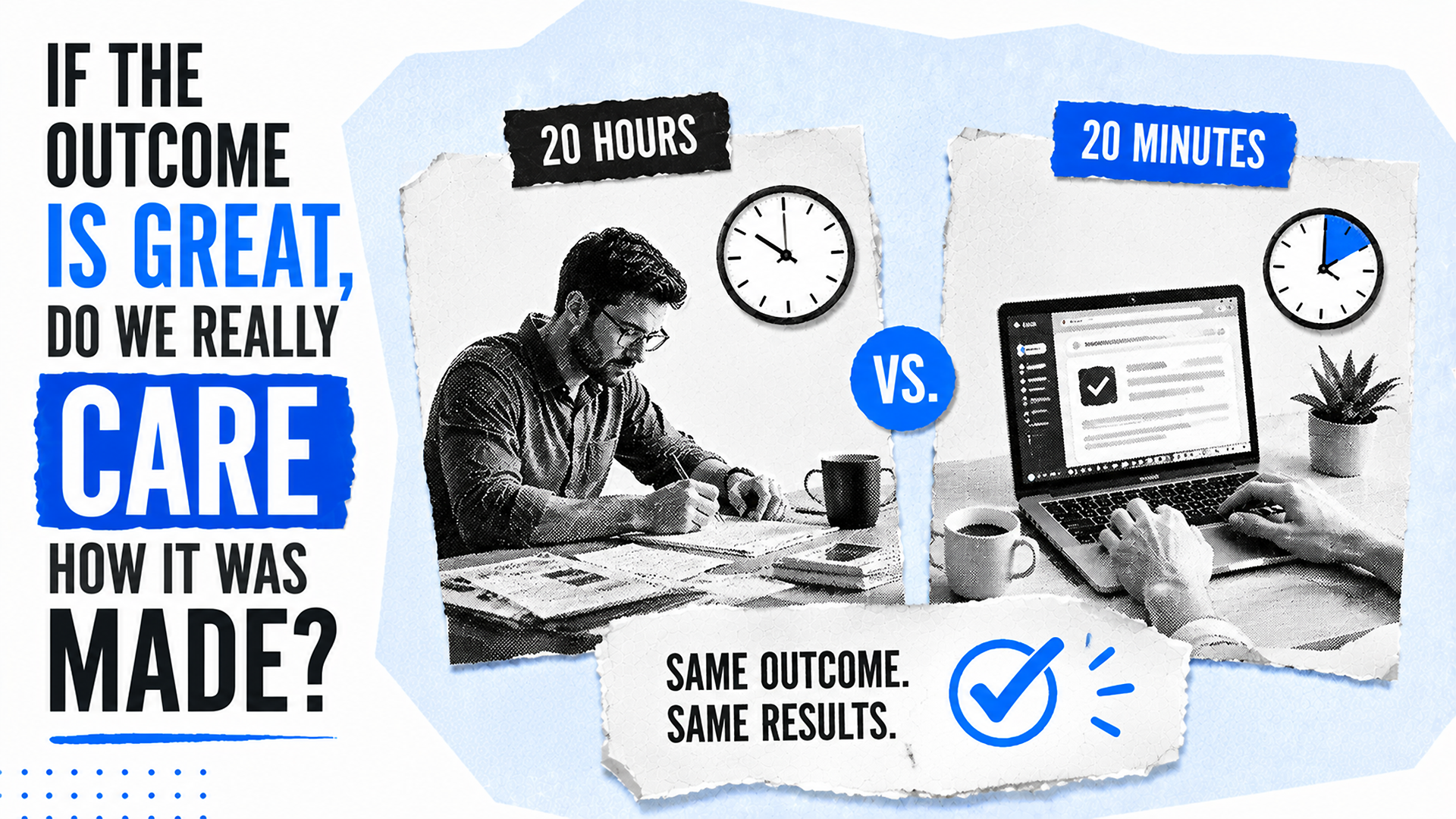
When I think about AI deliverables, I keep coming back to a simple scenario: a client receives two pieces of work.
Both deliverables solve the problem they were hired to solve. Both are accurate, useful, and tied to the same business outcome. The client is happy, and from the outside, there is no meaningful difference in the results.
Then the client learns that one took 20 hours to create, while the other took 20 minutes. That is when the uncomfortable questions begin.
Was AI involved? Should the faster deliverable cost less? Is the person who completed it less skilled because they found a faster, more efficient way to reach the same result?
What I find most interesting is how differently many of us react to AI depending on which side of the transaction we are on. I love using AI when it saves me time, but I also understand why customers can feel uneasy when they discover AI helped create something they paid for.
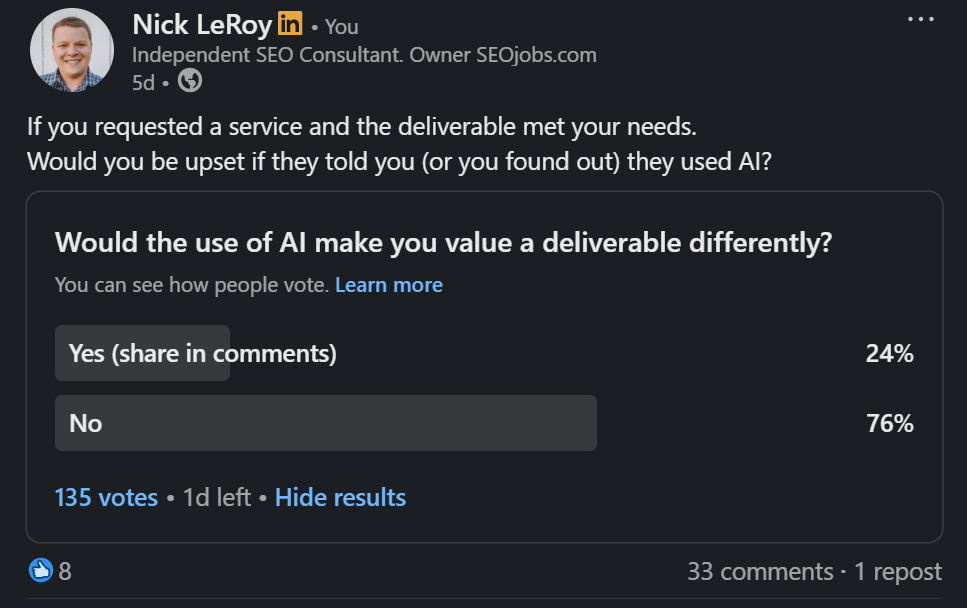
I recently ran a LinkedIn poll asking a simple question: if the outcome is great, do we really care how it was made?
The responses reinforced something I have been thinking about for a while. Many of the strongest objections people have to AI are not really about quality at all.
The Time vs. Value Fallacy
I think part of the discomfort comes from the fact that we have spent decades tying value to effort.
Long hours feel valuable. Fast work feels suspicious. Struggle often gets mistaken for expertise.
The harder something appears to be, the easier it becomes to justify the price attached to it.
There is an old story about a ship engine that stopped working. After multiple failed attempts to repair it, the owners brought in an engineer with decades of experience. He inspected the engine, tapped it once with a small hammer, and the machine roared back to life.
His invoice was $10,000.
The owners were furious and demanded an itemized bill. The response was simple: hammer tap, $2. Knowing where to tap, $9,998.
People debate whether that story is true or just a useful tale for people like me who believe in value-based pricing. But whether it really happened almost does not matter. The lesson still holds.
People are not paying for the tap. They are paying for the expertise behind it.
That is what makes AI such an important topic for me. It forces us to confront a question many of us have avoided for years: are we paying for expertise, or are we paying for visible effort?
Those are not always the same thing.
The Objections That Actually Matter
To be clear, I do not think every objection to AI is unreasonable. I have shared plenty of my own concerns, and some of them are serious.
In fact, I think the strongest arguments against AI have very little to do with how quickly something was created.
Those are legitimate concerns. What stands out to me is that none of them has much to do with how long it took to create the deliverable.
They are questions of trust.
Can the output be trusted? Can the recommendation be defended? Can someone confidently stand behind the work if it is questioned six months from now?
Because when something goes wrong, nobody gets to blame the AI. The employee is accountable. The consultant is accountable. The company is accountable.
That is why I have always found the quality debate to be the least interesting part of the conversation. The more important question is not whether AI was involved. It is whether the outcome is trustworthy enough for someone to put their name behind it.
The Outcome Test
The more I think about AI, the less interested I become in whether it was used.
Instead, I find myself asking a different set of questions. Was the outcome accurate? Was it useful? Was it better than the alternative? Would I be willing to stand behind it with my name, reputation, and credentials on the line?
If the answer to all of those questions is yes, then I have a hard time arguing that the production method matters more than the result.
Ironically, this is also where humans become more important, not less.
The future is not machines versus humans. I know, "The Terminator" and "I, Robot" movies will never feel the same. The real shift is humans using AI versus humans who refuse to adapt.
AI can accelerate execution, but people still decide what should be built, what should be published, and what risks are acceptable. More importantly, people are still responsible for the outcome.
The people who lose to AI will not be the ones using it. They will be the ones still evaluating effort while everyone else is measuring outcomes.
This post first appeared on the author’s website and is republished here with permission.
AI can misrepresent a brand without inventing an obvious falsehood. A technically correct description can still become misleading when an answer adds an unsolicited comparison, repeats an outdated assumption, or presents an opinion as settled fact.
That makes AI brand accuracy more than a visibility problem. The sources point to an interconnected challenge involving representation, consumer trust, source provenance, editorial controls, and responsibility for harmful outputs. Brands need a system that addresses all five.
Accuracy includes framing, not just factual correctness
Traditional fact-checking asks whether an individual claim is true. AI search requires a wider test: whether the complete answer represents the brand fairly and in the context of the user’s question.
A Profound article reported an analysis of 50,000 prompts across seven industries and said nearly half of the AI responses contained comparisons, opinions, or recommendations that users had not requested. The significance is not merely that models sometimes make errors. It is that they can change the meaning of an answer by deciding which competitors, attributes, or judgments belong beside a brand.
This creates at least three forms of accuracy risk. A claim may be factually wrong, such as an incorrect product capability. It may be stale, reflecting information that was once accurate but is no longer current. Or it may be contextually distorted: individual statements remain defensible, but the selection and framing leave users with the wrong overall impression.
Profound’s FactCheck announcement approaches the issue as a measurement problem. It describes a way to evaluate brand claims at scale, identify inaccurate statements, and examine the sources associated with those errors. As a product announcement, it does not independently establish how well the tool performs. It does, however, highlight an important operational principle: a useful accuracy program must connect problematic outputs to the evidence influencing them. Counting brand mentions alone cannot reveal whether those mentions help or harm understanding.
Rising use does not mean brands inherit rising trust
The consumer research reported by Search Engine Land shows why representation quality matters even as AI search expands. In a Fractl and Search Engine Land survey of 1,008 U.S. consumers and 150 marketers, 70% of consumers said they were using AI tools for search more than a year earlier. Yet the share describing AI-powered search as more helpful than traditional search reportedly fell from 82% to 54% between the 2025 and 2026 studies.
Those findings describe a convenience-trust gap. People may continue using a fast, accessible channel while becoming more cautious about its answers. A brand appearing prominently in that environment therefore gains exposure, but not an automatic endorsement. Accuracy, credible sourcing, and consistency across platforms become the conditions that determine whether visibility turns into confidence.
The same survey found that the average consumer consulted 2.4 platforms before a purchase decision. Google was reportedly the first destination for 39% of respondents, compared with 15% for Reddit and 14% for AI tools. This suggests that buyers can encounter an AI-generated brand narrative and then test it against search results, community discussion, reviews, or other sources. Contradictions that once remained isolated are easier to expose when the journey crosses several platforms.
Trust concerns also extend to brands’ own use of AI. The reported share of consumers who said heavy AI use would reduce trust in a brand rose from 20% to 39%. More than 80% wanted AI-generated material labeled across each content format measured, including 84% for written content and 91% for video. These figures do not show that audiences reject all AI-assisted work. They indicate that undisclosed volume and weak quality controls can become reputation signals in their own right.
Accountability is moving closer to the publisher of the answer
A separate Search Engine Land article reported that a German court held Google responsible for content in an AI Overview and rejected the proposition that a general warning placed the fact-checking burden entirely on users. According to that account, the court treated newly generated claims as Google’s content rather than merely a repetition of third-party material.
One reported ruling should not be treated as a universal legal standard, and the supplied source does not establish how other courts or jurisdictions will decide comparable cases. Its practical lesson is nevertheless relevant to any organization deploying AI: a disclaimer is not a substitute for controls proportionate to the possible harm.
The responsibility question changes depending on where an output appears. An inaccurate public article can damage readers or another company’s reputation. A faulty support response can misdirect a customer. An invented statement in an internal report can alter a decision even if it is never published. In every case, the organization receives the productivity benefit, selects the workflow, and decides whether a person reviews the result.
The consumer study suggests many organizations have started adding safeguards, but their coverage is uneven. It reported that roughly three in four organizations conduct human editorial review before publishing AI-generated content. Among the specific checks, 62% reviewed brand voice, 54% checked facts, 42% performed legal or compliance review, and 27% evaluated bias. Brand consistency was therefore checked more often than factual accuracy, while bias received substantially less attention. That ordering can produce polished material that still contains consequential problems.
A practical control system connects monitoring, evidence, and ownership
AI brand governance should cover both sides of the information boundary: what external systems say about the brand and what the organization publishes with AI assistance. These are related but distinct responsibilities. A company cannot directly edit every model answer, but it can improve authoritative source material, document errors, seek corrections where mechanisms exist, and prepare teams to respond consistently. It has much greater control over its own content, support messages, reports, and automated decisions.
External monitoring should test realistic questions across discovery, comparison, evaluation, and purchase contexts. Reviews should record the answer, platform, date, cited sources, exact claim at issue, and the type of failure. Separating false claims from stale information, unsupported recommendations, and misleading framing makes remediation more precise.
Source analysis should follow monitoring. When several answers repeat the same mistake, the next question is whether they rely on an outdated owned page, an ambiguous product description, a third-party article, or an unexplained model inference. Profound’s FactCheck announcement emphasizes this link between claims and contributing sources. Even without a specialized product, maintaining an evidence record helps distinguish a content correction from an escalation to a platform or publisher.
Internal controls should be based on consequence rather than content volume. Low-risk drafting may need a lighter review, while legal claims, product limitations, health or safety guidance, competitive statements, and customer-specific advice warrant stronger verification and named approval. The responsible reviewer should be identified before deployment, not after an error appears.
Finally, teams need a correction loop. Confirmed errors should update the relevant source material, prompt or workflow, review checklist, and monitoring set. Repeated failures should be treated as system defects rather than isolated copy edits. Useful reporting can track claim accuracy, contextual accuracy, source quality, correction status, recurrence, and the time required to resolve a material issue.
Key takeaways
AI brand accuracy includes factual truth, freshness, context, comparisons, and the overall impression created by an answer.
Greater AI search adoption does not guarantee greater trust; the reported consumer research showed use rising while perceived helpfulness weakened.
Brand monitoring is more actionable when each questionable claim is linked to its apparent evidence and classified by failure type.
Disclosure can address audience expectations, but it cannot replace factual, legal, compliance, and bias review.
Accountability should be assigned to a named owner and scaled to the consequences of an incorrect output.
As AI answers become part of ordinary brand discovery, the durable advantage will not come from producing the most material or collecting the most mentions. It will come from building an evidence-backed brand record, detecting distortions early, and showing that someone is accountable when automation gets the story wrong.
A paid media budget is more than a spending limit. It is a business commitment connecting campaign decisions with financial planning, future investment and client confidence.
A reported €30,000 underspend on a major B2B SaaS account illustrates how quickly that connection can break. The useful lesson is not that every budget must be exhausted, but that efficiency targets, delivery expectations, measurement and communication must be managed as one system.
Why underspending can become a business problem
According to the source account, a tighter target cost per acquisition reduced spending enough to leave €30,000 of the monthly budget unused. The immediate campaign result may have appeared more efficient, but the account failed to deliver against its agreed budget target.
The commercial consequence extended beyond media delivery. The source reported that the unused money had to be returned to finance, making it harder for the marketing team to defend a similar level of investment in later planning cycles. That turns pacing into a matter of organizational credibility: an approved budget can signal that the business expects marketing to deploy capital within an agreed strategy, not simply minimize cost in isolation.
This does not mean spending should be forced when demand, inventory or performance cannot support it. Budget discipline requires distinguishing between a justified underspend and an accidental one. A justified variance is identified early, supported by evidence and communicated to stakeholders. An accidental variance emerges too late for the team to adjust its bidding, targeting, creative or expectations.
Change control must connect efficiency with delivery
A target CPA is not merely a reporting preference. It influences how aggressively an automated bidding system can enter auctions, so changing it can alter both acquisition cost and spending volume. The source account acknowledged underestimating that effect and subsequently treated any adjustment capable of changing spend as a significant account change requiring close observation.
The broader operating principle is that optimization decisions need more than a desired efficiency outcome. Before a material change, the account team should define the expected effect on cost, conversion volume and budget delivery; record when the change was made; assign responsibility for reviewing it; and establish the conditions for keeping, modifying or reversing it.
Monitoring frequency should reflect the potential impact rather than the apparent simplicity of the platform control. A small interface adjustment can have a large financial consequence. Regular pacing checks make that consequence visible while there is still time to respond, especially when the remaining monthly budget and remaining days begin moving out of alignment.
Reliable measurement is part of budget governance
The source also identified flawed conversion tracking as a recurring industry weakness. That issue is directly connected to budget discipline because bidding systems and account teams optimize against the conversion data they receive. If implementation errors omit valuable actions, duplicate conversions or attach the wrong values, an apparently rational efficiency decision may rest on unreliable evidence.
Budget monitoring therefore cannot be separated from measurement assurance. Spend, conversions, cost per acquisition and delivery forecasts should be interpreted together, while material tracking changes or anomalies should be documented. When reported performance shifts, the team needs to determine whether customer behavior changed, campaign settings caused the movement or the measurement system stopped representing reality accurately.
AI-powered platform features do not remove this responsibility. The source supported using such tools but cautioned against adopting every new capability without human judgment and strategic oversight. Automation can execute and optimize at scale, but people still have to define acceptable business outcomes, validate inputs and notice when the system is satisfying one target at the expense of another.
Trust recovery requires an operating response
The source described personally explaining the underspend to the client and accepting responsibility without excuses. Although the client was understanding, the account noted that confidence had been affected. Weekly budget-pacing updates were then introduced to improve transparency and demonstrate that the problem would not recur.
That response highlights the difference between an apology and a control improvement. Accountability addresses the past, while a visible process gives the client evidence about the future. Useful communication should explain what happened, what it affected, what has changed and how the new control will reveal emerging risk. It should also avoid overstating certainty: no process can eliminate every mistake, but it can make detection and correction faster.
The episode remains a single reported account experience rather than a general performance benchmark. Its wider relevance lies in the management pattern it exposes: commercial trust depends not only on campaign results, but also on whether the team handles money predictably, surfaces problems promptly and makes its controls understandable to stakeholders.
Key takeaways
Evaluate budget delivery and acquisition efficiency together; improving one metric can undermine the other.
Treat bidding or targeting adjustments that may affect spend as material changes with an owner, review point and response threshold.
Separate defensible underspending from preventable underspending through early forecasting and stakeholder communication.
Include conversion-tracking checks in budget governance because optimization is only as dependable as its inputs.
Use automation within human-defined business constraints rather than assuming a platform target represents the whole commercial objective.
When an error occurs, combine direct accountability with a visible monitoring process that helps rebuild confidence.
As advertising systems become more automated, disciplined teams will treat pacing, measurement and communication as core business controls. Those fundamentals provide the stable foundation on which more advanced optimization can safely develop.
Publisher accountability disputes are converging on two different stages of the AI supply chain: how platforms acquire protected material and what they say after processing it. One dispute challenges the collection and distribution of publisher content through Common Crawl; another treats false statements in Google’s AI Overviews as content for which Google may be directly responsible.
Together, the reports suggest that platforms may find it harder to rely on a single intermediary defense. Publishers are pressing for control before their work enters AI systems and for meaningful remedies when those systems generate unsupported claims.
Key takeaways
AI accountability is developing at both the input layer, where publisher content is collected, and the output layer, where generated answers can affect publishers.
Digital Content Next argues that copyright requires permission rather than a publisher opt-out, while Common Crawl disputes allegations that it bypasses paywalls or misleads publishers.
The reported Munich ruling treated disputed AI Overview statements as Google’s own content because they presented standalone claims rather than merely directing users to sources.
Links and removal procedures do not resolve the same problem: attribution cannot correct an unsupported generated accusation, while output accuracy does not answer whether source material was authorized.
One accountability debate begins before generation
The Common Crawl dispute concerns the material available to AI developers before a model produces any answer. According to the source report, Digital Content Next sent the Common Crawl Foundation a cease-and-desist letter demanding that it stop collecting and distributing protected content belonging to its members. The organization also sought removal of member content already present in datasets, including paywalled and subscriber-only articles.
The report identifies Digital Content Next as representing publishers including the Associated Press, The New York Times, NBC Universal, Bloomberg, NPR and Fox. Its position is that copyright is not an opt-out regime and that making protected material available for AI development without authorization or compensation constitutes infringement. These remain claims advanced by the publisher group, not findings reported as having been resolved by a court.
Common Crawl presents a different account. Executive Director Rich Skrenta denied bypassing paywalls or misleading publishers and said the foundation responds to requests to remove previously collected material within the constraints of its dataset architecture. The source also notes that Common Crawl maintains a registry of sites that have opted out, while Digital Content Next questions whether the organization’s stated compliance has been adequate.
The practical importance extends beyond one crawler. The report describes Common Crawl, established in 2008, as a repository containing billions of webpages and as an important source of AI training material. It also relays two indicators of that role: The New York Times’ 2023 lawsuit against OpenAI reportedly said Common Crawl supplied 60% of GPT-3’s training data, and a 2024 Mozilla Foundation paper reportedly concluded that generative AI would scarcely exist in its current form without the repository. Those figures and characterizations are source-reported rather than independently verified here.
A second debate begins when an AI answer causes harm
The reported German ruling addresses a later stage: responsibility for claims generated after information has been collected and processed. The Regional Court of Munich reportedly considered false AI Overview statements that connected two Munich publishers with scams and questionable practices even though the linked pages did not support those allegations.
According to the account, the misinformation resulted from the system conflating information about other entities with information about the publishers. That detail matters because the disputed allegations apparently could not be traced to the cited pages. If Google were treated only as a conduit, the affected publishers would have no obvious third-party author to pursue for the newly assembled claim.
The court reportedly rejected that characterization. It viewed AI Overviews as processing material and presenting it in a distinct form, not simply listing third-party pages. Because the accusations appeared as complete answers and were created through a feature and algorithms controlled by Google, the court treated them as Google’s own content. Traditional protections for search engines acting as indirect intermediaries therefore did not apply in the same way.
The presence of links did not shift the burden back to users. The ruling account says the court rejected the argument that readers could verify the claims by opening the cited pages, reasoning that the Overview presented assertions that stood on their own. The resulting injunction required Google to refrain from repeating the disputed allegations. The court also reportedly considered comparison against primary sources technically possible, at least in analogous circumstances.
Permission, provenance and accuracy require separate controls
The two disputes are related, but they should not be collapsed into a single copyright or misinformation issue. The Common Crawl conflict asks whether material may be copied, retained and redistributed for AI development. The Munich case asks who owns the consequences when a platform transforms information into a new, unsupported statement. A platform could improve its answer verification without resolving a publisher’s rights objection, just as it could license every source and still generate a false claim.
Provenance also has different functions at each stage. During collection, it can identify where material came from, what access conditions applied and whether a removal request covers stored copies. At the answer stage, citations can help users inspect supporting material, but they do not establish that the generated wording is supported. The Munich report illustrates the gap: the pages were linked, yet the allegations attributed to them were reportedly absent.
This distinction changes what meaningful platform accountability looks like. Input governance concerns authorization, access controls, opt-out or consent signals, retention and downstream distribution. Output governance concerns entity matching, faithful synthesis, verification against cited material, correction and prevention of repeated harmful claims. Treating either set of controls as a substitute for the other leaves publishers exposed at a different point in the system.
What publishers can learn from the two disputes
For publishers, evidence should be organized around the stage at which the alleged failure occurred. A collection dispute depends on records such as ownership, access conditions, crawler instructions, removal correspondence and the continued presence or distribution of material. A generated-answer dispute instead depends on preserving the exact output, its citations, the underlying pages and the differences between what those pages say and what the platform asserted.
The reported cases also make platform promises worth examining at an operational level. A stated opt-out policy is not the same as confirmed removal from existing datasets. A cited answer is not necessarily a supported answer. A correction mechanism is not necessarily protection against repetition. Publishers evaluating an AI platform’s accountability can therefore ask whether its controls cover historical data as well as future collection, and whether answer citations are checked for actual support rather than merely attached.
Legal conclusions will depend on jurisdiction and the facts of each dispute, so the German ruling should not be treated as a universal rule and Digital Content Next’s allegations should not be treated as adjudicated findings. Their combined significance is narrower but still substantial: AI systems are prompting separate challenges to assumptions that web access implies permission and that automated synthesis remains neutral intermediation.
If consent requirements become stronger, the Common Crawl report suggests that licensed sources could gain importance relative to broadly collected web content. If courts continue to distinguish generated answers from conventional search results, platforms may also need more rigorous source validation and remedies at publication time. The durable accountability model will have to govern both directions of the exchange: what AI platforms take from publishers and what they publish about them.
If you run Google Ads, the uncomfortable part of deeper automation isn’t simply that software can make more decisions. It’s that Google may have broader latitude to build and manage ads while your team still owns the consequences.
You don’t need to abandon automation. You do need a clearer record of what Google can use, which changes require human review, how regulated placements are handled, and whether invalid activity credits are reflected in your performance numbers. Here’s a practical way to put those controls in place.
Key takeaways
Treat the July 1, 2026 terms as a change in operating permissions, not a routine administrative notice.
Document which inputs, URLs, accounts, claims, and assets Google may use before expanding campaign automation.
Keep compliance requirements ahead of eligibility for ads in AI-generated search experiences, especially in regulated sectors.
Add invalid activity credits to recurring campaign reviews so media performance and billed costs tell the same story.
Reset your risk boundary before July 1
The updated Google Ads terms take effect July 1, 2026. They apply to Google Ads accounts rather than unrelated products such as Workspace, and advertisers aren’t being asked to complete an immediate account action.
That lack of an account prompt shouldn’t become a reason to ignore the change. Updated language covers how your inputs may be used across Ads features, information supplied through conversational tools, and the URLs and accounts authorized for automated campaign setup. It also gives automation a larger role while leaving advertisers accountable for campaign review and outcomes.
Control area
What to examine
Decision you need to record
Input rights
Copy, images, product data, prompts, audience material, and other information supplied to Ads
Who owns it, who approved its use, and whether Google may reuse it across campaign features
Authorized properties
Websites, landing pages, feeds, accounts, and connected properties available to automated setup
Which properties are in scope and which must remain excluded
Automated management
Campaigns where Google can create, combine, select, or optimize elements
What can run automatically and what requires human approval
Regional terms
Contract entity, arbitration language, fees, and local legal requirements
Which legal or procurement owner must review each affected account
Start with your highest-spend, highest-risk, and regulated accounts. Create a simple inventory of active automation, connected properties, approved asset libraries, and responsible owners. For every input, be able to answer two questions: do you have the right to provide it, and would you be comfortable seeing it adapted into a live ad?
Regional language deserves separate review. Changes involving arbitration, fees, legal compliance, and Google BR’s transactional authority in Brazil won’t affect every advertiser in the same way. Route the relevant terms to counsel or procurement instead of relying on a universal account-level interpretation.
Put human approval around the decisions that matter
A useful AI policy doesn’t require a person to approve every bid adjustment. It identifies the decisions where an error could create a legal, financial, reputational, or measurement problem.
Set the generation boundary. List the materials automation may use, including authorized pages, feeds, existing assets, and conversational inputs. Exclude expired offers, unapproved claims, restricted pages, and material with uncertain ownership.
Set the activation boundary. Decide whether generated assets can go live automatically or require review. Regulated claims, brand promises, pricing language, and required disclosures should have a named approver.
Set the inspection cadence. Review live combinations, destination pages, policy status, and account changes on a recurring schedule. Assign the task to a role, not a vague team.
Set stop conditions. Pause or remove an asset when its rights are unclear, a required disclosure is missing, a claim hasn’t been approved, or the destination doesn’t support the promise made in the ad.
Preserve evidence. Keep the approved wording, reviewer, date, authorized property, and reason for any exception in one change record.
Conversational tools need the same discipline. A prompt can contain customer information, internal positioning, licensed copy, or an unapproved claim. Treat prompt content as material supplied to an advertising system, not as a private scratchpad. A conversational shortcut is not an approval workflow.
This separation lets you retain fast bidding and optimization while keeping human control over the assertions customers actually see. It also gives an agency a defensible answer when a client asks who approved a generated asset or why a particular property was available to automation.
Handle AI Mode ads without weakening compliance
Google has begun a small healthcare advertising test in AI Mode for English-language queries in the United States. Eligible participation can come from Performance Max, AI Max with search term matching, Shopping, and broad match campaigns. Those campaign types can also place ads in AI Overviews.
The current creative boundary matters: healthcare ads with pinned assets or text disclaimers aren’t eligible for this initial test. That is an eligibility condition, not a reason to remove a disclosure your organization requires. If a disclaimer or pinned message is necessary for compliance, accuracy, or patient safety, keep it and accept that the ad may not qualify.
Healthcare advertisers should maintain a small eligibility register for candidate campaigns. Record the market, query language, campaign type, pinned assets, required disclaimers, approval owner, and whether an AI Mode or AI Overview appearance has actually been observed. Don’t label every eligible campaign as participating, and don’t assume a test has expanded beyond its stated sector or market.
If you work outside healthcare, use the test for planning rather than access claims. Review which creative controls your sector cannot surrender and which landing pages are suitable for an AI-generated search context. You will be ready if eligibility expands, without rebuilding compliant assets around a placement that isn’t available to you.
Keep paid and organic AI visibility separate in reporting. An ad shown near an AI-generated response is paid distribution; it isn’t an organic citation, brand recommendation, or proof of generative search authority. Your AEO or GEO dashboard should identify those outcomes separately even when they appear in the same user interface.
Make invalid activity credits part of campaign reporting
More automated distribution makes cost reconciliation more important. Google says its systems filter invalid traffic before it creates a charge, but activity detected later may result in a credit. The Invalid Activity Credit Report for Search and Performance Max exposes credited clicks, credited interactions, credited spend, campaign-level effects, and performance after credits are applied.
You can generate it in Google Ads by opening Report Editor, going to the Template Gallery, and selecting Invalid Activity Credit Report: Search & PMax. Add the campaign metrics used in your normal performance review so the credit information isn’t examined in isolation.
Use the same date range as the billing and campaign review you are reconciling.
Include campaign name, cost, clicks or interactions, and the applicable credited columns.
Compare campaign-level credits with billing and transaction records.
Use adjusted performance fields where provided, and avoid subtracting the same credit twice in a separate spreadsheet.
Investigate concentration. A credit clustered in one campaign deserves more attention than the same amount dispersed across an account.
Annotate material credits before making budget, bidding, or client-reporting decisions.
An invalid activity credit doesn’t, by itself, prove deliberate click fraud or identify an attacker. It shows that spend or interactions were adjusted. Use it to reconcile costs and spot patterns, then keep any stronger conclusion tied to evidence you actually have.
Build one operating record for policy, placement, and spend
These changes become manageable when one campaign record connects permissions, approvals, placement eligibility, and financial adjustments. At minimum, track the campaign owner, automation in use, authorized URLs or accounts, rights owner, creative approver, regulated-sector status, mandatory disclosures, AI Mode eligibility or observation, invalid activity credits, and the latest review date.
Before July 1, review that record for your most consequential accounts and close any ownership or approval gaps. Then add the invalid activity report to your recurring performance process and keep AI-generated search placements distinct from organic AI visibility. You can continue using automation, but you’ll know where it is allowed to act, who checks its work, and which numbers belong in the final decision.
Your SEO dashboard shows a sharp decline after a release. Before you explain it to leadership, you need to answer two separate questions: did search performance actually change, and can you trust the data showing the change?
A reliable answer requires more than another chart. You need a record of what changed, monitoring that catches technical symptoms, and a reporting process that labels uncertain or stale data before anyone treats it as fact.
Build one evidence chain from deployment to outcome
Most SEO reporting failures begin with disconnected evidence. Engineering has deployment logs. Content teams have CMS histories. SEO has crawls, rankings, Search Console, analytics, and visibility tools. Each system may be accurate, yet nobody can reconstruct the full sequence.
Your operating model should connect four events: the change was approved, the change went live, monitoring detected a result, and a person interpreted the business impact. That sequence lets you distinguish correlation from a plausible cause.
This matters because changes that look routine can alter search visibility. A CMS release can remove important page copy. A product rollout can create conflicting canonicals. Updates to metadata, structured data, internal links, hreflang, redirects, or robots.txt can affect how search systems discover and understand pages. These are precisely the kinds of changes an SEO-aware changelog should expose.
Give every release or content change a shared identifier. Put that identifier in the deployment record, SEO changelog, monitoring annotation, and later performance analysis. When clicks fall, you can move from a chart to the relevant URLs, release, owner, and hypothesis without searching several tools for matching timestamps.
Record enough context to investigate the change
A changelog is useful only if someone who was not involved in the release can understand it later. Avoid entries such as “SEO updates” or “template fix.” They record activity without recording evidence.
Field
What to record
Why it matters
Change
The element added, removed, or modified
Defines what investigators should verify
Scope
Templates, directories, markets, page types, or named URLs
Creates a testable affected group
Reason
The problem being solved or opportunity being pursued
Preserves the original hypothesis
Timing
Deployment time and relevant rollout stages
Anchors before-and-after analysis
Owner
The team or person who can confirm implementation details
Shortens follow-up when behavior is unclear
Expected effect
The metric or technical behavior expected to change
Prevents vague retrospective claims
Observed effect
What happened after enough usable data became available
Turns the log into an organizational memory
Evidence
Ticket, pull request, crawl comparison, screenshot, or report link
Makes the entry auditable
Write scope in terms that monitoring systems can reproduce. “Product pages” is weak if the site has several product templates. “URLs using template X in these market folders” gives you a cohort that can be crawled and compared with unaffected pages.
Capture expected impact before the result is known. If a structured-data update is intended to improve eligibility for a search feature, say so. If a robots.txt change is intended to reduce crawling of a particular path, name that path. The expectation can be wrong; its purpose is to make the decision testable.
Monitor the change separately from its search symptoms
Deployment confirmation does not prove that the intended output reached every affected page. Monitoring should first verify implementation, then watch for search consequences.
Confirm the deployed output. Crawl or inspect representative URLs from the affected group. Check the rendered page and search-facing elements, not merely the CMS setting or code diff.
Compare the affected cohort. Separate changed pages from stable pages. If both groups move together, the release becomes a weaker explanation.
Inspect leading technical signals. Look for altered status codes, indexability, canonicals, metadata, internal links, structured data, hreflang, content, and crawl directives.
Inspect performance signals. Review impressions, clicks, landing-page traffic, rankings, and relevant conversions using comparison periods that fit the normal reporting cadence.
Document the interpretation. Mark the result as confirmed, plausible, unrelated, or still unresolved. Link the evidence and state the next check.
Alerts should point back to the changelog entry. A notification that title tags disappeared is more useful when it also identifies the recent template release, its owner, and its intended scope.
You can automate much of the capture. Deployment summaries can flow from GitHub or GitLab. Completed Jira or Linear tickets can create draft entries. CMS histories can supply content changes, while crawler and SEO platform alerts can attach observed anomalies. Keep an SEO review step for context that automation cannot infer reliably.
Label reporting reliability before explaining performance
A dashboard is not automatically trustworthy because its query ran successfully. A platform can return complete-looking but stale data, change a calculation, omit records, or temporarily restore an older dataset.
Google Search Console provided a useful warning when its links report showed zero links for some users and drops of more than 85% for others. The visible links later returned because Google temporarily switched back to data from the previous week while the underlying problem was being resolved. Reports created during that disruption could therefore contain either faulty or outdated link data.
Add a data-status layer to every recurring SEO report:
Validated: freshness and basic continuity checks passed, and no known platform issue affects the metric.
Provisional: the latest period is incomplete or has not passed your normal validation checks.
Degraded: a known outage, rollback, unexplained discontinuity, or stale dataset limits interpretation.
Unavailable: the data cannot support a defensible conclusion and should not be presented as current performance.
Display the extraction time, latest available data date, comparison window, and status next to the metric. Put a visible annotation on affected charts. If a number is degraded, preserve it only when the reader needs to see the limitation; do not quietly substitute it into a normal trend line.
When a metric moves sharply, run a short reliability check before escalating:
Confirm that the latest date advanced as expected.
Check whether the movement appears across unrelated properties, segments, or markets.
Compare the interface with exports or previously saved extracts.
Look for a known platform incident or an unexplained change in coverage.
Check the SEO changelog for releases affecting the same pages and timeframe.
State what is known, what remains uncertain, and when you will check again.
This wording is more useful than either silence or certainty: “Reported links declined, but the dataset is degraded and may be stale. No sitewide link-removal deployment appears in the changelog. We are withholding a performance conclusion until the data passes validation.”
Key takeaways
Connect approvals, deployments, monitoring results, and business outcomes with one shared change identifier.
Record the exact change, affected scope, reason, owner, expected effect, observed effect, and supporting evidence.
Verify what reached the page before attributing a search movement to a release.
Compare changed pages with a stable group instead of relying only on a sitewide trend.
Label every important metric as validated, provisional, degraded, or unavailable.
Report uncertainty explicitly when a platform returns stale, incomplete, or implausible data.
Start with one release team and one recurring report. Add the changelog fields, cohort annotation, and data-status label to that workflow. Once the team can trace a surprising metric from dashboard to deployment and evidence, expand the same pattern across the site.
An AI demo can collapse a visible task into a few prompts and still tell you almost nothing about productivity. The business question is whether the full workflow produces more accepted work, at the same or better quality, without quietly transferring effort to reviewers, managers, or downstream teams.
If you need to set an AI target, evaluate a pilot, or defend an investment, measure the gain from the workflow boundary to the accepted result. That turns a promising time-saving claim into a decision you can trust.
Key takeaways
A realistic AI productivity gain is net of preparation, prompting, review, correction, coordination, and failed outputs.
Measure labor per accepted output, not just generation time or the number of drafts produced.
Every percentage needs a named denominator, workflow boundary, baseline, and quality standard.
Released time becomes useful capacity only when the team can redirect it, remove a bottleneck, improve quality, or shorten delivery time.
Keep task efficiency, workflow efficiency, throughput, cost, and business value as separate claims.
The usable gain is smaller than the visible time saving
AI usually changes where work happens. Drafting may become quicker while context preparation, fact-checking, editing, escalation, and approval take more effort. A 25% efficiency gain can still matter, but its meaning depends on what became more efficient and whether the saved capacity survives the rest of the workflow.
Separate the layers before you attach a productivity label:
Model speed: how quickly the system returns an output. This affects waiting time, but it is not a measure of human productivity by itself.
Task time: the active labor required for a bounded activity such as drafting metadata, classifying queries, or generating a first version of JSON-LD.
Workflow labor: all human effort from the request entering the process to the output passing its normal acceptance gate.
Accepted throughput: the amount of usable work completed within a defined period, after quality control and rework.
Business capacity: the additional work, faster delivery, lower operating burden, or higher quality the organization can actually use.
Report the lowest layer you have genuinely measured. If your test covers only first-draft production, call the result a change in drafting time. Do not call it a change in content-team productivity. If you timed schema generation but excluded validation, page matching, deployment, and post-deployment checks, you measured generation rather than implementation.
Use explicit calculations so hidden labor cannot disappear inside a headline:
Gross task saving equals baseline operator time minus AI-assisted operator time.
Net workflow saving equals gross task saving minus new preparation, review, correction, escalation, and coordination time.
Acceptance rate equals outputs passing the normal quality gate without material correction divided by outputs submitted for review.
Labor per accepted output equals total human labor across the workflow divided by the number of outputs that passed.
Cost per accepted output includes human labor, tooling, implementation, and rework rather than the AI subscription alone.
The denominator matters as much as the result. Labor time per accepted brief, cost per validated schema deployment, and published pages per editor-hour are defined measures. AI productivity is not. It might refer to time, volume, cost, quality, or revenue, and those measures do not move in equal proportions.
Measure the workflow, not the impressive task
Start by drawing a boundary around a unit of work that has a recognizable finish. A generated asset is not finished merely because the model stopped responding. It is finished when the person or system that normally receives it would accept it.
Define the workflow in this order:
Name the unit. Examples include an approved content brief, a published landing page, a validated schema deployment, or a completed technical recommendation.
Mark the start. Use an observable event such as a complete request entering the queue, not the moment an operator opens the AI tool.
Mark the finish. Tie completion to the existing acceptance or publication gate.
List every role that touches the unit, including reviewers and specialists who handle exceptions.
Separate active labor from elapsed time. Waiting for an approval is different from the labor required to perform that approval.
Define rejection, material rework, and minor correction before the pilot begins.
For a content workflow, the boundary may include intake, research, briefing, drafting, factual review, search optimization, brand review, CMS entry, quality assurance, and publication. For structured data, it may include identifying the entity, selecting appropriate properties, grounding claims in page content, generating JSON-LD, validating syntax, checking vocabulary use, confirming consistency with the visible page, deploying, and monitoring.
This map exposes displaced effort. If AI reduces drafting labor but creates an editing queue, the drafting task improved while the workflow bottleneck moved. If the approval stage already limits throughput, sending it more drafts can increase work in progress without increasing published output.
Choose a pilot workflow with repeatable units, a stable quality gate, and enough ordinary volume to show variation. A one-off strategy project may be valuable, but it is a poor first benchmark because the work changes from case to case. Repeated briefs, metadata updates, query classification, internal-link candidates, schema drafts, and standardized audit checks are easier to compare without pretending every unit is identical.
Run a quality-adjusted before-and-after test
A credible baseline comes from normal work completed before the AI-assisted process begins. Use a representative mix rather than selecting unusually easy or painful cases. Record complexity in advance so a change in task mix cannot masquerade as a productivity gain.
Build the test around the following controls:
Use the same workflow boundary, output definition, and acceptance gate in the baseline and assisted conditions.
Keep task categories and complexity bands visible. Compare like with like before combining results.
Record active labor for preparation, prompting, reviewing, correcting, coordinating, and escalating.
Track elapsed lead time separately so a faster task is not confused with a faster delivery process.
Log whether each output passed on first submission, required minor edits, required material rework, or was rejected.
Record the tool, model, configuration, prompt or template version, and human role involved. A material process change creates a new test condition.
Separate rollout costs from ongoing operating costs. Training and workflow design matter to the investment decision even when they do not recur for every unit.
Do not let faster production lower the acceptance standard. Define quality in terms the workflow already understands. For SEO and AI-optimized content, that may include factual accuracy, completeness, intent fit, source traceability, brand compliance, internal consistency, and technical correctness. For JSON-LD, a syntax pass is necessary but not sufficient; the markup must also describe the visible content accurately and use the intended vocabulary appropriately.
Make rework categories operational. A minor correction is something the reviewer can fix without reconsidering the approach. Material rework changes the argument, evidence, structure, entity model, implementation choice, or substantial portions of the output. Write those definitions before reviewers see pilot results. Otherwise, enthusiasm for the tool can turn serious revisions into minor edits after the fact.
Your measurement sheet should include the workflow, accepted unit, task category, complexity band, owner, baseline active labor, assisted active labor, preparation time, review time, correction time, escalation time, elapsed lead time, first-pass status, final acceptance status, error class, tooling cost, and workflow version. Keep the raw observations. A single average hides whether the result is reliable across routine and difficult work.
Use the median to describe a typical case and show the spread or range to expose variability. Segment results when complex work behaves differently from routine work. An overall improvement can conceal a serious decline in the cases where accuracy matters most.
Convert released time into capacity the organization can use
Net time saved is an operational input, not automatically a business result. The next question is what happened to that time. If it remains scattered across tiny fragments, sits behind another bottleneck, or appears in a role with no additional demand, it may not create more output.
Decide which outcome you are targeting before the rollout:
More accepted output with the existing team.
Shorter lead time for the same output volume.
Higher quality, deeper analysis, or broader coverage without extending delivery time.
Lower overtime, fewer backlogs, or more resilience during demand spikes.
Capacity redirected to work that had been deferred or neglected.
Lower cost per accepted output after tooling and operating costs are included.
These outcomes are all legitimate, but they are not interchangeable. Reduced labor per unit does not prove payroll savings. Claim a cash saving only when paid hours, contractor spend, hiring requirements, or another real cost changes. Otherwise, describe the result as released capacity and identify where that capacity went.
Apply a bottleneck test before forecasting additional throughput:
Was the improved stage actually limiting the workflow?
Can the next stage absorb more volume without adding a queue?
Is there enough demand for additional accepted output?
Does the saved time arrive in usable blocks that can be scheduled elsewhere?
Does the team have authority and a plan to reassign that capacity?
Will higher volume create new review, publishing, governance, or maintenance work?
If the answer to those questions is no, do not discard the gain. Classify it correctly. It may reduce interruptions, create a buffer, shorten a stage, or make quality work possible. Those benefits can matter even when total output stays flat. What matters is reporting the observed outcome rather than converting every saved minute into hypothetical production.
A defensible result can fit into a single reporting sentence: In the named workflow and task category, the AI-assisted process changed median active labor per accepted unit from the baseline to the measured assisted level after preparation, review, and rework; first-pass acceptance changed from the baseline rate to the assisted rate; the team redirected the resulting capacity to the stated use; and tooling plus rollout costs were recorded separately.
Start with a single bounded workflow. Pull a representative batch of completed work, define its accepted unit, map every human touch, and capture the baseline before introducing AI. Then run the assisted process through the same gate. A modest gain that survives review and becomes usable capacity is worth more than a dramatic demo that disappears in production.