Category: Opinion

  • Boost Lead Quality in Performance Max: Expert Strategies

    Boost Lead Quality in Performance Max: Expert Strategies

    I’ve noticed that when I leave Performance Max campaigns running without proper setup, they tend to focus on getting easy conversions, often leading to a rise in low-quality leads. While this can quickly rack up conversion numbers, the quality isn’t always great. Google tends to prioritize cheaper conversions, benefiting their revenue, but not necessarily my pipeline.

    Many times, brands are surprised by these results after following Google’s sales advice too closely. Although low CPA metrics look tempting, they can often mask the fact that these new leads aren’t contributing to the real growth of my business.

    That said, with the right adjustments, Performance Max can be optimized to generate high-quality leads. Building these ‘guardrails’ effectively is key to success, and I’m here to share what I’ve learned.

    This guide will walk you through which strategies work for improving lead quality, tactics that don’t deliver desired results, and the notable differences between using Performance Max in Google versus Bing.

    How to Improve Lead Quality in PMax Campaigns

    Here are the actionable steps I’ve found to consistently impact lead quality:

    • Focus on conversion goals that align with higher quality targets. Try targeting metrics like closed-won leads or sales-qualified leads, which provide more valuable insights than just form fills. For this to work, ensure my CRM is accurately tracking offline conversions.
    • Utilize high-value audience signals. Target more specific behaviors, such as users who have ‘booked a meeting’ rather than just anyone who converts.
    • Concentrate on the correct audiences. Exclude irrelevant segments, and use Customer Match to help Google’s algorithms find users similar to my best customers.
    • Optimize campaign settings smartly. Examples include using brand exclusions, targeting high-performing geos, strategic scheduling, analyzing search themes, and employing site link extensions to channel traffic efficiently.
    • Refine forms for better lead filtering. Integrate reCAPTCHA to deter bots, implement field validation to block disposable domains, and include quality-check questions such as how they heard about my company or if they have budget allocations.

    Dig deeper: Top Performance Max optimization tips for 2026

    Tactics That Won’t Affect Lead Quality

    Some common optimizations don’t significantly enhance lead quality:

    ```json
{
  "alt": "The CapmatchOne logo with a gradient circle and bold text.",
  "caption": "Discover innovation with the CapmatchOne logo, featuring sleek typography and a modern gradient circle.",
  "description": "The CapmatchOne logo features bold, modern typography coupled with a gradient circle, symbolizing connection and innovation. The sleek design conveys a sense of progress and creativity. This image can be used for branding or promotional purposes, appealing to audiences interested in innovative solutions and forward-thinking designs."
}
```
    • Switching bid strategies offers minimal impact.
    • Adding more assets or budget doesn’t inherently improve lead caliber.
    • I’ve learned to be cautious when seeking help from Google support, as results can vary.

    Important Differences Between Google and Bing PMax Campaigns

    Google and Bing both offer Performance Max campaigns, but they differ significantly. Google’s expansive network includes search, display, YouTube, discovery campaigns, and Gmail. If not carefully managed, this can lead to spam-driven conversions, particularly from display and YouTube.

    Bing’s campaigns, on the other hand, focus on Bing search and their audience network, which covers display, Outlook, and MSN. I haven’t observed significant performance differences, but staying updated with platform changes is crucial.

    Dig deeper: Google and Microsoft: How their Performance Max approaches align and diverge

    Performance Max Isn’t Broken, but It Needs Control

    Entering PMax for lead generation with caution is a wise approach. Although promising for ecommerce revenue, lead quality demands stringent campaign guidelines. For instance, preventing misaligned conversions for a luxury retailer requires effective PMax guardrails.

    Considering Google’s shift towards automation and AI, it’s essential to continuously test and adapt. Recent updates like channel-level reporting and exclusion options offer new tools to shape my campaigns.

    Achieving quality leads and a healthy ROI is possible by navigating the algorithm strategically. If past PMax efforts were paused due to poor returns, revisiting and applying lessons learned could significantly improve future outcomes.


    Inspired by this post on Search Engine Land.


    crushpress.ai community screenshot
  • Elevate SEO Success with Strong Governance Models

    Elevate SEO Success with Strong Governance Models

    Let me guess: I just spent three months meticulously crafting an optimized product taxonomy, complete with schema markup, internal linking, and standout metadata.

    Then, out of nowhere, the product team decided to launch a site redesign without looping me in. Now half of my URLs are broken, the new templates have stripped away my structured data, and my boss is wondering why our organic traffic plummeted by 40%.

    Sound familiar?

    Here’s the thing: this isn’t an SEO failure, but a governance failure. It’s been costing us countless nights and weekends trying to fix problems that never should have occurred.

    This article sheds light on why weak governance keeps breaking SEO, how AI advancements have raised the stakes, and how a visibility governance maturity model can help SEO teams transition from firefighting to prevention.

    Governance isn’t bureaucracy – it’s your insurance policy

    I know what you’re thinking. “Great, another framework that means more meetings and approval forms.” But hear me out.

    The Visibility Governance Maturity Model (VGMM) isn’t about creating red tape. It’s about establishing clear ownership, documented processes, and decision rights that prevent your work from being accidentally destroyed by teams who don’t understand SEO.

    Think of it this way: VGMM is the difference between being the person who gets blamed when organic traffic tanks versus being the person who can point to documentation showing exactly where the process broke down – and who approved skipping the SEO review.

    This maturity model:

    • Protects your work from being undone by releases you weren’t consulted on.
    • Documents your standards so you’re not explaining canonical tags for the 47th time.
    • Establishes clear ownership so you’re not expected to fix everything across six different teams.
    • Gets you a seat at the table when decisions affecting SEO are being made.
    • Makes your expertise visible to leadership in ways they understand.

    The real problem: AI just made everything harder

    Remember when SEO was mostly about your website and Google? Those were simpler times.

    Now I’m trying to optimize for:

    • AI Overviews that rewrite your content.
    • ChatGPT citations that may or may not link back.
    • Perplexity summaries that pull from competitors.
    • Voice assistants that only cite one source.
    • Knowledge panels that conflict with your site.

    And I’m still dealing with:

    • Content teams who write AI-generated fluff.
    • Developers who don’t understand crawl budget.
    • Product managers who launch features that break structured data.
    • Marketing directors who want “just one small change” that tanks rankings.

    Without governance, I’m the only person who understands how all these pieces fit together.

    When something breaks, everyone expects me to fix it – usually yesterday. When traffic is up, it’s because marketing ran a great campaign. When it’s down, it’s my fault.

    I become the hero the organization depends on, which sounds great until I realize I can never take a real vacation, and I’m working 60-hour weeks.

    Dig deeper: Why most SEO failures are organizational, not technical

    ```json
{
  "alt": "The CapmatchOne logo with a gradient circle and bold text.",
  "caption": "Discover innovation with the CapmatchOne logo, featuring sleek typography and a modern gradient circle.",
  "description": "The CapmatchOne logo features bold, modern typography coupled with a gradient circle, symbolizing connection and innovation. The sleek design conveys a sense of progress and creativity. This image can be used for branding or promotional purposes, appealing to audiences interested in innovative solutions and forward-thinking designs."
}
```

    What VGMM actually measures – in terms you care about

    VGMM doesn’t care about your keyword rankings or whether you have perfect schema markup. It evaluates whether your organization is set up to sustain SEO performance without burning you out. Below are the five maturity levels that translate to your daily reality:

    Level 1: Unmanaged (your current nightmare)

    • Nobody knows who’s responsible for SEO decisions.
    • Changes happen without SEO review.
    • You discover problems after they’ve tanked traffic.
    • You’re constantly firefighting.
    • Documentation doesn’t exist or is ignored.

    Level 2: Aware (slightly better)

    • Leadership admits SEO matters.
    • Some standards exist but aren’t enforced.
    • You have allies but no authority.
    • Improvements happen but get reversed next quarter.
    • You’re still the only one who really gets it.

    Level 3: Defined (getting somewhere)

    • SEO ownership is documented.
    • Standards exist, and some teams follow them.
    • You’re consulted before major changes.
    • QA checkpoints include SEO review.
    • You’re working normal hours most weeks.

    Level 4: Integrated (the dream)

    • SEO is built into release workflows.
    • Automated checks catch problems before they ship.
    • Cross-functional teams share accountability.
    • You can actually take a vacation without a disaster.
    • Your expertise is respected and resourced.

    Level 5: Sustained (unicorn territory)

    • SEO survives leadership changes.
    • Governance adapts to new AI surfaces automatically.
    • Problems are caught before they impact traffic.
    • You’re doing strategic work, not firefighting.
    • The organization values prevention over reaction.

    Most organizations sit at Level 1 or 2. That’s not your fault – it’s a structural problem that VGMM helps diagnose and fix.

    Dig deeper: SEO’s future isn’t content. It’s governance

    How VGMM works: The less boring explanation

    VGMM coordinates multiple domain-specific maturity models. Imagine it as a health checkup that evaluates all your vital signs, not just one metric.

    It evaluates maturity across domains like:

    • SEO governance: Your core competency.
    • Content governance: Are writers following standards?
    • Performance governance: Is the site actually fast?
    • Accessibility governance: Is the site inclusive?
    • Workflow governance: Do processes exist and work?

    Each domain gets scored independently, then VGMM looks at how they work together. Because excellent SEO maturity doesn’t matter if the performance team deploys code that breaks the site every Tuesday or if the content team publishes AI-generated nonsense that tanks your E-E-A-T signals.

    VGMM produces a 0–100% score based on:

    • Domain scores: How mature is each area?
    • Weighting: Which domains matter most for your business?
    • Dependencies: Are weaknesses in one area breaking strengths in another?
    • Coherence: Do decision rights and accountability actually align?

    The final score isn’t about effort – it’s about whether governance actually works.

    Most importantly, VGMM translates your expertise into language that leadership understands. It protects your work from accidental destruction, so you can focus on strategic, creative, growth-focused work that truly matters.


    Inspired by this post on Search Engine Land.


    crushpress.ai community screenshot
  • Unveiling Agentic AI: Guiding E-commerce Execs with Clarity

    Unveiling Agentic AI: Guiding E-commerce Execs with Clarity

    Agentic AI is now a hot topic among executives. I’m here to break down precisely what’s happening, what remains unchanged, and how e-commerce brands should adapt.

    As an SEO leader working with e-commerce brands, I’m often in the position of clarifying the realities behind buzzwords like ‘agentic AI’. Executives frequently inquire about its implications for growth, risk, and competition.

    Executives crave facts over hype. They seek concise explanations, grounded insights, and actionable advice.

    My role as an SEO leader becomes essential here, not in predicting the future, but in enlightening leadership about the changes, the constants, and how to proceed pragmatically. Here’s my roadmap.

    Start with Defining ‘Agentic’

    First, I focus on demystifying the term. Agentic systems don’t replace customers; they work on their behalf. While the intent and preferences originate from individuals, the execution is taken over by the software.

    The working dynamics shift, where tasks like discovery, comparison, and even execution are now managed by software, processing data faster than any human.

    In discussions with executive teams, I emphasize simple illustrations:

    • “We’re not losing customers; instead, we’re incorporating a new decision-maker, which is the software acting as a customer proxy.”

    Understanding this calms the conversation and steers focus away from fear towards preparation.

    Manage Expectations to Avoid Hype

    Another key role I play is in tempering expectations. Agentic AI won’t sweep over all at once. Its effects will be gradual and varied across different categories.

    Some industries, with standardized products and organized data, will adapt faster. Others will face more challenges due to complexities and regulatory hurdles.

    I often see leadership teams falling into two detrimental traps:

    1. Panic: Hastily altering strategies and budgets without clarity.
    2. Dismissal: Ignoring changes until it impacts performance, leading to rushed responses.

    I offer a steady perspective, noting that agentic AI merely accelerates existing trends. It’s not about chasing new features but reinforcing strong fundamentals.

    Dig deeper: Are we ready for the agentic web?

    Shift Focus from Rankings to Eligibility

    I encourage conversations to evolve beyond search rankings. When agents lead the journey, the critical question becomes, “Are we eligible to be chosen?”

    Eligibility hinges on clear, consistent, and trustworthy data. Agents must grasp your offerings, target audience, pricing, availability, and risk factors associated with choosing your brand.

    Raising thoughts about data consistency, pricing reliability, and whether policies add or reduce uncertainty positions SEO as a practical bridge between strategy and execution.

    SEO Beyond Marketing

    There’s a misconception that SEO is confined to marketing. Agentic behavior challenges this notion.

    Selection by an agent involves variables beyond marketing, like data accuracy, technical integrity, inventory management, and payment reliability.

    My explanations revolve around broadening SEO’s scope—it’s about ensuring the business is machines-readable, trustworthy, and consistent.

    SEO becomes vital in helping leaders identify system or data gaps that could hinder the brand’s selection, highlighting its connection to both risk management and operational resilience.

    Dig deeper: How to integrate SEO into your broader marketing strategy

    Discovery’s Evolution

    In most e-commerce brands, agentic systems affect the top of the funnel first. Discovery shifts towards more personalized, conversational interactions.

    ```json
{
  "alt": "The CapmatchOne logo with a gradient circle and bold text.",
  "caption": "Discover innovation with the CapmatchOne logo, featuring sleek typography and a modern gradient circle.",
  "description": "The CapmatchOne logo features bold, modern typography coupled with a gradient circle, symbolizing connection and innovation. The sleek design conveys a sense of progress and creativity. This image can be used for branding or promotional purposes, appealing to audiences interested in innovative solutions and forward-thinking designs."
}
```

    Instead of brief search phrases, users convey needs, constraints, and preferences, which the agent then transforms into actions.

    This decreases the significance of owning category head terms. If an agent has comprehensive user data, it acts like a knowledgeable repeat customer.

    This presents a new reporting challenge. Not all SEO work will appear as direct demand creation, yet it still impacts outcomes. Leaders need to anticipate this shift.

    Rethink Consideration

    The consideration phase evolves too. Traditionally, it involves hosting reviews, comparisons, and reassurances.

    With agentic intervention, consideration morphs into a filtering process, retaining only the options that align with user preferences.

    This necessitates a quality over quantity strategy in content, emphasizing structural trust signals and consistent, verifiable information.

    Brands might be selected without user awareness. While this could boost conversions, it also poses a risk to brand recognition if not addressed elsewhere.

    Dig deeper: Align your SEO strategy with buyer intent stages

    Establish Honest Measurement Expectations

    Measurement often concerns executives, and agentic AI complicates this. With more processes happening inside AI, fewer interactions leave traceable or clear data.

    I address this early by stressing that while this isn’t a failure of optimization, it merely highlights the analytics limits in a complex digital landscape.

    The focus should shift to directional indicators and blended performance over precise attribution, acknowledging the new decision-making landscape.

    Advocate Proactive, Low-risk Responses

    The crux of leadership dialogue is next steps. Fortunately, most appropriate responses to agentic AI carry low risk.

    Enhancing product information, eliminating inconsistencies, strengthening reliability signals, and addressing technical vulnerabilities benefit the business now and pave the way for the future.

    Building brand trust outside search also plays a critical role. Trusted brands are more likely to be selected by agents performing comparisons.

    This strategy reassures leaders that success doesn’t require radical change but calls for focused improvement.

    Agentic AI: Focus Shifts, Fundamentals Persist

    For us SEO leaders, agentic AI modifies our focus. Instead of solely optimizing for visibility, we aim to protect eligibility, reduce ambiguities, and illustrate influence.

    This demands confidence and clear articulation, challenging hype with grounded perspectives. Agentic AI renders SEO more strategic and no less crucial.

    Agentic AI isn’t an imminent threat or foolproof advantage. It’s a transformation in decision-making approaches.

    For e-commerce brands, the winners are those who stay composed, communicate effectively, and transition their SEO approach from driving clicks to securing selections.

    This transition forms the backbone of the current SEO leadership discussions.

    Dig deeper: SEO Predictions for 2026: Insights from Leaders


    Inspired by this post on Search Engine Land.


    crushpress.ai community screenshot
  • Unveiling ChatGPT’s Brand Bias: An Insightful Analysis

    Unveiling ChatGPT’s Brand Bias: An Insightful Analysis

    I recently embarked on a fascinating exploration of ChatGPT’s brand recommendation patterns, and let me tell you, the findings offer a lot to chew on!

    We all know that AI responses are a roll of the dice – ask the same question ten times, and you’re bound to get ten different answers. But I couldn’t help but wonder, just how varied are these responses?

    Rand Fishkin’s intriguing research dives into this very question. His findings have significant repercussions for how we approach AI visibility tracking for brands.

    Fishkin experimented with prompts ranging from recommendations for chef’s knives to cancer care hospitals, as well as Volvo dealerships in Los Angeles.

    ```json
{
  "alt": "The CapmatchOne logo with a gradient circle and bold text.",
  "caption": "Discover innovation with the CapmatchOne logo, featuring sleek typography and a modern gradient circle.",
  "description": "The CapmatchOne logo features bold, modern typography coupled with a gradient circle, symbolizing connection and innovation. The sleek design conveys a sense of progress and creativity. This image can be used for branding or promotional purposes, appealing to audiences interested in innovative solutions and forward-thinking designs."
}
```

    His results showed that AI systems like ChatGPT almost never recommend the same set of brands in the same order twice.

    Moreover, when asking about something specific like running shoes, certain brands tend to appear more frequently than others.

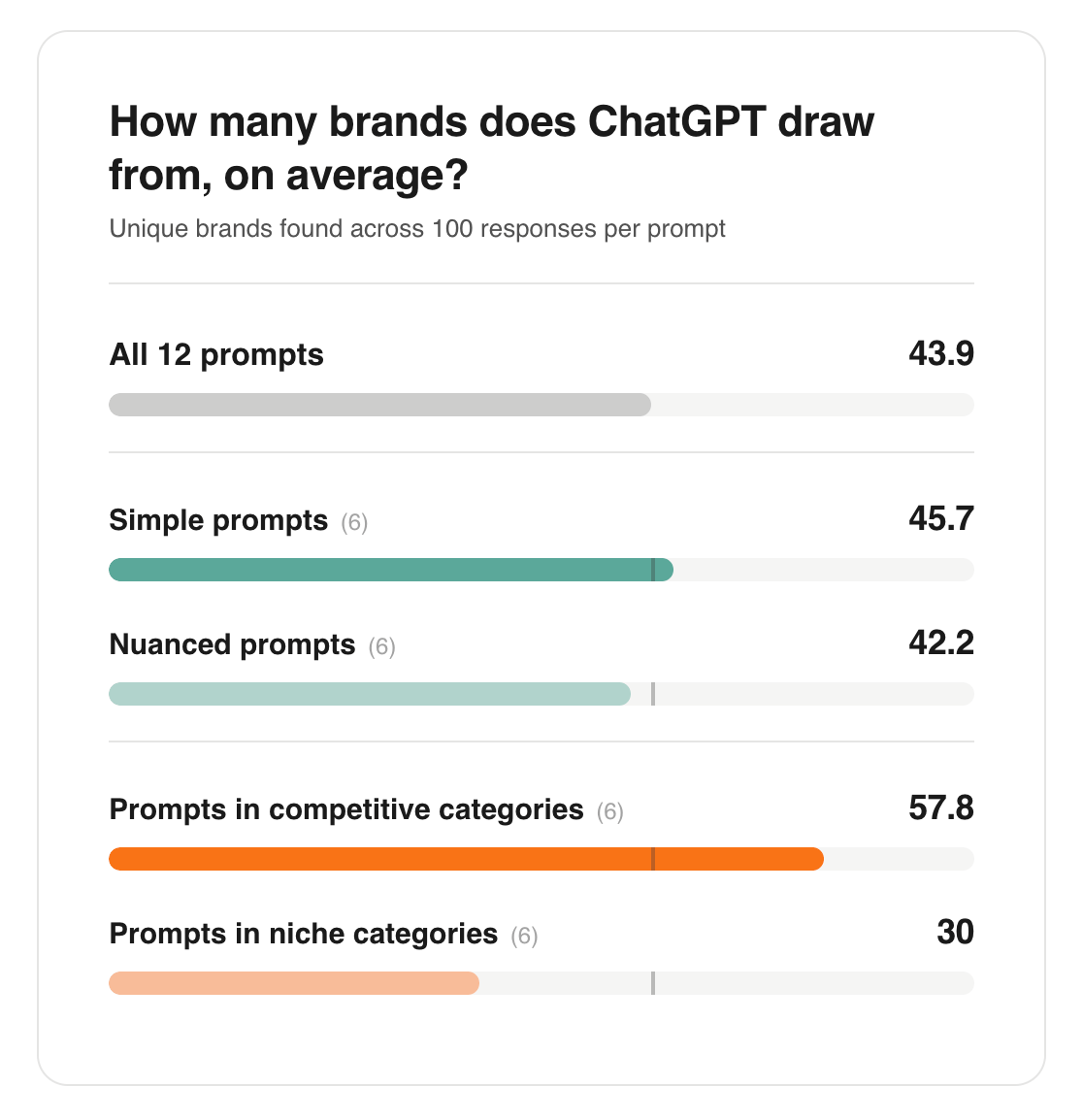
    Building on this research, I zeroed in on B2B scenarios, adding some of my own twists: does the complexity of the prompt or the competitiveness of the category make a difference to AI’s consistency?

    ```json
{
  "alt": "Bar chart showing average unique brands ChatGPT uses across different prompt types.",
  "caption": "Discover how ChatGPT sources brands with varying prompt complexities and categories. Competitive prompts yield the highest diversity, while niche prompts pull the fewest.",
  "description": "This bar chart illustrates the average number of unique brands ChatGPT identifies in response to different prompt types: simple, nuanced, competitive categories, and niche categories. On average, competitive category prompts result in the highest diversity with 57.8 brands, while niche category prompts have the least at 30. The chart provides insights for understanding brand diversity in AI responses, useful for optimizing prompt design."
}
```

    To investigate, I crafted twelve varied prompts, half of which addressed highly competitive B2B software categories, like accounting, and the rest focused on niche categories, such as user entity behavior analytics (UEBA) software.

    Further, I examined simple prompts against nuanced ones that included specific personas and use cases.

    Each prompt was fed into ChatGPT 100 times using different IP addresses to mimic 1,200 unique users.

    ```json
{
  "alt": "Bar chart showing average brand mentions per response across different prompt types.",
  "caption": "Discover how different prompt complexities affect brand mentions per response. From simple to niche, see the variations unfold.",
  "description": "This bar chart visualizes the average number of brands mentioned per response across various prompt types. 'Simple prompts' lead with 11.7 mentions, while 'nuanced prompts' have 9.2. 'Prompts in competitive categories' show 11.1, and 'prompts in niche categories' record 9.8. Each category includes six prompts, with data reflecting 100 responses per prompt, providing insights into how prompt complexity and category influence brand mention frequency."
}
```

    Now onto the juicy part: the findings.

    Submitting a single prompt to ChatGPT 100 times revealed that, on average, 44 different brands got mentioned. However, some response sets listed as many as 95 brands, heavily dependent on the category.

    Notably, competitive categories yield twice as many brand mentions per 100 responses compared to niche ones.

    ```json
{
  "alt": "Bar chart showing brand visibility distribution. Five dominant brands have high visibility, followed by 10 middle brands and 29 long tail brands.",
  "caption": "Discover which brands stand out! A visual breakdown of 44 brands shows how five dominate in visibility, with others trailing behind. Ideal for understanding brand awareness trends.",
  "description": "This bar chart illustrates the visibility percentages of 44 brands as recognized by ChatGPT. It categorizes them into dominant (5 brands), middle (10 brands), and long tail (29 brands) based on visibility levels. The dominant brands have significantly higher visibility, making up 11% of the total, while middle brands account for 23%, and long tail brands form 66%. This analysis is derived from average visibility across 100 responses and 12 prompts, useful for gauging brand prominence."
}
```

    Simple vs. nuanced prompts? ChatGPT typically mentions fewer brands in response to nuanced requests, but this isn’t a hard and fast rule.

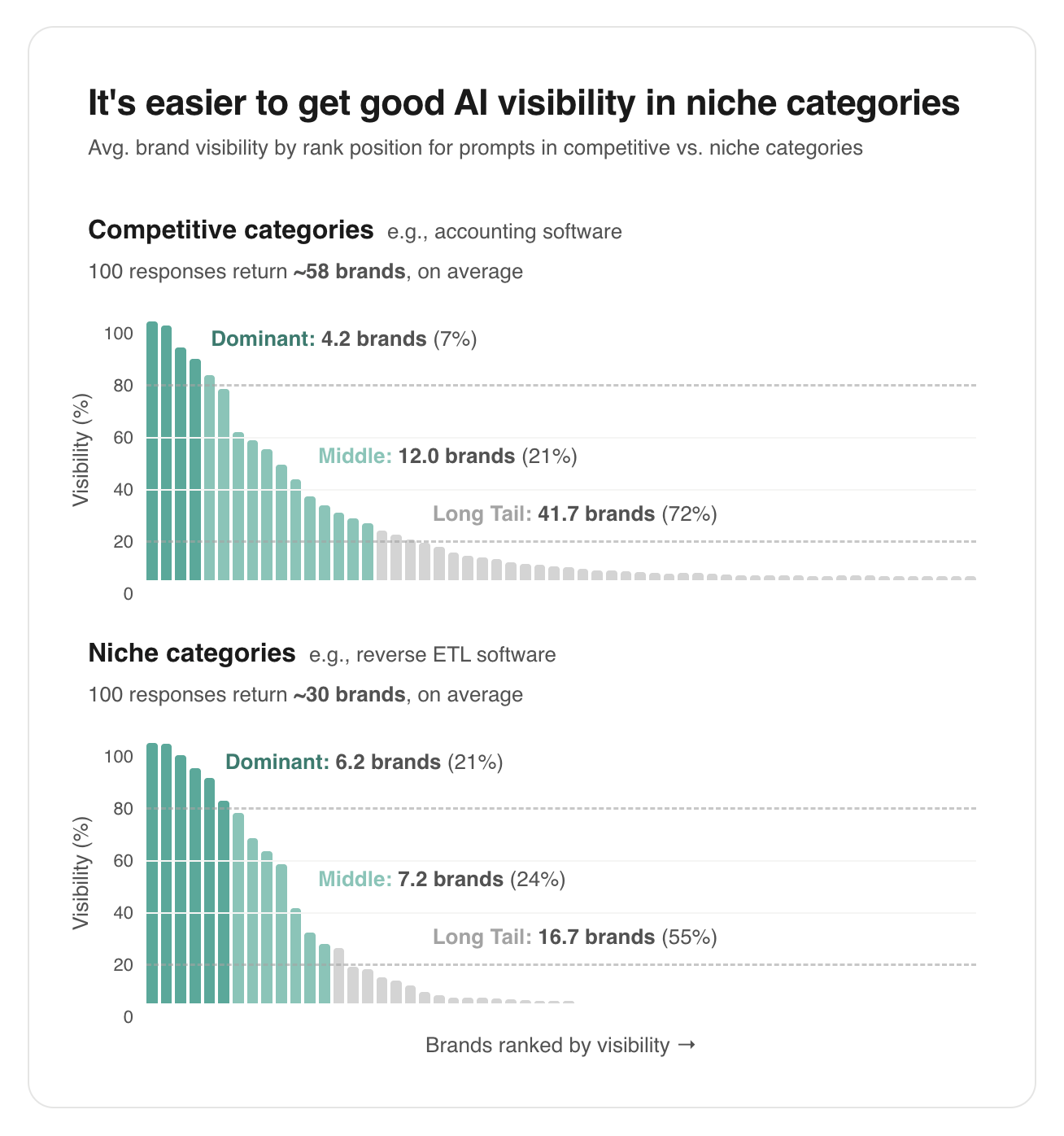
    When diving deeper into ChatGPT’s brand consistency, I found that in a set of 100 B2B software recommendations, only about five brands (11% of the total) were mentioned 80% or more of the time.

    Dominant brands in a category like accounting software were names we all recognize: QuickBooks, Xero, Wave, and the like.

    ```json
{
  "alt": "Bar graphs showing AI brand visibility in competitive vs. niche categories.",
  "caption": "Unlock niche success! Discover how AI visibility differs in competitive vs. niche categories with insightful bar graphs.",
  "description": "This image contains two bar graphs comparing AI brand visibility in competitive and niche categories. The competitive category, such as accounting software, includes approximately 58 brands, with dominant, middle, and long tail segments. The niche category, such as reverse ETL software, averages 30 brands, showcasing a variance in brand visibility distribution with distinct dominant, middle, and long-tail sections. Ideal for understanding AI market positioning, this infographic highlights the ease of achieving visibility in niche markets."
}
```

    If you’re not among the big guns, working within a niche offers a strategic advantage given the increased chance to be consistently recognized by AI.

    For marketers, this study underscores the necessity of standing out and perhaps carving a niche if dominance in a broad category seems out of reach.

    Moreover, most AI visibility tools might not give you the full picture if they’re conducting only a single spot-check. For more reliable data, multiple runs per prompt are essential.

    ```json
{
  "alt": "Chart comparing brand visibility for simple and nuanced prompts, showing dominant, middle, and long tail visibility percentages.",
  "caption": "Exploring brand visibility: Simple prompts showcase clear leaders, while nuanced prompts level the playing field, highlighting the challenges of capturing dominant positions.",
  "description": "This image features a comparative bar chart illustrating brand visibility for simple versus nuanced prompts. For simple prompts, out of 100 responses, around 46 brands participate, with 14% being dominant, 20% in the middle, and 66% in the long tail. For nuanced prompts, approximately 42 brands return from 100 responses, with 10% dominant, 23% in the middle, and 67% in the long tail. This visualization emphasizes the difficulty brands face in maintaining dominance with increasing prompt complexity. Keywords: brand visibility, simple vs. nuanced prompts, dominant brands, marketing analysis."
}
```

    So, if you’re tracking pivotal prompts, run each a handful of times to get a better sense of your brand’s visibility.

    I’m excited to share that future reports will explore ChatGPT’s understanding of brands and whether consistent recommendations reflect deeper brand awareness.

    This article was originally published on Visible and republished with permission.


    Inspired by this post on Search Engine Land.


    crushpress.ai community screenshot
  • Unlocking AI SEO: Why GA4 Isn’t Enough

    Unlocking AI SEO: Why GA4 Isn’t Enough

    I realized relying solely on GA4 to assess the impact of AI SEO is like using a broken compass. While GA4 is a great starting point, it doesn’t paint the whole picture.

    It’s crucial to look beyond Google’s tools to truly understand how audiences find and choose brands. SEO isn’t just about visits; it’s a journey shaped by algorithms and AI long before visits occur.

    Focusing only on measurable visits hides parts of this journey, leaving potential customers adrift. Understanding user intent through share of voice and mapping brand visibility with AI analytics is key.

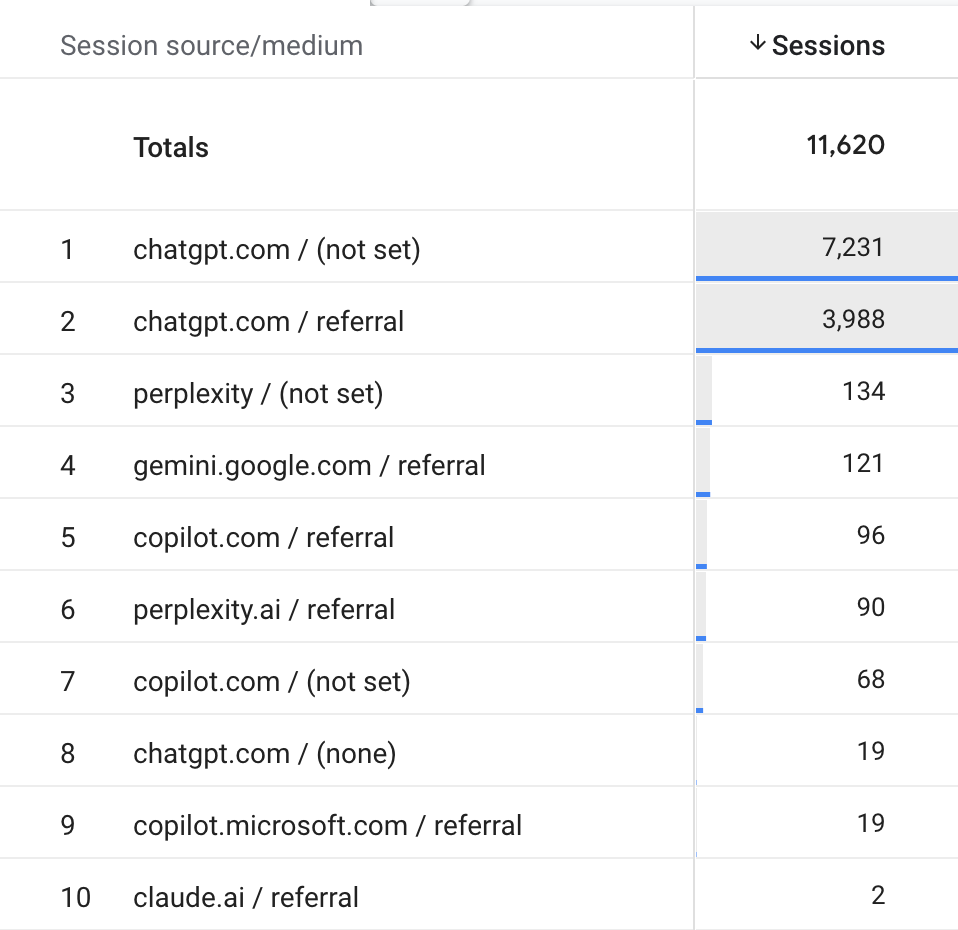
    ```json
{
  "alt": "Analytics table showing session sources and session counts, with chatgpt.com as the highest source.",
  "caption": "This analytics table highlights chatgpt.com as the top source of sessions, showcasing the site's significant online traffic influence.",
  "description": "The image displays an analytics table summarizing session sources and their corresponding session counts. It ranks session sources by traffic volume, identifying 'chatgpt.com' as the leading referrer with 7,231 sessions in 'not set' and 3,988 in referral, followed by perplexity, gemini.google.com, and others. The table provides insights into content performance and referral trends, perfect for SEO and web analysis purposes."
}
```

    I’ve learned that measuring AI visits with GA4 begins with tracking sessions from various AI sources. Creating a custom exploration to track these is an important first step.

    Despite its ease, GA4 struggles to fully capture AI’s impact. Many AI outputs can’t be distinctly tracked, making it crucial to explore other data sources to get a complete picture of brand impact.

    ```json
{
  "alt": "The CapmatchOne logo with a gradient circle and bold text.",
  "caption": "Discover innovation with the CapmatchOne logo, featuring sleek typography and a modern gradient circle.",
  "description": "The CapmatchOne logo features bold, modern typography coupled with a gradient circle, symbolizing connection and innovation. The sleek design conveys a sense of progress and creativity. This image can be used for branding or promotional purposes, appealing to audiences interested in innovative solutions and forward-thinking designs."
}
```

    Both Google Search Console and Bing Webmaster Tools don’t separate AI queries effectively, often mixing AI metrics with standard web traffic, making it challenging to gauge AI’s real impact.

    I’ve found utilizing regex in GSC to identify conversational queries useful, but as query diversity grows, distinguishing synthetic from human becomes harder.

    ```json
{
  "alt": "Search performance data dashboard displaying metrics for clicks, impressions, average CTR, and positions with a line graph for visual analysis.",
  "caption": "Dive into your web metrics with this interactive search performance dashboard, showcasing key insights such as clicks, impressions, and CTR over three months.",
  "description": "This image showcases a search performance dashboard displaying data metrics over a three-month period. Key features include metrics for clicks (3.7K), impressions (79.1K), and average CTR (4.69%). The dashboard provides a line graph to visualize these metrics, and a filter option is available to refine data by categories like Web and Chat, News, and more. A download option for the data is visible, enhancing accessibility and usability for in-depth analysis."
}
```

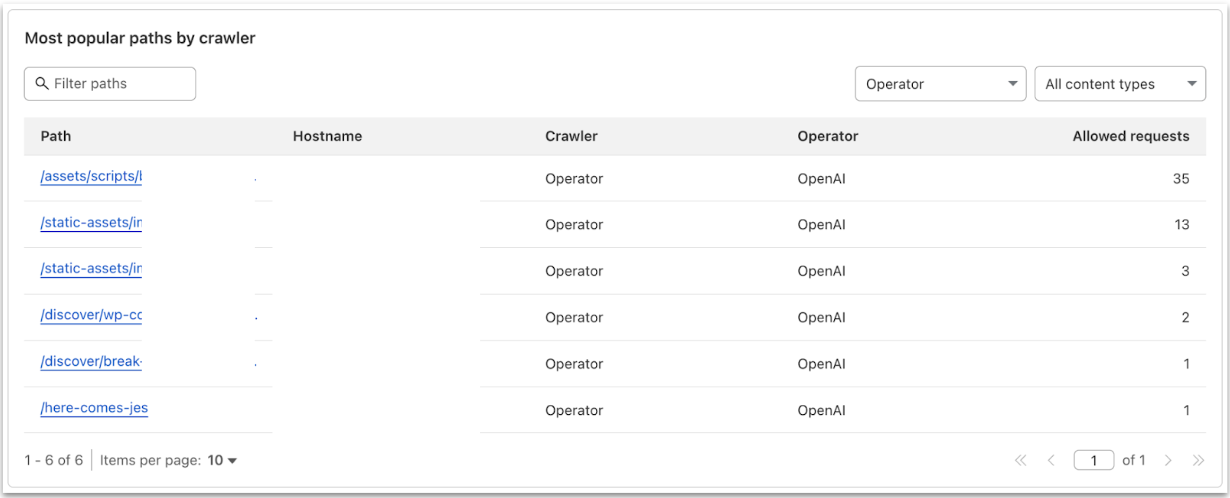
    Exploring AI agent analytics through log files has been insightful. AI agents using text-based browsers evade traditional analytics, requiring SEOs to delve into bot logs for agent patterns without real human traffic miss them.

    Following AI agent request paths, especially to conversion pages, reveals broken journeys and insights into improving user paths.

    ```json
{
  "alt": "Dashboard showing web crawlers' request data, highlighting the Operator AI Assistant crawler.",
  "caption": "A detailed view of web crawler performance, featuring Operator AI Assistant, showcasing allowed versus disallowed requests.",
  "description": "The image displays a dashboard of web crawlers, categorizing data by requests, category, and actions like 'Allow' or 'Block'. The Operator AI Assistant is highlighted, with request data showing 1.53k allowed and 2 disallowed. Graphs illustrate request trends, while robots.txt violations remain at zero. This setup aids in managing site interactions and optimizing SEO strategies."
}
```

    Reassessing traditional SEO reporting frameworks is essential for adapting to AI’s transformational role in search discovery.

    We need tools that track in-chat brand mentions and citations beyond standard website links. AI search analytics must evolve, reflecting SEO’s expansion towards measuring meaningful marketing KPIs and increasing market share.

    ```json
{
  "alt": "Table showing most popular paths by crawler with columns for path, hostname, crawler, operator, and allowed requests.",
  "caption": "Explore the top web paths accessed by crawlers, revealing insights into the most frequently sought-after digital routes and their request volumes.",
  "description": "This image depicts a table listing the most popular paths accessed by the 'Operator' crawler operated by OpenAI. The table includes columns for path, hostname, crawler, operator, and allowed requests, with specific paths like '/assets/scripts/' showing 35 allowed requests. The table serves as an analytical tool to track and manage web traffic efficiently. Useful for SEO analysis and understanding crawler behavior."
}
```

    As an SEO, my goal is no longer optimizing just a website. It’s about building a robust digital brand—one that is visible and trusted across all organic surfaces.


    Inspired by this post on Search Engine Land.

    crushpress.ai community screenshot
  • Uncover the Top Blocker to PPC Growth and Fix It

    Uncover the Top Blocker to PPC Growth and Fix It

    I’ve been there myself. A client approaches me, eager to upscale their Google Ads spend from €10,000 to €100,000 monthly. Like any dedicated PPC manager, I dive into the usual strategies:

    • Refine bidding strategies.
    • Test new ad copy.
    • Expand keyword lists.
    • Optimize landing pages.
    • Boost Quality Scores.
    • Launch Performance Max campaigns.

    Several months in, the ad spend only grows by 15%. The client is content, but I know we can do better.

    Here’s a harsh truth I’ve learned: much of what we consider PPC optimization is really just sophisticated procrastination.

    The theory of constraints, introduced by Eliyahu Goldratt, offers insights for PPC much like it does for manufacturing. It shows that every system has a single constraint that limits its potential.

    It doesn’t matter if the marketing team is super-efficient if the production capacity is what’s limited. Likewise, a 20% improvement in ad copy CTR isn’t useful if the real constraint lies in budget or conversion tactics.

    This theory calls for radical focus: pinpoint the weakest link, make it your priority, and tune out the rest.

    Applying this to PPC means stopping the widespread optimization efforts. Detect the primary barrier, resolve it, and press on.

    Over time, managing PPC accounts has shown me that scaling challenges usually fit within one of seven categories:

    Budget: Profitability could be higher, but client approval caps spending.

    For instance, a campaign might run successfully at €10,000 monthly, with scope to go to €50,000, yet the client hesitates due to risk aversion or cash flow concerns.

    ```json
{
  "alt": "The CapmatchOne logo with a gradient circle and bold text.",
  "caption": "Discover innovation with the CapmatchOne logo, featuring sleek typography and a modern gradient circle.",
  "description": "The CapmatchOne logo features bold, modern typography coupled with a gradient circle, symbolizing connection and innovation. The sleek design conveys a sense of progress and creativity. This image can be used for branding or promotional purposes, appealing to audiences interested in innovative solutions and forward-thinking designs."
}
```

    Developing a compelling business case that showcases past ROI and projected returns is vital here.

    I ignore ad copy tests or keyword expansions because, if I can’t increase budget, they won’t help.

    Impression Share: Already capturing over 90% share, limiting traffic growth.

    Entering new markets or ad platforms can often be the solution for these scenarios.

    The Creative aspect needs tightening when high impressions yield low CTRs, and so on for conversion rate, fulfillment, profitability, and tracking or attribution challenges.

    With my diagnostic steps, I start by running an audit to benchmark the key metrics—impression share, CTRs, CPCs, and conversion rates— to pinpoint what’s genuinely holding the account back.

    The moment I finish an audit and single out the top challenge, the focus becomes precise. For instance, if it turns out conversion rate optimization can unlock growth, that’s where all my efforts channel into until I see a breakthrough.

    Every time the constraint is overcome, a new bottleneck emerges, signifying growth and the movement to new phases. It is both a marker of success and a roadmap to what needs attention next.


    Inspired by this post on Search Engine Land.


    crushpress.ai community screenshot
  • Measure PR Success: SEO, PPC, and GEO Strategies Unveiled

    Measure PR Success: SEO, PPC, and GEO Strategies Unveiled

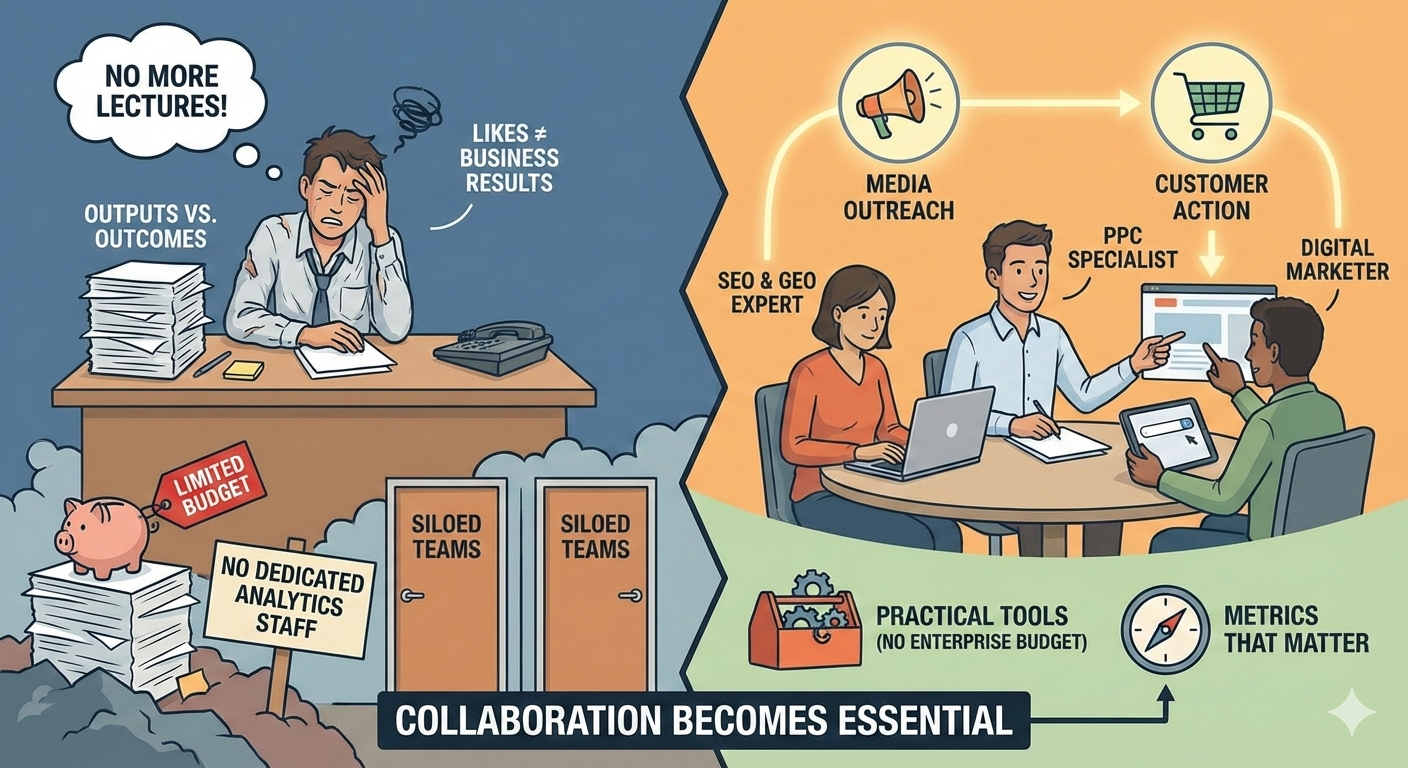
    As I reflect on the challenges of PR measurement, it becomes clear that many hurdles exist. Limited budgets and siloed teams often make it tough to connect our media efforts with tangible results.

    That’s why I’m convinced that collaboration with SEO, PPC, and digital marketing teams is key. Together, we can achieve what feels impossible on our own:

    Specifically, by linking media outreach with customer actions, integrating SEO and GEO into our measurement, and choosing the right tools, we can truly measure impact.

    This piece offers a practical roadmap for achieving this without needing an enterprise budget or specialized analytics team.

    Our digital age of communication isn’t linear. Audiences often engage with content across various channels before taking action, if they do at all. Understanding this loop is essential for measurement.

    ```json
{
  "alt": "Illustration highlighting challenges and solutions in business strategy with a frustrated man and a collaborating team.",
  "caption": "From Isolation to Integration: Transforming Business Outcomes Through Collaborative Strategy.",
  "description": "This illustration contrasts two business scenarios: a frustrated individual overwhelmed by limited resources, siloed teams, and ineffective outcomes, against a collaborative team utilizing practical tools and expertise for media outreach, SEO, and digital marketing to drive customer action. The image emphasizes the importance of collaboration and practical action over isolated efforts in achieving business success, underscoring the importance of metrics and strategic teamwork."
}
```

    I’m reminded of how SEO and PPC professionals focus on actions like searches, clicks, and conversions. We in PR should adopt this action-oriented mindset to enhance our measurement strategies.

    First, we need to prove the link between media outreach and customer actions. This often requires cross-departmental collaboration to access valuable data currently scattered across different systems.

    By incorporating PR touchpoints into analytics tools like Google Analytics 4, I can see our earned media’s influence on downstream behavior, turning PR from a cost center into a demand-creation channel.

    Second, while SEO is widely accepted, understanding its measurement in PR is less clear. Traditional metrics like coverage volume or sentiment don’t fully capture SEO’s impact.

    ```json
{
  "alt": "SEMRUSH ad promoting AI optimization with brand share of voice chart at 70%.",
  "caption": "Explore the future of search with SEMRUSH's AI Optimization. Discover if your brand will be seen in the changing digital landscape.",
  "description": "This SEMRUSH advertisement highlights the importance of AI optimization in modern search strategies. The image features a brand share of voice chart indicating 70%, along with a list of AI tools like Perplexity, Gemini, ChatGPT, and Claude. A call-to-action button invites users to get a demo. The vibrant purple design emphasizes innovation and technology. Keywords: AI optimization, SEMRUSH, brand visibility, search tools, digital marketing."
}
```

    GEO presents a new frontier, focusing on whether our content is a source for AI-generated answers. Tools like Profound and Semrush’s AI Visibility Toolkit offer insights into this new layer of measurement.

    Lastly, it’s crucial that we select tools based on strategic goals, not just what’s trendy. This involves working backward from the desired audience actions to choose the right measurement tools.

    In collaboration, PR, SEO, and PPC teams can integrate their strategies, avoid duplication, and create comprehensive insights that inform and improve future campaigns.

    Ultimately, this collaborative approach gives us the edge, allowing us to adapt swiftly to evolving measurement tactics and strengthen our collective impact.


    Inspired by this post on Search Engine Land.


    crushpress.ai community screenshot
  • Unlocking AI Visibility: Why Ranking Content Falls Short

    Unlocking AI Visibility: Why Ranking Content Falls Short

    I’ve been contemplating how even when content ranks well on search engines, it can still falter when it comes to AI retrieval. These AI systems assess pages very differently, based not just on their rank, but also on how information is extracted, embedded, and structured.

    There’s an intriguing disconnect between traditional ranking and being successfully parsed by AI. A webpage can comply with excellent SEO guidelines and still miss the mark with AI-generated responses and citations.

    In many situations, content quality isn’t the issue. It’s about whether the information can be reliably extracted after being segmented and embedded by AI systems.

    This challenge is becoming increasingly common as search engines view pages as complete entities, but AI systems dive into the raw HTML to extract meaning from fragments rather than entire pages.

    Crucial insights can get lost if they’re not appropriately structured or if they rely too heavily on visual rendering or inference.

    This leads to a divergence between what’s visible in search and what’s accessible via AI, where content might exist in an index but lacks substantial meaning for AI retrieval.

    The visibility gap is something I’ve been grappling with: Understanding the difference between ranking versus retrieval is key.

    ```json
{
  "alt": "Curl command example displaying user-agent GPTBot accessing a website",
  "caption": "An example of a curl command showcasing how to use GPTBot as a user-agent to access a web URL.",
  "description": "This image illustrates a simple curl command example, where the user-agent is set to 'GPTBot' to fetch data from 'https://www.yourwebsite.com/'. It's a useful snippet for developers or technical users aiming to test or demonstrate command-line interactions with web servers, particularly with a specified user-agent. Keywords: curl command, user-agent, GPTBot, web access, command-line."
}
```

    As search winds its processes around rankings, AI systems engage with fragments operated within a different representation of similar information. It’s here the visibility gap takes shape.

    A page might rank high, but if its embedded content is incomplete or poorly organized, then the AI retrieval process becomes unreliable.

    Treat retrieval as an entirely unique visibility factor. It doesn’t override SEO, but increasingly defines whether content can be effectively surfaced, summarized, or cited when AI filters come into play.

    Dig deeper: What is GEO (generative engine optimization)?

    Another structural issue arises when content never even becomes accessible to AI. Many AI crawlers only parse raw HTML without executing JavaScript or client-side rendering. This creates blind spots, especially for JavaScript-heavy sites where the core content may appear in Google’s index but remains invisible to AI.

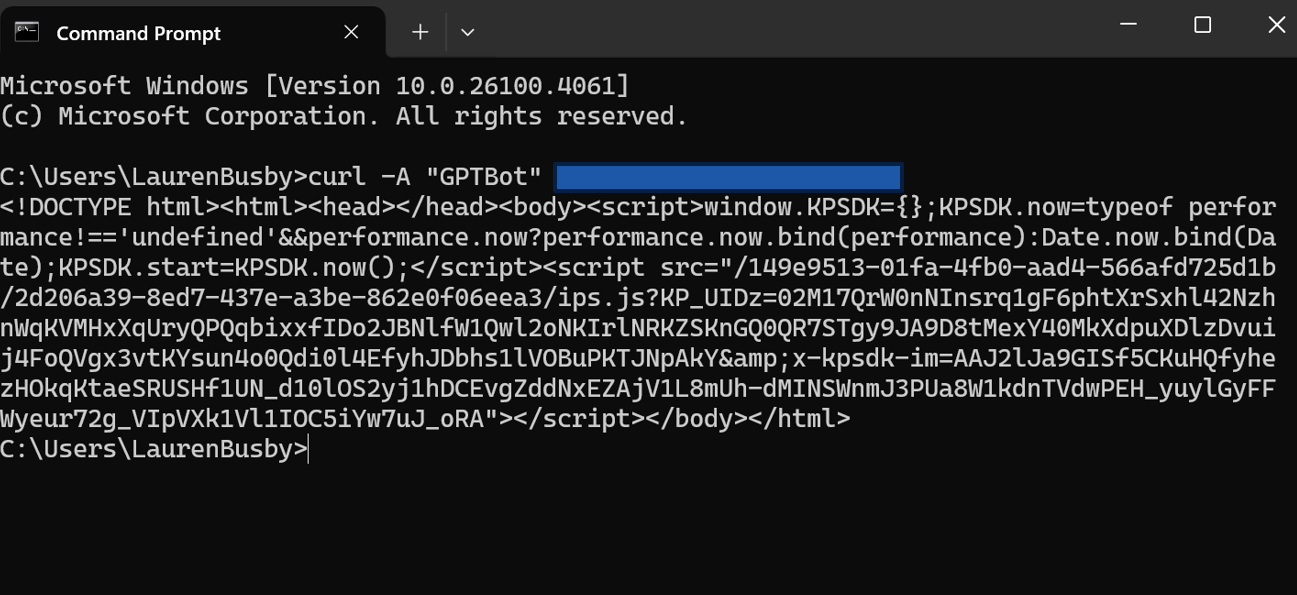
    Testing if your content appears in initial HTML is quite straightforward. Simply inspect the HTML response at fetch time rather than the version rendered in a browser.

    ```json
{
  "alt": "Command prompt window displaying a curl command and HTML code output.",
  "caption": "Exploring the command prompt as a tool, this image shows a curl command execution and its webpage source code result.",
  "description": "This image captures a screenshot of a command prompt window running on a Microsoft Windows operating system. It displays a 'curl' command executed with user-agent 'GPTBot', resulting in an output containing HTML source code, including script and document type declarations. The visible HTML suggests fetching website performance data using JavaScript. Keywords: command prompt, Windows, curl command, HTML output, scripting."
}
```

    Running requests with AI user agents like “GPTBot” reveals if your site returns blank HTML even if it appears fully populated to users, highlighting its absence in initial responses.

    Tools like Screaming Frog can validate this at scale. Disabling JavaScript rendering can reveal what AI systems see—if your essential content only displays with JavaScript, it can be indexed by Google’s search but not by AI retrieval systems.

    Keep in mind that even with content returned, excessive code and scripts can hinder extraction by AI systems. Cleaner HTML results in more reliable embeddings, enhancing AI visibility.

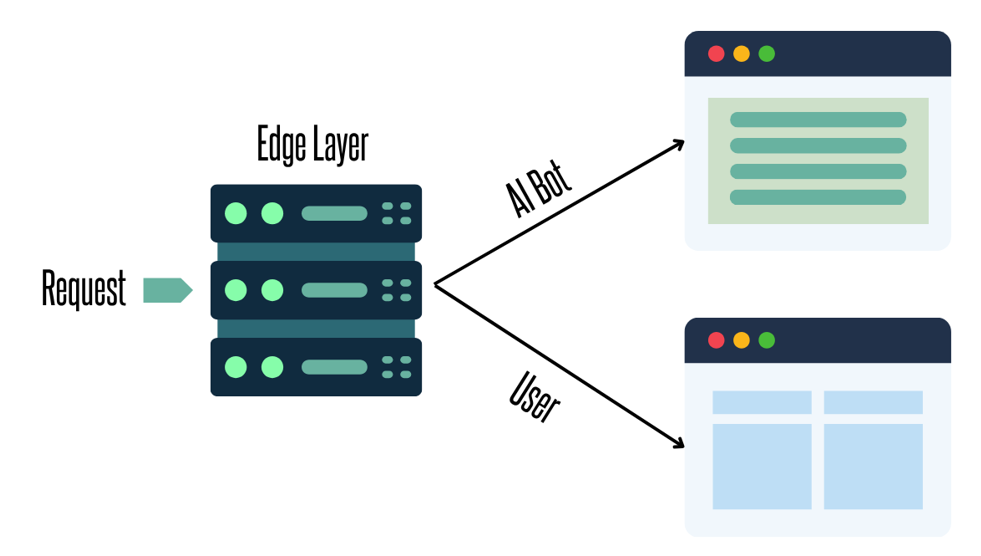
    To tackle this, deliver fully rendered HTML when AI systems fetch your content. Pre-rendering can often fix these retrieval issues, ensuring content is present in initial responses.

    Delivery can be managed effectively at the edge layer, providing AI crawlers with complete pages instantly. Human users receive a dynamic version while AI sees what it needs to extract meaning.

    If pre-rendering isn’t viable, focus on ensuring primary content is accessible in a clean initial HTML response, even without script execution.

    ```json
{
  "alt": "Diagram showing request to edge layer, branching to AI bot and user interfaces.",
  "caption": "Illustrating the flow from request to edge layer, branching to AI bot and user interfaces, highlighting seamless interaction.",
  "description": "This image depicts a flowchart illustrating a request directed to an edge layer. From the edge layer, the flow branches out to both an AI bot interface and a user interface. The diagram signifies the seamless interaction between back-end systems and front-end services, emphasizing split-routing technologies. Useful for understanding data distribution in network systems, the graphic serves as a visual representation of optimized communication paths in modern tech environments. Keywords: edge layer, AI bot, user interface, network flow, data distribution."
}
```

    Columns laden with excessive markup can interfere with proper extraction, diminishing the content’s value.

    The next structural failure to consider is when content is optimized for keywords rather than the entities AI seeks. Traditional SEO applies keyword relevance, but AI retrieves based on entity relationships.

    Without clear definition, entity signals can weaken, causing pages to underperform in retrieval even if they rank well for queries.

    AI evaluates sections independently once extracted, making the consistency of header tags essential to maintaining coherence.

    Ensuring sections have a single, defined purpose allows for better embedding when isolated from larger context.

    Finally, conflicting signals or metadata can dilute the semantics retrieved by AI, creating noise and ambiguity.

    SEO doesn’t have to mean choosing between ranking and retrieval anymore. Both must be prioritized to succeed in today’s landscape.


    Inspired by this post on Search Engine Land.

    crushpress.ai community screenshot
  • Google Ads: From Keywords to Intent-Driven Success

    Google Ads: From Keywords to Intent-Driven Success

    Why Google Ads auctions now run on intent, not keywords

    I’ve noticed a significant shift in how Google Ads operates. No longer is it about simply targeting keywords. Now, it’s all about understanding and leveraging user intent. Here’s what this evolution means for eligibility, structure, and PPC strategy.

    Most PPC teams, myself included, have operated on autopilot: compiling keyword lists, assigning match types, and structuring ad groups around search terms. This was the norm.

    However, Google’s auction process has transformed. Search interactions are evolving into more conversational experiences. People engage with AI as if they’re having a dialogue, asking follow-up questions and refining their inquiries. AI now reasons through a question before linking it to suitable ads.

    Today, the auction isn’t kicked off by a keyword but by the user’s implied intent. If I’m still relying on exact and phrase match structures, I’m planning for a system that’s no longer there. It’s time to embrace intent as the foundation—not the specific words typed, but the underlying goals they signify.

    With this intent-first approach, I find a more resilient strategy. It allows me to effectively design campaigns, creativity, and metrics, especially as Google rolls out new AI-focused formats.

    While keywords still play a role, they no longer serve as the framework.

    Recently, I’ve learned about changes happening under the hood during a search.

    Google’s AI now utilizes a method called “query fan out,” which breaks down complex queries into subtopics and conducts simultaneous searches to provide a comprehensive response.

    The auction begins even before users finish typing. Importantly, AI can deduce commercial intent from purely informational searches.

    ```json
{
  "alt": "Infographic showing the anatomy of a Google AI search query, detailing five steps from user query to ad integration.",
  "caption": "Ever wondered how Google AI processes your search queries? Discover the intricate journey from asking a question to getting results, with a seamless ad experience.",
  "description": "This infographic outlines the anatomy of a Google AI search query, illustrating the process from the user's complex question to AI processing, including query fan-out into subtopics, concurrent searches, and summary generation. Additionally, it explains how contextually relevant ads are integrated, emphasizing auction logic, eligible campaign types, and seamless user experience. Keywords: Google AI, search query, ad integration, AI processing, infographic."
}
```

    For example, if someone asks, “Why is my pool green?” Google understands they’re troubleshooting, not shopping, but identifies potential product needs and displays ads for pool-cleaning supplies. The AI’s reasoning layer recognizes the solution products offer.

    This change in auction logic focuses on matching offerings to the user’s inferred intent, rather than merely matching keywords to queries. Recognizing this shift is crucial, or I risk misinterpreting the user journey.

    I’ve come to appreciate the intricacies of an intent-first approach. It doesn’t eliminate the need for keyword research but changes how I prioritize keywords. Now, I align campaigns to the user’s intent.

    This strategy encourages me to consider:

    • What problem is the user addressing?
    • What stage of decision-making are they in?
    • What role does the product play in solving their issue?

    Realizing that the same intent can emerge from various queries and that identical queries can express different intents based on context has been illuminating. Phrases like “Best CRM” might indicate a need for feature comparison or a readiness to purchase; Google’s AI can now make those distinctions, and so should my campaigns.

    This shift is more mental than tactical. While I still build keyword lists, they’re now organized by intent rather than match type. My ad copy speaks directly to user goals instead of echoing search terms.

    Moving from keywords to intent isn’t merely a tactical alteration—it’s a strategic lens through which I plan for future campaigns, especially as Google enhances its AI-driven ad formats.

    Reorganizing campaigns around intent rather than keywords has its immediate effects, impacting eligibility and landing page efficacy while fundamentally influencing system learning.


    Inspired by this post on Search Engine Land.


    crushpress.ai community screenshot
  • Navigating Google Ads: Why Performance Max May Fail You

    Navigating Google Ads: Why Performance Max May Fail You

    As a new advertiser, I’ve often found myself overwhelmed by Google’s Performance Max recommendations.

    While well-intentioned, following them blindly can reduce my control and insight, leaving me to wonder if I’m truly making the best strategic decisions.

    Initially, my journey with Performance Max felt promising. Google Ads reps offered support, but I soon realized their alignment was more with Google’s interests than my own business objectives.

    It’s important to remember that they don’t have insight into my specific needs or business goals. They encourage the adoption of new features that might not align with my early-stage needs.

    Understanding Google Reps’ Role

    Google Ads reps are not strategic consultants for my business. Their main role is to promote Google’s products and services.

    Your margins or cash flow are not their concerns. Their focus isn’t on whether my ads are profitable, but on pushing newer ad types and increasing my ad spend.

    Therefore, understanding their incentives helps in taking their advice with the right perspective.

    Performance Max provides efficiency and scale for Google. However, for a new advertiser, this can lead to unclear insights and misaligned strategies.

    Performance Max: Who Does it Really Benefit?

    Performance Max often benefits Google more than it benefits me as the advertiser.

    Google controls how my budget is allocated across various channels, offering limited visibility into how these funds drive results. For me, this can be challenging, especially when new and needing clear insights.

    This model monetizes Google’s ecosystem efficiently, but leaves me with diluted budgets and unpredictable costs.

    Understanding these dynamics helps ensure my campaign choices are aligned with my actual business needs.

    Rethinking Google’s ‘Best Practices’

    What Google labels as ‘best practices’ might not fit my specific business strategy.

    Recommendations often stem from aggregated data rather than being tailored for my unique circumstance, creating a gap between my needs and their blanket solutions.

    For budding advertisers like myself, what’s globally optimal might not serve my business nuances and constraints.

    The Value of Earning Automation

    I’ve learned that automation success is something to be earned with data, not started with blindly.

    Shopping Ads have provided me with high-intent, controllable data—essential for testing and learning.

    This approach allows a clearer understanding of what truly works, paving the way for informed decisions.

    When done right, these strategies lay a solid foundation for future automation without risking budget waste.

    A Lesson in Practicality: Reviewing a Case Study

    Consider a chocolatier’s experience—a new Google Ads account, $3,000 spent, but only one purchase. Incorrect conversion tracking led to misleading data.

    After reworking the setup to a Shopping campaign, results began improving quickly, informing future campaigns with real performance data.

    Why Shopping Ads Offer Insight

    Focused on real behaviors and intent, Shopping Ads give granular control and transparency, which is crucial when each marketing dollar counts.

    This control allows me to experiment deliberately, understanding and scaling the strategies that work.

    Adopting a Hybrid Approach

    A mix of Standard Shopping and selective Performance Max can be powerful once a data foundation is set.

    This balance ensures sustainable growth by protecting proven strategies while allowing room for innovation driven by Performance Max.

    Strategizing for Long-term Success

    Starting small with clear data-driven campaigns creates a launchpad for successful automation.

    By validating products and refining acquisition costs through Shopping Ads, I set the stage for Performance Max to elevate proven strategies.

    It’s all about disciplined, strategic advertising that safeguards my investment and fuels long-term growth.


    Inspired by this post on Search Engine Land.


    crushpress.ai community screenshot