Category: News

  • Google AI Mode to Transform Complex Searches, Enhancing User Experience

    Google AI Mode to Transform Complex Searches, Enhancing User Experience

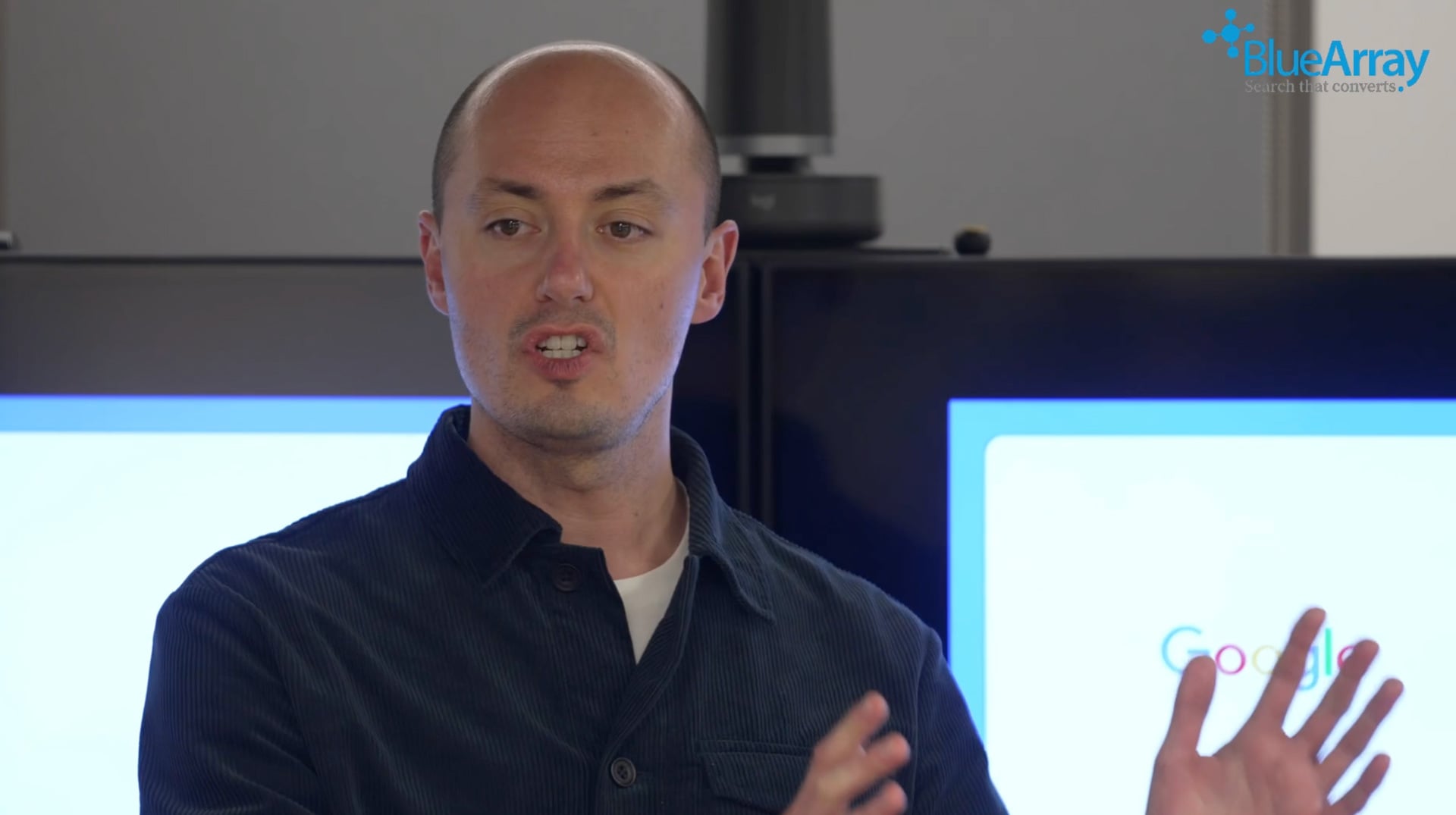
    I attended a fascinating talk yesterday at the Simply Business headquarters in London, where Jonathon Heard, the Industry Head, Insurance at Google, shared some groundbreaking insights. He revealed that Google Search is gearing up to direct complex queries straight to AI Mode, effectively bypassing the traditional search process.

    Heard also hinted at future enhancements in Google Search Console, aiming to provide separate reports for AI Mode and AI Overviews.

    Bypassing Google Search. According to Heard, with the advent of Gemini 3, complex queries will be automatically channeled through AI mode, a feature currently being tested in the US.

    One curious attendee asked about the implications of these changes. Heard confirmed that any query entered in the standard Google search could indeed be redirected to AI Mode. This revelation sparked a lively discussion, as the audience realized the significant shift this represents.

    Although Google previously hinted that AI Mode might become the default search experience, they later retracted those statements. Robby Stein from Google downplayed the speculation, emphasizing the company’s focus on easy access to AI Mode for interested users.

    AI Mode & AI Overview Search Console data. During the panel discussion, Simon Schnieders, Founder of Blue Array, inquired about the potential for separate AI Mode and AI Overview data within Search Console. Currently, these data points are lumped together, making it challenging to assess their individual performance.

    Heard responded that Google is actively exploring this possibility, acknowledging the need for new data structures as search interfaces evolve. Schnieders welcomed this openness, noting it was the first time a Google representative had mentioned it.

    Heard further elaborated, highlighting the rapid pace of change and the necessity to adapt reporting structures to keep up. He mentioned that although nothing is publicly announced yet, the transformation in reporting is a constant conversation within Google.

    Here is the video of the event:

    Why we care. I’ve reached out to Google to confirm the accuracy of Jonathan Heard’s statements. If Google transitions to an AI-centric approach bypassing traditional search, it will dramatically alter how users discover websites, content, and services.

    Additionally, Google’s reticence to discuss AI Mode and Overview data in Search Console since the SGE demo could signal substantial upcoming changes. We will update this story as soon as we receive new information.


    Inspired by this post on Search Engine Land.


    crushpress.ai community screenshot
  • Microsoft Ends Mobile Ad Management: Here’s What You Need to Know

    Microsoft Ends Mobile Ad Management: Here’s What You Need to Know

    I’m here to update you that Microsoft will be saying farewell to its Advertising mobile app in January 2026. This shift will affect how advertisers manage their campaigns on the go.

    As someone who relies on the Microsoft Advertising app for quick interventions or checks, I understand the importance of staying informed. Now, I’ll need to adapt by using the web interface, which will become the sole channel for managing campaigns.

    So, what’s the change? The app is no longer available in the Apple App Store or Google Play, and from January 2026, it will be completely retired. Microsoft’s web UI, rich with features, will be our go-to tool.

    ```json
{
  "alt": "Announcement about retiring the Microsoft Advertising mobile app in 2026.",
  "caption": "Microsoft Advertising announces the retirement of its mobile app by January 2026. Transition to their online platform for future campaign management.",
  "description": "This image is an official announcement from Microsoft Advertising about the retirement of their mobile app. The app will be removed from app stores in November 2025 but will function with updates until January 2026. Users are encouraged to continue managing campaigns through Microsoft Advertising's online platform. This message informs users about changes and provides guidance on adapting to new processes."
}
```

    I first learned about this through marketing specialist Ive Predovan, who shared Microsoft’s email notice via PPC News Feed.

    To wrap it up, if you’ve been managing Microsoft Ads from your phone, it’s time to prepare for change. The transition to the web interface is imminent, leaving us with no choice but to adapt.


    Inspired by this post on Search Engine Land.


    crushpress.ai community screenshot
  • Simplify Compliance with Google Ads’ New Political Content Setting

    Simplify Compliance with Google Ads’ New Political Content Setting

    When I heard about Google Ads’ latest update, I was excited to see how it could make life easier for advertisers like me. Google Ads now offers the ability to set a default, account-level declaration for political content. This change simplifies compliance, especially as new transparency regulations are coming into play.

    I remember when they first introduced the campaign-level setting back in August 2025. Quietly, without much fanfare, Google extended this feature to the account level, which means I no longer have to update each campaign individually. This enhancement allows me to define my political-advertising stance once and apply it across all my future campaigns.

    Why this matters to us. Having a more streamlined approach is crucial for advertisers who want to stay on top of political-ad regulations. With the EU’s TTPA rules taking effect in October 2025, these new features provide a much-needed consistency.

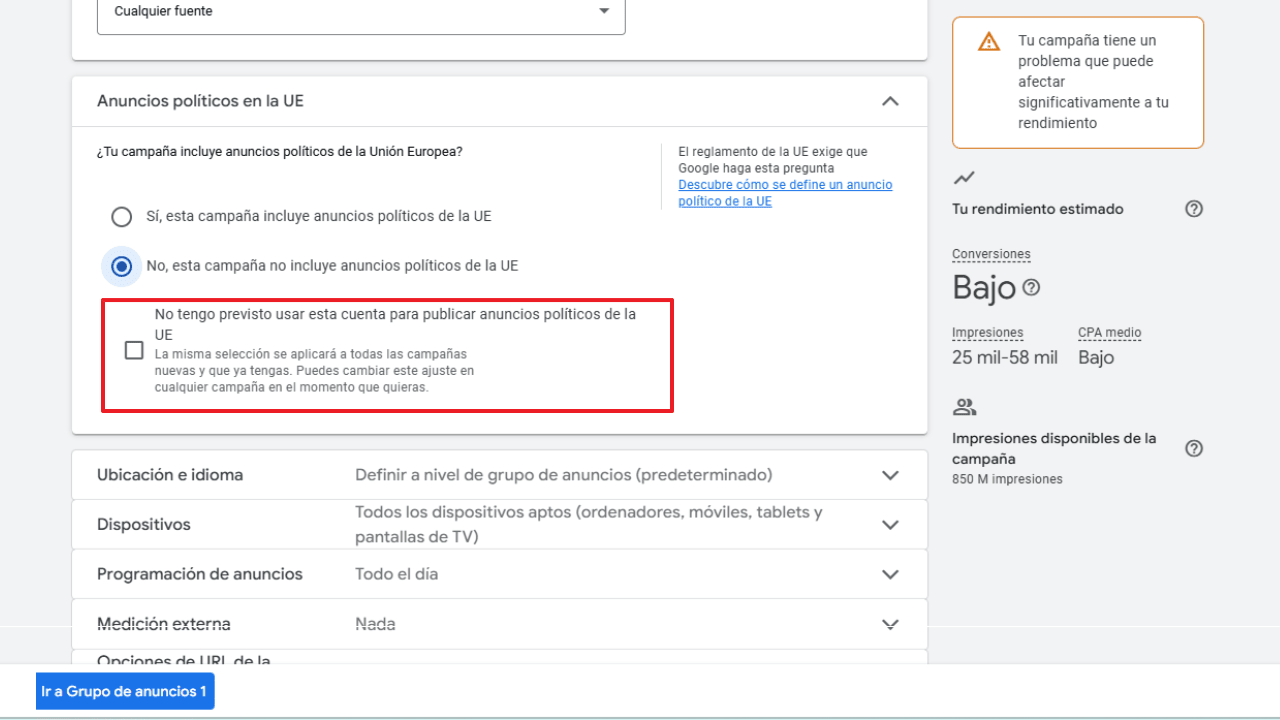
    Now, I can choose within my campaign settings:

    • “I don’t intend to use this account to run political ads in the EU”
    • Or declare that my campaigns will include political content.
    ```json
{
  "alt": "Screenshot of a Google Ads setting for political ads in the EU, highlighting campaign performance issues.",
  "caption": "Navigating Google Ads settings for EU political campaigns can help address potential performance issues effectively.",
  "description": "This image displays a section of the Google Ads settings page concerning political ads in the EU. The options include whether the campaign includes EU political ads and a checkbox for not using the account for such ads. The sidebar shows an alert about a performance-affecting issue, along with estimated performance metrics like conversions and impressions. Keywords: Google Ads, EU political ads, campaign settings, performance metrics."
}
```

    This new toggle becomes the default setting for all my future campaigns, which reduces the chances of making mistakes and leaves fewer gaps in compliance.

    Recently, I came across a Spanish-language version of the user interface through Victor Sellés Guillemat, a Google Ads Specialist. He shared his find in a LinkedIn post, showcasing this update in action.

    The broader perspective. With election cycles worldwide and evolving regional rules, it’s clear that platforms like Google are under increasing pressure to maintain transparency in political advertising. This update from Google is designed to help compliant advertisers by reducing the complexities involved and providing clearer, more consistent disclosures to regulators.

    Bottom line. While it’s a minor update in the user interface, it carries significant operational benefits. For those of us managing multiple campaigns, it means fewer compliance issues, and for Google, it ensures that political content declarations are as accurate and reliable as possible across accounts.


    Inspired by this post on Search Engine Land.


    crushpress.ai community screenshot
  • Revolutionize Creativity with Google DeepMind’s Nano Banana Pro

    Revolutionize Creativity with Google DeepMind’s Nano Banana Pro

    Google vs. AI systems visitors

    When I discovered Google DeepMind had launched Nano Banana Pro, my creative possibilities instantly expanded. This new generation of image generation technology builds on the original Nano Banana and powers up Gemini 3 Pro. By offering sharper text rendering, deeper world knowledge, and consistent edits, it transforms even the vaguest ideas into studio-quality visuals.

    Why this matters to me. With Nano Banana Pro, I have newfound control and precision in creating on-brand content. Whether crafting perfectly rendered text or achieving consistent product visuals, the tools I regularly use—like Google Ads and Slides—seamlessly integrate to save time and enhance creative testing.

    The efficiency gains are significant, as they reduce production time and increase ad relevance, allowing for the scaling of campaigns with top-tier visuals and less manual effort.

    ```json
{
  "alt": "Illustration and photo of String of Turtles plant, Peperomia prostrata, in a pot on a windowsill.",
  "caption": "Discover the charm of the String of Turtles, a delightful Peperomia prostrata with unique foliage. Perfect for bright, indirect light and requiring moderate watering, it's a whimsical addition to your indoor garden.",
  "description": "The image features a String of Turtles plant, scientifically known as Peperomia prostrata, depicted both in a photograph and an illustration. The plant is shown in a terracotta pot placed on a wooden windowsill, thriving in indirect sunlight. The leaves are small, round, and succulent with dark green reticulated patterns. Originating from the rainforests of Ecuador, this plant suits bright, humid conditions and is slow-growing, making it ideal for hanging baskets or decorative displays."
}
```

    Features that excite me:

    • Generating visuals rich in context, using real-world data through Search

    ```json
{
  "alt": "Woodchuck on stacked logs with carved letters forming 'How much wood would a woodchuck chuck if a woodchuck could chuck wood?'",
  "caption": "A playful woodchuck poses atop a stack of logs, carved into the classic tongue twister. Nature meets whimsy in this forest tableau!",
  "description": "An imaginative image featuring a woodchuck perched on a pile of logs in a forest. The logs are artistically carved to display the famous tongue twister, 'How much wood would a woodchuck chuck if a woodchuck could chuck wood?' Surrounded by lush greenery, the scene combines humor and nature, capturing the whimsical essence of the classic saying. Ideal for adding a touch of humor and creativity to any setting."
}
```
    • Rendering easily legible text across multiple languages within images
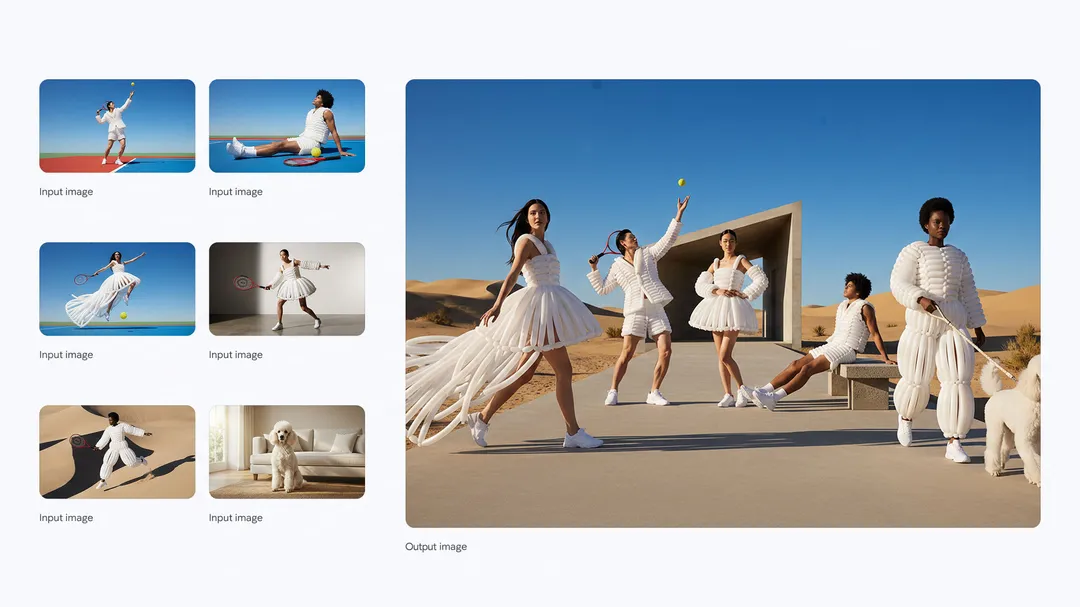
    • Holding character and object consistency across up to 14 inputs
    ```json
{
  "alt": "Collage with people in avant-garde tennis attire in a desert setting, accompanied by a dog.",
  "caption": "Step into the future of fashion and tennis with avant-garde outfits set against a stunning desert backdrop. This ensemble captures innovation and style seamlessly.",
  "description": "A captivating collage showcasing avant-garde fashion with a tennis theme. The main image features a group wearing futuristic white outfits with tennis elements in a desert. Smaller inset images highlight various poses and settings, including a dog indoors, creating a unique blend of high fashion and sports. This image combines elements of style, sport, and nature, making it a striking and imaginative visual. Keywords: fashion, tennis, avant-garde, desert, style, innovative clothing."
}
```

    • Transforming rough sketched ideas into polished scenes, diagrams, and storyboards
    • Executing localized edits, advanced lighting changes, and offering meticulous control over camera angles, color balancing, and aspect ratios

    ```json
{
  "alt": "Young person with red hair looking upwards, surrounded by floating white feathers against a deep blue sky.",
  "caption": "Lost in a moment of serene beauty, a young dreamer gazes skyward as gentle feathers drift by, creating a whimsical vision against a stunning blue backdrop.",
  "description": "The image depicts a young individual with red hair looking upwards, enveloped by floating white feathers against a deep blue sky. The soft, dreamy atmosphere creates an ethereal scene, capturing a sense of wonder and tranquility. The combination of the subject's expression and the ambient feathers evokes feelings of freedom and dreams. The composition includes both the original input image and processed outputs, showcasing varying perspectives of the same serene moment."
}
```

    The mechanics. By blending Gemini 3’s reasoning prowess with advanced image-editing capabilities, Nano Banana Pro is redefining how I create precise, on-brand visuals. It supports various creative outputs, making it valuable for:

    • Infographics and recipes using real-time data
    • Architectural and storyboard mockups
    • Crafting calligraphy, posters, and multilingual packaging
    • Making cinematic composites from numerous images
    • High-detail fashion, lifestyle, and landscape visuals
    • Studio-level lighting adjustments and refocusing techniques

    Accessing Nano Banana Pro. I’m thrilled to see Nano Banana Pro progressively debuting across Google’s platforms, with its image generation enhancements now available in Google Ads.

    The broader impact. As Nano Banana Pro elevates Google’s image capabilities, it shifts from producing quick visuals to crafting professional-grade content. With improved reasoning, nuanced control, and multilingual flexibilities, it’s poised to drive everything from classroom materials to comprehensive ad campaigns, and even cinematic productions.


    Inspired by this post on Search Engine Land.

    crushpress.ai community screenshot
  • Explore Google’s New Branded Queries Filter in Search Console

    Explore Google’s New Branded Queries Filter in Search Console

    I’ve got some exciting news about Google Search Console that’s just too good to keep to myself. They’ve introduced a branded queries filter that’s rolling out gradually, and trust me, you’ll want to get your hands on it!

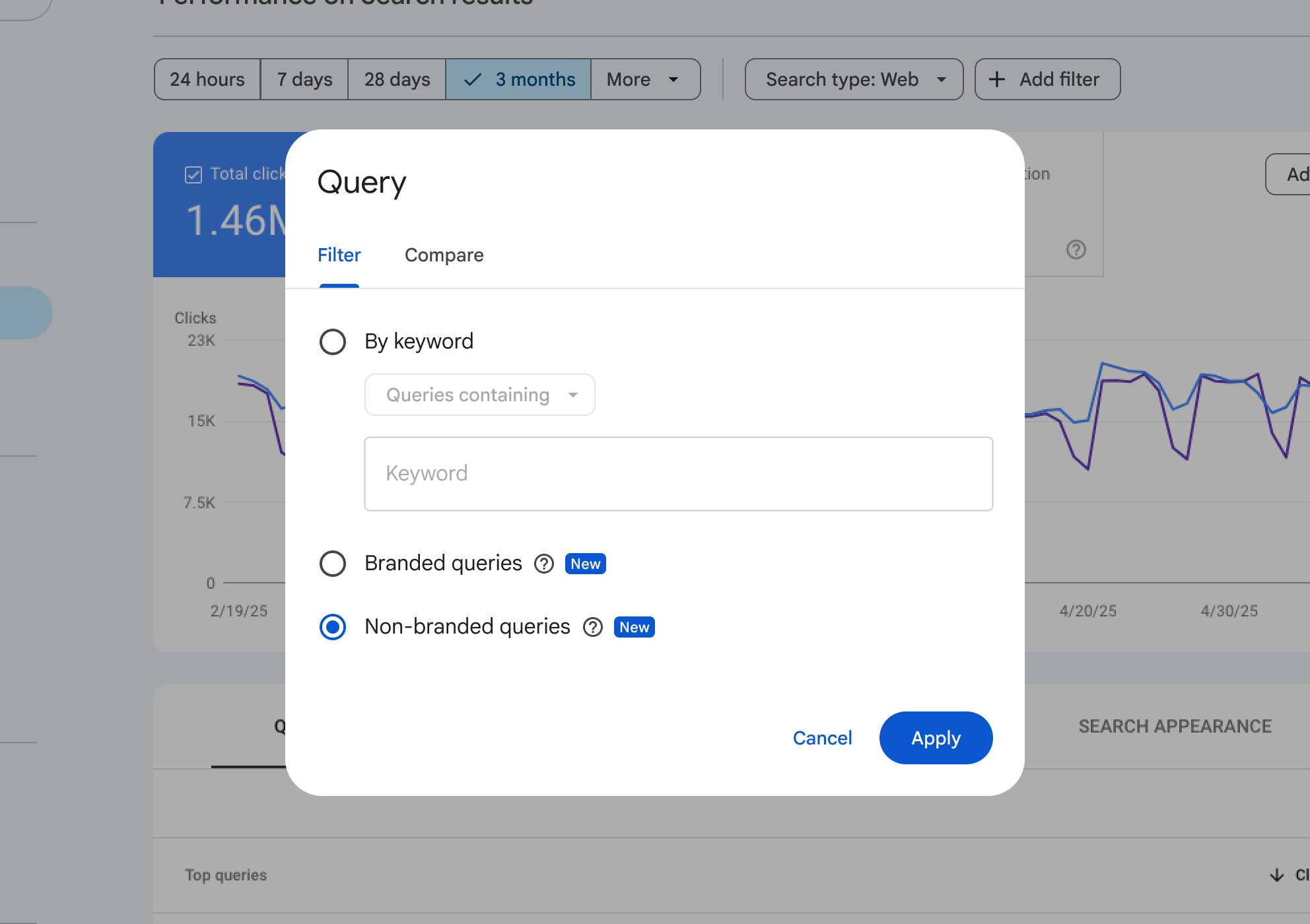
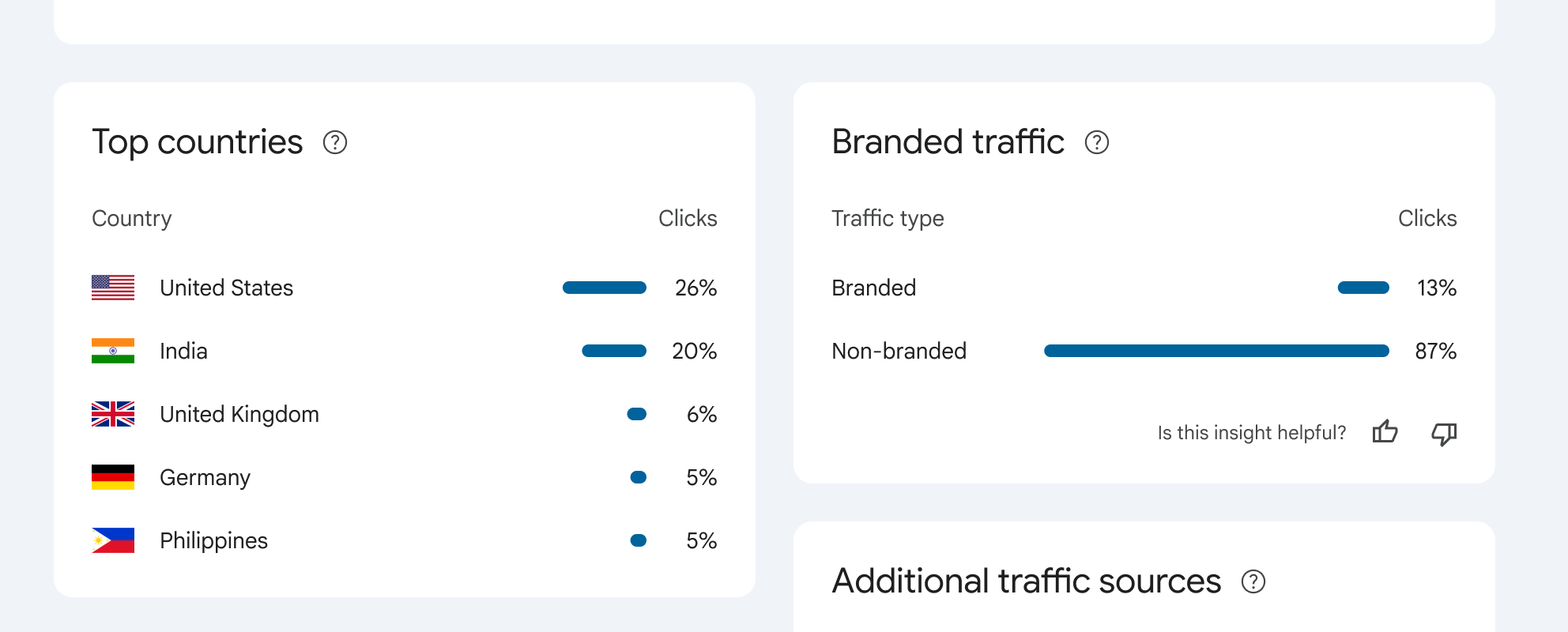
    With this new addition, I’ve found that filtering performance reports by branded or non-branded queries has never been easier. Google can now show me the percentage of traffic my site gets from either branded or non-branded sources, right from Search Console.

    This update made its debut at today’s Google Search Central event in Tel Aviv, and if you’re hearing about it now, it’s because news travels fast, especially from events like these.

    Understanding Branded Queries. Google defined branded queries for us: These are search queries that include my brand name, its variations or any brand-related products. For instance, if my brand was Google, related queries could be “Google,” “Gogle,” or even “Gmail.”

    This differentiation helps me see how returning users differ from new ones. Focusing on this can lead to higher click-through rates for branded queries. Meanwhile, non-branded ones show how new users find my content organically.

    ```json
{
  "alt": "Google Search Console filter menu for query settings with non-branded queries selected.",
  "caption": "Exploring search performance insights with Google Search Console's filter menu, focusing on non-branded queries for a three-month period.",
  "description": "This image displays the Google Search Console interface, specifically the filter menu for setting search query parameters. The menu shows options to filter by keyword, branded queries, and non-branded queries, with the latter selected. The background features a line graph representing performance data for a three-month timeframe. Key interface buttons 'Cancel' and 'Apply' are visible, providing a comprehensive tool for analyzing website performance metrics. Keywords: Google Search Console, filter, search queries, non-branded, performance analysis."
}
```

    Finding the Filter. Ready to use it? You can locate the branded versus non-branded filter within performance reports under search filters for queries. I love how it works across all search types, whether web, images, video, or news. Metrics like impressions and CTR tailored to my needs are just a click away.

    Here’s a handy screenshot for visuals:

    ```json
{
  "alt": "Chart showing top countries and branded traffic percentages. United States leads with 26% clicks, followed by India at 20%.",
  "caption": "Discover where your traffic comes from! The United States leads with 26% of clicks, while non-branded traffic dominates at 87%.",
  "description": "This image displays two charts: 'Top countries' and 'Branded traffic.' In the 'Top countries' section, the United States leads with 26% of clicks, followed by India at 20%, the United Kingdom at 6%, and both Germany and the Philippines at 5%. The 'Branded traffic' chart shows 13% branded and 87% non-branded clicks. These insights help understand the geographic and branding sources of website traffic."
}
```
    crushpress.ai community screenshot
  • Unlocking Google’s AI Max Potential: A Guide for Advertisers

    Unlocking Google’s AI Max Potential: A Guide for Advertisers

    I have been diving into Google’s AI Max for Search as it becomes more accessible in beta, and I’m exploring its impact on ad campaigns. AI Max is aimed at helping advertisers discover new conversion opportunities beyond their existing keywords, with a promise of clearer controls and measurable benefits.

    The buzz around AI Max has led many advertisers, like myself, to evaluate its performance and its compatibility with our current keyword strategies. Ginny Marvin, Google’s Ads Liaison, has been clarifying precisely what AI Max is and is not.

    Understanding the Purpose of AI Max

    AI Max isn’t here to replace or overshadow your existing keyword structures. Its main objective is to unlock incremental conversions or additional conversion value.

    • It extends your reach using broad match logic and keywordless matching, similar to DSA-style crawling of landing pages.
    • Dynamic creative optimization is part of the package, including text customization and Final URL expansion to better align with user intent.

    The Essentials

    If a search query matches your existing keywords, those keywords will be prioritized. AI Max is designed to capture new searches that you might not currently be targeting.

    Is AI Max Just a Rebranding? It’s a bit more than that, with improvements. AI Max combines broad match, DSA, generated text assets, and Final URL expansion into a streamlined system, offering enhancements like:

    • Controls at the ad-group level, including locations and brands
    • Enhanced search-term reporting, highlighting which creative assets and landing pages are used
    • Upcoming features like text guidelines for better customization

    Marvin believes that these components work more effectively together in AI Max than they do separately.

    What to Anticipate Based on Your Current Setup

    • Mostly Phrase/Exact users: Expect significant growth as AI Max leverages broader and keywordless capabilities.
    • Heavy Broad Match users: Anticipate marginal expansion, since you already cover a broad area.
    • DSA users: Experience less keywordless reach but gain improved performance with asset-driven signals absent in standard DSA.
    • PMax-heavy advertisers: AI Max introduces PMax-style matching to Search, and many users still observe incremental growth.

    Why CPA/ROAS May Differ. AI Max focuses on incrementality, leading to potentially higher costs for incremental conversions compared to core conversions from curated keywords.

    ```json
{
  "alt": "A comparison of CPA conversions between Exact Match and AI Max.",
  "caption": "Unveiling the impact of strategies: Exact match vs. AI Max in CPA conversions. Observe the averages and totals, revealing insights for effective targeting.",
  "description": "This image shows a comparison between Exact Match and AI Max CPA strategies. The Exact Match generates 7 conversions averaging $8.57 CPA, while AI Max produces 13 conversions with a $10.77 average, achieving a total of 20 conversions at an average CPA of $10.00. The image illustrates the effectiveness of AI driven strategies in enhancing conversion outcomes, providing key insights for digital marketing optimization."
}
```

    Google advises not to view match types in isolation but to assess whether the overall campaign provides more conversions or value at your desired CPA/ROAS.

    Why This Matters

    For advertisers like myself, Google clarifies that AI Max is intended to discover incremental demand not attainable through traditional keyword settings, potentially leading to more conversions or revenue without needing a campaign overhaul. It merges broad match, DSA, and dynamic creative into one system with advanced controls and reporting, providing transparency and measurability.

    The inclusion of A/B testing enables advertisers to confirm the validity of perceived gains.

    Measuring Incremental Lift

    Google now offers genuine A/B testing within AI Max experiments to compare control and treatment groups.

    • Brand and location controls are not yet available in AI Max experiments.
    • You can use Custom Experiments for those tests.
    • Disregard the learning period when analyzing results.

    The Overall View

    AI Max is developed to engage new, pertinent demands that your keywords may miss. Evaluate its effectiveness by focusing on campaign-level incremental lift — achieving more conversions or conversion value at your target efficiency.

    Google continues to enhance features and encourages advertisers to actively test and provide feedback.

    Explore Further Full article by Ginny Marvin.


    Inspired by this post on Search Engine Land.

    crushpress.ai community screenshot
  • Discover New Features on Google Maps: Insider Tips and More!

    Discover New Features on Google Maps: Insider Tips and More!

    I’ve recently discovered that Google Maps has introduced some exciting new features to better inform us about local businesses and events. Now, we can also choose to leave reviews using nicknames, giving us a bit more privacy when sharing our thoughts.

    Know Before You Go. One of the highlights is the ‘know before you go’ feature now available on Google Maps. I remember seeing this tested earlier, but it’s great to see it officially rolled out now.

    When I search for places, I can easily access ‘know before you go’ tips, showing me crucial details like parking tips, secret menu items, and ideal reservation methods. This information comes from user reviews and other online resources.

    These tips, dubbed ‘insider tips’ by Google, are now available in the U.S. on both Android and iOS. I’ve found them quite helpful in planning my visits more efficiently.

    Here’s a glimpse of how it looks:

    Trending Nearby in Explore Tab. There’s also a new addition to the Explore tab, highlighting trending restaurants, activities, and attractions nearby. I can simply swipe up on the explore tab to discover these popular spots.

    This feature sources trends from platforms like Viator, Lonely Planet, and local influencers, including Sisterssnacking. It’s been a fantastic way for me to stay updated on what’s happening around me.

    This update is available globally this month on both Android and iOS devices.

    Here’s what the new Explore tab looks like in action:

    Nicknames for Reviewers. One feature I particularly like is the option to use nicknames when leaving reviews. According to Google, “If you’d prefer not to use your real name, you can now choose a nickname and profile.”

    While there might be concerns about spammy reviews, Google assures us that their systems are equipped to monitor and detect fake reviews continuously, linking our reviews to our Google Accounts.

    This feature is rolling out globally this month on Android, iOS, and desktop.

    Here’s a quick look at how to set up a profile with a nickname:


    Inspired by this post on Search Engine Land.


    crushpress.ai community screenshot
  • Adobe’s Incredible Acquisition: Semrush Joins Forces in $1.9B Deal

    Adobe’s Incredible Acquisition: Semrush Joins Forces in $1.9B Deal

    Today, I’m thrilled to share the big news that Adobe is acquiring Semrush for a massive $1.9 billion. This exciting development, announced by the companies, is set to close in the first half of 2026, pending necessary approvals.

    You might know Semrush as a leading SEO platform that made headlines in October 2024 by acquiring Search Engine Land, MarTech, and Third Door Media. Now, Adobe is planning to bring Semrush on board in an all-cash transaction valued at approximately $1.9 billion, further enhancing Adobe’s robust portfolio.

    Insights from Semrush Leadership. Semrush CEO Bill Wagner shared his excitement on LinkedIn:

    We have some big news at Semrush today: we’re joining forces with Adobe.

    I am proud to announce our agreement to be acquired by Adobe for $1.9 billion. This is the right move at the right time for both of our respective companies and teams.

    The strategic fit couldn’t be more perfect. We’re combining Adobe’s leading customer experience orchestration through its AI-agentic content supply chain and other solutions, with Semrush’s high-quality digital brand visibility offerings. The result will be a new option for an end-to-end customer experience platform that serves as the new standard for the marketing technology industry.

    Today’s announcement is a true testament to the incredible work of the Semrush team that started well before my tenure. I am deeply grateful for their execution, passion, and hustle over the years – which I know will carry forward as we enter this new chapter.

    We’re excited to accelerate our shared vision with Adobe. More to come!

    Andrew Warden, Semrush’s chief marketing officer, also expressed his enthusiasm on LinkedIn:

    Big news: Semrush has agreed to be acquired by Adobe.

    It’s a winning combination:
    Adobe brings leading customer experience orchestration in the agentic AI era with its content supply chain and other solutions.

    Semrush is a strong player for search and brand visibility, first with SEO and now with GEO.

    Together, marketers can look forward to a new option for a unified brand visibility platform.

    This transaction is huge for our customers and their growth, and a testament to the hard work of our team. I’m proud of what we’ve built and look forward to this next chapter of growth with Adobe.

    The Adobe Perspective. Adobe’s press release elaborates on how this acquisition will drive forward a comprehensive customer experience, leveraging both Adobe and Semrush’s formidable strengths. With distinct capabilities in content supply chain management and AI-driven customer engagement, Adobe serves giants like Coca-Cola and IBM.

    In this rapidly evolving landscape, Semrush stands out with its expertise in GEO and SEO, ensuring brands remain visible in AI-powered searches. The collaboration aims to position itself as the new benchmark in marketing technology.

    Anil Chakravarthy, Adobe’s President of Digital Experience Business, emphasizes the merger’s potential to expand brand visibility, customer engagement, and conversions. Complementing this, Semrush’s CEO, Bill Wagner, highlights the enhanced insights brands can leverage through this partnership.

    Transaction Details: Both Adobe and Semrush boards have approved the deal, anticipated to finalize in the first half of 2026, aligning with regulatory and shareholder commitments.

    A complete end-to-end experience for marketers awaits, setting the course for future innovations in the evolving digital landscape. Stay tuned for updates as this strategy unfolds, promising more opportunities for businesses around the globe.


    Inspired by this post on Search Engine Land.


    crushpress.ai community screenshot
  • Unlock True Conversion Insights with Google Ads’ New Metric

    Unlock True Conversion Insights with Google Ads’ New Metric

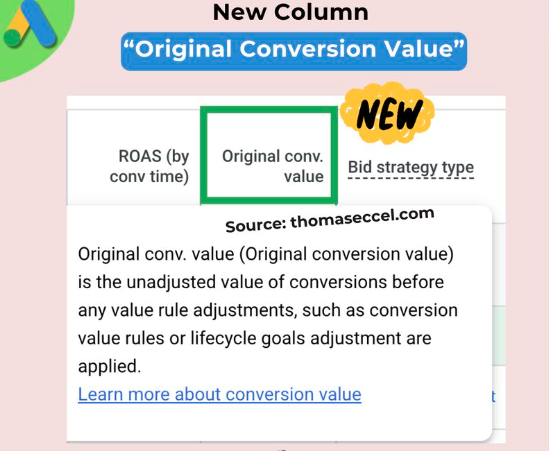
    I’ve discovered something exciting in the realm of Google Ads—a new metric called “Original Conversion Value.” It’s quietly revolutionizing how advertisers, like myself, can gauge the real, unaltered revenue our campaigns produce.

    Imagine seeing a new column, “Original Conversion Value,” in your Google Ads dashboard. This update gives us the chance to finally assess the true, unadjusted value of our conversions, cutting through all the noise.

    How it works. Google’s approach is refreshingly straightforward:

    Conversion Value
    – Rule Adjustments (value rules)
    – Lifecycle Goal Adjustments (e.g., NCA bonuses)
    = Original Conversion Value
    

    Why we care. For years, I’ve struggled alongside fellow marketers to extract genuine conversion values from the maze of Google’s adjustments—from Conversion Value Rules to Lifecycle Goals like New Customer Acquisition. This new metric simplifies the task of diagnosing performance, comparing data across campaigns, and identifying when automated bidding is inflating value rather than actual conversions.

    In essence, it provides clearer insights, a more precise ROAS, and greater confidence in decision-making.

    ```json
{
  "alt": "Overview of the new 'Original Conversion Value' column added to a table, highlighting its introduction and functionality.",
  "caption": "Discover the newly introduced 'Original Conversion Value' column that provides unadjusted conversion values, enhancing your data insights.",
  "description": "This image highlights the introduction of the 'Original Conversion Value' column in a data table setup, as announced by thomaseccel.com. It's pivotal for displaying the unadjusted conversion values without any applied rules or adjustments. The feature aims at improving data transparency and understanding within conversion metrics."
}
```

    Between the lines:

    • Value adjustments assist in navigating Smart Bidding.
    • However, they can inflate figures, complicating reports and performance assessments.
    • Many agencies and in-house teams have long requested a purer perspective from Google.

    What’s next. I anticipate “Original Conversion Value” will quickly become invaluable for:

    • Revenue reporting
    • Post-campaign analysis
    • Diagnosing inflated ROAS
    • Auditing automated bidding strategies

    First seen. The innovative update was first noticed by Google Ads Specialist Thomas Eccel, who shared his find on LinkedIn.

    The bottom line. This update, albeit small, brings significant clarity. Google Ads is, at last, offering us a more transparent lens into the actual value our advertisements bring.


    Inspired by this post on Search Engine Land.


    crushpress.ai community screenshot
  • Unveiling Gemini 3: Google’s Next AI Leap in Search

    Unveiling Gemini 3: Google’s Next AI Leap in Search

    I’m excited to share that Google has just introduced its latest AI marvel, Gemini 3. Sundar Pichai, Google’s CEO, described it as ‘our most intelligent model, combining all of Gemini’s capabilities to bring any idea to life.’

    As I delve into Gemini 3, I find it fascinating that it’s already powering the AI Mode in Search, bringing more complex reasoning and dynamic experiences right at our fingertips. Sundar Pichai highlighted, ‘This is the first time we are shipping Gemini in Search on day one.’

    AI Mode with Gemini 3. I’m thrilled to see how AI Mode in Search has evolved with Gemini 3, offering new generative UI experiences like immersive visual layouts and interactive simulations, all dynamically created based on our queries.

    Here’s a video demonstration showing how RNA polymerase functions with generative UI in AI Mode in Search. Watching it helped me better grasp these complex concepts.

    Robby Stein, VP of Product at Google Search, emphasizes how ‘Gemini 3 with generative layouts will make it easy to understand anything on your mind.’ It offers state-of-the-art reasoning, deep multimodal insights, and advanced agentic capabilities, making it shine in explaining advanced concepts or even coding interactive visuals instantly.

    More on Gemini 3. Diving deeper, I discovered that Gemini 3 features:

    • State-of-the-art reasoning
    • Deep multimodal understanding
    • Powerful vibe coding for seamless transitions from prompts to apps
    • Enhanced agentic capabilities for executing tasks efficiently

    Availability. I’m pleased to report that Gemini 3 is not just limited to AI Mode; it’s also accessible in:

    • The Gemini app and for Google AI Pro and Ultra subscribers in AI Mode in Search
    • Developers can integrate it via the Gemini API in AI Studio, on Google’s new agentic development platform, Google Antigravity; and through Gemini CLI
    • Enterprises can leverage its power through Vertex AI and Gemini Enterprise

    Why It Matters. For me, understanding Gemini 3’s impact is crucial as it continues to drive the future of Google Search. Staying ahead of these advancements is vital as they influence search dynamics and potentially impact sites and Google Ads strategies.


    Inspired by this post on Search Engine Land.


    crushpress.ai community screenshot