Category: News

  • Google Ads Enhances Accuracy with AI: 99% Appeal Success

    Google Ads Enhances Accuracy with AI: 99% Appeal Success

    I recently discovered that Google Ads has significantly improved its accuracy in handling advertiser account suspensions, thanks to the integration of Gemini AI. This fascinating technology has reduced incorrect suspensions by over 80%, and now 99% of appeals are resolved within just 24 hours.

    For many of us who rely on Google Ads to connect with our audience and drive revenue, the frustration of mistaken account suspensions has been a major concern. It’s reassuring to see such a substantial reduction in errors.

    By the numbers:

    • Incorrect account suspensions are down over 80%.
    • Suspension appeals are being processed 70% faster.
    • 99% of appeals are resolved within 24 hours.

    Why this matters to us. We depend heavily on uninterrupted access to Google Ads to reach our customers and keep our businesses thriving. Erroneous suspensions can seriously disrupt our campaigns and overall operations, particularly for smaller advertisers like myself.

    How did Google achieve this?

    • They clarified policy language to make compliance straightforward.
    • They enhanced detection systems using Google’s Gemini AI to minimize false positives.
    • They improved internal review and appeals processes to expedite the reinstatement of legitimate advertisers.

    The bigger picture. Google Ads manages millions of accounts worldwide and constantly contends with threats from scammers and policy violators. Successfully balancing stringent enforcement with fairness remains a top priority—a goal Google is closer to achieving with these AI enhancements.

    Want to learn more? Check out the Statement from Google Ads Liaison Ginny Marvin for an in-depth look.


    Inspired by this post on Search Engine Land.
  • Google’s PMax Innovations: Integrating Twitter Videos in Ad Campaigns

    Google’s PMax Innovations: Integrating Twitter Videos in Ad Campaigns

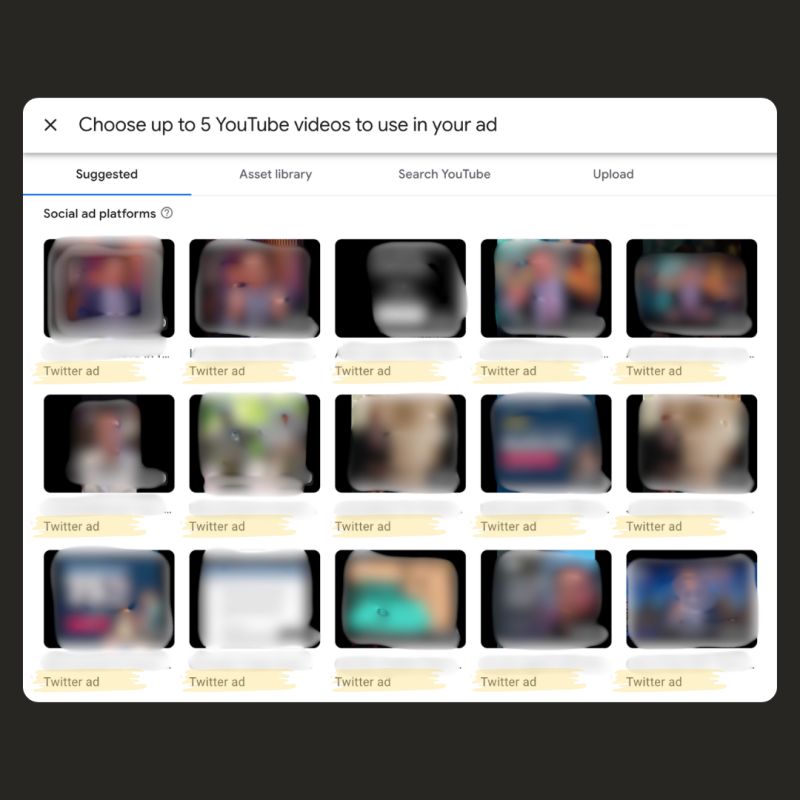
    When setting up my Performance Max (PMax) campaigns in Google Ads, I recently noticed something intriguing. Video assets from my Twitter (X) ad campaigns were popping up in the “Suggested” creatives section.

    How it works:

    The videos I found were seamlessly uploaded to a YouTube channel linked to my advertiser’s account.

    A transparency message revealed the source of the data: “Videos from other ad platforms are sourced by third-party provider @Pathmatics (by Sensor Tower).”

    Google prompts us to ensure we have the legal rights to use and distribute these videos through Google Ads.

    ```json
{
  "alt": "Interface for selecting YouTube videos for social media ads, showing blurred video thumbnails.",
  "caption": "Explore potential YouTube videos for your next social media ad. Choose wisely from a variety of suggested options.",
  "description": "This image displays a user interface for selecting YouTube videos to be used in social media advertisements. The page shows several blurred video thumbnails labeled as 'Twitter ad,' suggesting options for integrating video content into promotional campaigns. The interface includes tabs like 'Suggested,' 'Asset library,' 'Search YouTube,' and 'Upload' for user navigation, emphasizing a user-friendly approach to ad creation. Keywords: YouTube, social media ads, video selection, advertising platform."
}
```
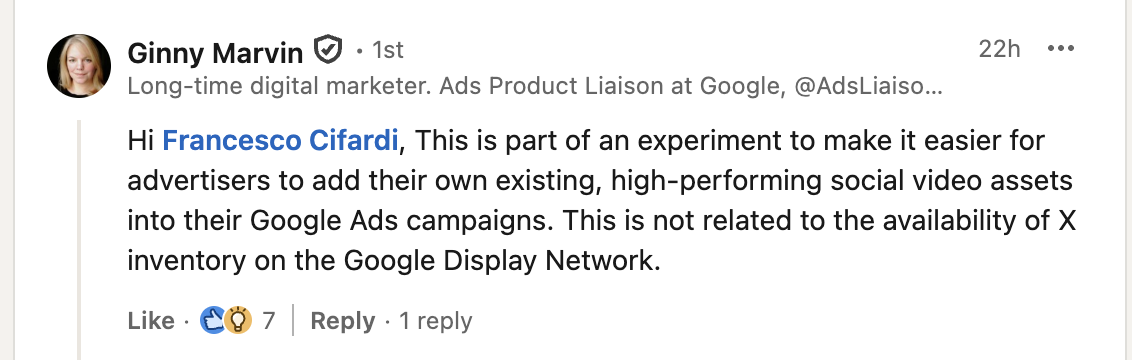
    What Google says: Google Ads Liaison, Ginny Marvin, has confirmed this feature is an experimental effort aimed at enabling advertisers like myself to easily incorporate our top-performing social video assets into Google Ads campaigns.

    She clarified that this isn’t related to X (Twitter) ad inventory being made available on the Google Display Network.

    Why we care. This experiment indicates Google Ads’ progress toward autonomously integrating assets across platforms. This could significantly decrease the time spent by reusing effective social campaign creatives. However, it does bring up concerns regarding data permissions, creative control, and transparency. These are aspects I’ll definitely be scrutinizing as automation in marketing deepens.

    Between the lines:
    ```json
{
  "alt": "Screenshot of a LinkedIn post by a Google Ads liaison discussing an experiment for social video assets in Google Ads.",
  "caption": "Discover the latest experiment from Google's Ads team, aimed at integrating high-performing social video assets into Google Ads campaigns.",
  "description": "This image is a LinkedIn post from a Google Ads Product Liaison. It discusses an experimental feature allowing advertisers to integrate existing social video content into their Google Ads campaigns. The post emphasizes that this feature does not affect the availability of X inventory on the Google Display Network. Relevant keywords include Google Ads, social video assets, and online advertising."
}
```

    This integration exemplifies Google’s increasing dependence on automation and partnerships to reduce creative barriers in PMax.

    Involvement of Pathmatics points to the use of third-party intelligence in surfacing social ad assets, which raises new questions about data sourcing and control for advertisers like myself.

    First seen. This update was first noticed by Performance Marketing Consultant Francesco Cifardi on LinkedIn.

    The bottom line. Although this feature is still experimental, it showcases Google’s aspiration to make PMax not only automated but also highly asset-aware across various platforms.


    Inspired by this post on Search Engine Land.
  • AI Traffic Insights: ChatGPT Leads, SEO Still Rules

    AI Traffic Insights: ChatGPT Leads, SEO Still Rules

    I recently came across a fascinating report on AI referral traffic that’s shaking things up in the digital world. According to Conductor’s AI search benchmark report, AI-generated traffic currently makes up just over 1% of website visits across ten major industries.

    AI referral traffic: It’s intriguing to see that 1.08% of all web traffic originates from AI. Among this, ChatGPT is a dominant force, accounting for 87.4% of AI referrals. Leading industries include IT with 2.8% and Consumer Staples at 1.9%, while Communication Services and Utilities are seeing the lowest shares, at 0.25% and 0.35%, respectively.

    AI answer engine market share: ChatGPT is at the helm, followed by Perplexity. Interestingly, the impact varies across industries. For instance, Gemini is responsible for 21% of AI traffic in Utilities, whereas Copilot contributes 5% in Financials.

    AI vs. traditional traffic: Despite the rise of AI, traditional organic search still reigns supreme. Industries like Health Care (42.4%), Communication Services (39.6%), and Industrials (33.8%) lead in organic search shares.

    Why we care: While organic search remains a heavyweight, AI is emerging as a powerful channel. If a brand isn’t appearing in AI answers, it risks being invisible to its audience. While SEO strategies overlap with AI and other platforms like ChatGPT, being a Google ranking champion doesn’t guarantee AI visibility.

    The brands AI cites most: Across 17 million AI responses, AI prefers different brands compared to Google. Giants like Amazon and Walmart top the list for consumer queries. In health and finance (YMYL categories), reputable sources like Mayo Clinic and NerdWallet are often cited. Meanwhile, industry stalwarts like Google and Microsoft lead in tech and B2B queries.

    AI Overviews benchmarks: From an analysis of 21.9 million Google searches, 25.11% triggered AI Overviews, with categories like Health Care and Financials in the lead. The preferred content types cited are blogs, videos, and articles among others.

    About the data: The comprehensive report analyzed 13,770 domains, over 3.3 billion sessions, and millions of AI interactions, offering a snapshot of the growing AI impact from May to September 2025.

    The report: For a detailed analysis, I recommend checking out The 2026 AEO / GEO Benchmarks Report.


    Inspired by this post on Search Engine Land.

  • Unlock Holiday Shopping with Google’s New AI Features

    Unlock Holiday Shopping with Google’s New AI Features

    As the holiday season approaches, I’m thrilled to share that Google has rolled out a range of exciting AI-powered shopping features. Just recently, Google announced this major update, perfectly timed for our holiday shopping adventures.

    What’s new with AI Mode? Picture this: you can now describe what you need as if you’re chatting with a friend! Google’s AI Mode organizes all the essentials—images, prices, reviews, and inventory—helping you decide confidently and quickly on your next purchase.

    In my Gemini App experience, it has become my go-to for brainstorming gift ideas. It effortlessly compares products and supplies answers with handy shoppable links, all within a chat.

    Are you too busy to check store stock levels? I now let Google’s agentic calling feature make those calls for me, ensuring I know about any promos or stock availability without lifting a finger.

    And here’s something I absolutely love: tracking prices with agentic AI. Whenever an item I’ve been eyeing drops in price at eligible U.S. merchants, I receive a notification. I can let Google purchase it securely using Google Pay, all within my budget!

    Why does this matter? The bustling holiday season is critical for many businesses. With these innovative AI features, I hope to see more traffic and revenue driving local stores rather than distracting buyers from making purchases.

    I’m curious to see how these tools impact our shopping experiences, and I encourage everyone to explore these features to see where your website ranks.


    Inspired by this post on Search Engine Land.

  • EU Investigates Google for Site Reputation Abuse Allegations

    EU Investigates Google for Site Reputation Abuse Allegations

    I’ve been following the news closely, and it seems the EU is setting its sights on Google. The buzz is about a new investigation concerning Google’s approach to penalizing publishers that use sponsored content. For many media outlets, this type of content is crucial for revenue.

    Google’s parent company, Alphabet, is preparing for what could be a significant EU scrutiny. The allegations suggest Google demotes news publishers in search results if they run promotional or sponsored content, a key revenue stream for these publishers.

    What’s Happening: The European Commission, the EU’s leading authority on antitrust regulation, is gearing up to announce this probe. We might hear something as soon as Thursday.

    The case is filed under the Digital Markets Act (DMA). This legislation aims to prevent tech giants, known as “gatekeepers,” from unfairly prioritizing their own services or disadvantaging others.

    Companies breaching these rules could be fined up to 10% of their global revenue, which is a hefty amount.

    Site Reputation Abuse: Google’s actions against these publishers spring from a spam policy first introduced in March 2024, and then refreshed in November 2024.

    This policy targets “site reputation abuse” or what we in the SEO world might know as parasite SEO. Essentially, it’s when third parties use trusted sites to post low-quality content to game Google rankings.

    Google argues that such content can mislead users and has actively taken measures against sites hosting these dubious materials.

    The policy was later amended to clarify that even content overseen by the original site can still breach the rules if it mainly aims to exploit a site’s ranking signals.

    The Report: If you’re interested in digging deeper, you might want to check out the detailed coverage at EU readies fresh investigation into Google over news publisher rankings (registration required).


    Inspired by this post on Search Engine Land.
  • Google Tackles AI Spam in Discover Feed: A Promised Fix

    Google Tackles AI Spam in Discover Feed: A Promised Fix

    After hearing numerous complaints about the quality of Google Discover, I’m interested to see how Google plans to tackle the issue of fake AI spam. They’ve assured us that a solution is in progress.

    I’m aware that Google is taking steps to remedy the situation with its Discover feed, especially with the appearance of fake AI spam in recent weeks. Google confirmed to the Press Gazette, which has reported several instances of this spam infiltration, that a fix is actively being developed.

    Google’s Assurance. In their words:

    “We keep the vast majority of spam out of Discover through robust spam-fighting systems and clear policies against new and emerging forms of low quality, manipulative content. We’re actively working on a fix that will better address the specific type of spam that’s being referenced here, maintaining our high bar for quality in Discover.”

    The AI Spam Issue. From what I’ve read, the Press Gazette has meticulously documented instances where fake news stories have garnered tens of millions of views on the Google Discover platform in just a week. Here’s a glimpse of some of these fake stories as reported:

    ```json
{
  "alt": "Collage of news headlines about UK pension and bank rule changes in 2025.",
  "caption": "Explore upcoming UK changes in pension, bank, and driving rules set for 2025. Stay informed on how these regulations might impact you.",
  "description": "A collage featuring various news headlines about upcoming UK regulatory changes in 2025. Headlines cover a range of topics including new pension rules, bank regulations for pensioners, and stricter driving test checks for elderly drivers. Reports highlight the Department for Work and Pensions (DWP) and HMRC as key institutions involved. With a mix of formal and urgent tones, these articles inform the public about significant financial and legal updates. Keywords include pension rules, DWP, UK driving rules, and HMRC."
}
```

    It’s fascinating how spammers are allegedly buying expired domains with previously trusted reputations, exploiting their domain authority to flood Google Discover with spam content. This tactic isn’t novel, and while Google Search generally manages these tricks well, many believe this is currently how spammers manipulate the Discover feed.

    French data journalist Jean-Marc Manach has been tracking this issue, building a comprehensive database of fake sites generating AI stories. His list now includes over 8,300 entries in French, 300 in English, and 150 in German.

    Why It Matters to Me. As someone who values relevant and trustworthy content, I understand the potential impact of Google Discover’s reach. These fake sites can momentarily generate significant revenue, only to be shut down, after which others rise in their place. It’s a cycle that Google is inevitably working to break, though new challenges will likely emerge.


    Inspired by this post on Search Engine Land.
  • Revolutionize Your Marketing: Google’s New AI-Powered Advisors

    Revolutionize Your Marketing: Google’s New AI-Powered Advisors

    I’ve always been intrigued by how technology can simplify complex tasks, and Google’s recent launch of AI-powered Ads and Analytics Advisors does just that. Acting as a personal assistant for advertisers, these tools offer a speedy way to analyze data, optimize campaigns, and immediately turn insights into action.

    Google is introducing two innovative AI-powered assistants—Ads Advisor and Analytics Advisor—built on their latest Gemini models. These assistants are designed to manage campaigns more efficiently and uncover insights faster.

    Starting early December, English-language Google Ads and Google Analytics accounts will have access to these tools. They transform complex data and campaign management into simple, user-friendly experiences.

    Ads Advisor: Optimization and Automation. This tool serves as your in-platform AI partner, offering support in managing, troubleshooting, and scaling campaigns. It evolves with user interaction, providing more tailored guidance over time. Key features include:

    • Performance optimization: Receive customized recommendations for Performance Max and Search campaigns that can be directly applied, like adding sitelink extensions or adjusting for seasonal events.
    • Creative generation: Get suggestions for new keywords, assets, and ad copy based on existing website and campaign data to keep your content fresh.
    • Performance diagnostics: Ask questions like “Why did my campaign performance drop?” and get pinpointed solutions and causes.
    • Policy troubleshooting: It spotlights ad disapprovals, offering explanations and sometimes implementing policy fixes directly.

    Analytics Advisor: Instant Insights. Bringing conversational AI into Google Analytics, Analytics Advisor acts as your tireless analyst, interpreting performance data and suggesting actionable next steps.

    • Fast, comprehensive insights: Quickly answer questions like “How is my site performing?” with dynamic visualizations and summaries.
    • Root cause analysis: Discover why there’s a spike or drop in traffic by understanding the key drivers relevant to your business.
    • Actionable recommendations: Use data-backed strategies to re-engage high-value users and capitalize on trends.

    Why we care. These AI advisors significantly streamline campaign management and optimization. Instead of sifting through reports and guessing at issues, I can now ask direct questions and receive data-driven solutions within seconds.

    The tools diagnose problems and suggest, or even apply, fixes, which helps improve performance, saves time, and turns data into immediate action.

    Between the lines. With Gemini-powered assistants embedded directly into Google Ads and Analytics, Google is advancing towards Agentic AI—tools that independently identify, explain, and execute improvements across the advertising landscape. This shift allows me to spend less time on data analysis and more on strategic actions.

    The bottom line. Google’s new Ads and Analytics Advisors turn campaign optimization and performance analysis into a conversation, revolutionizing how I can plan, measure, and make real-time decisions.


    Inspired by this post on Search Engine Land.
  • Mastering Google Ads: Custom Segments for Targeted Reach

    Mastering Google Ads: Custom Segments for Targeted Reach

    Have you ever felt puzzled by audience targeting in Google Ads? You’re not alone. I’ve often struggled with it too, particularly when it comes to custom segments. Yet, when understood correctly, these custom segments can become a powerful tool in our advertising arsenal.

    Custom segments allow me to craft audiences using Google’s vast data pool. It’s like taking audience targeting to the next level by making it personal and tailored to individual user behaviors.

    So, what exactly is a custom segment in Google Ads? Simply put, it lets us create an audience based on recent user interactions with content. Instead of targeting a generic website category, I’m aiming directly at users who have shown interest in specific topics, like running shoes, for instance.

    I see content targeting transforming into a more focused audience targeting. It’s exciting and effective.

    Building a custom segment is straightforward. From Audience Manager, I name my segment and choose up to four input types: interests, search terms, websites, and apps. This flexibility allows me to strategically target exactly who I want.

    If I’m using multiple inputs, I prefer creating multiple custom segments. This way, I can track which segment performs better – whether it’s search terms or websites.

    In my experience, search term-based custom segments often yield the best results. They specifically reach users who have searched for related terms, functioning much like Exact Match close variants.

    Starting with search terms, I dive into Search, Shopping, or PMax campaigns to extract my top non-branded search terms. I use these to shape a new custom segment, ensuring to target people who searched for these terms on Google.

    When applying this segment to a Demand Gen campaign, it’s crucial to stick to Google-owned networks like YouTube, Discover, Gmail, and Maps, where Google accurately knows user search behaviors.

    This strategy shines because it targets the same audience from Search or Shopping at a drastically reduced cost, often around 95% less per click!

    For website and app-focused segments, I focus on people who visit similar sites or use similar apps rather than exact ones. It’s a subtle but important tactic in my overall strategy.

    Despite the various names for custom segments across different campaign types, their versatility makes them invaluable in my Google Ads strategy. They offer a seamless entry into advanced audience targeting beyond traditional search methods.

    This article is part of an ongoing Search Engine Land series, designed to help you grasp key Google Ads features in just 3 minutes.


    Inspired by this post on Search Engine Land.

  • Unlocking Success: Easier and Faster Google Ad Tests

    Unlocking Success: Easier and Faster Google Ad Tests

    Have you ever wondered about the true impact of your ads? Google is now making it easier and more affordable to find out with their updated incrementality testing. This means I can measure and prove the real influence of my advertising efforts without breaking the bank.

    Google’s recent updates make incrementality testing accessible for all advertisers, regardless of budget. By significantly reducing the minimum spend from $100,000 to a mere $5,000, I’ve found it easier to gauge ROI with scientifically precise methods. Now, I can conduct controlled experiments to pinpoint exactly what’s driving my campaigns.

    I’m thrilled to learn that Google’s enhanced their incrementality testing with new statistical models, providing results that are up to 50% more conclusive. This improvement offers me clearer insights, reducing the uncertainty that could delay my decision-making process.

    The ability to receive faster insights and make swift actions is invaluable. Google’s updates let me customize experiment designs and view results directly, which means I can adapt my strategies more quickly, even if changes in performance are minimal.

    Incrementality testing is now part of a comprehensive measurement platform that includes Marketing Mix Models (MMMs) and Attribution. Together, these elements allow me to get a holistic view of my campaigns:

    • MMMs highlight the larger picture across various channels.
    • Incrementality focuses on the direct impact of specific campaigns.
    • Attribution links touchpoints to actual outcomes.

    When used together, these tools provide me with a robust strategy for measuring what really contributes to growth.

    Why is this important to me? As marketers like myself face increasing pressure to justify advertisement spending, Google’s updates provide a level playing field for smaller budgets to effectively measure and link ad investments directly to revenue growth.

    In conclusion, with reduced costs, superior data, and quicker reporting, Google’s incrementality updates have empowered me as an advertiser to verify what works, optimize my ad spend, and enhance confidence in my marketing ROI.


    Inspired by this post on Search Engine Land.

  • Unveiling Google Shopping’s New Brand Control Features

    Unveiling Google Shopping’s New Brand Control Features

    I’ve recently discovered that Google has quietly enhanced their Shopping campaigns by introducing brand inclusion controls. This long-awaited feature offers us advertisers unparalleled control over the brands that appear in our shopping ads without needing complex workarounds.

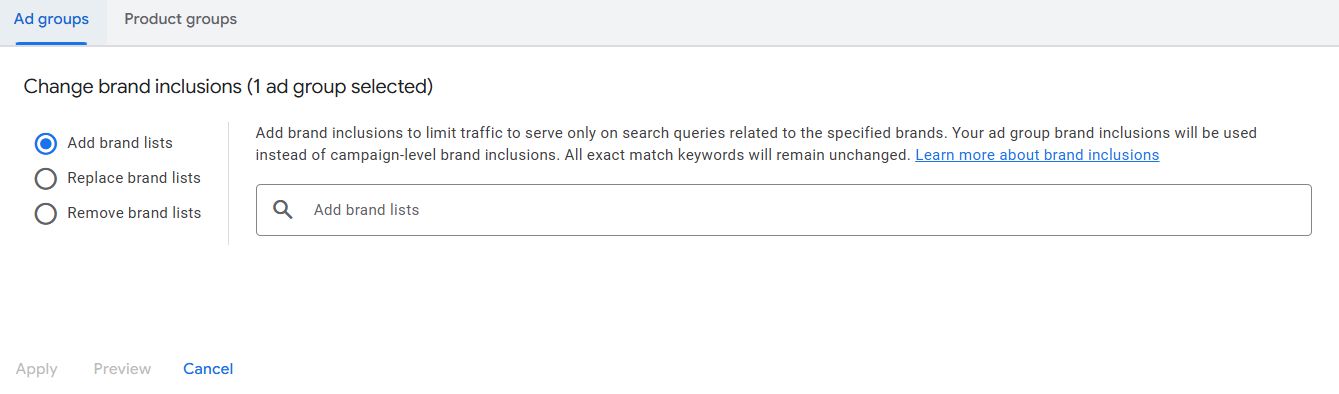
    How it works: Now, I can easily add or remove brand lists directly within the ad group targeting section of both Performance Max and Standard Shopping campaigns. This means I can specify exactly which brands to showcase or exclude, preview my setup, and apply changes seamlessly within the Google Ads interface.

    Why we care. Previously, brand targeting tools were only available in Performance Max and AI Max, leaving those of us using Standard Shopping campaigns to juggle search query scripts or set up intricate campaigns to manage brand visibility. This update changes that, finally giving us direct control over brand appearances.

    I find it eliminates the need for cumbersome scripts or overly complex campaign setups, simplifying brand visibility management. This improvement allows me to protect my budgets and target high-value brand traffic more precisely — a significant win for our advertising efficiency and control.

    ```json
{
  "alt": "Interface for changing brand inclusions in an ad group with options to add, replace, or remove brand lists.",
  "caption": "Streamline your ad targeting with efficient brand inclusion settings. Adjust your preferences to specifically tailor brand engagements.",
  "description": "This image shows a user interface where users can change brand inclusions for a selected ad group. Options are available to add, replace, or remove brand lists, with a search bar provided for ease of adding brands. This tool helps in refining ad targeting by including specific brand-related search queries, enhancing marketing efficiency. Keywords: brand inclusions, ad group, digital marketing, targeted advertising."
}
```

    Between the lines. For those of us in retail and ecommerce, this update is a game-changer in Shopping campaign management. It enables us to safeguard brand-specific budgets, control exposure within competitive categories, and avoid wasting money on unwanted brand traffic — all done conveniently within Google Ads.

    First seen. The update was initially noticed by Ryan Parks, Senior Search Director at Spark Foundry, who shared this valuable information on LinkedIn.

    The bottom line. With these brand inclusion features now accessible for Standard Shopping campaigns, we gain the same level of control and efficiency as Google’s automated campaign types offer. It’s a quietly powerful upgrade that will undoubtedly enhance precision in retail advertising.


    Inspired by this post on Search Engine Land.