Category: News

  • Google Ads API Update: Secure Your Conversion Tracking Now

    Google Ads API Update: Secure Your Conversion Tracking Now

    When I first heard about Google’s upcoming changes to the Ads API, I realized this could be a game-changer for many advertisers. Starting February 2nd, the Google Ads API will stop accepting new users of session attributes or IP address data in conversion imports. If you’re like me, and already using these fields, you might wonder what this means for your current set-up.

    This shift marks Google’s efforts to guide us all toward the Data Manager API, which they aim to make the primary hub for complex conversion and user data transfer. It’s becoming clear that the Google Ads API is honing its focus on core functions like campaign management and conversion workflows, leaving the heavy lifting to the Data Manager API.

    Here’s why this change matters to us: it directly influences whether our conversions are effectively captured. Blocking session attributes or IP data can cripple our conversion tracking and reporting, affecting performance insights and automated bidding strategies. Transitioning to the Data Manager API secures our data flow, ensures richer data signals, and aligns with Google’s long-term vision for measurement infrastructure.

    Who needs to act? If you’re a new developer trying to use session attributes or IP addresses with the Ads API, you’ll be blocked from doing so. For those of us already on this path, our operations continue, but the expectation to migrate is loud and clear, underscored by Google’s developer-token allowlisting requirements.

    What happens if we don’t transpose our setup? Post-change, some conversion imports will hit a roadblock with a CUSTOMER_NOT_ALLOWLISTED_FOR_THIS_FEATURE error, indicating rejection due to session attributes or IP address inclusions.

    To fix this, we need to promptly update our systems: temporarily exclude session attributes and IP data from Ads API imports, reroute this information through the Data Manager API, and ultimately phase out Ads API conversion imports once our new setup is fully integrated.

    The bottom line for those of us using the existing system is that while Google isn’t snipping the cord immediately, the roadmap is clear: if our tracking relies on session attributes or IP data, embracing the Data Manager API isn’t just advisable, it’s imperative.

    If you, like me, want to learn more, check out Google’s detailed update on this transition: Changes to IP Address and Session Attribute Support in the Google Ads API.


    Inspired by this post on Search Engine Land.


    crushpress.ai community screenshot
  • John Mueller: Master User Behavior for SEO & GEO Success

    John Mueller: Master User Behavior for SEO & GEO Success

    When I came across Google Search Advocate John Mueller’s response to a Reddit user’s query about SEO’s relevancy in the age of AI, I found it incredibly enlightening. The question was whether traditional SEO is still sufficient or if there’s a need to pivot towards generative engine optimization (GEO).

    His advice was strikingly straightforward: the labels we use are less significant than the reality we face.

    “If you have an online business that thrives on referred traffic, it’s essential to see the bigger picture and prioritize your strategies accordingly. The name you give it isn’t critical, but AI isn’t disappearing anytime soon,” Mueller emphasized.

    While Mueller didn’t delve into whether GEO will become its own field, he made it clear that AI’s presence is a constant we need to accept.

    Google remains skeptical about treating AI optimization as separate from traditional SEO, as seen in several instances:

    I realized that it’s crucial to ignore the surrounding buzz and focus on how our audience truly behaves. Mueller’s recommendation was to examine practical data, like:

    • How many of our audience members are using AI tools?
    • How does AI usage compare to search engines, social platforms, or other traffic sources?
    • What implications does this have for allocating our time and resources?

    The takeaway for me is that while SEO continues to be a significant traffic and revenue driver, it doesn’t guarantee AI visibility. We need to remember that not all SEO practices align with GEO.

    To quote Mueller from his Reddit comment:

    • “If you have an online business that makes money from referred traffic, it’s definitely a good idea to consider the full picture, and prioritize accordingly. What you call it doesn’t matter, but ‘AI’ is not going away, but thinking about how your site’s value works in a world where ‘AI’ is available is worth the time. Also, be realistic and look at actual usage metrics and understand your audience (what % is using ‘AI’? what % is using Facebook? what does it mean for where you spend your time?).”

    If you’re interested, you can check out the complete Reddit discussion here.


    Inspired by this post on Search Engine Land.


    crushpress.ai community screenshot
  • Discover Microsoft’s Revolutionary Copilot Checkout & Brand Agents

    Discover Microsoft’s Revolutionary Copilot Checkout & Brand Agents

    At the NRF 2026 Conference, I had the opportunity to see Microsoft’s latest innovations firsthand: the Copilot Checkout and Brand Agents features.

    Seeing Microsoft roll out its first agentic experiences within Copilot feels like stepping into the future. With Copilot Checkout, I can now shop seamlessly without leaving the conversation, making it easier to switch from browsing to buying.

    What’s more intriguing is the introduction of Brand Agents for Shopify sites. Imagine having an AI chat that’s trained on your product catalog, offering personalized shopping experiences that echo your brand’s unique voice. It’s a smart solution for fast and scalable implementation.

    Copilot Checkout. I’m excited to share that Copilot Checkout is starting its U.S. rollout on Copilot.com. This feature allows conversational purchases directly within your current chat and integrates with partners such as PayPal, Shopify, Stripe, and Etsy.

    For Shopify merchants, enrollment in Copilot Checkout is automatic, though opting out is possible. Non-Shopify merchants interested in joining can apply through a dedicated form.

    Check out a glimpse of how it works:

    Brand Agents. Now available for Shopify merchants, Brand Agents bring your brand’s voice into every interaction online. I was impressed to see how it leverages a brand’s product catalog to provide crystal-clear answers to product-specific inquiries.

    ```json
{
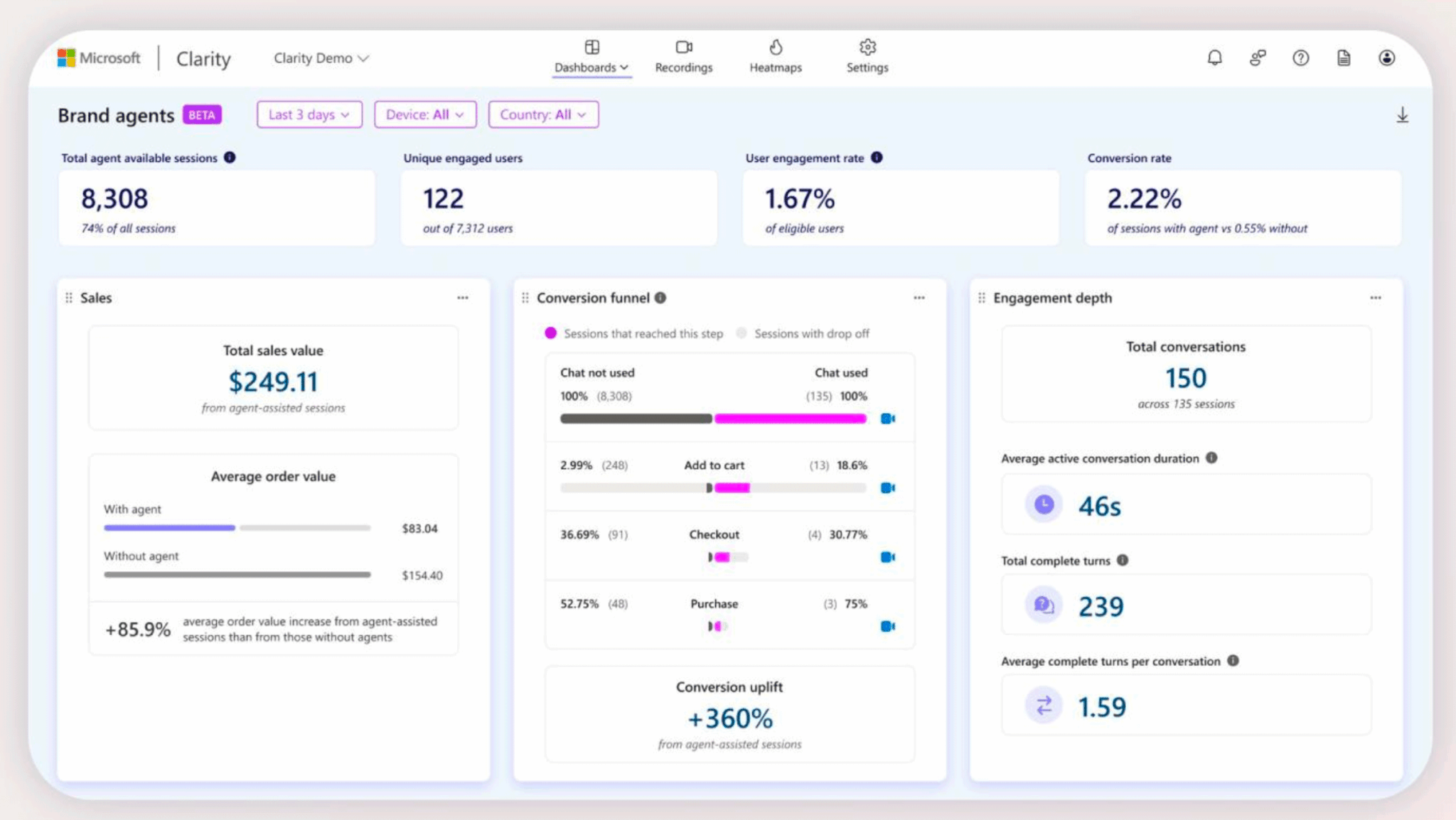
  "alt": "Microsoft Clarity dashboard displaying brand agents analytics with statistics on user engagement and sales conversion.",
  "caption": "Dive into detailed analytics with Microsoft Clarity's dashboard, showcasing insightful stats on brand agent engagement and sales conversion metrics.",
  "description": "The Microsoft Clarity dashboard image provides a detailed view of brand agents analytics, featuring data on total agent sessions, unique users, and engagement rates. It highlights sales metrics such as total sales value of $249.11 from agent-assisted sessions and an 85.9% increase in average order value. The conversion funnel outlines steps from 'Chat not used' to 'Purchase' with significant percentage uplifts. The engagement depth section covers total conversations, active conversation duration, and complete turns, offering a comprehensive overview for business insights."
}
```

    The AI speaks in your brand’s voice, seamlessly guiding customers from browsing to purchasing, and can be set up in just a few hours. Microsoft shared with me that sessions assisted by Brand Agents show higher engagement and conversion rates.

    Here’s a video showcasing Brand Agents in action:

    Brand Agents insights. Microsoft is innovatively using Microsoft Clarity to provide insights into Brand Agents conversations, helping merchants understand and optimize performance.

    Once I activated Brand Agents, I found myself equipped with additional insights to compare and optimize agent-assisted sessions against organic traffic, reinforcing my growth strategies.

    Here is where you can view these insights:

    Google and OpenAI. It’s fascinating to see how Google and OpenAI are also embracing agentic experiences. Google has introduced agentic checkout, whereas OpenAI announced its Instant Checkout in ChatGPT. Together, these developments mark a significant industry shift towards direct purchasing through AI experiences.


    Inspired by this post on Search Engine Land.


    crushpress.ai community screenshot
  • Revolutionizing Vehicle Ads: Google’s New Click-to-Call Feature

    Revolutionizing Vehicle Ads: Google’s New Click-to-Call Feature

    I recently discovered that Google is enhancing Vehicle Ads with a click-to-call feature. This update gives potential car buyers a direct and seamless way to connect with dealers, turning search behavior into swift, live conversations.

    CPC inflation: How fast are Google Ads costs rising?

    Why does this matter? Vehicle Ads typically attract buyers who are already showing a strong intent to purchase. Removing obstacles with the new click-to-call feature meets shoppers at the precise moment they’re ready to engage with a dealership.

    The big picture reveals a shift in automotive advertising towards instant human interaction. Buyers are more interested in real-time conversations rather than filling out additional forms. With call-enabled Vehicle Ads, connecting search to dialogue has never been easier.

    ```json
{
  "alt": "Vehicle ads with call extension feature, showcasing Porsche Panamera models for sale from different sellers.",
  "caption": "Discover the new call extension feature in vehicle ads, allowing instant contact with sellers. Explore Porsche Panamera offers now!",
  "description": "This image displays vehicle ads with a new call extension feature, highlighting Porsche Panamera models for sale. Each card shows the car's price, mileage, and seller details with a call icon for direct contact. This enhancement aims to improve user interaction and facilitate inquiries. Keywords: vehicle ads, Porsche Panamera, call extension, direct contact."
}
```

    In this evolving landscape, advertisers now bear a greater responsibility. Since the ad itself has become a conversion point, the quality of call handling, as well as staffing levels, can greatly affect performance. Dealers who prioritize phone interactions as a main conversion method will prevail, while those who do not may experience a decline.

    Credit goes to Google Ads specialist Thomas Eccel for spotting this update first and sharing it on LinkedIn.

    The bottom line is simple: Vehicle Ads have not only gained more visibility but have also come closer to facilitating actual sales.


    Inspired by this post on Search Engine Land.

    crushpress.ai community screenshot
  • Google Enhances Tagging with New Cloud Integration

    Google Enhances Tagging with New Cloud Integration

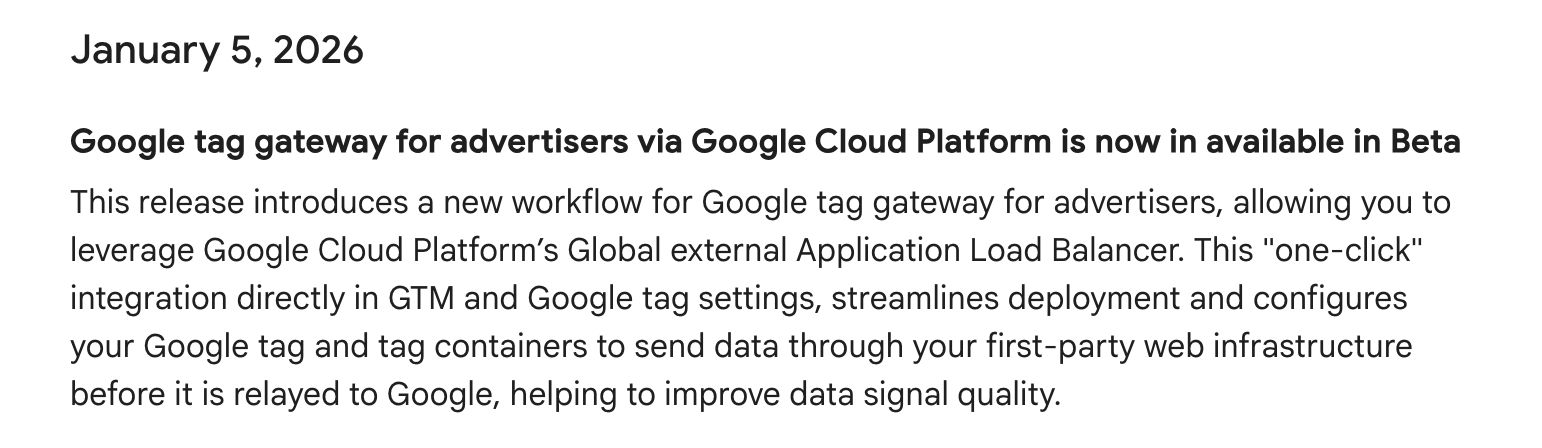
    Google just introduced a beta integration for the Google Tag Gateway, allowing advertisers, like myself, to deploy it effortlessly through the Google Cloud Platform (GCP). The process is now simplified with a new one-click workflow available in Google Tag Manager and Google tag settings.

    What’s really exciting is how the GCP integration leverages Google Cloud’s Global External Application Load Balancer. This tool routes tag traffic through our own first-party domain before sending it off to Google, which enhances the deployment process. This strategic approach not only improves data signal quality but also boosts resilience against ad blockers and features like Apple’s Intelligent Tracking Prevention.

    Why does this matter to us? As third-party tracking faces increasing limitations from browsers and platforms, advertisers like us need reliable ways to protect measurement signals. By directing Google tags through our infrastructure, we can maintain the integrity of our measurement signals against ad blockers and browser privacy constraints.

    For those of us already using Google Cloud, this one-click setup significantly reduces the barriers to achieving more resilient and future-proof tracking.

    What are others saying? Digital marketer and Simmer co-founder Simo Ahava highlighted this advancement on LinkedIn. According to him, the integration facilitates a seamless GCP deployment. It automatically configures an External Application Load Balancer with rules to direct Google Tag Gateway traffic to our backend services handling these requests.

    ```json
{
  "alt": "Google tag gateway for advertisers via Google Cloud Platform beta release announcement with details.",
  "caption": "Discover the new beta release of Google tag gateway, enhancing data signal quality with seamless integration via Google Cloud Platform.",
  "description": "The announcement dated January 5, 2026, introduces the beta release of Google tag gateway for advertisers, leveraging Google Cloud Platform's infrastructure. This feature allows for easy integration with Google Tag Manager settings, optimizing data transmission efficiency via first-party web infrastructure to improve data signal quality."
}
```

    Ahava also noted that Google Tag Gateway positions Google’s tagging infrastructure behind a same-site, same-origin first-party host, ensuring that tags endure in restrictive browser environments.

    The broader perspective here is that previously, Cloudflare was the only automated option for deploying Google Tag Gateway, with other CDNs requiring manual setups. By adding GCP, Google reduces the friction for us advertisers already committed to their cloud ecosystem, thus promoting first-party tagging strategies.

    The bottom line? Google is simplifying first-party tagging deployment, and while the GCP integration is still in its beta stage, it represents a significant stride toward robust measurement solutions in our increasingly privacy-focused digital landscape.


    Inspired by this post on Search Engine Land.


    crushpress.ai community screenshot
  • Consumers Shifting to AI for Faster Searches Over Google

    Consumers Shifting to AI for Faster Searches Over Google

    I recently came across a fascinating study revealing that 37% of consumers are now starting their searches with AI tools instead of Google. The frustration with traditional search methods seems to be steering many of us towards AI, compelling brands to maintain their visibility and credibility across both platforms.

    Personally, I find it intriguing how AI is reshaping the initial stages of search, impacting how we identify and evaluate brands. This hybrid approach begins with an AI-generated answer, followed by traditional search for confirmation. To keep their credibility intact, brands must ensure consistency across both platforms as the emphasis on visibility, trust, and clarity increases.

    According to the study, over a third of consumers—37% to be exact—are kicking off their searches with AI tools over traditional engines. The appeal lies in the promise of a quicker, clearer answer without the need to sift through ads and multiple links. Users described AI as faster, clearer, and less cluttered.

    Many of us are experiencing what could be termed as ‘traditional search fatigue’. The chief grievances include excessive clicking through links (40%), overwhelming ads and sponsored results (37%), and difficulty in getting straightforward answers (33%). The redundancy of information also ranks high in complaints at 28%.

    AI’s trustworthiness is gaining traction, with six out of ten respondents confident about the superiority of AI-generated answers compared to traditional search. However, a significant portion—85%—still cross-checks AI responses.

    Traditional search engines remain favored for product reviews, current news, multimedia, and health information. Interestingly, nearly half of the consumers trust AI to make brand recommendations, reshaping brand discovery by offering concise lists with brand assessments.

    AI’s influence extends to purchasing decisions as noted by the survey, with consumers using AI to decide on purchases (47%), find best prices (57%), compare products (54%), and even get review summaries (48%). While younger audiences lead this adoption, it actually cuts across all categories from daily items to travel and finance.

    Looking ahead to 2026, it’s expected that AI will continue to grow, with 63% of participants anticipating increased AI usage and nearly half expecting AI to handle comprehensive tasks. Yet, there’s still room for AI to improve in terms of fact-checking, transparency, and context personalization.

    The Eight Oh Two survey canvassed 500 active AI users last November, delving into AI’s role in search behaviors, trust levels, and purchasing influences, giving us a window into the evolving dynamics of search landscapes this year and moving forward.

    For more detailed insights, you can explore the 2026 AI and Search Behavior Study.


    Inspired by this post on Search Engine Land.

    crushpress.ai community screenshot
  • Google’s New Multi-Channel Product ID Rule: Prepare for Change

    Google’s New Multi-Channel Product ID Rule: Prepare for Change

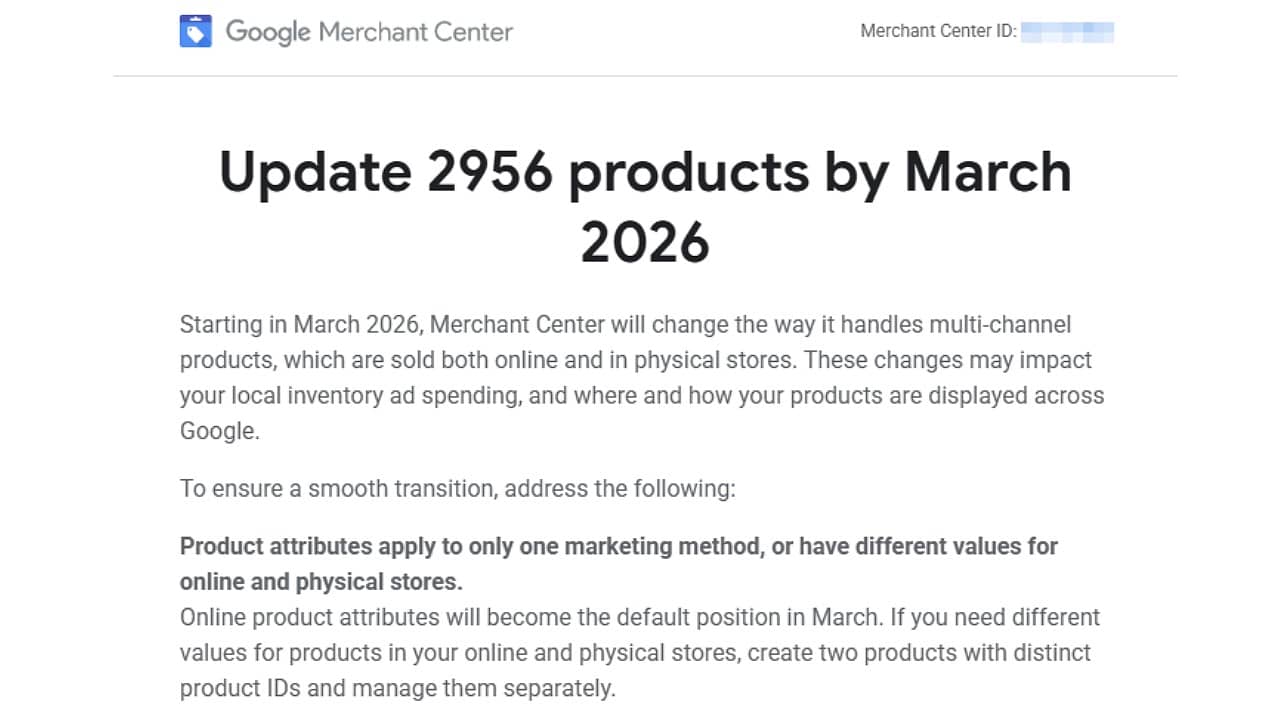
    I recently came across an important update from Google that I believe every retailer should pay attention to. Starting in March 2026, Google Merchant Center will implement a new requirement for multi-channel products, which are those available both online and in stores. This involves using separate product IDs when product details differ by channel.

    Understanding the Changes. So, what’s changing? Essentially, online product attributes will now act as the standard. If there is a variation in the product details for in-store items, such as different pricing or availability, I’ll need to create a separate version with a distinct product ID and manage it separately in my feeds.

    Steps to Take. Google has already started reaching out to affected accounts, marking products that will need updates before the March deadline. It’s critical for me to review my product data feeds to ensure that items are properly segmented between online and in-store, especially if I’m utilizing Local Inventory Ads or operating across multiple Google platforms.

    The Importance of Compliance. This change is not just procedural; it’s crucial because many retailers, including myself, have been managing online and in-store versions of products under a single ID. Google’s update demands that I now explicitly separate these products when attributes like price, availability, or condition differ.

    The Broader Impact. This update, while providing Google with cleaner, more consistent product data across channels, places additional responsibility on advertisers like me for feed management, especially if my inventory is complex and extensive.

    ```json
{
  "alt": "Google Merchant Center notice to update 2956 products by March 2026, addressing multi-channel product handling changes.",
  "caption": "Prepare your Google Merchant Center for change by March 2026! Update 2956 products to adapt to new multi-channel handling strategies for optimal performance.",
  "description": "A notification from Google Merchant Center instructs users to update 2956 products by March 2026. The update involves changes in handling multi-channel products impacting local inventory and ad spending. Users are advised to apply product attributes to a single marketing method or create separate entries for online and physical stores. This aims to align with the new default settings for online product attributes, ensuring smoother operations across Google's platforms."
}
```

    Initial Announcements. This update and the communication from Google were initially highlighted by PPC News Feed founder Hana Kobzová. I’m grateful for their early insights.

    Key Takeaway. If my products catalog for online and in-store are not perfectly aligned, Google’s new system requires that I start treating them as separate entities to maintain visibility and eligibility on Google’s platform.

    Learn More. To understand more about Google’s multi-channel product system update, I suggest visiting this support page.


    Inspired by this post on Search Engine Land.


    crushpress.ai community screenshot
  • Google Opens Doors to Prediction Market Ads with Strict Guidelines

    Google Opens Doors to Prediction Market Ads with Strict Guidelines

    I recently discovered that Google is planning to lift its previous restrictions on ads for prediction markets in the U.S., starting January 21st. This is exciting news as it opens a previously restricted category on Google Ads, though with stringent rules in place.

    Google will only permit ads from entities that are federally regulated. These developments mean that only Designated Contract Markets (DCMs) authorized by the Commodity Futures Trading Commission (CFTC) are eligible. Additionally, brokerages registered with the National Futures Association (NFA) offering access to products listed by qualifying DCMs can also participate. However, advertisers need to become Google certified to run these ads in the U.S.

    Why am I interested in this? Because prediction markets have historically been a restricted area on Google Ads. The new policy could greatly benefit advertisers, providing access to a target-rich, high-intent audience, yet within set compliance and regulatory confines. The strict eligibility criteria mean less competition—only those meeting stringent compliance standards need apply.

    All advertisements must comply with local laws, financial regulations, and Google Ads policies. This new policy is already available for preview in the Advertising Policies Help Center, specifically in the Financial Services and Gambling and Games sections.

    Looking at the more prominent perspective, it’s evident that Google is carefully extending its policy by acknowledging prediction markets as regulated financial products, yet keeping unregulated platforms at bay.

    The bottom line is that prediction market ads are making their way to Google, but these opportunities are reserved for advertisers who can meet the high bar set by federal and platform-specific requirements.


    Inspired by this post on Search Engine Land.


    crushpress.ai community screenshot
  • Enhanced Google Ads Creator Tools Streamline YouTube Partnerships

    Enhanced Google Ads Creator Tools Streamline YouTube Partnerships

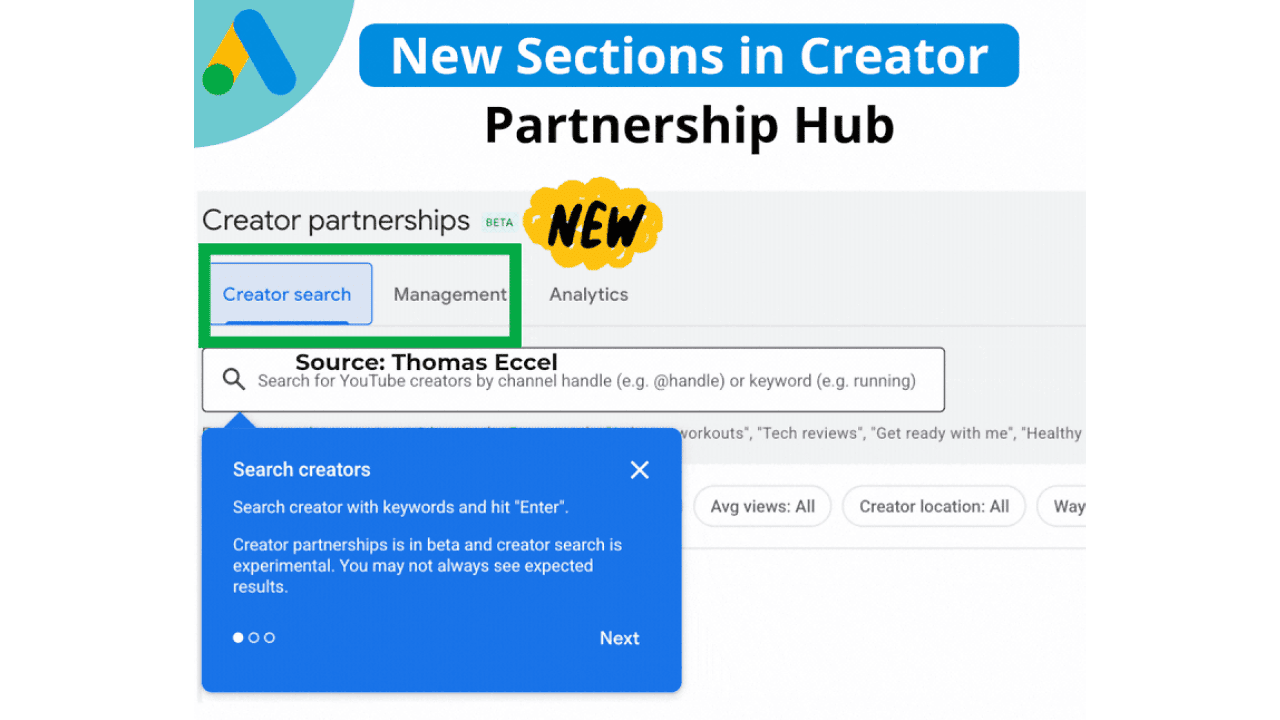
    Google Ads has introduced exciting updates to its Creator Partnerships, making it easier for me to manage collaborations with YouTube talents on a larger scale.

    With the introduction of Creator Search, I can now effortlessly find YouTube creators by utilizing keywords or channel handles. This tool allows me to refine my search based on subscriber count, average views, location, and their availability for contact. It’s a game-changer, significantly cutting down the manual work involved in discovering and reaching out to creators.

    In addition to the search feature, Google has unveiled a new Management section. This centralizes all communications with creators, allowing me to view their names, the status of inquiries, subjects, the latest updates, and scheduled response dates—all in one place with the convenience of direct email access.

    Why this matters to me. As creator-led campaigns become a core aspect of media strategies, having better tools to identify the right collaborators and maintain organized partnerships is crucial. The latest enhancements to Google Ads’ Creator Partnerships (beta) cater to these needs perfectly.

    ```json
{
  "alt": "Screenshot of new sections in Creator Partnership Hub with search features.",
  "caption": "Explore the latest features in the Creator Partnership Hub, including a new creator search tool to enhance your collaboration experience.",
  "description": "This image showcases the new sections in the Creator Partnership Hub, highlighting features like 'Creator search', 'Management', and 'Analytics'. A search box invites users to search for YouTube creators by channel handle or keyword. A blue dialog box provides guidance on the experimental 'Search creators' feature, noting it is in beta. Keywords for searchability include Creator Partnership Hub, search tool, collaboration, beta feature."
}
```

    First sightings. This update made headlines when Google Ads Specialist Thomas Eccel shared it on LinkedIn, making industry professionals eager to explore its capabilities.

    The big picture. These upgrades are pushing Creator Partnerships closer to a comprehensive workflow tool, aiding teams like mine to manage creator collaborations with the same efficiency and accountability that we apply to other paid media endeavors.

    Bottom line. By enhancing both discovery and organization, Google’s updates to Creator Partnerships empower me to execute creator campaigns at scale with ease.


    Inspired by this post on Search Engine Land.


    crushpress.ai community screenshot
  • Discover Google Ads’ Time-Saving ‘Go to…’ Shortcut Feature

    Discover Google Ads’ Time-Saving ‘Go to…’ Shortcut Feature

    Have you ever felt overwhelmed by the endless clicks in Google Ads’ change history, hunting through reports, campaigns, and ad groups? I know I have! But there’s good news—a ‘Go to…’ button has been introduced to streamline this painstaking process. It’s a subtle change that significantly speeds up audits and troubleshooting.

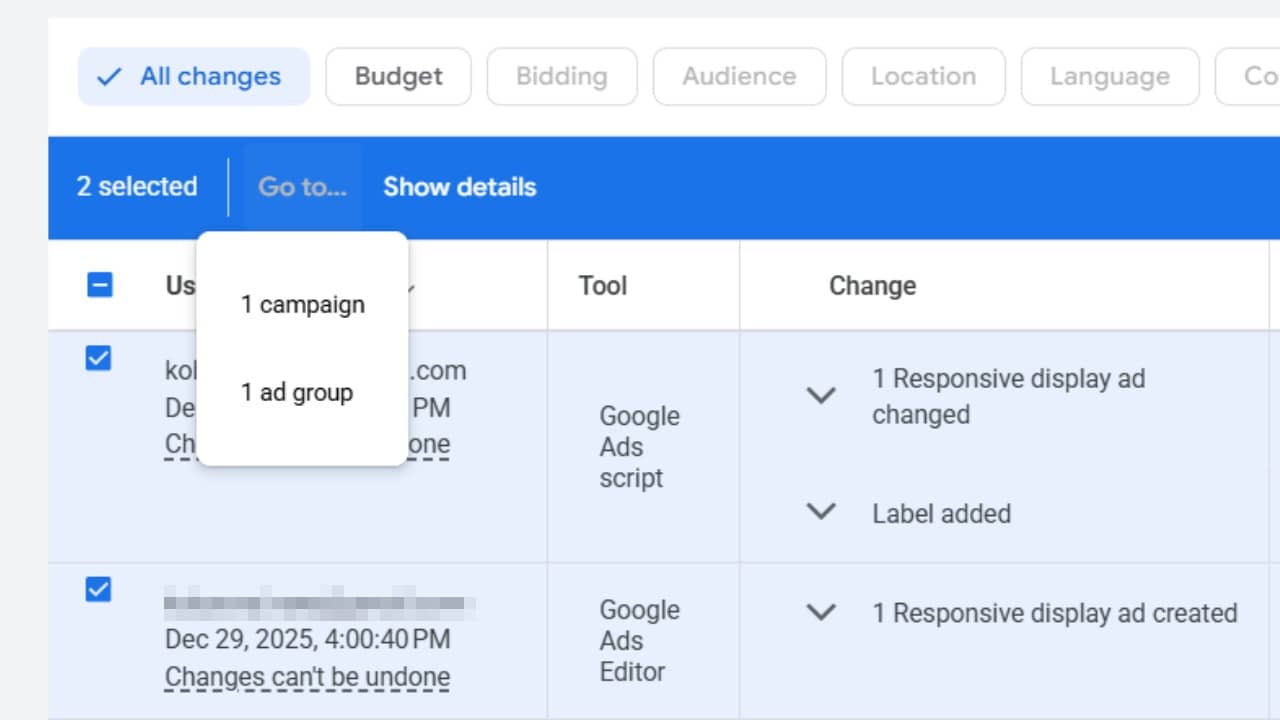
    Discovering What’s New: Google has integrated a ‘Go to…’ dropdown within the Change history report. This feature allows me to leap directly from a logged change to the relevant campaign or ad group, saving precious time, especially when dealing with bulk edits or script-driven updates.

    How It Works:

    ```json
{
  "alt": "A blue toolbar with 'All 50 selected', 'Go to...', and 'Show details' options highlighted.",
  "caption": "Navigating options in a toolbar with selection and details features highlighted in green.",
  "description": "This image shows a blue toolbar interface where 50 items are selected. The 'Go to...' button and 'Show details' feature are highlighted with green arrows. The toolbar also includes categories like User/Date & Time, Tool, Change, and Campaign. Useful for demonstrating navigation and selection features in software interfaces. Keywords: toolbar, select, details, user interface."
}
```
    • First, I select one or more changes from the Change history report.
    • Then, I use the ‘Go to…’ dropdown to directly navigate to the impacted entity.
    • This eliminates the need to manually sift through the account structure.

    Community Insights: PPC Specialist Arpan Banerjee was the first to notice this update, sharing it on LinkedIn.

    • Hana Kobzová, founder of PPC News Feed, observed that this feature “cuts down the steps in troubleshooting and quickens navigation, especially when reviewing bulk changes or those made with scripts or Google Ads Editor.”

    Why This Matters: For anyone managing extensive accounts or leveraging scripts and Google Ads Editor, this feature greatly reduces the hassle of identifying and locating changes. It saves me time during audits and troubleshooting, allowing for more efficient account management.

    ```json
{
  "alt": "Google Ads interface showing changes with options for campaigns and ad groups.",
  "caption": "Exploring changes in Google Ads: a snapshot of ad group and campaign modifications.",
  "description": "The image shows a Google Ads interface highlighting changes made to campaigns and ad groups. Two changes are selected with tools like Google Ads script and Editor involved in modifying responsive display ads. A menu indicates options for viewing specific campaigns and ad groups. Essential for tracking alterations and managing advertising strategies effectively."
}
```

    The Bottom Line: While it might not be the most glamorous update, for those of us who frequently work in Change history, this shortcut is a true time-saver.


    Inspired by this post on Search Engine Land.

    crushpress.ai community screenshot