Category: Business

  • Unlocking Franchise Success: Engineering Meets Marketing

    Unlocking Franchise Success: Engineering Meets Marketing

    Today, I have the pleasure of speaking with Anuj Srivastava, Principal/Partner at NY Engineers. With experience in supervising over 350 franchises, Anuj has a proven track record of helping them open stores 50% faster than competitors. We dive into how engineering and marketing strategies can work together to successfully launch a new franchise.

    .interviewer { padding-top: 2%; } .interviewee { padding-top: 2%; }
    Fps Logo Only Icon

    First Page Sage: Thanks for joining us, Anuj. Could you share more about NY Engineers and your role there?

    Anuj Author

    Anuj Srivastava: Certainly! At NY Engineers, I serve as a Principal/Partner, primarily focusing on franchises, retail, and multi-site rollouts. Our team is renowned for delivering fast, cost-effective mechanical/electrical/plumbing (MEP) and fire protection (FP) engineering services tailored to clients expanding across various locations. We’re licensed in all 50 U.S. states, have completed over 4,000 projects, and our turnaround is 50% quicker than industry norms.

    Fps Logo Only Icon

    First Page Sage: I know that scaling franchises presents unique challenges. What are some key engineering hurdles you encounter, and how do you tackle them?

    Anuj Author

    Srivastava: When a franchise expands to multiple locations, maintaining consistency and speed becomes vital. We ensure brand standards like equipment specs, layouts, and utility loads adhere to local codes. Change orders are costly, so we focus on upfront modeling to offer zero change order assurance. We also standardize components and coordinate early procurement to mitigate supply-chain issues.

    Fps Logo Only Icon

    First Page Sage: How do your engineering services intertwine with marketing and lead generation during franchise design?

    Anuj Author

    Srivastava: The success of a franchise relies not only on proper engineering but also on effective marketing. While we ensure the physical infrastructure is ready on time, marketing maximizes occupancy and ROI. SEO and content strategies are vital for visibility, making sure each location is easily discoverable and drawing in customer traffic. Not integrating marketing would mean missing potential opportunities.

    Fps Logo Only Icon

    First Page Sage: Can you highlight an often-overlooked area where engineering and marketing overlap, and how they can collaborate better?

    Anuj Author

    Srivastava: A key area for collaboration is data-driven site selection and pre-opening diagnostics. Engineering and marketing teams should exchange early data, like utility loads and customer behavior, to forecast foot traffic and peak hours. Furthermore, creating a consistent brand experience through both design and messaging helps reduce friction as the brand scales.

    Fps Logo Only Icon

    First Page Sage: Looking to the future, how do you foresee the engineering-marketing landscape shifting in franchise expansion, and what advice would you offer to brands working with both engineering and marketing firms?

    Anuj Author

    Srivastava: The integration of technology, data, and digital marketing with physical infrastructure is on the rise. Trends include greater use of BIM for efficient design and alignment of physical and digital launches. Emphasizing sustainability also complements both cost control and brand story. I advise brands to see their engineering and marketing partners as one team, ensuring that infrastructure and digital readiness align, along with consistent messaging across all platforms for a successful launch.

    Source


    Inspired by this post on First Page Sage Blog.

  • Mastering AI Search: Answer Hidden Questions or Disappear

    Mastering AI Search: Answer Hidden Questions or Disappear

    I recently dove into the world of AI search and discovered something crucial: if your brand isn’t competing for rankings, it’s competing for visibility through content reuse. Gone are the days when simply ranking was enough.

    During my visit to SMX Advanced, I shared insights on crafting an AI visibility engine. This system is all about making fresh facts accessible to both humans and AI across platforms that prioritize synthesis.

    ```json
{
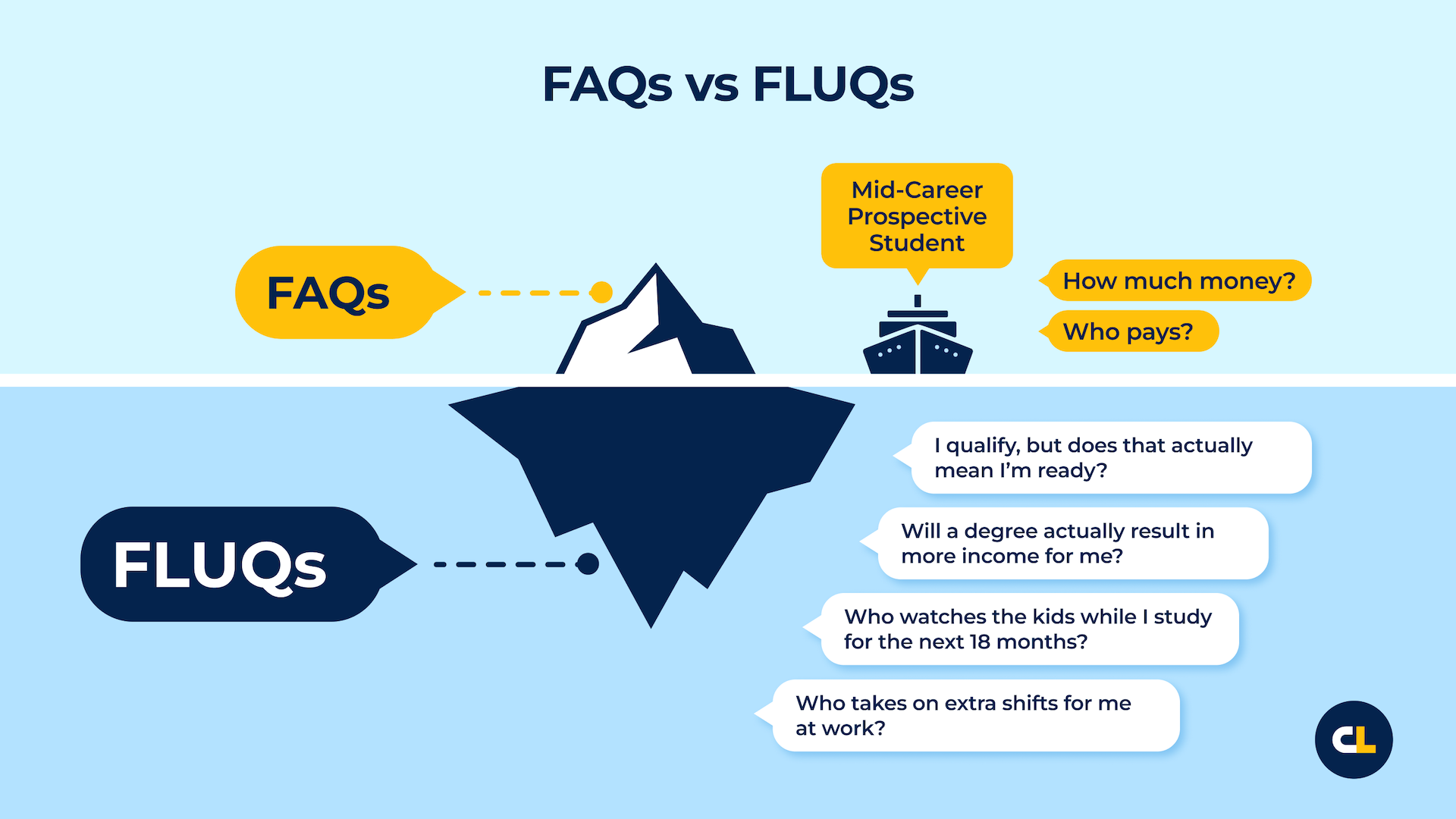
  "alt": "Infographic comparing FAQs and FLUQs using an iceberg metaphor with questions for prospective students.",
  "caption": "Explore the deeper questions: FAQs vs. FLUQs. Are you ready to dive beneath the surface?",
  "description": "This infographic illustrates the difference between FAQs (Frequently Asked Questions) and FLUQs (Frequently Left Unquestioned Questions) using an iceberg model. Above the surface, simple FAQ questions like 'How much money?' are highlighted. Below the surface, FLUQs such as 'Will a degree actually result in more income for me?' are shown, indicating deeper considerations for mid-career prospective students. The design features text bubbles and a ship illustration, suggesting a navigation through visible and hidden inquiries. Keywords: FAQs, FLUQs, iceberg, prospective students, deeper questions, education."
}
```

    We’re constructing this capability with our clients and within XOFU, our own LLM visibility GPT. Here’s the essence of our approach.

    ```json
{
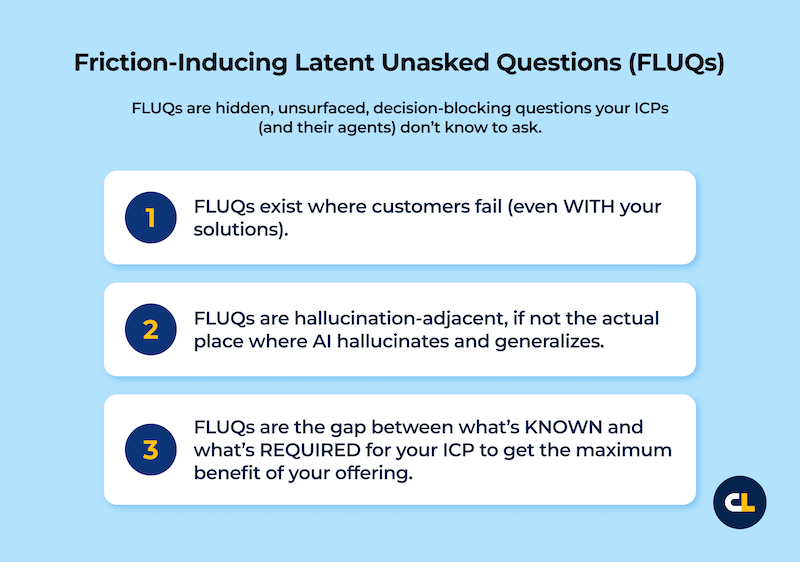
  "alt": "Graphic explaining Friction-Inducing Latent Unasked Questions (FLUQs) in customer decision-making.",
  "caption": "Uncover the hidden Friction-Inducing Latent Unasked Questions (FLUQs) that may be blocking your customers' decisions and impacting your outreach success.",
  "description": "This image outlines the concept of Friction-Inducing Latent Unasked Questions (FLUQs), which are hidden questions that can hinder decision-making for your ICPs. It lists three attributes of FLUQs: occurring where customers fail, being hallucination-adjacent, and representing the gap between known and required information for customer benefit. The design is visually structured with a blue background and numbered points for clarity. Keywords: FLUQs, decision-making, customer engagement, ICP."
}
```

    Find the FLUQs: Friction-Inducing Latent Unasked Questions

    ```json
{
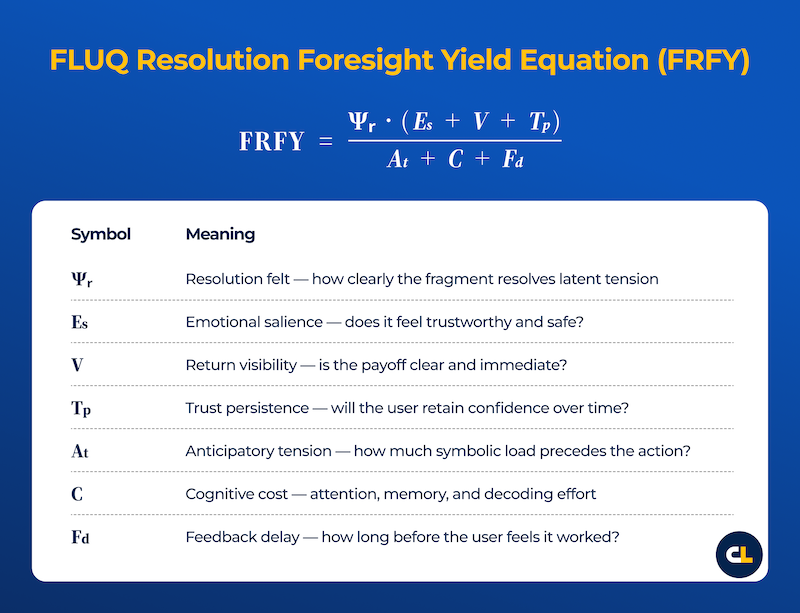
  "alt": "FLUQ Resolution Foresight Yield Equation diagram with symbols and meanings.",
  "caption": "Unlock the potential of foresight with the FLUQ Resolution Foresight Yield Equation, a blend of emotional salience, trust persistence, and more.",
  "description": "The image displays the FLUQ Resolution Foresight Yield Equation (FRFY) and its components. At the top, the equation is shown with variables Ψᵣ, Eₛ, V, Tₚ, Aₜ, C, and Fd. Below, a table explains each symbol's meaning. Ψᵣ denotes resolution felt, Eₛ emotional salience, V return visibility, Tₚ trust persistence, Aₜ anticipatory tension, C cognitive cost, and Fd feedback delay. This visualization helps clarify the elements influencing foresight yield, highlighting their importance in strategic contexts."
}
```

    FLUQs are those pivotal questions your audience doesn’t think to ask, yet lacking their answers can entirely disrupt the buying journey.

    ```json
{
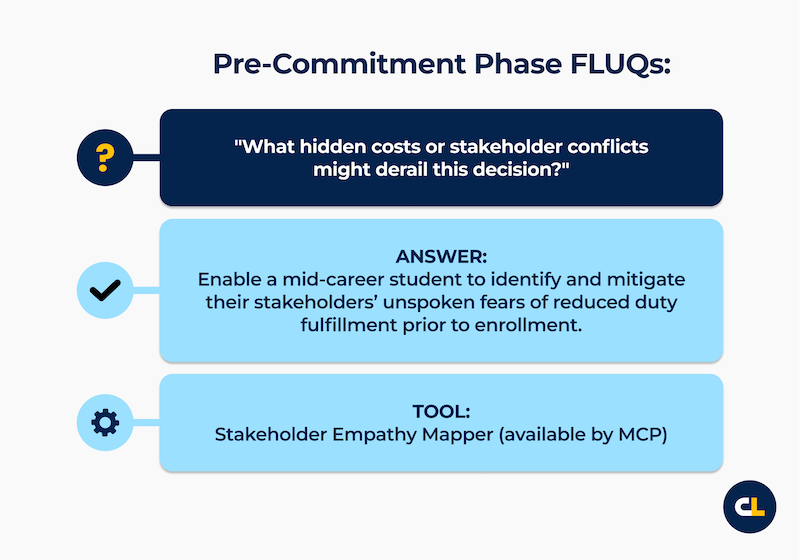
  "alt": "Graphic showing pre-commitment phase questions with solutions for stakeholder conflicts.",
  "caption": "Navigating the pre-commitment phase: Address hidden costs and stakeholder fears with the Stakeholder Empathy Mapper.",
  "description": "This graphic outlines the pre-commitment phase focus on identifying hidden costs and stakeholder conflicts. It provides solutions to mitigate unspoken fears that may hinder decision making for mid-career students, emphasizing the use of the Stakeholder Empathy Mapper tool. Keywords: pre-commitment, stakeholder conflicts, empathy mapping, decision making."
}
```

    We scrutinized this with a notable online education client. They had the basics covered but missed addressing the deeper, latent questions that potentially hindered student decisions.

    ```json
{
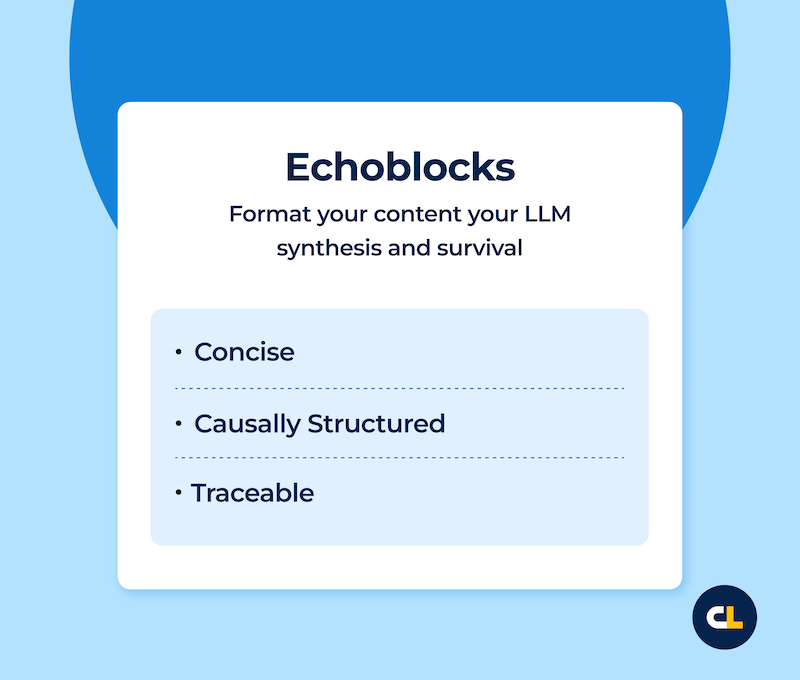
  "alt": "Graphic titled Echoblocks with text about content formatting for LLM synthesis and survival. Features three points: Concise, Causally Structured, Traceable.",
  "caption": "Discover the essentials of content formatting with Echoblocks: concise, causally structured, and traceable guidelines for effective LLM synthesis.",
  "description": "This image is a graphic titled 'Echoblocks' with instructions on formatting content for large language model (LLM) synthesis and survival. It emphasizes three key elements: making content concise, causally structured, and traceable. The design features a clean, professional layout with blue and white tones, accompanied by a small logo in the bottom right corner. This visual aid is ideal for educators and content creators interested in optimizing their written material for advanced language processing."
}
```

    Tackling these hidden inquiries builds trust and cements their decision-making process, thereby strengthening your brand’s relationship with customers.

    ```json
{
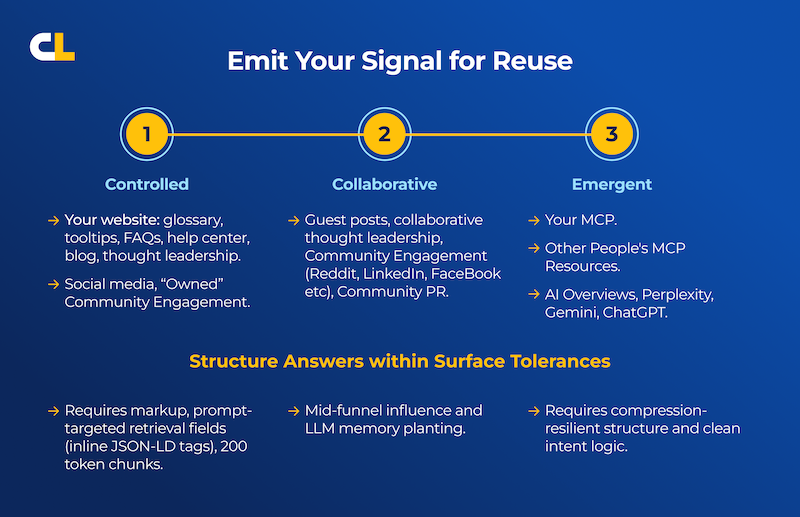
  "alt": "Blue infographic titled 'Emit Your Signal for Reuse' outlines three stages: Controlled, Collaborative, and Emergent, with details on engagement strategies.",
  "caption": "Discover the three stages of engagement: Controlled, Collaborative, and Emergent. This infographic guides you through effective strategies for content reuse and community interaction.",
  "description": "This infographic titled 'Emit Your Signal for Reuse' describes three approaches: Controlled, Collaborative, and Emergent. Each stage highlights different strategies for community engagement and content reuse. The Controlled stage involves websites and social media for direct management. Collaborative focuses on guest posts and public relations. Emergent leverages AI technologies and other resources. The graphic includes technical recommendations for each stage, emphasizing mid-funnel influence and structured answers."
}
```

    Extracting FLUQs from Where They Hide

    ```json
{
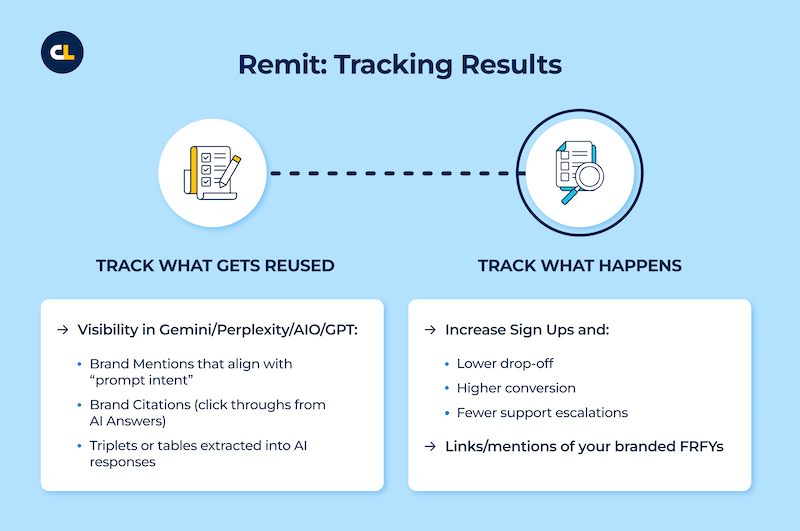
  "alt": "Infographic illustrating the concept of tracking results with two main sections: Track What Gets Reused and Track What Happens.",
  "caption": "Discover how tracking both reuse and outcomes can enhance brand visibility and conversion. This infographic breaks down the key elements for effective result tracking.",
  "description": "This infographic presents a method of tracking results, divided into two main categories: 'Track What Gets Reused' and 'Track What Happens.' The left section highlights visibility in AI systems like Gemini and GPT, emphasizing brand mentions, citations, and data extracted into AI responses. The right section focuses on increasing sign-ups, reducing drop-off, and enhancing conversions. The visual is designed with icons and text blocks, set against a light blue background to clearly convey the importance of strategic tracking in improving brand performance."
}
```

    To uncover these unspoken questions, I dive into customer service logs, online forums, and beyond — anywhere there’s repeated friction. It’s about understanding and addressing the points of hesitation that might not appear in initial searches or FAQs.

    ```json
{
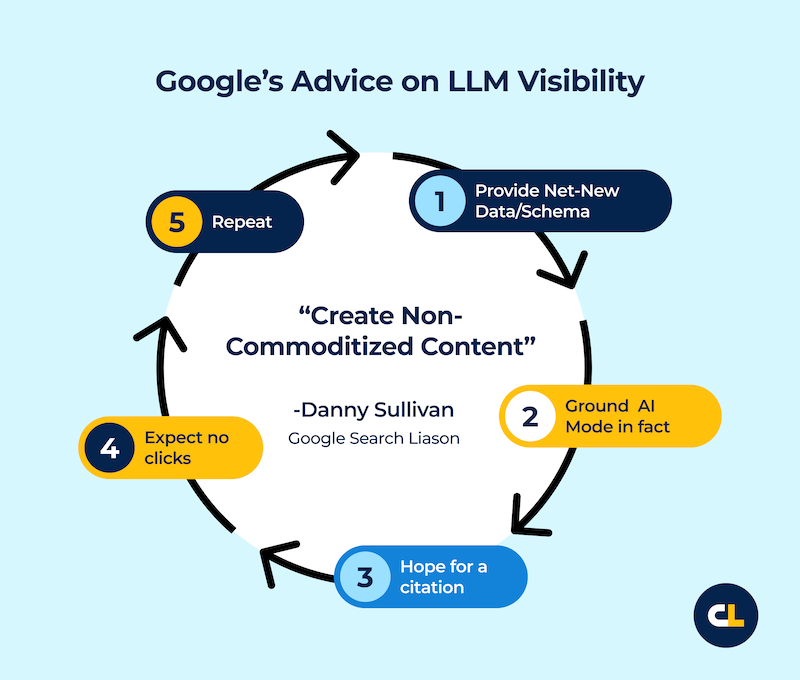
  "alt": "Google's advice on LLM visibility with a circular flowchart showing five steps to create non-commoditized content.",
  "caption": "Unlock the secrets of LLM visibility with Google's insights! Learn the five essential steps to crafting unique content that stands out in search results.",
  "description": "This image presents Google's advice on improving LLM visibility through a circular flowchart. Displayed steps include 'Provide Net-New Data/Schema', 'Ground AI Mode in fact', 'Hope for a citation', 'Expect no clicks', and 'Repeat'. At the center is a quote from Danny Sullivan about creating non-commoditized content. The design uses a mix of blue and yellow colors, emphasizing the key message for SEO and content strategy enthusiasts."
}
```

    In today’s AI-driven landscape, this approach isn’t optional. It’s essential.

    ```json
{
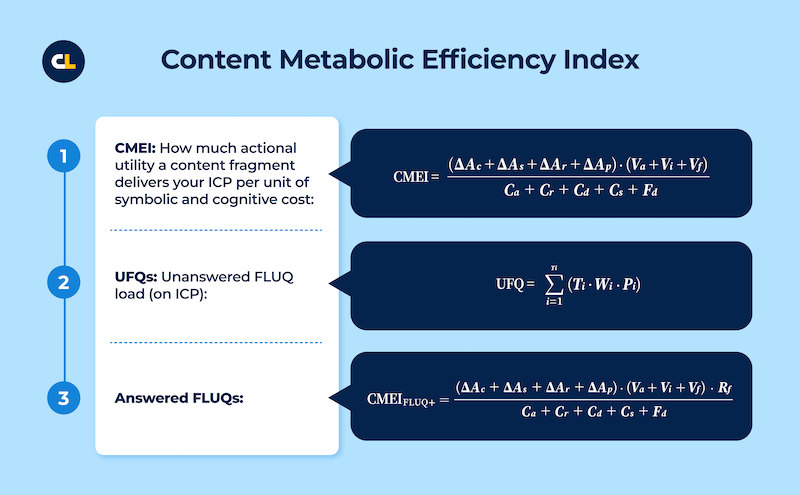
  "alt": "Infographic explaining the Content Metabolic Efficiency Index with equations and descriptions.",
  "caption": "Discover the Content Metabolic Efficiency Index: a framework to evaluate the utility and cognitive cost of content fragments using specific formulas.",
  "description": "This infographic illustrates the Content Metabolic Efficiency Index (CMEI), depicting three key components: CMEI, UFQs (Unanswered FLUQ load on ICP), and Answered FLUQs. Each concept is explained with a formula, emphasizing content actional utility vs. symbolic and cognitive cost. Useful for measuring content efficiency, it helps strategists optimize content impact. Key elements include equations and descriptions, designed for efficient content evaluation."
}
```

    Uncover Hidden Insights

    Following this path reveals insights, leading to content that AI can utilize and synthesize effectively. It’s about structuring facts to ensure survival even through AI’s compression processes.

    Proving FLUQs Matter: The Power of Facts

    Turning assumptions into facts requires analysis. For our educational client, we surveyed students and confirmed a crucial insight: those who negotiated expectations upfront had better outcomes.

    This net-new data now serves not just our client but is available for AI models to reference, ensuring longer-lasting visibility.

    Publishing Strategy: Ensuring Reuse by AI

    I prioritize structured, reusable content, whether it’s on owned platforms, in collaboration with others, or in emerging AI environments. The aim is sustainable visibility through facts that can be synthesized accurately.

    To summarize, it’s no longer enough to generate content; the focus is on creating content that stands up to AI scrutiny and remains usable across platforms.


    Inspired by this post on Search Engine Land.

  • Harnessing AI: Transforming Marketing for Creativity and Reach

    Harnessing AI: Transforming Marketing for Creativity and Reach

    As a marketer, I’ve found myself grappling with innovation while navigating changing consumer attitudes. It’s almost second nature, given the technological shifts over the past two decades. But predicting the future, especially with modern AI, is challenging due to its unpredictable nature. We can’t simply rely on today’s AI state to foresee where it’ll be in five years or even one year from now. Navigating this platform shift requires a fundamental understanding from the ground up.

    Despite this, certain fundamentals remain constant. Consumers will always seek products, services, and experiences that resonate and fulfill their needs. As marketers, I’ll always pursue quicker, more efficient ways to connect with these consumers. However, the technological landscape mediating these relationships is on the verge of significant change, drastically influencing our work and the customer experiences we provide.

    In the evolving world of marketing, less rote work and more creativity is the name of the game. The history of marketing is one of continuous evolution, but the rise of modern AI pushes even seasoned teams to adapt. For success, I’ve realized the need to embrace new skills, perspectives, and capabilities that allow us to accomplish more with fewer resources.

    The transformation is underway. Embracing AI means I’m spending less time on mundane tasks like manual message creation. Instead, I focus on strategy and creativity, from crafting innovative campaigns to refining testing and optimization strategies. As AI becomes a vital part of the engagement process, it enables me to establish goals and guidelines, empowering AI to operate independently, digesting context, making decisions, and acting on my behalf.

    Currently, that involves training basic AI agents in my brand’s voice for consistent messaging. But as we grow confident in AI’s ability to function autonomously over extended periods and manage complex projects, I look forward to dedicating more time to strategic management of AI resources, enabling greater AI decisioning and optimization.

    The team dynamics in marketing are destined to evolve with AI working alongside humans. As I thrive on collaboration, I recognize that successful customer engagement programs often hinge on the team’s ability to cooperate rather than individual prowess. AI isn’t just a tool; it becomes a direct teammate, offering support across various aspects of customer engagement. Entry-level marketers under my guidance may soon act like managers to autonomous AI subordinates.

    I’m excited at the prospect of deploying a team of AI agents for tasks like personalizing product recommendations, quality assurance of messages, translations, and providing alerts for campaign performance. By augmenting capabilities with these agents, I reduce the workload for myself and my human colleagues while building a digital institutional memory that benefits from accumulated context and goal alignment.

    Looking ahead, AI’s role in customer engagement promises unprecedented personalization. For years, personalizing communication on a 1:1 basis across vast audiences has been the ultimate goal in marketing, but the technology was lacking. With AI decisioning, this dream is becoming a reality, multiplying my marketing effectiveness and creative impact to deliver what consumers desire.

    Previously, reaching out to lapsed customers was a prolonged process. It involved using churn models, product predictions, and extensive A/B testing. While effective to an extent, personalized 1:1 engagement was out of reach. AI decisioning now offers a fresh approach by leveraging reinforcement learning, enabling AI to learn consumer behaviors and optimize key performance indicators autonomously.

    AI can now determine the best product offers for lapsed users, the ideal channels and timings, and even message frequency preferences. This constant background experimentation allows AI to adapt to consumer preference shifts, engaging individuals through first-party data for truly personalized interactions.

    As I witness this platform shift, I understand the importance of not just planning for the obvious but being prepared to respond to unforeseen changes. The real value of AI in customer engagement comes from a deep integration within a solid infrastructure. It’s not simply a shortcut but an amplifier, and our AI tools must be built on a foundation capable of supporting real-time action.

    Curious about how Braze is approaching AI in customer engagement? I invite you to explore our BrazeAIᵀᴹ page.


    Inspired by this post on Search Engine Land.

  • Why B2B Brands Embrace AI Over Keywords in 2025

    Why B2B Brands Embrace AI Over Keywords in 2025

    In recent years, I’ve observed a significant shift away from keyword-targeted search campaigns, reaching a pivotal moment this week.

    Two account managers on my team, each from different industry sectors, approached me with a common insight.

    They were considering swapping some keyword campaigns for Performance Max.

    Not impulsively, but selectively, based on months of consistent testing and optimization.

    These thoughtful decisions were backed by data showing Performance Max outperforming traditional keyword methods.

    Are we moving towards an era without keywords? Not entirely.

    However, some accounts are no longer predominantly focused on keywords, signaling a transformative shift.

    Seasoned PPC marketers, who built careers around keyword strategies, now recommend these AI-driven tools. It’s time to take notice.

    Resisting this shift isn’t being cautious—it’s sidestepping growth opportunities.

    Here’s the current scenario:

    • AI Overviews are increasingly visible in search results.
    • Google’s AI Mode is widely adopted.
    • YouTube viewership is rising.
    • User behavior on Google has evolved dramatically from a year ago.

    If user interaction with Google has shifted, shouldn’t our campaign strategies adapt as well?

    While Google has been advancing AI campaigns over the years, 2025 marks a pivotal year where AI strategies have become essential—not optional.

    Advertisers employing Performance Max, Demand Gen, and AI Max are reaping the benefits.

    Meanwhile, others watching from the sidelines see their competitors gaining ground.

    The Holistic Approach Missing in Many Campaigns

    I’ve noticed a pattern: B2B firms overly focused on performance marketing now face brand trust issues.

    Conversely, companies emphasizing only awareness struggle to convert leads.

    The solution? Embrace both sides.

    What I used to call awareness campaigns, I’ve now renamed as brand trust campaigns.

    By being consistently present across platforms, your brand builds trust—showing it matters and solves customer problems.

    Although LinkedIn and Meta dominate brand discussions, Google’s AI-forward Demand Gen campaigns merit attention.

    These campaigns utilize first-party data, engaging like social ads with strong recall.

    When combined with Performance Max, appearing across AI overviews and Google’s ecosystem, you’re investing in a sustainable strategy.

    Dig deeper: Optimizing B2B PPC Spend During Low Budgets and Confidence

    Performance Max Over Traditional Keyword Strategies

    Keywords aren’t obsolete, but exclusively keyword-targeted campaigns are less dominant now.

    In the accounts I mentioned, transitioning away from keyword strategies wasn’t swift—it was strategic.

    Clients initially wanted to promote all services via keywords, but it was too costly.

    We prioritized top services with keywords, testing Performance Max for others.

    The results? Promising enough to secure additional budget.

    After months, the data was clear: Performance Max was a rising star.

    We eventually added top-tier services to complement keyword efforts with PMax.

    Will we eventually drop all keyword campaigns for Performance Max? Possibly.

    However, this isn’t a one-size-fits-all solution.

    Often, combining Performance Max with keyword strategies works best.

    The trend? Performance Max commands more budget, trust, and results.

    AI campaigns expose your brand across search, Google, and YouTube.

    By the time a customer searches for your brand or a high-intent keyword, your campaign is ready, backed by pre-built awareness and trust.

    Dig deeper: Top B2B Paid Media Platforms for Effective Advertising

    AI Max: A Glimpse into the Future

    Google’s AI Max for Search campaigns mark a new evolution stage.

    Early results? Mixed. But that’s expected initially.

    Facing Performance Max’s initial skepticism again, yet AI Max’s location interest targeting is noteworthy.

    These additions hint at Google’s future direction.

    The Cost of Resistance

    I often hear:

    • “I tried Performance Max, it didn’t work.”
    • “Too many irrelevant keywords.”
    • “Not ready to give up control.”

    Change is daunting, and allowing AI to optimize feels like ceding control.

    But every Google product launch faces this resistance, and early adopters who test beyond initial struggles thrive.

    Something that failed six months ago may perform differently now. Performance Max evolves rapidly.

    Dismissal due to outdated tests is akin to refusing a train for last year’s delay.

    Preparing for an AI-Driven Future

    The evolution of user search habits calls for an AI-forward ad strategy.

    Neglecting AI tools now means missing out when competitors have moved ahead.

    Here’s what you can do now:

    • Audit current campaigns: Are you solely using keyword-targeted strategies? Test Performance Max and assess over two months.
    • Invest in brand trust: Use Demand Gen, LinkedIn, or YouTube to build trust and awareness.
    • Create high-quality assets: Compelling videos and images enhance AI campaign success.
    • Embrace a test-and-learn mindset: Allow time for tests to develop, adapting to evolving platforms.
    • See beyond control loss: Use AI as a means to broaden reach and results, with strong content as a foundation.

    Dig deeper: LinkedIn or Google Ads? Choosing Wisely for B2B Success

    AI-Forward Advertisers Own the Future

    The Google Ads ecosystem is moving towards AI-driven campaigns, with concrete account data validating this progression.

    Advertisers who adapt and learn are thriving, while those clinging to outdated methods fall behind.

    No need to overhaul everything at once but start experimenting.

    Challenge the learning curve, expecting the platform to evolve, and your results will follow suit.

    The train has departed. Will you ride early or wait, risking a delayed arrival?

    My team and I are on board, committed to testing, learning, and discovering what’s next, knowing that standing still isn’t an option for success.


    Inspired by this post on Search Engine Land.
  • Revolutionizing Ads: ChatGPT’s Unique Approach to Online Advertising

    Revolutionizing Ads: ChatGPT’s Unique Approach to Online Advertising

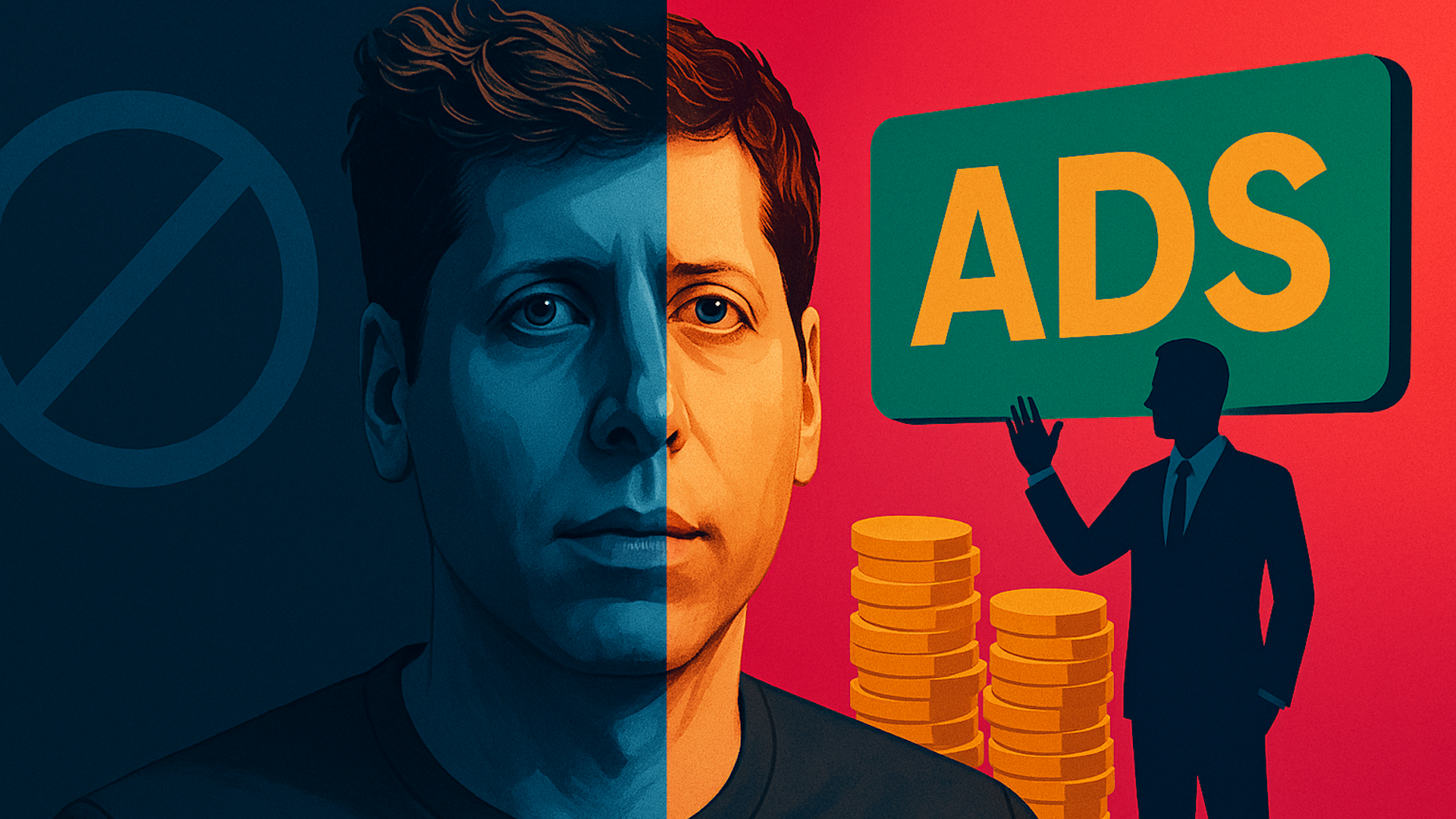
    As I’ve been closely following the developments at OpenAI, I’ve found ChatGPT’s potential shift to ads quite intriguing. CEO Sam Altman has indicated that ads might become part of ChatGPT’s framework, but he remains uncertain about their exact form. He’s also not convinced that advertising represents OpenAI’s most significant revenue opportunity.

    During a fascinating interview on Conversations with Tyler, Altman critiqued Google’s ad model:

    • “Ads on a Google search are dependent on Google doing badly. If it was giving you the best answer, there’d be no reason ever to buy an ad above it.
    • “So you’re like – that thing is not quite aligned with me. ChatGPT, maybe it gives you the best answer, maybe it doesn’t, but you’re paying it, or hopefully all are paying it, and it’s at least trying to give you the best answer.”

    His point was clear to me: Google’s profits stem from subpar results. Altman suggests that ChatGPT should earn only when it genuinely gains users’ trust.

    • “If ChatGPT were accepting payment to put a worse hotel above a better hotel, that’s probably catastrophic for your relationship with ChatGPT.”

    Why I care about this is that if Altman’s vision for ChatGPT ads comes true, the entire journey from inquiry to purchase could unfold seamlessly within a single conversation. It’s crucial for brands and businesses to adapt to this new landscape to maintain visibility.

    How Altman envisions ChatGPT Ads is captivating: Display the top recommendation first, and if I choose to book or buy with a single click, OpenAI might earn a small commission without affecting my results.

    • “If ChatGPT shows you its guess – the best hotel, whatever that is – and then if you book it with one click, takes the same cut that it would take from any other hotel, and there’s nothing that influenced it … I think that’s probably OK.
    • “We’ll do that for travel at some point.”

    What he won’t do is allow ChatGPT to have pay-to-play answers. Altman believes that if money influences rankings, the trust users place in ChatGPT will erode.

    • “There’s a kind of ad that I think would be really bad like the one we talked about. There are kinds of ads that I think would be very good – or pretty good – to do. I expect it’s something we’ll try at some point. I do not think it is our biggest revenue opportunity.”

    What an OpenAI ad might look like remains a mystery even to Altman. He relies on his team’s expertise, trusting that they’ll chart the right path.

    • “I’m really good about not doing the things I don’t want to do.
    • “You know, we have the world expert thinking about our product strategy. I used to do that. I used to spend a lot of time thinking about product and now she’s much better at it than me. I have other things to think about. I’m sure she’ll figure it out.”

    Dig deeper. For more insights, check out Sam Altman’s ChatGPT pivot: From ‘I hate ads’ to ‘maybe they don’t suck’

    The interview. Dive into Sam Altman on Trust, Persuasion, and the Future of Intelligence – Live at the Progress Conference


    Inspired by this post on Search Engine Land.

  • Why Relying on AI Prompt Volume Can Be Misleading: A Better Approach

    Why Relying on AI Prompt Volume Can Be Misleading: A Better Approach

    When it comes to AI prompt volume, I’ve learned that blindly relying on it might not be the best strategy. A more sustainable approach is to align your strategy with real business goals.

    Many people fall into the trap of trusting AI metrics without considering their actual business objectives. Instead, we should focus on building a robust Automated Enterprise Optimization (AEO) strategy.

    By doing this, we can ensure our efforts directly contribute to meaningful outcomes, rather than merely generating data for data’s sake.

    Considering this, I’ve realized the importance of setting goals based on substantial business needs, which not only creates genuine value but also supports long-term success.


    Inspired by this post on Conductor Blog.

  • Revolutionizing Marketing: AI Search and the End of Last-Click Attribution

    Revolutionizing Marketing: AI Search and the End of Last-Click Attribution

    I’ve discovered that AI search is dramatically changing how we approach marketing attribution. As zero-click searches become more prevalent, along with the rise of conversational funnels, the traditional last-click models are rapidly becoming outdated.

    In this new landscape, it’s crucial to explore alternative attribution models that can accurately capture the multi-faceted customer journey. Together, we’ll delve into these innovative strategies.


    Inspired by this post on HiGoodie Blog.

  • Unlocking the Power of First AI Queries in SERP Strategy

    Unlocking the Power of First AI Queries in SERP Strategy

    I’ve always been fascinated by how search engine ranking positions impact AI search results, specifically through ChatGPT. What really intrigues me is how the timing of queries can multiply the effects on citations.

    Diving into our study of 420 prompts and 2,867 ChatGPT queries, the data showed that securing the top spot in initial searches can capture a significant 40.2% of citations. In contrast, if you rank number one in subsequent searches, your citation rate plummets to 24.3%—this 1.7× difference is a game-changer for optimization strategies.

    Understanding this, I’ve realized that traditional SEO strategies like simply aiming to rank higher overlook a crucial element. Our findings highlight how gradient compression reduces sensitivity to rank positions by 55% across query sequences, showing that the synergy between search ranking and the timing of queries enhances outcomes rather than merely adding to them.

    This analysis offers an essential, data-driven framework for interpreting the two-dimensional attribution surface, which is reshaping both SEO and AEO strategies in 2025. Exciting times lie ahead for those ready to adapt to these transformative insights.


    Inspired by this post on Try Profound Blog.

  • Mastering AI: Transforming Your Customer Journey

    Mastering AI: Transforming Your Customer Journey

    As someone deeply involved in the digital landscape, I’ve learned that adapting to the ever-evolving AI customer journey is crucial. Recently, I discovered some valuable insights from Acquia’s leadership on how best to tailor content for this new era.

    The integration of AI into our everyday interactions with customers requires a strategic approach to content creation and delivery. By understanding how AI tools process and present our content, we can better position ourselves to meet customer expectations effectively.


    Inspired by this post on Conductor Blog.

  • Elevate Your AI Search Strategy: Expert AEO/GEO Tactics

    Elevate Your AI Search Strategy: Expert AEO/GEO Tactics

    Welcome to an exploration of advanced AEO and GEO strategies, where I dive into expert insights with leading minds at Conductor. Together, we’ll uncover transformative techniques that redefine how we approach search engine optimization in the AI era.

    Expert insights from Conductor experts on all things AEO / GEO and the future of search.

    My journey with AEO/GEO strategies is not just about techniques; it’s about vision. The way we engage with searches is evolving, and harnessing these powerful methods can set us apart. I’m excited to share actionable tips and insights that I’ve gathered.

    Join me in this deep dive. Let’s equip ourselves with the knowledge to master AI visibility and enhance our search optimization efforts with cutting-edge tools and strategies.


    Inspired by this post on Conductor Blog.