Author: shivamcrushpressai

  • How to Prioritize and Communicate SEO Recommendations

    How to Prioritize and Communicate SEO Recommendations

    Your crawler has produced a wall of red warnings. A stakeholder has forwarded an AI-generated SEO audit. Developers want to know what actually needs to ship, while leadership wants to know whether any of it will affect traffic, leads, or revenue.

    Your job is not to defend the audit or clear every warning. It is to turn uncertain technical findings into a short, defensible queue of business decisions. That requires two disciplines: ranking recommendations by likely impact and explaining them in language each decision-maker can use.

    Stop letting the audit tool set your roadmap

    An audit tool can identify a rule violation. It cannot decide how much that violation matters to your business. Its severity label usually describes technical conformity, not the value of the affected pages, the strength of the evidence, or the opportunity cost of assigning developers to the fix.

    That distinction matters because a site can have hundreds of reported issues without hundreds of worthwhile projects. A buried 404 that receives no meaningful traffic, blocks no journey, and has no useful backlinks may be noise. A small internal-linking or canonical problem across commercially important category pages may deserve attention even if the audit interface gives it a less alarming label.

    Treat every crawler finding as a lead to investigate, not an instruction to implement. Before it enters the roadmap, make it pass these tests:

    1. Verify the condition. Reproduce it on representative URLs. Check whether the crawler saw the current page, the intended response, and the rendered state rather than a temporary or obsolete condition.
    2. Identify the affected surface. Determine whether the problem touches an isolated URL, a reusable template, a key directory, or a sitewide component. A long URL list may represent one template defect; a short list may contain the business’s most valuable landing pages.
    3. Explain the search mechanism. State whether the issue can interfere with discovery, crawling, rendering, indexing, canonical selection, internal authority flow, or the user journey. If you cannot describe a plausible mechanism, you do not yet have an SEO recommendation.
    4. Connect the surface to business value. Name the page group, audience, search demand, conversion path, or strategic market that could be affected. Do not substitute total error count for value.
    5. Check the evidence. Look for agreement among the crawl, rendered pages, indexation signals, search-performance data, analytics, and any other relevant observations. One tool flag is weaker than several independent signals pointing to the same failure.
    6. Assess delivery reality. Ask which team owns the change, what it depends on, whether it can be tested safely, and what could regress. A sound idea that cannot be implemented or validated is not ready for scheduling.

    Key takeaways

    • A crawler severity label is not a business priority.
    • Prioritize affected value and search impact, not the number of URLs in an export.
    • Separate the observed finding, the impact hypothesis, and the proposed action.
    • State confidence, effort, dependencies, and validation alongside expected benefit.
    • Evaluate AI-generated suggestions through the same process as recommendations from any other origin.

    Build an impact case before assigning priority

    A strategist arranges blank recommendation cards among visual markers for impact, confidence, implementation effort, and risk.

    A useful priority reflects both expected benefit and delivery reality. You can express the impact side as business value multiplied conceptually by affected reach, problem severity, and confidence. Then adjust the delivery decision for effort, dependencies, implementation risk, and reversibility.

    This is a reasoning model, not a promise of mathematical precision. Relative labels such as high, medium, and low are often more honest than a score built from guesses. Define what each label means for your organization so that two recommendations can be compared on the same basis.

    FactorQuestion to answerWhat strengthens the case
    Business valueWhat useful outcome could improve if this works?The affected pages support an important product, service, audience, conversion path, or strategic objective.
    ReachHow much of the valuable site surface is affected?The condition is systematic across a relevant template or section rather than incidental.
    Search severityHow directly can the condition suppress performance?There is a credible path to impaired discovery, crawling, rendering, indexing, canonicalization, internal linking, or user completion.
    ConfidenceHow certain are we that the condition exists and matters?The issue is reproducible and supported by multiple forms of evidence.
    Effort and dependenciesWhat must change, and who must participate?The work has a clear owner, bounded scope, known dependencies, and testable acceptance criteria.
    Delivery riskWhat could break if the change is wrong?The change can be staged, monitored, and rolled back without exposing a larger surface.

    Once those factors are visible, place each recommendation in an impact-effort queue:

    • High impact, low effort: schedule these first when confidence is adequate. Template-level internal-link corrections or clear canonical fixes can fall here when they affect valuable pages and the implementation is contained.
    • High impact, high effort: treat these as business projects, not oversized tickets. Define phases, dependencies, risk controls, and the smallest useful release. High effort does not make an important problem unimportant.
    • Low impact, low effort: batch these with related maintenance or include them when a team is already touching the component. Do not let easy work displace a more valuable project merely because it creates visible ticket movement.
    • Low impact, high effort: decline or defer them unless new evidence changes the impact case. This is where cosmetic cleanup and best-practice compliance often consume time without changing search outcomes.

    Keep urgency separate from priority. An urgent issue is causing material harm now, affects a valuable surface, and becomes more costly if left in place. A rendering or canonical failure on key pages may satisfy those conditions. A worthwhile structural improvement may be high priority without being an incident. Calling every recommendation urgent makes the label useless and teaches stakeholders to ignore it.

    Also distinguish defect removal from opportunity creation. Restoring an unintentionally unavailable landing-page group is a recovery case. Improving internal links to help important pages become easier to discover is an opportunity case. Both can be valuable, but they require different expectations: one aims to remove a constraint, while the other tests whether a better structure produces additional performance.

    Write recommendations that people can decide on

    Most SEO findings arrive in the wrong shape for approval. “Fix canonical tags” is a task fragment. “Resolve critical errors” repeats the tool’s label. Neither tells a decision-maker what is wrong, why it matters, how much of the site is involved, or how success will be judged.

    Turn each material finding into a compact recommendation brief with these fields:

    • Decision requested: say whether you need approval, engineering estimation, further investigation, or an explicit decision to defer.
    • Observed condition: describe what you verified without interpreting it. Include representative URLs, templates, response behavior, or rendered output.
    • Affected surface: name the page group and explain why that group matters. Avoid presenting a raw error total without its distribution.
    • Search mechanism: explain the path from the condition to the potential search effect. Keep this causal statement short enough to challenge.
    • Business relevance: connect the affected surface to a product, service, audience, lead path, transaction, or strategic objective.
    • Evidence and confidence: distinguish what is observed from what is inferred. Label the confidence honestly and state what evidence would raise or lower it.
    • Proposed change: identify the component to modify and the desired behavior. Give developers an outcome, not only an SEO label.
    • Effort, owner, and dependencies: identify who must contribute and what could delay or expand the work.
    • Validation and rollback: define the technical acceptance check, the search signal to monitor, and the safe reversal path.

    Use three distinct statements inside that brief: fact, hypothesis, and choice. The fact is what you observed. The hypothesis is how that condition may affect search or users. The choice is the change you recommend. Keeping them separate prevents a plausible theory from being presented as proven causation.

    A decision-ready canonical example

    Suppose selected high-value category pages declare canonical URLs that point elsewhere even though those categories are intended search landing pages. A weak ticket says, “Fix canonical errors.” A decision-ready version looks like this:

    • Decision requested: approve engineering estimation for a category-template correction.
    • Observed condition: representative intended landing pages render canonical tags pointing to different URLs.
    • Impact hypothesis: the conflicting signals may make the preferred category URLs less clear to search systems, limiting their ability to appear consistently.
    • Business relevance: the affected template supports categories the business has already identified as valuable.
    • Proposed behavior: eligible category pages should emit the intended canonical URL consistently, while true duplicates should retain their approved canonical targets.
    • Acceptance check: test representative eligible pages, duplicates, filtered states, and any other affected template variants before expanding the release.
    • Outcome check: confirm the rendered tags and subsequent indexation behavior, then monitor the affected page group rather than the site’s aggregate traffic.

    This framing reflects why a single canonical or rendering correction can outweigh a large backlog of unrelated warnings: context and affected value determine the opportunity.

    Translate the same case for each audience

    Do not send the identical explanation to everyone and assume more detail will create agreement. Preserve the underlying evidence, but lead with what each person must decide:

    • Executives: lead with the business surface, likely consequence, confidence, cost, and tradeoff. They need to understand why this outranks another use of the same resources.
    • Product managers: lead with scope, customer or market relevance, dependencies, sequencing, and the decision required for the roadmap.
    • Developers: lead with reproducible behavior, affected templates, desired output, edge cases, acceptance criteria, monitoring, and rollback.
    • Content teams: lead with the affected intent, page role, content or linking change, editorial constraints, and how duplication will be avoided.
    • Clients: lead with what was found, what is known, what remains uncertain, the recommended response, and what will be measured. Avoid presenting implementation as guaranteed traffic growth.

    The message should become shorter as it moves upward, but the evidence underneath it should remain available. A concise executive recommendation is persuasive when it sits on top of a traceable analysis, not when inconvenient uncertainty has been removed.

    Evaluate AI-generated SEO suggestions without a turf war

    When a manager or client forwards an AI-generated audit, they are usually trying to help. Beginning with “ChatGPT is wrong” turns a technical evaluation into a contest over whose input deserves respect. A better response acknowledges the contribution, identifies useful ideas, and applies the same evidence standard you would use for a crawler, consultant, or internal proposal.

    A collaborative opening can be simple: Thanks for sending this over. Some of these ideas are worth exploring. We will validate them against the site’s goals, affected pages, current evidence, and implementation constraints, then return with a recommended disposition for each. That response recognizes the effort without accepting every conclusion.

    Triage each AI suggestion into a clear disposition:

    • Act: the condition is verified, the mechanism is credible, the affected surface matters, and the proposed change is proportionate.
    • Investigate: the idea is plausible, but evidence, scope, ownership, or implementation detail is missing.
    • Already covered: the underlying need exists in the roadmap, perhaps under different terminology or as part of a broader initiative.
    • Defer: the idea may be valid but loses to work with stronger impact, confidence, or timing.
    • Decline: the premise is false, the suggested behavior conflicts with the site’s needs, or the likely benefit does not justify the effort and risk.

    When you decline an item, challenge its premise rather than the tool’s identity. Replace “the AI does not understand SEO” with a testable explanation such as: “This recommendation assumes the affected URLs should be indexed, but they are intentionally consolidated into another landing page,” or, “This proposes a universal word-count target without evidence that additional length would satisfy the searcher’s need.”

    Precision in an AI response can look like evidence even when it is only specificity. A documented recommendation to create procedure pages exceeding 3,000 words did not hold up against shorter ranking pages. The correct question was not whether long pages are always bad. It was whether that prescribed length solved a demonstrated content or search problem on that site.

    If the AI output is potentially useful but generic, improve the input before debating the output. Provide the model with:

    • the business model and the conversion that matters;
    • the intended audience and markets;
    • the role of each important page type;
    • representative high-value and low-value URLs;
    • known crawl, rendering, indexing, canonical, or content constraints;
    • the relevant search-performance and analytics observations;
    • implementation limitations and available owners;
    • the requirement to separate observations, assumptions, recommendations, and validation steps.

    Then ask for hypotheses to investigate, not an unquestioned task list. AI can accelerate idea generation and organization. It should not bypass verification, business context, technical review, or prioritization.

    Make the stakeholder conversation end with a decision

    Four stakeholders agree around a conference table as one blank option card is moved into an action tray.

    A recommendation has not been communicated successfully merely because everyone understands it. The conversation must produce a decision, an owner, or a defined evidence gap. Otherwise the same item will return in the next audit with a new screenshot and no change in status.

    Bring a decision queue rather than a diagnostic dump. For each material item, show the recommended order, affected business surface, supporting evidence, confidence, effort, dependencies, risk of deferral, and exact decision needed. Put supporting URL exports and screenshots behind the summary instead of making stakeholders decode them during the discussion.

    Use this sequence for each recommendation:

    1. Name the decision. Ask for approval, estimation, investigation, deferral, or rejection.
    2. Lead with the outcome at stake. Identify the important page group or journey before describing tags, status codes, or crawler rules.
    3. Show the minimum evidence that proves the condition. Keep the deeper diagnostic material ready for questions.
    4. Explain the mechanism and confidence. State what is known, what is inferred, and what would disprove the hypothesis.
    5. Present the tradeoff. Explain the effort, dependency, delivery risk, and work that would be displaced.
    6. Record the disposition. Capture the owner, next action, dependency, validation plan, and reason if the item is deferred or declined.

    Answer common objections with the prioritization logic

    • “Why not fix every error?” Because the objective is improved search and business performance, not a perfect tool score. Low-impact cleanup consumes capacity that could address a verified constraint on valuable pages.
    • “The audit labels this critical. Why is it not first?” The label describes the rule the tool detected. Your priority also accounts for affected value, reach, evidence, effort, dependencies, and risk.
    • “Can you guarantee a traffic increase?” No. You can demonstrate the condition, explain a plausible mechanism, state confidence, limit implementation risk, and define how the affected surface will be measured.
    • “Why is a small issue ahead of a large error count?” URL count is not value. A contained defect on a strategically important template can matter more than many isolated warnings on pages with no meaningful search or user role.
    • “Why not implement the AI recommendations as written?” They have not yet been validated against the site’s purpose, evidence, architecture, constraints, or opportunity cost. Origin does not remove the need for evaluation.

    Measurement should be part of approval, not an afterthought. Capture the condition before implementation, verify that the shipped output meets the acceptance criteria, and monitor the page group and search mechanism named in the hypothesis. Record inconclusive or negative outcomes as carefully as positive ones. That history makes later prioritization less dependent on opinion.

    Start with the loudest item in your current backlog. Rewrite it as an observed condition, affected business surface, impact hypothesis, proposed change, confidence statement, and decision request. If you cannot complete those fields, move it out of the delivery queue and into investigation. If you can, you have something stakeholders can approve and a team can implement without guessing why it matters.


    References

  • How to Measure AI Discovery Traffic for B2B Pipeline Growth

    How to Measure AI Discovery Traffic for B2B Pipeline Growth

    You can see buyers using ChatGPT, Claude and Gemini to research vendors, yet your pipeline report may still reduce the result to organic, referral or direct traffic. If you cannot connect that activity to qualified demand, you cannot tell whether AI discovery deserves more investment or merely produces interesting charts.

    The practical answer is not a single AI metric. Build an evidence chain from visibility, to an identifiable site visit, to an onsite action, to an opportunity. Google Analytics can now cover the middle of that chain more cleanly. Your CRM, LinkedIn activity and measurement rules must cover the rest.

    Measure three layers instead of one AI traffic number

    Three connected translucent layers depict AI visibility signals, a website session and a conversion path leading to business account and opportunity nodes.

    AI discovery is not the same thing as AI referral traffic. A buyer can encounter your brand in an assistant without clicking, visit through an identifiable assistant link, or return later through another channel. Those behaviors create different evidence and should not be combined under one label.

    Measurement layerEvidence you can recordDecision it supports
    Discovery visibilityYour company, product or page appears for a controlled set of buyer questionsWhether assistants associate your brand with the right problem and category
    Identifiable trafficA supported assistant sends a visit that Google Analytics recognizesWhich assistants and cited pages generate site demand
    Business outcomeThe visitor completes a qualified action and the lead or account advancesWhether AI discovery contributes to pipeline, not just sessions

    For visibility, maintain a fixed set of questions that reflect how a buyer researches your category. Record the assistant, exact prompt, date, brands mentioned, cited URLs and whether your brand appears in the answer or only in a citation. Keep the prompt wording and access conditions consistent when you repeat the check. The result is an observation, not a universal ranking, because assistant outputs can vary.

    For traffic, use the native AI classification in Google Analytics. For business outcomes, use your existing definitions of a qualified action, lead, opportunity and revenue. This division prevents a common reporting error: treating a mention, a visit and a sale as interchangeable proof of success.

    Build a GA4 view your revenue team can trust

    Google Analytics now identifies supported assistant referrals automatically. Recognized visits can use the medium ai-assistant, the channel group AI Assistant and the campaign value (ai-assistant). This removes much of the custom filtering previously needed to isolate traffic from supported tools.

    1. Confirm that AI Assistant appears in your acquisition reporting. If it does not, check the date range and whether you have any identifiable assistant referrals before changing channel definitions.
    2. Break the channel down by source and landing page. The channel total tells you the size of the stream; the source shows which supported assistant sent it; the landing page reveals which answers or resources earned the click.
    3. Compare AI Assistant and organic search over the same date range. Use the same qualified actions and conversion definitions for both channels. Otherwise, the comparison answers a reporting question rather than a business question.
    4. Show counts beside rates. A high conversion rate based on a very small number of sessions is useful as an early signal, but it is not yet a dependable forecast.
    5. Keep unidentified traffic unidentified. Do not relabel direct visits as AI traffic merely because AI visibility increased during the same period.

    Your recurring report should include identifiable AI sessions, source, landing page, qualified action count, qualified action rate and any matched opportunities. Add the number of leads that explicitly named an AI assistant even when analytics did not record an AI referral. That last field exposes influence the channel report cannot see without pretending the attribution is certain.

    The pattern matters more than the channel total. If AI traffic is small but converts well, protect the pages earning those visits and expand the buyer questions they answer. If traffic grows while qualified actions remain flat, inspect the landing page promise, offer and next step. More assistant visibility will not repair a page that attracts one intent and presents a call to action for another.

    The AI Assistant channel is a measurement improvement, not complete AI attribution. It covers identifiable referrals from supported assistants. It cannot count an answer that satisfies the buyer without a click, and it cannot automatically recover an AI touch when the buyer returns later through direct traffic, branded search or a different device.

    Connect assistant referrals to leads, accounts and opportunities

    Anonymous referral streams pass through a website gateway and connect in sequence to a lead, a company account and a qualified opportunity.

    B2B attribution becomes difficult after the click because evaluation often continues across sessions and people. Solve that problem with explicit evidence labels rather than a more aggressive attribution claim.

    • Observed AI referral: Google Analytics placed the session in the AI Assistant channel.
    • Self-reported AI discovery: A lead named an assistant when asked how they found the company.
    • AI-influenced opportunity: the account has either form of documented AI evidence before opportunity creation.
    • AI-sourced opportunity: AI discovery met your narrower, written rule for the first known acquisition touch.

    Do not merge these labels. An observed referral has stronger click evidence than an inferred influence, while a self-reported answer can reveal discovery that analytics missed. Both are useful as long as the dashboard preserves the distinction.

    1. Choose the onsite action that represents meaningful intent for your sales motion. It might be a demo request, contact submission, trial start, pricing interaction or another event your team already treats as qualified.
    2. When a visitor becomes a lead, carry permitted acquisition fields into the CRM: original source, current source, landing page, campaign and the date of the qualifying action. Retain the original values rather than overwriting them on every return visit.
    3. Add a short, optional discovery question to the form or sales qualification process. Allow the buyer to name ChatGPT, Claude, Gemini or another route in their own words instead of forcing every answer into a fixed channel list.
    4. Join the evidence at the lead and account levels where your consent and data practices allow it. Account-level reporting matters when one person researches and another submits the form.
    5. Write the attribution rule directly in the dashboard. State which touch qualifies an opportunity as sourced, which touches count only as influenced, and whether the evidence must occur before lead or opportunity creation.

    Track progression as counts and rates: identifiable AI sessions, qualified actions, leads, opportunities and closed revenue. Keep pipeline value beside opportunity count because one large deal can otherwise make a small channel look predictably scalable. For the same reason, do not forecast from conversion rate alone while the denominator remains small.

    This model also gives sales a useful feedback role. When a prospect mentions an assistant, record the assistant, the question they were trying to answer and any page or claim they remember seeing. That information can reveal buyer language, missing content and attribution gaps without turning an anecdote into a performance benchmark.

    Turn LinkedIn activity into a measurable discovery loop

    LinkedIn can strengthen the public evidence around a B2B company, but activity alone is not a growth result. Treat the company page, employee expertise, long-form content and distribution as inputs. Measure assistant visibility, referral traffic and pipeline separately as outputs.

    Remove ambiguity from your company and expert profiles

    Start with factual consistency. Keep the business address, contact details and product descriptions accurate on your website. Update the LinkedIn company page’s About section and services, including relevant industry language. Treat the profiles of executives and active subject-matter experts as extensions of the same entity, with current roles and clear areas of expertise. These are core surfaces for B2B AI discovery work.

    Assign an owner to each surface and update all of them when the company changes a product name, category, service or positioning statement. If your site publishes corresponding organization or product structured data, include it in the same update. Consistency does not guarantee an assistant mention, but it removes avoidable uncertainty about what the company does and who represents it.

    Publish one complete answer for each valuable buyer question

    Use LinkedIn articles and newsletters for questions that require more than a short update. The 800-1,200-word range associated with stronger AEO mentions is a useful starting hypothesis, not a universal ranking requirement. A complete 700-word answer is more useful than 1,000 words padded to satisfy a target.

    Give each long-form asset a specific job:

    • Use the buyer’s question or decision in the headline.
    • Answer it directly near the beginning.
    • Name the product category, intended user and relevant constraints plainly.
    • Explain criteria and tradeoffs that help the buyer make a decision.
    • Link to the corresponding website resource when the reader needs evidence, implementation detail or a next step.
    • Connect the content to an identifiable expert whose profile supports the subject.

    Add campaign parameters to links you control from LinkedIn so you can measure LinkedIn visits accurately. Keep those visits classified as LinkedIn traffic. A tracked LinkedIn click is not an AI referral, even when the content was also designed to improve AI discovery.

    Use engagement thresholds as experiments, not ranking factors

    If your team needs an initial promotion checkpoint, start with at least 10 substantive comments or 60 reactions. These figures can guide a campaign test, but they are not verified causal ranking factors for every LLM. Record them as engagement outcomes, then look independently for changes in assistant mentions, AI Assistant referrals and qualified demand.

    Count comments that contribute a question, example, objection or informed response. A pile of generic replies may increase the visible total without improving the information around the topic. Employee participation, expert partnerships, boosted company updates, Thought Leader Ads and follower ads can expand distribution, but paid and organic exposure should remain separate in your campaign log.

    Test one topic cluster from publication to pipeline

    1. Choose one buyer question tied to a product or service that can create qualified demand.
    2. Record the current website answer, LinkedIn coverage, controlled prompt observations and identifiable AI traffic.
    3. Correct company and expert profile details before publishing, so entity changes and content changes happen in a documented sequence.
    4. Publish the complete website resource and its LinkedIn treatment. Record the URL, author, publication date, distribution method, paid support and engagement.
    5. Watch all three measurement layers through a reporting period appropriate to your traffic volume and sales cycle.
    6. Compare the result with a similar topic cluster you did not change. Treat the difference as directional evidence unless your test design supports a stronger causal conclusion.

    Read breaks in the chain literally. More LinkedIn engagement without more assistant visibility proves distribution, not AI discovery. More assistant visibility without referral growth may mean the answer resolves the question without a click or does not present a useful next step. More AI referrals without qualified actions points to the landing page or intent match. More qualified leads without opportunities points to qualification, offer fit or the sales handoff.

    Key takeaways

    • Measure AI discovery as visibility, identifiable traffic and business outcomes. No single metric covers all three.
    • Use GA4’s AI Assistant channel for recognized referrals from supported assistants, but do not relabel direct traffic to fill attribution gaps.
    • Preserve observed referrals, self-reported discovery, influenced opportunities and sourced opportunities as separate evidence classes.
    • Keep website facts, LinkedIn company details and expert profiles current before trying to scale content distribution.
    • Treat the 800-1,200-word content range and engagement thresholds as test inputs, not universal LLM ranking rules.
    • Scale a topic only after you can follow its path from buyer question to content, assistant visibility, qualified action and pipeline.

    Start with one revenue-relevant buyer question. Establish the baseline, publish a complete answer, track the assistant referral and carry the evidence into your CRM. The first broken link in that chain tells you what to fix next. Repair it before increasing content volume or promotion spend.

    References

  • How to Build AI Marketing Operations That Improve Visibility

    How to Build AI Marketing Operations That Improve Visibility

    Your team can use AI to produce briefs, drafts, reports, and campaign variants faster and still become no more visible in AI search. When that happens, generation is not the constraint. The missing piece is usually the operating system between a buyer’s question, the evidence your company owns, the page that carries the answer, and the feedback that tells you whether the answer was found.

    Treat AI visibility as a marketing operations problem. Connect demand discovery, content decisions, evidence management, publishing, structured data, technical access, and measurement in one governed loop. You will automate less blindly, publish fewer disposable assets, and learn where visibility is actually breaking down.

    Build a closed loop, not a collection of AI tools

    An AI-powered marketing operation should move through a repeatable loop: observe how people express a need, decide which questions matter, locate defensible evidence, create or update the right asset, make that asset technically understandable, measure its appearance and impact, and feed the result into the next decision.

    That is different from adding an AI tool to every task. A drafting tool may reduce production time without improving accuracy, retrieval, or conversion. A reporting assistant may summarize a dashboard without telling you which content gap caused the result. Local efficiencies matter, but they become useful only when each output has an owner, an acceptance rule, a destination, and a measurable purpose.

    Key takeaways

    • Design visibility work around real decision prompts and their likely subquestions, not isolated keywords.
    • Package repeatable marketing judgment as governed AI skills with approved inputs, output contracts, permission limits, and review gates.
    • Maintain a canonical evidence layer so AI workflows reuse verified facts instead of regenerating claims from memory.
    • Make visible content, internal relationships, technical signals, and JSON-LD describe the same entities and facts.
    • Measure the full chain from workflow quality to retrieval, citation context, qualified visits, and business outcomes.

    Use three separate questions when evaluating an AI initiative. Can the system complete the task? Can it complete the task consistently under your rules? Does the result improve discovery or a business decision? A workflow is not successful merely because it generated an output.

    Map buyer prompts to fan-out query coverage

    A glowing inquiry orb branches into many connected paths that lead to a coordinated group of content modules.

    A buyer’s prompt is not necessarily one retrieval event. The mechanics associated with ChatGPT Search include web.run and fan-out queries, which can turn one request into several related searches before an answer is composed. Do not assume every model, product surface, prompt, or session behaves identically. For planning purposes, however, a prompt should be treated as a bundle of information needs rather than a long keyword.

    Suppose a buyer asks which inventory platform fits a multi-location retailer with limited implementation resources. The visible prompt contains several possible subquestions: which platforms support multiple locations, what implementation involves, which systems integrate with the buyer’s stack, how migration works, what support is available, what commercial constraints apply, and which alternatives deserve consideration. A page optimized only for the phrase inventory platform may answer none of them well.

    Create a prompt map before creating more content. Give every row these fields:

    • Exact prompt: the question as the buyer would ask it, including relevant context and constraints.
    • Decision stage: learning, narrowing options, validating a choice, implementing, or troubleshooting.
    • Likely subquestions: the facts, comparisons, definitions, risks, and next steps needed to resolve the main prompt.
    • Entities: the products, organizations, people, locations, standards, or concepts that must be identified consistently.
    • Evidence requirement: the proof needed for each meaningful claim and the person responsible for maintaining it.
    • Canonical answer: the best existing URL or source-of-truth record for that subquestion.
    • Gap status: absent, incomplete, unsupported, stale, duplicated, technically inaccessible, or ready.
    • Next action: update an existing asset, create a focused asset, improve an internal relationship, fix technical access, or leave the coverage unchanged.

    The map prevents two common mistakes. The first is forcing every subquestion into one oversized page. The second is publishing several pages that compete to answer the same question. Keep related subquestions together when they serve the same intent and depend on the same evidence. Split them when the audience, decision stage, evidence, or required action differs materially.

    Assign one editorial source of truth to every important claim. That is not merely an HTML canonical tag. It is the internal record your people and AI workflows are expected to reuse. Other pages can adapt the explanation for a different context, but names, definitions, product capabilities, dates, limitations, and relationships should remain consistent.

    Prioritize gaps by decision value, not estimated content volume alone. A narrow implementation question that blocks a purchase may deserve attention before a broad informational query. Record why each prompt matters, what action a satisfactory answer should enable, and how you would recognize a useful visit or conversion.

    Turn repeatable judgment into governed AI skills

    Traditional automation works well when a trigger and response can be specified in advance. Marketing work often contains a layer of judgment between them: interpreting a prompt, selecting evidence, resolving conflicting inputs, applying brand rules, and deciding whether a human must intervene. The move toward AI skills as a layer of marketing automation gives you a practical way to package that judgment without pretending the entire operation can run unattended.

    For operating-design purposes, a skill is a reusable method with defined inputs, instructions, tools, quality checks, and handoffs. An agent may decide which actions to take and invoke one or more skills. Keeping those concepts separate helps you test the method before granting a system broader autonomy.

    Skill fieldWhat to specifyOperational purpose
    TriggerThe event that starts the work, such as a new prompt gap, changed product fact, failed validation, or scheduled reviewPrevents vague or unnecessary runs
    GoalThe decision or accepted outcome, not a generic activity such as analyze contentKeeps the workflow tied to value
    Approved inputsNamed repositories, fields, versions, owners, and freshness statusLimits unsupported claims and stale data
    ProcedureThe required sequence, decision rules, tool permissions, and stop conditionsMakes execution repeatable and auditable
    Output contractRequired fields, format, status labels, destination, and confidence or uncertainty notesAllows downstream systems and reviewers to rely on the result
    Evidence policyAcceptable evidence, citation requirements, and the treatment of missing or conflicting informationSeparates verified facts from generated language
    GuardrailsActions the skill may not take, including publishing, deleting, changing spend, or altering protected claims without approvalContains financial, reputational, and data-loss risk
    Review gateThe reviewer, acceptance criteria, escalation path, and rejection reasonsTurns human review into a defined control
    Run logInstruction version, inputs, tool actions, outputs, approvals, errors, and final statusMakes failures diagnosable instead of anecdotal

    A useful first skill is visibility-gap triage. Give it a fixed prompt set, your published URL inventory, the evidence registry, and current technical status. Require it to classify intent, propose likely subquestions as hypotheses, map those subquestions to existing assets, identify missing or weak support, and return a prioritized backlog with an owner and rationale. Do not let it invent supporting facts or publish the resulting content.

    The distinction between evidence and generated language must be explicit. A model can rewrite an approved claim for clarity. It should not turn its own prior output into proof. When evidence is absent or contradictory, the correct output is a flagged gap, not a smoother sentence.

    Start new skills with read access and a preview output. Add write access only after you can identify recurring failure modes and show that the review gate catches them. Publishing, budget changes, destructive edits, pricing updates, regulated claims, and legal commitments need explicit approval and a recoverable change path. Faster execution is not worth an untraceable change to a live asset.

    Treat external text as input data, not as instructions to the workflow. Keep governing instructions separate from fetched pages, restrict the available tools and destinations, and stop the run when a requested action crosses its permission boundary. These controls belong in the skill definition rather than in a reviewer’s memory.

    Publish answer-ready assets backed by a shared evidence layer

    A secure central repository of source materials connects to multiple digital content assets while human reviewers inspect the information flow.

    AI visibility does not improve simply because you publish more often. Your assets need to make the answer, its scope, its supporting evidence, and the relevant entity relationships easy to identify. The same structure also helps human readers decide whether the answer applies to them.

    For each important prompt, make sure the destination asset resolves these questions:

    • What is the direct answer to the user’s question?
    • Which audience, product, location, situation, or version does the answer cover?
    • What evidence supports each consequential claim?
    • What limitation, dependency, or uncertainty could change the answer?
    • Which named entity does each capability, quote, statistic, or relationship belong to?
    • Where can a reader verify details or continue to the next decision?

    Put a concise answer close to the relevant heading, then explain the mechanism, evidence, scope, and next action. Do not make the reader cross several promotional paragraphs to discover whether the page answers the question. Descriptive headings, short answer passages, explicit comparison criteria, and nearby evidence create clearer units for both reading and extraction.

    Keep an evidence registry outside the prose. A practical record includes the claim, supporting material, entity, scope, owner, approval status, last verified state, affected URLs, and the event that should trigger revalidation. Refreshing on a fixed calendar can miss an important product or policy change; trigger review when a dependency changes.

    Your structured data must agree with the visible page and the evidence registry. Choose Schema.org types that describe entities actually present on the page. Use stable @id values where you need to connect the same entity across nodes. Keep names, canonical URLs, authors, dates, products, organizations, and relationships consistent. Validate the generated JSON-LD after rendering, not merely inside the content management form.

    Do not use schema to manufacture certainty. Marking a statement as structured data does not substantiate it, and adding an unsupported property can make the machine-readable version less trustworthy than the visible content. If your team cannot verify a claim, fix or remove the claim before encoding it.

    Technical availability is the other half of answer readiness. Confirm that the canonical URL returns meaningful rendered content, is linked from an appropriate part of the site, is not blocked unintentionally, and does not send conflicting canonical, redirect, or indexability signals. Check whether important content appears only after an interaction that a crawler may not perform. Keep sitemaps, internal links, metadata, visible facts, and structured data aligned after migrations and template changes.

    Do not create a separate AI version of every page unless a real audience or delivery requirement justifies it. A parallel content layer creates another place for facts to drift. Improve the canonical human-readable asset first, then expose the same approved facts through the formats your workflows and distribution systems need.

    Measure the chain, then scale one workflow at a time

    A single AI visibility score cannot tell you why performance changed. Separate the operating chain into layers so that each signal points to a possible action.

    LayerWhat to recordWhat a problem may mean
    Workflow qualityAccepted outputs, rejection reasons, manual corrections, failed runs, review effort, and cost per approved resultThe skill, inputs, permissions, or output contract needs revision
    Answer coveragePrompts mapped, subquestions covered, evidence gaps, duplicated answers, and change dependenciesYour content plan does not match the decision journey
    Technical readinessCanonical status, indexability, rendered content, internal discovery, structured data validity, and identifiable crawler activityA good answer may be inaccessible or ambiguous to machines
    AI visibilityBrand presence, cited URL, citation context, answer position or role, and other entities included for a controlled prompt setThe asset may lack relevance, authority, clarity, coverage, or retrievability
    Business effectQualified landing-page visits, assisted conversions, sales or support actions, and downstream value supported by your attribution modelVisibility may be reaching the wrong audience or failing to help a decision

    Build a controlled prompt panel for measurement. Preserve the exact prompt and record the model or product label, date, language, locale, account or personalization state when known, full answer, cited links, and citation context. AI outputs can vary across runs and product contexts, so a screenshot from one prompt is evidence of an occurrence, not a trend.

    Compare like with like and retain the raw result. Do not average several models, languages, prompt variants, and user states into one unexplained number. A visibility score can be useful as a directional summary, but the underlying prompt-level evidence must remain available for diagnosis.

    Inspect how your brand appears, not merely whether it appears. A citation can support a competitor, repeat an outdated limitation, or place your company in the wrong category. Record the claim being supported and whether the cited page is the asset you want representing that claim.

    Use a narrow rollout to connect the layers:

    1. Choose one commercially meaningful buyer decision and define the action a useful answer should enable.
    2. Create a controlled prompt set and map each prompt to likely subquestions, entities, evidence, and canonical URLs.
    3. Audit those URLs for answer completeness, factual support, entity consistency, JSON-LD alignment, and technical access.
    4. Select one repeated handoff or analysis task and encode it as a governed skill with a preview output.
    5. Run the skill against approved inputs, categorize every rejection, and revise its rules before granting broader permissions.
    6. Publish only reviewed changes and preserve the previous version or another safe rollback path.
    7. Capture a prompt-level visibility baseline and connect referred or assisted activity to your existing analytics and attribution process.
    8. Expand to another journey only when outputs are traceable, permission boundaries hold, and reviewers are correcting exceptions rather than rewriting everything.

    Pause expansion when the workflow cannot identify the evidence behind a claim, repeatedly selects the wrong destination, changes protected content without approval, or produces an output that depends on extensive reviewer reconstruction. Those are design failures, not signs that you need more content volume.

    Start with one high-value buying question and one recurring workflow that currently creates avoidable handoffs. Map the question, strengthen its evidence-backed answer, wrap the repeatable work in a controlled skill, and measure the same prompt set before and after the change. That scope is small enough to govern and complete enough to reveal whether your real constraint is content, evidence, access, execution, or demand.

    References

  • Google’s New Merchant Advisor: Revolutionizing Retail Management

    Google’s New Merchant Advisor: Revolutionizing Retail Management

    Recently, I’ve discovered that Google is stepping up its game in AI tools for advertisers and retailers.

    They’re testing something quite futuristic called Merchant Advisor, an AI assistant integrated directly into the Merchant Center. This tool aims to simplify the process of setup, troubleshooting, and optimization for us all.

    What’s happening. As someone who watches Google’s every move, I’ve noticed them testing Merchant Advisor, a cutting-edge AI-powered chatbot right within Google Merchant Center. Although in beta, its purpose is clear: to offer personalized recommendations and support, making my experience smoother than ever.

    How it works. The Merchant Advisor acts like a proactive assistant, offering tasks and suggestions like setting up a returns policy or finalizing account setup steps. It feels like having an assistant who is always available to enhance my feed quality and account health.

    The bigger trend. This development is part of Google’s strategy to weave AI assistants throughout its marketing products, reminding me of earlier launches like Google Ads Advisor and Analytics Advisor. The AI co-pilots are evidently becoming the norm for managing campaigns and analytics.

    ```json
{
  "alt": "Google Merchant Center Next interface showing Merchant Advisor Beta with a message prompt for completing account setup.",
  "caption": "Explore the Google Merchant Center Next's Merchant Advisor Beta, guiding users to complete their account setup seamlessly!",
  "description": "The image displays the Google Merchant Center Next interface, highlighting the Merchant Advisor in Beta. It features a sidebar with options like Products & store, Marketing, and Analytics. The main section prompts the user to complete account setup by configuring the returns policy. Options like 'Help me set up my returns policy' offer user guidance. This screenshot highlights the use of AI to assist merchants in optimizing their setup."
}
```

    Between the lines. Let’s face it, Merchant Center can be a technical labyrinth, especially for smaller retailers juggling feeds, policies, and diagnostics. But now, with an embedded AI guide, I’m finding it less daunting to get onboarded quickly and spot optimization opportunities I might have overlooked.

    Spotted by. This feature first caught the eye of Tamara Hellgren during a Google Ads Decoded podcast episode that focused on retail innovations.

    The bottom line. It’s clear to me that Google is transforming the Merchant Center into a more intuitive, AI-assisted environment, which reflects a larger trend towards automation within its advertising landscape.


    Inspired by this post on Search Engine Land.


    crushpress.ai community screenshot
  • Discover How AI is Transforming Google Search Queries

    Discover How AI is Transforming Google Search Queries

    6 mistakes that hurt ecommerce campaigns on Google Ads
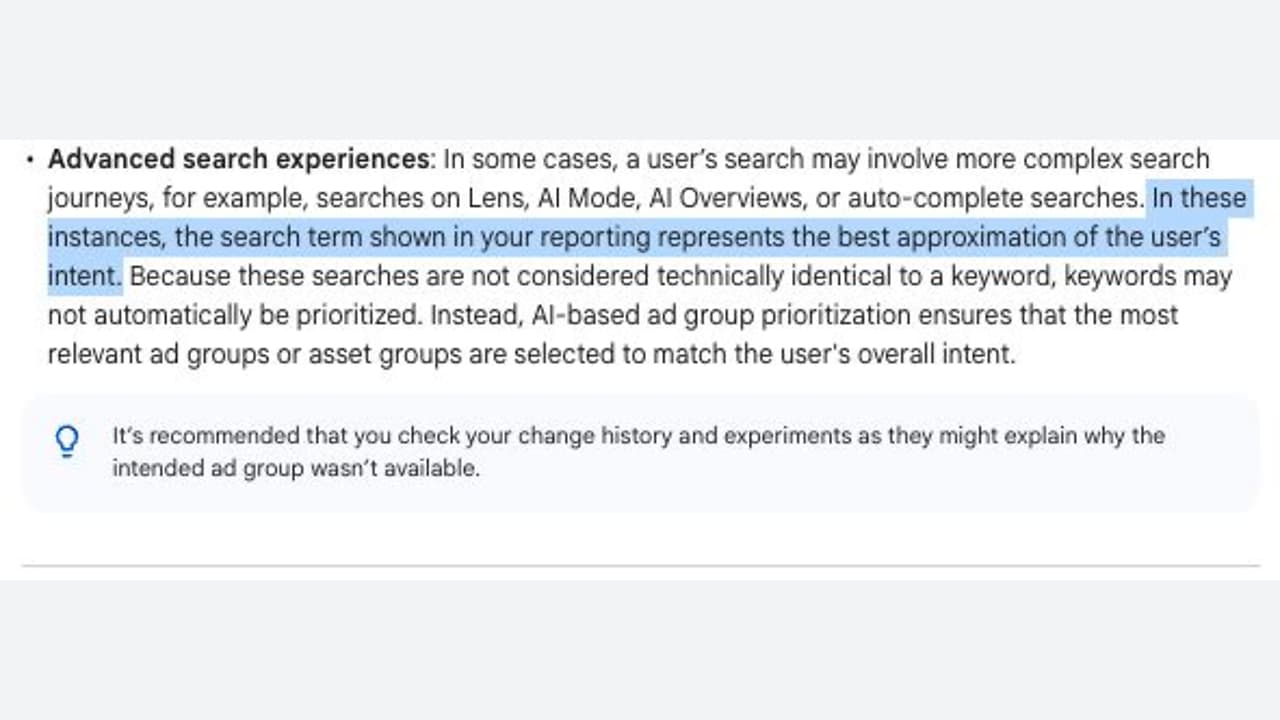
    I’ve noticed that Google Search Query Reports are moving towards AI-driven interpretations, reflecting inferred intent rather than exact user searches.

    What’s happening. Google has clarified that the search terms in Search Query Reports might not precisely match what users typed. Instead, the system displays the “closest approximation” due to the complexity of modern search behaviors.

    What’s behind it. It’s fascinating how heavily AI now influences Google Ads’ matching systems. Rather than depending solely on specific keywords, Google increasingly interprets user intent, context, and behavioral signals to decide which ads to display.

    Why we care. For those of us in advertising, Search Query Reports might become less of a mirror reflecting user language and more of a summarized representation of intent. This shift might complicate query analysis, decisions on negative keywords, and strategy around match types.

    ```json
{
  "alt": "Text explaining advanced search experiences and AI-based ad group prioritization.",
  "caption": "Decoding advanced search experiences: how AI enhances ad group prioritization by interpreting user intent for optimized results.",
  "description": "This image contains a section of text discussing advanced search experiences involving AI tools like Lens and AI Mode. It emphasizes that search terms in reports represent user intent and explains the role of AI-based ad group prioritization in aligning ads with user interests, despite the absence of directly matching keywords. A recommendation is also provided to review change history if an intended ad group is unavailable. Keywords: advanced search, AI, user intent, ad group prioritization."
}
```

    Discovered by. This update was brought to my attention by Adsquire founder, Anthony Higman, on an official Google help page discussing ad group and asset group prioritization in Google Ads.

    The bottom line. Google Ads continues its evolution from keyword matching to AI-driven intent modeling, meaning we might have less insight into the exact searches that activate our ads.


    Inspired by this post on Search Engine Land.


    crushpress.ai community screenshot
  • How to Choose an Addiction Treatment SEO Agency in 2026

    How to Choose an Addiction Treatment SEO Agency in 2026

    Your facility is not buying traffic. You are choosing who will translate real services, locations, qualifications, and intake pathways into pages that people can find and trust. A weak choice can waste budget, but it can also create false expectations for people making consequential care decisions.

    The right agency is not necessarily the one with the longest service list. It is the one whose operating model fits your actual constraint, whose claims survive due diligence, and whose work remains under your clinical, privacy, and business control. Use this process to build a defensible shortlist and run a much more revealing sales conversation.

    Define the problem before you compare agencies

    The first mistake is asking which addiction treatment SEO agency is best before deciding what the agency must own. Two facilities can want more qualified inquiries while needing completely different work.

    • Strategy and architecture: You have capable internal writers, but no clear map connecting services, locations, search intent, and priority pages.
    • Content production: Your experts know the subject, but drafts stall because nobody can turn approved clinical facts into useful search content.
    • Technical recovery: Important pages are difficult to crawl, duplicate templates compete with one another, internal links are weak, or a redesign left redirects and metadata in disarray.
    • Local visibility: Your location information, service-area pages, business profiles, and on-site location details do not tell a consistent story.
    • Integrated acquisition: SEO cannot be planned in isolation because branding, advertising, social media, automation, or offline outreach also shape how prospective patients reach intake.

    Choose a primary constraint. Secondary needs can remain in the brief, but they should not obscure the result you are hiring the agency to produce. A technical specialist should not win merely because its proposal contains more content deliverables. A full-service agency should not win merely because it can bundle channels you do not need.

    Before contacting vendors, prepare a short decision brief containing:

    • The services and levels of care you actually provide.
    • The physical locations that deliver each service.
    • The inquiries you want and the inquiries you should not attract.
    • The people who may approve clinical, brand, privacy, and legal claims.
    • Your website platform, analytics access, content resources, and known technical constraints.
    • The business event that matters after a visit, such as an appropriate inquiry or an intake milestone defined by your operations team.
    • The work your internal team will continue to own.

    This brief prevents a common procurement failure: buying a generic SEO package and discovering later that nobody owns implementation, clinical review, or the connection between marketing data and intake outcomes.

    Match the agency model to your operating constraint

    Category experience deserves a place in the first screen, but it should not decide the contract. One market screen spanning 40 enterprises and ranking 10 weighted notable clients at 45%, leadership experience at 25%, years in business at 25%, and company size at 5%. Those factors can help identify established candidates. They do not establish clinical accuracy, lead quality, implementation skill, privacy governance, geographic fit, or the quality of the team assigned to your account.

    The providers below have meaningfully different service mixes. Treat each one as an interview starting point, not as an automatic endorsement.

    AgencyDocumented emphasisWhen the model may fitWhat to verify
    First Page SageSEO content and strategic planning for in-house marketing teamsYou can implement or publish internally but need a search strategy and content engineWho develops the strategy, how briefs become approved pages, and where implementation responsibility ends
    Armada MedicalSEO combined with traditional marketing, including direct mailYour acquisition plan spans digital and offline channelsHow attribution, messaging, and budget decisions stay consistent across channels
    Dreamscape Marketing, LLCWeb design and marketing automation for addiction centersYour search problems are tied to the website experience or follow-up systemsPlatform ownership, migration safeguards, automation governance, and which work is performed by the assigned team
    SensisBranding and public-service content marketingPublic education and brand communication are central to the engagementHow educational content connects to service discovery without turning awareness material into unsupported treatment claims
    REQBranding, advertising, and SEOYou want coordinated brand and acquisition work from one partnerWhether SEO has dedicated leadership, deliverables, measurement, and implementation capacity inside the broader account
    Digital DotSocial media combined with SEO, with an emphasis on reaching younger audiencesSocial discovery is a deliberate part of your audience strategyHow audience assumptions are validated and how social activity supports, rather than substitutes for, durable search assets
    OffciteWebsite design and technical SEO, with newer addiction-treatment experienceYour main constraint is technical or design-relatedRecent category-specific examples, clinical review procedures, migration controls, and the experience of the people doing the work

    Service breadth is not the same as depth. If you already employ designers and developers, a bundled redesign can add cost and coordination risk. If your site is structurally unsound, a content-only engagement may produce drafts that cannot perform as intended. Shortlist agencies by the bottleneck they are equipped to remove.

    Make every agency prove its judgment before you hire it

    Clinical, compliance, admissions, and operations leaders question two agency strategists during a website planning review.

    A polished proposal tells you how the agency sells. A controlled working exercise tells you how it thinks. Give every finalist the same decision brief and ask the same questions so that differences cannot hide behind presentation style.

    1. Ask for relevant proof, not a client logo. Request a de-identified example involving an addiction treatment or comparable healthcare organization. Have the agency explain the starting condition, actions, implementation owner, business measure, and factors it could not control. Confidentiality may limit names and raw data; it should not prevent a coherent explanation of the work.
    2. Run a live problem-solving exercise. Choose a real service or location page from your site. Ask what the agency would investigate, what it would change first, who would make the change, and how it would verify the result. You are testing prioritization, not requesting a free comprehensive audit.
    3. Meet the people who will do the work. Clarify which leaders remain involved after the sale, who writes, who handles technical implementation, who reports results, and which tasks may move to contractors. Category experience at the company level matters less if the assigned team cannot demonstrate it.
    4. Inspect the clinical review workflow. Ask how writers separate search intent from medical fact, how claims are sourced, where your clinical reviewer enters the process, and what happens when an expert rejects or qualifies a draft. An SEO writer should organize approved knowledge, not invent eligibility rules, outcomes, or treatment advice.
    5. Define the measurement chain. Have the agency connect search visibility to visits, calls or forms, appropriate inquiries, and the intake outcomes your team is authorized to share. Traffic alone does not show whether the work is reaching people who can use the service.
    6. Clarify implementation. Determine whether the agency only recommends changes or can safely make them. Ask how it handles backups, approvals, staging, redirects, structured data, quality assurance, and rollback when a technical change fails.
    7. Test the handoff. Ask what you retain when the engagement ends: content, design files, code, accounts, dashboards, keyword or topic maps, structured-data documentation, change logs, and administrative access. The answer should also appear in the contract.

    Watch for signals that the sales process is outrunning the agency’s judgment:

    • Guaranteed rankings, inquiry volume, or admissions. Search outcomes are not fully under an agency’s control, and treatment suitability belongs to qualified care and intake professionals.
    • A proposal built around publishing volume before the agency verifies your services, locations, capacity, and approval process.
    • Case studies that show traffic growth but never explain query intent, geography, implementation, or business relevance.
    • Reports that merge brand searches, informational searches, and service-seeking searches into one favorable number.
    • Refusal to provide administrative access to accounts created for your organization.
    • Structured data used as a hidden place for claims that are absent from, or unsupported by, the visible page.
    • A request to copy patient histories, diagnoses, substance-use details, or call transcripts into general marketing tools without a formally approved privacy and data-governance process.

    An agency can understand addiction treatment marketing without becoming a clinical authority. Keep that boundary explicit. Your qualified clinical, privacy, and legal owners must control the decisions that fall within their roles.

    Scope the work so SEO, AI visibility, and safety agree

    Hands arrange unlabeled planning tiles beside a laptop and a secured records folder with a key on a conference table.

    The strongest engagement turns organizational truth into a controlled publishing system. It does not begin with a large keyword list. It begins with facts the facility is prepared to verify and maintain.

    Build a service-fact matrix before producing pages

    For every service and location, record the approved version of the facts that marketing may use:

    • The service name and a plain-language explanation.
    • The setting and level of care actually provided.
    • The physical location responsible for delivering the service.
    • The audience, eligibility conditions, and exclusions, using language approved by qualified staff.
    • Credentials, affiliations, or accreditations that can be substantiated.
    • Insurance and payment language approved for publication.
    • The correct contact and intake path.
    • Any emergency or crisis direction that your clinical and legal owners require.

    The agency can then map approved facts to service pages, location pages, educational resources, metadata, internal links, local profiles, and structured data. When a search opportunity requires a claim that is not in the matrix, the agency should request review instead of stretching the available language.

    Make answer-engine and generative-engine work auditable

    AI visibility can become a vague upsell unless the agency connects it to concrete site work. Ask which questions it wants your pages to answer, which facts need clarification, which entities and locations need consistent naming, and how it will check whether your organization is represented accurately in the search and answer environments included in the scope.

    JSON-LD should represent content and claims that a person can verify on the page. It should not manufacture authority, imply a service at a location that does not provide it, or turn a marketing description into a clinical fact. Require documentation showing which visible page elements support each important structured-data field and who owns updates when services change.

    Do not buy an AI optimization package that cannot identify the pages, facts, templates, or publishing processes it will change. A visibility report may be useful, but it is not a substitute for accurate content, accessible pages, technical maintenance, or appropriate inquiries.

    Measure the path to intake without exposing patient detail

    Build reporting as a chain rather than a single dashboard total:

    • Visibility for the intended service, informational, and location queries.
    • Visits and meaningful actions on the relevant landing pages.
    • Calls or forms attributed within the limits of your approved systems.
    • Inquiries meeting a definition agreed with your intake team.
    • Downstream operational outcomes that can lawfully and safely be reported in aggregate.

    The agency should report the layers it influences, while your organization owns the definitions and permissions. Do not send detailed health histories, diagnoses, substance-use disclosures, or unredacted conversations into analytics, advertising, call-tracking, or AI systems merely to improve attribution. Your privacy and legal owners should determine what may be collected, where it may go, who may access it, and how long it may be retained.

    Put ownership and change control in the contract

    The statement of work should make performance visible and a future handoff possible. Include:

    • Deliverables: Name the audits, pages, technical changes, local work, structured data, reports, and implementation support included. Avoid a scope defined only as ongoing optimization.
    • Responsibility: Assign each deliverable to the agency, your team, or a shared workflow. State who publishes and who validates changes.
    • Approvals: Identify the content that needs clinical, brand, privacy, or legal review and what happens when approval is delayed or denied.
    • Access and ownership: Confirm that your organization controls its domain, content-management system, analytics, search tools, local listings, call-tracking assets, creative files, and data exports.
    • Change records: Require a log of material publishing and technical changes so that a decline, error, or compliance concern can be investigated.
    • Measurement: Define the reportable events, data limits, attribution assumptions, and treatment of branded versus non-branded demand.
    • Conflicts: Clarify whether the agency serves competing facilities in the same market and what account separation or exclusivity, if any, the agreement provides.
    • Exit and handoff: Specify the access, documentation, exports, unpublished work, and transition support delivered when the relationship ends.

    Have qualified counsel review material contract, privacy, and regulatory terms. Marketing procurement should not quietly make legal or clinical decisions simply because they appear inside an SEO statement of work.

    Key takeaways

    • Choose an agency for the constraint it can remove, not for the number of services it can place in a proposal.
    • Use client history, leadership experience, longevity, and size to create a preliminary screen, then test the assigned team’s actual judgment.
    • Require finalists to solve the same real page problem and explain implementation, clinical review, measurement, and handoff.
    • Keep treatment claims, eligibility language, crisis direction, and privacy decisions under qualified internal review.
    • Make AI visibility and JSON-LD auditable by tying them to visible, approved, maintainable facts.
    • Define account ownership, data limits, approvals, change control, reporting, and exit terms before work begins.

    Before booking agency demonstrations, finish your decision brief and turn the evidence questions above into a shared scorecard. Give every finalist the same facility facts and the same page scenario. The differences in their answers will tell you far more than another customized pitch.

    References

  • Condé Nast Shifts Focus as Google Search Traffic Fades

    Condé Nast Shifts Focus as Google Search Traffic Fades

    Google zero

    Over the years, as Google continually tweaked its algorithms and transformed its search results pages, I’ve seen Condé Nast adjust its strategies considerably. Now, we’re designing our business around the notion that search traffic barely impacts us anymore.

    In a recent conversation featured on TBPN—the tech media network that’s been likened to “technology’s daily show”—CEO Roger Lynch shared that we’ve stopped regarding Google search as a dependable traffic source.

    Here’s what Lynch explained. While Google traffic isn’t expected to vanish completely, we’re intentionally planning as if it’s on the decline:

    “Last year, I instructed our teams: plan as if there is no search—consider search as non-existent.”

    “We’re not saying it will be gone entirely… but we anticipate it will comprise only single digits of our overall traffic—very minimal.”

    The background. Throughout the past few years, Lynch has observed a recurring trend: Google’s adjustments consistently exceeded our expectations in reducing our visibility.

    “For each of the last three years, we predicted some search traffic declines in our budgets, but it fell even more than anticipated,” he noted.

    Why has our search traffic dwindled? Lynch attributes this decline not only to algorithm changes but also to AI Overviews and Google’s increasingly commercial-centric results.

    “Seven or eight years ago, search results had a few ads, followed by ’10 blue links.’”

    Currently, users first encounter AI Overviews, then a slew of commerce links, pushing organic results further down the page.

    “It’s worked out well for Google,” Lynch commented.

    A shifting landscape. The alterations made by Google have disrupted the model that other digital entities, like BuzzFeed, used to convert social media and search traffic into revenue.

    “That era has ended,” he declared.

    Lynch mentioned that brands in the intermediary stages are having the most trouble adapting to changes in AI and search frameworks.

    “In today’s world, having a specified niche with a dedicated audience is crucial. Relying solely on advertising to support significant journalism investments is a challenging position,” he stated.

    Shifting priorities at Condé Nast. We are now emphasizing brands that excel in these areas:

    Dedicated direct audiences.

    Potential for subscriptions.

    Undeniable expertise in a given niche or category.

    Lynch also hinted at a potential advantage for premium publishers against AI-generated content:

    “Our audience expects and desires human-generated content. Creating AI-generated content doesn’t play to our strengths. Identifying and building on your competitive advantages is vital.”

    Why this matters. Lynch emphasized that the practice of turning search and social media traffic into lucrative businesses is outdated. Publishers lacking a strong brand or dedicated readership might face challenges, as platforms can revise their methods at any moment.

    The full interview. You can watch Lynch’s discussion, where he elaborates why human journalism remains crucial in the AI era, starting at 30:28 here.


    Inspired by this post on Search Engine Land.


    crushpress.ai community screenshot
  • TurboQuant: Revolutionizing AI with Entity-Driven SEO

    TurboQuant: Revolutionizing AI with Entity-Driven SEO

    I believe the launch of TurboQuant will revolutionize AI and SEO as we know it. This cutting-edge algorithm from Google drastically reduces the computing power and energy needs by allowing the massive compression of LLMs and vector search engines.

    Imagine using six times less memory and achieving eight times the speed without compromising accuracy. That’s how TurboQuant dramatically lowers the cost of running AI tasks.

    As search engines evolve from simply listing links on a SERP to providing immediate AI-generated overviews, it’s crucial for us in the SEO industry to adapt. We need to focus on creating meaningful, trustworthy content and understand its impact on searches.

    Before AI became prevalent, SEO was grounded in basic keywords and topics, which inefficiently represented user intent. High costs and energy consumption hindered mapping true meaning across the web, but now TurboQuant uses an advanced compression method, PolarQuant, to transform data into manageable coordinates. This breakthrough allows Google to process complex ideas far more efficiently.

    TurboQuant can match exact search meanings in real time, thanks to its ability to understand user intent using past searches and real-world contexts.

    The near-zero indexing lead time of TurboQuant eradicates delays between publication and ranking. Trusted publishers will gain instant recognition for their expertise, while the system also blocks manipulation and spam from appearing.

    We must prepare for the fast-approaching era where AI summaries become the norm in responding to most queries. Thin content, which adds no original value, will vanish because AI can now summarize the web almost instantly, making unique viewpoints and genuine data irreplaceable.

    Developing trust and authority with original thoughts, data, and experiences will prove essential, as AI-generated summaries merely consolidate existing information.

    ```json
{
  "alt": "The CapmatchOne logo with a gradient circle and bold text.",
  "caption": "Discover innovation with the CapmatchOne logo, featuring sleek typography and a modern gradient circle.",
  "description": "The CapmatchOne logo features bold, modern typography coupled with a gradient circle, symbolizing connection and innovation. The sleek design conveys a sense of progress and creativity. This image can be used for branding or promotional purposes, appealing to audiences interested in innovative solutions and forward-thinking designs."
}
```

    The focus of our SEO strategies should be to become a source AI recommends reliably, not just rankings based on keywords. TurboQuant maintains a more reliable index of facts by validating them against its real-time knowledge base.

    This new system tracks a brand’s strength across various platforms, reinforcing the necessity of improving our knowledge graph as a trusted source.

    With TurboQuant handling vast information without delays, hyper-personalization is set to explode in ways we’ve previously not imagined. AI agents could remember extensive user interactions to provide extensive personalization.

    TurboQuant’s capability to integrate various signals into a cohesive perception of a brand’s value demands a strategic shift toward consistent, omnichannel representation.

    We’ve prioritized quantity over quality for far too long in this industry. TurboQuant signals the end of this era, as it necessitates creating high-quality, meaningful content that establishes us as trusted entities.

    Delivering a reliable message with a clear voice will guide how our messages are distributed and our brand credibility.


    Inspired by this post on Search Engine Land.


    crushpress.ai community screenshot
  • Exciting Launch: Profound’s Revolutionary Future Unveiled

    As I look ahead, I’m thrilled to share what we have in store with our latest product, Profound. Over the coming weeks and months, we are embarking on a journey that represents a much bolder move than anything we’ve previously attempted.

    Internally, our team is buzzing with excitement, and we believe it’s time to extend that excitement to you, our valued customers. We’re eager to unveil our vision for the future and how it aligns with your needs.


    Inspired by this post on Try Profound Blog.


    crushpress.ai community screenshot
  • Is SEO Really Dead? Discover the Future of SEO in 2026

    Is SEO Really Dead? Discover the Future of SEO in 2026

    SEO isn’t dead—far from it. But let’s face it, AI is definitely changing the game in ways we never imagined. This got me thinking about how things are looking different for us, especially with the rise of zero-click searches and AI Overviews. In 2026, these are becoming more like the hand guiding our SEO strategies.

    With AI advancements, I’m seeing how crucial it is for all of us to adapt and build our SEO approaches around these innovations. Answer Engine Optimization (AEO) is making waves, and it’s fascinating to watch how it reshapes our tactics.

    If we want to stay ahead, integrating AI into our SEO strategies isn’t just optional—it’s essential. The landscape is evolving, and so should we.


    Inspired by this post on HiGoodie Blog.


    crushpress.ai community screenshot