Author: shivamcrushpressai

  • How to Choose an Industry-Specific GEO Agency in 2026

    How to Choose an Industry-Specific GEO Agency in 2026

    You have a shortlist of GEO agencies, and every one claims to understand your industry. The hard part is deciding whether that specialization will change the work or merely decorate the proposal.

    Even bounded 2026 evaluations considered 68 environmental agencies, 42 hospitality agencies, and 38 entertainment agencies. Those counts are not a census of the market, but they make the procurement problem clear: an industry label is a weak filter. You need evidence that the agency understands your customers’ questions, your entities, your acceptable claims, and the business outcome behind AI visibility.

    Key takeaways

    • Industry specialization should change the agency’s query map, evidence requirements, entity strategy, content plan, and measurement model.
    • Ask for reproducible AI visibility evidence: the prompts, engines, outputs, cited URLs, recording conditions, and examples where the brand was absent.
    • Build your own evaluation scorecard. Environmental, hospitality, and entertainment evaluations assign different importance to specialization, leadership, reviews, client history, and media authority.
    • Treat structured data as supporting infrastructure. JSON-LD can clarify entities and relationships, but it cannot compensate for weak claims, missing evidence, or undifferentiated content.
    • Use a fixed-scope pilot with written acceptance criteria before committing to a broad retainer.

    Specialization begins with the industry’s decision process

    A specialist should be able to explain how people evaluate your category before discussing content volume. That explanation should identify the questions that lead to a shortlist, the facts needed to answer them, the entities involved, and the sources an AI system may encounter while forming an answer.

    The required knowledge changes materially by sector. The environmental category covers renewable energy firms, waste management facilities, and conservation nonprofits. Hospitality includes hotels, resorts, vacation rentals, hospitality groups, and travel brands. Entertainment spans venues, streaming platforms, production companies, festivals, and music labels. An agency that uses one generic playbook across those business models is selling a production method, not industry expertise.

    IndustryWhat the agency must modelProof to request
    EnvironmentalTechnical offerings, commercial buyers, public-interest questions, project evidence, and the distinctions among companies and nonprofitsA question map separated by organization type, audience, and decision stage, with the evidence required for each answer
    HospitalityProperties, brands, destinations, amenities, traveler intent, and the path from discovery to bookingA prompt map by traveler need and property type, plus an audit of property and brand entities across owned pages
    EntertainmentTitles, talent, venues, events, releases, distribution channels, reputation, and time-sensitive informationA content and authority plan tied to the actual titles, people, venues, events, or services the business needs audiences to discover

    Prepare a fit brief before speaking with an agency. State the commercial decisions you want to influence, the audiences making them, the entities that must be understood, the geographic or market boundaries, the claims you can substantiate, and the action that counts as business value. A specialist should refine that brief. If the proposal could be sent unchanged to a company in an adjacent sector, the claimed specialization has not affected the strategy.

    Score evidence, not the word “specialist”

    A strategy director examines case-study materials, entity tokens, source documents, a claim shield, and a customer decision path beside an empty presentation box.

    There is no universal agency-ranking formula. Environmental evaluations gave AI visibility a 25% weight and leadership experience 20%. Hospitality evaluations weighted AI visibility at 25%, industry specialization at 20%, notable clients at 15%, and GEO expertise at 15%. Entertainment evaluations placed 25% on leadership experience, 25% on reviews, 20% on founder involvement, 10% each on notable clients and media references, and 5% each on longevity and specialty.

    That variation matters. It means you should not borrow a published rank as your buying decision. Use it to find candidates, then score each candidate against your own constraint. Mark every area as Pass, Partial, or Fail and attach the evidence behind the mark.

    • Industry model: Can the team describe your buyers, entities, terminology, evidence standards, and decision journey without relying on your explanation? Ask it to map one commercially important question from initial prompt to final action.
    • AI visibility evidence: Request the prompt set, engine, captured response, cited URLs, brand treatment, recording date, and testing conditions. A favorable screenshot without the prompt and method is not an auditable result.
    • Sector work: A client logo proves a commercial relationship, not the quality or relevance of the work. Ask for a redacted artifact such as a query map, entity audit, citation analysis, content brief, or performance report from a comparable engagement.
    • Strategy-mechanism fit: Determine whether your bottleneck calls for content, technical cleanup, entity clarification, digital PR, reputation work, measurement, or a coordinated mix. The agency should diagnose the bottleneck before prescribing deliverables.
    • Measurement: Ask how the team distinguishes appearance in an AI response from a useful business outcome. The answer should cover visibility and citations as well as the downstream event that matters to you, such as an inquiry, booking, ticket sale, application, or qualified visit.
    • Delivery ownership: Find out who performs the analysis, who approves recommendations, and who joins reporting calls. Leadership credentials matter only if that expertise reaches your account.
    • Operating fit: Reviews, communication, onboarding, access requirements, and reporting quality affect whether the strategy can be implemented. Ask what the agency needs from your subject-matter experts, developers, communications team, and analytics owner before signing.

    Founder involvement can be useful, but it is not a substitute for a documented process. Likewise, a large number of media references may indicate authority, but it does not prove that the assigned team can diagnose your site or measure your priority outcomes. Score the evidence that will affect delivery, not the prestige of the label attached to it.

    Demand a GEO operating system, not a content package

    GEO does not produce a permanent position that an agency can own. AI answers can change with the engine, prompt wording, context, and available information. Your program therefore needs a repeatable process for observing answers, improving the underlying evidence, and checking what changed.

    The monitored engine set should reflect where your audience asks questions. Sector evaluations already examine visibility across ChatGPT, Perplexity, and Google Gemini, while hospitality work also includes Claude. Including every platform is not automatically better. The agency should explain why each platform belongs in your measurement plan and keep the testing method consistent enough to interpret the observations.

    1. Map decisions to questions. Begin with questions that precede a real choice: identifying options, checking suitability, comparing alternatives, resolving objections, and deciding what to do next.
    2. Establish the baseline. Record the prompt, engine, response, cited pages, brand inclusion or omission, competitors mentioned, and the language used to represent each entity.
    3. Audit the evidence layer. For each important answer, identify the factual claims you can support, where those facts live, whether the pages are accessible, and which claims lack a credible owned or independent source.
    4. Repair the entity and content layer. Improve the pages that define the organization, offerings, people, places, products, events, or other relevant entities. Resolve contradictions before expanding content.
    5. Build authority where the gap requires it. Some problems call for stronger third-party coverage or clearer brand representation, not another page targeting a variation of the same query.
    6. Measure visibility and consequence separately. Track whether the brand appears and receives citations, then connect that observation to qualified traffic and the commercial event named in your fit brief.

    One documented entertainment approach connects AI citations with ticket sales and customer acquisition costs. That is a useful model for procurement even when your outcome differs: visibility belongs in the report, but it should not be mistaken for the final result.

    Structured data belongs inside this operating system, not above it. Ask the agency which entity or relationship each schema property clarifies, which visible page statement supports it, and how it will be validated after deployment. Reject a schema-only plan that leaves thin content, contradictory facts, poor internal linking, or weak external authority untouched. Markup can make existing meaning easier to interpret; it cannot manufacture evidence.

    You should also expect different agency models. Entertainment specialists in 2026 ranged across GEO content strategy, multi-channel marketing, budget-conscious execution, analytics-led tracking, and PR-integrated GEO. None of those models is inherently right for every business. Choose the one that matches the bottleneck identified in your baseline.

    Use a fixed-scope pilot before a broad retainer

    A client and agency team observes a compact test chamber that moves source blocks through connected research, review, monitoring, and measurement modules before wider lanes are activated.

    A pilot should test the agency’s reasoning and operating discipline, not ask it to promise a ranking. Give every finalist the same fit brief and require written answers to the same procurement questions.

    1. Which customer decisions and prompt patterns would you prioritize for our business, and why do they matter commercially?
    2. How will you establish an observable baseline across the engines that matter to our audience?
    3. Which parts of the plan depend on owned content, technical changes, structured data, independent authority, digital PR, or reputation work?
    4. What facts and access do you need from our subject-matter experts, analytics owner, communications team, and developers?
    5. Who will perform each part of the work, and where will senior sector or GEO expertise enter the process?
    6. How will reporting separate captured AI outputs from interpretation, recommendations, and downstream business results?
    7. Which work products, prompt records, datasets, briefs, and account access will we retain if the engagement ends?

    Write the acceptance test into the pilot scope. The baseline should be reproducible from the recorded method. The priority questions should correspond to real customer decisions. Recommendations should identify the evidence behind each proposed claim. Every implementation item should have an owner. Reporting should distinguish visibility observations from business impact. The pilot can pass those tests even before meaningful visibility changes appear; its immediate purpose is to prove that the agency has built a credible system for producing and evaluating change.

    Several warning signs should stop the process before a long contract creates avoidable cost:

    • A guarantee that your brand will hold a particular position in an AI answer
    • A visibility claim supported only by selected screenshots
    • A generic sector case study with no inspectable artifact or method
    • A proposal measured mainly by content volume
    • A schema-only prescription offered before an entity, content, and evidence audit
    • No named delivery owner or no explanation of when senior experts participate
    • A broad retainer proposed before the agency has defined your query universe and baseline

    Your next move is simple: send the same written fit brief to every finalist and compare the mechanisms they propose. Choose the agency that can show why your industry’s questions, evidence, entities, and outcomes require a distinct plan. If nobody can do that, narrow the pilot rather than expanding the commitment.


    References

  • Conversion Signal Decay: How to Protect Funnel Performance

    Conversion Signal Decay: How to Protect Funnel Performance

    Your sales may be intact even when an ad platform’s conversion column is falling. If you respond by cutting discovery campaigns, you can turn a measurement problem into a real acquisition problem.

    Before you change bids, creative, or budget, find out whether the funnel is losing customers or merely losing the signals that connect customers to earlier touchpoints. The repair is not one tracking feature. It is a cleaner chain from first interaction to verified business outcome.

    Why discovery campaigns lose credit first

    A conversion signal is the information your measurement and advertising systems receive about an action: a purchase, a qualified lead, a phone sale, or an earlier behavior that indicates progress. Signal decay occurs when that information is blocked, separated from the originating interaction, delayed, or reduced to a weaker proxy.

    The problem is most visible near the top of the funnel. Someone can watch a YouTube ad on a television, search for the brand on a phone, and buy on a desktop days later. Another person can see the same campaign and complete an expensive purchase by phone. Standard cookie-based measurement may fail to connect either outcome to the discovery touchpoint.

    YouTube is particularly exposed because it often introduces the brand rather than closing the transaction. Google’s research identifies it as the leading platform viewers use to research, evaluate, or decide on brands and products, yet many of the resulting purchases happen elsewhere.

    This creates a dangerous sequence. The platform observes fewer conversions than the business actually received. Discovery appears inefficient, so its budget is cut. Fewer new prospects enter the funnel, reported conversion volume falls again, and automated bidding has less useful information from which to learn. What began as missing attribution eventually becomes a genuine demand problem.

    That does not mean every weak upper-funnel campaign is secretly effective. It means an attribution gap is not evidence of effectiveness or ineffectiveness. You need to repair and validate the signal path before using platform reports to make that decision.

    Audit the four places where conversion signals break

    An analyst inspects four distinct breaks along a modular measurement chain carrying glowing signals toward a completed purchase parcel.

    Start at the verified outcome and work backward. For each purchase or qualified lead, ask what identifier connects it to the site session, the lead record, and the originating campaign. The clues below help you decide which repair belongs in your measurement plan.

    Signal breakWhat you are likely to noticeMost relevant repair
    Cross-device journeyThe interaction and transaction occur on different devices, leaving purchases disconnected from earlier exposure.Enhanced conversions using hashed first-party identifiers.
    Offline outcomeThe platform records a form submission or call but cannot tell which leads became customers.Offline conversion imports from the CRM or call workflow.
    Low upper-funnel volumePurchase events are too sparse to give automated bidding timely feedback.Carefully selected micro conversions that represent real progress.
    Browser or tag lossEligible purchases exist in internal systems, but some web conversion events never reach the advertising platform.Tag validation followed, where appropriate, by Google Tag Gateway.

    These breaks can coexist. Enhanced conversions may improve cross-device matching without recovering a sale completed by phone. An offline import may report that sale while doing nothing about a blocked browser event. Google Tag Gateway may recover more event delivery but cannot tell you whether a submitted lead was valuable.

    Treat the table as a routing tool, not a diagnosis. A difference between internal orders and platform conversions can also reflect attribution eligibility, reporting settings, duplicates, timing, or implementation errors. Reconcile those definitions before assuming privacy restrictions caused the entire gap.

    Rebuild the signal chain in the right order

    The order matters. If you send more events before deciding which outcomes deserve optimization weight, you can give an algorithm a larger quantity of lower-quality data.

    1. Define the outcome hierarchy. Mark revenue, completed purchases, or closed customers as primary business outcomes. Put qualified leads beneath them when sales happen later. Treat engagement behaviors as secondary evidence. A video view, a form submission, and a completed sale should not enter bidding as if they were economically equivalent.
    2. Reconcile the existing path before adding technology. Compare the events generated by the site with backend orders, then compare sent events or imports with what the platform received. Use matching definitions and periods. This separates event-generation failures from transmission failures and attribution differences.
    3. Add enhanced conversions for cross-device matching. Enhanced conversions supplement the normal conversion tag with hashed first-party information, such as an email address. Google can use the hashed data to connect an eligible conversion with an earlier ad interaction that cookie-based tagging missed. Hashing is a matching safeguard, not permission to collect or use personal data; keep the implementation within your applicable consent and privacy requirements.
    4. Import offline outcomes from the system that knows what happened. Preserve a consistent connection between the originating lead and its later CRM or call-center status. Send the outcome that matters – qualified, closed, purchased, or associated revenue – instead of stopping at the form completion. This lets bidding learn from customers rather than merely from people who submit forms.
    5. Introduce micro conversions only when primary outcomes are too sparse. Useful candidates can include a meaningful video view, an add-to-cart action, or sustained on-site engagement. Choose the action closest to the campaign’s role in the funnel, and keep it visibly separate from the primary conversion. If an easy engagement event becomes the main objective, the system may produce more of that behavior without producing more customers.
    6. Evaluate Google Tag Gateway after the base implementation is sound. The gateway uses a first-party path on your domain to load Google tags, which can recover some signals affected by browser restrictions. It can be especially practical on sites using a compatible content delivery network such as Cloudflare. It should strengthen a correct tag setup, not conceal a broken one.
    7. Test for duplication, delay, and value errors. Confirm that the same transaction cannot arrive once through a web tag and again through an offline import without deduplication. Check that values, statuses, and timestamps retain their intended meaning. A larger conversion count is not an improvement if it is caused by double counting.

    Roll out one major signal change at a time where practical, and annotate its launch date. If enhanced conversions, a new bidding strategy, and a budget increase all begin together, you will not know whether a reported improvement came from recovered attribution, algorithmic optimization, or added media spend.

    Judge recovered performance without mistaking attribution for growth

    Parallel channels show attribution signals becoming complete while customer and purchase volume stays steady, followed by a separate branch where both genuinely increase.

    A measurement repair can raise platform-reported conversions even when total revenue has not changed. That first jump may be legitimate signal recovery: the platform can now see outcomes that were already occurring. It becomes business growth only when verified revenue, customer acquisition, lead quality, or another primary outcome improves.

    Review four layers separately:

    • Delivery: Did the intended web and offline events reach the platform, with fewer unexplained gaps?
    • Quality: Are imported outcomes tied to purchases, revenue, qualified leads, or closed customers rather than inflated by low-intent actions?
    • Attribution: Did more verified outcomes become associated with cross-device or upper-funnel interactions?
    • Business performance: After bidding has had a relevant decision cycle to use the improved data, did the economics of acquisition improve in your internal records?

    Keep attribution settings, campaign scope, and outcome definitions consistent during a before-and-after comparison. If you change the measurement window or redefine a conversion at the same time, a reporting increase cannot be cleanly attributed to better signal capture.

    Large undercounts are possible, but you should not borrow someone else’s correction factor. Haus Research found that Google’s advertising tools underreported YouTube’s impact by 70% or more in its measurement work. That result shows why an audit can materially change a channel decision; it does not justify multiplying every advertiser’s YouTube conversions by the same amount.

    The same caution applies to infrastructure benchmarks. Google reports an 11% signal uplift for Google Tag Gateway users compared with advertisers not using the technology. Treat that as a vendor-reported benchmark, not a guaranteed result for your site. Your implementation should be judged against your own eligible events, verified outcomes, and acquisition economics.

    Recovered attribution also does not prove incrementality. A channel can receive more accurate credit for a sale without having caused an additional sale. Use restored signal data to improve reporting and bidding, but keep the causal question separate when deciding how much budget the channel deserves.

    Key takeaways

    • A falling platform conversion count can represent signal loss, a real funnel decline, or both; verify the signal path before cutting discovery spend.
    • Use enhanced conversions for cross-device gaps, offline imports for CRM and call outcomes, micro conversions for sparse feedback, and Google Tag Gateway for eligible tag-delivery loss.
    • Optimize toward the deepest reliable business outcome. Do not give an engagement event the same status as revenue.
    • Measure signal delivery, outcome quality, attribution recovery, and business growth as separate layers.
    • Do not apply a published undercount or uplift percentage as a universal correction factor. Establish the gap in your own funnel.

    Choose one high-value journey – for example, YouTube exposure to website visit to CRM sale – and map every handoff from interaction to verified outcome. Repair the first place where the identity or outcome disappears, validate it, and then move to the next break. That sequence gives you a defensible basis for the next budget decision instead of another guess based on a decaying signal.

    References

  • How to Build AI-Assisted Multi-Channel Marketing Operations

    How to Build AI-Assisted Multi-Channel Marketing Operations

    You probably don’t need another dashboard. You need a dependable way to turn one campaign brief into coordinated channel work, bring the results back into one operating view, and move from a useful signal to an approved action without reopening every platform.

    AI can shorten that loop, but only when it sits inside a clear operating system. Give it shared definitions, bounded permissions, review gates, and a record of every decision. Without those controls, AI simply produces inconsistent work faster.

    Find the delay between data and action

    When a campaign spans 12 channels, weekly reporting can become a chain of exports, spreadsheet repairs, naming lookups, metric reconciliation, screenshots, and explanations. The obvious cost is staff time. The more damaging cost is latency: a performance problem can continue consuming budget while the team is still assembling the evidence needed to discuss it.

    Start by tracking a full working week before choosing an AI tool. Record the work as it happens, including small tasks that disappear inside a reporting block. Use one row per task and capture:

    • Trigger: what caused the task, such as a scheduled report, a stakeholder question, or a performance alert.
    • Input: the dashboard, export, brief, message, or spreadsheet you had to open.
    • Transformation: what you changed, matched, calculated, reformatted, interpreted, or explained.
    • Output: the report, recommendation, platform change, approval request, or status update produced.
    • Manual handoffs: every person or system that had to receive, approve, correct, or re-enter the work.
    • Decision unlocked: the action that became possible after the task was complete. If there was no decision, note that too.
    • Elapsed time and waiting time: separate hands-on effort from delays caused by missing access, stale data, unclear ownership, or approvals.

    Then classify each task by the kind of work it contains. Retrieval moves information out of a channel. Reconciliation makes names and totals line up. Interpretation decides what the evidence means. Execution changes a live campaign. Explanation turns the decision into something another person can understand.

    This classification reveals where AI belongs. Repeated retrieval, formatting, matching, and first-draft explanation are strong candidates for assistance. Budget choices, attribution judgments, brand claims, audience exclusions, and live publishing require tighter human control. A task can contain both kinds of work, so automate the bounded transformation rather than handing over the entire task.

    Prioritize bottlenecks by their effect on the data-to-action cycle, not just by the hours they consume. Map the path as signal → review → decision → platform change → verification. A repetitive task near the beginning of that path can delay every decision downstream. Removing that delay is usually more valuable than automating a polished deliverable that nobody uses to make a decision.

    Build a shared campaign contract before adding automation

    Team members assemble channel components around a shared campaign blueprint while a small glowing AI mechanism works within predefined slots.

    Cross-channel automation needs a control plane: a small set of shared objects and rules that exist independently of any network. The central object should be a campaign contract. This is the approved record of what the campaign is trying to do and which elements must remain consistent when work moves between channels.

    A practical campaign contract should identify the business objective, intended audience, offer, message, conversion event, budget guardrails, geographic scope, active period, creative concept, required claims or disclaimers, asset identifiers, owner, approval state, and canonical campaign ID. It should also distinguish fixed elements from adaptable ones. The offer may be fixed while format, length, crop, placement, and channel-specific wording remain adaptable.

    The canonical campaign ID matters because network names are presentation labels, not reliable identity. Adopt a consistent naming convention across accounts, but keep a separate registry that maps every network campaign, ad group, creative, and tracking asset back to the shared campaign. This lets a shortened or platform-constrained name change without breaking the relationship.

    Build a metric dictionary beside that registry. For every metric used in a cross-channel view, record its business meaning, originating system, calculation, attribution basis, refresh expectation, exclusions, and owner. Networks can use different campaign structures and attribution logic, so identical labels do not guarantee identical measurements. Keep platform-reported conversions, analytics conversions, and modeled business outcomes visibly distinct unless you have an explicit reconciliation rule.

    Operating layerAuthoritative recordWhat AI may doWhat must be controlled
    IntentApproved campaign contractDraft channel adaptations and identify missing fieldsObjective, offer, audience, claims, and approval state
    IdentityCanonical campaign registrySuggest matches between network objects and shared IDsAmbiguous matches and changes to existing mappings
    EvidenceRaw channel data plus metric dictionaryNormalize formats, flag gaps, and prepare summariesDefinitions, attribution differences, and reconciliation rules
    DecisionRecommendation and approval ledgerGenerate hypotheses, summarize evidence, and draft actionsFinal judgment, accountable owner, and authorization
    ExecutionPlatform change historyPrepare or queue permitted changesSpend, publishing, targeting, deletion, and rollback

    This design prevents a common failure: forcing every channel into one flattened schema and calling the result unified. Unification should make relationships visible while preserving meaningful differences. Normalize identity, ownership, dates, currencies, and approved definitions. Do not erase attribution differences or channel-specific context merely to make the spreadsheet look tidy.

    Give AI bounded jobs, not vague authority

    An AI assistant performs better when each job has a defined input, transformation, output, and permission boundary. Telling it to optimize the campaign mixes analysis, judgment, execution, and accountability into one instruction. That makes errors harder to detect and leaves nobody certain about what the system changed.

    Write an AI work order for every automated workflow. Include:

    • Approved inputs: the exact campaign contract, data tables, assets, and prior decisions the job may use.
    • Requested transformation: the specific mapping, classification, adaptation, comparison, summary, or recommendation required.
    • Elements that must not change: such as the offer, conversion event, audience exclusions, brand claims, or legal language.
    • Output schema: the required fields and status values, including missing information and unresolved uncertainty.
    • Escalation rule: the conditions that should stop the workflow and send it to a named owner.
    • Write permissions: whether the system may only read, draft, queue for approval, or execute.
    • Verification step: how the team will confirm that the intended platform state matches the approved action.

    For example, a creative adaptation job could receive an approved campaign contract and master asset. It may adjust length, format, placement language, and crop guidance for each channel. It must preserve the offer, approved claims, audience, and call to action. Its output should contain draft variants, assumptions, missing assets, and a review status. It should have no publishing permission.

    Use deterministic rules where the answer must be exact. IDs, currencies, required fields, date formats, budget caps, and approval states should be validated by explicit logic. AI is useful when language or context is ambiguous: matching imperfect names, classifying creative themes, finding possible explanations, adapting a brief, and turning structured evidence into a readable draft. It should not quietly invent a value when an exact field is missing.

    A sensible permission ladder moves from read to draft, then recommendation, approval queue, and finally limited execution. Advance a workflow only after you can reconcile its inputs, inspect its logs, identify an accountable owner, detect failures, and reverse an incorrect change. For paid campaigns, unreviewed budget or targeting changes can waste money. For owned channels, an unreviewed publishing action can expose inaccurate claims. Keep those actions behind explicit approval until the controls have proved dependable.

    The goal is not to keep humans clicking every button forever. It is to reserve human attention for decisions that involve trade-offs, accountability, or material risk. The system can handle preparation and coordination while the owner approves the action and remains able to explain why it happened.

    Run the operation from exceptions and decisions

    Two marketing operators review three highlighted campaign exceptions routed by a transparent AI prism while routine signals continue in the background.

    A unified dashboard still leaves someone hunting for the important row. An effective operating view should instead tell you what changed, what needs attention, what decision is blocked, and whether an approved action reached the platform correctly.

    Organize the working queue around four kinds of exception:

    • Data exceptions: failed connections, stale refreshes, missing fields, duplicate records, unmatched campaign IDs, or totals that fail an agreed reconciliation rule.
    • Performance exceptions: a campaign crosses a threshold that the owner defined for its objective, budget, and stage. The AI may detect the condition, but it should not invent the threshold.
    • Decision exceptions: the evidence supports more than one plausible action, an assumption remains unresolved, or approval is overdue.
    • Execution exceptions: the live platform state does not match the approved change, verification failed, or the expected result cannot be observed.

    Check data health before discussing performance. A persuasive summary built from a stale connector or broken campaign mapping is still wrong. Surface the affected channels, the last successful refresh, the missing entities, and the decisions that should be paused until the evidence is repaired.

    Turn every recommendation into a decision record. Capture the campaign ID, evidence considered, attribution basis, proposed action, expected effect, uncertainty, reviewer, approval status, execution status, platform confirmation, and rollback instruction. If the recommendation changes during review, preserve both the original and approved versions. This gives you a traceable chain from evidence to action instead of a collection of chat messages and overwritten spreadsheet cells.

    Reporting should follow the same logic. Lead with business outcomes and material changes. Show what moved across channels, but label differences in attribution and data freshness. List actions completed, decisions required, owners, and unresolved data-quality issues. Put diagnostic detail in an appendix rather than forcing a stakeholder to infer the decision from a wall of metrics.

    Agencies can also automate branded reports assembled from multiple networks. The narrative still needs controls. Generate it from the approved metric dictionary and decision ledger, require links back to the underlying evidence, and prevent the report from presenting a hypothesis as a confirmed cause. Automation should remove assembly work without hiding uncertainty.

    Choose a pilot that tests the operating model

    Evaluate AI-native tools against your workflow, not their most polished demo. The useful promise is a shared brief that can coordinate work across channels and a unified view that shortens the route from evidence to action. Whether a product can support that promise depends on its connectors, identity model, controls, and failure behavior.

    Ask each vendor or internal team to demonstrate the following with a representative campaign:

    • Map network objects to your canonical campaign ID without discarding channel-specific structure.
    • Show the origin, refresh state, definition, and attribution basis of every reported metric.
    • Reconcile a channel view with its native platform under a written reconciliation rule.
    • Apply a change to the shared brief, preview the resulting channel adaptations, and route them through approval without publishing.
    • Expose every prompt, rule, recommendation, approval, and executed change in an audit trail.
    • Demonstrate what happens when a connector fails, a campaign is renamed, required data is missing, or two records appear to match.
    • Restrict permissions by role, channel, account, action type, and approval state.
    • Export the campaign registry, metric definitions, decision history, and reports in usable formats.
    • Show how a queued or completed change is stopped, corrected, or rolled back.

    Begin the pilot with a frequent, reversible workflow such as weekly data assembly, exception detection, recommendation drafting, and report generation. Connect data in read-only mode first. Establish the campaign mappings and metric definitions, reconcile the output, and then allow the system to draft recommendations. Keep execution behind approval while you test whether the evidence, reasoning, and logs are good enough to support a real decision.

    Measure the pilot against your own baseline. Track hands-on reporting time, waiting time, manual transfers, corrections, unmatched entities, stale-data incidents, recommendations accepted or materially changed, and elapsed time from signal to verified action. Do not substitute a vendor’s productivity claim for the bottleneck you observed in your own audit.

    Pause expansion if the system cannot reproduce agreed totals, preserve attribution context, identify the evidence behind a recommendation, enforce approval boundaries, or reveal what it changed. Those are operating requirements, not optional refinements. Adding more channels before they work will multiply ambiguity.

    Key takeaways

    • Optimize the delay from signal to verified action, not merely the time spent producing a report.
    • Create a shared campaign contract, canonical ID registry, and metric dictionary before automating cross-channel work.
    • Normalize identity and definitions while preserving genuine differences in channel structure and attribution.
    • Give AI bounded transformations, explicit inputs, structured outputs, escalation rules, and the minimum necessary permissions.
    • Run daily work from data, performance, decision, and execution exceptions rather than scanning every dashboard.
    • Test a read-only, approval-gated workflow against your own baseline before allowing broader execution.

    On your next reporting cycle, start the task log before opening the first platform. Use what it reveals to write the campaign contract and select one approval-gated workflow. Once that workflow can move from clean evidence to a verified action with a complete record, you have something worth extending to the next channel.

    References

  • How to Build Search Visibility Across Google and AI

    How to Build Search Visibility Across Google and AI

    Your pages can rank in Google while your brand remains absent from AI recommendations. The reverse happens too: buyers hear your name in communities, search for confirmation, and find thin pages, inconsistent claims, or results that fail to answer the decision in front of them.

    You do not need separate strategies for every discovery channel. You need one evidence system that works before a search, during Google validation, and when an AI system assembles an answer. The framework below will help you find the weak layer and invest there instead of treating every visibility problem as a ranking problem.

    Key takeaways

    • Plan for three moments: pre-search discovery, search confirmation, and AI synthesis.
    • Make important pages explicit about the entity, problem, audience, evidence, alternatives, and limitations.
    • Earn credible mentions in the communities and publications where buyers actually narrow their options.
    • Do not confuse AI training, current data access, and citation retrieval; each affects visibility differently.
    • Track branded demand, Google performance, AI inclusion, citation patterns, and language variants as separate signals.

    Map the three moments that create a buyer’s shortlist

    For many considered purchases, the first meaningful search is no longer a broad category query. A buyer may already have encountered several names through social feeds, specialist publications, peer groups, review discussions, or Reddit. By the time that person reaches Google, the query may be a brand review, a comparison, or a check for a specific concern. In other words, the mental shortlist often forms before the Google query.

    AI discovery adds another route through the same decision. A person can ask for recommended options, a comparison, or an explanation without visiting a conventional results page. The system may then combine information from brand-owned pages, independent coverage, community discussions, and other retrievable material.

    Decision momentWhat the buyer is doingWhat you need to provide
    Pre-search discoveryLearning the category and noticing possible optionsUseful participation, credible mentions, memorable problem-brand associations, and distribution where the audience already gathers
    Search confirmationChecking a brand, claim, comparison, reputation issue, or purchase concernClear owned pages, accurate third-party results, direct answers, and enough detail to support a decision
    AI synthesisAsking a system to explain, compare, shortlist, or recommendUnambiguous entity information, substantive evidence, independent corroboration, and passages that can be understood outside their surrounding page

    This model gives you a better diagnosis than a visibility score alone. If you rank for unbranded category terms but branded searches and direct visits remain weak, your pre-search presence may be the constraint. If people search for you but hesitate after landing, the confirmation layer is failing. If Google performs well but AI answers omit or misdescribe you, inspect whether your evidence is explicit, consistent, independently supported, and available in the contexts those systems retrieve.

    Do not assume absence from an AI response proves a single cause. The system may not have retrieved the relevant page, may not have found enough corroboration, may have interpreted the request differently, or may have selected a different answer on another run. Look at the citations and competing entities before choosing a remedy.

    Turn important pages into evidence Google and AI can use

    An abstract web page organizes demonstrations, sources, comparisons, and expert evidence for use by search and AI systems.

    A page can be technically indexable and still be difficult to use as evidence. The usual problem is not a missing keyword. It is missing meaning. The page never states exactly what the company or product is, whom it serves, which problem it solves, when it is appropriate, or where its limitations begin.

    That ambiguity matters in both search environments. Google has to decide which query and intent the page deserves to serve. An AI system has to extract claims, connect them to an entity, weigh them against other material, and assemble a useful answer. Clever brand language that avoids plain definitions makes both jobs harder.

    Use a decision-first page pattern

    1. Name the decision. Put the real question in the title, opening, or primary heading. A comparison page should identify the alternatives. A service page should name the problem and intended customer.
    2. Define the entity plainly. State what the company, product, service, person, or place is before introducing slogans or benefits.
    3. Set the scope. Identify relevant audiences, use cases, regions, languages, product versions, or other conditions. A claim without its boundary is easier to misunderstand.
    4. Explain the reasoning. Show why an option fits one situation and not another. Include tradeoffs, constraints, and unsuitable cases instead of presenting every feature as universally positive.
    5. Add experience that changes the decision. Reviews, interviews, support questions, community discussions, and customer language can reveal setup friction, recurring objections, unexpected limitations, and the circumstances behind a positive or negative outcome.
    6. Answer the next question. Connect the page to pricing, compatibility, implementation, alternatives, policies, or supporting explanations when those details determine the next step.

    Firsthand detail is especially valuable for subjective decisions. Official pages often describe capabilities, while community conversations explain what using the product felt like and why someone preferred one option. That is a major reason experience-rich discussions can become useful retrieval material. You can bring comparable depth to your own site through genuine reviews, interviews, demonstrations, support insights, and transparent explanations. Do not imitate the tone of a forum or manufacture customer stories.

    Keep the entity consistent across the site

    Check whether your homepage, about page, product pages, author profiles, help content, titles, internal links, and JSON-LD describe the same relationships. Product names, organization names, URLs, service areas, and category labels should not drift from page to page.

    Structured data should confirm what the visible page already establishes. It can make an explicit relationship easier to interpret, but it cannot turn vague copy into evidence or create independent authority. If the markup says one thing and the page implies another, fix the underlying content first.

    Review each priority page at the passage level. Copy a key paragraph into a blank document and ask whether a reader could still identify the entity, claim, scope, and supporting reason. If the paragraph depends on a logo, navigation label, or unexplained pronoun, rewrite it so the meaning survives extraction.

    Earn the mentions that happen before someone searches

    Publishing more pages will not place your brand into conversations occurring elsewhere. That requires audience research, listening, credible participation, and distribution. The objective is not to spread a link across every platform. It is to become relevant in the few environments where your buyers learn the category and narrow their options.

    1. Map decision environments. Identify the communities, professional groups, creators, specialist publications, review spaces, and comparison sites that appear while buyers investigate the problem.
    2. Record the questions that recur. Separate category education, implementation concerns, comparison questions, complaints, and brand-validation queries. These are different content and participation opportunities.
    3. Set up listening. Watch for the problem language, category terms, competing approaches, and your brand name. A timely, complete answer is more useful than a promotional interruption.
    4. Contribute without forcing the brand. Answer the question, disclose your connection when relevant, and mention your product only when it genuinely belongs in the answer.
    5. Build publication credibility. Give editors and specialist publishers a defensible insight, explanation, example, or point of view rather than asking for a context-free mention.
    6. Return what you learn to the site. When the same objection or misunderstanding keeps appearing, update the appropriate owned page so future searchers find a direct response.

    Reddit deserves attention only when your audience uses it for relevant decisions. The claim that a model was trained on Reddit is not, by itself, a reason to launch a subreddit or manufacture posts. Training, licensed or current access, and retrieval for citations are separate mechanisms. Training can influence general patterns without preserving a specific thread as a retrievable memory. Current access can expose newer discussions. Retrieval can surface a thread because it answers the immediate query.

    That distinction changes the action. You cannot reliably place a sentence into a model’s memory by posting it. You can create or support a genuinely useful public discussion that people find, reference, and potentially retrieve later. An empty product subreddit, scripted endorsement, or coordinated pile of repetitive comments supplies neither trustworthy experience nor durable community value.

    Choose platforms by behavior, not fashion

    Evaluate each platform against a short scorecard:

    • Decision relevance: Are people asking questions that affect a shortlist or purchase?
    • Audience fit: Are the participants actual users, buyers, advisers, or credible peers?
    • Contribution fit: Can your team answer usefully without turning the interaction into an advertisement?
    • Experience depth: Does the environment support reasoning, tradeoffs, and real usage details?
    • Discoverability: Can useful discussions continue to be found through site search, Google, links, or AI retrieval?
    • Continuity risk: What happens if the platform’s popularity, policies, or search visibility changes?

    A fashionable platform with weak decision relevance is a distribution distraction. A smaller specialist community where buyers openly compare options may contribute more to both reputation and engine comprehension.

    Separate core-update volatility from language retrieval failures

    An analyst compares widespread movement among web pages with broken connections between a source page and an AI answer system.

    A ranking decline and an AI visibility gap can happen at the same time without sharing a cause. Broad Google changes, weak content, inconsistent entity information, off-site reputation, language detection, and retrieval choices require different remedies. Diagnose the pattern before rewriting the site.

    Wait for a core update pattern, then inspect the affected intent

    Google makes broad core changes several times a year. For the May 2026 core update, Google indicated that the rollout could take up to two weeks. That specific window does not apply automatically to every future update, but it illustrates why a single day’s movement is a poor basis for a site-wide response.

    1. Mark the announced rollout period on your reporting timeline.
    2. Segment changes by page type, query intent, country, language, device, and brand versus non-brand demand.
    3. Look at the results that replaced you. Identify whether they answer a different intent, provide stronger evidence, offer a more useful format, or represent a different kind of site.
    4. Check technical access and indexing separately from content quality. A crawl or canonical problem should not be diagnosed as an editorial problem.
    5. Prioritize pages where the decline persists and a clear usefulness gap exists. Preserve pages that are merely fluctuating until the pattern is stable enough to interpret.

    A core-update loss does not automatically mean that every affected page is defective. It does mean the competitive result set has changed. Avoid mass deletion or indiscriminate rewriting during volatility. Removing established URLs can also remove content, links, and accumulated relevance you may later need. Preserve the URL, document the evidence, and improve it only when you can name the user problem the change will solve.

    Test each language as its own retrieval environment

    Multilingual visibility is not a translation checkbox. The language of a query can change which pages are retrieved, which authorities are favored, how local context is interpreted, and even which language the system thinks it is processing.

    Catalonia provides a useful warning because Catalan and Spanish queries can be tested in the same geography. Documented results have included Catalan being misidentified as Occitan, even with local context in Barcelona. The practical lesson extends beyond Catalonia: a strong result in one language does not prove equivalent retrieval in another.

    Build a paired test for every commercially important language:

    • Use queries with the same underlying intent rather than comparing unrelated keywords.
    • Record the query language, returned answer language, cited domains, brands included, and geographic framing.
    • Flag language misidentification, imported terminology, missing local entities, and citations from the wrong market.
    • Review whether your page was written for a local reader or merely translated word for word.
    • Strengthen native terminology, local examples, geographic context, and relevant in-language corroboration where gaps appear.
    • Report each language separately so strong performance in a dominant language does not hide failure in another.

    If one language underperforms while another succeeds in the same location, start with language detection, local evidence, and retrieval differences. A site-wide authority campaign is unlikely to be the most precise first move.

    Use a scorecard that reveals the next visibility constraint

    A single ranking report cannot tell you whether buyers know your brand, whether Google confirms their expectations, or whether AI systems include you accurately. Keep the layers separate, then read them together.

    Track pre-search demand

    • Brand mention volume by relevant platform or publication
    • The problems, categories, and competing options mentioned near the brand
    • Positive, negative, mixed, or corrective context
    • Branded search trends
    • Direct and referral visits connected to distribution activity

    Count context, not just mentions. A brand repeatedly associated with the wrong audience or problem may become more visible without becoming more likely to enter the desired shortlist.

    Track Google confirmation

    • Visibility and clicks for brand, brand review, brand comparison, and brand alternative queries
    • Unbranded discovery queries tied to the problem you solve
    • Which owned and third-party pages appear for brand validation searches
    • Page and query clusters affected during core updates
    • Whether the landing page answers the same concern expressed in the query

    If branded demand rises while clicks or downstream actions remain weak, inspect the results page and landing experience. The awareness layer may be working while search confirmation is exposing a reputation problem, unclear positioning, or an unanswered objection.

    Track AI inclusion and interpretation

    • Whether the brand appears in a fixed set of problem, category, comparison, and validation prompts
    • How the system describes the brand and intended audience
    • Whether inclusion is a recommendation, neutral mention, warning, or citation
    • Which domains and passages support the answer
    • Whether important claims are accurate, outdated, incomplete, or attributed to the wrong entity
    • How the result changes by platform, language, and location context

    Keep the prompts and test conditions stable enough to compare observations, but do not treat one generated answer as a permanent rank. Repeated inclusion, recurring citation patterns, and consistent descriptions are more informative than an isolated response.

    Read the combined signals as a diagnostic:

    • Mentions rise but branded demand does not: check audience fit and whether the brand is being connected to the right problem.
    • Branded demand rises but Google confirmation is weak: improve brand-result coverage, reputation evidence, and decision pages.
    • Google visibility is strong but AI inclusion is weak: inspect passage clarity, entity consistency, independent corroboration, and the domains being cited instead.
    • AI inclusion exists but descriptions are inaccurate: reconcile conflicting facts across owned pages and correct retrievable public information where you have legitimate access.
    • One language lags: investigate language-specific retrieval and local evidence before assuming a global authority problem.

    Start with one commercially important decision, not the entire market. Map where the shortlist forms, upgrade the owned page that should confirm it, choose the off-site environment where a useful contribution belongs, and capture a baseline across Google and a fixed AI prompt set. Your next investment should follow the first measured constraint. That is how visibility becomes an operating system instead of a collection of disconnected SEO tasks.

    References

  • Professional vs. Consumer AI Adoption: What Marketers Should Do

    Professional vs. Consumer AI Adoption: What Marketers Should Do

    If AI seems unavoidable in your professional feed, it is easy to assume your customers have already moved their discovery and buying journeys into ChatGPT, Claude, or Gemini. That assumption can send budget toward the loudest channel rather than the audience you actually serve.

    The useful question is not whether AI is popular. It is which audience uses which assistant for which job, and whether that behavior affects discovery, evaluation, or purchase. Once you separate those questions, you can make a defensible AI search plan instead of reacting to general enthusiasm.

    Professional and consumer adoption are moving on different curves

    Broad reach and segment-level growth can move in opposite directions. At its measured high point, OpenAI or ChatGPT reached 37% of U.S. desktop users in September 2025, then slipped to 34% by March. That is a reach signal within a specific geography and device class. It does not mean 34% used the tool daily, preferred it over every alternative, or relied on it during a purchase.

    The professional pattern looks different. Claude usage among B2B professionals was 373% higher than the U.S. average, while Claude and Gemini continued to gain users as ChatGPT’s desktop growth slowed. The 373% figure describes relative overrepresentation. It is not a market-share percentage, and it does not prove that most professionals use Claude.

    Retail-shopping audiences provide the counterweight. People in that audience were 15% less likely to use ChatGPT than a typical U.S. consumer, and Claude did not rank among their top four AI tools. An AI-heavy professional network can therefore give you a distorted baseline for consumer behavior.

    This is not a clean split between people who use AI and people who do not. The same person can be a heavy assistant user at work and follow a conventional search, marketplace, or retailer journey when shopping. Adoption depends on context, task, and perceived value, not just demographics.

    Key takeaways

    • Do not apply one AI adoption rate to professional and consumer audiences.
    • Separate assistant reach, frequency of use, task relevance, brand visibility, and commercial impact. They are different measurements.
    • If you market to B2B professionals, include Claude alongside ChatGPT and Gemini in your visibility testing.
    • If you market to retail shoppers, keep search, category, product, marketplace, and on-site discovery paths strong while you test AI as an additional layer.
    • Increase investment only when audience use and a relevant business outcome appear in the same segment.

    Map adoption by audience and task before assigning budget

    A marketing team arranges audience, device, search, shopping, document, and AI symbols on an unlabeled strategy table connected by illuminated routes.

    A market-wide AI number cannot tell you where to publish, what to optimize, or which assistant deserves attention. Build an audience-by-task map instead. It should distinguish what has been observed from what still needs to be tested.

    AudienceObserved signalWhat it does not establishPlanning response
    Broad U.S. desktop usersOpenAI or ChatGPT moved from 37% reach in September 2025 to 34% by MarchFrequency, task, loyalty, mobile behavior, or purchase influenceMaintain a baseline presence, but do not forecast automatic growth from general awareness
    B2B professionalsClaude usage was 373% higher than the U.S. averageWhich roles, industries, or work tasks produced the differenceAdd Claude to role-specific discovery and evaluation tests
    Retail-shopping consumersChatGPT usage was 15% lower than among typical U.S. consumers; Claude was outside the top four AI toolsWhether AI influences an earlier research step or a later purchase decisionPreserve conventional shopping journeys and test assistants selectively

    Build the map before choosing a platform

    1. Define audiences by commercial context. Separate professional users, procurement participants, existing customers, retail shoppers, and other materially different groups. Do not merge them merely because they can buy the same product.
    2. Name the task. Record whether the person is trying to understand a problem, compare options, verify a claim, troubleshoot, create work, find a seller, or complete a purchase. A tool can be strong for one job and irrelevant to the next.
    3. Collect audience-level evidence. Combine AI referral analytics with customer interviews, sales and support language, on-site search terms, and a direct attribution question. Ask which tool was used and what the person was trying to accomplish; a yes-or-no question about AI is too broad.
    4. Label your confidence. Mark each audience-task-tool combination as observed, indicated, or unknown. A visible market trend can justify a test, but it should not be relabeled as proof about your customers.
    5. Assign an action. Scale combinations supported by audience and outcome evidence, test combinations with a plausible signal, and monitor combinations supported only by general market attention.

    The most common planning error is to start with a platform and look for reasons to fund it. Start with the audience and task instead. The platform should be the last column you fill in, not the first.

    Adjust SEO, AEO, and GEO priorities to match the pattern

    Adoption signals should change your priorities, not your technical standards. Pages still need to be crawlable, indexable, internally linked, consistent about named entities, and clear enough for a person to verify. Structured data must describe visible content accurately; it cannot compensate for a vague, unsupported, or inaccessible page.

    For professional audiences, optimize around decisions

    Where your audience resembles the measured B2B cohort, Claude belongs in the test set. That does not justify abandoning ChatGPT or Gemini. It means a ChatGPT-only visibility report can miss an assistant that is unusually prominent among professional users.

    • Give each important page a decision job. A page might explain compatibility, implementation requirements, operating constraints, use cases, or the difference between two approaches. Do not make one page answer every stage of the buying process.
    • Lead with a direct answer. Follow it with evidence, definitions, exceptions, and practical constraints. This gives human readers a fast answer while leaving enough context for an assistant to represent it accurately.
    • Keep entities unambiguous. Use consistent organization, product, feature, and category names in visible copy, titles, internal links, and applicable schema. If two names refer to the same thing, explain the relationship.
    • Test real professional questions. Run the questions your target roles ask through ChatGPT, Claude, and Gemini. Record whether your brand appears, whether the description is accurate, whether a citation is present, and which URL is surfaced.
    • Fix the underlying page before chasing mentions. If an assistant gives an incomplete answer, check whether your page actually states the missing fact clearly and supports it. Assistant-specific duplicate pages create more content to reconcile and can leave conflicting claims online.

    For consumer audiences, treat AI as an added path

    Lower ChatGPT incidence among retail shoppers and Claude’s absence from that audience’s top four do not make AI irrelevant. They do make an assistant-only discovery plan hard to defend. Keep the complete shopping journey usable without requiring an AI intermediary.

    • Protect category, product, marketplace, local, review, and on-site search paths that already help shoppers find and evaluate an offer.
    • Answer natural-language buying questions on the relevant category or product page instead of hiding useful details in promotional copy or disconnected FAQ pages.
    • Use applicable Product, Offer, or other structured data only when the corresponding information is visible, current, and internally consistent.
    • Test the assistants your audience actually mentions or sends traffic from. Do not give every platform equal budget merely because each one is growing somewhere.
    • Treat AI visibility as a supporting indicator until you can connect it to product discovery, qualified visits, assisted conversions, or purchases for that consumer segment.

    The useful distinction is not B2B equals AI and B2C equals conventional search. It is that professional adoption currently provides a stronger reason to test multiple assistants aggressively, while consumer planning needs more segment-specific proof before AI becomes the primary route.

    Measure adoption separately from visibility and revenue

    An analyst examines three separate transparent instruments containing usage tokens, discovery symbols, and purchase symbols connected by narrow pipes and valves.

    A single AI traffic chart cannot tell you whether customers are adopting assistants, whether assistants know your brand, or whether visibility changes business results. Track those questions in separate layers.

    • Audience use: Ask which assistants people use, for what tasks, and at which point in the journey. Preserve an open-text option so your questionnaire does not force respondents into your platform assumptions.
    • Referral behavior: Break AI-referred sessions down by assistant, landing page, audience, and outcome. Treat this as a floor rather than a complete adoption count: copied answers and manually entered URLs will not preserve an AI referrer.
    • Answer visibility: Maintain a fixed set of audience-specific questions. For each check, record the assistant, date, answer, brand inclusion, factual accuracy, cited URLs, and competitors mentioned. Prompt tracking samples outputs; it does not measure how many customers saw them.
    • Commercial outcomes: Connect identifiable AI visits and self-reported AI use to qualified leads, sign-ups, assisted conversions, purchases, or the outcome your organization already values. Do not label correlation as causation when several channels touched the journey.
    • Technical access: Use server logs and crawl diagnostics to confirm whether relevant bots can reach important pages. Bot activity shows technical access or crawler interest, not human demand.

    Use a simple decision rule. Scale when a defined audience uses an assistant for a relevant task, your visibility has a fixable gap, and improvement is associated with a qualified outcome. Run a contained test when audience and task are supported but commercial impact remains uncertain. Keep monitoring lightweight when the only evidence is broad market enthusiasm.

    For your next planning cycle, choose one high-value professional segment and one important consumer segment. Build separate audience-task maps, test the assistants indicated for each, and move the next content investment only where audience, task, and outcome align.

    References

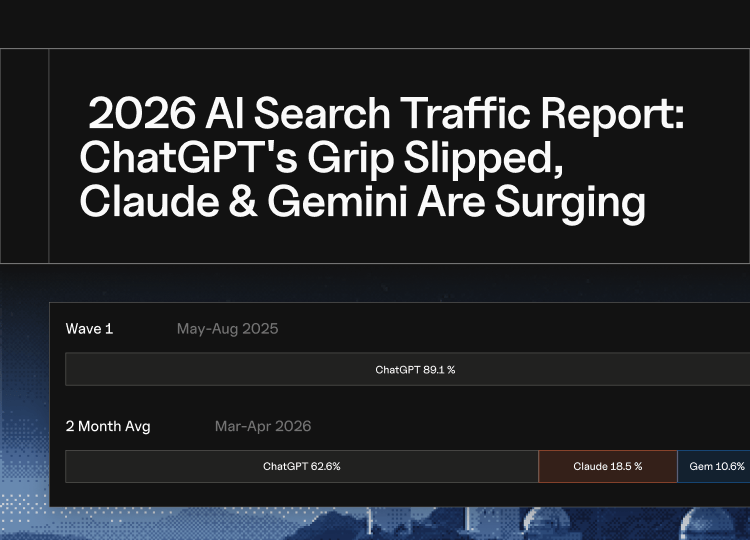
  • 2026 AI Traffic Insights: ChatGPT Fades as Claude & Gemini Rise

    2026 AI Traffic Insights: ChatGPT Fades as Claude & Gemini Rise

    I’ve just delved into Goodie’s enlightening AI search traffic report for early 2026, covering the period from January to April, and I’m excited to share my insights with you. This report dives into trends in usership, referral traffic, and marketing considerations, offering a comprehensive view of the shifting landscape.

    You’ll want to pay particular attention to how ChatGPT’s dominance is starting to wane, with some surprising contenders like Claude and Gemini making waves. This shift could significantly impact how marketers strategize their efforts in AI-driven search optimization.

    The data reveals fascinating patterns in user habits and referral traffic, which could inform future marketing strategies and the allocation of resources. For a full dive into these emerging trends and what they might mean for businesses, I encourage you to explore the detailed findings of the report.


    Inspired by this post on HiGoodie Blog.


    crushpress.ai community screenshot
  • How to Prepare Your Store for Google’s AI Shopping System

    How to Prepare Your Store for Google’s AI Shopping System

    Your products can be easy to find in Google and still be poorly prepared for an AI-assisted purchase. Discovery is only the first test. A product must also be understood, matched with an eligible offer, placed in a cart, and purchased without its price, availability, or terms changing along the way.

    Google is connecting those jobs across Merchant Center, Google Ads, AI Mode, Gemini, Search, Maps, YouTube, Google Pay, and the Universal Commerce Protocol. If you manage ecommerce visibility, your work now extends from SEO and feed optimization to promotion rules, checkout integrity, and AI-specific measurement.

    Google’s shopping stack now connects four different jobs

    Google’s AI shopping ecosystem is easier to understand as a transaction path than as another search feature. At Google Marketing Live 2026, the company connected conversational product discovery, personalized promotions, cross-retailer carts, checkout, payments, and performance reporting.

    LayerWhat Google is addingWhat you control
    DiscoveryConversational Attributes and description updates for matching products to natural-language shopping requestsAccurate, complete, variant-specific product facts
    RecommendationDirect Offers selected with Gemini from eligible discounts, giveaways, local coupons, and bundlesOffer eligibility, commercial limits, exclusions, and campaign guardrails
    TransactionUCP connections among catalogs, carts, checkout, and paymentsReliable product, price, inventory, checkout, and order data
    MeasurementAI Performance Insights and competitive share-of-voice reportingThe business metrics used to judge whether visibility produces valuable orders

    This distinction matters because each layer can fail independently. A product can be eligible but never recommended. It can be recommended with an unsuitable promotion. The offer can be accepted, only for checkout to reject it. A high AI share of voice can also coexist with weak revenue or poor margins.

    Availability is uneven. Conversational Attributes are launching globally, while AI Performance Insights are expected in the United States, Australia, Canada, India, and New Zealand. Direct Offers remains a United States pilot. The new UCP-powered capabilities are rolling out in the United States, with wider expansion expected later. Account access and geography should therefore be go-or-no-go checks before you assign launch dates or forecast revenue.

    Make product data answer the shopper’s decision question

    A countertop appliance is surrounded by visual attribute tiles connected to symbols representing a shopper's needs.

    A conversational product description is not simply a conventional description rewritten in a friendlier tone. It should supply the facts an AI system needs when someone asks a question such as: Will this fit my situation? Which variant is appropriate? What limitation should I know about? What makes this option different from a similar one?

    Merchant Center’s Conversational Attributes let merchants add structured details and update descriptions that Google’s AI can use across AI Mode, Gemini, and other AI shopping environments. That makes factual coverage more valuable than decorative copy.

    1. Collect the questions that appear at the point of choice. Look at site search, product comparisons, support requests, sales conversations, and return reasons. Focus on questions whose answers would change which product or variant a shopper selects.
    2. Convert each answer into an atomic, verifiable fact. Useful areas can include intended use, compatibility, dimensions, materials, fit, included components, care requirements, prerequisites, and limitations. Include only the fields that genuinely apply to the product.
    3. Keep variant facts attached to the correct variant. If size, material, capacity, color, compatibility, or included components differ, a family-level description should not imply that every option has the same properties.
    4. Reconcile the value across Merchant Center, the product page, structured data, the cart, and checkout. Different wording is acceptable; a different factual answer is not.
    5. Remove unsupported superlatives and inferred use cases. An AI system should not have to decide what terms such as best, professional, safe, sustainable, or universal mean for your product.
    6. Record where each claim came from inside your business. Product specifications, policy owners, and approved commercial copy should be traceable so that outdated values can be corrected at their origin.

    Your JSON-LD should reinforce the same product identity and supported facts, but it should not be treated as a substitute for the Merchant Center feed. Use properties with literal, accurate values. Do not force conversational phrases into unsupported schema fields or create markup for claims that the visible product page cannot substantiate.

    A practical validation test is simple: choose a real pre-purchase question and follow its answer through the feed, landing page, selected variant, cart, and checkout. If the answer disappears or changes at any stage, you have a data-governance problem before you have an AI optimization problem.

    Put commercial guardrails around every AI-selected offer

    Direct Offers moves promotions closer to the recommendation itself. Advertisers can upload eligible promotions and campaign guardrails through Google Ads, after which Gemini can curate relevant bundles and discounts from the shopper’s query and browsing context.

    That does not make the AI your pricing strategist. Relevance can help choose among approved offers, but it cannot protect margins, inventory, channel commitments, or customer promises that you have not expressed as rules. Before making a promotion eligible, create an internal offer card that answers these questions:

    • Which offer type is this: discount, giveaway, local coupon, or bundle?
    • Which products and variants are included, and which are explicitly excluded?
    • Which locations, audiences, order conditions, or fulfillment methods qualify?
    • Can the offer be combined with another promotion, loyalty benefit, or payment incentive?
    • When does eligibility begin and end, and what happens to an in-progress cart after expiry?
    • Which inventory or fulfillment constraint should stop the offer from appearing?
    • What commercial boundary must the offer preserve, including margin and maximum exposure?
    • Where can the shopper verify the terms before committing to payment?
    • Has the exact offer been tested through the checkout route on which it will appear?

    AI-generated bundles deserve particular scrutiny. Define which items may be combined, how unavailable components are handled, whether substitutions are permitted, and which total prices are valid. If your rules cannot distinguish an attractive bundle from an unprofitable or unfulfillable one, do not make the components available for automated bundling yet.

    Native checkout increases the cost of an offer mismatch because there are fewer remaining steps in which to explain or correct it. The displayed promotion, cart calculation, checkout total, and payment amount must resolve to the same commercial promise. A silent price change at checkout is not an optimization issue; it is a customer-trust and revenue-control failure.

    Travel businesses should apply the same discipline to dates, inventory, inclusions, and cancellation terms. Booking and Expedia are expected to surface travel offers inside AI-assisted trip planning, where an appealing deal can become misleading quickly if its underlying availability or conditions are stale.

    Treat UCP readiness as a catalog-to-payment integration audit

    A cutaway commerce system connects a product catalog, guarded offer controls, a shopping cart, and a secure payment device on a workbench.

    The Universal Commerce Protocol is intended to connect product catalogs, checkout, and payment experiences across Google surfaces. Its Universal Cart can hold products from multiple retailers, with purchase completion through Google Pay or a retailer’s own checkout system.

    For a merchant, that creates more than one possible ending to the journey. You cannot assume that every shopper will pass through the same landing pages, cart interface, recovery messages, or payment presentation. The handoff itself needs to carry enough accurate state for each route to finish honestly.

    1. Confirm product identity. The catalog item, variant, cart line, checkout line, and order record should refer to the same purchasable thing.
    2. Confirm commercial truth. Price, currency, quantity, promotion eligibility, and final total should remain consistent as the shopper moves between systems.
    3. Test stale inventory. A newly unavailable variant should stop cleanly before payment, without being replaced by a different product or option unless the shopper explicitly approves it.
    4. Test expired and ineligible offers. Checkout should explain why an offer no longer applies instead of silently removing it or changing the total.
    5. Test every enabled payment route. Google has announced Affirm and Klarna buy now, pay later integrations with Google Pay, but you should not advertise a financing option until its availability and terms are confirmed for the actual transaction.
    6. Check the post-purchase handoff. Confirmation, customer support, order status, cancellation, and return instructions must still be available when the journey begins outside your normal storefront path.

    Test failure states as deliberately as the successful purchase. Use sold-out variants, expired promotions, rejected payment attempts, and transfers to the retailer checkout. The goal is not merely to prevent an error screen. It is to ensure that no failure produces a false product, price, entitlement, or order state.

    Google also expects UCP to expand into hotel bookings and food delivery. If you sell services or time-sensitive inventory, model dates, availability, fulfillment choices, and cancellation conditions as transaction data. Page copy alone cannot keep a changing reservation state accurate.

    Measure AI visibility without mistaking it for revenue

    AI Performance Insights is designed to show a brand’s performance across AI-driven environments, including share of voice compared with similar competitors. That is useful diagnostic information, but it is not a complete business outcome.

    Share of voice does not tell you by itself whether the right products appeared, whether an offer protected margin, whether a recommendation produced an order, or whether the order was later cancelled or returned. Build a measurement ladder that keeps those questions separate:

    • Data readiness: Track missing attributes, rejected items, variant inconsistencies, stale descriptions, and differences between the feed and product page.
    • AI visibility: Review AI share of voice and product presence by country and product family where reporting is available.
    • Offer performance: Separate eligible, surfaced, accepted, expired, and rejected promotions using the reporting and transaction data available to you.
    • Checkout integrity: Count price mismatches, inventory failures, promotion removals, payment failures, and transfers that do not complete successfully.
    • Business outcome: Evaluate completed orders, revenue, contribution, cancellations, returns, and support costs. A recommendation that creates a costly order is not a successful recommendation.

    Keep a change log for every material feed, attribute, offer, and checkout update. Record the affected products, markets, date, commercial rule, and transaction version. Compare equivalent segments before and after the change, and avoid combining a description rewrite, a new bundle, and a checkout migration into one untraceable launch.

    Ask Advisor is also expected to enter Merchant Center. Use advisory output to find questions worth investigating, not as proof that a diagnosis is correct. Your product records, promotion rules, checkout tests, and completed transactions remain the evidence.

    FAQ: Google’s AI shopping rollout

    Do you need UCP before optimizing for conversational discovery?
    No blanket dependency has been established in these launches. Conversational Attributes are Merchant Center discovery controls, while UCP connects carts, checkout, and payments. Run them as connected workstreams, but do not treat them as the same eligibility switch.

    Should you rewrite every product description in a conversational tone?
    No. Start with missing decision facts, variant accuracy, and consistency. Friendly prose cannot compensate for absent compatibility, fit, material, inclusion, or limitation data.

    Is AI share of voice a primary ecommerce KPI?
    It is better used as a visibility diagnostic. Pair it with offer acceptance, checkout integrity, completed orders, and unit economics before deciding that performance improved.

    Can Google decide which discount your store should offer?
    You supply eligible promotions and campaign guardrails. If an eligibility rule, exclusion, or economic boundary has not been defined and tested, keep that offer out of automated selection.

    Start with a commercially important product family that has clean variant data, dependable inventory, and an offer you can explain in one sentence. Complete its Merchant Center facts, define its promotion rules, test every enabled checkout route, and capture a performance baseline. Expand only after the full path remains accurate. In AI commerce, clear operational truth gives the system fewer opportunities to guess.

    References

  • Discover Google Chrome Lighthouse’s New AI Scan Feature

    Discover Google Chrome Lighthouse’s New AI Scan Feature

    I’ve recently discovered that Google has introduced a new feature in Chrome Lighthouse to check for llms.txt files. Though Google mentions that llms.txt isn’t necessary for AI search visibility, Lighthouse has started flagging sites based on their presence.

    Google’s latest Lighthouse audits, under the “Agentic Browsing” category, now focus on a site’s usability for machine interaction. I find this interesting as it aligns with Google’s push towards better machine readability.

    The new audits are part of Chrome’s evolving “Agentic Browsing” features, which analyze if sites are prepared for automated interaction. This concept came soon after Google issued guidance on AI search optimization, debunking the necessity of llms.txt files in their new guide on generative AI features.

    What Lighthouse Evaluates Now. Lighthouse’s Agentic Browsing tests focus on how well my site is built for machine interactions, incorporating various deterministic audits as per Google’s documentation. These checks include:

    – WebMCP integration.

    – Accessibility tree integrity.

    – Layout stability through CLS.

    – Presence of an llms.txt file.

    These audits help ensure that there’s a machine-readable summary at the site’s domain root. Google explains that without llms.txt, agents might take longer to understand a site’s main structure.

    The impact of these audits doesn’t translate into a traditional Lighthouse score but into a fractional pass ratio related to agentic readiness signals.

    The Tension. Interestingly, while these audits don’t directly affect SEO rankings, their mention in Google’s readiness checks could make SEOs reconsider their stance on llms.txt files.

    Agentic Engine Optimization. Google’s approach aligns with insights shared by Addy Osmani from Google Cloud AI about Agentic Engine Optimization. Osmani emphasizes creating web content that is semantically structured, token-efficient, and easy for AI to process.

    SEO vs. llms.txt. According to Google, creating llms.txt or similar files isn’t necessary for AI search success, as outlined in the guide on Mythbusting generative AI search. The AI systems can discover, crawl, and index a variety of file types encountered on the internet.

    John Mueller from Google responded to concerns about the role of llms.txt in a discussion with Lily Ray on Bluesky, stating that the use of these files is more for functionality and not directly linked to search engine optimization.

    Google’s Take on AI Agents. Besides llms.txt, Google’s Lighthouse guidelines place strong emphasis on accessibility and interface stability. The insight I gained is that AI agents heavily rely on the accessibility tree as their core data model, focusing on integrity and proper layout.

    Ultimately, while Google indicates llms.txt isn’t needed for search, including such files might be beneficial for adapting to Google’s evolving tools that prioritize machine readability.

    Further Exploration.

    – Meet llms.txt, a proposed standard for AI website content crawling

    – llms.txt isn’t robots.txt: It’s a treasure map for AI

    – Does llms.txt matter? We tracked 10 sites to find out


    Inspired by this post on Search Engine Land.


    crushpress.ai community screenshot
  • Unlock Coding Potential with the Profound API Cookbook

    Unlock Coding Potential with the Profound API Cookbook

    Hey there! I’m excited to introduce you to something that has truly changed the way I approach coding projects—the Profound API Cookbook. If you’ve ever started with the thought, ‘I want this number,’ and wished for a seamless way to transform that into runnable code, this is for you.

    Imagine having a collection of end-to-end recipes right at your fingertips, perfectly layered on top of our REST API references. This isn’t just about coding; it’s about enhancing your workflow and efficiency in a whole new way. Each recipe is designed to guide you from concept to execution with ease.


    Inspired by this post on Try Profound Blog.


    crushpress.ai community screenshot
  • Mastering Entity Optimization: Boost AI Understanding of Your Brand

    Mastering Entity Optimization: Boost AI Understanding of Your Brand

    Entity optimization might sound like a complex term, but trust me, it’s incredibly powerful when you’re trying to make AI understand your brand better. Essentially, my goal is to help AI see exactly who I am and what I’m about. Let me share more about how you can do the same.

    When I optimize entities related to my brand, I start by clarifying what my brand represents. This means ensuring that all my online content clearly reflects my brand’s identity and core values. By creating a strong, consistent message, AI can better understand and categorize my content.

    Next, I focus on strengthening associations. This involves connecting my brand with relevant entities and concepts within my industry. When AI detects these connections, it increases my brand’s relevance in related searches.

    Finally, driving accurate AI citations is crucial. I make sure that any references to my brand on different platforms are correct and consistent. This helps in building trust with AI, ensuring that it can reliably reference my brand in the right contexts.


    Inspired by this post on HiGoodie Blog.


    crushpress.ai community screenshot