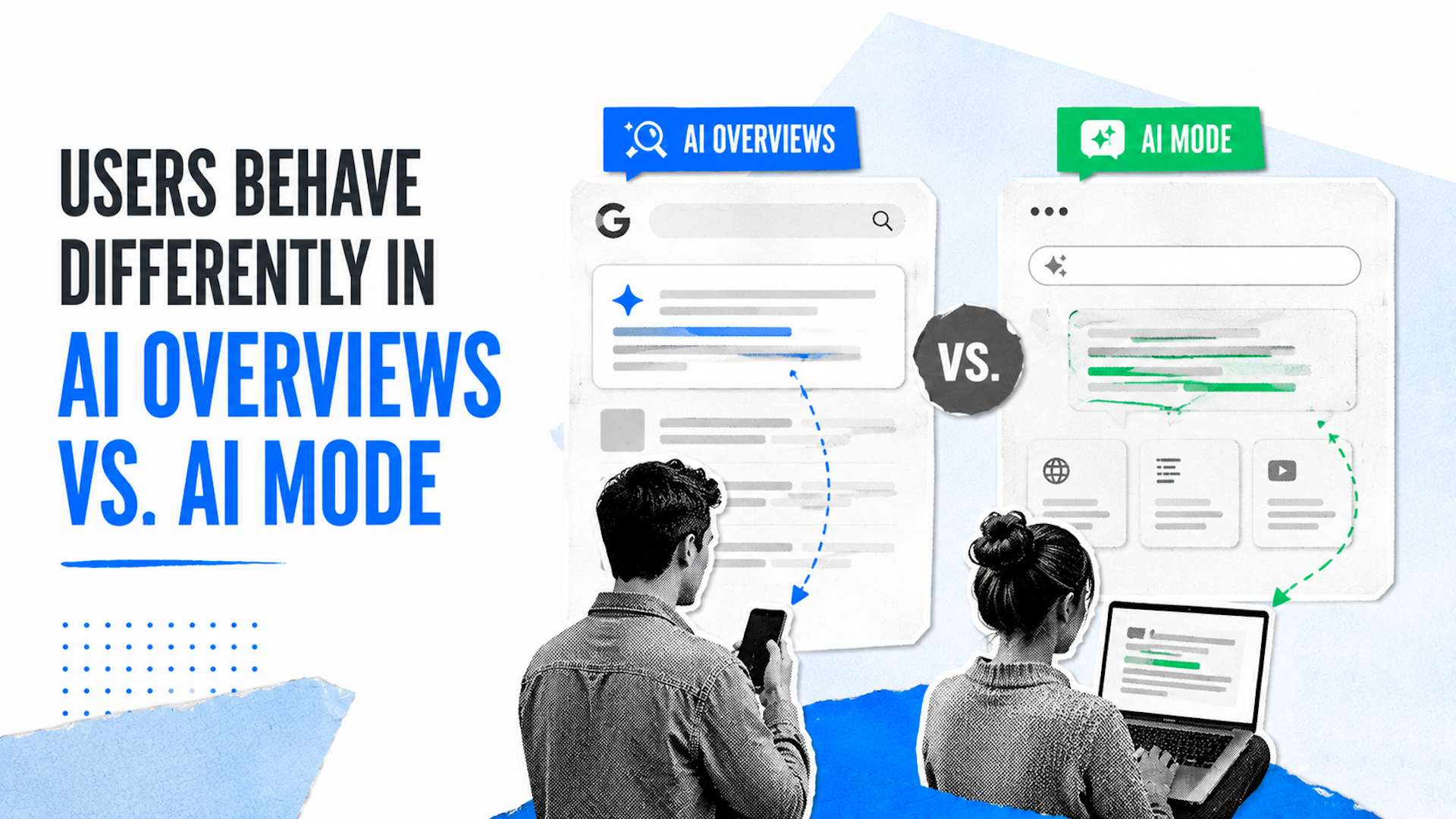
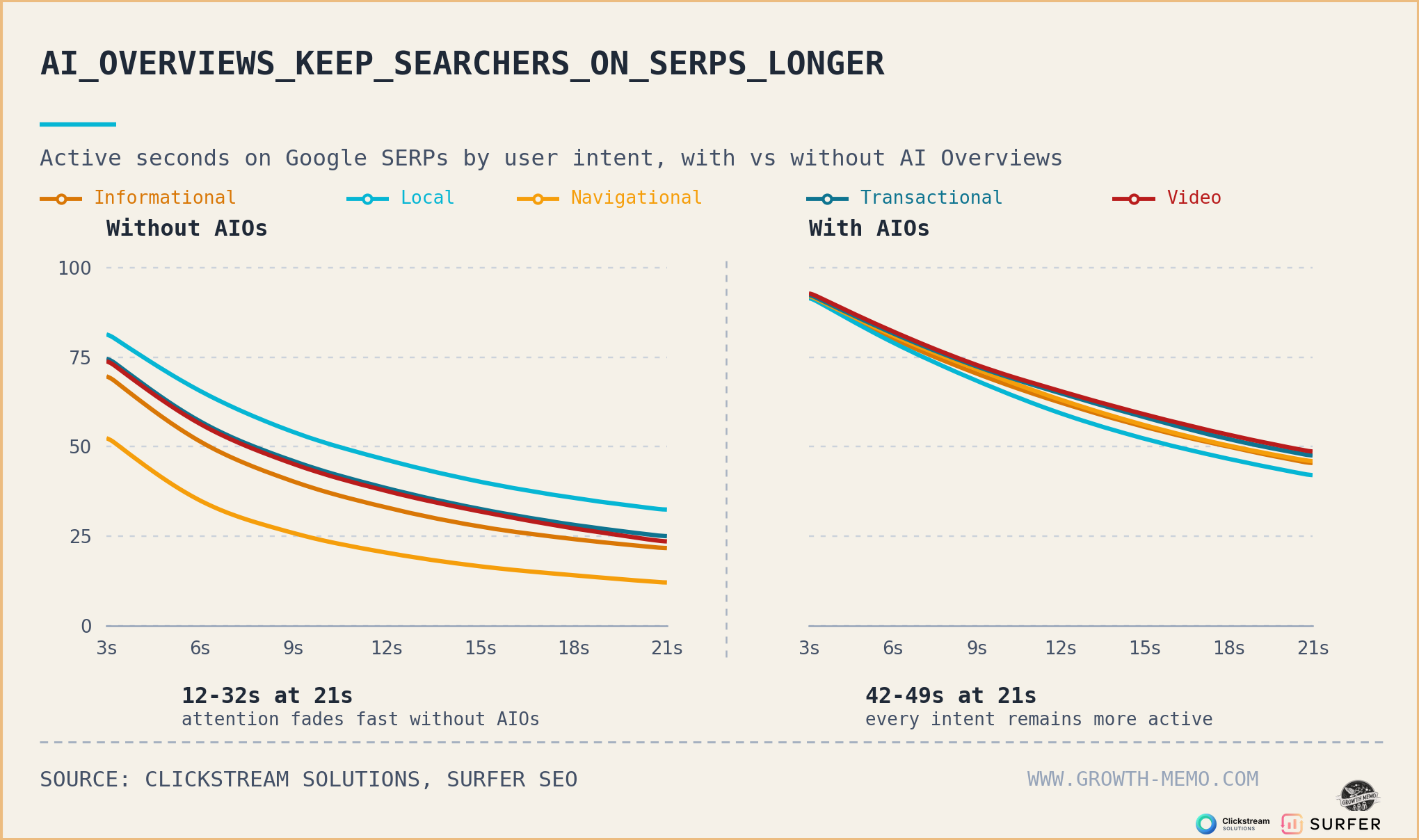
I find it fascinating that users interact differently when faced with AI Overviews compared to AI Mode. New clickstream data reveals that AI Overviews significantly alter user behavior—from reverse scrolling to extended evaluation of search results across various intents.
Take Netflix, for example. The average user spends about 18 minutes just browsing. They skim through tiles, watch trailers, and often circle back. It turns out, searching isn’t much different these days, thanks to new insights.
This week, I’m diving into:
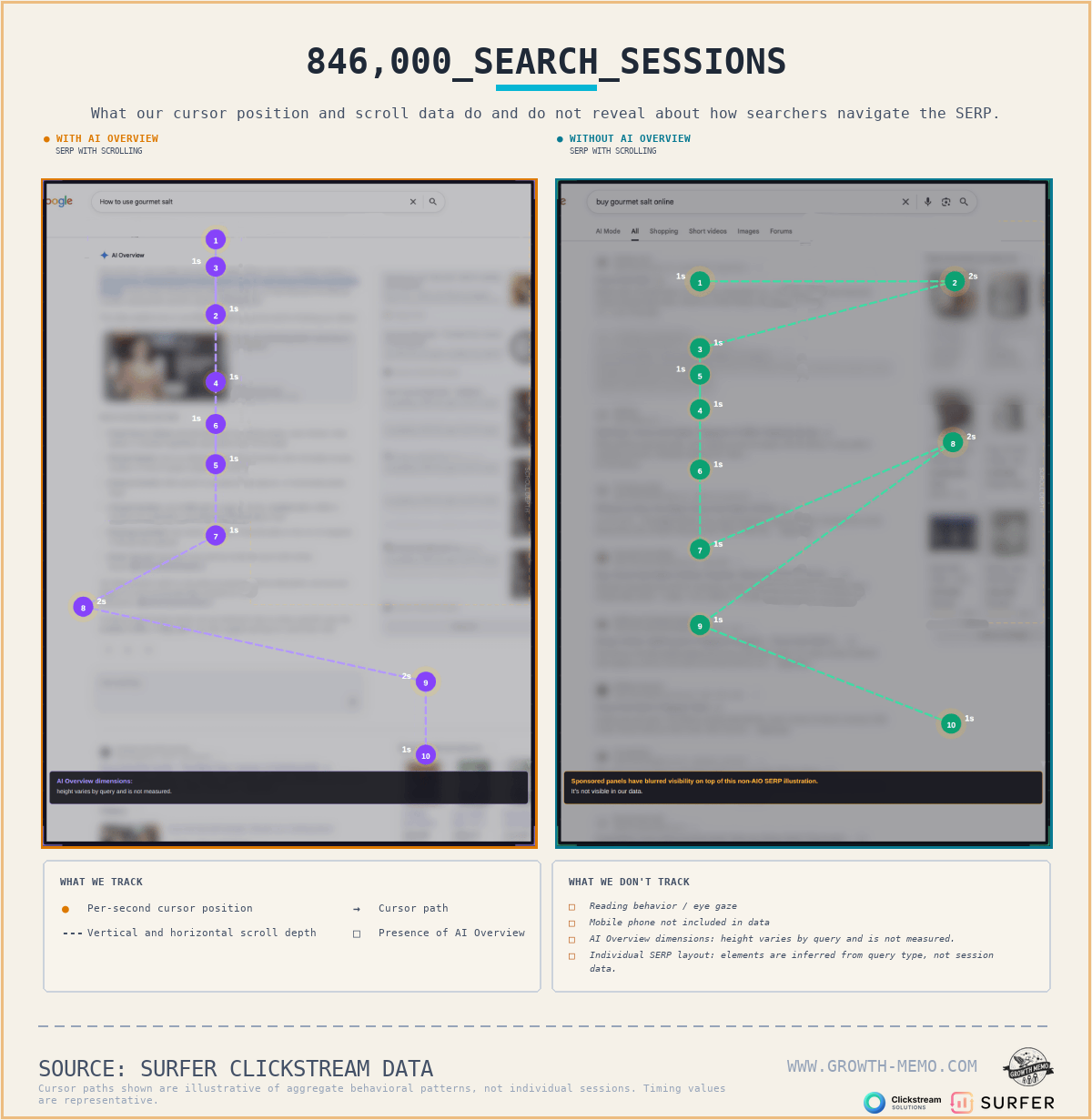
Four notable behavioral shifts observed with AI Overviews, gathered from over 846,000 Google sessions.
The evolving role of brand-name searches and why they no longer offer the same shortcuts.
An insight that might change how you craft title tags and meta descriptions this quarter.
Eric Van Buskirk from Clickstream Solutions mined anonymized clickstream data supplied by Surfer SEO. The study analyzed around 846,000 U.S.-based Google searches from February and March of 2026.
This marks the fifth study on user behavior with Google’s AI features over the past year. Earlier, a UX study on 70 users in May 2025 utilized think-aloud and screen recording methods, while a study from October 2025 examined AI Mode specifically. This research trades depth for scale, uncovering patterns too subtle for smaller studies.
For a bit of context, previous SERP mouse-tracking studies involved only a handful of people—this one, however, evaluates queries from tens of thousands of users.
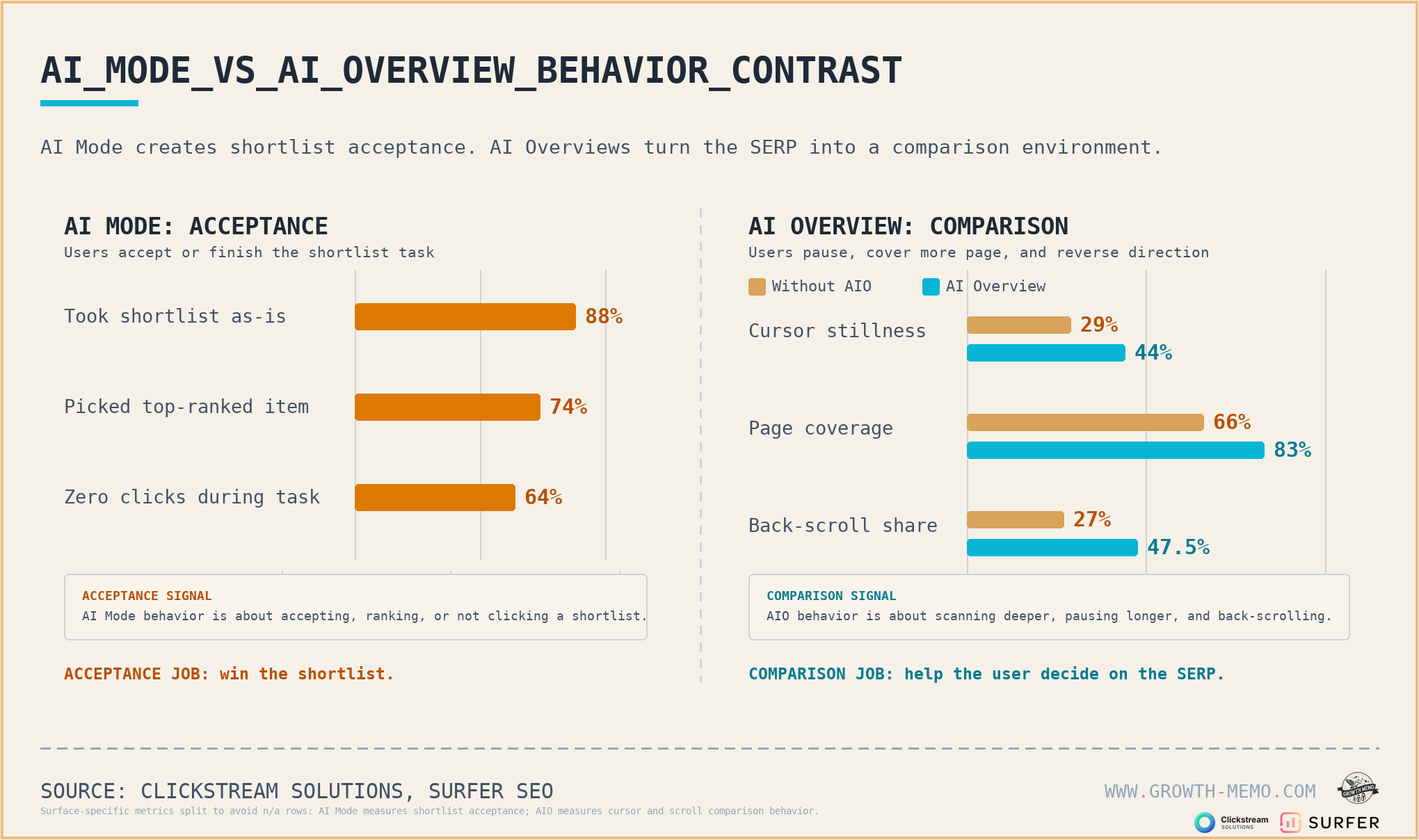
A fascinating contrast surfaces: User behavior in AI Overviews starkly opposes that in AI Mode, where AI Mode is akin to autoplay, while AI Overviews replicate the browsing experience.
This article outlines four major findings from this recent study and how they might influence your title tags and meta descriptions in 2026. Full methodology available here.
With groundbreaking insights, like how nearly half of AI Overview interactions involve reverse scrolling and how search types no longer reliably predict behavior, this data is invaluable. It challenges traditional assumptions and has meaningful implications for e-commerce and decision-heavy categories.
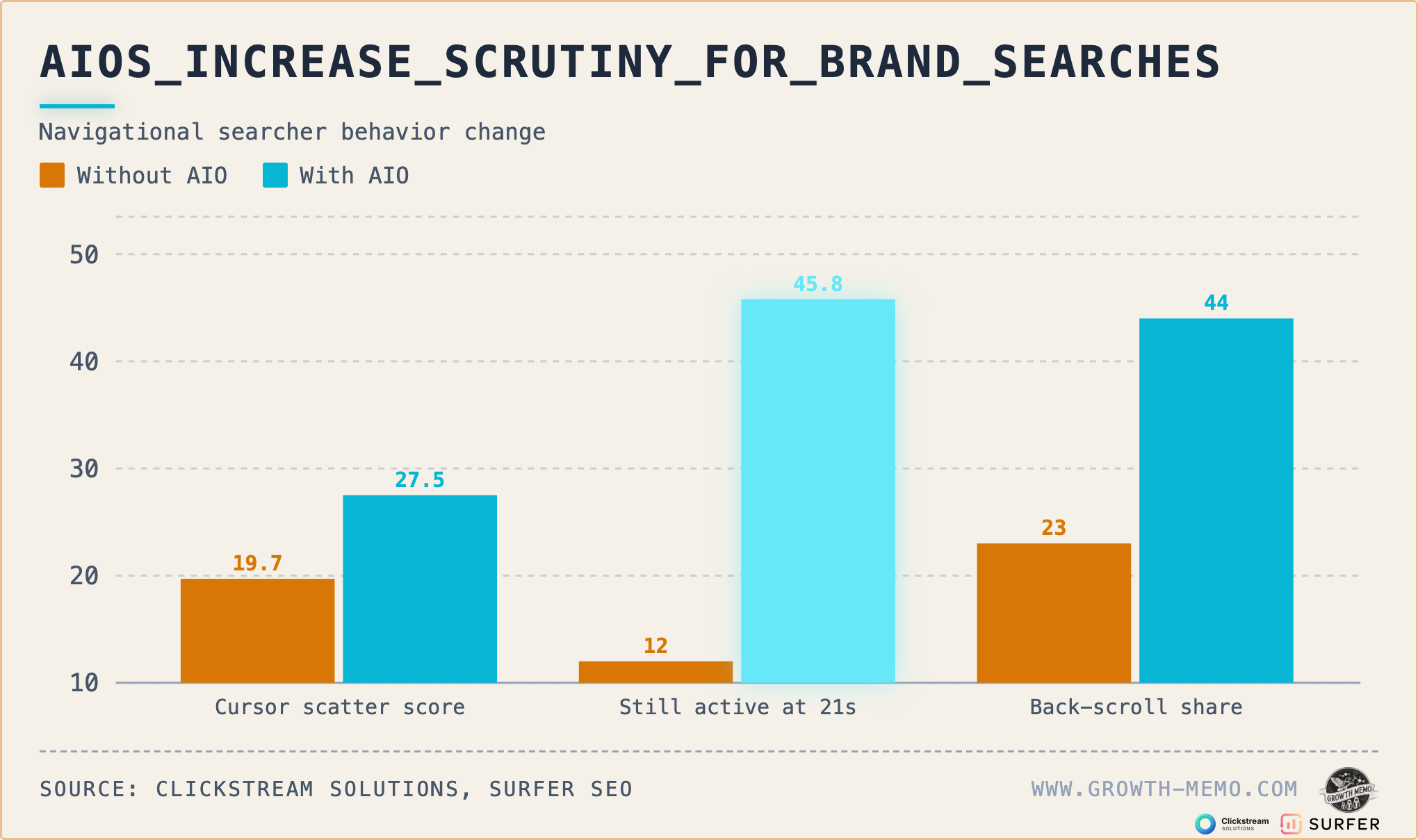
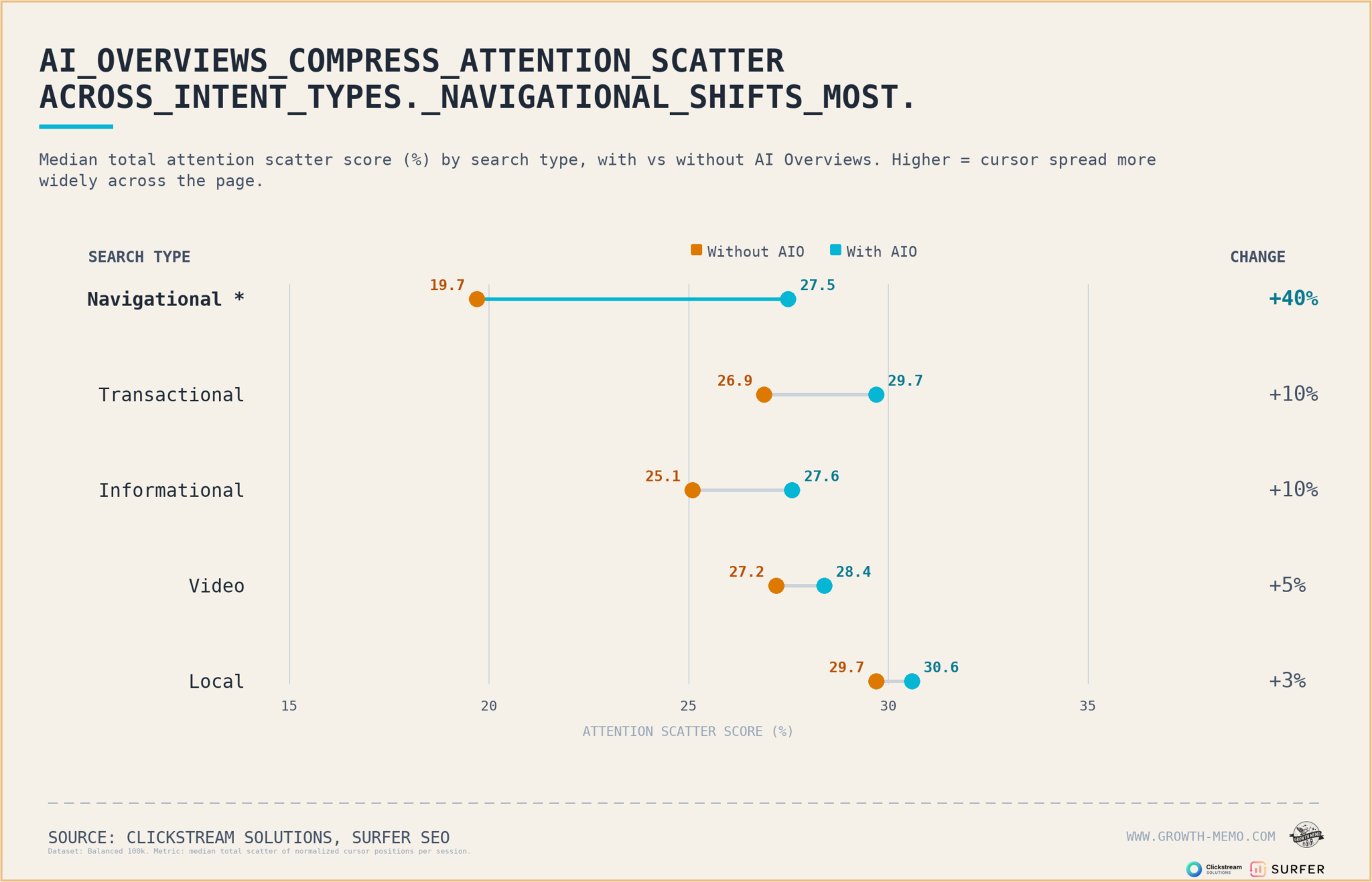
Surprising findings include brand searches losing their shortcut advantage, implying even users searching specifically for brands might pause to consider adjacent content on the SERP.
Read more intriguing insights on how the AI landscape shifts user engagement and strategy in SEO.
If your organic traffic depends on Google sending a click for every useful answer, you have a planning problem. Search is becoming more capable of explaining options, narrowing choices and helping people act without following the familiar results-page journey.
You don’t need to abandon SEO or guess at an entirely new playbook. You need to make your content easier for people and machines to understand, verify and use, then measure the business outcomes that remain after clicks become less predictable.
Plan for a task layer, not just a results page
The important change isn’t simply that Google can generate longer answers. Google’s stated direction brings Search, Gemini and agentic tools toward a more unified product capable of assisting with end-to-end tasks. An agent might help someone investigate a problem, compare possible solutions and take the next step within one continuous interaction.
Treat that as a direction of travel, not a finished product or a release schedule. Your practical response is to examine the jobs your pages help visitors complete. A page that merely attracts a broad query is vulnerable when an AI interface can satisfy that query directly. A page that supplies distinctive evidence, decision criteria, current business information or a useful action remains relevant to a deeper journey.
Start with your highest-value landing pages. Write down the decision each one supports and the action a qualified visitor should take next. If you can’t name either, the page probably has an unclear role. Tighten it before producing more content around the same keyword.
Google continues to describe the open web as part of its search experience, even while acknowledging that some clicks may disappear. That combination should shape your strategy: stay accessible to discovery systems, but stop treating a click as the only proof that your information created value.
Build pages around decisions an agent can support
Traditional keyword planning often stops after identifying what someone types. Agentic search requires a fuller model: what is the person trying to decide, what facts would change that decision, and what could prevent the next action?
Answer the immediate question without ending the journey
Put a direct answer near the point where the question appears. Then add the conditions that make the answer vary. If you sell a service, that may include who it fits, who it doesn’t fit, what inputs affect price, what preparation is required and what happens after an inquiry. If you publish educational content, show how readers can apply the answer and recognize when another option is better.
This gives an answer system a clear passage to interpret while giving a serious buyer reasons to continue. It also prevents a common failure: producing a concise answer that is technically extractable but too generic to establish why your brand deserves consideration.
Expose the comparison criteria
People rarely need more adjectives. They need dimensions they can compare. Replace claims such as “flexible,” “advanced” or “best for growing teams” with the facts behind them: compatible use cases, constraints, required inputs, available service areas, purchasing conditions and the tradeoffs between options.
Use consistent labels across related pages. If one page calls an offering a plan, another calls it a package and a third treats it as a product, you create unnecessary ambiguity. A stable vocabulary helps readers compare choices and gives automated systems a clearer entity model.
Make the next action explicit
Inspect every conversion path from the perspective of someone who has already received a competent summary elsewhere. That person may arrive ready to verify one detail and act. Put eligibility, availability, price structure, required information and the next step where they can be found without restarting the entire education journey.
Use descriptive action labels. “Check availability,” “request an assessment” or “compare plans” communicates more than “learn more.” Keep the destination aligned with the promise. An AI-assisted journey will not rescue a vague form, missing terms or a landing page that changes the subject.
Make your meaning verifiable with content and schema
Schema is useful when it expresses facts that are already clear on the page. It isn’t a substitute for missing information, and it doesn’t guarantee inclusion in an AI response. Think of JSON-LD as a machine-readable agreement with your visible content.
Choose schema types that match the actual entity and page purpose, such as Organization, Person, Product, Service or Article. Connect entities consistently. Names, URLs, authorship, offers and other properties should agree with what a visitor sees. If the business changes a price, service name or availability condition, update both the page and its markup as one publishing task.
Don’t add FAQ markup simply because question-shaped text looks attractive for search. Use it only when the page contains a genuine visible FAQ, and make every marked answer match the displayed answer. The same rule applies to reviews, offers and organizational details: describe what exists rather than decorating the page with attributes you hope a system will infer.
Verification also happens in the prose. Show who created or reviewed consequential content. State the basis for recommendations. Identify where a claim applies and where it doesn’t. Keep time-sensitive facts maintained. Link related pages through meaningful relationships instead of publishing disconnected variations of the same target phrase.
Finally, test the rendered page and the generated markup. A valid JSON-LD block can still describe the wrong entity, preserve an old value or conflict with visible copy. Your quality check should ask two separate questions: does the syntax work, and is the meaning accurate?
Measure qualified outcomes when raw clicks decline
Google has framed some disappearing traffic as low-quality or bounce-prone traffic. Treat that as a hypothesis to test in your own data, not permission to ignore falling visits.
Segment performance by landing-page purpose and query intent. Separate broad informational discovery from product evaluation, branded navigation and action-oriented visits. Then compare impressions, visits, meaningful engagement, leads, sales, subscriptions and retained customer value where those measures apply. A smaller audience can be healthy if the lost visitors never progressed. It is a warning if qualified demand, revenue or brand discovery falls with it.
Watch for mismatched signals. Stable visibility with fewer visits may indicate that answers are being consumed before the click. Stable traffic with weaker conversion may point to a page or offer problem. Falling non-branded discovery alongside stable branded demand may mean your existing audience still finds you while new prospects do not. Each pattern calls for a different response.
Publishers should also decide which relationships they want to own. Google has highlighted support for subscription-oriented experiences as publishers adapt to changing traffic patterns. A subscription can be part of that response, but only when you offer recurring value worth returning for. Email, saved tools, accounts, communities and customer data can serve the same strategic purpose: turning rented discovery into a direct relationship.
Annotate major content, template, schema and conversion changes so you can connect movement to a plausible cause. Don’t combine every AI-related metric into one visibility score. Keep enough detail to see whether you are being discovered, selected, visited and trusted to complete a business action.
Key takeaways
Audit important pages by the decision and next action they support, not only by the keyword they rank for.
Give direct answers, then add constraints, comparisons and evidence that make your contribution distinctive.
Make conversion paths usable for visitors who arrive late in the journey and are ready to verify or act.
Measure qualified demand and owned relationships alongside traffic so fewer clicks don’t automatically produce the wrong conclusion.
Your next move is small but consequential: choose one commercially important page, define the decision it helps a visitor make, correct its facts and schema, and remove friction from the next action. That work remains useful whether Google sends a traditional result, generates an answer or introduces an agent into the journey.
You do not need another advertising dashboard that promises smarter automation. You need to know whether an AI-powered platform can reach the right people, optimize for a business result, and prove that it contributed to that result.
The safest way to evaluate these platforms is to separate reach, decision-making, and measurement. When those three layers are clear, you can use automation without surrendering control of your budget or accepting a platform’s preferred version of success.
Choose the buying journey before you choose the platform
Start with the moment you want to influence. A visual discovery campaign and a conversational recommendation may both use AI, but they address different behaviors.
Google is consolidating visual discovery inventory inside Demand Gen. A campaign can reach people across YouTube, Discover, Gmail, Maps, and Google Display Network sites. Advertisers can manage Display placements through Demand Gen and, when needed, keep delivery limited to the Display Network.
That setup is useful when your job is to create or reinforce demand across visual environments. It can support product discovery, introduce a service, or bring a previous visitor back with a stronger message.
Conversational advertising is developing around a different moment. OpenAI is preparing ads intended to generate purchases, appointment bookings, and contact-form submissions. The reported direction includes paying for completed outcomes rather than impressions, with an initial emphasis on smaller and local businesses. These capabilities are still emerging, so they belong on a readiness plan rather than in a forecast as guaranteed inventory.
Write one sentence before opening any platform: “We need this campaign to move a person from ___ to ___.” If the first blank is awareness and the second is consideration, broad visual distribution may fit. If the person is already discussing a need and the second blank is a booking or purchase, a conversational placement may eventually fit better. If you cannot complete the sentence, the platform will end up defining the campaign for you.
Evaluate AI at three separate layers
Calling a product “AI-powered” tells you very little. Ask what the system controls at each layer and what you can still inspect.
Layer
Question to ask
Evidence you should require
Distribution
Where can the platform place the ad?
A channel list, placement controls, exclusions, and a delivery breakdown
Decision-making
What signals determine who sees it and when?
Optimization settings, audience inputs, creative combinations, and change history
Measurement
What event counts as success?
A written conversion definition, deduplication rules, attribution settings, and reconciliation with your own records
This separation prevents a common mistake: treating more inventory as proof of better performance. Wider reach gives an algorithm more opportunities to serve ads. It does not automatically mean those opportunities are equally valuable.
For every automated expansion option, ask for a channel-level answer to three questions: How much did we spend? What did we receive? Would those conversions have happened through another channel anyway? If reporting cannot help you investigate those questions, do not increase the budget merely because the blended result looks efficient.
Build measurement before the algorithm starts learning
An optimization system can only pursue the signal you give it. If a low-value form submission and a completed sale are recorded as equivalent conversions, AI will optimize toward whichever event is easier to generate.
Name the business outcome. Use an event such as a qualified appointment, accepted lead, completed purchase, or retained customer. Avoid treating a page view as the final result when revenue happens later.
Document the event path. Record where the event begins, which system confirms it, and which identifier connects the ad interaction to the customer record.
Assign values that reflect the business. If outcomes have different economic value, send distinct values or separate them into different conversion actions.
Reconcile platform data with your records. Compare reported conversions with confirmed orders, bookings, or qualified leads. Investigate gaps before changing bids or budgets.
Define the feedback loop. Decide how cancellations, refunds, duplicate leads, spam, and unqualified enquiries will flow back into campaign analysis.
This work matters even more for conversational ads. OpenAI’s reported performance-advertising plans include a website pixel and API connections for conversion data. Pixel-only tracking can lose visibility because of browser restrictions and ad blockers. An API connection can provide a stronger path for confirmed customer actions, but only if your systems use stable identifiers and consistent event definitions.
Do not wait for a new platform to launch before cleaning up this layer. A reliable conversion specification can be reused across Google, Meta, a future ChatGPT campaign, and your internal reporting. It also gives finance, sales, and marketing one shared definition of a result.
Run a controlled test instead of handing over the account
Automation needs room to find patterns, but a useful test still needs boundaries. The goal is to learn whether the AI-controlled change produces incremental business value.
Choose one decision to test. For example, test the addition of Display inventory rather than changing inventory, creative, bidding, and the landing page at the same time.
Keep a comparison point. Preserve a campaign, channel view, geographic segment, or previous operating setup that helps you distinguish the tested change from normal demand fluctuations.
Set guardrails before launch. Define the permitted inventory, excluded placements, eligible locations, daily budget, conversion action, and the business metric that can stop the test.
Review placement and channel mix. A good blended cost can conceal weak delivery in one part of a cross-channel campaign.
Inspect lead and revenue quality. Compare platform conversions with accepted leads, fulfilled bookings, net sales, or another downstream result your team trusts.
Record every material change. Without a change log, you cannot tell whether performance moved because of the algorithm, new creative, tracking repairs, or a budget adjustment.
Channel controls are especially important as Google moves more Display management into Demand Gen. The ability to use broad cross-channel delivery or remain on the Display Network gives you a practical testing sequence: establish how the narrower setup behaves, expand deliberately, and then inspect where the additional spend went.
Use the same discipline when conversational ads become available to your business. A pay-for-success model sounds low-risk, but the definition and verification of “success” determine what you actually buy. Confirm whether the billable action is a submitted form, a qualified lead, a kept appointment, or a completed transaction. Those events are not interchangeable.
Key takeaways
Match the platform to the buying moment: visual discovery and conversational intent solve different problems.
Assess distribution, decision-making, and measurement separately instead of accepting “AI-powered” as a complete capability.
Give the algorithm a conversion that represents business value, then reconcile its reports with confirmed customer records.
Expand inventory through a controlled test with channel reporting, budget limits, exclusions, and a comparison point.
Treat emerging ChatGPT advertising as a planning opportunity until its formats, access, pricing, and measurement are available to your account.
Your next step is not to move the whole budget into an AI-led campaign. Write the conversion specification, audit the tracking path, and select one contained inventory or optimization decision to test. That gives the platform enough freedom to help while keeping the business outcome under your control.
Your Google Business Profile is complete, your name and address are consistent, and you collect reviews. Yet when someone asks an AI assistant for the best provider in your area, your business is missing.
The gap is usually bigger than one listing or one page. Websites, business profiles, citations, and reviews remain foundational, but AI recommendations also reflect what the wider web says about a business. You need a repeatable way to find those external signals, strengthen them, and automate the routine work without spreading bad information.
Key takeaways
Track repeated AI recommendations before deciding which citations matter.
Prioritize domains that appear in answers for valuable local questions, not every directory you can find.
Automate approved listing submissions and data updates, while keeping outreach and editorial claims under human review.
Make your business details, service descriptions, and review themes consistent enough to reinforce one clear local identity.
Measure recommendation frequency and cited-source coverage, not just whether a listing was created.
Measure the recommendation gap before adding citations
Start with the questions a prospective customer would actually ask. A plumber might test “Who repairs hot water tanks in Denver?” alongside questions about emergency availability, weekend service, pricing, and specific neighborhoods. A restaurant, clinic, or agency would use a different set based on its services and buying journey.
Record the prompt, location, brands mentioned, cited domains, answer position, and date. Run each important query repeatedly because AI responses can vary between runs. Twenty runs per core query can expose recurring recommendations that a single test would miss.
Separate two observations in your worksheet. First, which competitors are recommended most often? Second, which websites are used to support those recommendations? The second question gives you a practical citation target list. It may reveal directories, local publications, industry resources, review platforms, videos, podcasts, forums, or city-specific roundups.
Do not treat every brand mention as equally useful. A mention on a site that repeatedly appears beside a high-intent query deserves more attention than a listing on a large directory that never surfaces in your results.
Turn cited domains into a prioritized citation queue
Create one row for every domain found during monitoring. Then score each opportunity using criteria you can verify:
Query relevance: Does the domain appear for a service and location you want to win?
Recurrence: Does it surface across several runs or only once?
Local or industry fit: Does the site serve your city, customer group, or professional category?
Placement type: Can you claim a listing, correct an existing profile, contribute expertise, earn editorial coverage, or participate in the community?
Accuracy risk: Could an automated submission create duplicate profiles or overwrite verified details?
Assign each domain to one of three queues. The first is claim or correct: existing profiles, directories, and review pages you can control. The second is earn: local news coverage, industry publications, podcasts, videos, and best-of lists that require a credible pitch or contribution. The third is participate: forums, social networks, and community spaces where useful engagement can build genuine recognition over time.
This classification prevents a common mistake: treating citation building as bulk directory submission. AI visibility depends on the broader reputation surrounding your business, so local publications, industry channels, communities, and review platforms can matter alongside traditional listings.
Automate placement without automating judgment
Citation automation is most useful when the destination and business data have already been approved. It can reduce repetitive work when placing a brand in eligible listings, freeing time for higher-value strategy. It should not decide what your company claims, invent local relevance, or impersonate genuine community participation.
Build a canonical business record before connecting any automation. Include the exact brand name, primary category, physical address or service-area description, phone number, website, hours, booking method, services, cities and neighborhoods served, approved business description, and links to official profiles.
Then use a controlled workflow:
Approve the destination. Confirm that the platform is relevant and that a listing does not already exist.
Map the fields. Match each destination field to the canonical record rather than generating a new answer each time.
Validate before submission. Flag missing categories, conflicting hours, unsupported claims, and possible duplicates for review.
Save evidence. Record the submitted URL, status, date, and version of the business data used.
Recheck published profiles. Confirm that the destination displays the correct information and working links.
Monitor changes. When hours, services, or contact details change, update the canonical record first and then distribute the approved revision.
Keep editorial outreach outside the unattended workflow. Guest contributions, podcast pitches, community replies, and requests for inclusion require context. Automation can prepare a queue and surface contact details, but a person should decide whether the approach is relevant and truthful.
Make every citation reinforce usable local evidence
A correct name, address, and phone number establish identity, but they do not answer why someone should choose you. Strengthen important profiles with specific facts about services, locations, availability, booking, qualifications, pricing approach, and customer fit. Only include details you can keep accurate.
Use explicit sentences when a platform allows a description. “Rescue Plumbing offers drain cleaning in Denver” is clearer than “We offer a complete range of solutions.” The first sentence identifies the business, relationship, service, and location. This subject-predicate-object structure reduces ambiguity for readers and machines.
Apply the same clarity to your own site. Put the direct answer near the beginning of a relevant page, then support it with process details, examples, common questions, and first-hand expertise. Cover what you do, who you serve, where you operate, when you are available, how customers book, what makes the service different, and what it costs when that information can be stated responsibly.
Reviews add another layer of evidence. Do not rely on one platform alone. Reviews across Google, Yelp, BBB, Facebook, and relevant industry platforms can create a broader view of customer experience. Ask customers to describe the service received, the problem resolved, punctuality or professionalism, and whether the outcome met their needs. Never tell them what sentiment to express.
Respond to reviews with useful context. A response can confirm the service, location, or process without repeating private customer information. It also gives you a chance to correct misunderstandings calmly and show how the business handles feedback.
Review your tracking sheet on a consistent schedule. Watch recommendation frequency for priority queries, the share of recurring cited domains where your brand has an accurate presence, unresolved listing errors, and whether new third-party mentions begin appearing in answers. Visibility can fluctuate, so judge progress across repeated observations rather than one favorable screenshot.
Your first move is simple: choose five commercially important local questions, run each one repeatedly, and log every cited domain. That small evidence set will tell you where citation automation can help and where your reputation still has to be earned.
Your SEO dashboard shows a sharp decline after a release. Before you explain it to leadership, you need to answer two separate questions: did search performance actually change, and can you trust the data showing the change?
A reliable answer requires more than another chart. You need a record of what changed, monitoring that catches technical symptoms, and a reporting process that labels uncertain or stale data before anyone treats it as fact.
Build one evidence chain from deployment to outcome
Most SEO reporting failures begin with disconnected evidence. Engineering has deployment logs. Content teams have CMS histories. SEO has crawls, rankings, Search Console, analytics, and visibility tools. Each system may be accurate, yet nobody can reconstruct the full sequence.
Your operating model should connect four events: the change was approved, the change went live, monitoring detected a result, and a person interpreted the business impact. That sequence lets you distinguish correlation from a plausible cause.
This matters because changes that look routine can alter search visibility. A CMS release can remove important page copy. A product rollout can create conflicting canonicals. Updates to metadata, structured data, internal links, hreflang, redirects, or robots.txt can affect how search systems discover and understand pages. These are precisely the kinds of changes an SEO-aware changelog should expose.
Give every release or content change a shared identifier. Put that identifier in the deployment record, SEO changelog, monitoring annotation, and later performance analysis. When clicks fall, you can move from a chart to the relevant URLs, release, owner, and hypothesis without searching several tools for matching timestamps.
Record enough context to investigate the change
A changelog is useful only if someone who was not involved in the release can understand it later. Avoid entries such as “SEO updates” or “template fix.” They record activity without recording evidence.
Field
What to record
Why it matters
Change
The element added, removed, or modified
Defines what investigators should verify
Scope
Templates, directories, markets, page types, or named URLs
Creates a testable affected group
Reason
The problem being solved or opportunity being pursued
Preserves the original hypothesis
Timing
Deployment time and relevant rollout stages
Anchors before-and-after analysis
Owner
The team or person who can confirm implementation details
Shortens follow-up when behavior is unclear
Expected effect
The metric or technical behavior expected to change
Prevents vague retrospective claims
Observed effect
What happened after enough usable data became available
Turns the log into an organizational memory
Evidence
Ticket, pull request, crawl comparison, screenshot, or report link
Makes the entry auditable
Write scope in terms that monitoring systems can reproduce. “Product pages” is weak if the site has several product templates. “URLs using template X in these market folders” gives you a cohort that can be crawled and compared with unaffected pages.
Capture expected impact before the result is known. If a structured-data update is intended to improve eligibility for a search feature, say so. If a robots.txt change is intended to reduce crawling of a particular path, name that path. The expectation can be wrong; its purpose is to make the decision testable.
Monitor the change separately from its search symptoms
Deployment confirmation does not prove that the intended output reached every affected page. Monitoring should first verify implementation, then watch for search consequences.
Confirm the deployed output. Crawl or inspect representative URLs from the affected group. Check the rendered page and search-facing elements, not merely the CMS setting or code diff.
Compare the affected cohort. Separate changed pages from stable pages. If both groups move together, the release becomes a weaker explanation.
Inspect leading technical signals. Look for altered status codes, indexability, canonicals, metadata, internal links, structured data, hreflang, content, and crawl directives.
Inspect performance signals. Review impressions, clicks, landing-page traffic, rankings, and relevant conversions using comparison periods that fit the normal reporting cadence.
Document the interpretation. Mark the result as confirmed, plausible, unrelated, or still unresolved. Link the evidence and state the next check.
Alerts should point back to the changelog entry. A notification that title tags disappeared is more useful when it also identifies the recent template release, its owner, and its intended scope.
You can automate much of the capture. Deployment summaries can flow from GitHub or GitLab. Completed Jira or Linear tickets can create draft entries. CMS histories can supply content changes, while crawler and SEO platform alerts can attach observed anomalies. Keep an SEO review step for context that automation cannot infer reliably.
Label reporting reliability before explaining performance
A dashboard is not automatically trustworthy because its query ran successfully. A platform can return complete-looking but stale data, change a calculation, omit records, or temporarily restore an older dataset.
Google Search Console provided a useful warning when its links report showed zero links for some users and drops of more than 85% for others. The visible links later returned because Google temporarily switched back to data from the previous week while the underlying problem was being resolved. Reports created during that disruption could therefore contain either faulty or outdated link data.
Add a data-status layer to every recurring SEO report:
Validated: freshness and basic continuity checks passed, and no known platform issue affects the metric.
Provisional: the latest period is incomplete or has not passed your normal validation checks.
Degraded: a known outage, rollback, unexplained discontinuity, or stale dataset limits interpretation.
Unavailable: the data cannot support a defensible conclusion and should not be presented as current performance.
Display the extraction time, latest available data date, comparison window, and status next to the metric. Put a visible annotation on affected charts. If a number is degraded, preserve it only when the reader needs to see the limitation; do not quietly substitute it into a normal trend line.
When a metric moves sharply, run a short reliability check before escalating:
Confirm that the latest date advanced as expected.
Check whether the movement appears across unrelated properties, segments, or markets.
Compare the interface with exports or previously saved extracts.
Look for a known platform incident or an unexplained change in coverage.
Check the SEO changelog for releases affecting the same pages and timeframe.
State what is known, what remains uncertain, and when you will check again.
This wording is more useful than either silence or certainty: “Reported links declined, but the dataset is degraded and may be stale. No sitewide link-removal deployment appears in the changelog. We are withholding a performance conclusion until the data passes validation.”
Key takeaways
Connect approvals, deployments, monitoring results, and business outcomes with one shared change identifier.
Record the exact change, affected scope, reason, owner, expected effect, observed effect, and supporting evidence.
Verify what reached the page before attributing a search movement to a release.
Compare changed pages with a stable group instead of relying only on a sitewide trend.
Label every important metric as validated, provisional, degraded, or unavailable.
Report uncertainty explicitly when a platform returns stale, incomplete, or implausible data.
Start with one release team and one recurring report. Add the changelog fields, cohort annotation, and data-status label to that workflow. Once the team can trace a surprising metric from dashboard to deployment and evidence, expand the same pattern across the site.
If your SEO plan ends at “answer the query,” you may win a ranking and still lose the buyer. People often search with a solution already in mind, even when they have not fully examined the problem or the alternatives.
Your content needs to do two jobs: satisfy the immediate intent and help the reader make a better decision. That combination is especially important when an AI-generated answer can handle the basic summary before anyone visits your site.
Key takeaways
Map the buyer’s problem, assumed solution, and credible alternatives instead of targeting isolated keywords.
Answer the stated query before introducing a different path; otherwise, the page feels evasive or promotional.
Build depth with decision criteria, trade-offs, firsthand experience, and next-step guidance rather than extra word count.
Match calls to action to the reader’s stage, from a diagnostic tool for early research to a consultation or purchase for late-stage demand.
Measure assisted journeys and qualified outcomes, not rankings and last-click conversions alone.
Map the decision behind each search query
A keyword tells you what someone typed. A journey map tells you what they are trying to change, what solution they currently believe in, and what uncertainty is keeping them from acting.
Start with one commercially important problem. Then collect the searches that can appear before, during, and after the obvious product comparison. These journey-adjacent queries often look unrelated in a keyword tool, but they belong to the same decision.
Query signal
What the buyer may be thinking
Useful content response
Problem-led: “How do I reduce lawn maintenance?”
I want an outcome, but I have not chosen a solution.
Explain the available paths, their trade-offs, and who each one suits.
Operational: “How often should I cut grass?”
I may still be trying to solve the problem myself.
Answer the task, then show when a tool or service becomes worthwhile.
Category-led: “Robot lawnmower price”
I recognize a solution and need help evaluating it.
Cover total decision criteria, limitations, and alternatives to ownership.
Comparison-led: “Robot mower vs. lawn service”
I am actively weighing different approaches.
Use a balanced comparison tied to property, effort, control, and support needs.
Branded research: “[Brand] reviews” or “[Brand] competitors”
I know the brand but remain open to evidence or another option.
Provide verifiable proof, candid constraints, and a clear fit assessment.
Branded transaction: “[Brand] buy”
I have probably made the decision.
Remove friction and keep alternative messaging secondary.
The opportunity is usually greatest before the final branded transaction. Someone researching reviews, costs, methods, or competitors is still testing assumptions. A useful page can introduce an option the buyer had not considered without ignoring the question that brought them there.
For each priority problem, write down three statements: “The buyer wants…,” “The buyer currently assumes…,” and “The buyer may not know….” Those statements give your content team a stronger brief than a primary keyword and target word count.
Build a content system that can redirect the journey
Journey-aware SEO is not one oversized guide. It is a connected set of pages that serve different levels of awareness while moving the reader toward the next useful question.
Create a problem hub. Explain the outcome the reader wants, the main causes or constraints, and the broad solution categories. Keep it neutral enough to earn trust.
Publish intent-matching pages. Build focused pages for the searches you already know matter: costs, reviews, comparisons, implementation questions, and product use cases.
Add alternative-path pages. Compare approaches the buyer may not yet view as competitors. A service can compete with software, ownership can compete with rental, and a paid offer can compete with a do-it-yourself process.
Connect the pages deliberately. Link from the direct answer to the relevant alternative, then from the comparison to evidence, tools, case examples, and commercial pages.
Assign one next step to each page. Decide what the reader should do after learning: diagnose the problem, compare options, calculate cost, read an experience, request help, or buy.
The order matters. A page targeting “how often to cut grass” should answer that question before presenting a robot mower or lawn service. Once the reader has the answer, you can explain the conditions under which doing the work personally becomes inconvenient. The offer then appears as a relevant decision path rather than an interruption disguised as advice.
Use internal-link language that describes the decision waiting on the next page. “Compare the cost of a mower with a recurring service” is more useful than “learn more.” It sets an expectation for the reader and makes the relationship between the pages explicit.
Go deeper than the answer an AI can summarize
AI summaries can cover the first layer of a question. Search behavior is also becoming more conversational, with people supplying more context in longer, more detailed queries. A page that merely defines the topic or repeats common advice gives the reader little reason to visit, trust, or cite your brand.
Depth is not length. A deep page removes uncertainty that a short answer leaves behind. After the direct answer, add the information a person needs to make or defend a decision:
Decision criteria: the conditions that should change the recommendation.
Trade-offs: what the reader gains, gives up, pays for, or must maintain.
Fit and non-fit: who benefits from an option and who should choose something else.
Experience: what happened during implementation, what was unexpectedly difficult, and what changed after use.
Evidence: named methods, transparent examples, attributable claims, and limitations.
Next questions: the issues a careful buyer should investigate before acting.
Human experience is particularly valuable in purchase decisions because buyers want to know what using a product or service was actually like. Capture that experience with structured interviews, customer stories, screenshots, demonstrations, expert commentary, or original analysis. Do not turn a testimonial into universal proof. Keep the context that explains why the outcome occurred.
Make the resulting page easy to parse. Use a descriptive heading for each decision, answer it directly in the opening sentence, and keep supporting detail close to the claim. Define ambiguous terms. Name the compared options consistently. A person should be able to scan the page and understand the decision path without reconstructing it from scattered paragraphs.
Structured data comes after this editorial work. Mark up information that is genuinely present and visible, such as organization details, breadcrumbs, product information, or a real question-and-answer section. JSON-LD can clarify entities and relationships; it cannot turn generic content into original expertise.
Turn broader discovery into a measurable, ethical path
A journey-interrupting page should not force every reader toward the same conversion. Match the offer to the amount of commitment the query implies. Early problem research may call for a checklist, assessment, template, calculator, webinar, or email course. A comparison page can lead to a detailed case example or fit guide. A late-stage product page can ask for a demo, consultation, trial, or purchase.
Measure the system at three levels. First, check whether the content is being discovered for problem-led, comparison, and branded research queries. Second, inspect whether readers continue to the intended decision page or use the supporting tool. Third, connect those journeys to qualified leads, trials, sales, or another business outcome. Assisted conversions matter because the page that changes the buyer’s frame may not be the final page visited.
Review weak pages by asking a diagnostic question rather than adding more copy. If impressions are low, the query set or internal linking may be incomplete. If people arrive but do not continue, the alternative may appear too early, feel irrelevant, or lack evidence. If engagement is healthy but commercial outcomes are poor, the call to action may ask for more commitment than the reader is ready to give.
Use stricter guardrails when the decision affects health, finance, education, or a career. Present alternatives in proportion to the evidence. State meaningful risks and limitations. Do not position a product as a substitute for professional care or imply that one path fits everyone. Health-related promotions also need appropriate legal and subject-matter review, including attention to FDA and FTC requirements. Responsible journey expansion gives the reader more agency; it does not exploit uncertainty.
Start with one product line and one problem this week. Map the assumed solution, identify one credible alternative, and upgrade the relevant page with a direct answer, decision criteria, honest trade-offs, and a stage-appropriate next step. That small cluster will show you where a broader AI-search content strategy deserves investment.
That changes what you need to watch. Clicks and form fills still matter, but they no longer explain the full journey. You need to separate auction pressure, conversational quality, and real business value before changing bids or budgets.
Key takeaways
Treat CPC, impression share, and visibility changes as alerts. Diagnose the cause before reacting.
Track competitor bidding, branded-query entrants, offers, messaging, ad frequency, and search-result coverage alongside your campaign metrics.
Judge conversational ads by the quality of the business outcomes they create, not merely by clicks or interaction volume.
Send accepted-lead, opportunity, sale, and revenue data back into the advertising system whenever your setup supports it.
Define where automation can explore and where a person must approve claims, offers, targeting changes, or budget shifts.
Read the signal stack from auction pressure to revenue
Start with the auction
Rising CPC, declining impression share, weaker visibility, and new advertisers on branded searches can reveal changing competition before the damage reaches revenue. These movements may appear days or weeks before a visible performance decline.
None of those metrics explains itself. A CPC increase can reflect more aggressive bidding, but it does not tell you whether the additional pressure affects valuable searches. A visibility decline may matter on a core commercial query and be harmless on exploratory traffic. Segment the change by campaign, query theme, brand versus non-brand demand, device, and geography before choosing a response.
Inspect the conversation
A conversational ad can let a prospective customer ask about services or pricing without following the familiar click, landing page, and form path. That interaction creates a new diagnostic layer. The questions people ask can reveal uncertainty about fit, cost, availability, proof, or the next step.
Use whatever interaction reporting the platform makes available, but do not mistake activity for success. A busy conversation that produces unsuitable inquiries is not better than a quiet one that produces qualified opportunities. Connect question themes and handoffs to downstream outcomes wherever privacy, consent, and platform controls allow.
Follow the outcome into your business
A form submission is an advertising event. An accepted lead, booked appointment, opportunity, sale, or renewal is a business result. If the bidding system sees only the first event, it may learn to find more inexpensive forms even when your sales team rejects them.
This is why CRM integration and offline conversion tracking become more important as automation expands. AI can optimize only against the information it receives. Pass back the deepest reliable outcome your sales cycle supports, and distinguish valuable outcomes from weak ones instead of assigning every conversion the same meaning.
Account for the model interpreting those signals
Lead intent scores, journey-aware bidding, predictive attribution, and AI Max move decision-making beyond visible keyword-to-conversion paths. AI Max can explore demand beyond familiar targeting patterns, while predictive measurement can connect exposure with later behavior. Those capabilities may uncover growth, but they also make weak data and unclear goals more consequential.
Keep a written record of the outcome being optimized, the data supplied to the system, and the decisions delegated to automation. When performance moves, you will know whether to investigate the market, the conversation, the business data, or the model interpreting it.
Use a signal map instead of reacting to isolated metrics
A useful monitoring view pairs every warning sign with a plausible explanation, a verification step, and a limited response. This prevents a single red metric from triggering an account-wide change.
Signal
What it may mean
What to check first
Practical response
CPC rises while impression share or visibility falls
Competitors may be bidding more aggressively on important demand
Query value, competitor coverage, budget constraints, and brand versus non-brand movement
Defend commercially important demand rather than raising bids across the account
A new advertiser appears on branded searches
A competitor may be trying to intercept high-intent prospects
Brand query coverage, ad distinction, impression share, and landing experience
Protect valuable brand demand and make your official offer unmistakable
CTR or conversion rate falls after rival messaging changes
Your proposition may look less relevant or less attractive
Offer, call to action, proof, pricing context, and search-result assets
Test a clearer value proposition based on customer needs rather than copying the rival
A competitor occupies more extensions, shopping placements, or other formats
Your visibility may be compressed even if rank appears stable
Asset eligibility, format coverage, feed quality, and query intent
Add formats that genuinely fit your inventory and the searcher’s task
Conversion volume holds while accepted leads or revenue decline
Automation may be finding cheap actions instead of valuable customers
CRM stages, offline imports, outcome definitions, and value mapping
Repair the business signal before expanding targeting or budget
Conversation activity rises without stronger qualified outcomes
The interaction may expose friction, attract poor-fit demand, or use incomplete business context
Available question themes, answer accuracy, qualification logic, and handoffs
Improve the approved answer set and route uncertain cases to the right next step
Interpret related signals together. Rising CPC with stable qualified revenue may be acceptable if the economics remain within your target. Growing form volume with declining accepted-lead quality is a stronger warning, even if the advertising dashboard labels the campaign successful.
Prepare your offer for questions, not only clicks
A click-focused ad makes a promise and sends the user elsewhere for detail. A conversational ad may need to explain fit before the visit. Give the system a consistent, approved business context covering audience fit, service availability, pricing context, exclusions, evidence, and the next step.
Start with the questions that determine whether someone should continue. Can you serve this location? Is the service appropriate for this type of need? What affects price? What is not included? What should the person do if the standard path does not apply? Clear answers can prevent poor-fit inquiries without forcing the AI to improvise.
Consistency matters across the ad conversation, landing page, sales script, and CRM. If the ad implies instant availability while the landing page describes a waiting period, you have created friction before the lead reaches a person. If pricing language changes between surfaces, you may attract interest that cannot survive qualification.
Finance, healthcare, and other trust-critical businesses need tighter controls. Use approved language for sensitive claims, define what the system must not infer, and provide a human escalation path when a question falls outside the approved context. The goal is useful qualification, not unrestricted improvisation.
AI-assisted creative production can reduce the effort required to make and test assets, but easier production does not create differentiation by itself. As more advertisers gain similar tools, brand strategy, audience understanding, and a defensible offer carry more of the load.
Respond without teaching automation the wrong lesson
Validate the cause. Pair the alert with evidence from another layer. If CPC rises, look for competitor expansion and check whether qualified acquisition cost or revenue changed. If lead quality falls, inspect the conversion signal and conversation path before blaming the auction.
Contain the exposure. Protect branded searches and the non-brand demand that reliably creates value. Avoid using an account-wide budget increase to solve pressure limited to a narrow query group. Expand ad formats only where they help you answer the searcher’s task or recover useful visibility.
Correct the weakest input. Auction pressure may call for tighter bidding or stronger coverage. A relevance problem may call for a clearer offer. Poor conversational qualification may call for better answers and handoffs. Weak business optimization requires better CRM and offline conversion data before more automation is added.
Test with a clean decision rule. Change a single major variable at a time when practical, state the business outcome you expect to improve, and record competitor conditions during the test. Otherwise, a market change can look like a successful creative test, or an improved offer can be hidden by a sudden auction surge.
Keep human control over strategy. Automation can explore targeting, predict intent, and assemble creative. You still need to decide which customers matter, which outcomes deserve value, which claims are acceptable, and when efficiency has become dependence on an opaque forecast. Lead-generation campaigns without reliable offline data face particular risk when AI-driven exploration expands beyond familiar campaign paths.
On your next campaign review, add competitor movement, conversational friction, and accepted business outcomes beside the usual PPC metrics. Require every bid, budget, creative, or automation change to name the layer it addresses and the downstream result it should improve. That is how you keep conversational advertising from turning a signal problem into a spending problem.
From March to May 2026, I dove into a deep analysis of over 50 agencies to unveil the top medical device SEO agencies of the year. I meticulously evaluated them based on the following pivotal factors:
Notable Clients (35%): To me, an agency’s past collaborations with medical device clients speaks volumes about its potential success. So, the history of these relationships carries the most weight in my ranking.
Average Reviews (25%): Another key aspect I considered is customer reviews, particularly those from clients within the medical device industry.
Leadership Experience (15%): Agencies led by individuals with extensive SEO leadership experiences for medical device companies immediately captured my attention.
Company Size (10%): Larger agencies might boast the ability to execute comprehensive strategies using ample resources, but smaller specialized firms shouldn’t be overlooked.
Year Founded (10%): I trust more seasoned agencies that have consistently adapted to evolving SEO practices and maintained client success, even during economic slumps.
Headquarters Location (5%): Although less critical in my evaluation, agencies in major cities such as San Francisco and New York are strategically positioned to draw in exceptional talent.
Based on my research, the following agencies stand out as the frontrunners in medical device SEO for 2026.
Your AI pilot probably does not need a smarter demo. It needs an accountable owner, a credible baseline, reliable data, permission boundaries, an escalation path, and a clear reason to exist after the demonstration ends.
That is where many enterprise programs stall. In adoption data compiled through May 14, 2026, enterprises led at 25% adoption, but adoption covered everything from an initial trial to full-scale implementation. Among enterprise adopters, 62% remained in experimentation and only 13% had reached full deployment. If you are responsible for moving AI automation into production, the job is not to collect more use cases. It is to turn a carefully chosen workflow into a controlled, measurable operating process.
Key takeaways
Fund a defined workflow with a business owner, not a broad AI capability looking for a problem.
Record the current cost, delay, error rate, conversion rate, or customer outcome before changing the process.
Favor workflows with stable triggers, accessible data, verifiable completion, bounded exceptions, and reversible actions.
Treat the model as one component. Production also requires permissions, deterministic rules, evaluations, monitoring, audit logs, human escalation, and rollback.
Set stage-gate criteria and stop conditions before the pilot begins. A project that cannot prove value should end without becoming permanent experimental infrastructure.
Choose the first workflow by value and controllability
Start below the level of a department. Customer service transformation is too broad. Qualifying an after-hours inquiry, answering approved questions, and offering an available appointment is a workflow. Supply chain optimization is too broad. Detecting a delayed shipment, checking an approved set of alternatives, and preparing a resolution for review is a workflow.
This distinction matters because ordinary automation and agentic AI solve different parts of the process. A conventional automation follows predefined rules. Generative AI produces an output such as a summary or draft. An agentic system can plan, decide, and execute a multi-step task from beginning to end. More autonomy creates more ways to complete useful work, but it also expands the number of decisions, integrations, and failure modes you must control.
A strong initial candidate has the following properties:
A visible operational leak: Work is being delayed, repeated, missed, or handled at an unnecessarily high cost.
A stable trigger: The workflow starts from a recognizable event such as an inbound request, completed meeting, status change, or new record.
Accessible inputs: The required data can be retrieved with appropriate permissions and has meanings the operating team agrees on.
A verifiable finish: You can tell whether the appointment was booked, case was resolved, package was sent, record was updated, or decision reached the right person.
Bounded exceptions: Unusual cases can be recognized and routed to a person instead of forcing the system to improvise.
Manageable consequences: A wrong draft can be reviewed or discarded. An unauthorized payment, deletion, price change, or legal commitment is much harder to reverse.
Enough recurring demand: The workflow occurs often enough for reduced handling time, faster response, or higher completion to matter.
Score candidate workflows as high, medium, or low on each property. Do not average away a fatal weakness. Low data access, an undefined finish, or an unbounded consequence should block the candidate until the underlying process is redesigned.
A useful workflow can also be unglamorous. One documented PR automation locates a completed Zoom recording, creates a transcript, and prepares an email containing both for the journalist. It saves about 30 minutes per interview while shortening the handoff. The value comes from removing a specific delay, not from inventing a new communications platform.
Apply the same discipline to the build-versus-buy decision. Existing software should handle commodity functions such as scheduling, transcription, telephony, CRM records, and routine orchestration when it meets your requirements. Custom development is easier to justify when the workflow depends on a proprietary process, distinctive formula, or exclusive data that is central to the business. Otherwise, concentrate engineering effort on integration, policy, evaluation, and observability rather than recreating a mature product category.
Make the pilot prove a business case it cannot game
Before selecting a model or vendor, write a testable operating hypothesis:
By automating these defined steps for these eligible cases, we expect this business metric to move from its recorded baseline to an approved target, without worsening these guardrails, as measured in this system over this evaluation window.
If the team cannot fill in each part, it is not ready to approve the pilot. A goal such as improve productivity leaves too much room to declare success after the fact. Reduce median handling time for eligible requests while maintaining resolution quality and escalation compliance can be measured.
The measurement plan should separate five kinds of evidence:
Business outcome: Completed bookings, qualified opportunities, resolved cases, accepted deliverables, cycle time, recovered demand, or another result the operating owner already values.
Guardrail: Error severity, complaint rate, rework, policy violations, inappropriate messages, missed escalations, or another consequence that must not deteriorate.
Coverage: The share of incoming work that is actually eligible and processed. A system can perform well on a narrow subset without materially changing the operation.
Technical diagnostic: Extraction quality, classification quality, tool-call success, retrieval failures, latency, retries, and exception frequency. These explain performance but do not replace a business result.
Economics: Software, model usage, integration, monitoring, review labor, incident handling, and ongoing process ownership.
Measure the baseline before the team sees pilot results. Otherwise, definitions tend to drift toward whatever the system can demonstrate. Specify which cases qualify, which are excluded, where each metric comes from, and who resolves disputed labels. When feasible, compare pilot cases with equivalent manually handled cases rather than assuming every change came from the automation.
Do not count outputs as outcomes. Drafts generated, conversations handled, or tasks attempted are activity measures. They matter only when the workflow reaches a valid completion or produces verified capacity that the business can use. Time saved is not automatically a cash saving, either. State whether the capacity will absorb growth, reduce a queue, improve service, avoid new hiring, or be reassigned to higher-value work.
Revenue automations need an additional capacity check. AI can help build targeted prospect lists, accelerate qualification, recover missed calls, and respond outside staffed hours, but increased demand can damage the customer experience when the business cannot fulfill it reliably. Map the next handoff before accelerating the top of the funnel. A faster response is not valuable if it creates an unstaffed queue downstream.
Finally, define the stop rule while expectations are still neutral. Stop, narrow, or redesign the pilot if it cannot move the primary outcome, breaches an approved guardrail, depends on unsustainable review labor, or lacks a credible path to production economics. Unclear success criteria and weak data are recurring reasons AI projects fail to progress, while cost pressure is particularly important for smaller organizations. An enterprise budget may delay that reckoning, but it does not remove it.
Build the operating system around the model
Separate deterministic rules from model judgment
Map the workflow from trigger to completion before deciding what the model should do. For every step, record the input, rule or judgment, system of record, permitted action, expected output, exception path, and owner.
Use ordinary code or workflow rules where the answer is deterministic. Required fields, account permissions, arithmetic, approved status transitions, duplicate checks, and routing tables should not become probabilistic merely because a language model is available. Use AI where interpretation is genuinely required, such as extracting intent from a message, summarizing an interaction, comparing unstructured evidence, or preparing a response under policy constraints.
This separation makes failures easier to locate. It also reduces the chance that a persuasive output will bypass a rule the business intended to enforce.
Increase authority only after the evidence supports it
Autonomy should be an explicit permission level, not an accidental property of an integration. A practical authority ladder is:
Read and recommend: The system analyzes data but cannot change a record or communicate externally.
Prepare a draft: It creates a message, decision, or action package for a person to review.
Execute after approval: A named reviewer authorizes the action with the relevant evidence visible.
Execute within narrow limits: The system acts only for approved case types, values, destinations, and tools; exceptions are escalated.
Execute the bounded workflow: The system completes eligible work autonomously while monitoring, audit, and shutdown controls remain active.
Start at the lowest level that can test the business hypothesis. Advance only when the prior level meets predeclared quality and guardrail requirements. Full deployment does not require maximum autonomy. A stable draft-and-approval system can be the right production design when the action carries legal, financial, employment, security, reputational, or regulatory consequences.
Use least-privilege credentials and separate test access from production access. Restrict the agent to the systems, records, fields, and actions required for the approved workflow. Payments, deletions, contractual commitments, price changes, sensitive employee decisions, and regulated communications should not become autonomous merely to remove a review step. If the business later approves that authority, it needs risk-specific testing, monitoring, and recovery controls.
Make every handoff observable and recoverable
A production trace should let an operator reconstruct what happened without relying on the model to explain itself. Capture the case identifier, input snapshot, relevant data version, workflow and prompt version, model and tool calls, retrieved evidence, proposed action, approval or override, external write, error, retry, elapsed time, unit cost, and final business outcome.
Design retries so they do not duplicate a booking, order, message, refund, or record. Provide a clear shutdown control, queue failed work for recovery, and document how the operating team restores the last valid state. Alerts should identify an actionable condition and its owner; a dashboard that merely shows activity will not shorten an incident.
Data readiness should be scoped to the workflow. You do not need to repair every enterprise dataset before beginning, but you do need a reliable contract for the fields this automation uses: canonical definitions, stable identifiers, permitted sources, freshness expectations, missing-value behavior, conflict resolution, and write-back ownership. Poor-quality and inconsistent data are common barriers to successful agent deployment. Giving an agent access to more systems does not solve disagreement between those systems.
Build an evaluation set from representative normal cases, boundary cases, known exceptions, and costly failure modes. For each case, define an acceptable result, required escalation, and prohibited action. Run it before live access, compare the system with the existing process in shadow mode, and retain it as a regression suite whenever the prompt, model, tools, policy, or data mapping changes. Production monitoring then checks whether real traffic is drifting beyond what the evaluation set covered.
Use stage gates to escape permanent pilot mode
The large gap between experimentation and full deployment is a governance problem as much as a technical one. Teams can keep improving a demonstration indefinitely when nobody has defined the evidence required for the next decision. Gartner has projected that around 40% of agentic AI projects could be canceled by 2027. Cancellation is not necessarily the wrong outcome; discovering weak value or uncontrolled risk early is cheaper than scaling it.
Gate
Evidence required
Decision
Workflow approval
Named owner, process map, baseline, eligible cases, business hypothesis, risks, and stop rule
Approve a bounded test, redesign the workflow, or reject the use case
Offline validation
Data contract, representative evaluation set, expected results, prohibited actions, permission design, and cost model
Move to shadow operation only if declared quality and safety requirements are met
Shadow operation
Comparison with the existing process, exception analysis, reviewer feedback, diagnostic logs, and revised operating procedures
Enter limited production, narrow the scope, or return to offline work
Limited production
Verified business outcome, guardrail performance, coverage, review burden, incident response, rollback, and actual unit cost
Scale, maintain the bounded scope, redesign, or stop
Operational scale
Accountable service owner, support model, change control, recurring evaluation, capacity plan, security review, and portfolio funding
Expand only while value and controls remain intact
Set the thresholds for these gates according to the consequence of failure, and approve them before results arrive. A drafting assistant and a payment agent should not share the same tolerance. The important discipline is that the team cannot redefine success after seeing the output.
At portfolio level, centralize the controls that should be consistent and decentralize ownership of the business outcome. A central AI function can provide identity, approved integrations, logging, evaluation tooling, security patterns, vendor review, and incident standards. The operating team should still own the process, metric, exceptions, staffing impact, and customer consequence. If ownership remains with an innovation lab after launch, the automation has not truly entered the business.
Maintain a register of active automations showing the workflow owner, systems touched, data classification, permitted actions, risk level, deployment stage, model and vendor dependencies, current economics, and next gate. Use it to find duplicate experiments, unsupported integrations, and pilots that consume resources without approaching a decision.
Before the next platform purchase, choose a specific queue or handoff that is already causing measurable loss. Name its owner, baseline, eligible cases, prohibited actions, escalation path, and stop rule. If those items cannot be written clearly, more AI will not make the process ready. If they can, you have the beginning of an automation that can earn its way into production.
You may still be managing AI search, paid media, product data, and ecommerce as separate workstreams. That separation is becoming the risk. AI platforms are starting to answer a question, present a promotion, select a call to action, and support a shopping task inside the same environment.
You don’t need to rush into every beta. You need a commerce system in which your product facts, content, ads, landing experience, checkout, and measurement agree. Build that foundation now, and you can test new platform inventory without handing the platform control of your customer truth.
The funnel is becoming a platform-controlled loop
The familiar funnel hasn’t disappeared. Its stages are being compressed. A shopper can ask for a recommendation, compare options, encounter an ad, and begin a transaction without moving through the sequence of search result, publisher page, product page, and checkout that your reporting was designed to measure.
Two developments make that shift concrete. Google has introduced Universal Cart as a cross-platform shopping protocol. OpenAI is testing ChatGPT ads with automatically selected calls to action such as Shop Now, Book Now, Sign Up, and Learn More, based on the creative and destination experience. The platform is no longer limited to referring demand. It can shape how that demand moves toward an action.
Commerce layer
What the customer is doing
What your brand must control
What to measure separately
Answer and discovery
Asking, comparing, or narrowing a choice
Clear claims, product facts, evidence, and current availability
Visibility, mentions, referrals, and assisted discovery
Paid placement
Considering a promoted option or call to action
Creative, targeting, budget, offer, and destination alignment
Impressions, clicks, spend, and qualified arrivals
Transaction
Starting a cart, booking, signup, lead, or purchase
Price, inventory, eligibility, checkout rules, and customer support
Completed actions, order value, margin, cancellations, and refunds
Owned customer system
Receiving the product or continuing the relationship
Order records, consent, service, retention, and first-party history
Fulfilment, repeat business, support cost, and customer value
A single customer interaction may cross all four layers. That doesn’t mean one platform deserves credit for the entire outcome. Keep discovery, paid exposure, transactional handoff, and the final owned record distinct whenever the available data allows it. If you collapse them into one conversion number, you won’t know whether you improved demand, bought more traffic, reduced checkout friction, or merely changed which system claimed the sale.
This distinction also protects your SEO, AEO, and GEO work. An organic recommendation, an ad beside an answer, and a platform-assisted purchase are different events. Report them separately even when they happen in the same interface.
Treat platform expansion as infrastructure, not another channel
OpenAI’s Ads Manager beta is gaining the controls expected of a more established media platform. New campaigns can use a daily or lifetime budget, while daily budgets currently apply only to newly launched campaigns. U.S. targeting can be set by state, designated market area, or ZIP code and adjusted later in campaign settings. Reporting tables now show aggregate impressions, clicks, and spend across campaign, ad group, and ad views. These changes make the channel easier to operate, but they don’t settle attribution, customer ownership, or transaction governance.
Google’s Universal Cart raises the stakes further because a shared shopping protocol can move the platform closer to the transaction itself. That may reduce steps for a shopper. It can also increase a merchant’s dependence on platform rules, identifiers, interfaces, and reporting. The right response is neither automatic adoption nor blanket refusal. It is a staged implementation with an exit path.
That caution matters because AI products are shipping quickly. At Google I/O 2026, overlapping Search and Gemini functions were explicitly framed around velocity and reduced managerial overhead. Information agents in Search and Spark or Daily Brief functions in Gemini already point toward overlapping ways to monitor the web. Some lifecycle questions, including how aging alerts and accumulated information should be managed, were still unresolved in the demonstrations.
Use four operating rules for any AI commerce or advertising integration:
Make the test reversible. Start with a controlled product set, geography, budget, or destination. Preserve the ability to pause the platform connection without breaking your normal site or checkout.
Keep one authoritative record. Decide which owned system controls price, inventory, product identifiers, geographic eligibility, and order status. A platform view should consume or mirror that truth, not become an unmanaged second version of it.
Name every handoff. Document where a platform interaction becomes a site session, cart, lead, booking, or order. Record the identifiers available on both sides so finance, analytics, ecommerce, and support teams can reconcile the same event.
Assign failure ownership before launch. Decide who responds when an item is unavailable, a price changes, a call to action reaches the wrong page, a cart cannot be completed, or a customer asks for a return.
Before enabling a transactional protocol, get written answers to a short set of questions: Which system wins when price or inventory conflicts? Where is the cart created? How is a platform cart mapped to an owned order? What data can you export? What happens when a product becomes unavailable during the handoff? Who handles cancellations, returns, and customer contact? If a provider can’t answer those questions yet, limit the scope until it can.
Build product and content truth before buying more reach
AI commerce readiness begins before the campaign setup screen. An agent, answer engine, ad system, and checkout can only coordinate reliably when the same offer is described consistently across your visible page, product feed, structured data, ad creative, and transactional system.
The apparent conflict between human-focused publishing and agent-readable commerce is avoidable. Google’s Search quality guidance told publishers to write for humans rather than AI, while Google’s own agent demonstrations showed systems browsing, interpreting, transacting, and creating web content. You shouldn’t respond by producing bot-only pages. Give the person a useful answer and make the underlying facts explicit enough for a machine to interpret without guessing.
Use this sequence for each important product, service, offer, or location:
Create a canonical commercial record. Use a stable internal identifier and define the exact name, variant, price, availability, service area, eligibility, fulfilment terms, and destination. If a field changes frequently, identify the system and owner responsible for updating it.
Answer the buying question on the visible page. State who the offer is for, what it does, what it includes, its important limitations, and the next action. Put evidence beside the claim it supports. Don’t force a person or an agent to assemble the basic proposition from slogans distributed across the page.
Make JSON-LD match the page. Structured data should express facts that a visitor can verify in the visible content. Names, offers, availability, currencies, URLs, and identifiers must agree with the page and the system that fulfils the transaction. Schema markup is not a place to add claims that the page doesn’t support.
Synchronize your surfaces. Compare the CMS, product feed, structured data, ad creative, landing page, and checkout. A product described as available in one surface and unavailable in another creates a bad customer experience before it creates an SEO problem.
Make the requested action literal. A shopping message should reach a purchasable product or a clear product choice. A booking message should reach live booking steps. A signup message should open a valid signup path. An educational message can reach a deeper explanation. Don’t send every intent to the homepage.
Record changes. Log material changes to price, availability, terms, destinations, and tracking. This lets you distinguish a media-performance change from a product-data or checkout change when results move.
Do not assume that adding schema automatically enrolls you in a commerce protocol or guarantees inclusion in an AI answer. Platform eligibility, integrations, and advertising access are separate from good structured data. The purpose of your content and JSON-LD layer is to reduce ambiguity and keep your own representation coherent, whether the next consumer is a crawler, an agent, an ad system, or a customer.
Avoid four shortcuts: pages written only for bots, duplicated doorway content for every conversational query, markup that overstates what the visible page offers, and platform-specific product records with no owned master. Each shortcut may make an initial integration look faster. Each also increases the chance that your answer, ad, cart, and fulfilment system disagree later.
Run controlled experiments and measure the whole handoff
AI-native advertising should begin as an acquisition experiment with one decision attached to it. Don’t launch merely to learn whether the interface can spend money. Decide whether you are testing qualified traffic, completed purchases, bookings, leads, incremental demand, or a particular geographic market.
A practical first test looks like this:
Choose one outcome. Define the completed business action and the system that confirms it. A click is a delivery event, not proof of a sale or qualified lead.
Select the budget type deliberately. Use a daily budget for an ongoing campaign that needs recurring pacing control, or a lifetime budget for a fixed total commitment. If you specifically need OpenAI’s new daily-budget option, create a new campaign because the option currently applies only to newly launched campaigns.
Target an operationally valid geography. State, DMA, and ZIP targeting can support regional tests, but the selected area should also match product availability, service coverage, fulfilment, and the landing page. Precision in Ads Manager cannot repair an offer that isn’t valid in the chosen location.
Align creative and destination. Because ChatGPT’s experimental calls to action are selected automatically from the creative and destination experience, make the intended action unmistakable in both. Test every destination on the path a customer will actually use.
Create a traceable handoff. Use a unique campaign destination and campaign parameters where supported. Preserve platform campaign, ad group, creative, geography, and destination identifiers in your analytics. Connect the resulting lead or order to an owned record whenever your systems permit it.
Establish a comparison. Use a pre-launch baseline, an eligible holdout region, a matched period, or another defensible control. Keep the offer and landing experience stable while testing media if you want to attribute the change to media.
Review business quality, not only delivery. Reconcile spend and clicks with qualified sessions, checkout starts or lead completions, final orders, revenue, margin, cancellations, and refunds as appropriate to your business.
The aggregate totals now available for impressions, clicks, and spend make pacing checks faster at campaign, ad group, and ad level. They do not replace the rest of the commercial record. A reporting table can confirm that delivery occurred and money was spent. Your analytics, CRM, commerce system, and finance records still have to confirm what happened after the click.
Keep four evidence classes separate in your analysis:
Platform-observed: impressions, clicks, spend, targeting, and creative delivery reported by the platform.
Site-observed: tagged sessions, product views, form starts, checkout starts, and other actions recorded on your owned destination.
Reconciled: a platform or campaign identifier connected to a validated lead, booking, or order in an owned system.
Inferred: incremental change estimated from a baseline, holdout, geographic comparison, or time-based test when a direct connection is unavailable.
Label inferred results as inferred. Do not mix them into directly reconciled conversions and present the sum as one observed total. That distinction will matter more as discovery and transactions happen inside interfaces where your analytics may see only part of the journey.
Set your scaling conditions before the campaign starts. At minimum, confirm that product data remains correct, the automated or displayed call to action reaches a matching experience, the final action is validated in an owned system, platform spend reconciles, and the resulting customer or order quality meets the target you already use for other channels. If one of those conditions fails, repair that layer before increasing the budget.
Key takeaways
AI discovery, advertising, and transactions are becoming adjacent parts of one customer interaction, but they still require separate measurement.
Universal shopping protocols can reduce customer steps while increasing platform dependence, so every integration needs an authoritative data source, named handoffs, and a rollback path.
Human-first content and machine-readable product data are complementary when the visible page, JSON-LD, feed, ad, and checkout express the same facts.
OpenAI’s daily budgets, granular U.S. geo targeting, aggregate reporting, and experimental dynamic calls to action make more controlled advertising tests possible, not automatically profitable.
Scale only after platform delivery, owned-site behavior, validated transactions, and business economics reconcile.
Start with one product family or service, one valid geography, one destination, and one business outcome. Audit the product record and structured data, test the complete action path, and instrument the handoff before you launch. Expand only when an order or lead can travel from platform exposure to your owned system without the facts changing along the way.