Month: March 2026

  • Marketing Agency Executive Search Firms: How to Choose

    Marketing Agency Executive Search Firms: How to Choose

    You are not simply hiring a senior marketer. You are choosing the person who may set your agency’s growth strategy, protect its creative culture, retain important clients, and decide how the business adapts when its current model stops working.

    That makes the search partner consequential. The right executive search firm will sharpen an unclear mandate, reach leaders who are not actively applying, and test candidates against the realities of agency leadership. The wrong one can produce an impressive slate that solves a different problem from the one you actually have.

    Define the leadership mandate before comparing firms

    Executives arrange a compass, wooden pieces, relationship tokens, a bridge model, and creative swatches during a leadership planning workshop.

    It is tempting to begin with firm names, presentations, and fee proposals. Begin with the business decision instead. Until you can explain why the agency needs this executive, you cannot tell whether a search firm understands the assignment.

    A marketing agency leader usually has a dual mandate. The person must improve commercial performance without damaging the creative, technical, or client-service capabilities that make the agency valuable. A candidate who knows growth but treats culture as decoration can lose the people clients came to work with. A respected creative leader who cannot manage delivery or profitability may preserve the work while weakening the business.

    Turn the job description into a one-page search brief

    Your brief should answer five questions:

    1. What triggered the search? Name the actual event: succession, stalled growth, new ownership, a changing service mix, international expansion, operational strain, or a broader transformation.
    2. What must be different after the hire? Write three to five observable outcomes. Examples include a clearer growth model, stronger new-business leadership, better integration between creative and performance teams, more disciplined operations, or a credible succession bench.
    3. What authority will the executive have? State the reporting line, decision rights, budget control, ownership expectations, and relationship with founders, investors, or a parent company.
    4. Which agency context matters? Specify whether you operate primarily in creative, digital, performance marketing, public relations, consumer communications, CRM, or marketing technology. Include the ownership model and geographic scope.
    5. What cannot be compromised? Separate genuine requirements from preferences. Client credibility, commercial judgment, transformation experience, technical depth, and creative leadership are not interchangeable.

    Do not disguise a conflicted mandate with a broad title. If the founders want a CEO to professionalize the business but do not intend to transfer meaningful authority, the search problem is governance, not candidate supply. Resolve that before paying a firm to approach the market.

    Give the firm enough economic context to assess fit

    An agency-savvy recruiter should want to understand how the business earns money, where growth comes from, how work is delivered, what clients expect from senior leaders, and which capabilities are difficult to scale. That context changes the candidate profile.

    For example, a growth mandate based on winning large accounts is different from one based on expanding CRM services inside existing relationships. A creative agency protecting a founder-led reputation needs a different successor from a performance agency integrating data, technology, and delivery operations.

    Share sensitive financial or client information carefully. Use sanitized figures, ranges, and anonymized examples during initial discussions, then provide deeper access after confidentiality terms and the working team are clear. An executive search does not require you to expose every commercial detail to every firm that submits a proposal.

    Match the search partner to the change you need

    No firm is the universal choice for every agency role. Your first shortlist should reflect the ownership model, function, seniority, geography, and kind of change the new executive must lead.

    Your situationWhat the search partner must understandFirms to investigate
    Agency CEO, president, or VP search with a broad growth mandateThe tension between commercial growth, creative culture, client relationships, and agency operationsTalentfoot has an agency-focused C-suite and VP practice covering traditional and digital businesses.
    Private equity-backed agencyGrowth expectations, operational discipline, financial leadership, and the relationship between management and ownershipJM Search is particularly aligned with private equity-backed agencies and growth-oriented leadership mandates.
    Marketing technology, CRM, or technically complex digital leadershipHow technical operations connect with creative services, client delivery, and commercial strategyIce Capital Recruitment specializes in martech and CRM leadership.
    Larger consumer, media, or communications agencyComplex stakeholder environments and leadership across consumer-facing and communications businessesCaldwell Partners has established consumer, media, and communications coverage.
    Multinational agency or cross-border communications roleGeographic reach, local market credibility, and assessment across multiple regionsOdgers Berndtson is suited to global agency and communications searches.
    Director-level creative or digital role where speed is centralSpecialist talent networks and fast access to creative and digital candidatesMondo is more naturally aligned with rapid creative and digital hiring at the director level than with a strategy-heavy C-suite search.
    C-suite transformationLeadership assessment, cultural alignment, and the executive’s ability to change the organizationN2Growth combines executive search with leadership consulting for transformation mandates.

    Treat those alignments as routing signals, not automatic endorsements. A firm’s market reputation does not tell you which partner will lead your assignment, how much agency experience the researcher has, or whether recent placements resemble your mandate.

    Push one level deeper when you make the shortlist. For a private equity-backed agency, ask for searches involving comparable ownership pressure and operating expectations. For a chief creative officer, ask how the firm distinguishes creative reputation from the ability to lead people, retain clients, and participate in commercial decisions. For a martech role, test whether the recruiter can discuss technical operations and agency delivery in the same conversation.

    Global reach deserves the same scrutiny. A multinational logo and a long office list do not prove that the proposed team has access to the markets you need. Ask which offices will participate, who owns candidate communication, and how assessments will remain consistent across regions.

    Use a 100-point scorecard to test the evidence

    A search professional and an agency executive sort colored tokens among unlabeled compartments beside objects representing leadership evidence.

    Presentations make most search firms sound experienced, connected, and consultative. A weighted scorecard forces you to compare evidence instead of adjectives. One practical 100-point model gives the greatest weight to agency leadership specialization and documented executive placements.

    CriterionWeightEvidence to request
    Marketing agency leadership specialization25 pointsComparable CEO, president, chief creative officer, and other C-suite or VP mandates; relevant backgrounds of the proposed partner and researcher
    Documented agency executive placements20 pointsRecent placements with the role, agency model, ownership context, location, and scope clearly identified; anonymized examples can be acceptable when confidentiality prevents naming the client
    Agency function expertise15 pointsEvidence that the team understands growth, creative leadership, operations, client relationships, and agency profitability rather than marketing as a generic corporate function
    Industry coverage and specialization15 pointsRelevant work across the agency types that matter to you, such as creative, digital, performance, public relations, CRM, martech, media, or communications
    Review quality and volume15 pointsRecent review patterns, referenceable clients, and direct references for comparable assignments; distinguish client evidence from employee commentary
    Visibility and relevant thinking10 pointsUseful material showing that the proposed team understands agency leadership issues; treat visibility as supporting evidence, not proof of placement performance

    Have each decision-maker score the firms independently before the selection meeting. Give no points when the proposal merely repeats your brief. Give partial credit for plausible but unverified experience, and full credit only when the firm supplies specific, relevant evidence. Discuss the scoring differences before calculating a final total; disagreement often exposes an unresolved assumption about what the agency really needs.

    Translate impressive metrics into definitions

    Talentfoot’s reported 98% client success rate and five-week average placement timeline sound highly persuasive. They are useful only after you understand what is being counted. This is true of every firm’s performance claims, not just Talentfoot’s.

    • Does success mean an accepted offer, a candidate who started, or a placement still in the role after a defined period?
    • Does the timeline begin when the contract is signed, when the brief is approved, or when outreach starts?
    • Does it end with the first slate, the accepted offer, or the executive’s start date?
    • Which roles, seniority levels, locations, and client types are included in the average?
    • How are cancelled searches, changed mandates, and replacement searches treated?

    The same rule applies to methodology. AI-enabled sourcing and a HOGAN assessment may support a disciplined process, but neither tells you whether the firm has defined the right competencies or interpreted the assessment in the context of your agency. Ask what decision each tool informs, who interprets the result, and how it changes the candidate recommendation.

    References should validate the team as well as the brand. Ask former clients whether the senior partner stayed involved, whether the initial slate matched the brief, how the firm handled difficult feedback, and whether it disclosed problems early. A polished launch followed by junior execution is a different service from a genuinely partner-led search.

    Interview the firm and run the search with the same discipline

    The finalist meeting should resemble a working session, not a credentials presentation. Give every firm the same one-page brief and ask it to show how it would execute the assignment.

    1. Ask for a read-back of the mandate. The team should explain the business problem, the tradeoffs in the profile, and which requirement will be hardest to satisfy. If it simply repeats the job description, it has not added much value.
    2. Request a sample market map. You do not need a free candidate list. You do need to see which kinds of organizations and leadership backgrounds the firm considers relevant, including adjacent talent pools you may have overlooked.
    3. Examine two or more analogous searches. Ask what made each mandate comparable, where the search became difficult, what changed during the process, and who on the proposed team did the work.
    4. Meet the operating team. Identify the partner, researcher, project lead, and candidate contact. Clarify their workload, responsibilities, and access to you after kickoff.
    5. Inspect the assessment plan. Require a direct connection between every interview, assessment, and reference question and the competencies in your candidate scorecard.
    6. Put commercial and process terms in writing. Confirm fees, expenses, payment events, off-limits restrictions, confidentiality, data handling, replacement provisions, anticipated timing, deliverables, and update cadence before authorizing outreach.

    A vague off-limits answer deserves particular attention. Search firms may be unable to approach people at certain clients because of existing relationships. That constraint can materially change the available market. Ask for a clear explanation of how it affects your search before you sign, especially when your candidate universe is small.

    Build the candidate scorecard before the first name arrives

    The firm-selection scorecard tells you who should run the search. A separate candidate scorecard tells everyone what a successful executive looks like. Do not let an impressive biography become the standard after the process starts.

    Choose competencies that follow directly from the mandate. A CEO or president scorecard may cover growth judgment, client leadership, operating command, culture, and the ability to build a leadership team. A chief creative officer scorecard should distinguish creative quality from talent leadership and commercial contribution. An operations or finance search should test the candidate’s command of delivery and profitability. A martech leader should be assessed across technical depth, service integration, and client-facing leadership.

    Assign weights that total 100 and define what strong, acceptable, and weak evidence looks like for each competency. Interviewers should score candidates independently before discussing them. This keeps charisma, pedigree, or enthusiasm from quietly replacing the agreed mandate.

    Require an evidence trail throughout the search

    At kickoff, approve the final role narrative, candidate scorecard, market boundaries, and confidentiality rules. Before outreach, approve how the opportunity will be described. During the search, require a written update on outreach, responses, candidate status, recurring decline reasons, compensation or location friction, and any assumption the market is challenging.

    Every candidate memo should map evidence to the scorecard, identify gaps, and explain why the firm recommends an interview. A biography is not an assessment. Claims such as “growth leader” or “strong cultural fit” should be supported by the situations the candidate handled, the decisions made, and the relevance to your mandate.

    Use references to investigate the same competencies, including any concern that emerged in interviews. Generic questions tend to produce generic praise. Ask for a concrete example of how the candidate handled a comparable growth, client, creative, operational, or transformation problem.

    If the slate remains weak, diagnose the cause before lowering standards. The obstacle may be compensation, location, authority, ownership dynamics, an unrealistic combination of requirements, or an unconvincing business story. Changing the specification without identifying the constraint merely makes the search less coherent.

    Key takeaways

    • Define the business change, decision rights, agency context, and measurable outcomes before comparing executive search firms.
    • Match the partner to the mandate: private equity, martech, global communications, creative leadership, director-level hiring, and C-suite transformation require different strengths.
    • Use a 100-point firm scorecard weighted toward agency specialization and documented placements, then score finalists independently.
    • Do not accept success rates, timelines, technology, or assessment tools at face value. Ask what they measure, which searches they cover, and how they affect decisions.
    • Run the search against a separate candidate scorecard and require evidence at every stage, from the market map through references.

    Your next move is simple: write the one-page mandate, invite two or three appropriately specialized firms to the same working session, and score the evidence. The safer choice is usually the team that makes your mandate more precise and proves it has solved a comparable leadership problem, not the one with the most polished credentials deck.


    References

  • Google Shopping AI Overviews: A Practical Ecommerce Plan

    Google Shopping AI Overviews: A Practical Ecommerce Plan

    Your ecommerce rankings can look stable while the search journey changes above them. When an AI Overview answers a product question, compares options, or frames the buying decision, your organic result and Shopping placement may have to compete for attention later than they used to.

    This is no longer a fringe scenario. AI Overviews appeared on 2,919,229 of 20,900,323 shopping-related queries in a large visibility analysis. If product discovery matters to your revenue, you now need to audit AI Overview exposure alongside rankings, Shopping visibility, clicks, and conversions.

    What the 14% figure should change in your strategy

    The headline number needs a precise reading. The keyword set consisted of product-intent searches whose results contained a Shopping box, whether paid or organic. Queries included products and categories such as weighted blankets, mushroom coffee, protein powder, and blue T-shirts. Within that defined set, 14.0% produced an AI Overview.

    That does not mean every ecommerce site lost 14% of its traffic. It does not measure click loss, revenue loss, AI Overview citations, or the percentage of shoppers who saw the feature. It measures how often the feature appeared across the monitored keyword set. Treating penetration as a traffic-loss estimate would turn a useful warning signal into a bad forecast.

    The direction is still hard to dismiss. Penetration had been 2.1% in November 2025 before reaching 14.0% in the later sample. The practical implication is that ecommerce exposure cannot be judged from ten blue links, conventional rankings, or Shopping positions alone.

    Your first response should be measurement, not a sitewide rewrite. Establish which valuable queries trigger AI Overviews, whether your brand or pages appear in them, and what happens to clicks when they do. Until you separate those questions, you cannot tell whether you have an inclusion problem, a click-through problem, or no material problem at all.

    Key takeaways

    • The 14.0% figure describes AI Overview penetration within a large set of product-intent queries that also returned a Shopping box. It is not a universal ecommerce traffic-loss rate.
    • Audit exposure by query intent and commercial value. A high-value comparison query deserves more attention than dozens of low-value searches combined.
    • Keep visible product information, JSON-LD, and commerce feeds consistent. Structured data can clarify facts, but it cannot guarantee AI Overview inclusion.
    • Measure AI Overview presence, brand inclusion, organic click-through rate, and conversion separately. A single visibility score cannot diagnose all four.
    • Improve the pages that already match exposed queries before producing large volumes of new content.

    Map AI Overview exposure by query intent and value

    Three search pathways pass through a translucent AI layer, leading to a single product, a product comparison, and a shopping basket.

    A useful audit starts with the searches that already matter to your business. Export product-intent queries from Google Search Console, add priority terms from your keyword tracking, and connect each query to its most relevant category or product page. Include revenue or conversion value where you have it.

    Do not examine this as one undifferentiated keyword list. Label the job the shopper is trying to complete. The page requirements are different when someone is exploring a category, narrowing by an attribute, comparing alternatives, or verifying a particular product.

    Query patternShopper’s taskWhat the landing page should make clearCommon audit question
    Broad category, such as weighted blanketsUnderstand the category and available choicesScope, meaningful differences, selection criteria, and routes to relevant productsDoes the page help someone choose, or does it merely repeat the category name?
    Attribute-led, such as blue T-shirtsNarrow the catalog using a required featureMatching products, visible attributes, filters, variants, and accurate availabilityDo the page title, copy, filters, products, and structured data agree?
    Comparison or best-fit queryChoose between optionsFactual differences, limitations, intended use, and a defensible basis for comparisonCan every comparative claim be verified on the page?
    Branded or model-specific queryConfirm exact product detailsName, brand, model, identifiers, price, availability, variants, and offer detailsAre facts consistent across the visible page, markup, and feed?
    Use-case queryJudge whether a product fits a particular needSupported suitability information, constraints, specifications, and relevant alternativesDoes the page answer the use case without making claims the evidence cannot support?

    For every tracked query, record whether an AI Overview appears, which pages or products it includes, whether your brand is visible, the result type around it, and the observation context. Search results can vary by device, location, and observation time, so save those details instead of treating one check as permanent.

    Also distinguish an AI Overview from the Shopping box used to define the original keyword set. They are separate search features. Record whether the Shopping element is paid or organic when your tooling exposes that distinction, and avoid attributing every change in click-through rate to the AI Overview.

    Prioritize the intersection of commercial value and exposure. Start with queries that contribute meaningful impressions, clicks, sales, or assisted conversions and repeatedly show an AI Overview. A long list of exposed keywords is less useful than a short list tied to products and categories you can improve.

    Make product information easy to verify and reuse

    A generic countertop appliance is surrounded by dimension, material, packaging, warranty, and image symbols connected to blank search and storefront panels.

    AI-search optimization for ecommerce is not a request to turn every product page into an essay. It is a data-quality and decision-support problem. Your pages should make important product facts explicit, keep them consistent across systems, and answer the questions that determine whether a shopper considers the product relevant.

    Give category pages a decision-making job

    A category page should do more than display a grid. Add concise information that helps a shopper understand the range and move toward a suitable option. The right content depends on the category, but the audit can use the same questions:

    • Is the category defined clearly enough to distinguish it from adjacent categories?
    • Are the attributes that genuinely change the buying decision explained in plain language?
    • Can the shopper identify which product groups fit different needs, constraints, or preferences?
    • Do links lead directly to useful subcategories, filters, comparisons, or products?
    • Are limitations and eligibility conditions visible where they affect the choice?

    Keep this material specific to the products on the page. Generic buying-guide copy creates words without resolving uncertainty. If a paragraph could be pasted onto a competitor’s category unchanged, it is probably not carrying enough product information to help either the shopper or a retrieval system.

    Reconcile the product page, JSON-LD, and feed

    Review each priority product as one record expressed through several surfaces. The visible page is what a person reads. Product and Offer structured data describe machine-readable facts. A commerce feed may supply another version of the same product and offer information. Contradictions among those surfaces create ambiguity you can remove.

    Check the product name, brand, model, stable identifiers such as SKU or GTIN when available, variant attributes, price, currency, availability, and offer details. Use the same canonical facts everywhere. If the displayed price changes by variant, make that relationship clear rather than exposing one value in the page copy and another in JSON-LD or the feed.

    Structured data should describe information that is accurate and supported by the page. Do not add properties merely because they look relevant to AI search, and do not mark up promotional, review, or availability claims that a shopper cannot verify. JSON-LD improves clarity; it is not a switch that forces Google to cite, summarize, or rank a product.

    After the core facts agree, look for unanswered decision questions. These may involve dimensions, materials, compatibility, care, included components, variant differences, usage constraints, shipping conditions, or returns. Add only what is applicable and supportable for that product. The goal is not maximum page length. It is minimum ambiguity.

    Comparison content deserves the same discipline. State the criteria, compare equivalent attributes, and separate facts from editorial judgement. Avoid unsupported superlatives. A claim such as best, safest, or healthiest needs a defensible basis; repeating it in schema does not make it more trustworthy.

    Measure visibility, clicks, and sales as separate outcomes

    An AI Overview can affect several stages of search performance, and each stage calls for a different response. Build a small measurement framework rather than compressing everything into an AI visibility score.

    • Exposure rate: the share of your monitored shopping queries on which you observe an AI Overview.
    • Inclusion rate: the share of observed AI Overviews that include your brand, product, or URL under the inclusion rule you define in advance.
    • Organic response: impressions, clicks, click-through rate, and average position for the same query cohort.
    • Commercial response: conversions, revenue, lead quality, or another outcome appropriate to the catalog and buying journey.

    Keep the monitored query set stable when comparing periods. Segment by intent, landing-page type, device, country, and approximate ranking band where the data supports it. Otherwise, a shift toward broader queries or lower organic positions can look like an AI Overview effect even when the query mix caused the change.

    When you change a template or content cluster, record the release and preserve an unchanged comparison group when practical. Recheck the same queries and note other factors that could move results, including rankings, price, availability, promotions, seasonality, and changes to paid Shopping activity. This will not create perfect experimental control, but it will stop you from assigning every movement to the newest search feature.

    Use the results to choose the next action:

    1. No AI Overview on a valuable query: continue conventional SEO, merchandising, feed, and Shopping work. Keep monitoring rather than rebuilding the page for a feature you have not observed.
    2. AI Overview present, brand absent: inspect the decision the overview resolves and the information its included pages provide. Check whether your relevant page lacks supported facts, comparison context, clear entity information, or consistent commerce data.
    3. Brand included, clicks healthy: preserve the useful page elements and data consistency. Apply the pattern selectively to closely related pages instead of redesigning the whole site.
    4. Brand included, clicks weakening: create a stronger reason to visit. Useful inventory depth, live variants, a complete comparison, detailed specifications, a selector, original product information, or a clear offer may provide value that a short summary cannot.
    5. AI Overview appearance is inconsistent: gather more observations before making a major change. A single screenshot is evidence of one result state, not a durable performance trend.

    Start with one commercially important category. Freeze its query list, capture the current search layouts, correct disagreements among the page, JSON-LD, and feed, and improve only the decision questions the existing pages leave unresolved. Then measure that same cohort again. This gives your next catalog release a clear hypothesis and gives you evidence for what to scale.

    References

  • AI Search Is Reshaping Brand Visibility: What to Do Now

    AI Search Is Reshaping Brand Visibility: What to Do Now

    If your important pages still rank but organic visits keep thinning out, the old SEO scorecard is no longer telling you enough. AI answers, shopping modules, discovery feeds, and other search surfaces can influence a decision before a conventional click reaches your site.

    You do not need to abandon SEO or chase every new interface. You need a wider visibility system: diagnose where attention moved, make your brand easy to retrieve and verify, measure whether AI systems select and cite it, and give people a reason to return directly.

    Key takeaways

    • Treat falling organic traffic as a distribution problem before treating it as a ranking problem.
    • Measure AI visibility in distinct stages: discovery, selection, citation, and business impact.
    • Match content to the surface. A page that can earn an explanatory citation is not automatically eligible for a shopping result.
    • Keep brand facts, claims, evidence, and structured data consistent across the channels you maintain.
    • Do not use fast percentage growth in AI referrals as proof that AI traffic can replace lost search traffic.

    Diagnose the traffic loss before changing your SEO strategy

    The disruption is not evenly distributed. Chartbeat data covering global publishers found that sites with 1,000 to 10,000 daily pageviews lost 60% of search referral traffic over two years. Larger publishers also declined, but the effect was less severe.

    Publisher sizeDaily pageviewsSearch referral decline over two years
    Small1,000 to 10,00060%
    Mid-sized10,000 to 100,00047%
    LargeMore than 100,00022%

    The channel details matter just as much as the headline decline. In the same reporting window, Google Search pageviews fell 34% year over year and Google Discover fell 15%. ChatGPT referrals grew 200%, yet still represented less than 1% of overall traffic. A rapidly growing channel can remain too small to close the absolute gap left by a much larger one.

    Traffic has not simply disappeared. Total weekly publisher pageviews declined by 6% from 2024 to 2025 while direct, internal, and messaging channels expanded. That pattern should change your diagnosis: do not assume every organic loss means your rankings, technical SEO, or content quality suddenly failed.

    Start by separating four signals that are often blended together:

    • Impressions: If impressions fell, investigate demand, topic coverage, indexing, and ranking visibility.
    • Clicks: If impressions or positions are steady but clicks fell, inspect the search-result experience and query intent before rewriting the page.
    • Landing-page outcomes: Identify which lost visits previously generated leads, sales, subscriptions, or meaningful engagement. A pageview decline and a qualified-demand decline are not automatically the same problem.
    • Channel mix: Track conventional search, Discover, AI referrals, direct visits, messaging, and internal recirculation separately. Combining them hides where attention is moving.

    Also split branded from non-branded demand. Falling non-branded clicks indicate a discovery problem. Falling branded demand points to a broader brand problem. That distinction determines whether your next investment belongs in page-level optimization, wider distribution, reputation work, or audience retention.

    Replace the ranking funnel with a visibility funnel

    Glowing signals pass through a series of transparent chambers and gather around a central object before forming a returning orbit.

    A ranking is an intermediate signal. In an AI-mediated journey, your brand must first enter the system’s candidate set, then be chosen for the response, and sometimes be cited as supporting evidence. AI search can use query fan-outs to retrieve information across related subquestions before selecting material. A page can therefore rank for one visible query while missing the supporting questions that influence an AI-generated answer.

    Use three AI-specific stages, then attach a business outcome to them:

    1. Discovery: Can the system retrieve your page, brand, product, expert, or claim for the relevant topic and its related subquestions?
    2. Selection: Does the system name or use your brand when composing its answer, recommendation, comparison, or summary?
    3. Citation: Does the response provide a link or identifiable reference to a page you control?
    4. Business impact: Does that exposure produce qualified visits, branded demand, leads, sales, subscriptions, or returning users?

    This sequence gives you a better troubleshooting method than a single visibility score. If the brand is not discovered, look at crawlability, entity clarity, topical coverage, and whether you answer the related questions. If it is discovered but rarely selected, strengthen relevance, evidence, differentiation, and fit for the user’s constraints. If it is named without a citation, make the supporting page easier to identify and substantiate. If citations produce no useful action, examine prompt intent, audience fit, and the destination page rather than celebrating the mention.

    A practical GEO program therefore needs separate measurement for discovery, selection, and citation impact. Combining those stages into one percentage may look tidy, but it conceals the exact failure you need to fix.

    Engineer content for retrieval, evidence, and the right surface

    Begin with one commercially important topic and map the questions an AI system may need to resolve around it. Include the core problem, relevant entities, selection criteria, user constraints, use cases, comparisons, tradeoffs, supporting proof, and conditions that change the answer. You do not need to force all of this onto one oversized page. You do need an intentional cluster with clear relationships and internal links.

    Every important page in that cluster should pass a practical retrieval test:

    • The opening states what the page resolves without making the reader decode a long preamble.
    • Headings follow real tasks and decisions, not a list of loosely related keyword variations.
    • Products, services, organizations, people, locations, versions, and categories are named precisely where they matter.
    • Evidence sits close to the claim it supports, with limitations and applicable conditions stated plainly.
    • Comparison content explains who each option fits, what changes the decision, and where a fair comparison is not possible.
    • Important facts agree across visible copy, metadata, structured data, product information, and maintained public profiles.

    JSON-LD can reinforce this work by expressing page entities and relationships in a machine-readable form. It cannot rescue vague copy, manufacture authority, or guarantee a citation. Mark up facts that are actually visible and supported on the page, choose schema types that match the content, and remove conflicting or obsolete values when the underlying information changes.

    Surface eligibility also changes the optimization job. Across 1.18 million prompts and a reviewed set of 7,500 labeled examples, shippable consumer-goods categories were much more likely to activate ChatGPT Shopping than software, services, travel, or financial products. Price, feature, and intended-use constraints increased the trigger likelihood within eligible product categories, but purchase-intent wording did not override an ineligible category. The pattern could reproduce observed shopping behavior with about 95% to 97% accuracy within that work.

    Treat that result as a strong platform-specific testing hypothesis, not a permanent specification. Interfaces and triggers can change. The immediate lesson is still useful: optimize for the result type your offer can realistically enter.

    • If you sell shippable goods: Make the product category, intended use, meaningful features, and relevant buying constraints explicit. Keep those facts consistent between the product page, supporting content, and product data.
    • If you sell software or services: Do not stuff purchase-intent phrases into pages in the hope of forcing a shopping card. Focus on explanatory retrieval, comparison context, evidence, qualification criteria, and a clear path to evaluation.
    • If you cover travel or financial products: Separate informational visibility from shopping visibility in your reporting. A useful citation or brand selection may be the realistic win even when a product card is not.

    This is why universal AI optimization checklists fail. The query, entity category, interface, and desired result type determine what visibility can look like.

    Make your brand verifiable beyond its own website

    Independent reference, storefront, product, document, microphone, archive, and publisher objects illuminate a blue object at the center of a connected network.

    As search referrals shrink, an unknown publisher or brand has fewer chances to turn a borrowed visit into recognition. The safer position is to be consistently identifiable across the places where people encounter, validate, and return to you.

    Omnichannel visibility does not mean opening an account everywhere. It means maintaining a coherent set of facts and evidence wherever your audience actually evaluates you. Create a simple brand evidence map with the following fields:

    • Canonical identity: The preferred brand name, primary website, category, audience, and concise description of what the organization does.
    • Core entities: Products, services, authors, experts, locations, and other named things that repeatedly appear in your content.
    • Material claims: The statements that affect a buying or trust decision, paired with the page or evidence that supports each one.
    • Public consistency: The profiles, listings, documentation, media, community pages, and other maintained surfaces where those facts should agree.
    • Update ownership: The person or workflow responsible for correcting outdated descriptions, renamed products, changed URLs, and unsupported claims.

    Use that map to fix contradictions before producing more content. If your category changes from one profile to another, an offer has several names, or an author bio makes expertise impossible to verify, additional publishing scales the ambiguity.

    Distribution should then carry useful evidence, not cloned promotional copy. Publish the definitive explanation on the most appropriate owned page. Adapt it for the channels where the audience discusses or validates the subject. Link back when a link genuinely helps the user. Earn independent mentions through work worth referencing; do not try to simulate corroboration with duplicated properties or fabricated consensus.

    At the same time, strengthen the path from first encounter to direct relationship. Direct, internal, and messaging channels expanded while search became a smaller share of publisher traffic. Give a qualified visitor an obvious next step: subscribe, save a tool, follow an update stream, join a relevant community, or move to the next useful page. The right action depends on your business, but relying on another search click should not be the only way someone can find you again.

    Measure AI visibility without mistaking noise for progress

    Referral analytics alone cannot measure AI visibility. A system may mention a brand without linking, cite a page that earns few clicks, or influence a later direct visit. Conversely, one unusual referral can look important when the underlying volume is tiny.

    Build a stable prompt set around decisions that matter to the business. Include category discovery, problem-solving, comparison, constrained recommendation, and branded verification prompts. Add shopping-constrained prompts only where the offer category makes them relevant. For every observation, record:

    • The engine and specific interface tested.
    • The exact prompt, including its constraints.
    • The date of the observation.
    • Whether the brand was absent, discovered, selected, or cited.
    • The wording and context of the mention, including any material inaccuracy.
    • The cited URL and the page a user would reach.
    • The business intent represented by that prompt.

    Keep the core prompts unchanged when you repeat the check. Otherwise, you cannot tell whether the system changed or your test changed. Treat an isolated appearance as an observation, not a trend, and retain screenshots or response records so that later reviews are based on evidence rather than memory.

    Pair that prompt log with three groups of business data:

    • Acquisition: Search, Discover, AI referrals, direct visits, messaging, and other meaningful channels.
    • On-site behavior: The destination pages, next-page paths, subscriptions, enquiries, and other qualified actions.
    • Commercial outcomes: Leads, sales, retained users, or the outcome your organization is actually trying to create.

    Then prioritize by value and failure stage. Protect topics that produce meaningful outcomes and remain highly dependent on search. Repair high-value topics where your brand is retrieved but not selected. Strengthen the supporting page when the brand is selected without a useful citation. Improve the destination when citations arrive but qualified action does not. Leave low-value visibility gaps alone until the evidence gives you a business reason to pursue them.

    For your next work cycle, choose one revenue-relevant topic and take it through the entire system: channel diagnosis, query fan-out, page and entity cleanup, evidence mapping, appropriate structured data, distribution, and a repeatable visibility baseline. One complete loop will teach you more than a broad collection of disconnected AI SEO tactics.

    References

  • Technical SEO for Local Leads: Fix the Path to Inquiry

    Technical SEO for Local Leads: Fix the Path to Inquiry

    Your local website can rank for a service name and still miss the customer who eventually buys. The gap often appears one step earlier, when that customer is searching for a symptom, trying to understand the problem and deciding whether professional help is necessary.

    To generate more qualified inquiries, treat technical SEO and local content as one system. The right page must exist for the customer’s question, search engines must be able to crawl and index it, and the page must move the visitor toward an appropriate service without forcing them to translate their problem into your internal terminology.

    Find the demand that appears before the service query

    Most local sites are organized around what the business sells: plumbing, drain cleaning, furnace repair, roof replacement or another named service. That structure serves people who already know what to request. It does much less for someone asking why a sink keeps backing up, why a room never gets warm or whether a roof stain needs urgent attention.

    Those searches aren’t merely informational. The person is diagnosing a visible symptom, estimating the seriousness of the situation and deciding what to do next. A site that answers only service-name searches can therefore miss high-intent demand during the decision stage that precedes a direct local-service query.

    Start by separating three jobs your pages need to perform:

    • Problem pages help a visitor understand a symptom, its plausible causes, safe next steps and the point at which professional help makes sense.
    • Service pages explain the professional solution, what the work involves and how to request it.
    • Location pages establish where the service is available and give locally relevant information rather than repeating a generic service page with a different place name.

    Build your initial problem-page list from actual customer language. Review search queries, on-site searches, inquiry forms, call notes, sales questions and customer-service messages. Record the symptom as the customer describes it, the service it normally maps to and the decision the person is trying to make. A question such as “Can this wait?” represents a different content need from “What causes this?” even when both eventually lead to the same service.

    Don’t turn every wording variation into a separate URL. If several phrases describe the same condition and require the same answer, consolidate them on one strong page. Create a new page only when the symptom, likely causes, available options or appropriate service materially changes. That distinction prevents a useful resource library from becoming a collection of overlapping, low-value URLs.

    Prioritize technical fixes by their effect on leads

    A technician repairs blocked pathways in a website structure while local customers wait near the route to an inquiry point.

    A technical audit can produce hundreds of findings, but a long export isn’t a delivery plan. Development capacity is a real constraint: up to 67% of respondents have identified non-SEO development work as an impediment to technical implementation. Your backlog must distinguish a blocked revenue path from a cosmetic imperfection.

    Triage issues in this order:

    1. Make priority pages accessible and indexable. Confirm that each important service, problem and location URL returns a successful response, isn’t blocked from crawling, doesn’t carry an unintended noindex directive and identifies the correct canonical URL. Check the rendered page, not only its raw source, when JavaScript supplies essential copy, navigation or forms.
    2. Resolve competing URL signals. Look for duplicate paths, outdated URLs, parameter versions and inconsistent canonical tags. Redirect retired URLs to the closest relevant replacement, link internally to the preferred version and keep noncanonical duplicates out of the XML sitemap.
    3. Remove architectural dead ends. Every priority page should be reachable through a relevant hub or service page. A URL that exists only in a sitemap has far less contextual support than one connected to the site’s visible customer journey.
    4. Fix performance where it interrupts action. Address backend delays before polishing minor front-end details. Then inspect excessive JavaScript, rendering dependencies, late layout movement and resources that delay the information or controls a visitor needs first.
    5. Test the complete mobile journey. Check navigation, readable content, tap targets, telephone links, forms, validation messages and confirmation states on a narrow screen. A fast landing page still fails commercially if the form becomes difficult to complete.

    Score each task against four questions: Does it affect a page capable of generating a lead? Does it prevent crawling, indexing, understanding or conversion? How many priority URLs inherit the problem? What implementation effort and coordination does it require? A shared template defect affecting every service page should usually outrank an isolated warning on an old resource, even if an audit tool labels both issues the same way.

    Performance work should also follow the user’s sequence. Prioritize the page heading, main explanation, navigation and primary action before secondary widgets. Backend bottlenecks can affect the whole experience; after those are addressed, techniques such as critical CSS, selective preloading and reserving space for dynamic elements can improve perceived speed and stability. The point isn’t to chase a score in isolation. It is to keep the visitor’s path to an informed decision usable.

    Build an architecture that connects problems to solutions

    Your site structure should reflect the customer’s journey without abandoning clear service organization. A practical model contains a main service hub, individual service pages, a problem or advice hub, focused problem pages and useful location pages. The exact folder names matter less than the relationships between those pages.

    Make the internal links intentional:

    • A problem page should link to the service that resolves the issue, using language that explains the relationship.
    • A service page should link back to the common symptoms or situations that lead customers to need it.
    • A service hub should help visitors distinguish between related services instead of presenting an undifferentiated list.
    • A location page should link to services genuinely available in that area and to any problem resources that add local relevance.
    • Breadcrumbs and visible parent navigation should preserve the hierarchy for visitors as well as crawlers.

    This structure does more than distribute internal authority. It tells search engines that a symptom page, a professional solution and a service area belong to the same topic. It also gives a visitor an obvious next step without making every page behave like a hard-sell landing page.

    Watch for signal dilution as the site grows. Multiple URLs competing for the same intent, inconsistent canonical choices and weak internal links can prevent search engines from identifying the page you consider most important. Consolidating overlapping topics and strengthening links to priority pages are often more achievable than a complete architecture rebuild, especially when development resources are limited.

    Avoid automatically multiplying every service by every city and every symptom. A service-location page deserves its own URL when it can provide distinct, accurate value about that service in that place. A problem page deserves its own URL when it answers a distinct decision. Swapping a place name across otherwise identical pages creates inventory, not usefulness.

    Write problem pages that turn uncertainty into action

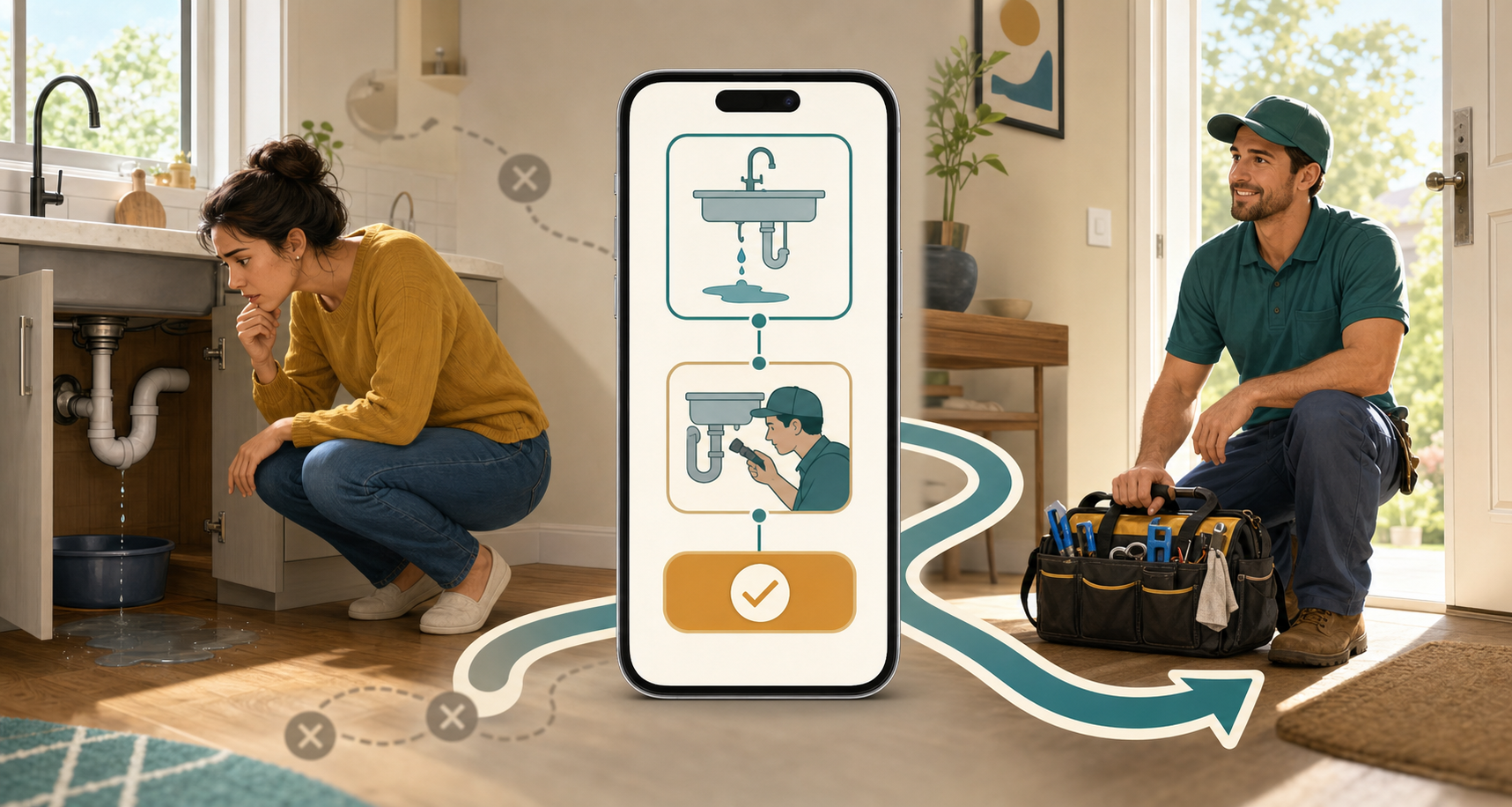
    A resident with a leaking sink follows a visual path through a mobile problem page to a visiting plumber.

    A useful problem page follows the visitor’s reasoning. It doesn’t open with a company history, a broad definition or a sales pitch. It begins with the situation the person can observe and then helps them make a safer, better-informed decision.

    Use this page sequence:

    1. Name the symptom precisely. Put the customer’s description in the title, opening paragraph and relevant subheadings. Confirm what the page covers and distinguish it from a similar-looking problem when that distinction matters.
    2. Give the short answer early. Explain what the symptom commonly indicates, whether several causes are possible and what the visitor should determine next. Don’t force someone to read an essay before learning whether the page applies to them.
    3. Order plausible causes usefully. Move from simpler or more common explanations toward causes that require inspection or specialist work. Explain the signs that separate one possibility from another without pretending to diagnose an unseen situation.
    4. Offer only safe checks. A visual observation or a basic setting check may be reasonable. Instructions involving gas, live electricity, structural damage, hazardous materials or equipment disassembly are not appropriate DIY lead magnets. State the stop condition and identify the qualified professional needed.
    5. Explain the available options. Tell the reader what can sometimes be monitored, what may require maintenance and what generally calls for professional diagnosis or repair. This is where the page earns trust by helping the visitor decide, not merely urging them to call.
    6. Set honest cost expectations. Publish a range only when it is supported by the business’s real service data and can be qualified appropriately. Otherwise, explain the factors that change the price, such as the underlying cause, access, parts, extent of damage or work required. Cost context and explicit signals for professional help reduce uncertainty without making an unsupported promise.
    7. Connect the problem to the service. Name the relevant service, explain how a professional would investigate the issue and offer an action that matches the urgency: request an assessment, call about an urgent condition or review the service before deciding.

    Place these pages inside a visible resource or problem hub, not in a forgotten chronological blog archive. A permanent position in the architecture makes their purpose clearer and lets service pages support them with relevant internal links.

    Make each answer easy for search and AI systems to interpret

    Clear structure helps beyond conventional rankings. Use headings that state the question being answered, concise paragraphs for direct explanations, lists for causes or decision criteria and consistent names for the symptom, service and location. A predictable symptom-to-cause-to-option-to-service relationship gives both search systems and AI-generated summaries less ambiguity about what the page means. Problem-led pages can therefore support indexing accuracy and visibility in AI-mediated search experiences, although no format guarantees inclusion.

    Clarity is more valuable than repetition. Don’t force the city, service and symptom into every heading. State the location where it changes the answer or establishes availability, and keep the diagnostic explanation readable for the person who actually has the problem.

    Key takeaways: measure the whole local lead path

    Don’t judge this work from rankings alone. Measure the handoffs between technical eligibility, discovery, consideration and inquiry:

    • Eligibility: priority service, problem and location URLs are crawlable, canonicalized correctly, rendered properly and eligible for indexing.
    • Discovery: problem pages receive impressions for symptom and decision-stage queries, not only for branded terms.
    • Movement: visitors use contextual links from problem pages to the relevant service pages or inquiry actions.
    • Conversion: calls, forms or bookings can be attributed to the landing page and page type that began the session.
    • Lead quality: the inquiries concern services the business provides in areas it actually serves.
    • Prioritization: the next fix is selected by lead impact, affected page reach and implementation effort, not by the raw number of audit warnings.

    The pattern in the data tells you what to change. Impressions without visits point toward a mismatch between the query, title and promised answer. Visits without movement to a service page suggest that the page isn’t resolving the visitor’s decision or making the next step clear. Service-page visits without inquiries shift attention to relevance, mobile usability, form friction and the offer itself. No impressions at all require you to revisit demand, internal linking and indexability before rewriting the call to action.

    Choose one commercially important service area for the next implementation cycle. Map its symptom questions, identify the existing service and location pages, fix the technical barriers across that small cluster, publish only the missing problem pages and connect the journey with deliberate internal links. Once you can measure that path from crawl to qualified inquiry, extend the model to the next service cluster.

    References

  • Google Ads Modernization: Better Automation, Better Measurement

    Google Ads Modernization: Better Automation, Better Measurement

    If Google Ads feels less like a collection of ads you build and more like a system you supply with signals, your instinct is right. Manual controls still matter, but the consequential decisions increasingly happen upstream: what Google may use, which conversion it should optimize, how long a click remains eligible for credit, and whether your inventory data can be trusted.

    That changes how you should modernize an account. Adding automation before fixing measurement gives the bidding system a faster way to pursue the wrong outcome. The practical order is measurement first, structured inputs second, automation third, and independent business validation throughout.

    Modernization moves control upstream

    In the policy change dated March 17, Google phased out multiple legacy ad-format policies, including older frameworks concerning form ads and image quality. Many of the formats had evolved into newer campaign types, so maintaining separate rule sets created unnecessary complexity.

    This policy cleanup does not mean creative quality, landing-page suitability, or compliance stopped mattering. It means an old checklist organized around retired formats is no longer a reliable account-control system. You need to map each campaign, asset, feed, and destination to the current policies governing the format that actually serves.

    The same shift appears in campaign execution. Google can select inventory, assemble richer ad experiences, and optimize bids from the signals you provide. You may make fewer decisions about the exact ad shown in an individual auction, but you have more responsibility for the boundaries within which those decisions occur.

    For every active campaign, document the inputs that define those boundaries:

    • The business outcome the campaign is supposed to produce.
    • The primary conversion action Smart Bidding uses as its success signal.
    • The click attribution window attached to that conversion.
    • The feeds, assets, prices, images, and landing pages available to automation.
    • The business system you will use to verify sales, revenue, profit, or qualified leads.
    • The current policy framework governing the campaign and its assets.

    If any item is unknown, you have found a more important modernization task than changing a bid strategy. Automation cannot repair an ambiguous objective. It can only optimize the signal it receives.

    Choose an attribution window from buying behavior

    Anonymous shoppers follow different-length paths from discovery and comparison to a completed purchase beneath a translucent time arc.

    An attribution window is an eligibility rule. It determines how long after an ad click a later conversion may receive credit. It does not prove that the click caused the sale, and it should not be treated as a substitute for understanding the customer journey.

    The default setting can be badly matched to the buying cycle. One DTC retailer had a 2.2-day average path to conversion, with a substantial share of purchases happening within a day, while Google Ads was using a 30-day click window. That gap left plenty of time for Google to claim orders after other marketing interactions had occurred, especially when Meta was receiving most of the advertising budget.

    The answer is not to copy a 7-day window into every account. A considered purchase with a longer sales cycle can legitimately need more time. Shortening its window too aggressively would exclude conversions that belong in campaign evaluation and could deprive Smart Bidding of useful signals.

    Start with the conversion-path data in your own account. Look for the delay between an eligible click and the conversion you actually value. Then ask whether the current window reflects that observed behavior or merely preserves a default.

    Because the primary conversion action influences bidding and spend, changing it in place can create an avoidable financial risk. It can also start a bidding recalibration before you have established whether the new measurement definition is suitable. A parallel secondary action gives you a safer comparison.

    The DTC implementation used this sequence:

    1. Duplicate the primary purchase conversion.
    2. Give the duplicate a 7-day click window and keep it as a secondary conversion action.
    3. Observe the original and duplicate actions side by side for two weeks.
    4. Move the shorter-window action into primary optimization only after checking its behavior. The account made that transition on January 12, 2026.

    That sequence separates measurement design from bidding intervention. During the comparison, inspect how much credited conversion value falls outside the proposed window, whether the excluded conversions fit the known purchase cycle, and whether the shorter definition improves agreement with the commerce or CRM record.

    Prepare stakeholders for two possible effects. Reported conversions may initially fall because fewer delayed orders qualify, and Smart Bidding may need to recalibrate when the primary signal changes. Neither effect automatically means the decision was wrong. The question is whether the new setting represents real buying behavior more faithfully and produces a cleaner optimization signal.

    Treat inventory feeds as campaign controls

    Products move from warehouse shelves through data validation gates into an automated campaign system while hands adjust the feed controls.

    Google Ads supports vehicle feeds from Merchant Center inside Search campaigns. The resulting listings can add make, model, price, and images to the text-ad experience. They appear as clickable assets beside or below the main ad and can send a user to a specific vehicle page or a broader landing page, depending on the interaction.

    This is more than a creative enhancement. The feed becomes part of ad selection, message construction, and destination selection. Google decides which vehicles to show from the query context and inferred intent, so the advertiser controls the quality of the candidate inventory rather than manually choosing the vehicle for every auction.

    That makes feed governance campaign governance. Before enabling the integration, check the parts of the experience automation will expose:

    • Confirm that the Merchant Center feed represents the inventory you are prepared to advertise.
    • Check that make, model, price, and image data agree with the corresponding vehicle page.
    • Open the destination as a prospective buyer would and verify that the advertised vehicle or relevant inventory path is easy to find.
    • Decide who owns corrections when inventory, pricing, imagery, or destination content changes.
    • Keep the existing Search campaign structure unless a separate campaign serves a real business purpose; the feed integration does not require duplicate campaign setup.

    Do not judge the feature only by whether the ads look richer. Segment reporting by Click type to distinguish interactions with vehicle listings from standard ad interactions. Compare the downstream conversions and conversion value available in the account, then validate lead or sale quality in the business system of record.

    A vehicle-listing click can indicate stronger inventory interest, but a higher click-through rate alone does not establish better economics. If the listing attracts people to unavailable inventory, a mismatched price, or an unhelpful destination, the richer format has amplified a data problem. If it attracts buyers who progress to qualified leads or profitable sales, the feed is doing useful work.

    Separate attribution improvement from business improvement

    Platform ROAS is useful for optimization, but it is not a complete account of incremental return. Google and Meta can each credit the same order under their own attribution rules. A shorter Google click window can reduce some delayed overlap, but changing the window does not itself create revenue or prove causality.

    Use three measurement layers, each answering a different question:

    • Platform attribution: Which conversions does Google Ads credit under the configured rules, and what signal is bidding using?
    • Business records: Did total sales, revenue, profit, qualified leads, or closed business improve in the system where those outcomes are recorded?
    • Incremental analysis: How much additional business did each channel likely generate beyond what would have happened without that investment?

    The DTC account produced an instructive, account-specific result after moving from the 30-day to the 7-day click window. The comparison covered the 30 days after the switch against the preceding period:

    Measurement layerMeasureReported change
    Google AdsSpendDown 6.3%
    Google AdsConversionsUp 42.9%
    Google AdsConversion valueUp 52.1%
    Google AdsROASUp 62.3%
    ShopifyTotal salesUp 20%
    ShopifyNet profitUp 30%
    Marketing mix modelingGoogle incremental ROASUp 10% to 1.82
    Marketing mix modelingMeta incremental ROASDown 25% to 0.59

    Those figures do not prove that shortening the window caused the gains. Campaign refinements were happening at the same time, so the effects cannot be cleanly isolated. The result should be read as evidence that performance remained stable while measurement became more aligned with the retailer’s short purchase cycle, not as a promise that a 7-day window will lift every account.

    It is also important not to compare Google Ads ROAS directly with incremental ROAS as though they were the same metric. Platform ROAS reflects conversions credited under platform rules. Incremental ROAS estimates additional return attributable to the channel. The ending value of 1.82 is an account result, not a universal target or threshold.

    The strongest interpretation comes from triangulation. Google Ads showed more conversion value on less spend, Shopify recorded higher sales and profit, and the marketing mix model reassigned the relative contribution of Google and Meta. Agreement across those layers supports a decision more convincingly than an isolated platform metric, while the concurrent campaign work still limits any causal claim.

    A shorter, better-aligned window can also make optimization feedback more current. Delayed attribution is reduced, diagnostics become easier to interpret, and Smart Bidding receives fresher signals after recalibration. That operational benefit matters even when the reported headline improvement is modest.

    Run your next account review in the right order

    A modern account review should begin with signal quality, not with a tour of campaign settings. Use this sequence to keep measurement changes, feed changes, and bidding changes distinguishable:

    1. Name the business outcome. Write down the sale, profit, qualified lead, or other result the campaign is expected to influence, plus the system that records it.
    2. Inspect conversion timing. Use conversion paths to understand how quickly the valued outcome normally follows an eligible ad interaction.
    3. Audit the primary conversion. Confirm that Smart Bidding is optimizing the intended action and that its attribution window fits the observed buying cycle.
    4. Test measurement in parallel. When a material window change is warranted, create a secondary version first so you can compare definitions without immediately changing bidding.
    5. Audit automation inputs. Review feeds, prices, images, assets, and destinations as parts of the campaign, not as background data maintained by someone else.
    6. Segment the new experience. For vehicle feeds, use Click type to isolate listing interactions and compare their downstream value with standard ad interactions.
    7. Validate outside Google Ads. Check platform movement against commerce or CRM outcomes and, when available, an incremental measurement method such as marketing mix modeling.
    8. Update the policy checklist. Remove dependencies on retired format-specific frameworks and map active formats to the current rules that govern them.

    Key takeaways

    • Google Ads modernization shifts control toward conversion definitions, attribution settings, structured data, assets, and policy boundaries.
    • Your attribution window should follow observed buying behavior rather than a default or a result from another account.
    • A secondary conversion action lets you evaluate a shorter window before exposing primary bidding and budget decisions to it.
    • Vehicle feeds turn Merchant Center inventory into Search ad inputs, while Click type reporting helps separate listing interactions from standard ad interactions.
    • Platform ROAS, business results, and incremental return answer different questions; a defensible decision uses all available layers.
    • Changing attribution can improve clarity and feedback speed, but it cannot by itself prove or create business growth.

    At your next review, resist the urge to begin with bids. Pull the conversion-path data, identify the primary action and its window, name the independent business record, and inspect every feed Google can use. Once those inputs are trustworthy, automation has a clear job and you have a credible way to judge whether it performed.

    References

  • Unlock AI Success: Use Customer Personas to Gain Early Wins

    Unlock AI Success: Use Customer Personas to Gain Early Wins

    Most content out there tends to be too generic, making it less effective in AI search. I’ve discovered that using customer personas allows me to pinpoint real problems and step into the search space much earlier.

    Whenever buyers pose a question, my goal is to deliver a clear answer. That’s essentially the “They Ask, You Answer” (TAYA) framework, which thrives even in AI-driven discovery.

    Though it sounds straightforward, I’ve seen many teams struggle to anchor their approach. This typically results in generic questions that lead to generic content.

    This is problematic since AI is transforming search behavior, shifting from simple queries to in-depth, context-rich questions. The difference lies in the questions we choose to answer, and that’s where customer personas shine.

    The Problem with Generic Questions

    Chances are, both I and my competitors have tackled these generic questions already or could do so quite easily.

    The trap of generic questions occurs when marketing teams, including mine at times, begin brainstorming content ideas with broad topics like:

    • What is CRM software?
    • What is marketing automation?
    • What is warehouse management?

    While reasonable, these questions are not what real buyers ask. Real buyers ask questions based on their specific situations, such as:

    • “What CRM should a 10-person sales team use?”
    • “Why are leads slipping through the cracks in our marketing?”
    • “Why is our warehouse picking speed so slow?”

    This distinction is subtle but crucial. The second set of questions integrates a person and a problem, transforming the quality of the content I produce.

    Why This Matters More in AI-Driven Discovery

    With AI, buyers are asking detailed, context-rich questions, such as:

    • “I run a 15-person marketing team, and we’re struggling to track leads properly. What should we do?”

    The AI provides explanations, outlines solutions, and suggests vendors, essentially giving the buyer a consultation. My content’s job is to explain why a specific persona faces a specific issue, framing how it should be perceived.

    This positions me into the conversation earlier, increasing the likelihood of staying top of mind as the user’s understanding evolves.

    Imagine this scenario, using myself as the subject:

    • Marcus.
    • 50 years old.
    • Meeting old friends in Birmingham, UK.
    • Looking for things to do for the day.

    I might start with a broad question:

    • “I’m looking for some things to do with friends in Birmingham on the weekend. I’m 50, and I have some old friends visiting for a day. We’ll enjoy some beers, but need activities too.”

    The answers might include bars, food, and activity bars. An F1 gaming arcade could be suggested, sparking my interest since I enjoy games but not cars, which prompts my follow-up question:

    • “Ah, we all like games. What gaming arcades could you recommend?”

    The responses might highlight a pinball arcade in Digbeth.

    • “Pinball Factory in Digbeth sounds fun. What else is there to do around there, food- and drinks-wise?”

    This kind of dialogue allows me to refine my day’s plan perfectly for my friends.

    Being part of the conversation from the start helps shape the dialogue and boosts the chance of being included in the final decision.

    Personas Make TAYA Far More Precise

    With personas, I think like my customers, identifying the questions they might ask long before they reach my offerings.

    When I define a customer segment, I delve into that persona, understanding their problems and goals to think like them, which helps in crafting content that answers their early-stage questions.

    Instead of creating content for a vague audience, I focus on real people, addressing specific needs like, “The best day out in Birmingham for a group of 50-year-old gamers.”

    ```json
{
  "alt": "The CapmatchOne logo with a gradient circle and bold text.",
  "caption": "Discover innovation with the CapmatchOne logo, featuring sleek typography and a modern gradient circle.",
  "description": "The CapmatchOne logo features bold, modern typography coupled with a gradient circle, symbolizing connection and innovation. The sleek design conveys a sense of progress and creativity. This image can be used for branding or promotional purposes, appealing to audiences interested in innovative solutions and forward-thinking designs."
}
```

    This small shift often leads to valuable content, positioning me within meaningful conversations rather than competing on crowded commercial queries.

    A Simple Way to Uncover Better Questions

    No need for a complex persona framework. Often, a simple three-question exercise reveals the problems buyers seek to solve.

    For each persona, I ask:

    • What are they responsible for? Examples include sales targets, marketing leads, or warehouse operations.
    • What problems complicate that responsibility? Issues like missed targets or inefficient operations might arise.
    • What might they search for when facing these problems?

    Now, the questions I generate differ greatly from generic ones:

    Instead of saying: “What is CRM software?”

    I see questions like:

    • “Why are leads slipping through the cracks in our CRM?”
    • “What CRM should a small sales team use?”
    • “Why is our warehouse picking speed so slow?”

    These questions reflect real situations, providing the most substantial content opportunities.

    ‘They Ask, You Answer’ Works Better with Personas

    TAYA covers five key areas: cost, problems, comparisons, reviews, and best-of. These topics offer structure, but approached generically, they mirror what everyone else is doing.

    Generic questions like:

    • “How much does CRM software cost?”
    • “What problems do warehouse systems have?”
    • “HubSpot vs. Salesforce”
    • “Best CRM systems”
    • “Salesforce review”

    Can be transformed into more targeted questions:

    • “What does CRM cost for a 10-person sales team?”
    • “Why do my warehouse managers struggle with picking accuracy?”
    • “HubSpot vs. Salesforce for a small B2B marketing team”
    • “Best CRM for growing sales teams”
    • “Is Salesforce suitable for a mid-size sales organization?”

    Although the topic remains the same, the approach is tailored to the buyer’s reality. This makes the content more useful and aligns with AI interactions.

    Targeted questions might include:

    • “We’re a small marketing team struggling to track leads properly. What CRM should we use?”

    If my content already answers these persona-centered questions, it increases the chance of my explanations becoming part of their conversation.

    In short, personas enhance TAYA by transitioning from broad topics to specific questions associated with real problems, improving the content and aligning better with buyers’ needs.

    Start with the Problem, Not the Product

    A common misstep in content marketing is leading with the product. Buyers, however, start with a problem.

    By using personas, I anchor content in the buyer’s perspective rather than my own, ensuring the focus is on the customer.

    This change can mean the difference between influence and mere existence of my content.

    Where You Enter the Conversation Matters

    “They Ask, You Answer” is an effective framework when the questions I address are of high quality.

    Personas help in turning vague topics into precise problems, resulting in content that resonates with buyers and AI systems while earning their trust.


    Inspired by this post on Search Engine Land.


    crushpress.ai community screenshot
  • How to Choose a Fintech Marketing Agency Without Guesswork

    How to Choose a Fintech Marketing Agency Without Guesswork

    You’re not really choosing between agency websites. You’re choosing who will translate a financial product into accurate claims, discoverable content, qualified demand, and reporting your team can trust. A polished pitch can hide weak audience knowledge, an inexperienced delivery team, or metrics no one can connect to the business.

    The safest way to make the decision is to define the assignment before outreach, score comparable evidence, and watch the proposed team work on a controlled diagnostic. That process gives you something more useful than a generic list of leading fintech marketing agencies: a defensible way to identify the right agency for your product, buyer, risk profile, and growth constraint.

    Set the mandate before you look at agencies

    The label fintech marketing agency is too broad to guide a purchase. A firm built around authority-building SEO and content solves a different problem from one centered on HubSpot-led inbound programs. Paid acquisition, public relations, lifecycle marketing, conversion work, and AI search visibility require different operating strengths again.

    Start by writing a short mandate that an agency cannot reinterpret into whatever it already sells. Use this structure:

    We need [specific audience] to take [observable action] because [business constraint or opportunity]. The agency will own [channels, systems, and outputs]. Our team will own [approvals, subject-matter input, implementation, and risk decisions]. Success will be assessed through [business outcome, funnel measure, and delivery evidence].

    Then add the information that determines whether the work is actually feasible:

    • Audience: Identify the buyer, user, internal influencer, and approver where those roles differ. A case study involving a bank is not relevant merely because your prospective customer is also a bank.
    • Product: Describe the product category, buying motion, implementation burden, and the parts prospects routinely misunderstand.
    • Bottleneck: Name the current constraint. It may be weak discovery, low-quality traffic, poor conversion, slow approvals, incomplete attribution, or content that fails to demonstrate expertise.
    • Scope: Separate strategy, production, distribution, technical implementation, campaign operations, analytics, and reporting. Do not assume that an agency recommending work is also equipped to ship it.
    • Claims: Provide approved language, evidence requirements, prohibited claims, and the people authorized to approve changes.
    • Systems: List the content management system, analytics stack, customer relationship platform, advertising accounts, and any access restrictions that will shape delivery.
    • Dependencies: Identify the internal experts, engineers, designers, analysts, legal reviewers, and compliance reviewers whose availability can affect progress.
    • Decision rights: State who can approve strategy, budget changes, publication, tracking changes, and exceptions to the normal process.

    This mandate becomes the control document for the selection. Give every candidate the same version. If one agency quietly changes the audience, channel, or definition of success in its proposal, you have learned something important before signing a contract.

    Score evidence instead of presentation quality

    An overhead view of proposal folders and blank evaluation cards arranged with tokens representing case studies, compliance, audience knowledge, and references.

    A useful baseline is built from seven evidence categories weighted to 100%: notable clients at 23%, leadership experience at 20%, average reviews at 18%, agency age at 15%, median employee tenure at 11%, founder-led status at 8%, and media references at 5%.

    Those weights are not a universal truth. They are a disciplined starting point. More importantly, they force you to distinguish evidence from marketing copy.

    CriterionBaseline weightEvidence to requestWhat weak evidence looks like
    Relevant clients23%The three closest engagements, including the product, audience, channel, agency scope, proposed team involvement, and business problemA logo wall with no explanation of what the agency did or whether the work resembled your assignment
    Leadership experience20%Relevant operating history and a clear statement of how agency leaders will participate after the saleImpressive biographies paired with no access to those leaders during delivery
    Average reviews18%Reviews that describe fintech-relevant work, communication, problem solving, continuity, and measurable outputsGeneric praise that could apply to any creative or digital agency
    Agency age15%Evidence of operating stability, repeatable processes, and adaptation as channels and platforms changedLongevity presented as a substitute for current expertise
    Median employee tenure11%Public team histories or disclosed tenure information for the people likely to serve the accountA sales team that cannot identify who will perform the work
    Founder-led status8%A precise description of founder involvement, decision authority, and escalation accessThe founder appears in the pitch but disappears from the operating model
    Media references5%Relevant third-party recognition tied to the capability you are buyingAwards and mentions that have no connection to fintech or the required channel

    Reweight the model around the risk in your assignment. If the work depends on senior judgment, increase the importance of leadership involvement. If you need sustained production, emphasize delivery-team tenure and capacity. If the brand faces significant reputational exposure, give more weight to references that demonstrate disciplined claims handling. If the assignment is a narrow technical build, direct implementation evidence may matter more than broad industry visibility.

    Avoid double-counting the same proof. A client logo, case study, review, award, and conference appearance may all originate from one engagement. Record the underlying engagement once, then note which parts of the agency’s claim it actually supports.

    Score the people assigned to you, not merely the company. Ask for names, roles, allocation assumptions, and replacement procedures. Senior agency experience has limited value if junior generalists will make the daily decisions without suitable supervision.

    Test how the agency handles fintech complexity

    Do not ask whether an agency understands fintech compliance. Almost every candidate will say yes. Give the proposed team a realistic, sanitized scenario and inspect how it reasons.

    • Product comprehension: Provide a representative product page and ask the team to restate the audience, problem, mechanism, limitations, and required evidence. Watch for simplifications that change the meaning.
    • Claim provenance: Ask how every material claim will be connected to an approved fact, subject-matter expert, product record, or other internal evidence.
    • Approval flow: Ask the team to map how a draft moves through marketing, product, legal, compliance, and publication. The answer should include what happens when reviewers disagree.
    • Change control: Ask who can alter approved language, how revisions are recorded, and how an outdated claim is corrected across derivative assets.
    • Audience precision: Ask the agency to separate the information needs of users, buyers, influencers, and approvers. A single generic persona usually produces generic content.
    • Data handling: Ask what customer, account, analytics, and advertising data the agency needs; where that data will be accessed; and which subcontractors or tools may receive it.
    • Escalation: Present a scenario involving an inaccurate published claim or broken conversion path. Look for containment, ownership, notification, correction, and prevention steps rather than improvisation.

    An agency does not need to practice law to demonstrate sound operational discipline. Final legal and regulatory judgments should remain with the qualified people your governance designates. Do not let industry familiarity become an informal substitute for your approval process; the downside is public-facing language that no accountable reviewer actually authorized.

    Challenge vague SEO, AEO, and GEO promises

    AI visibility has created a new layer of agency claims. The terminology can be useful, but only when it resolves into observable work. No agency controls whether a third-party AI system includes or cites a page, so a guarantee of placement is not a credible operating plan.

    Ask an agency claiming SEO, answer engine optimization, or generative engine optimization expertise to show:

    • The audience questions, entities, topics, and commercial decisions it intends to target.
    • The pages or assets it would create, consolidate, update, or remove, with a reason for each action.
    • How it will maintain consistency among product facts, expert statements, page copy, metadata, and structured data.
    • Which schema types are appropriate to the visible content, how markup will be validated, and who will fix errors after deployment.
    • How it distinguishes rankings, search impressions, organic visits, AI referrals, brand mentions, third-party citations, assisted conversions, and business outcomes.
    • Which measurements are direct observations and which are proxies. A proxy should not be relabeled as revenue impact.
    • How its reporting accounts for platform, prompt or query set, language, location, account state, collection method, and capture date.

    Schema can make page meaning more explicit to systems that process it, but it does not guarantee visibility or citation. Treat structured data as part of factual and technical quality, then evaluate it alongside accessible page content, authority signals, crawlability, and measurement.

    Key takeaways

    • Choose an agency for the bottleneck it must remove, not for the breadth of its fintech label.
    • Relevant experience must match your product, audience, channel, and operating constraints.
    • Evaluate the named delivery team separately from agency leadership and sales personnel.
    • Require an approval and correction workflow before the agency publishes risk-sensitive claims.
    • Define AI visibility through repeatable observations and business measures, never guaranteed placement.

    Use a paid diagnostic to expose the working relationship

    A fintech team and agency specialists collaborate around a table with an abstract product prototype, journey cards, compliance pieces, and measurement tokens.

    Proposals show how an agency sells. A controlled diagnostic shows how its people think, ask questions, handle missing information, and turn strategy into work. Run it with the team proposed for your account rather than a separate pitch team.

    Set a capped scope, confidentiality terms, and ownership terms before the diagnostic begins. Without those boundaries, a useful test can turn into open-ended consulting or leave both sides uncertain about who owns the resulting material.

    Provide realistic operating inputs, but sanitize customer records, credentials, unpublished financial information, and any confidential material not covered by the agreement. Useful inputs can include an approved product description, representative content, current measurement definitions, brand requirements, known audience objections, and the existing approval path.

    Ask for outputs that reveal judgment rather than decorative presentation:

    • Corrected mandate: The agency should identify ambiguities, contradictions, hidden dependencies, and decisions your brief failed to resolve.
    • Audience and intent map: It should connect audience questions and objections to a buying or adoption decision, not produce a loose collection of keywords.
    • Opportunity map: It should show what deserves action, what should wait, what cannot be known yet, and what evidence would change the priority.
    • Representative brief: A content, campaign, conversion, or technical brief should be detailed enough for another specialist to execute without guessing at the objective or claim boundaries.
    • Measurement design: It should define the baseline, required instrumentation, direct measures, proxies, reporting ownership, and known attribution limits.
    • Governance flow: It should place product, subject-matter, brand, legal, compliance, security, and publication decisions with named roles.
    • Risk register: It should identify access gaps, approval delays, data limitations, technical dependencies, and assumptions that could invalidate the plan.

    Evaluate the diagnostic process as closely as the deliverables. Strong teams ask for evidence before asserting causes. They distinguish a fact from an inference, surface inconvenient constraints, and assign owners to next actions. Weak teams rush to a familiar channel plan, disguise unknowns with polished language, or treat your approval process as an obstacle to work around.

    If procurement or budget rules prevent a paid diagnostic, run a structured working session with the proposed team and request redacted examples of comparable operating artifacts. That is less revealing than commissioned work, but it still provides better evidence than a credentials presentation alone.

    Put measurement, governance, and exit terms in the contract

    A good selection can still fail when the contract leaves delivery open to interpretation. The agreement should turn the mandate into accepted outputs, decision rights, measurement rules, and a usable exit path.

    Tie scope to accepted outputs

    For every recurring or project output, define:

    • The format and level of completion expected.
    • The agency owner, client owner, reviewers, and final approver.
    • The evidence, brand rules, and claim controls that apply.
    • The acceptance criteria and the process for rejected work.
    • The revision and change-control process.
    • The internal systems, access, and dependencies required.
    • Whether the agency recommends, produces, publishes, implements, monitors, or merely reports.

    This distinction matters in technical SEO and structured data work. A recommendation document is not an implementation. Generated markup is not validated deployment. Deployment is not ongoing accuracy. The contract should state where the agency’s responsibility ends and where yours begins.

    Build a measurement ladder

    Organize reporting from business impact down to delivery evidence:

    • Business outcomes: Use the approved commercial result appropriate to the assignment, such as qualified pipeline, funded or activated customers, retention, or another accepted value measure.
    • Funnel behavior: Track the actions that connect marketing exposure to the business outcome, with qualification rules defined in advance.
    • Channel outcomes: Use channel-specific measures such as qualified organic visits, campaign responses, conversion behavior, or attributable referrals.
    • Diagnostic signals: Monitor the observations that help explain movement, including query coverage, crawl and indexing state, content engagement, brand mentions, structured-data validity, and AI citations where they can be observed responsibly.
    • Delivery evidence: Record what was approved, shipped, corrected, and learned. Activity volume alone is not performance, but missing delivery can explain missing results.

    Do not blend these layers into a composite score unless everyone understands the formula and tradeoffs. A growing visibility proxy cannot cancel a falling business outcome. The agency should state which measures it can influence, which it merely observes, and which require action from your internal teams.

    For AI visibility reporting, preserve the exact observation context. Record the platform, prompt or query set, language, location, account state where relevant, collection method, and capture date. Treat an isolated answer as an observation, not a trend. Any claimed improvement should be accompanied by a repeatable method and a clear explanation of its relationship to qualified traffic or business activity.

    Keep governance and exit usable

    Your contract and operating plan should also cover:

    • Who approves financial, product, comparative, performance, and customer claims.
    • How credentials, customer data, analytics data, advertising data, and confidential materials may be accessed and stored.
    • Whether subcontractors or external AI tools can receive your information.
    • Ownership of accounts, domains, analytics properties, creative files, content, research materials, source files, schema, code, dashboards, audiences, and campaign history.
    • Whether core systems and accounts remain client-controlled throughout the engagement.
    • How conflicts of interest involving adjacent products or direct competitors are disclosed and handled.
    • How work, records, access, and institutional knowledge transfer when the engagement ends.

    Unclear ownership and data terms can create financial, legal, and operational exposure when you change agencies. Have qualified counsel and the appropriate privacy, security, and compliance owners review the provisions that govern claims, data handling, intellectual property, indemnity, termination, and transition. Familiarity with fintech marketing does not make an agency the final authority on your obligations.

    Your next move is not to book more introductory calls. Draft the mandate, turn the evidence categories into a scorecard, and send the same requirements to every credible candidate. The right fintech marketing agency should become easier to identify as the questions get more specific – not harder.

    References


  • Google Video Ad Changes: What Advertisers Should Do Next

    Google Video Ad Changes: What Advertisers Should Do Next

    Your video plan now has two moving parts. Google Ads is giving you a clearer view of video inside Performance Max, while YouTube is testing an ad experience that may keep a brand visible after a viewer skips. One affects what you can measure. The other may affect what people continue to see.

    You don’t need to rebuild every campaign in response. You do need to separate observation from causation, audit whether your creative still works when the full video is not watched, and make budget decisions with more discipline than a single reporting split can provide.

    Two video changes require two different decisions

    Google Ads has added an “Ads using video” segment to Performance Max reporting. It lets you separate results according to whether video was used in the ad mix. That makes video easier to investigate without changing how the campaign itself is managed.

    YouTube is also testing a sticky branded banner that can remain after a viewer skips an ad. Instead of disappearing with the skipped video, the advertiser’s card stays visible in the player until the viewer dismisses it.

    These developments should not be folded into one vague “video is becoming more important” conclusion. The Performance Max segment is a reporting change. It helps you diagnose where video is associated with results. The YouTube experiment is a format change. If it expands, it could alter the creative value of a skipped impression.

    That distinction determines your next move: use the first change to improve analysis, and use the second to pressure-test creative. Neither one, by itself, justifies an immediate budget increase.

    Use the Performance Max segment as a diagnostic, not a verdict

    An analyst examines a video performance tile with a magnifying lens while it remains connected to audience, budget, and conversion evidence.

    The new segment answers a useful descriptive question: how do results differ when video is part of the ad mix? It does not answer the causal question: how much incremental performance did video create?

    That difference matters because campaigns or reporting rows can vary for reasons unrelated to format. Budget, products, offers, audience signals, seasonality, conversion setup and campaign maturity can all influence the result. Performance Max also automates delivery, so the advertiser is not holding every placement and exposure condition constant.

    Use this reporting workflow before you change creative or move spend:

    1. Write down the decision you are trying to make. “Should we expand video assets in this campaign?” is useful. “Is video good?” is too broad to test.
    2. Choose the business outcome before looking at the split. Use the campaign’s actual objective, such as qualified conversions, conversion value, cost per acquisition or return on ad spend.
    3. Apply the “Ads using video” segment and compare video-associated results with the relevant non-video results.
    4. Check whether the compared rows share the same campaign objective, conversion configuration, date range, market, offer and product mix. Treat a mismatch as a confounding factor, not a minor footnote.
    5. Read volume and efficiency together. More conversions at an unacceptable acquisition cost are not automatically an improvement. Better efficiency on negligible volume may not support expansion.
    6. Record the observation, your explanation for it and the smallest action that could test that explanation. Add a review date so the result does not become an unsupported permanent rule.

    What common result patterns should trigger

    • If video-associated results show stronger volume and acceptable efficiency, verify that the comparison is reasonably like-for-like. Then expand video in a limited, clearly identified set rather than across the account at once.
    • If volume rises but efficiency weakens, decide whether the marginal acquisition cost still fits your economics. Do not call the result a win solely because the conversion count is higher.
    • If efficiency improves but volume falls, inspect whether delivery is too limited to support a reliable operational decision.
    • If there is little difference, check whether the creative carries a distinct message and whether video was used enough to make the comparison meaningful. A flat result does not prove that format never matters.
    • If video-associated results are worse, inspect the offer, landing-page continuity and comparison conditions before blaming the video asset. The segment identifies a pattern; it does not isolate the cause.

    The safest budget rule is simple: do not move material spend on the strength of an observational split alone. Use the segment to find a promising hypothesis, then make a bounded change whose downside your account can absorb. This is especially important when a reporting difference could actually reflect a different product, audience or period.

    Design for a skip that may no longer end exposure

    A hand dismisses a video on a smartphone while a smaller tile with the same unbranded product silhouette remains visible at the screen edge.

    A skippable ad has traditionally created a clean mental boundary: the viewer skips, the video disappears and attention returns to the chosen content. A persistent branded card changes that boundary. The viewer may reject the video while still receiving a lighter, static brand exposure.

    This remains a test, so do not treat it as a universal YouTube format or redesign your entire asset library around it. Instead, use it as a reason to check whether your advertising can survive partial attention.

    Audit each active video in three passes:

    1. Watch only the opening portion. Can a viewer identify the brand, product category or problem being addressed without waiting for the full narrative?
    2. Pause on the clearest branded frame. Does the identity remain understandable as a compact visual, or does it depend on motion, narration or a later reveal?
    3. Review the destination and call to action. If a viewer engages after only partial exposure, will the landing page immediately confirm the same brand, offer and next step?

    Do not respond by squeezing every selling point into one frame. A residual banner has less room and less attention than a complete video. Prioritize recognition: a clear brand, one useful proposition and an intelligible action. Dense copy turns extended visibility into visual noise.

    You should also keep exposure and response separate in your analysis. A skip may no longer mean that every trace of the advertiser vanished, but it still does not demonstrate interest, recall or purchase intent. Do not relabel a skip as an engagement merely because a branded element may persist afterward.

    Until Google establishes how any wider release appears in standard reporting, keep completed views, skips, clicks, site visits and conversions distinct. For brand activity, persistent exposure may be a useful directional signal. For performance activity, downstream behavior still carries the decision.

    Turn the changes into a controlled account workflow

    The practical opportunity is not simply “make more video.” It is to connect creative decisions to a cleaner evidence trail. You want to know what changed, where it changed and which outcome would justify keeping it.

    1. Inventory Performance Max campaigns with and without meaningful video creative.
    2. Capture a baseline for the business metrics that govern each campaign before changing assets or budget.
    3. Use the video reporting segment to locate the campaigns with the clearest difference worth investigating.
    4. Check for alternative explanations, including different offers, products, markets, conversion actions or seasonal conditions.
    5. Select one bounded campaign or product group for the next creative change.
    6. Give the pilot an evaluation window consistent with your normal conversion cycle and decision process. Do not stop it early because of an isolated daily movement.
    7. Evaluate the business result alongside the delivery context, document the conclusion and decide whether to expand, revise or stop.

    If the sticky-banner experience appears in your inventory, document it separately from the Performance Max analysis. A YouTube interface test and a Performance Max reporting segment are not two stages of one controlled experiment. Combining them would make it harder to tell whether a result came from creative, delivery, format or measurement.

    Key takeaways

    • The “Ads using video” segment makes video easier to investigate inside Performance Max; it does not prove that video caused the reported difference.
    • Compare business outcomes under similar campaign conditions before changing budgets.
    • YouTube’s post-skip banner is a test, not a format you should assume every viewer will encounter.
    • Creative should communicate a recognizable brand and proposition even when the complete video is not watched.
    • Keep skips, persistent exposure, clicks and conversions conceptually separate until the platform provides enough reporting clarity to connect them responsibly.

    Start with one account audit: apply the video segment, identify one result that is worth explaining and write down the confounding factors before you touch the budget. Then review the corresponding video as if the viewer will see only a fragment. That gives you one defensible measurement decision and one concrete creative improvement, without pretending the platforms have given you more certainty than they have.

    References

  • Google AI Search Personalization: A Publisher Traffic Plan

    Google AI Search Personalization: A Publisher Traffic Plan

    If your rankings still look familiar but organic sessions are getting harder to explain, stop looking for one universal search result. In AI Mode, an opted-in user can receive answers shaped by purchases, receipts, travel plans, interests, and connected Google apps. A rank tracker cannot reproduce that person’s private context, so its screenshot represents only one possible result.

    Your job is not to reverse-engineer anyone’s inbox or photo library. It is to identify which pages can be absorbed into a personalized answer, which pages still give the user a reason to visit, and how to measure the change without pretending that one ranking position explains it.

    One query no longer implies one reproducible result

    Traditional rank analysis treats the query as the main input: enter the same words under similar conditions and expect roughly comparable results. Personal Intelligence adds a private context layer. Google has expanded it to AI Mode for U.S. personal accounts, while related rollouts are moving through Gemini for free users and Chrome. Workspace accounts are not included for now.

    Users must opt in to app connections and can turn those connections off. Depending on what they connect, Google can combine the immediate query with information from services such as Search, Gmail, Photos, and YouTube. That changes what the system needs from the public web before it constructs an answer.

    • A shopping request can be narrowed by previous purchases, preferred brands, or buying behavior.
    • A troubleshooting request can use receipt details to identify the exact device involved.
    • A travel request can reflect flights, previous trips, and other personal plans.
    • A recommendation can be adjusted around interests and hobbies already visible in the user’s connected history.

    The distinction that matters for publishers is simple: you can improve the public information your page contributes, but you cannot control the private facts used to select, filter, or apply it. Producing dozens of thin pages for imagined personal profiles will not solve that problem. It is more useful to make one strong page explicit about the conditions under which each answer applies.

    For every important query cluster, create a context card with these fields:

    • User task: What decision, diagnosis, plan, or action is the person trying to complete?
    • Possible private context: What purchase, device, itinerary, preference, or history could narrow the answer?
    • Your public contribution: What verifiable fact, method, comparison, compatibility rule, or limitation does your page supply?
    • Click-worthy remainder: What useful work remains after a concise AI answer has been generated?
    • Qualification: Which model, location, account type, prerequisite, or exception changes the recommendation?

    This turns personalization from an unknowable ranking variable into a content-planning question. You do not need to predict every user. You need to publish information that remains accurate when the system combines it with different user contexts.

    Keep privacy out of your testing shortcuts. Google states that Gmail and Photos content is not directly used to train its AI models, although limited information such as prompts and responses may be used to improve systems. That does not make private accounts appropriate rank-tracking assets. Do not ask a staff member to connect a personal inbox or photo library just to capture search screenshots. If you do not have a legitimate, voluntarily opted-in testing setup, record the personalized layer as unobserved.

    Diagnose traffic change without relying on a single rank

    An analyst examines multiple abstract search-result pathways, with colored particles either stopping at answer cards or continuing to publisher page tiles.

    The traffic risk is credible, but its size is not established by the available evidence. Yahoo CEO Jim Lanzone has described Google AI Mode as the largest challenge from large language model interfaces to the traditional system in which search sends visits to publishers. He also tied the quality of answer engines to the continued health of the publishers that produce their underlying content.

    Treat that as a directional warning, not a universal loss estimate. A falling session count can also reflect demand, seasonality, indexing, a site release, a measurement change, or a weaker search snippet. Personalized AI results add another plausible mechanism; they do not remove the others.

    Use a cohort-based diagnostic instead of checking isolated keywords:

    1. Describe the observable environment. Record country, personal or Workspace account, signed-in state, AI Mode availability, and whether app connections are enabled. Record the setting, never the private contents of a connected account.
    2. Group pages by completion risk. A definition or short factual lookup may be fully answerable in the interface. A comparison or recommendation may depend on context. A detailed procedure, tool, transaction, or evidence set may still require a visit.
    3. Choose business signals for each group. Track available search visibility, organic entrances, meaningful on-site completions, and branded demand. Do not let a visibility metric stand in for revenue, leads, subscriptions, or another outcome that actually matters.
    4. Annotate other changes. Mark site migrations, template releases, indexing problems, campaign changes, and shifts in audience exposure alongside AI product changes.
    5. Compare page cohorts. If concise answer pages weaken while visit-dependent pages hold, that pattern is more informative than one volatile query. It is still an observation to investigate, not proof of a single cause.

    The following combinations are useful diagnostic prompts. None proves that AI Mode caused the movement.

    Observed patternPlausible readingNext check
    Search visibility and organic entrances both declineThe page may be losing discovery earlier in the journey.Check demand, indexing, site changes, query coverage, and affected page types before assigning a cause.
    Search visibility holds while organic entrances declineUsers may be seeing the result but completing more of the task without visiting, or the search presentation may have changed.Compare completion-risk cohorts and document the account environment used for any manual observations.
    Organic entrances decline while conversions holdSome lost visits may have carried weak intent.Judge the change by business value as well as session volume, and inspect which landing-page cohorts lost traffic.
    Organic entrances hold while conversions declineThe main problem may sit after the click rather than in AI visibility.Inspect intent alignment, page experience, offer clarity, forms, checkout, and other on-site changes.

    This measurement model accepts a hard limit: personalized output cannot be audited as though it were a fixed national ranking. You can still detect exposure and outcome patterns, but you must preserve the conditions attached to each observation. A screenshot with no account-state notes is weak evidence.

    Give the answer engine clarity and the reader a reason to continue

    An abstract AI prism extracts organized fact blocks from the entrance of a layered publisher page while a reader continues toward original testing, photography, comparison objects, and an expert demonstration.

    A page now has two jobs. It must make its core information easy to interpret, and it must contain enough additional value to justify a visit. Hiding the answer behind a long introduction may weaken the first job. Publishing only the answer may eliminate the second.

    Build the page in layers:

    • State the direct answer. Put the central conclusion in plain language and identify who or what it applies to.
    • Expose the decision variables. Name the compatibility requirements, prerequisites, exclusions, locations, versions, models, or user conditions that can change the result.
    • Support the conclusion. Show the evidence, reasoning, calculation, comparison criteria, or complete method behind the short answer.
    • Handle exceptions near the relevant claim. Do not bury a decisive limitation in a generic disclaimer at the bottom.
    • Provide the next useful action. A diagnostic path, full procedure, decision tool, original dataset, detailed comparison, or transaction can give the reader a concrete reason to continue.

    Personalization makes precise attributes more valuable than generic enthusiasm. If a system knows the device from a receipt, your troubleshooting page should state which models, symptoms, and operating conditions its instructions cover. If a system knows a travel itinerary, your page should make location limits, timing constraints, and exceptions explicit. If it knows a buyer’s preferred brands, a comparison should explain meaningful tradeoffs instead of repeating brand positioning.

    The private detail narrows the problem; your content still has to supply the reliable public rule. That is the part you can optimize.

    Use this editorial check before updating an exposed page:

    • Can the opening answer stand on its own without losing an essential qualification?
    • Are important entities, products, versions, and relationships named consistently?
    • Can a reader see why the recommendation changes under different conditions?
    • Does the page contain evidence or functionality beyond a concise summary?
    • Are unsupported superlatives, vague claims, and redundant sections removable?
    • Does the structured data accurately describe the visible page rather than promise information the page does not contain?

    JSON-LD belongs in that final consistency check. Choose a schema type that truthfully represents the page, keep entity names and properties aligned with the visible content, and validate the markup when the page changes. Schema can clarify meaning; it cannot manufacture distinctive information or guarantee traffic from a personalized answer.

    Do not optimize only for extraction. If every useful detail can be compressed into a short response with no loss, the interface may have little reason to send the user onward. The answer should be clear, but the underlying page should make the method, proof, edge cases, or next action materially better.

    Plan separately for the ad-free personalized environment

    Google is testing ads in AI Mode in the U.S., but users who connect apps for Personal Intelligence currently receive an ad-free AI Mode experience. The commitment was framed as the present state, not an irreversible promise.

    For a publisher, ad-free does not mean competition-free. The personalized answer itself can satisfy the task, even when no paid placement appears beside it. Nor does an ad-free answer protect your own advertising or affiliate revenue; that revenue still depends on the user reaching your property.

    Maintain separate planning lanes:

    • App-connected AI Mode: Evaluate whether your content supplies a public fact or deeper action that remains useful after private context is applied.
    • General AI Mode with ad tests: Observe organic and paid changes separately. Do not attribute a movement to personalization when the test environment did not use connected apps.
    • Possible future personalized advertising: Google has indicated that future ads could relate to the query, response context, and user interests. Treat that as a scenario to monitor, not as current behavior for connected-app experiences.

    If your organization buys traffic as well as publishing content, keep the paid and organic questions distinct. An ad impression can create a commercial connection without restoring the editorial visit that the answer displaced. Conversely, a decline in organic clicks does not prove that ads captured them. Measure each route on its own terms.

    Personal Intelligence is also spreading through Gemini and Chrome. Do not assume those surfaces will display, attribute, or send visits in the same way. Inspect your own analytics for actual referral and conversion behavior, and label any behavior you cannot observe instead of filling the gap with a guess.

    Key takeaways

    • Personalized AI results combine a public query with private context, so one rank-tracking result cannot represent every user’s experience.
    • Classify pages by whether the AI interface can complete the user’s task without a visit.
    • Measure page cohorts through visibility, organic entrances, meaningful completions, and branded demand rather than relying on average position alone.
    • Make conditions, compatibility, exclusions, evidence, and next actions explicit in both visible content and accurate structured data.
    • Treat app-connected, ad-free AI Mode as a distinct environment and preserve account-state notes for every manual observation.

    Start with the page cohort most closely tied to revenue or qualified demand. Write a context card for each query cluster, mark its completion risk, and identify the useful work that remains after a personalized summary. Then update the content and measurement plan together. If you change the page without changing how you evaluate it, you will still be unable to tell whether the strategy worked.

    The publishers best prepared for personalized search will not be the ones claiming to predict every answer. They will be the ones that know exactly what their pages contribute, why a person would still visit, and which business signal would prove that value.

    References