Month: February 2026

  • Google AI Search Infrastructure: A Reporting Playbook

    Google AI Search Infrastructure: A Reporting Playbook

    When an AI answer appears and your page does not, it is tempting to blame the final generation step. That diagnosis starts too late. Your page first has to be fresh enough to trust, relevant enough to retrieve, and competitive enough to survive several ranking passes.

    The practical question is not simply, “How do we rank in AI Search?” It is, “At which gate are we losing visibility, and what can our reporting actually prove?” Once you separate those questions, Google Search Console becomes more useful and your optimization backlog becomes much less speculative.

    Key takeaways

    • Google’s AI output sits on top of retrieval and ranking. Crawling, indexing, freshness, relevance, and ranking remain prerequisites for consideration.
    • Search can match a query to the meaning of a page or passage without requiring identical wording, so complete topic coverage matters more than repeated exact-match phrases.
    • Search Console’s AI-powered configuration builds reports from existing metrics, filters, and comparisons. It does not create an AI citation metric or reveal Google’s internal candidate set.
    • Clicks, impressions, CTR, and average position can narrow your diagnosis, but none of them alone proves why an AI answer did or did not use your content.
    • Use the AI configuration as a report builder, then inspect every generated setting before acting on the result.

    AI visibility is a pipeline, not a single ranking

    Google does not send an unrestricted model across the entire web every time someone enters a query. It reduces the problem in stages. Google’s Jeff Dean has described examples that begin with roughly 30,000 candidate documents and narrow the working material dramatically before the most capable model performs the final task. One LLM-oriented example ended with about 117 documents.

    Those figures are explanatory examples, not fixed quotas you can optimize against. Their value is architectural: the expensive reasoning step operates on a selected subset. If your content is absent from that subset, improving the polish of an answer paragraph will not solve the earlier failure by itself.

    1. Crawl and refresh: Google needs an accessible, current version of the page in its systems.
    2. Retrieve: lightweight methods identify a broad set of documents that could satisfy the query.
    3. Rerank: more sophisticated signals reduce that set and determine which candidates deserve deeper processing.
    4. Synthesize: an LLM reasons over a much smaller collection and constructs the response or result experience.

    This model changes how you prioritize SEO work. A page with weak crawl eligibility has a stage-one problem. A page that appears for irrelevant queries has a matching problem. A page with relevant impressions but poor competitive positions has a reranking problem. Only after those gates are reasonably healthy does synthesis readiness become the main editorial question.

    Matching is also broader than literal keyword overlap. LLM-based representations can assess the topical relationship between a query and an entire page or an individual paragraph. That gives Google room to connect different phrasings of the same intent. It does not make terminology irrelevant; it makes mechanical repetition a poor substitute for answering the full question.

    Semantic expansion is not an AI-era invention. When Google moved its index into memory across machines in 2001, it became practical to expand short searches into far richer query representations, including examples with around 50 terms. Modern models make the representations more capable, but meaning-based retrieval has deep roots in the search infrastructure. A reporting plan that tracks only one exact phrase therefore sees too little of the query space.

    Freshness belongs in the same pipeline. Google can refresh some material in under a minute, while crawl scheduling weighs how likely a page is to change and how valuable a newer version would be. Even an important page that changes infrequently may merit frequent checking. The actionable lesson is not to alter timestamps on a schedule. It is to identify pages where changed facts would alter the answer and maintain those pages when the underlying information actually changes.

    Read Search Console as evidence, not an AI visibility score

    Search Console gives you evidence about observed search performance. Its familiar metrics answer four different questions: did a result receive impressions, where did it tend to appear, how often did users click it, and what share of impressions became clicks? They do not expose the broad retrieval pool, the intermediate reranking passes, or the documents an LLM considered during synthesis.

    The AI-powered configuration does not change that boundary. It translates a plain-language request into a report by selecting clicks, impressions, average CTR, and average position; applying query, page, country, device, or date filters; and setting comparisons. That is valuable automation, but it is automation of report setup rather than a new source of AI-specific measurements.

    Use metric combinations to form a hypothesis, then segment until competing explanations become less plausible. The patterns below are diagnostic starting points, not causal conclusions.

    Pattern in a filtered viewWhat it can supportWhat it does not proveNext report to run
    Impressions fall and average position worsensThe selected cohort has lost search exposure or appears lower within its current query mix.It does not prove that an LLM rejected the pages.Split the cohort by page group and query theme, then compare countries and devices.
    Impressions remain stable while clicks and CTR fallThe pages are still appearing, but user response or the result environment may have changed.It does not prove that AI answers took the clicks.Hold the page and query filters constant, then separate device and country views.
    Impressions rise while average position worsensThe pages may be entering a broader or lower-ranking query mix.It does not automatically mean that established rankings declined.Find the query themes responsible for the new impressions and review their positions separately.
    Clicks and impressions rise with little movement in average positionDemand, eligibility, or the mix of queries may have expanded.It does not demonstrate increased inclusion in generated answers.Identify which pages and queries contributed the growth before assigning credit to a change.

    Average position needs particular care because it summarizes a changing mix. A page can gain many new impressions at lower positions while retaining its strongest rankings. The aggregate average then falls even though no established query deteriorated. Conversely, a stable sitewide average can hide a severe decline in one commercial directory if another directory improves at the same time.

    Scope matters too. At rollout, AI-powered configuration was limited to the Performance report for Search results, rather than serving as a configuration layer for Discover and News. Where that remains the interface presented in your property, keep conclusions within the Search results dataset. Do not label a Search performance chart as total AI visibility.

    Configure reports that isolate one failure mode

    Isometric diagnostic console filtering several document signal paths and highlighting one broken stage.

    A useful report begins with a decision, not a metric. “Show our AI performance” is too vague because neither the desired cohort nor the possible action is defined. “Did our migration guides lose search exposure on mobile after the update?” tells you which pages, device, period, and metrics matter.

    1. State the decision. Decide whether the result will trigger a technical check, a content review, a freshness update, or no action.
    2. Define one cohort. Use a page directory, query theme, country, or device that represents a coherent set rather than the whole property.
    3. Select all four metrics for the first pass. Clicks and impressions show scale, CTR shows response, and average position adds ranking context.
    4. Use comparable periods. Equal-length ranges reduce one obvious source of distortion. If demand is seasonal, compare periods that represent the same part of the demand cycle.
    5. Change one dimension at a time. After establishing the cohort baseline, split it by query, page, device, or country rather than changing several filters together.
    6. Record the generated settings. Your analysis should be reproducible without relying on the wording of the original prompt.

    The following requests are specific enough to produce an inspectable configuration:

    • Directory baseline: Show clicks, impressions, average CTR, and average position for pages containing /guides/, comparing the last 28 days with the previous 28 days.
    • Query-theme check: For mobile searches in Canada, show all four metrics for queries containing migration and compare the two specified date ranges.
    • Page-level drill-down: Show the four metrics for pages containing /pricing/ within the selected country and date comparison.
    • Device comparison: Compare mobile and desktop performance for queries containing the target topic within the same period.

    The prompts are starting configurations, not completed analyses. Replace the sample directories, topic, market, and dates with groups that map to your site. Keep one unfiltered baseline beside every filtered report so you can see whether a change is local or property-wide.

    Always inspect what Search Console generated. The configuration system may not interpret every request perfectly, so confirm that the intended metrics, filters, and comparison ranges are actually active. Check that a page filter was not substituted for a query filter, that the correct country and device remain selected, and that both periods use the same cohort. A fluent prompt response is not proof of a correct configuration.

    For recurring reporting, keep a small measurement ledger with six fields: question, cohort, filters, comparison periods, observed pattern, and decision. Add the action and the date you plan to reassess it. This prevents a common reporting failure in which a team remembers the chart but cannot reconstruct the population behind it.

    Turn the diagnosis into the right work queue

    Abstract page cards routed from a central diagnostic hub into four separate optimization work queues.

    The pipeline is useful only if it changes what you do next. Route each finding to the earliest plausible failure point. Fixing a later stage while an earlier gate is broken creates activity without restoring eligibility.

    Eligibility and freshness work

    Start here when a coherent page group loses impressions broadly across its relevant queries, especially if the decline spans devices and countries. Confirm that important pages remain available for crawling and suitable for indexing. Then check whether the information on them still reflects the facts a searcher needs.

    Prioritize freshness by consequence. A changed fact on a time-sensitive page can alter the answer, while a cosmetic rewrite on an evergreen definition may add no retrieval value. Google’s crawl systems consider both expected change and the value of obtaining a current version, and some pages can be refreshed extremely quickly when the system assigns sufficient value. Your publishing process should therefore flag meaningful changes early rather than rely on blanket update schedules.

    • Maintain a list of pages whose answers depend on changing facts.
    • Assign an owner to verify those facts when the underlying event, product, policy, or dataset changes.
    • Update the affected answer, supporting context, and visible date together.
    • Measure the page cohort separately from evergreen content so different update needs do not disappear inside one average.

    Semantic retrieval work

    Use this queue when a page appears for only a narrow slice of the intent it should satisfy, or when its impressions come from the wrong query themes. Audit the page around the reader’s task rather than a keyword count.

    • Write down the primary question the page resolves and the decisions a reader must make after receiving the answer.
    • Give each important subquestion a self-contained passage with enough local context to make sense on its own.
    • Use the vocabulary readers, practitioners, and product interfaces naturally use, including genuine variations, without repeating a single phrase mechanically.
    • Remove sections that broaden the page without helping the target task. More words do not automatically create stronger topical relevance.
    • Separate materially different intents into different pages when combining them would force one page to give several competing answers.

    Paragraph-level matching makes local clarity important. A passage headed “Requirements” should identify what is required, for whom, and under which conditions. A heading followed by several paragraphs of scene-setting makes the relevant passage harder to distinguish from surrounding material. This is an editorial implication of semantic retrieval, not a guaranteed citation formula.

    Ranking and synthesis-readiness work

    Move here when relevant pages receive impressions but consistently occupy weak positions within the intended query cohort. The page has cleared at least part of the retrieval problem; now it must compete within a smaller, stronger set.

    Make the central answer easy to identify. State the conclusion, define its scope, and place qualifications beside the claim they limit. Where the reader must choose, name the deciding criterion rather than listing options without guidance. Where the answer depends on a version, market, date, or audience, carry that condition into the relevant paragraph.

    This structure helps a human reader and gives downstream systems less ambiguity to resolve, but it cannot guarantee selection in an AI response. The synthesis stage still operates after retrieval and reranking, and Search Console does not disclose its document-level choices. Report improvements as stronger search eligibility or engagement when that is what the data shows. Do not convert them into unsupported claims about citations.

    Measurement work

    Sometimes the right action is a better test. If a decline disappears when you hold the query theme constant, the original problem was probably mix rather than a universal ranking loss. If it exists only on one device, investigate that segment before rewriting every page. If one directory falls while the sitewide totals remain flat, keep the work scoped to that directory until another report supports a wider response.

    At your next review, choose one business-critical directory and run four views: an unfiltered baseline, the directory cohort, its main query theme, and its device split. Validate every AI-generated setting, write down the earliest plausible pipeline failure, and assign only the work queue supported by the evidence. That is how you turn an opaque AI Search concern into a diagnosis you can test and improve.


    References

  • How to Measure AI Discovery, Attribution, and Conversion

    How to Measure AI Discovery, Attribution, and Conversion

    You can be named in AI answers, receive almost no identifiable referral traffic, and still influence a sale. You can also collect a burst of chatbot visits that never becomes revenue. If your dashboard treats those outcomes as the same thing, you will optimize the wrong part of the customer journey.

    The practical fix is to separate AI discovery visibility, attribution, and conversion, then reconnect them with an evidence chain. That gives you a defensible answer to three different questions: Are AI systems recommending you? Can you identify their influence? Does that influence create valuable outcomes?

    Key takeaways

    • Measure AI discovery, attribution, and conversion as separate stages. A strong result at one stage does not prove success at the next.
    • Treat AI visibility as sampled visibility, not a permanent ranking position. Track a fixed set of prompts, repeated outputs, mentions, recommendations, citations, and cited pages.
    • Build consistency around an entity home: one authoritative place where your identity, offers, audience, availability, and supporting facts agree with your visible content and JSON-LD.
    • Separate observed referrals, customer-reported AI influence, assisted journeys, and broader trend signals. Combining them into one conversion count creates false certainty.
    • Compare conversion rates only after checking traffic volume, intent, landing-page purpose, outcome quality, and measurement coverage.
    • Use one scorecard across content, analytics, CRM, and revenue systems so each team is working from the same channel definitions.

    Measure discovery, attribution, and conversion separately

    Three connected scenes show an AI highlighting an option, evidence trails converging through a lens, and a verified path reaching a purchase package.

    AI discovery visibility is your presence inside an assistant’s answer. It includes being mentioned, recommended, described accurately, cited, or used as the basis for an answer. The user does not have to visit your site for that visibility to matter.

    Attribution is the evidence connecting that exposure to a later action. A detectable referral is one form of evidence, but AI-assisted decisions can occur without producing the traditional click. That makes attribution a confidence problem rather than a simple channel lookup.

    Conversion is the valuable outcome: a purchase, booking, qualified lead, application, subscription, or another action your business has defined in advance. It belongs at the end of the chain. A brand mention is not a conversion, and a chatbot session is not proof of revenue.

    StageQuestion to answerUseful evidenceCommon mistake
    DiscoveryDoes the assistant include and represent us for relevant needs?Mentions, recommendations, citations, cited pages, answer accuracy, and repeatability across tracked promptsTreating one favorable answer as a stable ranking
    AttributionWhat evidence connects AI exposure with a visit or decision?Detectable referrals, customer reports, identifiable journey sequences, and directional demand signalsCalling every direct visit or branded search an AI visit
    ConversionDid identifiable or reported AI influence create a valuable outcome?Conversions, qualified outcomes, revenue, conversion rate, and time to conversionComparing rates without checking volume, intent, or measurement coverage

    Define the measurement contract before collecting results. Fix the audience, market, use case, conversion event, reporting window, and set of assistants you intend to evaluate. Otherwise, a change in prompt mix or business definition can look like a performance change.

    Your prompt set should cover distinct stages of intent. Category prompts reveal whether you are discovered at all. Comparison prompts reveal whether you enter a shortlist. Validation prompts reveal whether the assistant can explain your fit, limitations, and evidence. Decision prompts reveal whether it can direct a user toward the right next step. Keep these groups separate because an improvement in broad discovery can hide a decline among high-intent questions.

    Make your brand easy to identify and corroborate

    AI recommendations can vary considerably between outputs. There is no single position to check and declare permanent. Your first visibility metric should therefore be repeatability: does the same brand appear, for the same relevant need, often enough to indicate more than a one-off answer?

    Record the exact prompt, assistant, date, account state, answer, brand position within the answer, cited URLs, and any material factual errors. Repeat the same prompts under comparable conditions. This does not remove model variability, but it stops your own testing process from introducing avoidable noise.

    Establish an entity home

    An entity home is the authoritative page, or tightly connected group of pages, where a machine can resolve what your brand is. It should make the following facts explicit rather than forcing an assistant to infer them:

    • Your canonical brand name and website.
    • What you provide, using the terms customers use to describe the need.
    • Who the offer is for and when it is not a fit.
    • Where the offer is available and which limitations matter.
    • The relationship between the brand, its products, and any parent or operating organization.
    • The evidence supporting important claims.
    • The correct next step for someone who wants to evaluate, contact, buy, or book.

    Visible copy, navigation labels, page metadata, and JSON-LD should express the same facts. Structured data is a clarification layer, not a way to publish a second version of the business. If the page calls an offer a platform, the markup describes a service, and external profiles use a third label, you have created an identity-resolution problem.

    Keep a claim ledger

    Create a working list of the claims you want an assistant to repeat. For each claim, record the approved wording, the controlled page that supports it, the evidence behind it, the machine-readable representation, the external locations that mention it, and the person responsible for keeping it current.

    This catches a common failure mode: marketing changes a promise, product changes an availability condition, and structured data or external profiles retain the old version. An assistant may then omit the claim, hedge it, or reproduce the wrong version. Fix the disagreement before producing more pages about the same subject.

    Build corroboration, not repetition

    Repeating a claim across your own site can improve clarity, but it does not create independent support. More consistent AI visibility tends to emerge when your controlled identity and authoritative third-party information align. The practical goal is not to manufacture mentions. It is to make legitimate profiles, listings, coverage, documentation, and references accurate enough to confirm the same core facts.

    Audit contradictions before chasing additional coverage. Start with the facts most likely to affect a recommendation: category, audience, capabilities, availability, pricing model if publicly stated, location, ownership, and material limitations. A smaller set of consistent claims is more useful than a larger footprint full of stale descriptions.

    Write pages that can support an answer

    A page should answer one identifiable decision question well. Put the direct answer near the start, define who it applies to, show the supporting facts, state meaningful limits, and link to the canonical pages behind those facts. Give comparison and use-case pages enough context to stand alone; an isolated slogan is difficult to verify and easy to misrepresent.

    Do not judge these pages only by search visits. In an AI journey, a page can help establish the facts used in an answer even when the user never opens it. Track whether the page is cited, whether its language appears accurately in answers, and whether improvements make recommendations more consistent across your prompt set.

    Build attribution that survives a missing click

    A person researches on a tablet and later buys on a laptop, with indirect signal trails bridging the missing digital connection.

    No single attribution method will reveal every AI-influenced journey. The defensible approach is to keep evidence classes separate and assign each one an appropriate level of confidence.

    1. Observed AI referral: A visit arrives with a detectable referring platform or a campaign link you deliberately placed. This is the strongest channel evidence, but it covers only journeys that produce a visible handoff.
    2. Customer-reported AI influence: A lead or buyer identifies an AI assistant when asked how they discovered you or what helped them decide. Preserve the original response and map it to a reporting category without discarding the raw wording.
    3. Identifiable assisted journey: An AI referral occurs earlier in a known journey and a later session converts. Report it as assisted rather than relabeling the final touch.
    4. Directional influence signal: AI visibility changes alongside branded demand, direct visits, sales questions, or conversions. This can support an investigation, but correlation alone does not prove that AI caused the result.
    5. Unknown: No reliable connection can be established. Keep this category. Forcing unknown journeys into AI reporting makes the dashboard look complete while weakening every decision based on it.

    Use separate reporting fields for observed, reported, assisted, directional, and unknown influence. Your deduplicated AI-influenced conversion total may include the first three when their identities are clear. Directional signals should remain outside that total because they describe context, not attributable conversions.

    Preserve the evidence at collection time

    At the first identifiable visit, preserve the raw referrer, landing page, timestamp, campaign value when present, and assistant name when it can be observed. Do not overwrite those fields when your channel-classification rules change. Retaining the raw values lets you repair historical classification without inventing history.

    At a lead or purchase step, ask an optional discovery question such as, “Where did you first hear about us?” A second question such as, “What helped you decide?” distinguishes discovery from decision support. Offer an AI-assistant option, but retain an open field because customers may name a platform, describe a generated answer, or use terminology your choices did not anticipate.

    Do not quietly infer and store a person’s private prompt. Record only the information the platform legitimately passes or the customer voluntarily provides. Attribution does not become more accurate merely because more sensitive data is collected.

    Use the same definitions in every system

    A common channel taxonomy should flow through web analytics, lead records, customer systems, the data warehouse, and revenue reporting. If marketing defines an AI-assisted lead differently from sales operations, the reconciliation meeting will become an argument over labels rather than a decision about performance.

    Enterprise teams also need a repeatable way to move search intelligence into the systems where decisions are made. Conductor’s Data API is designed to extend search data across enterprise platforms and AI infrastructure. Whether you use that product or another integration route, the architectural requirement is the same: prompt-level visibility, visit evidence, customer-reported influence, and commercial outcomes need shared identifiers and shared definitions.

    Run a reconciliation check before presenting an AI revenue figure. Confirm that a conversion has not been counted once as an observed referral, again as a reported discovery, and a third time as an assisted journey. Preserve the separate flags, but deduplicate the commercial outcome.

    Read AI conversion rates without fooling yourself

    During Airbnb’s Q4 2025 earnings call, CEO Brian Chesky said chatbot traffic converted at a higher rate than Google traffic. The disclosure did not include the underlying conversion rates, referral volume, or the chatbots responsible for those visits. It is a useful signal that chatbot referrals can carry strong intent, but it is not a benchmark you can transfer to another business.

    A plausible interpretation is that some users arrive from assistants after narrowing their choices, which places them further along in the journey. Other explanations remain possible: different landing pages, audience composition, attribution coverage, device mix, or a small group of unusually motivated visitors. Your own data must distinguish those possibilities.

    Check six things before calling AI traffic a better channel:

    • Denominator: Decide whether the rate uses sessions, users, leads, or another unit. Do not compare rates built from different denominators.
    • Volume: Show the conversion count beside the rate. A small stream can produce a high rate while contributing little total revenue.
    • Intent: Compare visitors who were trying to complete a similar task. A decision-ready referral should not be compared casually with broad informational traffic.
    • Landing experience: Check whether channels enter through pages with different purposes. A booking or product page naturally has a different job from an educational page.
    • Outcome quality: Measure the outcome the business values, not merely the easiest event to count. For a complex sale, that may be a qualified opportunity rather than a form submission.
    • Coverage and lag: State how much traffic could be classified and how long conversions typically remain connected to an earlier touch in your reporting model.

    Keep rate, volume, and value in adjacent columns. If AI referrals convert strongly but remain small, expand visibility around the prompts and pages already producing qualified visitors. Do not treat the rate alone as a reason to reallocate a large budget. If referral volume rises while conversion weakens, inspect query intent and landing-page continuity before trying to increase visibility further.

    When visibility rises but detectable traffic does not, check which pages assistants cite and whether users have a clear reason to continue to your site. Some answers may satisfy the question without a click. Others may mention the brand but omit a usable next step. That is a discovery-to-handoff problem, not yet a conversion-rate problem.

    When referrals and customer-reported influence rise but qualified outcomes do not, the break is later. Compare the promise made in AI answers with the landing page, offer, eligibility conditions, and sales follow-up. A mismatch at that handoff can produce plenty of apparently relevant traffic without commercial value.

    Run one AI discovery-to-revenue review

    A useful review follows the journey in order. It does not open with a single visibility score or end with a single attribution number. Use the same prompt set and definitions for each reporting cycle, then organize the scorecard into four layers.

    Visibility layer

    • Mention rate: tracked runs in which the brand appears divided by total tracked runs.
    • Recommendation rate: tracked runs in which the brand is presented as a suitable option, kept separate from incidental mentions.
    • Citation rate: tracked answers that link to a controlled page, with the actual cited URLs listed.
    • Accuracy rate: appearances that represent the monitored brand facts correctly.
    • Repeatability: prompts for which the brand remains present across repeated comparable runs.

    Do not merge all prompts into one opaque score. Break these measures out by category discovery, comparison, validation, and decision intent. A stable overall percentage can otherwise hide movement at the stage closest to conversion.

    Attribution layer

    • Detectable AI referrals and the landing pages receiving them.
    • Customers who report discovering the brand through an assistant.
    • Customers who report that an assistant helped with the decision.
    • Identifiable journeys in which an AI referral assisted a later conversion.
    • Directional signals, displayed as context and clearly labeled as non-causal.
    • The share of outcomes that remains unknown or unclassified.

    Conversion layer

    • Sessions or users, conversion count, and conversion rate for observed referrals.
    • Qualified outcomes and value from customer-reported or identifiable assisted journeys.
    • Time from first known AI interaction to conversion.
    • Performance against a comparable non-AI cohort with similar intent.
    • Results by landing page, prompt-intent group, audience, and market where the data supports that split.

    Evidence-quality layer

    • Changes to the prompt set, assistant mix, account conditions, or collection process.
    • Changes to channel-classification rules or customer-survey wording.
    • Missing data, small groups, duplicate records, and known tracking gaps.
    • Entity-home, JSON-LD, content, or third-party corrections made during the period.

    End the review with one test tied to the weakest link. If visibility is inconsistent, reconcile the entity home and external descriptions around one important claim. If mentions are stable but citations are poor, improve the page that should substantiate the answer. If referrals are visible but influence disappears in customer records, repair the data handoff. If qualified conversions are weak, examine intent and promise continuity before publishing more content.

    You can start with a fixed prompt set, a canonical-fact audit, two optional attribution questions, and separate fields for observed, reported, assisted, and directional evidence. After one complete review cycle, invest in the stage where the chain actually breaks. That is how AI visibility becomes a measurable acquisition system instead of another disconnected dashboard.

    References

  • How to Build an AI-Era SEO and Content Strategy That Holds Up

    How to Build an AI-Era SEO and Content Strategy That Holds Up

    If your traffic plan still starts with a keyword list and ends when a page is published, AI search exposes the missing middle. You need content that answers a real decision clearly enough for search engines and language models to retrieve, while giving a person enough evidence to trust the answer and take the next step.

    You don’t need a separate content library for every search or AI interface. You need one evidence-led system: learn how your audience describes the problem, organize that demand into distinct decisions, publish answerable pages, keep them technically accessible, and measure what happens after a machine fetches them.

    Key takeaways

    • Start with customer evidence, not an AI-generated keyword universe. Reviews, calls, audience data and search behavior reveal the language and stakes behind a query.
    • Use a persona GPT as a critic grounded in your approved evidence. It can expose omissions quickly, but it cannot replace customers or validate its own assumptions.
    • Build long-tail clusters around distinct decisions, constraints and stages. Don’t create a new URL for every wording variation.
    • Make each important section an answer module: a descriptive heading, a direct answer, its conditions, supporting evidence and a useful next step.
    • Keep canonical HTML as your default. Treat Markdown delivery as a controlled experiment, not as a presumed AI-ranking advantage.
    • Measure demand, crawling, retrieval, visits and business outcomes separately. More bot requests alone do not prove more AI visibility or value.

    Start with audience evidence, not AI guesses

    AI can organize what you know about an audience. It cannot know that audience merely because you assigned it a name, job title and personality. A fictional persona built from a prompt usually reflects your assumptions with more polished wording.

    Begin with observable inputs. Useful audience research can combine SparkToro exploration, review mining and sales-call listening. Each channel reveals something different: where people spend attention, how they describe satisfactory and disappointing outcomes, and which question finally moves them to contact a company.

    Put those inputs into an evidence bank before asking AI to interpret them. Each record should preserve:

    • The trigger: what changed or happened before the person started looking.
    • The job: what progress the person is trying to make, expressed as an action rather than a broad topic.
    • The original wording: the customer’s own phrase, kept separate from your preferred terminology.
    • The constraint: budget, compatibility, risk, experience, time, approval or another condition shaping the answer.
    • The objection: what could stop the decision or make the person distrust a claim.
    • The decision criteria: what the person compares and which proof they need.
    • The journey moment: whether they are identifying the problem, evaluating approaches, choosing an option or trying to implement it.
    • The evidence location: the call note, review, survey response, analytics view or other record from which the observation came.

    This structure prevents a common content mistake. Two people can type similar words while facing different decisions, and one person can use several different queries while making the same decision. The decision should determine your content architecture; the wording should help you shape headings, examples and internal links.

    Now turn the evidence into an operational persona. Skip invented hobbies and decorative biographies unless they affect the purchase or task. Capture the person’s context, trigger, desired progress, current alternative, objections, proof threshold and appropriate next action. Attach the supporting records so an editor can inspect where each conclusion came from.

    A custom GPT becomes useful at this point because it acts as an interface to the evidence. Give it only approved persona material, explain which fields are facts and which are interpretations, and require it to expose uncertainty. Persona GPTs can provide fast feedback on alignment and omissions, but their claims still need to be checked against the supplied data.

    Use this persona test prompt: Review this page only against the supplied persona evidence. For every criticism, identify the supporting evidence field. Mark any unsupported inference as unknown. Separate missing information, unclear wording and genuine objections. Do not rewrite the page until you have explained why each proposed change matters to this persona.

    That last instruction matters. If you ask for a rewrite first, fluent copy can conceal weak reasoning. Ask for the evidence trail first, decide which criticism is valid, and then request a constrained revision. Update the persona when new calls, reviews or campaign findings change what you know; remove stale assumptions rather than allowing the profile to grow indefinitely.

    Map long-tail demand to decisions, not keyword variations

    Hands sort blank audience research cards into clusters that branch toward several different decision outcomes.

    A useful long-tail query is not simply a longer phrase. It usually narrows the decision by adding a situation, goal, constraint, comparison or stage. That specificity is valuable because it tells you what must be present for an answer to feel complete.

    Use customer language as the seed, then let AI expand the dimensions around it. AI-assisted long-tail work is most useful when the model is asked to expose meaningful variations rather than generate a large list of loosely related phrases.

    For each observed problem, explore these dimensions:

    • Situation: what is already true when the search begins.
    • Goal: the result the person is trying to achieve.
    • Constraint: the condition that rules out a generic answer.
    • Alternative: the option, workaround or competitor category being considered.
    • Risk: what the person fears losing, breaking or choosing incorrectly.
    • Stage: whether the person needs orientation, evaluation, selection or implementation help.

    Require every generated query or question to carry one of two labels: supported by an evidence-bank record or an unvalidated hypothesis. Hypotheses can become research prompts. They should not quietly become editorial facts just because the wording sounds plausible.

    Use this expansion prompt: From the supplied customer evidence, generate question variants by situation, goal, constraint, alternative, risk and journey stage. Preserve the customer’s terminology. Cite the evidence record behind each question. Put anything not directly supported into a separate hypothesis list, and do not invent demand, product capabilities or customer concerns.

    Next, group the questions by the decision they serve. You are looking for answer overlap, not merely shared words. If several queries lead to the same recommendation, evidence and next step, they probably belong on the same canonical page. Give the page a clear primary decision and use subsections for the meaningful variants.

    Create a separate URL only when the reader has a materially different job, needs a different answer, requires different proof, or should take a different next action. Otherwise, more pages create maintenance work and compete to explain the same thing. A larger content inventory is not broader coverage when the underlying answers are interchangeable.

    For every planned page, write a short content contract before drafting:

    • The decision this page helps the reader make.
    • The audience situation and constraints it covers.
    • The direct answer the page must deliver.
    • The evidence available to support that answer.
    • The adjacent questions that belong as subsections.
    • The questions that belong on other pages.
    • The next useful action after the reader understands the answer.

    This contract gives editors, subject-matter experts and AI tools the same boundary. It also makes content consolidation easier: when two pages claim the same decision, you can compare their evidence and choose which one should own it. Check existing traffic, links and business dependencies before merging or redirecting a live URL.

    Publish answer modules, then test the delivery format

    Editors rearrange the same visual answer modules into desktop, mobile, and conversational interface layouts.

    Build sections that can stand on their own

    Search results and AI answers often retrieve a passage, not the argument as you pictured it on the editorial calendar. Important sections therefore need enough local context to remain accurate when encountered on their own. That does not mean repeating the entire page under every heading. It means resolving ambiguous subjects and carrying necessary conditions into the answer.

    A durable answer module has a simple shape:

    • A descriptive heading: name the exact question, task or distinction addressed by the section.
    • A direct opening answer: give the conclusion before background, including any condition that changes it.
    • An explanation: show the mechanism, reasoning or distinction that makes the conclusion credible.
    • Supporting evidence: provide the relevant data, specification, example, expert input or first-party observation you actually possess.
    • An action boundary: tell the reader what to do, what not to infer and when a different answer applies.
    • A next step: point to the next decision, tool, page or workflow rather than ending with a vague invitation.

    Answer-first writing is not the same as oversimplification. A direct answer can be conditional. In fact, stating the condition early is more useful than offering a universal claim and burying the exceptions later. The reader should be able to tell quickly whether the answer applies to their situation.

    Keep entity references explicit at section boundaries. Name the product, organization, method or concept instead of opening a retrieved passage with an unclear it, they or this. Define an acronym before relying on it. Use the same name consistently unless a real distinction requires different terminology.

    Separate three kinds of statement during editing: observed fact, interpretation and recommendation. Facts need a traceable basis. Interpretations need reasoning. Recommendations need a condition and intended outcome. If you lack proof, do not ask AI to manufacture an example, quotation, benchmark or customer story to make the section feel authoritative.

    Use semantic HTML to preserve the hierarchy: headings for sections, lists for criteria or steps, and tables only for real comparisons. If you add JSON-LD, it should describe the visible page accurately. Structured data can clarify entities and content properties, but it cannot repair a vague answer, unsupported claim or page that search systems cannot fetch.

    Treat Markdown as a testable delivery hypothesis

    Markdown can represent clean, easy-to-parse text. That does not establish that AI crawlers prefer it, that additional crawling produces citations, or that citations produce customers. Formatting, access, retrieval and business value are separate questions.

    Your canonical public page should usually remain HTML because it serves browsers and ordinary search discovery directly. Do not replace working canonical pages or publish uncontrolled duplicate URLs merely to attract AI bots. If you want to offer a Markdown representation, decide how canonicalization, internal linking, metadata and updates will remain consistent before exposing it.

    Run a controlled test if format preference matters to your site:

    1. Select a representative cohort and a comparable control group.
    2. Change only the delivery format. Keep the underlying content, page purpose, internal discovery, canonical signals and server availability stable.
    3. Record which crawler labels request each version, whether the full response is delivered, and whether requests repeat.
    4. Measure crawl behavior separately from appearance in relevant AI answers.
    5. Measure AI visibility separately from human visits and qualified actions.
    6. Document the hypothesis and stopping condition before inspecting the result, so an interesting traffic spike does not become the success definition after the fact.

    One controlled setup observed 381 pages over three weeks. That scale is useful as a reminder that a formatting claim needs a cohort and an observation window, not a single-page before-and-after anecdote. It does not establish the correct sample or duration for your site, which depends on how often your pages are normally fetched.

    Request logs are diagnostic evidence, not the final KPI. A bot label does not tell you whether a model retrieved the page for an important question, represented the answer accurately, sent a visitor or influenced a business result. Keep those outcomes separate in your reporting.

    Measure the full chain from demand to business outcome

    AI-era SEO becomes manageable when you stop treating visibility as one metric. A page can answer a valuable question but remain inaccessible. It can be fetched without being retrieved. It can appear in an answer without earning a visit. It can earn visits that never reach the right next step.

    StageQuestion to answerSignals to inspectLikely response
    DemandDoes this question reflect a real audience decision?Customer calls, reviews, audience findings, search behavior and on-site questionsRevise the query cluster or collect more evidence before producing more content
    AccessCan the relevant systems discover and fetch the intended content?Server requests, successful delivery, canonical handling, internal links and rendered page contentFix discovery, blocking, rendering or delivery issues before rewriting the answer
    RetrievalDoes the page appear for the relevant question and context?A documented query set, answer citations, brand mentions and passage selectionImprove answer fit, entity clarity, supporting evidence and alignment with the decision
    VisitDo exposed users reach the site and continue?Landing sessions, available referral data and engagement with the intended next stepStrengthen the transition from the answer to a useful on-site action
    OutcomeDoes the interaction produce a qualified result?Relevant signups, inquiries, purchases or other business actionsCorrect the audience, offer, page intent or conversion path

    The stage where performance breaks tells you what to change. If crawlers do not fetch the page, investigate access and discovery. If the page is fetched but absent from relevant answers, inspect intent fit, extractability, evidence and entity consistency. If the answer mentions you but few people visit, the interface may already satisfy the query; give the reader a concrete reason to continue rather than withholding the basic answer. If qualified visitors arrive but do not act, the problem is more likely the offer, proof or next step than crawl format.

    Use a stable set of audience questions for retrieval checks. Record the wording, audience context, system tested and observed answer so later comparisons mean something. AI output can vary, so do not treat a single response as a durable ranking. Look for repeated patterns under documented conditions.

    Connect each content change to a hypothesis. A useful change log states which audience evidence triggered the edit, which answer module changed, what technical behavior should improve, and which downstream outcome will determine whether the change stays. Avoid changing the persona, page structure, delivery format and call to action at the same time; you will not know which layer caused the movement.

    A practical first implementation

    1. Choose a commercially meaningful query cluster already supported by customer evidence.
    2. Build the evidence bank and operational persona for that decision.
    3. Give the canonical page a content contract, then remove sections that do not help the decision.
    4. Rewrite the core sections as answer modules with explicit conditions, evidence and next steps.
    5. Check semantic structure, visible content, JSON-LD accuracy, internal discovery and server delivery.
    6. Use the persona GPT to identify unsupported assumptions and missing objections, requiring an evidence reference for every criticism.
    7. Establish the demand, access, retrieval, visit and outcome baselines before testing a delivery or content change.
    8. Expand the system to another cluster only after you can explain what worked, where it worked and which evidence supports that conclusion.

    Start with the page closest to a real customer decision, not the topic with the easiest AI-generated outline. By your next editorial review, you should be able to show which audience evidence shaped that page, which decision it owns, how machines can access and interpret it, and which outcome will decide its next revision.

    References

  • Unlock Ad Success: Connect External Data with Google Ads

    Unlock Ad Success: Connect External Data with Google Ads

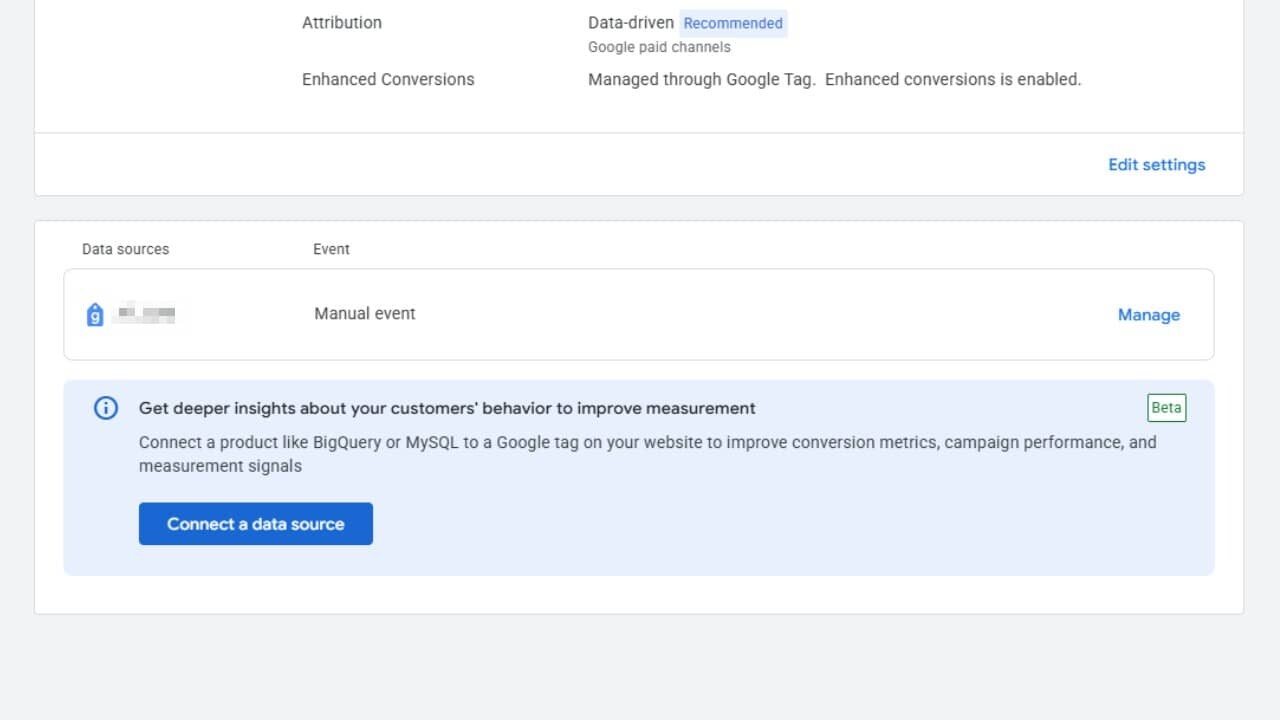
    I’ve recently discovered an exciting development in Google Ads that’s set to revolutionize how we track and measure our advertising success. The platform is now testing a beta feature that allows us to link external data sources directly into the conversion action settings. This move aims to strengthen the bridge between our first-party data and campaign measurement.

    How does this work, you might ask? In the conversion action details, a new section titled “Get deeper insights about your customers’ behavior to improve measurement” encourages us to connect our external databases to our Google tag, offering a seamless integration experience.

    This integration supports platforms like BigQuery and MySQL, with the primary goal of enriching our conversion metrics and enhancing performance signals. Notably, this feature is highlighted within the data attribution settings and is gradually being rolled out in its Beta phase.

    Why do we care? The ability to directly integrate these data sources reduces the hassle of syncing offline or backend data with ad measurements. This beta feature from Google Ads simplifies connecting first-party data to conversion tracking, improving our measurement accuracy and campaign optimization.

    ```json
{
  "alt": "Screenshot of a Google Ads interface showing data-driven attribution and enhanced conversions.",
  "caption": "Unlock deeper customer insights with enhanced Google Ads metrics. Connect data sources like BigQuery for improved measurement.",
  "description": "This image displays a screenshot of the Google Ads interface, highlighting data-driven attribution recommendations and information on enhanced conversions managed through Google Tag. It features a prompt to connect data sources such as BigQuery or MySQL to improve conversion metrics, campaign performance, and measurement signals, with an interactive button to 'Connect a data source'. Relevant keywords include Google Ads, data-driven attribution, enhanced conversions, and BigQuery."
}
```

    By harnessing the power of platforms like BigQuery or MySQL, we’re able to incorporate richer customer data into our signals, crucially offsetting any data loss resulting from recent privacy changes. In practical terms, this means smarter bidding, clearer attribution, and the potential for a stronger ROI.

    Beneath the surface, embedding these data connections directly within conversion settings—rather than relying on separate pipelines—democratizes advanced measurement tactics, making them accessible not only to large enterprises but to advertisers like you and me.

    As ad platforms compete for superior measurement accuracy, these native data integrations are emerging as a pivotal advantage, particularly for brands heavily investing in proprietary customer data.


    Inspired by this post on Search Engine Land.


    crushpress.ai community screenshot
  • Boost Your AEO Strategy with New Contentful Integration

    Boost Your AEO Strategy with New Contentful Integration

    I’m thrilled to share that Profound Agents now offer direct integration with Contentful CMS. This integration brings native Contentful support right to your AEO automation stack, enhancing your strategy and capabilities.

    With this development, I’m sure you’ll find managing content and automations far more streamlined and efficient. Having the power of Contentful within reach means we can align more closely with modern content management needs.

    I’m eager to see how this integration will open up new avenues for optimizing our automated processes and elevating overall performance.


    Inspired by this post on Try Profound Blog.


    crushpress.ai community screenshot
  • Strengthen Your SEO Results with Effective Agency Collaboration

    Strengthen Your SEO Results with Effective Agency Collaboration

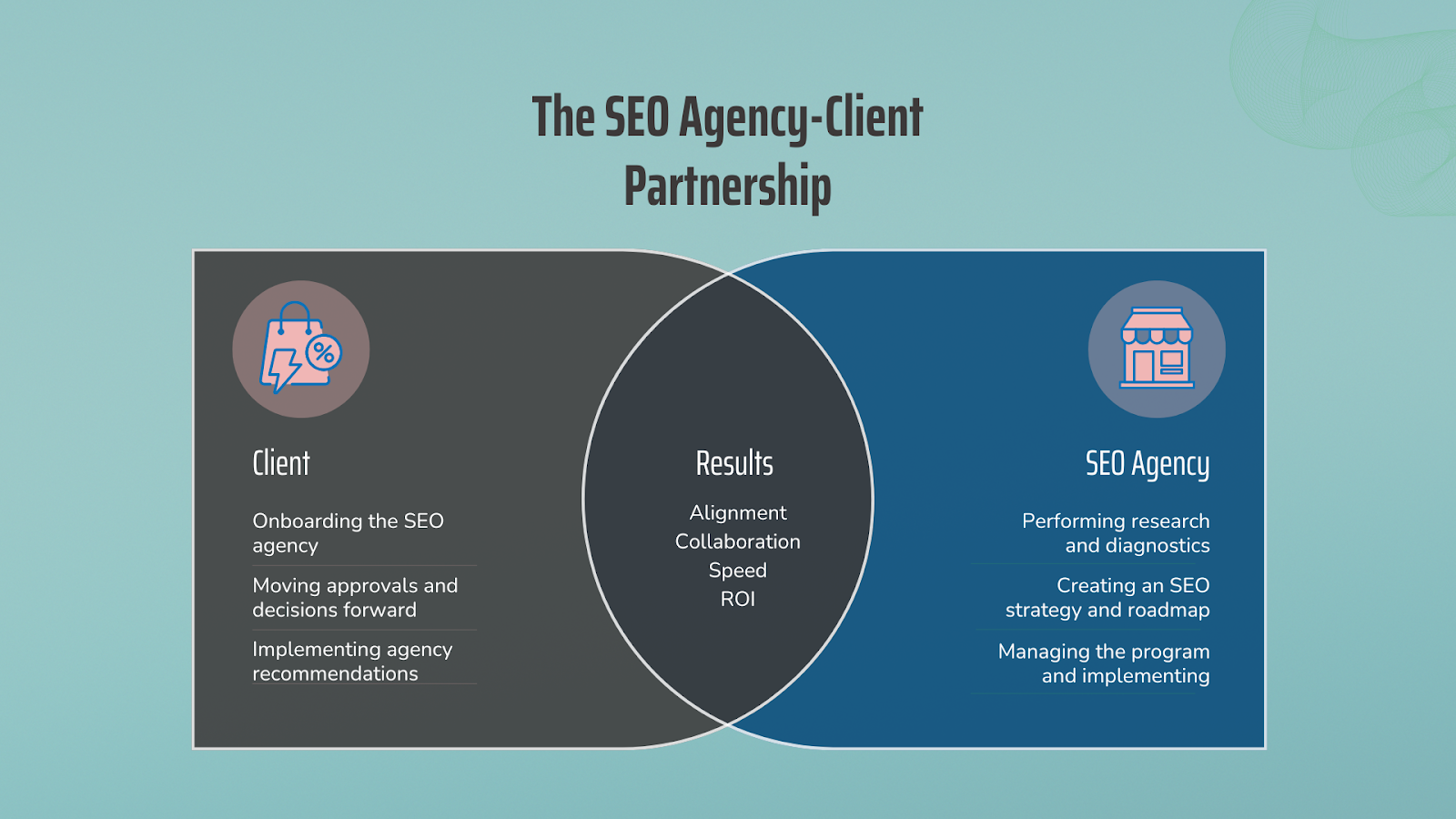
    From the very first kickoff to the technical execution phases, I’ve learned that the true value of hiring an SEO agency lies in our partnership and collaboration. Together, we can eliminate bottlenecks, empower cross-functional teams, and clearly demonstrate the ROI of our SEO investment.

    Hiring an SEO agency can truly transform how your brand stands out in search results. But remember, an agency’s effectiveness relies heavily on the partnership we build. Realizing the full potential of SEO requires a shared commitment to our goals and maintaining high momentum.

    Here’s what I’ve discovered about maximizing the benefits of working with my SEO agency: Alignment leads to faster progress, which makes it easier for us to prove the value of our efforts.

    To ensure we get the most out of this partnership, it’s crucial to align our SEO strategy with what truly drives our business. The company sets the business goals, and it’s the agency’s job to attract the traffic that helps achieve them.

    ```json
{
  "alt": "Venn diagram illustrating the SEO agency-client partnership detailing roles and results.",
  "caption": "Exploring the symbiotic relationship between SEO agencies and clients, this diagram reveals how collaboration leads to optimal results.",
  "description": "The image displays a Venn diagram titled 'The SEO Agency-Client Partnership' with three sections: Client, Results, and SEO Agency. The client side includes onboarding and implementing recommendations. The SEO agency side lists performing research and strategy creation. The overlapping area highlights shared results like alignment and ROI. The graphic visually represents the importance of collaboration and mutual goals in a successful SEO partnership."
}
```

    Having open discussions with the agency about how to align these goals right from the start enhances the effectiveness of our SEO program. Including cross-departmental stakeholders only reinforces the alignment and ensures everyone is on the same page.

    When the entire team understands the foundation of SEO, they can comprehend its role and their contribution to its success. In this spirit of collaboration, I facilitate SEO training across teams to empower everyone involved.

    I always come to the kickoff meeting fully prepared, ready to set agendas for productivity. Sharing pain points, detailing business operations, and clarifying the program’s scope helps everyone understand what to expect and what’s expected of them.

    ```json
{
  "alt": "The CapmatchOne logo with a gradient circle and bold text.",
  "caption": "Discover innovation with the CapmatchOne logo, featuring sleek typography and a modern gradient circle.",
  "description": "The CapmatchOne logo features bold, modern typography coupled with a gradient circle, symbolizing connection and innovation. The sleek design conveys a sense of progress and creativity. This image can be used for branding or promotional purposes, appealing to audiences interested in innovative solutions and forward-thinking designs."
}
```

    Regular communication with my agency, whether through emails, Slack, or meetings, is vital. Clear reporting methods are another key aspect, ensuring everyone remains accountable and the results are measurable.

    Switching from seeing the agency as just a vendor to viewing them as a true expert partner helps cultivate trust in their guidance, the very reason I hired them in the first place.

    By giving our agency visibility into past and present performance data, I ensure they have all vital information for optimizing our SEO efforts from day one. This setup includes access to essential tools and crucial performance metrics.

    ```json
{
  "alt": "Diagram showing SEO as a cross-functional effort involving leadership, marketing, product, dev/IT, design, and content.",
  "caption": "Explore SEO as a dynamic cross-functional collaboration! This diagram highlights the vital roles of leadership, marketing, and more in optimizing search visibility.",
  "description": "This image features a hexagonal diagram with 'SEO' at the center, surrounded by six connected blue circles labeled: Leadership, Marketing, Product, Dev/IT, Design, and Content. The background is light blue, and the text 'SEO as a Cross-Functional Effort' is displayed below. This graphic emphasizes the collaborative nature of SEO across various business functions, making it a key visual for presentations or educational materials related to digital marketing strategy."
}
```

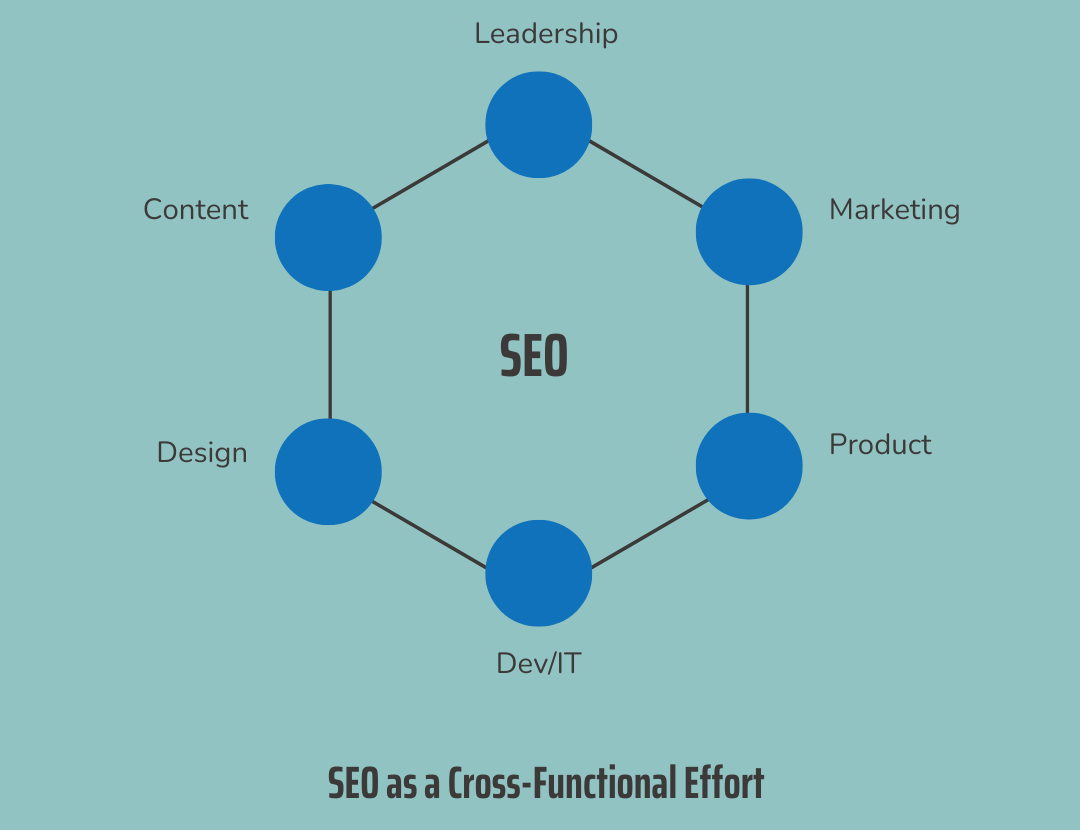
    SEO isn’t just an isolated activity—it requires contributions from multiple teams within the company. By including team leaders early in planning, I make sure everyone is engaged and accountable, from SEO briefings to content collaboration.

    My agency excels in SEO, but I bring invaluable brand knowledge to create content that aligns both with business goals and customer needs. By maintaining active involvement in content development, we produce material that truly resonates.

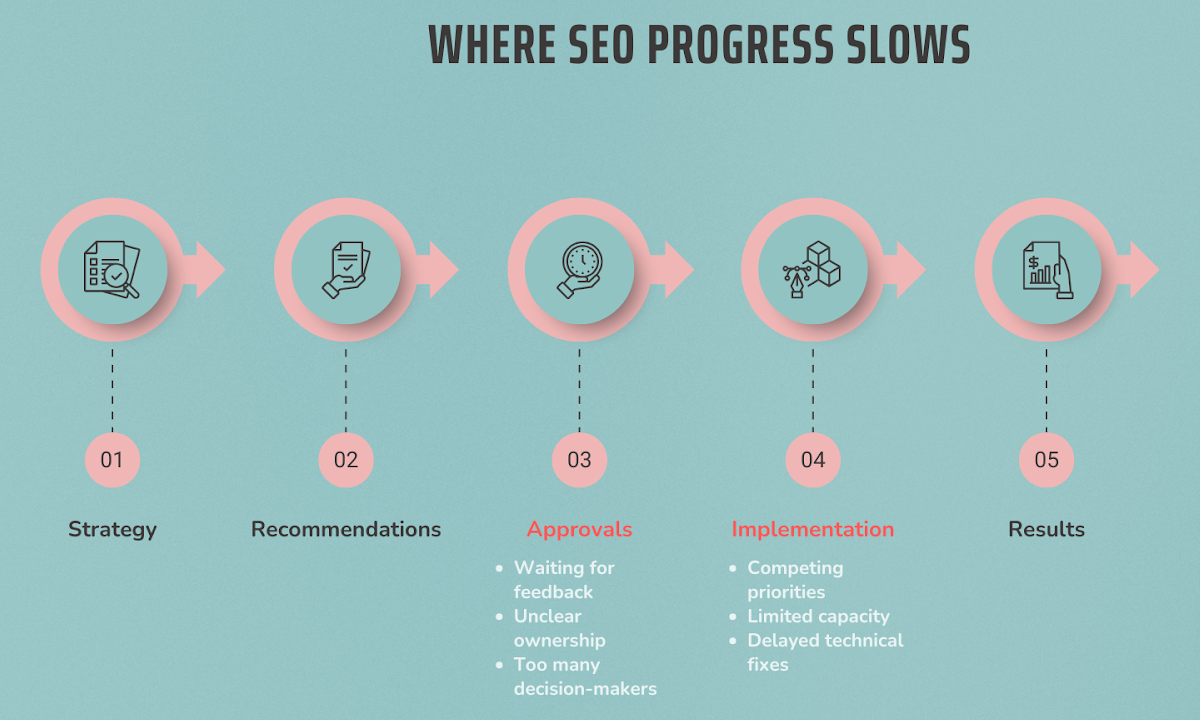
    Streamlining content reviews and setting clear guidelines helps eliminate approval hurdles that can slow down our SEO progress. Prioritizing high-impact tasks ensures we stay competitive in search results.

    ```json
{
  "alt": "Infographic showing five stages where SEO progress slows: Strategy, Recommendations, Approvals, Implementation, and Results.",
  "caption": "Explore the five critical stages where SEO progress often stalls, from strategy and recommendations to approvals, implementation, and final results.",
  "description": "This infographic highlights five key stages where SEO progress typically slows down: Strategy, Recommendations, Approvals, Implementation, and Results. Each stage is represented by icons within pink circles, connected by arrows. Approvals and Implementation are specifically noted for challenges like unclear ownership and competing priorities. Keywords: SEO, progress, strategy, recommendations, approvals, implementation, results."
}
```

    Each implementation, however small, contributes significantly to our overall SEO success. I prioritize these tasks during planning phases and involve technical teams early to ensure seamless execution.

    Maintaining engagement with my agency beyond the initial excitement stage is crucial for ongoing success. Continual communication, involvement in reviews, and flexibility help adjust to shifting business landscapes effectively.

    Ultimately, strong SEO results are built on strong partnerships. By working together, my agency and I drive our SEO program forward, creating a strategic and valuable business initiative.


    Inspired by this post on Search Engine Land.


    crushpress.ai community screenshot
  • Transforming Client Pressure into Growth: Insights from Andrea Cruz

    Transforming Client Pressure into Growth: Insights from Andrea Cruz

    On episode 341 of PPC Live The Podcast, I had the pleasure of chatting with Andrea Cruz, Head of B2B at Tinuiti. We delved into a challenge that many senior marketers face: the struggle of providing immediate answers when clients press for details without prior notice.

    We explored how missteps in communication can amplify client stress, and how adopting a proactive mindset can turn these challenges into pivotal moments of growth in one’s career.

    As Cruz progressed from a hands-on marketer to leading entire teams, she encountered the challenge of advocating for projects she wasn’t directly managing daily. This shift brought new struggles, especially when clients questioned campaign performance or outcomes.

    In those moments, freezing or delaying responses can damage trust. Cruz realized that senior leaders must offer clear direction, even without knowing every detail, to maintain confidence in discussions.

    Through her experiences and mentorship, Cruz honed a technique for buying time without losing trust: asking thoughtful questions. This strategy not only buys time but also ensures that the responses are precise and address the core of the client’s concerns.

    Her method includes asking clients to clarify expectations, requesting additional context, and confirming their understanding. This approach is crucial, especially in emotionally charged situations, and, for Cruz, it allowed her to manage complex conversations effectively despite being a non-native English speaker.

    At Tinuiti, the focus is on a solutions-driven culture over assigning blame. By addressing ‘Where are we now?’ and ‘How do we get where we want to be?’, teams foster a safe space to discuss errors and learn from them. Cruz believes that leaders should set the standard by openly sharing their own mistakes.

    Cruz advocates for proactive communication, urging teams to address issues before clients notice. Tailoring communication styles to client preferences fosters stronger relationships and transforms agencies into strategic partners.

    Common mistakes in B2B advertising include spreading budgets too thin and underfunding campaigns. Cruz emphasizes that it’s better to focus on fewer channels with adequate resources to avoid ineffective outcomes.

    Regarding AI, Cruz warns against limiting its use to basic tasks and shares how her team is leveraging AI for advanced operations, enhancing strategic execution.

    Cruz’s message is clear: growth requires preparation and a willingness to adapt. By anticipating client needs and embracing experimentation, marketers can turn pressure into golden opportunities.


    Inspired by this post on Search Engine Land.


    crushpress.ai community screenshot
  • AI Search Visibility Strategy: Build the System Behind It

    Your brand can rank well, publish strong content, and still appear inconsistently in AI answers. The usual weak point is not a missing optimization trick. It is the gap between product data, page copy, schema, PR language, and local information. When those inputs disagree, AI systems have to assemble an uncertain version of your brand.

    You need an operating system for visibility: one controlled fact layer, a publishing pipeline that catches contradictions, equivalent human and machine representations, and a repeatable way to measure what AI systems actually say. Build that foundation before you optimize individual pages or chase whichever AI platform is attracting attention.

    Choose the decisions you need to influence, not a favorite engine

    ChatGPT, Google AI Overviews, Perplexity, and Bing do not present information in identical ways. Their interfaces, answer formats, and potential value to a brand differ, so platform prioritization should follow your business objective. It should not define your underlying information architecture.

    Start by building a query portfolio. This is a controlled set of questions representing the decisions you want to influence. It gives content, SEO, product, and PR teams a shared target that is more useful than a broad instruction to improve AI visibility.

    1. Entity identification: Questions asking what your company, product, service, or expert is. These expose naming, category, and relationship problems.
    2. Category discovery: Questions asking which options fit a need. These show whether the brand is associated with the right problem and audience.
    3. Comparison: Questions asking how alternatives differ. These test whether your differentiators are specific, supported, and easy to retrieve.
    4. Verification: Questions about specifications, policies, locations, availability, qualifications, or other concrete facts. These are where stale or contradictory information becomes especially visible.
    5. Action: Questions asked immediately before a visit, signup, inquiry, or purchase. These reveal whether AI answers can connect a recommendation to a useful destination.

    For every query, record the audience intent, facts a correct answer must contain, the preferred evidence URL, acceptable variations in wording, and conditions that would make the answer wrong. A mention is not automatically a success. A brand can be mentioned in the wrong category, cited with an unsupported claim, or recommended to an unsuitable audience.

    Run the same portfolio across the platforms relevant to your audience. Keep the prompts stable long enough to identify patterns. If you change the questions, grading rules, and target platforms simultaneously, you cannot tell whether visibility improved or the test simply became easier.

    Build a canonical fact layer before producing more content

    Your website should not be the place where every team independently decides what is true. Establish an entity registry that controls the facts reused across pages, structured data, press materials, partner profiles, sales documents, and local properties. Consistent entities, narratives, and mentions give AI systems a more coherent set of signals.

    Create one record for each important company, product, service, location, person, and named methodology. A useful record includes:

    • Identity: Preferred name, approved aliases, category, parent organization, and relationships to other entities.
    • Core assertions: The facts that must remain stable, such as what the entity does, who it serves, and which features or qualifications can be claimed.
    • Evidence: The canonical page and any approved supporting URLs for each material assertion.
    • Scope: Geographic, product-version, audience, or time limitations that prevent a qualified fact from becoming an unqualified claim.
    • Ownership: The person or team allowed to approve a change, plus the date on which the record was last verified.
    • Distribution: The templates, schema fields, feeds, profiles, and communications that consume the record.

    Keep facts separate from expression. Your product page, comparison page, press release, and local landing page do not need identical sentences. They do need to agree on names, relationships, capabilities, qualifiers, and evidence. This lets writers adapt the message without quietly creating a second version of the truth.

    Infrastructure layerWhat it controlsRelease control
    Entity registryNames, relationships, approved facts, qualifiers, and evidenceA named data owner approves material changes
    Canonical pagesThe visible explanation and primary evidence for each entityEditors reconcile copy with the registry before publication
    Structured dataMachine-readable facts and relationships already supported by the pageTemplates validate and values match visible content
    External and local distributionPR terminology, profiles, partner descriptions, and regional factsBriefs inherit approved language and preserve local qualifiers
    Evaluation logPrompts, answers, citations, errors, and changes over timeTests use a stable query set and written grading rules

    Do not use schema to introduce a claim that the visible page does not support. Structured data should clarify the page, not act as a hidden correction layer. When copy and markup conflict, fix the fact at its owner and update every dependent surface. Patching only the schema leaves the contradiction in circulation.

    Put every important asset through five visibility gates

    A content calendar controls when material is published. A visibility pipeline controls whether it is ready to become evidence. The practical mechanism is a series of nonnegotiable gates for parsing, entity consistency, retrieval, authority, and localization.

    1. Technical parsing gate: Confirm that the canonical URL, response, crawl controls, rendered content, and schema.org markup behave as intended. Block release when markup is invalid, a value required by your template is empty, or structured data disagrees with the page. Validate the appropriate Product, Review, FAQ, organization, person, or other supported types where they accurately describe the content.
    2. Brand signal gate: Compare names, categories, relationships, and core claims with the entity registry. Block release when an unapproved alias changes the entity’s meaning, a press message introduces a different category, or a differentiator cannot be connected to evidence.
    3. Accessibility and retrieval gate: Make each important passage understandable when retrieved without the rest of the page. Lead with the answer, use descriptive headings, name the entity instead of relying on vague pronouns, attach units and qualifiers to numbers, and keep evidence near the claim it supports. Block release when the main answer depends on a heading, footnote, image, or previous paragraph that a retrieval system may not capture with it.
    4. Authority and de-duplication gate: Identify the primary URL for the topic and compare it with existing assets. Block release when two pages give conflicting answers or when a new page merely creates another candidate authority. Decide whether to update the canonical page, narrow the new page to a distinct intent, or reconcile the conflict before publishing.
    5. Localization gate: Verify which facts are global and which vary by market. Block release when a regional page inherits an unsupported global claim or omits a location, currency, availability, policy, or language qualifier that changes the answer.

    Put these checks inside the CMS workflow or the ticket system your teams already use. Each gate needs three fields: pass or fail, evidence, and an owner for remediation. A checkbox without evidence becomes ceremonial; a failed check without an owner becomes permanent backlog.

    Apply the full pipeline first to your highest-value entity templates rather than every URL at once. Product, service, location, and expert pages are good candidates because a template-level correction can improve many assets while keeping their facts aligned.

    Do not create a machine-only version of reality

    Machine-friendly delivery can reduce parsing overhead, but it does not excuse content divergence. Cloudflare’s Markdown for Agents illustrates the distinction. When a client requests Accept: text/markdown, the feature can fetch the origin HTML, convert it at the edge, return Markdown, and include both Vary: accept and a token estimate. Cloudflare claims the converted representation can reduce token use by up to 80% compared with HTML. That is a vendor-supplied maximum, not a guaranteed result for every page.

    The strategic risk is not Markdown itself. The risk appears when an origin server recognizes the Markdown request and returns different facts, altered product data, hidden instructions, or richer claims than a person sees. The same URL then has two candidate representations of reality, and every consuming system must trust one, compare them, or ignore the alternate version.

    Google and Microsoft representatives have also advised against maintaining separate Markdown pages solely for large language models. AI systems already parse normal web pages, and a second machine-only page creates another surface that can become stale or inconsistent.

    If you introduce content negotiation or another alternate representation, use these controls:

    • Fix the HTML first. If the page is too cluttered or ambiguous to transform reliably, improve its structure rather than treating Markdown as a repair layer.
    • Generate, do not rewrite. Derive the machine-friendly response from the same approved human-facing content. Do not maintain a separate set of claims.
    • Prevent origin-level branching. If the origin does not need to know that Markdown was requested, normalize or strip the signal before it reaches templates that could vary the content.
    • Separate caches correctly. Preserve the relevant Vary behavior so HTML and Markdown responses are not served to the wrong request.
    • Test semantic parity. Compare names, claims, numbers, qualifiers, links, tables, labels, and disclosures after conversion. A raw text diff is less useful than checking whether both representations support the same conclusions.
    • Inspect context loss. Markdown can flatten visual relationships. Review tables, captions, comparison layouts, footnotes, and nearby disclaimers to ensure a converted passage does not become misleading.
    • Keep the feature reversible. Monitor errors and maintain a quick way to disable the alternate response if parity fails.

    Treat Markdown as a transport optimization. It may make approved information cheaper to process, but it should never become a private channel for information you are unwilling to show users.

    Operate AI visibility with owners, metrics, and a 90-day rollout

    A visibility system without ownership becomes another audit document. The operating model needs both a technical architect and a cross-functional advocate, even when one person covers both roles in a smaller organization.

    • The technical owner is accountable for rendering, schema, crawl accessibility, content transformations, evaluation tooling, and the technical gates.
    • The visibility owner aligns product, content, PR, localization, and leadership around approved entities, shared targets, and remediation priorities.

    Do not assign AI visibility to SEO while allowing every other team to alter the inputs independently. Give product, PR, content, and localization teams shared objectives tied to the gates they control. Otherwise, SEO will keep detecting contradictions after publication instead of preventing them.

    Separate input quality from observed AI outcomes

    Your dashboard should show whether the information supply chain is healthy and whether external systems are interpreting it as intended. Keep those two classes of measurement separate.

    Leading indicators should include schema validation status on priority templates, unresolved conflicts between canonical facts and published pages, gate pass rates for new assets, unverified entity records, and localization exceptions. These metrics tell you whether the organization is producing clean inputs.

    Outcome indicators should include brand mentions for eligible queries, citations to approved evidence pages, factual accuracy, sentiment where it can be graded with a written rubric, AI-referred visits, and conversions from those visits. These metrics tell you what happened after the information entered the wider ecosystem.

    Define Share of Model internally before putting it on an executive dashboard. One defensible definition is the number of eligible tested answers that mention the brand divided by the total number of eligible answers in a fixed query portfolio. Define supported citation rate separately as the share of checked citations that genuinely support the associated claim. Do not blend the two: being mentioned and being used as evidence are different outcomes.

    For every test, retain the prompt, platform, date, answer, cited URLs, and grading decision. Use the same rubric on each run. AI answers can vary, so treat an individual response as an observation rather than a trend. Repeated tests with a stable denominator are what make changes interpretable.

    A practical first 90 days

    The first rollout should prove the operating model on a limited set of important entities. A three-phase audit, infrastructure, and accountability sequence keeps the work concrete.

    1. Days 1-30: Audit. Select the entities most connected to revenue, reputation, or customer decisions. Build the initial query portfolio, map every material claim to its current URLs, inspect schema and external descriptions, and log contradictions. Assign an owner to each disputed fact before rewriting content.
    2. Days 31-60: Infrastructure. Create the entity registry, add the five gates to your publishing workflow, validate priority templates, establish canonical evidence pages, and add parity tests for any alternate representation. Build the first dashboard from the same fixed query portfolio used in the audit.
    3. Days 61-90: Accountability. Give product, content, PR, SEO, and localization teams objectives tied to the gates they control. Review citation and accuracy failures together, fix them at the canonical fact layer, and verify that corrections reached every dependent surface. If compensation will eventually depend on these metrics, make the definitions auditable and resistant to gaming before attaching incentives.

    Key takeaways

    • Choose AI platforms after defining the audience questions and business decisions you need to influence.
    • Control important names, claims, relationships, qualifiers, and evidence in one canonical entity registry.
    • Require technical, brand, retrieval, authority, and localization gates before important content is published.
    • Keep human-facing HTML and machine-friendly representations semantically equivalent.
    • Measure mentions, citations, correctness, and business outcomes separately against a stable query portfolio.

    Start this week with one commercially important entity. Identify its canonical facts, trace where those facts are repeated, and run tenaciously through every conflict until the page, schema, communications, and AI test answers agree. Once that entity can move through the pipeline cleanly, turn the process into a reusable template and expand it to the next one.

    References

  • Paid Acquisition Optimization: A Practical Operating System

    Your paid acquisition account has stalled, and every obvious lever looks familiar: raise the budget, loosen the target, switch bid strategies, or rebuild the audience. Those changes may increase delivery, but they won’t necessarily fix the constraint. They can also spend more money while making the underlying problem harder to see.

    A better optimization process starts by separating five jobs that ad platforms often blur together: measuring demand, valuing a customer, producing effective creative, controlling delivery, and deciding how much you can afford to pay. Once you know which job is failing, the next action becomes much clearer.

    Diagnose the constraint before changing the bid

    Bidding is only one layer of paid acquisition. It determines how the platform competes for opportunities, but it cannot repair an unattractive offer, an incorrect conversion value, stale creative, broken tracking, or a landing page that contradicts the ad.

    This matters more as platforms automate auction decisions. Google Smart Bidding can evaluate signals such as device, location, behavior, and intent in real time, while Meta predicts outcomes instead of relying only on static audience definitions. That makes repeated bid-strategy changes a weak substitute for diagnosing the input that is actually limiting performance. In many accounts, creative has become a more important performance constraint as bidding has become more automated.

    Start each review with an observed pattern, not a proposed setting change. The pattern won’t prove a cause, but it will tell you what to inspect first.

    Observed patternCheck firstNext controlled action
    Spend remains below budgetDelivery status, eligibility, audience restrictions, asset coverage, and whether the target is too restrictiveResolve policy or tracking issues, then add genuinely distinct eligible assets before paying more for the same opportunities
    Traffic remains steady but conversion efficiency weakensOffer, landing-page experience, message match, and conversion trackingTest the promise or page while holding the delivery setup as stable as practical
    Acquisition cost rises while the same ads continue runningCreative fatigue, declining response, and loss of message relevanceIntroduce a new concept, not merely another crop or minor wording change
    Reported ROAS looks healthy but profit or cash generation does notConversion-value rules, margins, refunds, customer mix, and attribution assumptionsReconcile platform value with contribution economics before scaling
    Blended ROAS is acceptable but new-customer volume is weakNew-versus-returning customer identification and the value assigned to acquisitionSeparate customer types and define an explicit new-customer value

    Keep this diagnosis conditional. A rising acquisition cost can accompany creative fatigue, but it can also come from a changed offer, a measurement failure, a different product mix, or stronger auction pressure. Check those alternatives before declaring the creative responsible.

    The practical rule is simple: don’t change bids, budgets, audiences, creative, and landing pages in the same optimization pass. If every layer moves, you may improve the headline metric without learning why. You also lose a reliable control when performance later reverses.

    Define what a new customer is worth before asking for ROAS

    A target ROAS is meaningful only when the conversion value behind it is meaningful. ROAS is conversion value divided by ad spend. If the value sent to the platform exaggerates the economics, the campaign can hit its platform target while missing the business target.

    Separate accounting value from optimization value. Accounting value describes what happened, such as recorded order revenue. Optimization value tells the bidding system how strongly one outcome should be preferred over another. The two can be related without being identical, but any adjustment needs a documented economic reason.

    For acquisition, build the value from contribution rather than topline revenue. A useful working relationship is:

    Allowable acquisition cost = first-purchase contribution + defensible future contribution – omitted costs – uncertainty allowance.

    First-purchase contribution should reflect the money left after the costs that move with the sale. Future contribution should include only behavior you can support with customer data and a clearly defined observation window. If repeat-purchase evidence is weak, keep the future component conservative. Raising it to make a campaign appear scalable only authorizes the platform to spend against an assumption.

    Then document the valuation inputs in one place:

    • The conversion event being optimized.
    • How the platform identifies a new customer and what happens when identity is uncertain.
    • The ordinary value attached to the transaction.
    • The additional value, if any, attached to acquiring a new customer.
    • Which margins, refunds, cancellations, discounts, and fulfillment costs are reflected.
    • Whether future customer contribution is included and what evidence supports it.
    • The target ROAS applied to that value.
    • The owner responsible for reconciling platform reporting with actual customer economics.

    Google Ads is experimenting with a tool that proposes a new-customer conversion value from the advertiser’s desired ROAS. It gives advertisers a more structured alternative to choosing a flat premium by instinct. It does not remove the need to validate the value against profitability.

    The current limitation is important: the suggested value is applied broadly rather than being customized for each auction, campaign, or product. A single value can therefore hide meaningful differences between a low-margin first order, a high-margin product, and an acquisition source associated with stronger repeat behavior. Treat the suggestion as a bidding input, not as a universal statement of customer value.

    If your economics differ materially by product or customer type, preserve that detail in your own analysis even when the platform setting cannot. Review performance by the segments that change contribution, then decide whether the broad value is conservative enough for the full mix. Don’t increase the budget merely because the platform reports that the modeled target has been reached; confirm that new-customer contribution supports the additional spend.

    Make creative production part of the media plan

    Automated bidding needs useful choices. If every asset repeats the same visual, claim, and opening line, the system has little meaningful variation to match with different people and contexts. More files do not automatically create more learning; distinct ideas do.

    Meta’s Andromeda system puts substantial weight on creative signals when retrieving and ranking ads. Weak creative can therefore restrict meaningful delivery as well as reduce response after an impression. Google has also increased the role of assets in formats such as Performance Max and Demand Gen. The operational consequence is that creative planning can no longer sit downstream from media planning. Your spend plan needs enough creative capacity to supply new hypotheses while the campaign is running.

    Build a creative queue around questions, not deliverables. Each concept should test a reason someone might act:

    • Problem framing: Which pain, missed opportunity, or desired outcome earns attention?
    • Audience state: Is the person discovering the category, comparing approaches, or choosing a provider?
    • Claim: What specific benefit does the ad promise, and can the landing page support it?
    • Proof: What demonstration, product detail, customer evidence, process explanation, or constraint makes the claim credible?
    • Presentation: Which opening line, visual style, format, or spokesperson makes the idea understandable quickly?
    • Action: What should the person do next, and does the call to action match the commitment required?

    Distinguish concept variation from execution variation. Changing a background color, aspect ratio, or button label can help adapt a proven concept, but it usually does not test a new reason to buy. A concept changes the argument. An execution changes how that argument is expressed. Your library needs both, and the campaign report should label them separately.

    Use one clear hypothesis for each planned comparison. For example: a demonstration may answer uncertainty better than a feature list, or an outcome-led opening may be more relevant than a product-led opening. Hold as much of the rest of the path stable as the platform allows. Automated delivery may not distribute impressions evenly, so don’t call a winner from surface engagement alone. Check whether the intended acquisition outcome improved, whether the customer mix changed, and whether the result persisted after the platform found its preferred delivery pockets.

    Refresh creative in response to evidence, not an arbitrary calendar. Watch for a sustained pattern across delivery and business metrics: response weakening, acquisition cost rising, frequency or repeated exposure increasing where available, and the offer or measurement remaining unchanged. A single bad day is not a creative diagnosis. A recurring decline across the same concept is a reason to advance the next prepared hypothesis.

    Run one optimization loop across media, creative, and finance

    Paid acquisition breaks down when each team optimizes its own proxy. Media can maximize platform value, creative can maximize engagement, and finance can judge blended profitability, yet no one can explain whether the next customer is worth the next unit of spend. Use one shared loop that connects the auction decision to the business outcome.

    1. Name the decision. Write the business question before opening the ad platform. Examples include whether to increase acquisition spend, replace a fatigued concept, or change the value assigned to a new customer.
    2. Choose the decision metric. Use the metric that answers that question. New-customer contribution is more relevant to an acquisition decision than blended revenue that includes returning buyers.
    3. Record the current inputs. Capture the bid strategy, target, budget, conversion definition, value rules, customer classification, live creative concepts, landing page, offer, and relevant tracking status.
    4. State the suspected constraint. Explain the mechanism. Avoid labels such as underperformance when you mean that the creative is repetitive, the target is uneconomic, or the page fails to support the promise.
    5. Make the smallest useful change. Change the layer implicated by the diagnosis while preserving a usable comparison wherever practical.
    6. Read the result through the customer economics. Check delivery and response metrics to understand the mechanism, then judge the decision using acquisition cost, contribution, customer type, and the quality of the measured outcome.
    7. Keep the learning. Record what changed, what remained stable, what the platform did, and what decision followed. Feed creative learning into the next brief and value learning into the next budget discussion.

    This process also prevents a common category error: treating a platform forecast as proof of incrementality. Attribution tells you which outcomes the system assigned to an ad interaction. It does not, by itself, establish how many of those outcomes would have happened without the spend. Keep that distinction visible when branded demand, returning customers, or existing high-intent audiences can influence reported performance.

    Set ownership at the handoffs. Media should flag delivery and auction symptoms. Creative should maintain the hypothesis queue and concept labels. Analytics should protect event definitions and customer classification. Finance or the commercial owner should approve the contribution logic behind allowable acquisition cost. The shared review should end with one decision, one owner, and the evidence required to revisit it.

    Key takeaways

    • Diagnose economics, measurement, creative, delivery, and the customer journey before assuming the bid is the constraint.
    • Base new-customer value on contribution and defensible future behavior, not revenue or a premium chosen to make ROAS look better.
    • Treat Google’s experimental ROAS-linked value suggestion as a broad bidding input; it does not yet adapt the value by auction, campaign, or product.
    • Give automated systems distinct creative concepts, not a folder of cosmetic variants expressing the same idea.
    • Refresh creative when a repeatable performance pattern supports the diagnosis, not because a calendar date arrived.
    • Change one implicated layer at a time and judge the outcome against new-customer economics.

    At your next account review, bring a one-page valuation sheet and a queue of creative hypotheses. Pick the clearest constraint, make one controlled change, and record what would justify scaling, revising, or stopping it. That turns optimization from a series of platform reactions into a repeatable acquisition decision system.

    References