Tag: Smart Bidding

  • Master Broad Match: Control Smart Bidding Effectively

    Master Broad Match: Control Smart Bidding Effectively

    I’ve learned that broad match now operates alongside Smart Bidding. It’s fascinating how drift happens, why it’s important, and how to align performance with genuine intent.

    Broad match, once synonymous with “more reach, less relevance,” now depends on a machine learning layer to define relevance.

    Over time, Google has nudged us, the advertisers, towards fewer complexities like fewer match types and more automation.

    Since July 2024, broad match has become the default for new Search campaigns, signaling a shift in how we ought to think about it.

    If you’re stuck in the mindset of broad match being the “loosest match type,” you’re stuck in 2016, and that’s where problems like CPC inflation and irrelevant leads arise.

    Today’s broad match works within a system, collaborating with query matching, Smart Bidding, conversion signals, and optional tools like audiences and negatives.

    Google leverages broad match as a growth mechanism for Smart Bidding campaigns rather than a solitary reach tactic.

    In this article, I explore the changes, Google’s motivations behind them, and safe practices to maintain standards while using broad match.

    The real risk with broad match isn’t relevance, it’s direction

    Broad match tends to drift rather than fail completely.

    With shallow optimization goals, broad match coupled with Smart Bidding can find quick ways to meet them, sometimes resulting in:

    • Queries that trigger cheap forms without real sales potential.
    • Users who convert but never purchase.
    • Leads that look good in Google Ads but don’t end up profitable.

    Even when everything seems fine in the interface, the account might drift away from commercial intent.

    This illustrates why understanding broad match’s current behavior is crucial.

    What broad match actually is now

    Broad match no longer stands alone as a keyword setting but works within a larger optimization system.

    It’s built to work with Smart Bidding

    Google specifies that broad match is intended to run with Smart Bidding, as bidding decisions are now made during auctions using signals like:

    • Device
    • Location
    • Time of day
    • Query context
    • User behavior

    Broad match increases eligible queries. Smart Bidding evaluates which ones merit investment.

    Running broad match without Smart Bidding deviates from its intended design.

    Google has materially improved broad match matching

    Google claims that recent AI enhancements have uplifted broad match campaigns using Smart Bidding by 10%.

    This doesn’t imply broad match is inherently safe, but Google feels its matching layer justifies broader use.

    It’s no longer positioned as optional

    Starting July 2024, new Search campaigns activate broad match by default.

    The campaign-level setting enforces broad match when conversion-based Smart Bidding is active, marking a significant paradigm shift.

    Why Google wants advertisers to adopt broad match

    Google’s rationale is straightforward:

    • Search behavior is increasingly unpredictable and long-tail.
    • Manual keyword lists fail to keep up with language and intent shifts.
    • Machine learning can interpret intent at auction time better than rigid logic.

    Google positions broad match as a growth tool for Smart Bidding campaigns, providing algorithms with more opportunities to optimize for conversions.

    You might not agree with this philosophy, but when advertising on Google Search, you’re part of this system.


    A framework for using broad match without losing control

    Broad match expands your reach. Maintaining control requires thoughtful constraints.

    Conversion goals that reflect quality, not convenience

    Smart Bidding optimizes based on defined conversion actions and values.

    If your primary conversions are low-intent, broad match will scale this low intent.

    Successful setups often include:

    • Optimizing for deeper conversion actions.
    • Applying conversion values to identify lead quality tiers.
    • Importing offline conversions, like qualifying leads or revenue.

    This tackles the issue of associating cheap volume with success.

    Intent filters through audience signals

    Broad match identifies queries. Audience signals dictate ad visibility for those queries.

    Audiences should provide context, not just report data:

    • Customer lists favor known buyers.
    • Remarketing lists for measured expansion.
    • Audience insights to recognize quality-segment correlations.

    Even in observation mode, these signals help verify if broad match growth benefits the right areas.

    Negative keyword structures that scale

    With broad match, negative keywords transform from mere cleanup to structural elements.

    Effective accounts often include:

    • Account-level shared negative lists for terms like jobs, free, definition.
    • Campaign-level exclusions aligned with intent boundaries.
    • Regular search term reviews, crucial early on.

    Broad match naturally explores, while negatives determine its limits.

    Brand controls to protect intent

    Google’s brand controls can substantially reduce unwanted behavior in broad match.

    These controls include:

    These controls are handy when broad match starts overlapping with competitor intent or misaligned searches.

    How broad match succeeds and where it breaks

    A sensible rollout usually includes:

    • Choosing a campaign with effective tracking and enough conversion volume.
    • Aligning Smart Bidding with meaningful outcomes.
    • Launching with predetermined negative keywords.
    • Frequent search terms reviews in the initial month.
    • Verifying lead quality outside Google Ads before scaling.

    Broad match has potential and is beneficial if used wisely. However, it isn’t a simple fix.

    Failures often occur due to three common mistakes:

    • Choosing the wrong conversion to optimize: The algorithm follows your instructions meticulously.
    • Lack of a negative keyword system: Unchecked exploration becomes costly.
    • Judging success solely by platform metrics: CPC and CPA can look good, while revenue declines.

    Broad match is a system, not a setting

    Google favors a systemized approach to Search, moving from simple keyword management to a broader strategy.

    Control isn’t lost, but shifted.

    Successful broad match campaigns are defined by:

    • Clear quality definitions.
    • Deliberate intent constraints.
    • Success measured beyond the interface.

    If used judiciously, broad match can reveal new demand opportunities. Casual use, however, might lead you astray.


    Inspired by this post on Search Engine Land.


    crushpress.ai community screenshot
  • Unlocking Incrementality with Bayesian Tests at a $5K Budget

    Unlocking Incrementality with Bayesian Tests at a $5K Budget

    I’ve recently been intrigued by how Bayesian testing allows Google to measure incrementality with just $5,000. It’s fascinating how this modern approach opens up new possibilities for advertisers.

    Through these tests, advertisers like me can now explore lift measurement options without needing big enterprise budgets, as reported by Search Engine Land.

    This change immediately raises an important question: How exactly does Google achieve accurate measurements of incrementality with significantly less data?

    Previously, achieving reliable lift measurements demanded substantial budgets, lengthy test timelines, and the patience to handle inconclusive outcomes.

    Given this context, Google’s claim of delivering precise results with merely $5,000 seems almost too good to be true. But it isn’t just marketing fluff; it’s a utilization of innovative mathematical models.

    This transformation is powered by a testing methodology that emphasizes probability and learning, rather than aiming for absolute certainty.

    Understanding this new approach is crucial for accurately interpreting these incremental results and for enhancing our PPC strategies.

    ```json
{
  "alt": "Mathematical formula for Z-score involving proportions and sample sizes.",
  "caption": "Dive into statistics with this formula for calculating the Z-score from sample proportions. A fascinating glimpse into the world of data analysis!",
  "description": "This image displays a mathematical formula for calculating the Z-score based on the difference between two proportions, p2 and p1, over the standard error of the sample sizes, n1 and n2. This statistical formula is essential in hypothesis testing and helps determine how far apart proportions are in terms of standard deviation. Key elements include the square root, fraction, and parentheses, crucial in advanced statistics and data analysis."
}
```

    Before we delve deeper, let’s quickly revisit some key Bayesian terms that marketers often encounter.

    Glossary: Bayesian terms for search marketers

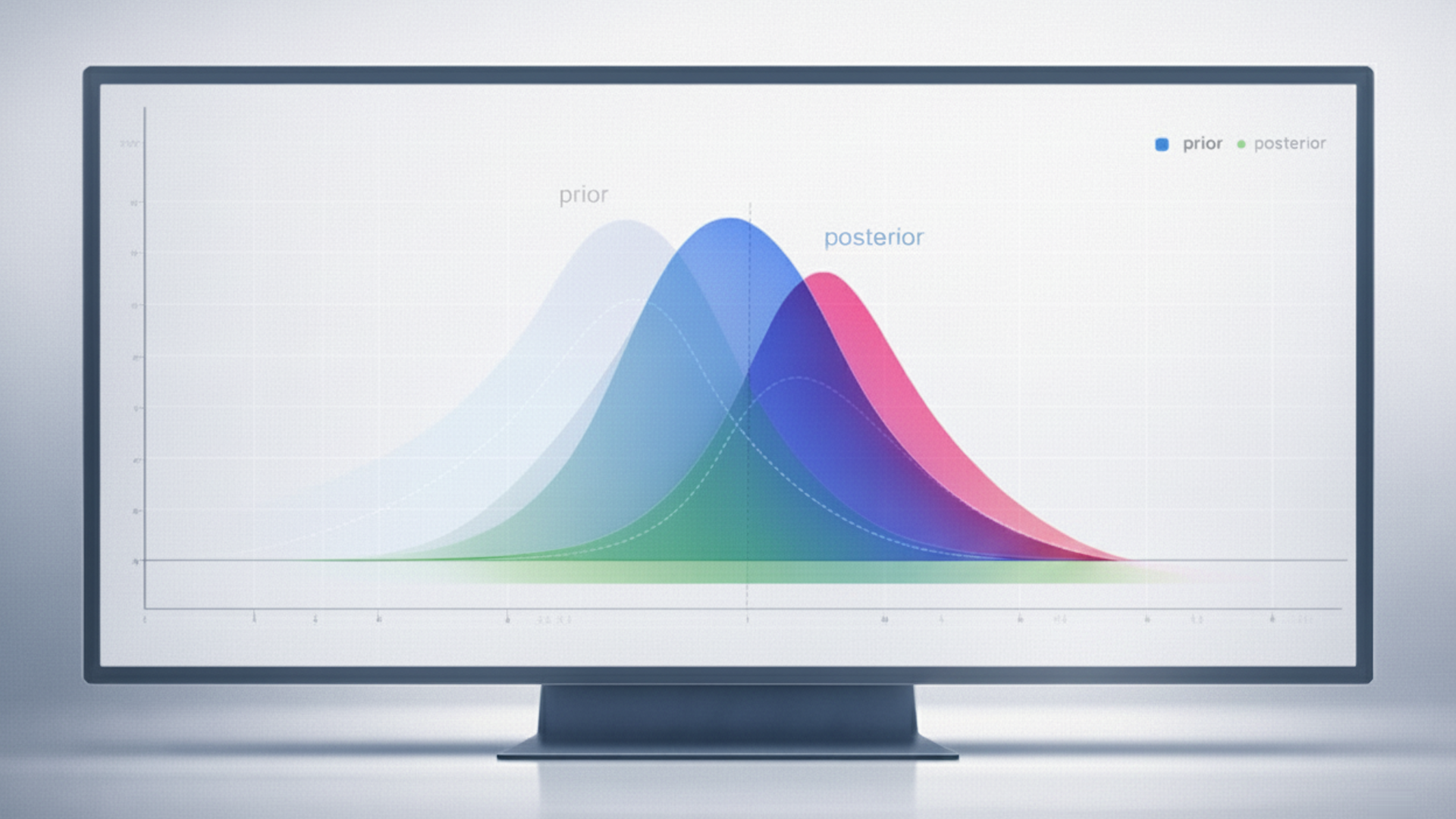
    • Prior: What we assume before the test begins.
    • Posterior: Updated belief after analyzing the data.
    • Credible interval: It shows the likely range of the result.
    • P-value: Frequency-based probability indication.

    Traditional A/B testing, which most PPC advertisers know even if unknowingly, follows frequentist statistics.

    These conventional A/B tests use metrics like p-values and fixed sample sizes to evaluate if changes reach statistical significance, often restricting smaller-budget tests.

    In contrast, Bayesian testing veers away from this binary framework, instead asking, “Given all we know, how likely is this result to be true?”

    Let’s see how Google legitimately manages to make $5,000 tests work effectively by embracing priors combined with its extensive data resources.

    ```json
{
  "alt": "Diagram showing Bayesian inference with steps: Prior, Data, Posterior.",
  "caption": "Visualizing Bayesian Inference: From Prior Beliefs to Updated Understandings.",
  "description": "This image illustrates a Bayesian inference process, consisting of three main steps: Prior (Initial Beliefs), Data (New Evidence), and Posterior (Updated Beliefs). It represents the process of updating beliefs based on evidence. The diagram uses simple text boxes and arrows to connect the concepts, emphasizing the logical flow from initial assumptions to refined conclusions. Keywords: Bayesian inference, Prior, Data, Posterior, beliefs, evidence."
}
```

    Google’s strategy rests on informed priors, hierarchically modeling, and probability assessments based on extensive campaign history.

    This enables a competent analysis even with modest budgets, thus transforming limited data insights into actionable intelligence without averaging noise across campaigns.

    Bayesian methods provide flexibility and adapt as more data is gathered, making them ideal for dynamic marketing environments, unlike their frequentist counterparts.

    As more data rolls in, Bayesian tests evolve, relying increasingly on real results rather than priors, ensuring refined decision-making from smaller experiments to large-scale trials.

    Using Bayesian inference, Google allows advertisers to derive directional insights without needing enormous budgets, effectively bridging gaps where frequentist testing falls short.

    Takeaways for advertisers interested in Bayesian testing include understanding the diminishing role of priors as data accumulates, needing a discerning approach to interpreting outcomes.

    To conclude, this mathematical ingenuity leverages Google’s vast data resources, offering a practical perspective over traditional methods, empowering PPC campaigns with more cerebral decision-making.


    Inspired by this post on Search Engine Land.

    crushpress.ai community screenshot
  • Why Seasonality Adjustments Mislead Advertisers on Black Friday

    Why Seasonality Adjustments Mislead Advertisers on Black Friday

    I recently came across a fascinating study highlighting how seasonality adjustments can actually backfire for advertisers during Black Friday, driving up costs and reducing efficiency.

    A thorough analysis over three years, involving up to 6,000 advertisers, indicates that using Google’s seasonality bid adjustments during Black Friday and Cyber Monday (BFCM) often undermines efficiency, despite the platforms recommending them.

    The big picture. Smart Bidding models are crafted to foresee predictable retail surges. Optmyzr analyzed tens of billions of impressions between 2022 and 2024, finding that advertisers who avoided seasonality adjustments usually had better efficiency metrics.

    Without adjustments, Smart Bidding:

    • Recognized the BFCM conversion lift independently
    • Increased bids rationally
    • Maintained stable or improved ROAS, particularly in 2024

    With adjustments: CPCs surged faster than the actual conversion rates, eroding efficiency.

    Reality check: Google doesn’t need your “heads up.” Seasonality adjustments prompt Google to expect a conversion rate rise and to bid accordingly. If your prediction is off—and it usually is—Smart Bidding overshoots.

    For example:

    • You predict a +50% CVR lift
    • The actual lift is +40%
    • This results in an overbid of about 7.1%

    During BFCM’s high sales volumes, even minor mistakes become costly quickly.

    The data: 3 years of the same story

    ```json
{
  "alt": "Table showing CPC inflation from 2022 to 2024 with and without seasonal bid adjustment.",
  "caption": "A comparison of CPC inflation rates over three years reveals significant seasonal adjustments.",
  "description": "This table illustrates the CPC inflation rates from 2022 to 2024, comparing figures with and without seasonal bid adjustments. In 2022, CPC inflation without adjustment is 17%, increasing to 36.7% with adjustment. For 2023, the rates are 16% without adjustment and 32% with adjustment. In 2024, both rates without and with adjustment are 17% and 34%, respectively. This data highlights the impact of seasonal adjustments on advertising costs, a crucial insight for marketers and advertisers."
}
```

    1. Smart Bidding already adjusts for the CVR spike

    • 2022: +17.5%
    • 2023: +11.9%
    • 2024: +7.5%

    No additional guidance needed.

    2. CPC inflation doubles with adjustments

    Across all observed years, CPCs increased approximately twice as much when a seasonal adjustment was used.

    3. ROAS drops significantly

    Advertisers relying on Smart Bidding saw stable or improved ROAS, whereas those who intervened suffered double-digit losses.

    The one exception: “Volume at all costs.” If the aim is pure revenue growth, disregarding margins, seasonality adjustments can be beneficial.

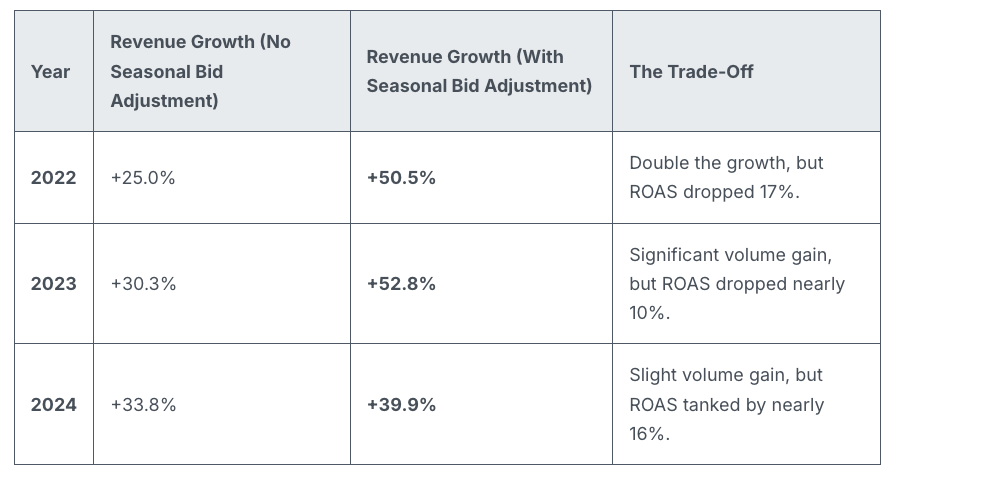
    Revenue lifts were notably higher with adjustments:

    • 2022: +50.5% vs. +25.0%
    • 2023: +52.8% vs. +30.3%
    • 2024: +39.9% vs. +33.8%
    ```json
{
  "alt": "Table showing revenue growth from 2022 to 2024 with and without seasonal bid adjustment with related trade-offs.",
  "caption": "Seasonal bid adjustments impact revenue growth significantly, but come with trade-offs in ROAS, as shown from 2022 to 2024.",
  "description": "This table presents a comparison of revenue growth from 2022 to 2024, analyzing scenarios with and without seasonal bid adjustments. In 2022, a 25% growth without adjustment jumps to 50.5% with it, though ROAS drops by 17%. In 2023, adjustments raise growth from 30.3% to 52.8%, with a 10% ROAS decline. By 2024, growth is 33.8% without and 39.9% with adjustment, noting a 16% ROAS reduction. Keywords: seasonal bid adjustment, revenue growth, ROAS, trade-off."
}
```

    Efficiency may decline, but volume certainly increases.

    When seasonality adjustments make sense. They’re useful when Google doesn’t have prior signals, like one-off or niche events.

    Good for:

    • One-time flash sales
    • Email-only offers
    • Surprise clearance sales
    • Niche seasonal spikes

    Not recommended for:

    • Black Friday
    • Cyber Monday
    • Christmas
    • Valentine’s Day
    • Any event with a predictable historic pattern

    Why we care. Google already recognizes the significance of Black Friday. Smart Bidding is trained with years of BFCM data and can detect conversion rate spikes independently. Overriding this can lead to excessive bidding, increased CPCs, and reduced ROAS, so many marketers might be wasting their budget during this crucial week.

    By recognizing when Smart Bidding has an adequate signal, advertisers can avoid expensive errors, maintain efficiency, and reserve seasonality adjustments for when they add true value.

    Bottom line. Smart Bidding effectively manages major retail holidays. Seasonality adjustments often bring more chaos than benefits during predictable retail peaks. Keep them for unique, brand-specific events that Google can’t predict.

    Smart move: Trust the algorithm — use tools like anomaly alerts, pacing monitors, and bid caps for control without conflicting with Smart Bidding’s core models.

    Dig Deeper. Do Seasonality Adjustments Actually Help During BFCM? A 3-Year Study Says No.


    Inspired by this post on Search Engine Land.

    crushpress.ai community screenshot