Tag: Semrush

  • Discover the Top Brands Shaping AI Search Visibility

    Discover the Top Brands Shaping AI Search Visibility

    I’m excited to share that Semrush has launched the new AI Visibility Awards, highlighting which brands are excelling in AI-generated search results.

    As AI chatbots increasingly become our go-to for travel plans and product recommendations, I often wonder how we can ensure our brands feature prominently in their answers.

    Semrush seems to have found the solution and has introduced this award program to celebrate the trailblazers in this field.

    The AI Visibility Awards honor brands frequently mentioned and recommended in AI-generated responses, assessed using Semrush’s AI Visibility Index—a dataset crafted from over 2,500 real prompts processed through ChatGPT and Google’s AI Mode.

    Andrew Warden, Semrush’s CMO, notes:

    • “This year marks a turning point in how visibility is achieved. It’s driven by actual user behavior rather than submissions or panels. These awards spotlight those marketers who have mastered AI interaction and earned significant trust inside the answers.”

    What the AI Visibility Awards Measure

    The awards recognize three performer types within four major industries:

    • Category Leaders: Brands with the biggest presence in AI searches
    • Growth Engines: Brands rapidly gaining visibility
    • Challengers: Emerging brands gaining AI traction

    To illustrate, Google tops the Business & Professional Services category, while Rippling stands out as a Challenger. In Consumer Electronics, Samsung leads, with Logitech and Nothing Technology recognized as a Growth Engine and Challenger, respectively.

    Other notable winners include:

    • Microsoft, named Category Leader for Digital Tech & Software
    • UNIQLO as a Growth Engine in Fashion & Apparel
    • Anthropic as a Challenger in Digital Tech & Software

    The award insights reveal some emerging truths about AI-powered discovery:

    • Stability among leaders: Top brands display less than 20% monthly volatility in AI share-of-voice, suggesting AI platforms tend to “lock in” trusted names.
    • Niches break through: Brands with niche relevance—like Patagonia in ethical fashion or Logitech in gaming accessories—prove advantageously positioned.
    • Challengers can compete: Newer players, like Nuuly and Anthropic, gain traction with robust positioning and strategic momentum.
    • Verticals behave differently: While some sectors, such as Business & Professional Services, stay fiercely competitive, others benefit from consistency or unique specialization.

    These awards highlight a significant message for marketers: gaining AI visibility is turning into a crucial part of the competitive landscape. For certain brands, it’s already reshaping strategies.


    Inspired by this post on Search Engine Land.


    crushpress.ai community screenshot
  • Master AI Search: Techniques to Enhance Your SERP Strategy

    Master AI Search: Techniques to Enhance Your SERP Strategy

    As I dive into the evolving landscape of search, I’ve noticed a shift from traditional keywords to more conversational prompts. In today’s digital world, searchers are replacing shorter queries with detailed prompts, seeking comprehensive answers rather than a mere list of links.

    Until we’re equipped with an AI-specific Google Search Console or Bing Webmaster Tools, understanding our audience’s behavior on AI platforms feels like a guessing game. But fear not, as we can still trace their journey using data proxies. By leveraging these proxies, I can uncover how my audience might be searching and track those prompts with my preferred AI Tracking Tool.

    ```json
{
  "alt": "Screenshot showing SEO-related questions and a link to 'SEO For Dummies' on Amazon.",
  "caption": "Curious about SEO? Discover answers to common questions and explore 'SEO For Dummies' on Amazon to enhance your understanding and skills.",
  "description": "This image is a screenshot of a Google search result displaying SEO-related questions under 'People also ask', including 'What is SEO and how does it work?' and 'What is SEO for dummies?'. It features a highlighted link to 'SEO For Dummies (For Dummies (Computer/Tech))' on Amazon, designed to guide beginners in optimizing websites for better search engine ranking. Keywords: SEO, search engine optimization, SEO guide, Amazon SEO book."
}
```

    One invaluable tool is the ‘People Also Ask’ feature on search engines. This well-known SERP component can help transition from keywords to questions. Introduced in 2014, it suggests related questions, allowing me to explore queries that echo conversational prompts.

    ```json
{
  "alt": "The CapmatchOne logo with a gradient circle and bold text.",
  "caption": "Discover innovation with the CapmatchOne logo, featuring sleek typography and a modern gradient circle.",
  "description": "The CapmatchOne logo features bold, modern typography coupled with a gradient circle, symbolizing connection and innovation. The sleek design conveys a sense of progress and creativity. This image can be used for branding or promotional purposes, appealing to audiences interested in innovative solutions and forward-thinking designs."
}
```

    Using platforms like AlsoAsked, I can extract these questions at scale, finding long conversational queries that closely resemble AI prompts.

    ```json
{
  "alt": "Search performance dashboard showing top queries for 12 months.",
  "caption": "Explore the top search queries of the past year with this performance dashboard, highlighting key interests and trends in software and SaaS platforms.",
  "description": "This image displays a section of a performance dashboard for search results, focused on the last 12 months. It highlights top search queries, including interests in software companies and SaaS pricing comparisons. Tabs like QUERIES and options to filter data by time are visible. This tool helps analyze search trends and insights for business strategies."
}
```

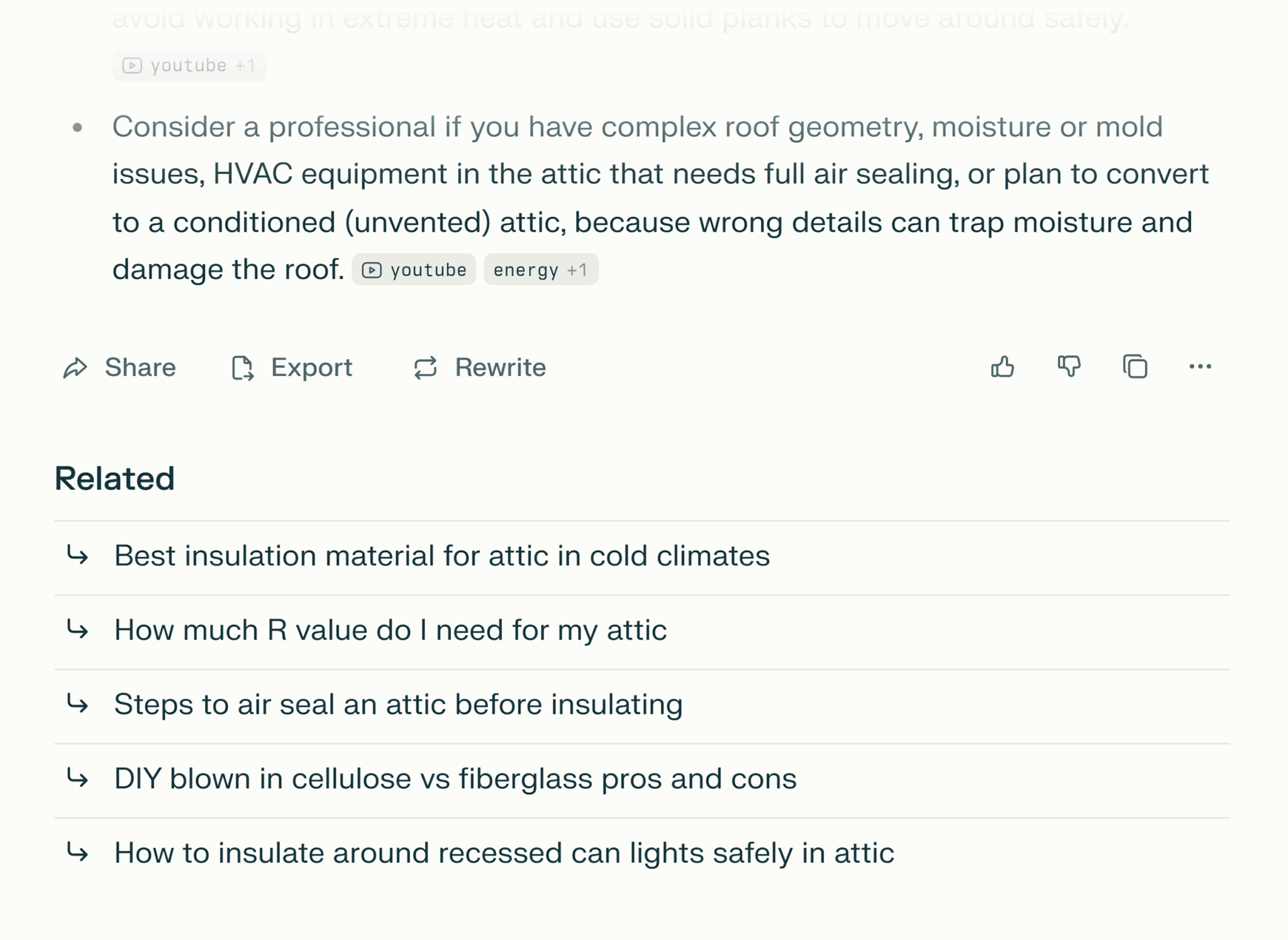
    Another avenue I explore is through Userbots such as ChatGPT-User and Perplexity-User. These bots offer insights into how my content is utilized in AI search, highlighting pages that are frequently cited without needing to guess the relevance of prompts.

    ```json
{
  "alt": "Screenshot showing advice on attic maintenance with related article links.",
  "caption": "Considering attic improvements? Explore expert advice with links to related DIY guides and tips.",
  "description": "This image features a section of a website discussing attic maintenance, emphasizing hiring professionals for complex roof issues and HVAC sealing. It also includes related article links on topics such as insulation materials, R-value requirements, air sealing steps, and DIY materials comparison. Icons for sharing, exporting, and rewriting are visible, providing users with interactive options."
}
```

    The process, called RAG (Retrieval-Augmented Generation), effectively grounds language models in factual data. It’s fascinating to consider how my content can play a role in shaping user responses, even if it doesn’t result in a direct click.

    ```json
{
  "alt": "Dashboard showing data on content marketing including related topics, prompts, brands, and source domains.",
  "caption": "Explore the dynamic world of content marketing with this informative dashboard, featuring insights on topics, prompts, brands, and source domains, highlighting the ever-evolving landscape of digital strategies.",
  "description": "This image displays a data dashboard focused on content marketing research. Key elements include related topic volume of 1.6 million, 137 topics, 3,000 prompts, and the mention of 4,000 brands. The graph indicates informational intent as the dominant type. Brands like LinkedIn, Google, and Instagram are highlighted, alongside top sources YouTube.com, LinkedIn.com, and Reddit.com. The dashboard offers valuable insights into current trends and strategies in content marketing as of October 31, 2025. Keywords: content marketing, data dashboard, digital strategy, brand insights."
}
```

    Gaining insights from long queries through tools like Google Search Console is another method I employ. By utilizing innovative techniques like Ziggy Shtrosberg’s complex regex filters, I can unearth queries that simulate AI search behavior.

    ```json
{
  "alt": "Screenshot of a browser developer tools network panel with filters and response details displayed.",
  "caption": "Diving into the network panel: A behind-the-scenes look at web page data with browser dev tools. Explore the intricacies of online transactions with ease.",
  "description": "This image shows a screenshot of a browser's developer tools, focusing on the network panel. The interface includes options like 'Preserve log' and 'Disable cache,' along with a filter search for 'conversation.' Various request names are shown, along with detailed response headers and values. This tool is essential for developers to track and debug network requests and responses efficiently, aiding in webpage optimization and debugging."
}
```

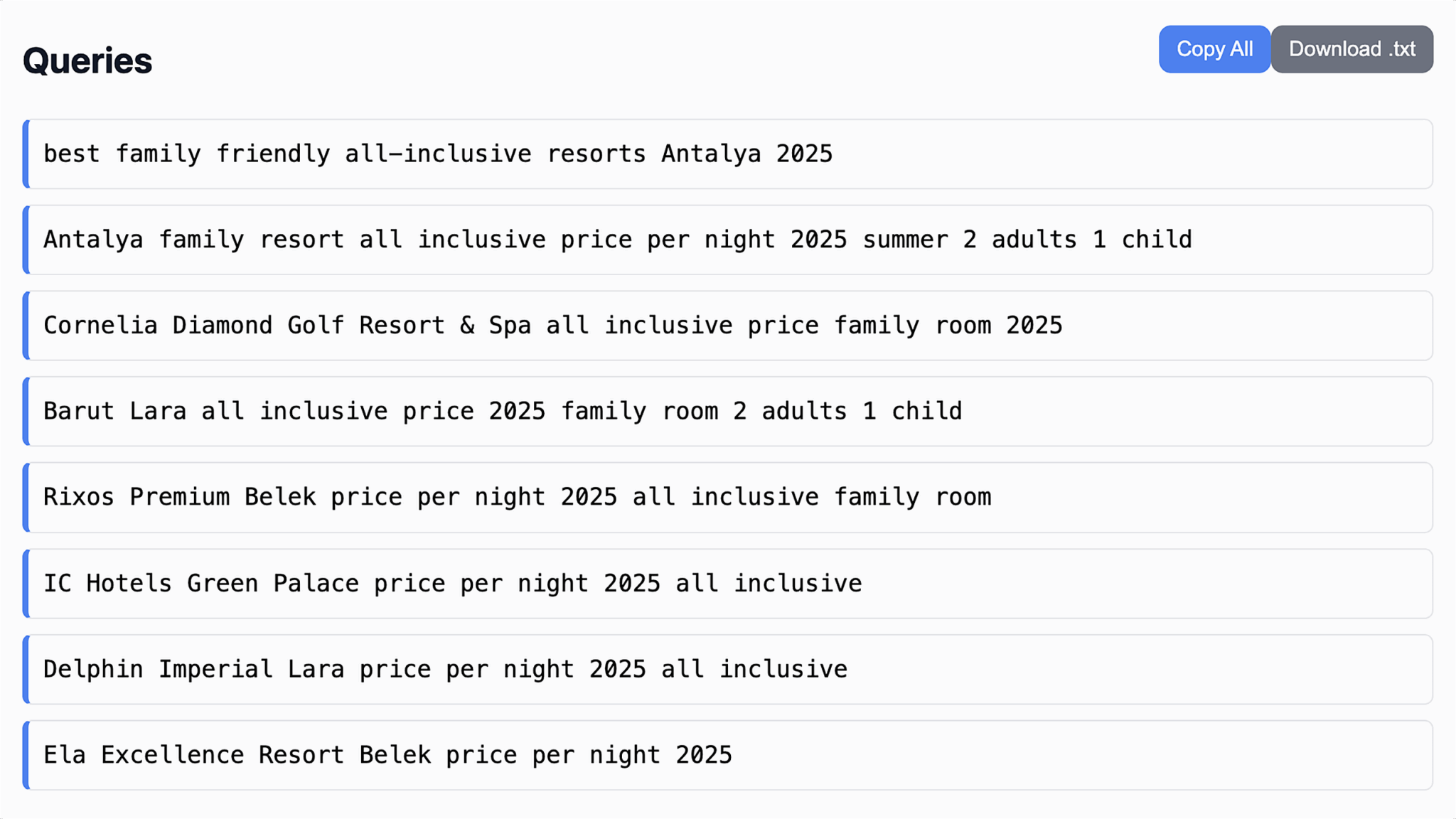
    It’s essential to approach this data cautiously, as some patterns might stem from automated trackers rather than genuine human interaction. For instance, high-appearance queries with zero clicks could indicate non-human usage.

    ```json
{
  "alt": "A list of search queries for family-friendly all-inclusive resorts in Antalya for 2025.",
  "caption": "Explore the top family-friendly resorts in Antalya for an all-inclusive 2025 vacation. Discover the best deals for families and enjoy unforgettable memories.",
  "description": "The image displays search queries related to family-friendly all-inclusive resorts in Antalya for the year 2025. Queries include resort names like Cornelia Diamond Golf Resort & Spa, Barut Lara, and Rixos Premium Belek, focusing on family room pricing for two adults and one child. Keywords like 'price per night' and 'summer' are present, highlighting user interest in affordable, comprehensive vacation packages in Antalya's popular hotel destinations."
}
```

    Engaging with Perplexity AI’s follow-up feature is also enlightening. This feature can hint at how users might prompt AI systems, aiding my understanding of expected human interaction.

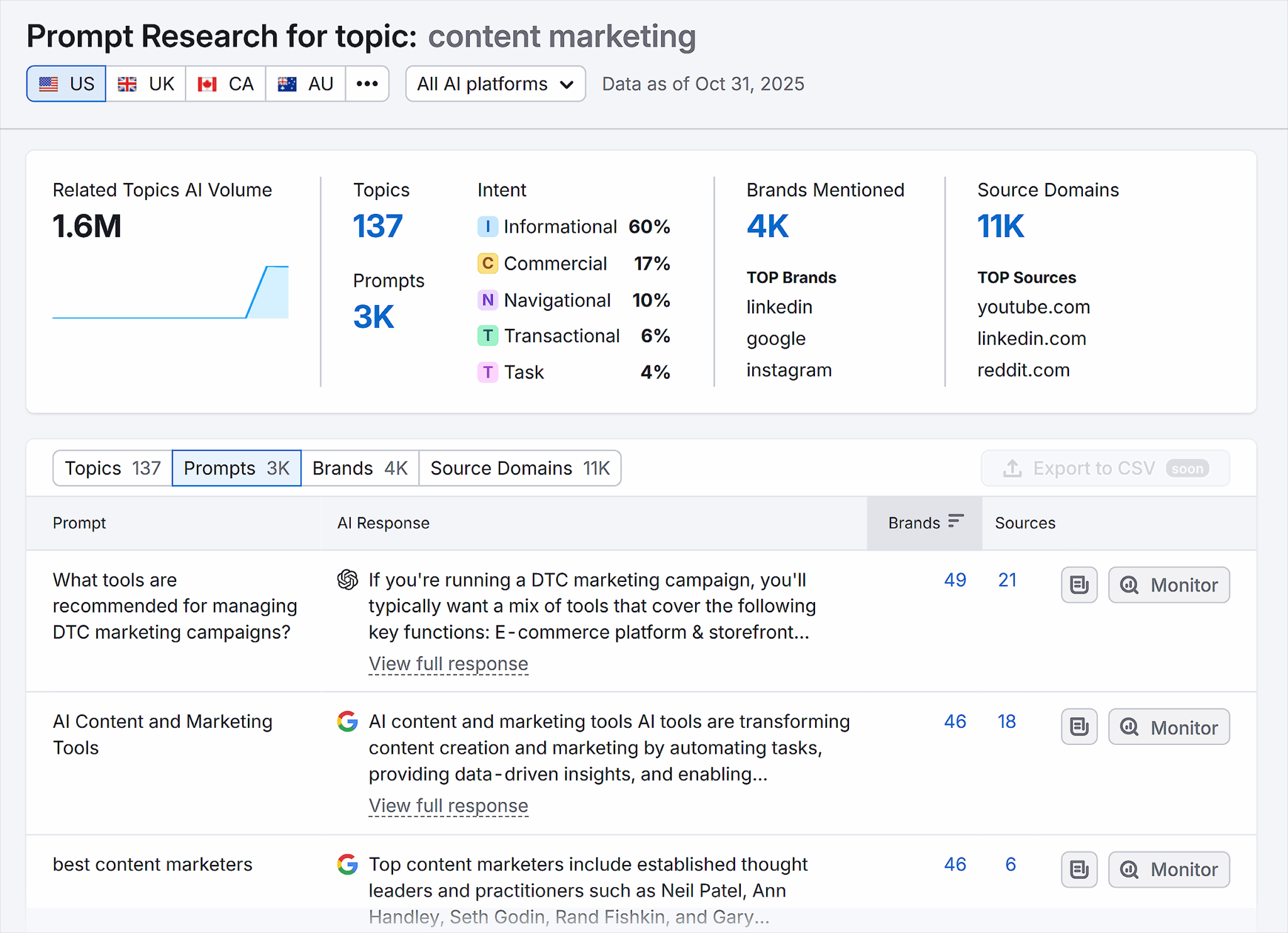
    Finally, the Semrush AI Visibility Tool provides an ingenious way to manage the scaling challenge of unique prompts. By merging prompts into broader topics and using AI to distill their meanings, I gain valuable insights into intent and brand mentions across different regions.

    In a rapidly changing tech environment, staying grounded in data is vital. Not all prompts engage Retrieval-Augmented Generation (RAG), which means those needing answers already in training data may bypass linking to new page sources.

    However, when users seek recommendations (for example, dining options or attractions), page visibility within AI-generated answers can still convert offline interactions, benefiting brand exposure.

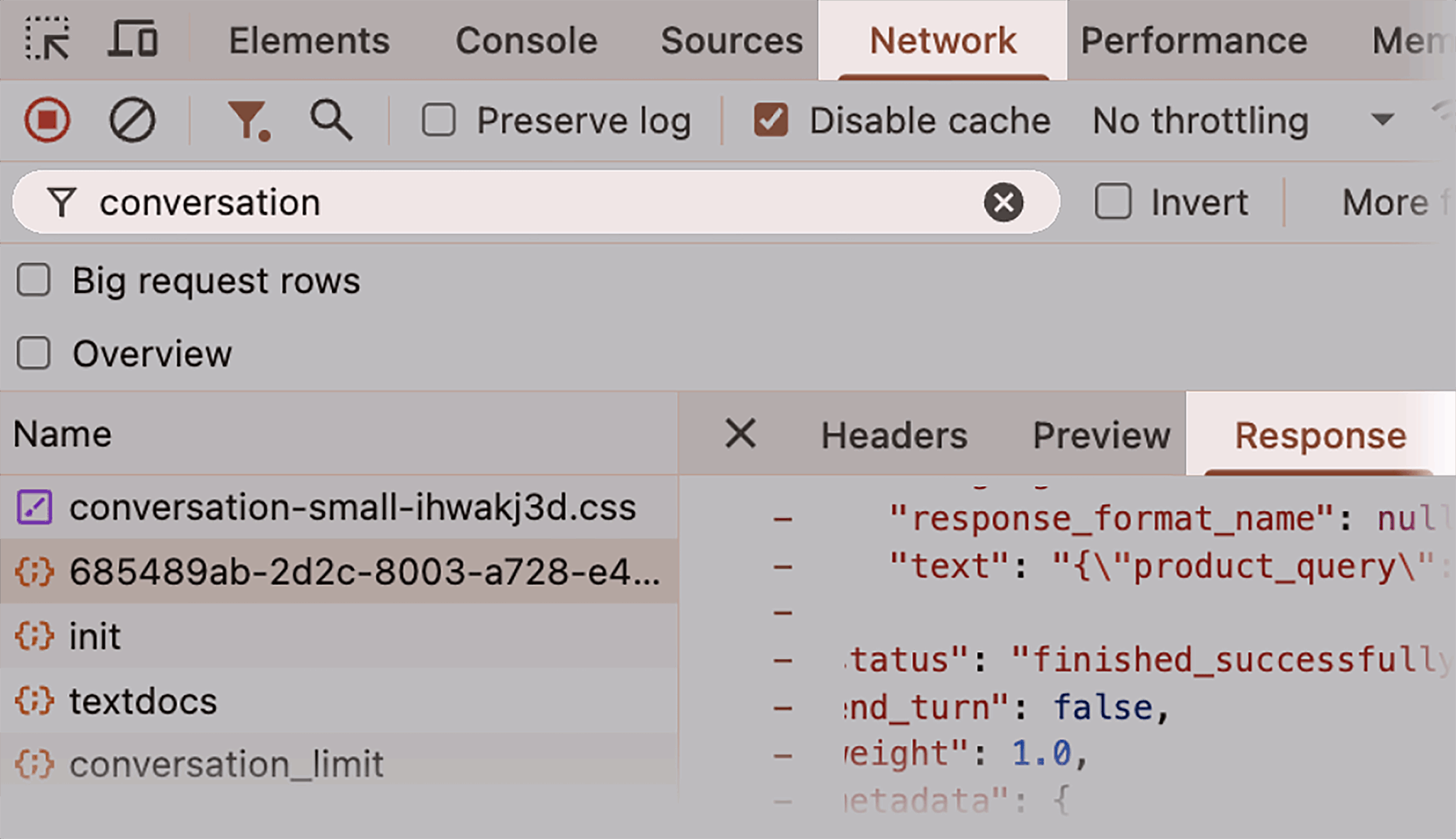
    Checking the background operations of ChatGPT reveals search prompts within Chrome Dev Tools. By identifying searches and their relevancy to RAG, I can strategize to optimize this invisible layer of search behavior.

    The quest to master AI search dynamics is ongoing. New AI models and evolving user behaviors necessitate continuous adaptation to comprehend and leverage audience interactions effectively.


    Inspired by this post on Search Engine Land.


    crushpress.ai community screenshot
  • How Google AI Overviews Transformed Search in 2025

    How Google AI Overviews Transformed Search in 2025

    I’ve been captivated by how Google AI Overviews shifted the search landscape in 2025. Since then, I’ve delved into a detailed analysis by Semrush, which evaluated over 10 million keywords, revealing significant volatility, an increase in ads, stronger click-through rates (CTRs), and AI Overviews venturing beyond purely informational searches.

    The year witnessed a rapid expansion of AI Overviews in Google’s search functions, which eventually tapered off as they began appearing in commercial and navigational inquiries. Between January and November, Semrush’s analysis identified these dynamic changes.

    AI Overviews surged, then retreated. The deployment of AI Overviews was far from linear. Google introduced them at a rapid pace, peaking mid-year, then scaled back based on user data and feedback:

    • January: AI Overviews appeared in 6.5% of all queries.
    • July: Their presence peaked, appearing in nearly 25% of searches.
    • November: By this time, their appearance was retracted to less than 16%.

    Zero-click behavior defied expectations. Contrary to initial beliefs, I noticed that click-through rates for searches with AI Overviews have increased steadily. It seems that rather than reducing clicks, AI Overviews may actually encourage them.

    • AI Overviews are more common on searches that generally lead to no clicks.
    • But when examining the same keywords pre and post-introduction of an AI Overview, the zero-click rates decreased from 33.75% to 31.53%.

    Informational queries no longer dominate. At the start of 2025, AI Overviews predominantly served informational purposes:

    • January: 91% informational
    • October: 57% informational

    Eventually, I observed AI Overviews appearing in commercial and transactional searches:

    • Commercial queries: Jumped from 8% to 18%
    • Transactional queries: Increased from 2% to 14%

    Navigational queries are rising fast. Interestingly, there’s a noticeable increase in AI Overviews intercepting brand and destination searches:

    • Navigational AI Overviews rose from under 1% in January to over 10% by November.

    Google Ads + AI Overviews. Earlier this year, ads rarely appeared next to AI Overviews. Now, their presence is much more common:

    • Ads alongside AI Overviews grew from about 3% in January to around 40% by November.
    • Roughly 25% of AI Overview SERPs now show ads at the bottom.

    Science is the most impacted industry. In terms of keyword saturation, Science tops the list with AI Overviews appearing in 25.96% of searches. This is followed by Computers & Electronics at 17.92%, and People & Society at 17.29%.

    • Since March, Food & Drink has experienced the fastest growth among all categories in AI Overview usage.
    • In contrast, sectors like Real Estate, Shopping, and Arts & Entertainment see AI Overviews in less than 3% of queries.

    Why we care. With AI Overviews persistently reshaping click behaviors, commercial visibility, and ad placements, I believe it’s important to keep a close eye on these shifts and adapt accordingly.

    The report. For a deeper dive, you can explore the full Semrush AI Overviews Study: What 2025 SEO Data Tells Us About Google’s Search Shift.

    Dig deeper. Earlier, in May, I reported on the initial findings of Semrush’s study in Google AI Overviews now show on 13% of searches: Study.


    Inspired by this post on Search Engine Land.


    crushpress.ai community screenshot
  • Win an All Access Pass: Help Shape SMX Advanced 2026!

    Win an All Access Pass: Help Shape SMX Advanced 2026!

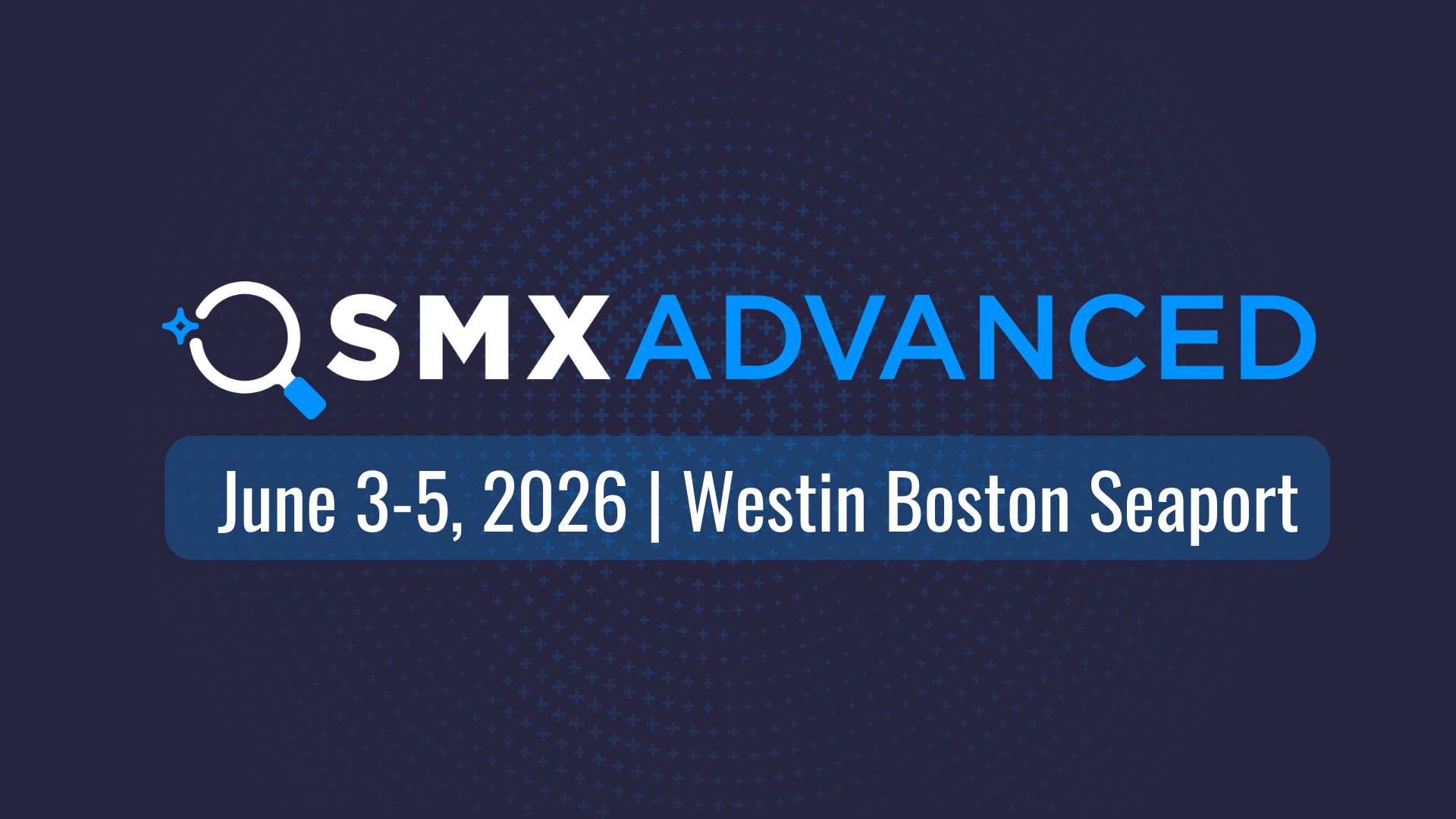
    I’m excited about the opportunity to influence the future of search marketing events. You can help shape SMX Advanced 2026 by sharing your insights and preferences. The event is happening from June 3-5 at the Westin Boston Seaport, and we want to know what you’re eager to learn and who you’re interested to hear from.

    Reflecting on June’s event, it was thrilling to reunite in person for the first time since 2019 at SMX Advanced. It was more than just a conference; it felt like a global reunion for search marketers to connect, share ideas, and dive into cutting-edge insights.

    The world of search is ever-evolving, with swift changes in AI SEO, algorithm updates, and the delicate balance of AI with a human touch. Advanced, actionable education is more crucial than ever, and that’s where you come in.

    Help Shape SMX Advanced 2026

    Our aim for SMX Advanced 2026 is to make it the most relevant and exciting yet, but we need your expertise to get there. Your input is invaluable, and we’re inviting you to directly influence the 2026 curriculum.

    Completing our brief survey lets you help build a program that addresses the critical challenges and opportunities you’re facing. Share with us:

    • Which advanced topics will boost your professional growth.
    • The search changes and complexities that concern you the most.
    • Experts and innovators you’re excited to hear from.
    • Preferred session formats, whether deep-dive clinics, lightning talks, or interactive panels.

    Fill out the survey here.

    Be Entered to Win an All Access Pass

    As a token of our appreciation, everyone completing the survey gets a chance to enter an exclusive drawing.

    One lucky winner will receive an All Access pass to SMX Advanced 2026! Join us for this landmark event at the Westin Boston Seaport from June 3-5.

    Submit a Session Pitch

    Beyond influencing the agenda, we’re offering you the chance to submit a session pitch. If you’ve developed a groundbreaking strategy or have valuable insights, lead the conversation and showcase your expertise.

    Check out our guide to speaking at SMX for details on submitting your session idea. When you’re ready, create your profile and send us your pitch.

    I’m looking forward to your submissions and insights! If you have questions, feel free to reach out to me at kathy.bushman@semrush.com.


    Inspired by this post on Search Engine Land.


    crushpress.ai community screenshot
  • Mastering LLM Visibility: Metrics and Insights for Real Impact

    Mastering LLM Visibility: Metrics and Insights for Real Impact

    I’ve been deeply involved in the compelling discussions around AI, especially the intriguing intersection of ‘AI hype meets AI reality.’ Tools like Semrush One and its Enterprise AIO tool have taken center stage, offering invaluable insights into what’s happening inside LLMs. The big questions I often ponder are: How many citations are we capturing and just how many mentions are our brands accumulating?

    When this data first emerged, it felt revolutionary. However, it quickly prompted other questions, like ‘What’s the ROI here?’ and ‘How can I integrate this data into my team’s marketing strategy?’ Ensuring that this valuable and fascinating data translates into actionable insights is a challenge I enjoy tackling.

    ```json
{
  "alt": "The CapmatchOne logo with a gradient circle and bold text.",
  "caption": "Discover innovation with the CapmatchOne logo, featuring sleek typography and a modern gradient circle.",
  "description": "The CapmatchOne logo features bold, modern typography coupled with a gradient circle, symbolizing connection and innovation. The sleek design conveys a sense of progress and creativity. This image can be used for branding or promotional purposes, appealing to audiences interested in innovative solutions and forward-thinking designs."
}
```

    It’s no secret that the data these tools provide is incredibly valuable. But, what steps do I take next? Let’s uncover this journey together.

    ```json
{
  "alt": "Trending products list showing ranking of TV brands and models by share of voice.",
  "caption": "Discover what's trending in TV technology as LG and TCL lead the rankings by share of voice.",
  "description": "This image displays a list of trending TV products ranked by share of voice. LG's G3 model takes the top spot with 11%, followed by LG's C3 and TCL's 6-Series both with an 8% share. Samsung's QN90C and S95C, along with TCL's QM8K, also feature among the top-ranked models. The list highlights popular brands and models in the current TV market, useful for consumers looking to stay informed about top choices."
}
```

    The Fundamental Challenges of Tracking LLMs

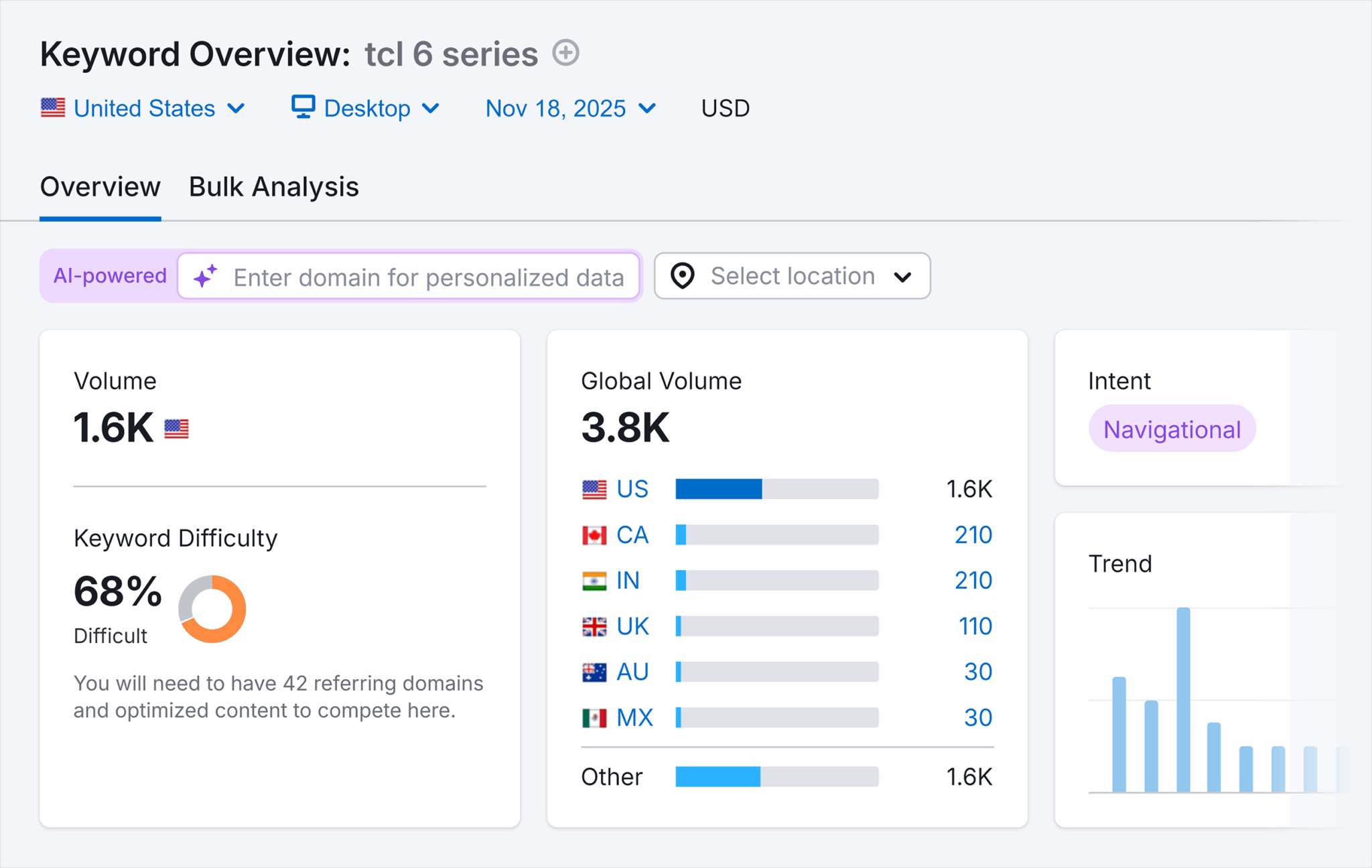
    Tracking LLMs can be more challenging than traditional metrics like Google rankings. Google rankings may show where I stand, but ranking doesn’t always correlate with traffic or revenue. Even if I rank highly, an AI Overview could dominate the search, reducing my traffic for a given keyword. I need to ask myself, is this the right traffic for my business goals?

    ```json
{
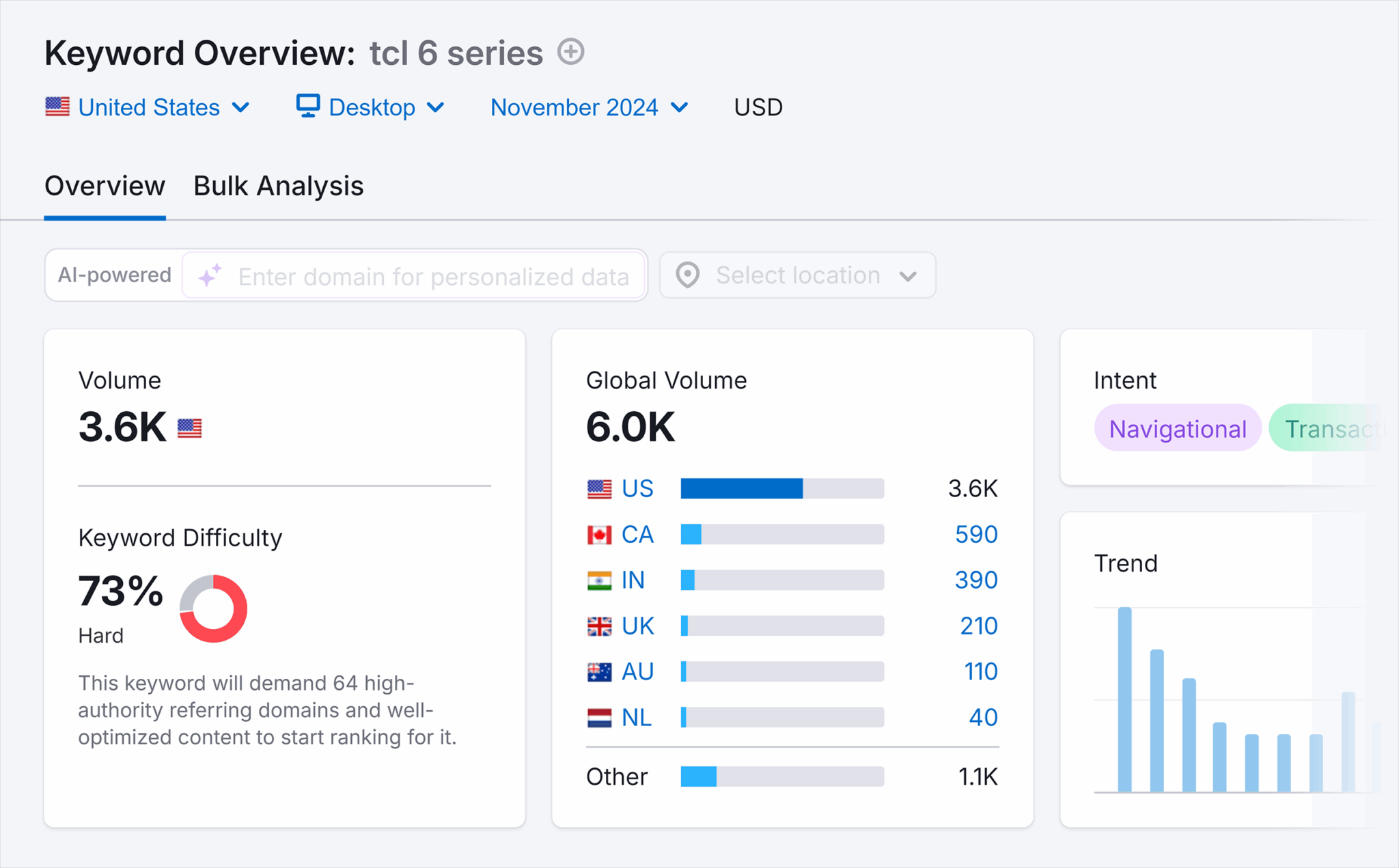
  "alt": "Keyword overview of TCL 6 series showing search volume, keyword difficulty, and trend data.",
  "caption": "Explore the keyword analysis for 'TCL 6 series' with detailed volume, global reach, and trend insights for November 2024.",
  "description": "This image displays a keyword analysis dashboard for the 'TCL 6 series.' In November 2024, the keyword has a search volume of 3.6K in the US and 6K globally, with a difficulty score of 73%, indicating high competition. The data is segmented by country, revealing insights into search intent and trend progression, helpful for content strategists and SEO professionals optimizing for this keyword."
}
```

    The big difference between traditional SEO rankings and LLM visibility is the straightforward correlation between strong rankings and increased revenue, which is more complex with LLMs. I can easily track user behavior after they land on my site from organic search, but it’s not so clear-cut with LLMs.

    ```json
{
  "alt": "Keyword overview for TCL 6 series, showing search volumes, keyword difficulty, and intent.",
  "caption": "Explore detailed keyword insights for the TCL 6 Series, highlighting search volume, difficulty, and intent to refine your SEO strategy.",
  "description": "The image presents a keyword overview for the TCL 6 Series, detailing a search volume of 1.6K in the US and a global volume of 3.8K. It notes a keyword difficulty of 68%, indicating a challenging competition level. The intent is labeled as navigational, with trends visualized in a bar graph. This data is segmented by countries, including CA, IN, UK, AU, and MX, offering a comprehensive analysis suitable for refining SEO efforts. Keywords: TCL 6 Series, Keyword Overview, Search Volume, SEO, Navigational Intent."
}
```

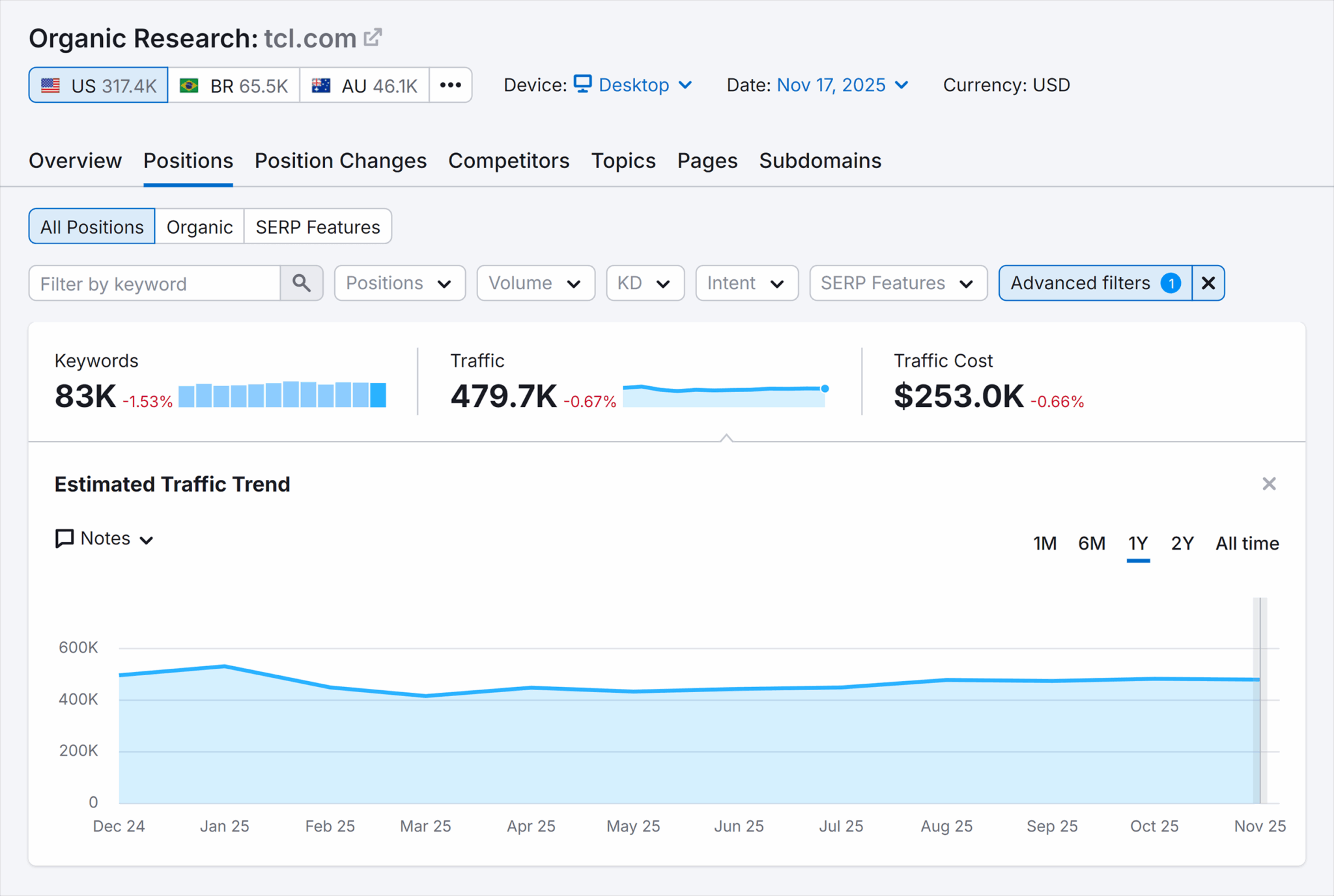
    SEO effectively drives traffic to my site, allowing me to evaluate the success of my conversion rate optimization (CRO) strategies. However, LLMs operate differently, leaving me with the task of creatively connecting the dots.

    ```json
{
  "alt": "SEO report for tcl.com showing keyword, traffic, and cost data with a traffic trend graph.",
  "caption": "Dive into the SEO stats for tcl.com, showcasing keyword performance, traffic data, and cost analysis, all accompanied by a visual traffic trend over the past year.",
  "description": "This image presents an SEO report for tcl.com as of November 17, 2025. It highlights key statistics such as 83K keywords, 479.7K monthly traffic, and a traffic cost of $253K, each experiencing slight decreases. The report includes a traffic trend graph showing fluctuations over the past year. This report is useful for analyzing search performance and strategizing for better visibility. Keywords: SEO, traffic, keywords, tcl.com, report, analysis, performance, trend."
}
```

    The Problem with Methodology

    As I dive deeper into using LLM-related data, I realize this approach requires me to step out of my comfort zone as a performance marketer. My usual reliance on direct attribution and data points is shifted toward constructing a narrative that ties LLM visibility to larger brand storytelling.

    ```json
{
  "alt": "SEO report showing organic research data for tcl.com including keywords, traffic, and estimated traffic trend over two years.",
  "caption": "An in-depth look into tcl.com's SEO performance: Explore key metrics like declining keywords and traffic, alongside an estimated trend over the past two years.",
  "description": "This image displays a detailed SEO report on tcl.com, featuring data such as a 5.37% drop in keywords to 317, a 1.72% decrease in traffic to 2.2K, and an 8.13% rise in traffic cost to $1.1K. The chart illustrates the estimated traffic trend for desktop devices over a two-year span from January 2024 to October 2025, with significant fluctuations and an overall downward trajectory. This visual is essential for analyzing SEO metrics and understanding website performance in different markets, including the US, Brazil, and Australia."
}
```

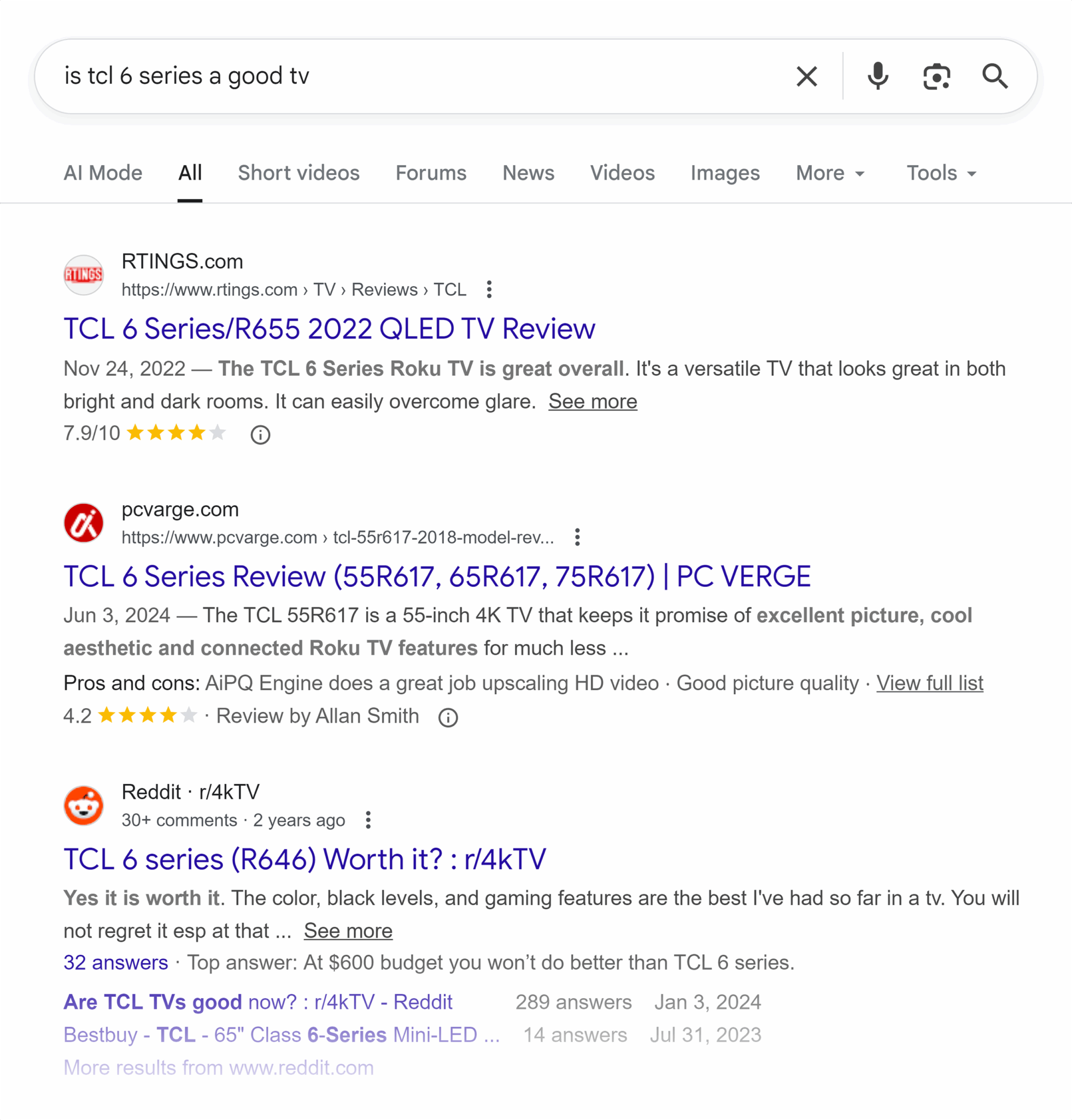
    This method isn’t novel, however. Brand marketers have dealt with indirect metrics since the days of billboard advertising. Still, the shift requires me to create insights from what might seem like fragmented LLM data.

    ```json
{
  "alt": "Search results for 'is tcl 6 series a good tv' showing review snippets from RTINGS, PC Verge, and Reddit.",
  "caption": "Curious about the TCL 6 Series TV? Explore a compilation of expert reviews and user opinions from RTINGS, PC Verge, and Reddit.",
  "description": "This image displays Google search results for the query 'is tcl 6 series a good TV.' The results include snippets from RTINGS, PC Verge, and Reddit discussing the TCL 6 Series TV. The RTINGS review describes it as a great overall product, highlighting its versatility. PC Verge emphasizes the TV's excellent picture quality and Roku features, with a 4.2-star rating. Meanwhile, a Reddit thread discusses the TCL 6 Series model R646, with users praising its color and gaming features. This image provides a quick overview of expert and user assessments of the TCL 6 Series TV."
}
```

    Metrics and Approach to LLM Impact Measurement

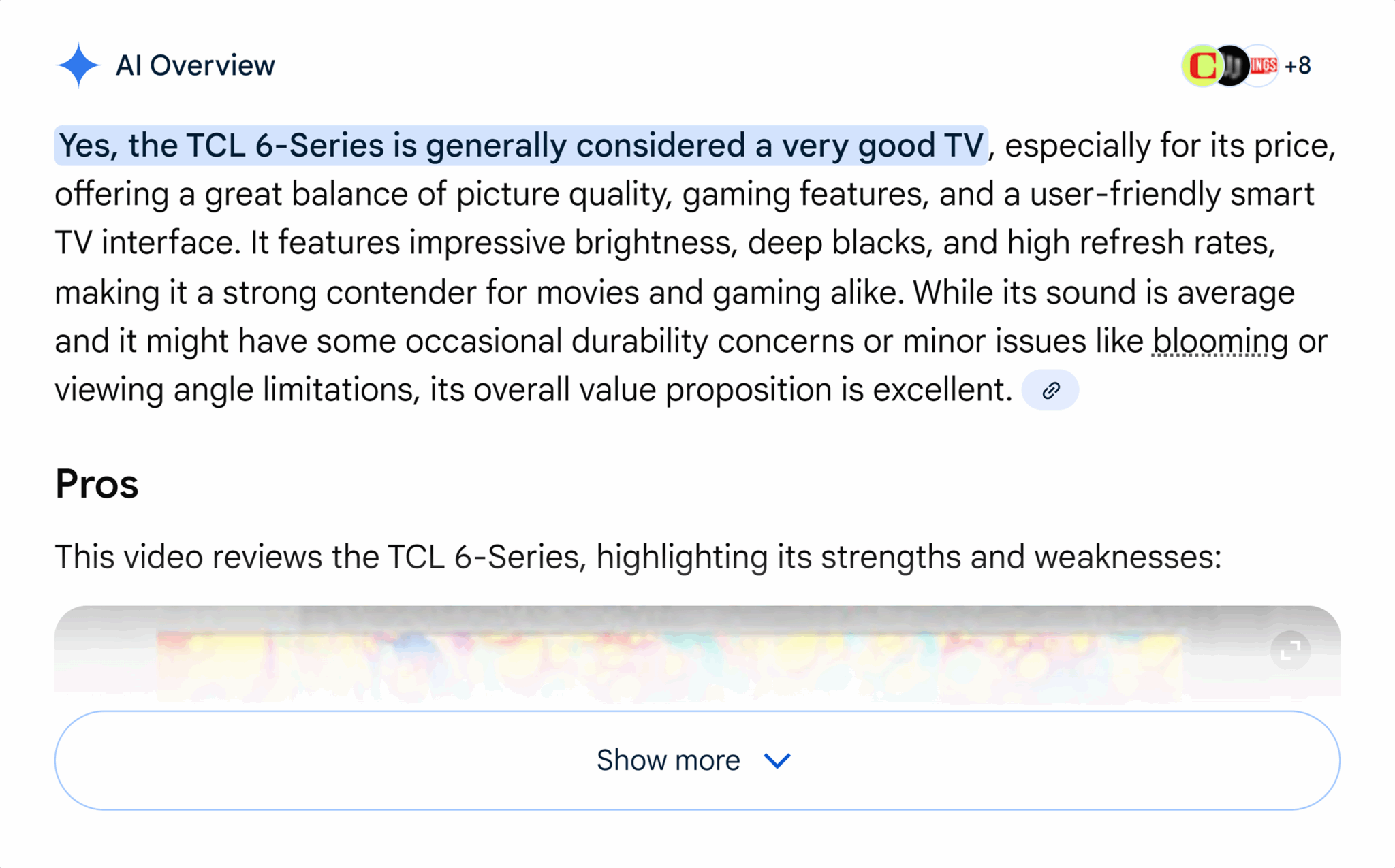
    Uncovering the true value brought by LLM visibility metrics is a layered and comprehensive process. To do this accurately, I need to understand the wider ecosystem of my organization’s promotional efforts. This understanding allows me to determine the root cause of site traffic or branded searches effectively.

    ```json
{
  "alt": "Text review of the TCL 6-Series TV highlighting its strengths and weaknesses.",
  "caption": "Discover why the TCL 6-Series TV is celebrated for its picture quality and gaming features, balancing affordability with performance.",
  "description": "This image features a text review of the TCL 6-Series TV, emphasizing its value for money with excellent picture quality, gaming features, and a smart TV interface. The text acknowledges minor issues like blooming and sound quality but highlights the TV’s competitive edge for movies and gaming. Keywords: TCL 6-Series, TV review, picture quality, gaming features, smart TV."
}
```

    For instance, if a TV ad campaign runs concurrently with optimizing for LLM mentions, analyzing their impact becomes essential. Only with complete awareness of such activities can I identify true causality or correlation.

    ```json
{
  "alt": "Line graph showing share of voice trends for Samsung, LG, and TCL over a span of one month.",
  "caption": "Explore the fluctuating share of voice for Samsung, LG, and TCL across a bustling month, revealing dynamic brand interactions.",
  "description": "This line graph displays the share of voice trends for three major brands: Samsung (blue), LG (yellow), and TCL (green), over a monthly period starting October 3rd to November 2nd. The graph showcases the daily variations in visibility and mentions for each brand, highlighting peaks and troughs in their market presence. Useful for tracking brand performance and consumer engagement over time."
}
```

    From here, I find that LLM visibility data is usually just the starting point. It’s unlike traditional SEO insights, which might be more apparent and direct. My task is to delve deeper, probing these data points to uncover richer insights.

    ```json
{
  "alt": "Visibility overview dashboard for buffalowildwings.com showing AI visibility score and audience data across multiple platforms.",
  "caption": "Explore the visibility insights of buffalowildwings.com with this detailed dashboard, highlighting AI visibility scores and audience metrics over time.",
  "description": "The image displays a visibility overview dashboard for buffalowildwings.com. It includes AI visibility scores, with a total score of 74 out of 100, labeled as medium. There are graphs indicating trends in total AI visibility, Chat GPT, AI Overview, and AI Mode from September to October 2025. The audience metrics show a monthly audience of 98.7 million, with an increase of 3.9 million, and mentions at 18.4K, which decreased by 390. The mention sources include Chat GPT, AI Overview, and AI Mode, with future integration of Gemini."
}
```

    The Branded Search of It All

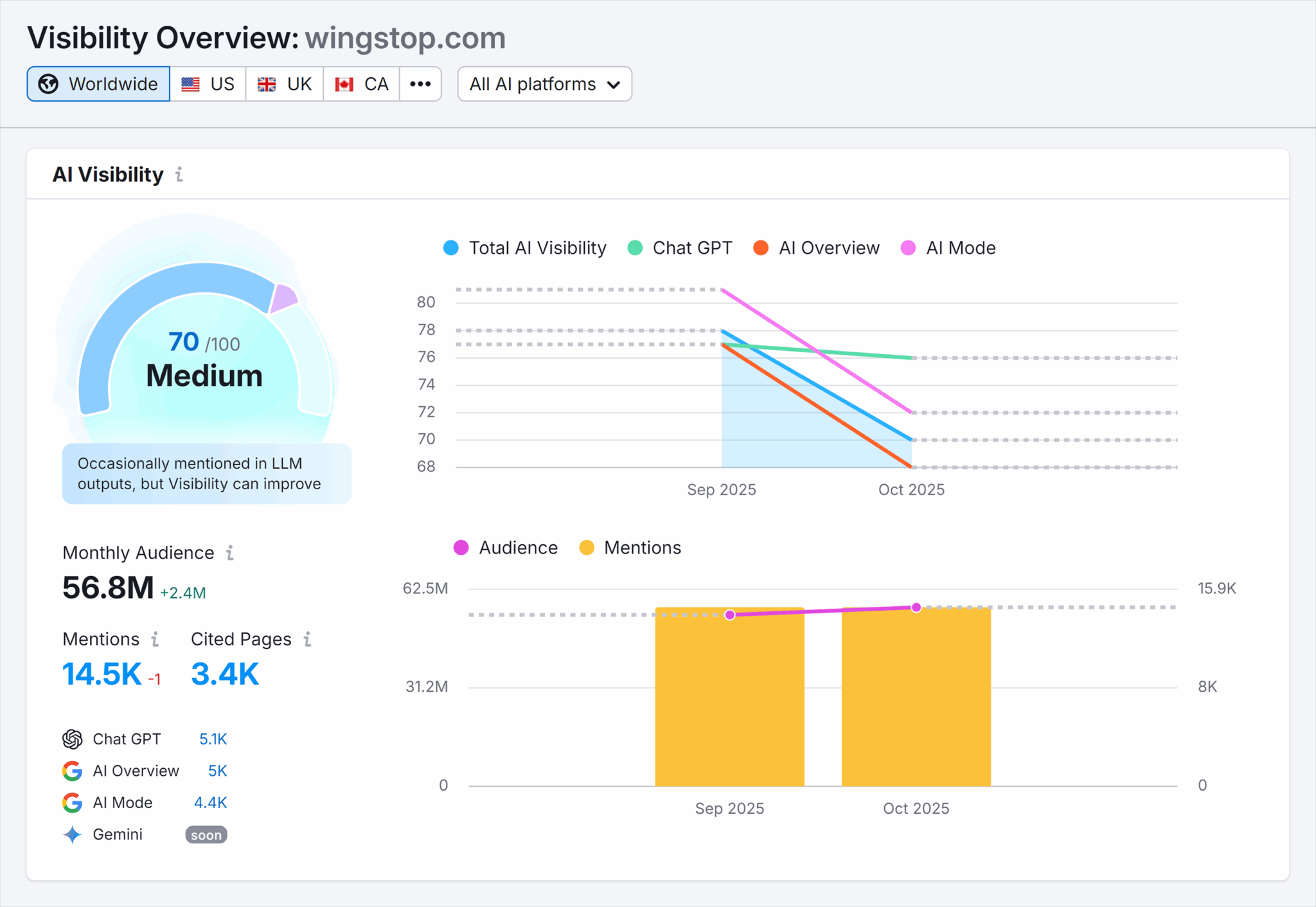
    I’ve noticed that brand search provides exceptional insights into LLM performance, offering a rich vein of marketing intelligence. The comparison between two competing chicken wing chains, Buffalo Wild Wings and Wingstop, brightened this understanding for me. While their LLM citations differ, their brand awareness through social media presence offers a clearer picture of market positioning.

    ```json
{
  "alt": "AI visibility overview for wingstop.com showing medium AI visibility and audience metrics for Sep to Oct 2025.",
  "caption": "Wingstop.com is currently rated as having medium AI visibility with audiences engaging steadily through to October 2025.",
  "description": "This image displays an AI visibility overview for wingstop.com. It highlights a medium visibility score of 70/100, with key metrics such as monthly audience at 56.8M and mentions at 14.5K. The accompanying chart visualizes trends in audience and mentions from September to October 2025 across platforms like Chat GPT and AI Overview."
}
```

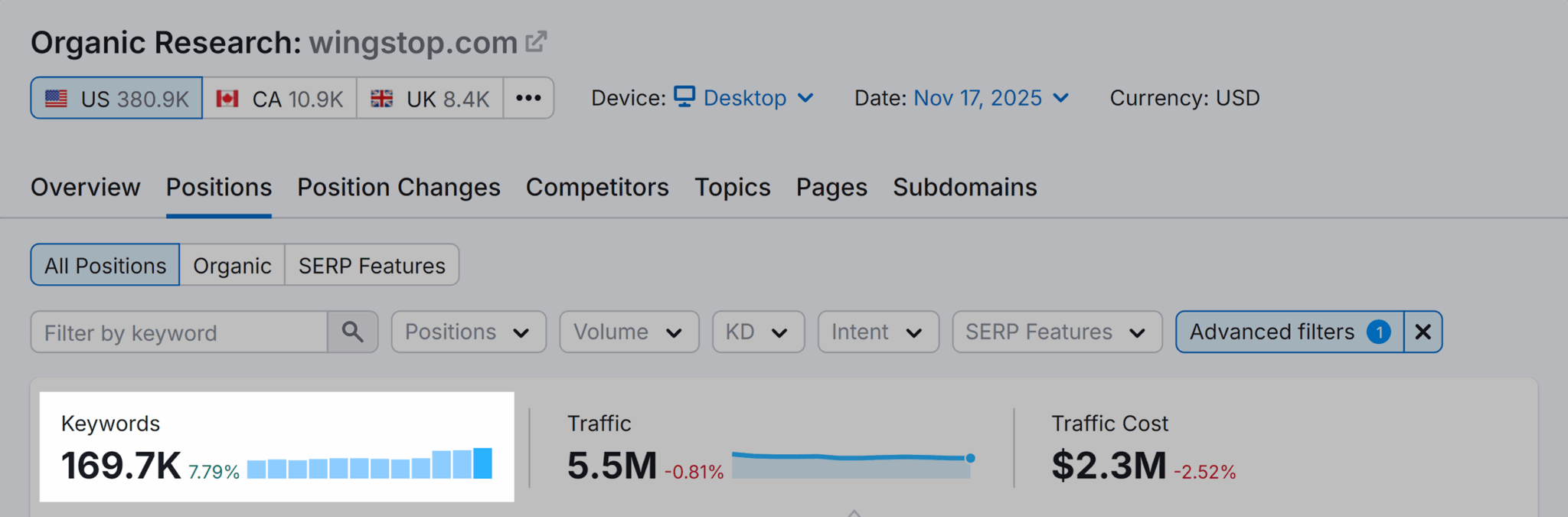
    Simply examining the branded search traffic showed me how both brands performed similarly on Google, despite their different social media followings. Here lies the heart of utilizing search data creatively to find LLM visibility data strategies.

    ```json
{
  "alt": "Instagram profiles of Wingstop and Buffalo Wild Wings with logos and follower counts.",
  "caption": "Wingstop and Buffalo Wild Wings go head-to-head on Instagram, showcasing their vibrant profiles and follower stats. Which wing will you pick?",
  "description": "This image displays the Instagram profiles of two popular restaurants, Wingstop and Buffalo Wild Wings. Wingstop's profile features a green logo, 772K followers, and promotes their 'Fiery Lime' flavor. Buffalo Wild Wings showcases a yellow logo with a bison, boasting 540K followers, and advertises their 'Pick 6 Meal For 2'. Both profiles include website links and number of posts and followings, emphasizing their presence on social media."
}
```

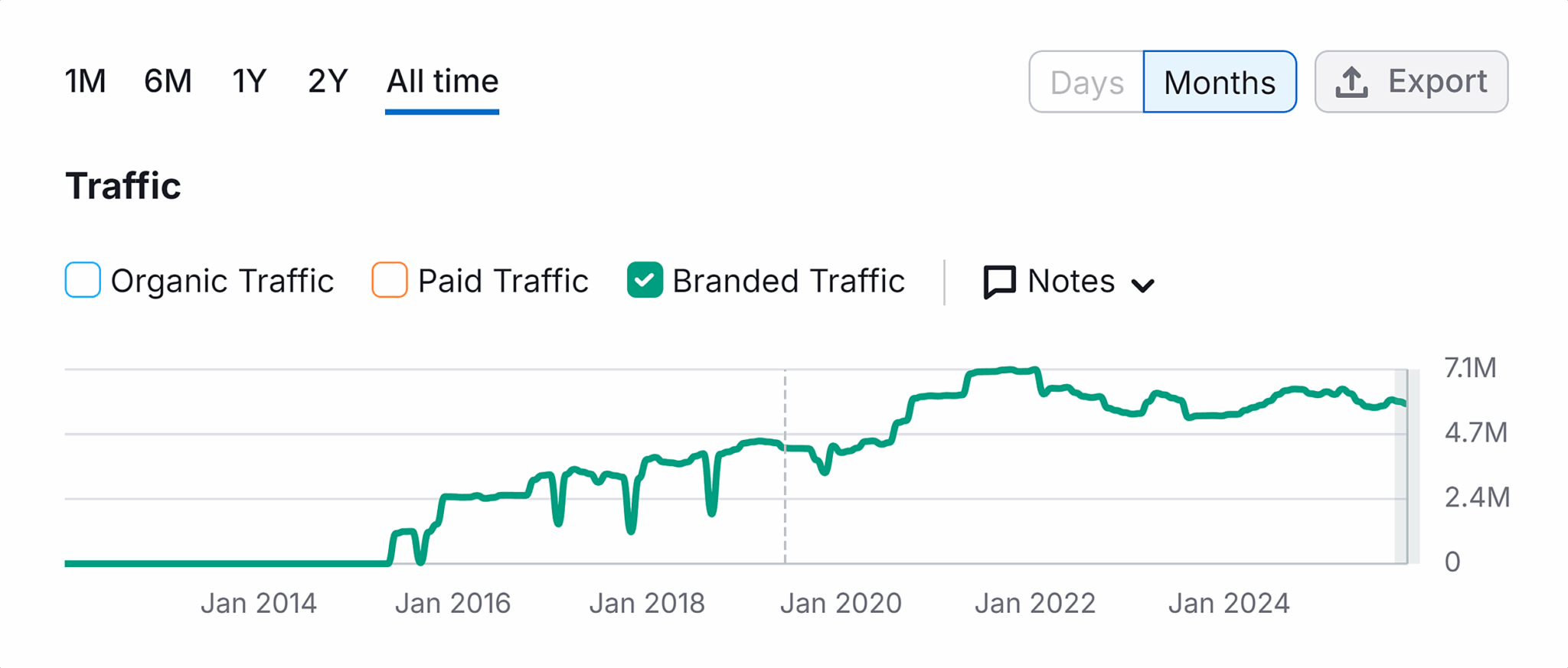
    Rather than merely counting traffic, I am now compelled to consider the number of branded keywords involved, providing a sometimes surprising view on brand awareness and diversity. This approach provides a richer understanding of LLM visibility’s impact.

    ```json
{
  "alt": "Graph showing branded traffic growth from 2014 to 2024.",
  "caption": "Branded traffic trends over a decade reveal growth patterns and fluctuations from 2014 to 2024.",
  "description": "This line graph illustrates the growth of branded traffic from 2014 to 2024. Displayed over a timeline, the data reveals significant upward trends with moments of fluctuation, particularly notable around 2018 and 2022. The graph uses a green line to represent branded traffic, with metrics ranging from 0 to 7.1 million. The interface includes options to view data in various time frames, including days and months, and features a menu for exporting the data."
}
```

    Direct Traffic: My Trusted LLM Data Companion

    I’ve come to see direct traffic as an essential part of my LLM data narrative. Far from being a black hole, direct traffic can often indicate brand awareness and affinity, especially when correlated with LLM visibility metrics. Understanding these correlations allows me to paint a clearer picture of AI’s practical impact on consumer behavior.

    ```json
{
  "alt": "Traffic chart showing branded traffic from January 2014 to January 2024 with steady growth and fluctuations.",
  "caption": "Charting Success: This graph illustrates the rise and fluctuations in branded traffic over a decade, painting a picture of strategic growth!",
  "description": "This image features a traffic chart depicting the growth of branded traffic from January 2014 to January 2024. The graph shows a green line that represents the number of visitors in millions, starting near zero in 2014 and rising to over 4.7 million by 2024. The data reflects a general upward trend with noticeable fluctuations, representing periodic changes in traffic levels. The chart includes options for viewing organic and paid traffic, and it is set to display monthly data over the entire period. Keywords: traffic chart, branded traffic, growth, analytics."
}
```

    For instance, if I compare LG and TCL, LG’s superior direct traffic and increasing momentum in LLM visibility suggest a tangible AI-driven influence, a possibility I must explore through multi-metric analysis.

    ```json
{
  "alt": "SEO dashboard for buffalowildwings.com showing keyword metrics and traffic data.",
  "caption": "Explore the SEO metrics of buffalowildwings.com, showcasing keyword rankings and traffic trends as of November 17, 2025.",
  "description": "The image displays an SEO research interface for buffalowildwings.com, focusing on positions and metrics. It highlights keyword usage of 360.2K with a 3.28% change, alongside traffic data of 5.7M visitors and a traffic cost of $886.4K. The dashboard offers a detailed view of SEO performance across different regions, including the US, Canada, and the UK, with device-specific metrics for desktop usage."
}
```

    Considering various metrics together and identifying shared trends offer insight into how LLM visibility might be affecting my brand’s overall recognition and engagement.

    ```json
{
  "alt": "Screenshot of organic research data for wingstop.com showing keyword statistics, traffic, and traffic cost.",
  "caption": "Explore Wingstop.com's robust organic search performance, showcasing a substantial keyword volume and valuable traffic data insights.",
  "description": "This image displays a screenshot from an SEO tool showing organic research data for wingstop.com. It highlights key metrics, including 169.7K keywords with a growth of 7.79%, 5.5M in traffic with a slight decrease of 0.81%, and a traffic cost of $2.3M, down 2.52%. The interface presents data for the US, Canada, and the UK, with options to filter results by keywords and positions. This detailed view assists in analyzing website performance and search engine visibility."
}
```

    Not Just One Metric: Stitching Together LLM Data Stories

    Ultimately, it’s about developing a comprehensive data story from LLM visibility insights. This story goes beyond direct KPIs, utilizing various data sources, such as bounce rates and organic traffic, to add depth and relevance to the narrative. Every piece of performance-focused data stands as testimony to the expertise we can bring to LLM visibility.

    ```json
{
  "alt": "Dashboard showing keyword, traffic, and cost metrics for 'sauce' with a traffic trend graph.",
  "caption": "Explore the SEO journey of 'sauce' with detailed keyword performance, traffic data, and cost analysis over the past year.",
  "description": "This image depicts an SEO dashboard for the keyword 'sauce,' showing 406 keywords with a 3.79% decrease, traffic at 10.4K with a slight 0.04% drop, and a traffic cost of $585 reflecting a 5.49% decrease. A traffic trend graph illustrates data over a year, highlighting fluctuations. Useful for SEO analysis and tracking keyword performance metrics."
}
```

    Total LLM visibility data, when creatively amalgamated with performance data, can transform insights into actionable strategies that align with pragmatic business objectives, showcasing our value in the AI-driven landscape.

    ```json
{
  "alt": "Traffic analytics chart showing keyword and traffic data for 'sauce'.",
  "caption": "Dive into the analytics! This chart reveals keyword dynamics and traffic trends for the term 'sauce' over the past year.",
  "description": "This image displays a traffic analytics dashboard for the keyword 'sauce', revealing data on keyword volume, traffic, and traffic costs. The chart shows an estimated traffic trend spanning a year from December to November, with metrics indicating a slight decline in keyword count and traffic cost, but an increase in total traffic. The interface includes advanced filter options and time range adjustments for detailed insights."
}
```

    Inspired by this post on Search Engine Land.


    crushpress.ai community screenshot
  • Adobe’s Incredible Acquisition: Semrush Joins Forces in $1.9B Deal

    Adobe’s Incredible Acquisition: Semrush Joins Forces in $1.9B Deal

    Today, I’m thrilled to share the big news that Adobe is acquiring Semrush for a massive $1.9 billion. This exciting development, announced by the companies, is set to close in the first half of 2026, pending necessary approvals.

    You might know Semrush as a leading SEO platform that made headlines in October 2024 by acquiring Search Engine Land, MarTech, and Third Door Media. Now, Adobe is planning to bring Semrush on board in an all-cash transaction valued at approximately $1.9 billion, further enhancing Adobe’s robust portfolio.

    Insights from Semrush Leadership. Semrush CEO Bill Wagner shared his excitement on LinkedIn:

    We have some big news at Semrush today: we’re joining forces with Adobe.

    I am proud to announce our agreement to be acquired by Adobe for $1.9 billion. This is the right move at the right time for both of our respective companies and teams.

    The strategic fit couldn’t be more perfect. We’re combining Adobe’s leading customer experience orchestration through its AI-agentic content supply chain and other solutions, with Semrush’s high-quality digital brand visibility offerings. The result will be a new option for an end-to-end customer experience platform that serves as the new standard for the marketing technology industry.

    Today’s announcement is a true testament to the incredible work of the Semrush team that started well before my tenure. I am deeply grateful for their execution, passion, and hustle over the years – which I know will carry forward as we enter this new chapter.

    We’re excited to accelerate our shared vision with Adobe. More to come!

    Andrew Warden, Semrush’s chief marketing officer, also expressed his enthusiasm on LinkedIn:

    Big news: Semrush has agreed to be acquired by Adobe.

    It’s a winning combination:
    Adobe brings leading customer experience orchestration in the agentic AI era with its content supply chain and other solutions.

    Semrush is a strong player for search and brand visibility, first with SEO and now with GEO.

    Together, marketers can look forward to a new option for a unified brand visibility platform.

    This transaction is huge for our customers and their growth, and a testament to the hard work of our team. I’m proud of what we’ve built and look forward to this next chapter of growth with Adobe.

    The Adobe Perspective. Adobe’s press release elaborates on how this acquisition will drive forward a comprehensive customer experience, leveraging both Adobe and Semrush’s formidable strengths. With distinct capabilities in content supply chain management and AI-driven customer engagement, Adobe serves giants like Coca-Cola and IBM.

    In this rapidly evolving landscape, Semrush stands out with its expertise in GEO and SEO, ensuring brands remain visible in AI-powered searches. The collaboration aims to position itself as the new benchmark in marketing technology.

    Anil Chakravarthy, Adobe’s President of Digital Experience Business, emphasizes the merger’s potential to expand brand visibility, customer engagement, and conversions. Complementing this, Semrush’s CEO, Bill Wagner, highlights the enhanced insights brands can leverage through this partnership.

    Transaction Details: Both Adobe and Semrush boards have approved the deal, anticipated to finalize in the first half of 2026, aligning with regulatory and shareholder commitments.

    A complete end-to-end experience for marketers awaits, setting the course for future innovations in the evolving digital landscape. Stay tuned for updates as this strategy unfolds, promising more opportunities for businesses around the globe.


    Inspired by this post on Search Engine Land.


    crushpress.ai community screenshot
  • Unlocking AI Search: Insights from Semrush’s Visibility Index

    Unlocking AI Search: Insights from Semrush’s Visibility Index

    Have you ever wondered which brands are thriving, which are waning, and which remain steady within AI search platforms? I’ve delved deep into Semrush’s AI Visibility Index, and I’m here to share strategies to safeguard and enhance your visibility.

    AI search is a dynamic field that’s evolving rapidly. Over the past three months, it’s become clearer which brands stand out and which sources AI models prefer to trust.

    In examining three months of AI Visibility Index data, particularly from ChatGPT and Google AI Mode, I’ve realized just how volatile AI search truly is, a pattern likely to persist in the near term.

    Brands that come out on top are those who consistently monitor and adjust to these changes as they unfold.

    The research includes a study of 2,500 real-world prompts across five crucial sectors: Business & Professional Services, Digital Technology & Software, Consumer Electronics, Fashion & Apparel, and Finance. It unveils dramatic shifts in source diversity, brand mentions, and model behavior—info no marketer can afford to ignore.

    What Changed at a Model Level?

    ChatGPT: Unique brand mentions fluctuated, while the number of sources cited grew by 80% in October alone, showing a move toward greater source diversity.

    ```json
{
  "alt": "Bar chart comparing unique source domains of ChatGPT and Google AI Mode from August to October.",
  "caption": "A bar chart reveals ChatGPT's lead over Google AI Mode in unique source domains, peaking in October with a significant uptick.",
  "description": "This bar chart illustrates the number of unique source domains for ChatGPT and Google AI Mode from August to October. ChatGPT consistently outperforms, with October showing a marked increase to 22,001 domains compared to Google AI Mode's 13,737. The data, sourced from SEMRUSH Enterprise, indicates growing dominance and competitiveness in AI source domain diversity. Key terms: ChatGPT, Google AI Mode, unique source domains, SEMRUSH Enterprise, data comparison."
}
```

    Google AI Mode: From August to October, brand mentions dropped by 4%, hinting at stricter recommendation controls. Source diversity saw a moderate 13% rise, indicating a more conservative stance compared to ChatGPT.

    Key Trends Over Three Months

    Reddit’s Correction and Resurgence: ChatGPT reduced Reddit mentions by 82% but maintained it as the fourth most-cited source. Meanwhile, Google AI Mode’s use of Reddit increased by 75%, becoming the second top source. Both platforms are recognizing Reddit’s value, albeit differently.

    Brand Diversity Varies by Vertical and Model: ChatGPT noted a 20% rise in unique brand mentions in Consumer Electronics, while Finance saw a 15% decline. Conversely, Google AI Mode saw a decline across almost every vertical, underscoring the need for model-specific strategies.

    Top Brands Remain Relatively Stable: Over three months, 25 new brands joined the top 100, yet only two cracked the top 50. Leading brands’ visibility changes stayed within a ~20% range, much narrower than the overall market turbulence.

    Source Strategies Must Be Model-Specific: ChatGPT and Google AI Mode agree on brand mentions 67% of the time, but agree on sources only 30% of the time. Dominant sources include Wikipedia, Forbes, and Amazon for ChatGPT, while Google AI Mode favors Amazon and YouTube.

    ```json
{
  "alt": "Bar graph showing top 100 source similarity with data for Business, Consumer Electronics, Technology, Fashion, and Finance for August and October, including percentage change.",
  "caption": "SEMRush Enterprise highlights top source similarities across industries, showcasing changes from August to October. Dive into trends in finance, technology, and more!",
  "description": "This bar graph illustrates the top 100 source similarity across various industries, including Business & Professional Services, Consumer Electronics, Technology & Software, Fashion & Apparel, and Finance. It compares percentages from August and October, highlighting the percentage change in purple. The data provides insights into trends and shifts in each sector, as tracked by SEMRush Enterprise."
}
```

    I’ve learned that maintaining AI visibility requires ongoing vigilance. Both platforms are testing diversity, adjusting for past overdependencies, and refining strategies.

    What This Means for Your Strategy

    In the ever-evolving world of AI search, past visibility doesn’t secure future success.

    Both ChatGPT and Google AI Mode feature 61 of the top 100 brands, indicating strong brand overlap. However, source overlap is much less and has decreased from August to October.

    Translation: Enhance your brand’s visibility on both platforms but customize your source strategy based on each model’s nuances.

    Explore the AI Visibility Index to access full rankings, interactive leaderboards, and comprehensive trends across all five sectors. Download proven strategies to bolster your visibility in this swiftly changing domain. It’s complimentary!


    Inspired by this post on Search Engine Land.


    crushpress.ai community screenshot
  • AI SEO Tactics: Step Beyond Traditional SEO in the AI Era

    AI SEO Tactics: Step Beyond Traditional SEO in the AI Era

    I’ve noticed that many people labeling things as “AI SEO” are just applying traditional SEO concepts dressed up with new buzzwords.

    AI SEO, however, stands apart.

    When I explore how AI tools like AI Overviews, ChatGPT, and Perplexity sort and condense information, it’s clear there are strategies available to us now that simply didn’t exist in the old Google 10-blue-links era.

    In this article, I’ll walk you through those unique AI SEO tactics, leveraging concrete data, not just hopeful speculation.

    Feeling the drop in clicks, right? Here are some compelling facts:

    • Research has shown that when Google’s AI Overviews were applied, the click-through rates to top organic results fell by about 30 to 35%. In some cases, publishers reported losing 40 to 80% of their search traffic.
    • According to an analysis with Similarweb data, news traffic from Google declined from around 2.3 billion to under 1.7 billion visits in just a year as zero-click searches increased from 56 to 69% after AI summaries were introduced.
    • From a Semrush study on 10 million keywords, AI Overviews now frequently appear, especially for informational queries, changing the visibility landscape by consolidating multiple sources into a single AI-generated response.

    Meanwhile, the AI market is expanding at a rate of over 30% CAGR, with projections suggesting that total AI spending will reach into the trillions by the early 2030s.

    AI SEO is about optimizing not just for clicks but for factual representations that earn places within AI-generated answers.

    Here are 12 exclusive tactics to thrive in this new landscape:

    1. Prompt Graph Coverage

    Traditional SEO treats a query as a single unit mapped to a page.

    AI engines deconstruct queries into graphs of subtasks and address each. Google mentions “multi-step reasoning” for tackling complex queries at once. Academic research on AI SEO also indicates that AI functions break down queries into sub-questions, synthesizing information across sources.

    AI SEO strategy: Model that graph personally.

    • Transform the primary query into predictable sub-questions.
    • Create detailed sections that fully address each subtask.
    • Ensure each section is self-contained and suitable for the specific micro-intent.

    When writing about “best project management software,” consider prompting for:

    • “criteria for agencies”
    • “comparison vs spreadsheets”
    • “pricing breakdown by seat”
    • “implementation timeline”

    Each needs its own precise, well-titled segment.

    2. LLM Seeding

    While traditional search engines don’t absorb all content into their algorithms, LLMs do.

    AI SEO shows a preference for neutral sources like Wikipedia and governmental documents over branded marketing pages, so contributing to factual and earned sources is key. Backlinko’s findings reinforce engaging in the right content surfaces for training and retrieval.

    AI SEO-only move:

    • Release definitions, glossaries, and FAQs publicly.
    • Contribute to places where models learn their foundational facts.
    • Sow Q&A style content in widely used forums.

    This is about showing where the model will find the canonical truth, making sure it’s your content.

    3. Passage-Level Retrieval Optimization

    Traditional SEO generally ranks entire pages. AI engines retrieve information at a passage level.

    Studies show that models cite specific highly structured passages, not entire pages.

    AI SEO-only move:

    • Treat each heading as a standalone answer.
    • Include all claims, qualifiers, and evidence within one passage.
    • Minimize the reader’s need to traverse the page for logic.

    Stand out as the model’s go-to reference for any particular question.

    4. Citation-Ready Evidence Packaging

    AI engines must justify their responses.

    Studies indicate pages commonly cited by AI engines have structured data, semantic HTML, and explicit evidence like tables. The absence of verifiable facts increases the tendency for models to hallucinate.

    AI SEO-only move:

    • Present data in machine-readable formats: tables, comparisons, glossaries, checklists.
    • Support each strong claim with solid statistics and a source.
    • Ensure the model can easily extract your “proof block.”

    You need to be verifiable and structured for easy reuse.

    5. Neutrality Engineering

    Models favor neutral, non-promotional sources over overtly commercial ones.

    According to research, Google’s definition of spam has widened to include content that lacks depth, especially in AI Overviews.

    AI SEO-only move:

    • Remove promotional language from pages aimed at being cited.
    • Ground your narrative in facts, comparisons, and third-party validations.
    • Create separate layers for opinion and positioning.

    Continue to sell, but ensure your main content remains neutral and evidence-based.

    6. Brand-Entity Memory Alignment

    While search engines focus on page-query matching, LLMs concern themselves with how well your entity is understood across the board.

    Studies suggest variance in how engines perceive brands, often favoring well-recognized and consistently presented entities.

    AI SEO-only move:

    • Clearly define your brand’s canonical facts: identity, operations, audience.
    • Ensure consistency across high-authority platforms.
    • Rectify outdated or conflicting information across channels.

    Train the model to understand who you are, not just what metadata say.

    7. Competitor Co-occurrence Hijacking

    A significant portion of buying intent lies in comparative prompts.

    AI engines synthesize answers by comparing multiple competitors. Research shows brands frequently appearing in comparative content often benefit in AI outputs.

    AI SEO-only move:

    • Position your brand in neutral, third-party comparison content.
    • Craft balanced comparisons that consider multiple competitors honestly.
    • Encourage inclusion in “shortlist” content likely used in category training.

    Traditional SEO hopes for a ranking opportunity. AI SEO embeds you within the model’s default competitive landscape.

    8. Source Blending Strategy

    In AI search, a “SERP” is a blend of diverse sources, not just a page.

    Semrush and others note that AI engines pull from a wide range of sources, favoring community and documentation in many sectors.

    AI SEO-only move:

    • Develop your presence into an ecosystem, beyond a single website.
    • Identify which non-Google platforms in your niche influence LLMs and establish credibility there.
    • Use consistent terminology to form a coherent online identity.

    Your goal is corpus optimization, not just ranking in an index.

    9. LLM-Friendly Specification Publishing

    Models excel at snapping structures into place.

    Content rich with detailed structures like definitions, lists, and stepwise instructions performs best in AI responses.

    AI SEO-only move:

    • Share your key frameworks as open specifications.
    • Convert ambiguous messaging into clear decision-making instruments.
    • Document methodologies in public, thorough formats.

    Offer the model a blueprint beyond just marketing speak.

    10. Training-Surface Expansion

    AI SEO is emerging as an industry on its own, backed by significant future investments.

    However, this investment is not focused on just one index.

    AI SEO-only move:

    • Explore potential training surfaces within your specialty like open datasets and public reports.
    • Place your best insights there openly, ready for retrieval or training.
    • Treat every public snippet as training material, not only lead generation.

    You are determining where and how models will encounter your reality.

    11. Anti-Hallucination Engineering

    Hallucination in AI isn’t hypothetical.

    Benchmarking and academic studies consistently show that AI can produce false details, particularly in low-coverage or vague topics.

    AI SEO-only move:

    • Distribute concise fact sheets about your entity across neutral sources.
    • Remove contradictory public claims wherever possible.
    • Monitor and adjust how AI systems portray your brand.

    While eliminating hallucinations is impossible, you can ensure the model opts for a well-documented version of you.

    12. Mention vs. Citation Optimization

    In AI searches, there are three distinct states:

    • Your brand is not mentioned.
    • Your brand is mentioned, without citation.
    • Your brand is both mentioned and cited.

    Research indicates that citation patterns relate closely to specific quality signals on the page and sites.

    AI SEO-only move:

    • Design pages that meet both narrative and citation criteria.
    • Grow earned media allowing third-party sites to be cited.
    • Map your current state across engines and craft campaigns to elevate your position.

    Just as traditional SEO distinguishes between impressions and clicks, AI SEO separates mentions from citations, and this is crucial for visibility.

    The Uncomfortable Balance

    We must face some key truths:

    • AI summaries are raising zero-click behavior, compressing publisher traffic, with click-through rate declines between 15 to 80% depending on the query.
    • Platforms claim higher quality clicks and satisfaction while expanding these features into search.
    • Despite advances, LLMs still hallucinate, reducing errors involves better grounding and evaluation.

    As individual brands, we cannot change these broad issues. But we can adapt to the current landscape:

    • Treat AI answers not as a novelty added to SEO but as a unique channel.
    • View AI SEO as a standalone channel with specific levers, measurements, and content styles.
    • Create content for retrieval, trustworthiness, and reuse by generative systems.

    Traditional SEO isn’t obsolete, but it is only part of the journey now.


    Inspired by this post on Search Engine Land.

  • Mastering SEO and AI: A Unified Search Strategy for Success

    Mastering SEO and AI: A Unified Search Strategy for Success

    I often reflect on the evolving landscape of search and how tools like Google Search and AI platforms such as ChatGPT are reshaping how we discover content. With these shifts, I’ve learned how crucial it is to track, optimize, and convert customers effectively across both platforms.

    Recent developments like AI Overviews, ChatGPT, and zero-click results have led many to speculate about the end of SEO. However, I believe SEO is far from dead – in fact, it might be more vibrant than ever.

    Search engines are still responsible for about 88% of all search traffic, while AI usage is nearly doubling. This dual rise tells me that consumers aren’t just choosing between Google and ChatGPT – they’re using both together.

    The narrative that we must choose between SEO or AI search can be misleading. I see them as parallel paths of discovery that need to be mastered together.

    People like certainty and often look to focus resources on either a tried-and-true channel or explore a new one. Yet, I’ve realized overindexing in AI while ignoring classic SEO forfeits current market share, and hesitating gives competitors a head start.

    ```json
{
  "alt": "Purple text on black background reads: As Search Expands, So Must Your Strategy. SEMRUSH Enterprise logo below.",
  "caption": "Optimize your digital approach as search trends evolve. Discover how expanding your strategy can keep you ahead in the SEMRUSH Enterprise landscape.",
  "description": "This image features a motivational message in purple text on a black background: 'As Search Expands, So Must Your Strategy.' The SEMRUSH Enterprise logo is prominently displayed below, emphasizing the importance of evolving business strategies in digital marketing. The color scheme of purple and black gives a modern and sleek look, aligning with cutting-edge digital trends. Keywords: SEO, strategy, SEMRUSH, digital marketing."
}
```

    The assumption that AI growth reduces Google usage is flawed. While Google’s share fell to 89.62%, ChatGPT’s user base is soaring. Yet, from where I stand, consumers aren’t leaving Google – they are just using more platforms.

    From my perspective, ChatGPT adoption has led to increased usage of Google, with sessions rising from 10.5 to 12.6 sessions per week. AI complements traditional search, enhancing the scope of our discovery process.

    This expansion in search activity presents a ripe opportunity for ecommerce. Remarkably, 43% of ecommerce traffic comes from Google’s organic search, and organic traffic supports 23.6% of all ecommerce sales. Meanwhile, shopping inquiries in ChatGPT grew from 7.8% to 9.8% in the first half of the year.

    The total addressable market for search visibility has multiplied, with searches now distributed across various channels. I ask myself how brands can capture this holistic search opportunity.

    ```json
{
  "alt": "Infographic showing ChatGPT increasing search sessions alongside Google, not replacing it.",
  "caption": "ChatGPT complements Google Search by increasing the total number of search sessions, demonstrating a collaborative potential rather than a competitive one.",
  "description": "This infographic from SEMrush illustrates how ChatGPT increases overall search sessions without replacing Google. Before using ChatGPT, there were 10.5 Google search sessions per week. After integrating ChatGPT, Google sessions increased to 12.6, alongside 5 ChatGPT sessions per week. The data suggests an expansion in search activities, indicating that ChatGPT enhances search capabilities rather than competing with Google. The visual is designed with contrasting colors to clearly display the comparison and highlight the supportive relationship of ChatGPT with traditional search engines."
}
```

    Tracking is essential. Implementing comprehensive tracking allows me to see the full picture of our search performance. This often requires managing traditional search statistics separately from AI results, yet the integration of tools like Semrush Enterprise AIO has been invaluable for tracking visibility across different platforms.

    On the content side, key SEO principles support AI search performance, but the structure might need tweaks for optimal topical coverage. I always ask if my content answers users’ actual questions effectively. Covering vital questions upfront boosts relevance and the potential for AI citation.

    Giving content full context is another principle I adhere to. AI models view topics as connected ideas. Writing about sustainable products means also discussing eco-friendly materials and related subtopics, but without resorting to keyword stuffing.

    Ensuring my content is accessible to both AI and humans means prioritizing readability, clarity, and logical structure. It means everything from heading hierarchy to scannable formatting must be on point.

    ```json
{
  "alt": "Content optimization tool interface showing keyword suggestions and AI SEO score.",
  "caption": "Boost your content strategy with AI-powered tools. Enhance keyword effectiveness and SEO scores effortlessly to maximize reach and audience engagement.",
  "description": "This image displays the interface of a content optimization tool, featuring a sidebar, keyword suggestions for 'Mother's Day,' and an AI SEO Score widget scoring 66. It includes metrics like Structure Score (80% good), Question Score (75% good), and Cluster Coverage (60% okay). Designed to enhance SEO strategies by providing actionable insights and suggestions to improve content performance."
}
```

    Platforms like Semrush Enterprise AIO help by offering dual-channel optimization capabilities that I find reduce guesswork and provide guidance for maximizing search performance.

    Profit is the ultimate focus, and I’ve found that AI search visitors are 4.4 times as valuable in terms of conversion. Coupling this with search engines’ role in brand discovery shows the importance of optimizing across both avenues.

    To me, the outdated choice between SEO and AI is a misunderstanding of modern search discovery. Customers aren’t choosing – they use both Google and ChatGPT, often simultaneously.

    By embracing this dual-channel approach, brands are poised to dominate the search landscape, ensuring they are present wherever customers begin their search journey.


    Inspired by this post on Search Engine Land.