Tag: Semantic Optimization

  • GraphRAG SEO: Why Entity-First Retrieval Matters

    GraphRAG SEO: Why Entity-First Retrieval Matters

    Making a brand machine-readable and improving its odds of being selected for AI-generated answers are important, but I see them as only part of the larger shift. Under the surface, a retrieval layer is changing how AI systems identify entities, connect facts, and decide which brands deserve to be cited.

    That layer is GraphRAG. Once I understand how it works, “optimize for AI” stops feeling like a vague instruction and starts looking like a practical SEO strategy.

    What is GraphRAG, actually?

    GraphRAG extends traditional retrieval-augmented generation (RAG) by adding a knowledge graph. That graph helps AI understand entities and the relationships between them, instead of treating content as disconnected text fragments.

    Microsoft Research introduced GraphRAG in 2024, and a broader ecosystem has formed around it since then. Instead of pulling from a flat sea of text chunks, GraphRAG builds a map.

    In that map, nodes are the entities: a company, product, person, certification, location, or concept. Edges are the relationships between those entities, such as “offers,” “is certified by,” “authored,” or “operates in.”

    I think of it as a system of things and the lines connecting them. When a model works from a map instead of a pile of scraps, it does not have to guess its way toward an answer. It can follow the relationships.

    If the map says Entity A holds Certification B in Region C, the system can follow that path with confidence instead of inferring the connection and hoping it is right. That is why graph-based retrieval can produce more complete, better-grounded answers to complex questions with fewer hallucinations.

    Microsoft described this failure mode in its GraphRAG patent, “Knowledge Graph Extraction” (US20250131289A1). The patent calls out a recall problem in naive RAG: a less prominent entity can disappear inside chunk embeddings, which means the system may retrieve nothing useful.

    It also describes one of the fixes: entity resolution. When duplicate spellings or variations of the same thing are merged, the system can treat them as one entity instead of scattering their authority across several weak signals. That is one of the core building blocks behind graph-based retrieval.

    Dig deeper: What patents reveal about the foundations of AI search

    Why strong content still gets passed over

    Traditional RAG works by chopping content into fixed chunks, turning each chunk into a vector, and storing those vectors in a database. When I ask a question, the system retrieves the closest chunks in vector space and passes them to a language model to generate an answer.

    That can work for simple questions like “What is the capital of France?” It struggles with the questions that usually matter most in business: the multi-step questions.

    If I ask a system to find a provider that offers a specific service, holds a specific certification, and operates in a specific region, naive RAG may stitch together an answer from scraps that merely sound related. It does not truly understand how the facts connect, so it guesses across the gaps.

    When a system has to guess, the safer move is often to leave a brand out rather than risk saying something inaccurate about it. That is the part I think many SEO teams need to sit with.

    This explains a common frustration: “Our content is strong, but AI systems still do not cite us.” The issue may not be content quality. GraphRAG consistently outperforms naive RAG on complex, multi-hop questions where vector search falls apart. That is where the visibility leak often starts.

    In many cases, the machine could not reliably tell what the brand is, how its facts fit together, or whether it could trust those relationships enough to cite the brand by name.

    The three problems GraphRAG is built to fix

    I see GraphRAG lining up with three SEO problems that show up again and again: disambiguation, attribution, and relationships.

    Disambiguation matters when the same entity appears under different names and gets counted as several weaker signals instead of one strong one. If “the firm,” “the agency,” and the actual brand name never resolve to a single entity, authority gets split.

    Attribution matters when the fact survives but the credit disappears. When content is blended into an AI answer, the brand behind the original insight can easily vanish.

    Relationships matter when the connections that give expertise meaning stay buried in prose instead of being declared in a way a machine can read.

    If I have ever watched AI repeat something a company wrote without naming it, or credit a competitor for a specialty the company actually owns, I have seen all three problems in action.

    What ties them together is simple: this is not only a content problem. It is an identity problem.

    Same sentence, more machine-readable context

    I want to make the idea of an entity concrete, because it can become abstract quickly. I will use one real-world example and one fictional example.

    Start with Wayne Gretzky. Search his name in almost any AI client and I expect to see a confident summary: facts, former teams, records, and related links. That confidence is not luck. It is what a well-established entity looks like. His identity is nailed down and agreed upon across the web, so the system does not have to guess who he is.

    Now imagine the opposite. Picture a goaltending coach in Moncton. I will call her Marie Tremblay. Her About page says: “Our head coach, Marie ‘Lefty’ Tremblay, has run elite goaltending camps across the Maritimes for 20 years.”

    That is a good sentence. A parent understands it immediately. I would not rewrite it into robotic prose just to satisfy a machine. Optimizing for AI does not mean abandoning human voice.

    The better move is to keep the sentence and add context around it. I need to make explicit what a human reader infers automatically.

    That means clarifying that “Lefty” and “Marie Tremblay” are the same person. It means connecting Marie to the academy, to goaltending as a discipline, and to the Maritimes as the region she serves. It also means making “20 years” and “elite” verifiable claims rather than loose adjectives.

    A human gets all of that from one sentence. A machine may not. My job is to close the gap between what the reader understands and what the system can verify, so Marie becomes as legible to AI retrieval systems as a famous entity like The Great One already is.

    Why a flat triple is no longer enough

    Knowledge graphs are built on triples: subject, predicate, object. “Acme offers consulting” is clean and useful, but it is flat. A bare triple cannot easily carry the high-stakes details that matter, such as whether the relationship is true, where it applies, who says so, and what evidence supports it.

    The standards community is working on that gap. The W3C is extending the model with Resource Description Framework (RDF)-star, which allows site owners to make statements about statements. In practice, that means source, date, confidence, and other metadata can attach directly to a relationship instead of floating around as a disconnected claim. It is moving through the RDF 1.2 standardization process, with the RDF 1.2 Primer serving as a plain-English introduction.

    Microsoft’s GraphRAG patent points in a similar direction. It pulls claims into a subject-action-object structure and weights relationships by how often they appear, instead of treating every stated link as equally reliable.

    The practical lesson is clear to me: the future is not just saying two things are related. It is saying they are related and showing the proof in a form a machine can verify. A richer triple beats a flatter page.

    The publishing layer is starting to respond

    I am also watching the publishing layer, because that is where the shift is becoming visible outside the models themselves.

    On June 1, the new open standard EntityMap launched a 33-day public consultation ahead of its July 1 launch. It was started by Fred Laurent, CTO of InLinks and Waikay, with backing from Dixon Jones. For anyone following entity SEO and the move from “strings to things,” those names matter.

    The concept is deliberately familiar. Where sitemap.xml tells search engines which pages exist, an entitymap.json file tells AI systems what an organization knows: which entities it covers, how they relate, and where the evidence lives.

    EntityMap aims at the same three problems: disambiguation, attribution, and relationships. It also builds in the richer-triple idea by allowing declared relationships to carry receipts, including a source URL, publisher, and timestamp.

    I would treat it as a signal, not a mandate. EntityMap is a proposal in consultation, not a requirement. No major engine has committed to reading files like these, so I would not turn it into another box-checking exercise yet. The important point is that credible people are building entity-first publishing standards, and that direction is worth watching.

    The honest state of GraphRAG

    I do not think GraphRAG belongs in hype territory, because two realities keep it grounded.

    First, GraphRAG is expensive. Building the map requires a language model to extract entities and relationships, and that is the costly part. By Microsoft’s own estimate, graph extraction accounts for roughly 75% of indexing costs. That LLM cost is one reason web-scale, real-time graph retrieval has not taken over everything overnight.

    Second, the cost curve is bending. Recent research is attacking the infrastructure problem directly, including TurboQuant, a vector compression method from Google Research and NYU, presented at ICLR 2026. It reduces the memory footprint of vectors these systems traverse while preserving quality well enough to make the economics more interesting.

    That does not mean every engine is running GraphRAG across the open web today. It means the economics are improving, which helps explain why entity-first standards are emerging now. I am cautious about anything framed as inevitable, but this shift makes practical sense.

    Structured data still matters. Schema.org markup, a clean Knowledge Panel, consistent NAP, and strong entity signals are not going away. Entity-first work extends that discipline. It does not replace it.

    My entity-first action plan

    Here is how I would make this practical without betting everything on one standard.

    Inventory entities, not just keywords. I would go beyond the search terms that historically brought traffic and list the things the brand genuinely knows about: products, services, people, methods, concepts, locations, and credentials. That becomes an entity map, whether or not it ever gets published as a formal file.

    Disambiguate, then connect to the graph. I would claim and confirm the brand’s Wikidata entity and Google Knowledge Panel where possible. I would standardize naming, resolve variants, and keep sameAs links consistent across structured data. This is how “Lefty” and “Marie Tremblay” become one clear identity instead of two weak signals.

    Make relationships explicit. I would use Schema.org types and properties such as Organization, Person, Product, knowsAbout, sameAs, and author so expertise is declared rather than implied. I would also mirror those relationships in internal linking.

    Attach evidence to every claim. I would connect important facts to verifiable sources: named authors, first-party data, citations, documentation, and dated references. Graph-based systems increasingly need proof behind a relationship, not just the assertion.

    Front-load defining facts. Retrieval still works through narrow windows, so I would place the clearest, most verifiable statement of what the brand is and what it does near the top of important pages.

    Watch the publishing layer without overcommitting. I would read the EntityMap spec, follow how it develops, and decide later whether an entity index belongs in the stack. Schema.org work should continue either way.

    Tie the entity map to revenue. I would map entity coverage to the queries and answer surfaces that influence leads, sales, margin, and retention. That helps leadership see entity work as revenue protection, not an academic exercise.

    Measure what AI systems can recognize

    Rankings and clicks still matter, but they describe the old search-page model. I would add metrics that show whether AI systems can recognize, trust, and cite the brand.

    AI citation share measures how often the brand is named or cited in AI answers compared with competitors. I would track it monthly with an AI visibility tool.

    Entity recognition asks whether priority entities have confirmed Knowledge Panels, Wikidata entries, and consistent identity signals. It is simple, but foundational.

    Relationship completeness looks at how many priority entities have explicit, marked-up relationships and consistent sameAs links.

    Attribution rate tracks how many core claims are backed by linked, verifiable evidence.

    Answer-equity proxies include branded-query lift, assisted conversions from AI referrals, and lead stability as raw click volume softens. These business signals help show whether authority is compounding even when CTR is harder to read.

    Where graph-based retrieval is heading

    I expect graph-based retrieval to keep moving toward multimodal graphs, where text connects to images, audio, video, and structured data. I also expect more streaming and incremental indexing for live data, plus domain-specific ontologies for areas like medicine, finance, and law.

    The move from strings to things is gaining momentum. The brands that stay visible will not simply be the ones publishing the most content. They will be the ones machines can understand without guessing, with clear entities, explicit relationships, and claims backed by evidence.

    I do not need to wait for a new standard to launch before preparing. I can make a brand more legible now to systems that do not just read pages, but read what the brand knows. In the answer economy, I see the real battleground as identity, not just content.


    Inspired by this post on Search Engine Land.


    crushpress.ai community screenshot
  • How I Use Google Query Expansion to Boost Visibility

    How I Use Google Query Expansion to Boost Visibility

    LLMs have changed how people search and how Google responds. The SERP has not been limited to 10 blue links for a long time, but traditional search has usually centered on one core intent: the thing someone is trying to find.

    Now, AI Overviews can create a full answer directly in the SERP. They do more than respond to the original query. They also bring in related terms, contextual refinements, and supporting information that help searchers make better decisions.

    That is why I pay close attention to Google query expansion. When I understand how Google connects related searches, I can find visibility opportunities that competitors may miss.

    What is Google query expansion?

    I think of Google query expansion as Google broadening a searcher’s query so it can return more accurate results, especially for long-tail searches that might otherwise produce weak or limited results.

    This can happen through synonyms. For example, Google may connect “budget” with “affordable” when the intent is similar.

    It can also happen through intent expansion. Google may understand what my audience means even when they do not type the exact words I expected.

    Related topic expansion matters too. Google can use similar searches and connected topics to surface content that supports the searcher’s broader need.

    I do not use this as an excuse to stuff keywords into a page. Instead, I use query expansion as a research signal. When I see related searches that make sense, I can add useful supporting information and help my content rank for a wider range of relevant queries.

    Here is a simple example. If I have an article about backyard chicken care and someone searches “What’s the average lifespan of a chicken?”, my page might appear even if I never used the word “lifespan.”

    Image

    In that case, Google has decided the article is semantically relevant. Once I know Google has made that connection, I can add a helpful section about chicken lifespan. That gives the page a stronger chance to rank for the term and attract more traffic.

    It can also improve the odds that my content appears in relevant AI Overviews.

    The difference between Google query expansion and query fan-outs

    Google query expansion and query fan-outs are related, but I do not treat them as the same thing.

    Query expansion is part of traditional search. Google broadens a query with synonyms, related terms, and intent signals before results are generated. Because of that, my content can rank for searches I did not directly target.

    Query fan-outs are part of AI Mode. They break a query into multiple related subqueries while the AI response is being generated. Because of that, my content can be retrieved as a source for an AI-generated answer.

    So why does traditional query expansion still matter in a search world shaped by LLMs and AI Overviews?

    Because the same semantic relationships that help Google expand a query can also influence which content AI systems retrieve during query fan-outs.

    How I find query expansion opportunities

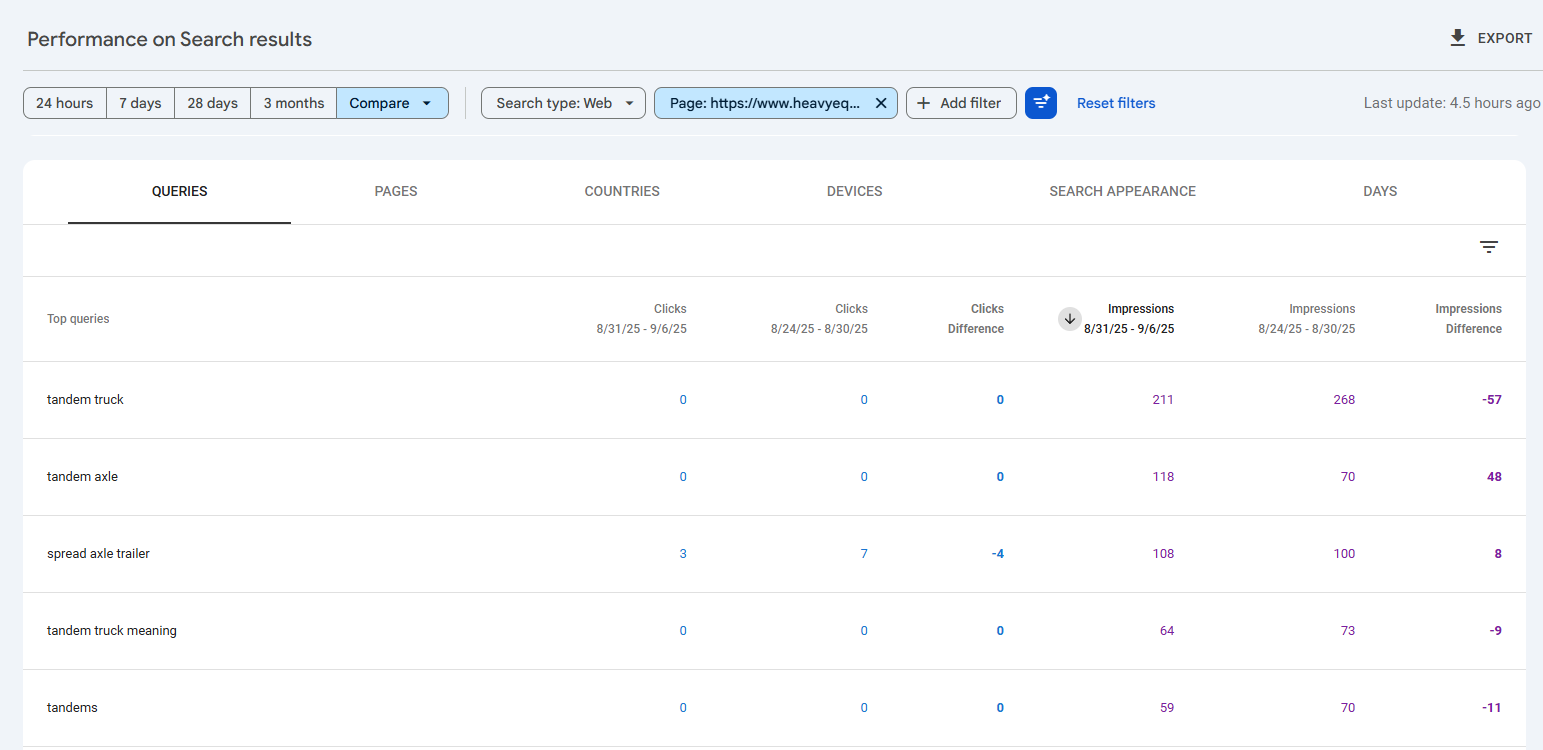
    The first place I look is Google Search Console. It is one of the clearest ways to confirm whether query expansion is already happening for my site and my content.

    Image

    My workflow is straightforward. I go to Performance > Search results, filter by a specific page, pull the full query list, and sort by impressions.

    From there, I look for queries I never intentionally targeted. I pay attention to synonyms with meaningful impressions, question-based searches that may be especially useful for AI visibility, and broader keywords that are not currently addressed on the page.

    I do not assume every discovered query deserves a content update. Sometimes a page appears for terms that are not truly relevant. When that happens, I audit the page and make sure the content is not drifting into unrelated topics that fail to match the promise of the SERP result.

    How I plan better content with query expansion

    Once I understand which expanded queries Google is connecting to my content, I use that data to strengthen the page instead of chasing isolated keywords.

    I write for topic coverage

    For a long time, strong SEO has been less about exact keywords and more about semantic relevance. I try to build coverage around subtopics, related questions, and adjacent ideas because that gives Google more context than a page built around one keyword alone.

    I answer questions adjacent to the main topic

    For example, if I am working on content for a company that sells chicken feed, I would not only explain the feed itself. I would also consider why the right balance matters and how the right feed can support chicken health.

    I can find those adjacent questions by reviewing query expansion data in Google Search Console, checking tools like Ahrefs, and studying the SERP to see what supporting information Google is already surfacing for the topic.

    I use expansion data to find content gaps

    If Google Search Console shows that Google is pulling my page for a query I have not planned for, and that query is genuinely relevant, I treat it as a signal that the page may need more complete coverage.

    Image

    Sometimes query expansion data includes odd or unrelated searches. I ignore those. But when I find adjacent queries that clearly strengthen the topic, I add them to the page in a useful and natural way.

    I also revisit content regularly, usually at least once a quarter. New queries can appear, while others fade away. Since I am already keeping content fresh for the SERP, query expansion gives me another practical way to make each topic stronger.

    How I use query expansion to improve AI Overviews visibility

    AI Overviews often pull from ranking pages on a topic to build a more complete answer. Those answers can include semantic connections and supporting subtopics, not just the exact phrase someone searched.

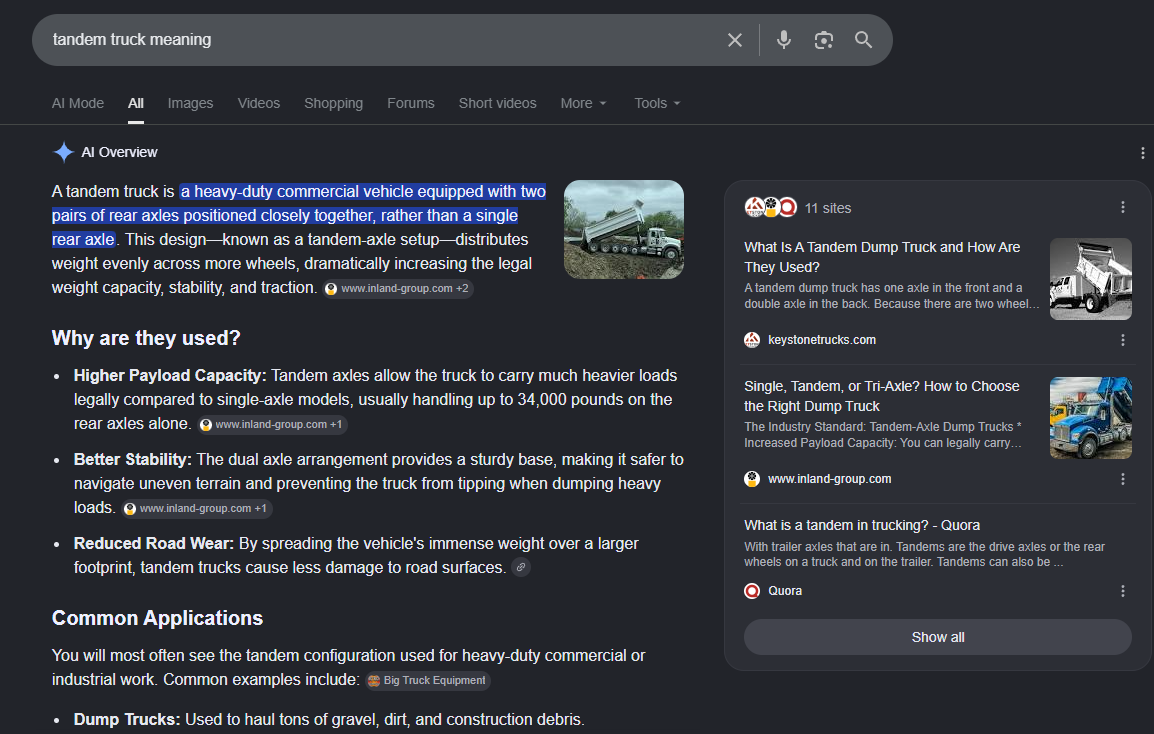
    That is why I cross-reference my query expansion data with the main keyword in the SERP. If an AI Overview includes supporting topics that are relevant to my page, I consider adding those topics to the content.

    For example, I followed this process for a blog post titled “Tandem vs. Spread Axles in Trucking.” After filtering by impressions, I found that the page appeared for “tandem truck meaning,” even though that exact phrase was not specifically included in the content.

    The page ranked first, but it was not included in the AI Overview for that specific query. That told me there was an opportunity.

    Because the page already ranked well, I could use the expanded query and the supporting information in the SERP to create a section that better addressed both the query expansion term and the query fan-out patterns behind the AI Overview.

    That is the value of this process. Query expansions can reveal supporting topics that strengthen traditional search visibility and improve the chances of being included in AI-driven results.

    How query expansion helps my SEO strategy evolve

    I use query expansion as a practical way to identify supporting topics and expand content coverage across search experiences.

    As clicks become harder to earn, I want my content to appear across more relevant search moments. Broader visibility can strengthen brand awareness, support AI visibility, and keep my content in front of the people most likely to need it.


    Inspired by this post on Search Engine Land.

    crushpress.ai community screenshot
  • Semantic PPC and SEO Tactics That Still Win With AI

    Semantic PPC and SEO Tactics That Still Win With AI

    Why advanced semantic techniques still matter in PPC and SEO

    Now that I can use AI to generate keywords and launch a paid search campaign in minutes, it is tempting to think the hardest part of PPC and SEO work has already been handled.

    But I still need more than fast keyword output if I want structured, scalable performance. I need to understand how search actually works, how people phrase intent, and how noisy search term data can distort a campaign if I do not organize it properly.

    That is where semantic techniques such as n-grams, Levenshtein distance, and Jaccard similarity continue to matter. I use them to interpret messy data, apply real client context, and build frameworks that AI alone cannot reliably produce.

    What I learn from n-grams in PPC and SEO analysis

    I think of n-grams as the “n” words that make up a keyword. In the search term “private caregiver nearby,” I can break the phrase into smaller pieces that are easier to analyze.

    • 3 unigrams (one word): “private,” “caregiver,” and “nearby”
    • 2 bigrams (two consecutive words): “private caregiver” and “caregiver nearby”
    • 1 trigram (three consecutive words): “private caregiver nearby”

    I use n-grams because they simplify large keyword lists without stripping away the patterns that matter.

    For example, I recently restructured several campaigns that had more than 100,000 search terms. By using n-grams, I reduced those lists into much more workable sets.

    • ~6,000 unigrams.
    • ~23,000 bigrams.
    • ~27,000 trigrams.

    Once I have those smaller sets, I can spot patterns quickly. If every keyword containing the “free” unigram performs poorly, I can exclude “free” as a broad match negative.

    On the other hand, if I see that “nearby” performs especially well, I may test more local variations, build location-specific landing pages, or adjust campaign structure around that intent.

    I still have to respect the limits of this method.

    • I need a large volume of search terms, so this approach usually works best for accounts with bigger budgets.
    • As “n” gets larger, the output becomes less useful because the data expands again. At that point, I usually need more advanced methods such as Levenshtein distance or Jaccard similarity.

    How I cluster keywords with n-grams

    When I analyze SEO and PPC data, I often deal with huge volumes of long-tail search terms. Many appear only once and carry very little standalone data.

    N-grams help me turn that chaotic long-tail data into clearer, more manageable intelligence.

    That intelligence helps me reduce wasted spend, find new opportunities, and build a structure that can scale.

    • I start by exporting search term data. In PPC, that includes cost, impressions, clicks, conversions, and conversion value by search term.
    • For each n-gram, I sum cost, impressions, clicks, conversions, and conversion value.
    • Then I calculate CPA, ROAS, CTR, CVR, and any other metrics that matter for the account.

    With a shorter and more digestible dataset, I can rank the top-spending n-grams that do not convert, which often become negatives, and the ones that do convert, which become positives.

    From there, I build ad groups around recurring n-grams that consistently drive performance.

    For example, I may find that emergency-related n-grams such as “24/7,” “same day,” or “urgent” deliver higher conversion rates. I would segment those terms so I can control budget, bidding, and messaging more precisely.

    Bottom line: I use n-grams to isolate themes that deserve special attention.

    Once I have identified those themes, it becomes much easier to build advanced paid search structures around high-impact n-grams and improve ROI.

    Dig deeper: How to uncover hidden gems in your paid search accounts

    How I use Levenshtein distance to improve keyword quality

    Levenshtein distance measures the minimum number of single-symbol edits, including insertions, deletions, or substitutions, needed to turn one string into another.

    That may sound complicated, but the idea is simple once I put it into practice.

    The Levenshtein distance between “cat” and “cats” is 1 because I only need to add the “s.” Between “cat” and “dog,” the distance is 3.

    One common PPC use case is finding brand and competitor misspellings inside search term reports.

    For example, “uber” and “uver” have a Levenshtein distance of 1, so I would feel confident excluding the misspelled version from non-brand campaigns.

    I can apply the same logic to keyword relevance.

    If the distance between a keyword and the search terms it matches is too high, such as 10 or more, those terms probably have very little in common with the keyword and deserve review.

    A low distance usually tells me those queries are close enough to be safe and do not need the same level of manual inspection.

    How I consolidate PPC keywords with Levenshtein distance

    After I use n-grams to create initial keyword clusters, I may still have thousands of search terms to organize into a practical campaign structure.

    Manually sorting through 6,000 unigrams is not realistic. This is where Levenshtein distance becomes especially useful.

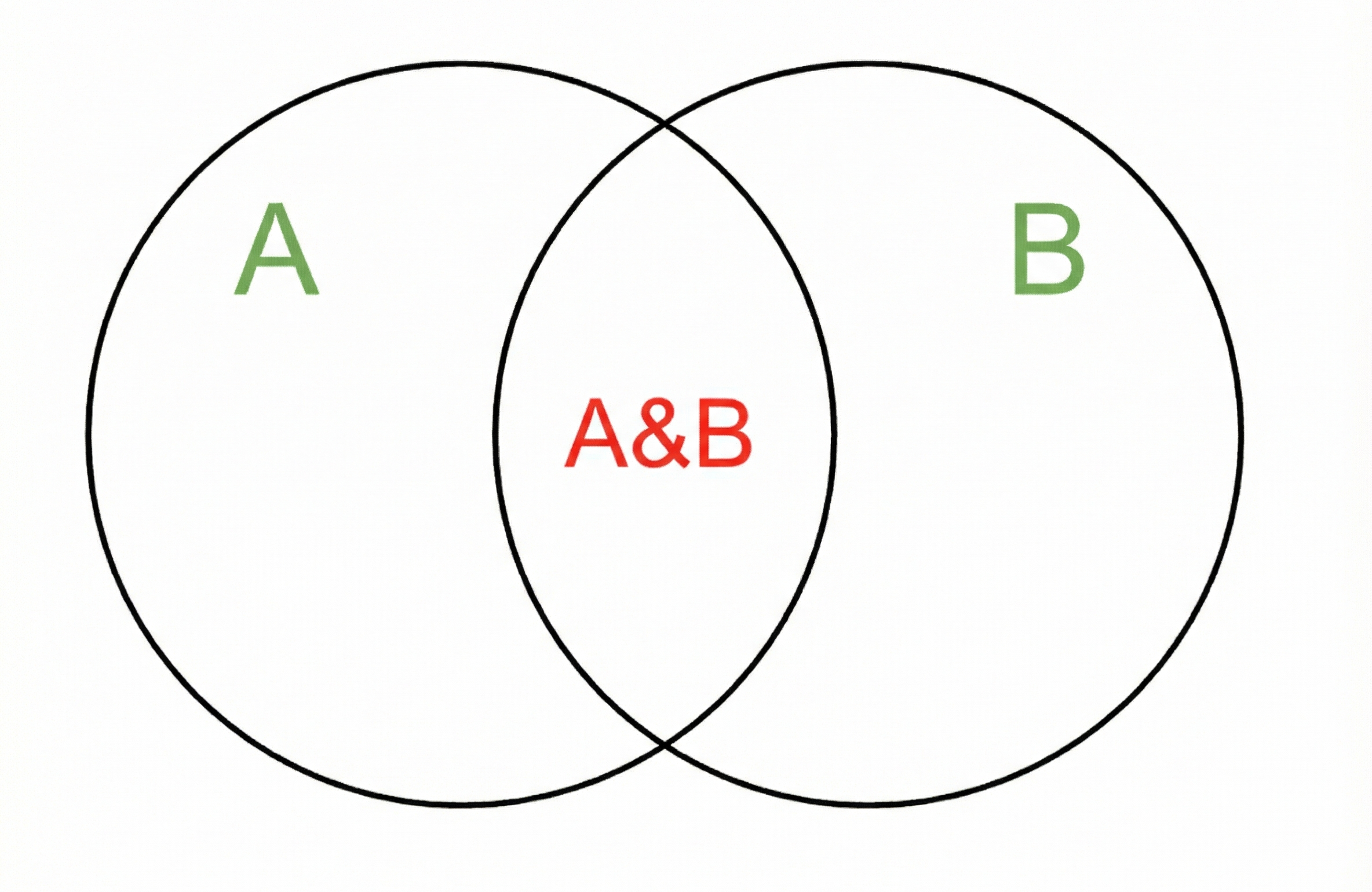
    Venn diagram showing sets A and B with their overlapping intersection labeled A&B, illustrating Jaccard similarity for SEO and PPC keywords.
    A simple Venn diagram visualizes how Jaccard similarity measures the shared overlap between keyword sets A and B in semantic PPC and SEO analysis.

    My goal is to merge ad groups that target nearly identical keywords so I do not end up with an overly granular, SKAG-like structure.

    Too much granularity makes reporting and account management harder. It can also create inefficient bidding and wasted spend.

    Using the same dataset, I calculate the Levenshtein distance between queries across different ad groups.

    Then I identify the closest keyword and ad group using a predefined threshold. A threshold of 3, for example, gives me a high degree of accuracy.

    This helps me consolidate keywords and ad groups with confidence. If I use a looser threshold, such as 6, I can also group or name ad groups by broader similarity or intent.

    Here is a simple example showing why these three keywords can be grouped together:

    Levenshtein distance24/7 plumber24 7 plumber247 plumber
    24/7 plumber011
    24 7 plumber101
    247 plumber110

    Dig deeper: How to use negative keywords in PPC to maximize targeting and optimize ad spend

    How I go further with Jaccard similarity

    In PPC, I use Jaccard similarity as a practical proxy for understanding the overlap between two sets of n-grams.

    The calculation is straightforward: I divide the number of shared unigrams between two sets by the total number of unique unigrams across both sets.

    It sounds technical, but I visualize it simply:

    • Jaccard similarity = Red / Green
    A plus B - A and B

    Here are a couple of concrete examples I use to explain the concept:

    • “new york plumber” and “plumber new york” = 1 because all three unigrams appear in both sets, just in a different order.
    • “new york plumber” and “NYC plumber” = 0.25 because only “plumber” is shared, and there are four unigrams in total.

    Jaccard similarity is a helpful first step for deduplicating similar keywords. I see it as a bridge between old phrase match logic and broad match modified logic.

    But it has an important limitation: it does not understand meaning.

    In the example above, “new york” and “NYC” should be treated as equivalent, but the Jaccard calculation sees them as different.

    To handle that kind of nuance, I need more advanced techniques, which I would treat as the next layer of analysis.

    How I combine Jaccard similarity and Levenshtein distance

    Consider a cybersecurity course campaign with the following top 10 keywords:

    KeywordSemrush average monthly searches in the U.S.
    cybersecurity courses5,400
    cybersecurity online course1,900
    free cybersecurity courses1,300
    online cybersecurity courses1,300
    cybersecurity course1,000
    cybersecurity courses online880
    google cybersecurity course880
    cybersecurity courses free720
    cybersecurity free courses590
    cybersecurity online courses480

    By combining singular and plural versions, along with reordered versions of the same idea, I can reduce that top 10 into a more actionable top four.

    • “Cybersecurity courses.”
    • “Cybersecurity courses online.”
    • “Free cybersecurity courses.”
    • “Google cybersecurity course.”

    I could use n-grams to do this, but scaling n-gram analysis across thousands of keywords can quickly become overwhelming.

    A more efficient approach is to use both similarity metrics in sequence.

    • First, I apply Levenshtein distance to consolidate very similar queries.
    • Then I use Jaccard similarity to deduplicate reordered variants.
    • At each step, I sum the usual KPIs, including cost, conversions, and other performance metrics, so the analysis stays actionable.

    The result is a clear, compressed structure that can hold up even as search term volume grows.

    How I restructure paid search campaigns with semantic techniques

    With the right semantic techniques, I can restructure massive keyword sets quickly and still produce consistent, high-quality results.

    AI can absolutely help me create an initial summary, but I do not rely on it entirely.

    Otherwise, I run into the classic problem of “garbage in, garbage out.”

    Broad match can be powerful, but it also introduces more noise. These techniques help me verify that the queries I am matching stay aligned with campaign goals.

    I use n-grams, Levenshtein distance, and Jaccard similarity to apply client context to raw search data and build a stable structure around real intent.

    If the process feels overwhelming at first, I use this summary to decide which technique fits the job:

    ScenarioBest techniqueWhy
    Identify high-intent patterns in huge search-term exportsn-gramsSurfaces themes fast; reduces dimensionality
    Clean duplicate / near-duplicate keywords at scaleLevenshtein distanceCaptures spelling + structural similarity
    Deduplicate reordered or slightly varied keyword stringsJaccard similarityOrder-insensitive token-based comparison
    Create scalable clusters for campaign rebuildsCombo: Levenshtein → Jaccard → n-gramSequence gives accuracy + compression

    For me, the main lesson is simple: AI can accelerate PPC and SEO work, but semantic analysis gives that work structure, signal quality, and strategic control.


    Inspired by this post on Search Engine Land.

    crushpress.ai community screenshot
  • How AI Determines Brand Success at the Delegation Boundary

    How AI Determines Brand Success at the Delegation Boundary

    The delegation boundary- How AI decides which brands win

    AI assistants are revolutionizing how recommendations, purchases, and transactions are made, shifting the competitive landscape for brands. It’s not enough to chase clicks anymore; gaining algorithmic confidence is where the real battle lies.

    The AI engine pipeline is complex, running through 10 gates from discovery to winning. The initial five gates—discovered, selected, crawled, rendered, and indexed—make your page legible to machines.

    The critical competitive gates—annotated, recruited, grounded, and displayed—decide which brand the algorithm will showcase to potential buyers.

    ```json
{
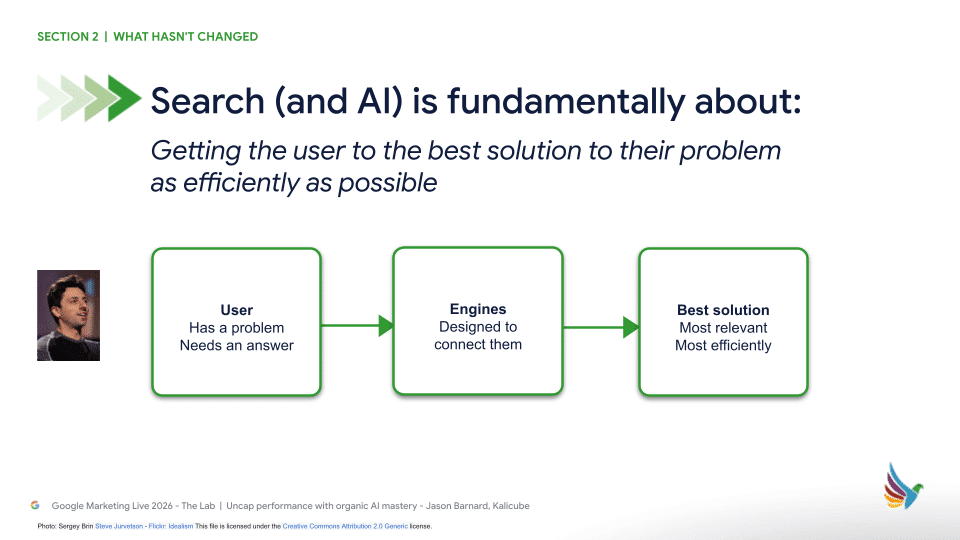
  "alt": "Diagram illustrating search and AI concept with flow from user to best solution via engines.",
  "caption": "Explore the seamless journey from a user's query to the best solution with AI and search engines, designed to connect efficiently.",
  "description": "This image presents a flowchart depicting the process of search and AI. It visually details how a user's question flows through 'Engines' to reach the 'Best solution'. The section emphasizes efficient problem-solving. The image includes a reference to its source and licensing information. This serves as a visual summary for discussions related to search efficiency and AI integration. Keywords: search, AI, engines, solution, efficiency."
}
```

    Reaching the ‘won’ milestone means your brand secures a click or a recommendation. This gate has evolved drastically in recent years. Previously, it meant securing a user’s attention through traditional search results. Now, it can also mean having your brand named by an assistive engine or an agent transacting on behalf of the user.

    Delegation is at the heart of this evolution—deciding what to entrust to machines and when. Although the concept isn’t new, the boundaries of delegation have expanded, allowing more of the journey to be handled by technology. Brands must prepare for this spectrum of delegation.

    ```json
{
  "alt": "The CapmatchOne logo with a gradient circle and bold text.",
  "caption": "Discover innovation with the CapmatchOne logo, featuring sleek typography and a modern gradient circle.",
  "description": "The CapmatchOne logo features bold, modern typography coupled with a gradient circle, symbolizing connection and innovation. The sleek design conveys a sense of progress and creativity. This image can be used for branding or promotional purposes, appealing to audiences interested in innovative solutions and forward-thinking designs."
}
```

    The ultimate objective of search remains unchanged: offering users the most efficient solution to their problems. AI doesn’t alter this aim but enhances the speed and smoothness of arriving at that solution, reducing friction encountered in traditional searches.

    The delegation boundary is a dynamic line marking the division between what users manage independently and what is handed over to the engine. Shifting this boundary towards the engine accelerates reaching ‘won,’ while holding back delays it.

    ```json
{
  "alt": "Diagram showing AI's role in consumer decision-making funnel: Research, Evaluation, and Decision stages.",
  "caption": "Explore how AI simplifies consumer decisions across the research, evaluation, and decision-making stages in the funnel.",
  "description": "This diagram illustrates the evolving role of AI in consumer decision-making processes. It highlights the three stages of the funnel: Research (top), Evaluation (middle), and Decision (bottom), each with corresponding queries like 'Will I break my bass amp?' and AI-driven insights. The image is part of a presentation on how AI is influencing search behavior, emphasizing automation in decision-making. Keywords: AI, decision-making funnel, consumer insights, search evolution."
}
```

    From Problem to Purchase in 15 Minutes with ChatGPT

    As a professional double bass player, picking up a guitar gig at the last minute threw me into an unexpected scenario. My trusty bass amp had to double up for my guitar since I was unprepared to buy new gear for a singular event.

    This need led me to ChatGPT, quickly transforming a typical week-long search into a smooth 15-minute journey. Conversations with ChatGPT guided me from curiosity to purchase by expertly recommending pedals and vendors, even ensuring delivery timelines were met.

    ```json
{
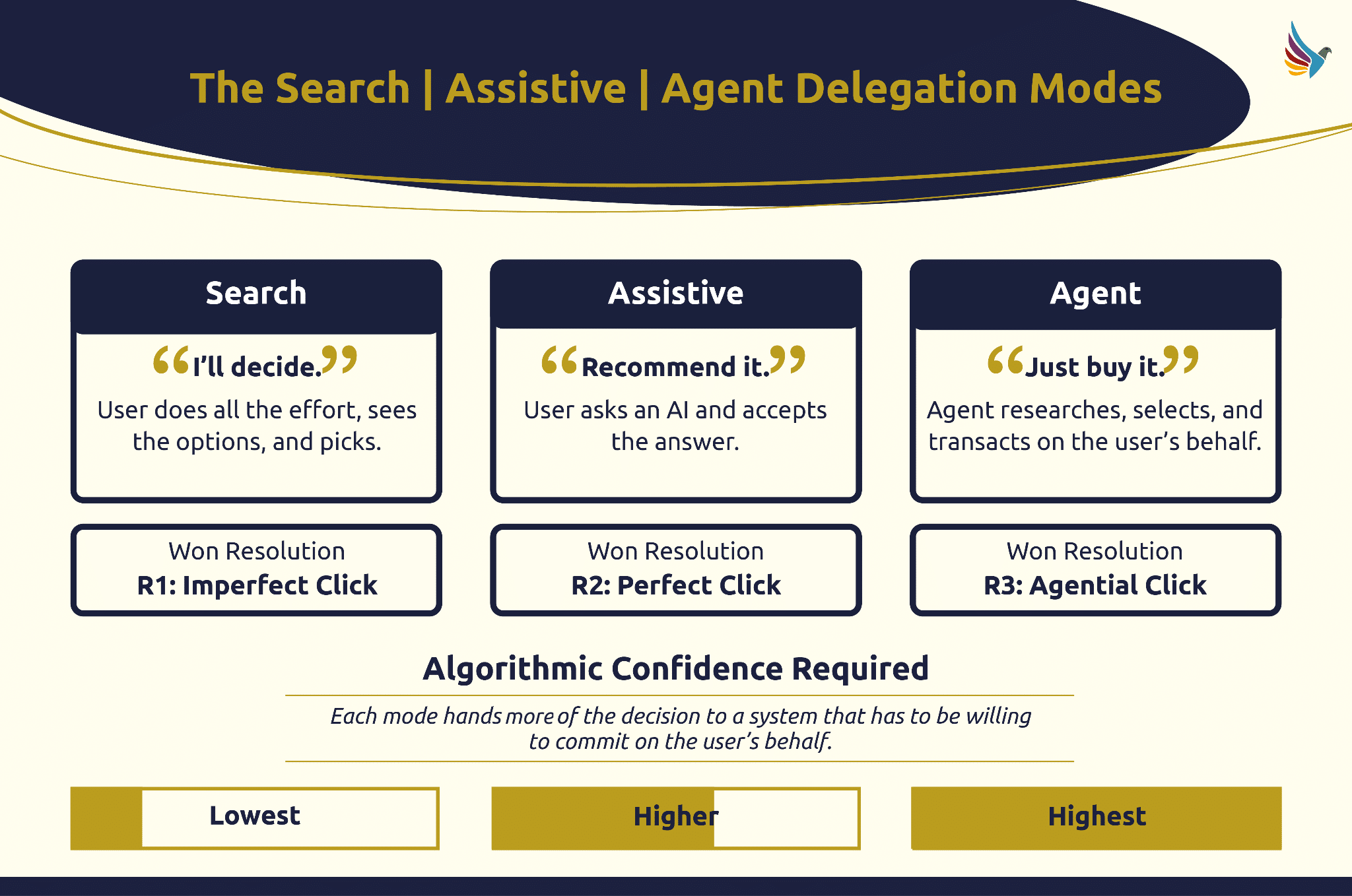
  "alt": "Diagram illustrating Search, Assistive, and Agent Delegation Modes with steps: I'll decide, Recommend it, and Just buy it.",
  "caption": "Explore decision-making modes: Search, Assistive, and Agent. From manual choices to AI-driven decisions, discover the perfect click.",
  "description": "This image depicts Search, Assistive, and Agent Delegation Modes. It explains the decision-making process: 'I'll decide' involves user-driven effort, 'Recommend it' includes AI assistance, and 'Just buy it' lets the agent make transactions. Each mode shows varying algorithmic confidence: Lowest for Search, Higher for Assistive, and Highest for Agent, with corresponding resolution outcomes: Imperfect Click, Perfect Click, and Agential Click. The graphic emphasizes the role of algorithmic confidence required in each mode."
}
```

    ChatGPT managed everything leading up to the purchase decision, understanding my requirements, and effortlessly condensing possibilities into an actionable recommendation. This seamless experience underscored how AI can streamline purchasing, tailoring pathways to fit personal preferences.

    The real win for my chosen brand, Thomann, was AI’s confidence in their consistency and reliability. They earned my repeated business owing to structured and precise visibility in AI databases, allowing ChatGPT to confidently stake its recommendation.

    The Single-Mode Assumption Is Dead: Three Modes Coexist Now

    ```json
{
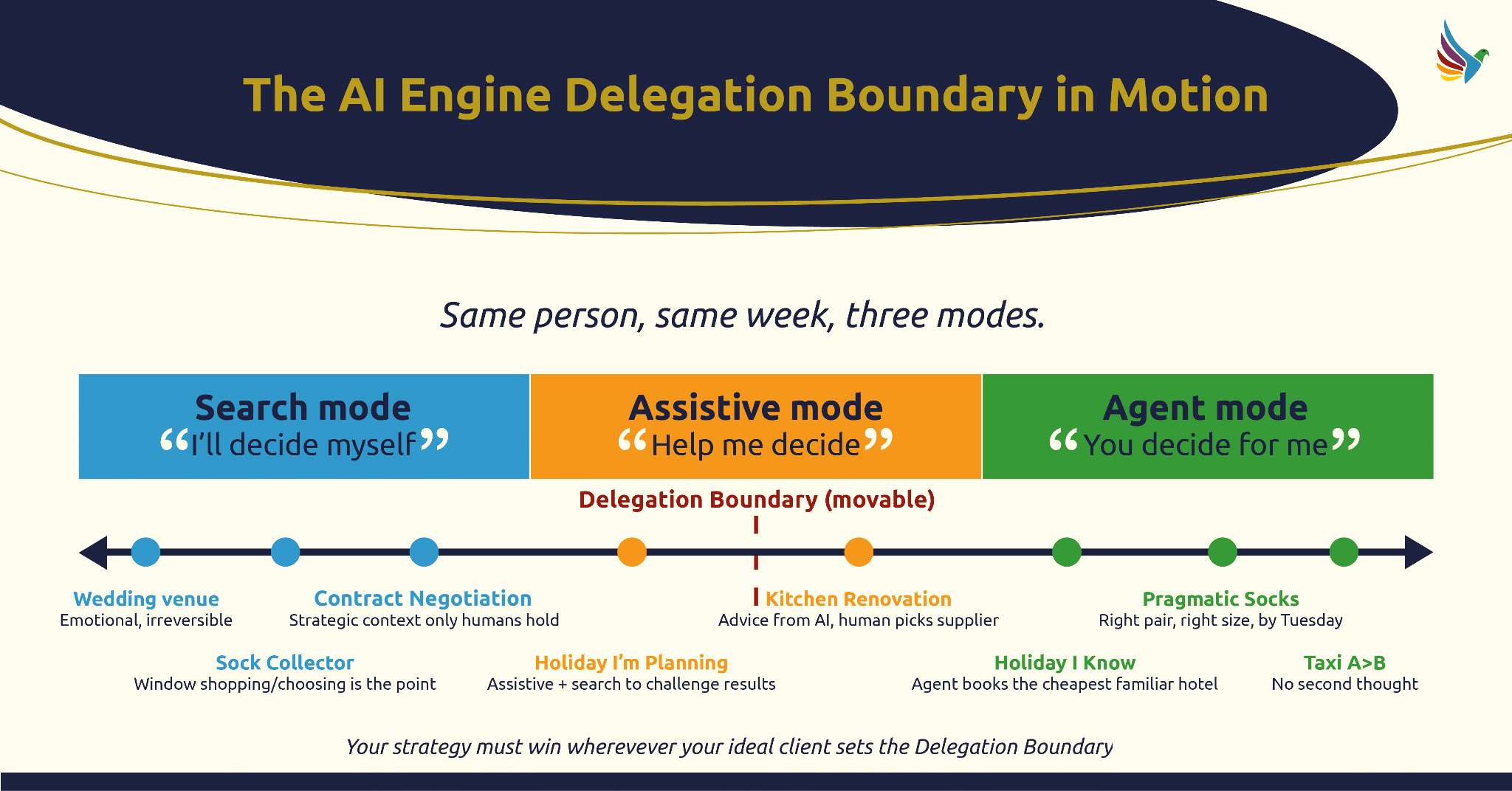
  "alt": "Infographic showing AI delegation boundary with three modes: Search, Assistive, and Agent.",
  "caption": "Explore the dynamic AI delegation boundary in motion, transitioning from Search to Agent mode, adapting to your decision-making style.",
  "description": "This infographic illustrates 'The AI Engine Delegation Boundary in Motion,' highlighting three modes: Search, Assistive, and Agent. Each mode represents varying levels of AI involvement in decision-making. The visual includes a movable delegation boundary and examples like wedding venue selection under Search mode and taxi booking under Agent mode. Keywords: AI delegation, decision-making, Search mode, Assistive mode, Agent mode."
}
```

    Gone are the days when ‘optimize for search’ sufficed. Now, brands juggle three pathways, integrating search with assistive and agentic modes, which can be interchanged throughout the user journey.

    The assistive mode leverages AI to recommend and reduce decision friction, while agent mode eliminates friction altogether, completing transactions independently of the user. Each mode redefines what ‘won’ looks like.

    The flexibility of delegation boundaries urges brands to adapt, strategizing for each unique user journey from the deliberate search of a professional to the convenience-seeking consumer.

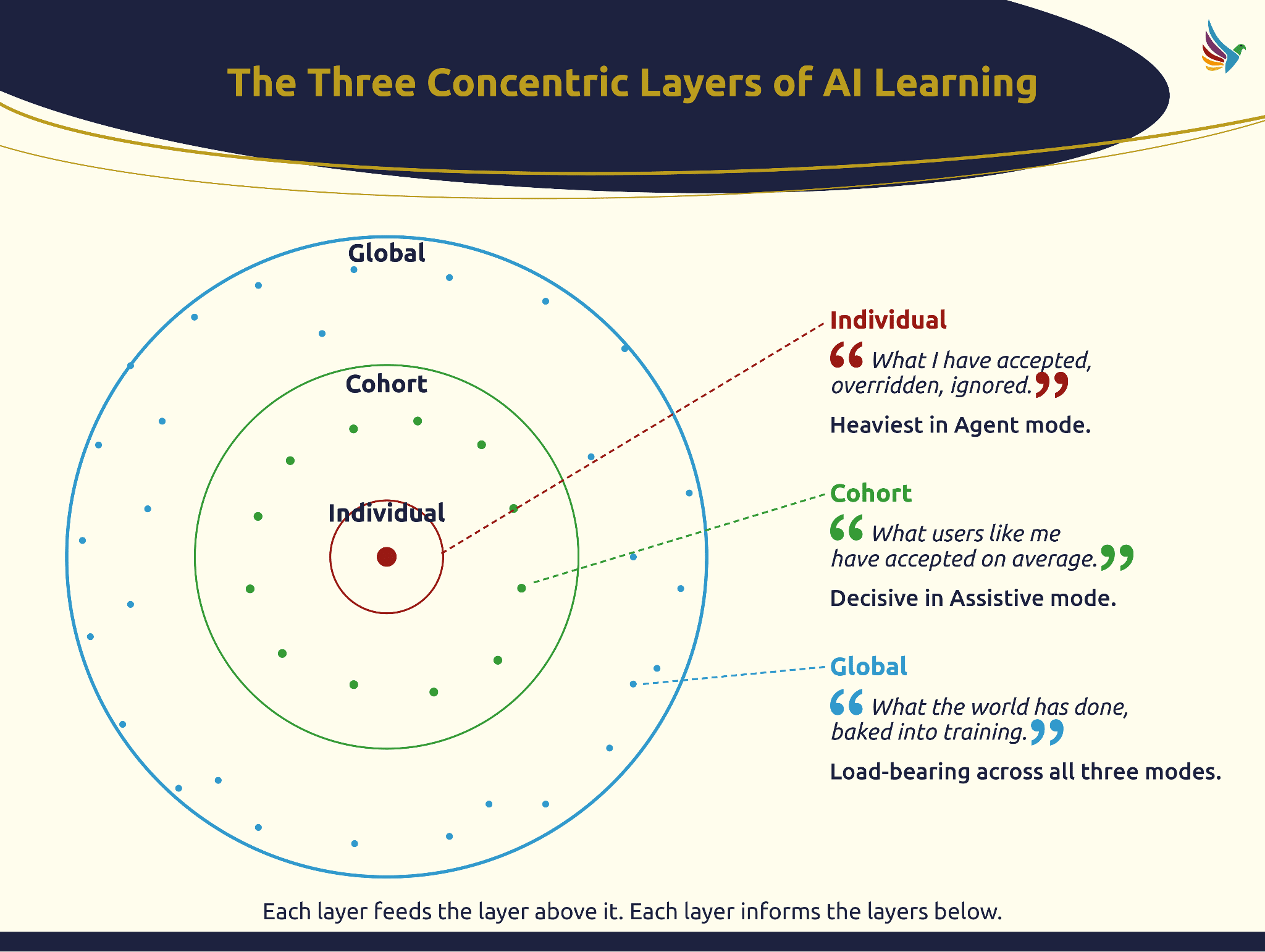
    ```json
{
  "alt": "Diagram showing the three concentric layers of AI learning: Individual, Cohort, and Global.",
  "caption": "Discover the three layers of AI learning: Individual, Cohort, and Global, each contributing uniquely to how AI processes data and learns.",
  "description": "This image illustrates the 'Three Concentric Layers of AI Learning' in a diagram with three colored circles representing different learning modes: Individual (red), Cohort (green), and Global (blue). The Individual layer focuses on personal interactions, Cohort reflects group behaviors, and Global deals with wider aggregated data. Annotations explain how each layer influences AI's decision-making and training processes, highlighting their impact in various AI modes such as Agent and Assistive."
}
```

    Map your strategies to account for these dynamics, recognizing diverse customer pathways, and be prepared for all forms of AI interaction.

    The strategies that drive success in this AI-driven landscape are centered on confidence—whether users search, rely on recommendations, or let AI transact. Mastering AI’s learning mechanisms and understanding user intent create pathways to success, allowing dynamic flexibility in engaging potential buyers.


    Inspired by this post on Search Engine Land.


    crushpress.ai community screenshot
  • Transforming SEO: A Guide to Semantic and Programmatic Success

    Transforming SEO: A Guide to Semantic and Programmatic Success

    As I dive into the world of Programmatic SEO (pSEO), I understand that many people in the industry view it with suspicion, associating it with low-quality pages and duplication. Often, it’s seen simply as replicating city names on static templates.

    Google’s policies on content spam are clear: strategies that generate unoriginal content just to influence rankings will not be tolerated.

    In the modern landscape, pSEO isn’t about mass page generation. Instead, I aim to address thousands of search intents with local specificity and semantic depth, achieving what isn’t possible manually.

    Here, I share my blueprint for transitioning from syntax-based to semantics-based pSEO, using methods we’ve tested with major companies in Brazil.

    When embarking on a pSEO project, it’s common to start with templates. Yet, this approach often misses the mark. For instance, the intent behind “Best Hotel in [Las Vegas]” differs from “Best Hotel in [Orlando],” focusing on entirely different priorities and amenities.

    I leverage AI to make content more granular, ensuring that each page addresses unique travel intents rather than generic keywords. My goal isn’t just to create a thousand pages, but a thousand pages that each fulfill a specific travel need.

    Before creating content, I must answer a vital question: where does my domain have authority to rank? Failed pSEO projects often miss this step, targeting areas without established authority. My solution involves deep analysis using real Google Search Console data.

    ```json
{
  "alt": "The CapmatchOne logo with a gradient circle and bold text.",
  "caption": "Discover innovation with the CapmatchOne logo, featuring sleek typography and a modern gradient circle.",
  "description": "The CapmatchOne logo features bold, modern typography coupled with a gradient circle, symbolizing connection and innovation. The sleek design conveys a sense of progress and creativity. This image can be used for branding or promotional purposes, appealing to audiences interested in innovative solutions and forward-thinking designs."
}
```

    Through cluster audits, priority definitions, and strategic calendar alignment, I ensure my pSEO actions enhance topical authority while addressing existing semantic gaps.

    Brand consistency is a hurdle when adopting AI. By implementing context governance, I ensure AI-generated content remains true to the brand’s voice, using guidelines to prevent deviations.

    For internal linking, I adopt the semantic mesh strategy to ensure that every page connects logically, directing the user through a logical journey rather than dead ends.

    In practice, understanding regionalization and seasonality at scale is crucial. Ânima Educação in Brazil is a perfect case study, showing how strategic pSEO leads to precision and considerable business impact.

    As I scale content, monitoring with technical SEO agents helps maintain site quality, foreseeing issues like indexing problems or high LCP in real time.

    In summary, successful SEO is about integrating the efficiency of technology with the nuanced human touch to deliver timely and relevant content to users.


    Inspired by this post on Search Engine Land.

    crushpress.ai community screenshot
  • Build an AI Search Strategy Focused on Context

    Build an AI Search Strategy Focused on Context

    AI-driven discovery relies heavily on semantic depth and a retrievable structure. I align language, taxonomy, and schema to achieve modern search visibility.

    AI-based discovery offers a sophisticated way to surface content, moving beyond mere reliance on keywords. It’s clear to me that contextual and semantic elements are now more crucial than ever.

    When optimizing, it’s not just about reinforcing keywords. I focus on constructing a semantic environment that’s easily retrievable.

    This shift affects my approach to writing, creating, and conceptualizing content, regardless of whether I write it all myself or use automated workflows.

    Reframing My Publishing Strategy Around Context

    Although much has been written about this, I aim to tie these concepts together for a cohesive publishing strategy and tactical approach.

    If I’m already using a context mindset, I’m likely making these elements work in my favor. For a deeper understanding of contextual and semantic strategy beyond keyphrase-first approaches, I must continue exploring.

    Context, semantics, meaning, and intent have always been core to optimization. What’s evolving is how content is presented and discovered, especially on LLM platforms.

    This evolution changes how I categorize and structure context across a website, affecting taxonomy, schema, internal linking, and content organization.

    It’s also a shift away from lengthy word counts, focusing instead on precision, benefiting both machines and human readers.

    Keywords aren’t obsolete but function best within a broader, well-defined strategy. It’s essential to understand what this means for my publishing strategy going forward.

    Dig deeper: If SEO is rocket science, AI SEO is astrophysics

    Structure for a Contextual-Density Approach

    I think of keyphrases as multidimensional points, building semantics in a unified framework. This means treating topics as semantic fields rather than isolated words.

    • Primary topic as the axis.
    • Secondary and tertiary concepts for structure.
    • Intent-based problems for context.
    • Stemmed or varied phrasing for linguistic diversity.
    • Entity associations for depth.
    • Readable chunks as retrieval units.
    • Structural signals like internal links and taxonomy.

    While the keyword anchors the page, it’s the surrounding elements that define performance and meaning. Effective writing considers all these aspects as crucial to creating impactful content.

    Context Density and SERP-Level Linguistic Analysis

    I compare keyword-level analysis to a broader SERP-level approach, which isn’t entirely new but more comprehensive now with platforms like Content Experience.

    By scraping top result pages and assessing common high-ranking words, these tools reveal semantic indicators crucial for content performance.

    These analyses help me create competitive, high-performing content in areas where competitors lack depth in their contextual understanding.

    Using Secondary and Tertiary Keyphrases

    By understanding secondary and tertiary keyphrases as linguistic supports, I can categorize and emphasize language into a useful hierarchy.

    ```json
{
  "alt": "The CapmatchOne logo with a gradient circle and bold text.",
  "caption": "Discover innovation with the CapmatchOne logo, featuring sleek typography and a modern gradient circle.",
  "description": "The CapmatchOne logo features bold, modern typography coupled with a gradient circle, symbolizing connection and innovation. The sleek design conveys a sense of progress and creativity. This image can be used for branding or promotional purposes, appealing to audiences interested in innovative solutions and forward-thinking designs."
}
```

    These keyphrases are context stabilizers that reinforce my main topic, adding scope and relevance.

    Each secondary keyword should bring a unique contribution to my page, whether introducing new topics, addressing questions, or adding context to my primary theme.

    Stemmed Linguistics

    The power of comprehensive keyword optimization lies in capturing related searches that share roots with primary keywords.

    For instance, a detailed guide on “content marketing” might also rank for specific variants and related high-intent searches.

    Covering secondary and tertiary keywords thoroughly increases the likelihood of capturing these valuable searches.

    High-Level Technical Foundations for Contextual Emphasis

    Shifting from string-based to context-based strategies entwines with how machines and humans interact with content.

    Retrieval Mechanics: From Pages to Chunks

    Large language models segment content into retrievable chunks evaluated for contextual similarity to the searcher’s intent.

    Achieving meaningful content fast can be beneficial for both machine evaluation and user experience.

    Structural Context: Architecture as Meaning

    The way I organize content matters significantly, providing both taxonomical hierarchy and contextual signals.

    Internal links apply meaning and reinforce connections between related topics and entities.

    Schema and Entity Context

    Schema markup offers a way to express meaning explicitly, helping clarify entity relationships and reinforcing signals across platforms.

    This adds formal structure to content while maintaining strong, clear writing.

    For an in-depth understanding, I recommend Duane Forrester’s book, “The Machine Layer.”

    Moving to a Context-First Strategy

    Aligning linguistics, structure, and declaration around a central theme is key to my context-first strategy.

    Even though shifting from keyword-focused approaches might be challenging, it’s achievable through attentive writing and research practices.

    Ultimately, this strategy focuses on creating content that is machine-readable while resonating at both page and site levels.


    Inspired by this post on Search Engine Land.


    crushpress.ai community screenshot