Tag: Performance Channel

  • Revolutionize Your Marketing: Google’s New AI-Powered Advisors

    Revolutionize Your Marketing: Google’s New AI-Powered Advisors

    I’ve always been intrigued by how technology can simplify complex tasks, and Google’s recent launch of AI-powered Ads and Analytics Advisors does just that. Acting as a personal assistant for advertisers, these tools offer a speedy way to analyze data, optimize campaigns, and immediately turn insights into action.

    Google is introducing two innovative AI-powered assistants—Ads Advisor and Analytics Advisor—built on their latest Gemini models. These assistants are designed to manage campaigns more efficiently and uncover insights faster.

    Starting early December, English-language Google Ads and Google Analytics accounts will have access to these tools. They transform complex data and campaign management into simple, user-friendly experiences.

    Ads Advisor: Optimization and Automation. This tool serves as your in-platform AI partner, offering support in managing, troubleshooting, and scaling campaigns. It evolves with user interaction, providing more tailored guidance over time. Key features include:

    • Performance optimization: Receive customized recommendations for Performance Max and Search campaigns that can be directly applied, like adding sitelink extensions or adjusting for seasonal events.
    • Creative generation: Get suggestions for new keywords, assets, and ad copy based on existing website and campaign data to keep your content fresh.
    • Performance diagnostics: Ask questions like “Why did my campaign performance drop?” and get pinpointed solutions and causes.
    • Policy troubleshooting: It spotlights ad disapprovals, offering explanations and sometimes implementing policy fixes directly.

    Analytics Advisor: Instant Insights. Bringing conversational AI into Google Analytics, Analytics Advisor acts as your tireless analyst, interpreting performance data and suggesting actionable next steps.

    • Fast, comprehensive insights: Quickly answer questions like “How is my site performing?” with dynamic visualizations and summaries.
    • Root cause analysis: Discover why there’s a spike or drop in traffic by understanding the key drivers relevant to your business.
    • Actionable recommendations: Use data-backed strategies to re-engage high-value users and capitalize on trends.

    Why we care. These AI advisors significantly streamline campaign management and optimization. Instead of sifting through reports and guessing at issues, I can now ask direct questions and receive data-driven solutions within seconds.

    The tools diagnose problems and suggest, or even apply, fixes, which helps improve performance, saves time, and turns data into immediate action.

    Between the lines. With Gemini-powered assistants embedded directly into Google Ads and Analytics, Google is advancing towards Agentic AI—tools that independently identify, explain, and execute improvements across the advertising landscape. This shift allows me to spend less time on data analysis and more on strategic actions.

    The bottom line. Google’s new Ads and Analytics Advisors turn campaign optimization and performance analysis into a conversation, revolutionizing how I can plan, measure, and make real-time decisions.


    Inspired by this post on Search Engine Land.
  • Unlocking Success: Easier and Faster Google Ad Tests

    Unlocking Success: Easier and Faster Google Ad Tests

    Have you ever wondered about the true impact of your ads? Google is now making it easier and more affordable to find out with their updated incrementality testing. This means I can measure and prove the real influence of my advertising efforts without breaking the bank.

    Google’s recent updates make incrementality testing accessible for all advertisers, regardless of budget. By significantly reducing the minimum spend from $100,000 to a mere $5,000, I’ve found it easier to gauge ROI with scientifically precise methods. Now, I can conduct controlled experiments to pinpoint exactly what’s driving my campaigns.

    I’m thrilled to learn that Google’s enhanced their incrementality testing with new statistical models, providing results that are up to 50% more conclusive. This improvement offers me clearer insights, reducing the uncertainty that could delay my decision-making process.

    The ability to receive faster insights and make swift actions is invaluable. Google’s updates let me customize experiment designs and view results directly, which means I can adapt my strategies more quickly, even if changes in performance are minimal.

    Incrementality testing is now part of a comprehensive measurement platform that includes Marketing Mix Models (MMMs) and Attribution. Together, these elements allow me to get a holistic view of my campaigns:

    • MMMs highlight the larger picture across various channels.
    • Incrementality focuses on the direct impact of specific campaigns.
    • Attribution links touchpoints to actual outcomes.

    When used together, these tools provide me with a robust strategy for measuring what really contributes to growth.

    Why is this important to me? As marketers like myself face increasing pressure to justify advertisement spending, Google’s updates provide a level playing field for smaller budgets to effectively measure and link ad investments directly to revenue growth.

    In conclusion, with reduced costs, superior data, and quicker reporting, Google’s incrementality updates have empowered me as an advertiser to verify what works, optimize my ad spend, and enhance confidence in my marketing ROI.


    Inspired by this post on Search Engine Land.
  • Unveiling Google Shopping’s New Brand Control Features

    Unveiling Google Shopping’s New Brand Control Features

    I’ve recently discovered that Google has quietly enhanced their Shopping campaigns by introducing brand inclusion controls. This long-awaited feature offers us advertisers unparalleled control over the brands that appear in our shopping ads without needing complex workarounds.

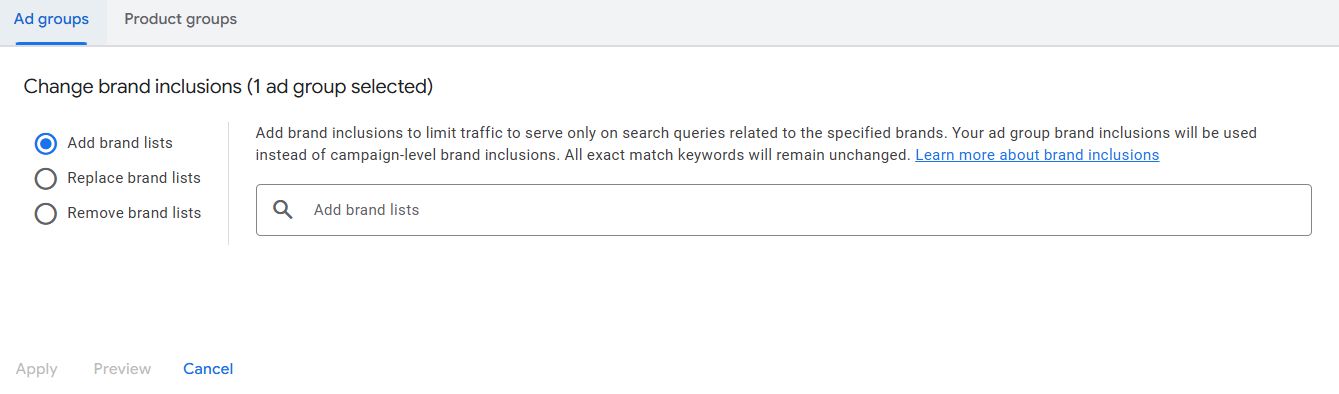
    How it works: Now, I can easily add or remove brand lists directly within the ad group targeting section of both Performance Max and Standard Shopping campaigns. This means I can specify exactly which brands to showcase or exclude, preview my setup, and apply changes seamlessly within the Google Ads interface.

    Why we care. Previously, brand targeting tools were only available in Performance Max and AI Max, leaving those of us using Standard Shopping campaigns to juggle search query scripts or set up intricate campaigns to manage brand visibility. This update changes that, finally giving us direct control over brand appearances.

    I find it eliminates the need for cumbersome scripts or overly complex campaign setups, simplifying brand visibility management. This improvement allows me to protect my budgets and target high-value brand traffic more precisely — a significant win for our advertising efficiency and control.

    ```json
{
  "alt": "Interface for changing brand inclusions in an ad group with options to add, replace, or remove brand lists.",
  "caption": "Streamline your ad targeting with efficient brand inclusion settings. Adjust your preferences to specifically tailor brand engagements.",
  "description": "This image shows a user interface where users can change brand inclusions for a selected ad group. Options are available to add, replace, or remove brand lists, with a search bar provided for ease of adding brands. This tool helps in refining ad targeting by including specific brand-related search queries, enhancing marketing efficiency. Keywords: brand inclusions, ad group, digital marketing, targeted advertising."
}
```

    Between the lines. For those of us in retail and ecommerce, this update is a game-changer in Shopping campaign management. It enables us to safeguard brand-specific budgets, control exposure within competitive categories, and avoid wasting money on unwanted brand traffic — all done conveniently within Google Ads.

    First seen. The update was initially noticed by Ryan Parks, Senior Search Director at Spark Foundry, who shared this valuable information on LinkedIn.

    The bottom line. With these brand inclusion features now accessible for Standard Shopping campaigns, we gain the same level of control and efficiency as Google’s automated campaign types offer. It’s a quietly powerful upgrade that will undoubtedly enhance precision in retail advertising.


    Inspired by this post on Search Engine Land.

  • Mastering SKAGs Consolidation: Boost Efficiency Today

    Mastering SKAGs Consolidation: Boost Efficiency Today

    I remember when the Alpha Beta account structure was the gold standard in paid search.

    As a PPC marketer, I’ve seen firsthand how we’ve had to adapt to Google’s shift toward automation and AI. We initially tweaked the Alpha Beta structure, built around single keyword ad groups (SKAGs), but eventually, we have had to move away from it completely.

    Maintaining and building out SKAGs is no longer ideal for today’s paid search landscape, but transitioning isn’t as simple as flipping a switch.

    However, existing SKAGs still contain valuable data and insights that can be carried into a more consolidated setup.

    In this article, I’ll explore the benefits of consolidating SKAGs and share best practices for creating a structure that can set your campaigns up for success.

    As someone who loves control over my campaigns, I get the allure of SKAGs.

    Custom bidding, tailored ad copy, and specific landing pages offer precision that’s hard to relinquish.

    The challenge is that “precision” no longer means the same thing it once did.

    With Google’s looser match types, gaining control over every query is no longer feasible, even for top-performing ones.

    Google now rewards data density and simplified account structures.

    The user interface simplifies consolidation, and algorithms improve faster with enhanced data.

    While results vary, a modest efficiency lift—around 10%—is achievable with proper consolidation.

    Effective control is elsewhere:

    • Enhanced conversions.
    • Strategic offline conversion tracking (OCT).
    • Negative keywords.
    • Ad copy with deep user understanding.

    Focusing on these areas is a far better use of my team’s time, enhancing tracking and measurement both within Google and across platforms.

    Consolidating SKAGs effectively might allow you to avoid the drop in performance typically seen with major account restructures.

    In my agency’s experience, consolidating accounts has not led to major negative impacts—but instead, allowed data density to work in our favor.

    Dig deeper: When to restructure your Google Ads account – and how to do it right

    To make consolidation successful, focus on structuring the balance of data density with control.

    Remember, Google’s algorithm favors data density.

    Switching from SKAGs to two-keyword ad groups won’t suffice; accounts often need more consolidation.

    Over-segmented setups can lead to:

    • Inefficient budget allocation.
    • Data cannibalization, reduced performance visibility.
    • Time-consuming management.
    • Inconsistent ad coverage, messaging.

    Consolidation saves time, which can be redirected toward higher-impact work, showing real business gains.

    In one SaaS account, efficiency in cost per opportunity improved by 6% in the first month and 27% in the second, while maintaining opportunity volume.

    These gains are not due to seasonality.

    Dig deeper: 7 PPC mistakes hiding in your ad accounts

    We’ve also encountered accounts with too many keywords in an ad group, resulting in ads serving irrelevant queries.

    Over-consolidating limits insights into performance.

    If dissimilar geos are grouped together, visibility into which areas drive growth is lost.

    Google finds the easiest path to your goals, which often contradicts your interests.

    Avoid clumping brand and non-brand keywords as Google will favor branded queries with lower incremental conversions.

    Separate brand and non-brand to make Google work harder to convert new users.

    Don’t group products with varying price points; Google will target the cheapest conversions.

    Keep products with similar price points together for better performance alignment.

    Avoid mixing high- and low-quality keyword leads to maintain high-value ad groups.

    Set realistic volume targets and optimize for deep-funnel actions like SQLs or opportunities.

    Using negative keywords aggressively helps manage irrelevant query exposure in consolidated ad groups.

    Aim for broad coverage to protect budgets from inefficient spend.

    The key benefit of consolidation goes beyond performance improvement. Saving time and allowing algorithms to work simplifies the structure and lets us focus on campaign differentiation.


    Inspired by this post on Search Engine Land.
  • Google Ads Editor 2.11: Empowering Advertisers with Advanced Tools

    Google Ads Editor 2.11: Empowering Advertisers with Advanced Tools

    The latest update to Google Ads Editor, version 2.11, has just arrived, and I’m excited to dive into its new features. This release brings campaign-level negatives, enhanced reporting, and smarter automation, designed specifically for managing large-scale advertising accounts more efficiently.

    One of the most awaited features is the ability to add negative keywords at the campaign level in Performance Max campaigns. This means I can have better control over ad placements, ensuring my budget isn’t wasted on irrelevant searches.

    Another new feature is search term reporting for Performance Max, which provides transparency on which queries trigger my ads. This insight helps me understand performance drivers and refine my strategies.

    Scheduled link checks are now automated, flagging broken URLs without manual effort. This feature protects my conversion processes by ensuring users always have functional links.

    I’ve also found the account-level placement and IP exclusions helpful, as they allow me to apply settings globally across my account, speeding up setup and maintaining consistent brand safety.

    The Smart Bidding Exploration tool is another exciting addition. It lets Google’s AI test high-performing queries with flexible ROAS targets, driving new conversions without manual tweaks from me.

    Editable lead forms are now a breeze, allowing me to update lead form assets directly, eliminating the need to start from scratch.

    The video generation feature makes creating on-brand video content for YouTube much easier by automating the process with existing assets and styles.

    The Search campaign creation process is now more streamlined with an AI-assisted flow that guides me through each step, ensuring I build well-optimized campaigns.

    I appreciate the more granular tracking control, as asset groups can now have individual tracking parameters for better measurement precision.

    Elective campaign syncing in the updated CSV and download features lets me efficiently manage larger accounts through a more intuitive interface.

    Additional updates include improved ad preview support and new targeting expansions, helping me stay ahead in managing effective campaigns.

    In summary, these updates give me greater control over ad placements, transparency into campaign performance, and new automation tools that enhance efficiency. As a result, my ad spending becomes smarter, leading to a higher return on investment.

    It’s also worth noting what’s being phased out, such as legacy App install and certain Display ad types, while adopting the new Video View Campaigns instead of Manual CPV bidding.

    Ultimately, Google Ads Editor 2.11 enhances my control and efficiency with features like campaign-level negatives in Performance Max campaigns, fulfilling a long-standing request.


    Inspired by this post on Search Engine Land.
  • Microsoft Demands Clarity for Safer Ad Placements

    Microsoft Demands Clarity for Safer Ad Placements

    Microsoft is taking a big step towards enhancing advertising standards, and I feel it’s stirring up quite a conversation. They have announced that now all third-party publishers are required to use Microsoft Clarity, their free behavioral analytics tool, to continue receiving paid impressions and clicks through Microsoft Advertising. It’s an important change that affects us all.

    The details:

    What’s required: As publishers, we must install Microsoft Clarity and activate Consent Mode. This enables us to monitor and analyze how users interact on our sites while adhering to privacy regulations.

    What it does: Clarity provides a window into user behavior, helping us see clicks, scrolls, and various engagement patterns. This insight allows us to make informed decisions to optimize our conversion rates — a crucial aspect for any publisher.

    What changes: Now, only the ad traffic from pages that have Clarity activated will count towards billing. This ensures every paid impression aligns with Microsoft’s stringent editorial and safety standards.

    Why we care. This move is all about improving transparency, user experience, and brand safety in the Microsoft Ads ecosystem. Pages not using Clarity will have their ad clicks and impressions filtered out as nonbillable. For us publishers, this means monetization is linked directly with compliance, urging us to implement these changes if we haven’t already.

    Between the lines. By essentially tying Clarity to revenue, Microsoft leverages its vast advertising network to reinforce higher standards, providing advertisers with increased confidence in the placements of their ads across trusted inventories.

    This news was shared by Microsoft Product Liaison Navah Hopkins on LinkedIn, underscoring its significance in our industry.

    The bottom line. For us publishers, using Clarity is no more optional. For advertisers, it ensures better brand safety and visibility regarding their advertising spend, marking a win for transparency in the constantly evolving Microsoft network.


    Inspired by this post on Search Engine Land.
  • Mastering AI Visibility: The New Frontier for Brands

    Mastering AI Visibility: The New Frontier for Brands

    AI availability is reshaping how we think about brand recognition, becoming a crucial battleground for companies. Let me take you through why this is transforming our approach to marketing.

    GEO, AI SEO, AEO – whatever you name it, what matters most is understanding this transformative shift.

    At the heart of this change is AI availability – a concept that’s redefining the landscape of visibility. Let me explain how and why this matters.

    What is AI availability?

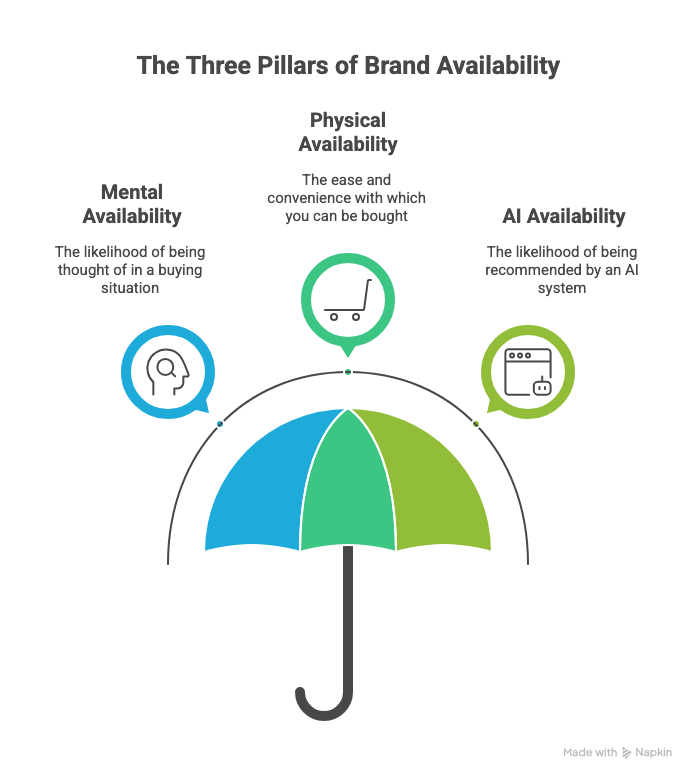
    The concept originates from Byron Sharp, who highlighted it as crucial for brand growth. It centers on two forms of availability: mental and physical.

    Brands grow through sales, which flourish through these two types:

    • Mental availability: Being thought of in purchasing situations.
    • Physical availability: Seamless and easy access to a product.

    Generative search introduces a third type – AI availability, marking how AI systems impact purchasing decisions.

    AI as the new influencer

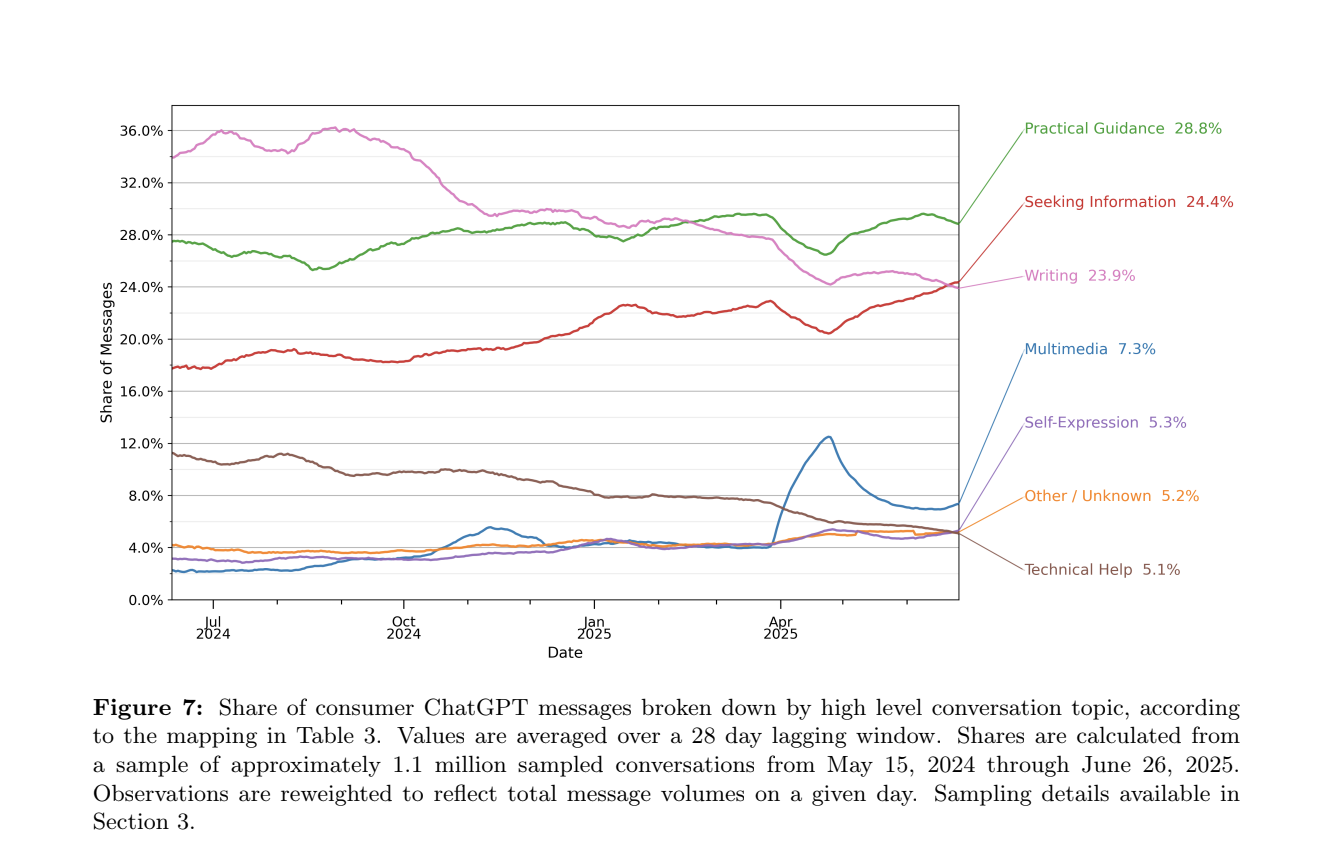
    If you still view AI merely as technology, it’s time to think bigger – it’s the ultimate influencer now. Data shows ChatGPT, alone, reaches 10% of adults globally. Think of it not as coding support but decision-making assistance, making AI the new gatekeeper.

    Decisions on what to buy and who to trust are moving through AI systems, transforming them into today’s most powerful influencers.

    ```json
{
  "alt": "Illustration showing three pillars of brand availability: mental, physical, and AI, represented by icons above an umbrella.",
  "caption": "Discover the three pillars of brand availability: mental recall, physical access, and AI recommendations, illustrated above a colorful umbrella.",
  "description": "This illustration highlights the three pillars of brand availability: Mental Availability is about being thought of in buying situations, Physical Availability emphasizes ease of purchase, and AI Availability pertains to AI recommendation likelihood. Icons representing each pillar are interconnected above a multi-colored umbrella, symbolizing protection and support. This visual is crafted to promote understanding of brand presence in a holistic market context."
}
```

    From keywords to fitness signals

    For years, the SEO industry optimized around human usage of keywords. But with large language models, the focus shifts to fitness signals – inherent traits that outcompete rivals.

    This means aligning your business performance attributes with today’s sophisticated AI systems, making them distinctly visible to a machine’s interpreters of need.

    The psychology of performance

    Drawing from evolutionary psychology, Geoffrey Miller argues consumers chase fitness cues – a concept AI utilizes to interpret queries not as keywords, but needs.

    Your aim? Ensure your brand’s fitness and performance attributes stand out in AI’s mental context of your category, shifting from traditional SEO efforts to robust AI presence.

    Category entry points and the new SEO

    Category entry points become your new keywords in GEO. They’re expressed as needs or triggers rather than search terms, requiring alignment with your brand’s unique context, so AI recognizes your offerings as solutions.

    This evolution makes your foundational brand strategy vital for influencing AI, feeding sophisticated recommendation systems.

    A local example: The sandwich shop in Stoke

    ```json
{
  "alt": "Line graph showing share of consumer ChatGPT messages by topic from May 2024 to June 2025, highlighting Practical Guidance and Seeking Information.",
  "caption": "Consumer ChatGPT messages reveal trends from May 2024 to June 2025, with Practical Guidance leading at 28.8%. Discover how user interactions evolve over time.",
  "description": "This line graph depicts the share of consumer ChatGPT messages categorized by topics like Practical Guidance, Seeking Information, and Writing from May 2024 to June 2025. Practical Guidance holds the highest share at 28.8%, followed by Seeking Information at 24.4%, and Writing at 23.9%. The data is derived from an analysis of roughly 1.1 million sampled conversations, reflecting trends and user preferences in AI usage over time. The chart includes categories like Multimedia and Technical Help, with fluctuations in message shares across months."
}
```

    Consider a modest sandwich shop in Stoke. It focuses on visibility by highlighting key performance attributes, like ingredient sources, and leveraging positive reviews across platforms, thereby informing AI networks of its offer.

    Such efforts help small businesses carve out recognition within AI systems, demonstrating GEO’s direction of combining good marketing with intelligent technology.

    Embrace both SEO and GEO

    The strategies of SEO and GEO are not mutually exclusive. Cultivating both influences AI availability for local businesses and larger corporations aiming to boost presence through intelligent visibility tactics.

    Building AI availability

    Visibility to AI systems begins with comprehensive audits and extends through strategic appearances in credible lists and directories, further achieving saturation by creating valuable content ecosystems.

    By accurately positioning your brand’s finest attributes, you’re readying it for AI’s recognition, pushing it to thrive in this new landscape.

    The future of visibility

    In this AI-driven age, marketing fundamentals still rule. To be chosen, your brand must become recognizable among machine intelligence, reshaping the familiar PR, branding, and SEO tools to serve this advanced audience.


    Inspired by this post on Search Engine Land.

  • Google Ads Tightens Grip on Fraudulent Phone Numbers

    Google Ads Tightens Grip on Fraudulent Phone Numbers

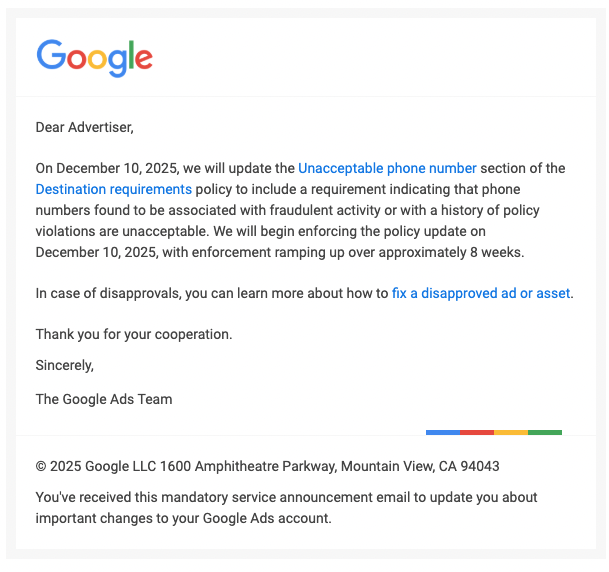
    As an advertiser, I need to be vigilant about the phone numbers I include in my Google Ads. Recently, Google has announced stricter rules, and any number linked to fraud or past policy breaches will soon be disallowed.

    Google Ads tactics to drop

    Google is updating its Destination requirements policy to ensure all phone numbers used in ads are free from any ties to fraudulent activities or previous policy violations. This is part of an ongoing effort to prevent misleading advertising tactics.

    The timeline:
    • Policy update effective: December 10, 2025
    • Enforcement ramp-up: Over roughly 8 weeks after rollout

    What’s changing. Any phone number identified as fraudulent or having a history of policy violations will be rejected under the new Destination requirements policy, resulting in ad disapprovals.

    Why it matters to me. This update is crucial because it targets individuals who might misuse legitimate-looking phone numbers to deceive users or bypass policy enforcement. It’s a reminder for me to thoroughly review and verify all contact information across my campaigns to avoid disruptions in ad delivery, delays in approvals, or impacts on my campaign performance.

    ```json
{
  "alt": "Google Ads email notification about policy updates effective December 10, 2025.",
  "caption": "Stay informed! Google Ads announces policy changes effective December 10, 2025, focusing on phone numbers linked with fraudulent activities.",
  "description": "This image shows an official email from Google Ads informing advertisers of an update to the Destination requirements policy concerning unacceptable phone numbers. Effective December 10, 2025, numbers associated with fraudulent activity will not be accepted. The enforcement will occur over approximately 8 weeks. The email provides links for handling disapproved ads and maintains advertiser compliance. This mandatory update is crucial for advertisers using the Google platform."
}
```

    Steps for advertisers. If I’m affected by these changes, I’ll receive a disapproval notice and can consult Google’s help center for steps to rectify any disapproved ads or assets.

    First seen. This significant update was initially shared by Anthony Higman, founder of ADSQUIRE, on X.

    Reading between the lines. This policy update is part of Google’s broader strategy to enhance ad verification and destination standards amid growing attention on scams and maintaining consumer trust. It’s clear that the responsibility for ad content now goes beyond just the landing page.


    Inspired by this post on Search Engine Land.

  • Unlock New Insights: Google Introduces Asset-Level Reporting for Display Ads

    Unlock New Insights: Google Introduces Asset-Level Reporting for Display Ads

    Inside Google Ads’ AI-powered Shopping ecosystem: Performance Max, AI Max and more

    I’m excited to share that Google is enhancing our ability to understand Display campaign performance with the rollout of asset-level reporting. This new feature will let us see how each creative performs, which will undoubtedly help us make smarter optimization decisions.

    Why it Matters to Us. Previously, our insights were limited to an overall view of ad performance. Now, we can dive deeper, analyzing each asset—be it images, headlines, or descriptions—to understand what’s truly driving engagement.

    How We Can Use This. Google Ads is introducing a new Assets tab where I’ll be able to:

    • Examine the performance of each creative asset.
    • Track when assets were last updated, giving insight into iteration history.
    • Decide which assets to keep, update, or remove based on performance data.

    The Details. To help us get started, Google has published a support page titled “About asset reporting in Display,” which includes links on:

    • Get started
    • How it works
    • Asset reporting for your Display campaigns
    • Assessing asset performance

    Looking Deeper. This update draws parallels with Performance Max reporting features, highlighting Google’s ongoing efforts to merge insights across different campaign formats and increase transparency in automated advertising.

    What’s Next. Although the feature isn’t live yet, I discovered its mention in Google’s support center, first pointed out by PPC News Feed founder Hana Kobzová, indicating that a broader release is on the horizon.


    Inspired by this post on Search Engine Land.
  • Google’s AI Tool ‘Opal’: Revolutionizing Content Creation or Breaking Its Own Rules?

    Google’s AI Tool ‘Opal’: Revolutionizing Content Creation or Breaking Its Own Rules?

    I recently came across Google’s latest announcement about their AI tool called Opal. It’s causing quite a stir among SEOs and content creators, including myself, who are wondering about its implications.

    Google’s blog post described Opal as a tool for creating ‘optimized’ content in a ‘scalable way.’ This has left many of us questioning whether this approach aligns with Google’s own search guidelines, particularly those relating to scaled content abuse.

    What Google Shared. According to Google’s blog, Opal is particularly useful for creators and marketers aiming to produce consistent and scalable custom content. It can generate optimized blog posts, social media captions, and even video ad scripts from a single product concept.

    The Policy Concerns. This leads us to Google’s scaled content abuse policy, which warns against generating numerous pages primarily to manipulate search rankings. The practice usually involves creating unoriginal content that offers little value to users.

    Google’s examples include using generative AI tools to churn out many pages without adding user value.

    I'm unable to analyze images directly. However, I can guide you on how to create descriptions if you provide details about the image. If you can describe the image, I'd be happy to help format that information into the JSON structure you need.

    Does This Breach Google’s Guidelines? The pressing question is whether promoting Opal contradicts Google’s established rules. As long as the main goal isn’t to game the search rankings, but rather to genuinely assist users, Google states using such AI tools is acceptable.

    Interestingly, Reddit’s use of AI to translate pages on a large scale was something Google seemed fine with, as noted in a related discussion.

    Community Backlash. Many within the SEO community argue that Google’s stance appears contradictory, sparking considerable debate. I gathered several reactions shared by SEOs, highlighting these concerns.

    Some voices suggest Google is now promoting AI tools that could very well create ‘spam’ content, while traditionally, it has opposed such practices.

    I'm unable to see the image you're referring to. Please provide the image description or context, and I can generate the JSON format descriptions for you.

    Our Role and Responsibility. This situation prompts us to consider how ‘AI slop’ might damage the web. Google’s algorithms are, fortunately, designed to reward content that genuinely aids users, emphasizing that AI isn’t inherently negative.

    When leveraging AI tools like Opal, it’s crucial to use them as aids rather than letting them fully automate without oversight. Responsibly integrating AI will ensure content remains valuable and user-focused.

    As of now, we’re still awaiting further comments from Google to shed more light on this topic. I will make sure to update the story when we receive their statement.


    Inspired by this post on Search Engine Land.