Tag: Design Thinking

  • How Dark Themes Outperformed in Our B2B Landing Page Test

    How Dark Themes Outperformed in Our B2B Landing Page Test

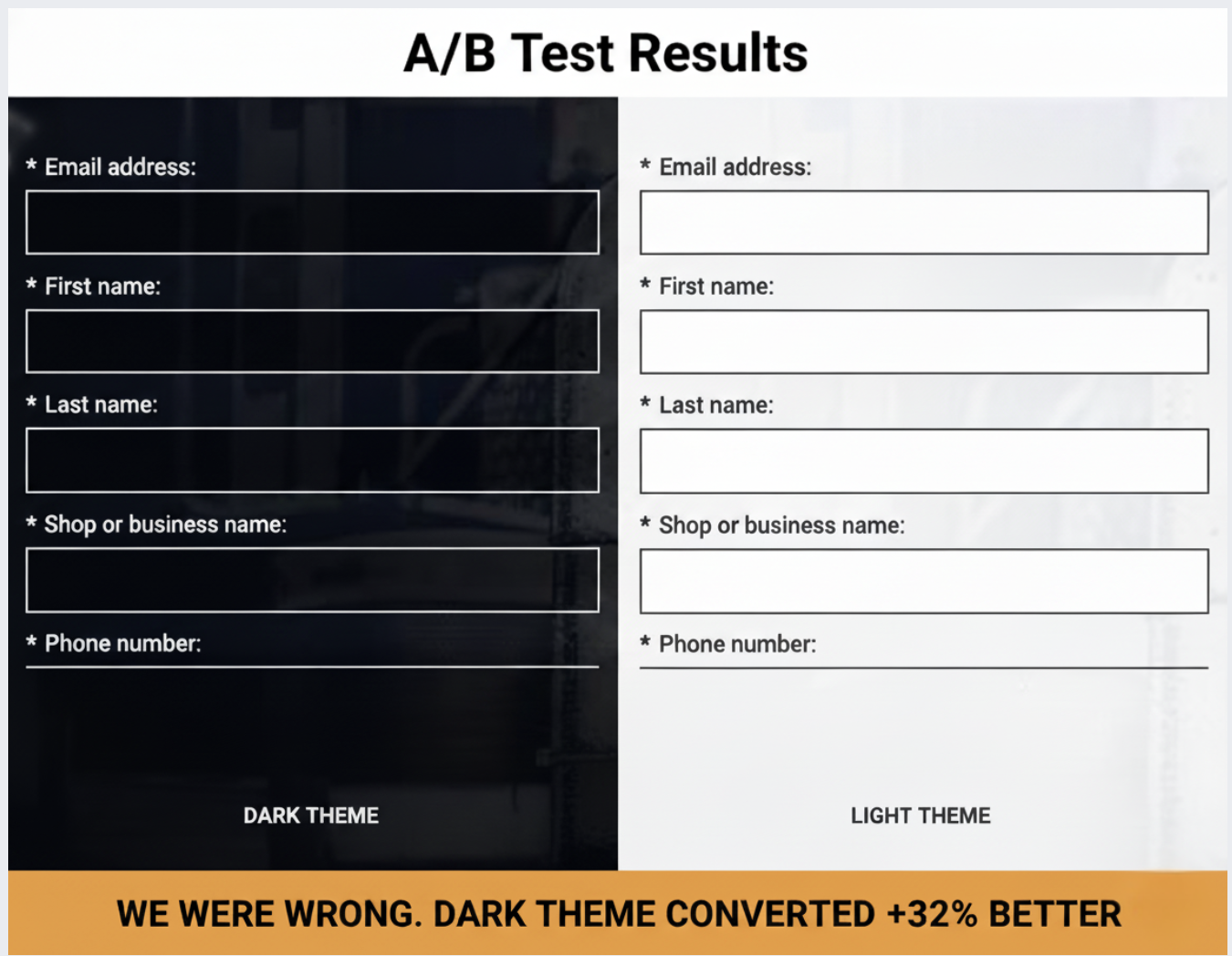
    I have to admit, I was surprised when our dark-themed landing page outperformed the light one.

    Everything I believed about conversion optimization suggested the light background would dominate.

    Light themes are generally the norm for B2B lead generation due to their readability and clean look, aligning perfectly with accessibility standards.

    Unbounce’s study of 41,000 landing pages backs up this trend for light backgrounds. Betting on the light theme seemed like a safe decision.

    However, after dividing our paid traffic equally between a dark and a light landing page for our industrial fleet repair SaaS, despite a 16.62% higher CTR for the light variant, it resulted in 42% fewer conversions.

    This isn’t a call for adopting dark themes universally.

    Rather, it’s a case study showing how audience context and industry-specific associations can outweigh best practices drawn from broader samples.

    We cater to a niche in the B2B SaaS market, particularly serving the transportation industry—businesses maintaining commercial vehicles and equipment.

    Our intended audience includes shop owners and operators engaged in industrial settings, managing technicians, equipment, and demanding commercial clients.

    Going into this test, my expectations were clear.

    I anticipated light backgrounds would be more effective for our text-heavy lead generation pages, given their emphasis on whitespace and visual hierarchy. Our 7-field form aimed at busy shop operators seemed poised for success with light mode.

    I also assumed blue CTAs would yield better results, with blue being associated with trust and security crucial for B2B software purchases. Thus, we used a blue CTA button.

    I was incorrect on both fronts.

    We conducted this test by isolating the visual design, directing traffic through Google Ads and Meta to two vastly different landing pages with identical copy.

    The control page sported a dark theme with a black background, white text, high-contrast form fields, and a subtly outlined black CTA button. The header lacked a brand logo, intensifying the focus on the content.

    Conversely, the treatment page featured a light theme, employing white and light gray elements, dark text, and a blue CTA button. Here, our brand logo was prominently placed in the header.

    All other variables remained the same, emphasizing the importance of isolating design as the sole differentiating factor.

    This test spanned three to four weeks, with Google Ads search campaigns topping $8,205.97, yielding 767 clicks and 30 conversions.

    The light theme’s seemingly advantageous CTR masked the truth—it attracted less qualified traffic, converting at a similar or worse rate than expected.

    A consistent preference for the dark theme also emerged in Meta tests, reinforcing the role of audience preference rather than algorithmic anomaly.

    Understanding why the dark theme won lies in recognizing how it aligns with the psychological and environmental cues of our target audience in the industrial sector.

    The dark theme resonated well with the familiarity of industrial aesthetics—functional, robust environments characterized by dark, metallic tones.

    The contrast provided by white form fields on a dark background was unmistakable, drawing eye attention naturally.

    Dark themes carry a tone of seriousness and value, fitting for the weighty decision-making expected in B2B software acquisitions.

    Moreover, embracing familiar industry conventions, the dark interface enhanced trustworthiness and familiarity.

    This test taught me that testing design psychology is just as crucial as testing visual elements themselves. Before embarking on similar experiments, consider what your design communicates to your audience rather than just aesthetic appeal.

    Finally, ensure your experiments include significant contrast between variations while keeping other elements constant to draw accurate conclusions.

    Audience context should guide optimization efforts more than generalized best practices. By focusing on specific audience needs and signals, I’ve learned that real, lasting optimization success can be achieved.


    Inspired by this post on Search Engine Land.


    crushpress.ai community screenshot
  • Marketing’s Evolution: Embracing Engineering and AI

    Marketing’s Evolution: Embracing Engineering and AI

    For a significant part of my marketing career, creativity, intuition, and an almost magical knack for connecting with audiences drove our success. We’d brainstorm campaign ideas, spend weeks executing them, and then eagerly analyze the outcomes.

    I have Theodore Levitt’s “The Marketing Imagination” sitting on my bookshelf. It reminds me of how we’ve longed for unified insights about customers. Yet, our technology often offers a fragmented view, never capturing the customer’s full journey. The idea of one tool to give us a panoramic view remains elusive—a mythical nirvana.

    Today, our landscape is changing rapidly. A new paradigm emerges—marketing driven by data and precision, resembling the structured work of engineers rather than the whimsical world of Mad Men. For me, this shift is thrilling as it blends art with systems and processes familiar to developers.

    This transformation isn’t theoretical; it’s the heartbeat of digital evolution. The central idea of “The Digital Helix” presents marketing as a constant growth engine, energized by data and adapting to customer signals in real-time.

    From Campaigns to Continuous Systems

    In the past, marketing campaigns had distinct start and end points. We worked through long phases—briefing, creating, launching, measuring, and then repeating the cycle. But modern digital customers are restless, navigating multiple channels and expecting immediate brand interaction.

    This demands a transition from episodic campaigns to perpetual systems—self-correcting, learning, and evolving without the need for interruption. In engineering, this is continuous integration; in marketing, it allows us to alter messaging, content, and offers dynamically, mid-course.

    Here, marketing transforms into a form of system design. It requires ongoing engineering and a mindset of agility and continuous learning. We, as marketers, must blend creativity with practical engineering approaches to thrive.

    Why the Shift is Happening Now

    There are five core reasons why marketing is evolving into an engineering mindset.

    1. Data as the Core Material

    Much like engineering relies on inputs, marketing is driven by data. Every customer interaction, be it a click, search, or video pause, serves as input to our decision-making engine. We harness real-time customer data to guide strategies and automate responses, ensuring marketing decisions are precise and predictive.

    Data is not a secondary consideration; it is the foundation of our marketing experience. It provides direction, allowing us to construct innovative ideas and guide our strategies effectively every day.

    2. Modular, Reusable Assets

    Developers often rely on libraries and frameworks. Similarly, marketing now focuses on creating modular content pieces that can be reused across platforms—enhancing efficiency and coherence.

    Leading brands are designing “APIs for brand” to streamline the use of logos, imagery, and narratives, echoing engineering practices like version control and modularity, akin to Lego or Tesla’s methodologies.

    3. Agile Becomes the Default

    Agility is crucial. Long planning cycles can’t match the pace of changing customer preferences. We adopt sprint-based workflows, borrowing from Agile methodologies, to test, iterate, and optimize marketing strategies on-the-go.

    4. Journeys as Living Architectures

    The traditional customer funnel evolves into a dynamic experience architecture. We guide customers through personalized pathways, continually adjusting based on real-time behaviors—akin to managing traffic systems.

    5. AI and Automation as the Toolchain

    AI and automation streamline our marketing processes, much like toolchains in development. These technologies enhance efficiency and personalization, empowering us to focus on creative storytelling while managing complex data flows.

    Engineers with Empathy — Marketing’s New Mandate

    This integration of data and humanity enhances rather than replaces the marketer’s role. We rely on empathy and creativity within scalable systems to connect with audiences genuinely and effectively.

    Tomorrow’s marketers need to blend engineering skills with storytelling capabilities—testing, refining, and optimizing narratives just like prototypes.

    The transformation of marketing is not merely theoretical—it reflects a broader integration of engineering principles, creating a more responsive and anticipatory approach to customer engagement.


    Inspired by this post on Search Engine Land.


    crushpress.ai community screenshot