AI is revolutionizing how we discover, search, and purchase—it’s all happening at lightning speed. If we can’t clearly articulate the problem our brand solves, AI won’t be able to either.
I’ve noticed that customer journeys are now condensed into a single decision-making instance. David Edelman describes this as a blending of behaviors that traditionally occurred separately.
As decisions become more instant, it’s essential that I clarify what my brand can solve for the customer. Yet, too often, I find myself increasing activity rather than honing the strategy behind it.
Edelman, in his March 2026 Think with Google essay, emphasizes the rapid blending of streaming, scrolling, searching, and shopping behaviors, propelled by generative AI.
This insight shows that the traditional linear journey from awareness to purchase is outdated. Now, users multitask across platforms, fluidly moving between entertainment and intent.
The realization hit home when I learned people are using AI search engines to pose complex, emotionally rich queries, expressing context and urgency rather than just keywords.
AI processes these queries, breaking them into multiple streams and quickly synthesis results—a task that once required numerous browser tabs and hours is now done in seconds.
From this, I understand two things:
The competition now revolves around how well brands serve as solutions to specific needs, not just as products.
The demand framework is simultaneous—creating, capturing, and converting demand can no longer occur in sequence.
As I think of Walt Kelly’s Pogo, I’m reminded of the risk of mistaking busyness for progress. His words cut deep: ‘Having lost sight of our objectives, we redoubled our efforts.’
I see brands scrambling to generate content tailored for this new speed of decision-making, yet without clear strategic goals, it’s just activity for activity’s sake.
While the compressed customer journey is an opportunity for brands with precise positioning, it’s a trap for those without clear direction. Inconsistent brand signals lead to confusion.
Edelman highlights this issue by suggesting that brands should be seen as ‘the sum of signals’ that reveal them as solutions. I realized the journey compression issue isn’t just technological; it’s about setting clear objectives.
A question I continually ask is: What specific situation does my brand best address? If I can’t answer that concisely, AI certainly won’t be able to.
I often find myself pondering the vital question every marketing leader should consider: How robust are our customer relationships? Not just the campaigns or channels but the genuine connections we forge with our customers.
This question is more challenging than it seems. Over the past two decades, we’ve focused on building around specific channels.
Every channel like email, social media, or ecommerce had its own team, its own metrics, and its own measure of success. From our perspective, it appeared as progress—after all, each team reached its goals.
Yet, customers felt like they were dealing with multiple companies under one logo. Imagine receiving a heartfelt ‘We miss you!’ email the day after a frustrating customer support experience. Sales might not realize a demo had already been seen. In-store purchases could go unnoticed by the ecommerce team. There’s simply no unified memory or relationship there.
On March 11, 2026, top minds in marketing, customer experience, and engagement, including those from BMW, Essity, and Sinch, will converge at Engage with SAP Online. This free, virtual event is essential for leaders ready to shift from isolated channel optimization to holistic customer relationship building.
Who’s Speaking and Why It Matters
The event kicks off with Sara Richter of SAP Engagement Cloud sharing insights from the SAP Engagement Index, a global study. But the real highlight is the presentations that follow.
Mark Ritson, known for his no-nonsense marketing approach, will deliver the keynote on the trends reshaping customer experience. Expect a sharp analysis on the fast-changing customer behaviors and why loyalty needs to transcend marketing.
Following Ritson, Jutta Richter from BMW will discuss modern customer journeys and brand relevance. Daniele Tedesco from Essity and Venky Naravulu from Sinch will share practical lessons on AI and connected systems.
The discussions will focus on what’s effective, what’s not, and actionable steps to enhance engagement.
The Backdrop: Why This Conversation is Urgent
This event is critical as there’s a growing disconnect between customer expectations and organizational delivery capabilities, as highlighted by the SAP Engagement Index.
SAP calls this the Engagement Divide, a widening gap that underscores the urgent need for a new operational model focused more on relationship management rather than isolated channel success.
As businesses navigate this challenging terrain, the speakers at Engage with SAP Online are set to provide the strategies needed to organize around customer relationships effectively.
I’ve realized that many of us, myself included, might be tracking the wrong SEO metrics lately. We need to shake things up, especially with 2026 approaching.
Picture this: I present an impressive chart depicting a 47% increase in site traffic. But instead of excitement, I’m met with puzzled looks from the CMO, wondering why revenue remains stagnant. Or, I celebrate a top-three ranking for a keyword nobody searches for.
The SEO metrics that boosted my confidence back in 2019 might just be steering me wrong in 2026. With AI Overviews taking over search results and zero-click searches becoming the new standard, clinging to outdated metrics might jeopardize my strategy and budget.
I’m ready to take you through the precise metrics that our SEO team should retire and which new, revenue-focused metrics to prioritize instead.
Traffic Metrics
1. Organic Traffic
Organic traffic has been my go-to KPI in SEO reports ever since I started. But relying solely on it doesn’t provide enough context.
Not all traffic is equally valuable. A thousand visitors who bounce instantly are not beneficial. However, a hundred visitors converting at an 8% rate? That’s a success story.
I witnessed a local HVAC company whose traffic dropped by 22%, year on year. Panic, right? Yet, organic revenue increased by 31%. We focused on enriching high-intent service pages, pruning low-intent content. Fewer visitors, but better ones.
Before panicking over traffic drops, I always reassess where traffic is declining. If losses involve informational articles and customer login pages, it’s not a revenue issue. That’s just noise exiting my dashboard.
2. Total Impressions Without Intent Segmentation
This metric can mislead. A million impressions from merely informational queries like “what is SEO” might build some awareness, but they contribute zero revenue. Meanwhile, ten thousand impressions from business-driven queries like “best enterprise SEO agency” could significantly boost my pipeline.
Google Search Console offers this data, but many teams, myself included, often fail to segment it intelligently.
3. Traffic Growth Without Revenue Correlation
This is a risky trap for SEO teams. Bringing a 35% increase in organic traffic to a quarterly review sounds impressive, right until the CFO asks, “And how does this translate to revenue?” If I can’t answer that, I’m just reporting noise.
Ranking Metrics
4. Average Keyword Position
This metric might look compelling in a dashboard, but it doesn’t hold up under scrutiny. If I rank first for a keyword with ten monthly searches and fiftieth for one with 50,000, my average position might seem okay, but I’m losing where it matters most.
The average position treats all keywords as identical when they aren’t. With personalized search results, an “average position” can vary greatly by user and location.
5. Isolated Keyword Tracking
Searchers these days don’t typically use isolated keywords. They pose questions, explore themes, and adjust their queries. Google’s focus has shifted toward semantic search and topic modeling.
Tracking a solitary keyword like “lawyer” is pointless without understanding intent — are searchers interested in criminal defense, divorce services, or merely looking up what lawyers do?
6. Share of Top 10 Rankings
This metric sounds clever until it’s clear that 80% of my top-10 rankings might involve low-intent, low-volume queries. Meanwhile, competitors claim the top-three spots for crucial commercial queries in my niche.
Achieving a No. 1 ranking for a high-converting transactional keyword is more valuable than holding 50 top-10 positions for low-value informational queries.
Authority and Engagement Metrics
7. Domain Authority and Domain Rating
DA and DR might not align with Google’s metrics. They’re proprietary scores from SEO tool companies. Yet, teams often set misguided goals like boosting DA from 42 to 50 by Q3.
I’ve seen how backlink volume is often overrated. Google’s algorithm prioritizes link quality, relevance, and context over sheer volume.
A single link from a high-quality, relevant site outweighs hundreds of low-grade directory links. I’ve seen sites with 100,000+ backlinks struggle to rank for meaningful terms because most links lacked quality.
9. Bounce Rate
I’ve found bounce rate misunderstood for years. If someone searches for my company’s business hours, finds them on the contact page, and leaves, that’s a success with a 100% bounce rate.
Google replaced bounce rate with “engagement rate” in GA4 for a reason. Similarly, session duration and pages per session need context. A high pages-per-session score on my pricing page may indicate confusion, not engagement.
Why These SEO Metrics Are Failing Now
I’ve noticed the search landscape shifting quite a bit. Up to 58.5% of U.S. and 59.7% of EU Google searches now conclude without a click, as per SparkToro’s zero-click study. This means, for every 1,000 searches, only 360 result in a visit to a site.
AI technologies are capturing and synthesizing information, bypassing the need for a click. My content can gain visibility and influence without contributing to sessions in Google Analytics.
Wynter’s latest B2B buyer research indicates nearly 24% of CMOs now utilize AI tools like ChatGPT for research, a significant rise from last year.
Buyers discover brands via AI tools and use Google to validate those discoveries. This alters my SEO focus from merely driving traffic to ensuring my brand is visible during pivotal decision-making stages.
Modern customer journeys can be erratic. Often, users who initially find us through organic search might return through paid ads or direct links. If we use last-click attribution, the true value of SEO is obscured, although this organic start was critical for conversion.
For ecommerce, I aim to track revenue from organic sessions by product category and landing pages. For lead-generation, I’ll track how many leads convert to customers. Integrating with a CRM helps in connecting those dots.
No one’s interested in your DA if you can demonstrate $1.2 million in revenue attributed to organic channels.
Conversion-weighted Visibility
I’ll focus on visibility for high-value terms that lead to conversions.
A franchise client noticed they dominated low-intent queries but were invisible for crucial local terms. We adjusted priorities, and their qualified leads doubled in four months.
Topic Cluster Performance
This metric supersedes individual keyword rankings. Monitoring how I rank across full topic clusters, and the aggregate visibility and conversions from these clusters, gives a comprehensive view of topic authority.
SERP Real Estate Ownership
By gauging control over the entirety of search pages, not just listings, including snippets and local packs, I can effectively keep competitors at bay for crucial queries.
AI Platform Visibility and Brand Mentions
My focus will also be on how frequently my brand is mentioned in AI responses. Mentions are becoming as crucial as click-through rates.
For instance, if I secure a favorable recommendation rate across multiple AI platforms for vital topics, it’s a win, even if website traffic appears unchanged.
While tools are emerging to monitor this, manual spot checks can reveal valuable insights, enhancing authority and awareness, eventually leading to brand searches and conversions.
Branded Search and Direct Traffic as AI Visibility Proxies
I notice when buyers find out about my brand through zero-click searches, they often search the brand name directly instead of clicking through. This reflects in my branded and direct traffic rather than organic metrics.
If I see no change in nonbranded organic traffic but an increase in branded search and direct visits, it usually indicates that my content gains attention in AI Overviews.
How to Transition My Reporting
Revamping reporting around new metrics might feel daunting. Stakeholders are comfortable with old metrics.
I start by evaluating my current dashboard, ensuring relevant metrics face business outcomes directly rather than just tallying activities.
Transition by gradually omitting vanity metrics. If organic traffic was my focal KPI, I now introduce it segmented by intent and accompany it with organic-attributed revenue. Gradually, I pivot focus and phase out the dated metrics.
When I introduce new metrics, I frame them in relatable terms. Avoid using “conversion-weighted visibility.” Opt for “visibility metrics for top-converting terms.”
The Metrics That Prove SEO’s Value
The metrics we’ve relied upon — organic traffic, average keyword position, domain authority, bounce rate — aren’t inherently harmful. They’re just incomplete, providing a potentially false sense of security while others prioritize revenue-generating metrics.
Newly adopted metrics — revenue contributions, conversion-oriented visibility, topic authority, SERP dominance, AI platform mentions — directly relate SEO to tangible business outcomes. They prove ROI, justify budgets, and align strategies with business growth.
Consider which metrics in your dashboard lend false impressions of activity over effectiveness. Retire them. Replace them.
Ultimately, no one’s concerned with traffic numbers or DA scores. They want to know if SEO drives growth. Make sure your metrics affirm it.
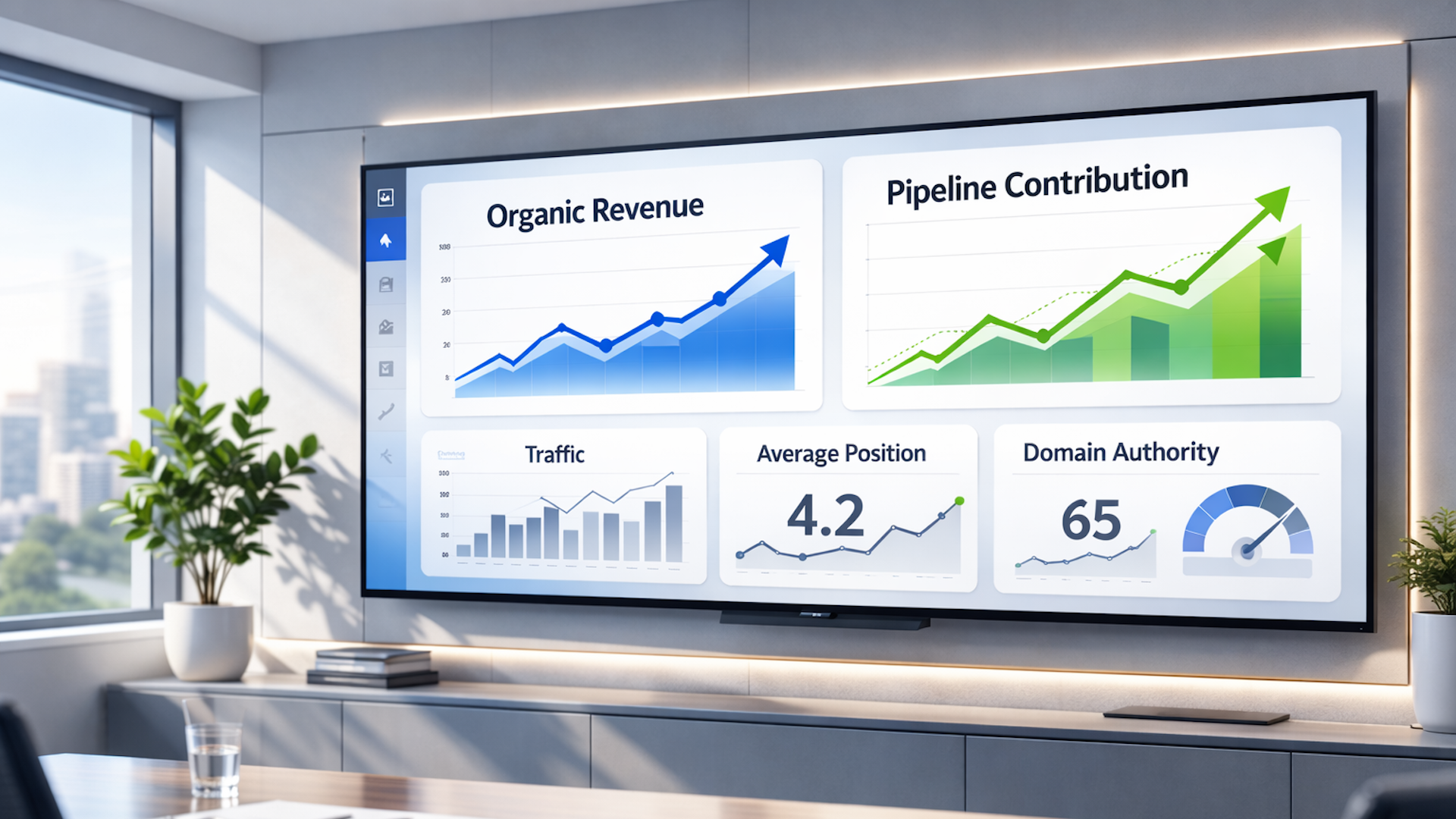
I’ve noticed that while many search teams are celebrating improved rankings, greater visibility, and a surge in traffic, the feedback regarding pipeline, revenue, and sales outcomes isn’t exactly echoing this enthusiasm.
Even when SEO KPIs are all green and the graphs are trending upward, the business outcomes don’t always reflect this apparent success.
Search performance can seem robust on the surface, yet falter in areas that the search teams don’t own or fully understand.
The immediate inclination might be to examine attribution models, data quality, or the KPIs themselves.
However, often the breakdown occurs post-click, in spaces the search teams don’t control.
Despite advancements in automation, software, and workflows making search efforts easier to scale, there’s more to it than execution; it’s about understanding and control.
This is a long-standing challenge, one that scaling often exacerbates.
An early halt or too shallow an analysis limits the understanding of performance within the broader business context.
In larger organizations, siloed operations widen the gap. Without tight CRM and sales integration with search, the journey often lacks a unified owner.
Leadership pressure can further exacerbate these issues.
When results appear promising yet fail to impact the bottom line, the ambiguity becomes troubling. Though not new, this dynamic is increasingly apparent.
To bridge these gaps, focusing on five key breakpoints can be pivotal.
1. Intent Misalignment
Intent forms the backbone of how we tailor content and target our audiences through search, yet it’s sometimes out of sync with deeper factors like buying stages, urgency, or seasonal sales expectations.
Even when aligned with the latest research, the readiness or stage of a prospect can remain elusive.
Understanding the problem a searcher aims to solve and comparing it with sales’ positioning can bridge the gap between search and actual sales, refining the way teams optimize their approaches.
It’s awkward when leads driven by search don’t convert to customers, sparking tensions around conversion quality.
While technically compliant leads meet criteria, issues like unaligned CTAs or vague follow-ups often go unnoticed, focusing on conversion rate optimization as a quick fix when it’s usually more complex.
Conversions rarely guarantee committed customers, making it crucial to evaluate if the initial search promise and subsequent visitor journey align with their intentions.
Achieving a shared understanding of what qualifies as a marketing or sales-ready lead is vital, particularly when definitions, scoring models, and expectations vary.
Aligning on these criteria aids in demonstrating search’s true value to the business, though it may require navigating uncomfortable discussions.
I’m not critiquing search leaders; these challenges aren’t new, nor are they solely search team’s problems, but cross-functional issues needing better communication, agreed definitions, and ownership.
Rather than perfection, marketing leaders need actionable insights and a unified understanding of results.
The true danger isn’t declining performance but thriving metrics with unclear reasons behind them, impeding confident scaling efforts.
Every move aims to enhance credibility and influence far beyond traditional KPI mastery. Embrace understanding over sheer execution.
I recently came across insightful advice from Acquia’s leadership on how to effectively adapt my content for the AI-driven customer journey, and I wanted to share what I’ve learned with you.
The AI landscape is ever-evolving, and understanding how to tailor content to meet the changing expectations of users is crucial. With AI, there’s a chance to engage and connect with audiences in new, meaningful ways.
By integrating AI optimization strategies into my content processes, I can ensure my content remains relevant and engaging. Whether it’s through AI-powered tools or personalized user experiences, the key is to embrace these advancements as they develop.