Tag: Content Creation

  • Unlock Content Creation with Profound: Harness Prompt Volumes

    Unlock Content Creation with Profound: Harness Prompt Volumes

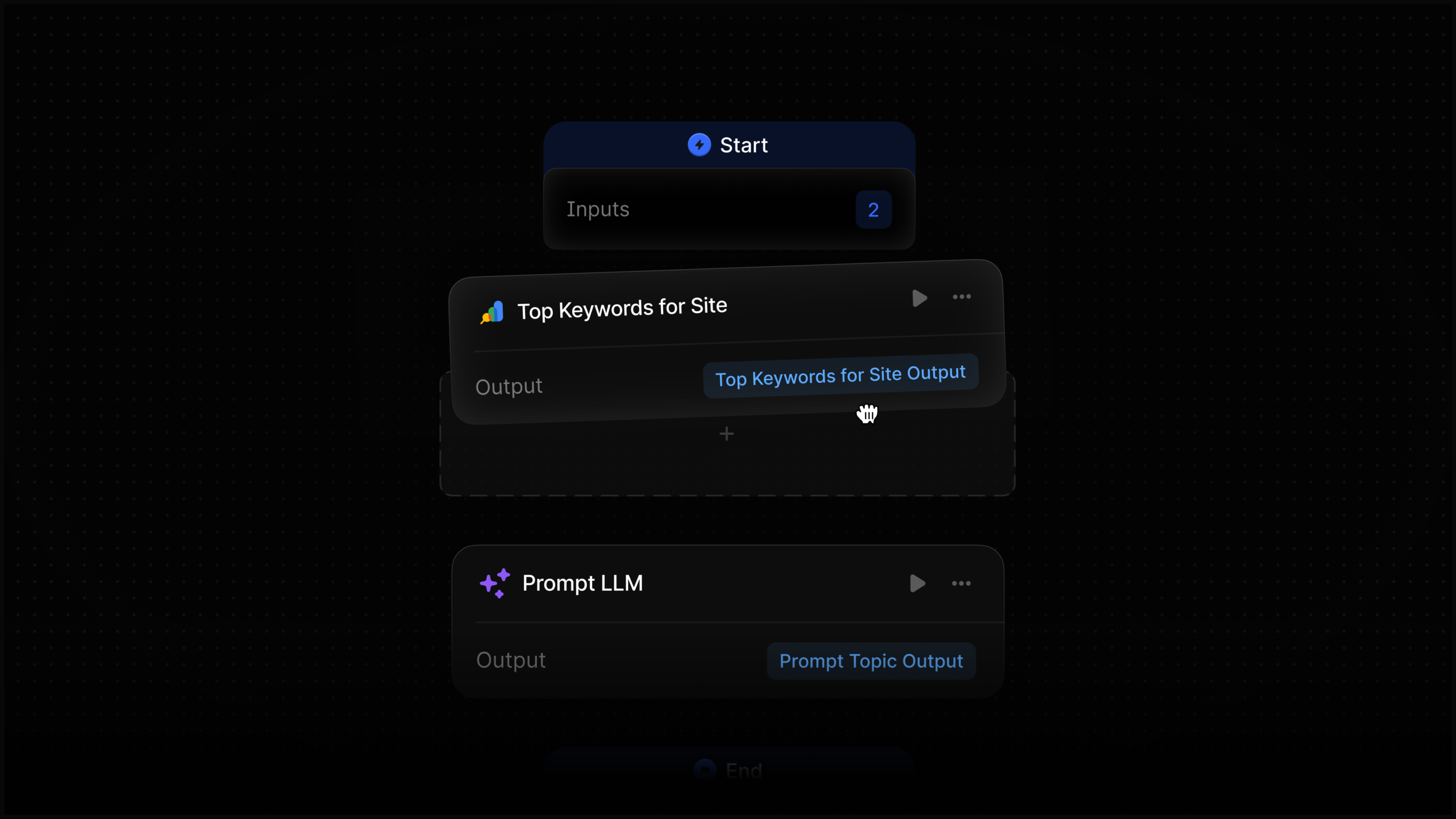
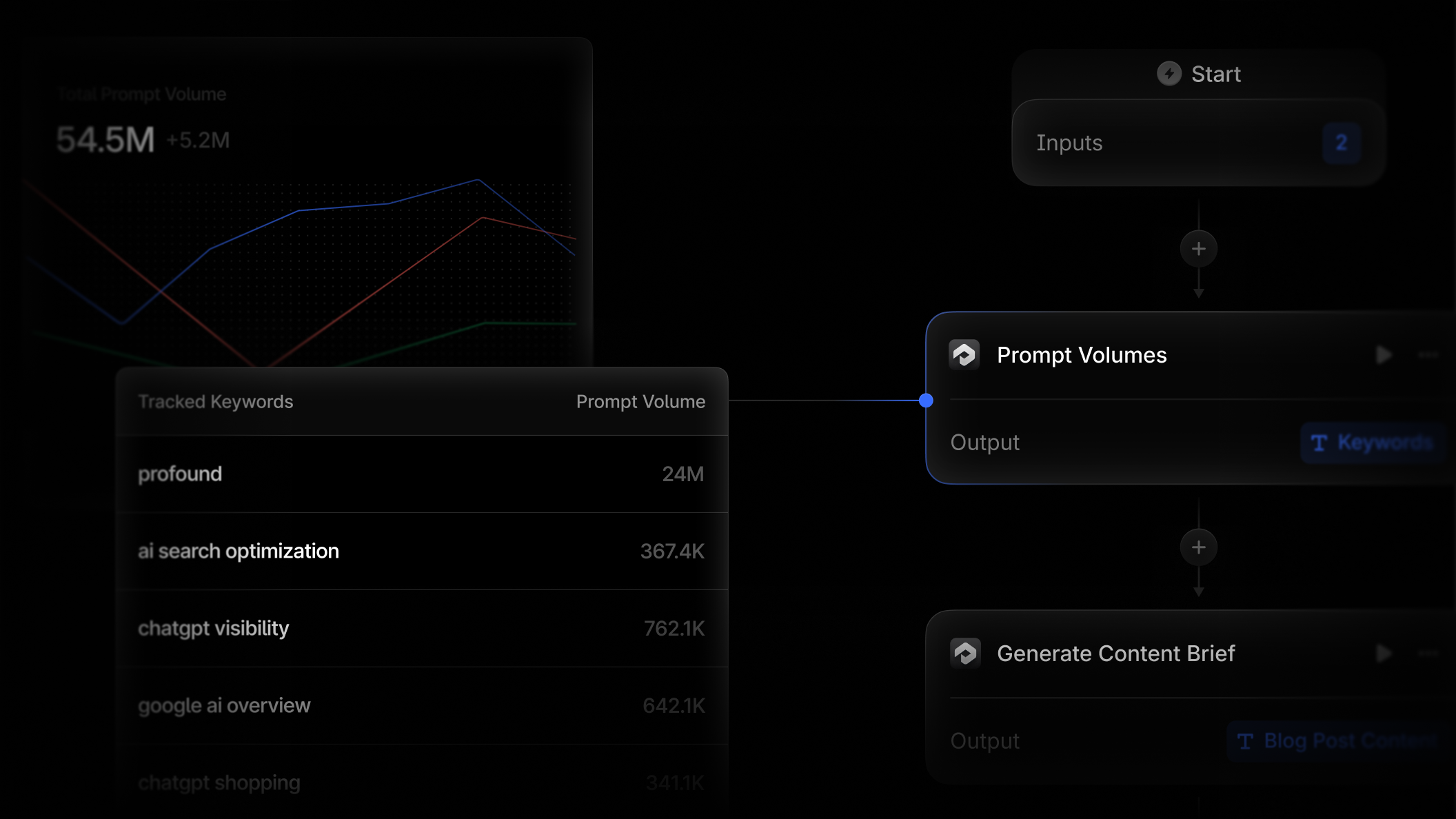
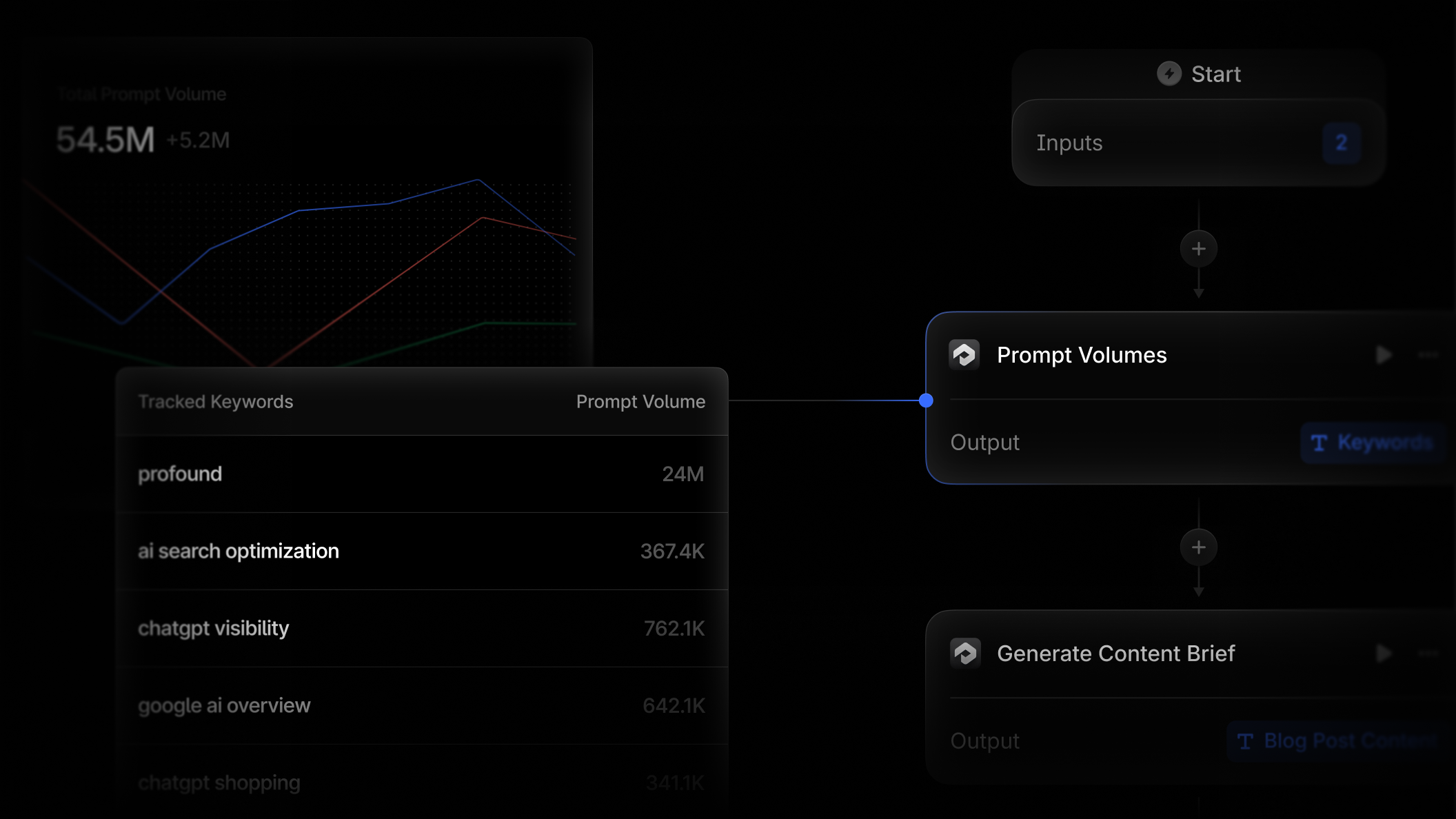
    I’ve found an incredible new way to streamline content creation, competitive analysis, reporting, and monitoring with the latest Profound Agents feature. We can now effortlessly integrate prompt volume data directly into any Profound Agent, bringing together all our workflows into a single platform. This innovation is perfect for marketers looking to enhance efficiency.


    Inspired by this post on Try Profound Blog.


    crushpress.ai community screenshot
  • Transform Automated Workflows with Gamma Integration

    Transform Automated Workflows with Gamma Integration

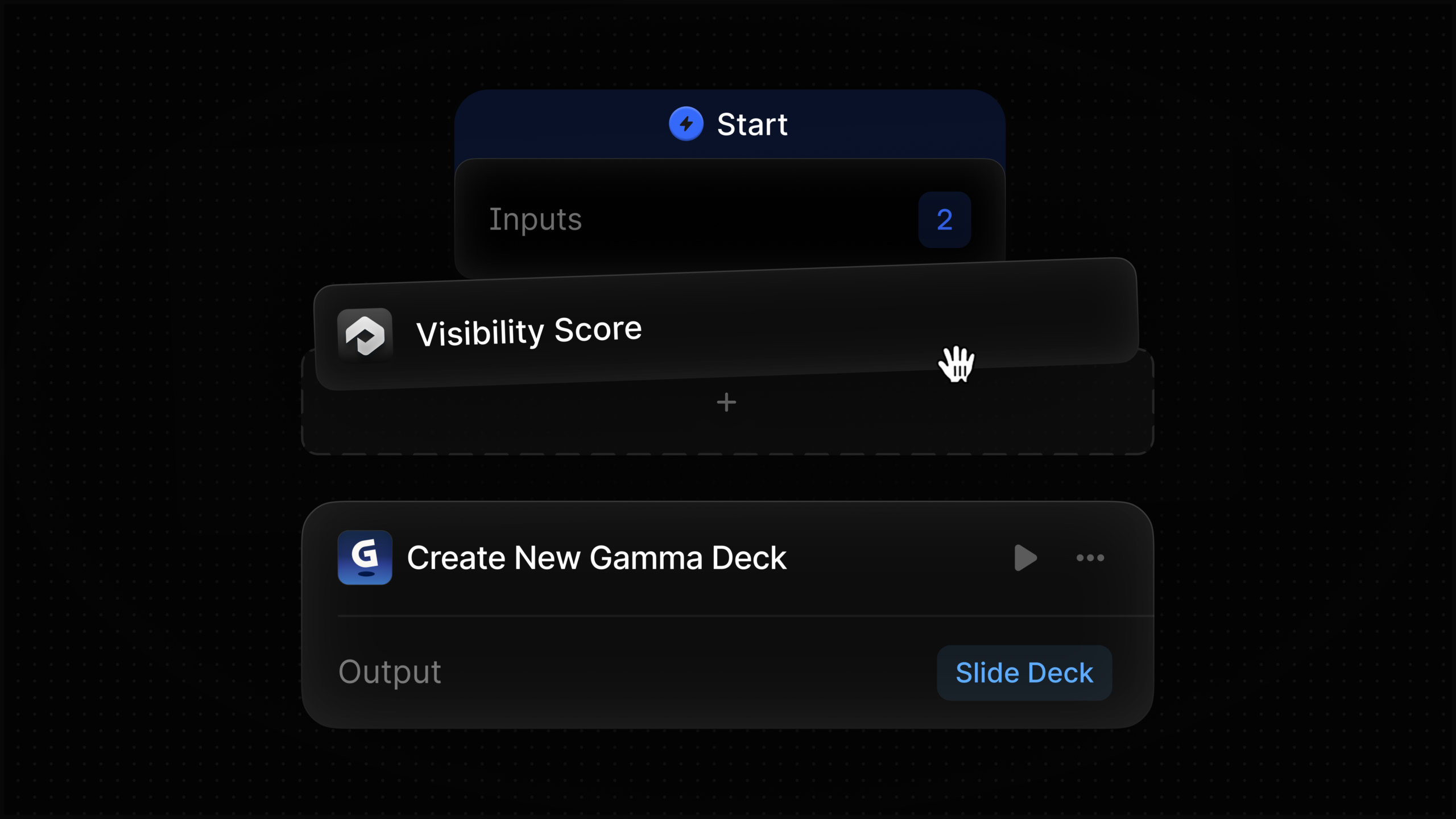
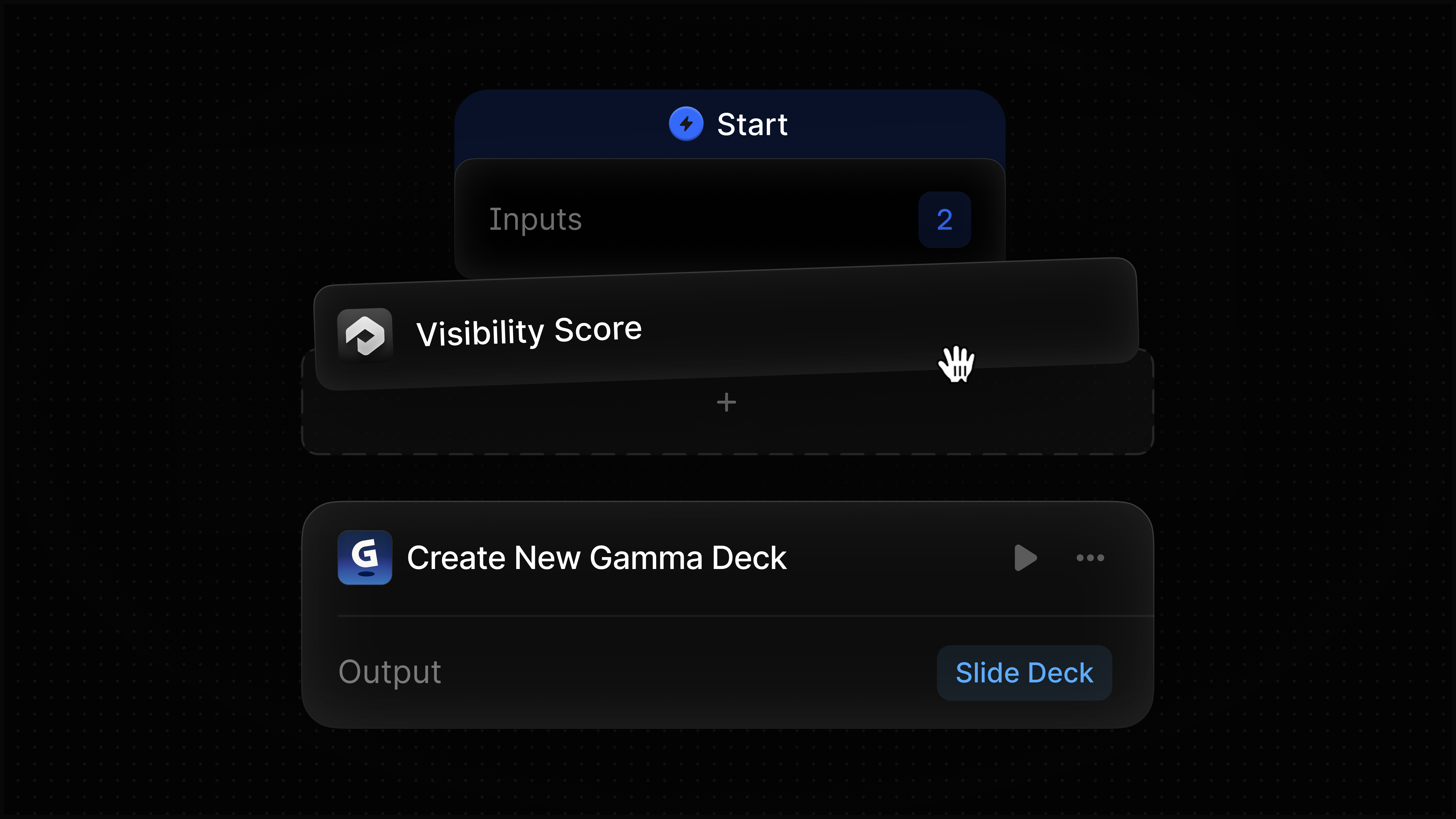
    I’m thrilled to share that Profound Agents can now seamlessly create presentations, documents, and webpages within Gamma as part of my automated workflows. No more hassle of exporting data and rebuilding it elsewhere. My Agent takes the outputs from upstream nodes and crafts them into ready-to-share assets in Gamma, streamlining the entire process.


    Inspired by this post on Try Profound Blog.


    crushpress.ai community screenshot
  • Google Nano Banana 2: A Practical Workflow for Marketers

    Google Nano Banana 2: A Practical Workflow for Marketers

    You have a campaign brief, not an afternoon to spend rerolling images. The asset needs readable copy, stable people and products, multiple formats, and localized versions. Someone also needs to know exactly what changed between creative variants.

    Google Nano Banana 2 can carry more of that production workload, but only if you treat it as part of a controlled creative system. The useful shift is not simply better-looking output. It is the ability to move from a structured brief to a consistent family of assets with fewer compromises between speed, detail, text, and continuity.

    What Nano Banana 2 changes in an image workflow

    Nano Banana 2 is the informal name for Gemini 3.1 Flash Image. Google DeepMind has positioned it as a combination of Nano Banana Pro’s image intelligence and Gemini Flash’s faster generation. For a marketing team, that combination matters because image quality and iteration speed normally pull the workflow in opposite directions.

    The model’s improvements map to four practical jobs:

    • Knowledge-heavy visuals: Real-time web grounding can bring current context into infographics and data-oriented images. Treat that as assistance with generation, not proof that a visual is factually correct.
    • Images containing words: Improved text rendering and translation make social graphics, diagrams, promotional cards, and localized creative more viable. Every visible word still needs human proofreading.
    • Scenes that must remain recognizable: Stronger instruction adherence and subject consistency make it easier to preserve the same cast, objects, visual hierarchy, and art direction during revisions.
    • Assets for different placements: Supported output extends from 512px through 4K, so the same workflow can cover lightweight concepts and high-resolution deliverables.

    The documented consistency envelope reaches up to five characters and 14 objects in one workflow. Read that as an upper capability boundary, not a guarantee that a crowded scene will remain perfect. The closer your composition gets to the limit, the more deliberate your naming, placement, and review need to be.

    Key takeaways

    • Use Nano Banana 2 for repeatable asset families, not just isolated image generation.
    • Write prompts as production briefs with explicit priorities, subjects, composition, copy, and output requirements.
    • Approve one master image before generating formats, languages, or test variants.
    • Verify every word, number, label, and data point even when web grounding is involved.
    • Keep important page meaning in HTML and metadata rather than leaving it trapped inside an image.

    Turn the prompt into a production brief

    Visual reference tiles for a mug, customer, kitchen, colors, lighting, and image formats connect to a finished campaign image.

    Stronger instruction adherence is only useful when the instructions have a clear hierarchy. A loose collection of adjectives leaves the model to decide what matters. A production brief tells it what the asset must accomplish, what cannot change, and where it has room to interpret.

    1. Start with the asset’s job. Name the destination and the action the visual should support: a landing-page hero, an ad variant, a report cover, a diagram, or a localized social card. This gives the composition a reason to exist.
    2. Define the required subjects. List each person, product, interface, or meaningful object. Give recurring subjects short, stable labels so later instructions can refer to them without ambiguity.
    3. Specify spatial relationships. State what belongs in the foreground, where the main subject sits, which direction a person faces, and where clear space is required for external copy or controls.
    4. Describe the visual system. Set the palette, lighting, texture, level of realism, camera perspective, and overall mood. Use concrete visual properties rather than piling up subjective terms such as premium, bold, or modern.
    5. Supply text as exact copy. Separate the headline, labels, supporting text, and language. If a phrase must not be translated, say so. Do not bury critical wording inside a long paragraph of art direction.
    6. Name the output requirements. Include the intended aspect ratio, supported resolution, crop needs, and any areas that must remain uncluttered. Request 4K when the approved asset actually needs it, not by default for every concept.
    7. Declare the invariants. Say which identities, objects, colors, text, and layout relationships must remain unchanged across revisions.

    A reusable prompt pattern

    Goal: Create a 4K landscape hero image for a landing page promoting a search visibility report. Subjects: Show one analyst at a desk and one dashboard object displaying a clean line chart. Composition: Place the analyst and dashboard on the right, with the left third uncluttered for an HTML headline. Visual direction: Use deep navy, off-white, and restrained cyan accents, with soft directional lighting and realistic textures. Restrictions: Do not add logos, watermarks, interface labels, extra screens, or text inside the image. Continuity: Keep the analyst’s appearance, dashboard layout, palette, and lighting unchanged in later variants.

    This example deliberately reserves the headline for HTML. That is usually the cleaner choice for a web hero because the copy remains editable, selectable, responsive, and available to assistive technology. Use embedded text when the words are part of the artifact itself, such as a social card, diagram label, poster, or standalone ad creative.

    For an image that needs embedded copy, add a separate instruction such as On-image copy: Q3 Search Visibility Report. Then identify the exact location, hierarchy, and language. Keeping copy in its own instruction makes proofreading and localization easier.

    Follow-up prompts should be smaller than the original brief. Ask to change one controlled element while restating the invariants: replace the background environment, change the accent color, translate the approved copy, or adapt the crop while preserving the subjects. Rewriting the entire prompt for every revision invites unplanned changes.

    Build variants without losing control of the experiment

    Six campaign previews preserve the same coral running shoe and fictional athlete while changing backgrounds, lighting, props, and crops.

    Fast generation can create a false sense of progress. Twenty visually different outputs are not a useful test if the headline, palette, composition, subject, and offer all changed together. You will know which image performed better, but not why.

    Use a master-and-variant workflow instead:

    1. Generate a baseline. Produce the first complete interpretation of the brief before requesting alternatives.
    2. Review against the brief. Separate objective misses, such as incorrect text or a missing object, from subjective preferences, such as wanting warmer lighting.
    3. Correct the baseline. Do not build variants from an image that already violates the required composition, copy, or identity.
    4. Approve a master. Record the accepted prompt, output, invariants, language, and intended placement.
    5. Create one-variable variants. Change one meaningful family of attributes at a time, such as the background, focal framing, callout treatment, or color emphasis.
    6. Localize after visual approval. Preserve the master composition while changing the language-specific copy, then allow only the layout adjustments required by the translated text.

    Your review should use explicit gates rather than a general looks-good decision:

    • Brief compliance: Are all required subjects present, and are unwanted additions absent?
    • Continuity: Do recurring people, products, and objects remain recognizable across versions?
    • Copy: Does every character match the approved wording, including punctuation, capitalization, and product terms?
    • Factual content: Do chart labels, values, dates, maps, and explanatory elements match the information you intend to publish?
    • Visual integrity: Are faces, hands, object boundaries, reflections, lighting, and small details internally coherent?
    • Placement safety: Will important content survive the real crop, overlay, and responsive layout?
    • Delivery: Does the final file have the resolution and aspect ratio required by its actual destination?

    Web grounding does not remove the factual review gate. It can help the model reason about the requested subject, but it cannot approve a statistic, establish which date your campaign should use, or decide whether a generated chart supports your claim. Keep the underlying facts in a separate, human-reviewed content sheet and compare the rendered visual against it.

    The same discipline applies to translation. Generate the localized version, copy the visible wording out of the image, and compare it with approved language line by line. Check line breaks and hierarchy as well as meaning; a correct translation can still become unreadable when it is forced into the original layout.

    Nano Banana 2 is integrated into Google Ads as well as the broader Gemini ecosystem, which makes rapid campaign variation an obvious use case. Keep the creative test interpretable: hold the audience, offer, and measurement setup steady when the purpose is to learn whether a visual change affected performance.

    Finish the asset for SEO, AEO, and GEO

    A production-quality image is not automatically a search-ready asset. Image generation creates pixels. Your publishing workflow must connect those pixels to the page’s subject, the user’s task, and machine-readable context.

    Keep the meaning outside the pixels

    • Match the search intent. Use the image to clarify the answer, process, entity, comparison, or result the page is actually about. A polished but generic visual adds little retrieval value.
    • Write functional alt text. Describe the information or purpose the image contributes in its context. Do not paste the generation prompt or turn the attribute into a keyword list.
    • Use descriptive filenames. Name the finished asset for its actual subject and role rather than preserving a generator’s default filename.
    • Publish essential facts as HTML. If an infographic contains a process, statistic, or comparison that the reader needs, provide the same core information in nearby page text. Do not make people or search systems depend on reading pixels.
    • Add a useful caption when context is needed. A caption should explain why the visual matters, not merely repeat what it depicts.
    • Create delivery derivatives. Keep a high-resolution master, but serve a file sized and compressed for the placement. Sending a 4K image everywhere can add page weight without improving the reader’s experience.
    • Localize the surrounding context. When you translate text inside an image, update the filename, alt text, caption, nearby explanation, and linked destination for the same audience.

    Treat structured data as a record

    If your page’s structured data references the image, the markup should describe the asset that is visibly published at the live URL. Keep the image URL, dimensions, caption, creator information, and licensing information aligned with what you can substantiate. Do not manufacture metadata simply to fill properties.

    JSON-LD does not rescue a weak relationship between the visual and the page. The image, headline, body copy, captions, internal links, and structured data should all describe the same primary subject. That consistency gives search engines and answer systems a clearer entity-and-context relationship to interpret, although it cannot guarantee rankings, citations, or inclusion in an AI-generated response.

    This is also where subject consistency becomes strategically useful. Reusing a recognizable product, character, diagram language, or branded visual system across a related content cluster can make the collection feel coherent. Keep each asset specific to its page, however; duplicating one generic image across every URL does not explain what makes those pages different.

    Choose a pilot that exposes the model’s real value

    Do not judge Nano Banana 2 by asking it for a single decorative image. That tests whether it can produce an attractive picture, not whether it can improve your production system.

    Our rule of thumb is to choose a pilot that needs at least two of the model’s differentiating capabilities:

    • A recurring person, product, or object that must remain consistent.
    • Exact words or labels inside the visual.
    • Several controlled creative variants for a campaign.
    • Localization into more than one language.
    • A knowledge-heavy infographic or data visualization.
    • Outputs ranging from smaller concept images to a 4K master.

    A strong pilot might be a report launch that needs a hero image, a labeled social card, ad variants, and localized editions. One approved visual system can then be carried through each placement while the team measures generation time, correction cycles, consistency, proofreading effort, and final usability.

    Begin concepts at the smallest supported resolution that lets your team judge composition. Move to 4K after the direction is approved. This keeps reviewers focused on the idea before they spend time inspecting final-level detail.

    The model is available across Google Ads, the Gemini app, Search AI Mode, Lens, and other parts of Google’s ecosystem. That reach makes shared governance more important than platform-specific habits. Store the master brief, approved copy, invariants, final asset, localization decisions, and QA result together so the next person can reproduce the workflow.

    Pick one recurring campaign asset this week. Define its invariants, create one approved master, and generate a single controlled variant. If the model preserves the subject, copy, composition, and visual system through that cycle, you have evidence for expanding the workflow. If it does not, the QA record will show whether the problem came from the brief, the generation, or the review process.

    References


  • How to Use AI Response Patterns to Build Better Content

    How to Use AI Response Patterns to Build Better Content

    You ask an AI assistant which product, service, or method it recommends. Your brand appears. You run the same prompt again, and it disappears. If you build a content brief around either answer, you may be optimizing for an accident.

    The better unit of analysis is the pattern across many answers. Repeated structures, concepts, comparisons, and entity associations can show you what a model consistently treats as relevant. Once you separate those durable signals from one-off wording, AI responses become useful inputs for content planning rather than volatile rankings to chase.

    Key takeaways

    • Do not treat one AI answer, citation, or brand mention as a ranking result.
    • Test several phrasings of the same intent across at least two model families and repeated runs.
    • Keep web-search settings, model labels, context, and prompts documented so you know what changed.
    • Classify recurring signals as structural, conceptual, or entity patterns before editing content.
    • Use a working threshold to filter noise, then apply audience knowledge and factual review before acting.

    A single AI answer is not a position you can rank for

    Traditional rank tracking works because a search result has an ordered position that can be checked again. An AI response is generated probabilistically. Its wording, selections, order, and level of detail can change with the prompt, conversation context, model, retrieval method, and search setting.

    The variation can be substantial. Across one large prompt test, ChatGPT or Google AI had a less than 1% chance of returning the same brand list in two responses. That does not mean every topic will be equally unstable. It does mean that a single inclusion or omission is too fragile to support a content decision.

    Separate two questions that teams often mix together:

    • Visibility question: Did the model mention or cite your brand in this sample?
    • Pattern question: Which ideas, criteria, entities, and answer structures kept returning across the sample?

    The first question produces a volatile observation. The second can reveal a usable content opportunity. If renewal pricing appears in most answers about choosing a domain registrar, for example, you have evidence that the concept belongs in the decision journey. You still do not know that adding a renewal-pricing section will cause a citation. You do know that omitting the issue may leave the page incomplete for that cluster of questions.

    This distinction also changes how you report results. A sentence such as “we rank in ChatGPT” claims a stable position that may not exist. A defensible statement is narrower: your brand appeared in a stated share of a documented response sample, under specified test conditions. For content planning, the recurring concepts and associations in that sample are usually more actionable than the mention count alone.

    Build a response sample that can separate signal from noise

    Many abstract response tiles pass through a mesh filter, leaving repeated shapes grouped together while irregular fragments fade away.

    You do not need an expensive monitoring platform to begin. You do need a repeatable collection method. A spreadsheet is enough if every row records the conditions that could explain a different answer.

    1. Choose a small set of decision topics. Start with three commercially or editorially important topics. A topic should represent a decision or task your audience actually brings to an AI assistant, not just a keyword you want to rank for.
    2. Create three to five prompt variations per topic. Keep the underlying intent stable while changing the wording. A domain-registration cluster might include “How do I register a domain name?”, “How can I get a domain name?”, and “Where can I buy a domain?” Do not mix an introductory how-to prompt with a migration or troubleshooting prompt and call them one cluster.
    3. Define the test conditions. Select at least two model families. Decide whether web search will be enabled, disabled, or left to the model. If you test more than one search condition, analyze each as a separate segment. Use fresh or private sessions where possible so an earlier conversation does not silently alter the next response.
    4. Capture every response consistently. Record the prompt, displayed model or version, web-search status, date, full response, cited URLs, brand mentions, and any initial pattern labels. Preserve the complete answer; excerpts can hide section order and qualification.
    5. Repeat on a fixed cadence. Weekly collection is practical for many teams. Consistency matters more than running a large burst once and then changing the prompt set. Build toward 20 to 30 responses per prompt before drawing strong conclusions.

    Your tracking sheet can start with these columns:

    • Topic cluster
    • Exact prompt
    • Model and displayed version
    • Web search: enabled, disabled, or model-decided
    • Date
    • Full response
    • Citations or referenced URLs
    • Your brand mentioned: yes or no
    • Structural labels
    • Concept labels
    • Entity and association labels

    Do not pool unlike conditions without labeling them. A response produced with live web retrieval is not equivalent to one generated without it. A model update can also change the output even when your site and prompt remain untouched. Recording those conditions protects you from crediting your content for a change caused elsewhere.

    A useful working definition of a strong pattern is one that appears in at least 75% of the sampled outputs, across two models and multiple prompt variations. The threshold is a filter, not a law of AI behavior. It forces you to demand recurrence in more than one environment before calling an observation meaningful.

    Always retain the numerator and denominator. “Pricing transparency appeared in 9 of 12 responses” is auditable. “AI cares about transparent pricing” turns a bounded observation into an unsupported universal claim. If you work alone and cannot collect a full sample, you can flag patterns beginning around 60% as provisional, but keep them separate from patterns that clear the stronger threshold. A smaller workload should reduce your confidence, not disappear from the methodology.

    Read each response pattern at three different layers

    Three concentric transparent layers organize surface shapes, connected concepts, and generic objects around a central subject.

    Frequency alone does not tell you what to change. First classify what is recurring. Structural, conceptual, and entity patterns answer different editorial questions and lead to different actions.

    Pattern layerWhat you recordWhat it can changeCommon misreading
    StructuralSection order, lists, steps, comparisons, pros and cons, tables, and depthAnswer architecture and information sequenceCopying the model’s format as if it were a required template
    ConceptualRecurring criteria, risks, questions, features, and tradeoffsTopic coverage and explanation depthTreating every repeated phrase as a keyword to insert
    EntityBrands, products, tools, sources, categories, and feature associationsPositioning, evidence, comparisons, and partnership researchAssuming an omission proves a technical or reputation problem

    Structural patterns reveal the expected path through an answer

    Mark how each response is assembled. Does it begin with a definition, move into selection criteria, name tools, and end with implementation? Does it repeatedly use a comparison table? Does it frame the decision through advantages and disadvantages, or as a numbered procedure?

    If the sequence “definition > criteria > tools > implementation” persists across prompts and models, it is a clue that the topic is commonly synthesized as both an explanation and a decision process. Your page may need to support both. That does not require copying the sequence mechanically. A reader who already understands the category may need the criteria first, while a beginner may need a short definition before making sense of those criteria.

    Record the level of detail as well as the headings. A recurring step that receives several qualifications is more informative than a heading that appears but gets one sentence. The useful editorial question is not merely “Was this topic mentioned?” It is “What role did this topic play in helping the response reach a recommendation or action?”

    Conceptual patterns identify the criteria a page must handle

    Concepts are the recurring considerations inside the answer. For a domain-registrar decision, those may include initial and renewal pricing, customer support, privacy, email add-ons, security, bundles, and transfer procedures. A concept that returns across differently phrased prompts is more useful than an exact phrase repeated by one model.

    Turn each recurring concept into a question for the content, not an instruction to add a keyword. If renewal pricing is a strong pattern, ask:

    • Does the page distinguish the introductory price from the renewal price?
    • Can the reader locate that information without interpreting vague pricing language?
    • Does the comparison use equivalent billing periods and inclusions?
    • Are exceptions or conditions stated where they affect the decision?

    This approach improves usefulness even if the wording in future AI responses changes. It also prevents superficial optimization. Repeating “pricing transparency” does not make pricing transparent; showing the relevant terms clearly does.

    Entity patterns show how the category is being framed

    Entity analysis tracks more than which brands appear. Record which features, audiences, or use cases are attached to each entity, where the entity appears in the answer, and which pages are cited in support.

    Suppose a competitor repeatedly appears beside “simple transfers” while your brand appears beside “bundled services.” That pattern does not establish either claim as true. It does reveal the associations you should verify. Check whether your product documentation, comparison pages, and third-party coverage make the relevant capabilities explicit. If the association is inaccurate, the answer is not to imitate it. Clarify your actual positioning with evidence.

    An absent brand can have several explanations: model variability, an unfamiliar prompt, retrieval choices, weak category association, insufficient supporting content, or no factual fit for the recommendation. The response sample cannot diagnose the cause on its own. Use it to form a question, then inspect your content and real market position before choosing a remedy.

    Convert the pattern map into a content brief

    Once the sample is labeled, do not hand the raw answers to a writer and ask for an average version. That tends to reproduce generic phrasing and whatever biases already dominate the outputs. Convert the recurring signals into editorial requirements that leave room for expertise, original evidence, and a clear point of view.

    1. Name the reader’s decision. Write one sentence describing what the page must help the reader decide or complete. If your prompt variations contain different decisions, split the cluster before drafting.
    2. Write the direct answer first. State the useful answer in plain language before designing headings. This keeps a recurring AI structure from displacing the reader’s actual need.
    3. Select the structural pattern that supports that decision. Use a procedure for a task, a criteria-led structure for a purchase decision, or a comparison only when the underlying options are genuinely comparable.
    4. Translate strong concepts into coverage requirements. Record the observed frequency and the question each concept must answer. Specify required depth, such as a definition, caveat, example, or decision rule.
    5. Audit entity claims. List the brands, tools, features, and category relationships that require verification. Decide which claims need first-party documentation and which need credible independent support.
    6. Define what the page will not cover. Exclude concepts that belong to another intent or page. A recurring term is not permission to turn one focused answer into an unfocused topic warehouse.

    A practical response-pattern brief should contain these fields:

    • Reader and decision: who the page serves and what they must be able to do afterward.
    • Prompt cluster: the exact variations used to collect the sample.
    • Test conditions: models, versions, search settings, dates, and number of responses.
    • Direct answer: the page’s concise answer to the shared intent.
    • Strong structural patterns: recurring answer sequences and formats, with counts.
    • Strong conceptual patterns: required considerations, with counts and planned treatment.
    • Provisional patterns: useful leads that need more sampling or independent audience evidence.
    • Entity associations: repeated brand-feature or tool-use-case pairings that require verification.
    • Evidence plan: where facts, prices, limitations, and comparisons will be substantiated.
    • Exclusions: adjacent intents that belong on another page.

    Then run a simple editorial test on every proposed section. Can you trace it to a strong response pattern, direct audience evidence, necessary factual context, or the page’s stated decision? If not, remove it. For every strong concept, confirm that the draft answers the underlying question rather than merely using the model’s preferred vocabulary.

    The finished page should also add value that pattern analysis cannot supply. That may be a clearer decision rule, documented limitations, precise product information, a transparent comparison method, or an explanation of when the common recommendation does not apply. AI responses can expose the recurring frame. They should not set the ceiling for the content.

    Measure batches, not anecdotes, after you publish

    Preserve a baseline response batch before making a substantial update. After the revised page is available, repeat the same prompt set under comparable conditions. Keep the old and new batches separate, and document any model or search-mode change between them.

    Track a small group of interpretable measures:

    • Pattern persistence: which structural, conceptual, and entity patterns remain strong across later batches.
    • Concept coverage: whether the target page now answers each relevant strong concept accurately and at the required depth.
    • Brand mention rate: the number of sampled responses mentioning the brand divided by the total responses in that segment.
    • Association quality: whether the context around the brand is accurate, relevant, and aligned with its actual offer.
    • Citation behavior: whether the page is cited, what claim it supports, and whether the cited source is appropriate.
    • Page performance: whether conventional search visibility, qualified visits, engagement, and conversions move in a useful direction for the page’s purpose.

    Do not treat movement in a small AI sample as proof that your edit caused it. Models may draw from training data, live search, or a combination that is not obvious to the tester. Their behavior can also change after a new model release. A before-and-after batch gives you a better observation, not automatic causality.

    Use three decision rules to keep the program disciplined:

    • Act: A pattern clears your strong threshold across models and prompts, matches the reader’s decision, and can be addressed truthfully.
    • Investigate: A provisional pattern is strategically important but needs a larger sample, audience validation, or factual checking.
    • Ignore for now: A detail appears in isolated responses, depends on one model or wording, conflicts with reliable facts, or does not help the target reader.

    Watch for the feedback loop that makes every page look like an existing AI answer. Training-data bias, retrieval uncertainty, factual errors, and dominant category conventions can all recur. Repetition proves that a pattern exists in your sample; it does not prove that the pattern is correct, fair, current, or useful. Human review is the step that turns recurrence into an editorial decision.

    Choose one important prompt cluster for your next brief. Freeze the variations and test conditions, collect the first documented batch, and label the three pattern layers before changing the page. The question to carry into the edit is not “What did the AI say?” It is “What persisted, under which conditions, and what does our reader genuinely need from us?”

    References


  • Meta Paid Subscriptions: A Decision Guide for Marketers

    Meta Paid Subscriptions: A Decision Guide for Marketers

    If Meta offers you a paid tier inside Instagram, Facebook, or WhatsApp, don’t start with the length of the feature list. Start with the recurring problem you need the subscription to solve. A premium control is valuable only when it changes a decision, removes meaningful work, or produces a measurable business result.

    That distinction matters because Meta is experimenting with several kinds of value at once: audience controls, deeper insights, AI creation capacity, and AI-assisted productivity. You need a way to evaluate each capability without assuming that payment automatically buys attention.

    What Meta is actually testing across its apps

    Meta is testing paid subscriptions on Instagram, Facebook, and WhatsApp. The core experiences are expected to remain free, and the experiments are being developed as app-specific offerings rather than one universal bundle.

    These subscriptions are also separate from Meta Verified. That is an important purchasing distinction. Verification-related value and access to premium creation, productivity, or audience tools should be evaluated as different products, even if they eventually appear next to each other in an account.

    Instagram’s initial candidates may include unlimited audience lists, information about non-followers, and stealth Story viewing. Treat those as provisional examples, not a promised package. A feature displayed in another account, market, or test does not belong in your business case until it appears in the offer available to you.

    AI is a larger part of the direction. Meta intends to give paying users greater access to its Vibes AI video generator through a freemium model. It also plans to embed the Manus AI agent in its apps and offer separate Manus subscriptions to businesses. Meta acquired Manus for $2 billion, and an Instagram shortcut has been reported as part of the prospective integration. The investment shows that AI is not merely a decorative subscription extra, but it still does not tell you which workflows the final products will support.

    Put every proposed feature into one of four practical buckets:

    • Control: who can see something, how an audience is organized, or how you interact with content.
    • Intelligence: information that can improve a content, audience, or campaign decision.
    • Production: tools or capacity that help create more usable assets.
    • Productivity: assistance that removes steps from a repeatable workflow.

    This classification gives each feature an owner and a measurement plan. It also exposes vague offers. If your team cannot identify the bucket, the recurring job, and the expected result, the feature is not ready for a budget.

    Paid access does not automatically mean greater reach

    An unbranded phone unlocks a set of premium tools while a distant audience remains the same size and distance away.

    Nothing in the subscription test description establishes that paying will give posts preferential ranking or guaranteed distribution. Do not build a forecast around an algorithmic advantage that Meta has not explicitly offered.

    A subscription could improve results indirectly. Better non-follower information might change what you publish. More AI video capacity might let you test additional creative ideas. Audience lists might make a recurring sharing workflow easier. In each case, however, the paid feature is only the first link in a longer chain:

    • Entitlement: your account receives access to the feature.
    • Adoption: someone uses it in a defined workflow.
    • Audience effect: the resulting content or interaction produces a different response.
    • Business effect: that response contributes to a qualified visit, lead, sale, retention outcome, or documented cost saving.

    Only entitlement follows directly from the transaction. You have to demonstrate the other three. This is why impressions, generation counts, and time spent inside a premium interface are weak success measures on their own.

    The same discipline applies to SEO, answer engine optimization, and generative engine optimization. A paid Meta tool may help you create or adapt content, but it does not by itself produce a durable, crawlable, well-supported answer on your website. It also does not guarantee that a search engine or frontier model will cite your brand. Keep social production and owned-content visibility as connected but separately measured systems.

    If reach is your goal, write the hypothesis in mechanism terms. For example: non-follower insights will reveal a recurring topic gap; the team will use that gap to revise its content plan; the revised content should increase qualified actions from people outside the existing audience. That can be tested. “Premium will increase reach” cannot.

    Decide whether a feature solves a paid-worthy problem

    A long menu makes an offer feel valuable even when most of its features will never enter your workflow. Replace feature counting with a written decision gate.

    Answer five questions before checkout

    1. What recurring job is difficult now? Name the work, the person doing it, and where the friction occurs.
    2. Does the available tier support that job today? Verify the in-account offer. Do not pay for a roadmap, a reported test, or a feature available only to someone else.
    3. What action will change? More data is not an outcome. Identify the content, audience, or operating decision that the new information will alter.
    4. What evidence will establish value? Choose a workflow metric and a downstream metric before activating the tier.
    5. What is the exit rule? Set the minimum result required for renewal and the condition that will trigger cancellation or another controlled test.

    If you cannot answer the third question, wait. A dashboard that creates no decision is another reporting obligation, not an intelligence advantage.

    Translate candidate features into proof

    Candidate capabilityProblem it could solveEvidence worth collectingCommon purchasing mistake
    Non-follower insightsUnderstanding how people beyond the current audience respondA documented content decision followed by qualified actions from the relevant audience segmentPaying for more charts without changing the content plan
    Unlimited audience listsManaging repeated sharing to distinct groupsLess list-maintenance work and better response from the intended groupCreating segments that nobody owns or uses
    Additional Vibes capacityProducing more usable video variations from a defined conceptApproved assets per production hour and outcomes per published assetCounting generated clips instead of publishable, effective clips
    Stealth Story viewingA specific personal or research preferenceA clearly stated utility that justifies the recurring expenseInventing a growth case for a feature with no growth mechanism
    Manus integrationA workflow the available agent can demonstrably completeCompletion time, error rate, review work, and avoided tool costSubscribing because of the acquisition or future integration plan

    For a business, calculate a maximum defensible recurring price before the actual price influences your judgment. Use this structure: verified labor saved, plus attributable incremental contribution, plus the cost of any tool you can genuinely retire, minus added review and governance costs. If the subscription is mainly for personal utility, compare it with a fixed discretionary budget instead of manufacturing a commercial return.

    Because Meta intends to develop different offerings for its apps, run that calculation separately for Instagram, Facebook, and WhatsApp. An Instagram production benefit does not justify a WhatsApp fee unless the WhatsApp tier independently improves a workflow you use.

    Test the workflow before making the subscription permanent

    A marketer tests an unbranded phone feature through a tabletop workflow that compares time, remaining work, results, and recurring cost.

    A new tool often receives extra attention during its first use. That novelty can look like productivity. A useful pilot captures all the work around the feature and holds unrelated variables steady.

    1. Capture a baseline. Use one complete, representative content or operating cycle. Record time, output, review work, and the downstream result with exact metric definitions.
    2. Choose one primary hypothesis. Tie one premium capability to one workflow change and one main result.
    3. Hold major confounders steady. Avoid changing publishing cadence, paid-media spend, offer, audience, and creative process at the same time.
    4. Log actual use. Record who used the feature, for which task, what failed, and how much correction or manual work followed.
    5. Inspect the full chain. Check entitlement, adoption, audience response, and business effect instead of stopping at platform activity.
    6. Apply the exit rule before the next billing decision. Renew, cancel, or run a narrower follow-up based on the threshold set before the test.

    A simple before-and-after pilot is not a true A/B test unless comparable users or outputs are assigned concurrently and other meaningful conditions are controlled. Call the method what it is. The goal is a decision-grade result, not a more impressive label.

    Measure AI output as a production system

    Generation speed alone will overstate the value of Vibes or any future AI feature. Include prompt preparation, source gathering, factual review, brand review, revisions, and publishing work. Useful operational measures include:

    • Approved assets per production hour: approved assets divided by the team’s total production and review time.
    • First-pass acceptance rate: assets approved without revision divided by all assets reviewed.
    • Publication rate: generated assets that were actually published divided by all generated assets.
    • Outcome per published asset: the chosen qualified action divided by the number of assets published.
    • Correction burden: review and revision time added because of factual, brand, or quality problems.

    These measures prevent cheap generation from hiding expensive review. They also let you compare an integrated Meta tool with your existing workflow without pretending that every generated variation has equal value.

    Keep your website as the factual source of truth

    If premium AI tools increase your social output, anchor that output in owned content. Publish the durable explanation, product information, evidence, or answer on your website first. Then derive platform-native clips and captions from the approved source.

    • Keep names, product details, definitions, and claims consistent between the web page and its social derivatives.
    • Give each substantive page a clear purpose, visible authorship where relevant, and a review process for material changes.
    • Use structured data only when it accurately represents content visitors can see on the page.
    • Link from social content when the page provides the useful next step, not merely to manufacture a click.
    • Measure social referrals, branded discovery, leads, and assisted outcomes separately; do not claim search or AI visibility from social activity alone.

    This arrangement gives AI production a controlled input and gives your audience a stable place to verify details. It also protects the content program from becoming dependent on a feature package Meta may change after testing.

    Key takeaways

    • Meta is testing separate paid offerings for Instagram, Facebook, and WhatsApp while keeping the core experiences free.
    • The proposed subscriptions are distinct from Meta Verified and may combine audience controls, insights, AI creation, and productivity features.
    • No described feature establishes that subscribers will receive automatic ranking or distribution priority.
    • Subscribe only when a capability changes a recurring workflow, has a measurable downstream result, and clears a pre-set renewal threshold.
    • Evaluate each app independently and include review, governance, and correction work in the cost of AI output.
    • Use premium social tools to derive and distribute content from an accurate owned source, not as a substitute for one.

    When an offer reaches your account, take a screenshot of the exact features and terms, choose one paid-worthy problem, and write the success and exit criteria before activating it. If you cannot define the changed action and the evidence it should produce, keep the free experience and revisit the decision when the product is clearer.

    References

  • How to Apply for Search Engine Land’s 2026 Contributor Team

    How to Apply for Search Engine Land’s 2026 Contributor Team

    You don’t need to prove that you know everything about search marketing. You need to show that you can turn substantial hands-on experience into clear, original guidance for practitioners. That is a different test, and a long career history alone won’t pass it.

    The 2026 contributor intake covers SEO, generative AI, PPC, and data and analytics. If you are considering applying, use this guide to choose your strongest lane, assemble credible evidence, develop useful pitches, and decide whether a volunteer contributor role supports your goals.

    Key takeaways

    • You need at least five years of hands-on experience, but the application still has to show what you learned from doing the work.
    • Choose one primary subject area. A precise position is more credible than claiming equal authority across SEO, AI, PPC, and analytics.
    • Prepare several decision-focused pitches, proof from real work, relevant writing samples, a concise bio, and a list of potential conflicts before opening the application form.
    • The role is volunteer-based. Evaluate the time commitment against realistic career value rather than treating visibility as guaranteed compensation.
    • If you are applying as an AI SEO or GEO expert, distinguish observation from hypothesis and citations from traffic, conversions, or conventional rankings.

    Decide whether the contributor role fits your career

    The experience threshold is straightforward: applicants should have at least five years of hands-on work. The important phrase is “hands-on.” Time spent adjacent to search marketing is not the same as making decisions, implementing changes, reading results, correcting mistakes, and explaining what happened.

    Build a quick experience inventory before you apply. List the programs, campaigns, migrations, investigations, experiments, or measurement systems in which you had direct responsibility. For each one, note the decision you owned, the constraint you faced, the evidence you used, and what another practitioner could learn from it. If that inventory produces only job titles and broad responsibilities, you need more concrete proof.

    You should also evaluate the economics honestly. This is a volunteer position, not a paid freelance assignment. The possible return includes professional visibility, reputation building, network growth, a stronger resume or LinkedIn profile, and potential career momentum. Those outcomes are possible, not automatic.

    The opportunity does have meaningful reach: Search Engine Land has operated for more than two decades and reports an audience of more than one million marketing professionals each month. That makes the platform relevant, but it does not tell you how much recognition, referral traffic, or commercial value any individual contribution will generate.

    The role is more likely to fit if you want to teach practitioners, can produce original material consistently, and have permission to discuss suitably anonymized work. It is a weaker fit if your main goal is immediate lead generation, a promotional link, or a place to republish material created for another channel. Editorial contribution and demand generation can overlap, but they are not the same job.

    Before committing, decide what would make the unpaid time worthwhile for you. A useful outcome might be a body of respected work, a clearer public specialization, stronger industry relationships, or a credential that supports your next role. If you cannot name the outcome, you cannot judge whether the commitment is working.

    Turn your expertise into a focused application

    A marketing specialist selects campaign evidence, a webpage mockup, and blank idea cards for a focused application portfolio.

    The recruitment areas are broad: SEO; generative AI, including GEO and AI SEO; PPC across paid search, paid social, display, and video; and data and analytics. Do not respond to that breadth by presenting yourself as an expert in all of it. Choose a primary lane in which your evidence is deepest, then mention a secondary area only when the connection is useful.

    Choose the lane where you can explain decisions

    • SEO: Identify the types of decisions you can unpack, such as technical remediation, migrations, content systems, international search, local visibility, or enterprise implementation. Name the constraints and failure modes you understand, not merely the deliverables you have produced.
    • Generative AI, GEO, or AI SEO: Show that you can define what was measured, which system or interface was involved, when the observation was made, and what remains uncertain. Avoid presenting every change in an AI answer as an optimization win.
    • PPC: Establish which paid channels you have managed and which decisions you can teach. Budget allocation, query quality, creative testing, automation controls, audience strategy, and measurement are more informative than a generic claim that you improved performance.
    • Data and analytics: Explain how you have dealt with collection gaps, attribution choices, reporting definitions, or competing interpretations. Strong analytics writing connects the measurement problem to the decision it changed.

    Your positioning statement should connect expertise to a reader problem. “I am passionate about the future of AI” does not give an editor much to assess. A stronger version would be: “I help enterprise content teams evaluate changes in AI search visibility, including what their measurements can and cannot prove.” The second sentence defines the audience, decision, and evidentiary boundary.

    Prepare an evidence packet before you open the form

    The following materials are preparation assets, not a claim about mandatory form fields. Creating them in advance keeps your application specific and consistent.

    • A concise position: State whom you help, which problem you understand, and what kind of decisions you can explain.
    • Several developed pitches: Give each idea a defined reader, problem, angle, and practical payoff. Avoid submitting a list of keywords.
    • A proof inventory: Capture situations in which your work changed a decision, exposed a limitation, or corrected a common assumption. Use information you are authorized to disclose.
    • Relevant writing samples: Choose material that demonstrates analysis and teaching, not merely subject familiarity. If your strongest work is internal or confidential, create a clean sample that does not expose protected information.
    • A short professional bio: Include the experience that establishes authority for your chosen lane. Remove unrelated career history.
    • A conflict map: Identify employers, clients, products, investments, partnerships, or commercial relationships that could affect what you cover. Early disclosure is easier to manage than a credibility problem after publication.

    A useful pitch answers a decision question. Start with what the reader must decide, identify the mechanism you will explain, name the evidence available to you, and state the boundary of the conclusion. That structure produces ideas such as how to interpret incomplete AI referral data, how to validate a site migration when signals disagree, or how to evaluate paid-search automation without mistaking reduced control for improved performance.

    Avoid pitches such as “the future of SEO” or “why AI matters.” They are subjects, not editorial angles. A contributor earns attention by resolving a specific uncertainty that working marketers encounter.

    Demonstrate editorial judgment, especially in AI SEO

    An editor compares abstract AI-generated material with multiple sources and flags a questionable passage at a computer workstation.

    Operational experience gets you into consideration. Editorial judgment shows whether readers can rely on you. Your application should make clear that you can separate what you observed, what you infer, and what you recommend.

    • Lead with the decision: Explain what a practitioner should do differently after reading your work.
    • Show the mechanism: Connect the recommendation to the process, constraint, or measurement issue behind it.
    • Carry the limitations: Say when an observation applies only to a particular platform, interface, market, account type, or implementation.
    • Protect confidential information: Do not assume that removing a client’s name makes a case unidentifiable. Obtain permission where necessary or use a reproducible method instead of protected results.
    • Separate education from promotion: A product can appear when it is necessary to understand the method. It should not become the unstated answer to every problem.

    This discipline matters even more in generative search. AI outputs can vary by system, interface, prompt, context, location, account state, and time. If your idea depends on an observed output, preserve those conditions in your notes and avoid implying that one response represents a permanent ranking.

    Keep the outcome categories separate as well. Being mentioned in an AI response, receiving a citation, earning referral traffic, influencing a branded search, and producing a conversion are not interchangeable results. An application that treats them as one metric signals weak measurement judgment.

    The same caution applies to JSON-LD and schema claims. If you want to cover structured data in an AI SEO pitch, define the mechanism you can support and the outcome you actually observed. Do not promise that adding markup will make a brand appear in a frontier model unless you have evidence capable of supporting that causal claim.

    You do not need a dramatic result for every idea. A failed implementation, ambiguous experiment, or measurement limitation can produce excellent practitioner guidance when you explain why the expected result did not materialize. That is often more useful than presenting a clean success story with no account of the confounding factors.

    Submit carefully and clarify the working terms

    Use the 2026 contributor application once your positioning, pitches, proof, samples, and disclosures are ready. Tailor every answer to this editorial audience. Copy your completed responses into your own records before submitting so you can refer to the same claims and pitches later.

    Selected applicants will be contacted directly by email. No response window is supplied in the available recruitment details, so do not invent one or interpret a short period of silence as a decision. Monitor the address you submitted, including its spam or filtered folders.

    If you are invited to proceed, clarify the operating terms before accepting recurring work:

    • Expected publishing cadence, typical deadlines, and whether contributors pitch their own ideas or receive assignments.
    • How editing, fact-checking, headline changes, corrections, and final approval are handled.
    • Originality, exclusivity, republication, and content-rights requirements.
    • Policies for conflicts of interest, commercial relationships, client examples, and AI-assisted work.
    • What may appear in your author biography and which external links, if any, are permitted.
    • Whether contributors receive performance information that can help them improve later work.
    • How either side can pause or end the arrangement if availability or editorial fit changes.

    These questions are not resistance. They protect the time of both contributor and editor, especially when the work is unpaid. A clear cadence and rights policy also let you decide whether the role can coexist with your employer, clients, and existing publishing commitments.

    Your next move is concrete: write one positioning sentence, develop your strongest pitches, gather proof and writing samples, and disclose anything that could affect your independence. If you can teach from real work without turning the contribution into an advertisement, make that unmistakable in the application.

    References


  • Google DeepMind Nano Banana Pro: A Marketer’s Workflow

    Google DeepMind Nano Banana Pro: A Marketer’s Workflow

    If your team can already make one attractive AI image, the harder problem is repeatability. Can the same product, character, visual hierarchy, and approved copy survive the next ten versions without a cleanup cycle wiping out the time you saved?

    Google DeepMind’s Nano Banana Pro is relevant because it brings stronger reasoning, multi-reference consistency, text rendering, and targeted editing into one image workflow. Its value, however, depends less on the first impressive render than on how you brief, review, publish, and test the resulting assets.

    Decide whether the job matches Nano Banana Pro

    Nano Banana Pro builds on the original Nano Banana and combines image generation and editing with Gemini 3 Pro’s reasoning capabilities. That combination is designed for more controlled production work, not merely open-ended image prompting.

    Those capabilities make Nano Banana Pro a strong candidate when your bottleneck is controlled variation: adapting one approved concept into new layouts, markets, scenes, or campaign treatments. It is less convincing as an unsupervised authority for exact logos, prices, measurements, product claims, or factual diagrams. Those elements still need deterministic files, approved copy, and human sign-off.

    Access should also be treated as product-dependent. The rollout was described as progressive across Google’s platforms, while image-generation enhancements were made available in Google Ads. Confirm that the surface your team intends to use actually provides the required controls before you redesign a production process around it.

    Build a controlled brief, not a clever prompt

    An overhead workspace shows an unbranded product, character model, color swatches, material samples, and blank composition cards arranged as a controlled visual brief.

    A clever sentence may produce an interesting image. It rarely produces a dependable asset system. For repeatable work, separate the business objective, reference material, fixed constraints, creative variables, and approval criteria.

    1. Define the asset’s job. State where the image will appear, who it is for, what it must communicate, and what action it supports. A product-page hero, paid-ad variant, visual explainer, and storyboard frame need different compositions even when they share a subject.
    2. Curate the reference set. Nano Banana Pro can work across up to 14 inputs, but that is a ceiling rather than a target. Include only references with a clear role, then label each role: product geometry, character appearance, palette, environment, lighting, typography direction, or composition.
    3. List the non-negotiables. Specify what must remain unchanged, such as product proportions, wardrobe, brand colors, approved terminology, packaging structure, or the number and position of objects. Do not hide these requirements inside a long mood description.
    4. Separate creative variables. Name the elements that may change: background, camera angle, lighting, crop, season, supporting props, or emotional tone. This gives the model room to work without making every part of the asset unstable.
    5. Supply approved on-image copy. Put every required word in a dedicated field, including capitalization, punctuation, language, and desired line breaks. Multilingual rendering is useful only after a qualified reviewer has approved the translation itself.
    6. Describe the composition explicitly. Identify the focal subject, foreground and background relationship, viewing angle, negative space, intended crop, lighting direction, color treatment, and required aspect ratio. Terms such as premium or cinematic are too broad unless you explain what they mean visually.
    7. Approve one master before making variants. Resolve product shape, character continuity, hierarchy, copy, and overall art direction in a master image. Only then use localized edits and detailed visual controls to create derivatives.
    8. Record what produced the approved result. Save the references, prompt, approved copy, output, requested edits, intended channel, and reviewer decisions together. Without that record, the next campaign starts as another guessing exercise.

    A reusable Nano Banana Pro brief

    You can turn the workflow into a short production template. Replace each instruction with project-specific language:

    • Objective: Create an image for a named page, campaign, or presentation and state the decision or action it should support.
    • Reference roles: Input 1 controls product shape; input 2 controls palette; input 3 controls character appearance; input 4 controls composition.
    • Must preserve: List the objects, proportions, colors, expressions, terminology, and layout relationships that cannot change.
    • Scene and treatment: Define environment, camera position, focal length in plain visual terms, lighting direction, depth, color balance, and mood.
    • Exact copy: Provide the approved words, language, capitalization, punctuation, and hierarchy. Instruct the system not to add other text.
    • Output: State the required aspect ratio, placement of negative space, and any crop-safe area your channel needs.
    • Edit rule: Preserve every approved element and change only the named variable in each revision.

    The edit rule is especially important. Instead of asking for a better version, request a defined delta: keep the subject, pose, product, copy, palette, and framing unchanged; adjust only the background lighting. A narrow instruction gives you a result that is easier to compare and approve.

    Review the image like a production asset

    A reviewer compares an unbranded running shoe on a monitor with a physical sample while inspecting enlarged details, shadows, and materials.

    Rendering quality and correctness are different tests. Text may look polished while containing a substituted character. A product may remain recognizable while its controls, label, or proportions drift. Search-connected context may help the model build a scene, but it does not transfer responsibility for the scene’s claims to Google.

    • Check text character by character. Compare every word, numeral, unit, punctuation mark, and line break with the approved copy. Review the exported size as well as the large preview; small labels can fail only after resizing.
    • Review each language independently. Legibility does not prove that a translation is accurate, culturally appropriate, or compliant with your terminology. Give a fluent reviewer the copy and the rendered image, not the image alone.
    • Compare products and brand elements with their references. Inspect silhouettes, component count, labels, materials, colors, logo geometry, and relative scale. If exactness is mandatory, replace generated brand marks or copy with approved production assets.
    • Verify factual content against approved data. Recheck names, quantities, relationships, ingredients, annotations, and visualized facts. For an infographic, keep the underlying data and its provenance with the review record.
    • Inspect continuity across the set. Look beyond facial resemblance. Check clothing details, accessories, object placement, shadows, materials, and environmental logic from one image to the next.
    • Test the real crop. Preview every destination rather than assuming one output will adapt cleanly. Confirm that the focal subject, required copy, and important context remain visible wherever the image will appear.
    • Provide a text equivalent. If an image contains information needed to understand the page, repeat that information in HTML. Alt text should describe the image’s purpose in context, not become a list of target keywords.

    Assign ownership before review begins. A creative owner can approve composition and consistency, a subject or language owner can approve claims and copy, and a channel owner can approve crop, accessibility, and placement. A general request for everyone to check everything usually leaves the riskiest detail without a named decision-maker.

    If repeated local corrections begin changing previously approved areas, return to the master and regenerate the derivative from there. A chain of patched exports is harder to reproduce, audit, and update than one approved base with documented variations.

    Make each output useful to search systems and ad testing

    For SEO, AEO, and GEO content

    A generated image can explain an idea, establish context, or make a page easier to scan. It cannot replace the page’s evidence. If the answer exists only inside pixels, you make it harder for people using assistive technology and for systems that depend on accessible page text to interpret and cite the underlying information.

    • Place the image beside the passage it supports rather than treating it as detached decoration.
    • Repeat essential labels, claims, instructions, and data in visible HTML. For a detailed infographic, provide a compact text explanation or accessible transcript.
    • Write alt text around the image’s function on that page. Describe what a reader needs to understand; do not paste a keyword list or duplicate a long caption.
    • Add a caption when the visual needs a title, data context, methodology note, or explanation that would be awkward in alt text.
    • Use consistent names for products, entities, and concepts in the image, heading, body copy, and metadata. Visual creativity should not introduce new terminology for the same thing.
    • Where the page’s existing schema type supports an image property, connect it to the final image URL and keep the structured description aligned with the visible page. JSON-LD expresses a relationship; it does not verify that a generated claim is true.

    This distinction matters for Search-connected generation. Real-world context can accelerate visual creation, but it is not a citation or a provenance record. Keep the factual basis of the image visible, inspectable, and consistent with the surrounding content.

    For Google Ads and campaign experiments

    Nano Banana Pro’s availability through Google Ads can reduce the handoff between asset creation and campaign setup. That convenience does not demonstrate that an image will improve performance. Treat every generated variation as a creative hypothesis.

    • Start with one approved master so visual differences are intentional rather than accidental.
    • Change one meaningful variable per test, such as background context, camera angle, product emphasis, or lighting treatment.
    • Keep the offer, audience, landing experience, and other campaign conditions stable when you need to learn whether the visual caused the difference.
    • Choose the decision metric before launching. A higher click-through rate may be useful, but it should not justify broader spend if the campaign’s actual conversion or cost objective deteriorates.
    • Name and archive variants by the changed variable. Labels such as blue-background or close-product-crop are more useful than final-7.
    • Do not increase spend merely because a generated asset looks more polished. Use your normal budget controls until performance against the campaign objective supports the change.

    The production advantage is the ability to explore more controlled variations without rebuilding every asset manually. The measurement advantage appears only when those variations remain controlled enough to teach you something.

    Key takeaways

    • Nano Banana Pro is most useful for constrained visual production: consistent references, exact copy requirements, localized edits, and planned variants.
    • Although it can work across as many as 14 inputs, use only the references that have a defined role in the output.
    • Approve one master before creating derivatives, and request one explicit change at a time.
    • Readable multilingual text, Search-connected context, and polished rendering still require language, factual, product, and brand review.
    • For search content, keep essential information in HTML and align the image with visible copy, alt text, captions, and applicable structured data.
    • For advertising, evaluate generated variants through controlled tests rather than assuming faster production or better-looking creative will improve results.

    Start with one existing asset that already creates expensive variation work. Define what must stay fixed, choose one variable, produce and approve a master, then run a small controlled test. If Nano Banana Pro preserves the constraints and makes the next version easier to reproduce, it belongs in the production workflow. If it cannot, keep it upstream as a concept and storyboard tool.

    References

  • Microsoft AI-Generated Video Ads: A Practical Testing Plan

    Microsoft AI-Generated Video Ads: A Practical Testing Plan

    You already have image ads that communicate the offer. The problem is turning them into credible video creative without waiting for another full production cycle.

    Microsoft’s AI image animation can close part of that gap, but generating motion is only the production step. You still need to choose the right source image, protect the message, control the test, and decide whether the resulting video deserves more spend.

    What Microsoft’s image animation changes

    Microsoft Advertising’s Copilot-powered Image Animation feature turns static creative into video through Ads Studio’s video templates. It was introduced as a global pilot available outside mainland China, so account access should be verified before you make it part of a campaign deadline.

    The practical benefit is asset extension. Instead of beginning every video concept with a script, shoot, edit, and new approval cycle, you can give an existing image a motion treatment and make it eligible for more video opportunities across Microsoft’s publisher network.

    That does not make an animated image equivalent to a purpose-built video. It does not create a stronger offer, repair weak positioning, or prove that video will outperform the original image. The feature reduces production friction; it does not remove the need for creative judgment.

    This distinction should shape your first decision. Use image animation when the static asset already contains a complete, intelligible idea and motion could make that idea easier to notice. Commission purpose-built video when the message depends on a demonstration, a sequence of claims, a spokesperson, a detailed explanation, or a narrative change over time.

    Choose a source image that can survive motion

    A hand selects a clean, spacious running-shoe image from three unbranded advertising compositions on a design table.

    Your most attractive image is not automatically your best animation candidate. Motion directs attention, which means it can amplify either a clear hierarchy or a confused one. Start with assets that pass these checks before animation is added:

    • The image has one obvious focal point. A person, product, interface, or result should command attention without competing with several equally prominent elements.
    • The offer works as a still image. A viewer should understand the basic promise even if the animation fails to add meaning.
    • The text is readable without depending on motion. Animation should support the message rather than move essential words through the frame or make them harder to follow.
    • The brand is identifiable. A logo alone is not enough if the colors, product, offer, and landing-page experience feel unrelated.
    • The composition has room to move. A crowded collage, dense screenshot, or image packed with disclaimers gives the animation little freedom without creating distraction.
    • The asset has a reason to be tested. Prior engagement or conversion performance is useful evidence, but a strategically important new image can also qualify if you define the hypothesis clearly.

    Be especially cautious with comparison charts, multi-product grids, small interface screenshots, and images whose meaning depends on fine print. These can be effective static ads because viewers can pause and inspect them. Added motion may reduce that advantage.

    Do not choose an image merely because it is available. Write one sentence explaining what the motion is supposed to improve: make the product easier to notice, reveal a benefit, create depth around the focal point, or refresh a proven concept for video inventory. If you cannot finish that sentence precisely, you do not yet have a testable reason to animate the asset.

    Build a controlled image-to-video workflow

    The fastest route from image to video is not necessarily the fastest route to a usable ad. Put a short decision process around generation so that reviewers evaluate the output against the same objective.

    Define the test before generating variants

    1. Name the source asset. Record the exact image, its message, and why it was selected.
    2. State the motion hypothesis. Describe the viewer behavior you expect the animation to influence, not simply that the video should be more engaging.
    3. Set the non-negotiables. Identify the product details, logo treatment, claims, price information, and required disclosures that must remain accurate and legible.
    4. Generate a small, meaningfully different set. Do not keep numerous near-identical outputs. Retain only variants that create distinct attention paths or motion treatments.
    5. Choose against the hypothesis. Select the version that best serves the intended message, even if another version looks more dramatic.
    6. Preserve the static control. Keep the original image and its performance context so the video result can be judged as an extension of known creative rather than an isolated asset.

    Keep campaign variables stable wherever the platform and inventory permit it. The audience, offer, landing page, bidding approach, and measurement window should not all change at the same time as the format. Otherwise, a result cannot tell you whether animation helped or whether another variable produced the difference.

    Apply a quality gate before the ad reaches review

    AI-generated motion can be technically valid and still be commercially unusable. Watch the complete output repeatedly, including without audio, and stop the asset if any of these checks fail:

    • Object integrity: Products, hands, faces, packaging, interfaces, and logos remain visually coherent throughout the motion.
    • Claim integrity: Movement does not imply a product function, transformation, or result that the offer cannot support.
    • Message order: The first thing motion emphasizes is also the first thing the viewer needs to understand.
    • Text stability: Essential copy remains readable and is not obscured, distorted, or pulled away from its intended context.
    • Brand continuity: The animation still looks like the brand and still leads naturally into the landing page.
    • Ending clarity: The final state leaves the viewer with a recognizable product, offer, and next action instead of ending on decorative movement.

    Reviewers should also compare the video directly with the source image. The right question is not, “Does this move?” It is, “What became clearer because it moves?” Reject output that adds activity but weakens comprehension.

    Keep the approved source image, generated output, final exported asset, approval record, and campaign label connected in your asset library. That lineage matters when a price changes, a claim expires, or a product image is replaced. Without it, an efficient production process can create a larger cleanup problem later.

    Measure whether motion improves the business outcome

    A marketing analyst compares matched static and animated versions of the same bottle advertisement on two displays.

    Video metrics can make weak creative look busy. Views, starts, and completion behavior tell you how people consumed the format, but they do not automatically tell you whether the ad attracted the right audience or advanced the campaign goal.

    Select the primary metric from the campaign objective before launch. A response campaign should ultimately be judged by the valuable action it is designed to produce. An awareness campaign can use video-consumption and reach signals, but it still needs a defined outcome rather than a collection of whichever metrics improved.

    Read the result as a sequence rather than a single total:

    • Delivery changed: If the animated asset receives different inventory or substantially different exposure, separate the effect of access from the effect of creative quality.
    • Video engagement improved but clicks did not: The movement may hold attention without communicating a sufficiently relevant offer.
    • Clicks improved but post-click performance weakened: The animation may be creating curiosity that the landing page does not satisfy, or it may be attracting less-qualified traffic.
    • Downstream performance improved: Check whether the gain is consistent enough to justify producing more animations from the same creative pattern.
    • Nothing meaningful changed: Do not add more motion by default. Revisit the source image, the hypothesis, and whether animation is the appropriate format for the message.

    These patterns are diagnostic clues, not proof of a cause. Campaign delivery, inventory, audience composition, and normal variation can affect them. The cleaner your setup and asset labeling, the less likely you are to scale a false winner.

    When a test wins, scale the principle before you scale the production volume. Identify what appears to have worked: focal-point movement, a clearer product reveal, stronger brand presence, or access to useful video inventory. Apply that lesson to the next suitable image and test again. Generating a large batch from every asset would replace a production bottleneck with a measurement bottleneck.

    Key takeaways

    • Microsoft’s Copilot-powered feature converts static images into video through Ads Studio templates and can extend existing creative into more video inventory.
    • Account availability should be confirmed because the documented rollout was a pilot rather than an unconditional promise of access.
    • The strongest source image already communicates one clear idea; motion should reinforce that hierarchy rather than invent it.
    • A useful test changes the format while keeping the offer, audience, landing page, and measurement approach as stable as practical.
    • Generated motion needs human review for distorted objects, altered claims, unstable text, weak endings, and brand discontinuity.
    • Scale only when the video improves the metric tied to the campaign objective, not merely because it collects more video activity.

    Start with one image whose role you understand. Write the motion hypothesis, generate a restrained set of options, pass the winner through a strict quality check, and test it against a preserved control. If the downstream result improves, you have found a repeatable creative direction rather than merely a faster way to make files.

    References