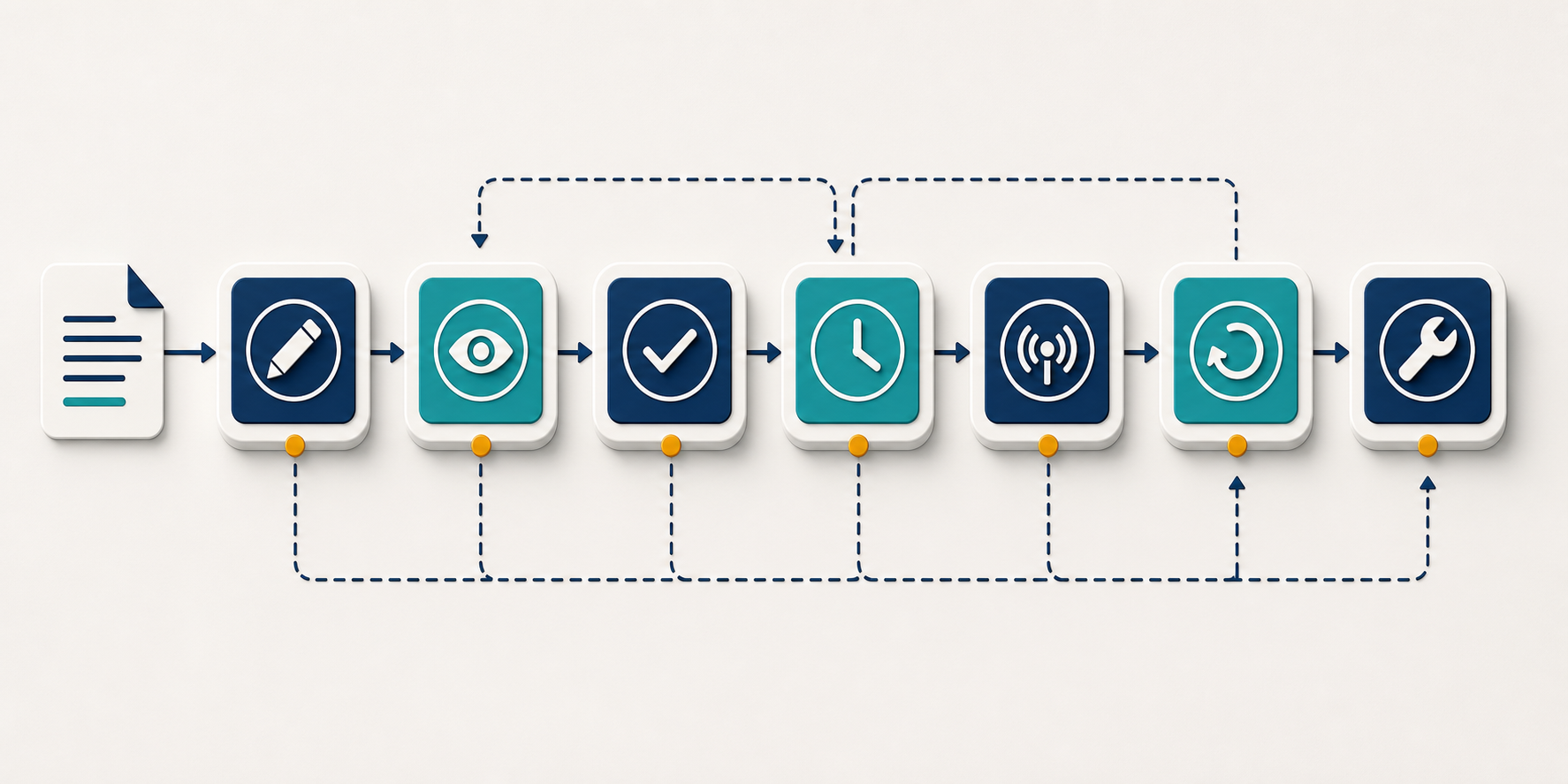
You probably don’t need another AI tool that can generate copy on command. You need campaign work to move without facts being invented, approvals being skipped, or teammates spending longer repairing output than creating it.
The useful promise behind turning workflows into agents is not that software becomes a teammate by declaration. It is that a system can hold a bounded responsibility, use approved context, produce a reviewable change, and return control at the right moment. Getting those boundaries right is what turns an agent from an interesting demo into a dependable part of marketing operations.
Give the agent a responsibility, not a vague objective
An assistant waits for a prompt. A conventional automation follows a predetermined sequence. An agent can work toward an outcome across a bounded series of decisions and actions. Real tools often blend all three modes, so the label matters less than the responsibility you assign.
“Help with content marketing” is not a responsibility. It leaves the system to guess which pages matter, which evidence is acceptable, what it may change, and when a person should intervene. Those guesses create the same coordination problems you were trying to remove.
Write the assignment in this form:
When this trigger occurs, prepare this outcome from these approved inputs, stop before this decision, and hand the work to this owner.
Marketing agent role template
A content-refresh agent, for example, could be responsible for preparing an evidence-backed change set when a page enters an editorial review queue. It may inspect approved performance data, compare the page with the current content brief, identify unsupported or outdated passages, draft revisions, and suggest structured-data changes. It may not publish, alter the canonical URL, introduce a new product claim, or remove the existing page. The content owner makes those decisions.
That boundary gives the agent meaningful work without pretending that every judgement can be delegated. Define the role with the following fields:
Trigger: the event that starts the work, such as a scheduled review, an approved campaign brief, or a flagged content issue.
Outcome: the artifact or state the agent is expected to produce. Name the deliverable rather than saying “improve” or “optimize.”
Inputs: the repositories, reports, templates, and records it may use.
Permissions: what it may read, draft, edit, submit, publish, or send.
Stop conditions: conflicts, missing evidence, unusual risk, or decisions that must be escalated.
Owner: the person accountable for accepting the result and deciding what happens next.
If you cannot complete those fields, the workflow is not ready for an agent. The problem is usually unclear ownership or an undocumented decision rule. Fixing that ambiguity will help the human team even if you postpone the automation.
Design the handoffs before granting action permissions
Marketing collaboration breaks at handoffs. A draft exists, but nobody knows whether it is ready for legal review. A campaign recommendation is accepted in chat, but the media plan still contains the old decision. A schema change reaches production, but the content team never sees the new claims encoded in it.
An agent can make those failures happen faster unless every handoff has a visible state. Use a simple operating sequence for each assignment:
A compromised administrator account, a rushed handoff, or one mistaken approval can put campaigns and billing at risk. Google Ads multi-party approval reduces that one-person exposure by requiring a second eligible administrator to authorize certain sensitive changes before they take effect.
The control is useful, but it is not self-managing. You still need enough qualified approvers, a clear review standard, and a process for requests that are urgent, stale, denied, or simply missed. Here is how to build that process without turning every account change into a bottleneck.
What multi-party approval changes in Google Ads
Multi-party approval introduces dual control for selected high-risk account actions. An administrator initiates a sensitive change, but that administrator’s authority alone is not enough to finalize it. Google Ads sends an in-product approval request to other eligible administrators, one of whom must review and approve or deny the action.
The request remains actionable for 20 days. If nobody acts before that window closes, the request expires and the proposed change is not implemented. That fail-closed behavior matters: silence does not become permission merely because the request has been waiting.
You can find these requests in the Admin menu under Access and security. Google Ads labels their outcomes as Complete, Denied, or Expired, giving your team a visible record of how each approval request ended.
The important qualifier is that the workflow applies to specific sensitive changes, not every campaign edit. Do not describe it in policies, client documentation, or audit evidence as a universal two-person rule for the entire account. A more accurate statement is that Google Ads enforces a second-administrator decision when its multi-party approval workflow is triggered.
That distinction prevents a dangerous assumption. Multi-party approval reduces the risk attached to one administrator’s authority, but it does not replace authentication controls, access reviews, campaign monitoring, or ordinary change management.
Build an approval path before a request is urgent
The 20-day window is a technical expiration period, not a sensible operating target. A legitimate request can become outdated long before it expires because budgets, promotions, account ownership, or campaign plans have changed. Your internal process should therefore route requests promptly and force a fresh review when their original context no longer holds.
Inventory eligible administrators. Record each person’s business role, account responsibility, and whether that person is expected to propose changes, approve them, or provide backup coverage.
Confirm that every protected account has more than one eligible administrator. Do not wait for an important request to discover that nobody else can approve it.
Designate a primary and backup approver. A request should have a named destination even though Google Ads can notify multiple eligible administrators.
Create a change record before initiating the action. Include the account, requested outcome, reason, expected campaign or billing effect, requester, review owner, and any time dependency.
Initiate the change in Google Ads and alert the designated reviewer through your normal work channel. Treat that message as a routing aid, not as the approval itself.
Have the reviewer open Google Ads independently, inspect the request, and approve or deny it inside the platform. A reply in chat, email, or a ticket does not substitute for the in-product decision.
Record the final Complete, Denied, or Expired status in the same change record. If the request was denied or expired, document whether it was abandoned, corrected, or submitted again.
This workflow separates three things teams often blur together: proposing a change, authorizing it, and documenting its outcome. Keeping those events distinct makes it easier to investigate an unexpected account state and harder for an informal message to be mistaken for permission.
Prevent the approval process from creating new weaknesses
A second administrator improves control only when that administrator is independent, identifiable, and capable of evaluating the request. Watch for these common failure modes:
Only one eligible administrator exists. The workflow can stall until the request expires. Establish backup coverage before you depend on multi-party approval.
Extra administrators are added merely for convenience. Administrator access is powerful, so increasing the number of administrators can expand your attack surface. Give that role only to people who genuinely need it and can fulfill the approval responsibility.
Administrators share credentials. A shared login defeats person-level accountability and makes it difficult to establish who proposed or authorized a change. Use named user access instead.
The approver rubber-stamps the request. Requiring a second click is not the same as receiving an independent review. The approver should validate the account, scope, purpose, timing, and likely consequence before acting.
A chat or email response is treated as the final approval. Keep discussion wherever your team works, but complete the binding decision within Google Ads.
An old request is approved because it is still available. Availability within the 20-day window does not prove that its business context is current. Deny a stale request and initiate a new one with updated evidence when the underlying conditions have changed.
The team assumes dual control makes account compromise harmless. It reduces the danger of one compromised administrator, but it cannot protect you if multiple privileged accounts are compromised or if inappropriate access remains active.
You also need a plan for absence and urgency. Identify who covers the primary approver and how the requester escalates an unanswered request. The backup should perform the same review, not bypass it. An urgent change can have serious financial consequences, but urgency is a reason to route the request faster, not a reason to weaken authorization.
Use a consistent approve-or-deny standard
An approver should be able to answer the following questions from the Google Ads request and its accompanying change record. If a material answer is missing or inconsistent, denial is safer than assumption.
Is the requester a known administrator acting within an assigned responsibility?
Is this the intended Google Ads account, and is the requested scope no broader than necessary?
Does the change record explain the business purpose clearly enough to evaluate the request?
Could the action interrupt active campaigns, alter control of the account, or affect billing exposure?
Does the requested action match what the team discussed, rather than a shortened or materially different version of it?
Is the timing still valid, or has the request become stale since it was initiated?
Is there a named owner who will verify the resulting account state and respond if the outcome is unexpected?
Denial is not an accusation against the requester. It is the correct outcome when the reviewer cannot establish that the change is authorized, accurate, and current. The requester can correct the scope or supporting record and begin again.
Approval should also create an operational handoff. Once a request reaches Complete status, the change owner should inspect the relevant account state rather than assuming that an approval label proves every downstream result is correct. Multi-party approval governs authorization; it does not perform campaign quality assurance for you.
Key takeaways
Google Ads multi-party approval requires another eligible administrator to approve or deny certain sensitive changes.
An unanswered request expires after 20 days, and the proposed change is not implemented.
Requests and their Complete, Denied, or Expired outcomes are available under Admin, then Access and security.
The feature is selective, so it should not be represented as two-person approval for every Google Ads edit.
A useful internal process names the requester, primary approver, backup approver, business purpose, affected account, expected consequence, and final status.
Multi-party approval complements named accounts, strong authentication, access reviews, monitoring, and change records; it does not replace them.
Your next step is simple: open Access and security, inventory the eligible administrators on each important Google Ads account, and assign a real approval path. Fix accounts with no backup approver first, then give every approver the same review checklist before a sensitive request arrives.
You can fix crawl paths, rewrite metadata, validate schema, and still watch important pages stall. When technically sound SEO work keeps arriving late, shipping partially, or losing its effect after launch, the constraint is usually somewhere upstream of the website.
Before you commission another audit, examine how your organization makes decisions, releases changes, protects search requirements, builds authority, and measures outcomes. That is where many persistent SEO problems begin.
Key takeaways
If an accepted recommendation repeatedly dies between planning and release, you have a governance problem rather than a knowledge problem.
SEO needs named decision rights, mandatory review triggers, and an escalation path before teams begin changing shared templates or site architecture.
Small navigation, template, and copy changes can accumulate into performance loss even when no individual release looks dangerous.
Digital PR should build relevant brand associations and demand around commercial pages, not merely accumulate links to informational content.
Your scorecard should track delivery quality and organizational behavior alongside rankings, traffic, and revenue.
Diagnose the operating system before adding SEO tickets
Start by separating a technical defect from an SEO delivery defect. A technical defect means the site itself prevents the intended result: an important page cannot be discovered, rendered, indexed, understood, or connected to the rest of the site as expected. An SEO delivery defect means the organization knows what should change but cannot reliably approve, implement, preserve, or evaluate it.
The distinction matters because another ticket cannot resolve an absent owner. A better specification cannot compensate for a team that may override it without review. A fresh audit will rediscover the same symptoms if the release process remains unchanged.
Find the original decision. Record what was requested, which pages or templates it affected, and which business outcome it was supposed to support.
Trace the handoffs. Identify every team that interpreted, approved, designed, built, edited, tested, or released the change.
Compare the requirement with production. Look for deleted conditions, altered copy, reduced scope, delayed dependencies, or a different destination page.
Name the decision-maker. Determine who could resolve a conflict between SEO, product, design, engineering, legal, and commercial priorities.
Inspect detection. Establish who noticed the variance, how they noticed it, and whether detection happened before or after release.
Classify the result by its primary failure mode:
Knowledge: nobody understood the search consequence.
Ownership: several people contributed, but nobody was accountable for the result.
Authority: the SEO owner saw the risk but could not influence the decision.
Capacity: the work was accepted but repeatedly displaced by other priorities.
Release control: the correct requirement entered development but a different implementation reached production.
Measurement: the change shipped, but nobody defined the evidence needed to judge it.
This classification tells you what to fix. A knowledge problem may need training or clearer acceptance criteria. An authority problem needs a decision-path change. A release-control problem needs evidence and approval gates. Treating all three as backlog management hides the real constraint.
Give SEO decision rights before work reaches production
Inviting an SEO specialist to a launch meeting is not governance. By that point, the commercial goal, page structure, user experience, copy, and engineering scope may already be fixed. SEO can comment, but it cannot shape the decision without forcing rework.
Effective placement is less about drawing the perfect organization chart and more about giving SEO enough reach to enter decisions early. When the function sits too low or too far from product, marketing, and engineering, it tends to become a reactive cleanup service for changes other teams have already shipped.
A workable governance record for each shared page system should contain five things:
One accountable owner. This person owns the search outcome even when several teams own pieces of the implementation.
A trigger list. Define which changes require SEO review. Typical triggers include navigation, taxonomy, URLs, internal linking, reusable templates, headings, core page copy, structured data, rendering, canonical rules, and large-scale page creation or removal.
Named review points. SEO should contribute while requirements are being formed, again when the implementation can be inspected, and before production approval when the risk warrants it.
An escalation route. If product speed, conversion goals, brand language, or engineering constraints conflict with search requirements, name the person who can accept the trade-off.
An exception record. When the business deliberately ships against the SEO recommendation, record the affected pages, expected downside, decision owner, and condition for revisiting it.
SEO does not need an unconditional veto over every site change. It needs the right to expose consequences before a decision becomes expensive to reverse. The final decision may still favor another business need, but the trade-off should be explicit rather than discovered through a traffic decline.
Consider a navigation redesign. Product may own the customer objective, design may own the interaction, engineering may own deployment, and SEO may own the analysis of discoverability, internal authority flow, and landing-page coverage. Governance identifies who makes the final call if those needs conflict. It also prevents the familiar situation in which each team completes its part successfully while the combined release weakens search performance.
Stop small site changes from becoming cumulative SEO loss
Not every decline follows a migration or a dramatic technical failure. Sites also drift. A new navigation label, a shortened category description, a reusable component update, or a campaign landing-page rule may look harmless in isolation. Under continuing commercial pressure, many individually reasonable changes can accumulate into a material loss.
You do not need SEO approval for every pixel. You do need visibility into classes of change that can alter search demand coverage, site relationships, or machine-readable meaning. Create a searchable release register for those changes. Each entry should identify:
the affected page type, template, directory, or navigation component;
the business reason for the change;
the search intent or query class those pages serve;
the accountable product, content, engineering, and SEO owners;
the approved requirement and a representative production example;
the evidence that will be checked after release; and
the condition that would trigger correction or rollback.
Review impact at the same level at which the change occurred. If a template affected one category, a sitewide organic traffic chart can bury the signal. Compare the affected page group with its previous behavior, relevant unaffected groups, and the intended query class. Keep demand changes, implementation errors, and business seasonality conceptually separate instead of assigning every movement to the release.
Your scorecard should combine operational signals with search and commercial outcomes:
Review coverage: how many qualifying changes entered SEO review before approval rather than after launch.
Implementation fidelity: whether the released behavior matched the accepted requirement across the affected page group.
Decision latency: where unresolved cross-team questions delayed work or forced a default choice.
Drift: how many production changes altered previously approved search behavior without an explicit decision.
Search outcome: whether the affected pages retained or improved their intended visibility, discovery, and landing-page role.
Business outcome: whether relevant organic visits contributed to enquiries, transactions, or another defined commercial action.
The operational measures are leading indicators. Rankings and revenue usually reveal the consequence after the organization has acted. Review coverage and implementation fidelity reveal whether the system is capable of producing the intended result in the first place.
Build authority where buyers and machines form opinions
SEO performance is also shaped outside your release process. A technically polished commercial page can remain weak if the brand lacks relevant recognition, demand, and contextual authority. This is where digital PR becomes more than a link-acquisition exercise.
Relevant coverage can place a brand in front of buyers during consideration, increase familiarity, and contribute to later branded searches or direct visits. Those effects are commercially useful but difficult to isolate cleanly in last-click analytics. Treat them as part of a demand and authority system, not as proof that one placement caused one sale.
Begin a PR brief with the association you need to create, not the number of links you hope to collect. Answer these questions before developing the campaign:
What product, service, category, or problem should people associate with the brand?
Which buyer is close enough to a decision for that association to matter?
Which publication and, more importantly, which section serves that audience in the right context?
What timely angle, credible evidence, or useful expert input makes the story easier for a journalist to produce?
Which product, category, or core service page is the most honest and useful destination?
What would make the placement valuable if it produced a relevant mention but no followed link?
The journalist is the first audience for the pitch. Clear angles, usable evidence, fast responses, and an obvious fit with the publication’s readers reduce the work required to turn an idea into coverage. Treating a newsroom as a distribution endpoint produces brand-centered pitches. Treating the journalist as the person whose problem must be solved produces material that is more likely to be useful.
Choose destinations according to the business goal. A link to a general blog page may be easy to accommodate, but it can leave authority far from the page that needs to compete. For commercial visibility, relevant links to product, category, and core service pages can carry greater economic value. The destination must still make editorial sense; forcing an unrelated money page into a story weakens the pitch and the reader experience.
Context also matters when no link is present. Repeatedly placing a brand near a specific topic can build familiarity for people and may help search and AI systems understand the brand’s topical associations. This is sometimes described as entity lifting. It is a strategic outcome, not a guaranteed ranking event, so do not record every mention as proven organic uplift.
Relevance is more useful than prestige without context. A focused mention in the appropriate industry or subject section can be more meaningful than a generic appearance elsewhere on a large domain because authority is built within relevant knowledge areas. Evaluate the surrounding language, audience, section, and destination together.
Spread campaign risk as well. One elaborate idea can consume the budget and still fail to match a newsroom’s needs. Maintain a portfolio of smaller timely stories, responsive expert contributions, and selective larger campaigns. This creates more opportunities to earn consistent, relevant coverage without making the entire program depend on one creative bet.
Measure that portfolio with a balanced view: publication and section relevance, topical context, destination-page value, referral activity, branded demand, direct visits, commercial-page visibility, and eventual business actions. Look for movement across several signals. A single traffic spike is attention; a durable association between the brand, its category, and buyer demand is authority.
Run the next SEO cycle as an operating-system test
You do not need to reorganize the whole company before improving SEO. Use one commercially important page group to test whether the organization can turn a clear search objective into a faithful release and relevant external authority.
Select the page group. Choose product, category, or service pages tied to a defined buyer need rather than starting with the easiest informational content.
Write the intended outcome. Name the search intent, the pages that should satisfy it, and the business action those visits should support.
Map the decision path. Record who owns requirements, approval, implementation, content, release, measurement, and conflict resolution.
Install the release controls. Define the review triggers, production evidence, post-release checks, and correction condition before work begins.
Plan the authority path. Identify the topics, publications, sections, and credible contributions that would connect the brand with the same commercial need.
Review the system as well as the result. Judge whether the right decision was made early, whether production matched it, whether relevant authority grew, and whether the target pages moved toward the intended outcome.
If the cycle works, apply the same operating model to the next page group. If it stalls, you will know whether the blockage is ownership, authority, capacity, release control, PR relevance, or measurement. Fix that constraint before buying another audit or expanding the backlog.
Your next SEO gain may still require technical work. The difference is that you will have an organization capable of choosing the right work, shipping it intact, protecting it from drift, and building the authority needed for it to perform.
Your team works in Slack, but your content lives in a CMS. When review requests, approvals, publication decisions, and correction notes drift between the two, nobody can tell which instruction is current.
The fix is not to move content management into chat. Keep the CMS authoritative and use Slack to bring the right decision to the right person. A well-designed connection between WordPress or Sanity and Slack can streamline publishing, updates, and coordination. The operational gain comes from how you define states, permissions, alerts, and write-backs around that connection.
Make the CMS authoritative and Slack actionable
Start with a hard boundary: the CMS owns durable content state; Slack owns attention and conversation. This distinction prevents a familiar failure mode in which a message says an item is approved while the CMS still says it is in review.
What the CMS should own
The current body, title, media, taxonomy, and machine-readable metadata.
The content status, such as draft, in review, approved, scheduled, published, or update required.
The current revision identifier and revision history.
The assigned owner, reviewer, and publisher.
Publication settings, including the URL, schedule, canonical selection, and index controls.
The durable record of approvals, rejections, overrides, and publication events.
What Slack should own
Notifications that a content item needs attention.
A concise summary of the proposed transition and its consequences.
Links to the editing screen, preview, and relevant validation results.
Authorized actions that write a decision back to the CMS.
Discussion about an exception, contained in a thread associated with the content item.
Escalation when an automated step fails or a deadline is at risk.
Apply one rule to every integration feature: if a Slack action changes the official state of a content item, the integration must record that change in the CMS. A button that only changes a message, adds an emoji, or posts a reply has not completed the workflow.
The boundary also protects sensitive implementation details. Slack messages should contain content identifiers and links, not CMS credentials, API tokens, unpublished secrets, or full payloads that do not belong in chat. Keep credentials in the integration’s secret store and let CMS permissions determine what each person may do.
Model content events before connecting the tools
Do not begin by sending every CMS update to a channel. That creates a feed, not an operating system. Begin with the state changes that require a person to decide, act, or investigate.
A practical first workflow is the review loop: an author requests review, a reviewer approves or returns the item, a publisher schedules it, and the system confirms publication. It is narrow enough to test, but it exposes the permissions, stale-revision, notification, and failure-handling problems that larger automations must solve.
Name each event for what happened, such as content.review_requested, content.approved, content.scheduled, content.published, and content.publish_failed.
Define the CMS state required before each event. A schedule action, for example, should not accept an item that is still marked in review.
Define who may trigger the transition. Channel membership alone should never grant publication authority.
Specify the write-back. Record the actor, decision, relevant revision, timestamp, and reason where one is required.
Specify the failure path. Decide who is notified, what remains unchanged, and how the action can be retried safely.
Put enough context in every actionable message
A reviewer should not have to search several systems just to understand the request. Each actionable Slack message should identify:
The content title and stable CMS identifier.
The content type, site, locale, and environment when your operation has more than one.
The current state and requested next state.
The owner and requested reviewer.
The revision being reviewed.
A preview link and an edit link with visibly different labels.
The requested action and any deadline already stored in the workflow.
Validation failures or missing fields that could block the transition.
Include the revision identifier even if people rarely read it. Without it, someone can approve an earlier preview after another editor has changed the content. The integration should reject or re-request an approval when the underlying revision no longer matches.
Engineer for duplicate and delayed events
CMS events can be retried, delivered late, or received more than once. Give each event a stable identifier, retain the content and revision identifiers, and make handlers idempotent so a retry cannot schedule or publish the same revision again. When event order matters, compare the incoming revision and state with the current CMS record before changing anything.
A failed delivery also needs an explicit destination. Send operational failures to a channel monitored by the people who can resolve them, with the content identifier, attempted action, error category, and safe retry path. Do not report success until the CMS has accepted the mutation.
Route by responsibility rather than broadcasting everything. Review requests belong where reviewers work; release confirmations belong where publishers monitor launches; integration failures belong with the workflow owner. Batch low-priority activity into a digest if nobody needs to act immediately. Notification volume is part of the design because an alert that is routinely ignored is not a control.
Make approvals durable, scoped, and revision-aware
Approval is a state transition, not a reaction. An emoji can communicate sentiment, but it should not be the only evidence that a specific person approved a specific revision for publication.
Use separate roles even when one person fills more than one of them:
The author prepares the item and requests review.
The reviewer approves the current revision or returns it with a reason.
The publisher confirms the destination and schedule.
The integration verifies the transition, writes it to the CMS, and reports the resulting state.
Keeping the actions distinct makes handoffs visible. It also lets you change permissions later without redesigning the entire workflow.
Validate every action at the moment it is taken
Authenticate the Slack user and map that identity to an authorized CMS user or role.
Confirm that the content remains in the expected state.
Confirm that the revision still matches the one shown in the message.
Require a reason when content is rejected, sent back, or moved through an override path.
Write the result to the CMS before updating the Slack message.
Replace the actionable controls with the final outcome so an old button cannot be used later.
If any check fails, leave the CMS state unchanged and explain what the person should do next. A stale approval should lead to a fresh preview and review request, not a best-effort approval of whatever revision happens to be current.
Plan the exception path before you need it
Urgent corrections will eventually bypass a normal queue. Give that path tighter controls rather than no controls: limit who can use it, require a reason, identify the revision, record the override, and notify the content owner. For destructive actions, prefer unpublishing or archiving with revision history intact over deleting content from a Slack control. A mistaken chat action should not erase the recovery path.
Threads are useful for discussion, but the final decision must still return to the CMS. Summarize the resolution in a structured field or audit entry rather than expecting a future editor to reconstruct it from channel history.
Tie the workflow to AI-search quality, then measure it
Connecting Slack to a CMS does not, by itself, make a page more visible in AI search. The connection supports visibility when it helps your team publish accurate, accessible, well-structured content and correct problems without losing ownership or context.
Turn high-risk quality checks into publication gates
Store these checks in the CMS or validation service and surface their results in Slack. Do not ask reviewers to type machine-readable values into chat.
Confirm that the title, summary, headings, and visible answer agree about the page’s subject.
Confirm that the intended public URL, canonical selection, and index controls are set for the correct environment.
Validate that structured data describes the content a visitor can actually see rather than an earlier draft or a different page type.
Require the relevant author, organization, product, service, date, and taxonomy fields for the content type.
Check that important claims, citations, and destination links survived the latest revision.
Assign an owner for future corrections so a published item does not become operationally anonymous.
The Slack notification should report pass, fail, or needs review for each gate and link to the field that needs work. It should not bury a blocking error in a long log. If a check is advisory rather than mandatory, label it that way so reviewers know whether they can proceed.
After publication, send a separate confirmation containing the public URL, CMS identifier, published revision, responsible user, and validation outcome. A publication request and a successful publication are different events. Treating them separately keeps a timeout or platform error from looking like a completed launch.
Measure the handoffs, not the message count
Slack activity is not a useful success metric on its own. Join workflow events by content identifier and track the points where work waits, returns, or fails:
Review queue age: time from review request to the first reviewer action.
Approval cycle time: time from review request to approval of the accepted revision.
Revision loops: how often an item returns to the author before approval.
Stale actions: attempted decisions against a revision or state that has already changed.
Metadata completeness: required fields present when review or publication is requested.
Publication reliability: successful confirmations compared with failed or unresolved publication attempts.
Post-publication corrections: items that require an avoidable fix after release.
Establish the baseline before adding more automation, then compare the same content type and workflow stage. If review time remains high but routing delay falls, the integration is doing its job and the remaining constraint is editorial capacity or decision quality. If correction volume rises, faster publishing has exposed a weak gate rather than solved the operation.
Keep operational measures separate from AI-search outcomes. Visibility, mentions, citations, and referral traffic can change for many reasons outside Slack. Use the integration to preserve a reliable record of what changed and when, then evaluate search outcomes against that record without assigning the entire movement to one tool connection.
Key takeaways
Keep content, metadata, permissions, revisions, and final state in the CMS; use Slack to route attention and authorized actions.
Automate named state transitions rather than forwarding every update into a channel.
Attach every approval to a specific content item and revision, then write the decision back to the CMS.
Design for duplicate events, delayed events, stale buttons, permission failures, and publication errors from the beginning.
Surface SEO, structured-data, and content-quality gates in Slack while retaining their values and validation logic outside chat.
Measure queue age, revision loops, stale actions, failed publications, metadata completeness, and corrections before expanding the workflow.
Start with one transition that currently causes visible friction, usually the move from ready for review to approved. Make that loop authoritative, revision-aware, and recoverable. Once it works without manual reconciliation, extend the same event model to scheduling, publication, updates, and post-publication quality checks.
Your campaign brief is ready and the customer signal is fresh, but the work cannot move. Insight sits with an analyst, creative with a designer, execution with marketing operations, access with an engineer, and approval somewhere else. By the time every queue clears, the moment you wanted to act on may have passed.
Positionless marketing operations gives the person accountable for the result enough access, capability, and authority to move from signal to launch and learning. It does not ask every marketer to become an expert in every discipline. It removes routine dependencies while preserving specialist judgment where the risk or complexity requires it.
Key takeaways
Organize recurring campaign work around one outcome owner rather than a chain of task owners.
Remove handoffs caused by missing access, inherited habits, or routine production work. Keep controls that protect customers, data, brand standards, budgets, and technical reliability.
Give the owner data, reusable creative, execution tools, measurement, and decision rights together. Providing only some of these capabilities creates another queue.
Use AI to improve predictions and prepare options, and use automation to execute approved routines. Humans should still set objectives, judge context, and handle exceptions.
Measure customer results, total cycle time, waiting, rework, and exceptions. A faster launch is not an improvement if quality or campaign performance deteriorates.
Positionless is an operating model, not a staffing shortcut
Traditional marketing operations divides a campaign into specialties and sends the work through them in sequence. Each person may complete an assigned task efficiently while the campaign as a whole remains slow. The local metrics look healthy because every department finished its part. The customer outcome still arrives late.
A positionless model changes the unit of responsibility. Instead of owning a brief, segment, asset, workflow, or report, one marketer owns the campaign outcome from the initial signal through execution and evaluation. Other specialists can contribute, but routine progress no longer depends on each of them taking possession of the work.
Operating question
Sequential model
Positionless model
What does a marketer own?
A task or stage
An outcome and the decisions needed to reach it
How does routine work advance?
Through departmental queues
Through self-service tools and preapproved patterns
What do specialists do?
Execute most requests
Build systems, define guardrails, advise, and handle exceptions
When is approval required?
At each inherited stage
When the work crosses a stated risk or authority boundary
Who answers for the result?
Responsibility is distributed across contributors
One named owner is accountable end to end
This is not a case for eliminating designers, analysts, engineers, channel experts, or governance teams. Their leverage often increases when they stop repeating routine production work and start building the templates, data products, controls, and escalation paths that let other marketers operate safely.
Nor does end-to-end ownership mean one person must perform every keystroke. The outcome owner can request advice or delegate specialized work. The important distinction is that the campaign does not lose its owner each time another discipline becomes involved. That person remains responsible for the campaign logic, tradeoffs, launch, and response.
The potential compression can be substantial when coordination is the real constraint. One documented gaming workflow required seven teams and six weeks to launch a campaign. A separate iGaming operation reduced campaign execution from five days to five minutes, while another campaign process moved from six weeks to hours. These are individual transformations in gaming-related businesses, not universal benchmarks. Use them as evidence that structural delay can be large, not as a target your team must copy.
Find the handoffs that create delay, not safety
Do not start the redesign by buying a new platform or rewriting job descriptions. Start with one recurring campaign and reconstruct what actually happened. The official process usually omits informal messages, access requests, clarification loops, and work that sits untouched between departments.
Name the trigger and outcome. Write down the customer or business signal that started the work and the response the campaign was meant to produce. If the outcome is vague, ownership will be vague too.
Trace the real path. List every person or team that received the work, what they were asked to provide, and what the campaign owner could not do while waiting.
Separate touch time from wait time. Record when each request entered a queue, when work began, and when the usable output returned. The gap shows whether expertise or availability is constraining the campaign.
Mark every return trip. A brief that comes back for missing data, an asset returned for resizing, or a workflow rebuilt after an audience change is rework. It deserves its own line rather than being hidden inside the original step.
Identify the permission behind the handoff. Ask whether the next team supplied expertise, exercised a necessary control, held exclusive system access, or simply inherited the task historically.
Choose the smallest removable dependency. Give the owner the access, template, or rule needed to bypass one routine queue, then observe what happens to speed, quality, and exceptions.
Classify each dependency before removing it
Four labels keep a workflow review from turning into an indiscriminate campaign against collaboration:
Expertise dependency: another person must interpret an unfamiliar problem or perform work requiring deep skill. Preserve access to that specialist, but define which routine cases can be handled through templates, training, or reusable components.
Control dependency: another function protects a material boundary involving customer data, regulated claims, contractual obligations, brand risk, spend, or system stability. Keep the boundary and make the escalation condition explicit.
Access dependency: the marketer knows what to do but cannot see the data, use the tool, create the segment, modify the asset, or publish the campaign. This is a strong self-service candidate if appropriate permissions and audit records can be established.
Habit dependency: the handoff exists because the work has always moved that way. Remove it unless someone can identify a current capability or control that it provides.
The test is not whether a handoff involves an important team. It is whether transferring ownership is necessary for this class of work. A brand team may need to establish the visual system without manually adapting every approved layout. An analyst may need to define a reliable audience model without pulling every recurring segment. An engineer may need to administer the platform without configuring every routine campaign.
Pay particular attention to clarification loops. If a specialist repeatedly asks the same questions, the answer is usually not a faster request form. Convert those questions into a required brief, validation rule, template, or in-product prompt that helps the outcome owner provide the right input before work starts.
Build a minimum viable autonomous campaign workflow
A marketer is not autonomous because the organization announced a new operating philosophy. Autonomy exists only when the person can complete a defined class of campaign without seeking routine access, production, execution, and measurement help.
For the workflow you selected, assemble these capabilities as one operating package:
An outcome brief: the trigger, intended audience, desired response, channel, campaign constraints, and the measure that will determine whether the work succeeded.
Usable data access: approved customer signals, audience definitions, exclusions, and enough context to understand what the data does and does not mean.
Reusable creative: modular templates, approved components, brand rules, required language, and a clear route for creative work that falls outside those patterns.
Execution rights: permission to configure and launch the routine campaign within defined channel, scheduling, volume, and budget boundaries.
Measurement access: a shared view of delivery and customer response, with consistent metric definitions and enough detail to diagnose the result.
These elements have to arrive together. Creative self-service does not help if audience creation still waits in another queue. Execution access does not create ownership if the marketer cannot see the result. A dashboard does not produce action if every campaign change needs a new approval chain.
Write decision rights as operational rules
Ambiguous authority sends people back to the hierarchy as soon as a real choice appears. For each recurring decision, write one of three instructions:
The owner may decide: the choice is inside an approved pattern and does not require consultation.
The owner must consult: specialist input is useful, but the outcome owner retains the decision unless the work crosses a separate control boundary.
The owner must escalate: the choice creates a stated risk, exceeds an approved limit, introduces a new use of data, makes a sensitive claim, or changes a protected system.
Make the escalation route just as concrete as the boundary. Name the role that can decide, specify what information the owner must provide, and explain what happens while the decision is pending. Otherwise, an exception path becomes the same opaque queue under a new name.
Approval should follow risk, not organizational distance. A recurring campaign built from an approved audience, template, offer, and channel pattern should not need a ceremonial review merely because several departments once touched it. A campaign introducing a new data purpose or a claim with legal implications should still reach the appropriate privacy, compliance, or legal specialist before launch. The safe way to increase autonomy is to preapprove known patterns and escalate deviations, not to let individual marketers interpret high-risk boundaries on their own.
Specialists also need a feedback loop. When the same exception appears repeatedly, they should decide whether to turn it into a supported pattern, improve training, tighten a rule, or keep it exceptional. That is how the autonomous scope expands deliberately instead of through informal workarounds.
Use AI and automation without outsourcing judgment
AI and automation can make positionless operations practical, but they solve different parts of the problem. AI can help interpret signals, generate options, adapt approved components, or predict a likely response. Automation can validate inputs, assemble routine workflows, apply exclusions, launch approved actions, and return results. Neither one decides what the organization should optimize or which risk is acceptable.
Keep objectives human-owned. A model can optimize a stated target, but the marketer must decide whether that target represents the customer and business outcome that matters.
Constrain the available inputs. Give tools access only to data and content approved for the workflow. More access is not automatically better if it introduces data that the marketer is not authorized to use.
Ground production in approved components. Templates, product facts, offer rules, brand language, and required disclosures reduce the distance between a generated option and a usable campaign.
Validate before execution. Check required fields, exclusions, links, audience logic, scheduling, and other campaign-specific conditions before automation can publish.
Route exceptions to people. Novel claims, unfamiliar audiences, unexpected model outputs, anomalous results, and decisions outside established limits need named human reviewers.
Retain an audit trail. Record the inputs, material choices, approvals, generated assets, final configuration, and outcome so the team can investigate errors and improve the system.
Do not use autonomous as a synonym for unsupervised. The marketer may operate without routine departmental handoffs while still working inside centrally maintained permissions, validations, and monitoring. That combination is what turns governance from a sequence of manual approvals into part of the operating environment.
AI also cannot repair unclear ownership. If a generated campaign still needs several people to decide what it is trying to achieve, who may launch it, and who answers for the result, the organization has accelerated production without changing operations. Establish the owner and decision rights before adding more generation capacity.
Run one pilot and measure whether speed creates value
Choose a recurring campaign that suffers visible delay, uses reasonably stable inputs, and can be kept within existing controls. Avoid beginning with the organization’s most novel, sensitive, or technically fragile campaign. You need a workflow that can reveal operational problems without making every run a special case.
Baseline the existing campaign. Capture the signal-to-launch time, touch time, waiting, handoffs, rework, exceptions, and customer result from a comparable run.
Name one outcome owner. Give that person responsibility for the brief, audience logic, creative choices, execution, and evaluation within the pilot scope.
Remove a complete set of dependencies. Provide the data, templates, tools, measurement, and permissions required to bypass the selected routine queues.
Publish the operating boundaries. State what the owner may decide, when consultation is optional, what must be escalated, and who resolves each exception.
Run the campaign and log friction. Record every point where the owner still cannot proceed, every manual correction, and every case in which a guardrail prevents an error.
Compare the whole result. Evaluate time, quality, campaign performance, rework, and risk events together. Then decide which dependency to remove or which control to improve next.
Your pilot scorecard should answer several different questions:
Customer outcome: Did the intended audience respond in the way the campaign was designed to produce?
Signal-to-launch time: How long passed between identifying the opportunity and making the campaign available to customers?
Wait-to-touch ratio: How much of the total elapsed time was active work, and how much was time spent waiting for another person, permission, or system?
Required handoffs: How many transfers had to occur before the campaign could launch and be evaluated?
First-pass completion: Did the owner launch inside the approved pattern without work being returned for avoidable corrections?
Exception demand: Which decisions still required specialist involvement, and did the same exceptions recur?
Rework and errors: Did broader autonomy introduce corrections, customer-facing mistakes, reporting problems, or operational cleanup?
Read the measures together. A shorter launch time accompanied by worse customer response may mean the team optimized for speed instead of relevance. Fewer handoffs with more preventable errors may mean the templates or training are incomplete. Faster execution with unchanged waiting may mean the bottleneck moved from production to decision-making.
Do not borrow the five-minute or same-day timing of another organization as your success threshold. Your starting architecture, controls, channels, and campaign type determine what is realistic. The credible target is an improvement against your own baseline without deterioration in the outcome or an unacceptable increase in risk.
Take the last routine campaign your team completed and circle every moment when its owner knew what should happen but could not proceed. Classify each stop as expertise, control, access, or habit. Remove one access or habit dependency, keep the necessary safeguards, and run the workflow again. When the same accountable person can see the signal, make an approved choice, launch, and read the response, you have a positionless operation you can expand.
If your website gives one answer, a retailer gives another, and community discussions repeat an outdated claim, an AI system has no clean version of your brand to trust. You can rank well in traditional search and still be described inaccurately when an answer is assembled from several public surfaces.
The fix is not to publish everywhere at once. Build a controlled source of truth, earn corroboration for its important claims, and use real audience conversations to expose what your internal language misses. That turns cross-channel SEO from a collection of campaigns into an operating system for AI visibility.
Treat AI visibility as a verifiable-consensus problem
This does not mean every channel needs the same copy. It means the important facts must survive every retelling. A product name, capability, limitation, use case or availability statement can be expressed differently in a product page, interview, retailer listing and community response. The underlying claim should not change unless a version, market or other stated condition explains the difference.
A practical cross-channel model has three layers:
Definition: Your owned properties state what the product, service or organization is, what it does, who it serves and where its limits are.
Validation: Relevant external entities independently confirm the claims that matter to a buyer or evaluator.
Experience: Customers and communities discuss how those claims hold up in real situations, using language that may differ from your internal terminology.
Start by creating a claim registry rather than another keyword spreadsheet. Give each important claim its own row and record:
The question a person would ask before needing the claim.
The approved factual answer, written without promotional language.
Any version, location, plan, customer type or other condition that changes the answer.
The team responsible for confirming the fact.
The primary page where the fact should be explained.
The retailer listings, profiles, media materials and other external surfaces that repeat it.
The event that should trigger a review, such as a product, policy, price or availability change.
This registry separates three problems that teams often mix together. A missing fact is a content problem. A hard-to-extract fact is a structural problem. A conflicting fact is a governance problem. Publishing more content only solves the first one.
Key takeaways
Make your owned website the clearest and most current expression of each priority claim.
Pursue relevant third-party corroboration, not backlink volume without context.
Keep facts consistent across channels while adapting the format and language to each audience.
Use community discussions to find unanswered questions and weak brand associations, not to manufacture praise.
Give one SEO lead authority to route evidence, resolve conflicts and decide which layer needs work next.
Phase 1: Make owned pages the cleanest truth source
Begin with the surfaces you control. Before you try to influence how an AI system describes your brand, make sure it can find an unambiguous answer on your site. The work shifts from optimizing only for search terms toward presenting facts in a form machines can extract accurately.
The first input should come from customer-facing reality. Ask sales, support and product teams which questions recur, which capabilities prospects misunderstand and which details customers discover too late. Search demand can tell you that a topic matters. These teams can tell you what a useful answer must contain.
Turn that input into an owned-content workflow:
Collect the actual questions. Preserve the audience’s wording, including comparisons, constraints and use-case language. Do not translate everything into internal product vocabulary before the content team sees it.
Assign each question to one primary page. A reader and a machine should not have to reconcile several pages to determine the basic answer. Supporting pages can add context, but one page should carry the complete claim.
State the answer explicitly. Name the relevant entity, capability and condition in the same passage. Replace phrases such as “flexible options are available” with the options, eligibility rules or limitations you can actually substantiate.
Structure the supporting detail. Use descriptive headings, direct explanatory paragraphs, lists for genuine sets of items and tables for attributes that readers need to compare. Keep labels stable when the same concept appears on several pages.
Match structured data to visible content. Schema and JSON-LD should represent facts a reader can verify on the page. Markup is another machine-readable expression of the page, not a place to introduce a stronger or different claim.
Install a change path. When the underlying product fact changes, the owner should know which page, markup, feed, retailer record and communications material must be reviewed.
A useful answer pattern is simple: identify the thing, answer the question, qualify the answer, and show the evidence or detail needed to interpret it. For example, a capability section can follow this template: “[Product] supports [named capability] for [applicable users or plans]. It works through [relevant method]. It does not include [important limitation].” The brackets must be replaced with approved facts, not broad marketing language.
Do not confuse extractability with brevity. A one-sentence answer can establish the fact, while the surrounding page explains selection criteria, exceptions, setup or consequences. The goal is to make the core answer easy to lift without stripping away a condition that changes its meaning.
Phase 1 is ready to support wider distribution when:
Every priority question has an approved answer and a responsible subject-matter owner.
Each answer has a clear primary location on the site.
Visible copy, structured data and first-party product feeds agree.
Important qualifications are written beside the claim rather than buried on an unrelated page.
Teams can identify which records must change when the fact changes.
If those conditions are not met, external promotion will distribute ambiguity. Fixing the owned layer first gives every other team something dependable to reference.
Phase 2: Turn external coverage into factual corroboration
Once your owned facts are stable, identify where an external voice would make them more credible or discoverable. AI search can validate information across the public web, and independent mentions may carry more weight than a brand repeating its own narrative. That changes the purpose of outreach: you are not merely acquiring links; you are building a coherent body of relevant corroboration.
Plan earned visibility claim by claim. For each one, decide:
What needs validation: a capability, use case, category association, product detail or other approved fact.
Who needs the answer: the audience and decision context in which the claim matters.
Which external surface fits: specialist media, a retailer page, an affiliate resource, a video, an expert contribution or another relevant entity.
What can be substantiated: the product detail, demonstration, documentation, customer evidence or subject-matter access available to support the claim.
Where the complete answer lives: the owned page external coverage should be able to verify.
Who maintains consistency: the person responsible for checking published details and resolving conflicts.
This is a better filter than a domain list sorted only by link metrics. A citation is useful when the external entity is relevant to the subject, the context supports the intended association, and the claim remains understandable. A passing brand mention on an unrelated page may add little. A detailed, accurate reference in the right niche can help both a potential customer and a system trying to validate the answer.
PR should operate as a continuing narrative function rather than a sequence of disconnected launches. A single approved theme can support a media pitch, expert commentary, a video brief, organic social material and updates to partner resources. Reuse the factual core, but adapt the treatment to the channel. Identical copy is not required; factual agreement is.
Commerce pages deserve the same attention as editorial coverage. Retailer product detail pages can act as external verification points for specifications, availability and product positioning. Audit them against the claim registry. If a marketplace lists an old attribute or uses a name that no longer matches the site, decide whether the difference reflects a legitimate version or market. If it does, label that condition. If it does not, correct the conflicting record rather than publishing another page that adds a third answer.
Give communications teams a compact evidence package for every priority narrative:
The exact claim and its important qualifications.
The audience question it answers.
The primary owned URL containing the full explanation.
The approved product details or evidence that support it.
The terms that must remain consistent across coverage.
The likely objection or misunderstanding the content should address.
The person who can approve a factual correction.
This keeps creative work flexible without allowing the facts to drift. It also makes monitoring actionable. When a mention is incomplete, classify the gap: wrong fact, missing qualification, weak context, outdated terminology or no link to a complete answer. Each class points to a different correction.
Phase 2 is working when relevant external entities repeat the same factual core, retailer records agree with first-party product data, and PR themes build on one another instead of resetting with each campaign. The aim is not artificial uniformity. It is enough independent agreement that an evaluator can determine what is true without guessing.
Phase 3: Use community signals without manufacturing them
Treat community work as listening and service, not a placement exercise. Fabricated praise, undisclosed promotion and scripted imitation of customer language can damage trust. They also produce poor strategic data because the team ends up measuring its own intervention instead of learning what customers actually think.
Build a community insight log around observable conversations. Capture:
The question or comparison being discussed.
The exact words people use for the need, product category and desired outcome.
The answer receiving support and the reason participants find it credible.
The misconception, missing fact or negative experience behind disagreement.
Whether your owned content already resolves the issue.
The team that can act: product, content, support, PR, commerce, paid media or community management.
Keep facts and sentiment separate. “This plan includes a feature” is a claim that can be verified. “This option feels easier” is a preference that depends on the user and context. Both are useful, but they should not be processed as the same kind of evidence. The first may require a factual correction; the second may reveal an audience association you need to understand.
When participation is appropriate, answer the question in the community’s own context. Disclose the brand relationship, correct factual errors without attacking the person, and link to your site only when the destination materially helps. A clear limitation can be more useful than a promotional response because it prevents the wrong buyer from carrying an inaccurate expectation forward.
Community insight should also inform paid and partner channels. Repeated audience language can become an ad-copy hypothesis. A persistent objection can shape a landing-page test. A misunderstood distinction can be added to an influencer brief or affiliate resource. These channels can expand and test a message, but their performance does not prove that the underlying product claim is true. Keep the approved claim registry as the factual control.
Use a closed loop rather than a listening report that disappears into a folder:
Capture a recurring question, association or misunderstanding.
Classify it as a factual gap, language gap, experience issue or product issue.
Route it to the team that can resolve the cause.
Update the owned answer when the public information is incomplete.
Brief PR, commerce, social, affiliate and paid teams on the corrected narrative.
Return to the relevant community only when you can add a transparent, useful answer.
Phase 3 is mature when community managers can trace repeated questions to content or product decisions, paid teams test language drawn from genuine demand, and partners receive the same factual guardrails as internal teams. The output is not a larger volume of brand posts. It is a more accurate understanding of how people describe and evaluate the brand.
A dedicated internal lead is a practical default because product knowledge, organizational context and internal relationships matter. An agency can add outside pattern recognition, specialist execution and additional capacity, but it should strengthen a named internal owner rather than leave the operating model ownerless.
The exchange between teams should be explicit:
Team
Input to the SEO lead
What it receives
Shared decision
Content
Subject expertise, editorial judgment and creation capacity
Audience questions, optimization requirements and performance gaps
Which owned answer needs to be created or improved
PR and communications
Brand messaging, media relationships and outreach
Search trends, mention gaps and authority targets
Which claim needs independent corroboration
Commerce and marketplaces
Product records, reseller feedback and purchase-stage questions
Product-page requirements and identified inconsistencies
Which external listings need correction or expansion
Social and community
Audience language, engagement patterns and recurring concerns
Priority themes, factual references and response context
Which conversation requires listening, content or participation
Web development
Technical infrastructure, templates and site constraints
Implementation priorities and extraction requirements
Which structural change removes the largest information gap
Creative and paid media
Visual assets, campaign feedback and message-test results
Audience themes, factual guardrails and landing-page priorities
Which message should be expressed or tested next
Give the group one decision log. For each issue, record the affected claim, evidence, conflicting surfaces, owner, chosen action and review trigger. This prevents a correction from being trapped in an SEO ticket while retailer copy, media briefs and social responses remain unchanged.
Measure the failure mode, not just visibility
A single AI visibility score may tell you that something changed, but it cannot tell you what to fix. Use a diagnostic scorecard tied to the three phases:
Answer accuracy: For a stable set of priority questions, record the generated answer, the cited or surfaced URLs and the exact factual error or omission. Keep the platform, query wording and observation context with the record because generated responses can vary.
Owned fact coverage: Check whether each priority claim has a complete primary page, an approved owner and machine-readable markup where appropriate.
Cross-channel agreement: Compare the primary page with important retailer listings, profiles, media materials and partner pages. Classify differences as valid conditions, stale records or true contradictions.
Relevant authority coverage: Track which priority claims receive substantive mentions from entities that matter in the niche. Do not reduce this to a raw backlink count.
Community question closure: Track whether recurring questions lead to an answer, content change, product escalation or documented decision. Engagement alone does not show that the information problem was solved.
Business relevance: Connect the monitored questions to the pages and actions that matter to the audience. Visibility for an irrelevant association is not a successful outcome.
The scorecard should tell you which phase deserves the next unit of effort:
If the generated answer is factually wrong and your site is also unclear, return to Phase 1.
If your site is explicit but the claim lacks credible external support, prioritize Phase 2.
If the facts are correct but the language or preferences in the answer do not reflect customer reality, investigate Phase 3.
If channels contradict one another, pause broader distribution and resolve ownership before adding more campaigns.
If visibility improves without helping the intended audience act, revisit the question set, landing experience and business relevance rather than chasing more mentions.
Start with one decision area, not the whole brand
You do not need an immediate company-wide reorganization. Choose one product, service or decision area with meaningful demand and visible information gaps. Build its claim registry, assign its primary pages, compare its most important external records, and inspect how people discuss it in relevant communities. That contained scope will expose the handoffs your operating model needs without turning the first attempt into an inventory of the entire internet.
At your next planning meeting, bring one disputed or under-supported claim instead of a generic request for more AI content. Decide who owns the fact, where its complete answer belongs, which independent entities could validate it, and which audience conversations can test your understanding. Once that path works, apply it to the next decision area. Cross-channel AI search strategy becomes manageable when each expansion begins with a verified claim, not another channel calendar.
If you lead SEO inside a corporation, the hardest question usually isn’t what needs fixing. It is how to get a correct recommendation understood, approved, shipped, measured, and protected when priorities change.
Your title can give you access, but it cannot make another team accept your evidence or put your work on its roadmap. The same is true whether you are improving conventional search performance, visibility in AI-generated answers, or both. You need a way to turn specialist knowledge into decisions the organization can carry out.
Your job is to improve decisions, not merely diagnose pages
SEO expertise gets you into the room. Leadership determines whether anything useful leaves the room.
A technically correct audit can still fail because it does not resolve the decision facing product, engineering, content, legal, analytics, or finance. A long list of issues tells people that work exists. It does not tell them what to choose, who must act, what tradeoff they are accepting, or how they will know whether the change worked.
Turn each recommendation into a decision packet
Before asking for resources, reduce the recommendation to a compact decision packet. It should answer:
Decision: What choice must be made now?
Problem: What user, search, or business behavior is being limited?
Evidence: What can you observe, and where is uncertainty still present?
Consequence: What continues to happen if the organization does nothing?
Proposed move: What is the smallest meaningful change?
Ownership: Who approves it, who implements it, and who operates it afterward?
Dependencies: Which systems, teams, policies, or releases could block it?
Validation: What would count as implementation proof, directional progress, success, or failure?
Protection: What monitoring or rollback condition limits the downside?
Next decision: What specifically do you need from the people in the room?
Consider the difference between asking engineering to fix canonical tags and asking the organization to decide how filtered category URLs should behave. The second framing forces the real questions into view: which URLs are intended search surfaces, which should consolidate, how templates will express that policy, how the output will be validated, and who will prevent the old behavior from returning.
This framing also prevents false precision. You do not need to manufacture an impressive traffic forecast when the evidence cannot support one. State the uncertainty, explain which signal the change should affect first, and define what you expect to learn. A credible range of possible outcomes is more useful than an unsupported promise.
Translate the work without changing the truth
Stakeholders do not need different facts, but they do need the facts organized around the decisions they own.
Engineering needs the current behavior, desired behavior, affected templates or systems, acceptance criteria, monitoring, and rollback path.
Product needs the user impact, strategic fit, roadmap tradeoff, affected experience, and consequence of delay.
Content teams need a repeatable decision rule: what to create, update, consolidate, retire, or leave alone.
Analytics needs the expected behavioral change, available signals, attribution limits, and comparison logic.
Legal or compliance needs the exact claim, surface, market, and risk requiring review. A vague request for approval creates unnecessary delay.
Executives need the objective, material constraint, opportunity cost, accountable owner, and decision that only they can make.
Translation is not spin. If you silently change the claim for each audience, trust will erode as soon as stakeholders compare notes. Keep the evidence and uncertainty stable; change only the route through which each person can evaluate them.
Power here does not simply mean seniority. It includes control over budget, engineering capacity, release approval, measurement, content standards, risk acceptance, and ongoing maintenance. Someone with a modest title may control the queue you need. A senior sponsor may support your goal but be unable to change that queue directly.
Create a decision map, not a stakeholder list
For each meaningful initiative, identify these roles by name or team:
Sponsor: Protects the objective when priorities compete.
Decision owner: Has authority to accept the tradeoff.
Resource owner: Controls the people, budget, or roadmap capacity required.
Implementation owner: Turns the decision into a working change.
Evidence owner: Controls the data needed to evaluate the problem and outcome.
Veto holder: Can stop the work because of security, legal, brand, platform, operational, or architectural risk.
Beneficiary: Gains from the result and may help build support.
Operational owner: Maintains the change after launch.
A list of names without these roles is only an address book. The map becomes useful when it exposes a missing sponsor, an unconsulted veto holder, or a maintenance obligation nobody has accepted.
Diagnose resistance before answering it
Not every objection is a request for more evidence. Treating every form of resistance as an education problem leads to longer decks and the same blocked decision.
What you hear
What may be underneath it
Useful response
Not now
A priority conflict or no protected capacity
Ask which commitment would have to move, who owns that tradeoff, and what event should reopen the decision.
We need more data
Real uncertainty, defensive delay, or unclear success criteria
Ask what decision the additional evidence would change, then agree on the required signal before doing more analysis.
This is too risky
Unbounded exposure or unclear accountability
Reduce the affected surface, define monitoring, assign an owner, and agree on a rollback condition.
SEO can handle it
Confusion between advisory ownership and implementation ownership
Separate the work SEO can perform from the code, content, policy, or release decision another team controls.
We tried this before
Organizational memory without preserved conditions or evidence
Recover what changed, where it was applied, how it was measured, and whether the current system is materially the same.
Everyone agrees, but nothing moves
No resource owner, decision deadline, or consequence for delay
Make the unresolved tradeoff explicit and ask the sponsor to assign capacity or close the initiative.
The distinction matters. An evidence problem calls for analysis. A capacity problem calls for prioritization. A risk problem calls for containment. An ownership problem calls for a named decision. Do not spend SEO credibility solving the wrong one.
Prewire important decisions
When the stakes justify it, use a deliberate sequence before the formal decision meeting:
Review the problem with the implementation owner. Remove requirements that are unrealistic or needlessly broad.
Speak with likely veto holders. Ask what would make the proposal unacceptable and what safeguards they require.
Confirm the evidence and measurement limits with the data owner.
Give the sponsor a clear view of the tradeoff, opposition, and decision needed.
Circulate the decision packet early enough for stakeholders to identify missing information.
Use the formal meeting to resolve the remaining choice, assign ownership, and record the outcome.
Prewiring is not a way to conceal disagreement. It is a way to discover disagreement while there is still time to improve the proposal. A surprise objection in a large meeting often pushes the work back into analysis even when the real issue could have been resolved privately.
Build an operating system that survives shifting priorities
Corporate SEO becomes fragile when its state lives in one person’s memory. A reorganization, platform migration, leadership change, or new planning cycle can erase context without reversing a single formal decision.
Your operating system does not need to be elaborate. It needs to preserve decisions, ownership, evidence, and the next action well enough that another person can reconstruct why the work exists.
Run an outcome roadmap, not an audit queue
An audit queue is organized around defects. An outcome roadmap is organized around changes the business is trying to produce. For every initiative, record:
The intended user, search, or business outcome.
The affected surfaces, systems, templates, or content types.
The current decision state.
The accountable decision and implementation owners.
The main dependency or constraint.
The evidence supporting the work.
The next decision, action, and responsible party.
The validation and maintenance plan.
Use state labels that describe reality. A practical set is exploring, decision-ready, committed, in delivery, validating, and maintained. Avoid treating shipped as synonymous with successful. Code can deploy without appearing on every intended template, being rendered as expected, or remaining intact through a later release.
Preserve the decisions that shaped the work
A lightweight decision log should capture what was decided, who owned the decision, the evidence available at the time, the alternatives rejected, the assumptions that mattered, and the condition that should trigger reconsideration.
This is especially valuable when someone later asks why a URL policy, content rule, rendering choice, or structured-data implementation works the way it does. Without the log, teams often reopen settled debates or preserve old decisions after their assumptions have expired.
Agree on validation before implementation begins
Validation should have distinct layers:
Release proof: Did the intended code, template, content, or configuration reach the intended surface?
Behavior proof: Do crawlers, rendering systems, internal links, metadata, structured data, or content outputs now behave as designed?
Search response: Are discovery, crawling, indexing, result presentation, citations, visibility, or landing behavior moving in the expected direction?
Business response: Is the change contributing to relevant visits, qualified actions, conversions, revenue, retention, or another agreed business outcome?
Durability: Is the implementation still present and correct after normal publishing and release activity?
These layers operate on different evidence and should not be collapsed into one status. A release can be correct before a downstream outcome is observable. A business metric can also move for reasons unrelated to the SEO change. Report what the evidence supports, and label inference as inference.
Make status reporting decision-oriented
A useful update tells leaders what changed, what is blocked, what decision is needed, and what evidence will arrive next. It should not force them to decode a long activity log.
Changed: New evidence, delivery progress, or altered conditions.
Blocked: The exact dependency, owner, and consequence of continued delay.
Decision required: The tradeoff and the person authorized to resolve it.
Next evidence: What will be checked and how it will change the decision.
Confidence: What is known, inferred, or still untested.
Match the reporting cadence to the organization’s planning and release rhythm. The important feature is consistency: stakeholders should know where to find the current state before a problem becomes an escalation.
Prioritize for organizational feasibility as well as upside
A large estimated opportunity is not automatically the right next project. Before committing, ask:
Does the work support a business objective that already has sponsorship?
Can the organization make the required decision?
Is there an implementation owner with realistic access to the affected system?
Can you reduce the scope if uncertainty or risk is high?
Will the work produce reusable learning even if the expected outcome does not appear?
Can the organization monitor and maintain the result?
What valuable work will be displaced?
Do not hide these judgments inside a universal score that makes unlike uncertainties look comparable. A roadmap benefits from explicit reasoning. If a smaller change can resolve the most important assumption before a broad rollout, fund the learning first.
Build career capital that travels beyond your current title
Career growth in corporate SEO is not simply a progression from larger audits to larger websites. Your leverage grows when you can combine technical judgment, commercial understanding, and organizational execution.
That combination is portable. A platform, reporting line, or job title can change while your ability to frame decisions, align teams, preserve evidence, and manage uncertainty remains useful.
Keep an evidence ledger for your own work
Do not wait for a performance review or job search to reconstruct your contribution. Maintain a private, policy-compliant record containing:
The situation and organizational constraint.
The decision that had to change.
Your specific contribution, separated from the team’s work.
The implementation or behavior that changed.
The evidence available before and after the change.
The limits on attributing the outcome to your work.
The reusable process, template, or lesson created.
This gives you defensible material for reviews, promotion cases, interviews, and resumes. It also reveals whether your role is developing you. If the ledger contains only deliverables and no changed decisions, durable systems, or measurable behavior, your scope may be busy without becoming more influential.
Make the operation less dependent on you
Hoarding context can create short-term importance, but it limits the size of the work you can lead. Document recurring analyses, decision rules, data definitions, validation procedures, known failure modes, and escalation paths. Teach other teams enough to recognize when SEO input is needed.
Your judgment remains valuable because you can handle ambiguity and tradeoffs, not because you are the only person who knows where a report lives. A leader who can hand off routine operation has room to take on more consequential decisions.
Evaluate roles by operating conditions, not title alone
When considering a new role or expanded remit, ask questions that expose how work really moves:
Who owns technical changes that affect discoverability and search presentation?
How does SEO obtain engineering, product, content, and analytics capacity?
Who decides when SEO priorities conflict with another roadmap?
What evidence can the team access without repeated special approval?
How are cross-functional outcomes evaluated when SEO does not control implementation?
What happened after the latest material search-performance problem?
Which SEO decisions are centralized, and which belong to business units or markets?
Who maintains changes after launch?
How does the manager handle disagreement with a powerful stakeholder?
Listen for named owners, real decision paths, and examples of resolved tradeoffs. Broad enthusiasm for organic growth is not the same as an operating model. Accountability without implementation access, evidence access, sponsorship, or a clear escalation route is a structural risk to both performance and your career.
Use political skill without becoming manipulative
Organizational politics is the movement of attention, resources, risk, and credit. Ignoring it does not make it disappear. Ethical political skill means understanding those forces while keeping your claims honest.
Give collaborators visible credit for implementation and problem-solving.
Raise foreseeable concerns privately before they become public surprises.
Disagree with the proposal without diminishing the person.
Record decisions and assumptions without using documentation as a threat.
Explain who absorbs the cost of your recommendation, not only who receives the benefit.
Do not trade analytical honesty for access to a powerful sponsor.
When you escalate, state the unresolved decision and consequence rather than attacking the team that is blocked.
Trust compounds when stakeholders know you will describe uncertainty accurately, share credit, and surface risk early. That trust increases the chance that they involve you before a harmful decision has already hardened.
Recognize a difficult project versus an impossible system
A blocked initiative does not prove that a role is broken. Look for a repeated pattern: goals without decision authority, responsibility without access, constantly changing success criteria, punishment for surfacing risk, or sponsorship that disappears whenever a tradeoff becomes real.
Before making an irreversible career move, test the pattern. Document the constraint, ask for a specific decision path, seek a credible sponsor, and assess whether an internal change could improve the operating conditions. If the same structure persists, build options deliberately and judge any departure in light of your own financial and professional circumstances. The lesson is not to leave whenever influence is hard. It is to stop confusing personal effort with authority the organization has never granted.
Key takeaways
Corporate SEO leadership is the ability to improve decisions and execution systems, not merely identify technical problems.
Package recommendations around the decision, evidence, ownership, dependencies, validation, and rollback condition.
Map sponsors, resource owners, implementation owners, evidence owners, veto holders, and maintenance owners before committing to a roadmap.
Diagnose whether resistance comes from evidence, capacity, risk, ownership, or incentives before deciding how to respond.
Keep an outcome roadmap, decision log, validation plan, and decision-oriented status update so progress can survive organizational change.
Build career capital by documenting your contribution, transferring routine knowledge, and learning to manage cross-functional tradeoffs honestly.
Evaluate a role by its access to decisions, resources, evidence, and maintenance ownership rather than by title or stated enthusiasm for SEO.
Start with the most important initiative currently on your roadmap. Rewrite it as a decision packet, map the people who control its path, and identify the next unresolved choice. That exercise will show you whether the work needs more SEO analysis or a better leadership move.
If your regional specialists must navigate every dashboard and workflow in a second language, translation becomes part of every task. Labels take longer to interpret, handoffs require extra explanation, and a small misunderstanding can follow an insight all the way into content planning.
Profound is rolling out a beta App Language Selector with support for more than 30 languages. That can remove a meaningful layer of friction for international teams. To use it well, however, you need to distinguish the language of the application from the language of your prompts, measurement, analysis, and published content.
Start with the right model of what language access changes
A language selector changes how a person interacts with an application. It should not be treated as proof that every other language-dependent part of the workflow changed with it.
Before enabling the feature across your team, separate four layers:
Interface language: The language used for navigation, labels, instructions, messages, and other application text.
Research language: The original wording of the question, query, prompt, topic, product, or entity being investigated.
Measurement context: The market, audience, platform, model, location, and other settings that define what your team is examining.
Publication language: The language and locale of the content your audience will ultimately read.
Changing the first layer does not, by itself, change the other three. A French interface does not automatically make an English-language research set representative of France. A Spanish label on a report does not prove that the underlying prompts were run in Spanish. A German dashboard does not localize the pages your team plans to publish.
This distinction matters in AI search because language carries intent, not just vocabulary. A literal translation can change the specificity of a question, the entity it appears to reference, or the way a local audience describes a need. Keep the original wording visible throughout the workflow, even when the interface and the team’s shared working language are different.
Pilot one complete workflow before enabling every language
A broad launch can hide where confusion begins. Run a limited pilot around one recurring task that already causes translation friction. The task should have a clear start, a clear decision, and a handoff to another person.
Define the result in one sentence. For example: a regional analyst can review an existing visibility finding, explain what it means, and pass an unambiguous recommendation to the content owner without reverting to the team’s fallback language.
Record the current path. List the screens, decisions, terminology, and handoff involved in the task. Capture screenshots only where they clarify a critical state, and avoid placing sensitive information in the test record.
Repeat the task in the preferred interface language. Use the same workspace and the same underlying item so the interface language is the main variable.
Review with two perspectives. A fluent user should judge whether the language is natural and understandable. A system owner should verify that the user interpreted the controls, states, and resulting action correctly.
Test the return path. Confirm that the user knows how to switch back to an agreed fallback language if a translated label, message, or support step becomes unclear.
Decide from observed blockers. Expand only when the person can complete the task and hand off the result without guessing at terminology or meaning.
Keep an issue log during the pilot. For each problem, record the selected interface language, location in the application, displayed wording, intended meaning, screenshot, operational impact, workaround, owner, and status. A note such as “translation seems odd” is difficult to act on. A note that identifies the exact label and the decision it disrupted is useful.
Do not grade the pilot on whether every phrase sounds elegant. Grade it on whether the user can understand the state of the work, choose the intended action, recognize errors, and communicate the result accurately. Those are the conditions that determine whether multilingual access improves operations.
Keep interface, measurement, interpretation, and content separate
A lightweight record prevents a translated interface from creating false confidence about the rest of the analysis. Attach the following information to any multilingual AI visibility finding that could influence strategy or publication.
Layer
What to record
What can go wrong if it is omitted
Interface
The language selected when the work was completed and the date it was checked
A later reviewer may mistake translated labels for a change in the underlying research context
Research input
The exact original-language query, prompt, topic, or entity name
A translation can hide a change in intent, phrasing, or entity meaning
Measurement context
The market, audience, AI surface, model, and other settings relevant to the finding
Results from different contexts may be compared as though language were the only difference
Interpretation
The native-language conclusion plus a short shared-language explanation where needed
The regional nuance can disappear during the handoff
Content action
The target locale, page or asset, decision owner, and intended change
A useful finding may turn into generic translation instead of a market-specific improvement
Preserve original-language research inputs as immutable evidence. Add translations beside them; do not replace them. If a phrase has no clean equivalent, annotate the intended meaning and the uncertainty instead of forcing a polished translation. This gives reviewers enough context to distinguish a real market difference from a wording difference.
Apply the same discipline to comparisons. Two prompts written in different languages should remain separate rows unless someone qualified in both languages has confirmed that they express the same intent. Even then, label the relationship as an analytical judgment rather than treating one prompt as a mechanical copy of the other.
Turn native-language access into a better decision process
The practical benefit does not come from translated menus alone. It comes from giving the person closest to a market a cleaner route into the analysis and a defined role in the resulting decision.
A reliable handoff can follow this sequence:
The regional reviewer interprets the finding. They work in their preferred interface language and write the conclusion in the language that preserves the market’s meaning most accurately.
The original evidence stays attached. Exact prompts, queries, entity names, and relevant context travel with the conclusion.
A shared-language explanation supports coordination. This should explain the decision, not replace the original evidence. Terms with no direct equivalent should be flagged.
The measurement owner checks definitions. They verify that the team is using the same metric definitions and comparing compatible contexts.
The content owner assigns an action. The handoff names the target locale, asset, owner, and intended outcome rather than ending with a general observation.
Build a small operational glossary alongside this workflow. Include only terms that can change a decision: product states, measurement labels, workflow statuses, recurring market concepts, and action verbs. For each entry, record the approved translation, a plain-language definition, terms that must remain untranslated, the owner, and the last review date.
Do not try to standardize every sentence a team might write. Standardize the words that affect interpretation and action. If two specialists disagree, divide authority clearly: the regional owner decides local meaning, the system owner explains platform mechanics, and the content owner governs publication style. Record unresolved ambiguity instead of letting the loudest translation become the default.
Govern the beta as a working dependency
Because the selector is in beta, build a workflow that can tolerate wording or behavior changing. Permanent training material based only on screenshots will age quickly. Document the purpose of each step in text, then use screenshots as supporting context rather than as the procedure itself.
Use event-based revalidation instead of choosing an arbitrary review schedule. Recheck a workflow when a new language is introduced to your team, when the application changes a critical screen, when the team changes its process, or when multiple users report confusion around the same term. That focuses effort where the risk has actually changed.
Your operating guardrails should include an agreed fallback language, an owner who consolidates translation issues, a glossary for decision-critical terminology, and a route for escalating problems that stop work. Keep local workarounds in the shared issue log. Otherwise, each region may quietly invent a different meaning for the same control or status.
Key takeaways
Profound’s App Language Selector is a beta feature that makes the platform available in more than 30 languages.
Interface language, research language, measurement context, and publication language are separate layers.
Pilot one complete workflow with both a fluent reviewer and a system owner before expanding access.
Preserve original-language prompts and queries; add translations beside them instead of overwriting them.
Manage terminology, handoffs, fallback access, and beta issues as operational assets rather than informal knowledge.
Choose one regional workflow that creates repeated translation work and write its expected outcome in a single sentence. Test it end to end in the user’s preferred language. If the finding can move from review to action without ambiguity, expand deliberately. If it cannot, classify the blocker as interface, measurement, interpretation, or content. Each category has a different fix, and identifying the right one is the fastest way forward.
Your team may have an SEO roadmap, an AI visibility dashboard, and several departments publishing different versions of the same product story. That is not mainly a tooling problem. It is an ownership problem.
AI-era SEO still depends on discoverable pages, clear answers, credible evidence, and a usable website. The job has widened, though. You now need to keep your brand understandable across search results, generative answers, third-party mentions, sales conversations, and the journey that follows discovery. Here is a practical operating model for doing that without building a separate strategy around every new acronym.
The channel changed; the job got wider
People can investigate the same decision through a search results page, an AI-generated response, a publisher, a social discussion, or a vendor website. Those routes overlap, but they do not retrieve, summarize, or present information in exactly the same way.
The behavioral shift is substantial enough to plan for. Of 2,000 consumers surveyed in June, 82% described AI-powered search as significantly more useful than traditional methods. That result reflects one survey, not a universal migration away from search engines, but it is a strong reason to examine whether your brand can be represented accurately outside a conventional results page.
Use the following as working definitions, not universal standards:
Label
Useful operating meaning
What it does not mean
SEO
The umbrella discipline for making content discoverable, understandable, relevant, and useful throughout an organic search journey.
Rankings alone, or work that ends when a visitor reaches the website.
GEO
A strategy for helping generative systems represent a brand, entity, product, or idea accurately and with support.
A guaranteed method for earning a mention or citation from an AI system.
AEO
The practice of making important questions and answers explicit, concise, and well supported.
A reason to turn every page into a shallow collection of question-and-answer blocks.
AISEO or AISO
Umbrella language for SEO roles or programs that explicitly include AI-mediated discovery.
A settled technical standard or a replacement for content, technical, authority, and user-experience work.
A simple nomenclature policy prevents weeks of internal debate. Keep SEO as the established business function, use GEO for the generative-discovery workstream, and use AEO for answer design when that distinction helps. If your organization prefers another label, document it once and move on. The operating model matters more than the name.
Treat visibility as an answer supply chain
A search or AI answer is the visible end of a longer supply chain. Customer language enters the business, teams turn it into positioning and evidence, publishers distribute it, systems interpret it, and a person decides whether to take the next step. Weakness at any handoff can make an otherwise strong page irrelevant.
Capture the decision. Start with what a person is trying to choose, verify, compare, or accomplish. Search queries are one input. Add recurring sales objections, customer-success questions, support language, account discussions, and the reasons prospects choose you or reject you.
Define the facts. Establish the approved names, descriptions, relationships, capabilities, limitations, audiences, and differentiators that every team should communicate consistently.
Attach evidence. Connect each material claim to a page, case study, demonstration, policy, customer example, or other evidence that actually supports it. If nobody can point to support, rewrite or remove the claim.
Publish and reinforce. Express the same core meaning across product pages, educational content, communications, public relations materials, customer resources, and relevant third-party profiles. Adapt the format to each audience without changing the underlying fact.
Complete the journey. After discovery, make the logical next action obvious. A correct answer that leads to an unclear page, an unexplained form, or an irrelevant call to action has not created much business value.
This model changes how you diagnose poor visibility. Do not begin with, “How do we get mentioned by an AI tool?” Begin with, “Which decision are we failing to support, and where does the answer supply chain break?” The problem might be missing evidence, contradictory descriptions, weak distribution, inaccessible content, or a landing page that does not continue the conversation.
Empathy becomes operational here. You need to understand the person’s uncertainty, the constraints of the platform presenting the answer, and the internal team responsible for the missing input. Machines do not need empathy. The people asking questions, building platforms, approving claims, and acting on answers do.
Build a canonical brand knowledge layer
Most large organizations do not lack content. They lack agreement. A product page uses one category name, sales uses another, public relations emphasizes a third, and customer success explains the offer in language that never reaches the website. Each version may be defensible in isolation while the combined brand becomes difficult to interpret.
Create a claim ledger before creating more pages
A claim ledger is a controlled record of what the organization is prepared to say and prove. Build it around one priority offer first. Give every entry the fields needed for review, reuse, and correction:
The entity, product, service, or capability being described.
The approved name and concise description.
The audience and customer problem to which the claim applies.
The exact claim, including any limitation or qualification needed to keep it accurate.
The evidence and canonical URL supporting the claim.
The business owner responsible for accuracy.
Permitted wording variants for different channels or audiences.
The review trigger, such as a product change, policy change, expired proof point, or revised positioning.
Separate facts from promotional language. “The product includes capability X” is a factual claim that product should verify. “The easiest way to solve Y” is a comparative or persuasive claim that requires a different standard of support. Mixing the two is how unsupported superlatives spread across pages and later become difficult to correct.
Turn the ledger into an enterprise ontology
An ontology is the organized map behind the ledger: what the important entities are, which names refer to them, how they relate, and which attributes belong to each one. You do not need to model the entire company at once. Start with the entities needed to explain one buyer decision without ambiguity.
Define the company, brand, offer, category, audience, problem, capability, and evidence entities involved in the decision.
Record preferred names, accepted variants, and terms that should not be treated as synonyms.
Map relationships explicitly: which company offers which product, which capability addresses which problem, and which evidence supports which claim.
Identify exclusions and limits. Knowing what an offer does not do can prevent a damaging overstatement.
Assign an owner to each business-critical entity so changes have a clear path into content and data.
Consistency does not require identical copy everywhere. A technical page, a press briefing, and a sales deck serve different readers. Their depth and tone should differ. The entity name, category, capability, limitation, and proof should not contradict one another.
Align visible content and JSON-LD
Treat JSON-LD as the machine-readable expression of the same knowledge layer, not as an independent growth hack. The visible page and its structured data should describe the same entity, relationships, and facts. Markup should never introduce an aspirational claim that the page itself does not support.
Use this order of operations: approve the fact, publish a clear human-readable explanation, encode the matching structured data, and then distribute or reinforce the fact elsewhere. Starting with markup merely gives a contradictory organization another place to contradict itself.
Check that names, descriptions, and relationships match the approved knowledge layer.
Confirm that important claims have visible evidence a reader can inspect.
Remove stale markup when the corresponding offer, fact, or page changes.
Find older pages, profiles, and downloadable assets that still use obsolete positioning.
Record corrections in the ledger so the same discrepancy does not return during the next campaign.
Structured data can reduce ambiguity, but it cannot force a search engine or generative system to use, cite, or endorse your content. Its strategic value comes from expressing a truthful and consistent model of information you have already made clear.
Make every function responsible for one part of the answer
AI-era visibility becomes fragmented when each department optimizes its own output. Product focuses on features, public relations focuses on reputation, analytics focuses on exposure, and SEO tries to reconcile the results after publication. Give each function a defined responsibility inside the answer supply chain instead.
Product marketing owns the approved positioning, audience, differentiators, and visual explanation of the offer.
Product confirms feature names, current behavior, limitations, and changes that make existing content inaccurate.
Communications and public relations carry consistent facts into announcements, briefings, profiles, and outreach while respecting the editorial independence of third parties.
Customer success contributes recurring questions, implementation language, adoption barriers, and evidence that reflects real customer needs.
Sales and account executives contribute decision-makers, objections, comparison criteria, buying language, and reasons a prospect chooses or rejects the offer.
Analytics connects discovery activity with useful actions and distinguishes exposure from qualified progression.
Compliance reviews claims whose wording creates regulatory, contractual, or reputational exposure and states the boundaries teams must preserve.
Do not ask every department to “do GEO.” That request is too abstract to own. Bring each team a named discrepancy: an outdated product description, a missing proof point, an objection nobody answers, a case study disconnected from the relevant offer, or a discovery path that ends on the wrong page.
Run a narrow pilot around one decision
A useful pilot is organized around a customer decision, not an AI platform. Choose one important offer, one audience, and one decision where inaccurate or incomplete representation has a plausible business consequence.
Write the questions a person asks while discovering, comparing, validating, and acting on that decision.
Capture the current environment: search results, relevant AI answers, owned pages, third-party profiles, sales materials, and the destination pages offered to the user.
Classify each problem as absent, inaccurate, unsupported, inconsistent, inaccessible, or a journey dead end. This makes the remediation assignable.
Trace every problem back to its owner. Product corrects a capability. Customer success supplies an implementation answer. Communications resolves a stale profile. Content publishes missing evidence. Web teams repair the next step.
Update the canonical facts before updating individual channels. Otherwise, each team may solve the same discrepancy differently.
Revise the relevant pages, structured data, supporting assets, and approved external materials.
Repeat the documented questions, inspect the resulting pages, and test the user’s path to the intended action. Record what changed and what remains unresolved.
Do not confuse consistency with syndicating identical copy. Preserve the same factual meaning while allowing each channel to serve its audience. You can govern your claims and approved assets; you cannot require an independent publisher to use your preferred wording or reach your preferred conclusion.
Decision-question coverage: the share of monitored priority questions for which the brand is represented in a relevant and accurate context.
Claim accuracy: the share of sampled statements about the brand that are correct and supportable under your agreed review rubric.
Evidence coverage: the share of material claims connected to current, accessible proof.
Cross-surface consistency: the share of checked priority surfaces that agree on core names, categories, capabilities, and limitations.
Correction cycle time: the elapsed time between identifying a material discrepancy and correcting the surfaces under your control.
Journey completion: the share of tested discovery paths on which a person can find the promised information and complete the intended next action without an avoidable block.
Business contribution: qualified inquiries, assisted opportunities, retained accounts, or other business outcomes in which a monitored discovery path played a documented role.
Define the rubric before scoring results. Decide what counts as a relevant appearance, a material error, acceptable supporting evidence, and a completed journey. Establish your own baseline rather than borrowing a universal benchmark that ignores your category, buying cycle, risk, and current visibility.
Sample AI answers as observations, not fixed rankings
Log enough context to make each observation interpretable: the exact question, platform, model or mode when displayed, language, location, observation date, logged-in state, response, cited URLs, and evaluator. Repeat the same controlled question set over time and retain the outputs.
A single response is evidence of what happened in one run, not a stable market-share percentage. Look for repeated patterns: the same factual error, the same missing proof, the same competitor framing, or the same destination-page problem. Those patterns tell you where to intervene even when individual wording changes.
Connect visibility to the nearest defensible outcome. If revenue attribution is not available, use qualified progression, completed tasks, evidence coverage, resolved objections, or correction speed. Label proxies as proxies. Do not convert an appearance count into an invented revenue claim.
Key takeaways
Keep SEO as the operating foundation; use GEO and AEO to describe distinct work when the labels improve ownership.
Organize the program around customer decisions and answer supply chains, not around whichever AI platform is receiving attention.
Build a controlled knowledge layer linking approved claims, entities, evidence, owners, pages, and structured data.
Require consistency of meaning across teams and channels, not word-for-word duplication.
Start with one offer, one audience, and one decision so every discrepancy has an accountable owner.
Measure accuracy, evidence, journey completion, correction speed, and business contribution alongside traffic and visibility.
Your next move is small but consequential. Select one high-value question a buyer asks before choosing your offer. Trace the answer from customer language to approved claim, supporting evidence, search or AI representation, destination page, and next action. Mark every contradiction and dead end, then bring the responsible teams together to resolve those specific failures.
That completed loop is more valuable than another visibility dashboard. It gives you the repeatable unit from which an AI-era SEO operating model can grow.
If your franchise openings keep slipping even though engineering and marketing each appear to be on schedule, the problem is probably the schedule itself. You have two launch plans: one controls the physical location, while the other controls how customers find and understand it.
Engineering-led growth replaces those parallel plans with one location-level release process. It does not put engineers in charge of marketing. It gives both teams the same site assumptions, brand standards, decision gates, and definition of ready. That is how you make speed repeatable instead of depending on last-minute coordination.
Approve sites on demand and engineering feasibility
A promising trade area is not automatically a workable franchise site. Marketing can establish whether the location has a plausible customer base. Engineering must determine whether the building can support the concept without expensive redesign, utility work, or brand compromises. Neither answer replaces the other.
Reviewing utility requirements and customer behavior during site selection gives you a more useful decision than reviewing them in separate meetings. Marketing should not use utility data to predict demand, and engineering should not treat expected traffic as proof that a site is feasible. Put the two views next to each other so you can test whether the proposed location can support the demand pattern you expect.
Before a site advances, require clear answers to these questions:
Can the available utilities support the equipment and operating loads required by the concept?
Which parts of the standard layout or equipment package conflict with local conditions or codes?
When does marketing expect the busiest operating periods, and has the design accounted for that operating pattern?
Which standardized components have long or uncertain procurement paths?
Which unresolved assumptions could change the opening date, project economics, or customer experience?
Capture the answers in a site-acceptance brief. It should contain the location identifier, customer-demand case, expected peak periods, proposed layout, equipment requirements, utility loads, known local deviations, procurement risks, unresolved issues, and the person responsible for each decision. End it with an explicit outcome: approved, rejected, or approved subject to named conditions.
That final line matters. A collection of favorable comments is not an approval. If nobody can say who accepted a site assumption, the disagreement usually resurfaces after drawings, purchasing, and launch commitments have already been made.
If a feasibility issue affects a lease, code compliance, or a substantial capital commitment, do not resolve it with an informal growth-team vote. Route it to the qualified engineering, legal, and financial professionals responsible for that risk before the commitment becomes difficult to reverse.
Turn brand standards into a controlled design system
Standardization speeds a rollout only when it captures decisions the next location can safely reuse. Copying the last drawing set is not standardization. It also copies assumptions that may belong to a different building, jurisdiction, utility service, or equipment package.
A scalable design system separates four kinds of information:
Core prototype requirements: the equipment specifications, brand-critical layout rules, operating requirements, and utility-load assumptions that define the concept.
Site-specific conditions: the local codes, available utilities, physical constraints, and other conditions that prevent a literal copy of the prototype.
Approved options: substitutions or alternate layouts that have already been reviewed and can be selected when the default does not fit.
Controlled exceptions: deviations that need a named approver, a stated reason, and a record of their effects on cost, schedule, operations, and the customer promise.
Do not treat a change order as a single-project accounting event. Classify why it happened. A client-requested improvement, an unknown site condition, a late equipment substitution, and a recurring prototype defect require different responses.
For every material change, record:
what changed and why;
which location and design version were affected;
whether the cause could exist at other locations;
the effect on the opening plan, purchasing, operations, and public launch information;
who approved the change; and
whether the prototype, approved-options library, or site checklist must be updated.
Some rollout providers offer a zero-change-order assurance based on upfront modeling. Treat that as a commercial commitment that needs a precise definition, not as permission to assume that nothing will change. Ask which baseline design it covers, which client changes or concealed conditions are excluded, how substitutions are handled, and what remedy applies when a covered change occurs.
Your operational goal is not to suppress every change. It is to prevent avoidable changes and convert recurring ones into better standards.
Connect design release to procurement
A standard component saves time only if the purchasing team knows when it is needed, whether it is available, and which alternatives are approved. Early procurement coordination is therefore part of design control, not a task that begins after the drawings are complete.
Every released package should identify the selected component, approved substitute, decision deadline, purchasing owner, and locations affected by a shortage. If a substitution changes utility needs, layout, service capacity, or a customer-facing feature, send it back through engineering and launch review. Do not let purchasing solve a supply problem by creating an undocumented design problem.
Building information modeling can support this process by making coordination and reusable design information easier, but the model is not the operating system by itself. BIM is useful for efficient franchise design only when teams also maintain ownership, version control, exception rules, and release decisions.
Release the physical location and digital entity together
Each franchise location exists in two forms. One is the physical site that engineering, construction, and operations must make usable. The other is the digital entity that customers, search engines, maps, and AI answer systems encounter. They describe the same business, so they should not be managed as unrelated projects.
A store can be physically ready but difficult to discover. It can also be heavily promoted while its opening date, available services, or contact information remains uncertain. Aligning infrastructure with SEO, content, and the digital launch prevents both failures.
Create one controlled location record before producing location pages, structured data, listings, or campaign assets. At minimum, it should hold:
Identity: the approved brand and location name, street address, location identifier, and customer-facing contact information.
Launch state: whether the site is proposed, coming soon, approved to open, open, delayed, or otherwise unavailable.
Operating facts: approved hours, services, equipment-dependent capabilities, and other promises a customer can act on.
Timing: the internally approved opening target and the public date or status that marketing is allowed to publish.
Evidence and ownership: who validated each field, when it was last checked, and which system is authoritative when records disagree.
Assign validation by subject. Engineering confirms site capabilities and design-dependent facts. Operations confirms staffing-dependent hours and the actual opening decision. Marketing turns approved facts into useful customer content. One accountable location owner resolves conflicts and controls the release.
Use the location record as the source for search and AI visibility
The visible location page, its structured data, external business profiles, and campaign landing pages should express the same operational truth. Structured data cannot repair a page that displays conflicting information, and a polished page cannot correct an inaccurate opening status distributed elsewhere.
Use a controlled sequence:
Publish pre-opening information only after the address, launch state, and public wording have been approved. If the date is not firm, say that the location is coming soon instead of inventing precision.
Generate visible content, structured data, and external profile updates from the approved location record.
When the opening is authorized, update the page, markup, profiles, hours, and active campaigns through one release checklist.
After opening, reconcile the public record with any site-specific deviations discovered during commissioning or early operation.
This consistency does not guarantee a search ranking, an AI citation, or customer demand. It does remove preventable contradictions that make the location harder for people and machines to interpret. It also stops marketing from advertising a prototype feature that the completed site cannot deliver.
Manage the rollout with gates and shared metrics
Parallel status meetings tell you what each department is doing. Gates tell you whether a location is allowed to move forward. That distinction becomes more important as the number of sites grows, because activity can increase while unresolved decisions accumulate.
Gate
Decision question
Required evidence
Possible outcome
Site acceptance
Does this location satisfy both the demand case and engineering constraints?
Site-acceptance brief with utility, layout, code, demand, and procurement assumptions
Approve, reject, or approve with named conditions
Design release
Is the site-specific design ready to purchase and build?
Approved design package, exception record, selected components, and unresolved-item owners
Release or hold for correction
Launch readiness
Do the physical site and public location facts support opening?
Operational approval plus a validated digital location record
Open, delay, or restrict the launch scope
Rollout learning
What should change before the next location reaches the same gate?
Change causes, operational exceptions, customer-demand observations, and digital discrepancies
Update the standard or correct the individual site
Track measures that reveal where the system loses time and accuracy:
elapsed time from site submission to an explicit acceptance decision;
days blocked by missing information or an unnamed decision owner;
first-pass acceptance of site-specific design packages;
change orders grouped by cause rather than reported only as a total;
variance between the approved opening target and actual opening;
percentage of required digital fields validated at launch approval; and
post-opening exceptions that should modify the prototype or launch checklist.
Define the clock behind every speed claim. When a provider reports turnaround 50% quicker than industry norms, ask what starts and stops the measurement, which locations form the comparison, and whether client, permitting, procurement, or site delays are excluded. A percentage without a shared baseline cannot manage your rollout.
Give one person accountability for the complete location record and gate decision, but keep subject-matter responsibility with the relevant teams. The owner should not overrule engineering on technical compliance or invent marketing facts. The owner makes sure disagreements are visible, routed, and resolved before the location advances.
Use recurring rollout meetings to review exceptions, blocked gates, and decisions due. Routine activity belongs in the shared record. If the meeting is consumed by reading departmental updates aloud, the team has no time left to solve the cross-functional constraints that actually move the opening.
Key takeaways
Do not approve a site on customer demand alone. Pair the market case with utility, layout, equipment, code, and procurement feasibility.
Separate prototype requirements from local conditions, approved options, and controlled exceptions. Copying drawings is not a scalable standard.
Classify every material change by cause and update the reusable system when the cause can recur.
Maintain one validated location record for physical readiness, visible content, structured data, profiles, and campaign facts.
Replace parallel departmental schedules with explicit site acceptance, design release, launch readiness, and rollout-learning gates.
Measure blocked decisions and change causes, not just opening dates. Those leading indicators show where the next delay is forming.
Start with one active location. Build its site-acceptance brief, design exception record, digital location record, and gate definitions before the next rollout meeting. If the team cannot identify the evidence required to release that location, you have found the constraint to fix before adding more sites.