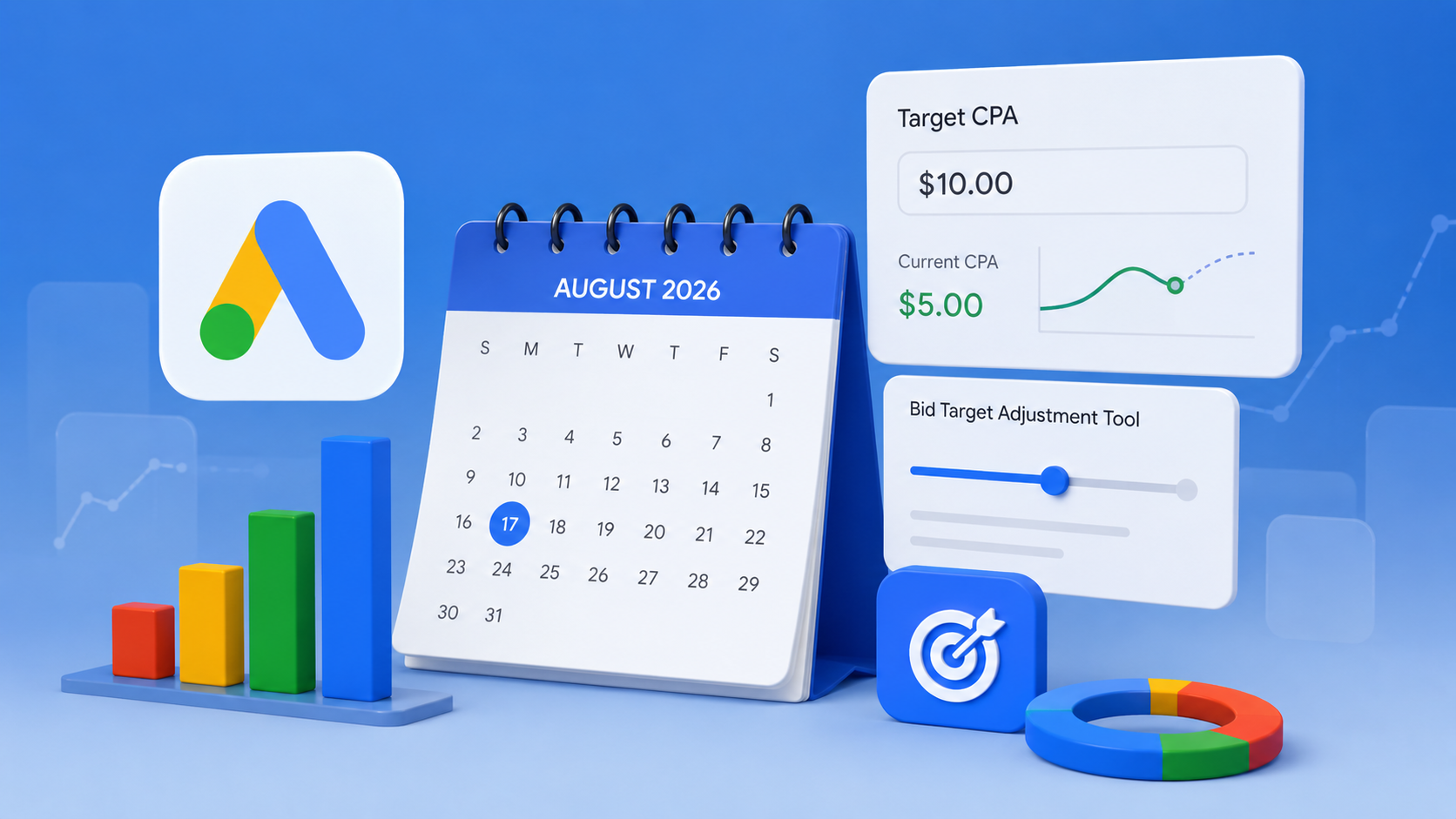
I’ve come across important news about Google Ads that could significantly impact how we manage our campaigns. Google is on the verge of altering its target-based bidding strategies, particularly for campaigns running on limited budgets.
Mark your calendar for August 17th when these changes will take full effect. But don’t worry, a Bid Target Adjustment Tool will be available as of July 6 to help us prepare and adjust our goals accordingly.
What’s going on? Google’s update aims to closely align target-based bidding strategies such as Target CPA with our set goals, even when budget constraints come into play.
They’re introducing a new tool that allows us to tweak our targets before the updates hit, which is crucial for maintaining our campaign performance.
Why should we care? If your campaigns are currently exceeding their target CPA or ROAS goals, they might not continue to do so post-update without adjustment. This update is meant to ensure budget-constrained campaigns stay true to their targets.
For example, if my campaign is achieving a $5 CPA against a $10 target, the performance might shift towards $10 unless I make some changes.
Thankfully, the new tool is there to help us proactively update our bidding goals before the changes roll out. If we don’t take advantage of this, we might end up paying more per conversion or see our performance realign with Google’s targets instead of our historical results.
Why is Google doing this? Google wants to reduce fluctuations and provide more predictable results when we tweak or adjust our budgets.
The tool is designed to help us synchronize our bidding targets more closely with actual business outcomes before the automatic implementation begins.
What should we do? It’s a good time for us to reevaluate campaigns using target-based strategies and verify if our current targets still align with desired results.
Notifications will be sent through Google Ads accounts before the update, and the Bid Target Adjustment Tool can highlight which campaigns might be affected.
Key takeaway: For those of us with campaigns that consistently outperform their targets, maintaining current performance might require tweaking target settings instead of leaving them unchanged.
Reddit’s emerging AI advertising stack is designed to turn community conversations into campaign inputs, creative elements and shopping experiences. The important shift is not simply faster ad production: it is the attempt to make advertising reflect the language, interests and product discussions already present on the platform.
For marketers, the practical question is whether that conversational context can improve relevance without sacrificing accuracy, brand control or measurement discipline. The supplied report outlines a promising toolset, but it also makes clear that several features and their performance evidence remain preliminary.
Key takeaways
Reddit is applying AI to several stages of advertising, including concept generation, community-specific creative, social-proof elements and product discovery.
The reported tools draw on a corpus of more than 25 billion posts and comments, giving Reddit a distinctive source of conversational context.
The free-form ad generator and tailored creative assets were described as beta products, while Redditor Highlights was reported as generally available and the carousel-style shopping format as a test.
Early tests reportedly produced a 130% increase in view-through rates and a 71% increase in video completion rates, but the supplied report does not provide enough methodological detail to treat those figures as universal benchmarks.
Advertisers should evaluate relevance, brand safety, authenticity and incremental business results separately rather than assuming that community-informed creative will improve every metric.
Four advertising jobs within one AI strategy
The reported releases are best understood as a connected workflow rather than a single AI product. Reddit is using community data at four different points: drafting an ad, adapting it to an audience, adding evidence from users and connecting product discovery to relevant discussions.
Generating a platform-native starting point
The free-form ad generator, described as being in beta, combines information from an advertiser’s website with Reddit conversations. Its strategic role is to create a first draft informed by both the brand’s source material and the way related subjects are discussed on Reddit.
That can reduce the distance between conventional campaign copy and a community’s vocabulary, but generated output still requires human review. A brand remains responsible for verifying product claims, preserving its voice and ensuring that conversational language is not mistaken for permission to imitate users.
Adapting creative to particular communities
A second beta capability reportedly identifies relevant communities and produces tailored headlines and visuals. This moves personalization beyond basic audience selection: the creative itself can change according to the context in which it appears.
The potential benefit is greater message-to-community alignment. The corresponding risk is fragmentation. If each variation uses a different promise or tone, campaign managers may struggle to determine whether performance came from the audience, the creative treatment or another delivery variable.
Placing community sentiment inside the ad
Redditor Highlights, reported as generally available, allows advertisers to incorporate Reddit discussions into ads. Unlike AI-generated copy, this feature uses community expression as an explicit credibility layer.
Its value depends on context. A relevant discussion can help a prospective buyer understand why a product matters, while an isolated or unrepresentative comment could create a distorted impression. Advertisers therefore need to assess whether a highlighted conversation supports the ad’s claim and fairly reflects the surrounding sentiment.
Connecting product discovery with active discussion
The report also describes a shopping format being tested in which products appear in a carousel and are matched with ongoing conversations. This treats commerce as an extension of research behavior: a person discussing a need or comparing options can encounter relevant products without leaving the conversational setting.
That proximity may shorten the path from consideration to product discovery, but relevance is crucial. A technically related product can still feel intrusive if the discussion is informational, sensitive or resistant to commercial participation.
The strategic opportunity is context, not automation alone
Many advertising platforms can automate copy or image variations. Reddit’s claimed differentiation is the use of what the report calls Community Intelligence: patterns and sentiment derived from the platform’s conversations. The supplied article says that the underlying corpus exceeds 25 billion posts and comments.
Scale alone does not guarantee insight. The useful part is the relationship among questions, recommendations, objections and purchase considerations within communities. When interpreted carefully, those signals can help an advertiser identify the language people use, the trade-offs they care about and the information missing from conventional product messaging.
This makes the tools potentially useful beyond production speed. They can support a feedback loop in which audience research informs creative, campaign responses expose new questions, and those questions shape later messaging. That is a broader application than using generative AI merely to produce more versions of the same advertisement.
How to read the early performance claims
The source reports that early machine-learning tests delivered a 130% lift in view-through rates and a 71% increase in video completion rates. These figures are signals worth investigating, not settled expectations for every advertiser.
The supplied material does not specify the campaign mix, comparison baseline, test duration, sample size or statistical uncertainty behind the results. It also does not establish which tool or model change produced each lift. Because only one source report was supplied, the claims are not independently corroborated within this synthesis.
View-through and video completion metrics reveal whether people stayed with an ad, but they do not by themselves establish incremental sales, qualified leads or long-term brand effects. A sound test would keep the business objective visible while separating creative engagement from downstream outcomes. Advertisers should compare community-informed creative with an appropriate control, use consistent conversion definitions and examine whether any improvement persists across communities and campaign periods.
A practical framework for advertiser evaluation
The maturity labels in the report should shape adoption. Generally available functionality can enter normal campaign testing with established controls, while beta and experimental formats warrant narrower pilots, closer review and documented assumptions.
Creative quality should be judged on more than fluency. Reviewers need to check whether a generated concept is supported by the advertiser’s website, whether it accurately reflects the targeted community and whether its language respects the difference between participating in a conversation and exploiting it. Claims, visuals and cited discussions should also be examined individually; a suitable headline does not make every associated asset suitable.
Measurement should distinguish three questions. First, did the AI-assisted version improve attention or engagement? Second, did that attention produce a meaningful business result? Third, did the effect come from better creative, a better audience match or the novelty of the format? Treating those as separate questions makes the results more transferable to later campaigns.
Reddit’s direction suggests that community conversations may increasingly influence both what an ad says and where a product appears. The advertisers most likely to learn from that shift will use the tools as structured hypotheses about audience relevance, then let controlled results determine where automation deserves a larger role.
Google is developing two different ways to reduce friction in advertising operations: stronger conversion inputs for advertisers and conversational analysis for publishers. One beta supplements website conversion actions with backend records; the other brings a Gemini-powered assistant into Google Ad Manager.
The tools do not form a single workflow, and the supplied reports do not describe an integration between them. Together, however, they illustrate a broader operating model: improve the evidence used to judge performance, then make that evidence easier to investigate and act on.
Two tools address different parts of the advertising cycle
The distinction between the products matters. CrushPress.AI reported that Google’s supplemental conversion data beta is intended for advertisers using eligible website conversion actions in Google Ads. Ask Ad Manager, meanwhile, was reported as a conversational assistant for publishers working in Google Ad Manager.
Area
Supplemental conversion data
Ask Ad Manager
Primary user
Advertisers measuring website conversions
Publishers managing advertising inventory and delivery
Core problem
Conversions that website tags may not capture
Time spent building reports, investigating delivery and navigating the platform
Main input
Backend transaction records from systems such as CRMs, order databases and ecommerce platforms
Natural-language questions evaluated against the publisher’s Ad Manager data
Reported outcome
A more complete conversion action for measurement and optimization
Tailored answers, reports, recommendations and platform guidance
Important boundary
Enhances rather than replaces website tagging
Assists analysis and operations rather than repairing conversion collection
This comparison prevents a common category error. Better conversion capture cannot diagnose every publisher delivery issue, while a conversational reporting interface cannot recover a transaction that never reached an eligible conversion action. Each tool works on a different constraint.
Supplemental data strengthens the measurement foundation
According to CrushPress.AI’s report, the Google Ads beta lets an advertiser attach an additional data source to an existing website conversion action through Google Ads Data Manager or the Data Manager API. Backend conversion records are combined with signals collected by Google tags, allowing the same conversion action to support campaign measurement and optimization.
The reported purpose is recovery, not replacement. Browser restrictions, privacy settings or ad blockers can prevent some tag-based signals from being captured. Transactional systems may retain evidence of those completed outcomes, so supplying that evidence can make measurement more resilient and give automated bidding a more complete input set.
That benefit depends on record quality. The report states that every upload must include a transaction ID and the conversion date and time, plus at least one attribution identifier such as hashed customer data or a Google click identifier. Google reportedly uses transaction IDs to deduplicate tag and backend records within the same conversion action.
The reported eligibility limits are equally significant. The beta applies to website conversion actions implemented with Google tags or Google Tag Manager; Google Analytics imports and URL-based conversion actions are excluded. Google also advises adding the supplemental source to the existing action instead of creating another action, which could introduce double-counting across campaign goals. Prompt uploads and conversion values formatted consistently with the tag’s currency were also reported as recommended practices.
Ask Ad Manager compresses the path from question to diagnosis
Ask Ad Manager tackles a different bottleneck: extracting usable answers from a complex publisher platform. CrushPress.AI described it as a Gemini-powered beta that lets Google Ad Manager users ask questions in ordinary language and receive responses grounded in their own Ad Manager data.
The reported capabilities span three recurring tasks. The assistant can investigate why line items are underdelivering and suggest possible causes or next steps. It can produce requested metrics, benchmarks and customized reports without requiring the user to construct each report manually. It can also direct a user to relevant Ad Manager pages while applying filters and settings derived from the conversation.
The practical shift is from interface-led work to question-led work. Instead of beginning with menus, report fields and filters, a publisher can begin with the business or delivery question. The assistant then helps translate that question into platform activity. This may reduce operational effort, but the source does not establish that every answer or recommendation will be correct. As a general operating discipline, consequential findings should still be checked against the underlying report and campaign configuration.
The report also attributes a wider roadmap to Google. Planned additions include developer tools such as REST APIs and an MCP server, along with specialized agents that could help publishers and agencies explore inventory, negotiate deals and execute campaigns. Those items are forward-looking plans, not capabilities established by the reported beta.
Key takeaways
The conversion beta improves the data entering an eligible Google Ads conversion action; Ask Ad Manager improves how publishers interrogate and use their Ad Manager data.
Supplemental conversion data depends on reliable transaction IDs, timestamps, attribution identifiers and consistent values, as well as correct conversion-action configuration.
Deduplication is central to the measurement design because tag and backend systems may describe the same transaction.
Conversational analysis can shorten reporting and troubleshooting work, but important recommendations still warrant validation against source data and settings.
Both features were reported as betas, while the APIs, MCP server and specialized Ad Manager agents remain part of Google’s stated roadmap.
A practical evaluation framework for advertising teams
Teams evaluating the conversion beta should first determine whether their conversion actions use an eligible implementation. They can then assess whether backend systems retain the required identifiers, timestamps and values, and whether transaction IDs remain consistent across the tag and transactional record. This is not merely an integration exercise: weak identity matching, inconsistent currency formatting or duplicate campaign goals can undermine the additional data.
Publishers assessing Ask Ad Manager should judge it against concrete operational questions. Useful tests include whether it can reproduce a trusted report, identify a known delivery issue and navigate to the correct filtered view. The relevant measure is not how fluent the conversation sounds, but whether it reduces investigation time without obscuring the evidence behind an answer.
Across both products, data discipline remains the connecting requirement. More complete records can improve the basis for optimization, while a conversational layer can make platform data more accessible. Neither advantage removes the need for clear conversion definitions, dependable identifiers, reviewable reports and accountable decisions.
If Google’s reported direction continues, advertising work will increasingly combine first-party data connections with agent-assisted operations. The teams best positioned to benefit will be those that treat reliable data and human verification as prerequisites for automation, not as cleanup work after deployment.
Meta’s shopping initiatives bring three parts of social commerce closer together: live product discovery, personalized advertising and payment. The supplied reporting describes a strategy for turning attention inside Facebook and Instagram into purchases with fewer interruptions.
For advertisers, the important development is not any one feature in isolation. Live ads can widen discovery, product catalogs can improve relevance, and virtual cards can address payment hesitation. Their value depends on how well those layers operate as one purchase path.
Live ads extend the storefront beyond its original audience
CrushPress.AI reported that Meta was expanding Live Video Ads globally on Facebook and introducing them on Instagram. In the United States, the company was also working with live-commerce providers CommentSold and TalkShopLive to help sellers turn livestreams into ads capable of reaching people who had not joined the original broadcast organically.
This changes the role of a live shopping event. Instead of functioning only as a scheduled broadcast for an existing following, it can also supply advertising creative and product demonstrations for a wider audience. Facebook’s Live Shopping tools, according to the report, allow viewers to browse and purchase products without leaving the livestream.
The resulting funnel is shorter in principle: a viewer encounters a demonstration, evaluates the featured product and moves toward purchase within the same experience. That convenience may remove unnecessary navigation, although it does not guarantee demand or compensate for an unclear offer.
Virtual cards address a specific source of checkout friction
The report also described a planned virtual-card payment feature for Facebook and Instagram, developed through collaborations with Mastercard and Visa. It said the system would generate a temporary, one-time card number linked to a shopper’s existing card, allowing a transaction without exposing the underlying card details.
That design addresses a narrow but meaningful trust question: whether a shopper must disclose a primary card number during an in-app purchase. It should not be interpreted as a complete guarantee of transaction safety. Virtual card numbers do not resolve concerns about product quality, delivery, refunds, merchant legitimacy or account security.
The distinction also matters when assessing availability. The supplied material characterizes the feature as an upcoming rollout but does not provide enough detail to establish current geographic coverage, merchant eligibility or adoption. Advertisers should therefore verify access in their own accounts before designing a campaign around it.
Product catalogs become the connective data layer
CrushPress.AI reported that Meta was making product data a core component of Sales campaigns. The described approach combines catalog feeds with creative assets while Meta’s AI assembles ads for individual users. Details such as price and availability can therefore influence both what is shown and how accurately an ad reflects the product being sold.
This positions the catalog as more than an inventory file. It connects recommendations, ad delivery and the purchase opportunity. The report also framed product discovery as increasingly driven by recommendations appearing in feeds, creator videos and business content rather than beginning with a conventional product search.
That makes feed quality operationally important. If product names, prices, availability or destinations are incomplete or stale, automated assembly can distribute those weaknesses at scale. Strong creative still matters, but it must be supported by reliable commerce data.
Campaign evaluation should follow the entire purchase path
The combined proposition should be assessed as a sequence rather than as an ad-format experiment alone. Advertisers need to distinguish reach generated by live promotion from meaningful product engagement, checkout starts and completed purchases. A large viewing audience is useful only when it produces qualified movement through the funnel.
Catalog accuracy, livestream presentation and checkout confidence can each become a constraint. If viewers engage but do not open product information, the offer or demonstration may need work. If product engagement is healthy but checkout completion is weak, payment confidence, total cost or post-purchase policies may deserve closer examination. Virtual cards could remove one objection, but they cannot diagnose every reason for abandonment.
Advertisers should also separate platform automation from commercial judgment. Meta’s AI can use product data to assemble and deliver ads, as the report describes, but businesses remain responsible for assortment, positioning, accurate information and the customer experience after payment.
Key takeaways
Live shopping ads can extend a broadcast beyond its organic audience while keeping product discovery close to the buying action.
Virtual card numbers are intended to limit exposure of a shopper’s underlying card details, but they address only one dimension of transaction trust.
Product catalogs increasingly support ad personalization and discovery, making feed accuracy central to campaign quality.
Performance should be judged across viewing, product engagement, checkout initiation and purchase rather than by reach or clicks alone.
The next meaningful test is whether Meta can make these layers consistently available and reliable enough to produce measurable gains for merchants. Advertisers that establish clean catalog data and full-funnel measurement will be better positioned to evaluate that opportunity as access expands.
A reported Google Ads change will shift more responsibility for classifying conversion-based customer lists into Google’s systems beginning in August 2026. For advertisers, the important question is not simply what label appears in Audience Manager, but whether that label matches the role each audience actually plays.
The practical response is to audit lifecycle definitions before the reported change takes effect. Clear distinctions between customers, prospects, and other segments can reduce the risk that automated acquisition or retention decisions are informed by the wrong audience signal.
What Google reportedly plans to classify
CrushPress.AI reports that Google will automatically categorize customer types in conversion-based lists starting in August 2026. The reported categories are existing customers, new customers, and other customer segments.
The report frames the change as part of Google’s effort to make customer-acquisition and retention signals more consistent across its advertising tools. It also says Google Ads expert Bia Camargo first identified the alert on LinkedIn. Because the available source does not detail every classification rule, advertisers should avoid assuming how Google will resolve ambiguous or overlapping audiences.
Key takeaways
Google reportedly plans to classify conversion-based customer lists automatically from August 2026.
The stated classifications distinguish existing customers, new customers, and other customer segments.
A technically accurate list can still send an unsuitable lifecycle signal if its business meaning is unclear.
Advertisers should review Customer Match lists and their classifications in Google Audience Manager before the change.
Why lifecycle labels matter to automated campaigns
Audience membership and audience meaning are different things. A list may accurately contain people who completed a conversion, yet that conversion may not represent the same customer state in every business. The source specifically warns that incorrect classification could affect how Google’s systems optimize users across their lifecycle.
This matters because acquisition and retention strategies ask different questions. Acquisition focuses on finding or prioritizing people treated as new customers, while retention focuses on people the business already recognizes as customers. When a list’s Google-assigned category does not match the advertiser’s internal definition, automation may receive a signal that is valid at the data level but misleading at the strategy level.
The central risk is a mismatch in definitions
The reported categories sound straightforward, but their boundaries may not be. An advertiser’s internal customer model can contain lifecycle distinctions that do not map neatly to broad labels such as existing, new, or other. The source does not explain how Google will treat every edge case, so the safest analysis is to focus on whether each list has one clear strategic purpose.
The most consequential ambiguity is likely to appear where conversion status and customer status are treated as interchangeable. A conversion-based list records an action according to the advertiser’s setup; classification assigns that audience a role in the customer journey. Reviewing the underlying meaning of the conversion is therefore more useful than relying on a familiar list name alone.
How to prepare before August 2026
The source recommends auditing Customer Match lists based on conversion data in Google Audience Manager. That review should establish what each list contains, which lifecycle state the business intends it to represent, and whether Google’s expected classification appears consistent with that intent.
Advertisers should pay particular attention to lists used in customer-acquisition strategies, because the reported change is intended to clarify the distinction between prospecting and retention audiences. Internal campaign owners should also agree on the meaning of each lifecycle label so that a list is not interpreted differently across campaigns.
The goal before August 2026 is not to predict every decision Google’s classifier may make. It is to remove avoidable ambiguity from the audience signals the system will evaluate and to be ready to assess whether the resulting classifications still support the intended campaign strategy.
Two advertising-platform updates are changing different parts of campaign management: Microsoft is adding professional seniority as an audience signal, while Google is changing how certain impression-influenced Demand Gen activity is billed.
Together, the changes illustrate a broader operating challenge for advertisers. More precise controls can improve campaign decisions, but only when targeting, optimization, billing and measurement remain aligned with the business outcome.
Microsoft adds a professional-identity layer to targeting
CrushPress.AI’s Microsoft Ads report says LinkedIn Profile targeting now includes job seniority for Search and Audience campaigns. Advertisers can reportedly select from 10 levels, ranging from CXO to Volunteer, and apply the setting at either the campaign or ad-group level.
The practical value is not merely narrower reach. Seniority can help distinguish people who may approve a purchase from those who influence, evaluate or use it. A B2B advertiser could therefore separate executive-oriented messaging about organizational outcomes from practitioner-oriented messaging about operational efficiency.
The report also says the seniority filters can be used in observation mode. That gives advertisers a lower-risk way to examine performance by professional level without initially restricting delivery. Availability was reported for selected markets across the Americas, EMEA and APAC, so account-level access should be confirmed before campaign plans depend on the feature.
Google ties some Demand Gen charges to impressions
CrushPress.AI’s Google Ads report describes a different kind of change. From July 15, Demand Gen campaigns on Discover using view-through conversion optimization are reportedly moving from cost-per-click billing to cost-per-thousand-impressions billing. The transition is described as automatic and limited to campaigns with that optimization enabled.
The reported rationale is alignment: a view-through conversion credits an impression that precedes a later conversion even when the user does not click the ad, so impression-based billing more closely matches the behavior being optimized. Advertisers that do not want the new billing treatment can reportedly disable view-through conversion optimization.
The updates affect different campaign levers
Microsoft’s update changes audience interpretation: it offers another signal for deciding who should see an ad, how much that audience may be worth and which message it should receive. Google’s update changes the economic frame: advertisers using the affected optimization will pay according to exposure rather than clicks.
That distinction matters when comparing results across platforms. A Microsoft segment may appear valuable because it identifies a strategically important professional group, even if its immediate conversion volume is modest. A Google campaign may generate more billable impressions without a corresponding rise in clicks, even while the system is pursuing view-through outcomes. Neither pattern can be interpreted responsibly through a click-only dashboard.
The common requirement is measurement discipline. Audience quality, conversion value, impression volume, click activity and attributed conversions answer different questions. Platform settings determine which of those signals influence delivery and cost, while the advertiser must decide whether they represent meaningful business progress.
Key takeaways
Microsoft’s reported seniority targeting can support separate bids, messages and analysis for decision-makers, influencers and practitioners.
Observation mode offers a way to assess seniority performance before using the signal to limit Microsoft Ads reach.
Google’s reported CPM transition applies to Discover Demand Gen campaigns using view-through conversion optimization, not every Demand Gen campaign.
Advertisers evaluating the Google change should track spend and impression movement alongside clicks, attributed conversions and downstream business results.
Cross-platform reporting should distinguish an audience-targeting change from a billing change instead of treating both as ordinary performance fluctuations.
What advertisers should watch next
Microsoft advertisers can begin with observation data and look for durable differences in lead quality before segmenting budgets aggressively. Google advertisers affected by the billing transition should document their pre-change delivery and cost patterns, then assess whether view-through optimization continues to fit their attribution standards and campaign purpose.
As platforms connect campaign objectives more tightly to audience signals and charging models, account teams will need to review settings as strategic choices rather than background configuration. The most useful next step is to establish which business outcome each setting is meant to improve before the resulting platform metrics begin to move.
PPC bidding can determine which auctions an advertiser enters and how aggressively a campaign pursues demand. It cannot, by itself, determine whether a click becomes a qualified lead, a signed client, or profitable revenue.
Taken together, the two source reports point to a more useful way to evaluate bidding: connect auction-time optimization with search intent, landing-page relevance, operational follow-up, and closed-loop measurement. That makes it possible to distinguish genuine growth from a larger volume of inexpensive but low-value conversions.
Key takeaways
Automated bidding can explore additional demand, but its value depends on whether the campaign optimizes toward conversions that reflect business outcomes.
CPA and ROAS targets are operating controls, not complete measures of performance; qualified leads, signed cases, and revenue provide essential context.
Temporary bidding and budget changes can help capture peak demand when they are paired with sufficient fulfillment or intake capacity.
Search-term reviews, intent-specific landing pages, CRM outcomes, and offline conversion data give bidding systems more meaningful signals.
Budget allocation should follow marginal business value rather than lead volume alone.
Why efficient bidding can still produce weak business results
A platform can lower the reported cost per conversion while the underlying economics deteriorate. This happens when the conversion being optimized is too far removed from the outcome the advertiser actually values. A form submission, for example, may be easy to generate but may say little about qualification, purchase intent, or eventual revenue.
The law-firm PPC source illustrates the problem through the difference between leads and signed retainers. It argues that cost per lead alone leaves out the intake process, response speed, qualification, and the rate at which qualified prospects become clients. Its recommended reporting chain extends from ad spend and leads through qualified leads, signed cases, CPL, and CPA, segmented by channel and practice area.
That distinction also changes how an advertiser should interpret automated bidding. Google’s Smart Bidding Exploration update, as described in the other source, lets advertisers specify a ROAS tolerance so campaigns can pursue conversion opportunities beyond queries they might otherwise reach. The source reports that campaigns using the capability saw about an 18% increase in unique converting search-query categories and a 19% increase in conversions. Those are platform-reported expansion indicators; they do not establish that every additional conversion carried the same downstream value.
The practical question is therefore not simply whether bidding found more conversions. It is whether the incremental conversions remained qualified and profitable after the full customer journey was considered.
Conversion quality is built before and after the auction
Better outcome data begins with the query. The law-firm source recommends reverse-engineering keyword strategy from call transcripts and CRM records rather than beginning with broad, generic terms. It also advocates segmenting keywords and campaigns by intent, funnel stage, budget, and conversion objective, with weekly search-term reviews used to identify valuable language and exclude irrelevant demand.
This creates an important complement to bidding automation. The algorithm decides among available opportunities, while campaign structure defines which opportunities are grouped together and which outcome signals they share. If high-intent and exploratory traffic are mixed under one target, an aggregate CPA can conceal substantial differences in lead quality.
Landing pages provide the next quality filter. The law-firm report calls for alignment between the searcher’s intent and the page headline, supporting proof, fast mobile performance, and immediate contact options. It reports that replacing a generic page with intent-specific pages, recent reviews and results, and fewer form fields doubled one client’s conversion rate without additional ad spend. Because this is a single account example reported by the source, it should be treated as illustrative rather than a universal expectation.
Post-contact operations complete the chain. The same source recommends a response time below 60 seconds, an answer rate above 90%, and a signed rate of 25% to 40% among qualified leads for the law-firm context. These are the source’s operational targets, not general benchmarks for every industry. Their broader significance is that slow or inconsistent follow-up can erase gains produced by bidding and landing-page optimization.
Use automated expansion and peak bidding with guardrails
Google’s reported updates introduce two distinct bidding use cases. Smart Bidding Exploration is intended to uncover incremental demand while allowing a degree of ROAS flexibility. Promotion Mode, described as a beta in the source, is designed for temporary changes to ROAS targets and daily budgets around seasonal events, product launches, and flash sales. The source also says Exploration was extended to Performance Max campaigns without product feeds and was being tested for Shopping ads in Performance Max and Standard Shopping campaigns.
Exploration should be judged as a controlled expansion test. Advertisers need to compare the new query categories with established traffic on qualified-conversion rate, acquisition cost at the final outcome, and revenue contribution. Search-term analysis remains relevant even when automation broadens reach because it can reveal whether incremental volume represents new high-intent demand or merely looser matching.
Promotion-oriented bidding requires a different guardrail: operational readiness. Raising a daily budget and relaxing a ROAS target may generate more opportunities during a short demand window, but the extra volume only has value if inventory, sales, intake, and customer service can process it. Temporary settings should also have a defined end point so an exceptional trading period does not quietly become the campaign’s permanent efficiency standard.
For campaigns constrained by budget, the Smart Bidding source also reports a change intended to produce more consistent performance against CPA and ROAS targets. Consistency can make planning easier, but a target should not be treated as proof of profitability. Budget decisions still need to account for the quality and economic value of the outcomes being purchased.
Build a measurement loop that bidding can learn from
A reliable PPC system connects UTMs, call tracking, website analytics, CRM stages, and final outcomes. The law-firm source specifically points to Google Analytics and CRMs such as Lawmatics or Clio as parts of that chain. Its emphasis is not the choice of software, but the ability to trace a click through qualification and retention rather than ending reporting at the ad platform.
That closed loop supports better decisions at three levels. Search terms and landing pages can be evaluated by the quality they produce. Campaign targets can be based on downstream value instead of superficial conversion volume. Budgets can then move toward the channels, practice areas, or intent groups that contribute the strongest business outcomes.
The law-firm source also recommends Marketing Efficiency Ratio as an ecosystem-level measure rather than evaluating every channel in isolation. Used alongside channel-level CPL, CPA, qualified-lead rates, and signed outcomes, it can help distinguish the contribution of the overall marketing mix from the performance reported inside a single platform.
The next stage of PPC optimization is therefore less about choosing between automation and manual control than about improving the feedback connecting them. Advertisers that define valuable conversions, preserve intent distinctions, and return verified outcomes to the campaign will be better positioned to use bidding expansion without losing sight of profitability.
Google’s expansion of its Limited ad serving policy adds a trust and identity layer to Search advertising visibility. According to CrushPress.AI, Google may restrict impressions when an advertiser appears unqualified, attracts negative user feedback, or makes its identity difficult to recognize.
For advertisers, the practical issue is broader than formal policy compliance. Clear branding, an understandable offer, and consistency between the ad and landing page may now help determine whether an otherwise eligible campaign receives its intended reach.
What the expanded policy changes
CrushPress.AI reports that Google is extending Limited ad serving to more Search scenarios and plans to continue implementing the expansion through 2028. The policy gives Google greater scope to limit ads on searches where it believes showing them could result in a poor user experience.
This distinction matters operationally. A campaign can have bids, targeting, and creative in place yet still encounter constrained exposure if Google does not have sufficient confidence in the advertiser or believes users could be confused about who is behind the message. That makes limited serving an eligibility and trust concern, not simply a conventional campaign-performance problem.
Key takeaways
Google is expanding Limited ad serving across additional Search scenarios, according to CrushPress.AI.
Advertiser qualification, user feedback, and the clarity of the advertiser’s identity can influence ad visibility.
New advertisers, brands associated with negative feedback, and ads with ambiguous branding may face greater reach risk.
Advertisers should make the business identity, offer, and brand relationships easy to understand in both ads and landing pages.
A domain-focused first headline in a responsive search ad is one tactic reported as potentially helpful for clarifying identity.
Trust signals now sit closer to campaign reach
The source highlights two related signals: user feedback and advertiser identification. Advertisers that receive frequent complaints about misleading content or practices could have their ads limited. Restrictions may also apply when an ad does not make it easy for a searcher to determine who the advertiser is.
Together, those signals create a wider standard than checking whether individual words or claims violate a rule. The apparent question is also whether the complete experience is trustworthy and intelligible: Is the business clearly named? Does the message explain what is being offered? Does the landing page confirm the same identity and purpose?
This can be especially consequential for generic ad copy. A message built around a broad promise may leave little room for a recognizable brand, domain, or relationship disclosure. Similarly, an advertiser referring to another company, product, or service can create ambiguity if the affiliation is not explained. CrushPress.AI specifically advises advertisers to clarify brand affiliations rather than leaving users to infer them.
Which advertisers have the most immediate exposure
CrushPress.AI identifies newcomers, brands with negative feedback, and advertisers whose ads do not clearly present their identity as groups that could see their appearance frequency affected. These are not necessarily identical problems, so each calls for a different response.
New advertisers: The challenge is establishing recognizable and consistent identity signals when little history is available.
Advertisers receiving complaints: The priority is identifying whether users are reacting to unclear claims, misleading presentation, or a mismatch between the ad and the destination.
Businesses using generic creative: The immediate task is making the advertiser and offer explicit without forcing the searcher to interpret vague language.
Advertisers referencing other brands: The relationship should be stated accurately so the ad does not imply an affiliation that the landing page cannot substantiate.
A reach decline should therefore be investigated separately from ordinary auction volatility. Adjusting bids or rewriting a call to action may not address a restriction rooted in identity confusion or trust. The diagnostic question should be whether the advertiser is understandable before the team treats the issue as a pricing or conversion problem.
A practical audit for clearer advertiser identity
The source recommends stronger brand visibility, less generic messaging, clearer affiliations, and alignment between ads and landing pages. Advertisers can turn those principles into a repeatable review:
Read the ad without account context. Check whether an unfamiliar searcher could name the advertiser and understand the offer from the visible message alone.
Review responsive search ad combinations. Make sure identity does not disappear when assets are assembled in different combinations. CrushPress.AI notes that placing a domain headline in the first position can help make the advertiser more apparent.
Compare the ad with its destination. Confirm that the landing page promptly reinforces the same business name, domain, offer, and relationship described in the ad.
Replace avoidable ambiguity. Rework generic promises, unclear pronouns, or language that could make one business appear to be another.
State affiliations precisely. If the offer involves a partner, marketplace, reseller relationship, or another brand, describe that relationship accurately rather than relying on implication.
Examine complaint patterns. Where feedback is available, look for recurring confusion about identity, claims, billing, fulfillment, or the nature of the offer, then address the underlying experience.
The continuing rollout reported through 2028 makes this an ongoing governance issue rather than a one-time copy edit. Advertisers that incorporate identity clarity into creative reviews, landing-page checks, and feedback analysis will be better positioned to adapt as Google applies the policy to more Search situations.
A weak paid media result can originate in several places: the reporting may be misleading, an advertised item may be unable to serve, or eligible inventory may simply be underperforming. Treating every symptom as an optimization problem risks changing bids, budgets, or creative before the underlying fault is known.
Recent reporting on Google Analytics source controls and Microsoft Ads catalog diagnostics points to a more disciplined approach. Measurement integrity should be checked first, delivery eligibility second, and performance efficiency only after both foundations are credible.
A diagnostic sequence for separating symptoms from causes
The two source reports address different parts of the paid media system. The Google Analytics changes concern how traffic is classified and which domains contribute events to reporting. Microsoft Ads Product Explorer concerns whether catalog items are eligible, sufficiently described, and producing results. Together, they support a layered diagnostic model rather than a single dashboard verdict.
Diagnostic question
Layer under review
Relevant evidence
Decision it informs
Can the reported traffic be trusted?
Measurement integrity
Source classification and hostname provenance
Whether channel comparisons are reliable enough to guide budget decisions
Could the advertised products serve?
Delivery eligibility
Catalog status, required metadata, and identified feed issues
Whether reach is constrained before bidding or creative can have an effect
How did eligible inventory perform?
Performance efficiency
Product-level results and consistently classified conversion traffic
Which items or channels warrant optimization, expansion, or closer investigation
This sequence matters because similar symptoms can have unrelated causes. A channel can appear fragmented when one platform is recorded under several source names. A product can show no meaningful activity because it is not eligible to serve. Only after those possibilities are addressed does an efficiency diagnosis become well grounded.
Clean attribution before comparing channel performance
The Google Analytics source reported that a new Source Group reporting dimension consolidates variations of the same traffic source. Its example groups labels such as “facebook” and “fb” into one recognizable value. It also reported improvements to the Source Platform field intended to make classifications more consistent across advertising channels.
For paid media diagnostics, that standardization reduces a common analytical distortion: one platform appearing as several small sources while another appears as a single consolidated source. The report said the structure extends beyond Google properties to platforms including TikTok, Pinterest, and Amazon, while also accounting for AI-originated traffic such as ChatGPT and Perplexity. It further said source-group information is available retroactively for historical analysis.
Source consolidation does not resolve every attribution limitation. It makes labels more coherent, but a consistently named source is not automatically proof that the source caused a conversion. Analysts still need to distinguish reporting consistency from causal measurement and apply the same attribution interpretation when comparing channels.
The reported hostname filters address a separate trust issue. According to the Google Analytics source, administrators can exclude events from unapproved domains before those events enter reporting. This can help prevent traffic associated with unexpected hosts from influencing campaign analysis. The practical control is to document which domains are legitimate before filtering; otherwise, an overly narrow approval set could remove activity that should have remained visible.
Check catalog eligibility before optimizing retail campaigns
Microsoft Ads Product Explorer moves the investigation from attribution to inventory readiness. The Microsoft-focused source described a searchable catalog interface with filters for SKU, title, GTIN, and product ID. It reportedly surfaces eligibility problems, metadata gaps, and other conditions that may stop products from serving, while providing recommended actions and exportable filtered product lists.
This changes how low delivery should be interpreted. If a product is ineligible or lacks necessary feed information, adjusting campaign-level settings does not address the immediate constraint. Catalog remediation comes first. Once an item is active and capable of serving, its advertising results can be evaluated as a performance issue rather than confused with a feed-health issue.
The source also reported product-level performance visibility covering the previous 30 days. That window can connect operational diagnostics with observed activity: advertisers can distinguish products blocked by catalog problems from active items receiving exposure or producing results. The report stated that Product Explorer was live in advertiser accounts, although the source did not independently test its coverage or recommendations.
Turn cleaner evidence into better optimization decisions
The strongest synthesis is not a new all-in-one metric. It is a division of diagnostic responsibilities. Analytics source controls help establish whether cross-channel reports are internally coherent. Catalog tools help establish whether retail inventory can participate in the auction. Performance analysis then assesses what happened among the traffic and products that survived those checks.
That separation also clarifies ownership. Measurement anomalies belong with analytics governance; product eligibility and metadata gaps belong with feed operations; efficiency questions belong with campaign management. Teams can still investigate collaboratively, but each finding should be routed to the layer capable of correcting it.
A defensible performance review should therefore record both the result and the conditions under which it was observed. Channel comparisons should note whether source grouping and hostname controls were reviewed. Retail conclusions should note whether the relevant products were eligible and whether catalog issues were present. This creates an audit trail that makes later changes in reported performance easier to interpret.
Key takeaways
Validate source classification and domain provenance before moving budget based on cross-channel reports.
Treat source standardization as a reporting improvement, not as proof of causal attribution.
For retail advertising, resolve eligibility and metadata problems before diagnosing low delivery as a bidding or creative failure.
Evaluate product and campaign efficiency only after measurement integrity and serving readiness have been checked.
As advertising platforms automate more campaign execution, diagnostic discipline becomes more important, not less. The next useful advance will be a repeatable review process that connects trustworthy measurement, servable inventory, and performance decisions without collapsing them into the same signal.
Two Google advertising updates point to a broader operating model for advertisers: eligibility must be maintained through clearer requirements, while campaign improvements should be validated through controlled experiments. The changes affect different products, but together they show how governance and optimization are becoming more structured.
For Local Services Ads, the reported emphasis is on clearer terminology and alignment with Google’s revised badge framework. For Performance Max, the emphasis is on testing creative decisions before applying them more broadly. Advertisers therefore need both reliable compliance processes and a repeatable approach to experimentation.
Two updates address different kinds of advertising risk
CrushPress.AI’s Local Services Ads coverage reported that Google plans to rename its “Local Services platform policies” as “Local Services Ads requirements” on July 6. The report characterized the change as a clarification and modernization of guidance rather than a major enforcement crackdown. It also connected the revised language to Google’s recent restructuring of its badge system and verification standards.
That update concerns participation risk: whether a business understands and satisfies the conditions associated with advertising and badge eligibility. Clearer requirements may reduce ambiguity, but a new label does not eliminate the need to keep credentials, verification information and operating standards current.
The separate Performance Max report focused on decision risk. Because creative changes can affect results, advertisers need evidence before committing budget across campaigns. The newly reported experiment capabilities are intended to provide a more controlled way to assess assets instead of treating every creative revision as an immediate full rollout.
Performance Max testing adds more useful creative comparisons
According to CrushPress.AI’s coverage, Performance Max advertisers can test entirely new asset groups, evaluate the effect of adding individual assets, and compare seasonal material with evergreen creative. The report also said that assets produced through Google’s Asset Studio can be included, allowing generated creative and other asset approaches to be assessed within the same experimentation framework.
The practical value is not simply the ability to declare one asset a winner. The report described an additional success metric that can help advertisers evaluate more than one objective, such as conversion volume alongside efficiency. This matters because a creative change can improve one measure while weakening another; a broader evaluation can expose that trade-off before the change is expanded.
The coverage also reported that experiments, including conversion lift studies, are being centralized on one Experiments page. Support for manager accounts and the Google Ads API was described as beginning to roll out soon, while further experiment and measurement capabilities were said to be forthcoming. Those rollout statements should be treated as reported product direction rather than proof that every account already has access.
Key takeaways
Local Services Ads guidance is reportedly being reframed as explicit requirements and aligned with Google’s revised badge and verification framework.
The Local Services Ads change was presented as a clarity initiative, but businesses still need dependable processes for maintaining eligibility information.
Performance Max experiments reportedly support tests of asset groups, individual additions, seasonal versus evergreen creative, and assets created with Asset Studio.
An additional success metric can help teams judge creative against multiple campaign objectives rather than a single headline result.
Centralized experiment management may simplify oversight, although manager-account and API support were reported as rolling out rather than universally available.
Advertisers need separate controls for eligibility and performance
The two updates should not be collapsed into a single workflow. Local Services Ads requirements concern whether an advertiser can participate and qualify under the relevant framework. Performance Max experiments concern whether a proposed creative change produces a desirable outcome. Passing a verification check says nothing about asset effectiveness, while a successful creative test says nothing about compliance or badge eligibility.
A practical response is to assign each issue to the appropriate review process. Local advertisers and their agencies can track requirement changes, verification materials and badge-related dependencies as governance work. Performance teams can document the hypothesis behind each asset experiment, the primary and secondary measures used to judge it, and the scope of any subsequent rollout.
This separation also makes accountability clearer. Eligibility reviews should answer whether the business remains qualified and whether its information is current. Experiment reviews should answer what changed, what comparison was made, which measures moved and whether the evidence supports broader deployment. Both disciplines reduce avoidable risk, but they do so in different ways.
Questions remain about access, enforcement and interpretation
The source material does not establish how the renamed Local Services Ads requirements will affect individual advertisers, whether enforcement practices will change, or exactly how compliance will determine badge status in every case. The reported alignment suggests that eligibility and trust signals should be reviewed together, but it does not justify assuming a new penalty or automatic badge outcome.
Likewise, the Performance Max report does not provide universal availability dates, account-level eligibility details or a guarantee that every experiment will produce a conclusive result. Advertisers should confirm which capabilities appear in their own accounts and avoid treating an announced rollout as completed access.
As Google develops both frameworks, the durable advantage will come from operational readiness: maintaining evidence for eligibility decisions and using experiments to support creative decisions. Teams that establish those routines can adapt to additional requirements and measurement features without rebuilding their processes around every product update.