
Tag: Business Strategy

  • How to Choose an Industry-Specific GEO, AEO, and SEO Agency

    How to Choose an Industry-Specific GEO, AEO, and SEO Agency

    You have a shortlist of agencies, and every one of them claims to understand your industry. The difficult part is determining whether that expertise changes the work or merely changes the sales deck.

    You can make that decision without relying on polished case studies or a vague AI visibility score. Test how each agency maps your buyers, handles sector-specific evidence, separates GEO from AEO and SEO, measures progress, and works inside your approval process.

    Decide what industry specialization must change

    An industry-specific agency does not necessarily need to work exclusively in your sector. It does need to show that sector knowledge changes its decisions. If the proposed strategy would remain the same after swapping your company name for a business in another industry, the specialization is probably cosmetic.

    Look for specialization in five parts of the work:

    • Audience distinctions: The team separates people who use, approve, recommend, regulate, or pay for the product. Those audiences often ask similar questions but require different evidence and calls to action.
    • Query interpretation: The agency understands what your buyers mean when they use ambiguous category terms, abbreviations, product names, specialty language, or location modifiers.
    • Evidence standards: It can identify which claims need subject-matter review, primary documentation, current product data, or third-party corroboration before publication.
    • Entity relationships: It understands how your company, products, experts, locations, services, integrations, and parent or subsidiary brands should be represented consistently.
    • Conversion design: It knows whether a useful next step is a purchase, consultation, demo, application, appointment, property inquiry, technical evaluation, or another sector-specific action.

    This is why a broad label such as healthcare, financial services, real estate, or SaaS is not enough. A healthcare team may be credible in one specialty and generic in another; healthcare specialty breadth is evaluated separately from reviews, retention, leadership experience, and AI visibility. In financial services, experience with complex niches and the tenure of the people doing the work can reveal whether expertise belongs to a durable delivery team or a single salesperson.

    Ask each candidate to explain which parts of its standard process would change for your exact market. Require named changes to the query map, evidence model, review workflow, entity strategy, and conversion path. A credible answer will contain operational differences, not just industry terminology.

    Make the agency prove all three disciplines
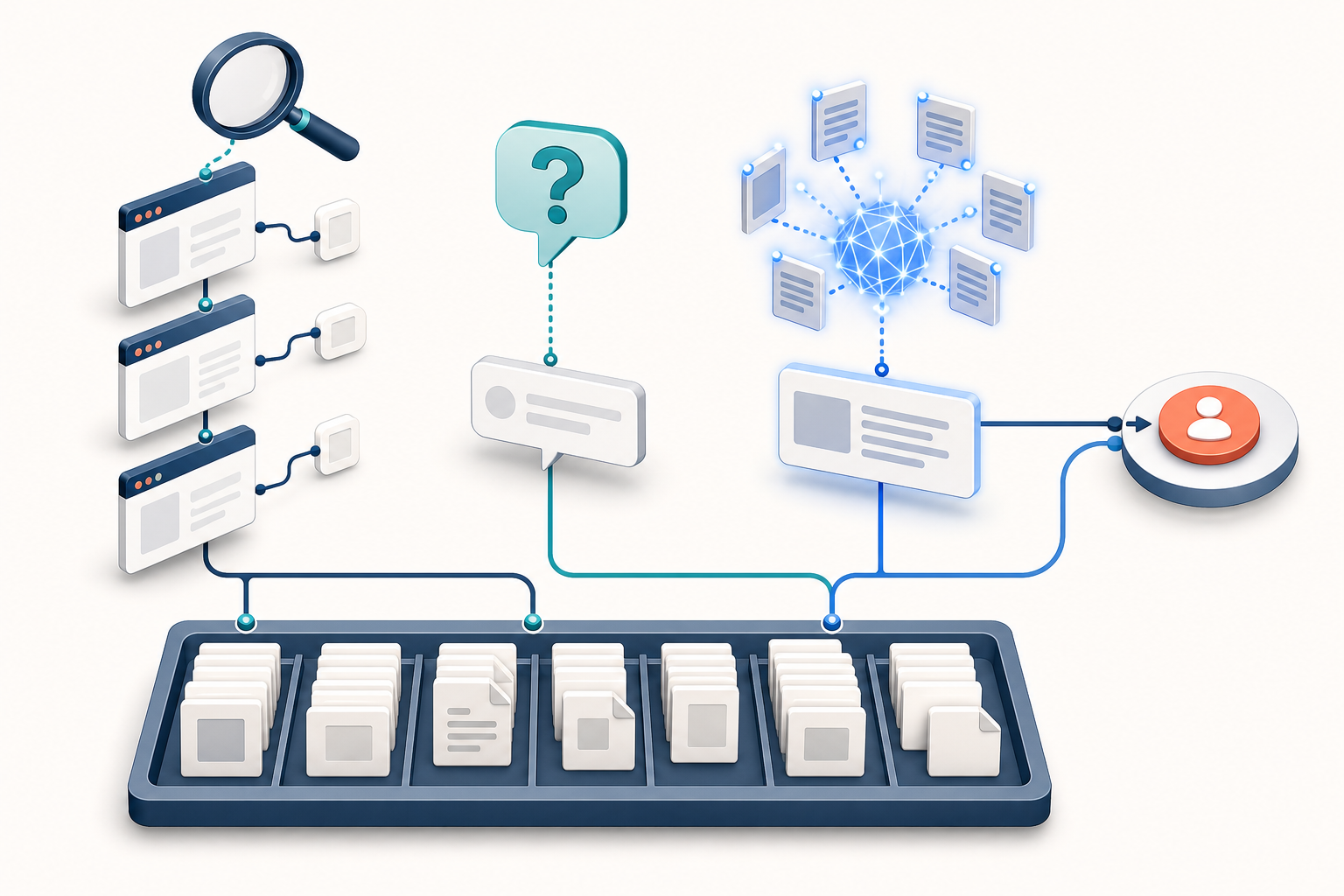
    Three distinct digital discovery workflows—web search, direct answers, and generative synthesis—converge on one customer decision while remaining connected to a shared evidence library.

    SEO, AEO, and GEO overlap, but they are not interchangeable labels. An agency should be able to define the job of each discipline, show its deliverables, and explain where one piece of work serves more than one channel.

    DisciplinePrimary jobEvidence to requestUseful measurement
    SEOHelp relevant pages become discoverable and competitive in conventional search results.Technical diagnosis, query-to-page map, internal-link plan, content briefs, and a method for resolving duplication or intent mismatch.Visibility for relevant queries, qualified organic visits, conversions, and the performance of priority landing pages.
    AEOMake accurate answers easy to locate, understand, extract, and connect to the appropriate entity.Question inventory, answer structure, page-type recommendations, entity definitions, and structured-data specifications where the markup is appropriate.Coverage of important questions, answer accuracy, search-feature visibility, and engagement with the pages that support those answers.
    GEOImprove the likelihood that a brand and its information are represented accurately in generative responses.Prompt-set design, baseline observations, citation and mention analysis, corroboration gaps, entity inconsistencies, and a plan for publishing material worth referencing.Mentions, citations, factual accuracy, coverage across defined prompt groups, and downstream qualified demand where it can be observed.

    The deliverables should connect. A technically sound service page can target a search need, answer a decision-stage question, clarify the entities involved, and provide evidence that an answer system can cite. That does not make the three measurement systems identical. A page may rank without appearing in a generative answer, or be cited in an answer without producing a referral click.

    Be particularly careful with agencies that present JSON-LD as the entire AEO or GEO strategy. Structured data can make supported information more explicit to machines, but markup cannot create evidence that is missing from the visible page. Ask the agency to name the page type, the entity being described, the properties it would mark up, the visible information supporting each property, and the intended consumer of that markup.

    The same standard applies to AI visibility. ChatGPT, Gemini, and Perplexity are not interchangeable reporting rows. The agency should disclose the prompts, platform, date of observation, treatment of citations versus unlinked mentions, and method for judging factual accuracy. A proprietary score without those components is difficult to audit and almost impossible to improve responsibly.

    Audit sector fluency with a real business problem

    Logos tell you that an agency had a contract. They do not tell you what the agency owned, whether the relevant team still works there, or whether the engagement resembles yours. Replace the generic request for industry experience with a working test.

    Give every shortlisted agency the same representative problem. Include one product or service, one priority audience, the real conversion action, and the constraints that normally slow publication. Ask the agency to identify the search intents, direct questions, generative prompts, evidence requirements, page types, entity relationships, and measurements it would use. You are evaluating the reasoning, not asking for a free campaign plan.

    IndustryThe agency must distinguishA revealing evidence requestWhat a superficial answer misses
    HealthcareSpecialty, audience, care setting, service, location, and the difference between educational and decision-stage information.Ask the team to mark which statements require review by your medical or clinical subject-matter owner and how approved language will be preserved during optimization.Treating all healthcare queries as patient-acquisition keywords or assuming experience in one specialty transfers automatically to another.
    Financial servicesConsumer and institutional audiences, product category, risk context, eligibility language, and the people who use versus approve a service.Ask for an annotated brief showing where product, compliance, legal, or investment subject-matter input would be required under your existing governance process.Optimizing high-volume financial terms without accounting for claim sensitivity, qualification, or the actual route to a commercial decision.
    Real estateGeography, property type, transaction role, service area, local entity, and time-sensitive versus durable information.Ask the team to map the relationships among the brand, brokerage or developer, agents or experts, offices, developments, properties, and markets relevant to the assignment.Producing interchangeable city pages or confusing local visibility with a complete GEO and AEO program. Real-estate agency evaluation has treated technical expertise, AI visibility, retention, notable clients, and years in business as distinct signals for this reason.
    SaaSUser, administrator, developer, security reviewer, economic buyer, use case, integration, and category language.Ask for a query and prompt map that separates feature discovery, problem education, implementation, integration, comparison, security review, and purchase intent.Publishing generic category pages while leaving product facts, integration details, comparisons, and technical evaluation questions disconnected. A field containing 47 SaaS-focused GEO and AEO agencies still requires you to verify the individual delivery team.

    Listen for the questions the agency asks before proposing tactics. A capable team will want to know which claims are approved, which experts are available, how product or service data changes, who owns each entity, what counts as a qualified conversion, and where prospects hesitate. A team that jumps straight to article volume has not yet understood the assignment.

    Then verify who will perform the work. Meet the strategist, technical lead, content lead, and reporting owner who would actually join the account. Ask each person to explain part of the same scenario. This exposes whether industry knowledge is shared across the team or concentrated in the pitch.

    Build the decision around auditable evidence and outcomes

    A cross-functional team traces source documents, approval checkpoints, measurement artifacts, and outcome markers during an agency evaluation workshop.

    No single agency metric should decide the hire. Reviews can indicate client satisfaction, while retention can reveal relationship durability. Years in business can show endurance, and leadership experience or employee tenure can indicate whether knowledge remains inside the firm. Notable clients and media references can add context. None of those signals proves that the proposed team can solve your problem.

    The weighting should also reflect the work. One healthcare evaluation placed the most weight on average reviews at 30% and AI visibility at 25%, while a real-estate evaluation assigned 25% to AI visibility and 20% each to reviews and technical expertise. Those are useful reminders that reputation, AI visibility, and execution skill answer different questions. They are not a universal procurement formula.

    Use a pass, conditional, or fail decision for each criterion instead of hiding weak evidence inside one impressive total score:

    • Sector fluency: Pass only if the delivery team can distinguish your audiences, terminology, evidence requirements, entities, and conversion path using your representative problem.
    • Technical competence: Pass only if the agency can connect site architecture, crawl and indexing issues, page intent, internal linking, structured data, and content operations to an ordered plan.
    • GEO method: Pass only if prompts, platforms, observations, citations, mentions, accuracy judgments, and limitations are visible in the methodology.
    • AEO method: Pass only if question selection, answer structure, entity clarity, visible supporting evidence, and appropriate markup are treated as connected work.
    • Commercial measurement: Pass only if the agency can trace priority topics to meaningful actions and explain which indicators are directional rather than attributable revenue.
    • Governance: Pass only if content owners, subject-matter reviewers, approval states, revision handling, and publication permissions are defined.
    • Team continuity: Pass only if you know who will do the work, what each person owns, and how knowledge will be preserved if staffing changes.
    • Evidence quality: Pass only if case studies, references, reviews, or visibility examples resemble your market and identify what the agency actually controlled.

    For every AI visibility claim, ask four practical questions: What was measured? Against which prompt set? Over what recorded observations? How was success connected to an action the team could take? If the agency cannot show the denominator behind a visibility percentage or score, record the claim as unverified rather than treating it as comparable data.

    Require a baseline before accepting an improvement claim. The baseline should preserve the exact query or prompt, platform, observed result, citation or ranking position where applicable, landing page, factual errors, and relevant conversion path. Without that record, a later screenshot can show a favorable result but not demonstrate systematic progress.

    Keep business outcomes beside channel indicators. SEO reporting can include qualified organic conversions and the performance of priority pages. AEO reporting can track coverage and accuracy for important questions. GEO reporting can track mentions, citations, accuracy, and representation across the agreed prompt groups. The agency should explain how these indicators support demand, not quietly relabel every mention as a lead.

    Key takeaways for making the hire

    • An industry-specific agency should change its audience map, query interpretation, evidence requirements, entity model, approval workflow, and conversion strategy for your sector.
    • Require separate definitions, deliverables, and measurements for SEO, AEO, and GEO, even when one page or content asset supports all three.
    • Test candidates with the same representative business problem. Evaluate the reasoning and questions produced by the people who would actually run the account.
    • Treat reviews, retention, tenure, notable clients, leadership experience, AI visibility, and technical expertise as different forms of evidence. No single one proves fit.
    • Reject opaque AI visibility scores. You need the prompt set, platforms, recorded observations, citation rules, accuracy checks, and baseline behind the number.
    • Put definitions, owners, approvals, deliverables, measurement rules, data access, and handoff requirements into the scope before work begins.
    • Do not accept guaranteed placement in generative answers. Hire for a defensible method, accurate representation, useful content, and measurable improvement.

    Open your current shortlist and remove the agency names from the first review. Compare only the proposed team, method, evidence, governance, and measurement plan. Restore the names after you have marked every criterion pass, conditional, or fail. That small change makes it much harder for familiarity, a famous client logo, or an unsupported AI score to make the decision for you.

    References


  • How to Choose a US SEO or Digital Marketing Agency

    How to Choose a US SEO or Digital Marketing Agency

    Your shortlist probably contains a boutique SEO shop, a local-search specialist, a B2B firm, and a full-service digital agency. Their websites may promise similar outcomes, but they are not selling the same operating model.

    The right choice depends less on which agency looks most accomplished and more on where your growth is stuck, what your team can implement, and how you will verify progress. Use the framework below to narrow the US agency landscape, interrogate the evidence, and put an engagement on terms you can manage.

    Key takeaways

    • Define the business bottleneck before searching for an agency. A vague goal such as “increase traffic” produces vague proposals.
    • Choose an agency lane that matches the problem: SEO specialist, local SEO, small-business SEO, B2B SEO, or integrated digital marketing.
    • Evaluate comparable work, measurement definitions, team continuity, and implementation ownership. A review score alone cannot establish fit.
    • Make AI search an explicit scope of work. Require named deliverables, observable measures, and candid limits instead of a generic promise of AI visibility.
    • Protect account access, data, content, structured data, reporting history, and transition support in the contract. You should be able to leave without rebuilding your marketing infrastructure.

    Choose the agency lane that matches your bottleneck

    The US market is not one undifferentiated pool of SEO providers. It includes broad SEO specialists, agencies built around local search and local-pack visibility, firms focused on small-business needs, B2B SEO specialists, and full-service digital marketing agencies. Those labels overlap, but the operating demands behind them are different.

    Start by completing this sentence: “Growth is constrained because…” Name the point where demand, discovery, conversion, or implementation breaks down. Do not begin with a channel merely because that channel is underperforming. Weak organic traffic can come from poor technical access, thin content, weak market positioning, limited authority, or a site that ranks but does not convert. Each cause calls for different work.

    Your primary problemBest initial agency laneEvidence to request
    Important pages are not earning qualified organic discoverySEO specialistA technical diagnosis, a query-to-page plan, an editorial brief, and a clear division between recommendations and implementation
    Customers choose providers by location, but your locations are inconsistently representedLocal SEO specialistA location-level audit covering Google Business Profile, location pages, reviews, listings, and the way local outcomes will be attributed
    Your company has limited internal marketing capacity and cannot support a large production systemSmall-business specialistA prioritized scope that states what the agency will produce, what you must supply, and what will deliberately wait
    Your offer has a long or complex buying process involving several stakeholdersB2B SEO specialistBuyer-role and search-intent mapping, a subject-matter-expert workflow, and reporting that connects content to pipeline signals
    SEO, paid media, content, conversion work, and reporting need one coordinated planFull-service digital marketing agencyA channel-role map, named owners, an attribution approach, and an explanation of how budget and learning move between channels

    A local specialist is not automatically the right choice just because you have an address. The deciding question is whether location materially changes how customers discover and select you. Likewise, a B2B label matters only if the agency can handle complex offers, subject-matter review, non-linear buying journeys, and the gap between an early content interaction and a later commercial outcome.

    Small-business specialization is also about constraints, not company prestige. A workable partner must design around your available people, approval speed, technical access, and production capacity. An ambitious plan that quietly depends on your team writing every draft, fixing every template, and managing every stakeholder is not a small-business plan. It is an outsourced strategy with the implementation returned to you.

    Choose full-service digital marketing when channels genuinely need shared planning and the agency can demonstrate that integration. Buying more services from one supplier is not integration by itself. Ask who decides what each channel is meant to accomplish, how teams share audience learning, and who resolves conflicts when paid and organic teams want different landing-page changes.

    Verify the operating system behind the pitch

    A blank agency presentation sits in a conference room while a delivery team works behind glass on website structure, analytics, content, and project workflows.

    A pitch is written in the future tense. Useful evidence shows how the agency has already diagnosed a comparable problem, made trade-offs, completed the work, and measured the result. Your evaluation should therefore move past brand recognition and into the agency’s day-to-day operating system.

    Read reviews for patterns, not reassurance

    Agency feedback appears across Clutch, G2, UpCity, Sitejabber, Capterra, and Google. No single platform should settle the decision. Review populations, moderation, and commercial incentives can differ, so look for patterns that survive across platforms.

    • Prioritize reviews describing a problem, a scope, and a working relationship similar to yours. Generic praise tells you very little about fit.
    • Notice whether clients name the people who performed the work. Repeated praise for a salesperson does not establish the quality of the delivery team.
    • Look for evidence about communication after onboarding, when senior sales staff may no longer be involved.
    • Read critical feedback for recurring failure modes such as missed handoffs, unexplained reporting, slow implementation, or frequent team changes.
    • Inspect the agency’s responses to criticism. A specific, accountable response is more informative than a defensive dismissal or a stock apology.

    Reviews are a screening signal, not a substitute for diligence. They rarely reveal the client’s baseline, internal execution, market conditions, or the exact work that produced an outcome.

    Inspect continuity and decision ownership

    Median employee tenure and founder involvement in daily operations can help you assess continuity. Neither is proof of quality. Long tenure can indicate accumulated client knowledge, while direct founder involvement can improve strategic access. It can also reveal a bottleneck if every important decision depends on one person.

    Ask to meet the people who would actually own strategy, account management, content, technical work, and reporting. Then ask:

    • Which responsibilities belong to named employees, contractors, or partner firms?
    • Who can approve a change in priorities without escalating it through sales leadership?
    • What happens to context, documentation, and deadlines if the account lead changes?
    • How much of the proposed work depends on access to your developers, executives, sales team, or subject-matter experts?
    • Who is responsible for implementation when an audit identifies a technical or content problem?

    The final question prevents a common mismatch. Some agencies diagnose and advise. Others also write, design, publish, configure, test, and coordinate releases. Both models can work, but only if the responsibility boundary is explicit before the engagement starts.

    Audit case evidence before accepting the headline

    A percentage increase without a baseline, measurement window, or definition of the metric is incomplete evidence. For every relevant example, ask the agency to explain:

    • The client’s starting condition and the commercial problem being solved
    • The work the agency performed, separated from work completed by the client or another supplier
    • The period over which the change occurred
    • Whether the result refers to rankings, impressions, clicks, qualified leads, pipeline, sales, or another outcome
    • Which external factors or parallel campaigns may have affected the result
    • What failed, changed, or took longer than expected

    That last question matters. An agency that can discuss a failed assumption and the resulting adjustment is showing you how it thinks. One that presents every engagement as a smooth upward line is giving you a sales narrative, not an operating record.

    Define AI search work in deliverables, not slogans

    A marketing team moves source materials and structured content components through a staged workflow toward several unbranded digital answer interfaces.

    AI optimization has become part of agency selection, but the phrase can conceal very different services. Some firms mean improved content structure. Others mean schema, entity work, digital PR, prompt monitoring, AI referral analysis, or large-scale content generation. If a proposal merely adds “GEO” or “AEO” to an existing SEO package, you still do not know what you are buying.

    Require the agency to separate the work into inspectable layers:

    • Content: pages that answer the audience’s real questions directly, define important entities consistently, expose useful comparisons, and make claims easy to verify
    • Technical foundations: crawlable pages, intentional canonicalization, stable internal linking, and structured data that agrees with the visible page
    • Authority: a plan for earning credible mentions and references rather than manufacturing unsupported claims of expertise
    • Measurement: documented prompts or query themes, named AI systems, observation dates, referral data where available, citation or mention checks, and conventional search and conversion metrics
    • Governance: ownership, factual review, update triggers, and a process for correcting content when products, policies, or market facts change

    Schema deserves particular scrutiny. Structured data can make page meaning more explicit, but markup should describe what a user can actually see and verify. Ask which schema types are being proposed, why each property applies, where the underlying fact appears on the page, and how the markup will be tested and maintained. Treat any claim that schema alone will create authority or guarantee AI inclusion as a warning sign.

    AI visibility also needs a measurement definition. If an agency reports one proprietary score, ask to see the systems, prompts, sampling method, dates, weighting, and raw observations behind it. The score may still be useful, but only after you understand what changed when the number moved.

    Use these questions to separate a real AI-search practice from a renamed content package:

    • Which deliverables are different from your standard SEO work?
    • Which AI systems will you observe, and why are they relevant to our buyers?
    • How will you distinguish an AI citation, a brand mention, referral traffic, and a conventional organic visit?
    • What can your team influence, and what will you explicitly refuse to guarantee?
    • How do you prevent generated content from publishing unsupported facts, stale details, or near-duplicate pages?
    • How will AI-search findings change our editorial, technical, authority, or conversion priorities?

    We would reject guaranteed placement in AI answers, undisclosed bulk content production, schema that invents facts not present on the page, and reporting that cannot be traced back to observable inputs. Those are control problems as much as marketing problems.

    Run a selection process that exposes trade-offs

    The best way to compare agencies is to give each one the same bounded problem. Otherwise, you are comparing different assumptions, different scopes, and different definitions of success.

    1. Write a concise brief covering the commercial goal, audience, geography, offer, current bottleneck, relevant systems, available internal support, and constraints.
    2. Screen for the matching agency lane before requesting a proposal. Remove firms whose operating model depends on resources you do not have.
    3. Hold the same working session with every finalist. Use one real page, query cluster, local-search problem, or reporting question so you can compare how each team reasons.
    4. Request a written scope that names priorities, deliverables, owners, dependencies, approval requirements, measurement definitions, and exclusions.
    5. Speak with a relevant client reference and ask about the period after onboarding: team continuity, missed expectations, implementation friction, reporting clarity, and the way disagreements were handled.

    Do not demand an entire strategy as unpaid speculative work. A bounded diagnostic is enough to reveal whether the team asks useful questions, distinguishes symptoms from causes, and can explain what it would defer. If deeper access or analysis is necessary, a paid discovery phase can produce a cleaner decision while respecting the work involved.

    Compare the real resource model

    The retainer is only one part of the cost. Your operating comparison should include agency fees, required tools or media, internal review time, development work, content contributions, implementation effort, and likely rework. A lower fee can be the more expensive option when the proposal transfers production and coordination back to your team.

    Ask each finalist to show a responsibility map. Every recurring activity should have an owner, an approver, required inputs, and a destination. Pay particular attention to technical fixes and content publishing, because recommendations often stall between the person who identifies a change and the person authorized to release it.

    Protect ownership and the exit before signing

    A marketing engagement can create financial and operational exposure if critical assets sit in agency-controlled accounts. Have the contract state who owns and can access:

    • Analytics, advertising, search-platform, tag-management, and business-profile accounts
    • Domains, hosting, content-management access, repositories, and deployment credentials
    • Content drafts, briefs, templates, designs, structured data, research files, and reporting history
    • Audience lists, conversion definitions, dashboards, custom configurations, and documentation
    • Work created by contractors, affiliates, or other third parties engaged by the agency

    Your organization should hold the primary account wherever practical and grant the agency appropriate access. Shared credentials obscure accountability and make revocation harder; named user access is safer and easier to audit.

    The agreement should also cover team substitutions, approval delays, scope changes, data handling, use of generated content, reporting cadence, termination, final exports, credential removal, and transition support. If the relationship ends, you need editable assets and enough documentation for another team to continue the work. A folder of PDFs is not a complete handoff when the underlying accounts, configurations, prompts, templates, or source files remain elsewhere.

    Before you book another pitch, write your bottleneck in one sentence and choose the corresponding agency lane. Send every candidate the same evidence questions. The stronger partner will make its assumptions, responsibilities, limits, and trade-offs visible before asking you to commit.

    References


  • What the CrushPress Founders’ San Francisco Move Means

    What the CrushPress Founders’ San Francisco Move Means

    If you saw that CrushPress’s founders were heading to San Francisco, the obvious question is whether New York is being left behind. That is not the right reading of the move. San Francisco is being added as a second home, while New York remains central to how the company began.

    The useful question is what a second city can change. For customers, partners, candidates, and AI-search practitioners, the answer depends less on the address than on whether greater proximity to the AI community produces clearer insights, better decisions, and more useful work.

    The important word is second

    CrushPress’s New York connection is not incidental. The founders first crossed paths at South Park Commons in New York City, and they expected the venture they built together to remain rooted there. New York’s pace, ambition, and grit matched the kind of company they wanted to create.

    Calling San Francisco a second home therefore signals addition, not erasure. It preserves the founding relationship with New York while opening another place from which the founders can build relationships and learn.

    That distinction prevents a common misreading. A founder presence in a city does not automatically establish a new headquarters, a customer-facing office, a full-team relocation, or a change to contracts and support. Those are separate operational facts. If you work with CrushPress, do not infer them from the move alone; rely on direct communication about anything that affects your account.

    At the same time, founder geography is not meaningless. It changes which conversations happen frequently, which problems are heard early, and which relationships can develop without every interaction requiring a planned trip. The opportunity is real, but it still has to travel from the room into the work.

    Why San Francisco can sharpen an AI-search company

    AI practitioners gather around laptops and notebooks in a sunlit San Francisco workspace while abstract network shapes are projected nearby.

    AI search sits at the intersection of models, search interfaces, content systems, measurement, and brand strategy. The field changes through many small shifts: a new answer format, a different citation pattern, an emerging workflow, or a change in how marketing teams evaluate visibility. Written updates reveal the finished change. Direct conversations can reveal the unresolved problem behind it.

    A San Francisco base can compress that learning loop. Proximity makes it easier to encounter model builders, technical operators, marketers, founders, investors, and prospective hires in overlapping communities. A question heard in one meeting can be tested in the next. A repeated complaint can be separated from a one-off preference before it influences a roadmap or editorial position.

    But proximity is an input, not an outcome. Being near an active AI community does not automatically improve a product, an optimization method, or a customer’s visibility. The move becomes strategically useful only when the resulting access passes through a disciplined sequence:

    1. Listen for repeated problems. A memorable conversation is not necessarily a market signal. The same need should appear across different roles and companies before it drives a major decision.
    2. Separate platform change from user confusion. Sometimes a model or interface has changed. In other cases, users have not yet adapted their workflow. Those situations require different responses.
    3. Turn learning into a concrete decision. Useful proximity should affect a product priority, measurement approach, technical recommendation, explanation, or partnership.
    4. Make the insight portable. Customers and readers outside San Francisco should benefit through documentation, content, tools, or clearer guidance.
    5. Check the result. The final test is whether the decision solved a real problem, not whether the original conversation sounded important.

    This is the standard worth applying to any company’s move into an industry hub. Access has value when knowledge moves outward. If the insight remains inside private dinners and event rooms, the location may strengthen a network without strengthening the work.

    A two-city company needs one clear entity story

    For anyone responsible for SEO, AEO, GEO, structured data, or digital PR, the move also illustrates a less glamorous problem: location language can create entity ambiguity. People, search engines, and language models may encounter company facts across an About page, founder biographies, job listings, interviews, directories, social profiles, press coverage, and JSON-LD. If those surfaces use location terms carelessly, they can describe different companies without meaning to.

    Keep these concepts separate:

    • Origin: where the founders met or where the company took shape.
    • Founder presence: where one or more founders spend time and participate in a community.
    • Office: an actual operational location used by the company.
    • Headquarters: the primary location the company formally identifies as its central base.
    • Service area: the markets or customers the company serves, which may have little relationship to founder residence.

    A second home can describe founder presence and community connection without settling the other four facts. Treating those terms as interchangeable creates avoidable contradictions.

    If your own company is adding a city, use a simple publishing process:

    1. Write one canonical sentence that distinguishes the company’s roots from the new presence.
    2. Use that distinction consistently on the About page, founder biographies, media materials, recruiting pages, and major social profiles.
    3. Audit address-related structured data. Do not encode a narrative connection to a city as a postal address, office, or headquarters unless that underlying fact is true.
    4. Link secondary announcements and biographies to one canonical page that explains the relationship between the locations.
    5. Review important third-party profiles for stale or overstated wording after the change becomes public.

    For CrushPress, the clean narrative is already available: New York is the founding root, and San Francisco is a second home. Future operational details can be added when they are established. That is more accurate than forcing the move into the familiar but potentially false story of one headquarters replacing another.

    Judge the move by what crosses the bridge between cities

    Anonymous teams carry glowing geometric objects in both directions across a bridge connecting an East Coast district and a hilly West Coast district.

    You do not need to guess whether the move will work. Watch the outputs that should follow if the new proximity is creating value.

    • More specific insight: Look for clearer explanations of how AI discovery, citations, brand representation, and measurement are changing. Generic enthusiasm about AI is not evidence of learning.
    • Visible transfer: Useful ideas should reach customers and readers who are not in San Francisco. Documentation, technical guidance, product decisions, and public analysis are stronger signals than event attendance.
    • Stronger collaboration: Partnerships should solve recognizable user problems or expand access to relevant expertise. A list of logos without an explained benefit says little.
    • Continuity in New York: A second home should add capacity without making the company’s original community feel like discarded history.
    • Factual consistency: Company pages, founder profiles, structured data, and third-party descriptions should agree about what each city represents.

    If you are a customer, keep your due diligence practical. Ask whether your point of contact, support process, contracting entity, billing, or data handling has changed. A founder’s location does not answer any of those questions. If you are considering a role or partnership, ask where the work happens, how often travel is expected, and where decisions are made. Those answers matter more than the broad label attached to the move.

    Key takeaways

    • San Francisco is being positioned as a second home for CrushPress, not as a replacement for its New York roots.
    • The strategic opportunity is a shorter feedback loop with people building and using AI, but location alone does not produce better outcomes.
    • The move creates value when local conversations become concrete decisions and portable knowledge.
    • A two-city narrative requires precise language across biographies, company pages, media materials, and structured data.
    • Customers should act on formal operational changes, not assumptions created by a city name.

    For now, watch what CrushPress carries from San Francisco back into its products, methods, and public guidance. That transfer – not the move by itself – will show whether the second home is becoming a strategic advantage.

    References